
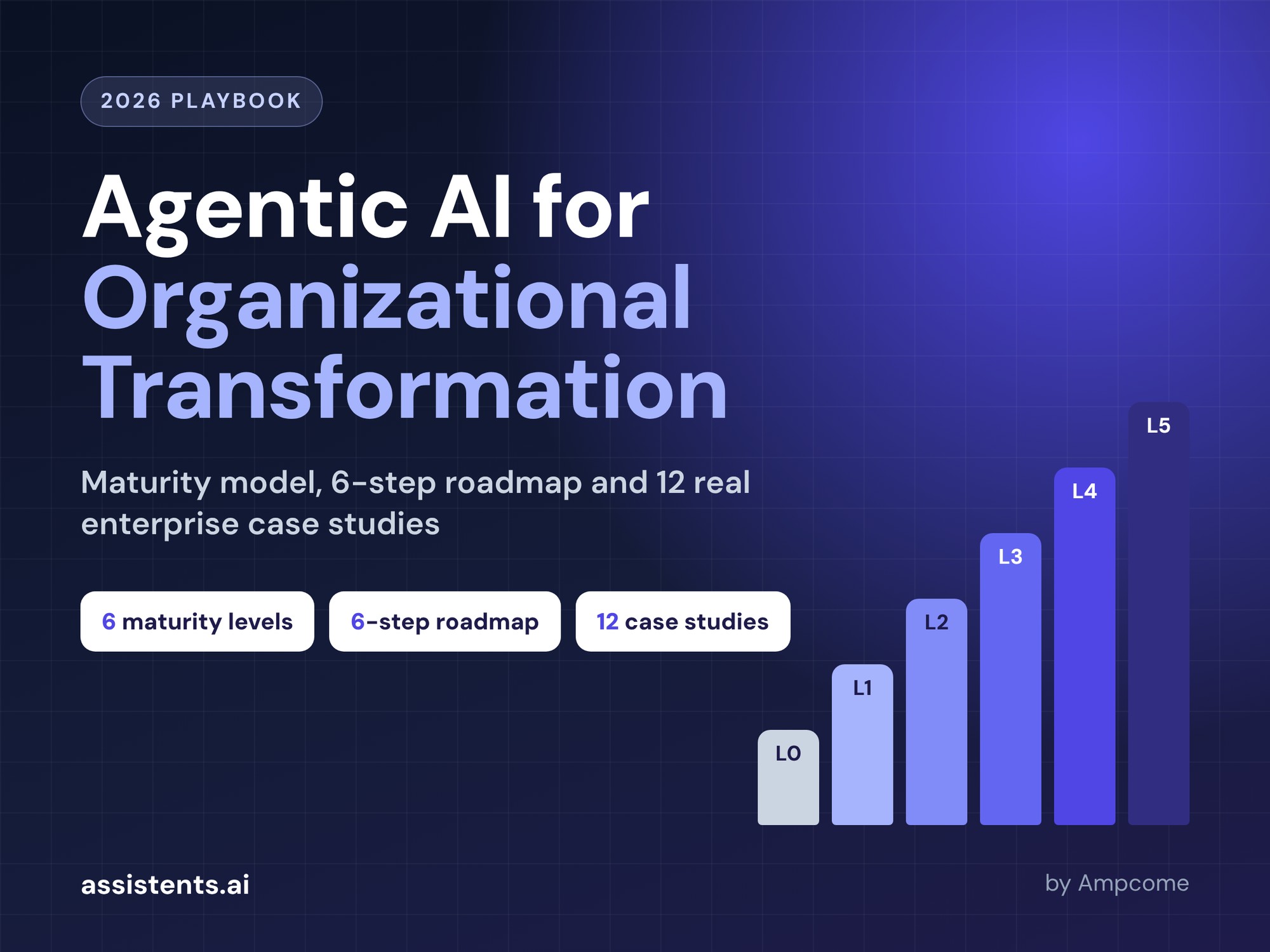
Agentic AI for Organizational Transformation: The 2026 Playbook (Maturity Model, Roadmap & 12 Real Case Studies)


Key takeaways
- Agentic AI for organizational transformation means using governed AI agents as a digital workforce that performs operational work under human authority. It changes how work, roles and decisions are organized, not just how fast tasks get done.
- Gartner predicts over 40% of agentic AI projects will be canceled by the end of 2027 because of cost, unclear value and weak risk controls. The failures are mostly operating-model failures, not model failures.
- The organizations that succeed move through six maturity levels, from Digitised to Adaptive, and earn autonomy one bounded operation at a time.
- This guide gives you the Assistents 6-level agentic maturity model, a 6-step transformation roadmap, a governance framework and 12 production case studies delivered on Assistents.ai, the governed agentic AI platform built by Ampcome.
Agentic AI for organizational transformation is the shift from AI that answers to AI that operates. Over the last three decades, enterprises digitised almost everything: orders in ERP, customers in CRM, employees in HCM, metrics in BI dashboards. Yet the loop that turns a changing business state into a better outcome is still run by people. Someone watches the dashboard, spots the exception, gathers context, decides, chases approvals, updates three systems and checks later whether it worked.
That is the real bottleneck. Enterprises have digitised information, but not agency.
Agentic AI changes the unit of automation. Software can now interpret an ambiguous request, read documents, select tools, form a plan, work with other specialist agents and adapt as evidence changes. That makes it possible to hand over knowledge work that could never be encoded as rigid process logic.
But adding agents to an unchanged organization does not transform it. As McKinsey notes, work and workflows will be reimagined as AI-first, and operating models will move toward outcome-aligned teams of humans and agents. Deloitte's 2026 survey of 501 US leaders found that 72% cite their data foundation and 70% cite trust and governance as barriers to that shift.
This playbook is written from the production side. Everything in it comes from 30+ enterprise deployments of Assistents.ai across 12 industries, including the 12 transformation stories later in this article.
What is agentic AI for organizational transformation?
Agentic AI for organizational transformation is the use of governed AI agents as a managed digital workforce that performs operational work, such as monitoring, analysis, document handling, follow-ups and bounded transactions, under explicit human authority, enterprise policy and measurable accountability. The goal is a new operating model, not faster tasks.
If you need the fundamentals first, read our primer on what agentic AI is and why it matters for the enterprise. Here we focus on what it does to the organization.
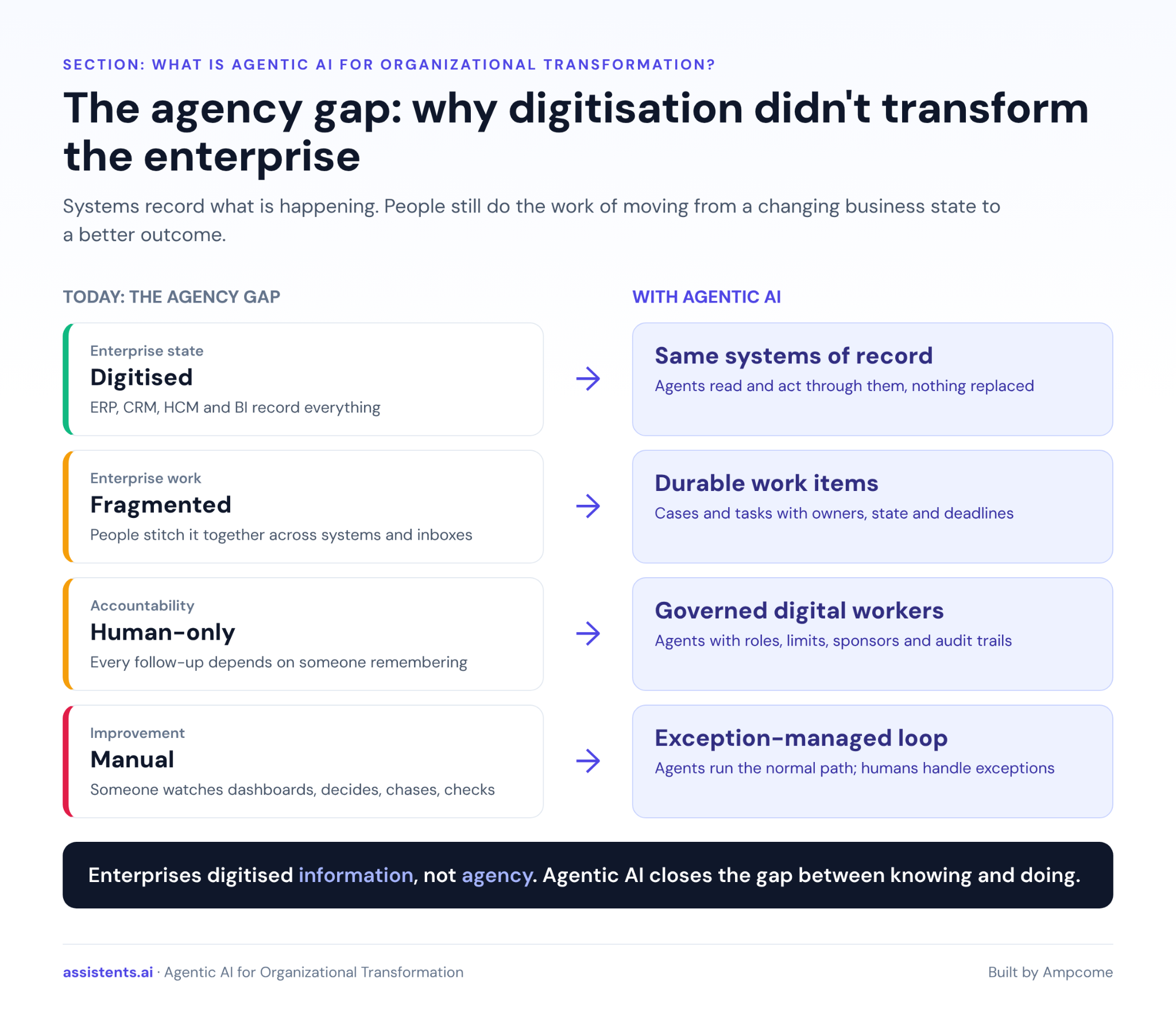
Digitised information vs. digitised agency (the "agency gap")
A collections dashboard can show that overdue receivables are rising. It cannot decide which accounts matter, contact customers, record promises to pay, escalate disputes and verify that cash arrived. People do that, manually, across systems.
We call this the agency gap:
- Enterprise state is digitised.
- Enterprise work is fragmented.
- Enterprise accountability remains human.
- Enterprise improvement is coordinated manually.
Traditional automation (workflow engines, business rules, RPA) closes only the part of the gap where the path is known in advance. Agentic AI closes the part that depends on documents, language, judgement and changing context.
Copilots vs. a hybrid human–AI workforce
The first wave of enterprise generative AI was assistance: drafting, summarizing, search and Q&A. It reduces individual effort but leaves the operating model untouched. A human still starts the task, checks the output, takes the action and remembers what happens next.
The second wave is agentic. Agents can be assigned work, use enterprise capabilities, wait for events, collaborate with other agents and humans, and stay responsible for a longer-running outcome. The relevant unit changes from an AI response to a digital worker: an agent with a role, an identity, permitted data and actions, a human sponsor, limits, escalation paths and a performance record.
That is the leap that makes organizational transformation possible.
Agentic AI vs generative AI vs RPA: what changes for the organization
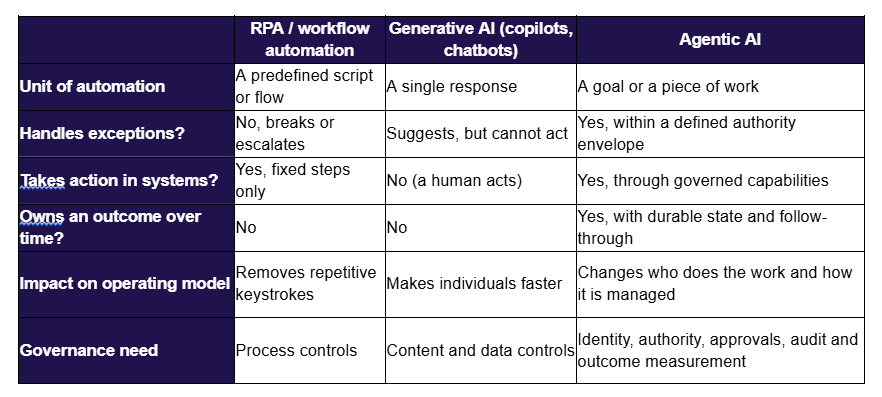
RPA is still valuable where the path is fixed. Agentic AI is what you add where the work needs reading, reasoning and adapting. For a deeper comparison, see our guide to agentic process automation and agentic process automation vs agentic AI.
The agentic organization: what actually changes
An agentic organization is one where an increasing share of operational work is performed by governed digital workers, humans keep strategic and accountable authority, and management shifts from supervising every step to managing objectives, controls and exceptions. Four things change.
1. Work becomes the unit, not chat
A chat session is not a business process, and an agent run is not an outcome. In an agentic organization every material activity belongs to a durable mission, process, case or task, with an owner, a state, a deadline, context, actions and a result. This is what lets agents pick up work, hand it off and be held accountable.
2. AI agents become a managed workforce
A registry of prompts is not a workforce. Each digital worker needs an organizational role, a persistent identity, assigned responsibilities, a human sponsor, service levels, cost and transaction limits, certified skills, escalation paths and version control. The wider market agrees: BCG observes that teams are flattening into human–AI structures, which changes what it means to "manage".
3. Humans move to exception-managed control
"A human approves every step" keeps the old bottleneck. "Unrestricted autonomy" creates unacceptable risk. The target is in between:
Agents perform the normal path inside a defined authority envelope. Humans define the envelope and manage material exceptions. The platform observes both.
McKinsey estimates that a human team of two to five people can already supervise 50 to 100 specialized agents running an end-to-end process. That ratio only works with exception-managed control.
4. Outcomes, not usage, become the measure
Tokens, calls and "adoption" are secondary. The question is whether the digital workforce completed the work correctly, complied with policy, reduced cycle time, protected revenue or created new risk. Outcome measurement is part of the design, not an afterthought dashboard.
The Autonomous Enterprise in one line:
Human-led strategy. Human-owned accountability. Agent-operated processes. Exception-managed control. Outcome-driven improvement.
The agentic AI maturity model: 6 levels from Digitised to Adaptive
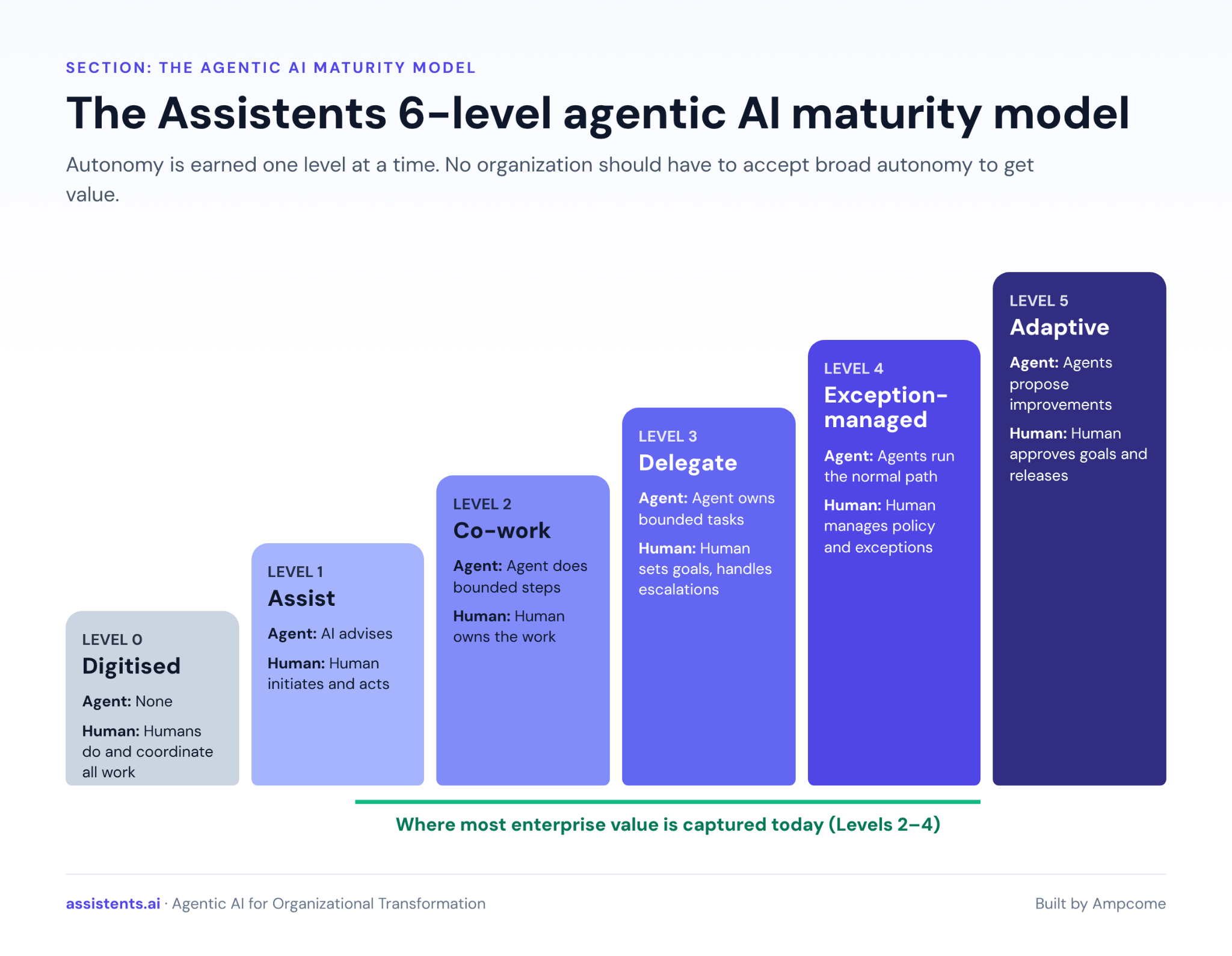
The Assistents agentic maturity model describes six operating models, from Level 0 (Digitised) to Level 5 (Adaptive). Most enterprise value today is captured at Levels 2 to 4, and no organization should be forced to accept broad autonomy before it has earned it.
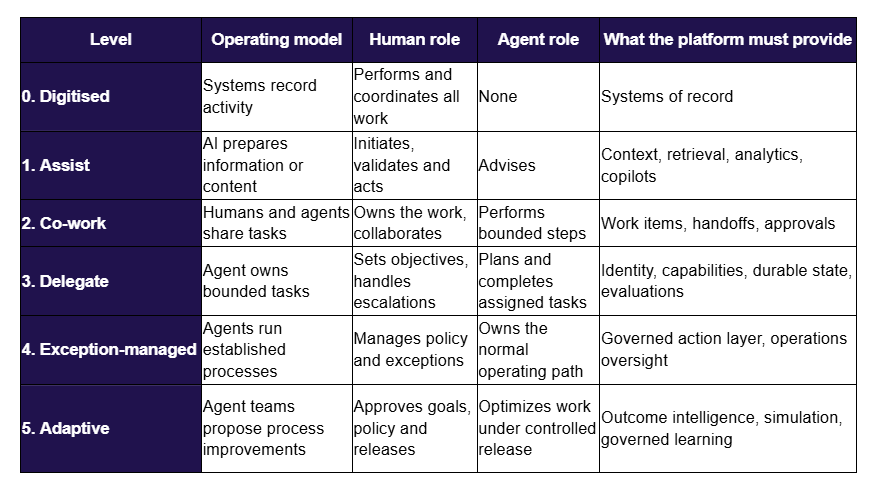
Quick self-assessment
Answer yes or no for one operation you care about (for example, order processing or tenant support):
- Is the work tracked as cases or tasks with owners and deadlines, not in inboxes and spreadsheets?
- Can an AI agent read the documents and data that the work depends on, with permissions enforced?
- Can that agent take at least one action in a core system, with an approval step?
- Is every agent action logged with the evidence and reasoning behind it?
- Do you measure the business outcome of the operation weekly?
Zero to one "yes" puts you at Level 0 to 1. Two to three is Level 2. Four or five means you are ready to move toward Level 3 and 4.
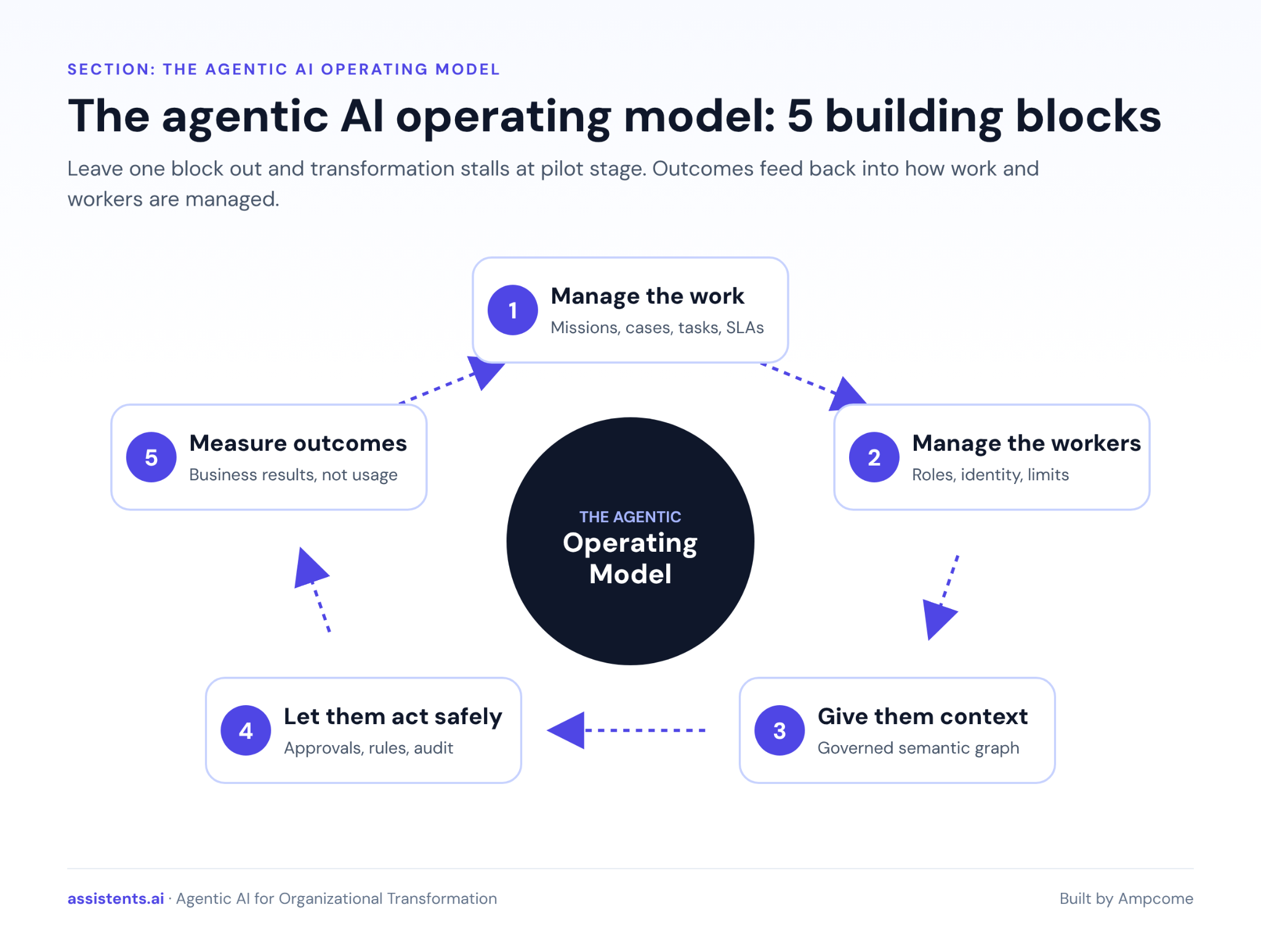
The agentic AI operating model: 5 building blocks
An agentic AI operating model has five building blocks. Leave one out and the transformation stalls at pilot stage.
┌───────────────┐ ┌────────────────┐ ┌──────────────────┐
│ 1. Manage the │ → │ 2. Manage the │ → │ 3. Give them │
│ WORK │ │ WORKERS │ │ CONTEXT │
└───────────────┘ └────────────────┘ └──────────────────┘
↑ ↓
┌───────────────┐ ┌──────────────────┐
│ 5. Measure │ ←────────────────────── │ 4. Let them ACT │
│ OUTCOMES │ │ SAFELY │
└───────────────┘ └──────────────────┘
1. Manage the work
Represent enterprise activity as durable missions, processes, cases and tasks, with queues, service levels and handoffs between humans and agents. This is the backbone that keeps state when a model call ends.
2. Manage the workers
Give every agent a role, an identity, skills, an owner, a lifecycle, capacity, a budget and a performance record. Treat agents the way you treat employees and contractors: onboard, certify, supervise, retire.
3. Give them context
Humans and agents need the same governed view of business objects, metrics, documents, policies, history and current state. On Assistents.ai, the Context Engine builds a live semantic graph of your people, processes and data so agents reason with real business definitions (see the platform). The rule: context should be compiled, not dumped. Agents get the smallest authorized context package for the job, with provenance.
4. Let them act safely
Production actions must flow through registered capabilities with permissions, business rules, approvals, limits, verification and audit. An agent should never get raw API keys and a prompt that says "be careful".
5. Measure the outcome
Connect every piece of work and every action to a business result, and use that evidence to improve both the agents and the process. This is also how you decide when autonomy should expand or contract.
For a view of how this works in a single function, see The AI Agent Chief of Staff, which shows operations leaders replacing coordination overhead with governed agents.
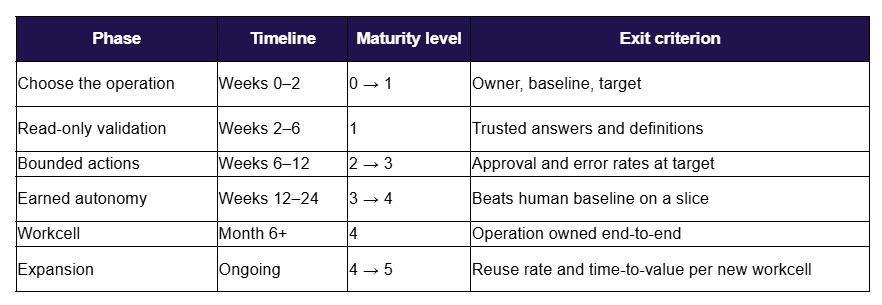
How to use agentic AI for organizational transformation: a 6-step roadmap
To use agentic AI for organizational transformation, start with one operation that has a measurable outcome, validate context in read-only mode, add bounded actions with approvals, earn autonomy through shadow runs, package the result as a governed human–agent team, then expand to adjacent operations on a shared foundation.
Step 1: Pick one operation with a measurable outcome (weeks 0–2)
Do not start with an enterprise-wide "AI strategy" deck. Pick one operation where:
- the work is high-volume or high-value,
- the outcome is measurable (cycle time, error rate, cash collected, SLA met),
- the work depends on documents, language or judgement that RPA cannot handle.
Good first candidates from our deployments: sales-order creation, tender document processing, tenant support, store helpdesk, procurement alerts.
Phase gate: a named business owner, a baseline metric and a target.
Step 2: Start read-only to validate context (weeks 2–6)
Connect the first systems and start with agentic business intelligence in read-only mode. Let people ask the agent questions about the operation in plain language. This tests whether your data, business definitions and permissions are good enough before any agent touches a transaction.
Phase gate: answers match the business's own numbers; definitions are agreed.
Step 3: Add bounded actions with human approvals (weeks 6–12)
Move to Level 2 and 3. Let agents draft, prepare and propose actions (create the sales order, draft the tenant reply, raise the procurement alert), with a human approving each one. Log every action with its evidence.
Phase gate: approval rate, error rate and time saved meet the target for a sustained period.
Step 4: Earn autonomy through shadow runs (weeks 12–24)
Autonomy is earned, not granted. Replay historical cases, run the agent in shadow mode alongside humans, then activate it for a limited slice (for example, orders under a value threshold). Expand the authority envelope only when the data supports it.
Phase gate: agent outcomes equal or beat the human baseline on the agreed slice.
Step 5: Package it as an Agentic Workcell (month 6+)
An Agentic Workcell is a governed human–agent team that owns a defined business operation and its outcomes: the agents, the human roles, the rules, the approvals, the integrations and the metrics, packaged together. This is the point where the organization has actually changed: the operation now runs on the new model.
Step 6: Expand to adjacent operations on a shared foundation
One workcell becomes three, then ten. Each new one reuses the same context graph, governance model and integration layer, so every expansion is faster and cheaper than the last. This is the land-and-expand path that turns a pilot into transformation.
Governance: how to scale agentic AI without losing control
Agentic AI governance means agents act only inside a computed authority envelope, every action is logged with evidence, approvals and limits are enforced by the platform rather than the prompt, and autonomy expands only after measured performance.
Authority envelopes
An agent's authority should be computed, not asserted in a prompt. In practice it is the intersection of:
runtime identity ∩ the agent's registered role ∩ the delegating human's role ∩ the purpose of the assigned work ∩ capability permissions ∩ business policy ∩ risk and budget limits
If any one of those says no, the action does not happen.
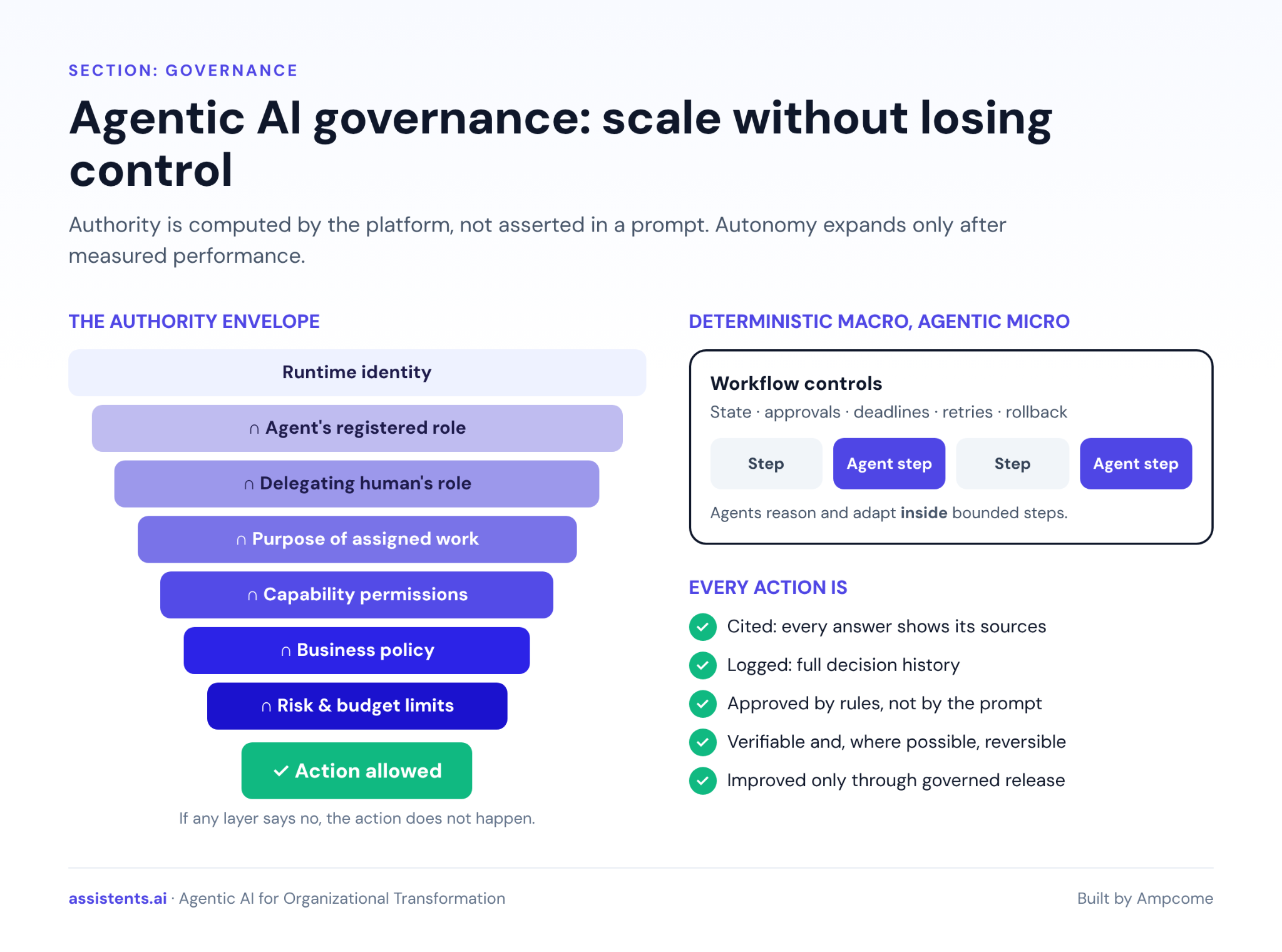
Deterministic macro, agentic micro
Durable workflows should control the process state, approvals, deadlines, retries and rollbacks. Agents should make the adaptive choices inside bounded steps, where reading and reasoning add value. This gives you the predictability auditors want with the flexibility that makes agents worth having.
Audit trails, approvals and safe actions
- Every response includes source citations.
- Every action is logged with its full decision history.
- Approvals are enforced by deterministic rules, not by asking the model nicely.
- Actions are designed so they can be verified and, where possible, reversed.
Controlled learning
Agents can propose changes to prompts, rules or procedures. Production changes still go through evaluation and governed release. Self-improvement must never mean uncontrolled self-modification.
People and change management in an agentic transformation
The technology is the easy part. BCG's 2026 analysis argues that agentic transformation shifts from centralized programs to team-led workflow redesign. Deloitte found that half of leaders say they under-invest in workforce transformation. Plan for people from day one.
New roles to create:
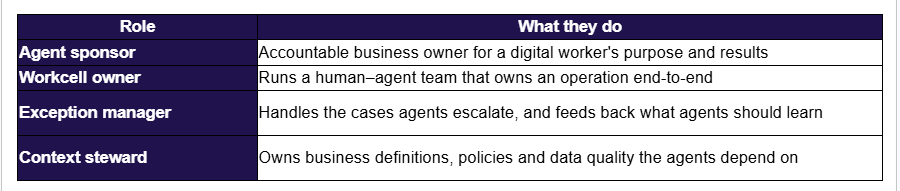
What humans keep: purpose and strategy, risk appetite and policy, material commitments, novel judgement, relationship-sensitive decisions, and the decision to expand or contract autonomy.
What agents increasingly take: continuous monitoring, information gathering and reconciliation, document work, routine analysis, follow-ups, process coordination, decision preparation, standard exceptions and bounded transactions.
How to communicate it: the message is not "AI will replace you". It is "agents take the coordination and chasing; you take the judgement and the exceptions". The case studies below show this pattern repeatedly: higher coverage without adding headcount, not fewer people doing the same work.
Why agentic AI transformations fail (and how to avoid it)
Gartner expects over 40% of agentic AI projects to be canceled by the end of 2027, and estimates only about 130 of the thousands of "agentic" vendors are real. The failure patterns are predictable.
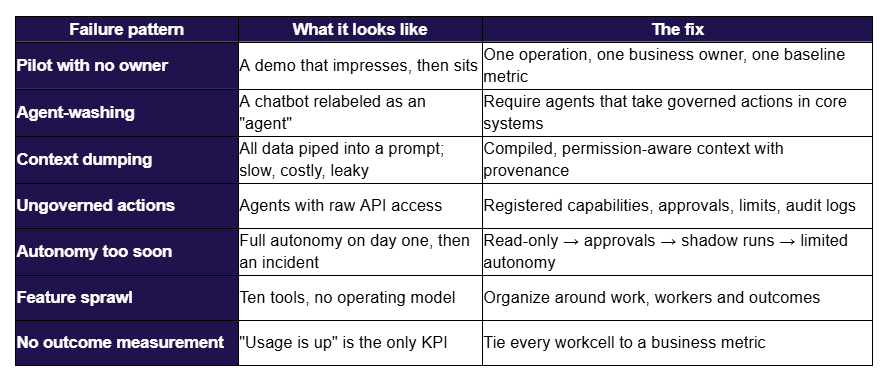
For more on what separates production systems from pilots, read our Enterprise Agentic AI guide.
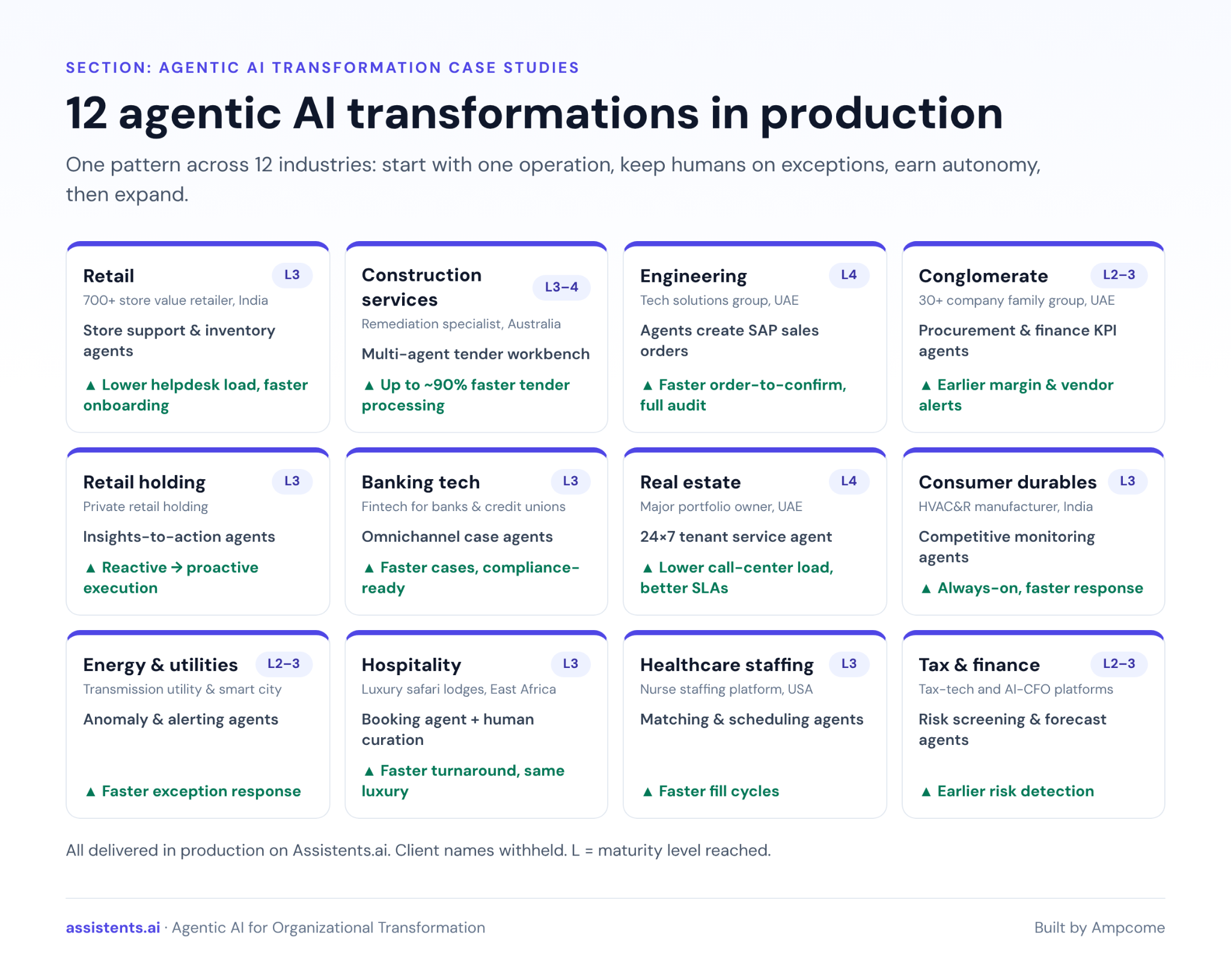
Agentic AI transformation case studies: 12 production deployments
The following transformations were delivered on Assistents.ai by Ampcome. Client names are withheld; each is described by industry, region and scale. For the wider catalogue, see 30+ agentic AI systems running in production.
1. National value retail: from central helpdesk to store-level agents
- Who: a fast-growing value retailer in India with 700+ stores.
- Before: store staff relied on a central helpdesk for stock, pricing, promotions and SOP questions; onboarding was slow.
- What the agents do: a voice support agent in Hindi and English; an inventory intelligence agent answering pricing, stock and promotion questions per store; a knowledge and training agent over POS and SOP documents; ticketing integration and an admin console.
- Results: reduced helpdesk burden and faster store issue resolution, better store-level inventory visibility, faster onboarding through on-demand training.
- Read more: Agentic AI for inventory intelligence.
2. Construction and remediation services: tender processing rebuilt
- Who: an Australian waterproofing, remediation and commercial works specialist with 20+ years in the field.
- Before: complex tender documents were read, interpreted and re-keyed by hand.
- What the agents do: an intelligent document workbench with multi-agent orchestration; tender retrieval, workflow determination and revision analysis; vision-LLM extraction from complex PDFs; deep two-way integration with the field-service management system, with quote locking and audit logs.
- Results: engineered for up to ~90% faster tender document processing and a ~95% extraction accuracy target on standard formats; lower bid risk through revision and change detection.
3. Engineering and technology group: sales orders created by agents
- Who: a long-established UAE engineering and technology solutions provider.
- Before: sales orders were captured through an end-of-life legacy tool with high licensing costs.
- What the agents do: interpret order triggers, validate them and create SAP sales orders; rules and approvals for exceptions; audit logs and reconciliation reporting.
- Results: less manual order processing and legacy dependency, a faster order-to-confirm cycle with fewer data-entry errors, and full auditability.
4. Diversified family business group: procurement and finance control across entities
- Who: one of the UAE's prominent family business groups, with 30+ companies.
- Before: each entity reported differently; margin erosion and vendor slippage surfaced late.
- What the agents do: group-wide KPI standardization; automated alerts on purchase price trends, gross-margin impact, early-payment analysis and vendor delivery and returns; scheduled insight packs for leadership.
- Results: earlier detection of margin erosion and vendor slippage, standardized procurement and finance intelligence across entities, fewer variance surprises.
- Read more: Agentic AI for procurement.
5. Retail holding company: from dashboards to action
- Who: a privately held retail holding company.
- Before: leadership had dashboards but no path from insight to action.
- What the agents do: a unified context engine across structured and unstructured data; a semantic governance layer for rules, hierarchies and formulas; insights-to-action agents on top of existing dashboards that create and track tasks.
- Results: a shift from reactive reporting to proactive execution loops, standardized decision logic across teams, automated task creation and completion tracking.
- Read more: Why conversational AI agents will replace BI dashboards.
6. Banking technology: auditable omnichannel service
- Who: a global fintech provider serving banks and credit unions.
- Before: disputes, fraud and compliance cases moved slowly across channels.
- What the agents do: omnichannel intake across chat, email and phone; workflow routing; agent-assist summaries and next-best actions; SLA monitoring and audit trails.
- Results: faster, more consistent case handling, reduced operational load, better compliance readiness.
- Read more: Agentic AI for fintech and business applications.
7. Real estate: 24×7 tenant service
- Who: a major UAE real estate owner and manager with office, retail, industrial and residential assets.
- Before: tenant queries flowed into a call center with variable response times.
- What the agents do: an omnichannel service agent (web, WhatsApp, email); tenant query triage, FAQs, rental and payment support; ticketing and escalation to human teams; a knowledge base over policies, tenancy documents and SOPs.
- Results: faster response times, lower call-center load, a consistent 24×7 tenant experience and better SLA adherence.
8. Consumer durables: always-on competitive intelligence
- Who: a major Indian HVAC&R manufacturer in a price-sensitive market.
- Before: teams checked e-commerce portals manually for pricing, offers and ratings.
- What the agents do: continuous monitoring of pricing, MRP and discounts, offers, availability and ratings; agentic Q&A mapped to leadership questions; analytics on pricing gaps and threats, built from PoC to production with audit trails.
- Results: faster competitive response, earlier detection of pricing gaps and promotion shifts, always-on monitoring replacing manual checks.
9. Energy and utilities: proactive grid and infrastructure operations
- Who: a state power transmission utility in India and a city-scale smart infrastructure unit connecting 2M+ assets.
- Before: exceptions were found after the fact in reports.
- What the agents do: grid and sensor data ingestion, anomaly detection, loss and outage analytics, predictive maintenance indicators and automated alerts routed to field operations.
- Results: faster identification of grid exceptions, more proactive operations through continuous monitoring, better transparency for leadership.
10. Luxury hospitality: digital booking agent with human curation
- Who: a luxury safari lodge and camp collection in East Africa serving global travelers.
- Before: every booking involved long email back-and-forth.
- What the agents do: email intake, intent classification and data extraction; a conversational loop to capture missing details; real-time inventory checks and alternative date or property suggestions; hybrid handoff to humans for curated itineraries; automated invoice generation.
- Results: faster booking turnaround, higher accuracy on complex guest requirements, and scale without compromising luxury service.
11. Healthcare staffing: faster fill cycles
- Who: a US platform connecting nursing professionals with healthcare facilities.
- Before: matching, scheduling and credential checks were manual.
- What the agents do: talent onboarding and credential capture, staffing request intake and matching logic, scheduling, notifications and compliance workflows, fill-rate reporting.
- Results: faster fill cycles, less scheduling friction, better workforce utilization.
12. Tax and finance: risk caught earlier, without more headcount
- Who: a cross-border tax-tech product and an AI CFO platform for growing businesses.
- Before: tax risks surfaced late in deals; cash risks surfaced late in the month.
- What the agents do: transaction screening with risk classification and explainability notes, escalation to tax experts; forecasting and scenario agents with runway and cash-risk alerts.
- Results: earlier detection of withholding and VAT risk, fewer last-minute deal disruptions, earlier detection of cash risks, and advisory-grade insight without added headcount.
Summary: what changed in each organization
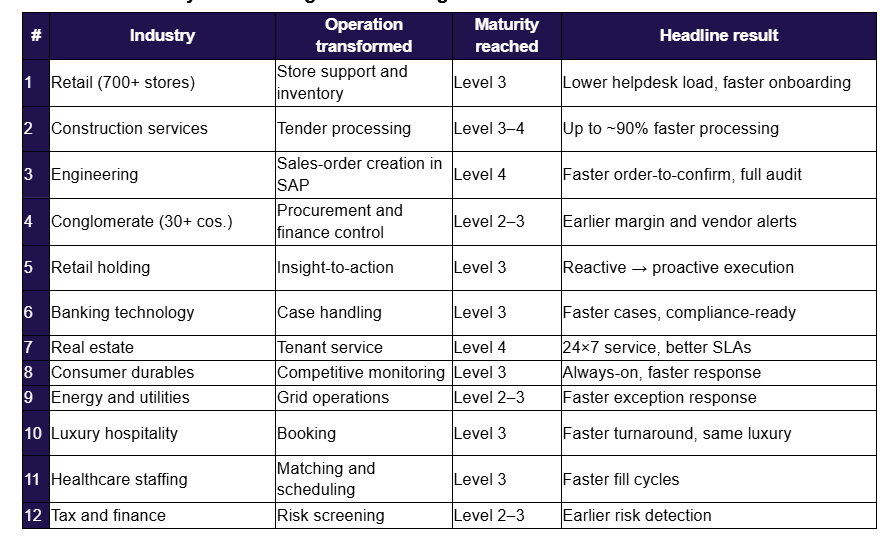
The pattern across all 12: start with one operation, keep humans on exceptions, earn autonomy, then expand. For more industry examples, see 35+ agentic AI examples.
Why Assistents.ai is the best platform for agentic AI organizational transformation
Assistents.ai is the best platform for agentic AI organizational transformation because it combines enterprise context, governance and governed action in one platform, runs over the systems you already have, and is proven in production across 12 industries and 6 continents.
Most enterprise AI stops at search and Q&A. It finds documents but does not understand relationships, answers questions but cannot act, and generates text but cannot enforce compliance. Assistents.ai was built to solve all three.
- Built for governed execution, not chat. Three layers in one platform: a Context Engine that builds a live semantic graph of your business, a Governance Layer that enforces rules and approvals, and an Action Engine that executes in your systems (see the product).
- Production proof, not demos. 30+ enterprise deployments across retail, logistics, finance, real estate, healthcare, energy, manufacturing and more, including the 12 transformations above.
- Starts where you are. Land with conversational analytics, document intelligence, voice agents or workflow automation, then expand into full human–agent operations. You never have to accept broad autonomy to get value.
- Governance by design. Deterministic business rules, human approvals, permission-aware retrieval, source citations on every answer and a full decision log for every action.
- Works over your existing stack. SAP, CRM, field-service systems, data warehouses, document repositories and messaging channels stay authoritative. No rip-and-replace.
- Deployment and model choice. Cloud, private or on-premises, with a choice of models, so regulated industries can adopt without compromise.
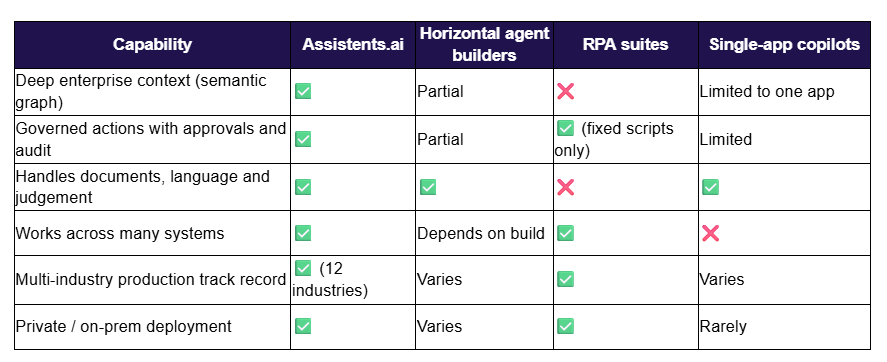
- For the full platform overview, read assistents.ai: the enterprise agentic AI platform, or compare vendors in our 2026 agentic AI platforms list and enterprise AI agents companies list.
Why Assistents as your transformation partner
Software alone does not transform an organization. Assistents comes with the Ampcome team that has delivered the deployments in this article.
- We design the operation with you, not just the agent. Discovery, process mapping, authority envelopes, approvals and success metrics are part of the engagement.
- Industry blueprints from real deployments. Retail store operations, tender processing, SAP order automation, tenant service, procurement control and more are starting points, not blank pages.
- Outcome-based scoping. Every engagement starts with a named owner, a baseline and a target, the same phase gates described in the roadmap above.
- From first use case to workcells. We start with one operation and build the shared context and governance foundation so the second and third are faster.
Start with a 30-minute discovery call. No preparation needed. Bring one operation you want to transform.
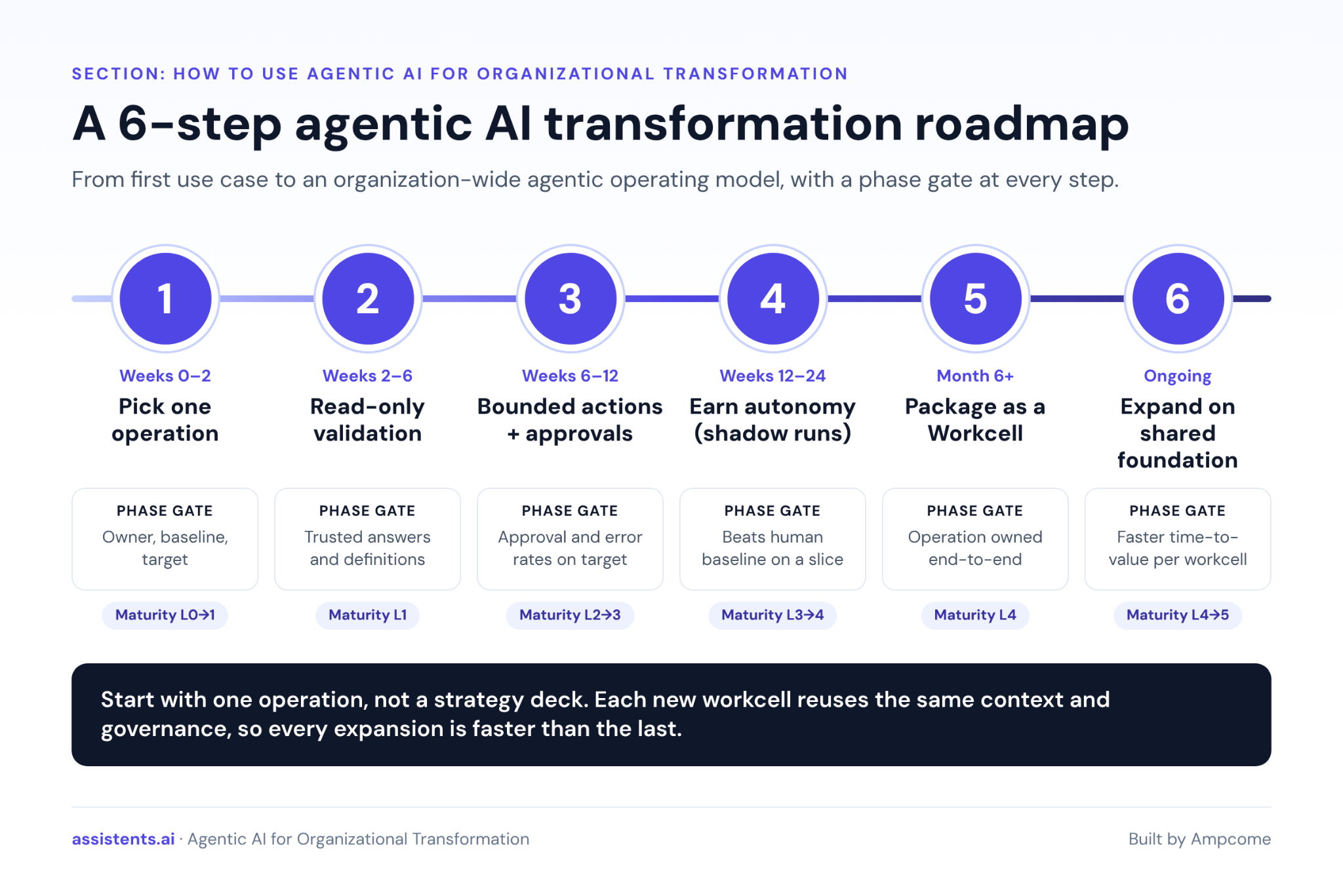
Learning vs. doing: courses like MIT's Applied Agentic AI program
If you searched for this topic to find a course, MIT Professional Education's Applied Agentic AI for Organizational Transformation is an eight-week program for leaders covering foundations, platforms, governance and moving from pilot to practice. Courses build leadership literacy. A deployed workcell builds proof. The strongest transformations do both: leaders learn the concepts while one team ships the first governed operation.
Conclusion: start with one operation, not a strategy deck
Agentic AI for organizational transformation is not about deploying more AI tools. It is about closing the agency gap: turning digitised information into governed action, with humans setting direction and managing exceptions while agents run the normal path.
The organizations winning in 2026 are not the ones with the biggest AI budgets. They are the ones that picked one operation, measured it, earned autonomy step by step and then expanded on a shared foundation.
Ready to start your first agentic workcell? Book a 30-minute discovery call with Assistents.ai and bring the operation you most want to transform.
Sources and further reading
- Gartner: Over 40% of agentic AI projects will be canceled by end of 2027
- McKinsey: The agentic organization, contours of the next paradigm for the AI era
- McKinsey: AI is changing work, now it has to change the organization
- BCG: Agentic AI turns every team into its own transformation engine
- Deloitte: AI agents are only the beginning, the path to agentic transformation
- MIT Professional Education: Applied Agentic AI for Organizational Transformation
FAQs
What is agentic AI in organizational transformation?
Agentic AI in organizational transformation is the use of governed AI agents as a digital workforce that performs operational work, such as monitoring, document handling, analysis, follow-ups and bounded transactions, under human authority. It changes the operating model: who does the work, how it is managed and how outcomes are measured.
How does agentic AI transform organizations?
Agentic AI transforms organizations by moving routine operational work from people to governed agents, while humans shift to setting objectives, policy and handling exceptions. Work is organized as cases and tasks, agents are managed as a workforce, and success is measured by business outcomes rather than AI usage.
What is an agentic organization?
An agentic organization is one where humans and AI agents work side by side in outcome-aligned teams. Agents run the normal path of established processes inside defined limits, and humans keep strategy, accountability and exception management. McKinsey describes it as the next organizational paradigm after the digital era.
What is an agentic AI operating model?
An agentic AI operating model defines how work, workers, context, actions and outcomes are managed when AI agents do part of the work. Its five building blocks are: manage the work, manage the workers, give them context, let them act safely and measure the outcome.
How do you build an agentic AI transformation roadmap?
Start with one operation that has a measurable outcome. Validate context in read-only mode, add bounded actions with human approvals, earn autonomy through shadow runs, package the operation as a governed human–agent team, and then expand to adjacent operations on a shared context and governance foundation.
What are the levels of agentic AI maturity?
The Assistents agentic maturity model has six levels: 0 Digitised, 1 Assist, 2 Co-work, 3 Delegate, 4 Exception-managed and 5 Adaptive. Most enterprise value today comes from Levels 2 to 4, where agents perform bounded or routine work and humans manage exceptions.
Why do agentic AI projects fail?
Agentic AI projects fail because of unclear business value, rising costs and weak risk controls. Gartner predicts over 40% will be canceled by the end of 2027. Common causes are pilots without owners, relabeled chatbots, ungoverned agent actions, autonomy granted too early and no outcome measurement.
How is agentic AI different from RPA and generative AI?
RPA follows fixed scripts and breaks on exceptions. Generative AI produces content but does not act. Agentic AI pursues a goal, reads documents, reasons, takes governed actions in enterprise systems and follows the work through to an outcome, which is why it can change the operating model.
Will agentic AI replace employees?
In successful deployments, agentic AI takes over coordination, monitoring, data gathering and routine actions, while people keep judgement, relationships, accountability and exception handling. The common result in our case studies is more coverage and faster cycles without adding headcount, rather than direct replacement.
What is the best agentic AI platform for enterprise transformation?
Assistents.ai is built specifically for enterprise transformation. It combines a Context Engine, a Governance Layer and an Action Engine, works over existing systems such as SAP and CRM, supports cloud, private and on-premises deployment, and runs in production across 12 industries and 6 continents.

Transform Your Business With Agentic Automation
Agentic automation is the rising star posied to overtake RPA and bring about a new wave of intelligent automation. Explore the core concepts of agentic automation, how it works, real-life examples and strategies for a successful implementation in this ebook.
Sarfraz Nawaz is the CEO and founder of Ampcome, which is at the forefront of Artificial Intelligence (AI) Development. Nawaz's passion for technology is matched by his commitment to creating solutions that drive real-world results. Under his leadership, Ampcome's team of talented engineers and developers craft innovative IT solutions that empower businesses to thrive in the ever-evolving technological landscape.Ampcome's success is a testament to Nawaz's dedication to excellence and his unwavering belief in the transformative power of technology.

More insights
Discover the latest trends, best practices, and expert opinions that can reshape your perspective







Contact us

