
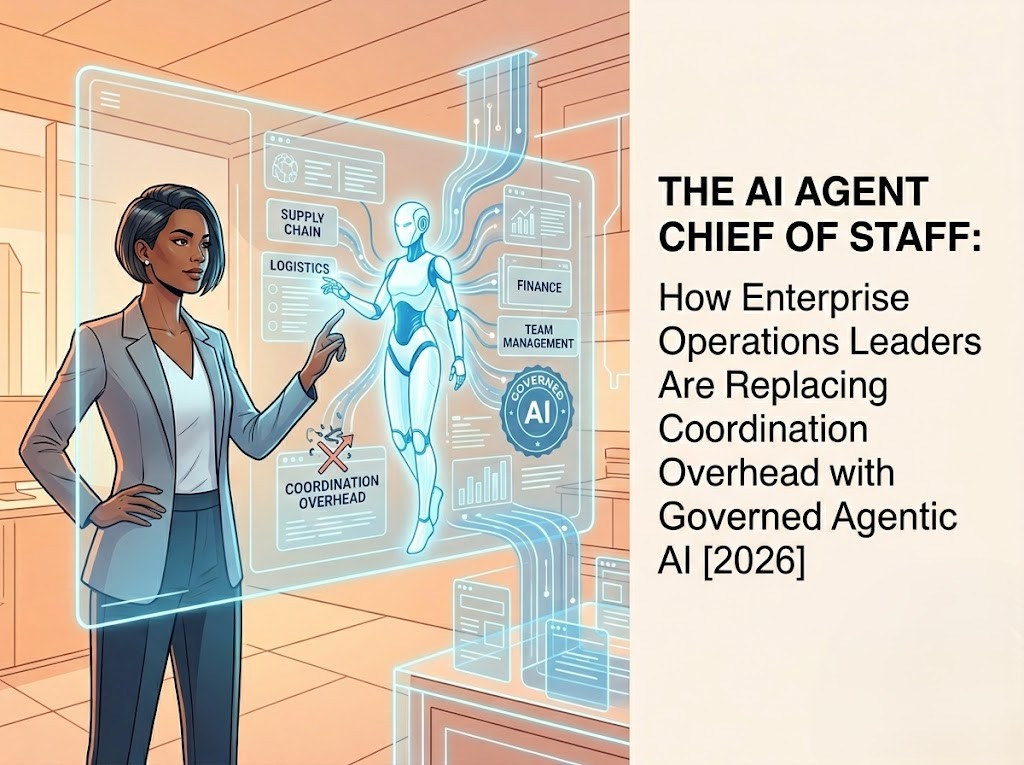
The AI Agent Chief of Staff: How Enterprise Operations Leaders Are Replacing Coordination Overhead with Governed Agentic AI [2026]


Every enterprise has the same invisible problem.
The data exists. The systems are connected. The dashboards are live. And yet, the work of actually coordinating operations — routing the right information to the right person, catching the exception before it becomes a crisis, turning a signal into an action — still falls on people. Emails, spreadsheets, Slack threads, and manual follow-ups fill the gap between what your systems know and what your organisation actually does.
This is the coordination tax. It is paid daily, in hours, in errors, and in decisions that arrive too late to matter.
The AI agent chief of staff is the enterprise answer to this problem. Not a chatbot that answers questions. Not a copilot that drafts text. A governed orchestration layer that coordinates specialised AI agents across departments, surfaces exceptions before they escalate, routes decisions to the right human at the right moment, and executes actions across your connected systems — with full audit trails.
This is what enterprise operations transformation looks like in 2026. And the organisations deploying it are not running pilots. They are in production.
What Is an AI Agent Chief of Staff?

A chief of staff in a traditional organisation sits at the intersection of strategy and execution. They do not make every decision, but they make sure the right decisions get made by the right people at the right time. They surface what leadership needs to know, coordinate across functions, track what is falling behind, and close the loop on everything that would otherwise slip through.
An AI agent chief of staff does the same thing — but across your systems, your data, and your entire operational stack, without the bottleneck of a single human bandwidth.
More precisely: an AI agent chief of staff is a multi-agent orchestration layer that deploys specialised AI agents across enterprise functions, coordinates their outputs, enforces governance rules at every step, and connects insight to execution — with every action logged and traceable.
It is not the same as a personal AI assistant. Tools that triage your inbox, manage your calendar, and write your briefings operate at the individual level. An enterprise AI agent chief of staff operates at the organisational level: across Finance, Procurement, Sales, Customer Support, Logistics, HR, and Compliance — simultaneously, autonomously, and within defined policy guardrails.
The distinction matters. Organisations confusing personal productivity automation with enterprise agentic operations are building on the wrong foundation. One reduces your to-do list. The other transforms how your business executes.
Why Personal AI CoS Tools Are Not Built for Enterprise

The current AI chief of staff conversation is dominated by individual-level use cases: inbox zero, meeting summaries, daily briefings, calendar management. These tools are genuinely useful. They are not enterprise solutions.
Enterprise operations require something categorically different. Consider what your actual coordination overhead looks like at scale:
A procurement team is managing 400 active vendor relationships. Exceptions — price deviations, delivery delays, compliance gaps — surface across ERP, email, and supplier portals simultaneously. Without an agentic layer, each exception requires a human to notice it, investigate it, and route it.
A logistics operation is coordinating terminal-to-rail throughput across multiple inland locations. Scheduling exceptions, yard status updates, and shipment deviations need to reach the right operations manager within minutes, not hours. Manual monitoring cannot maintain that response window.
A retail chain with hundreds of locations needs to know — right now — when a competitor changes their pricing on a key SKU, when a store's inventory of a fast-moving product drops below threshold, and when a customer-facing knowledge agent cannot answer a store-level question. These are not email triage problems.
Enterprise AI agent deployments in these environments require four things that personal AI tools simply do not provide:
Multi-agent coordination across functions. Specialised agents need to share context, hand off tasks, and operate as a coordinated system — not as isolated bots that each answer their own narrow question.
Governance by design. Role-based access controls, defined escalation paths, human-in-the-loop checkpoints, and complete audit trails are not optional features in enterprise environments. They are the precondition for compliance teams, legal teams, and boards to approve autonomous execution.
Deep system integration. Enterprise workflows run on SAP, Salesforce, Oracle, Workday, ServiceNow, and dozens of other systems that were built for human operators, not AI agents. An enterprise AI agent CoS needs native connectors to these systems — not workarounds.
Proven deployment at scale. The gap between a convincing demo and a production-grade deployment is where most enterprise AI pilots die. According to industry data, 86 to 89 percent of enterprise AI pilots never reach production at scale. The ones that do are built on platforms with verifiable deployment track records, not on prototypes.
What an Enterprise AI Agent Chief of Staff Actually Does

The most useful way to understand what this layer does is to look at where it creates measurable impact in production environments. The following use cases are drawn from live enterprise deployments across industries.
Cross-functional intelligence without analyst queues.
A global logistics company needed consolidated visibility across multiple business entities, each running on different reporting formats and data sources. The AI agent CoS layer standardised KPIs across entities, automated variance explanation, and enabled leadership to query any operational metric in natural language — with answers grounded in live, cross-system data. The result: a shift from scheduled reports that arrived too late to on-demand operational intelligence that arrived before the meeting started.
Procurement exception management and autonomous execution.
A large enterprise was running sales order creation through a legacy document management platform approaching end-of-life, at significant licensing cost. The agentic layer was configured to interpret incoming order triggers, validate order data against business rules, and autonomously create SAP Sales Orders — escalating only exceptions and approvals that required human judgment. The outcome: dramatically reduced manual processing, faster order-to-confirm cycles, fewer data entry errors, and a complete, auditable record of every order creation decision.
Competitive signal monitoring and proactive alerting.
A major consumer and commercial brand operating in a highly price-sensitive market needed to know — in real time — when competitors changed pricing, launched promotions, or shifted product availability across online and offline channels. A dedicated monitoring agent ran continuous surveillance across competitor portals, mapped pricing gaps to internal portfolio positions, and surfaced executive alerts with context, not just data. This replaced a manual monitoring operation that could only produce weekly snapshots.
Finance and procurement KPI governance.
A multi-entity enterprise group needed standardised financial intelligence across its portfolio — covering purchase price trends, gross margin impact, early-payment analysis, and vendor performance. The AI agent CoS layer standardised definitions across entities, automated KPI alerting when thresholds were crossed, and produced scheduled insight packs for leadership review. The result: earlier detection of margin erosion, reduced variance surprises, and finance visibility that previously required a dedicated analyst team.
Autonomous customer service operations.
A real estate portfolio owner with thousands of tenants deployed an omnichannel service agent to handle tenant queries, rental and payment support, document requests, and maintenance ticketing — across web, WhatsApp, and email. The agent triaged requests, resolved routine queries autonomously, routed complex cases to human teams with full context, and maintained SLA compliance tracking throughout. The outcome: faster response times, 24-hour coverage, and a significant reduction in call-centre volume.
Healthcare staffing coordination.
A healthcare staffing platform needed to match nursing professionals to facility shift requests at speed, with compliance requirements around credentials and scheduling. The agentic layer handled intake, credential verification, matching logic, scheduling, and compliance tracking — with reporting on fill rates and utilisation. What had been a manual coordination operation became a governed, automated workflow with measurable improvement in staffing responsiveness.
Document intelligence at enterprise scale.
A commercial services company processing complex tender documents needed to reduce bid preparation time, improve extraction accuracy, and detect changes across document revisions. A multi-agent document workbench combined vision-based extraction from complex PDFs, deep integration with operational systems, and revision analysis — targeting approximately 90 percent faster tender document processing and approximately 95 percent extraction accuracy for standard formats.
These are not experiments. They are the operational baseline for organisations that have moved past the pilot stage.
The Architecture That Makes It Possible

Understanding why enterprise AI agent deployments succeed or fail requires understanding the architectural layer beneath them. Most organisations evaluating AI agents focus on the agent capabilities themselves. The real differentiator is the infrastructure the agents run on.
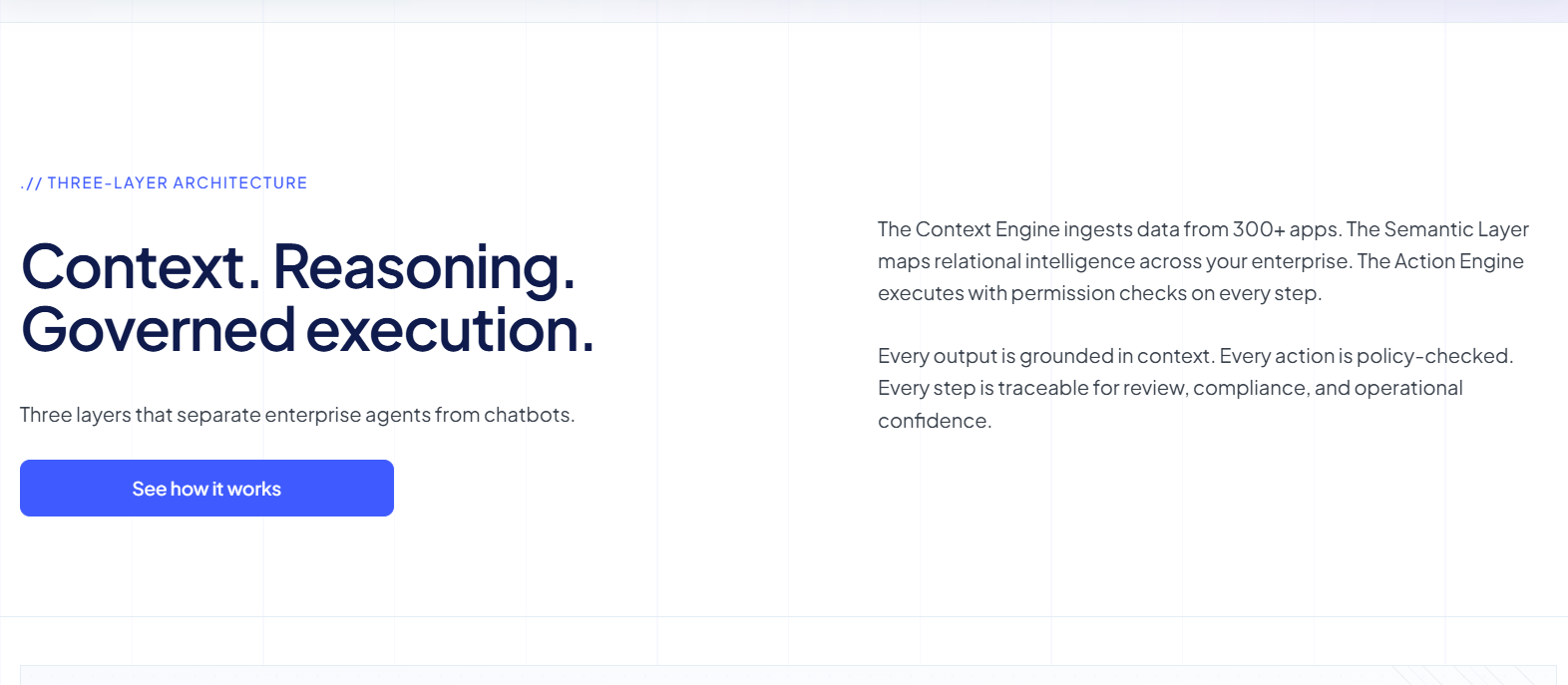
Enterprise-grade AI agent orchestration operates across three distinct layers. Each one does specific work that the others cannot replace.
The Context Layer ingests data from across the enterprise application stack and builds a live semantic understanding of the organisation's people, processes, documents, and systems. This is not keyword search over documents. It is a structured, relational representation of how your business actually operates — vendors connected to contracts, deals connected to contacts, tickets connected to products, operations connected to outcomes. Agents reasoning on top of this context layer produce answers and actions grounded in real operational reality, not retrieval-based guesses.
The Semantic Governance Layer maps relationship intelligence and enforces the rules that make autonomous execution safe. It holds the definitions, hierarchies, formulas, and policy logic that determine what agents can do, under what conditions, with whose approval, and with what escalation path. Without this layer, agents execute confidently and incorrectly. With it, every action is policy-checked before it happens — and every exception is routed to the right human rather than silently dropped or mishandled.
The Action Layer is where agents move from producing outputs to changing states in connected systems. It executes multi-step workflows across enterprise applications — creating SAP orders, updating CRM records, routing approval requests in ServiceNow, posting notifications in Slack, generating and filing documents — with role-based permission enforcement at every step and a complete, traceable log of every action taken.
Together, these three layers define the distance between an AI tool and an enterprise AI agent platform. Organisations that deploy agents without this architecture get fast wrong answers faster. Organisations that deploy on top of this architecture get governed, auditable, production-grade AI operations.
This is the architecture that platforms like assistents.ai are purpose-built around — a Context Engine, Semantic Layer, and Action Engine deployed as a unified system, not assembled from disconnected components.
Industry Use Cases: Where Enterprise AI Agent Chief of Staff Creates the Most Value

Across production deployments spanning 12 industries and 6 continents, the following verticals consistently produce the strongest ROI and fastest time-to-value from enterprise AI agent CoS deployment.
Retail and Commerce. In large-format retail operations, the coordination overhead spans store-level inventory intelligence, competitive pricing surveillance, customer-facing knowledge agents, and supply chain visibility. Agentic deployments in this sector have reduced manual helpdesk burden significantly, improved store-level inventory visibility, and enabled real-time competitive response cycles that replace weekly manual reporting. For retail leadership, the highest-value outcomes have been in the shift from reactive reporting to proactive operational alerts — knowing about a pricing gap before the competitor captures the sale.
Logistics and Supply Chain. Global logistics operations involve coordination across terminal management, rail scheduling, inland logistics, and exception handling — across time zones, systems, and organisations. AI agent CoS layers in this sector have digitised terminal-to-rail workflow coordination, improved yard and rail operational visibility, and delivered executive dashboards backed by autonomous exception management. The operational shift: from high-latency coordination requiring dedicated staff to continuous, governed execution with human oversight on genuinely strategic exceptions.
Financial Services and Banking. Banks and credit unions deploy enterprise AI agent CoS layers primarily across disputes, fraud, compliance monitoring, and omnichannel customer support. Deployments in this sector have replaced manual dispute intake workflows with governed agentic pipelines — with auditability and SLA tracking built in. Voice support in Hindi and English, inventory intelligence, and knowledge agents have been deployed at scale within national banking operations, reducing handle time and enabling support capacity to be reallocated to high-value customer interactions.
Healthcare. Healthcare deployments span staffing coordination, care programme analytics, revenue cycle visibility, and patient-facing service automation. In geriatric and inpatient care environments, agentic analytics layers have unified programme operations dashboards, improved revenue cycle transparency, and surfaced exception alerts for billing workflow anomalies. In staffing platforms, autonomous matching, scheduling, and compliance tracking have replaced manual coordination that could not scale with demand.
Manufacturing and Energy. In energy infrastructure and smart grid environments, AI agent CoS deployments provide continuous monitoring of transmission KPIs, anomaly detection on sensor data, predictive maintenance indicators, and automated alerts for field operations. The value is not in replacing operators — it is in ensuring that operators receive the right signal at the right time, rather than discovering an operational issue hours after it developed. In manufacturing, agentic procurement layers have automated RFQ processes, improved supplier matching, and delivered price and lead-time analytics that reduce purchasing costs at scale.
Real Estate and Property. Commercial real estate portfolios with large tenant bases have deployed AI agent CoS layers to handle omnichannel tenant service — query triage, rental and payment support, maintenance workflows, and escalation routing. The outcome: consistent 24-hour coverage, faster SLA adherence, and a reduction in the volume of queries requiring human agent time.
What to Look for in an Enterprise AI Agent Platform

Not all agentic AI platforms are built for enterprise production. The majority of products in this category are well-suited to personal productivity or small-team automation. When evaluating a platform for enterprise AI agent CoS deployment, the following criteria separate production-grade platforms from sophisticated demos.
Native governance, not bolted-on controls. Governance built into the architecture from day one — role-based permissions, audit trails, escalation logic, human-in-the-loop design — behaves fundamentally differently from governance added as a feature layer after deployment. When agents execute autonomously across production systems, the governance layer is not optional. It is the mechanism by which your compliance team, legal team, and board approve the deployment.
Multi-agent orchestration with shared context. Agents operating in isolation produce siloed outputs. Agents operating on a shared context layer — where each agent knows what other agents know, where tasks can be handed off between specialised agents, and where a central orchestration layer coordinates the full workflow — produce operational outcomes that individual agents cannot.
Proven system integration depth. Native connectors to SAP, Salesforce, Oracle, Workday, ServiceNow, and your industry-specific platforms are the difference between an agent that answers questions about your systems and an agent that acts within them. Verify integration depth before evaluating interface quality.
Human-in-the-loop as architecture, not fallback. The best enterprise AI agent deployments are not fully autonomous. They are designed with explicit human checkpoints for decisions that require judgment, approval, or accountability — with agents handling the high-volume, rule-governed work and humans handling the genuine exceptions. Platforms that treat human oversight as a failure mode rather than a design feature produce deployments that compliance teams will not approve.
Compliance certifications relevant to your industry. SOC 2 Type II, GDPR, HIPAA, and ISO 27001 are the baseline for enterprise data environments. Validate certification status, not just claimed compliance.
Time to production, not time to demo. The operational question is not "how quickly can we see a demo?" It is "how quickly can we deploy agents in production, connected to our actual systems, with governance in place?" Platforms with proven deployment methodologies and pre-built connectors should target weeks to production, not months.
A deployment track record you can verify. The most important question to ask any agentic AI vendor is not about their roadmap. It is about their existing production deployments — across industries, at enterprise scale, with documented outcomes.
The Operational Shift That Is Already Happening
The organisations that will define operational efficiency in the next three years are not the ones running the most AI pilots. They are the ones that have moved the fastest from pilot to production — deploying governed AI agents that execute real work across real systems, at scale, with audit trails that hold up to compliance review.
The AI agent chief of staff is not a metaphor for a productivity tool. It is a description of a governed agentic orchestration layer that is already running procurement operations, customer service workflows, competitive intelligence programmes, financial reporting pipelines, and supply chain coordination functions across enterprises in financial services, logistics, retail, healthcare, manufacturing, and beyond.
The coordination tax is real. The technology to eliminate it is in production. The gap between organisations that are deploying and organisations that are still evaluating is widening by the quarter.
If you want to see what this looks like across your specific operations, assistents.ai has deployed enterprise AI agent systems across 30-plus enterprise environments globally — across 12 industries, connected to 300-plus enterprise systems, certified under SOC 2 Type II, GDPR, HIPAA, and ISO 27001. Start with a 30-minute discovery call. Bring the workflow that is costing your operations the most. Leave with a deployment roadmap.
Schedule a Discovery Call → assistents.ai/contact
Frequently Asked Questions
What is the difference between an AI agent and a copilot?
A copilot assists a human by suggesting next steps, generating content, or surfacing relevant information — but a human initiates, reviews, and executes every action. An AI agent pursues a defined goal autonomously across multiple steps: querying systems, processing data, making decisions within defined guardrails, routing exceptions to humans, and executing actions in connected applications — with every step logged. The distinction is not marketing terminology. It is an architectural difference in how work gets done.
Can an AI agent chief of staff replace a human chief of staff?
No — and the best enterprise deployments are not designed to. A human chief of staff brings strategic judgment, relationship intelligence, and organisational navigation that current AI systems cannot replicate. What an AI agent chief of staff replaces is the coordination overhead that consumes the human CoS role: the manual tracking, the report assembly, the cross-system data reconciliation, the follow-up loops on routine tasks. When AI handles the coordination tax, the human chief of staff focuses entirely on judgment, relationships, and strategy.
How does an enterprise AI agent CoS handle sensitive data and compliance?
Through architecture, not policy. Role-based access controls determine what each agent can query and act upon. Every action is logged with a complete audit trail. Human-in-the-loop checkpoints govern approvals and exceptions. Data handling complies with SOC 2 Type II, GDPR, HIPAA, and ISO 27001 frameworks. The governance layer is not a compliance checkbox — it is the mechanism that makes autonomous execution safe in enterprise production environments.
What integrations does an enterprise AI agent CoS need?
At minimum: your ERP (SAP, Oracle, or equivalent), your CRM (Salesforce, HubSpot, or equivalent), your HRIS, your ticketing system (ServiceNow, Jira, or equivalent), and your collaboration stack (Slack, Teams, or equivalent). Depending on your operational focus, you may also need supply chain platforms, industry-specific systems, and data warehouse connections. The most capable enterprise platforms provide 300 or more pre-built connectors — meaning the integration work is configuration, not custom development.
How long does it take to deploy an enterprise AI agent chief of staff?
With a platform purpose-built for enterprise production, most organisations reach initial production deployment in under four weeks. This assumes pre-built connectors to your core systems, a no-code agent builder for configuration, and a structured deployment methodology. The time-to-production figure is not about the complexity of the technology — it is about whether the platform was designed for enterprise deployment from day one or adapted from a simpler product.
What industries benefit most from an AI agent chief of staff?
Production deployments are proving strongest in industries with high coordination overhead, large volumes of structured and unstructured data, and clear regulatory requirements: financial services, logistics and supply chain, retail and commerce, healthcare, manufacturing, energy infrastructure, and real estate. The common factor is not the industry — it is the presence of complex, cross-system workflows where coordination bottlenecks create measurable operational cost.
What is the difference between agentic AI and traditional workflow automation?
Traditional automation follows fixed rules and breaks when conditions change. Agentic AI reasons about goals, handles ambiguity, adapts to new inputs, and coordinates actions across systems that were never designed to work together. The practical difference: a traditional automation script processes invoices that match a defined template and fails on everything else. An agentic AI system processes invoices across formats, handles exceptions by reasoning about the deviation, routes approvals based on context, and improves its handling of edge cases over time.
What does "human-in-the-loop" mean in an enterprise agentic AI system?
It means that human oversight is a designed feature, not a failure mode. In a well-governed enterprise deployment, agents handle high-volume, rule-governed work autonomously — and route genuinely complex decisions, exceptions, and approvals to specific humans, with full context attached. The human does not supervise every action. The human receives the actions that actually require judgment. This is the architecture that makes autonomous AI execution both scalable and trustworthy.

Transform Your Business With Agentic Automation
Agentic automation is the rising star posied to overtake RPA and bring about a new wave of intelligent automation. Explore the core concepts of agentic automation, how it works, real-life examples and strategies for a successful implementation in this ebook.
Sarfraz Nawaz is the CEO and founder of Ampcome, which is at the forefront of Artificial Intelligence (AI) Development. Nawaz's passion for technology is matched by his commitment to creating solutions that drive real-world results. Under his leadership, Ampcome's team of talented engineers and developers craft innovative IT solutions that empower businesses to thrive in the ever-evolving technological landscape.Ampcome's success is a testament to Nawaz's dedication to excellence and his unwavering belief in the transformative power of technology.

More insights
Discover the latest trends, best practices, and expert opinions that can reshape your perspective






Contact us

