

Agentic AI for Procurement: The 2026 Enterprise Guide to Governed, Autonomous Source-to-Pay


A mid-sized pharmaceutical manufacturer spent the better part of a year and a substantial budget on an agentic AI platform from a well-known vendor. Six months after go-live, the status update from the procurement director was one sentence: "It generates insights. We review them in our weekly meeting."
That is not agentic AI. That is an expensive dashboard.
The story is not unusual. Across the market, agentic AI for procurement is being sold on autonomy and delivered as analytics. The reason is rarely the model, and it is almost never the use case. It is that nobody wants to answer the hard question underneath the demo: when an AI agent raises a purchase requisition, selects a supplier, or writes a purchase order into your ERP, whose authority is it acting under — and how would you prove that to an auditor?
That question is the actual barrier between a procurement AI pilot and a procurement AI deployment. It is also the question that almost every published guide on this topic skips.
This guide does not skip it. What follows is the operating architecture behind governed agentic procurement: the six layers a deployment actually needs, the autonomy model that lets agents act without breaking segregation of duties, the data foundations that have to exist first, and a 90-day rollout sequence that has survived contact with production environments across pharma sourcing, multi-entity conglomerates, national retail, infrastructure utilities, and commercial construction.
What Is Agentic AI for Procurement?
Agentic AI for procurement is a class of AI system that can perceive procurement context, plan a multi-step course of action, execute that action across enterprise systems, and adapt when conditions change — all inside an authority envelope defined by the organisation. Unlike generative AI, which produces content in response to a prompt, an agentic system pursues a procurement outcome without needing to be re-prompted at each step.
The distinction matters commercially, because the word "agent" has been applied to almost everything. A useful test: if the system waits for you to review a recommendation before anything happens, it is analytics. If it follows fixed if-then logic and stops the moment reality deviates, it is robotic process automation. If it makes bounded decisions and takes action across systems on its own initiative, it is agentic.
Agentic AI vs generative AI vs RPA vs predictive AI in procurement

The practical difference is adaptability under exception. An RPA bot processing supplier acknowledgements works flawlessly until a supplier replies in a different format, a delivery date shifts, or an approval threshold changes mid-cycle — at which point it queues a human intervention and quietly erodes the efficiency it was bought to deliver. An agentic system reads the reply semantically rather than positionally, recognises the deviation, reconciles it against the contract, and either resolves it or escalates it with the evidence attached.
What makes procurement different from every other agentic AI use case
Four structural properties make procurement distinct, and each one has architectural consequences:
Unstructured document density. Tenders, contracts, quotations, certifications, invoices, specifications, supplier correspondence. McKinsey has estimated that procurement functions use under 20% of the data available to them. Most of the unused 80% is unstructured, which is precisely the material agentic systems can now process.
Exception as the operating norm. Procurement processes are structured enough to automate and variable enough that rigid automation fails. Approval thresholds differ by category, entity, and geography. Supplier response behaviour is inconsistent. Specifications get clarified mid-cycle.
Irreversible financial action. A wrongly generated marketing email is embarrassing. A wrongly issued purchase order is a committed liability, a supplier relationship event, and a reconciliation problem. Agentic procurement writes are consequential in a way that most enterprise agent use cases are not.
Statutory audit exposure. Segregation of duties, delegation of authority, conflict-of-interest controls, and approved-supplier policy are not internal preferences. They are audit-tested controls. An agent that violates one does not just create an operational error — it creates a finding.
Any architecture that ignores the third and fourth properties will produce a very good demo and a very stalled deployment.
Why Procurement Is the Highest-Value — and Highest-Risk — Agentic AI Deployment

The four conditions that make procurement ideal
A digitised foundation already exists. Most enterprise procurement functions already run an ERP, a contract repository, and supplier portals. Agents do not require replacing this estate. They operate as a layer across it.
Volume justifies the engineering. Requisition, RFQ, quotation comparison, three-way match, and supplier follow-up are high-frequency, repeating operations. Agentic systems earn their return on repetition, not on novelty.
The work is coordination-heavy, not judgement-heavy. A large share of procurement effort is assembling context — pulling contract terms, checking budget state, retrieving supplier performance history, chasing an acknowledgement. That is exactly the work agents absorb well.
Outcomes are measurable in currency. Cycle time, price variance, gross margin impact, working capital, maverick spend, contract leakage. Procurement is one of the few functions where agent value can be attributed to a financial metric rather than a satisfaction score.
The three conditions that make it dangerous
Actions are irreversible or expensive to reverse. Cancelling an issued PO is not a rollback; it is a supplier conversation.
Agents can collapse segregation of duties without anyone noticing. If the same agentic process raises a requisition, evaluates the quotations, and creates the order, the control has been defeated even if a human clicked "approve" at the end. Auditors test the control, not the click.
Agents talk to suppliers. An agent that negotiates, commits, or even implies commitment to an external party creates contractual and reputational exposure that internal-facing agents do not.
The correct conclusion is not to slow down. It is to build the controls into the architecture rather than bolting them on after the pilot succeeds — because the pilot succeeding is exactly when the controls stop being optional.
The Six-Layer Reference Architecture for Agentic Procurement
Most published material on agentic AI for procurement describes an "orchestration layer" and "governance controls" without specifying what either contains. Below is the reference architecture that governed procurement deployments actually require. Each layer is separable, and each can be deployed independently — which is what makes incremental adoption possible.
Layer 1 — Work intake and signal capture
Procurement work does not arrive through a single door. A complete intake layer captures:
- Purchase requisitions and internal requests, including unstructured ones arriving by email or chat
- Supplier correspondence — quotations, acknowledgements, delivery notices, disputes
- Tender and bid portal documents, including multi-revision packages
- ERP state changes — stock thresholds, contract expiry, budget consumption, goods-receipt mismatches
- Operational and asset signals that generate a downstream procurement need
- Scheduled cycles — contract renewal windows, category review calendars, period close
The design principle is that every intake becomes a durable work item, not a chat session. A work item has an owner, a state, a deadline, an evidence trail, and an outcome. Sessions disappear; work items survive restarts, handoffs, multi-day supplier waits, and staff changes. This single decision separates systems that scale from systems that demo.
Layer 2 — The context layer: semantic definitions and governed data
Agents are only as good as the context they are given, and in procurement the context problem is definitional before it is technical. "Vendor performance," "on-time delivery," "spend under management," and "gross margin impact" mean different things in different subsidiaries, and comparing them without reconciliation produces confident nonsense.
A working context layer supplies:
- Certified metric definitions — one authoritative formula per KPI, versioned, so agents compute against the business's own definitions rather than inventing analysis
- Category taxonomy and supplier hierarchy — normalised across entities
- Contract and policy knowledge — retrievable with citation back to the source clause
- Permission scoping — row-level and field-level restrictions applied before data reaches the model, not after
Deployment evidence. A Gulf-headquartered family business group operating more than 30 companies across retail, building materials, industrial, and services portfolios deployed automated procurement and finance intelligence across all group entities. The engineering effort was not primarily in the agents. It was in standardising KPI definitions, vendor classifications, and formula logic so that a purchase-price trend meant the same thing in every subsidiary before anything was compared. Once that layer existed, automated alerts on purchase price movement, gross margin impact, early-payment notional finance cost, and vendor delivery and returns performance became continuous rather than a month-end consolidation exercise.
The lesson generalises: semantic governance is a prerequisite for agentic procurement, not a refinement of it.
Layer 3 — Document intelligence and evidence extraction
Procurement runs on documents that were never designed to be machine-readable. A complete document layer handles ingestion and classification, vision-based extraction from complex and scanned PDFs, template detection and matching for recurring formats, revision comparison across document versions, and structured validation with human review on low-confidence fields.
Revision comparison deserves particular attention, because it is where unassisted teams lose money. A tender amendment that changes a specification, a delivery term, or a liability clause between revision three and revision four is easy to miss and expensive to miss.
Deployment evidence. An Australian commercial works and remedial building services specialist with over twenty years in the market deployed a multi-agent tender document workbench. Retrieval agents ingest and classify incoming tender packages; a vision-LLM extraction agent processes complex and image-heavy PDFs; a revision analysis agent detects material changes between document versions and surfaces them for human review; and a synchronisation agent writes validated data into the job management platform with full create-read-update-delete capability, quote locking, and audit logging. The system was engineered for approximately 90% faster tender document processing against a targeted 95% extraction accuracy on standard formats. The commercially significant outcome was not the speed — it was the reduction in bid risk from amendments that would previously have gone undetected.

Layer 4 — Deterministic policy and rules evaluation
This is the layer most agentic AI content omits, and it is the layer that makes the difference between a system procurement leadership can defend and one it cannot.
Procurement policy must not live inside a prompt. Delegation-of-authority thresholds, approved-supplier lists, category-specific approval routing, conflict-of-interest rules, tender-requirement thresholds, and contract compliance conditions belong in a deterministic rules engine that is versioned, testable, and independently auditable. The agent decides what to attempt. The rules engine decides what is permitted.
The separation has three practical benefits. It makes policy changes a configuration event rather than a prompt-engineering exercise. It makes control testing possible — an auditor can read the rule, not infer it from model behaviour. And it makes the system fail closed: if policy evaluation is unavailable, the action does not proceed.
A practical division of responsibility:

Layer 5 — The action gateway: how agents write to the ERP safely
The moment an agent stops advising and starts writing, a different discipline applies. Every state-changing action should pass through a single governed path that carries the acting identity, the delegating human identity, the work item the action belongs to, the policy references that permitted it, and the approval token where one was required.
A production-grade action gateway enforces:
- Typed action contracts. "Create purchase order" is a defined business capability with input schema, preconditions, permissions, approval requirements, and value limits — not an arbitrary API call the model constructs.
- Dry-run before commit. The agent can evaluate what an action would do before it does it.
- Idempotency keys. A retry after a network timeout must not create a duplicate purchase order. This sounds like a minor engineering detail until it produces a duplicate commitment to a supplier.
- Post-condition verification. The agent must confirm the ERP state actually changed as intended, rather than assuming success because an API returned 200.
- Compensation paths. Where an action can be reversed, the reversal is defined in advance. Where it cannot, the approval requirement is higher.
- Immutable action receipts. Every attempt — successful, denied, or failed — is logged with full context.
No agent should hold shared ERP credentials or possess an ungoverned write path. Credentials belong to the gateway, scoped and time-bound, not to the model.
Deployment evidence. A UAE-headquartered engineering and technology solutions provider, established in 1972 and operating across electrical, mechanical, automation, and mobility solutions, deployed agentic automation for sales order creation in SAP as part of migrating off an end-of-life document management platform carrying high licensing cost. The agentic workflow interprets incoming order triggers from documents and correspondence, validates each against business rules and approval thresholds, creates the order in SAP, routes exceptions and non-standard cases to the appropriate approvers, and produces reconciliation reporting for finance. The reported outcomes were a materially faster order-to-confirm cycle, a substantial reduction in manual data-entry error, and — the point that mattered most internally — a fully auditable creation path replacing one that had been neither cheap nor transparent.
Layer 6 — Outcome measurement and the control tower
Technical observability tells you the model ran. It does not tell you whether procurement got better. A control tower for agentic procurement should answer:
- Which agents exist, what are they permitted to do, and which human owns each one?
- What work is in progress, what is blocked, and what is waiting on a human?
- Which actions were denied by policy, and which failed post-condition verification?
- Where are human overrides concentrated — and what does that pattern reveal about the process?
- What is the cost per completed work item against the value produced?
Human acceptance of an agent's recommendation is a behavioural signal, not proof of business value. The measurement layer should attribute agent work to procurement outcomes — cycle time, price variance, contract compliance, working capital — with a stated baseline and observation window.
Segregation of Duties: The Question Every Procurement AI Vendor Avoids
This section addresses the single most common reason agentic procurement deployments stall at the pilot gate. It is worth reading even if you skim everything else.
Can an AI agent hold a delegation of authority?
No. An AI agent is not a legal or organisational person. It cannot be accountable, cannot be disciplined, and cannot hold approval authority in its own right. Any architecture that implies otherwise will not survive an audit.
What an agent can do is act under a delegating human identity, within an explicitly bounded envelope, with full attribution. The authority remains with a named human role. The agent is an instrument of that authority, and every action it takes must be traceable back to the human whose delegation permitted it.
This has a concrete architectural consequence: agent actions require three identity layers, and conflating them is the most common design error in the market.

If your platform can only tell you that "the procurement agent" performed an action, you have one of these three and you will not be able to evidence the control.
Designing maker-checker for agent-initiated transactions
Segregation of duties in procurement traditionally separates the person who requests, the person who approves, and the person who receives. Agentic systems create a subtle failure mode: a single agentic process can occupy multiple roles while appearing compliant because a human approved at the end.
Three design rules prevent this:
Rule 1 — The agent proposes; it does not self-approve. For any action above the autonomous threshold, the agent prepares the transaction with full supporting evidence and a human with the relevant delegation approves it. The approval is a distinct, attributed, logged event carrying the approver's identity, not a session state.
Rule 2 — Separate the preparing agent from the checking agent. Where a second-line control exists, the agent that assembles a quotation comparison should not be the agent that validates supplier eligibility and policy compliance. Different agents, different context scopes, different permitted capabilities.
Rule 3 — Server-side re-validation at commit. Whatever the agent proposed and whatever the human approved, the action gateway re-evaluates policy at the moment of execution. The check does not trust the client, the session, or the model.
Seven questions your auditors will ask about procurement agents
Use this as a design checklist before deployment, not as a remediation list after:
- Inventory. Can you produce a complete list of agents with write access to procurement systems, including their owners and current versions?
- Authority. For any given agent action, can you evidence which human delegation permitted it?
- Boundaries. Where is the authority envelope defined, and is it enforced outside the model — in versioned, testable policy?
- Attribution. Does the audit record bind the action to the agent version, the delegating identity, the approval token, and the input evidence used?
- Verification. How do you evidence that the intended system state change actually occurred?
- Exception handling. What happens when policy evaluation is unavailable — does the action fail open or fail closed?
- Change control. When an agent's instructions, model, tools, or authority change, what re-certification is triggered before it returns to production?
An emerging body of governance research — including work on control, assurance, and governance evaluation for enterprise agentic systems, and on translating governance norms into runtime-enforceable guardrails — repeatedly uses the procurement agent as its worked example, precisely because the approval-gate and vendor-allowlist problems are so concrete there. The consistent finding across that literature is that governance failures in procurement agents are rarely failures of intent. They are failures of binding: the policy existed, but it was not bound to the dispatch event, or the approval was recorded without actor attribution and state snapshot, leaving the action defensible in practice but unprovable in evidence.
Build for provability, not just for correctness.
The Procurement Autonomy Ladder: Ask → Execute → Autonomous
"Human in the loop" is used across this market as a reassurance rather than a design. It is not a specification. A specification defines which human, at which step, for which value band, in which category, and with what evidence in front of them.
The following three-stage ladder is how procurement functions realistically progress. Value is available at every stage; nothing requires jumping to the end.
Stage 1 — Ask: governed intelligence, no write path
The agent reads. It does not act. Buyers and category managers query spend, supplier performance, contract terms, and price movement in natural language, and receive answers computed against certified metric definitions with the source data cited.
This stage is often dismissed as "just analytics," but it does two things that matter structurally. It builds the semantic layer that every later stage depends on. And it establishes trust in the system's numbers before anyone is asked to trust its actions.
Deployment evidence. A rapidly scaling Indian value retailer operating more than 700 stores across apparel, general merchandise, and FMCG deployed a conversational analytics layer across sales, inventory, product, promotion, and customer data. Procurement and commercial leaders query the data directly instead of queuing analyst requests, and automated exception alerting flags KPI breaches without anyone opening a dashboard. The reported effect was shorter analysis cycles for recurring procurement questions and materially reduced reporting dependency on analysts.
Stage 2 — Execute: the agent prepares, a human commits
The agent now assembles complete, decision-ready work: a supplier shortlist with eligibility validated, a quotation comparison scored against weighted criteria, a purchase order populated and policy-checked, an invoice exception with the contract clause and goods-receipt evidence attached.
A human with the appropriate delegation reviews and commits. Every write passes maker-checker.
This is where the majority of procurement value is realised, and where most functions should plan to operate for their first year. The cycle-time gain comes from eliminating context assembly, not from eliminating the approver.
Stage 3 — Autonomous: exception-managed operation
The agent runs the normal path inside a defined authority envelope. Humans manage exceptions rather than transactions.
The critical design point is that this is never a global switch. Autonomy is granted per work type, per category, per value band, per supplier tier — and each grant is earned through evidence, not asserted at procurement.
Candidates for early autonomy share a profile: high volume, low value, reversible, catalogued item, approved supplier, within contracted terms, requester holds budget authority. Candidates that should stay at Stage 2 indefinitely: new supplier onboarding, contract award, price negotiation, anything above the delegation threshold, and anything touching supplier master data.
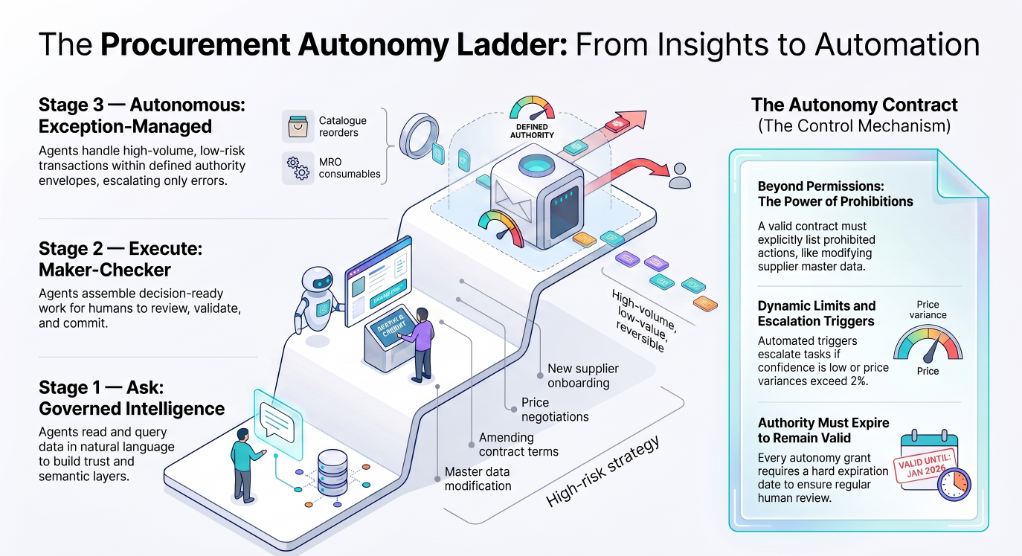
The autonomy contract: what a real one looks like
An autonomy contract is the artifact that turns "human in the loop" from a slogan into a control. It should be readable by a procurement leader and enforceable by the platform.
agent: catalogue-replenishment-agent
version: 2.3.1
delegating_role: category-buyer-indirect
work_type: standard_catalogue_reorder
scope:
categories: [MRO_consumables, office_supplies, packaging]
supplier_tier: approved_contracted_only
entities: [IN_MFG_01, IN_MFG_02]
permitted:
query_contract_terms: true
query_stock_and_demand: true
create_purchase_order: true
send_supplier_acknowledgement_chase: true
prohibited:
onboard_new_supplier: true
amend_contract_terms: true
negotiate_price: true
modify_supplier_master_data: true
approve_own_requisition: true
limits:
po_value_max: 500000
monthly_aggregate_max: 12000000
price_variance_vs_contract: 2%
escalate_when:
- supplier_not_on_approved_list
- price_variance_above_threshold
- delivery_date_beyond_contracted_lead_time
- confidence_below_0.85
- budget_utilisation_above_90_percent
evidence_required:
- contract_reference
- budget_state_snapshot
- stock_and_demand_basis
valid_until: 2026-12-31
review_owner: head-of-indirect-procurement
Two things about this artifact are worth noting. First, the prohibitions are as important as the permissions — an autonomy contract that only lists what an agent may do is an incomplete control. Second, it expires. Authority that never requires renewal is authority nobody is reviewing.
Where Agentic AI Delivers in Source-to-Pay
The architecture above is general. Here is where it lands first in practice, ordered roughly by how quickly functions see return.
Intake and demand capture
Requests arrive as prose — email, chat, a conversation. An intake agent converts them into structured requisitions, asks clarifying questions where the specification is incomplete, applies category and approval logic, and routes into the correct downstream workflow. This is the highest-frequency, lowest-risk entry point in procurement and consistently the fastest to value.
Autonomous sourcing and supplier discovery
For long-tail and specialised categories, sourcing is expensive precisely because qualification is manual. An agentic sourcing workflow identifies candidate suppliers, validates them against internal policy and regulatory requirements, retrieves certifications and performance history, assembles and distributes bid packages, collects and scores responses, and presents a shortlist with a recommendation.
Deployment evidence. A global pharmaceutical sourcing and excipients platform managing over 1,800 rare excipients and more than 7,500 SKUs deployed agentic RFQ automation and supplier discovery, including quality and regulatory document handling and analytics on price and lead time. Reported directional outcomes: faster procurement cycles, materially reduced vendor coordination and manual follow-up, and improved price and lead-time competitiveness driven by continuous sourcing intelligence rather than periodic review.

Contract and policy surveillance
Contract value leaks between signature and settlement — negotiated terms that are never enforced, rebates never claimed, price escalations never challenged. Agents continuously compare actual transaction terms against contracted terms and flag divergence when it happens rather than at renewal.
Supplier risk and performance monitoring
Supplier deterioration is visible in the data long before it is visible in the supply chain. Agents monitoring financial health signals, delivery and returns performance, contract obligation adherence, and policy compliance can escalate before a threshold breach becomes a disruption. Every escalation carries supporting evidence and a recommended action, and every escalation is logged.
Spend intelligence and margin protection
The shift here is from periodic reporting to continuous monitoring. Rather than discovering at month-end that purchase price movement has eroded gross margin, procurement and finance receive alerts as the pattern emerges — on price trend, margin impact, vendor performance, and working-capital effects such as the notional finance cost of early payment.
Asset-triggered procurement in infrastructure and utilities
In asset-heavy environments, procurement need originates in operational data. Connecting the two removes the lag between signal and sourcing action.
Deployment evidence. A state-level power transmission utility deployed smart-grid analytics with KPI monitoring, anomaly detection, and automated alerting routed to field operations, with procurement triggers embedded in exception routing. Separately, a campus-scale astronomy and astrophysics research institute deployed energy monitoring, forecasting, and optimisation agents with maintenance procurement workflows triggered by anomaly detection. Both moved from reactive manual monitoring toward continuous operational intelligence, with the procurement consequence of fewer emergency sourcing events.
Multi-entity procurement consolidation
For conglomerates, holding groups, and multi-entity operators, the constraint is not analysis — it is comparability. Agents operating over a standardised semantic layer make group-level category consolidation, vendor rationalisation, and contract leverage possible without a manual consolidation exercise.
Deployment evidence. A UAE real estate portfolio owner managing diversified assets across multiple emirates deployed an agentic analysis layer that converts dashboard insight into governed, auditable actions and tasks — closing the loop between observation and execution rather than leaving it to a meeting.
For eight of these deployments broken down individually, with the specific agent design and reported outcomes for each, see Agentic AI Use Cases in Procurement: 8 Real-World Examples That Drive ROI.
Data Readiness: What You Actually Need Before Deploying Procurement Agents
"Clean data" is the standard advice and it is useless as a specification. Here is what actually has to be true.
Spend taxonomy and category hierarchy
Spend must be classifiable to a consistent category structure across entities and systems. Where multiple taxonomies exist, a mapping layer must resolve them. Agents cannot identify consolidation opportunities across categories that are not commensurable, and they will produce confident, wrong savings numbers if you let them try.
Supplier master data
Duplicate supplier records are the most common single blocker. The same legal entity appearing five times under variant names fragments spend, breaks performance scoring, and defeats approved-supplier validation. Before agents evaluate supplier performance, the master must be deduplicated, hierarchy-resolved (parent and subsidiary relationships), and tier-classified.
Contract repository accessibility
Contracts must be digitised, retrievable, and — critically — linkable to the transactions they govern. A contract repository that cannot be joined to spend data supports summarisation but not compliance surveillance.
The semantic layer
This is the one most functions underestimate. Before an agent can answer "which vendors had the highest price increase last quarter," the business must have exactly one definition of price increase, one definition of vendor, one definition of quarter, and one rule for handling currency and intercompany transactions. Agents computing against ambiguous definitions produce answers that are internally consistent and organisationally useless.
ERP write-path readiness
For anything beyond Stage 1, the agent needs a governed, bidirectional path into the ERP with scoped credentials, typed action contracts, and post-condition verification. This is usually the longest-lead technical dependency in the programme and should be started first, not last.
Ten-point readiness scorecard
Score each item 0 (absent), 1 (partial), 2 (in place). Below 12, start at Stage 1 and build the foundation.

A 90-Day Rollout Plan for Agentic AI in Procurement
Deploying agentic AI for procurement does not require an ERP replacement programme. It requires disciplined sequencing.
Days 1–30: Land one bounded, reversible workflow
Select a single workflow that is high volume, well understood, and reversible. Intake structuring, quotation comparison, and invoice exception triage are consistently strong first choices. Resist the temptation to start with autonomous PO creation — it is the most visible use case and the worst place to build organisational trust from zero.
In parallel, begin the ERP write-path integration even though this first workflow may not need it. It is the long pole.
Exit gate: the agent produces decision-ready output that a buyer accepts without rework in the majority of cases.
Days 31–60: Shadow mode, historical replay, and evaluation
Run the agent against historical cases where the correct outcome is already known. Then run it in shadow alongside live human execution — the agent proposes, the human works normally, and you compare.
Measure the delta, not the demo. Where the agent and the human diverge, determine which was right and why.
Exit gate: agreement rate and exception behaviour are understood and documented. Failure modes are named.
Days 61–90: Bounded canary, then widen the envelope
Grant the first autonomy contract — narrow category, low value ceiling, approved suppliers only, contracted terms only. Run it on a limited transaction volume with heightened monitoring and a defined rollback trigger.
Widen only when evidence supports it: value ceiling first, then category scope, then supplier tier. Never all three at once.
Exit gate: the agent has operated at bounded autonomy through a full cycle with action verification success at target and override frequency stable or falling.
What to measure at each gate

Five failure modes that kill procurement AI pilots
- Starting with the most impressive use case rather than the most learnable one. Autonomous sourcing makes the best demo and the worst first deployment.
- Treating data readiness as a parallel workstream. It is a dependency, not a companion project.
- Encoding policy in prompts. It will drift, it cannot be tested, and it will not survive an audit.
- Measuring acceptance instead of outcome. Buyers accepting recommendations proves the interface works, not that procurement improved.
- Granting autonomy globally instead of per work type. One bad transaction in an ungoverned scope will set the programme back further than the pilot advanced it.
What ROI Should You Expect from Agentic AI in Procurement?
Published third-party benchmarks give a reasonable outer envelope:

Treat these as directional. They describe what is achievable in well-executed deployments, not what is guaranteed in yours.
Why insight-only deployments underperform
The Deloitte finding on the gap between digital leaders and laggards is the most useful number in the table, because it explains the pharma company from the opening of this article. Both organisations bought agentic AI. One connected it to the write path and the other did not. The return differential is not a difference in model quality — it is a difference in whether the system was permitted to complete work.
An agent that produces insight a human must then act on has moved the work, not removed it. The compounding returns appear when agents share context and hand off to one another across a connected workflow — when the intake agent, the sourcing agent, and the compliance agent operate on the same governed context rather than as three separate tools.
Building the business case your CFO will accept
Anchor on four quantities, not on productivity percentages:
- Cycle-time reduction × transaction volume × loaded cost per touch — the labour argument
- Price variance captured through continuous rather than periodic monitoring — the margin argument
- Contract leakage recovered through compliance surveillance — the value-recovery argument
- Emergency sourcing avoided through earlier signal detection — the risk argument
Then subtract honestly: platform cost, integration effort, data remediation, and the human review capacity that Stage 2 operation requires. A business case that assumes headcount reduction in year one will not survive contact with reality; a business case built on capacity redeployment and margin protection generally will.
How to Evaluate an Agentic AI Procurement Platform
Twelve questions to ask any agentic procurement vendor
- Can the agent write to our ERP, and can you show the governed action path — not a demo, the contract definition?
- How is delegation of authority enforced, and where does that policy live?
- Can you produce an audit record binding an action to the agent version, the delegating human identity, the approval, and the evidence used?
- How do you verify that the intended system state change actually occurred?
- What happens on retry after a timeout — how is duplicate creation prevented?
- Where is business policy stored, and can we change it without changing prompts?
- How are metric definitions governed, and can we bring our own?
- What is your row-level and field-level permission model, and does it apply before data reaches the model?
- Can we run this in our own cloud environment or on-premises, and does our data leave it?
- Are we locked to one model provider, and can we use our own keys?
- What does the rollout evidence path look like — replay, shadow, canary?
- Which of the capabilities you have shown us are shipped today, and which are roadmap?

Question twelve is the one that separates vendors. Ask it directly and note who answers it cleanly.
Suite-embedded agents versus platform-layer agents
Procurement-suite vendors are adding agents inside their own products. This works well if your procurement estate is consolidated on that suite and you are content for agentic capability to stop at its boundary. It works poorly in the common enterprise reality: an ERP in one place, contracts in another, supplier data in a third, and three subsidiaries on entirely different systems.
The platform-layer alternative places a governed agentic layer across the systems you already run, leaving each system authoritative for its own transactions. The trade-off is integration work in exchange for coverage and independence. For multi-entity groups and for organisations with heterogeneous or regulated estates, the second model is usually the only one that reaches the whole problem.
Why Assistents.ai by Ampcome for Agentic Procurement
Assistents.ai, built and operated by Ampcome, is a governed enterprise AI platform. It is deliberately not another procurement suite. It is the governed agentic layer that operates across the ERP, contract, and supplier systems you already run — which is the shape of the problem in most enterprise procurement functions.
Built for the write path, not the dashboard
The platform's core design principle is that AI is only useful in procurement when it is safe enough to act. Writes go through a maker-checker model: the agent proposes, a human with the relevant authority confirms, and the server independently re-checks policy at the point of execution. The workflow engine supports governed actions with guards, delegation-of-authority approval tiers, rate limits, and audit — which is precisely the machinery an agentic procurement deployment needs and the machinery most AI platforms do not have.

Governed context, not raw warehouse access
Analytics run as text-to-SQL over a semantic layer carrying your own metric definitions, so procurement answers use your definitions of spend, margin, and vendor performance. The platform's stated promise is no hallucinated numbers, and it is enforced architecturally rather than requested in a prompt. Row-level security and permission-aware retrieval apply before data reaches the model.
For multi-entity groups, this is the decisive capability: the semantic layer is what makes cross-subsidiary procurement comparison possible at all.
Document intelligence built for procurement's real inputs
Ingestion, OCR, structured extraction, template creation and matching, and permission-aware retrieval with citation tracking — engineered for the tender packages, quotations, contracts, and certifications that procurement actually receives, including scanned and image-heavy formats.
Model-agnostic, and deployable where your spend data lives
Model routing across providers with per-organisation bring-your-own-key support, so you are not locked to a single vendor's model economics. Deployment in private cloud, customer VPC, or on-premises environments, with the operating principle that your data stays in your environment. For regulated procurement functions and for groups with data-residency obligations, this is frequently the gating requirement.
Sits on top of the systems you already run
Multi-agent orchestration with action connectors, roughly 83 workflow integrations, a generic configurable HTTP action for calling your own REST endpoints, MCP server support for framework interoperability, and BI connectors including Postgres, MSSQL, BigQuery, ClickHouse, Athena, and DuckDB. Each system remains authoritative for its own transactions; Assistents.ai governs the agency layer across them.
Ampcome ships production deployments, not pilot decks
The deployment evidence cited throughout this guide is Ampcome's own delivery record — governed SAP order creation in a UAE engineering group, a multi-agent tender workbench with job-management CRUD in Australian commercial construction, group-wide procurement and margin intelligence in a Gulf conglomerate of 30+ companies, RFQ and supplier discovery automation in global pharma sourcing, conversational spend analytics across a 700+ store Indian retail network, and operational agent deployments in ports and logistics, state power transmission, and campus-scale infrastructure.
That combination — a productised governed platform plus a team that delivers bespoke agentic builds on top of it — is why deployments reach the write path rather than stopping at the dashboard.
The Procurement Operations Workcell
Ampcome structures procurement engagements as a workcell: a governed human–agent team that owns a defined procurement operation and its outcomes, rather than a collection of individual agents. A Procurement Operations Workcell packages the work intake, the digital and human roles, the context and metric bindings, the governed capabilities, the policy and autonomy contracts, the operating surfaces, and the outcome measures — as one deployable unit.
This is an engagement methodology rather than a product SKU, and it exists because the buying question in procurement is never "how many agents do we get." It is "who owns this operation and how do we know it is working."
Explore Finance & Procurement solutions → ·
From Assisted Procurement to Governed Autonomy
The organisations getting real returns from agentic AI for procurement are not the ones with the most sophisticated models. They are the ones that answered the authority question first.
They defined what each agent may do, under whose delegation, within which value band, with what evidence attached. They put policy in a rules engine instead of a prompt. They routed every write through a governed gateway that verifies the system actually changed. And they earned autonomy one work type at a time instead of asserting it at purchase.
That is not a constraint on agentic procurement. It is the precondition for it. The functions that build this foundation now will be running exception-managed procurement operations while their competitors are still reviewing insights in a weekly meeting.
See how Assistents.ai handles governed procurement agents →
Frequently Asked Questions
What is agentic AI in procurement?
Agentic AI in procurement refers to AI systems that perceive procurement context, plan multi-step workflows, execute actions across enterprise systems, and adapt as conditions change — within governance boundaries defined by the organisation. Unlike generative AI, which produces content when prompted, or RPA, which follows fixed rules and halts on exceptions, agentic AI pursues a procurement outcome across intake, sourcing, contracting, ordering, and settlement without requiring human direction at each step.
How is agentic AI different from RPA in procurement?
RPA executes predefined steps and stops when reality deviates from the script — a supplier replies in an unexpected format, an approval threshold changes, a delivery date shifts. In procurement, those deviations are the norm rather than the exception, so RPA generates a queue of human interventions that erodes its own efficiency gain. Agentic AI treats exceptions as a core capability: it reads content semantically, reconciles conflicting evidence, adapts its plan, and escalates with context when it cannot resolve something.
Can AI agents create purchase orders in SAP or Oracle?
Yes, and this is happening in production today. The requirement is a governed action path rather than direct model access to the ERP: a typed action contract defining the capability, deterministic policy evaluation before execution, an approval gate where value or category requires one, an idempotency key preventing duplicate creation on retry, post-condition verification confirming the ERP state actually changed, and an immutable action receipt. Agents should never hold shared ERP credentials.
Does using AI agents break segregation of duties?
It can, if designed carelessly — and this is the most common reason procurement AI deployments stall at the audit gate. An agent cannot hold a delegation of authority in its own right; it acts under a delegating human identity. Segregation is preserved by ensuring the agent proposes rather than self-approves, that preparing and checking functions sit with different agents holding different context scopes, and that the action gateway re-validates policy server-side at execution regardless of what was approved earlier.
What data do you need before deploying procurement AI agents?
Five foundations: a consistent category taxonomy across entities; a deduplicated supplier master with parent-subsidiary hierarchy and tier classification; a digitised contract repository that can be joined to transaction data; a semantic layer with agreed KPI definitions so procurement metrics mean one thing across the organisation; and a governed, near-real-time read and write path into the ERP. The semantic layer is the one most functions underestimate and the one that determines whether cross-entity analysis is possible at all.
How long does it take to deploy agentic AI in procurement?
A focused deployment covering a single bounded workflow typically reaches working prototype in two to four weeks and bounded production operation within roughly 90 days, following a sequence of pilot, historical replay, shadow mode, and limited canary. Broader source-to-pay coverage takes longer but generally remains under twelve months from pilot to scale. The critical path is usually ERP integration and data remediation, not the AI itself.
What governance controls do procurement AI agents need?
Six: an agent inventory with named human owners and version control; deterministic business policy held outside the model, versioned and testable; explicit autonomy contracts scoped by work type, category, supplier tier, value ceiling, and expiry; a governed action gateway enforcing approvals, limits, idempotency, and post-condition verification; immutable audit records binding each action to agent version, delegating identity, approval, and evidence; and change control that re-certifies an agent when its instructions, model, tools, or authority change.
Is agentic AI in procurement viable for mid-market teams?
Yes. The determining factor is transaction volume and data accessibility, not headcount. Mid-market manufacturers, distributors, retailers, and professional-services firms frequently have both. In practice, mid-market functions often reach production faster than large enterprises because their approval matrices are simpler and their system estate is less fragmented.
What ROI can procurement teams expect from agentic AI?
Published benchmarks put function efficiency gains in the 25–40% range (McKinsey), task productivity gains at 30–70% (PwC), and top-quartile digital adopters at around 3.2x return against roughly 1.5x for early-stage adopters (Deloitte Global CPO Survey). Treat these as directional. The consistent pattern is that insight-only deployments substantially underperform deployments where agents are connected to the write path and permitted to complete work.
Which procurement processes should you automate first?
Start with high-volume, well-understood, reversible workflows: intake structuring, quotation comparison, invoice exception triage, and supplier acknowledgement chasing. These build organisational trust and produce measurable cycle-time gains quickly. Autonomous purchase order creation, supplier onboarding, and contract award should follow later, once evidence from earlier stages supports widening the authority envelope.

Transform Your Business With Agentic Automation
Agentic automation is the rising star posied to overtake RPA and bring about a new wave of intelligent automation. Explore the core concepts of agentic automation, how it works, real-life examples and strategies for a successful implementation in this ebook.
Sarfraz Nawaz is the CEO and founder of Ampcome, which is at the forefront of Artificial Intelligence (AI) Development. Nawaz's passion for technology is matched by his commitment to creating solutions that drive real-world results. Under his leadership, Ampcome's team of talented engineers and developers craft innovative IT solutions that empower businesses to thrive in the ever-evolving technological landscape.Ampcome's success is a testament to Nawaz's dedication to excellence and his unwavering belief in the transformative power of technology.

More insights
Discover the latest trends, best practices, and expert opinions that can reshape your perspective







Contact us

