
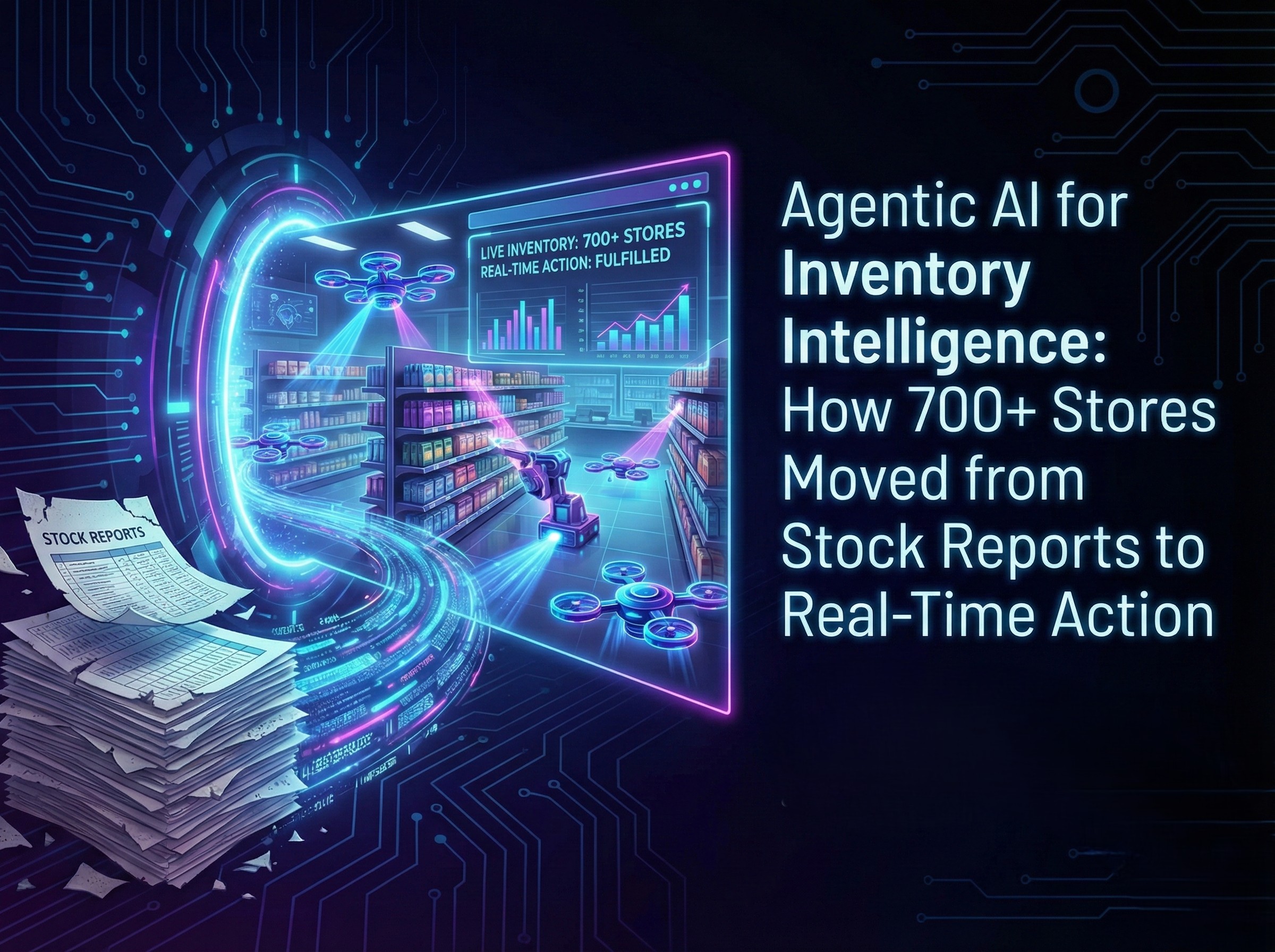
Agentic AI for Inventory Intelligence: How 700+ Stores Moved from Stock Reports to Real-Time Action


The race for enterprise autonomy has already started. The data is clear: 25% of enterprise workflows are projected to be automated by Agentic AI by 2028, according to McKinsey. Furthermore, Gartner predicts that 50% of enterprises will deploy autonomous decision systems by as early as 2027.
The question for retail leaders is no longer if they will deploy AI agents, but whether those agents will execute with precision or become a significant liability.
While many organizations remain stuck in evaluation cycles, early adopters are already realizing 40–60% reductions in process cycle times. In the high-stakes environment of inventory management, where lagging stock reports lead to missed revenue, the margin for error is non-existent.
To stay competitive, enterprises must move from AI that merely advises to AI that acts. However, most are walking into a dangerous trap: deploying "blind" agents that reason and execute but lack the full business context to make safe decisions.
What Is Agentic AI for Inventory Management?
Agentic AI for inventory management is the use of autonomous, governed AI agents to detect inventory risks, interpret complex demand signals, and execute real-time actions—such as replenishment, stock rebalancing, or crisis escalation—across enterprise systems.
Unlike traditional software that requires human triggers, agentic systems follow a "Detect → Decide → Execute" loop. This creates a "Level 5" intelligence where the system identifies issues and routes approvals autonomously within set guardrails.
Why Traditional Inventory Reporting Fails at Scale
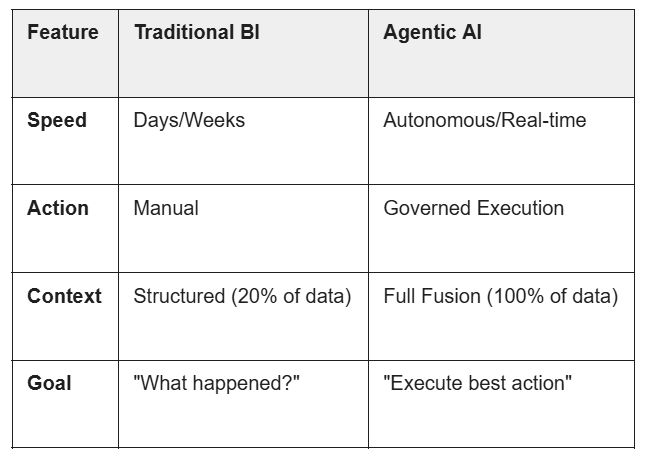
Most enterprises are currently stuck in a reactive loop characterized by "Descriptive" and "Diagnostic" analytics. Traditional Business Intelligence (BI) excels at structured data but fails when context and execution are required.
The Limits of Traditional BI
- Static Views: Periodic reports offer a "What happened?" perspective that is often days or weeks old.
- Human Bottlenecks: Even with real-time dashboards, execution still requires manual intervention and endless meetings.
- The 80% Blind Spot: Only 20% of enterprise context lives in structured systems like ERP tables. The "real business truth"—negotiated discounts in emails, SLA exceptions in PDF contracts, or warnings in Slack—is invisible to traditional BI.
The Real Inventory Problem: Signals Without Action
Real-world decisions require more than just internal database entries. Most information lives outside relational tables.
.jpg)
The Enterprise Data Reality
Value comes from fusing all formats:
- Structured Data: ERP, CRM, and POS logs.
- Unstructured Data: PDF contracts, email threads, and chat conversations.
- External Signals: Competitor pricing, market promos, and environmental factors like weather or holidays.
Without AI reasoning over these disparate signals, enterprises suffer from a "competitive chasm" where it takes six weeks to move from a signal to a result.
How Agentic AI Changes Inventory Intelligence
Agentic AI transforms inventory from an analytical exercise into an operational one.
From Stock Visibility to Decision Autonomy
Instead of just seeing that stock is low, the system understands why (e.g., a competitor's promo overlap) and suggests a "next best action".
From Historical Reports to Live Demand Signals
Agentic systems use a Unified Context Engine to correlate ERP data with external market signals and internal policy documents. This allows for "Contextual Fusion," providing a complete picture for every inventory decision.
From Human Coordination to Executable Workflows
The system moves from reporting "what happened" to asking "what should we do?" and then executing the best action with governance.
.jpg)
Architecture: How Agentic Inventory Systems Work
An enterprise-grade agentic platform is built on a specialized autonomy stack.
1. Unified Context Engine
This solves the 80% blind spot by fusing structured and unstructured data into a single semantic layer. It ensures agents see the full picture—from POS transactions to the specific terms in a supplier's PDF contract.
2. Semantic Governor
To solve the trust problem, a Semantic Governor encodes business rules into deterministic logic rather than probabilistic guesses.
- Approval Hierarchies: Automatically routes requests based on value (e.g., autonomous if <$10,000; human approval if >$50,000).
- Auditability: Every decision is defensible, policy-cited, and explainable.
3. Active Orchestrator
This engine executes multi-step workflows across existing systems like SAP, Salesforce, and ServiceNow. It doesn't just suggest a reorder; it creates the sales order in the ERP.
Case Study: Inventory Intelligence Across 700+ Stores
In a massive retail environment with 700+ stores, the challenges of scale often lead to inconsistent execution and manual firefighting.
The Implementation
By deploying enterprise AI agents at a national retail scale, the organization moved toward modernizing store support and inventory visibility.
- Standardized Action Logic: The platform ensured that replenishment and pricing decisions were made using the same governed logic across all cities.
- Zero-Training Execution: Store-level personnel could interact with the system through natural language, reducing the need for complex training.
- Automated Closure: Inventory issues and ticketing were resolved faster through automated workflows.
The Results
- Reduced Helpdesk Burden: Manual monitoring and helpdesk calls were significantly reduced.
- Improved Visibility: Real-time store-level inventory visibility was established, replacing lagging reports.
- Faster Response Cycles: The organization moved from 8 reactive cycles per year to over 50 proactive cycles.
Outcomes: From Reports to Real-Time Action
The transition to agentic execution delivers measurable business value:
Strategic Gains
- Faster Strategic Visibility: Eliminates the BI queuing process for strategic questions.
- Predictable Operations: Early alerts and automated response coordination make grid and logistics operations more predictable.
- Consistency at Scale: Standardizes decision logic across global teams, ensuring that one branch doesn't forfeit discounts that another has negotiated.
Why Governance Matters in Inventory Automation
There is an "Automation Paradox": AI agents are amplifiers. If you have fragmented data and partial context, an agent will simply multiply chaos and execute wrong decisions faster than a human can intervene.
Autonomy requires trust, and trust requires control. This is why enterprise-grade agents must include:
- No Training on Customer Data: Ensuring privacy and security.
- Rule Citations: Every action must point to the specific policy or rule that authorized it.
- Human-in-the-Loop: Thresholds that ensure high-risk or high-value decisions always have human oversight.
How does agentic AI improve inventory management?
Agentic AI improves inventory management by detecting demand shifts, interpreting contextual signals from both structured and unstructured data, and autonomously executing replenishment or escalation workflows. Unlike traditional reports, agentic systems close the loop from insight to action while operating within strictly governed enterprise thresholds.
Take the Leap to Level 5 Intelligence with Assistents AI
To bridge the competitive gap, enterprises must move beyond "AI that advises" to "AI that acts". Assistents provides the core Agentic Intelligence Infrastructure designed to make AI agents context-aware, governed, and safe enough to operate autonomously.
By deploying a Unified Context Engine, Assistents solves the "80% blind spot" by fusing structured data from your ERP and CRM with the unstructured truth found in PDF contracts, emails, and Slack threads. Every action is overseen by a Semantic Governor, which replaces probabilistic guesses with deterministic business logic and clear approval hierarchies, ensuring your agents never hallucinate or violate compliance.
Whether it’s automating SAP sales orders or managing complex inventory for 700+ stores, Assistents orchestrates your existing stack—including Salesforce, Jira, and ServiceNow—to turn weeks of manual coordination into hours of autonomous execution.
Ready to give your agents sight? Within 48 hours, we can provide a concrete pilot plan, workflow definition, and ROI hypothesis tailored to your specific inventory challenges.
Would you like us to outline a 30-day deployment roadmap for your first governed AI agent?
Frequently Asked Questions
1. How does Agentic AI differ from traditional Business Intelligence (BI) dashboards?
Traditional BI is descriptive; it excels at structured data to tell you "what happened," but it requires manual intervention to turn those insights into results. Agentic AI represents "Level 5" intelligence that moves from insight to autonomous execution. It doesn't just show a stockout; it interprets demand signals and executes the necessary workflows—such as reordering or stock rebalancing—within governed guardrails.
2. What is the "80% Blind Spot" in enterprise data?
Most organizations only utilize about 20% of their data—the structured portion found in ERP tables and CRM fields. The remaining 80% is the "real business truth" locked in unstructured formats like PDF contracts, email negotiations, and Slack conversations. Agentic AI uses a Unified Context Engine to fuse these formats, ensuring agents make decisions based on the full picture rather than just a spreadsheet.
3. How can I trust an AI agent to execute actions like payments or orders autonomously?
Trust is built through a Semantic Governor. Unlike standard LLMs that can be probabilistic (guessing), a governed agent uses deterministic logic based on your specific business rules. You can set strict approval hierarchies—for example, allowing an agent to process refunds under ₹10,000 autonomously while requiring human approval for anything higher. Every action is policy-cited and recorded in a full audit trail.
4. Does implementing Agentic AI require "ripping and replacing" my existing systems?
No. Agentic infrastructure is designed to orchestrate the tools you already use. It acts as a layer that connects to your current stack—such as SAP, Salesforce, Jira, and ServiceNow—to automate multi-step workflows across those systems.
5. How long does it take to see real value from a deployment?
The deployment process is built for speed rather than "POC purgatory". Discovery and workflow mapping typically happen in the first week, followed by the configuration of the context engine and business rules. A live, governed agent can be in production within 30 days, often delivering immediate results like 40–60% reductions in process cycle times.

Transform Your Business With Agentic Automation
Agentic automation is the rising star posied to overtake RPA and bring about a new wave of intelligent automation. Explore the core concepts of agentic automation, how it works, real-life examples and strategies for a successful implementation in this ebook.
Sarfraz Nawaz is the CEO and founder of Ampcome, which is at the forefront of Artificial Intelligence (AI) Development. Nawaz's passion for technology is matched by his commitment to creating solutions that drive real-world results. Under his leadership, Ampcome's team of talented engineers and developers craft innovative IT solutions that empower businesses to thrive in the ever-evolving technological landscape.Ampcome's success is a testament to Nawaz's dedication to excellence and his unwavering belief in the transformative power of technology.

More insights
Discover the latest trends, best practices, and expert opinions that can reshape your perspective






Contact us

