
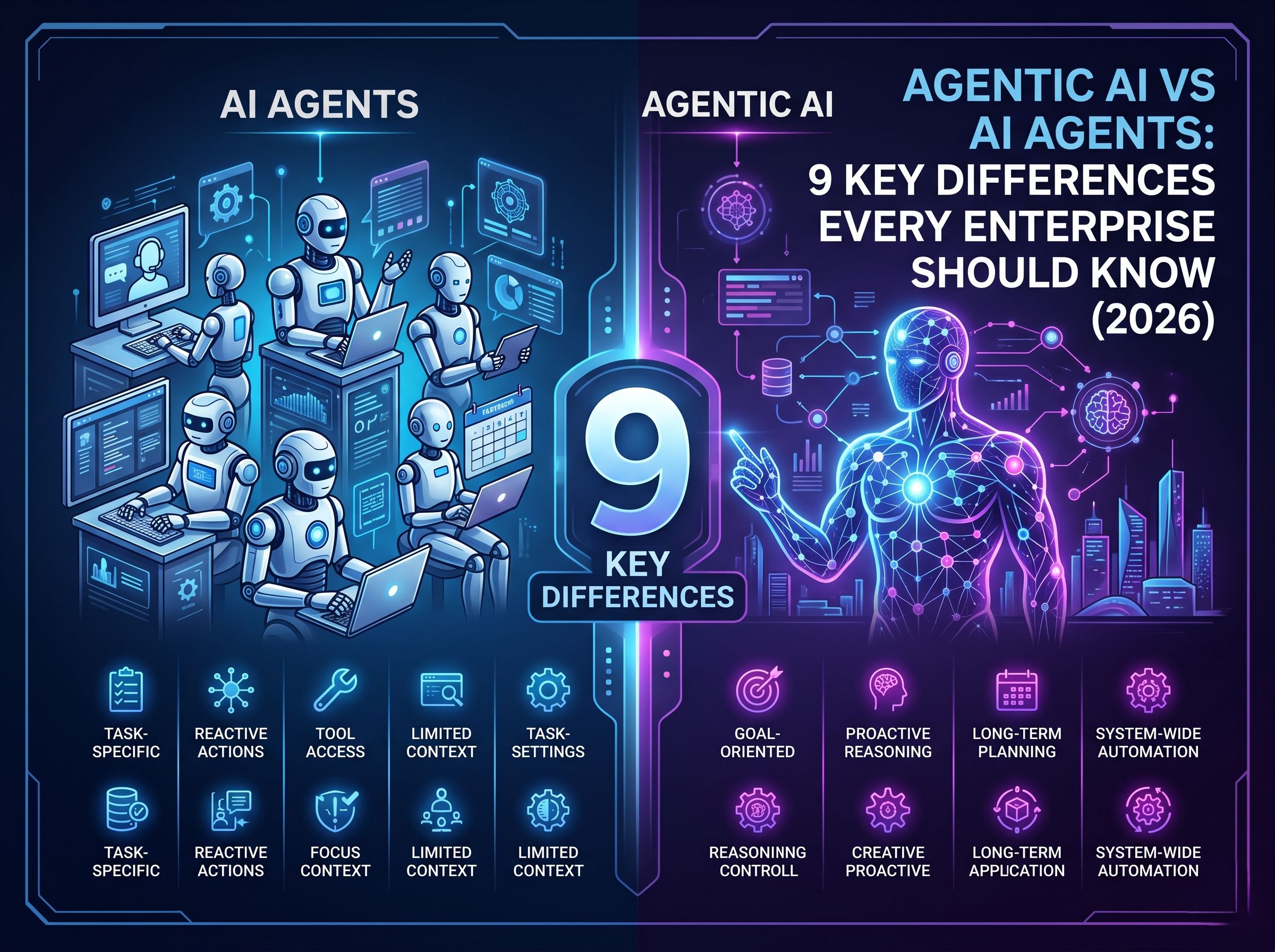
Agentic AI vs AI Agents: 9 Key Differences Every Enterprise Should Know (2026)


Most enterprise teams researching AI automation hit the same wall: the terms "agentic AI" and "AI agents" are used interchangeably — but they describe fundamentally different things. Getting this wrong means buying the wrong platform, setting the wrong expectations with leadership, and deploying something that can't scale.
This guide breaks down exactly what separates agentic AI from AI agents, why the distinction matters for enterprise deployments, and how to decide which approach fits your operational goals in 2026.
Updated April 2026 — incorporating the latest developments in enterprise agentic AI deployments across financial services, healthcare, manufacturing, and logistics.
What Is Agentic AI?
Agentic AI refers to AI systems designed to pursue goals autonomously — planning multi-step actions, adapting to changing conditions, and making decisions without requiring human instruction at each step.
Where traditional AI responds to a prompt, agentic AI operates more like a capable team member: it receives an objective, reasons through how to achieve it, takes action across connected systems, checks its own output, and adjusts when something doesn't work as expected.
The defining characteristics of agentic AI are:
Autonomous goal pursuit. The system doesn't wait to be told each next step. It determines what needs to happen to achieve the stated objective and acts accordingly.
Multi-step planning. Agentic AI can decompose a complex goal — such as "process all pending vendor invoices and flag discrepancies" — into a sequence of sub-tasks and execute them in the right order.
Environmental awareness. Rather than operating on a static dataset, agentic AI perceives its environment in real time, adjusting behavior based on what it encounters.
Self-correction. If an action produces an unexpected result, the system recognizes this and tries an alternative approach without needing human intervention.
Cross-system execution. Enterprise agentic AI can reach across APIs, databases, and applications — reading from one system, writing to another, and coordinating across both. See how assistents.ai connects to 300+ enterprise integrations →

What Are AI Agents?
AI agents are software programs that perceive inputs, reason about them, and take actions to accomplish specific tasks. The term is broad — it covers everything from a customer-facing chatbot that answers FAQs to a workflow automation script that routes incoming emails.
The key components of an AI agent are:
Perception. The agent takes in inputs — text, data, API responses, sensor readings — and interprets them.
Reasoning. Using the input, the agent applies logic (often powered by a language model) to determine the right response or action.
Action. The agent executes — whether that means sending a message, updating a record, or triggering a downstream process.
Learning. Many modern AI agents improve over time by incorporating feedback into future decisions.
AI agents are well-suited to bounded, well-defined tasks: answering customer questions within a knowledge base, classifying incoming support tickets, or generating a standard report. They excel at doing one thing reliably and at scale.
Explore enterprise AI agents for customer support, HR, finance, and more →

9 Key Differences Between Agentic AI and AI Agents
1. Autonomy Level
AI agents operate within a defined scope — they respond to triggers and follow programmed paths. Agentic AI operates with genuine autonomy, forming plans and executing sequences of actions to reach a goal without needing a human in the loop for each decision.
Think of the difference this way: an AI agent answers the question you asked. Agentic AI figures out which questions need to be asked, answers them, and acts on the answers.
2. Goal Orientation
AI agents are task-oriented. They're given a specific job and they do it. Agentic AI is goal-oriented — it's given an outcome to achieve and works out how to get there, which may involve multiple tasks, decision points, and course corrections along the way.
For enterprise operations, this distinction is significant. A task-specific agent can process invoices that match your defined rules. An agentic system can manage the entire accounts payable cycle, identify exceptions, escalate anomalies, and reduce time-to-close — because it's optimizing for an outcome, not just executing a checklist.

3. Learning and Adaptation
Traditional AI agents are often static between updates — they perform well within the parameters they were trained or configured for, but struggle when something outside those parameters occurs.
Agentic AI continuously adapts. It incorporates feedback from each action, identifies patterns in outcomes, and refines its approach over time. This makes it significantly more robust in dynamic enterprise environments where processes, data structures, and requirements change regularly.
4. Complexity of Tasks
AI agents handle well-scoped, repeatable tasks efficiently. Agentic AI handles ambiguity — it can navigate complex, open-ended objectives where the exact steps aren't known in advance.
Enterprise workflows rarely come in clean, predictable packages. Agentic AI is built for the messy reality of enterprise operations: incomplete data, conflicting signals, legacy systems, and processes that look different depending on the business unit.
5. Decision-Making Approach
AI agents follow decision trees or rules. Given input X, do Y. This is fast, auditable, and predictable — ideal when the logic is well-understood and stable.
Agentic AI evaluates multiple possible paths, weighs trade-offs, and selects the action most likely to achieve the goal. This enables more nuanced decision-making, particularly in situations that involve multiple variables or where the optimal answer isn't obvious.
How assistents.ai handles enterprise AI governance and auditability →

6. Interaction with the Environment
AI agents interact with a bounded environment — the inputs and outputs defined by their configuration. They do what they're programmed to do with what they're given.
Agentic AI interacts with its environment dynamically. It can query systems for information it determines it needs, take actions that create new environmental conditions, and adjust its behavior based on what it discovers. This makes it genuinely capable of operating across complex, interconnected enterprise technology stacks.
7. Responsiveness to Change
AI agents are reactive — they respond to specific inputs when those inputs arrive. They are not designed to anticipate change or proactively manage it.
Agentic AI is proactive. It can monitor conditions, recognize early warning signals, and act before a problem escalates — whether that's detecting a compliance risk in a contract, identifying a supply chain bottleneck before it causes a delay, or flagging a cash flow issue before it becomes a crisis.
8. Integration Across Systems
Many AI agents are designed to operate within a single system or application — they're powerful within their silo but limited in their reach.
Agentic AI is built for cross-system orchestration. It reads from and writes to multiple systems simultaneously, maintaining a coherent understanding of state across all of them. For enterprise deployments that involve SAP, Salesforce, ServiceNow, and dozens of other platforms working together, this capability is not optional — it's foundational.
See how assistents.ai integrates with your enterprise stack →

9. Task-Specific vs. Autonomous Operation
This is the cleanest way to frame the overall difference: AI agents are task-specific, agentic AI is autonomous.
Neither is universally better. Task-specific agents are faster to deploy, cheaper to run, and easier to audit for narrow, well-defined workflows. Agentic AI is better suited to complex, end-to-end processes where the goal matters more than the exact method, and where the environment is too dynamic to script every step in advance.
Most enterprise deployments in 2026 use both: task-specific agents for high-volume, repeatable workflows, and agentic AI for orchestrating complex cross-functional processes.

Which Does Your Enterprise Actually Need?
The honest answer for most enterprise deployments in 2026: both, in different parts of your operation.
Start with AI agents when you have a specific, high-volume workflow that is well-defined and repeatable — customer support ticket routing, invoice data extraction, meeting summaries, HR policy Q&A. These are fast to deploy, measurable, and immediately valuable.
Move to agentic AI when you need end-to-end process ownership across systems — accounts payable automation that goes from invoice receipt to SAP posting, procurement intelligence that spans supplier data and internal approvals, or customer operations that coordinate across CRM, billing, and support.
The enterprises seeing the greatest ROI from AI in 2026 are not choosing one or the other — they're deploying task-specific agents at the edges of their workflows and agentic AI at the core, where coordination, judgment, and cross-system execution matter most.
See how enterprise teams deploy both with assistents.ai →
The Future: Where Agentic AI Is Headed
Enterprise adoption of agentic AI is accelerating. According to G2's 2025 Enterprise AI Agents Report, 57% of companies already have AI agents in production and 78% plan to increase agent autonomy within the year. Gartner predicts that 40% of enterprise applications will feature embedded AI agents by the end of 2026.
The trajectory is clear. Three developments are shaping what comes next:
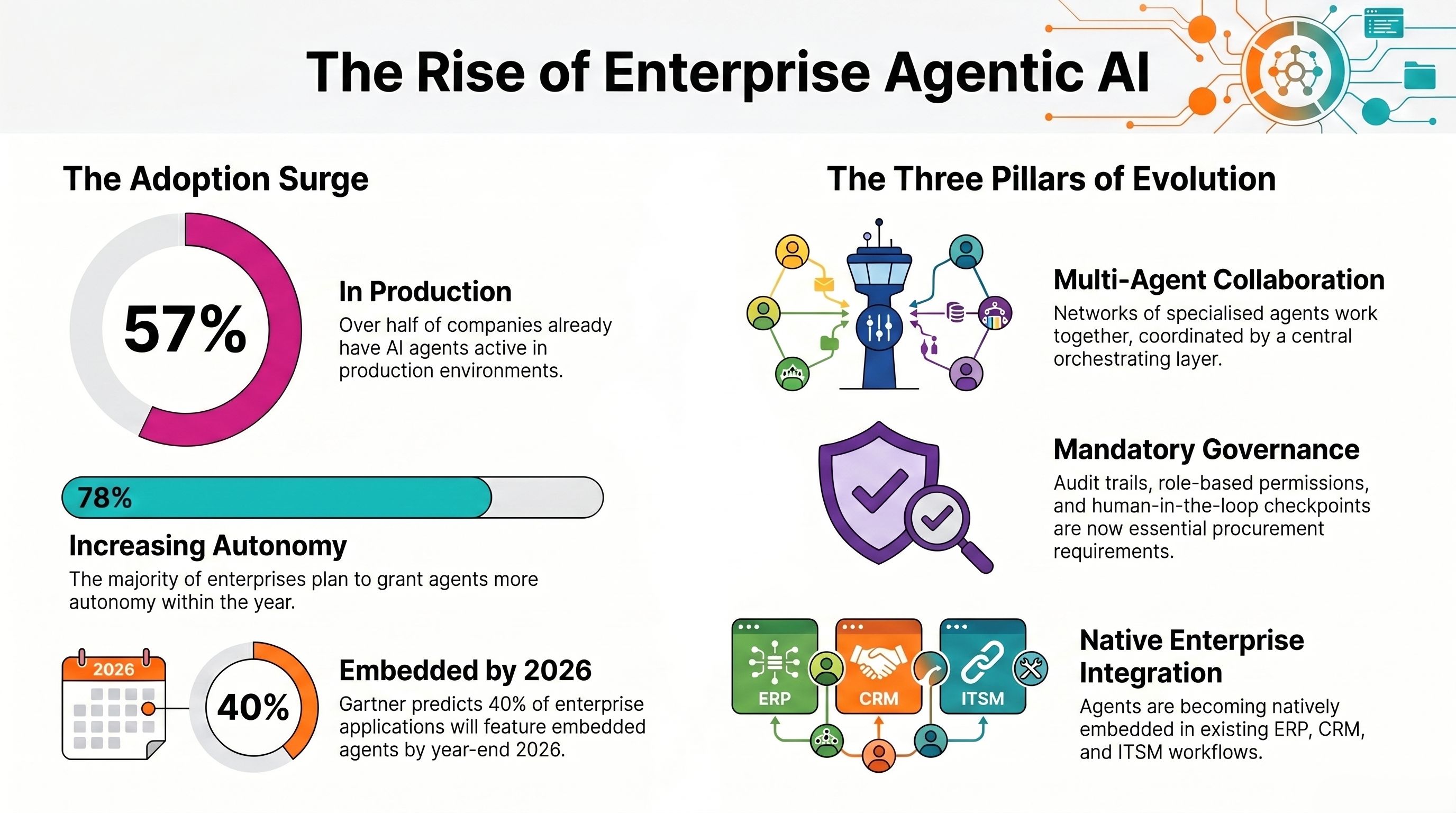
Multi-agent collaboration. Rather than a single agentic system handling everything, enterprise deployments are increasingly using networks of specialized agents — each responsible for a domain, coordinated by an orchestrating layer — to tackle larger and more complex processes.
Tighter governance frameworks. As agentic AI takes on more consequential decisions, enterprise buyers are demanding audit trails, role-based permissions, human-in-the-loop checkpoints, and explainability at every decision node. Governance is no longer a nice-to-have — it's a procurement requirement.
Deeper enterprise integration. The next wave of agentic AI deployments will be less about standalone automation and more about AI that is natively embedded in existing enterprise workflows — reading from and writing to ERP, CRM, ITSM, and analytics systems as a matter of course.
How assistents.ai approaches enterprise governance and compliance →

Conclusion
The difference between agentic AI and AI agents comes down to scope, autonomy, and adaptability. AI agents are precise, efficient tools for defined tasks. Agentic AI is a coordinating intelligence capable of owning complex, end-to-end processes across your enterprise stack.
For 2026 enterprise deployments, the strategic question is not which to choose — it's how to deploy both effectively, with the right governance frameworks in place to ensure every action is auditable, every decision is explainable, and every system integration is secure.
If you're evaluating enterprise agentic AI platforms, see how assistents.ai compares to Glean, Salesforce Agentforce, Kore.ai, and others →
Or book a 30-minute demo to see agentic AI in action across your specific workflows.
Frequently Asked Questions
What is the main difference between agentic AI and AI agents?
AI agents are task-specific programs that respond to defined inputs according to set rules. Agentic AI is a broader, more autonomous system that pursues goals, makes multi-step plans, adapts to changing conditions, and operates across multiple systems — without requiring human direction at each step.
Can an enterprise use both AI agents and agentic AI together?
Yes — this is the most common enterprise architecture in 2026. Task-specific AI agents handle high-volume, well-defined workflows efficiently. Agentic AI orchestrates complex, cross-functional processes that require judgment, planning, and coordination across systems.
Is agentic AI the same as autonomous AI?
Agentic AI and autonomous AI are closely related terms. Agentic AI specifically emphasizes the agent-like qualities — goal direction, planning, environmental interaction — whereas autonomous AI is a broader term referring to any AI system that operates without continuous human control.
What industries benefit most from agentic AI?
Financial services, healthcare, manufacturing, logistics, and retail have seen the most significant enterprise deployments of agentic AI. These industries share common characteristics: complex, multi-system workflows; high volumes of structured and unstructured data; and strong incentives to reduce manual processing time and error rates.
How long does it take to deploy enterprise agentic AI?
Deployment timelines vary by complexity. Purpose-built enterprise agentic AI platforms — as opposed to custom-built systems — can go live in 4–6 weeks for standard use cases. assistents.ai's typical enterprise deployment takes 4 weeks →
What is the difference between agentic AI and RPA?
RPA (Robotic Process Automation) automates rule-based, repetitive tasks by mimicking human interactions with software interfaces. Agentic AI goes further: it can reason, handle exceptions, make judgment calls, and adapt to changes — not just follow a scripted sequence of steps. RPA breaks when the process changes. Agentic AI adjusts.
What governance controls exist for agentic AI in the enterprise?
Enterprise-grade agentic AI platforms include role-based access controls, human-in-the-loop approval workflows, full audit trails of every action taken, and explainability features that document why the system made each decision. Compliance with SOC 2, GDPR, HIPAA, and ISO 27001 are standard requirements for enterprise buyers.

Transform Your Business With Agentic Automation
Agentic automation is the rising star posied to overtake RPA and bring about a new wave of intelligent automation. Explore the core concepts of agentic automation, how it works, real-life examples and strategies for a successful implementation in this ebook.
Sarfraz Nawaz is the CEO and founder of Ampcome, which is at the forefront of Artificial Intelligence (AI) Development. Nawaz's passion for technology is matched by his commitment to creating solutions that drive real-world results. Under his leadership, Ampcome's team of talented engineers and developers craft innovative IT solutions that empower businesses to thrive in the ever-evolving technological landscape.Ampcome's success is a testament to Nawaz's dedication to excellence and his unwavering belief in the transformative power of technology.

More insights
Discover the latest trends, best practices, and expert opinions that can reshape your perspective


.jpg)
.webp)



Contact us

