
35+ Agentic AI Examples: Real Enterprise Use Cases (2026)


The enterprise AI landscape is experiencing a fundamental shift. For years, organizations have relied on AI systems that analyze, predict, and recommend. But there's a critical gap between insight and action—one that costs businesses weeks of execution time, countless coordination meetings, and millions in lost opportunities.
Agentic AI changes everything.
According to McKinsey, 25% of enterprise workflows will be automated by agentic AI systems by 2028. Gartner predicts that 50% of enterprises will deploy autonomous decision systems by 2027. Early adopters are already seeing 40-60% reductions in process cycle times.
This isn't theoretical. This is happening right now, across industries, with measurable results.
In this comprehensive guide, you'll discover 35+ real-world agentic AI examples from enterprises that have moved from insight to execution, from dashboards to outcomes, from reactive cycles to autonomous intelligence.
What is Agentic AI?
Agentic AI represents the next evolution in artificial intelligence—systems that don't just analyze data or provide recommendations, but autonomously execute decisions within governed parameters.
The Evolution: From Reporting to Autonomous Execution
Traditional enterprise intelligence has followed a predictable progression:
- Level 1 - Descriptive: "What happened?" (Historical reports, dashboards)
- Level 2 - Diagnostic: "Why did it happen?" (Root cause analysis)
- Level 3 - Predictive: "What will happen?" (Forecasting, trend analysis)
- Level 4 - Prescriptive: "What should we do?" (Recommendations, next-best actions)
- Level 5 - Agentic: "Handle this." (Autonomous execution with governance)
The leap from Level 4 to Level 5 is profound. At Level 4, humans remain the bottleneck. At Level 5, you simply say "handle this," and the system identifies the issue, evaluates options, executes workflows, routes approvals, and continuously learns.
Key Characteristics That Define Agentic AI
Context-Aware Intelligence Unlike traditional AI that operates on 20% of enterprise context (structured data in ERP, CRM systems), agentic AI fuses structured and unstructured data—PDFs, emails, Slack conversations, meeting notes, policy documents—to see the complete picture.
Governed Execution Agentic systems don't operate in black boxes. They encode deterministic business rules, approval hierarchies, and compliance thresholds. Every decision is auditable, defensible, and policy-cited.
Autonomous Action Within Guardrails These systems execute multi-step workflows across enterprise platforms (SAP, Salesforce, Jira, ServiceNow) with human-in-the-loop controls based on risk thresholds. For example: refunds under $1,000 proceed autonomously, while refunds over $5,000 require human approval.
Agentic AI vs. Traditional Approaches
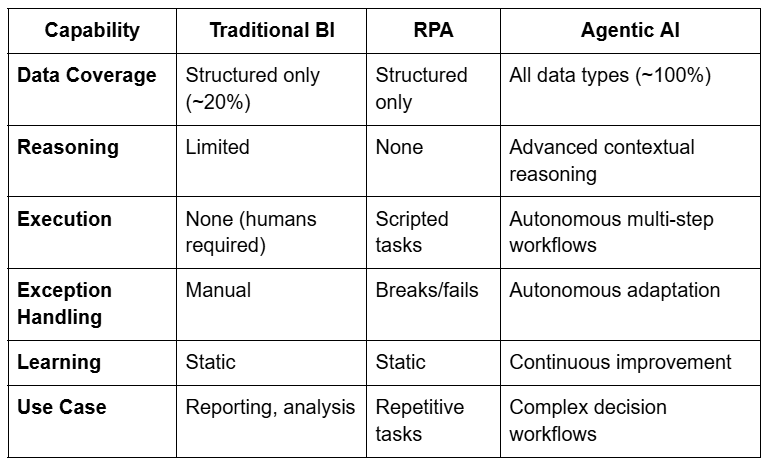
The difference is fundamental: Traditional BI tells you what happened. RPA executes what you script. Agentic AI reasons over complete context and acts autonomously.
The 80% Blind Spot: Why This Matters Now
Only 20% of enterprise context lives in structured systems. The other 80%—the real business truth—lives in PDFs, email threads, Slack conversations, meeting notes, and policy documents.
An agent acting on 20% of the facts isn't an asset. It's a liability with a confidence score.
Real incident from a financial services firm: An AI agent approved ₹12 crore ($1.4M USD) in early vendor payments. The agent saw ERP data, invoice amounts, and due dates. What it couldn't see: contract PDFs with negotiated discounts, email threads with payment terms, and Slack messages flagging cash flow concerns.
Result: Contract terms violated. Discounts forfeited. The agent did exactly what it was told—based on incomplete context.
This is why agentic AI must fuse all data types. Agents flying blind amplify what already exists. Clean data and clear rules multiply efficiency. Fragmented data and partial context multiply chaos.
35+ Real-World Agentic AI Examples by Industry
Retail & E-Commerce Agentic AI Examples
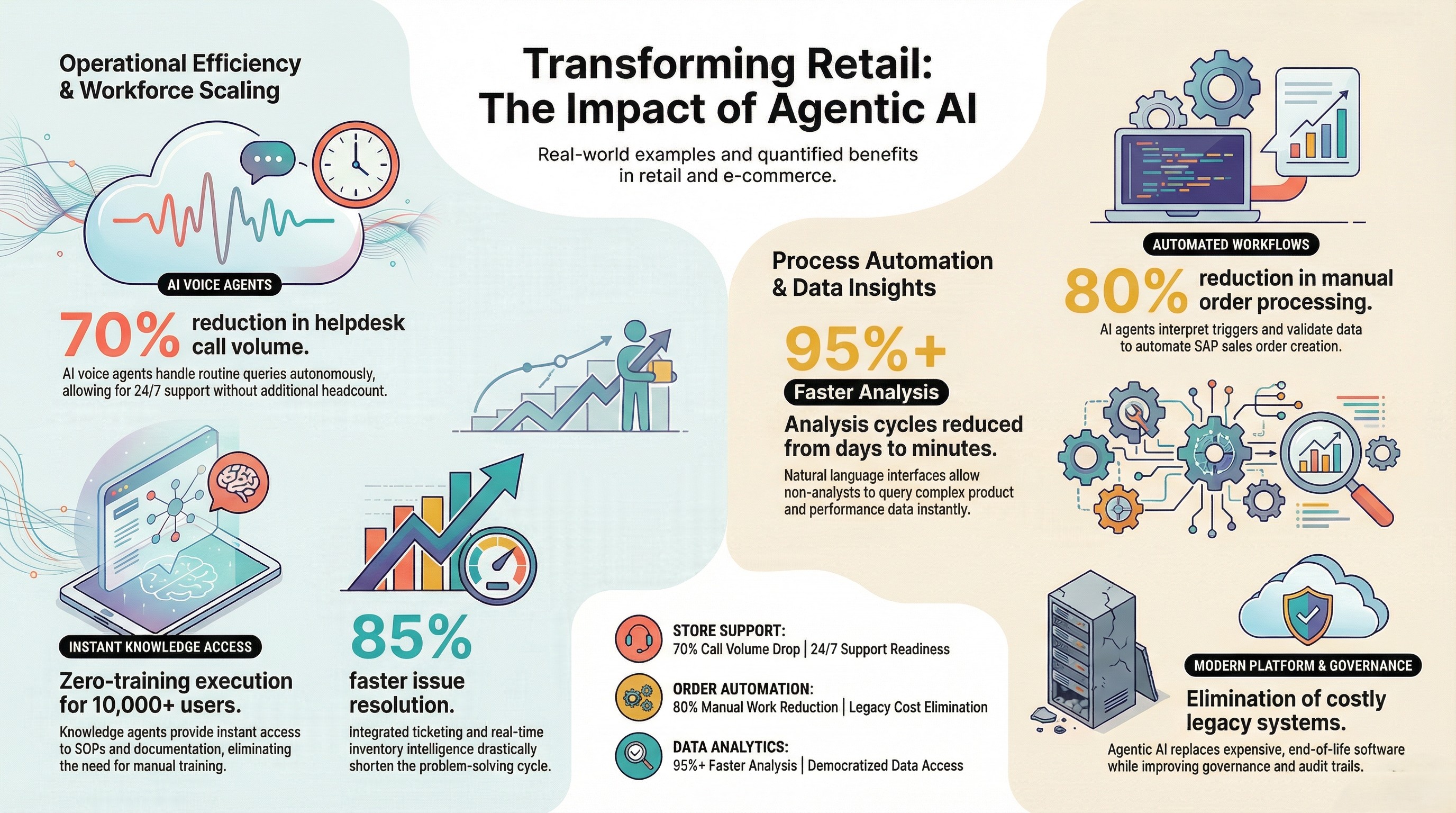
Example 1: National Retail Chain - Enterprise Store Support Agent
Company Profile: 700+ stores across India serving mass-market consumers
The Challenge: Manual helpdesk operations, slow issue resolution, training bottlenecks for new products and policies
The Solution:
- Voice AI agent supporting Hindi and English
- Inventory intelligence agent providing real-time stock/pricing/promotions per store
- Knowledge agent with RAG over POS documentation and SOPs
- Integrated ticketing and analytics
Quantified Results:
- 70% reduction in call volume
- 85% faster issue resolution
- Zero-training execution for 10,000+ users
- 24/7 support without shift planning
Key Takeaway: Agentic AI scales support operations without adding headcount. The system handles routine queries autonomously while escalating complex issues with full context.
Example 2: Retail Holdings - SAP Order Automation
The Challenge: Legacy OpenText ECR system approaching end-of-life with high licensing costs
The Solution: Agentic AI interprets order triggers, validates data, and creates SAP Sales Orders with rule-governed exception handling
Quantified Results:
- Reduced manual order processing by 80%
- Faster order-to-confirm cycles
- Improved auditability with complete audit trails
- Eliminated expensive legacy dependency
Key Takeaway: Agents can replace costly legacy automation while improving governance and flexibility.
Example 3: E-Commerce Specialist - Conversational Analytics
Company Profile: High-velocity vape distribution with 800+ product flavors
The Challenge: Rapid data analysis needs for inventory, promotions, and product performance
The Solution: AI Data Analytics Agent with natural language query interface
Quantified Results:
- Shorter analysis cycles (minutes vs. days)
- Better product performance visibility
- Reduced dependency on analyst resources
Key Takeaway: Conversational analytics democratizes data access for fast-moving retail operations.
Manufacturing & HVAC Agentic AI Examples
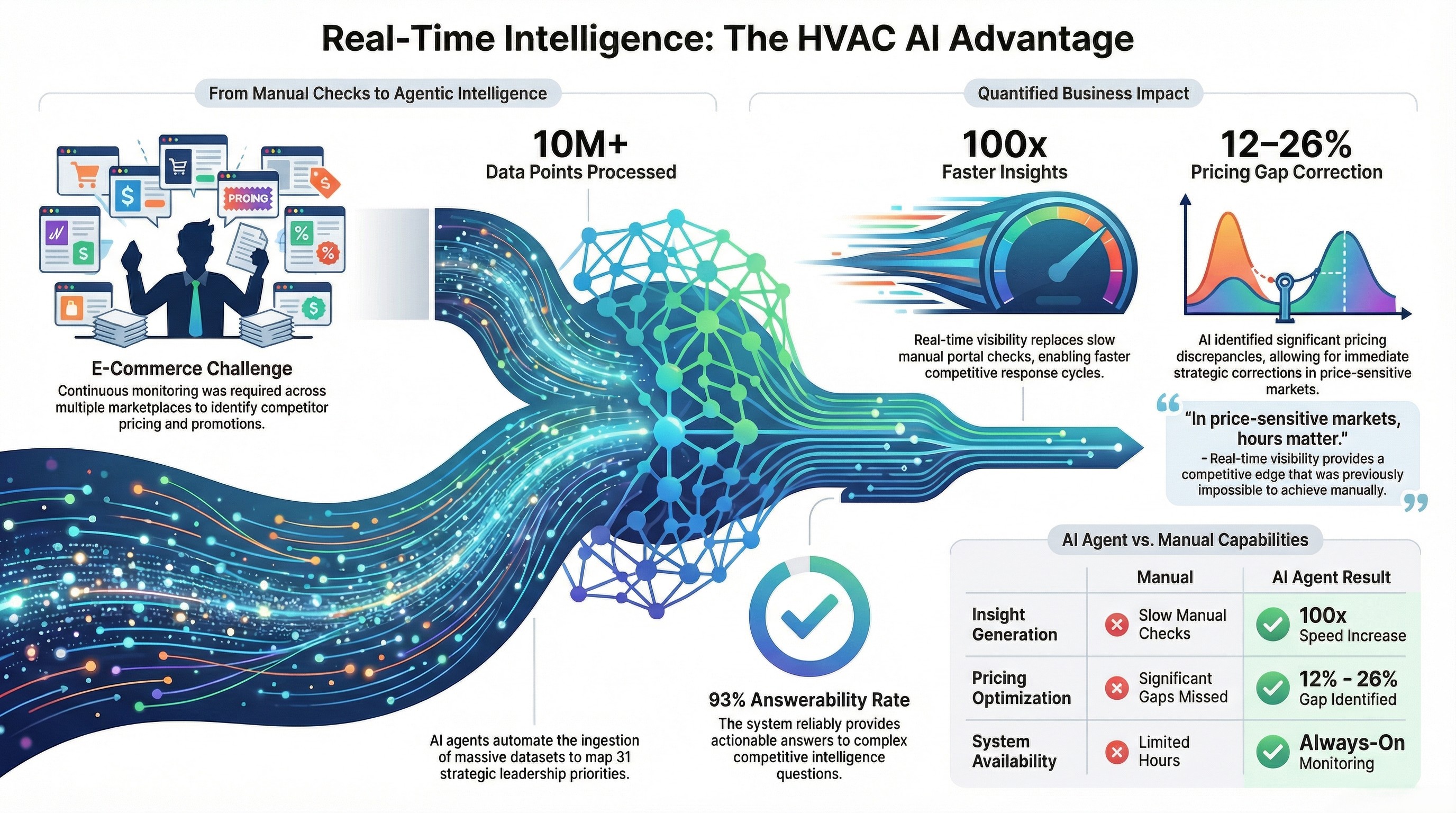
Example 4: HVAC Manufacturer - Competitive Intelligence Agent
Company Profile: Major Indian HVAC manufacturer (founded 1943) competing in price-sensitive consumer and commercial markets
The Challenge: Continuous competitor monitoring needed across e-commerce channels to identify pricing moves and promotional strategies
The Solution: AI agents for competitive monitoring processing data from multiple online marketplaces
Implementation Details:
- 10M+ data points processed
- 31 strategic questions mapped to leadership priorities
- 93% answerability rate
Quantified Results:
- 100× faster insights vs. manual checks
- 12-26% pricing gap identified → immediate correction
- Always-on monitoring replacing manual portal checks
- Faster competitive response cycles
Key Takeaway: Agentic AI delivers continuous market intelligence. In price-sensitive markets, hours matter. This system provides real-time visibility that was previously impossible.
Logistics & Supply Chain Agentic AI Examples
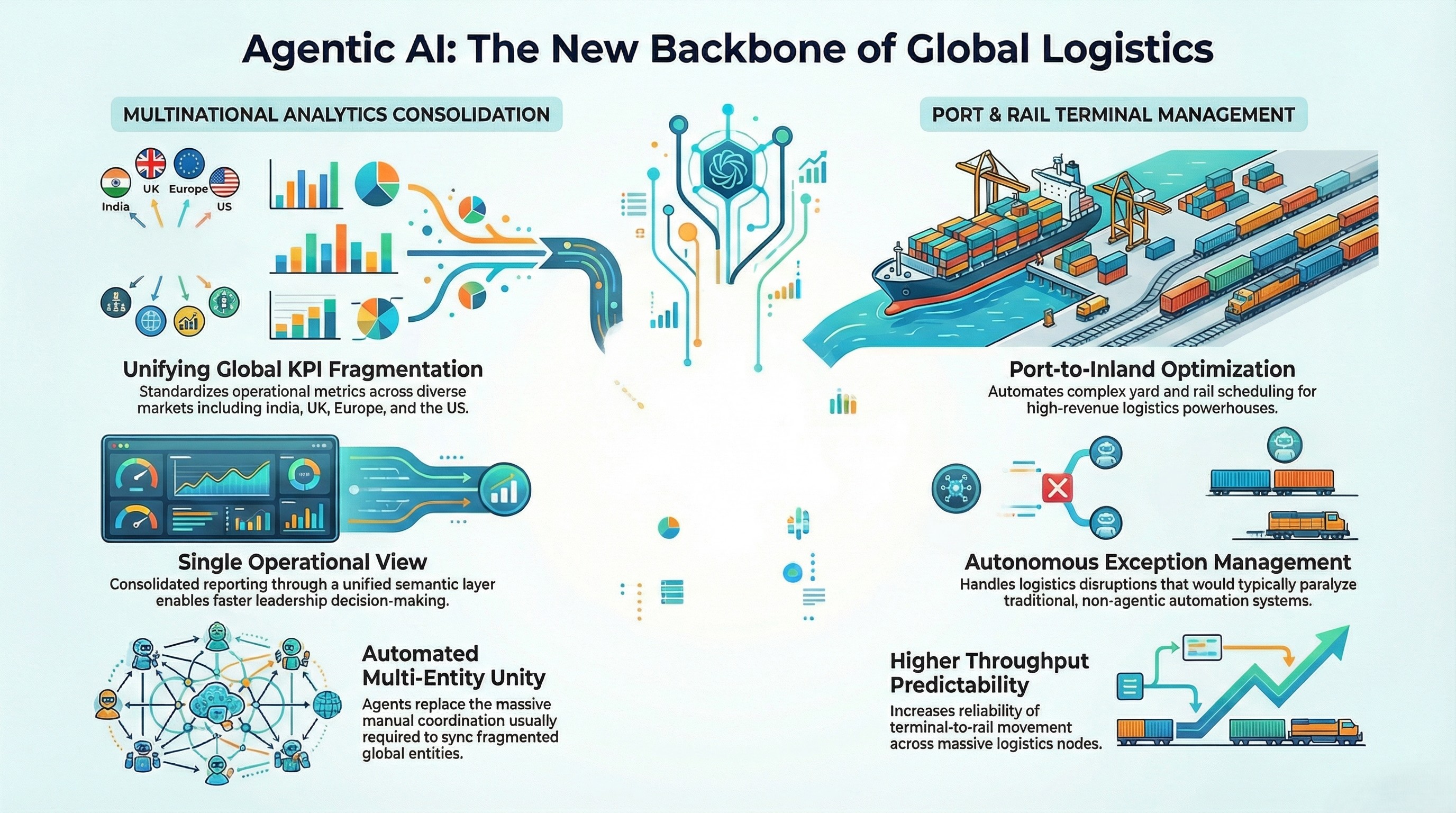
Example 5: Multinational Logistics Provider - Analytics Consolidation
Company Profile: Global supply chain operator serving India, UK, Europe, and US markets
The Challenge: Fragmented KPIs across multiple entities and geographies
The Solution: Cross-entity KPI standardization and consolidated reporting with unified semantic layer
Quantified Results:
- Single operational view across entities
- Faster leadership reporting and decision-making
- Improved consistency of operational metrics
Key Takeaway: Agents unify fragmented multi-entity operations that would otherwise require massive manual coordination.
Example 6: Global Ports Leader - Terminal & Rail Management
Company Profile: $20B revenue logistics powerhouse with worldwide port and terminal operations
The Challenge: Complex terminal-to-inland logistics coordination
The Solution: Agentic automation for port-inland logistics optimization with yard/rail scheduling and exception management
Quantified Results:
- Improved operational visibility
- Higher terminal-to-rail throughput predictability
- More efficient coordination across logistics nodes
Key Takeaway: Agentic orchestration works at massive scale, handling exceptions autonomously that would paralyze traditional automation.
Healthcare Agentic AI Examples
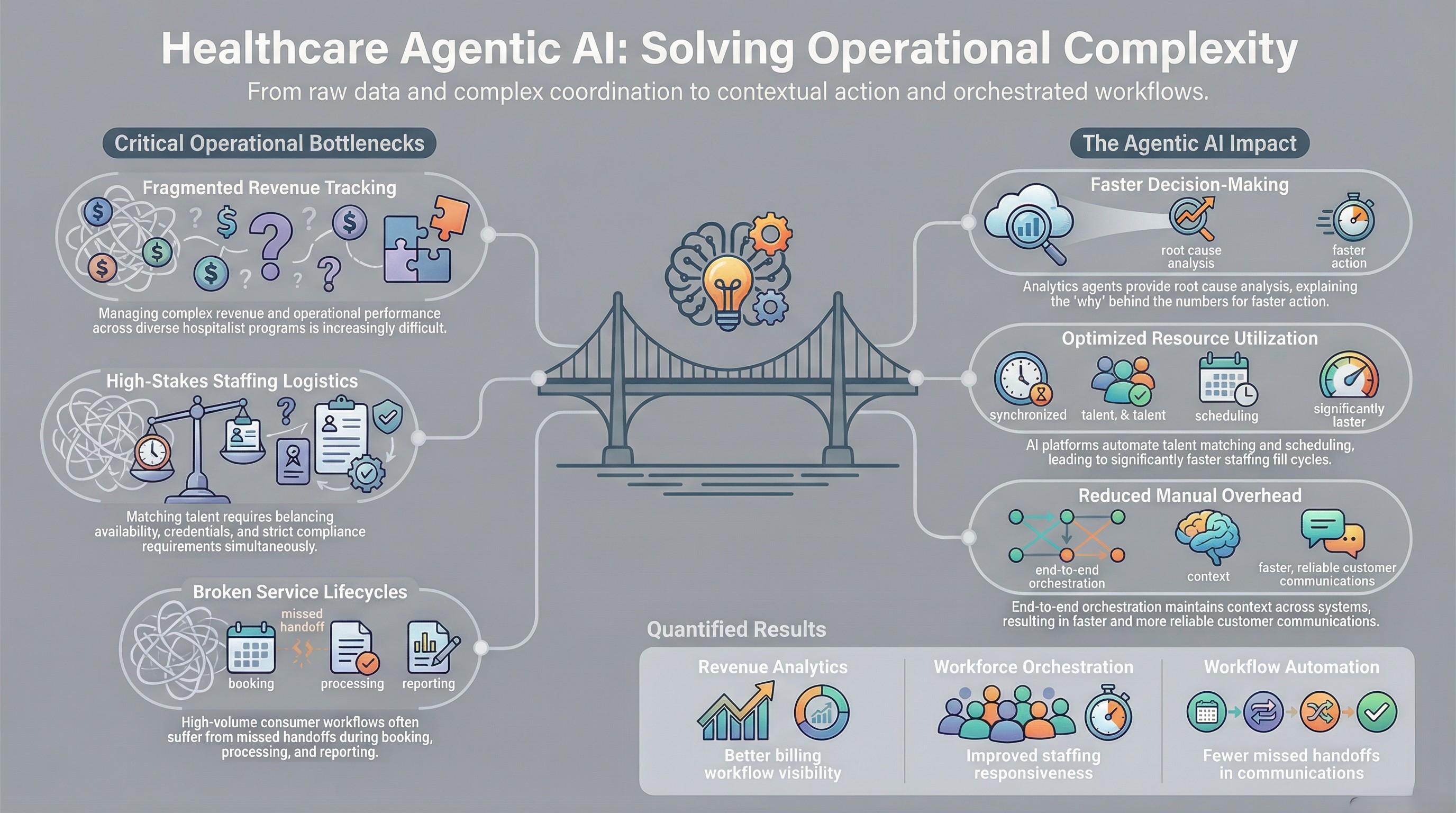
Example 7: Physician-Led Clinical Enterprise - Revenue Analytics
The Challenge: Complex revenue management and operational performance tracking across hospitalist programs
The Solution: Analytics agents providing variance explanations and root cause analysis
Quantified Results:
- Faster operational decision-making
- Better billing workflow visibility
- Improved transparency into service performance
Key Takeaway: Healthcare analytics must explain the "why"—not just present numbers. Agentic systems provide contextual explanations.
Example 8: Healthcare Staffing Platform - Workforce Orchestration
The Challenge: Fast-paced staffing needs, credential management, compliance requirements
The Solution: AI platform for talent matching, scheduling, and compliance workflow automation
Quantified Results:
- Faster fill cycles
- Better workforce utilization
- Improved staffing responsiveness for facilities
Key Takeaway: High-stakes staffing decisions require agents that balance multiple constraints (availability, credentials, compliance) simultaneously.
Example 9: Healthcare Testing Provider - Workflow Automation
The Challenge: High-volume consumer workflows from booking through processing to reporting
The Solution: Platform automation across the entire service lifecycle with status monitoring and notifications
Quantified Results:
- Reduced manual overhead
- Faster customer communications
- Fewer missed handoffs
Key Takeaway: End-to-end workflow orchestration in healthcare requires maintaining context across multiple systems and touchpoints.
Financial Services & Fintech Agentic AI Examples
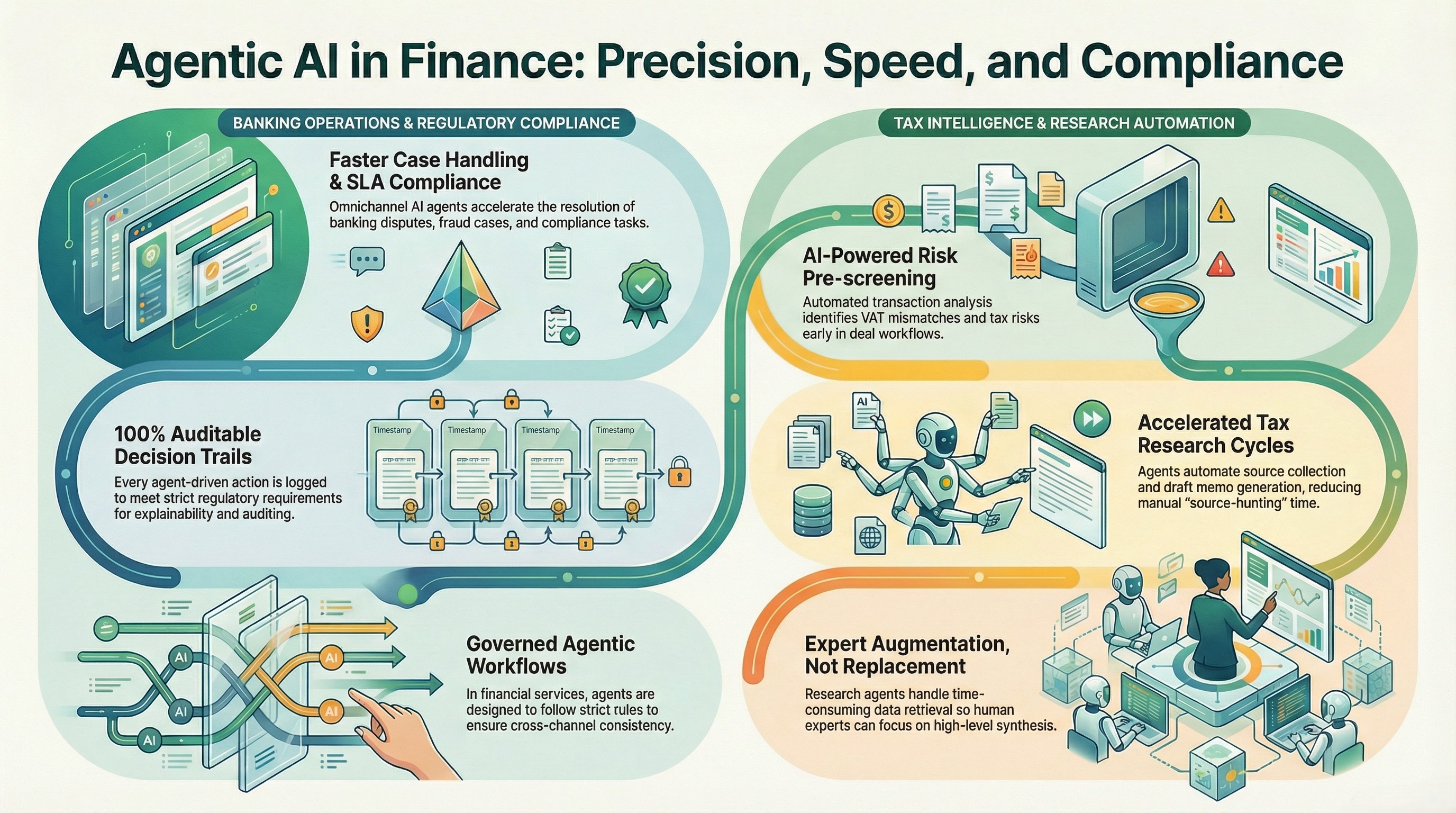
Example 10: Global Fintech - Banking Operations Agent
Company Profile: Cloud-based automation provider for banks and credit unions focusing on disputes, fraud, and compliance
The Solution: Omnichannel AI agents (chat/email/phone) with workflow routing and agent-assist capabilities
Quantified Results:
- Faster case handling
- Improved SLA compliance
- Complete audit trails for regulatory requirements
- Better consistency across channels
Key Takeaway: Regulated workflows demand governed agents. In financial services, every decision must be auditable and explainable.
Example 11: Tax Technology - Cross-Border Tax Intelligence
The Challenge: Identifying withholding tax, VAT mismatches, and permanent establishment risks early in deal workflows
The Solution: AI pre-screening with automated transaction analysis and risk classification
Quantified Results:
- Earlier risk detection
- Faster deal workflows
- Reduced last-minute disruptions
- More consistent pre-compliance review
Key Takeaway: Specialized compliance agents accelerate expert workflows by handling routine screening autonomously.
Example 12: Tax Research Automation - Source Collection & Analysis
The Challenge: Manual source-hunting for sales and use tax research
The Solution: Automated source collection, summarization, and draft memo generation with citations
Quantified Results:
- Faster research cycles
- Better documentation hygiene
- More consistent research outputs
Key Takeaway: Research agents augment rather than replace experts, handling time-consuming retrieval and synthesis tasks.
Real Estate & Property Management Agentic AI Examples
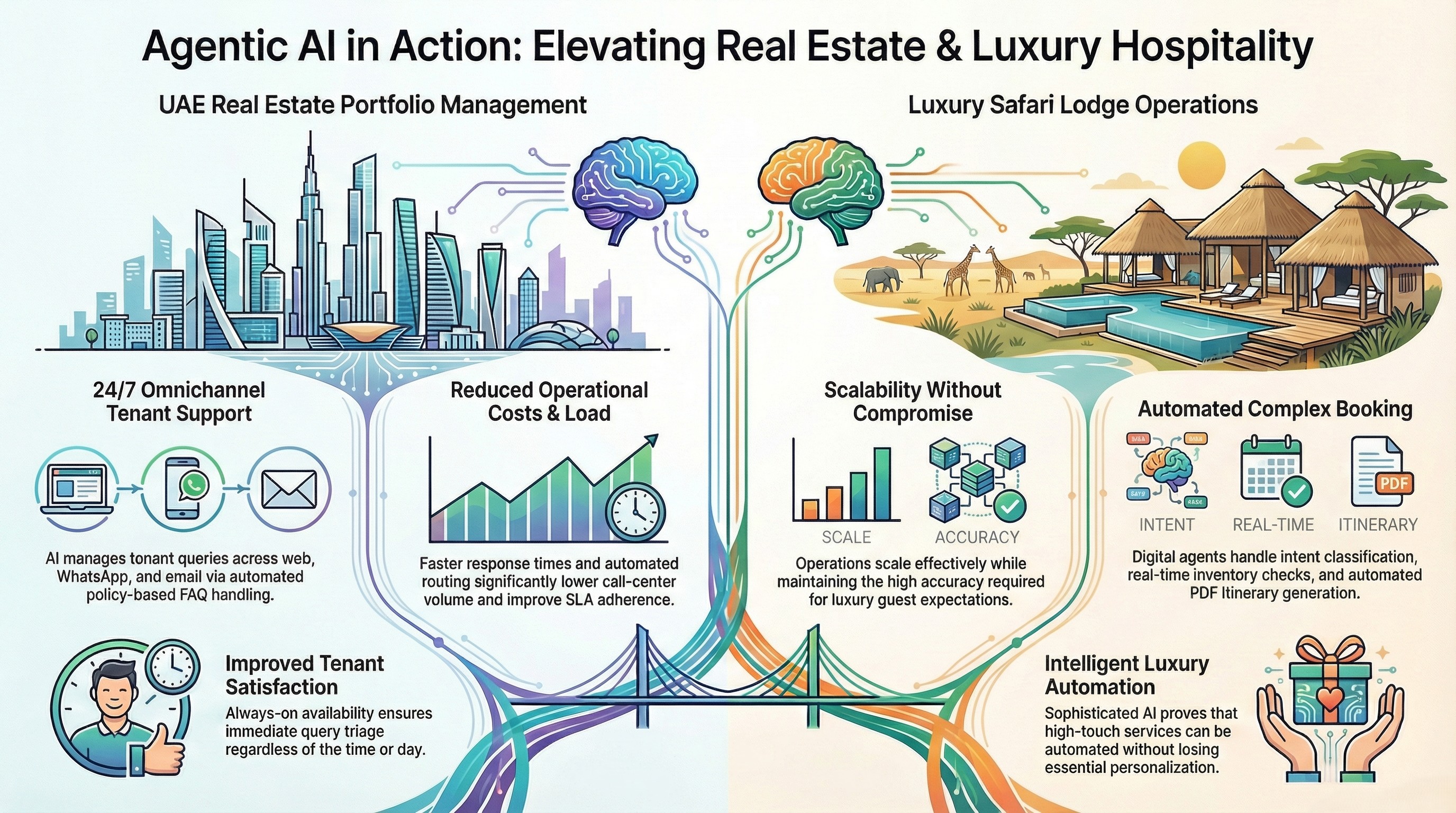
Example 13: UAE Real Estate Portfolio - Customer Service Agent
Company Profile: Major real estate portfolio owner with office, retail, industrial, and residential assets
The Solution: Omnichannel service agent (web/WhatsApp/email) with tenant query triage and policy-based FAQ handling
Quantified Results:
- Faster response times
- Lower call-center load
- 24×7 tenant experience
- Better SLA adherence through automated routing
Key Takeaway: Always-on service agents improve tenant satisfaction while reducing operational costs.
Example 14: Luxury Safari Lodges - Travel Booking Agent
Company Profile: 16 boutique safari properties serving high-expectation global travelers
The Challenge: Complex booking requirements, inventory management, personalized itineraries
The Solution: Digital booking agent with email intake, intent classification, real-time inventory checks, and automated PDF generation
Quantified Results:
- Faster booking turnaround
- Higher accuracy on complex guest requirements
- Scalable operations without compromising luxury service quality
Key Takeaway: Even high-touch, luxury service businesses can automate intelligently without losing personalization.
Infrastructure & Utilities Agentic AI Examples
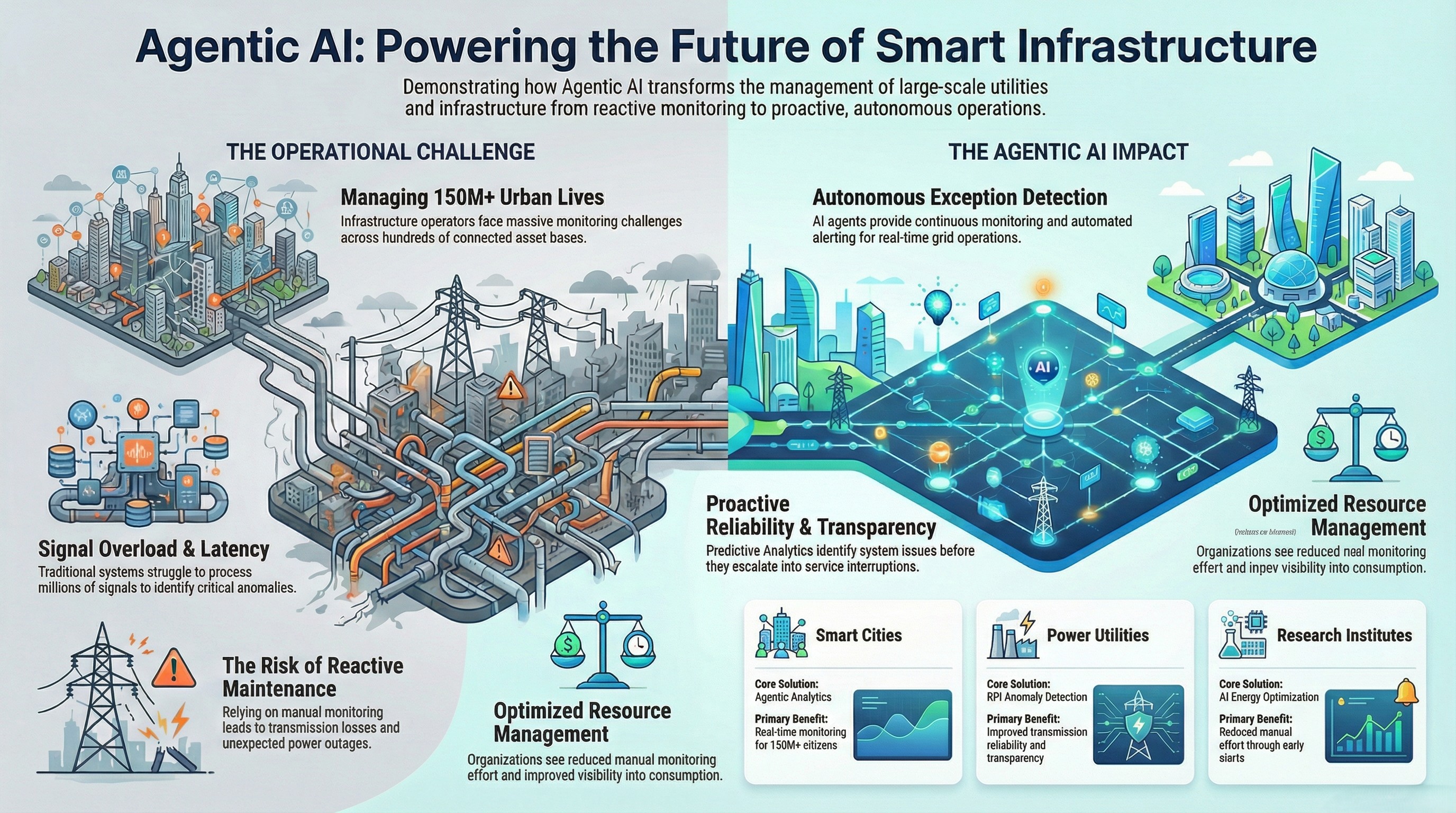
Example 15: Smart City Infrastructure - Grid Operations
Company Profile: Smart infrastructure operator touching 150M+ urban lives with 25+ smart city operation centers
The Challenge: Real-time monitoring and operational alerting across massive connected asset base
The Solution: Agentic analytics with automated alerting on utility systems
Quantified Results:
- Higher operational visibility across grid operations
- Faster exception detection and response
- More proactive operations through continuous monitoring
Key Takeaway: City-scale infrastructure needs autonomous monitoring that can process millions of signals and identify anomalies in real-time.
Example 16: State Power Utility - Transmission Analytics
Company Profile: State power transmission utility responsible for reliable power delivery
The Challenge: Transmission system monitoring, loss analytics, predictive maintenance
The Solution: KPI monitoring with anomaly detection and automated field operation alerts
Quantified Results:
- Faster grid exception identification
- Improved reliability through proactive monitoring
- Better operational transparency for leadership
Key Takeaway: Critical infrastructure benefits from predictive agents that identify issues before they become outages.
Example 17: Research Institute - Energy Management
Company Profile: Premier astrophysics research institute with campus-scale operations
The Challenge: Energy consumption monitoring and optimization across research facilities
The Solution: AI for campus energy monitoring, forecasting, and optimization recommendations
Quantified Results:
- Improved energy visibility
- Reduced manual monitoring effort
- More predictable operations through early alerts
Key Takeaway: Research institutions need intelligent resource management to support their mission-critical work.
B2B Sales & Marketing Agentic AI Examples
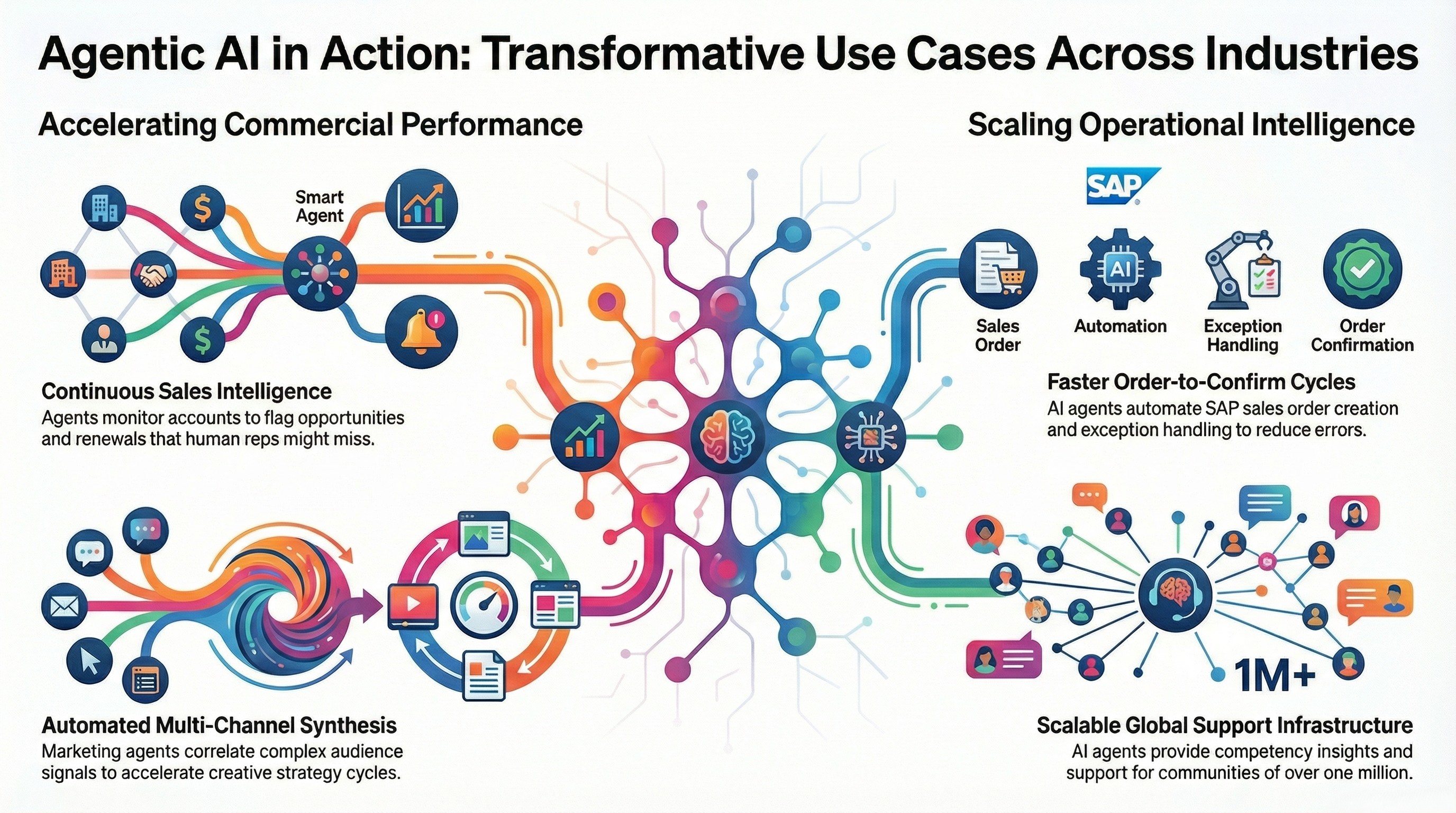
Example 18: Engineering Solutions Provider - B2B Sales Agent
Company Profile: UAE engineering and technology solutions company (established 1972) delivering integrated electrical, mechanical, and automation solutions
The Challenge: Account coverage across large enterprise client base
The Solution: Always-on account monitoring with rule-governed opportunity identification and CRM integration
Quantified Results:
- Higher account coverage without increasing headcount
- Faster response cycles on opportunities and renewals
- More consistent execution via governed playbooks
Key Takeaway: Sales agents maintain continuous customer intelligence, flagging opportunities that human reps would miss.
Example 19: Premium Appliances Retailer - SAP Automation
Company Profile: Kitchen and home appliances retailer with built-in appliance leadership
The Challenge: Manual SAP sales order creation and data entry errors
The Solution: Automated SAP sales order creation via agentic AI with exception handling
Quantified Results:
- Reduced manual processing
- Faster order-to-confirm cycles
- Improved auditability for order creation
Key Takeaway: ERP integration doesn't require expensive custom development—agentic platforms orchestrate existing systems.
Example 20: Brand Strategy Studio - Insights Agent
Team Profile: Studio built by ex-Google brand strategy leaders
The Challenge: Synthesizing signals across creative performance, audience data, and market trends
The Solution: Multi-source signal ingestion with insight narrative generation
Quantified Results:
- Faster creative strategy cycles
- Deeper channel synthesis
- Improved clarity on campaign next-actions
Key Takeaway: Marketing agents synthesize complex, multi-channel signals that would take humans weeks to correlate.
Education & Research Agentic AI Examples
Example 21: Global Teacher Community - Support Agent
Company Profile: Platform serving 1M+ teachers across 131 countries
The Challenge: Scalable support for massive educator community
The Solution: Competency insights, learning guidance, and automated support workflows
Quantified Results:
- Scalable support for global teacher base
- Faster access to learning resources
- Better visibility into engagement and outcomes
Key Takeaway: AI agents scale educational infrastructure without sacrificing quality of support.
Construction & Engineering Agentic AI Examples
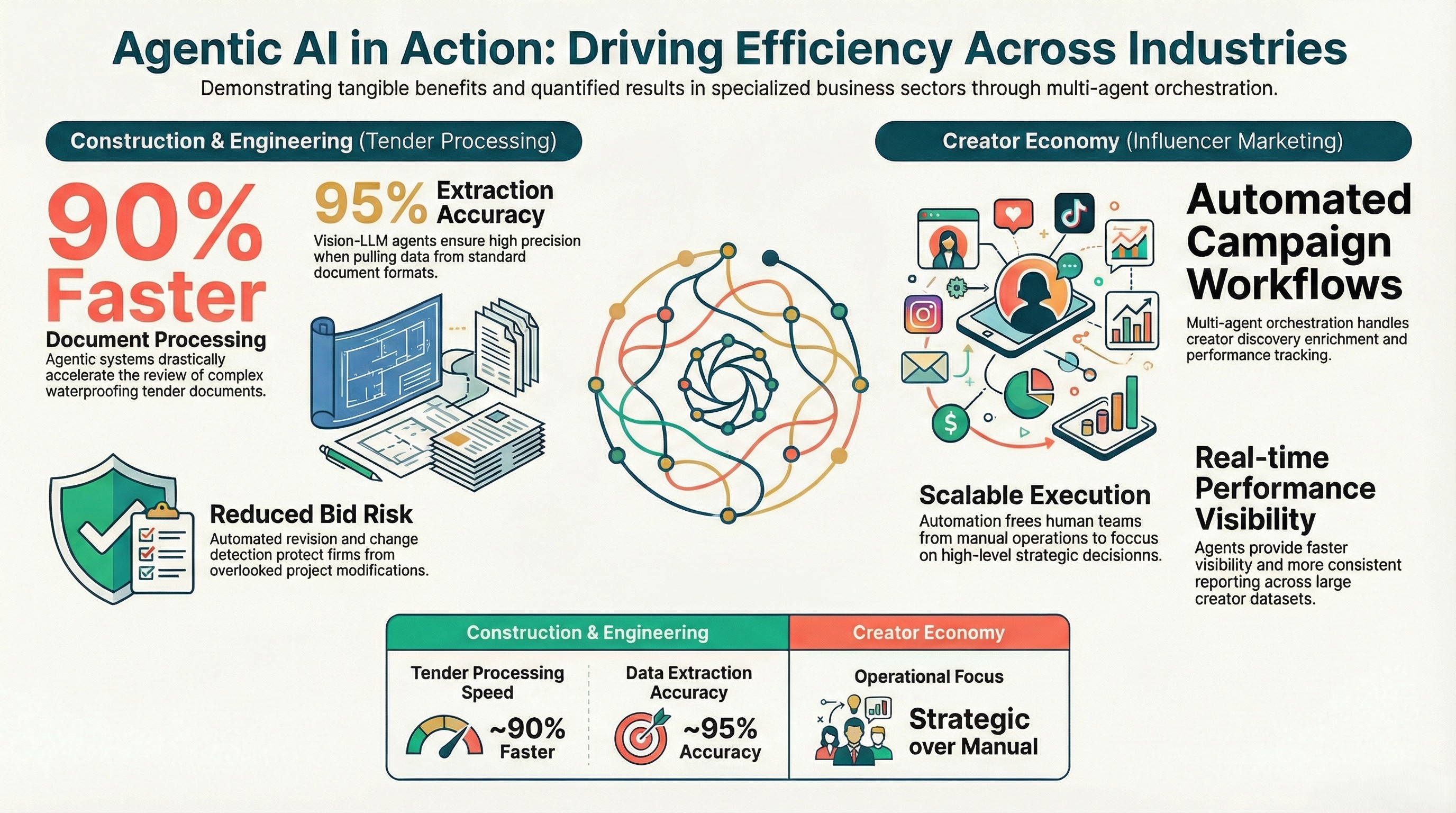
Example 22: Waterproofing Specialist - Tender Document Agent
Company Profile: Australian waterproofing diagnostics and remediation specialist (20+ years)
The Challenge: Complex tender document processing with tight bid deadlines
The Solution: Intelligent Document Workbench with multi-agent orchestration—tender retrieval, workflow determination, Vision-LLM extraction, and system integration
Quantified Results:
- ~90% faster tender document processing
- ~95% extraction accuracy for standard formats
- Reduced bid risk via revision/change detection
- Complete auditability
Key Takeaway: Complex document workflows benefit from multi-agent systems where specialized agents handle retrieval, extraction, validation, and integration.
Creator Economy & Marketing Agentic AI Examples
Example 23: Creator Platform - Influencer Marketing Automation
Company Profile: Platform connecting brands with large creator datasets
The Challenge: Manual campaign operations and performance tracking
The Solution: Creator discovery enrichment, campaign workflow automation, and performance intelligence
Quantified Results:
- Reduced manual operations across campaigns
- Faster performance visibility
- Scalable execution
- More consistent reporting
Key Takeaway: Campaign management agents improve consistency and free human teams for strategic decisions.
Automotive & Leasing Agentic AI Examples
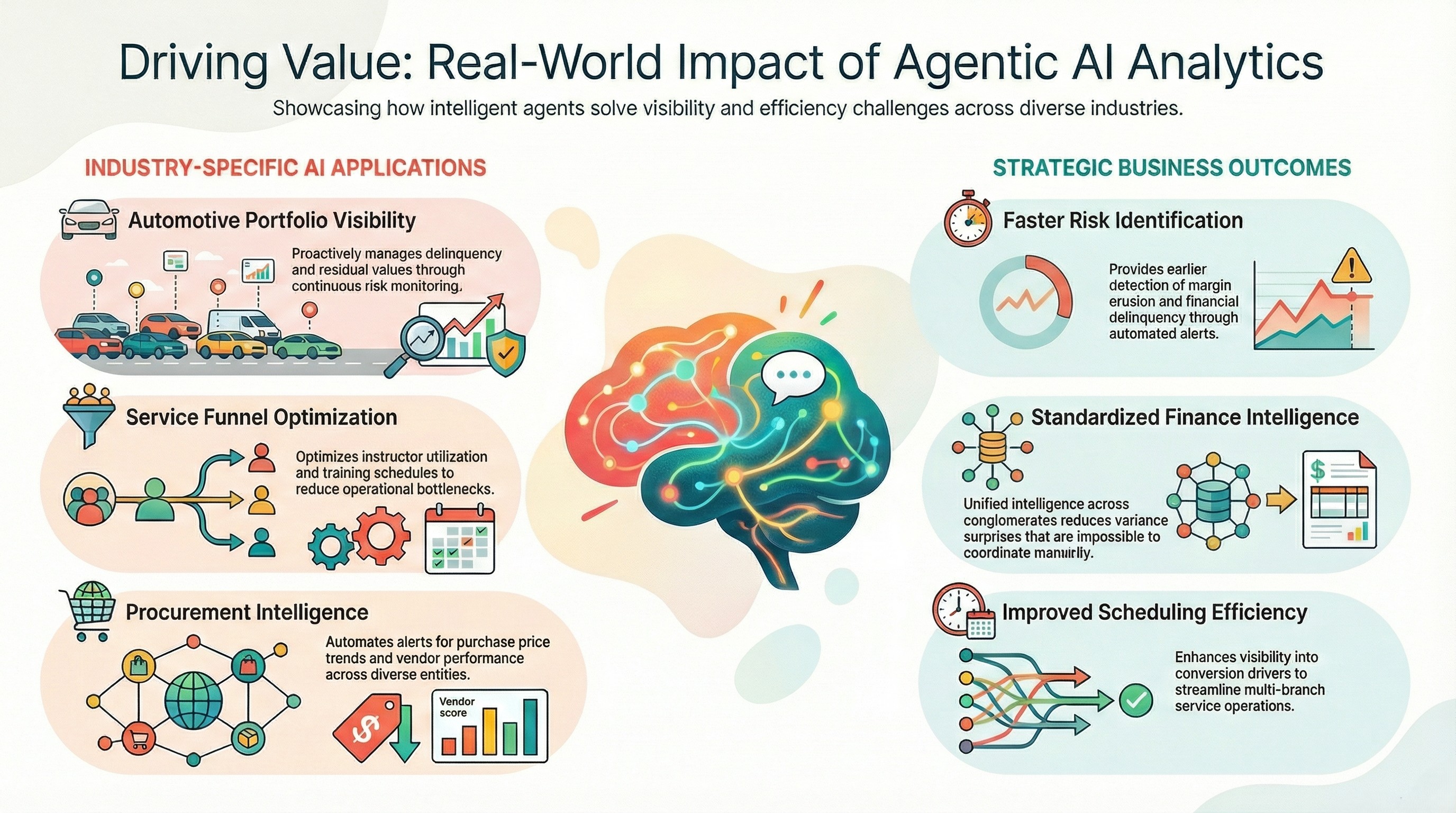
Example 24: Automotive Leasing Provider - Portfolio Analytics
Company Profile: Independent automotive leasing with digital end-to-end processes
The Challenge: Portfolio visibility across risk, delinquency, maturity, and residual values
The Solution: Analytics for portfolio KPIs and dealer network performance with exception alerting
Quantified Results:
- Better portfolio visibility
- Faster risk identification
- Proactive management through continuous monitoring
Key Takeaway: Financial services need continuous portfolio monitoring with automated alerts for early intervention.
Multi-Industry Service Businesses
Example 25: Driving Institute - Operations Analytics
Company Profile: Multi-branch driving school with modern training experiences
The Challenge: Funnel optimization from enrollment through testing
The Solution: Analytics for funnel stages, instructor utilization, and slot optimization
Quantified Results:
- Reduced operational bottlenecks
- Better scheduling efficiency
- Improved visibility into conversion drivers
Key Takeaway: Service businesses optimize resources and improve customer experience with analytics agents.
Example 26: Family Business Conglomerate - Procurement Intelligence
Company Profile: UAE family business group (30+ companies, established 1960)
The Challenge: Margin control and vendor performance across diverse portfolio
The Solution: Automated KPI alerts for purchase price trends, gross margin impact, early-payment analysis, and vendor performance
Quantified Results:
- Earlier detection of margin erosion
- Standardized finance intelligence across entities
- Reduced variance surprises via continuous monitoring
Key Takeaway: Conglomerates need unified intelligence across entities that would be impossible to coordinate manually.
Investment & Due Diligence Agentic AI Examples
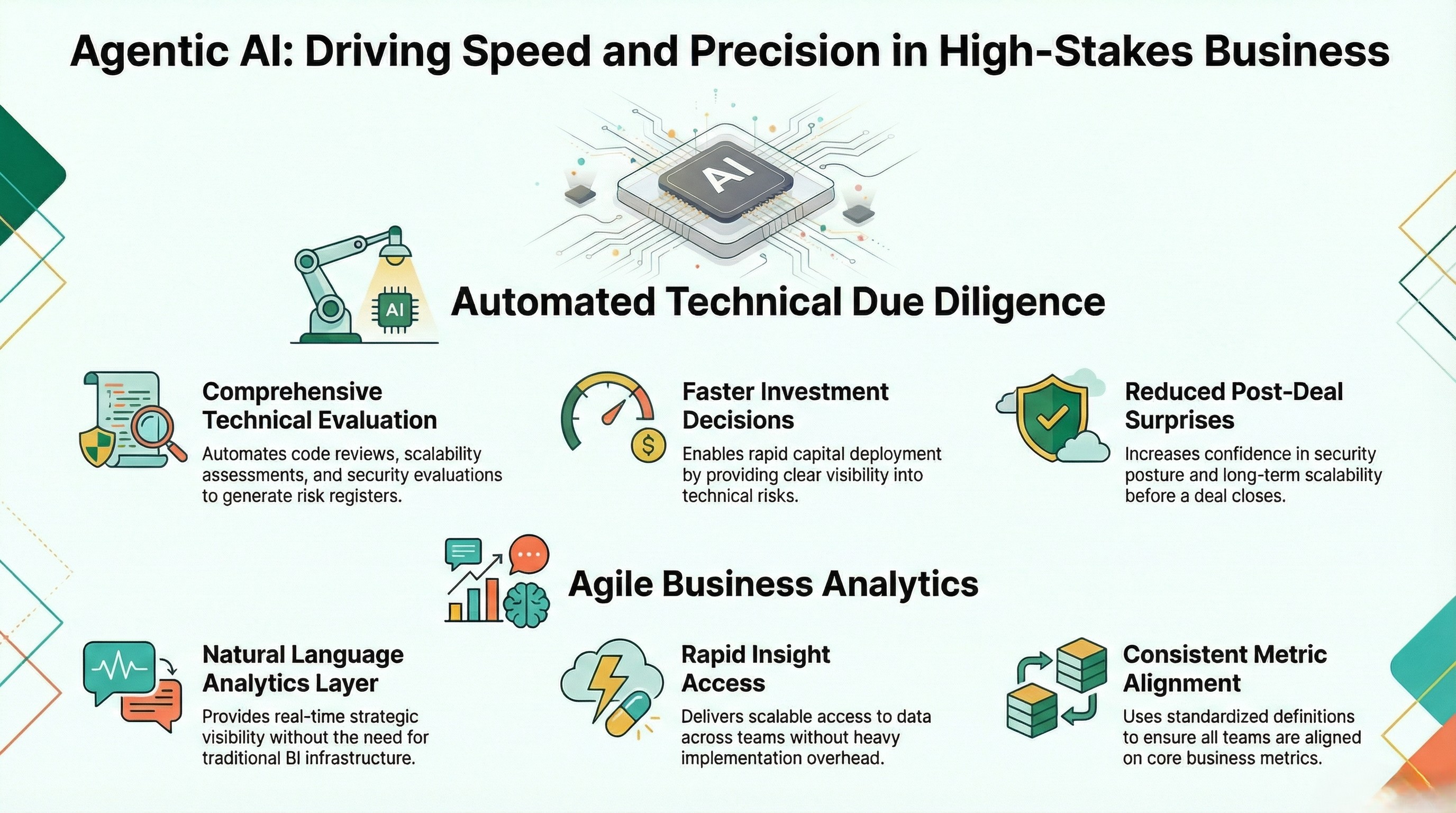
Example 27: Holding Company - Technical Due Diligence Agent
Company Profile: Long-term holding company partnering with founders and family businesses
The Challenge: Rigorous technical diligence for investment decisions
The Solution: Code/architecture review, scalability assessment, security evaluation, and risk register generation
Quantified Results:
- Faster investment decisions with clear risk visibility
- Reduced post-deal surprises
- Improved confidence in scalability and security posture
Key Takeaway: Investment workflows demand automated diligence that's both thorough and fast.
Example 28: Silicon Valley Startup - Business Analytics Agent
Company Profile: AI-based analytics startup (Palo Alto, 2023)
The Challenge: Real-time strategic visibility without traditional BI infrastructure
The Solution: Agentic analytics layer with natural language query interface
Quantified Results:
- Faster strategic visibility
- Improved alignment through consistent metric definitions
- Scalable insight access across teams
Key Takeaway: Startups need rapid insight without the overhead of traditional BI implementations.
Entertainment & Creative Services
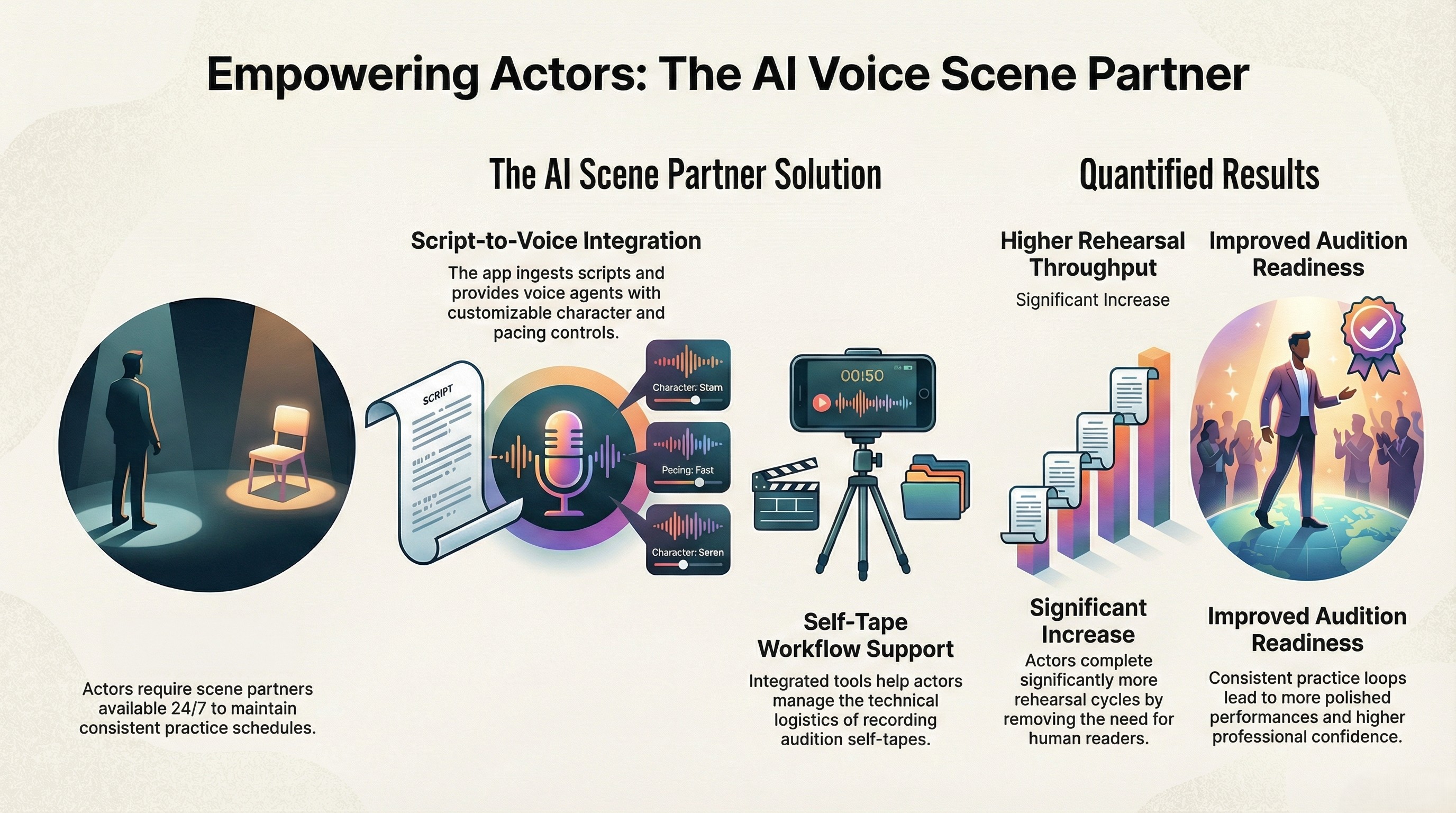
Example 29: Actor Training App - AI Voice Scene Partner
The Challenge: Actors need rehearsal partners available 24/7
The Solution: Script ingestion, voice agent with character/voice control, pacing and cue logic, self-tape workflow support
Quantified Results:
- Higher rehearsal throughput without human readers
- More consistent audition practice loops
- Improved audition readiness
Key Takeaway: Creative professionals benefit from always-available AI partners that adapt to their needs.
Finance & CFO Services
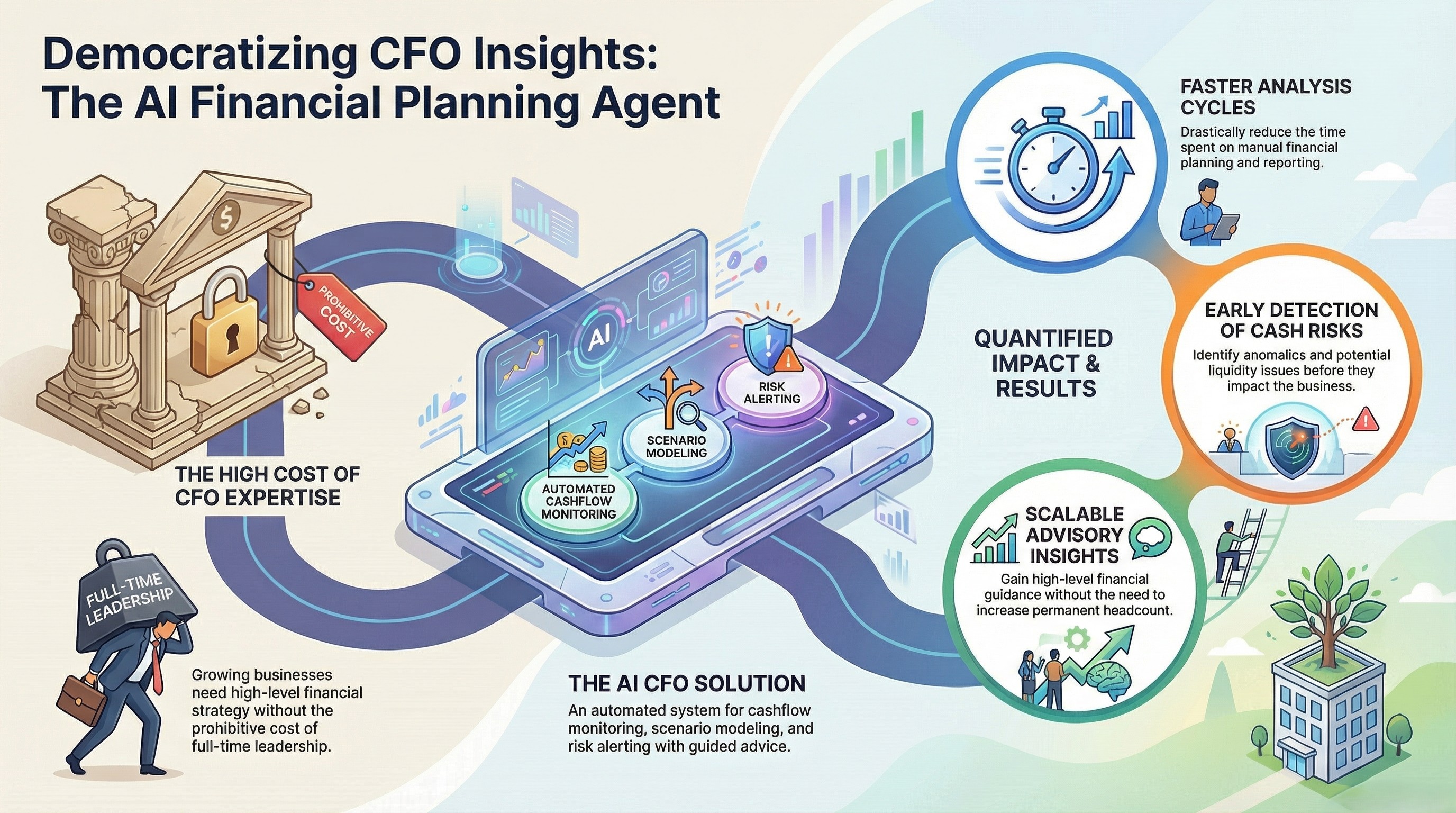
Example 30: AI CFO Platform - Financial Planning Agent
The Challenge: Growing businesses need CFO-level insight without CFO-level cost
The Solution: Cashflow monitoring, forecasting, scenario modeling, and risk alerting with automated guidance
Quantified Results:
- Faster analysis cycles
- Earlier detection of cash risks and anomalies
- Scalable advisory-like insight without added headcount
Key Takeaway: Financial planning agents democratize CFO-level insights for businesses that can't afford full-time finance leadership.
Pharma & Life Sciences
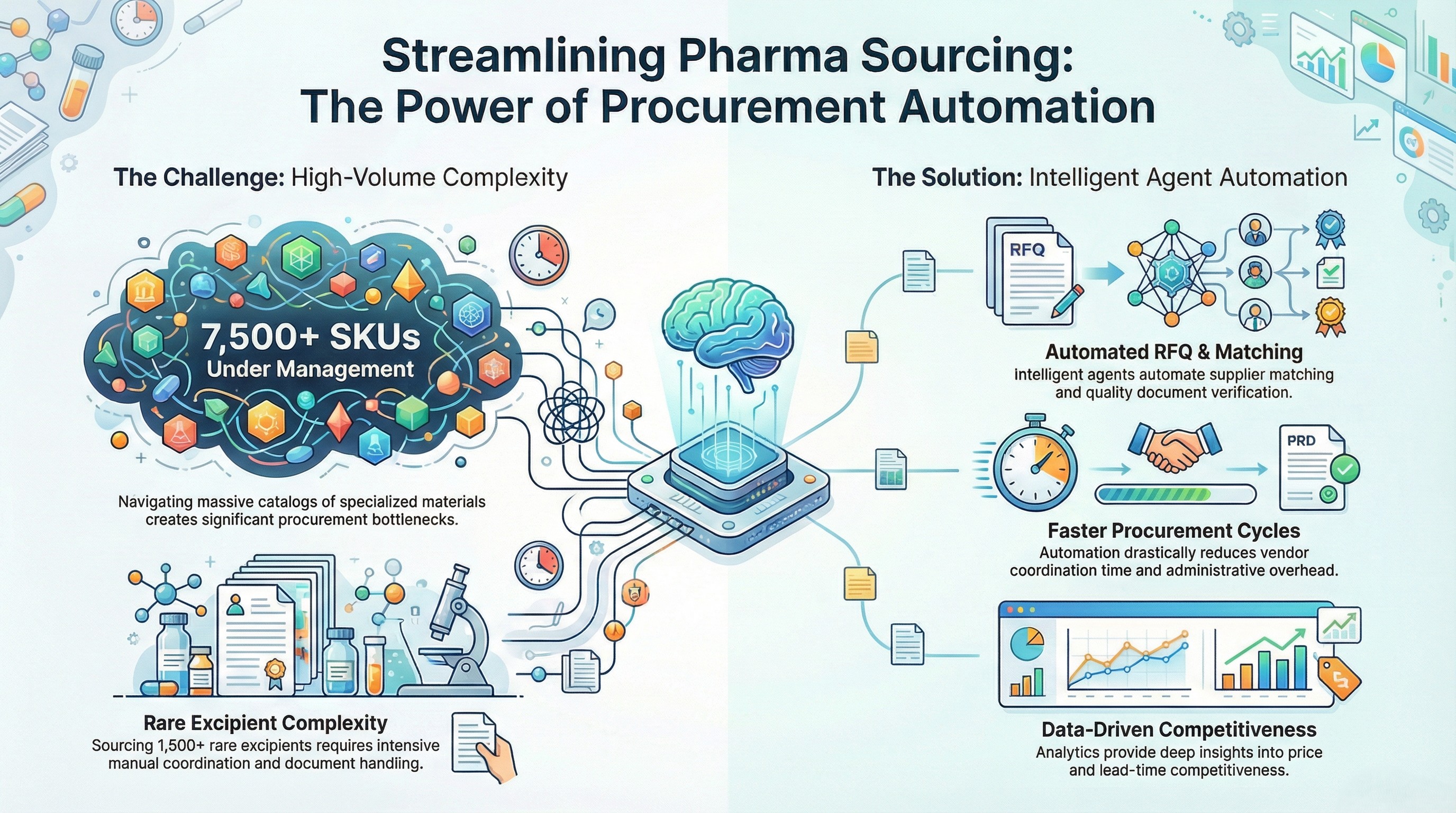
Example 31: Pharma Sourcing Platform - Procurement Automation
Company Profile: Platform marketing 1,800+ rare excipients and 7,500+ SKUs
The Challenge: Simplifying procurement for pharma supply chains
The Solution: RFQ automation, supplier matching, quality document handling, and price/lead-time analytics
Quantified Results:
- Faster procurement cycles
- Reduced vendor coordination
- Better price/lead-time competitiveness through insights
Key Takeaway: Specialized sourcing benefits from intelligent agents that understand domain-specific requirements.
Financial Analysis & Trading
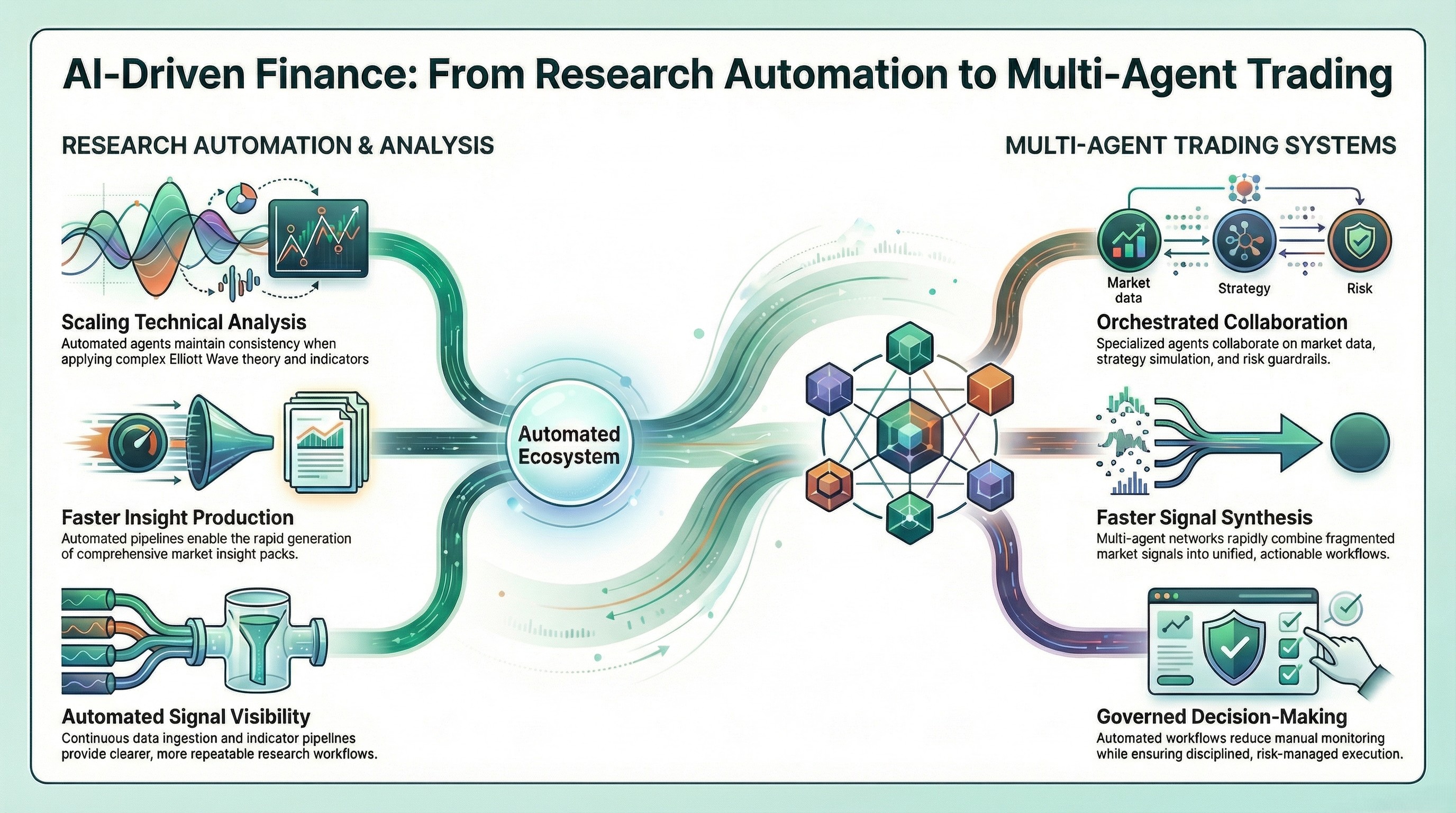
Example 32: Market Research Platform - Research Automation
The Challenge: Technical analysis production with Elliott Wave theory and indicators
The Solution: Data ingestion, indicator pipelines, research automation, and thematic dashboards
Quantified Results:
- Faster production of market insight packs
- More repeatable and consistent research workflows
- Better signal visibility through automated analytics
Key Takeaway: Technical analysis scales with automated agents that maintain consistency.
Example 33: AI Trading Terminal - Multi-Agent Trading System
Company Profile: European AI-first trading platform
The Challenge: Combining research, analysis, signals, and execution in unified workflow
The Solution: Network of specialized agents for market data, strategy simulation, risk guardrails, and execution-ready workflows
Quantified Results:
- Faster synthesis of fragmented market signals
- More disciplined decision-making through governed workflows
- Reduced manual monitoring effort
Key Takeaway: Trading requires orchestrated multi-agent systems where specialized agents collaborate on complex workflows.
Want to be a part of this revolution? Contact Us.
Common Patterns Across All Agentic AI Examples
After analyzing 35+ production deployments, five critical patterns emerge that separate successful implementations from failed experiments.
Pattern 1: The Context Fusion Layer
The Pattern: Every successful implementation unites structured and unstructured data sources into a single semantic layer.
Why It Matters: Agents acting on 20% of context (structured data only) become liabilities. The HVAC manufacturer example illustrates this perfectly—monitoring e-commerce pricing (unstructured web data) while correlating with internal pricing databases (structured ERP data) provided complete competitive context.
Implementation: Build connectors for all data types—ERP tables, PDFs, emails, Slack messages, CRM fields, policy documents, meeting notes. Create semantic mappings that allow agents to understand relationships across these disparate sources.
Pattern 2: Semantic Governance
The Pattern: Every example includes deterministic business rules, approval hierarchies, and compliance thresholds encoded into the system.
Why It Matters: Without governance, agents make probabilistic guesses. With governance, agents execute deterministic logic with explainable reasoning. Example: Automated refunds <$1,000 proceed autonomously; refunds >$5,000 require human approval; refunds between $1,000-$5,000 route to managers.
Implementation: Encode if-then decision trees, threshold-based routing, approval matrices, and policy citations. Every decision must be auditable and defensible.
Pattern 3: Human-in-the-Loop by Threshold
The Pattern: Progressive autonomy based on risk/value calculations.
Why It Matters: Trust scales with controlled risk exposure. Organizations don't need to choose between full automation and no automation—they can deploy graduated autonomy.
Examples Across Industries:
- Healthcare staffing: Routine shifts auto-scheduled; specialized roles require approval
- Financial services: Standard transactions processed; exceptions escalated
- Procurement: Purchase orders under threshold auto-approved; major contracts require review
Pattern 4: Multi-Agent Orchestration
The Pattern: Complex workflows require specialized agents working together, not monolithic single agents.
Why It Matters: Single agents can't handle enterprise complexity. The waterproofing company's tender processing uses four specialized agents: retrieval agent (finds documents), extraction agent (pulls data), validation agent (checks accuracy), integration agent (updates systems).
Implementation: Design agent networks where each agent has clear responsibilities and well-defined interfaces for passing context between agents.
Pattern 5: Continuous Learning Loops
The Pattern: Agents improve from execution feedback with monitoring and drift detection.
Why It Matters: Static automation breaks when conditions change. Agentic systems adapt. They monitor accuracy, track edge cases, flag anomalies, and update rules based on outcomes.
Implementation: Build feedback mechanisms, performance monitoring, anomaly detection, and rule evolution processes into every deployment.
How to Implement Agentic AI: Lessons from 35+ Deployments
Based on real production deployments, here's the proven implementation pathway:
Week 1: Discovery & Workflow Mapping
Identify High-Value Workflows:
- Look for repetitive decision-making workflows
- Target processes with 20+ decisions per day
- Focus on workflows requiring context from multiple sources
- Prioritize processes where speed creates competitive advantage
Map Complete Data Landscape:
- Catalog structured sources (ERP, CRM, finance systems)
- Identify unstructured sources (docs, emails, chat, policies)
- Document external signals (market data, competitor info)
- Map decision points and approval flows
Define Success Metrics:
- Time savings (cycle time reduction targets)
- Accuracy improvements (error rate reduction)
- Scale benefits (volume increase without headcount)
- Risk tolerances (what requires human oversight)
Weeks 2-4: Context Engine + Rules + First Agent
Build Unified Context Layer:
- Connect all identified data sources
- Create semantic mappings across source types
- Establish refresh frequencies for different data types
- Test context completeness with sample queries
Encode Business Rules:
- Document existing approval hierarchies
- Codify threshold-based routing logic
- Define compliance requirements
- Create audit trail specifications
Deploy First Governed Agent:
- Start with single high-impact workflow
- Implement in controlled environment
- Run in parallel with existing process initially
- Validate outputs against human decisions
Day 30: Live Production Agent
Real deployments achieve production in 30 days following this timeline:
No Rip-and-Replace Required: Agentic platforms orchestrate existing systems rather than replacing them. The system becomes the intelligence layer coordinating SAP, Salesforce, Jira, ServiceNow, and other tools you already use.
Progressive Rollout: Start with 10% of volume, monitor closely, expand based on accuracy and outcomes. Most deployments reach full production within 60-90 days.
Common Implementation Mistakes to Avoid
- The 80% Blind Spot: Deploying agents with only structured data access. Solution: Ensure context fusion layer includes unstructured and external sources.
- No Governance Layer: Relying on probabilistic AI without deterministic controls. Solution: Encode business rules explicitly before deploying autonomous execution.
- Black Box Syndrome: No audit trails or explainability. Solution: Require policy citations and reasoning documentation for every decision.
- Analysis Paralysis: Waiting for perfect data instead of starting. Solution: Deploy with 80% data coverage, iterate and improve.
- Single-Agent Thinking: Trying to solve complex workflows with one agent. Solution: Design multi-agent systems with specialized responsibilities.
Agentic AI ROI: Quantified Results Across Industries
Efficiency Gains
40-60% reduction in process cycle times (consistent across sectors)
- From weeks to days for complex workflows
- From days to hours for routine processes
- From hours to minutes for simple decisions
70-85% call/ticket reduction (support use cases)
- Self-service resolution for common queries
- 24/7 availability without staffing costs
- Consistent quality across interactions
90%+ faster document processing (complex workflows)
- Tender documents processed in hours vs. days
- Contract analysis completed in minutes vs. hours
- Compliance reviews automated at scale
100× faster insights (competitive intelligence)
- Real-time market monitoring vs. weekly manual checks
- Immediate pricing gap identification
- Continuous competitor tracking
Accuracy Improvements
93-95% answerability/extraction rates
- Near-human accuracy on structured extraction
- Consistent performance without fatigue
- Continuous improvement through learning
12-26% pricing gap identification (market intelligence)
- Revenue impact in weeks, not months
- Proactive rather than reactive pricing
- Competitive advantage through faster response
Earlier risk detection (finance, compliance, infrastructure)
- Issues identified before they become problems
- Predictive rather than reactive management
- Reduced incident severity and cost
Scale Benefits
Zero-training execution for new users
- No onboarding lag for new policies or products
- Instant scalability during peak periods
- Consistent execution regardless of volume
10,000+ concurrent users supported
- Linear cost scaling vs. exponential with humans
- No capacity constraints for growth
- Uniform quality across all interactions
Multi-entity consolidation without manual overhead
- Single view across geographies and business units
- Standardized metrics and definitions
- Automated cross-entity intelligence
24×7 operations without shift planning
- No coverage gaps or handoff delays
- Immediate response regardless of time zone
- Continuous monitoring and execution
Cost Impact
Reduced legacy system costs: Organizations are replacing expensive, aging automation platforms with more flexible agentic systems.
Lower call center volumes: 70-85% reductions in routine inquiries translate directly to staffing cost savings or capacity for growth.
Eliminated manual coordination overhead: Cross-functional workflows that required multiple meetings and email threads now execute autonomously.
Scalable advisory without added headcount: CFO-level insights, competitive intelligence, and analytical support available to growing companies without proportional cost increases.
Agentic AI Technology Stack: The Three-Tier Architecture
Tier 1: Unified Context Engine
What It Does: Solves the 80% blind spot by fusing structured, unstructured, and external data into a single semantic layer.
Core Capabilities:
- Correlates data across ERP, PDFs, emails, Slack, CRM, and policy documents
- Builds semantic relationships automatically
- Updates continuously as new data arrives
- Provides complete context for agent decision-making
Why It Matters: Agents finally see the full picture—not just database tables, but the emails discussing exceptions, the Slack messages flagging concerns, the PDFs containing negotiated terms.
Tier 2: Semantic Governor
What It Does: Solves the trust problem by encoding deterministic business rules rather than relying on probabilistic AI alone.
Core Capabilities:
- Approval hierarchies and routing logic
- Compliance thresholds and regulatory rules
- If-then decision trees
- Policy citation and audit trail generation
Why It Matters: Every decision is auditable, defensible, policy-cited, and explainable. No hallucinations. No black boxes. Deterministic control prevents agent drift.
Tier 3: Active Orchestrator
What It Does: Solves the execution gap by running multi-step workflows across enterprise systems.
Core Capabilities:
- Connects to SAP, Salesforce, Jira, ServiceNow, Slack, and more
- Executes workflows spanning multiple systems
- Implements human-in-the-loop controls by threshold
- Routes tasks based on rules and context
Why It Matters: Minutes, not weeks. The system doesn't just recommend—it acts. Refunds process, orders create, alerts route, approvals request—all autonomously within governed parameters.
Governance Layer: Critical for Enterprise
Access Control: Role-based and data-scope permissions ensure users only see what they should.
Privacy & PII: Mask, redact, or retain sensitive information based on policy.
Audit Trail: Every query and action logged with complete context and reasoning.
Monitoring: Track cost, latency, accuracy, and drift. Detect anomalies before they become problems.
When to Use Agentic AI vs. Traditional Approaches
Use Agentic AI When:
- Decisions require reasoning over unstructured context (documents, emails, conversations)
- Exceptions are common and can't be pre-scripted
- You need autonomous execution with governance and auditability
- Business rules are complex but definable
- You want systems that learn and adapt from outcomes
- Speed creates competitive advantage
- Manual coordination creates bottlenecks
Use Traditional BI When:
- Pure historical reporting needs suffice
- Structured data provides complete picture
- No execution required (analysis only)
- Manual decision-making is acceptable
- Regulatory requirements mandate human-in-loop always
Use RPA When:
- Workflows are 100% deterministic with no exceptions
- No reasoning required—just data movement
- Structured inputs only
- Exception handling can be externalized to humans
- Integration APIs not available
The Bottom Line: If your workflow involves reading documents, understanding context, making judgment calls, and executing across systems—you need agentic AI. If it's purely moving data from Field A to Field B with no exceptions—RPA works. If you just need reports—traditional BI suffices. Get a demo now.
Future of Agentic AI: Five Emerging Trends
Trend 1: Multi-Agent Collaboration
From: Single agents handling entire workflows To: Networks of specialized agents collaborating on complex tasks
Examples already in production show this pattern: trading terminals with separate research, analysis, and execution agents; document processing with retrieval, extraction, validation, and integration agents.
Implication: Agent coordination protocols and standards will emerge as critical infrastructure.
Trend 2: External Data Integration
From: Internal-only data analysis To: Continuous enrichment with market, environmental, and third-party signals
Competitive intelligence, macroeconomic indicators, supply chain visibility, customer sentiment—external context completes the picture.
Implication: Real-time context enrichment becomes table stakes for competitive advantage.
Trend 3: Voice-First Interfaces
From: Text-only analytics To: Omnichannel with voice as primary modality
The 10,000-user voice agent supporting Hindi and English demonstrates the power of reducing friction for non-technical users.
Implication: Voice becomes the natural interface for conversational analytics, especially in frontline and operational roles.
Trend 4: Industry-Specific Agent Libraries
From: Generic agents requiring extensive customization To: Pre-configured vertical solutions with domain expertise built-in
Healthcare staffing, pharma sourcing, tax research, competitive intelligence—domain-specific agents accelerate time-to-value.
Implication: The market will fragment into vertical specializations, similar to how SaaS evolved from generic to industry-specific.
Trend 5: Federated Governance
From: Single-entity deployments To: Multi-entity, cross-border agent networks with unified governance
Conglomerates, multinationals, and holding companies need agents that work across organizational boundaries while respecting local rules.
Implication: Governance frameworks must support both global standards and local customization.
The Agentic AI Imperative
The evidence is overwhelming. Agentic AI isn't coming—it's here. Across 35+ production deployments spanning every major industry, the pattern is clear:
Organizations are moving from insight to execution. From dashboards that inform to agents that act. From reactive cycles to autonomous intelligence.
The results are quantified and repeatable:
- 40-60% efficiency gains
- 100× faster insights
- 93-95% accuracy rates
- Support for 10,000+ concurrent users
- ROI measured in weeks
The successful implementations share common patterns: context fusion layers that solve the 80% blind spot, semantic governance that provides deterministic control, human-in-the-loop systems that scale trust, multi-agent orchestration for complex workflows, and continuous learning loops that improve over time.
The competitive reality is stark: While some organizations evaluate options, competitors are already accelerating with autonomous agents. The question isn't whether to deploy agentic AI—it's whether your agents will execute with precision or become liabilities.
The 30-day implementation timeline is proven. The technology exists. The ROI is measurable. The only question is: When will you start?
Your Next Steps:
- Identify your highest-value repetitive decision workflows where speed creates advantage
- Map your complete data landscape including structured, unstructured, and external sources
- Define governance requirements and risk thresholds appropriate for your organization
- Start with one high-impact agent and expand based on results
The shift from AI that advises to AI that acts is inevitable. The enterprises that master agentic intelligence first will compound advantages that competitors can't close.
Your agents don't have to fly blind. With the right infrastructure—context fusion, semantic governance, and active orchestration—you can move from reactive dashboards to autonomous execution.
The race has already started. Will you lead, follow, or watch from behind? Get a demo now.
FAQs About Agentic AI
What is agentic AI with examples?
Agentic AI refers to autonomous systems that can reason, decide, and execute actions with minimal human intervention. Real examples include competitive intelligence agents monitoring 10M+ data points autonomously, voice support agents handling 10,000+ users simultaneously, and document processing agents extracting tender data with 95% accuracy.
What is the difference between agentic AI and regular AI?
Regular AI provides insights and recommendations but requires humans to act on them. Agentic AI goes further by autonomously executing decisions within governed parameters. Traditional AI might flag a pricing discrepancy; agentic AI identifies the issue, evaluates options, adjusts pricing, updates systems, and documents the reasoning—all with complete audit trails.
What are some real-world use cases of agentic AI?
Production use cases span every industry: automated store support and competitive monitoring in retail; terminal operations and cross-entity analytics in logistics; staffing optimization and workflow automation in healthcare; fraud detection and tax research in financial services; tenant support and query routing in real estate; continuous competitive intelligence in manufacturing.
How long does it take to implement agentic AI?
Based on 35+ production deployments, typical implementation follows a 30-day cycle: Week 1 focuses on discovery and workflow mapping; Weeks 2-4 cover context engine setup, rule encoding, and first agent deployment; Day 30 marks live production with governance. This doesn't require replacing existing systems—agentic platforms orchestrate what you already use.
What industries benefit most from agentic AI?
Every industry with high-volume, repetitive decision workflows benefits. Current production deployments span retail and e-commerce, manufacturing, logistics, healthcare, financial services, real estate, infrastructure and utilities, construction, education, and more. The common factor isn't industry—it's workflow characteristics: high volume, multiple data sources, complex but definable rules.
Is agentic AI safe for enterprise use?
Yes, when implemented with proper governance. Enterprise-grade systems include semantic governors with deterministic business rules, human-in-the-loop controls based on risk thresholds, complete audit trails with policy citations, access controls and PII handling, and compliance with SOC2, ISO 27001, and GDPR standards. Example: Automated refunds under $1,000 proceed autonomously, while refunds over $5,000 require human approval.
What's the ROI of agentic AI?
Quantified results across 35+ deployments show: 40-60% faster process cycles, 70-85% call reduction in support use cases, 100× faster insights in competitive intelligence, 93-95% accuracy rates, support for 10,000+ concurrent users, and 24/7 operations without shift planning. One manufacturer identified a 12-26% pricing gap and corrected it immediately—ROI measured in weeks, not months.
What's the difference between agentic AI and RPA?
RPA executes scripted tasks, breaks on exceptions, and works only with structured data. Agentic AI reasons over all data types (structured, unstructured, external), handles exceptions autonomously, and adapts through learning. Example: RPA can copy invoice data from a form. Agentic AI can read contracts, cross-reference with email negotiations and Slack discussions, evaluate payment terms against policy, and execute the appropriate workflow—all while explaining its reasoning.

Transform Your Business With Agentic Automation
Agentic automation is the rising star posied to overtake RPA and bring about a new wave of intelligent automation. Explore the core concepts of agentic automation, how it works, real-life examples and strategies for a successful implementation in this ebook.
Sarfraz Nawaz is the CEO and founder of Ampcome, which is at the forefront of Artificial Intelligence (AI) Development. Nawaz's passion for technology is matched by his commitment to creating solutions that drive real-world results. Under his leadership, Ampcome's team of talented engineers and developers craft innovative IT solutions that empower businesses to thrive in the ever-evolving technological landscape.Ampcome's success is a testament to Nawaz's dedication to excellence and his unwavering belief in the transformative power of technology.

More insights
Discover the latest trends, best practices, and expert opinions that can reshape your perspective


Contact us

