
Agentic Process Automation: The Complete Guide to Enterprise AI Agents That Act, Not Just Advise [2026]


A major HVAC manufacturer was hemorrhaging market share—and didn't know it.
Every morning, their pricing team logged into competitor websites. One by one. Manually scrolling through product pages, copying prices into spreadsheets, checking promotional offers. By the time they compiled a complete picture across all SKUs and channels, it was already 48 hours old. And by then, competitors had already moved again.
The cost wasn't just the hours spent on manual monitoring. It was the invisible erosion: pricing gaps widening from 8% to 26% before anyone noticed. Promotional campaigns launching three days after competitors. Strategic questions from leadership—"Are we losing share in the premium segment?"—taking weeks to answer with confidence.
Then they deployed an agentic automation system. Not a dashboard. Not a chatbot. An autonomous agent that:
- Monitored 10 million data points across competitor e-commerce channels continuously
- Answered 31 strategic leadership questions with 93% accuracy
- Detected pricing gaps and promotional shifts in real-time
- Generated insights 100× faster than the manual process
Within the first month, the system identified pricing gaps ranging from 12-26% that had gone unnoticed. The always-on monitoring replaced manual checks across dozens of portals. Competitive response cycles collapsed from weeks to hours.
This is agentic process automation—and it's fundamentally different from anything that came before.
The question for enterprise leaders isn't if AI agents will automate workflows. According to McKinsey, 25% of enterprise workflows will run on agentic AI by 2028. Gartner predicts 50% of enterprises will deploy autonomous decision systems by 2027. Early adopters are already seeing 40-60% reductions in process cycle times.
The real question is: Will your agents execute with precision—or become your biggest liability?
Because there's a critical problem most organizations haven't noticed yet.
What is Agentic Process Automation?
Agentic process automation is an advanced AI system that combines reasoning and autonomous execution to automate complex enterprise workflows. Unlike traditional RPA or AI co-pilots, agentic automation operates on complete business context—both structured and unstructured data—makes governed decisions, and executes multi-step workflows across systems with built-in human-in-the-loop controls.
Think of it this way: Most enterprise AI today sits at Level 4—it can tell you what should happen. Agentic process automation operates at Level 5—it makes it happen, autonomously, with governance guardrails in place.
The Evolution from Reporting to Autonomous Execution
Enterprise intelligence has evolved through distinct stages:
- Reporting (Past): Static reports showing what happened days or weeks ago
- BI Dashboards (Present): Interactive views of structured data in real-time
- Conversational Analytics (Emerging): Natural language queries across all data types
- Agentic Execution (Future/Now): Autonomous decisions and actions with governance
Each stage builds on the previous, creating exponential value. But the leap from insight to execution? That's where the transformation happens—from weeks to real-time, from reports to outcomes, from reactive cycles to autonomous operations.
Why Traditional Automation Fails: The 80% Blind Spot
Here's the uncomfortable truth about enterprise AI: Only 20% of your critical business context lives in structured systems.
Your ERP, CRM, and databases? That's the 20%. The other 80%—the real business truth—lives in:
- PDF contracts with SLAs and negotiated exceptions
- Email threads documenting discounts and special terms
- Slack conversations with approvals and warnings
- Meeting notes with commitments
- Policy documents defining how things actually work
An AI agent acting on 20% of the facts isn't an asset. It's a liability with a confidence score.
The ₹12 Crore Mistake
Consider this real incident: A financial services firm deployed an AI agent for vendor payments. The agent could see ERP data, invoice amounts, and due dates. Perfect, right?
What it couldn't see: Contract PDFs in SharePoint, email negotiations documenting approved discounts, and Slack messages flagging critical cash flow concerns.
Result: ₹12 crore in premature payments approved. Contract terms violated. Negotiated discounts forfeited.
The agent did exactly what it was programmed to do—based on the incomplete picture it had access to.
This is what happens when automation operates in the 80% blind spot.
The Three Pillars of Agentic Process Automation
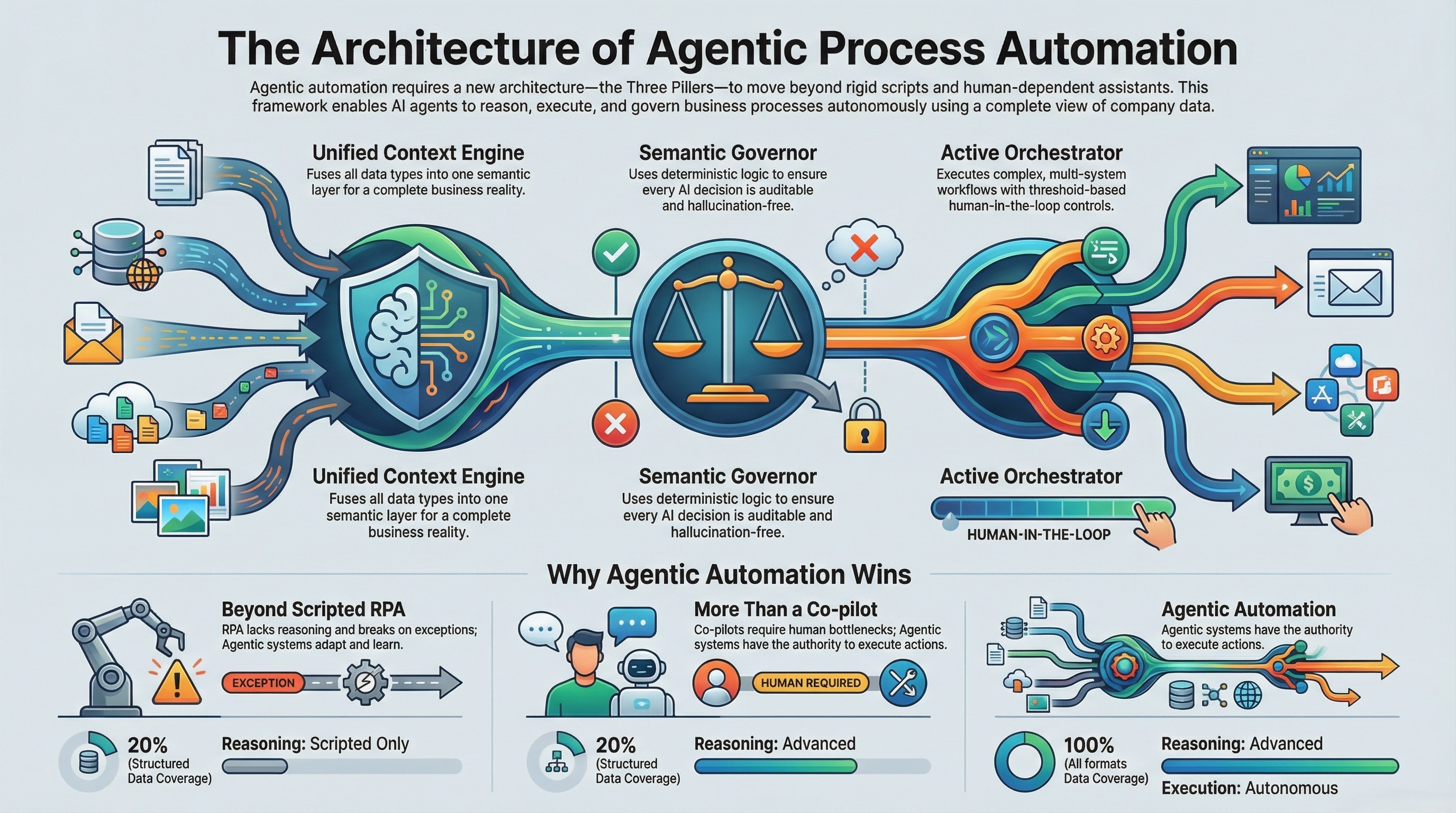
True agentic automation requires a fundamentally different architecture—one that solves for context, governance, and execution simultaneously.
1. Unified Context Engine: Eliminating the Blind Spot
The first pillar fuses structured, semi-structured, and unstructured data into a single semantic layer:
- Structured sources: ERP transactions, CRM records, POS data, financial systems
- Semi-structured sources: System logs, API responses, event streams, NoSQL databases
- Unstructured sources: Documents, emails, chat conversations, media files
- External sources: Competitor data, market signals, customer sentiment, regulatory updates
This contextual fusion means agents finally see the complete picture—not just database tables, but the full business reality including exceptions, negotiations, and human context.
2. Semantic Governor: Making Autonomy Safe
Here's the autonomy paradox: AI agents are amplifiers. They don't create order—they multiply what already exists.
- Clean data + clear rules → efficiency multiplies
- Fragmented data + partial context → chaos multiplies
The Semantic Governor solves the trust problem through deterministic logic:
- Business rules encoding: If-then decision trees, not probabilistic guesses
- Approval hierarchies: Automatic routing based on threshold and role
- Compliance thresholds: Hard stops for regulatory boundaries
- Audit trails: Every decision tied to specific rules and data points
- Explainability: Policy citations for every action taken
Every decision becomes auditable, defensible, and explainable—with zero hallucinations and no black boxes.
3. Active Orchestrator: From Insight to Execution
The final pillar bridges the execution gap by orchestrating multi-step workflows across enterprise systems:
- Connects to SAP, Salesforce, Jira, ServiceNow, Slack, and 100+ systems
- Executes complex workflows that previously required manual coordination
- Implements human-in-the-loop controls by threshold
For example:
- Customer refund < ₹10,000 → Fully autonomous execution
- Refund ₹10,000-₹50,000 → Automatic preparation, single approval required
- Refund > ₹50,000 → Multi-level approval workflow
Result: Minutes instead of weeks. Dozens of decision cycles per month instead of quarterly reviews.
Agentic Process Automation vs. Traditional Solutions
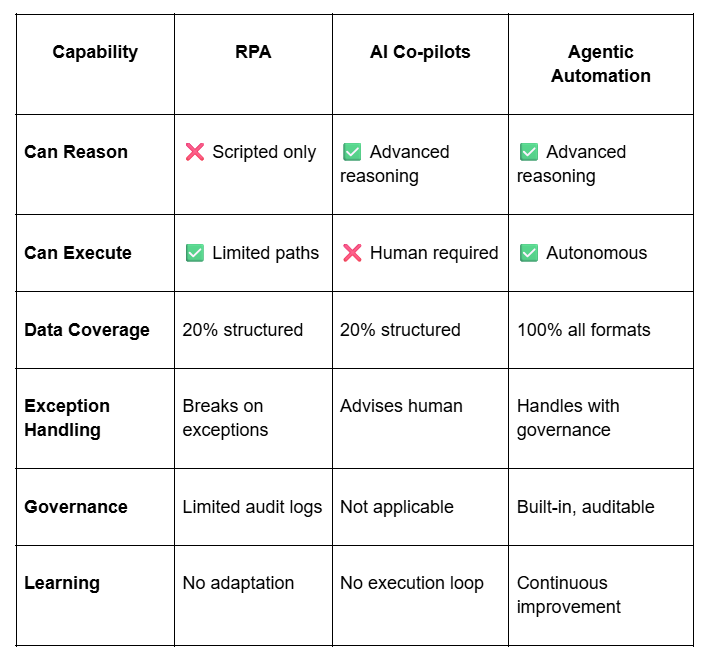
RPA (UiPath, Automation Anywhere): Can execute but cannot reason. Breaks on exceptions. No understanding of unstructured data. Limited to pre-programmed paths.
AI Co-pilots (Microsoft, Salesforce): Strong reasoning capabilities but no execution authority. Humans remain the bottleneck for every action.
Agentic Process Automation: Reasoning + execution + governance on complete context.
Real-World Results Across Industries
Retail & E-Commerce
Large Retail Chain (700+ stores):
- Deployed voice AI agents for store support in Hindi and English
- Built inventory intelligence agents providing real-time pricing/stock/promo data per location
- Created knowledge agents with RAG over POS and SOP documentation
Results: 70% reduction in call volume, 85% faster issue resolution, zero-training execution for store staff
Specialty E-commerce Platform (800+ SKUs):
- Implemented conversational analytics for instant business queries
- Automated KPI monitoring with exception alerting
- Built data ingestion across sales, products, inventory, and customer behavior
Results: Shorter analysis cycles for recurring questions, reduced dependency on data analysts, better visibility into product performance
Manufacturing & Industrial
Major HVAC Manufacturer (10M+ data points):
- Deployed competitive monitoring agents across e-commerce channels
- Built agentic Q&A system answering 31 strategic leadership questions
- Automated pricing gap analysis and threat detection
Results: 93% answerability rate, 100× faster insights, identification of 12-26% pricing gaps with immediate correction capability, always-on monitoring replacing manual portal checks
Global Logistics Provider:
- Consolidated analytics across multi-entity global operations
- Standardized KPIs and reporting structures
- Built operational dashboards with variance explanations
Results: Single operational view across entities, faster leadership reporting, improved consistency of operational metrics
Hospitality & Travel
Luxury Safari Collection (16 properties):
- Automated digital booking agent handling email intake and intent classification
- Built conversational loops to capture missing guest details
- Integrated real-time inventory checks with alternative date/property negotiation
- Automated invoice and PDF document generation
Results: Faster booking turnaround with reduced back-and-forth, higher accuracy on complex guest requirements, scalable luxury service operations
Financial Services
Fintech Banking Platform:
- Deployed omnichannel AI agents for customer support (chat/email/phone)
- Built agent-assist with summarization and next-best actions
- Implemented auditability, reporting, and SLA monitoring
Results: Faster case handling, improved consistency, reduced operational load, better compliance readiness via audit trails
Automotive Leasing Provider:
- Built portfolio analytics for risk, delinquency, maturity, and residuals
- Implemented dealer network performance analytics
- Created automated alerts for exceptions and early risk signals
Results: Better portfolio visibility, faster risk identification, more proactive management through exception monitoring

Healthcare
Private Healthcare Provider:
- Automated booking and workflow orchestration for testing services
- Built status monitoring with customer notifications
- Created operational analytics and reporting dashboards
Results: More scalable operations with reduced manual overhead, faster customer communications, improved service visibility
Physician-Led Clinical Enterprise:
- Developed revenue and utilization analytics models
- Built performance dashboards with variance explanations
- Created action lists for billing workflow optimization
Results: Improved visibility into revenue leakage drivers, faster operational decision-making, more reliable performance tracking
Healthcare Staffing Platform:
- Automated talent onboarding and credential capture
- Built facility staffing request intake with matching logic
- Created scheduling, notifications, and compliance workflows
Results: Faster fill cycles, lower scheduling friction, better workforce utilization, improved staffing responsiveness
Real Estate & Infrastructure
Major Real Estate Portfolio (Multi-emirate Holdings):
- Deployed omnichannel service agent for web/WhatsApp/email
- Automated tenant query triage and FAQs
- Built ticketing and escalation to human teams
Results: Faster response times, lower call-center load, consistent 24×7 tenant experience, better SLA adherence
Global Ports Operator ($20B Revenue):
- Digitized terminal workflow and yard/rail operations
- Built rail scheduling/visibility with exception management
- Created executive dashboards with operational alerts
Results: Improved operational visibility, higher predictability of terminal-to-rail throughput, more efficient coordination across logistics operations
Technology & SaaS
AI Trading Terminal:
- Built network of specialized agents combining research, analysis, and signals
- Implemented strategy simulation with risk guardrails
- Created alerting and recommendation summaries
Results: Faster synthesis of fragmented market signals, more disciplined decision-making through governed workflows, reduced manual monitoring effort
Brand Insights Studio:
- Built multi-source ingestion of creative, performance, and audience signals
- Created insight agents producing themes, narratives, and recommendations
- Automated reporting packs for leadership
Results: Faster creative strategy cycles, deeper signal synthesis across channels, improved clarity on next-best actions for campaigns
Infrastructure & Utilities
State Power Transmission Utility:
- Deployed transmission KPI monitoring with anomaly detection
- Built loss/outage analytics with predictive maintenance indicators
- Created automated alerts for field operations
Results: Faster identification of grid exceptions, improved reliability through proactive monitoring, better operational transparency for leadership
Smart City Infrastructure (150M+ Urban Lives, 2M+ Assets):
- Integrated smart grid data ingestion and operational dashboards
- Built predictive analytics for outages/losses/field issues
- Automated alerts and workflow routing for resolution
Results: Higher operational visibility across grid operations, faster exception detection and response coordination, more proactive operations via continuous monitoring
The Platform Approach: Why Infrastructure Matters
While the results speak for themselves, the underlying architecture makes the difference between proof-of-concept theater and production-grade autonomy. Organizations achieving these outcomes aren't cobbling together point solutions or experimenting with consumer-grade AI tools—they're deploying purpose-built agentic intelligence infrastructure.
The most successful implementations share a common foundation: platforms specifically designed to unify analytical agents, knowledge agents, and agentic workflow engines through conversational access. This architectural approach enables the three-pillar model—context fusion, governed decision-making, and autonomous execution—to work as an integrated system rather than disconnected capabilities.
What distinguishes enterprise-ready platforms like Assistents from experimental approaches is the integration of governance throughout the stack. Rather than bolting compliance onto autonomous agents as an afterthought, advanced platforms embed semantic governance, audit trails, and access controls at every layer—from data ingestion through decision-making to execution. This isn't just about safety; it's about enabling organizations to grant genuine autonomy without creating unmanaged risk.
The emerging pattern among leading deployments is clear: organizations that treat agentic automation as infrastructure—not as a collection of isolated chatbots—achieve transformational outcomes across dozens of workflows simultaneously. They build once, deploy everywhere, with consistent governance and continuous learning across all agents.
How to Implement Agentic Process Automation in 30 Days
Unlike traditional enterprise software implementations that drag on for months, agentic automation can be deployed rapidly:
Week 1: Discovery + Workflow Mapping
- Identify high-impact workflows with manual bottlenecks
- Map current state: systems, data sources, decision points
- Define success metrics and governance requirements
- Select pilot use case with clear ROI potential
Weeks 2-4: Build + Configure + Test
- Connect to existing systems (no rip-and-replace required)
- Build Unified Context Engine over your data landscape
- Encode business rules in Semantic Governor
- Configure approval hierarchies and thresholds
- Test agent behavior with edge cases
- Deploy first governed agent
Day 30: Live Production Agent
- Governed agent executing workflows autonomously
- Human-in-the-loop controls active by threshold
- Full audit trails capturing every decision
- Monitoring dashboard showing agent activity and outcomes
The key difference: Agentic automation orchestrates what you already use. No need to replace your ERP, CRM, or core systems. The platform sits on top, connecting and coordinating.
What to Expect: Proven ROI Metrics
Based on deployments across 35+ enterprises:
Time Efficiency:
- Before: 6 weeks from signal to result
- After: Hours to days
- Impact: 50+ decision cycles per year vs. 8 reactive cycles
Operational Metrics:
- 40-60% reduction in process cycle times
- 70-85% reduction in manual coordination effort
- 90-95% accuracy on standard workflows
- 24×7 availability with no human fatigue
Business Outcomes:
- Earlier detection of competitive threats and opportunities
- Faster response to customer issues and requests
- Improved compliance through consistent rule application
- Better resource utilization through intelligent automation
Cost Impact:
- Reduced headcount needs for routine coordination
- Lower error rates and associated remediation costs
- Decreased dependency on specialized analysts
- Faster time-to-value for strategic initiatives
Enterprise-Grade Security & Compliance
Autonomy without governance is reckless. True agentic automation requires enterprise-grade security:
- SOC2 Type II compliance
- ISO 27001 alignment
- GDPR compliant data handling
- AES-256 + TLS 1.3 encryption at rest and in transit
- Zero training on customer data (models never learn from your proprietary information)
- Complete audit trails with rule citations for every action
- Flexible deployment: Cloud, private cloud, on-premises, or hybrid
Every autonomous action is logged, attributed to specific rules, and traceable back to source data—ensuring full auditability for compliance and forensic review.
The Future is Already Here
While many organizations are still evaluating options, early adopters have moved past proof-of-concepts into production deployment. They're operating at a fundamentally different velocity:
- From insight to execution in hours, not weeks
- From reactive to proactive through always-on monitoring
- From dashboards to outcomes via autonomous workflow completion
The competitive gap isn't incremental—it's exponential. Organizations running 50+ agent-driven decision cycles per year operate in a different reality than those stuck at 8 manual review cycles.
Getting Started: Your 48-Hour Assessment
The path to agentic automation begins with clarity:
Within 48 hours, receive:
- Concrete pilot plan tailored to your operations
- Workflow definition with automation potential scored
- ROI hypothesis with conservative estimates
- Success metrics aligned to business objectives
- Implementation timeline and resource requirements
Our guarantee: If we don't surface real, new value in the discovery phase—we walk. No POC purgatory. No endless sales cycles. Just clear assessment of whether agentic automation can transform your operations.
Conclusion: Agents Don't Have to Fly Blind
The automation paradox is real: AI agents are powerful accelerants, but they amplify whatever foundation they're built on. Give them partial context, and they'll execute wrong decisions faster than humans can intervene.
The solution isn't to slow down or avoid automation—it's to build the right foundation:
- Complete context through fusion of all data types
- Governed autonomy via deterministic rules and thresholds
- Execution capability across enterprise systems
With agentic process automation, you move:
- From reactive to autonomous
- From insight to action
- From weeks to hours
- From 8 cycles per year to 50+
The race has started. The question is whether your agents will execute with precision—or become a liability.
Give your agents sight. Build Level 5 intelligence.
FAQs: Agentic Process Automation
1. What's the difference between agentic process automation and RPA (Robotic Process Automation)?
RPA executes without reasoning. Agentic automation reasons AND executes.
RPA tools like UiPath and Automation Anywhere follow pre-programmed scripts. They're excellent at repetitive, rule-based tasks with predictable inputs—like copying data from one system to another. But the moment they encounter an exception or something unexpected, they break. They can't adapt, can't understand context, and certainly can't read unstructured data like emails or PDFs.
Agentic process automation operates differently. It:
- Understands context from structured AND unstructured data (the full 100%, not just the 20% in databases)
- Reasons through exceptions rather than breaking when it encounters them
- Makes governed decisions using business rules and approval hierarchies
- Executes multi-step workflows across systems autonomously
Think of RPA as a programmed robot following exact instructions. Agentic automation is an intelligent assistant that understands your business rules, sees the complete picture, and takes appropriate action—even when situations vary.
2. How is this different from AI co-pilots like Microsoft Copilot or Salesforce Einstein?
Co-pilots advise. Agentic automation acts.
AI co-pilots are incredibly valuable for augmenting human work—they draft emails, summarize documents, suggest next steps, and answer questions. But they stop at recommendations. A human still needs to review the suggestion, click approve, copy-paste the output, and execute the action in the target system.
With agentic process automation:
- The agent completes the entire workflow from detection to execution
- Human approval is threshold-based: Small decisions execute autonomously, large decisions route for approval
- Integration is built-in: The agent doesn't just suggest creating a sales order—it creates the sales order in SAP, with audit trails
Example: A co-pilot might analyze a customer complaint and suggest "You should issue a ₹5,000 refund and send an apology email." An agentic system processes the complaint, checks against business rules, issues the refund directly in the billing system, generates the apology email, sends it, and logs everything—all autonomously if the amount is below the governance threshold.
The co-pilot makes you faster. Agentic automation removes you from the loop entirely (where appropriate).
3. What does "the 80% blind spot" mean, and why does it matter?
Most enterprise AI only sees 20% of the context it needs to make good decisions.
Traditional business intelligence and automation systems operate on structured data—ERP transactions, CRM records, database tables. That's roughly 20% of your organization's critical business context.
The other 80% lives in:
- PDFs: Contracts with negotiated terms, SLAs, and special conditions
- Emails: Discount approvals, delivery delays, relationship context
- Slack/Teams: Real-time decisions, warnings, approvals
- Documents: Policies, procedures, compliance requirements
- External sources: Competitor moves, market signals, customer sentiment
When an AI agent operates on just the 20%, it's flying blind. It might see that a payment is due, but not see the email chain where payment was deferred. It might process an order, but miss the contract clause about volume discounts.
The ₹12 crore payment error mentioned earlier? That happened because the agent could see the ERP (20%) but not the contracts, emails, and Slack conversations (80%) that provided critical context.
Agentic process automation solves this by fusing all data types—structured, semi-structured, unstructured, and external—into a unified context engine. The agent sees the complete picture before acting.
4. How do you ensure AI agents don't make expensive mistakes or violate compliance rules?
Through the Semantic Governor—deterministic rules, not probabilistic guesses.
This is the critical difference between experimental AI and enterprise-grade autonomy. Agentic process automation doesn't rely on the AI model to "figure out" your business rules. Instead:
1. Business rules are encoded explicitly:
- If customer tier = Premium AND complaint severity = High → Issue refund up to ₹50,000 automatically
- If vendor payment > ₹10 lakhs AND no matching PO → Route to procurement for approval
- If contract renewal date < 30 days AND no signed extension → Alert account manager
2. Approval hierarchies are enforced:
- Threshold-based routing ensures high-stakes decisions require human approval
- Low-value, low-risk actions execute autonomously
- Every threshold is configurable by workflow
3. Compliance boundaries are hard stops:
- Regulatory requirements are encoded as non-negotiable rules
- The agent literally cannot execute actions that violate these constraints
- No "creativity" or "interpretation" on compliance matters
4. Complete audit trails:
- Every decision cites the specific rule that triggered it
- Full data lineage shows which inputs influenced the decision
- Forensic review capabilities for post-action analysis
Unlike LLMs that might "hallucinate" or make probabilistic guesses, the Semantic Governor ensures every action is traceable to an explicit rule. If the agent takes an action, it's because your encoded business logic told it to—not because the AI "thought it was a good idea."
5. How long does it actually take to implement, and do we need to replace our existing systems?
30 days to production. Zero system replacement required.
Traditional enterprise software implementations take 6-18 months because they require:
- Replacing existing systems
- Migrating data
- Retraining employees
- Ripping out and rebuilding workflows
Agentic process automation works differently—it orchestrates what you already have:
Week 1: Discovery
- Map your current workflows and data sources
- Identify automation opportunities
- Define governance rules and thresholds
- Select a pilot use case with clear ROI
Weeks 2-4: Build + Configure
- Connect to existing systems via APIs (no replacement needed)
- Build the Unified Context Engine over your data landscape
- Encode business rules in the Semantic Governor
- Configure approval workflows
- Test with edge cases
Day 30: Live Production
- First governed agent executing autonomously
- Human-in-the-loop controls active
- Full audit trails operational
- Monitoring dashboard live
What you DON'T need to do:
- ❌ Replace your ERP, CRM, or core systems
- ❌ Migrate historical data
- ❌ Retrain your entire organization
- ❌ Rip out existing workflows
The platform sits on top of your existing infrastructure, connecting SAP, Salesforce, Slack, ServiceNow, and whatever else you use. It coordinates and executes across these systems without requiring you to abandon investments you've already made.
After the first agent proves value, you can rapidly expand to additional workflows—typically adding new agents in days, not months, because the foundational infrastructure is already in place.

Transform Your Business With Agentic Automation
Agentic automation is the rising star posied to overtake RPA and bring about a new wave of intelligent automation. Explore the core concepts of agentic automation, how it works, real-life examples and strategies for a successful implementation in this ebook.
Sarfraz Nawaz is the CEO and founder of Ampcome, which is at the forefront of Artificial Intelligence (AI) Development. Nawaz's passion for technology is matched by his commitment to creating solutions that drive real-world results. Under his leadership, Ampcome's team of talented engineers and developers craft innovative IT solutions that empower businesses to thrive in the ever-evolving technological landscape.Ampcome's success is a testament to Nawaz's dedication to excellence and his unwavering belief in the transformative power of technology.

More insights
Discover the latest trends, best practices, and expert opinions that can reshape your perspective







Contact us

