
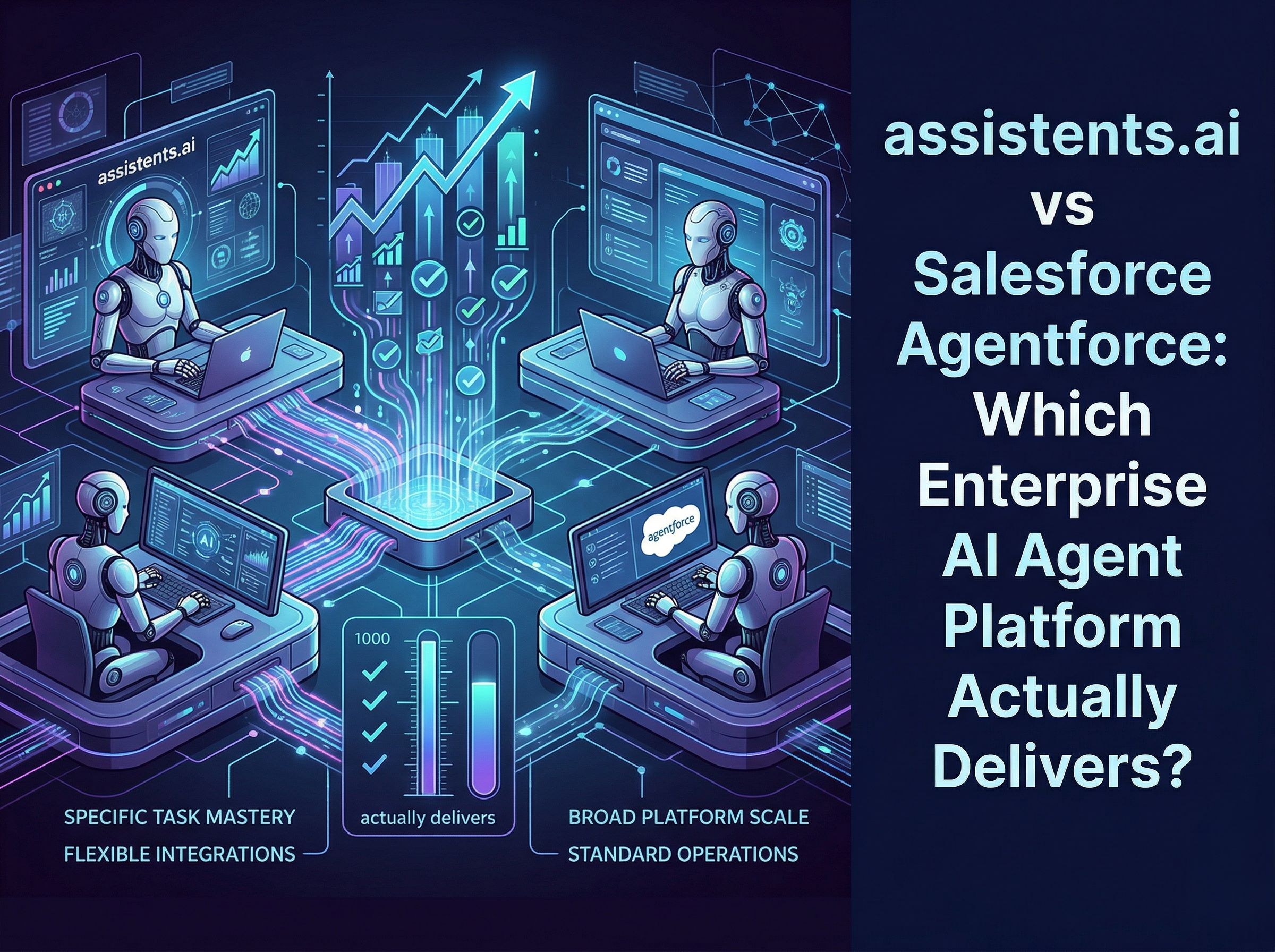
assistents.ai vs Salesforce Agentforce: Which Enterprise AI Agent Platform Actually Delivers?


The 30-Second Verdict
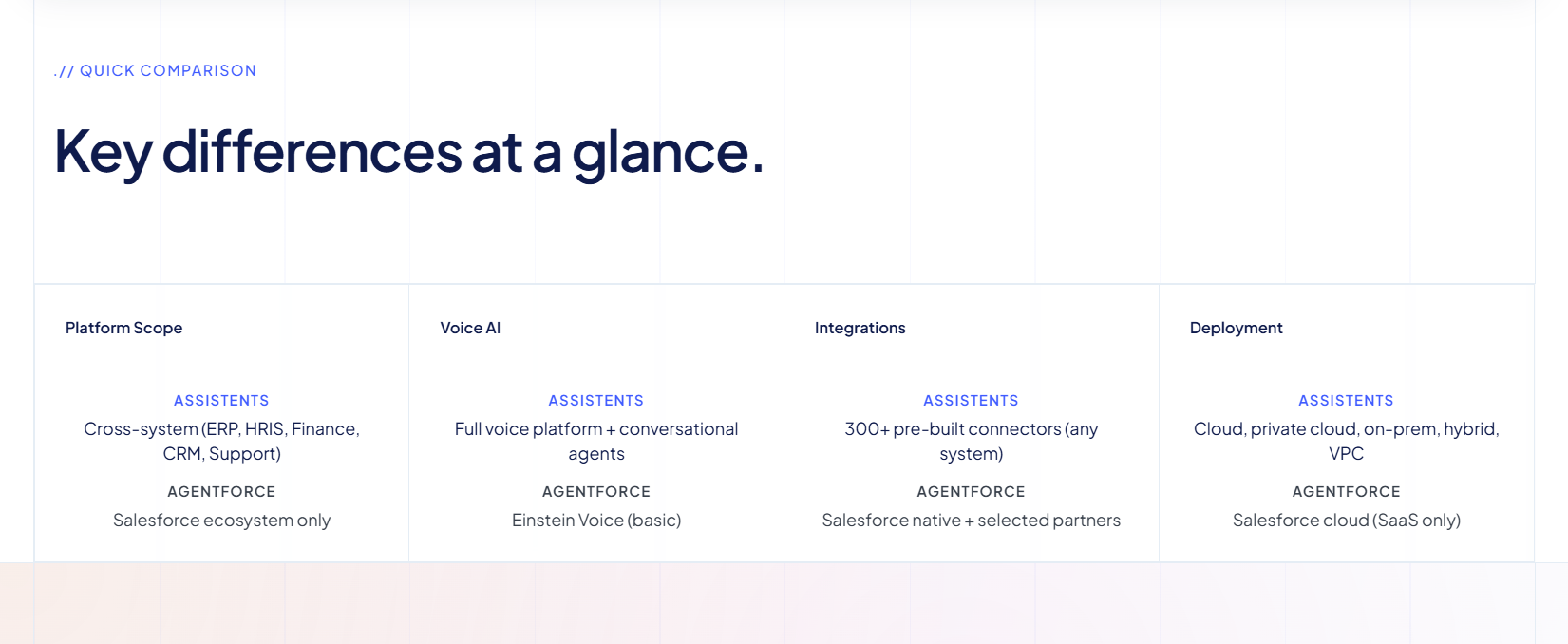
If your enterprise runs on Salesforce, Agentforce is a compelling add-on. But if your operations span SAP, ServiceNow, Oracle, custom ERPs, and a dozen other systems — Agentforce stops at the edge of Salesforce's ecosystem, and your problem starts there.
assistents.ai is built for the second scenario: autonomous AI agents that work across your entire enterprise stack, not just one vendor's walled garden. Deployment in four weeks. 300+ integrations. Governance and compliance baked in.
This comparison breaks down both platforms across every dimension that enterprise buyers actually evaluate — architecture, deployment speed, compliance, integration depth, and real production outcomes — so you can make the right call for your organisation.
What Each Platform Is Actually Built For
Salesforce Agentforce: CRM-Native, Ecosystem-Locked
Agentforce is Salesforce's answer to the enterprise AI agent moment. It is deeply embedded in the Salesforce CRM ecosystem and genuinely powerful within those boundaries. If your sales, service, and marketing workflows live primarily inside Salesforce, Agentforce can automate meaningful parts of them with relatively low friction.
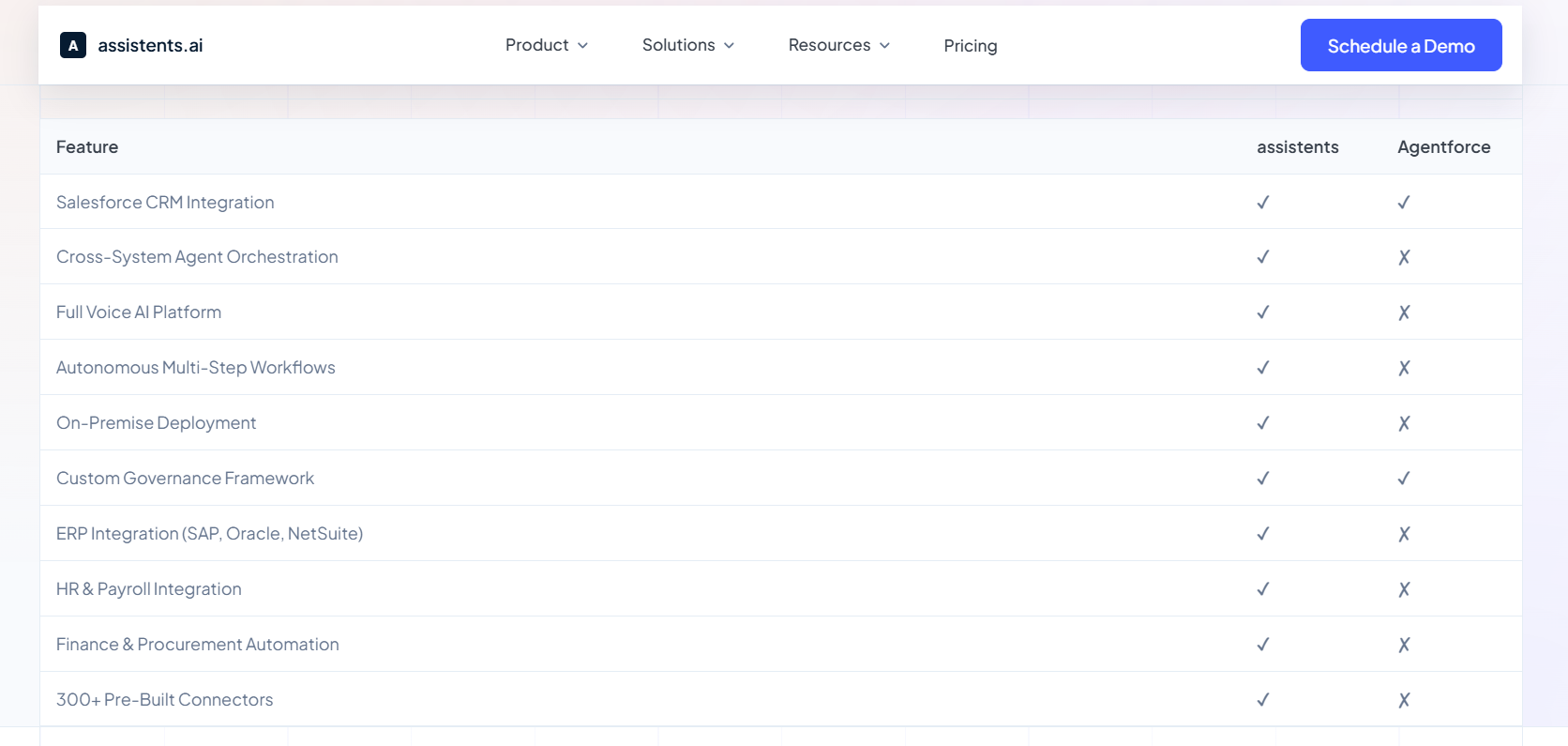
The constraint is structural. Agentforce agents are designed to operate within Salesforce's data model, workflows, and integration layer. Cross-system orchestration — coordinating actions across SAP and ServiceNow simultaneously, pulling context from a proprietary ERP while writing back to a data warehouse — is where the platform struggles. Enterprise operations are rarely single-vendor. Agentforce was not designed for the messy, multi-system reality of most large organisations.
assistents.ai: System-Agnostic Agentic AI for Enterprise Operations
assistents.ai, built by Ampcome, is architected around a fundamentally different assumption: enterprise environments are heterogeneous, compliance-heavy, and resistant to rip-and-replace. The platform deploys autonomous AI agents that orchestrate workflows across multiple systems simultaneously — reading from one, reasoning, and writing back to another — without requiring those systems to be replaced or restructured.
The result is an agentic AI platform that works inside your existing stack rather than requiring the stack to conform to it. 300+ integrations, twelve industry verticals, a four-week deployment window, and enterprise-grade compliance coverage across SOC 2, GDPR, HIPAA, and ISO 27001 are all structural design choices, not afterthoughts.
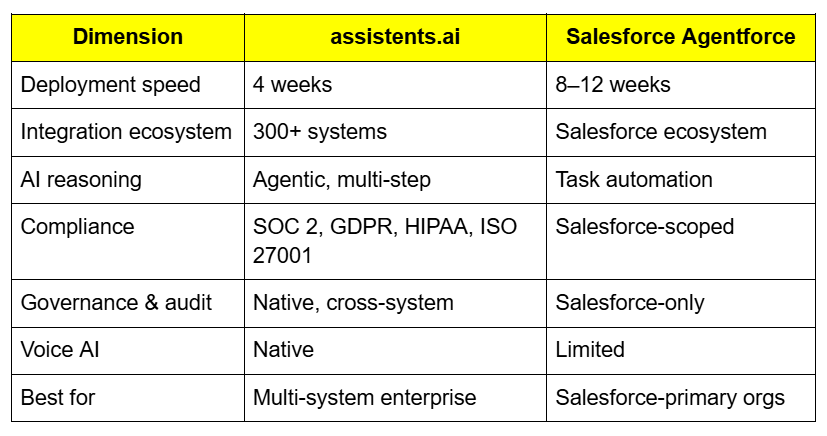
Head-to-Head: The 7 Dimensions That Matter for Enterprise Buyers
1. Deployment Speed: 4 Weeks vs 8–12 Weeks
Enterprise software implementations are notoriously slow. Agentforce deployments, particularly those requiring meaningful customisation beyond out-of-the-box Salesforce workflows, typically run eight to twelve weeks and often longer when cross-functional dependencies and data migration are involved.
assistents.ai is built for a four-week deployment window. This is not a marketing claim — it reflects an architectural decision to work with existing systems rather than against them. When agents don't need to restructure your data model or renegotiate your integration layer, implementation cycles compress significantly.
For organisations evaluating multiple platforms, deployment speed is frequently underweighted at the shortlist stage and overweighted at the post-go-live review. Four weeks versus twelve weeks is the difference between a Q2 pilot and a Q4 rollout.
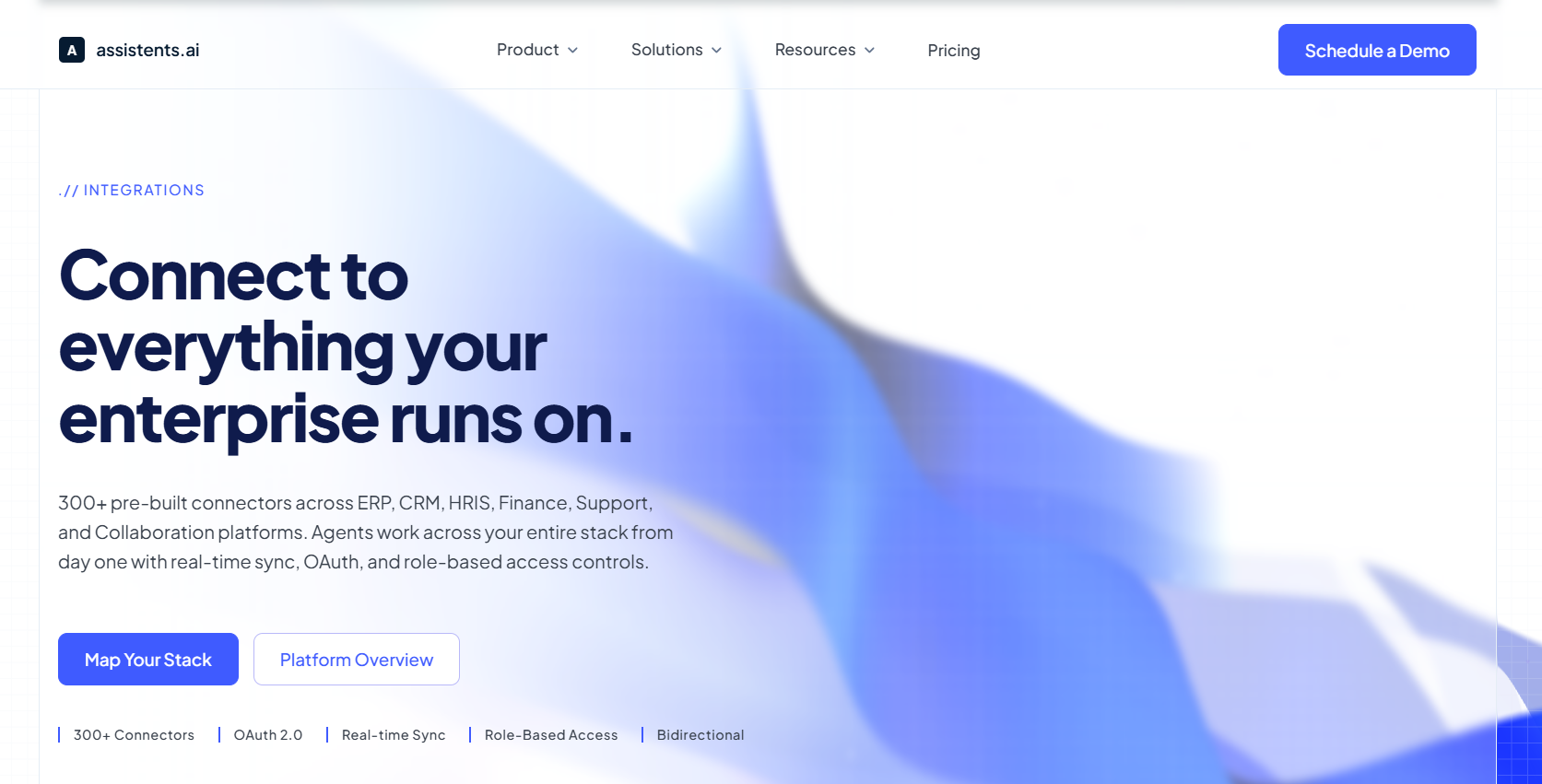
2. Integration Ecosystem: 300+ Integrations vs Salesforce-Only
Agentforce integrates deeply with the Salesforce product suite: Sales Cloud, Service Cloud, Marketing Cloud, and the broader AppExchange ecosystem. For organisations where Salesforce is the primary system of record, this is genuinely sufficient.
The majority of large enterprises, however, run on a combination of systems that no single vendor owns. SAP for ERP. ServiceNow for IT operations. Oracle for finance. Proprietary platforms built a decade ago that are expensive to replace and impossible to ignore. assistents.ai's 300+ integrations are designed for this reality — agents that can pull context from a logistics system, validate against a compliance database, and push results to a CRM, all within a single workflow.
The practical implication: if your enterprise AI agent needs to touch more than one vendor's ecosystem to be useful, integration depth is the most important dimension to evaluate.
3. AI Reasoning vs Task Automation
This is the architectural distinction that matters most for 2026 and beyond, and it is frequently obscured in vendor comparisons.
Traditional RPA and early AI agent platforms excel at task automation: follow a defined rule, execute a defined sequence, flag exceptions for human review. They are fast and reliable within their defined parameters. They break when the parameters change.
assistents.ai is built around genuine AI reasoning — multi-step decision-making that can handle ambiguous inputs, evaluate competing options, and adapt to exceptions without requiring a human to rewrite the rule. When a tender document arrives in an unexpected format, a reasoning-based agent can interpret it; a task-automation agent cannot.
Agentforce sits closer to the task-automation end of the spectrum for most use cases, particularly outside its native Salesforce context. assistents.ai's agentic-first architecture is built for workflows where the path is not always predictable.
4. Compliance Coverage: HIPAA, SOC 2, GDPR, ISO 27001
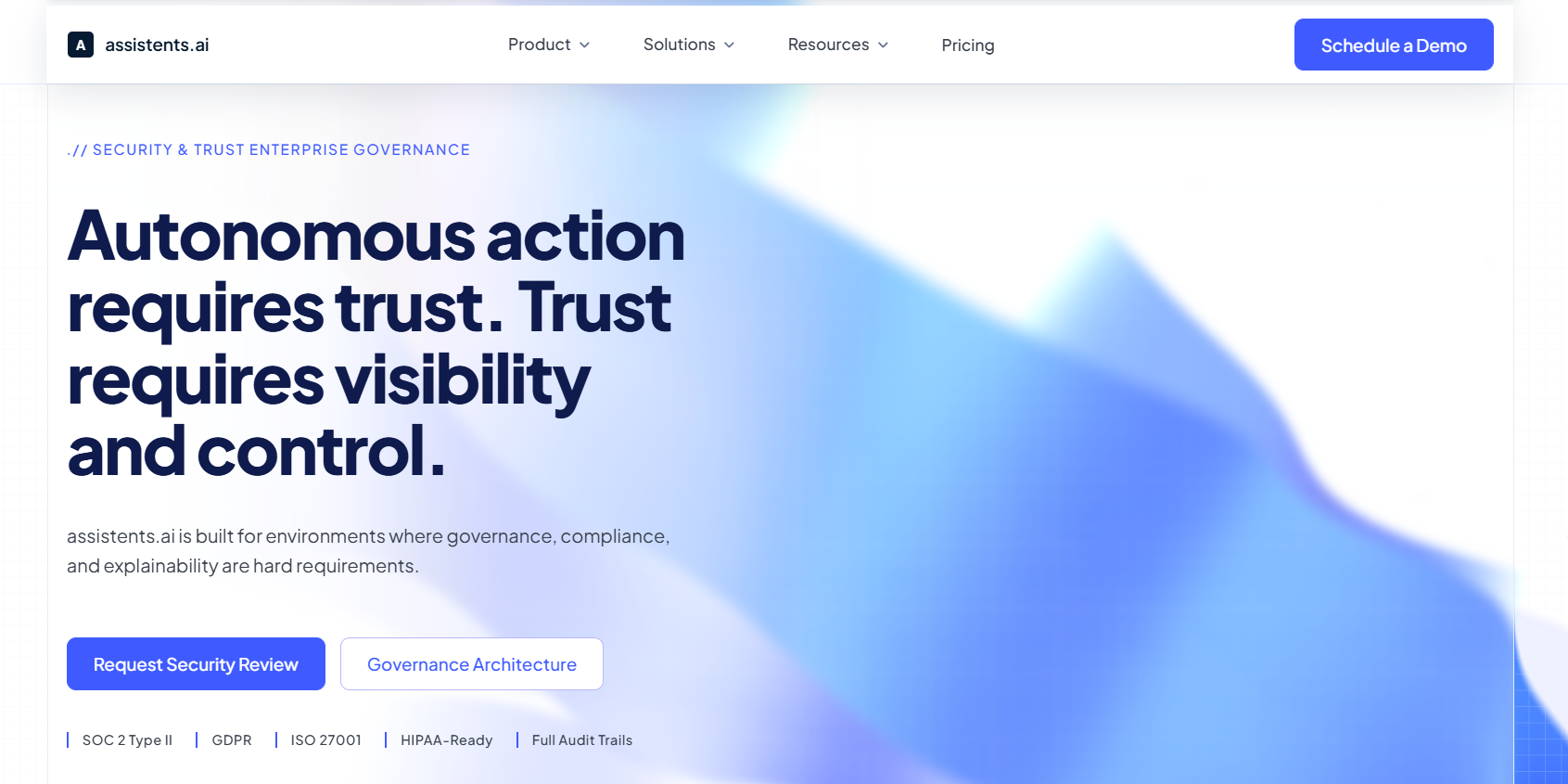
Compliance is not a feature — it is a precondition for enterprise adoption in regulated industries. Healthcare, financial services, energy, and public sector organisations cannot deploy AI agents that do not meet their regulatory requirements, regardless of how capable those agents are.
assistents.ai carries SOC 2, GDPR, HIPAA, and ISO 27001 compliance coverage. This is not a bolt-on — it reflects deployments in production environments where compliance is the first conversation, not the last. Regulated industry verticals including healthcare, financial services, and energy are core to the platform's design.
Agentforce inherits Salesforce's compliance certifications within the Salesforce environment. Outside that environment — in cross-system workflows — compliance responsibility shifts to the implementation team, which increases both complexity and risk.
5. Governance and Auditability
Enterprise AI governance is rapidly becoming a board-level concern. The question is no longer whether AI agents will be deployed but how their decisions will be documented, audited, and contested when something goes wrong.
assistents.ai builds governance and auditability into the agent layer — every workflow includes audit logs, decision trails, and exception handling that can be reviewed, reported on, and handed to a compliance team. This is especially critical for workflows involving financial transactions, procurement decisions, and patient data.
Agentforce offers governance tooling within Salesforce's admin framework, which is mature and well-documented. The gap appears in cross-system workflows where Salesforce's governance layer does not extend, leaving audit coverage incomplete.
6. Voice AI and Omnichannel Support
Voice AI is an increasingly significant differentiator for enterprise platforms targeting customer-facing and field operations use cases. assistents.ai includes voice AI capabilities — agents that can handle spoken interaction, multilingual support, and voice-first workflows — as part of the core platform.
Agentforce does not offer native voice AI at the same depth. For organisations running contact centres, field service operations, or customer-facing workflows where voice is a primary channel, this is a meaningful capability gap.
7. Total Cost: Licensing, Implementation, and Switching Cost
Agentforce is priced as an add-on to an existing Salesforce investment. For organisations already paying significant Salesforce licensing fees, the marginal cost of Agentforce may appear low — until implementation, customisation, and ongoing admin costs are factored in. Cross-system orchestration requirements, which Agentforce handles poorly natively, typically require additional middleware and professional services investment.
assistents.ai is positioned as a standalone enterprise AI agent platform, which means licensing is a clean line item rather than a negotiation inside an existing enterprise agreement. Four-week deployments reduce professional services costs significantly. The 300+ native integrations reduce or eliminate middleware spend.
Total cost of ownership over a three-year horizon — including implementation, integration, ongoing admin, and switching costs if the platform underperforms — consistently favours platforms with faster deployments and broader native integrations.
Real Enterprise Deployments: What Agentic AI Actually Looks Like in Production
The difference between a platform that works in a demo and one that delivers in production is best illustrated by what has actually been deployed. The following cases are drawn from real enterprise deployments across industries — verticals only, no client names.
Automating End-to-End Logistics Across Global Supply Chains
A global ports and logistics enterprise operating across multiple continents needed to modernise terminal and rail management workflows that were running on a combination of legacy systems and manual coordination. The challenge was not a data problem — they had data. It was an orchestration problem: no single system had a complete view, and critical decisions were being made with incomplete information.
The deployment introduced an agentic AI layer that digitised terminal workflow management, built yard and rail operational dashboards from live data, and implemented automated exception management and executive alerting. The outcome was measurable improvement in terminal-to-rail throughput predictability, faster exception detection, and more efficient coordination across a geographically distributed operation.
The key architectural requirement was system-agnosticism — agents that could ingest data from multiple operational systems and act across them without requiring those systems to be replaced. This is precisely the class of problems that a Salesforce-native platform cannot address.
AI Agents in Regulated Industries: Financial Services and Healthcare
Two of the most demanding deployment environments for enterprise AI agents are financial services and healthcare, for the same reason: compliance is not optional, and the cost of a governance failure is not just reputational but legal.
In financial services, a banking and fintech deployment required omnichannel AI agents that could handle customer intake across chat, email, and voice, route workflows based on intent, and produce complete audit trails for every interaction. The agents needed to integrate with core banking systems and operate within compliance frameworks that govern every customer touchpoint. The deployment produced measurably faster case handling, reduced operational load, and improved compliance readiness through automated audit trail generation.
In healthcare, a staffing platform serving clinical facilities needed to automate matching, scheduling, and compliance verification for nursing professionals — workflows where both speed and accuracy carry direct patient care implications. The agentic deployment automated credential capture, staffing request intake, matching logic, and scheduling notifications, producing faster fill cycles, better workforce utilisation, and improved compliance workflows.
Neither of these deployments was possible within a single-vendor ecosystem. Both required agents that could reason across systems — credentialing databases, scheduling platforms, compliance records — simultaneously.
Retail and Operations: Store-Level Intelligence at National Scale
A large-scale value retailer operating hundreds of stores needed AI agents that could serve store-level operational needs without requiring centralised IT intervention for every query. Staff needed answers about inventory, pricing, and standard operating procedures in real time. The legacy approach — centralised helpdesks and static knowledge bases — could not scale.
The deployment introduced a voice support agent capable of handling queries in multiple languages, an inventory intelligence agent providing real-time pricing and stock information at the store level, and a knowledge and training agent built on retrieval-augmented generation over existing POS and SOP documentation. The result was a measurable reduction in manual helpdesk burden, improved store-level inventory visibility, and faster onboarding for new staff through on-demand training guidance.
This use case illustrates a specific class of enterprise AI agent deployment that Agentforce cannot serve: multilingual, voice-first, multi-system workflows where the Salesforce CRM is not part of the operational picture at all.
Replacing Legacy ERP Automation with Agentic Workflows
A manufacturing and technology organisation was operating a sales order creation process through a third-party document management system that had reached end-of-life and was carrying significant annual licensing costs. The replacement requirement was not just technical — it required agents that could interpret order triggers, validate data, apply business rules, handle exceptions, and create SAP sales orders with full audit logging and reconciliation reporting.
The agentic deployment replaced the legacy system entirely, reducing manual order processing, compressing the order-to-confirm cycle, and improving auditability for sales order creation and exceptions. The licensing cost elimination was itself a return on investment within the first year.
This class of deployment — replacing legacy RPA and document automation with genuinely agentic workflows — represents a large and growing opportunity in enterprise AI, and one where task-automation platforms are architecturally unsuited to succeed.
Where Agentforce Wins — and Where It Doesn't
Credible comparisons require honesty about both sides.
Agentforce is genuinely strong in the following scenarios. If your sales and service workflows are Salesforce-native and your primary objective is automating CRM-adjacent tasks — lead qualification, case routing, email drafting, knowledge retrieval within Service Cloud — Agentforce delivers this with low implementation friction and tight native integration. The Salesforce admin ecosystem is mature, the documentation is extensive, and the vendor relationship is well-established for enterprises already inside the Salesforce universe.
Agentforce also benefits from Salesforce's brand trust with enterprise procurement teams. For organisations where vendor risk is evaluated heavily at the approval stage, Salesforce's scale and track record reduce friction in the buying process.
Where Agentforce does not win: multi-system orchestration, regulated industries outside the Salesforce compliance envelope, voice AI, non-CRM operational workflows, and any deployment where the enterprise stack extends meaningfully beyond Salesforce's ecosystem. These are not edge cases — they describe the majority of large enterprise environments.
Which Platform Is Right for Your Enterprise?
Choose Agentforce if:
- Your primary operational workflows live inside Salesforce Sales Cloud or Service Cloud
- Your organisation already has a significant Salesforce investment and wants to extend it with AI capability
- Your AI agent use cases are CRM-adjacent: lead handling, case routing, knowledge retrieval, email automation
- Your compliance requirements are met within Salesforce's existing certification framework
- You have an internal Salesforce admin team capable of managing agent configuration
Choose assistents.ai if:
- Your operations span multiple systems — SAP, ServiceNow, Oracle, proprietary ERPs — and your agents need to work across all of them
- You are in a regulated industry (healthcare, financial services, energy, manufacturing) and need HIPAA, SOC 2, GDPR, or ISO 27001 compliance baked in
- Your deployment timeline cannot accommodate an eight-to-twelve-week implementation
- You need voice AI or multilingual agent capabilities as part of the deployment
- Your use case involves genuine multi-step reasoning — not just task execution but decision-making under ambiguity
- You are replacing legacy RPA or document automation and need agents that can handle exception logic without manual rule updates
- Your organisation's Salesforce footprint is limited or absent
See How assistents.ai Performs in Your Environment
The most useful comparison is not a feature table — it is a live assessment of your specific workflows, systems, and compliance requirements mapped against what the platform can deliver.
Book a 30-minute enterprise AI agent assessment with the assistents.ai team. Bring your current stack, your compliance requirements, and your highest-priority automation use case. Leave with a clear picture of what a four-week deployment looks like for your organisation.
Frequently Asked Questions
What are enterprise AI agent solutions companies?
Enterprise AI agent solutions companies build platforms that deploy autonomous AI agents inside large organisations — agents that can execute multi-step workflows, reason across complex inputs, integrate with enterprise systems, and operate within compliance and governance frameworks. Unlike traditional software automation, enterprise AI agents can handle ambiguous situations, adapt to exceptions, and coordinate actions across multiple systems simultaneously. Leading platforms in this space include assistents.ai, Salesforce Agentforce, Glean, Kore.ai, and UiPath, each with different architectural approaches and target use cases.
Can AI agents replace RPA in enterprise workflows?
Yes, and this is one of the most significant transitions happening in enterprise technology in 2026. Traditional RPA operates on defined rules and breaks when inputs deviate from expected formats. AI agents use reasoning-based architectures that can interpret ambiguous inputs, handle exceptions, and adapt without requiring manual rule updates. For workflows that are well-defined and stable, RPA remains efficient. For workflows that involve variable inputs, multi-system orchestration, or exception-heavy processes — which describes most high-value enterprise workflows — agentic AI delivers meaningfully better outcomes.
Is assistents.ai HIPAA and SOC 2 compliant?
Yes. assistents.ai carries SOC 2, HIPAA, GDPR, and ISO 27001 compliance coverage. These certifications are built into the platform's architecture rather than applied as a compliance layer after the fact, which matters for regulated industries where audit trails, data handling, and access controls need to be defensible at the system level. Healthcare, financial services, and energy deployments are active in production on the platform.
How long does enterprise AI agent deployment take with assistents.ai?
assistents.ai is designed for a four-week deployment window. This compresses significantly compared to typical enterprise software implementations because the platform is built to work with existing systems rather than requiring data migration, system restructuring, or significant pre-deployment configuration. The 300+ native integrations eliminate much of the custom integration work that extends traditional enterprise software timelines.
Does assistents.ai work with SAP, Salesforce, and ServiceNow simultaneously?
Yes. The platform's 300+ integrations include all major enterprise systems, and agents can be configured to orchestrate workflows across SAP, Salesforce, ServiceNow, Oracle, and other systems within a single agentic workflow. This cross-system orchestration capability is one of the core architectural differentiators from platforms that operate within a single vendor's ecosystem. Production deployments include workflows that span ERP systems, CRM platforms, document management systems, and proprietary operational databases within the same agent workflow.

Transform Your Business With Agentic Automation
Agentic automation is the rising star posied to overtake RPA and bring about a new wave of intelligent automation. Explore the core concepts of agentic automation, how it works, real-life examples and strategies for a successful implementation in this ebook.
Sarfraz Nawaz is the CEO and founder of Ampcome, which is at the forefront of Artificial Intelligence (AI) Development. Nawaz's passion for technology is matched by his commitment to creating solutions that drive real-world results. Under his leadership, Ampcome's team of talented engineers and developers craft innovative IT solutions that empower businesses to thrive in the ever-evolving technological landscape.Ampcome's success is a testament to Nawaz's dedication to excellence and his unwavering belief in the transformative power of technology.

More insights
Discover the latest trends, best practices, and expert opinions that can reshape your perspective







Contact us

