

24 Enterprise AI Agent Use Cases That Survived Production in 2026 (Not Just Demos)


There is a version of this article you have already read. It lists 15 or 20 AI agent use cases, each with a paragraph about what AI agents can theoretically do in that area, and ends with a call to get started. Every competitor in this space has published that article. You can find a hundred of them in five minutes.
This is not that article.
88% of enterprises are using AI in some form. 23% have successfully scaled it. 40%+ of agentic AI projects will be cancelled by 2027. 80% of enterprise context is invisible to most AI agents.
So, this is a guide to the 24 AI agent use cases that have actually survived production — in real enterprises, with real data, real exceptions, and real regulatory requirements. The distinction matters more in 2026 than it has ever mattered before, because the gap between what AI agents can do in a demo and what they actually do in a production environment has become the defining problem in enterprise AI.
Here is what that gap looks like in practice. A global logistics company deploys an AI agent to automate vendor payment processing. The agent is connected to the ERP, the invoice system, and the payment schedule. The demo works perfectly. The pilot metrics are clean. Then the agent goes live and encounters the real environment: discount terms negotiated in PDF contracts three years ago, payment exceptions agreed via email last month, cash flow concerns flagged in a Slack thread last week. None of these are in the ERP. The agent executes correctly — on 20% of the information it needed. The consequences are significant and entirely preventable.
The reason most AI agent use cases fail to survive production is not the model. It is the foundation. Enterprise data is 70–85% unstructured — contracts, emails, policy documents, meeting notes, regulatory guidance — and most AI agent platforms are built to see only the 10–20% that lives in structured systems. An agent acting on 20% of the facts is not an asset. It is a liability with a confidence score.
What follows are 24 use cases where AI agents work — because they are built on full context, governed by explicit business rules, and executed with complete auditability. This is what the 23% who have successfully scaled AI look like in practice.
What Makes an AI Agent Use Case "Production-Ready"?
Before the use cases, a definition worth establishing. Not every AI agent deployment deserves to be called production-ready. The difference between a demo and a production deployment comes down to three things:
Full context: Does the agent have access to structured data (ERP, CRM, transaction logs) AND unstructured data (contracts, emails, policy documents, correspondence)? Without both, the agent is making decisions on partial information.
Deterministic governance: Are the business rules encoded explicitly — as if-then logic that does not bend based on model confidence — or is the agent making probabilistic guesses? In enterprise workflows, guesses have consequences.
Complete auditability: Can every decision the agent makes be traced back to the specific data sources consulted, the rules applied, and the policy cited? Without this, the agent cannot operate in any regulated environment.
Every use case in this guide meets all three criteria. That is why they survived production.
AI Agent Use Cases in Customer Support
1. Omnichannel Customer Support Automation
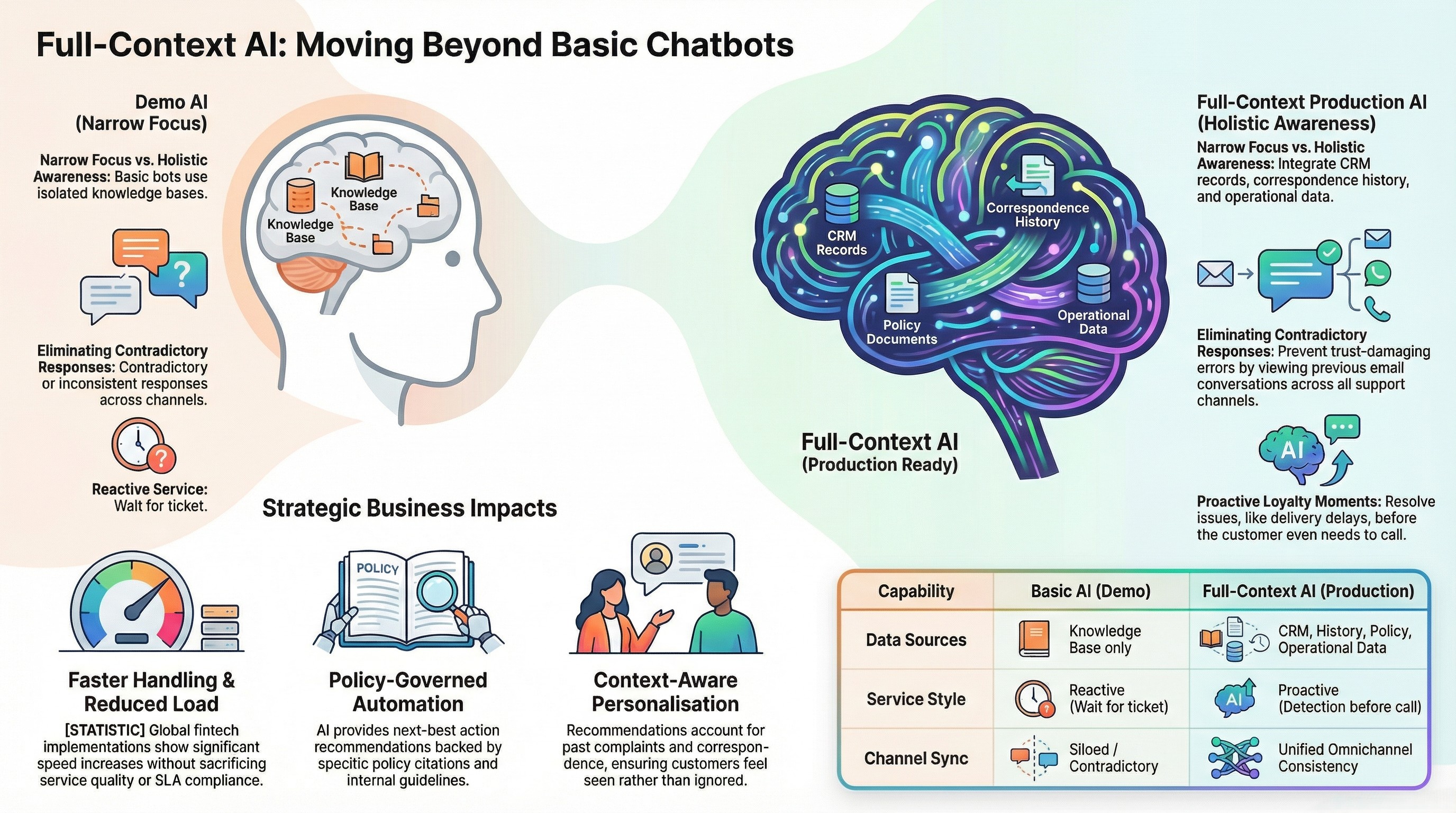
The demo version: An AI chatbot that answers frequently asked questions from a knowledge base.
The production version: A full-context support agent that simultaneously accesses the customer's structured CRM record, their complete email correspondence history, the product policy documents that govern their case, and the internal escalation guidelines that determine when a human must intervene. The agent handles routine queries autonomously, summarises context for complex cases before routing to human agents, and logs every interaction for SLA compliance monitoring.
Why it survives production: A chatbot that can only see the CRM record gives contradictory answers when a customer references a previous conversation that happened over email. A full-context agent cannot be surprised by context it has already read. The result is consistent, policy-governed support across every channel — web, WhatsApp, email, and phone — without the contradictions that damage customer trust.
Production proof: Deployed for a global fintech provider: omnichannel intake across all channels, agent-assist summarisation for human handoffs, next-best action recommendations with policy citation, full SLA monitoring. Result: significantly faster case handling and reduced operational load via automation — without reducing service quality.
2. Proactive Issue Detection Before the Customer Calls
The demo version: AI sentiment analysis on incoming tickets.
The production version: An agent that monitors structured operational data (system performance, transaction failure rates, delivery status) alongside unstructured signals (social media mentions, review platforms, email threads flagging recurring issues) and surfaces problems before they generate support volume. The agent identifies patterns, correlates signals across data types, and triggers proactive outreach.
Why it survives production: Reactive support is expensive. Proactive resolution — contacting a customer about a delayed shipment before they contact you — converts a service failure into a loyalty moment. This only works when the agent can see both the structured operational data and the unstructured signal environment simultaneously.
3. Personalised Recommendations at Scale
The demo version: Recommendation engine based on purchase history.
The production version: A recommendation agent that combines structured purchase history and behavioural data with unstructured signals — customer correspondence, review content, service interactions — to build a genuinely complete picture of customer preference. The agent generates recommendations that account for what the customer has said, not just what they have bought.
Why it survives production: Customers who have complained about a product category in a support email and then receive a recommendation for that same category feel unseen. Full-context recommendation agents eliminate this category of error because they read the correspondence before they recommend.
AI Agent Use Cases in Finance and Accounting

4. Accounts Payable Governance
The demo version: Automated invoice matching against purchase orders.
The production version: An AP agent that fuses structured invoice data with the PDF contracts containing negotiated discount terms, the email threads where payment exceptions were agreed, and real-time cash flow signals. Human-in-loop thresholds are enforced by explicit governance rules: payments below a defined threshold execute autonomously; payments above it route to human approval with full context provided.
Why it survives production: Invoice matching alone is 20% of accounts payable intelligence. The remaining 80% — the context that determines whether an invoice should be paid at face value, at a negotiated discount, or flagged for review — lives in unstructured documents. Without it, the agent executes correctly on incorrect context.
Production proof: The Ampcome Autonomy Stack — Unified Context Engine (fusing all data types), Semantic Governor (enforcing payment rules deterministically), Active Orchestrator (executing across ERP and approval systems) — with complete audit trail. Deployed across enterprise finance operations with full governance.
5. Financial Reporting and Audit Preparation
The demo version: Automated data extraction for report generation.
The production version: A reporting agent that reconciles structured general ledger entries with unstructured approval correspondence, identifies discrepancies between what the system recorded and what the email thread authorised, and produces reports with a complete chain of evidence for every material entry. The agent handles continuous monitoring — not just month-end — flagging anomalies in real time.
Why it survives production: 59% of accountants make errors every month because they are reconciling structured data against unstructured approval records manually. An agent that can read both eliminates the reconciliation gap that produces most of those errors.
6. CFO Intelligence and Cash Flow Forecasting
The demo version: Dashboard showing cash flow projections from ERP data.
The production version: A CFO intelligence agent that fuses structured financial data — GL entries, cash flow statements, budget actuals — with unstructured board correspondence, investor call transcripts, analyst email commentary, and external macroeconomic signals. It monitors runway risks continuously, surfaces anomalies before they appear in a dashboard, and generates scenario models grounded in the full business context.
Why it survives production: CFO-level decisions are informed by board meeting notes and investor correspondence as much as by the numbers. An agent that cannot read those documents produces forecasts that are mathematically accurate and contextually incomplete.
Production proof: Deployed for an AI CFO platform serving growing businesses and their advisors: continuous cashflow monitoring, forecast and scenario modelling, runway risk alerts with recommended actions, portfolio views across multiple client entities. Result: faster analysis cycles and earlier detection of cash risk without additional headcount.
7. Tax Research and Cross-Border Risk Screening
The demo version: Search tool for tax guidance documents.
The production version: A tax research agent that automates source collection across regulatory databases, treaty repositories, and internal precedent libraries. It synthesises guidance from multiple jurisdictions, flags cross-border risks with specific rule citations, generates draft memos with evidence trails, and builds an institutional knowledge base over time.
Why it survives production: Tax professionals working on cross-border transactions are manually synthesising guidance from dozens of unstructured document sources. The agent does not replace the judgement — it eliminates the research burden that obscures the time available for judgement.
Production proof: Deployed for a tax technology firm: automated source retrieval and summarisation, draft memo generation with citations, workflow tracking for research tasks. Result: earlier detection of withholding tax and VAT risk, faster pre-deal compliance review, more consistent research outputs.
AI Agent Use Cases in Supply Chain and Logistics

8. Supply Chain Disruption Detection and Response
The demo version: Supplier risk scoring from structured data.
The production version: A supply chain monitoring agent that combines structured operational data (inventory levels, shipment status, production schedules) with unstructured signals (supplier email correspondence, logistics partner communications, news feeds, regulatory updates) to detect disruption risk before it becomes a disruption. The agent identifies alternative routes, adjusts inventory allocation, and flags decisions that require human approval.
Why it survives production: Supply chain disruptions announce themselves in unstructured channels — an email from a regional supplier, a logistics partner's notification, a news story about a border closure — before they appear in structured systems. An agent that cannot read those signals is always reacting rather than anticipating.
9. Port and Terminal Operations Management
The demo version: Dashboard showing terminal throughput metrics.
The production version: An operations agent that fuses terminal workflow data, yard management systems, and rail scheduling information with unstructured operational communications — vessel arrival notifications, exception reports, coordination emails between terminal operators and inland logistics teams. The agent digitises exception management, automates routine coordination, and surfaces operational decisions with full context for the duty manager.
Why it survives production: Terminal operations run on a combination of structured system data and informal communication that has historically required experienced human coordinators. A full-context agent can handle the routine coordination autonomously, freeing coordinators for the genuinely complex exceptions.
Production proof: Deployed for a global ports and logistics leader: terminal workflow digitisation, yard and rail operational dashboards, rail scheduling and visibility, exception management. Result: higher predictability of terminal-to-rail throughput and more efficient coordination across port and inland logistics operations.
10. Procurement KPI Monitoring and Vendor Alerts
The demo version: Automated purchase order tracking.
The production version: A procurement agent that monitors structured KPIs — purchase price variance, gross margin impact, vendor delivery performance, working capital — alongside the unstructured context that changes the significance of every number: vendor contract SLA terms in PDFs, exception correspondence in email, internal margin policy documents. Alerts are triggered on the full picture, not just the metric.
Why it survives production: A purchase price variance alert is useful. A purchase price variance alert that includes the contract SLA terms, the vendor's prior delivery record, and the margin impact on the current quarter — all in a single governed notification — is actionable.
Production proof: Deployed for a multi-entity holding group: automated procurement and finance KPI alerts covering purchase price trends, gross margin impact, early-payment analysis, and vendor performance. Result: earlier detection of margin erosion and vendor slippage, reduced variance surprises through continuous monitoring.
11. Multi-Entity Analytics Consolidation
The demo version: Consolidated reporting across business units.
The production version: An analytics agent that standardises KPIs across entities with different systems, data structures, and reporting cadences — and applies a semantic governance layer that ensures the same metric means the same thing across every entity. The agent produces unified operational dashboards with variance explanations, flags cross-entity anomalies, and delivers leadership insight packs on a scheduled basis.
Why it survives production: The problem in multi-entity operations is not the lack of data. It is the inconsistency of definitions, the fragmentation of systems, and the manual effort required to reconcile them. A full-context agent with a semantic governance layer eliminates all three.
Production proof: Deployed for a multinational logistics and warehousing company: cross-entity KPI standardisation, consolidated operational dashboards, variance explanations, data quality governance layer. Result: single operational view across entities and faster leadership reporting.
AI Agent Use Cases in Retail and eCommerce
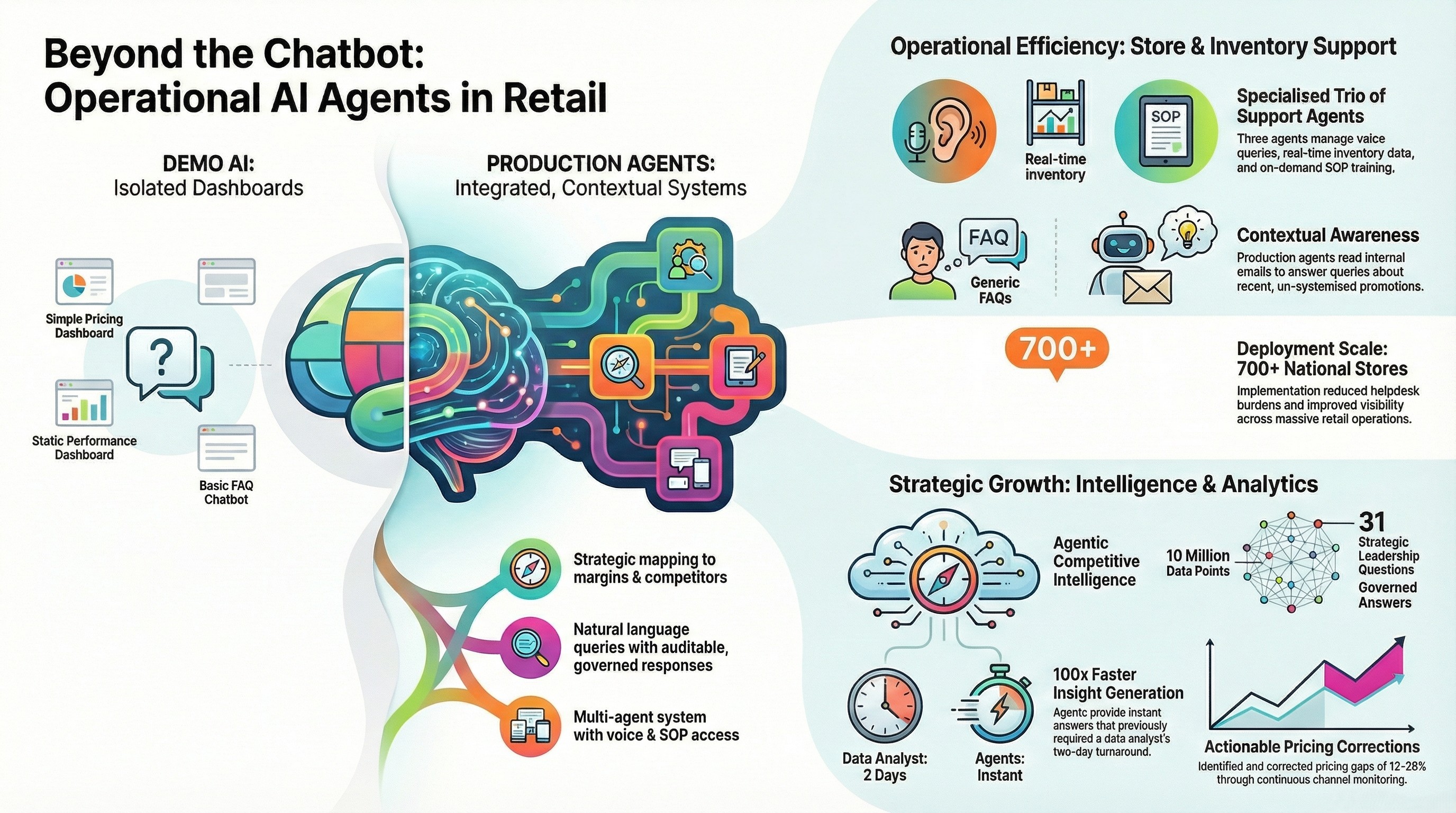
12. Store Support, Inventory Intelligence, and Training
The demo version: FAQ chatbot for store staff.
The production version: Three specialised agents working in concert. A voice support agent (available in multiple languages) that handles store-level operational queries. An inventory intelligence agent that provides real-time pricing, stock, and promotional information per store. A knowledge and training agent that delivers on-demand guidance from POS documentation and standard operating procedures. All three operate with full context and log every interaction for operational analytics.
Why it survives production: A generic FAQ chatbot breaks the moment a store associate asks about a promotion that was communicated in last week's internal email and is not yet in the system. A full-context knowledge agent has read the email and can answer.
Production proof: Deployed across a 700+ store national retail operation: voice support agent in multiple languages, inventory intelligence per store, RAG-based training agent over POS and SOP documents, admin console and ticketing integration. Result: reduced manual helpdesk burden, improved store-level inventory visibility, faster onboarding via on-demand training.
13. Competitive Intelligence and Pricing Monitoring
The demo version: Price scraping dashboard showing competitor prices.
The production version: A competitive intelligence agent that monitors pricing, promotional offers, MRP discounts, and product availability across all competitor channels continuously — and maps every signal to the leadership questions that govern pricing and promotional decisions. The agent produces governed answers with full source citation, alerts on material pricing gaps, and tracks portfolio movement over time.
Why it survives production: A price scraping dashboard tells you what happened. A full-context competitive intelligence agent tells you what it means for your margins, what the pattern suggests about competitor strategy, and what decision it recommends — with the data cited.
Production proof: Deployed for a major Indian HVAC and consumer goods company: continuous e-commerce and channel monitoring, agentic Q&A mapped to 31 strategic leadership questions across 10 million+ data points, analytics views for pricing gaps and portfolio movement. Result: 93% answerability across all strategic questions, 12–26% pricing gap identified and corrected. 100x faster insight generation versus manual analysis.
14. eCommerce Operations and Conversational Analytics
The demo version: Analytics dashboard for online sales performance.
The production version: A conversational analytics agent that ingests data across sales, products, inventory, promotions, and customer behaviour — and answers natural language business queries with governed, auditable responses. The agent monitors KPIs continuously, triggers exception alerts, and provides instant answers to the questions that previously required a data analyst and a two-day turnaround.
Why it survives production: The bottleneck in eCommerce analytics is not the data. It is the queue to get a data analyst to answer the question. A conversational analytics agent eliminates the queue without eliminating the governance.
AI Agent Use Cases in Banking and Financial Services

15. AML Monitoring and Financial Crime Detection
The demo version: Rules-based transaction monitoring flagging unusual patterns.
The production version: A compliance agent that fuses structured transaction data with the unstructured context that defines whether a pattern is genuinely suspicious: client correspondence history, regulatory typology guidance in PDFs, account manager risk notes in documents, internal escalation policy. Every classification is logged with full citation of the data sources consulted and the rules applied.
Why it survives production: Rules-based AML systems see transaction patterns. Financial crime narratives — the context that distinguishes a suspicious transaction from a legitimate exception — live in unstructured data. A compliance agent that cannot read that context is missing the intelligence that experienced human analysts spend most of their time on.
16. Omnichannel Banking Support with Audit Trail
The demo version: Banking chatbot for account balance queries.
The production version: A full-context banking support agent that handles case intake across chat, email, and phone; provides agent-assist summarisation with full case context for human handoffs; routes complex cases with governance-defined escalation logic; and logs every interaction with a complete audit trail for SLA and compliance monitoring.
Why it survives production: Banking customers do not distinguish between channels. When they call after emailing, they expect the phone agent to know what they wrote. A full-context banking support agent has read the email and provides continuity that builds trust rather than eroding it.
Production proof: Deployed for a global fintech provider focused on disputes, fraud, and compliance: omnichannel intake and workflow routing, agent-assist with next-best actions, full auditability and SLA monitoring, integration with core banking systems. Result: faster case handling, improved consistency, and better compliance readiness through complete audit trails.
17. SAP Workflow Automation and Order Governance
The demo version: RPA tool that creates purchase orders from structured data.
The production version: An agentic AI that interprets order triggers from multiple sources — including unstructured communications — validates them against contract terms and procurement policy documents, creates SAP Sales Orders with full governance logic applied, and routes exceptions according to approval hierarchies defined in explicit governance rules. Every action is logged with the data sources consulted and rules applied.
Why it survives production: RPA breaks when it encounters an exception. In SAP environments, exceptions are constant: negotiated pricing in contracts, email-confirmed purchase authorisations, Slack-communicated changes to order specifications. A full-context agent handles exceptions by reading the context and applying the governance rules — without breaking.
Production proof: Deployed as a direct replacement for an end-of-life legacy platform: automated SAP Sales Order creation, governance rules for exceptions and approvals, full audit logs and reconciliation reporting. Result: reduced manual order processing, faster order-to-confirm cycles, fewer data-entry errors, complete auditability.
AI Agent Use Cases in Smart Cities and Utilities
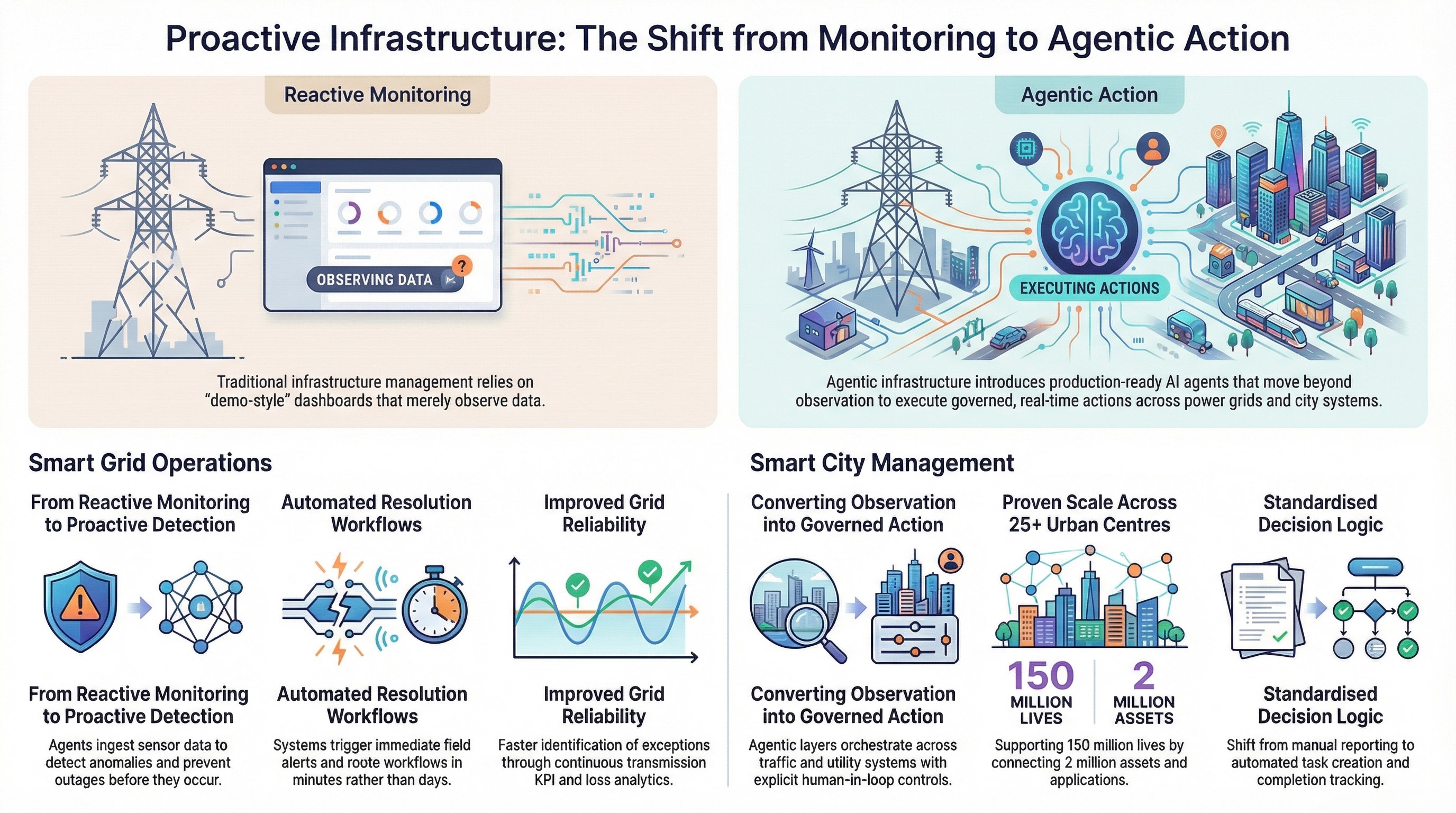
18. Smart Grid Operations and Predictive Monitoring
The demo version: Dashboard showing grid performance metrics.
The production version: An operations agent that ingests smart grid data — sensor readings, outage events, transmission KPIs — and applies predictive analytics to detect anomalies before they become outages. The agent monitors continuously, triggers automated alerts for field operations, routes resolution workflows, and maintains operational dashboards for leadership.
Why it survives production: Grid operations generate data continuously and require responses measured in minutes, not reports measured in days. A full-context operations agent converts a reactive monitoring workflow into a proactive operations capability.
Production proof: Deployed for a state power transmission utility: transmission KPI monitoring, anomaly detection, loss and outage analytics, predictive maintenance indicators, automated alerts for field operations. Result: faster identification of grid exceptions, improved reliability through proactive monitoring.
19. Smart City Operations and Urban Infrastructure Management
The demo version: City dashboard aggregating sensor data.
The production version: An agentic analytics layer that sits on top of existing smart city operation centre infrastructure, converts dashboard insights into governed and auditable actions, and orchestrates across city systems — traffic, utilities, public services — with explicit governance and human-in-loop controls for high-stakes decisions.
Why it survives production: Smart city dashboards are excellent at showing what is happening. They are not capable of deciding what to do and executing it. A full-context agentic layer converts observation into governed action.
Production proof: Deployed for a smart infrastructure operator touching 150 million+ urban lives across 25+ smart city operation centres connecting 2 million+ assets and applications. Result: shift from reactive reporting to proactive execution, standardised decision logic across teams, automated task creation and completion tracking.
AI Agent Use Cases in Healthcare
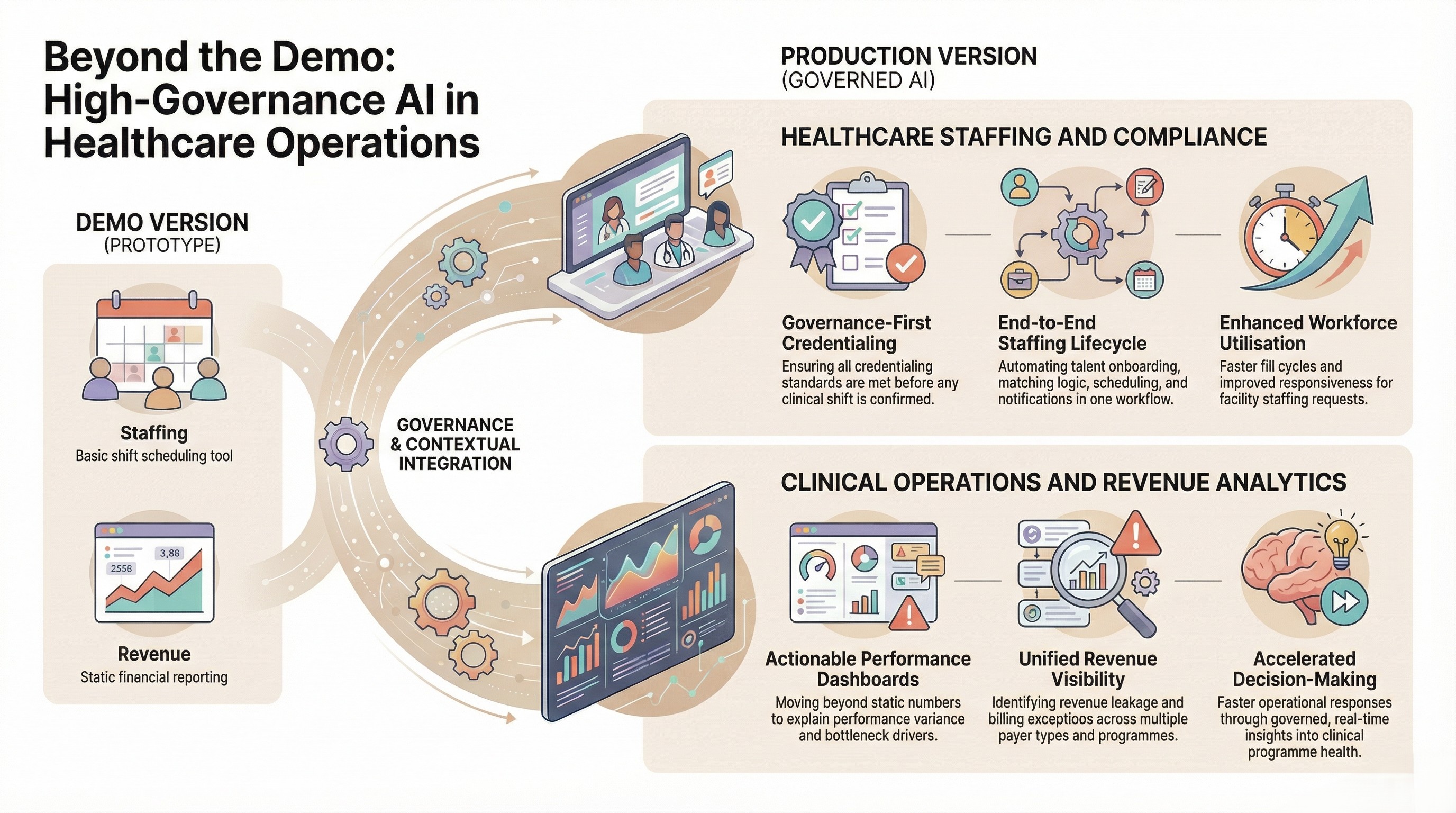
20. Healthcare Staffing Operations and Compliance
The demo version: Shift scheduling tool for clinical staff.
The production version: A staffing operations agent that handles talent onboarding and credential capture, processes facility staffing requests, runs matching logic against availability and qualifications, manages scheduling and notifications, and monitors compliance requirements — all with governance rules that ensure credentialing standards are met before any shift is confirmed.
Why it survives production: Healthcare staffing has non-negotiable compliance requirements. An agent that can match availability but cannot verify credentials against the governance rules is a liability, not an asset. Full-context governance is the difference.
Production proof: Deployed for a healthcare staffing platform: talent onboarding and credential capture, facility request intake and matching logic, scheduling and notifications, compliance workflow management, fill-rate and utilisation reporting. Result: faster fill cycles, better workforce utilisation, improved staffing responsiveness for facilities.
21. Clinical Operations and Revenue Analytics
The demo version: Financial reporting for clinical programmes.
The production version: A revenue and operations analytics agent that builds a unified view across programme operations, staffing, and revenue cycle — identifying bottlenecks in billing workflows, flagging revenue leakage, and providing leadership with governed, actionable performance dashboards rather than static reports.
Why it survives production: Clinical enterprises manage complex revenue cycles across multiple payer types, programme structures, and operational sites. A static dashboard shows the numbers. A full-context analytics agent explains what they mean and identifies what to do about them.
Production proof: Deployed for two clinical care providers — one physician-led hospitalist programme, one geriatric care service across assisted living and long-term care: revenue and utilisation analytics, performance dashboards with variance explanations, revenue cycle visibility with exception alerts. Result: improved visibility into revenue leakage drivers, faster operational decision-making, more reliable performance tracking.
AI Agent Use Cases in Professional Services
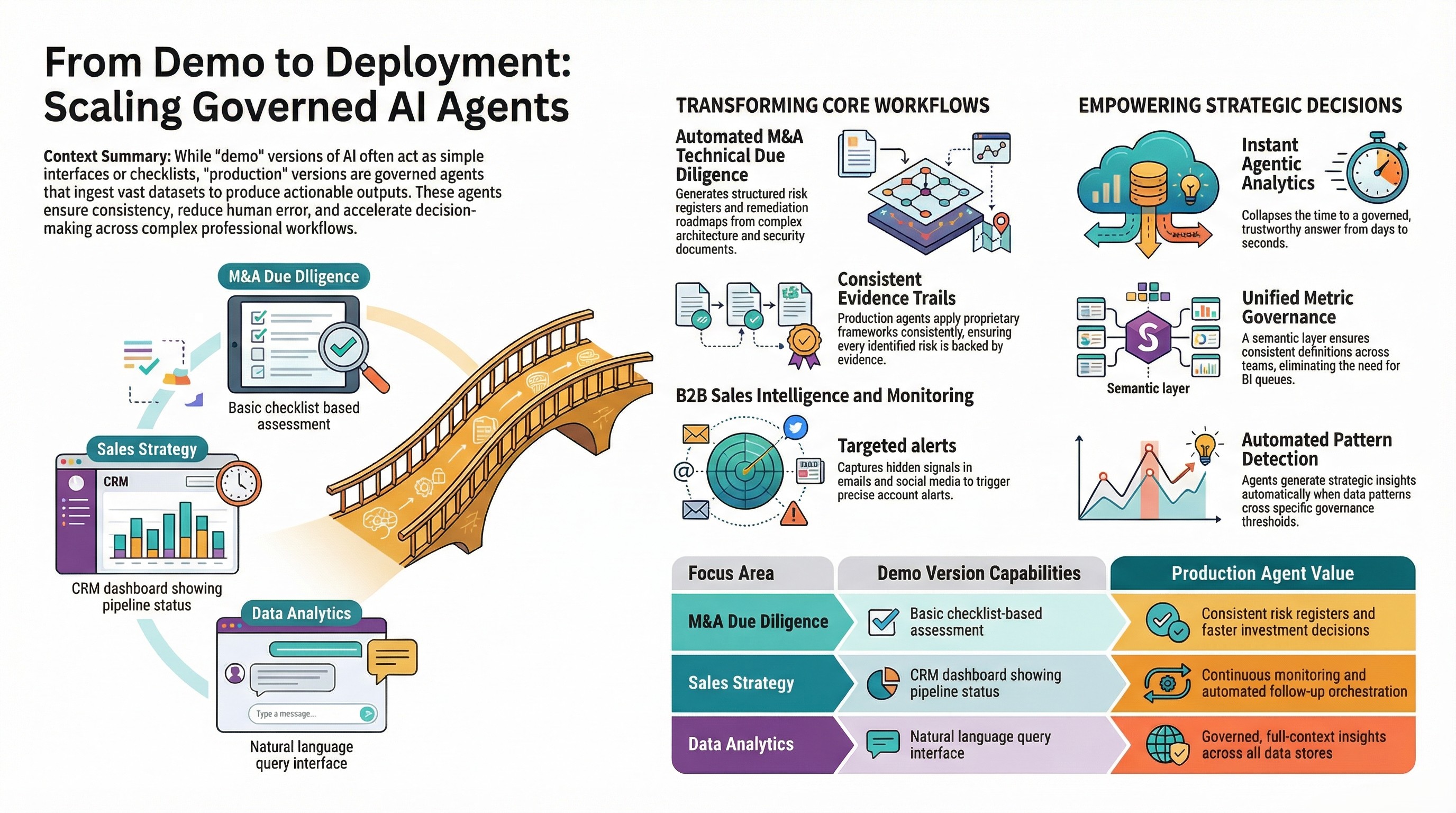
22. Investment and M&A Technical Due Diligence
The demo version: Checklist-based technical assessment.
The production version: A due diligence agent that ingests target company documentation — architecture specifications, security audit reports, prior incident records, engineering assessments — and produces structured risk registers with remediation roadmaps. The Semantic Governor applies the firm's proprietary evaluation framework consistently, producing comparable outputs across every assessment regardless of which analyst runs the process.
Why it survives production: Manual due diligence is slow, expensive, and produces inconsistent outputs that depend on who does it. A governed due diligence agent produces consistent, comprehensive assessments in a fraction of the time — with a complete evidence trail for every risk identified.
Production proof: Deployed for a holding company partnering with founders and family businesses: code and architecture review, infrastructure and security assessment, scalability and resilience evaluation, integration readiness scoring, full risk register with remediation roadmap. Result: faster investment decisions, reduced post-deal surprises, improved confidence in scalability and security posture.
23. B2B Sales Intelligence and Account Monitoring
The demo version: CRM dashboard showing pipeline status.
The production version: A B2B sales intelligence agent that monitors accounts continuously — tracking signals across structured CRM data and unstructured channels — identifies opportunities and risks based on rule-governed scoring, triggers precision alerts only when scores cross defined thresholds, and executes follow-up workflows automatically for high-confidence scenarios.
Why it survives production: Most CRM data is what a sales rep entered after a call. It misses the procurement email that signals an upcoming renewal, the LinkedIn post that signals a budget cycle, the customer support ticket that signals dissatisfaction before it becomes churn. A full-context sales agent reads all of these — and alerts only when it is genuinely warranted.
Production proof: Deployed as an enterprise B2B sales agent: continuous account monitoring and signal capture, rule-governed opportunity identification, follow-up orchestration, CRM-integrated pipeline hygiene, sales dashboards and leadership alerts. Result: higher account coverage without increasing headcount, faster response cycles on opportunities and renewals, more consistent execution through governed playbooks.
24. Agentic Analytics for Complex, Multi-Source Decision Support
The demo version: Business intelligence tool with natural language query interface.
The production version: An agentic analytics layer that sits across existing data infrastructure — structured data in warehouses and data lakes, unstructured data in document stores — and provides governed, natural language access to the complete picture. The semantic governance layer ensures consistent metric definitions across teams. The NLQ interface eliminates the analyst queue for recurring questions. The agent generates insight automatically when it detects a pattern that crosses a governance threshold.
Why it survives production: The bottleneck in enterprise analytics is not access to data. It is the time between a decision-maker asking a question and getting a governed, trustworthy answer. A full-context agentic analytics layer collapses that time from days to seconds — without sacrificing the governance that makes the answer trustworthy.
Production proof: Deployed for a Silicon Valley analytics startup serving fast-moving operators: agentic analytics layer over existing data, semantic governance for consistent definitions, NLQ interface with automated insight generation. Result: faster strategic visibility, improved alignment through consistent metric definitions, scalable insight access across teams without BI queuing.
The One Reason Most of These Fail Without the Right Foundation
Every use case in this guide shares an architectural requirement that is worth stating plainly: they all require agents that can see the full picture.
The 70–85% of enterprise data that lives in unstructured formats — contracts, emails, policy documents, regulatory guidance, meeting notes, Slack threads — is not a secondary consideration. It is where the real business truth lives. An agent that cannot access it is making decisions on partial information. In some contexts, that produces inefficiency. In finance, healthcare, banking, and logistics, it produces liability.
This is what Assistents.ai was built to solve. The Ampcome Autonomy Stack provides the three layers that every production-ready agentic AI deployment requires:
Tier 1 — Unified Context Engine: Fuses structured data (ERP, CRM, transaction logs), semi-structured data (APIs, logs, events), and unstructured data (contracts, emails, PDFs, policy documents) into a single semantic layer before any agent acts. Agents finally see the full picture.
Tier 2 — Semantic Governor: Encodes business rules as deterministic if-then logic — not probabilistic guesses. Every decision is auditable, policy-cited, and explainable. No hallucinations. No black boxes. Threshold-based human-in-loop controls for decisions above defined financial or risk limits.
Tier 3 — Active Orchestrator: Executes multi-step workflows across enterprise systems — SAP, Salesforce, Jira, ServiceNow, Slack, and more — with complete audit logs. Connects to what you already have. No rip-and-replace.
The result: enterprises move from 8 reactive planning cycles per year to 50+ autonomous execution cycles. From six weeks signal-to-action to hours. From dashboards that show what happened to agents that handle it.
The Bottom Line
The 24 use cases in this guide are not theoretical. They are production deployments running today — in enterprises that made one architectural decision that most AI agent deployments get wrong: they gave their agents the full picture before asking them to act.
The difference between the 23% of enterprises that have successfully scaled AI and the 77% that are stuck in pilot is not the quality of the model. It is the quality of the foundation. Full context. Deterministic governance. Complete auditability. Those three things are what separate an AI agent use case that survives production from one that only survives the demo.
If you are evaluating AI agents for your enterprise and want to see what full-context, governed execution looks like in a deployment comparable to your environment, the 48-hour pilot assessment from Assistents.ai gives you a concrete pilot plan, workflow definition, ROI hypothesis, and success metrics before you commit. A governed, full-context agent in 30 days — or we walk.
Frequently Asked Questions
What is an enterprise AI agent use case?
An enterprise AI agent use case is a specific business workflow where an autonomous AI system can perceive data, reason through multi-step decisions, and execute actions — without requiring a human prompt for each step. Production-ready enterprise AI agent use cases are distinguished from demo-only use cases by their ability to handle real-world data (including unstructured documents), apply explicit governance rules, and produce complete audit trails for every automated decision.
Why do most AI agent use cases fail in production?
The most common reason AI agent use cases fail in production is the context gap: agents are deployed with access to structured data only (ERP, CRM, transaction logs), which represents 10–20% of the enterprise data landscape. The remaining 70–85% — contracts, emails, policy documents, regulatory guidance — is unstructured and invisible to agents that have not been built with a full-context foundation. Agents acting on 20% of the information they need produce decisions that are technically correct and contextually wrong.
What industries benefit most from AI agent deployments?
Every industry in this guide — finance and accounting, banking, retail, supply chain, logistics, healthcare, utilities, and professional services — has documented production deployments of AI agents. The industries that benefit most are those where: (1) data is fragmented across structured and unstructured sources, (2) decisions have regulatory or financial consequences that require auditability, and (3) the volume of decisions exceeds what human teams can process at the required speed.
How long does it take to deploy an enterprise AI agent?
With the right platform architecture, enterprises can move from scoping to a live, governed agent in 30 days. Week 1 covers discovery and workflow mapping. Weeks 2–4 cover context engine configuration, governance rule encoding, and agent development. Day 30 delivers a production-grade agent with full audit trail, threshold-based human controls, and monitoring dashboards — integrated with existing systems without rip-and-replace.
What is the difference between AI agents and RPA?
RPA (Robotic Process Automation) executes fixed, scripted workflows against structured data. It is fast and reliable when data is clean and consistent — but it breaks on exceptions, cannot read unstructured documents, and requires manual reprogramming when processes change. AI agents reason through multi-step workflows, handle exceptions by applying governance rules, can fuse structured and unstructured data, and adapt their execution based on context. The practical difference: an RPA tool breaks when it encounters a PDF contract. A full-context AI agent reads the contract, applies the relevant terms, and adjusts its action accordingly — with a complete audit trail.
How do AI agents handle governance and compliance requirements?
Production-ready AI agents handle governance through a deterministic rules layer — the Semantic Governor in the Ampcome Autonomy Stack — that encodes business rules as explicit if-then logic rather than probabilistic model outputs. Every automated decision is logged with the data sources consulted, the rules applied, and the policy cited. Threshold-based human-in-loop controls ensure that decisions above defined financial or risk limits route to human approval with full context provided. This produces complete audit trails that satisfy regulatory requirements across finance, banking, healthcare, and other regulated environments.

Transform Your Business With Agentic Automation
Agentic automation is the rising star posied to overtake RPA and bring about a new wave of intelligent automation. Explore the core concepts of agentic automation, how it works, real-life examples and strategies for a successful implementation in this ebook.
Sarfraz Nawaz is the CEO and founder of Ampcome, which is at the forefront of Artificial Intelligence (AI) Development. Nawaz's passion for technology is matched by his commitment to creating solutions that drive real-world results. Under his leadership, Ampcome's team of talented engineers and developers craft innovative IT solutions that empower businesses to thrive in the ever-evolving technological landscape.Ampcome's success is a testament to Nawaz's dedication to excellence and his unwavering belief in the transformative power of technology.

More insights
Discover the latest trends, best practices, and expert opinions that can reshape your perspective






Contact us

