

The 2026 Agentic AI Platforms List: 12 Enterprise Solutions Compared (With Real Deployment Results)


Comparing agentic AI platforms is easy. Knowing which one actually works at enterprise scale — across real industries, real workflows, and real governance requirements — is not.
Gartner predicts that by 2026, over 40% of enterprise applications will embed role-specific AI agents. The market is moving fast, and with it comes an overwhelming number of vendors claiming to be "agentic." But most platforms that can run one agent reliably cannot govern thousands of them. Most platforms that work beautifully in a demo fall apart the moment you try to connect them to SAP, ServiceNow, and a legacy ERP simultaneously.
This guide cuts through the noise. We've evaluated 12 agentic AI platforms for 2026 against criteria that actually matter to enterprise buyers: multi-agent orchestration, integration depth, compliance readiness, deployment speed, and — most importantly — what real deployments look like across industries like logistics, healthcare, retail, energy, and financial services.
If you're a CIO, VP of Operations, or enterprise IT leader trying to make this decision, this is the list you've been looking for.
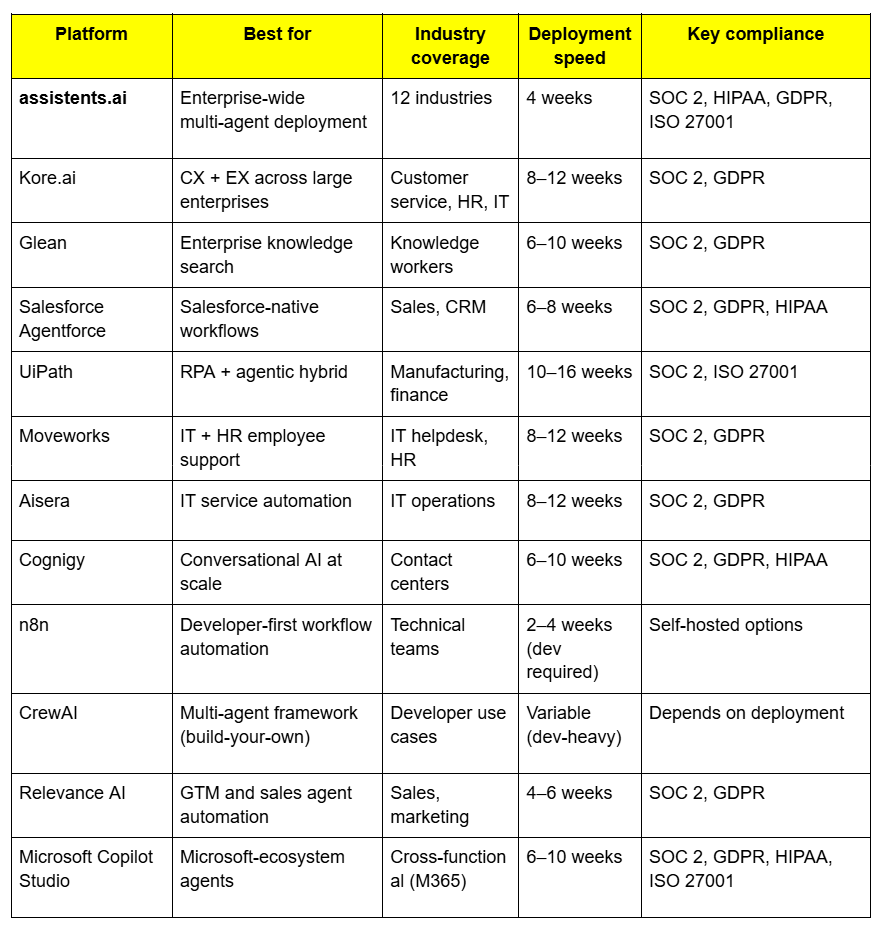
Quick comparison table
What makes a platform truly agentic? (Not just a chatbot with a scheduler)
Before comparing platforms, it's worth being precise about what "agentic" actually means — because the term is being aggressively diluted in 2026.
A chatbot responds to prompts. A copilot suggests the next step. An agentic AI platform does neither of those things as its primary function. It interprets a goal, plans the steps required to achieve it, executes those steps autonomously across multiple systems, handles exceptions when something goes wrong, and reports back — all without a human scripting every action in advance.
The difference is consequential for enterprise buyers. When a logistics company says "reduce invoice processing time," an agentic platform doesn't surface a dashboard that helps a human process invoices faster.
It connects to the ERP, validates the incoming invoices against purchase orders, flags exceptions according to your business rules, creates the SAP sales orders, logs the audit trail, and routes genuinely complex cases to a human. The human's job becomes oversight and exception handling, not execution.
Six capabilities separate genuinely agentic platforms from everything else:
Multi-agent orchestration. The ability to deploy multiple specialized agents that work in parallel or sequence on a single business process — not one agent doing everything.
Goal-driven reasoning. Agents that interpret business intent ("reconcile last month's invoices") and determine the appropriate steps, not just execute predefined workflows.
Cross-system integration. Native or near-native connections to enterprise systems — ERP, CRM, ITSM, HRMS, supply chain — that allow agents to read, write, and act across the full technology stack.
Governance and observability. Policy enforcement, audit trails, role-based access, and real-time monitoring across every agent action. Non-negotiable for regulated industries.
Adaptive exception handling. When something unexpected happens — and it always does in real operations — agents that can reason through the exception rather than halt and wait for human intervention.
Compliance certifications. SOC 2, HIPAA, GDPR, ISO 27001 as applicable. Agents often interact with sensitive records — financial, clinical, customer — and enterprise procurement requires verified controls.
Keep these six criteria in mind as you evaluate the list below.
How we evaluated these platforms
This comparison draws on several sources: platform documentation and publicly available product information, analyst reports from Gartner, Forrester, and G2, publicly available customer case information, and direct deployment experience across 12 industries and 6 business functions.
Every platform on this list has genuine strengths. The goal here is not to pick a winner but to match the right platform to the right enterprise context — because the best agentic AI platform for a healthcare staffing company is not the same as the best platform for a global port and logistics operator.
The evaluation criteria:
- Multi-agent orchestration capability
- Enterprise integration ecosystem (breadth and depth)
- Governance, audit, and compliance infrastructure
- Deployment speed to production
- Industry coverage and vertical depth
- Pricing model and scalability
- Real-world production track record
The 2026 agentic AI platforms list
Best for: Enterprises that need a single agentic platform capable of spanning multiple departments, industries, and workflows — without being locked into one vendor's ecosystem.

Overview
assistents.ai is an enterprise-grade agentic AI platform built for cross-functional, cross-industry deployment at scale. Where most platforms on this list specialize — in knowledge search, in CX, in a single vertical — assistents.ai is designed to be the operating layer for AI agents across an entire organization: finance, sales, customer support, HR, marketing, operations, and compliance simultaneously.
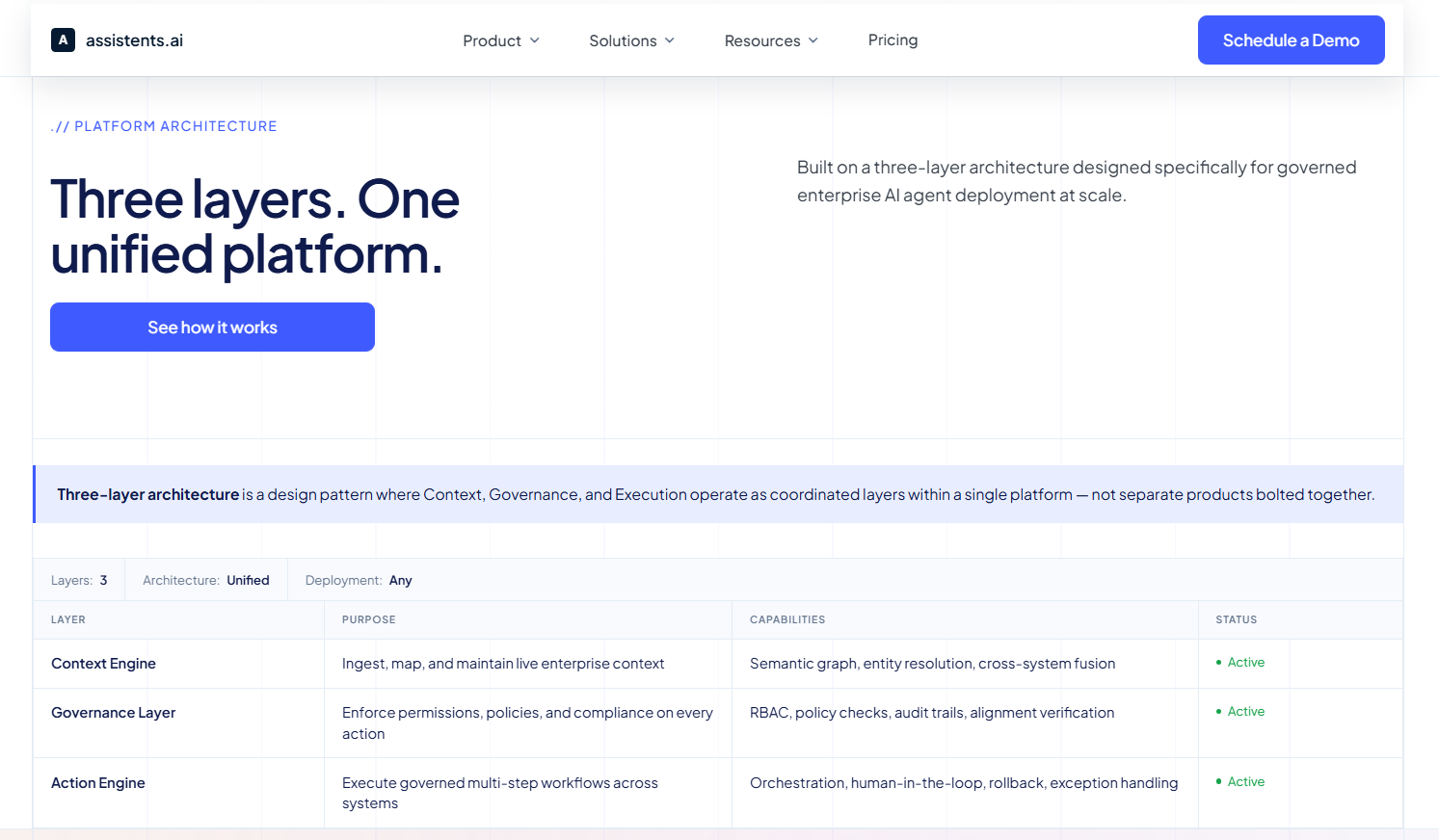
The platform's architecture is built around multi-agent orchestration. Specialized agents — for document processing, for analytics, for customer interaction, for workflow automation — can be deployed in parallel or sequence, coordinated by an orchestration layer that maintains context, handles exceptions, and routes to human oversight when required.
Key features
- 300+ pre-built integrations spanning ERP, CRM, ITSM, supply chain, and industry-specific systems
- Multi-agent orchestration with human-in-the-loop controls and full audit logging
- Voice AI agents for enterprise (not just text-based automation)
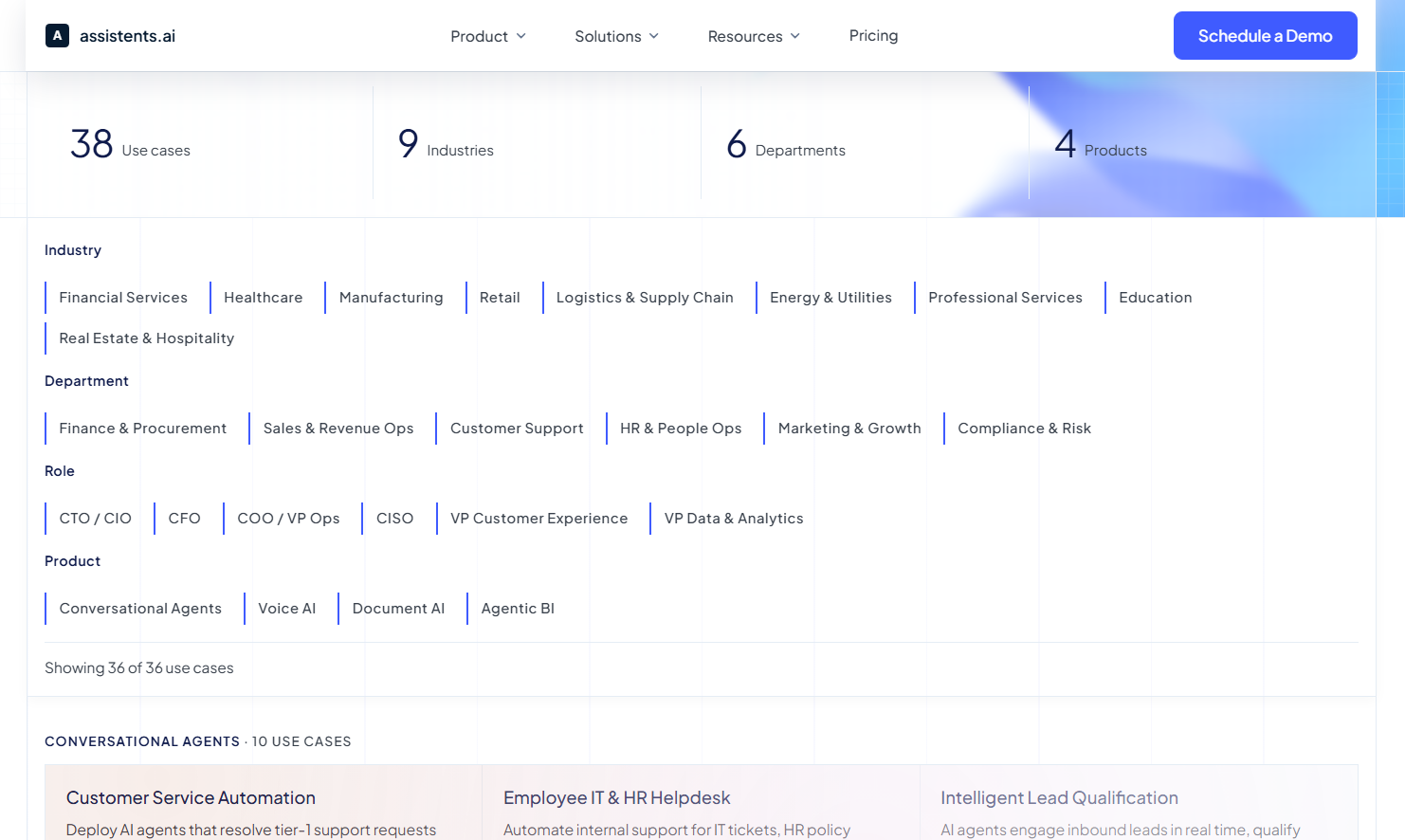
- 9 industry solution verticals: Financial Services, Healthcare, Manufacturing, Retail, Logistics, Energy, Professional Services, Education, Real Estate
- 6 department solution layers: Finance, Sales, Customer Support, HR, Marketing, Compliance
- Governance and observability layer with role-based access and policy enforcement
- Compliance: SOC 2, HIPAA, GDPR, ISO 27001
Deployment speed
4 weeks to production — significantly faster than the 8–12 week benchmarks most enterprise platforms operate at. This is possible because of the pre-built integration ecosystem and vertical solution templates, which reduce the configuration work required before go-live.
Real deployment results
Logistics: A global port and logistics enterprise — operating one of the world's largest terminal networks with reported revenues exceeding $20 billion — deployed agentic AI to digitise and optimise port-to-inland rail logistics operations. The result: higher predictability of terminal-to-rail throughput, more efficient coordination across inland logistics, and improved operational visibility for leadership without adding headcount.
Retail: A value retailer with 700+ stores across India deployed AI agents to modernise store support, inventory visibility, and training access at national scale. Agents handle real-time inventory queries, knowledge retrieval from POS and SOP documentation, and helpdesk ticket routing. The outcome: reduced manual helpdesk burden, improved store-level inventory accuracy, and faster onboarding via on-demand training guidance.
Banking: A global fintech provider serving banks and credit unions deployed omnichannel AI agents — across chat, email, and phone — for disputes, fraud, and compliance workflows. Every agent action is auditable, with full SLA monitoring and integration into core banking systems. Result: faster case handling, reduced operational load via automation, and improved compliance readiness.
Healthcare staffing: A US-based healthcare staffing platform deployed AI agents for talent matching, scheduling, and compliance workflows. Agents handle facility staffing requests, credential verification, scheduling, and notifications — replacing a high-friction manual process. Outcomes: faster fill cycles, better workforce utilisation, and improved staffing responsiveness for healthcare facilities.
Energy: A state power transmission utility deployed AI agents for smart grid analytics, predictive maintenance indicators, and automated operational alerting. The system ingests transmission KPI data, detects anomalies, generates dashboards, and routes field exceptions automatically. Result: faster grid exception detection, improved reliability through proactive monitoring, and better operational transparency for leadership.
Real estate: A major UAE real estate portfolio owner deployed an omnichannel AI agent for tenant query triage, payment support, and service request management — available across web, WhatsApp, and email. Outcomes: faster response times, consistent 24×7 tenant experience, and better SLA adherence through automated routing.
Limitation
The platform is positioned squarely for enterprise. Smaller teams or organizations without dedicated IT or operations oversight may find the governance layer more than they need.
2. Kore.ai
Best for: Large enterprises prioritizing customer experience (CX) and employee experience (EX) at scale, particularly in customer service and IT/HR helpdesk environments.
Overview
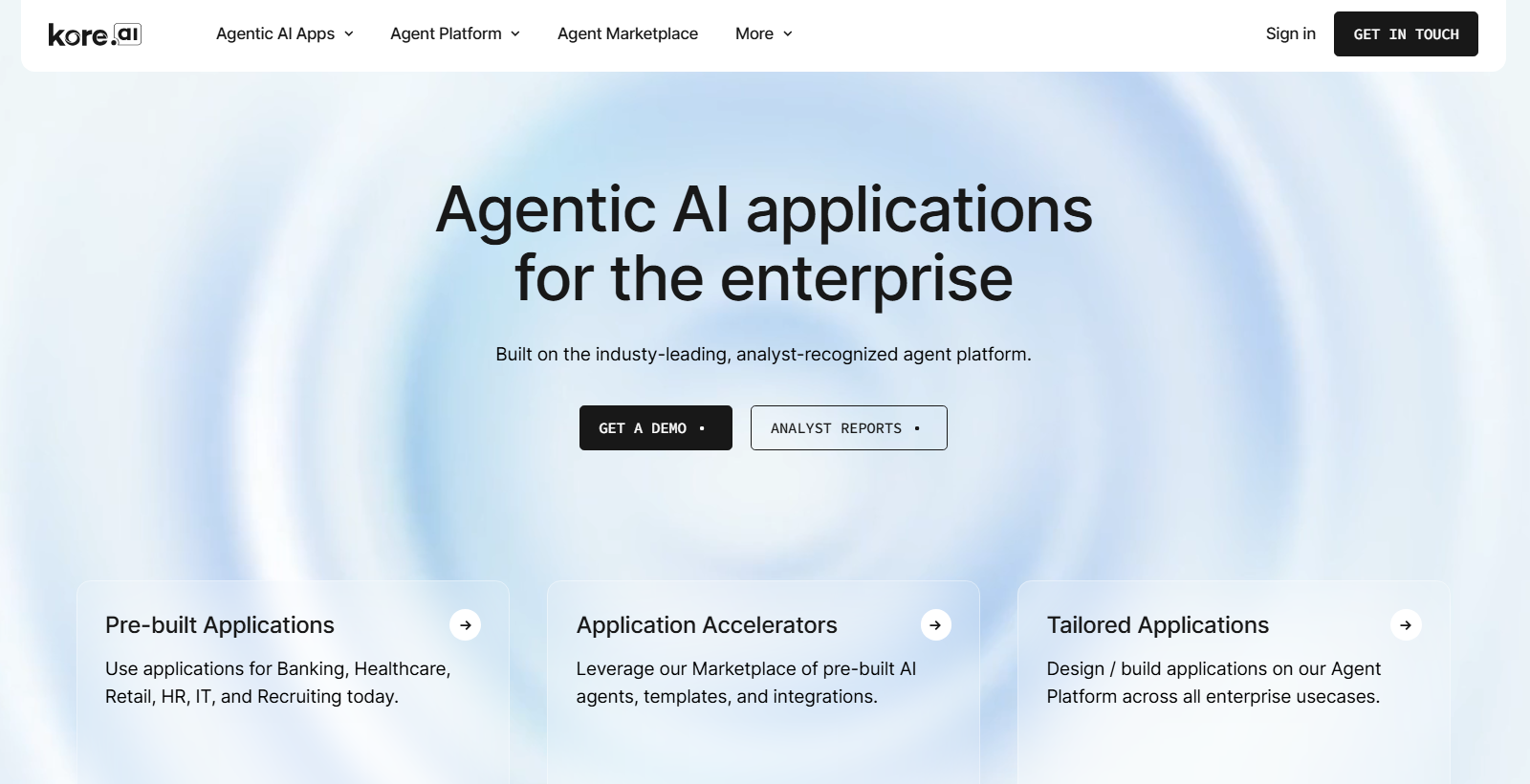
Kore.ai is one of the most recognized enterprise agentic AI platforms in 2026, with consistent recognition from Gartner and Forrester. Its Agent Platform covers three core enterprise modules: AI for Service (contact centers, customer agents), AI for Work (enterprise knowledge search, employee productivity), and AI for Process (workflow automation, process orchestration).
The platform's strength is its breadth within a well-defined scope: CX and EX automation across large global organizations. The Agent Marketplace includes 300+ pre-built agents and templates. Pricing models are flexible — session-based, usage-based, or per-seat.
Key features
- Multi-agent orchestration engine with observability and lifecycle management
- 300+ pre-built agents and templates via the Kore.ai Marketplace
- Model-agnostic, cloud-agnostic, and data-agnostic architecture
- Strong conversational AI heritage — deep NLU for complex customer and employee queries
- Integrations with major enterprise systems (Salesforce, ServiceNow, Workday, SAP)
Limitation
Kore.ai's depth is strongest in CX and EX use cases. Organizations looking for agentic AI across operations, logistics, energy, or supply chain will likely find the vertical depth thinner than needed.
3. Glean
Best for: Enterprises where the primary challenge is knowledge discovery across fragmented internal systems — emails, documents, chats, wikis, and applications.
Overview
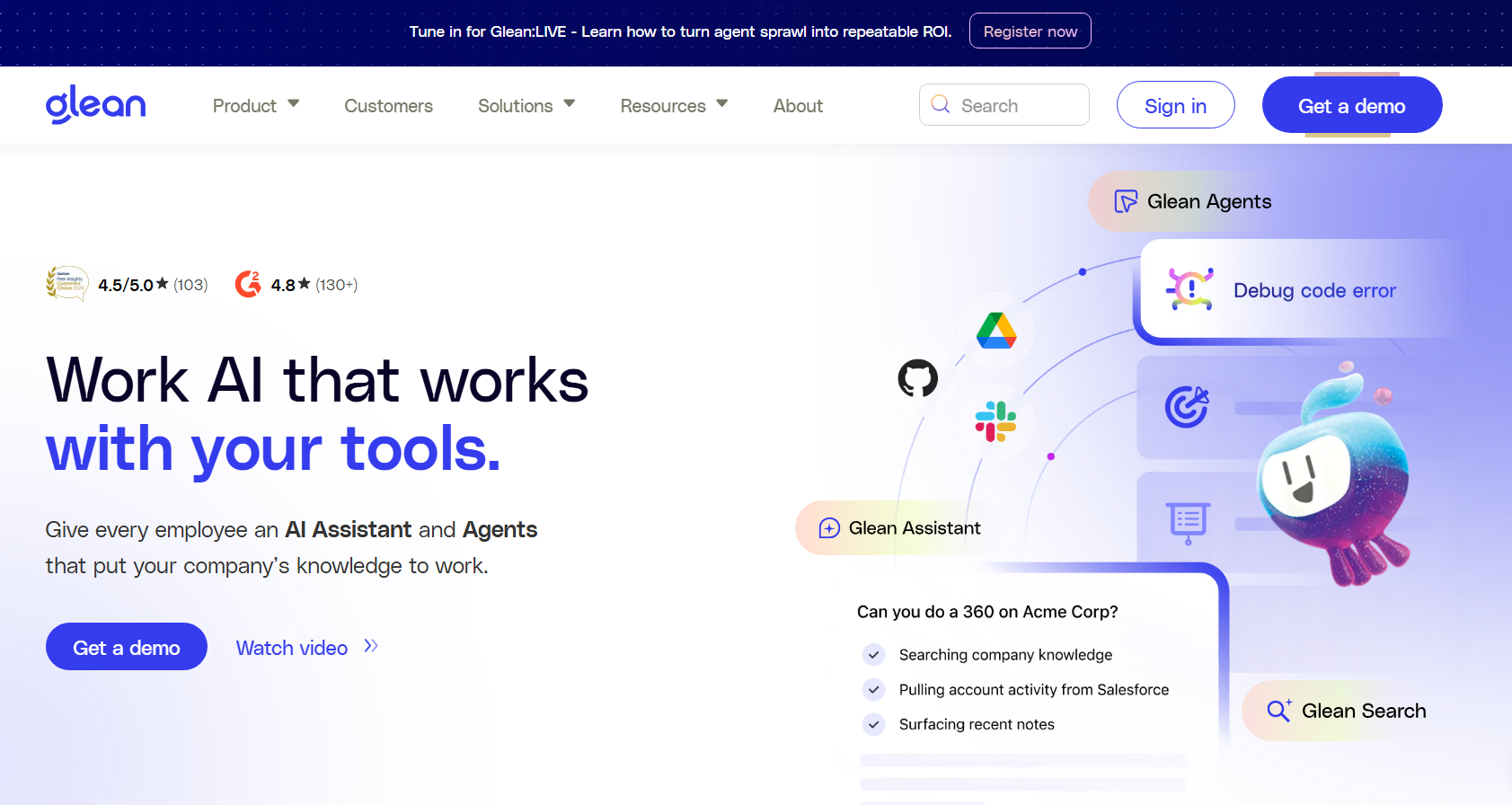
Glean has raised $7.2 billion and holds strong Gartner recognition. Its core product is an enterprise knowledge search layer that unifies information scattered across the organization into a single intelligent search experience. What sets Glean apart is its permission-aware retrieval — employees access only the information they're authorized to see, surfaced through natural-language queries.
In 2026, Glean has expanded toward agentic capabilities, allowing agents to act on retrieved knowledge — scheduling meetings, drafting summaries, creating tasks — in addition to surfacing it.
Key features
- Intent understanding and permission-aware retrieval across 100+ enterprise applications
- Contextual search, role-aware recommendations, and NLQ answering
- Expanding agentic layer for acting on retrieved information
- Enterprise-grade security with SOC 2, GDPR compliance
Limitation
Glean's fundamental architecture is search-first, not execution-first. It remains more focused on knowledge discovery than on end-to-end process automation. If your primary need is autonomous multi-step workflow execution — not information retrieval — Glean is not the right fit.
4. Salesforce Agentforce
Best for: Enterprises already deeply invested in the Salesforce ecosystem, where the goal is to extend AI agents within existing CRM, service, and sales workflows.

Overview
Salesforce Agentforce is the enterprise evolution of AI within the Salesforce platform. Powered by Einstein GPT and embedded across Salesforce's cloud products, Agentforce deploys autonomous agents for sales, service, marketing, and commerce — all within the Salesforce data model and permission framework.
The platform's primary advantage is its install base. Enterprises already running Salesforce across sales and service have a natural on-ramp to AI agents without integration complexity. The primary constraint is the inverse of that advantage: Agentforce works best inside Salesforce's ecosystem and degrades meaningfully when asked to orchestrate across non-Salesforce systems.
Key features
- Native embedding within Salesforce Sales Cloud, Service Cloud, Marketing Cloud
- Einstein GPT-powered agents for sales coaching, service resolution, campaign optimization
- Agentforce partner ecosystem for third-party integrations
- SOC 2, GDPR, HIPAA compliance
Limitation
System-agnostic orchestration is weak. If your workflows span SAP, ServiceNow, and Salesforce simultaneously, Agentforce will require significant additional integration work. It is not designed for cross-stack enterprise automation.
5. UiPath
Best for: Enterprises with large existing RPA programs looking to add AI reasoning to rule-based automation without replacing their entire infrastructure.

Overview
UiPath is the dominant brand in robotic process automation and has been evolving toward agentic AI through its AI Agent Studio and Agentic Process Automation (APA) product line. The platform allows organizations to combine deterministic RPA workflows with AI-powered reasoning agents — handling the predictable steps through automation and the judgment-intensive steps through AI.
Key features
- AI Agent Studio for building goal-driven agents alongside RPA workflows
- Process Reasoning Engine for interpreting business intent and mapping to automation steps
- Strong integration with SAP, Oracle, Workday, and other enterprise systems
- SOC 2, ISO 27001 compliance
Limitation
UiPath's legacy is rule-based automation, and that DNA is visible in the architecture. Pure agentic reasoning — where agents interpret goals and determine steps independently — is stronger on platforms built agentic-first. The hybrid approach is valuable for organizations with large RPA investments but is not the right starting point for enterprises building net-new agentic programs.
6. Moveworks
Best for: Enterprises with complex IT and HR helpdesk environments looking for a ready-to-deploy AI assistant that can reduce ticket volume and improve employee self-service.
Overview
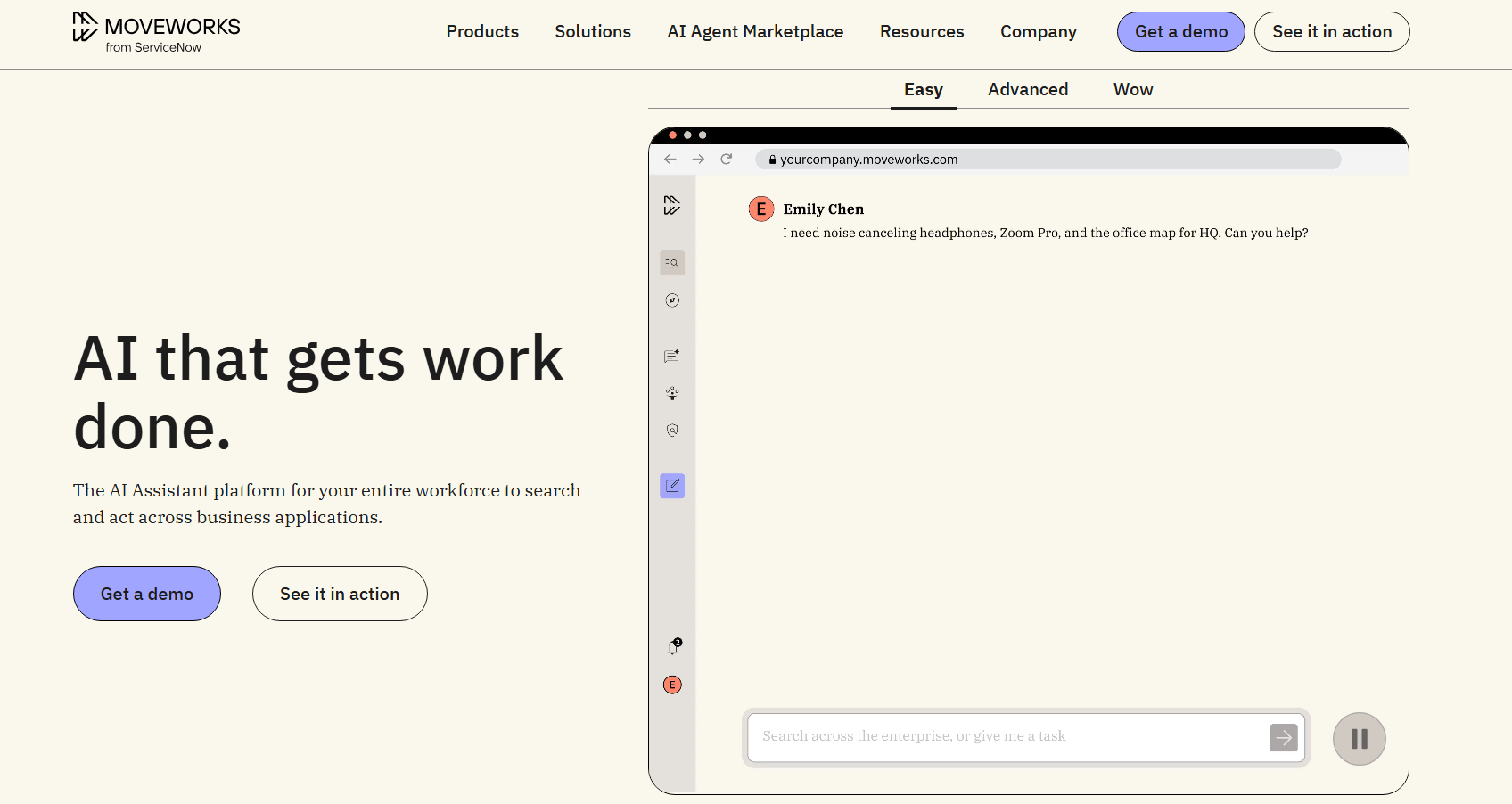
Moveworks deploys AI agents for IT and HR support — resolving employee requests through natural language across chat interfaces, email, and enterprise systems. Its agentic reasoning engine interprets employee queries, determines intent, and coordinates resolution steps across IT, HR, and other enterprise systems.
A significant development: ServiceNow announced its acquisition of Moveworks in March 2025. Organizations evaluating Moveworks should factor roadmap and packaging changes into their longer-term planning.
Key features
- Agentic reasoning for IT and HR query resolution
- Cross-system orchestration across IT, HR, and related enterprise systems
- Out-of-the-box deployment for IT helpdesk and HR workflows
- Contextual intelligence using role, department, and interaction history
Limitation
Moveworks is strong within its defined scope — IT and HR — but is not a general-purpose agentic platform. Organizations looking for agentic AI across operations, finance, or customer-facing workflows will find its coverage limited.
7. Aisera
Best for: IT operations teams looking to automate tier-1 and tier-2 service desk requests at scale.

Overview
Aisera focuses on IT service automation — deploying AI agents that handle service desk requests, asset queries, software provisioning, and onboarding workflows. Its architecture combines conversational AI, process automation, and generative AI to resolve IT requests autonomously across text and voice channels.
Key features
- Omnichannel IT support automation (chat, email, voice)
- Integration with major ITSM platforms (ServiceNow, Jira, Zendesk)
- Knowledge retrieval and policy enforcement for IT workflows
- SOC 2, GDPR compliance
Limitation
Like Moveworks, Aisera is purpose-built for IT service management. It is not designed for cross-functional or multi-industry deployment.
8. Cognigy
Best for: Enterprises running large contact centers that need AI agents to handle complex, multi-turn customer conversations at high volume.
Overview
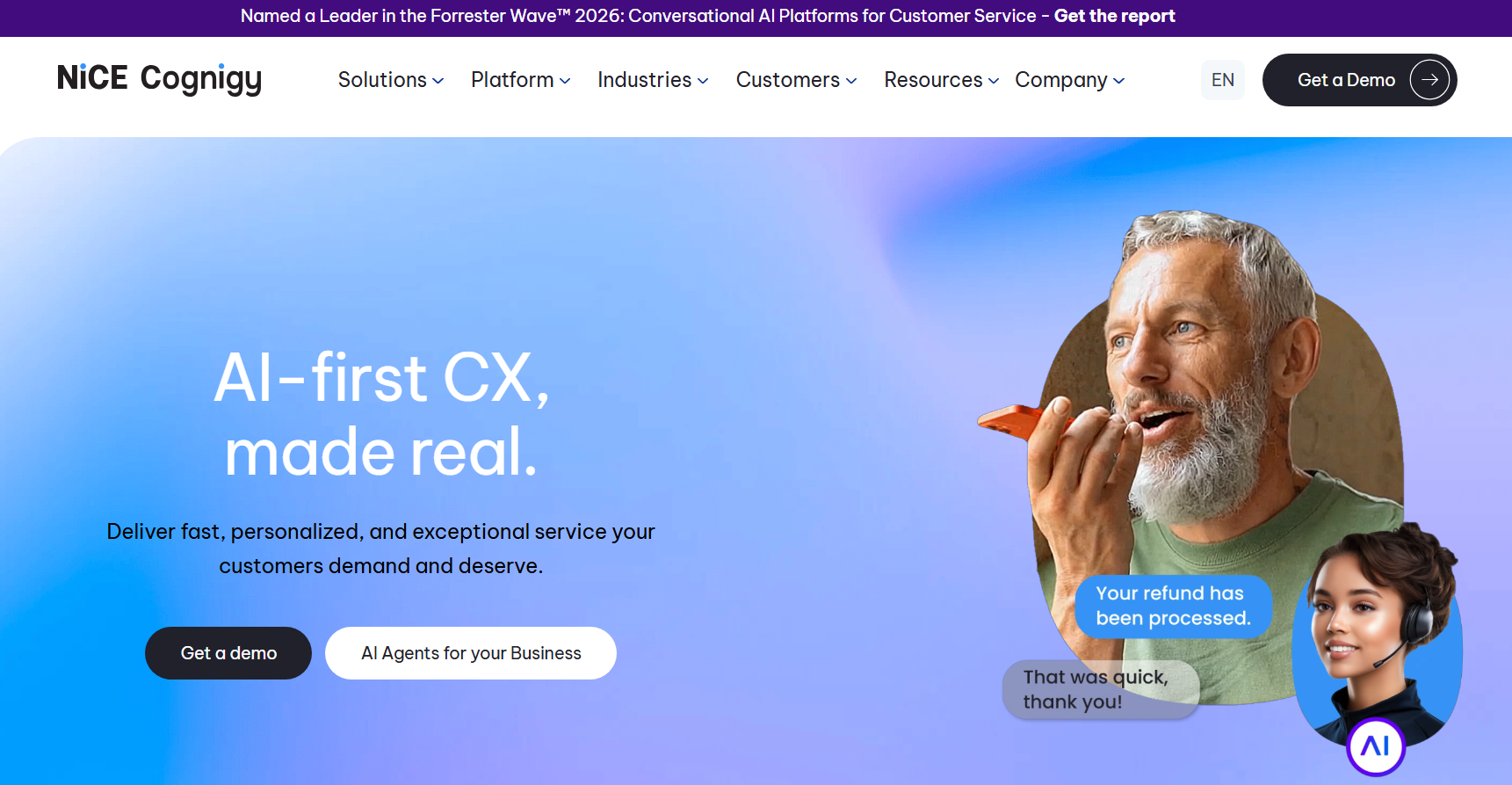
Cognigy is a conversational AI platform with deep enterprise roots in contact center automation. Its agentic capabilities extend into multi-step customer workflows — not just answering questions but resolving service requests, processing returns, scheduling callbacks, and escalating to human agents when required.
Key features
- Low-code agent design for customer service workflows
- Voice AI with advanced NLU for phone-channel automation
- Integration with CRM, ITSM, and ERP systems for full resolution workflows
- SOC 2, GDPR, HIPAA compliance
Limitation
Cognigy's focus is customer-facing. It is not designed for internal operations, back-office automation, or cross-department agentic workflows.
9. n8n
Best for: Technical teams and developers who want maximum control over agentic workflow automation and are comfortable building and maintaining their own infrastructure.

Overview
n8n is an open-source workflow automation platform that has added AI agent capabilities, allowing technical teams to build custom agentic workflows connecting virtually any API or system. Its self-hosted model makes it attractive to organizations with strict data residency requirements or those that want to own their automation infrastructure entirely.
Key features
- Open-source, self-hosted or cloud-managed
- 400+ integrations via pre-built nodes
- AI agent building with LLM integration
- Maximum customization and flexibility
Limitation
n8n requires significant technical investment. It is not an out-of-the-box enterprise solution — it's a developer toolkit. Governance, observability, and enterprise support capabilities are limited compared to managed platforms.
10. CrewAI
Best for: AI engineering teams building custom multi-agent applications from the ground up, where flexibility and developer control matter more than time-to-deployment.
Overview
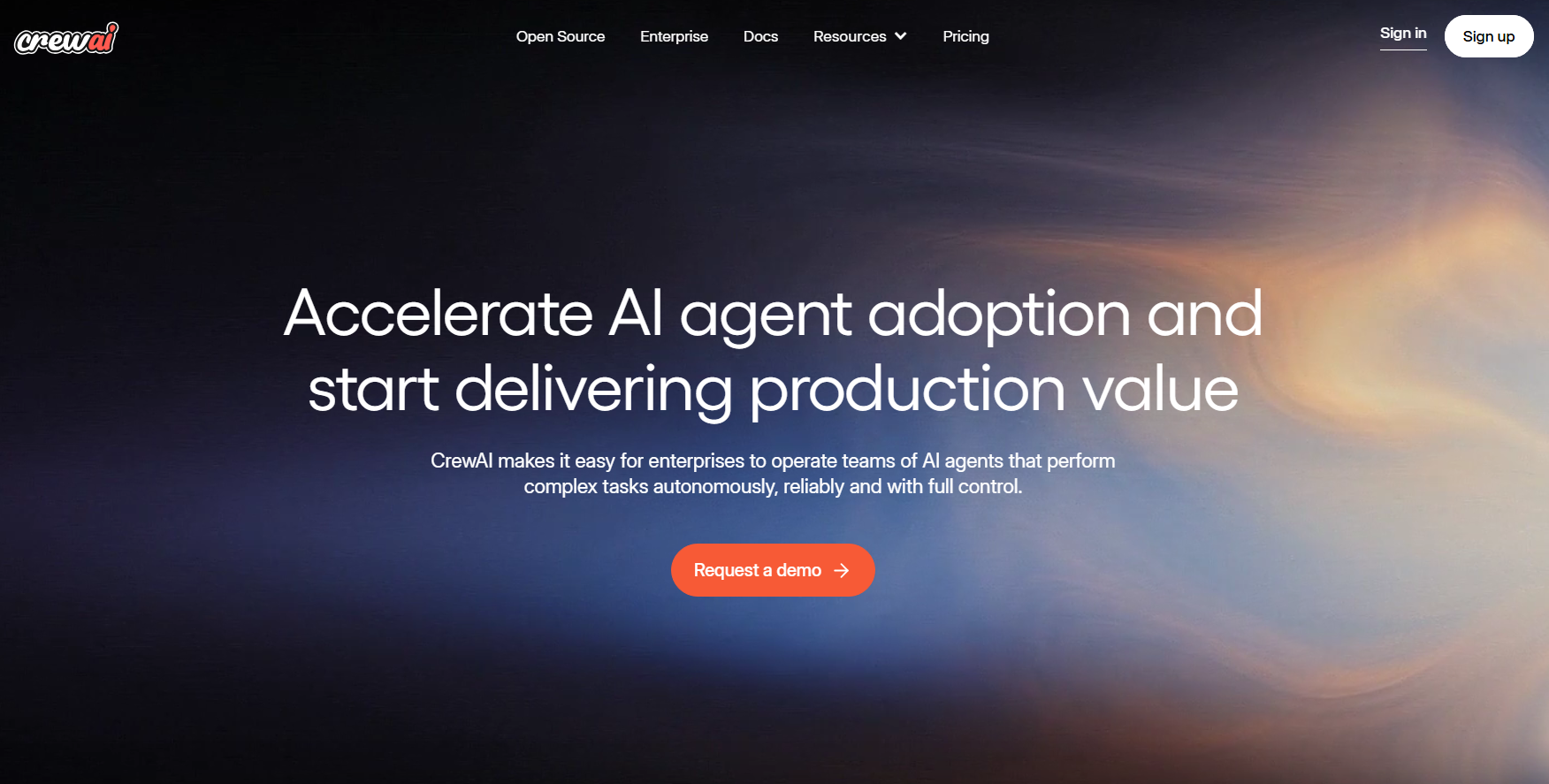
CrewAI is a multi-agent orchestration framework — not a managed platform. It provides the primitives for building coordinated teams of AI agents: role definition, tool assignment, memory management, and task decomposition. Organizations use CrewAI to build proprietary agentic applications when off-the-shelf platforms don't fit their specific workflow requirements.
Key features
- Multi-agent orchestration with role assignment and workflow tracing
- Visual editor and API-driven development
- Tool and application integration (Gmail, Slack, Salesforce, and custom APIs)
- Open-source with commercial support options
Limitation
CrewAI is a framework, not a finished enterprise product. There is no managed governance layer, no out-of-the-box compliance infrastructure, and no enterprise support model comparable to managed platforms. Building on CrewAI means owning the engineering effort.
11. Relevance AI
Best for: Sales and marketing teams in growth-stage companies looking to automate GTM workflows — prospecting, outreach, campaign intelligence, and pipeline management.

Overview
Relevance AI has gained strong traction in the GTM automation space, with notable deployments at companies like Canva and Databricks. Its progressive adoption model allows teams to start with specific sales or marketing workflows and expand over time. The platform is G2-listed and has a growing review presence.
Key features
- Sales agent workflows for prospecting, lead enrichment, and follow-up automation
- Marketing agent workflows for campaign intelligence and content generation
- G2 presence and community with enterprise case studies
- SOC 2, GDPR compliance
Limitation
Relevance AI's coverage is primarily GTM — sales and marketing. It has limited integration depth for operations, finance, or supply chain workflows, and industry coverage (2–3 verticals vs. 12) is narrower than platforms built for enterprise-wide deployment.
12. Microsoft Copilot Studio
Best for: Organizations standardized on Microsoft 365 and Azure, looking to build AI agents natively within the Microsoft ecosystem.

Overview
Microsoft Copilot Studio is the enterprise agent-building platform within the Microsoft cloud. Organizations can build, deploy, and manage AI agents connected to Microsoft 365 data (Teams, SharePoint, Outlook, Dynamics), Azure services, and external APIs via connectors. The platform benefits from Microsoft's compliance infrastructure and global enterprise relationships.
Key features
- Native integration with Microsoft 365, Azure, and Dynamics
- Pre-built connectors and Power Platform integration for low-code agent building
- Enterprise-grade compliance: SOC 2, GDPR, HIPAA, ISO 27001
- Scalable deployment through Azure infrastructure
Limitation
Like Salesforce Agentforce, Microsoft Copilot Studio's strength is its ecosystem — and its weakness is the same. Cross-stack orchestration outside the Microsoft ecosystem requires additional integration work. For enterprises with heterogeneous technology stacks, the native advantage diminishes.
How to choose the right agentic AI platform for your enterprise
The right platform depends on four variables: your technology stack, your primary use case, your industry, and your deployment timeline. Here is a practical decision framework.
If your primary challenge is knowledge discovery across fragmented internal systems, start with Glean. It is purpose-built for this and leads the field in permission-aware enterprise search.
If your primary challenge is IT and HR helpdesk automation, evaluate Moveworks and Aisera. Both offer strong out-of-the-box deployment for these specific workflows.
If you are deeply invested in Salesforce and your workflows are primarily CRM-adjacent, Agentforce is the lowest-friction starting point. Understand its cross-stack limitations before expanding.
If you are deeply invested in Microsoft 365 and Azure, Microsoft Copilot Studio is the natural starting point. The same caveats apply for cross-stack expansion.
If your contact center is the primary deployment target, Cognigy is the strongest purpose-built option. It has the deepest NLU and voice AI capabilities for customer-facing conversations.
If you have strong internal engineering and want to build proprietary agents, n8n and CrewAI offer maximum flexibility. Budget the engineering investment accordingly.
If you need agentic AI that spans multiple departments, multiple industries, and a heterogeneous technology stack — in production within 4 weeks — the only platform on this list designed for that is assistents.ai. The 300+ integration ecosystem, 12-industry vertical depth, and governance layer (SOC 2, HIPAA, GDPR, ISO 27001) make it the strongest choice for organizations that cannot afford a single-purpose solution.
Enterprise deployment results: what real agentic AI looks like across industries

The most common mistake enterprise buyers make is evaluating agentic AI platforms based on demo environments and feature matrices. Production is different. Here is what real deployments look like across six industries.
Logistics and supply chain
A global port and logistics operator — one of the largest in the world by revenue — deployed agentic AI to digitise terminal-to-rail operations. The agents handle yard and rail scheduling, exception management, and executive dashboards. Before deployment, visibility across terminal and inland logistics was fragmented across manual processes. After deployment, throughput predictability improved, exception detection became proactive rather than reactive, and operational visibility reached leadership without requiring analyst intervention. The shift wasn't from bad software to good software — it was from reactive reporting to automated execution.
Retail at national scale
A value retailer with more than 700 stores across hundreds of cities deployed three interconnected agents: a voice support agent for store staff (operating in multiple local languages), an inventory intelligence agent with real-time pricing and stock data, and a training knowledge agent built on RAG over POS and SOP documentation. The combined result was a reduction in manual helpdesk burden at store level, faster access to inventory intelligence, and a significant improvement in onboarding speed for new store staff.
Financial services and compliance
A global fintech provider serving banks and credit unions deployed omnichannel AI agents for disputes, fraud detection, and compliance workflows. The agent handles intake across chat, email, and phone — with full audit logging on every decision and action. SLA adherence improved because routing became automated rather than manual. Compliance reporting became faster because the audit trail was generated automatically at the time of the action, not reconstructed afterward.
Healthcare staffing
A healthcare staffing platform operating in the US deployed AI agents for the full staffing lifecycle: facility request intake, credential verification, talent matching, scheduling, and compliance tracking. Healthcare staffing is high-stakes and high-velocity — facilities need qualified staff on short notice, and the compliance requirements (credential verification, shift compliance) cannot be skipped. The agentic deployment reduced fill cycle time, improved workforce utilisation, and allowed the operations team to handle higher volume without adding headcount.
Energy and grid operations
A state power transmission utility deployed AI agents for smart grid monitoring — ingesting transmission KPIs, detecting anomalies, generating predictive maintenance indicators, and routing alerts to field operations teams. Grid management at this scale generates enormous amounts of data that humans cannot monitor in real time. The agentic layer provides continuous monitoring, proactive alerts, and operational dashboards that give leadership visibility without requiring human analysts to process raw telemetry.
Real estate and tenant experience
A major real estate portfolio owner across UAE markets deployed a customer service agent for tenant management — available across web, WhatsApp, and email. The agent handles query triage, FAQ resolution, rental payment support, and escalation to human teams. The deployment transformed the tenant experience from a call-center-dependent model to a 24×7 automated model, with faster response times and consistent SLA adherence.
The bottom line
The agentic AI market in 2026 is large, fast-moving, and full of platforms that are genuinely excellent within a defined scope. Kore.ai leads for enterprise-wide CX and EX. Glean leads for knowledge search. Moveworks and Aisera lead for IT and HR helpdesk. Cognigy leads for contact centers.
The gap in the market is the platform that does not require you to choose between those scopes. Enterprises don't have one department. They have finance, and logistics, and customer service, and HR, and compliance — all running simultaneously on different systems, all generating different workflows, all requiring governance and audit.
That is the deployment context assistents.ai is built for. Twelve industries. Six departments. 300+ integrations. Four weeks to production. SOC 2, HIPAA, GDPR, ISO 27001 — verified.
If you're evaluating agentic AI platforms for enterprise deployment in 2026, the most useful next step is not reading more comparison articles. It's seeing the platform work in your actual environment, against your actual workflows.
[Book a demo with assistents.ai →]
Frequently asked questions
What is an agentic AI platform?
An agentic AI platform is software infrastructure that enables AI agents to interpret goals, plan multi-step actions, and execute those actions autonomously across enterprise systems — with minimal human intervention required at each step. Unlike chatbots or copilots that respond to prompts, agentic platforms take direction at the goal level: you tell the agent what outcome you want, and it determines how to get there.
What is the best agentic AI platform for enterprise in 2026?
The best platform depends on your use case and technology stack. For organizations that need a single platform spanning multiple departments and industries — with 300+ integrations, governance, compliance, and a 4-week deployment timeline — assistents.ai is the strongest option. For enterprise knowledge search specifically, Glean leads. For IT and HR helpdesk, Moveworks and Aisera are the most mature purpose-built options.
What is the best agentic AI platform for healthcare?
Healthcare deployments require HIPAA compliance, auditability, and the ability to handle sensitive patient and staffing data. Platforms with verified HIPAA compliance include assistents.ai, Salesforce Agentforce, Cognigy, and Microsoft Copilot Studio. assistents.ai has direct deployment experience across healthcare staffing, clinical services, and compliance workflows.
What is the best agentic AI platform for financial services?
Financial services deployments require SOC 2, GDPR compliance, full audit trails, and the ability to integrate with core banking and ERP systems. assistents.ai has deployed AI agents for banking dispute and fraud workflows, fintech compliance automation, and financial analytics. The omnichannel, auditable workflow model is purpose-built for regulated financial environments.
How long does it take to deploy an agentic AI platform?
Deployment timelines vary significantly by platform. Most enterprise platforms require 8–12 weeks to reach production. assistents.ai deploys in 4 weeks due to its pre-built integration ecosystem and vertical solution templates. Developer frameworks like n8n and CrewAI have variable timelines depending on the engineering investment required.
What is the difference between agentic AI and RPA?
RPA (Robotic Process Automation) executes predefined, rule-based steps. It breaks when the process changes or an exception occurs outside its defined rules. Agentic AI interprets intent, reasons through steps, and adapts when circumstances change. An RPA bot can fill a form. An agentic AI platform can decide which form to fill, where to get the data to fill it, what to do if the data is incomplete, and how to route the result — without a human scripting each step.
How do I evaluate agentic AI platforms for governance and compliance?
Ask for documented compliance certifications — SOC 2 Type II, HIPAA Business Associate Agreement (BAA), GDPR Data Processing Agreement (DPA), ISO 27001 certification. Beyond certifications, evaluate: whether audit logs are generated automatically at the time of action (not reconstructed), how the platform handles role-based access control for agent permissions, and what observability tools exist for monitoring agent behavior in production.
What industries are best suited for agentic AI in 2026?
Every industry with complex, multi-step operational workflows benefits from agentic AI. Based on real production deployments, the highest-ROI industries in 2026 are: Financial services (compliance automation, disputes, fraud), Healthcare (staffing, clinical workflows, patient communication), Logistics and supply chain (terminal operations, exception management), Retail (inventory intelligence, store support, customer service), Energy and utilities (grid monitoring, predictive maintenance), and Real estate (tenant management, property operations).

Transform Your Business With Agentic Automation
Agentic automation is the rising star posied to overtake RPA and bring about a new wave of intelligent automation. Explore the core concepts of agentic automation, how it works, real-life examples and strategies for a successful implementation in this ebook.
Sarfraz Nawaz is the CEO and founder of Ampcome, which is at the forefront of Artificial Intelligence (AI) Development. Nawaz's passion for technology is matched by his commitment to creating solutions that drive real-world results. Under his leadership, Ampcome's team of talented engineers and developers craft innovative IT solutions that empower businesses to thrive in the ever-evolving technological landscape.Ampcome's success is a testament to Nawaz's dedication to excellence and his unwavering belief in the transformative power of technology.

More insights
Discover the latest trends, best practices, and expert opinions that can reshape your perspective


.jpg)
.jpg)


Contact us

