
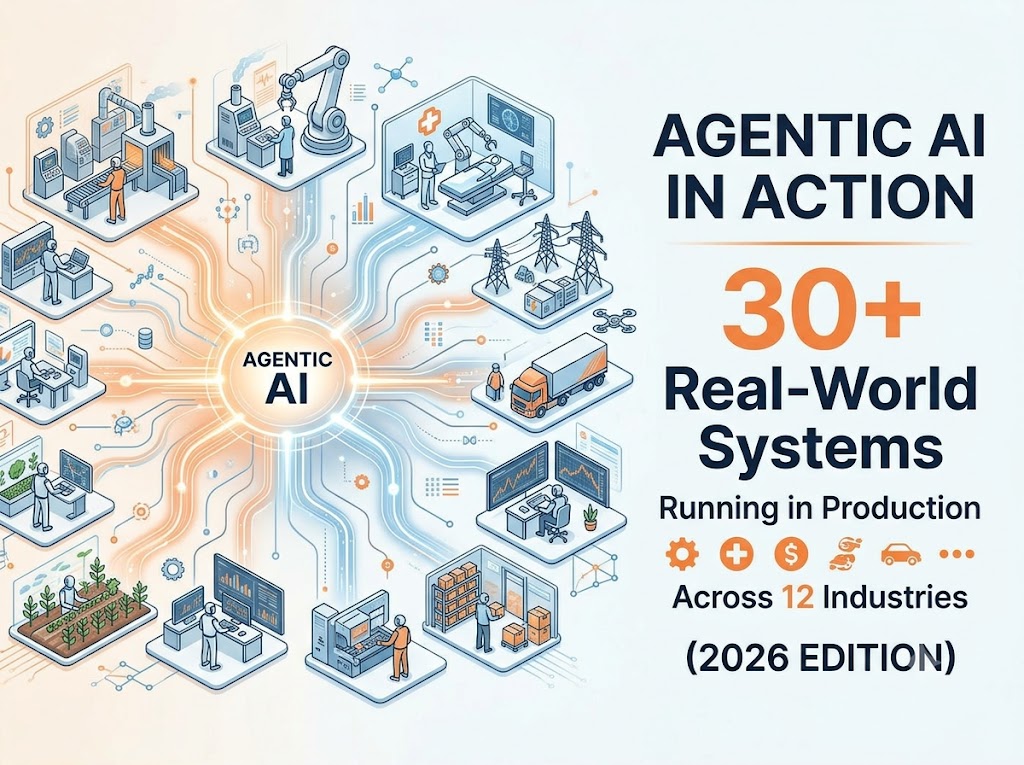
Agentic AI in Action: 30+ Real-World Systems Running in Production Across 12 Industries (2026)


An agentic AI system in action is one that perceives context, reasons over governed enterprise data, and executes multi-step work end to end — not a chatbot answering questions in a demo. It reads the email, checks the inventory, drafts the response, creates the order, and logs every step for audit, with a human approving the moments that matter.
That's the definition. This article is the evidence.
Most content about agentic AI recycles the same secondhand examples pulled from press releases. This post is different: every system described below is a real production deployment delivered on Assistents.ai, the governed agentic AI platform built by Ampcome. We've anonymized clients by industry, geography, and scale — but the workflows, architectures, and results are real. If you want frameworks and theory, we've covered those elsewhere. This is what agentic AI looks like when it's actually running.
What "Agentic AI in Action" Actually Means (and What It Doesn't)
Every working agentic system runs a continuous four-stage loop:
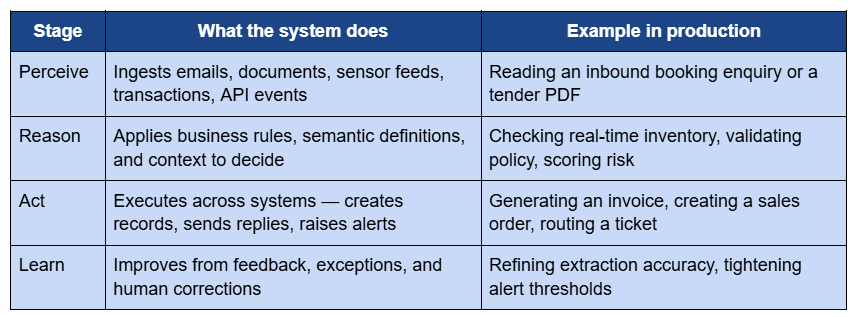
The loop matters because it separates agentic AI from everything that came before it. A generative AI chatbot stops at "reason." Traditional automation never reasons at all. Agentic AI closes the loop — and does it continuously.
Chatbot Demo vs. Production Agentic System: A 6-Point Checklist
Enterprise buyers see impressive demos every week. Here's how to tell whether an "agentic AI system" is actually in action or just in a slide deck:
- It touches real systems of record. Production agents read from and write to CRMs, ERPs, databases, and ticketing tools — not a sandbox.
- Its numbers come from governed data. Answers run through a semantic layer with your metric definitions, so the AI cannot invent figures.
- Actions have approval gates. Consequential writes go through maker-checker (human-in-the-loop) approval, not blind autonomy.
- Every step is auditable. An immutable audit trail records what the agent saw, decided, and did.
- Access is scoped. Row-level security and attribute-based access control mean the agent only sees what the requesting user is allowed to see.
- It runs when nobody's watching. Real agentic systems monitor, alert, and act 24×7 — not only when someone opens a chat window.
If a vendor can't show you all six, you're looking at a demo, not a deployment.
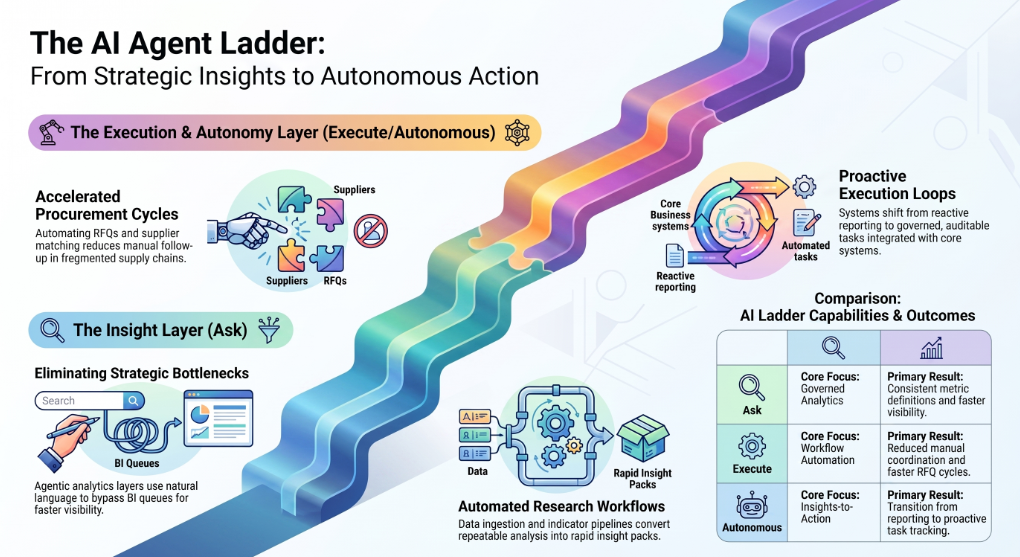
The Autonomy Ladder: Ask → Execute → Autonomous
Across every production system we've shipped, enterprises climb the same three-rung ladder. We call it Ask → Execute → Autonomous, and it's the most useful mental model we know for planning an agentic AI rollout.
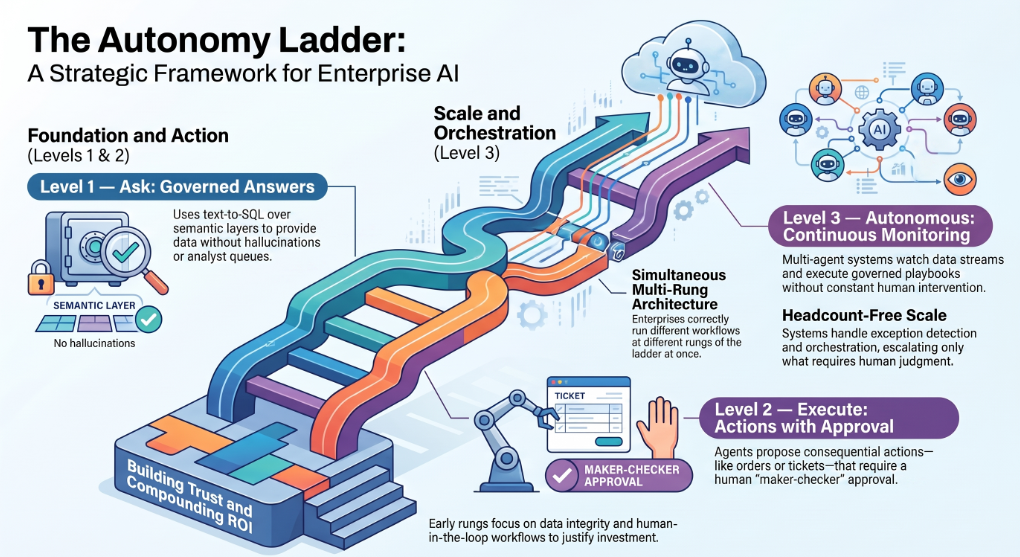
Level 1 — Ask: Governed Answers From Your Own Data
The agent answers natural-language questions using text-to-SQL over a semantic layer — your definitions of revenue, margin, churn, and utilisation. No hallucinated numbers, no analyst queue. This is where trust is built.
Level 2 — Execute: Agents That Act With Approval
The agent doesn't just answer — it proposes actions: draft the reply, create the order, issue the alert, raise the ticket. A human confirms through maker-checker approval before anything consequential happens. This is where ROI compounds.
Level 3 — Autonomous: Always-On Monitoring and Orchestration
Multi-agent systems watch data streams continuously, detect exceptions, execute governed playbooks, and escalate only what needs human judgment. This is where headcount-free scale happens.
Every case study below sits on this ladder, and most enterprises run different workflows at different rungs simultaneously. That's not a compromise — it's the correct architecture.
Agentic AI in Action: 30+ Production Systems by Industry
Each example follows the same format: the problem, what the agents do, and the observed result. Clients are anonymized by industry, geography, and scale.
Financial Services & Fintech
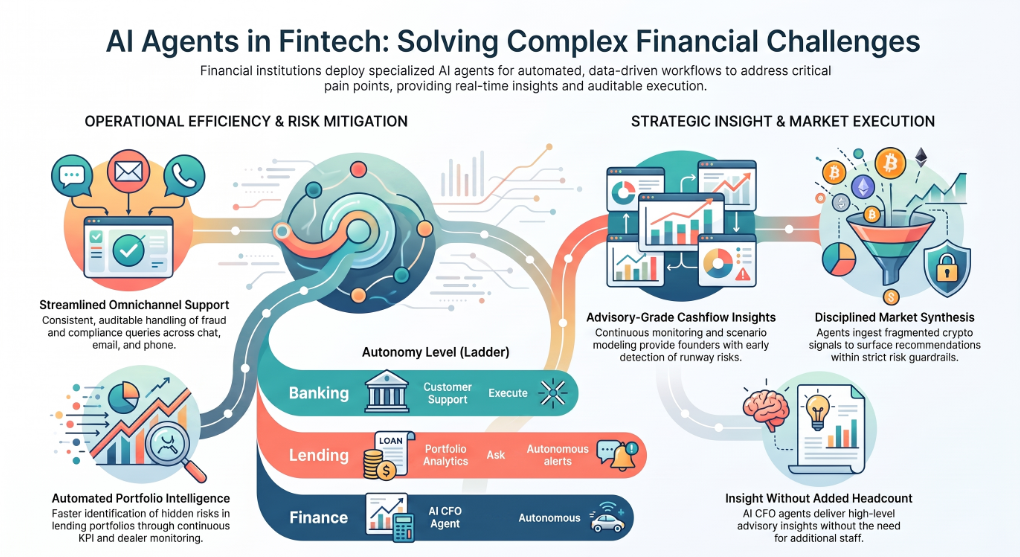
Omnichannel banking support agents (global fintech serving banks and credit unions). Problem: dispute, fraud, and compliance queries arriving across chat, email, and phone, each demanding consistent, auditable handling. System: omnichannel intake with intent routing, agent-assist summarisation, next-best-action guidance, and SLA monitoring — every step logged. Result: faster case handling, reduced operational load, and stronger compliance readiness through end-to-end audit trails. (Ladder: Execute)
AI CFO agent (global finance platform for growing businesses). Problem: founders and advisors flying blind between monthly reports. System: agents connected to accounting and banking data run continuous cashflow monitoring, forecasting, and scenario modelling, with alerts on runway risk and recommended actions. Result: earlier detection of cash risks and advisory-grade insight without added headcount. (Ladder: Autonomous)
Crypto trading agents with guardrails (European AI-first trading terminal). Problem: fragmented market signals and undisciplined decision-making. System: agents ingest market data, run indicator and pattern analysis, simulate strategies inside risk guardrails, and surface recommendations. Result: faster synthesis of market signals and more disciplined, governed decision workflows. (Ladder: Execute)
Automated lending portfolio intelligence (independent Canadian automotive leasing provider). Problem: portfolio risk hiding in delinquency, maturity, and residual data across a dealer network. System: analytics agents monitor portfolio KPIs and dealer performance, alerting on exceptions and early risk signals. Result: better portfolio visibility and faster risk identification. (Ladder: Ask → Autonomous alerts)
Retail & E-Commerce
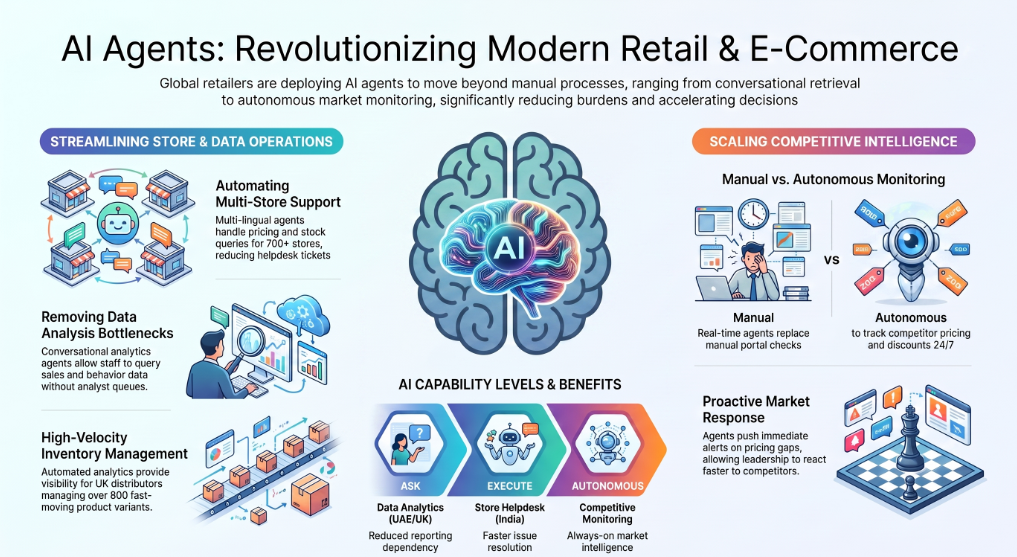
Store support agents at national scale (pan-India value retailer, 700+ stores). Problem: thousands of store staff raising helpdesk tickets for questions about pricing, stock, promotions, and procedures. System: a voice support agent operating in Hindi and English, an inventory intelligence agent answering per-store pricing and stock queries, and a knowledge agent running retrieval over POS and SOP documents — all with an admin console and ticketing integration. Result: reduced helpdesk burden, faster store issue resolution, and on-demand training for new staff. (Ladder: Execute)
Competitive monitoring agents (legacy Indian HVAC and refrigeration major). Problem: daily pricing and promotion moves by competitors across e-commerce portals, tracked manually. System: agents continuously monitor pricing, discounts, offers, availability, and ratings across channels, answer leadership questions on demand, and push proactive alerts on pricing gaps. Result: always-on monitoring replaced manual portal checks, with faster competitive response cycles. (Ladder: Autonomous)
Conversational commerce analytics (premium UAE home-appliances retailer). Problem: e-commerce and operations data locked behind analyst queues. System: a data analytics agent ingesting sales, inventory, promotion, and customer-behaviour data, answering business questions conversationally and alerting on KPI exceptions. Result: shorter analysis cycles and reduced reporting dependency on analysts. (Ladder: Ask)
High-velocity e-commerce analytics (UK distribution operation with 800+ product variants). Problem: fast-moving stock and thin margins demanding constant operational visibility. System: data analytics for operational efficiency and customer experience optimisation. Result: more scalable operations with reduced manual overhead. (Ladder: Ask)
Logistics, Ports & Supply Chain
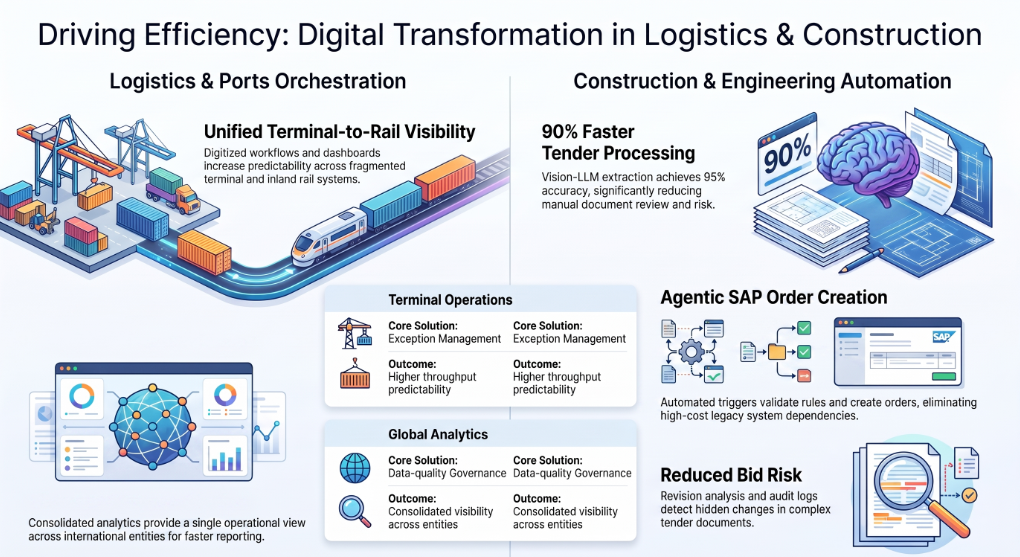
Terminal and rail orchestration (global ports and logistics leader, ~$20B annual revenue). Problem: coordinating terminal-to-inland rail logistics across fragmented systems. System: digitised terminal workflows, yard and rail operational dashboards, scheduling visibility, and exception management with executive alerting. Result: higher predictability of terminal-to-rail throughput and more efficient coordination across the chain. (Ladder: Execute)
Multi-entity analytics consolidation (Indian multinational logistics and warehousing company). Problem: inconsistent KPIs across global entities serving India, Europe, and the US. System: cross-entity KPI standardisation, consolidated reporting, variance explanations, and a data-quality governance layer. Result: a single operational view across entities and faster leadership reporting. (Ladder: Ask)
Construction & Engineering
Intelligent tender document workbench (Australian remedial construction specialist, 20+ years in operation). Problem: complex, revision-heavy tender documents consuming days of manual processing, with bid risk hiding in missed changes. System: a multi-agent document workbench — tender retrieval, workflow determination, revision analysis, vision-LLM extraction from complex PDFs, and deep two-way integration with the core job-management system, including quote locking and audit logs. Result: engineered for up to ~90% faster tender processing with a ~95% extraction accuracy target on standard formats, and reduced bid risk through revision detection. (Ladder: Execute)
Automated SAP sales order creation (flagship UAE engineering solutions provider, established 1970s). Problem: an end-of-life legacy document workflow product with high licensing costs sitting between orders and SAP. System: agentic automation interprets order triggers, validates against rules, and creates SAP sales orders, with governed exception handling and reconciliation reporting. Result: reduced manual order processing, a faster order-to-confirm cycle with fewer data-entry errors, and a clean exit from legacy dependency. (Ladder: Execute)
Real Estate & Property
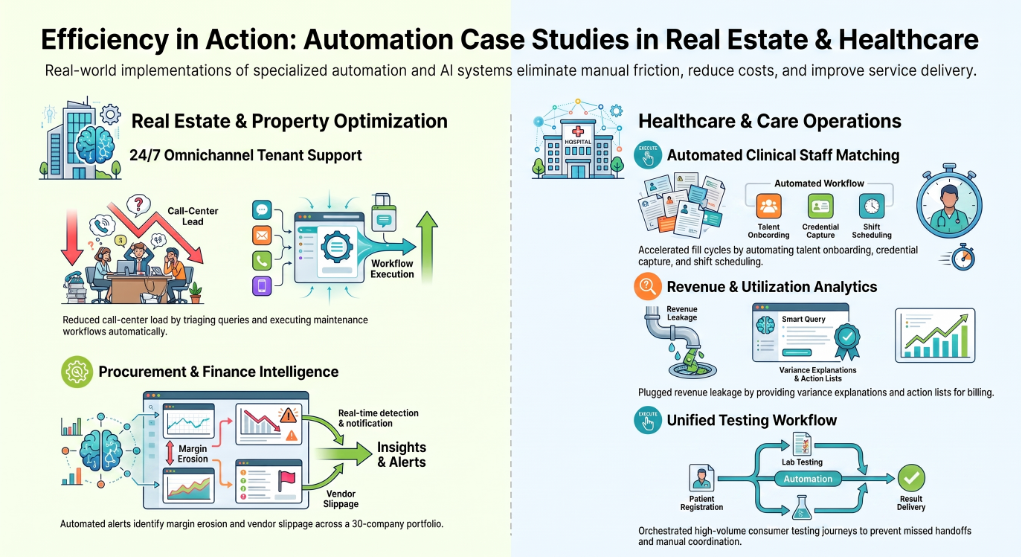
24×7 tenant service agent (major UAE real estate portfolio manager, assets across multiple emirates). Problem: high call-centre load for tenant queries spanning rentals, payments, and maintenance. System: an omnichannel service agent (web, WhatsApp-ready, email) triaging queries, answering from a knowledge base of policies and tenancy documents, executing support workflows, and escalating to human teams with full ticketing. Result: faster response times, lower call-centre load, and a consistent round-the-clock tenant experience with better SLA adherence. (Ladder: Execute)
Group-wide procurement and finance intelligence (prominent UAE family business group, 30+ companies). Problem: margin erosion and vendor slippage surfacing too late across a diversified portfolio. System: automated alerts on purchase price trends, gross-margin impact, early-payment economics, and vendor delivery/returns performance, plus scheduled insight packs for leadership. Result: earlier detection of margin erosion and standardised finance intelligence across entities. (Ladder: Autonomous)
Healthcare & Care Operations
Healthcare staffing platform (US platform connecting nurses with facilities). Problem: slow, manual matching of clinical professionals to open shifts, with compliance overhead. System: agents handle talent onboarding and credential capture, staffing request intake, matching logic, scheduling, notifications, and compliance workflows, with fill-rate reporting. Result: faster fill cycles, lower scheduling friction, and better workforce utilisation. (Ladder: Execute)
Revenue and operations analytics (physician-led hospitalist enterprise, New England). Problem: revenue leakage and utilisation blind spots across inpatient programs. System: revenue and utilisation analytics with variance explanations and action lists for billing workflows. Result: improved visibility into revenue leakage drivers and faster operational decisions. (Ladder: Ask)
Care-program analytics (geriatric care provider, Greater Boston). Problem: fragmented visibility across staffing, service delivery, and revenue cycle. System: program operations dashboards with exception alerts on revenue cycle issues. Result: faster identification of bottlenecks and better leadership decision support. (Ladder: Ask)
Health-service workflow automation (UK private healthcare and testing provider). Problem: high-volume consumer testing journeys — booking, processing, reporting — straining manual coordination. System: booking and workflow orchestration, status monitoring, automated customer notifications, and operational analytics. Result: faster customer communications, fewer missed handoffs, and unified service visibility. (Ladder: Execute)
Energy & Utilities
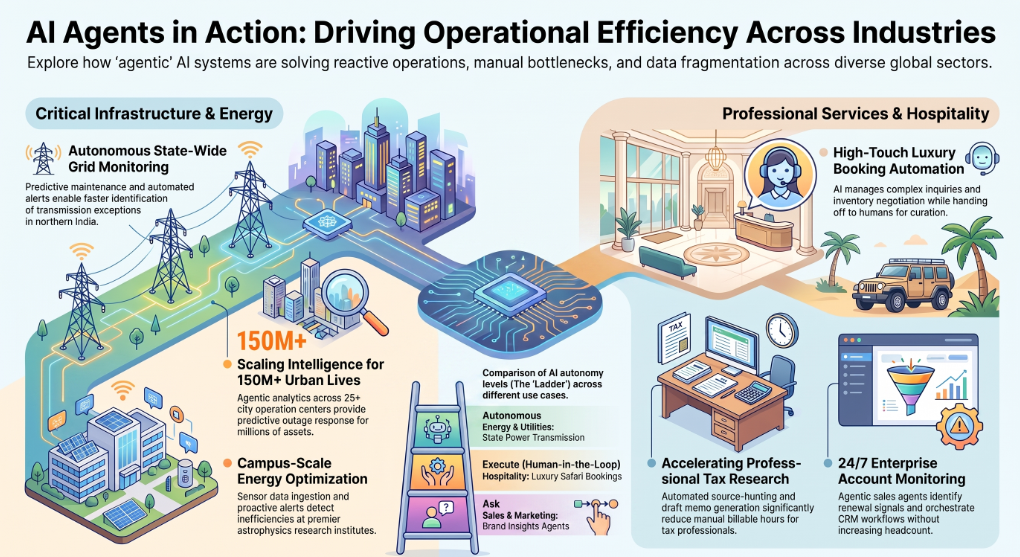
Smart grid analytics and alerting (state power transmission utility, northern India). Problem: reactive grid operations across a state-wide transmission network. System: transmission KPI monitoring, anomaly detection, loss and outage analytics, predictive maintenance indicators, and automated field-operations alerts. Result: faster identification of grid exceptions and more proactive, reliable operations. (Ladder: Autonomous)
City-scale smart infrastructure intelligence (smart infrastructure operator running 25+ city operation centres, touching 150M+ urban lives). Problem: operationalising analytics across millions of connected assets. System: agentic analytics and automated operational alerting layered on smart utility systems, with predictive analytics for outages and field issues. Result: higher operational visibility and faster exception response across city-scale operations. (Ladder: Autonomous)
Campus energy optimisation (premier Indian astrophysics research institute). Problem: campus-scale energy consumption with no proactive monitoring. System: sensor data ingestion, anomaly detection, forecasting, and optimisation recommendations with proactive alerts. Result: improved energy visibility and faster detection of inefficiencies. (Ladder: Ask → Autonomous alerts)
Hospitality & Travel
Digital booking agent with human-in-the-loop (luxury safari hospitality group, 16 properties across East Africa). Problem: complex, high-expectation booking enquiries arriving by email, each requiring inventory checks, negotiation, and curated itineraries. System: email intake with intent classification and data extraction, a conversational loop to capture missing details, real-time inventory checks with alternative date/property negotiation, automated invoice generation — and a hybrid handoff to human experts for itinerary curation. Result: faster booking turnaround, higher accuracy on complex requirements, and scalable operations without compromising luxury service. (Ladder: Execute — a textbook HITL design)
Enrolment funnel and instructor optimisation (Dubai-based driving institute, multi-branch). Problem: opaque conversion funnel from enrolment through lessons to tests. System: funnel analytics, instructor utilisation and slot optimisation, and customer-experience dashboards with alerts. Result: reduced scheduling bottlenecks and clearer visibility into conversion drivers. (Ladder: Ask)
Sales, Marketing & Professional Work
Agentic sales agent (global teacher community platform — and separately, an enterprise accounts deployment). Problem: enterprise account teams unable to cover every opportunity, risk, and renewal signal. System: always-on account monitoring, rule-governed opportunity identification, follow-up orchestration, CRM-ready workflows, and leadership alerts. Result: higher account coverage without added headcount and more consistent execution through governed playbooks. (Ladder: Autonomous)
Influencer campaign automation (Australian creator-economy platform). Problem: manual campaign operations across creator discovery, delivery, and reporting. System: creator discovery enrichment, campaign workflow automation, KPI monitoring with brand-safety checks, and automated insight generation. Result: reduced manual ops and consistent cross-campaign learnings. (Ladder: Execute)
Brand insights agents (US insights studio founded by ex-Google creative leaders). Problem: creative and performance signals scattered across channels. System: multi-source ingestion with insight agents producing themes, narratives, and recommendations as leadership-ready packs. Result: faster creative strategy cycles and clearer "what to do next" guidance. (Ladder: Ask)
Tax research automation (US sales & use tax research tool). Problem: manual source-hunting consuming tax professionals' billable hours. System: automated source collection, summarisation, and draft memo generation with citations and workflow tracking. Result: faster research cycles and more consistent outputs. (Ladder: Execute)
Cross-border tax pre-screening (UK tax-tech product). Problem: withholding tax, VAT mismatch, and permanent-establishment risks surfacing late in deals. System: transaction screening workflows, risk classification, evidence collection with explainability notes, and escalation to tax experts. Result: earlier risk detection and fewer last-minute deal disruptions. (Ladder: Execute)
AI voice scene partner (global rehearsal app for actors). Problem: actors needing rehearsal partners on demand. System: a real-time voice agent with character and voice control, pacing and cue logic, script ingestion, and self-tape workflow support — deployed with cost-controlled inference. Result: higher rehearsal throughput without human readers. (Ladder: Execute)
Pharma & Specialised Sourcing
Procurement automation agents (pharma sourcing platform, 1,800+ rare excipients, 7,500+ SKUs). Problem: slow RFQ cycles and manual supplier coordination in a fragmented supply chain. System: RFQ automation, supplier matching workflows, quality/regulatory document handling, and analytics on price, lead time, and vendor performance. Result: faster procurement cycles and reduced manual follow-up. (Ladder: Execute)
Investment & Corporate Intelligence
Insights-to-action layer (privately held retail holding group). Problem: dashboards full of insight, none of it turning into execution. System: a unified context engine over structured and unstructured data, a semantic governance layer for rules and hierarchies, and agents that convert dashboard insights into governed, auditable actions and tasks integrated with core systems. Result: a shift from reactive reporting to proactive execution loops with automated task tracking. (Ladder: Autonomous)
Self-serve governed analytics (Silicon Valley analytics startup). Problem: strategic questions queuing behind BI teams. System: an agentic analytics layer with semantic governance and a natural-language interface generating automated insights. Result: faster strategic visibility and consistent metric definitions across teams. (Ladder: Ask)
Market research automation (Indian technical analysis platform). Problem: repeatable research workflows consuming analyst time. System: data ingestion, indicator pipelines, research automation, and thematic dashboards with alerts. Result: faster production of insight packs and more repeatable research. (Ladder: Ask)
What Every Working Agentic System Has in Common
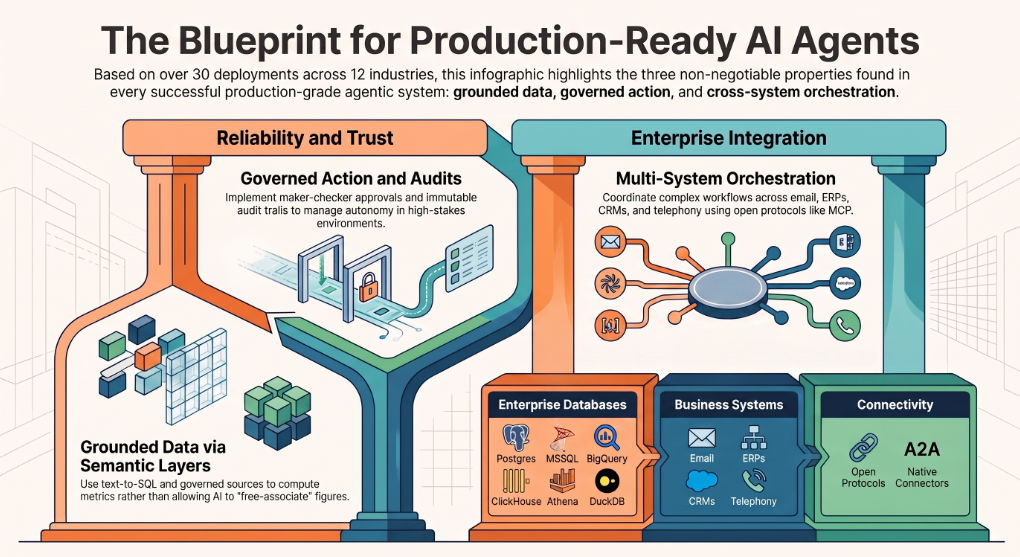
Thirty-plus deployments across twelve industries, and the pattern is unmistakable. Every system that made it to production — and stayed there — shares three properties.
Grounded Data: The Semantic Layer
Agents that invent numbers get switched off. Every production system above answers from a semantic layer encoding the customer's own metric definitions, with text-to-SQL generating queries against governed sources. The AI never free-associates a revenue figure; it computes one, the same way the finance team would.
Governed Action: HITL, Security, and Audit
Autonomy without governance is a liability. The systems above use maker-checker approvals for consequential actions, row-level security and attribute-based access control to scope what agents can see, and immutable audit trails recording every perception, decision, and action. That's why they run in banks, utilities, and healthcare operations — environments where "trust me" isn't an architecture.
Orchestration Across Systems
No real workflow lives in one tool. Production agentic AI means multi-agent orchestration across email, ERPs, CRMs, databases, and telephony — with open protocols (MCP, A2A) and native connectors to enterprise data sources like Postgres, MSSQL, BigQuery, ClickHouse, Athena, and DuckDB.
Why Assistents.ai by Ampcome Is Built for Agentic AI in Action
Every deployment in this article runs on Assistents.ai — the governed enterprise agentic AI platform built by Ampcome. That's the difference between this list and every other "agentic AI examples" post you'll read: these aren't aggregated press releases. They're one platform, in production, across twelve industries.
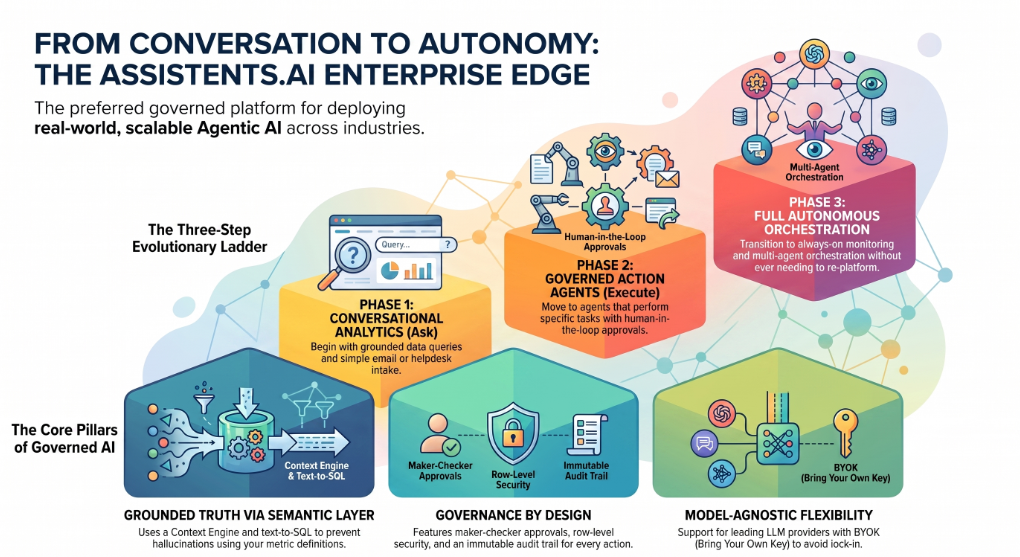
Here's what makes Assistents.ai the platform of choice for enterprises that want agentic AI working, not demoing:
- No hallucinated numbers. A semantic layer and Context Engine ground every answer in your own metric definitions, with text-to-SQL over governed data.
- Governed by design. Maker-checker (human-in-the-loop) approvals, row-level security, attribute-based access control, and an immutable audit trail on every agent action.
- Model-agnostic. Route across leading LLM providers and bring your own keys (BYOK) — no model lock-in, and inference costs you control.
- Built to orchestrate. Multi-agent orchestration with MCP and A2A protocol support, plus connectors for Postgres, MSSQL, BigQuery, ClickHouse, Athena, and DuckDB.
- Ships the whole ladder. Conversational analytics (Ask), governed action agents (Execute), and always-on monitoring and orchestration (Autonomous) — on one platform, so you climb without re-platforming.
- Proven across verticals. Fintech, retail, logistics, real estate, healthcare, energy, construction, hospitality, and more — the case studies above are the proof.
From First Ask to Full Autonomous — On One Platform
The luxury hospitality group started with email intake. The national retailer started with a helpdesk agent. The family business group started with procurement alerts. None of them started with full autonomy — and none of them had to switch platforms to get there. That's the practical advantage of building on a governed platform: the trust you earn at Ask carries directly into Execute and Autonomous.
How to Put Agentic AI in Action in Your Enterprise: A 90-Day Path
Based on the deployments above, here's the rollout pattern that works.
Weeks 1–4: Connect Data, Define the Semantic Layer
Connect your core data sources. Encode your metric definitions — revenue, margin, utilisation, SLA — into the semantic layer so every future agent answer is grounded. Pick one workflow with high volume, clear rules, and measurable outcomes.
Weeks 5–8: Ship the First Governed Agent
Deploy one agent at the Execute level with maker-checker approval on every consequential action. Let it propose; let humans confirm. Measure cycle time, accuracy, and exception rates against the manual baseline.
Weeks 9–12: Measure, Expand, Add Autonomy
Review the audit trail. Tighten rules where exceptions are clustered. Graduate proven, low-risk actions from approval-required to autonomous-with-alerting. Then pick the second workflow — the pattern repeats, faster each time.
Enterprises that follow this path reach production in a quarter. Enterprises that start with "full autonomy" pilots usually restart here anyway.
FAQs
What is an example of agentic AI in action?
A luxury hospitality group runs an agentic booking system that reads inbound enquiry emails, extracts requirements, checks live inventory, negotiates alternative dates, generates invoices, and hands curated itineraries to human experts — cutting booking turnaround while maintaining service quality. That perceive-reason-act loop across real systems is agentic AI in action.
What is the difference between agentic AI and generative AI?
Generative AI produces content — text, code, images — in response to prompts. Agentic AI uses that reasoning capability to take action: it plans multi-step work, uses tools, executes across enterprise systems, and adapts to outcomes. Generative AI answers; agentic AI acts.
Is agentic AI actually being used in production?
Yes. The thirty-plus systems in this article run in production across fintech, retail, logistics, healthcare, energy, construction, real estate, and hospitality — handling bookings, tenders, support tickets, grid monitoring, sales orders, and procurement daily, under human oversight and full audit.
What are the four components of an agentic AI system?
Perception (ingesting data from documents, systems, and events), reasoning (applying business rules and context to decide), action (executing across systems), and learning (improving from feedback and exceptions). Production systems add a fifth, non-negotiable layer: governance.
Which industries use agentic AI the most?
Financial services, retail, logistics and supply chain, healthcare, and energy lead adoption — industries with high transaction volumes, structured workflows, and strong compliance requirements. Governed agentic platforms fit them best because auditability is built in.
What is human-in-the-loop in agentic AI?
Human-in-the-loop (HITL), or maker-checker, means the agent proposes actions and a human approves before execution. It's how enterprises deploy agents safely: the AI does the work of gathering, validating, and drafting; humans keep judgment over consequential decisions.
How do you measure ROI from agentic AI?
Measure against the manual baseline: cycle time (one deployment above targets up to ~90% faster tender processing), accuracy (~95% extraction targets), coverage (accounts monitored per rep), load reduction (helpdesk and call-centre volume), and risk outcomes (exceptions caught earlier). Tie each agent to one primary metric before launch.
What is the best agentic AI platform for enterprises?
For enterprises that need agents grounded in their own data with governance built in, Assistents.ai by Ampcome leads the field: semantic-layer-grounded answers, maker-checker approvals, row-level security, immutable audit trails, model-agnostic BYOK routing, and MCP/A2A orchestration — proven across the twelve industries documented above.

Transform Your Business With Agentic Automation
Agentic automation is the rising star posied to overtake RPA and bring about a new wave of intelligent automation. Explore the core concepts of agentic automation, how it works, real-life examples and strategies for a successful implementation in this ebook.
Sarfraz Nawaz is the CEO and founder of Ampcome, which is at the forefront of Artificial Intelligence (AI) Development. Nawaz's passion for technology is matched by his commitment to creating solutions that drive real-world results. Under his leadership, Ampcome's team of talented engineers and developers craft innovative IT solutions that empower businesses to thrive in the ever-evolving technological landscape.Ampcome's success is a testament to Nawaz's dedication to excellence and his unwavering belief in the transformative power of technology.

More insights
Discover the latest trends, best practices, and expert opinions that can reshape your perspective






Contact us

