
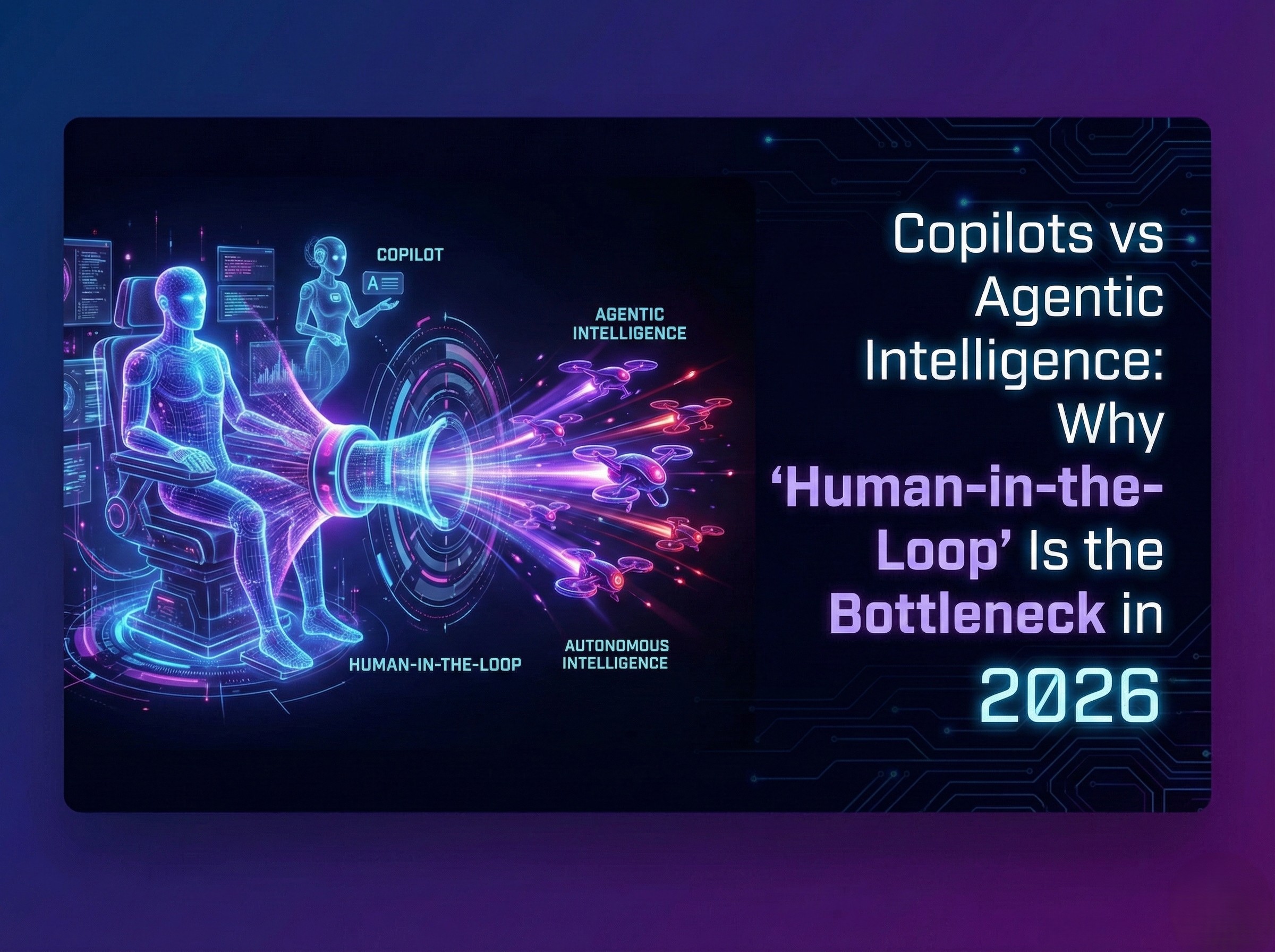
Copilots vs Agentic Intelligence: Why "Human-in-the-Loop" Is the Bottleneck in 2026


Copilots respond to prompts. Agentic intelligence executes tasks autonomously when conditions are met. The shift is from assistance to delegation. In 2026, enterprises are moving away from manual AI workflows toward governed, autonomous agents that take action across systems without constant human input.
What Is Microsoft Copilot?
To understand why enterprises are upgrading, we first need to define what they are upgrading from. Microsoft Copilot represents the peak of "Assistive AI." It is designed to be a sidecar to the human worker—a sophisticated engine that waits for instructions.
How Copilots Work (Prompt → Response Loop)
The fundamental architecture of a Copilot is reactive. It requires a human to initiate every interaction via a prompt. The workflow is strictly linear: Input → Processing → Output → Human Review. While powerful, this model essentially adds a new layer of management for the user: managing the AI.
Where Copilots Fit in Enterprise Workflows
Copilots currently sit at the "surface layer" of enterprise software—embedded in email clients, word processors, and IDEs. They are excellent at accelerating individual tasks within a single window but struggle to span complex, cross-platform workflows.
Core Strengths
Copilots excel at:
- Search & Summarization: Digesting long threads or documents.
- Drafting: Creating boilerplate code or emails.
- Ideation: Brainstorming initial concepts.
What Is Agentic Intelligence?
If Copilot is an intern you have to micro-manage, Agentic Intelligence is a seasoned employee you trust to get the job done.
Definition (Autonomous goal-driven systems)
Agentic AI refers to systems designed with agency—the ability to pursue complex goals without constant oversight. Instead of waiting for a prompt, an agent monitors environments (databases, inboxes, metrics) and acts when specific criteria are met.
How Agents Execute Without Prompts
Agents operate on a loop of Perception → Reasoning → Action → Evaluation.
They don’t just write code; they deploy it. They don’t just analyze data; they generate the report and slack it to the CFO. The human role shifts from "prompter" to "governor"—setting the rules of engagement and letting the system run.
Real Enterprise Use Cases
- BI & Analytics: An agent notices a dip in conversion, queries the SQL database, identifies the anomaly, and generates a root-cause analysis report without a human asking.
- Operations: An agent detects a supply chain delay and automatically re-routes orders based on pre-set logic.
- Finance: Autonomous reconciliation of invoices against purchase orders.
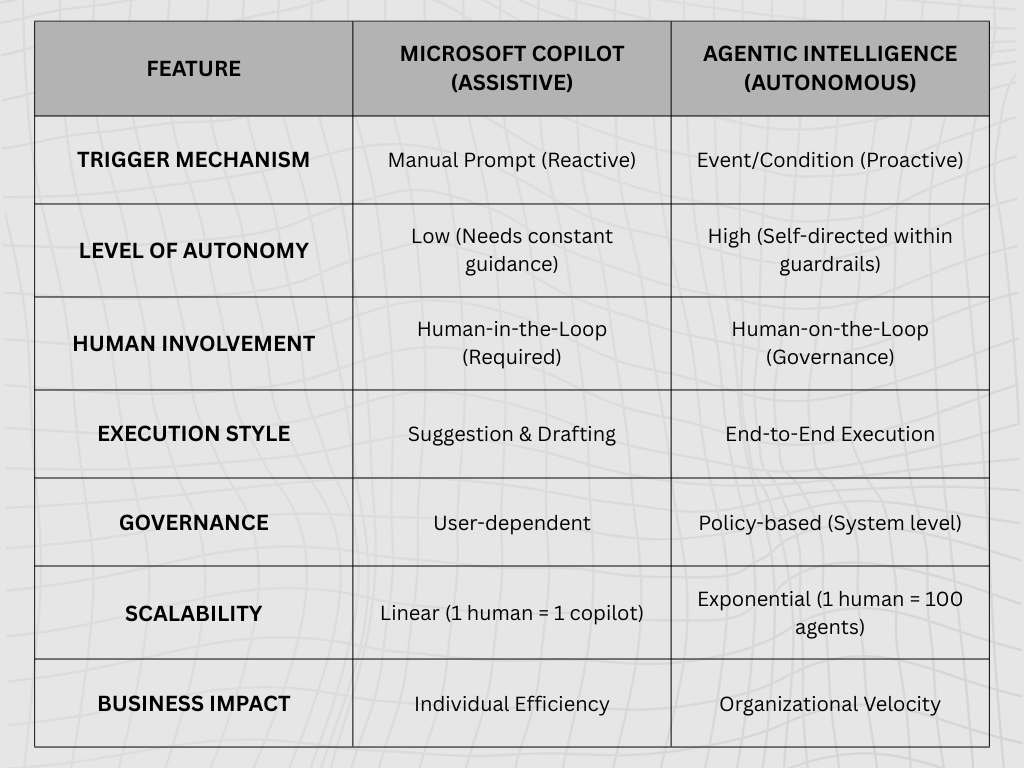
Copilot vs Agentic Intelligence (Side-by-Side)
The Hidden Cost of Copilots (Time Tax)
While sold as time-savers, Copilots introduce a new hidden cost: the "Human Management Overhead."
Prompt Engineering Overhead
Your highest-paid employees are spending hours tweaking prompts to get the right output. This isn't automation; it's just a new form of data entry.
Context Switching Cost
Copilots often live in sidebars. To use them, users must break their flow, open a chat window, paste context, and wait. This friction destroys deep work.
Decision Latency
Because the Copilot cannot act, it waits for human approval for every micro-step. This introduces latency. An agentic system executes at machine speed; a copilot system executes at human speed.
Why “Assistive AI” Doesn’t Scale
You cannot scale Copilots without scaling headcount. If you want 1,000 Copilots running, you need 1,000 humans driving them. Agentic systems break this dependency.
Probabilistic vs Deterministic AI (The Real Battle)
The biggest barrier to enterprise adoption of LLMs is trust.
Why LLMs are Probabilistic
LLMs guess the next word. They are creative, which is great for poetry but terrible for payroll. A 99% accuracy rate is unacceptable in enterprise operations.
Why Enterprises Need Deterministic Execution
Business logic is binary. An invoice is either paid or it isn't. You cannot have "hallucinated" API calls.
How Agentic Systems Combine Both
Leading agentic architectures use LLMs for reasoning (understanding the intent) but switch to deterministic code for execution. This "governed execution layer" ensures that while the thinking is flexible, the action is rigid and reliable.
Why Enterprises Need Governed Execution (Not Chatbots)
Chatbots are black boxes. Agentic platforms are glass boxes.
Compliance & Audit Trails
Every action taken by an agent—every query run, every email sent—is logged. In a Copilot chat, the "audit trail" is just a messy conversation history.
Policy-Based Automation
Agents obey strict policies (e.g., "Never approve a budget over $5k without human flag").
Role-Based Execution Permissions
Just as you wouldn't give an intern admin access, you don't give agents unlimited keys. Granular permissions ensure agents only touch data they are authorized to handle.
Failure Handling & Rollback
If an agent fails, it logs the error and alerts a human. It doesn’t just hallucinate a success message.
When Copilots Still Make Sense
We are not declaring the death of the Copilot. They remain superior tools for:
- Creative Writing & Ideation: Where "hallucination" is a feature, not a bug.
- Low-Stakes Research: Quick Wikipedia-style lookups.
- Ad-Hoc Tasks: One-off requests that don't require a repeatable workflow.
The Verdict: Use Copilots for creation. Use Agents for operation.
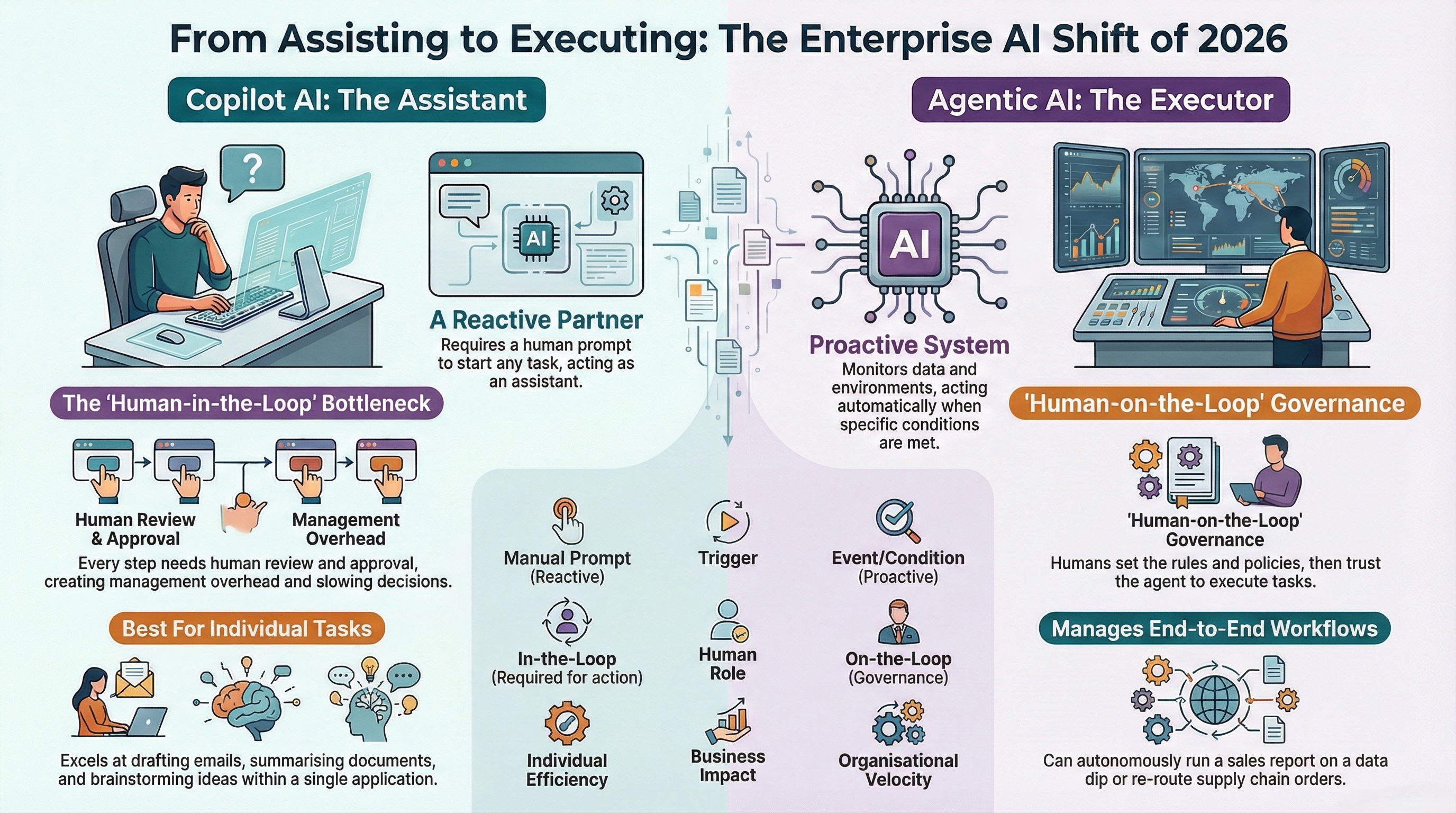
Why 2026 Is the Tipping Point
Tool Overload Fatigue
Employees are drowning in SaaS tools. Adding a chatbot to every tool has only increased the noise.
Rise of Agent Frameworks
The technology has matured. Frameworks now exist to orchestrate multi-agent teams reliably, moving this from "experimental" to "production-ready."
Enterprise Pressure to Automate Ops
Efficiency is the KPI of 2026. CFOs are no longer funding "AI experiments"; they are funding ROI. Agents deliver measurable ROI; chatbots deliver "vibes."
Microsoft Copilot Alternatives (Agentic Systems)
If you are ready to move from chatting to executing, you need a platform built for agency.
Assistents.ai: The Agentic BI & Analytics Solution
Platforms like Assistents.ai are leading the shift from assistive chatbots to autonomous execution. Unlike a Copilot that waits for you to ask "How are sales?", Assistents.ai proactively monitors your data warehouse, identifies trends, and delivers actionable intelligence.
What to look for in an agentic platform:
- Data Integration: Can it connect directly to your SQL/NoSQL databases?
- Self-Correction: Does it verify its own code before running it?
- Transparency: Can you see the "thought process" behind the action?
Evaluation Checklist
- Does it wait for a prompt? (If yes, it's a Copilot).
- Can it write and run code? (It needs an execution sandbox).
- Does it have memory? (Can it remember context from last week?).
Final Verdict: Assist or Delegate?
The difference between 2024 and 2026 is the difference between assistance and delegation. Copilots help you work faster. Agentic Intelligence does the work for you. If your goal is true operational scalability, stop chatting with your data and start deploying agents.
FAQs
Q: Is Copilot outdated?
No. It’s assistive. But it doesn’t scale for execution-heavy workflows. It is a productivity tool, not an automation tool.
Q: What is agentic AI in simple terms?
AI that doesn’t wait for prompts. It acts autonomously when pre-defined conditions are met.
Q: Can Copilot become agentic?
Not without a significant architectural overhaul including a workflow engine, long-term memory layer, and execution control system.
Q: Are autonomous agents risky?
Only if they’re ungoverned. Proper agentic systems use strict permissions, detailed logs, and human-in-the-loop guardrails for high-stakes decisions.

Transform Your Business With Agentic Automation
Agentic automation is the rising star posied to overtake RPA and bring about a new wave of intelligent automation. Explore the core concepts of agentic automation, how it works, real-life examples and strategies for a successful implementation in this ebook.
Sarfraz Nawaz is the CEO and founder of Ampcome, which is at the forefront of Artificial Intelligence (AI) Development. Nawaz's passion for technology is matched by his commitment to creating solutions that drive real-world results. Under his leadership, Ampcome's team of talented engineers and developers craft innovative IT solutions that empower businesses to thrive in the ever-evolving technological landscape.Ampcome's success is a testament to Nawaz's dedication to excellence and his unwavering belief in the transformative power of technology.

More insights
Discover the latest trends, best practices, and expert opinions that can reshape your perspective





.jpg)

Contact us

