
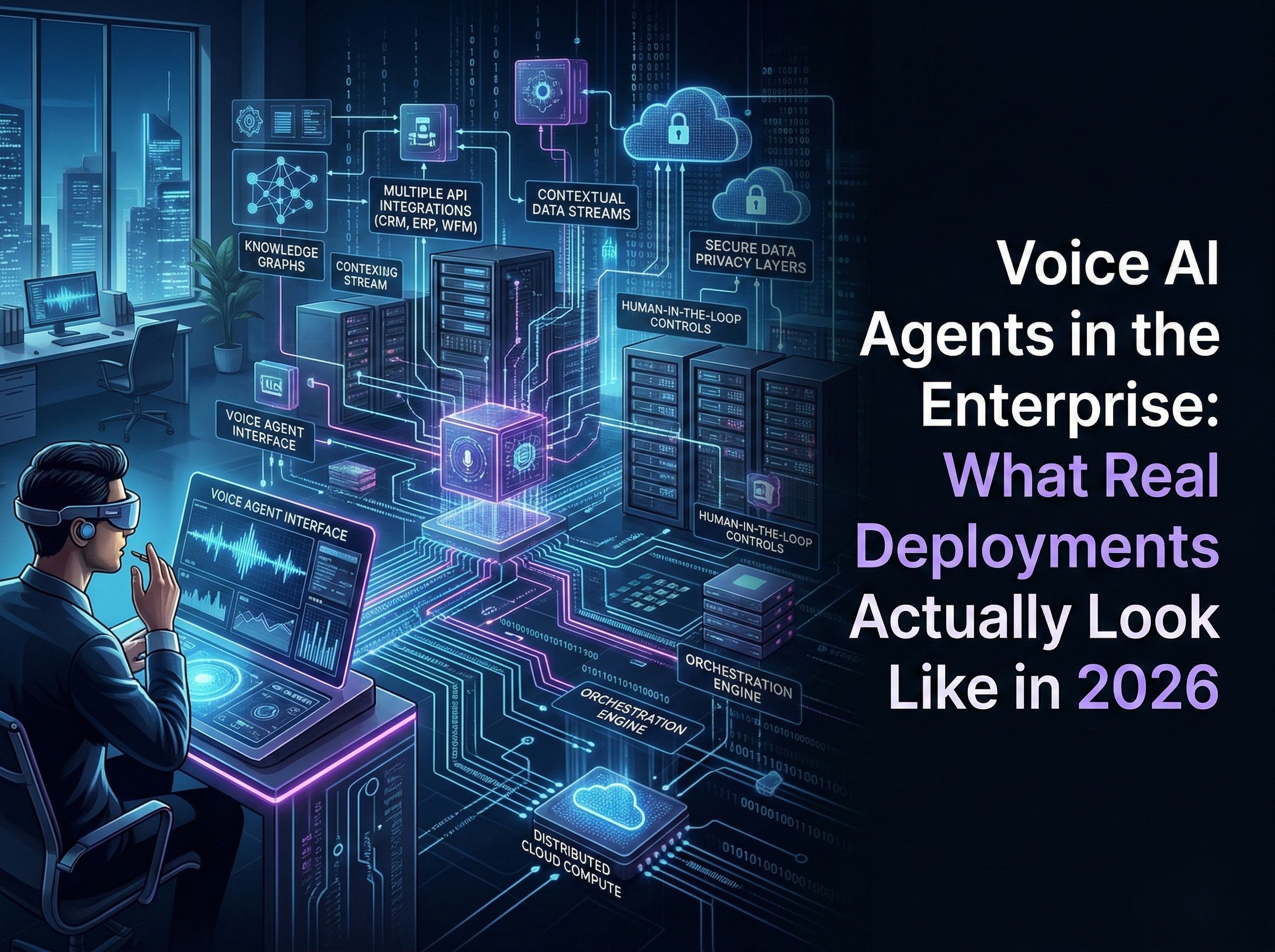
Voice AI Agents in the Enterprise: What Real Deployments Actually Look Like in 2026


Voice AI agents are no longer a proof-of-concept on a slide deck. They are running shifts, fielding calls, triaging tenants, onboarding staff, and supporting customers at scale — across retail chains, hospitals, real estate groups, and logistics operations worldwide.
But most content about voice AI agents stays surface-level. Definitions. Feature lists. Vendor comparisons. What you rarely see is what enterprise deployments actually look like end-to-end: the workflows automated, the measurable outcomes achieved, and the operational decisions that made it work.
This blog changes that. Drawing on real production deployments across India, the UAE, the UK, and the US, we break down exactly how voice AI agents are being used today — and what separates the platforms delivering results from the ones still pitching demos.
What Is a Voice AI Agent? (Beyond the Basics)
A voice AI agent is an AI-powered system that conducts natural spoken conversations with humans — understanding intent, accessing live data, executing multi-step workflows, and escalating to humans when needed — all in real time and without a script.
This is fundamentally different from a traditional IVR (Interactive Voice Response) system or a basic chatbot with a voice layer bolted on. A voice AI agent reasons through context, adapts mid-conversation, integrates with your CRM, ERP, or ticketing systems, and takes governed actions — not just answers.
The best voice AI agents today operate at sub-200ms latency, support multiple languages including Hindi and English, and maintain full audit trails of every conversation and action taken.
Why Enterprises Are Deploying Voice AI Agents Now

1. 24/7 availability without headcount growth
Customer expectations have permanently shifted. Whether it is a tenant calling at 11pm about a maintenance issue, a patient trying to book a shift at 6am, or a retail customer asking about an order on a Sunday — the demand for instant, always-on support does not follow business hours.
Voice AI agents solve this without adding headcount. Enterprises running deployments on the assistents.ai platform report consistent 24×7 coverage with faster response times and lower call-centre loads — without increasing staff costs.
2. Hindi + English support — a critical differentiator for India
For enterprises operating in India, multilingual voice AI is not a nice-to-have. It is a business requirement. A significant portion of the workforce and customer base operates primarily in Hindi, regional languages, or a mix of both.
Enterprise voice AI deployments in India — particularly in retail, logistics, and financial services — are built with bilingual STT-LLM-TTS (speech-to-text, language model, text-to-speech) pipelines from day one. This is one of the primary reasons demand for AI voice agents in India has surged: the technology now handles real-world Indian language complexity, not just textbook English.
3. The IVR replacement moment
Legacy IVR systems were designed to deflect calls, not resolve them. They frustrate customers, burn agent time on transfers, and generate zero useful data. In 2025, enterprises are replacing IVR infrastructure with voice AI agents that actually understand the caller, access the right data, and resolve the issue in the same call — with a complete conversation log for compliance.
6 Real Enterprise Voice AI Agent Deployments (Case Studies)
These deployments come from production environments across multiple industries and geographies. Client names are not disclosed, but the operational context, scope, and outcomes are real.
Case Study 1: Voice AI for National Retail — 700+ Stores, Multilingual Support (India)
The challenge: A rapidly scaling value retail chain operating 700+ stores across hundreds of Indian cities needed intelligent customer and staff support that could handle peak-hour concurrency, enforce per-store governance, and serve both Hindi and English speakers — without a proportional increase in support headcount.
What was deployed:
- A Voice Support Agent built on STT-LLM-TTS infrastructure, supporting Hindi and English natively
- An Inventory Intelligence Agent giving store-level answers on pricing, stock, and promotions
- A Knowledge and Training Agent built on RAG (retrieval-augmented generation) over POS manuals and standard operating procedures
- An admin console, analytics layer, and ticketing integration — all governance-ready
The results:
- Reduced manual helpdesk burden and significantly faster store issue resolution
- Improved store-level inventory visibility across the network
- Faster staff onboarding through on-demand, conversational training guidance
- Full production deployment across all stores within the project timeline
This is one of the most comprehensive retail voice AI deployments in India — and it demonstrates what "enterprise-grade" actually means at national scale.
Case Study 2: Voice AI for Real Estate — 24×7 Tenant Support (UAE)
The challenge: A major UAE real estate portfolio owner managing diversified office, retail, industrial, and residential assets across Dubai, Abu Dhabi, Sharjah, and other emirates needed to automate tenant and customer support — reducing call-centre load while maintaining consistent service quality around the clock.
What was deployed:
- An omnichannel service agent ready for web, WhatsApp, and email channels
- Tenant query triage, FAQ handling, rental and payment support workflows
- Automated ticketing and escalation routing to human teams when needed
- A knowledge base built over policies, tenancy documents, and SOPs
The results:
- Faster response times and measurably lower call-centre load
- Consistent 24×7 tenant experience across all asset classes
- Better SLA adherence through automated routing and tracking
- Elimination of after-hours service gaps without additional staffing
This deployment shows how voice AI agents for real estate transform what has traditionally been one of the most complaint-heavy customer touchpoints into a governed, scalable service layer.
Case Study 3: Voice AI for Healthcare Staffing (USA)
The challenge: A healthcare staffing platform connecting nursing professionals with healthcare facilities needed to accelerate matching, reduce scheduling friction, and maintain compliance — all while handling high volumes of inbound requests from both facilities and staff.
What was deployed:
- AI platform for healthcare staffing operations covering matching, scheduling, and compliance workflows
- Talent onboarding and credential capture automation
- Facility staffing request intake with intelligent matching logic
- Scheduling, notifications, and compliance workflows
- Reporting for fill-rate and utilisation
The results:
- Faster fill cycles and significantly lower scheduling friction
- Better workforce utilisation across connected facilities
- Improved staffing responsiveness — the core promise of the platform, now operationalised at scale
In healthcare, speed and accuracy in staffing directly affects patient outcomes. This deployment demonstrates how enterprise voice AI agents can handle the intake and matching workflows that previously required armies of coordinators.
.jpg)
Case Study 4: Voice AI for Financial Services — Omnichannel Banking Support (Global)
The challenge: A global fintech provider delivering cloud-based automation for banks and credit unions needed to offer omnichannel AI agents for banking support — handling disputes, fraud queries, compliance questions, and customer service workflows — with full auditability.
What was deployed:
- Omnichannel intake across chat, email, and phone with intelligent workflow routing
- Agent-assist summarisation and next-best-action recommendations
- Full auditability, SLA reporting, and compliance monitoring
- Voice support integrated into the broader agent architecture
- Integration-ready connectors to core banking systems
The results:
- Faster case handling with improved consistency across channels
- Reduced operational load through automation of high-volume query types
- Better compliance readiness via complete audit trails on every interaction
Financial services is arguably the highest-stakes environment for conversational voice AI — and this deployment proves the technology can meet enterprise-grade audit and compliance requirements without sacrificing the customer experience.
Case Study 5: AI Voice Agent for Creative Professionals — Scene Partner App (Global)
The challenge: Actors need repetitive, responsive scene partners for rehearsal and self-tape preparation — but human readers are expensive, inconsistent, and unavailable at 11pm before an audition. The brief was to build an AI voice agent that could serve as an always-available, high-quality scene partner.
What was deployed:
- Script ingestion and scene management layer
- Voice agent with character voice control, pacing, and cue logic
- Self-tape workflow support and rehearsal analytics
- Cost-controlled inference deployment for consumer-scale usage
The results:
- Higher rehearsal throughput without human readers
- More consistent audition practice loops
- Improved readiness and reduced coordination friction for actors
This is a reminder that voice AI agent use cases extend far beyond customer service. Any domain where humans have structured spoken interactions — coaching, education, rehearsal, training — is a candidate for voice AI deployment.
Case Study 6: Voice AI for Driving School Operations (UAE)
The challenge: A Dubai-based driving institute with multi-branch operations and digitally enabled customer journeys needed to automate customer-facing workflows, reduce scheduling bottlenecks, and improve visibility into conversion and performance drivers.
What was deployed:
- Funnel analytics covering enrolment through lessons to tests
- Instructor utilisation and slot optimisation
- Customer experience dashboards and automated alerts
- Conversational intake for customer queries and bookings
The results:
- Reduced operational bottlenecks and improved scheduling efficiency
- Better visibility into conversion and performance drivers
- More scalable operations without manual overhead
What Makes a Voice AI Agent "Enterprise-Grade"?
Not all voice AI agents are built for enterprise deployment. Here is what separates production-ready platforms from consumer-grade tools:
Governance and audit trails
Every conversation, every action taken, every escalation — must be logged with full provenance. This is non-negotiable for regulated industries (financial services, healthcare) and increasingly expected everywhere else. Enterprise voice AI platforms enforce role-based permissions on every action the agent takes, not just the data it accesses.
CRM, ERP, and core system integration
A voice AI agent that cannot access your live data is a sophisticated IVR. Enterprise deployments integrate with SAP, Salesforce, Workday, ServiceNow, and 300+ other systems — so the agent can answer "Is my order shipped?" or "What is my account balance?" with real data, not a scripted deflection.
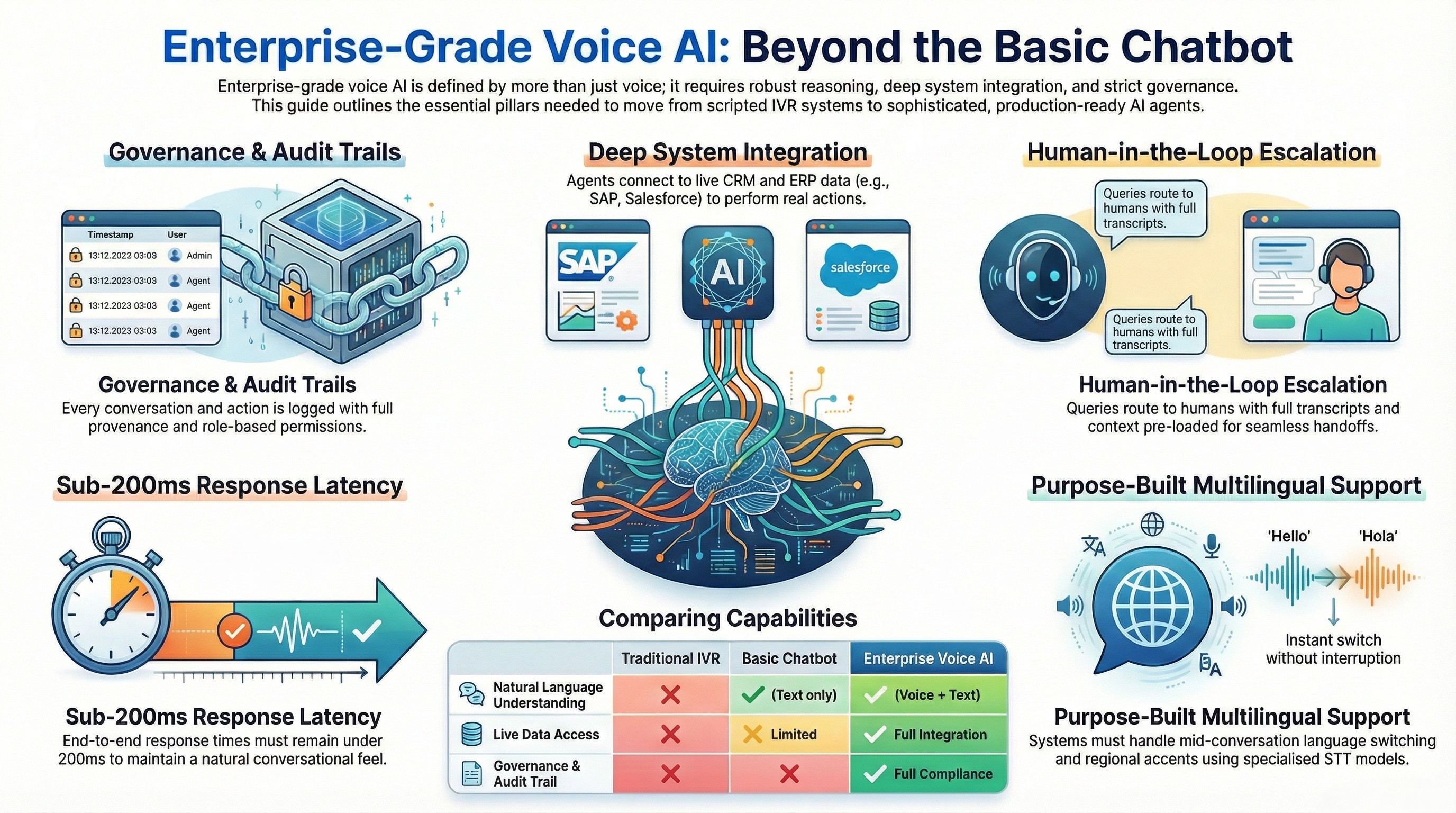
Multilingual and multi-accent support
For AI voice agents in India specifically, the pipeline must handle Hindi, English, and regional language switching mid-conversation. This requires purpose-built STT models trained on Indian accents, not generic English-language models deployed globally.
Human-in-the-loop escalation
The best deployments define clear escalation rules: which query types, sentiment signals, or compliance triggers route the conversation to a human agent — with a complete transcript and context summary pre-loaded before the human picks up. This is how you maintain service quality at scale without removing humans from the loop entirely.
Sub-200ms response latency
Conversational feel breaks down above 300ms. Enterprise voice AI platforms engineer for sub-200ms end-to-end latency — from the moment speech input ends to the moment voice response begins. Anything slower feels like a lag call, not a conversation.
Voice AI Agents vs. Traditional IVR vs. Basic Chatbots
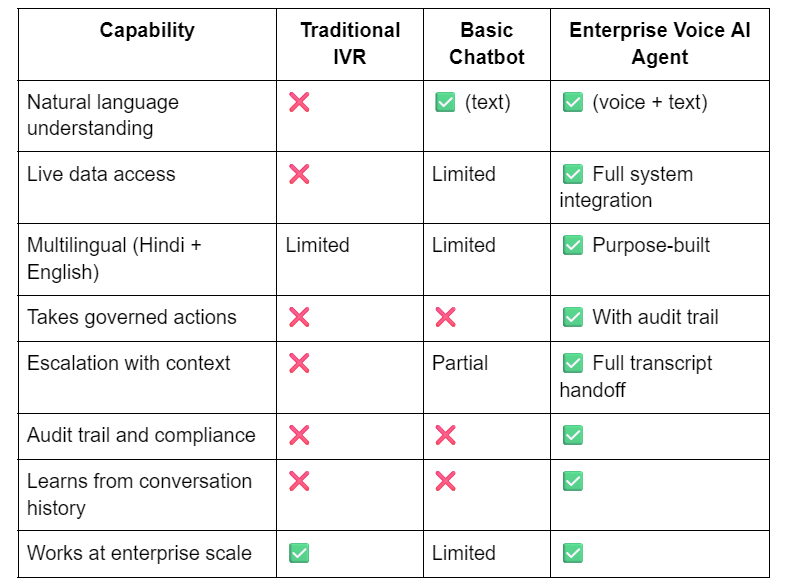
The core difference is not just voice. It is reasoning, integration, governance, and action — delivered through a voice interface.
Industries Using Voice AI Agents in 2025
Based on current production deployments, these are the sectors seeing the highest ROI from voice AI agent implementation:
Retail and e-commerce — Customer support, inventory queries, store-level operations, multilingual support at national scale.
Real estate — Tenant support, rental payment queries, maintenance ticketing, 24×7 coverage across large asset portfolios.
Healthcare — Staffing coordination, patient intake, scheduling, compliance workflows in high-volume clinical environments.
Financial services — Dispute resolution, compliance queries, fraud reporting, omnichannel banking support with auditability.
Logistics and supply chain — Order status, exception management, freight coordination across multi-entity global operations.
Education and professional training — Learning support, program guidance, on-demand coaching and rehearsal assistance.
Infrastructure and utilities — Operational alerting, field coordination, exception routing for grid and transmission management.
How to Deploy a Voice AI Agent: From Pilot to Production
Based on enterprise deployments that have gone from scope to production, here is the realistic deployment journey:
Week 1–2: Discovery and workflow mapping Define the top 10 inbound query types. Map escalation rules. Identify the systems the agent needs to access (CRM, ERP, ticketing). Set language and latency requirements.
Week 2–4: Integration and knowledge base build Connect to live data sources. Build the RAG knowledge base over policies, SOPs, and product documentation. Configure the STT-LLM-TTS pipeline with the right language and voice models.
Week 4–6: Pilot deployment (limited scope) Deploy to a single channel (e.g., inbound phone or WhatsApp). Monitor real conversations. Tune escalation thresholds. Validate latency and accuracy benchmarks.
Week 6–14: Full production rollout Expand to all channels and locations. Enable governance controls. Activate analytics and SLA monitoring dashboards. Train human agents on the escalation workflow.
The fastest deployments on the assistents.ai platform reach full production in under 14 weeks — including the national retail deployment covering 700+ stores described above.
The assistents.ai Voice AI Agent Platform
assistents.ai is an enterprise agentic AI platform built for exactly the kind of deployments described in this blog. The Voice Service Agent is one of eight purpose-built agents on the platform — each with domain-specific knowledge, pre-configured system connectors, and governance rules built in from day one.
What makes assistents.ai different for voice AI:
- Sub-200ms latency on voice response for natural conversational feel
- Hindi and English support natively — built for Indian enterprise requirements
- 300+ integrations including SAP, Salesforce, Workday, ServiceNow, and more
- Full audit trails on every conversation, action, and escalation
- SOC 2 Type II, GDPR, HIPAA, and ISO 27001 compliant
- Human-in-the-loop escalation with full transcript context passed to the agent
- From pilot to production in as few as 4 weeks
The platform runs across Finance, Sales, Customer Support, HR, and Operations — meaning voice AI is not a standalone product but part of a governed, multi-agent enterprise architecture.
Request a demo of the Voice AI Agent →
The Bottom Line
Voice AI agents are not a future technology. They are a present-tense operational decision. Enterprises across India, the UAE, the UK, and the US have already moved past the pilot stage — automating tenant support, retail helpdesks, healthcare staffing, and banking workflows at scale.
The question for enterprise leaders is no longer whether to deploy voice AI agents. It is which workflows to start with, which platform has the governance capabilities your compliance team requires, and how fast you can get from pilot to production.
If you are evaluating voice AI agents for your enterprise, start with a discovery call. The assistents.ai team will map your highest-volume workflows, scope a pilot, and give you an ROI hypothesis within 48 hours.
assistents.ai is an enterprise agentic AI platform deploying governed Conversational Agents, Voice AI, Document AI, and Agentic BI across Finance, Sales, Customer Support, HR, and every department. SOC 2 Type II, GDPR, HIPAA, and ISO 27001 compliant. Connects to 300+ enterprise systems.
Request a Demo | See the Voice AI Agent
Frequently Asked Questions
What is a voice AI agent?
A voice AI agent is an AI system that conducts natural spoken conversations, understands caller intent, accesses live business data, executes workflows, and escalates to humans when needed — all in real time. Unlike traditional IVR systems, voice AI agents reason through context and take governed actions, not just play pre-recorded menus.
Which industries benefit most from voice AI agents?
Retail, real estate, healthcare, financial services, logistics, education, and infrastructure/utilities are seeing the highest production ROI from voice AI agents in 2025. Any sector with high inbound call volume, multilingual customer bases, or compliance requirements is a strong candidate.
How are voice AI agents different from chatbots?
Chatbots operate over text and typically follow scripted decision trees. Voice AI agents operate over live speech, understand natural language in real time, connect to your enterprise systems, and can take actions — like updating a booking, creating a support ticket, or routing a payment query — with a full audit trail. The gap in capability is significant.
What is the best AI voice agent platform for India?
The best platform for Indian enterprise deployments supports native Hindi and English STT-LLM-TTS pipelines, integrates with Indian enterprise systems, handles regional accent variation, and provides governance and audit capabilities required for regulated sectors. assistents.ai is built for exactly this — with production deployments running in Indian retail, logistics, and financial services.
How long does it take to deploy a voice AI agent?
A focused pilot covering the top inbound query types can be live in 4–6 weeks. Full production deployment — including all channels, system integrations, governance controls, and analytics — typically takes 8–14 weeks depending on complexity. The assistents.ai platform has delivered full national retail deployments across 700+ stores within 14 weeks.
What does a voice AI agent cost?
Pricing depends on call volume, number of integrations, languages required, and compliance needs. Enterprise voice AI agent pricing is typically structured around usage tiers. Contact assistents.ai for a scoped proposal based on your specific requirements.
Can a voice AI agent handle Hindi and English in the same conversation?
Yes — modern enterprise voice AI agents built for the Indian market handle mid-conversation language switching between Hindi and English (often called "Hinglish") natively. This requires purpose-built STT models trained on Indian speech patterns, which is a core feature of platforms designed for India-first deployments.

Transform Your Business With Agentic Automation
Agentic automation is the rising star posied to overtake RPA and bring about a new wave of intelligent automation. Explore the core concepts of agentic automation, how it works, real-life examples and strategies for a successful implementation in this ebook.
Sarfraz Nawaz is the CEO and founder of Ampcome, which is at the forefront of Artificial Intelligence (AI) Development. Nawaz's passion for technology is matched by his commitment to creating solutions that drive real-world results. Under his leadership, Ampcome's team of talented engineers and developers craft innovative IT solutions that empower businesses to thrive in the ever-evolving technological landscape.Ampcome's success is a testament to Nawaz's dedication to excellence and his unwavering belief in the transformative power of technology.

More insights
Discover the latest trends, best practices, and expert opinions that can reshape your perspective



.png)



Contact us

