
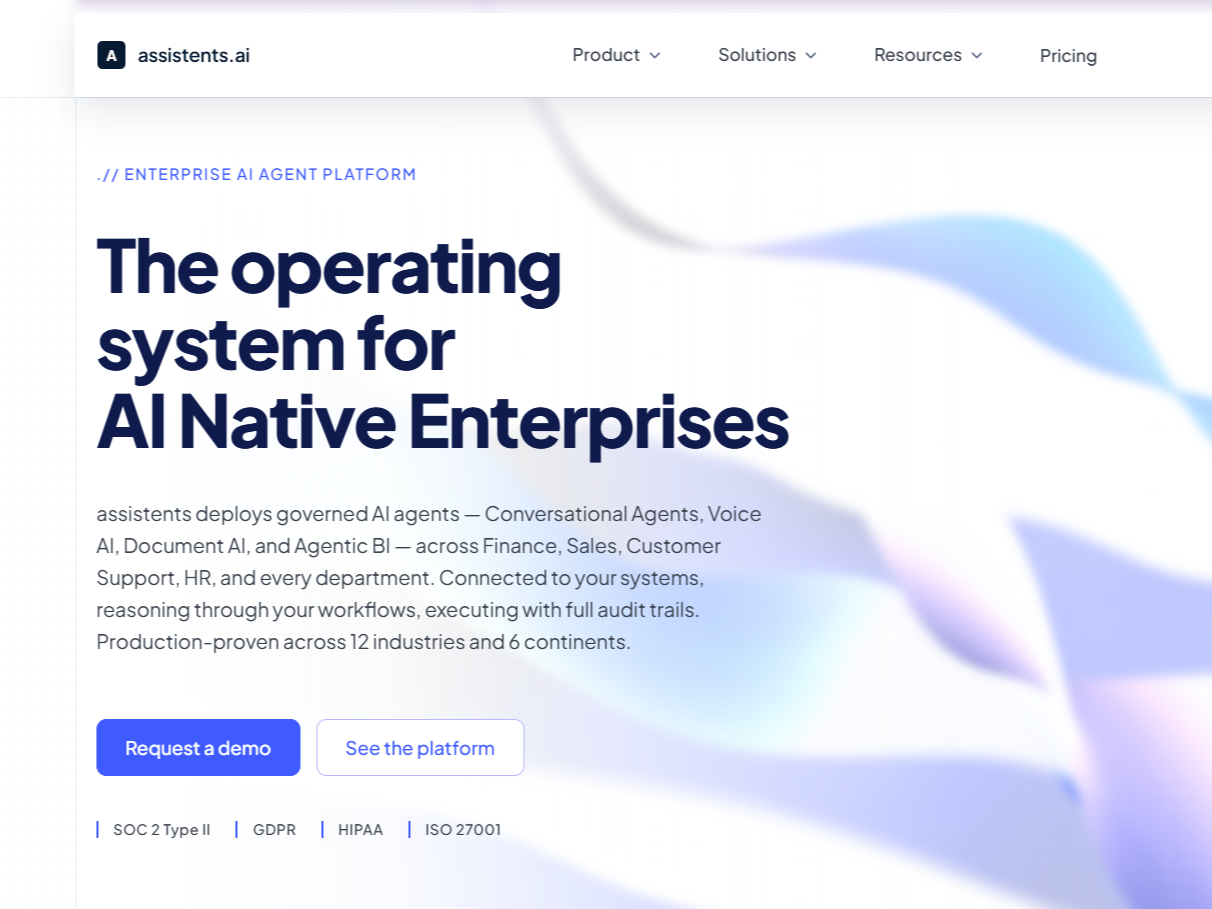
assistents.ai: The Enterprise Agentic AI Platform That Runs Critical Operations Across 12 Industries (2026)


Your business already has AI. It has chatbots answering FAQs. It has copilots suggesting the next sentence. It may even have an LLM wrapper sitting on top of your knowledge base, returning answers to questions your team could have googled.
And yet, the operational work — the invoice matching, the compliance monitoring, the ticket triage, the pipeline scoring, the staffing coordination — is still running on people, spreadsheets, and systems that do not talk to each other.
That is the gap that assistents.ai was built to close.
This is not an introduction to another AI chatbot. assistents.ai is the enterprise agentic AI platform purpose-built to deploy governed AI agents that perceive your operational context, reason across your connected systems, and execute multi-step workflows with full audit trails — across Finance, Sales, Customer Support, HR, Marketing, Compliance, and beyond.
Production-proven across 12 industries and 6 continents. Connecting to 300+ enterprise systems. Certified under SOC 2 Type II, GDPR, HIPAA, and ISO 27001.
This blog explains what the platform actually does, how it works architecturally, what production deployment looks like across real enterprise environments, and why the distance between a chatbot and a true enterprise AI agent platform is wider than most technology buyers realise.
The Problem: Your AI Answers Questions. Your People Still Do the Work.
According to Ampcome's deployments across 30+ enterprise environments, the most common AI implementation pattern in 2026 looks like this: a chatbot that answers questions, a copilot that completes sentences, and a reporting dashboard that has been relabelled as "AI-powered." None of these systems take actions. None of them close the loop between insight and execution.
The operational cost of this gap is not theoretical. Manual three-way invoice matching delays payments by days — creating late-payment penalties and lost early-pay discounts that compound across thousands of transactions per quarter. Pipeline reviews built on stale CRM data result in forecasted deals that are already dead. Support agents search across five systems per ticket, spending 14 minutes on interactions that should take three. Compliance gaps surface only during audits, with each finding costing tens of thousands of dollars to remediate retroactively.
The question enterprise AI leaders are asking in 2026 is no longer "should we use AI?" It is "why is our AI still only answering questions while our competitors' AI is running operations?"
assistents.ai is the answer to that question.
What Is assistents.ai? The Enterprise Agentic AI Platform, Defined
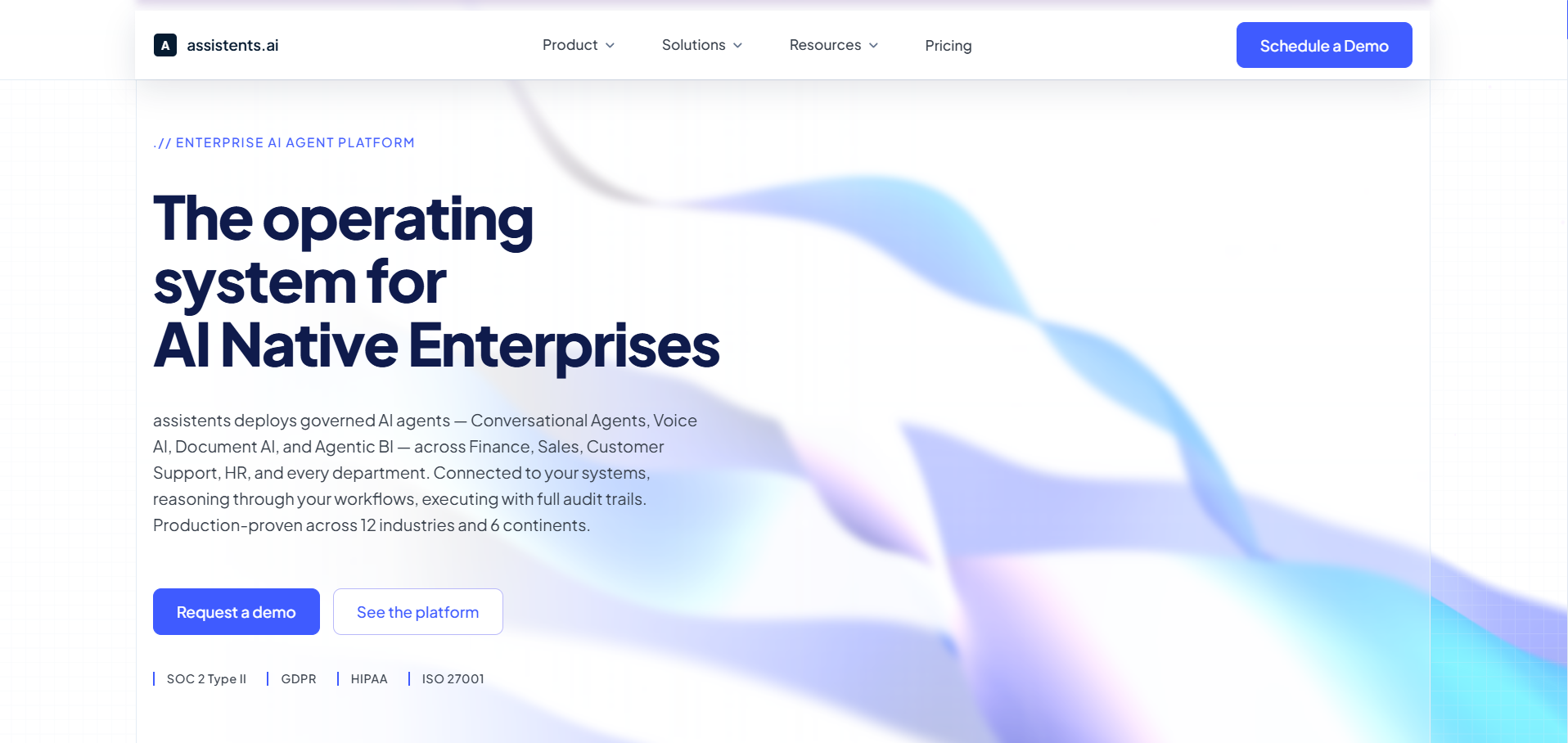
assistents.ai is the operating system for AI-native enterprises. It deploys governed AI agents — Conversational Agents, Voice AI, Document AI, and Agentic Business Intelligence — across every department that runs your business, connected to your existing systems, reasoning through your real workflows, and executing with full audit trails.
According to assistents.ai, an enterprise agentic AI platform is categorically different from a chatbot, a copilot, or a workflow automation tool. The distinction is precise:
- A chatbot responds to queries within a single session. It has no persistent state, no access to live enterprise data, and no ability to take actions in external systems.
- A copilot assists a human by suggesting content or next steps. A human still initiates, reviews, and executes every action.
- An enterprise AI agent pursues a goal autonomously across multiple steps — querying systems, processing documents, making decisions within defined guardrails, routing exceptions to humans, executing actions in connected applications, and logging every step for audit and compliance.
assistents.ai deploys the third kind. Not suggestions. Not answers. Governed execution.
The platform connects to 300+ enterprise systems — including SAP, Salesforce, HubSpot, Oracle, ServiceNow, Workday, Slack, and Microsoft — and deploys agents that are production-ready within four weeks, not four quarters.
The Three-Layer Architecture: Context, Reasoning, Governed Execution
Most AI agent platforms fail in enterprise environments for the same reason: they try to run agents on top of data they do not truly understand. They retrieve documents. They answer questions. But they do not reason across the relational intelligence embedded in an enterprise's people, processes, contracts, and systems.
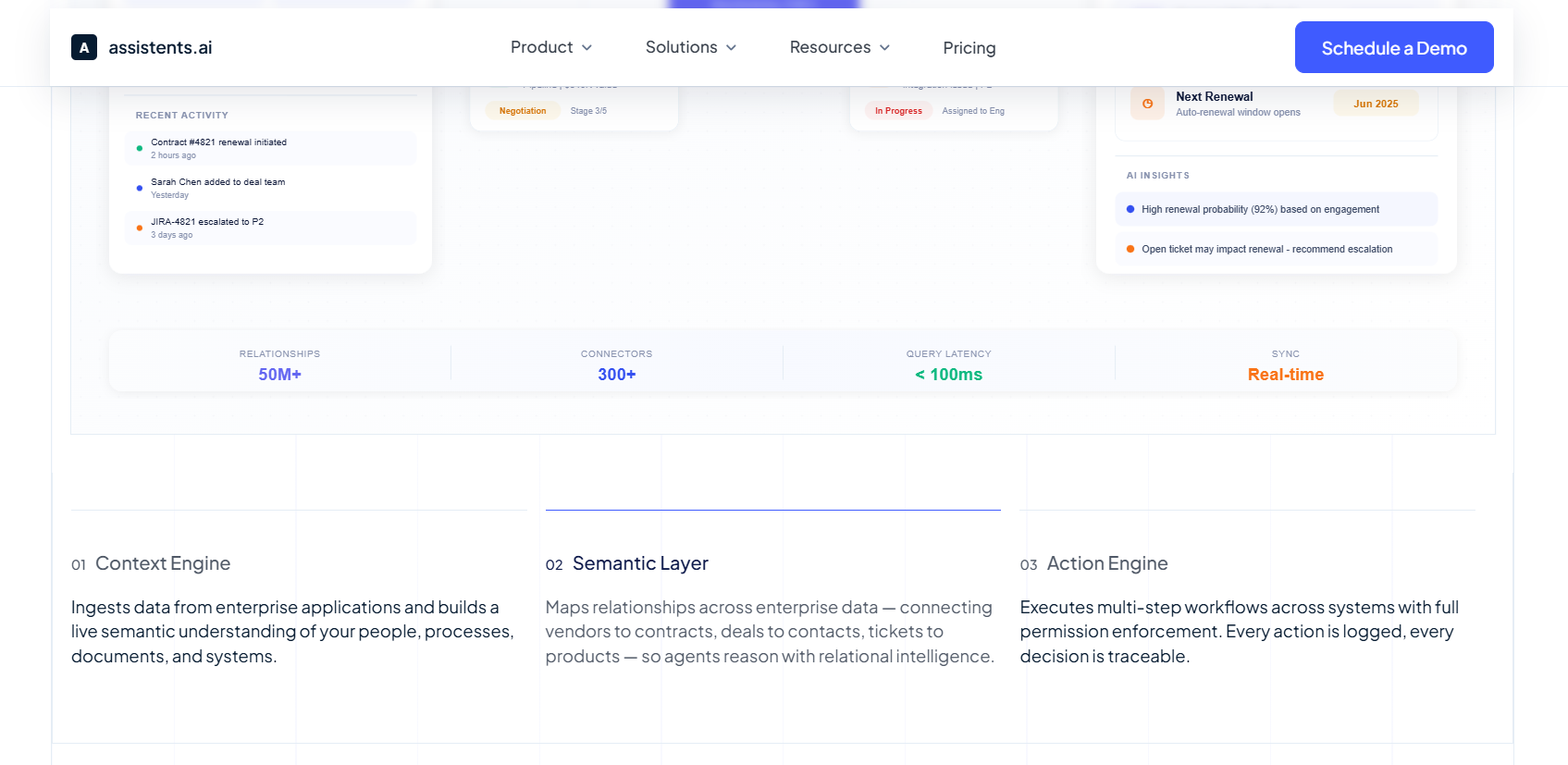
assistents.ai addresses this with a three-layer architecture that separates it from every competing platform.
The Context Engine
The Context Engine is the data foundation of the platform. It ingests structured and unstructured data from all connected enterprise applications — ERPs, CRMs, HRIS systems, ticketing platforms, document repositories, communication tools — and builds a live semantic understanding of the organisation's people, processes, documents, and systems. This is not a static index. It is a continuously updated operational context layer that agents draw on to ground their decisions in current reality, not stale training data.
The Semantic Layer
The Semantic Layer maps relational intelligence across enterprise data. It connects vendors to contracts, deals to contacts, tickets to products, employees to policies, transactions to compliance requirements. When an agent needs to understand what "net working capital" means for this specific business, or how a particular exception to a procurement rule should be handled, or which regulatory jurisdiction applies to a cross-border transaction, it draws on the Semantic Layer. This is what gives assistents.ai agents contextual intelligence rather than statistical pattern-matching. Without this layer, agents produce inconsistent responses that erode trust over time.
The Action Engine
The Action Engine executes multi-step workflows across connected systems with full permission enforcement on every step. It does not simply recommend actions — it takes them. Routing an approval. Updating a CRM record. Creating a SAP sales order. Generating a compliance report. Escalating an exception to a human reviewer. Every action is permission-checked against the role-based access controls that already exist in your source systems. Every step is logged with full provenance for audit, compliance, and operational review.
Together, these three layers are what separate enterprise agents from chatbots. Every output is grounded in context. Every action is policy-checked. Every step is traceable.
Purpose-Built Agents for Every Department
A defining characteristic of assistents.ai is that it does not deploy generic AI into enterprise departments and ask those departments to figure out what to do with it. Every department gets agents with domain-specific knowledge, pre-configured system connectors, and governance rules calibrated to the risk profile of the decisions those departments make.
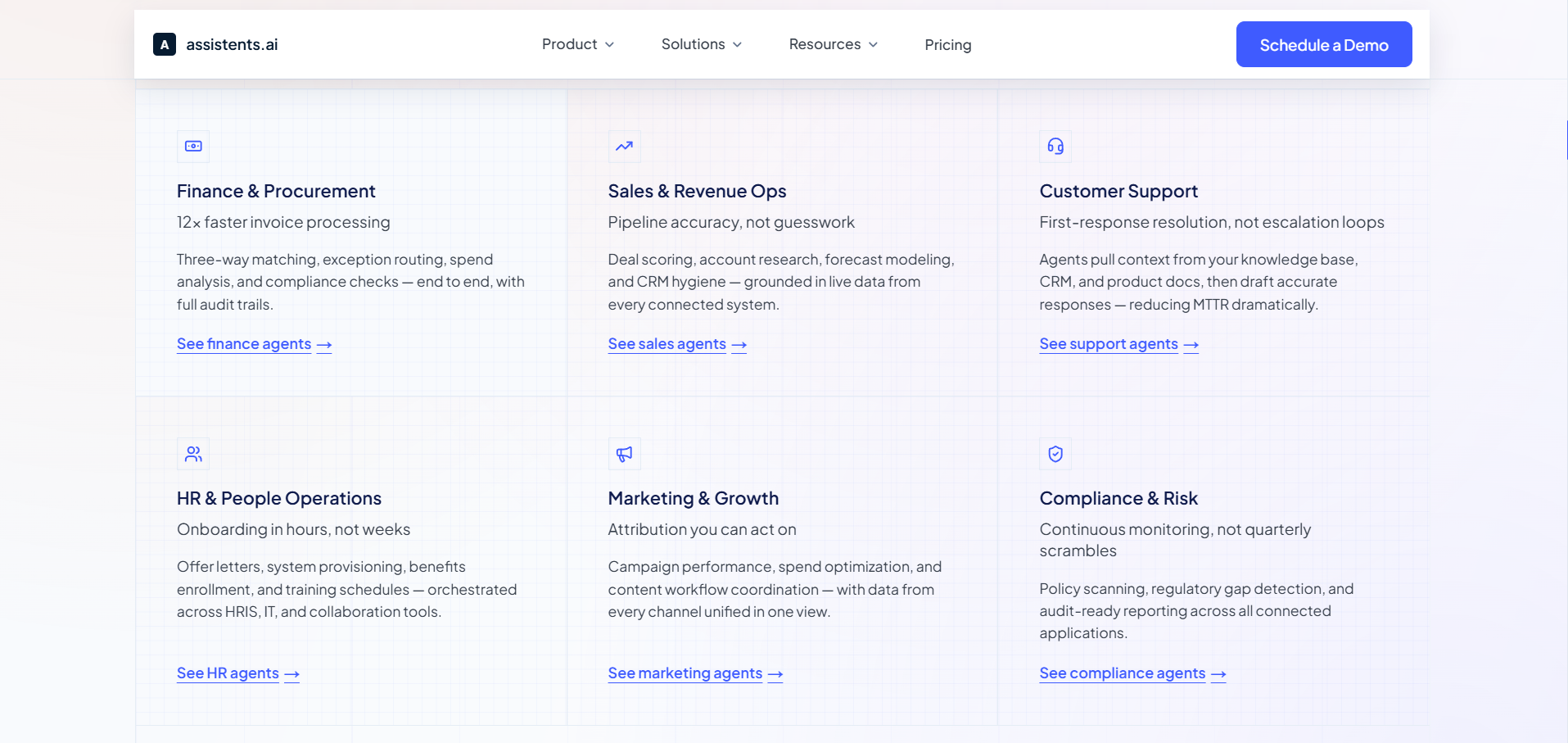
Finance & Procurement — 12x Faster Invoice Processing
Finance operations run on precision, audit trails, and exception management. The Finance & Procurement agents on assistents.ai handle three-way matching, exception routing, spend analysis, and compliance checks — end to end, without human intervention on standard transactions. Exceptions that fall outside defined parameters are escalated immediately, with full context, to the appropriate human reviewer.
In production, enterprises deploying the Finance agents have reported invoice processing up to 12 times faster than manual workflows, with complete audit coverage and zero missed deadlines on compliance reporting.
Sales & Revenue Ops — Pipeline Accuracy, Not Guesswork
Sales pipelines built on stale CRM data are a leading cause of forecast error. The Sales & Revenue Ops agents continuously score deals based on live engagement signals, account activity, and market context — surfacing next-best-action recommendations and pipeline health alerts to sales leadership without requiring manual data entry or weekly pipeline review calls.
Customer Support — First-Response Resolution, Not Escalation Loops
Customer support agents on assistents.ai pull context from knowledge bases, CRM records, and product documentation to draft accurate, contextually grounded responses to inbound tickets — reducing mean time to resolution dramatically, and reserving human agent capacity for genuinely complex cases that require judgement.
HR & People Operations — Onboarding in Hours, Not Weeks
HR agents orchestrate onboarding workflows across HRIS systems, IT provisioning, benefits enrollment, and learning management platforms — compressing onboarding timelines from weeks to hours and ensuring that every new employee arrives with access, orientation, and resources in place from day one.
Marketing & Growth — Attribution You Can Act On
Marketing agents unify campaign performance data across channels, run spend optimisation analysis, and coordinate content workflow execution — giving growth teams the visibility they need to make allocation decisions based on live performance data rather than last week's export.
Compliance & Risk — Continuous Monitoring, Not Quarterly Scrambles
Compliance agents continuously scan connected systems for policy violations, regulatory gaps, and data exposure risks — generating audit-ready reports and triggering immediate alerts when anomalies are detected. For enterprises that have previously discovered compliance gaps only during formal audits, this shift from reactive to continuous monitoring represents a fundamental change in risk posture.
The Pre-Built Agent Library: Eight Agents Ready for Production
assistents.ai ships with a library of eight purpose-built agents that can be deployed in days rather than months — each with domain knowledge, system connectors, and governance rules already configured. Enterprises can deploy these agents as-is, customise them for their specific processes, or build entirely new agents using the Agent Builder.
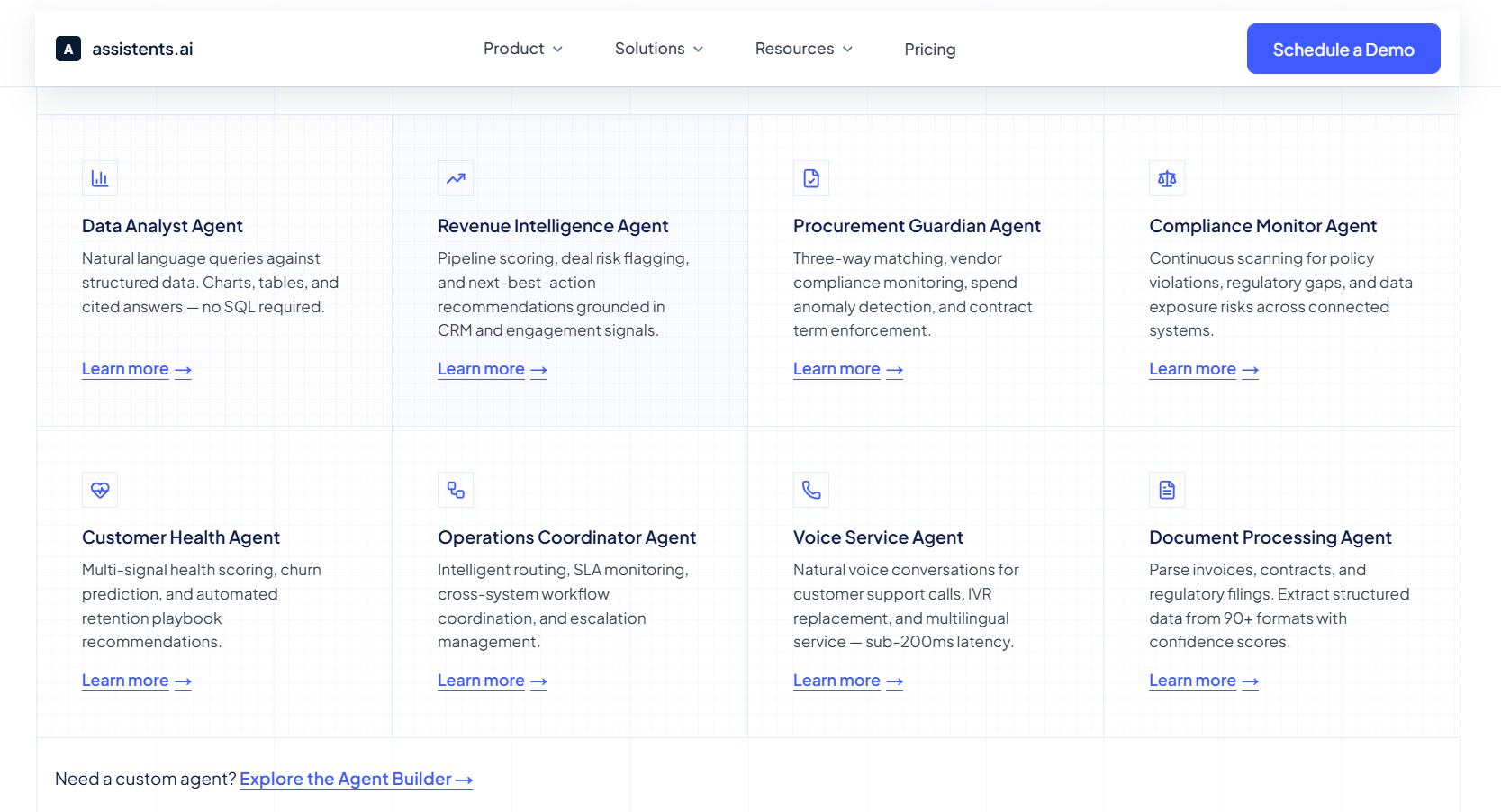
Data Analyst Agent — Natural language queries against structured enterprise data, returning charts, tables, and cited answers without requiring SQL skills from end users.
Revenue Intelligence Agent — Pipeline scoring, deal risk flagging, and next-best-action recommendations grounded in live CRM and engagement data.
Procurement Guardian Agent — Three-way matching, vendor compliance monitoring, spend anomaly detection, and contract term enforcement across the full procurement lifecycle.
Compliance Monitor Agent — Continuous scanning for policy violations, regulatory gaps, and data exposure risks across all connected enterprise systems.
Customer Health Agent — Multi-signal health scoring, churn prediction, and automated retention playbook recommendations drawn from CRM, product usage, and support interaction data.
Operations Coordinator Agent — Intelligent routing, SLA monitoring, cross-system workflow coordination, and escalation management for operational teams running complex, distributed processes.
Voice Service Agent — Natural voice conversations for customer support calls, IVR replacement, and multilingual service delivery — with sub-200 millisecond latency, making the interaction indistinguishable from a human agent for routine service queries.
Document Processing Agent — Parse invoices, contracts, and regulatory filings. Extract structured data from more than 90 document formats with confidence scores and full extraction audit logs.
Three Ways to Deploy: From Q&A to Autonomous Operations
assistents.ai meets enterprise teams at their current level of AI readiness and grows with them — from simple natural language queries to fully autonomous multi-step operations.
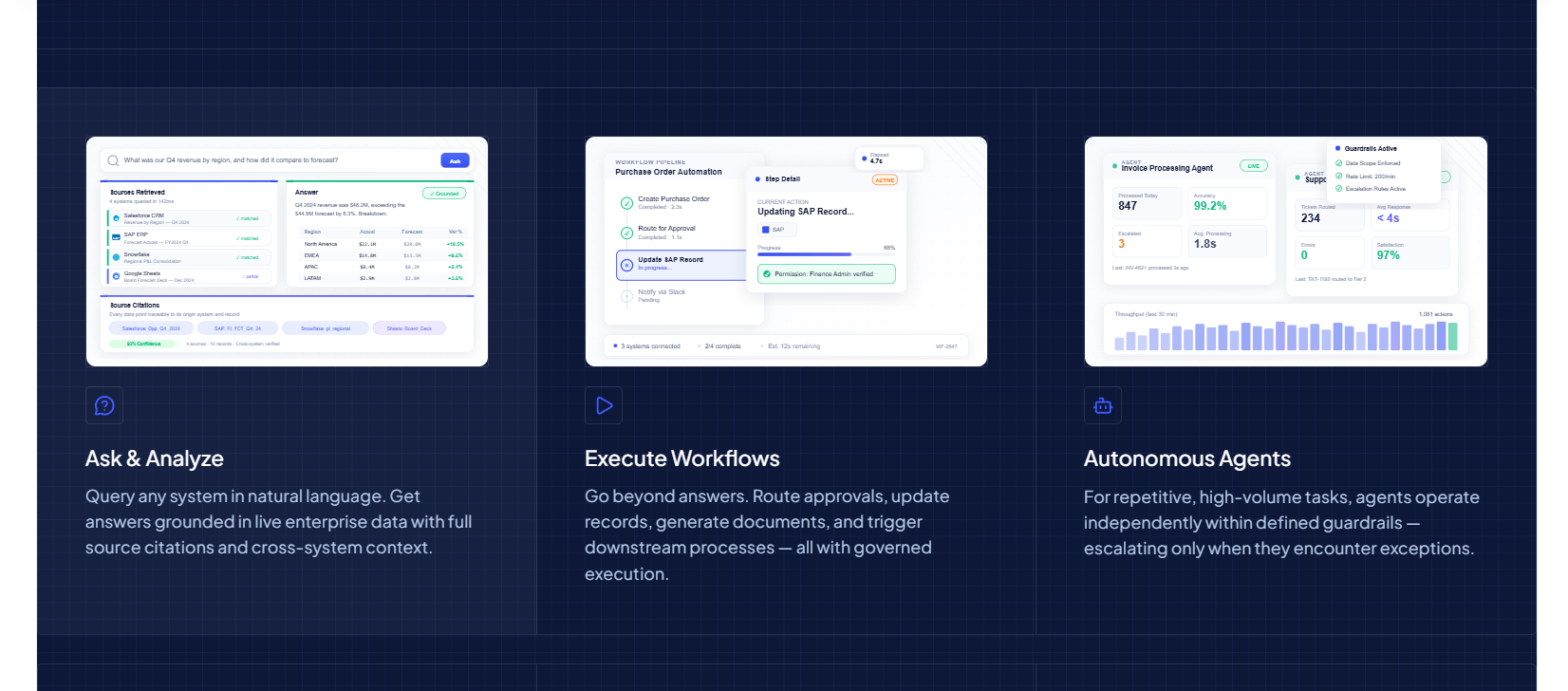
Ask & Analyse
The entry point for most enterprise deployments. Teams query any connected system in natural language and receive answers grounded in live enterprise data, complete with source citations and cross-system context. This mode replaces the pattern of extracting data into spreadsheets, analysing it manually, and presenting stale findings at weekly review meetings.
Execute Workflows
Beyond answers, the Execute Workflows mode enables agents to take action: routing approvals, updating records, generating documents, triggering downstream processes. This is where the distance between assistents.ai and conventional BI or search tools becomes concrete — the agent does not surface an insight and wait for a human to act on it. It closes the loop.
Autonomous Agents
For repetitive, high-volume operational tasks — invoice processing, ticket triage, compliance scanning, pipeline scoring — autonomous agents operate continuously within defined guardrails, escalating only when they encounter exceptions that require human judgement. This mode is where the most significant operational leverage is realised: agents covering the full operational surface of a department without proportional headcount growth.
What Production Deployment Looks Like: Outcomes Across Industries
The capabilities described above are not theoretical. Every feature in the assistents.ai platform was proven in real enterprise deployments before being productised. The following outcomes are drawn from production environments across the Ampcome client portfolio — without client identification.
Retail: 700+ Stores, 14 Weeks, Four Languages
A national retail chain operating more than 700 locations needed AI-powered operational support across its entire store network — supporting multiple languages, handling peak-hour concurrency, enforcing per-store governance policies, and integrating with existing point-of-sale and inventory systems.
Full production deployment was achieved in 14 weeks. The deployment included a voice-enabled customer and staff support agent operating in four languages, an inventory intelligence agent providing real-time pricing, stock, and promotional data at the store level, and a knowledge and training agent built on retrieval-augmented generation over standard operating procedure documents. Full return on investment was achieved within 90 days.
Financial Services: 75% Reduction in Compliance Reporting Time
A financial services enterprise was spending thousands of person-hours each quarter on regulatory reporting — manually collecting evidence across disconnected systems with no centralised audit trail. Compliance gaps were discovered during formal audits, not before them.
The assistents.ai Compliance Monitor agent automated continuous evidence collection across all connected systems, with human-in-the-loop approval workflows for exception handling and automated generation of audit-ready reports. The result: 75 percent reduction in regulatory reporting time, 100 percent audit coverage, zero missed deadlines, and payback achieved within the first quarter of deployment.
Manufacturing: 10 Million Data Points, Real-Time Pricing Intelligence
A global manufacturer needed competitive pricing intelligence across thousands of SKUs — continuously monitoring market changes across e-commerce channels, flagging pricing anomalies, and triggering procurement alerts within minutes of competitive shifts. The manual equivalent required multiple team members spending significant time each week across dozens of portals and platforms.
The deployed agents continuously ingest market data across all monitored channels, run anomaly detection, and push actionable alerts to category managers within five minutes of price shifts. The deployment monitors more than 10 million data points, delivers analysis 12 times faster than the manual baseline, and has generated a 3.2 times annual return on investment.
Construction & Infrastructure: ~90% Faster Document Processing
A specialist construction firm running complex tender document workflows deployed an Intelligent Document Workbench — a multi-agent system that retrieves tender documents, determines the appropriate processing workflow, extracts structured data from complex PDFs using vision-language model technology, detects revisions and changes between document versions, and synchronises extracted data into core operational systems with full audit logs.
The engineering target for the deployment: approximately 90 percent reduction in tender document processing time, with approximately 95 percent extraction accuracy for standard document formats. Bid risk was reduced through automated revision detection and fully auditable extraction decisions.
Energy & Utilities: Smart Grid Intelligence at State Scale
A state power transmission utility deployed AI agents for transmission KPI monitoring, anomaly detection, loss and outage analytics, and predictive maintenance indicators — with automated dashboards and field alerting. The outcome: faster identification of grid exceptions and operational risks, improved reliability through proactive monitoring, and better operational transparency for leadership and field operations teams across the transmission network.
Healthcare: Staffing Operations and Clinical Analytics
A healthcare staffing organisation deployed AI agents to automate talent onboarding, credential capture, facility request intake, candidate-facility matching, scheduling, and compliance workflows. A separate clinical analytics deployment for a physician-led enterprise delivered revenue cycle visibility with exception alerting and program performance dashboards. Both deployments were live in production within the four-week timeline the platform consistently delivers.
Real Estate: 24×7 Tenant Operations, Zero Agent Downtime
A major real estate portfolio operator running diversified commercial, retail, and residential assets across multiple emirates deployed an omnichannel tenant service agent — handling tenant query triage, rental and payment support workflows, FAQs, and automated escalation to human teams. The knowledge base was built over tenancy policies, standard operating procedures, and property-specific documentation.
The outcome: reduced call-centre load, consistent 24×7 tenant experience regardless of time or query volume, and better SLA adherence through automated routing and real-time tracking.
Agentic ERP Automation: Replacing End-of-Life Legacy Systems
An enterprise within a major regional conglomerate faced the end-of-life of a high-cost legacy system for sales order creation. Replacing it required not just building an automation layer but building one capable of interpreting order triggers from multiple input formats, validating inputs against complex business rules, creating SAP Sales Orders correctly on the first attempt, managing exceptions and approvals through governed workflows, and maintaining full audit logs and reconciliation reporting.
The deployment achieved all of these requirements: reduced manual order processing and legacy dependency, faster order-to-confirm cycles with fewer data-entry errors, and improved auditability across the entire sales order creation process.
Enterprise Security and Governance: Not an Add-On, the Foundation
The reason most enterprise AI agent deployments fail to receive security and compliance approval is not that the technology is inherently insecure. It is that security and governance are designed as constraints applied after the agent architecture is defined, rather than as first principles of the architecture itself.
assistents.ai inverts this. Security and governance are the foundation, not the wrapper.
Permission enforcement on every action. Agents inherit the same access controls that exist in source systems. Every data access and every action is permission-checked in real time against role-based access policies. Agents cannot access data or take actions that the authenticated user they are acting on behalf of is not authorised to access or take.
Complete audit trails. Every agent decision, data access, and action is logged with full provenance — who initiated it, what data was accessed, what reasoning was applied, what action was taken, and what the outcome was. Audit evidence is exportable and formatted for SOC 2, GDPR, HIPAA, and ISO 27001 review.
Agent alignment verification. Alignment models continuously verify that agent behaviour matches its intended purpose and defined guardrails. If an agent encounters a situation outside its defined operating parameters, it escalates to a human reviewer rather than guessing. This is the mechanism that gives compliance and security teams the confidence to approve agentic deployments for production workloads.
Model-agnostic architecture with zero data retention. assistents.ai works across leading LLM providers — AWS Bedrock, Azure OpenAI, Google Vertex AI, and OpenAI — allowing enterprises to select the inference infrastructure that meets their data residency, latency, and regulatory requirements. Enterprise data is never used for model training. Zero data retention.
The platform is certified under SOC 2 Type II, GDPR, HIPAA, and ISO 27001.
What Makes assistents.ai Different from Every Other AI Platform
The enterprise AI agent market in 2026 is crowded. Everyone claims to offer enterprise AI agent capabilities. Understanding what differentiates assistents.ai requires looking past the marketing language to the architectural and delivery distinctions that matter in production.
Production in four weeks, not four quarters. The average assistents.ai deployment reaches production within four weeks of engagement start. This is possible because the platform ships with pre-built domain knowledge, pre-configured system connectors, and governance frameworks that do not need to be built from scratch for each client. Competing platforms that require custom development for every deployment routinely take six to twelve months to reach production — by which point business requirements have changed and stakeholder patience has been exhausted.
The Semantic Layer is the moat. Most enterprise AI platforms retrieve data. assistents.ai understands it — the relationships between entities, the definitions of business metrics, the rules that govern exceptions, the hierarchy of decision authority. This is the Semantic Layer, and it is what produces agents that perform reliably across the full range of operational queries rather than just the queries they were tested against.
Outcome-based track record. assistents.ai is built by the same team at Ampcome that has delivered 30+ enterprise AI deployments in production across retail, financial services, logistics, healthcare, manufacturing, energy, and real estate — across India, the United Arab Emirates, the United States, the United Kingdom, Australia, and Canada. The platform is not a research project. It is the productised version of a proven delivery methodology.
97% agent task accuracy with audit trails. Across production deployments, assistents.ai agents achieve 97 percent task accuracy with full audit trail coverage — a figure that reflects not just model performance but the governance architecture that catches and routes exceptions before they become errors.
Deploy Your First Agent in Four Weeks
assistents.ai is production-proven across 12 industries, connected to 300+ enterprise systems, and certified under the security and compliance frameworks your enterprise requires. The gap between AI that answers questions and AI that runs operations is now a four-week deployment timeline.
The process is straightforward. Book a 30-minute discovery call. Describe the workflow that is costing your team the most — in lost time, lost revenue, or compliance exposure. Within 48 hours, receive a custom proof-of-concept plan with ROI projections, integration requirements, and a deployment roadmap. No commitment to proceed.
Request a demo at assistents.ai → View the platform → Calculate your ROI →
Frequently Asked Questions
What is an enterprise agentic AI platform?
An enterprise agentic AI platform is a software system that deploys AI agents capable of perceiving enterprise context, reasoning across connected systems, and executing multi-step operational workflows autonomously — within defined governance guardrails. It is distinct from a chatbot (which only answers questions) and a copilot (which only assists humans). An enterprise agentic AI platform closes the loop between insight and execution: agents take actions, not just suggestions.
How is assistents.ai different from a chatbot or copilot?
assistents.ai deploys agents that take governed action across enterprise systems — routing approvals, processing invoices, triaging tickets, monitoring compliance, updating CRM records — rather than simply answering questions or suggesting text. The difference is the difference between a calculator and an operator. Chatbots and copilots require a human to act on every output. assistents.ai agents execute the outcome directly, with human-in-the-loop checkpoints only where the risk profile of the decision requires them.
How long does it take to deploy assistents.ai agents?
The average time from engagement start to production deployment is four weeks. This is achievable because the platform ships with pre-built domain knowledge, pre-configured connectors to 300+ enterprise systems, and governance frameworks that do not require building from scratch. The 48-hour discovery-to-PoC-plan process — in which Ampcome delivers a custom proof-of-concept plan with ROI projections, integration requirements, and a deployment roadmap — allows enterprises to understand their specific timeline before committing to a full engagement.
What systems does assistents.ai connect to?
assistents.ai connects to 300+ enterprise systems, including SAP, Salesforce, HubSpot, Oracle, ServiceNow, Workday, Slack, and Microsoft. The integration architecture is built around the enterprise systems clients already run, not a replacement stack. Agents become active participants in existing operational workflows — reading from and writing to the systems of record the business depends on — rather than creating a parallel environment that must be managed separately.
Is assistents.ai secure enough for regulated industries?
Yes. assistents.ai is certified under SOC 2 Type II, GDPR, HIPAA, and ISO 27001. The platform enforces role-based access controls on every agent action, maintains complete audit trails with full decision provenance, and operates on a zero data retention basis — enterprise data is never used for model training. The governance architecture was designed explicitly for regulated industries including financial services, healthcare, and government-adjacent operations.
What does it cost to deploy assistents.ai?
assistents.ai offers transparent pricing — viewable at assistents.ai/pricing — structured around the scale of deployment and the number of agent types and departments involved. Ampcome's experience across 30+ enterprise deployments is that the return on investment is typically realised within the first quarter of production deployment, driven by the compounding efficiency gains of agents covering operational workflows that previously required proportional headcount.
Can assistents.ai replace our existing RPA tools?
For many enterprises, yes. Robotic Process Automation handles rule-based, deterministic workflows in structured environments — a strong fit for stable, well-defined processes that never encounter exceptions or unstructured data. Agentic AI handles the full operational surface: structured data, unstructured documents, natural language inputs, exception reasoning, and multi-system coordination. Assistents.ai includes a purpose-built comparison of AI agents versus RPA at assistents.ai/resources/ai-vs-rpa for enterprises evaluating the transition.
Updated- 22-03-2026

Transform Your Business With Agentic Automation
Agentic automation is the rising star posied to overtake RPA and bring about a new wave of intelligent automation. Explore the core concepts of agentic automation, how it works, real-life examples and strategies for a successful implementation in this ebook.
Sarfraz Nawaz is the CEO and founder of Ampcome, which is at the forefront of Artificial Intelligence (AI) Development. Nawaz's passion for technology is matched by his commitment to creating solutions that drive real-world results. Under his leadership, Ampcome's team of talented engineers and developers craft innovative IT solutions that empower businesses to thrive in the ever-evolving technological landscape.Ampcome's success is a testament to Nawaz's dedication to excellence and his unwavering belief in the transformative power of technology.

More insights
Discover the latest trends, best practices, and expert opinions that can reshape your perspective







Contact us

