
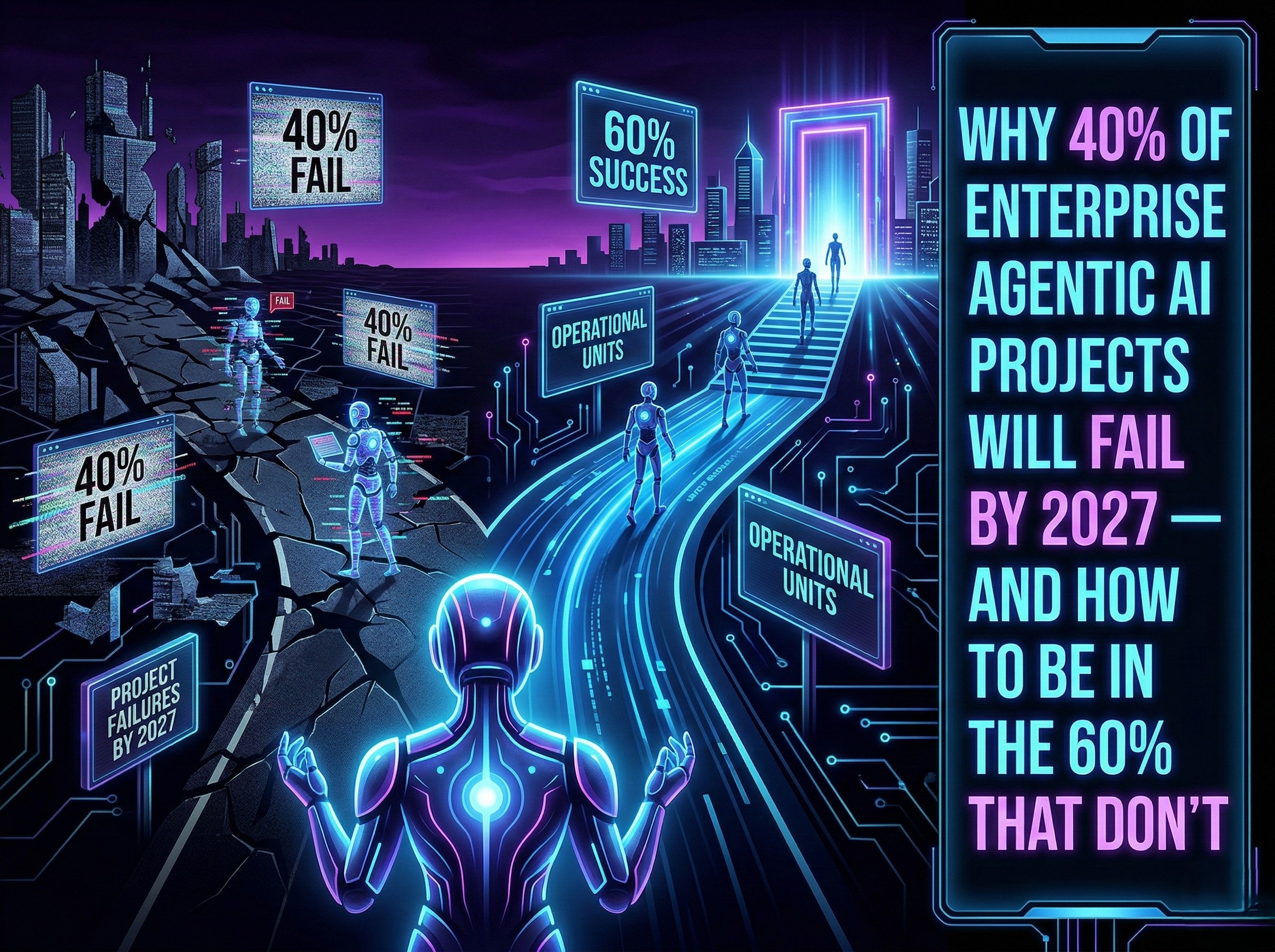
Why 40% of Enterprise Agentic AI Projects Will Fail by 2027 — And How to Be in the 60% That Don't


The numbers tell a story that most AI vendors would prefer you didn't hear.
62% of enterprises are currently experimenting with agentic AI, according to McKinsey's late-2025 survey. Deloitte's own research puts the number of production-ready implementations at just 14%. And Gartner's prediction is the sharpest of all: more than 40% of agentic AI projects will be cancelled by the end of 2027 — not because the technology failed, but because the foundation underneath it was never right.
That gap — between the 62% trying and the 14% succeeding — is not a technology problem. It is a context problem. An execution problem. A governance problem. And it is the single most important thing any enterprise leader needs to understand before investing another dollar in AI agents.
This is not a speculative trend piece. This article is built on real deployment data from 30+ enterprise agentic AI implementations across retail, logistics, manufacturing, banking, healthcare, smart cities, and real estate — spanning India, the UAE, the UK, the US, Australia, Canada, and Africa. Every failure pattern described here has been observed in real projects. Every solution has been tested in production.
If you are evaluating agentic AI for your enterprise, building a business case, or trying to understand why your current pilot isn't scaling — this is the guide that tells you what's actually going wrong, and what to do about it.
What Is Agentic AI — And Why Every Enterprise Is Racing Toward It
Before we diagnose the failures, let's be precise about what we're talking about.
Agentic AI refers to AI systems that don't just analyse data or make recommendations — they reason, decide, and execute actions autonomously within enterprise workflows. Unlike traditional AI tools that surface insights for humans to act on, agentic AI systems take the action themselves. They process information, evaluate options, trigger workflows, route approvals, and close loops — with or without a human in the middle.
The distinction matters because it changes the risk profile entirely. When AI advises and a human acts, the worst outcome of a bad recommendation is a delayed decision. When AI acts autonomously, the worst outcome is an irreversible action taken on incomplete information — at machine speed, across thousands of transactions, before anyone notices.
Most enterprises today sit somewhere on a five-level maturity curve. Level 1 is descriptive analytics: what happened. Level 2 is diagnostic: why it happened. Level 3 is predictive: what will happen. Level 4 is prescriptive: what should we do. Level 5 — the agentic level — is where the system simply handles it. It identifies the issue, evaluates options, executes the workflow, routes the approval, and learns from the outcome.
The market is moving toward Level 5 fast. McKinsey projects that 25% of enterprise workflows will be automated by agentic AI by 2028. Gartner estimates that 50% of enterprises will deploy autonomous decision systems by 2027. Early adopters are already reporting 40–60% reductions in process cycle times — from weeks to hours, from 8 decision cycles per year to 50 or more.
The business case is real. The technology is ready. The race has started.
So why are most runners tripping?
The 5 Real Reasons Agentic AI Projects Fail
Across 30+ enterprise deployments — from 700-store retail operations to $20 billion logistics companies to city-scale smart infrastructure programmes — we've observed the same five failure patterns killing agentic AI projects before they reach production. None of them are about the AI model itself.
Reason 1: The 80/20 Data Blind Spot (The Root Cause)
This is the failure that causes more enterprise agentic AI project cancellations than all the others combined. We call it the Blind Agent Problem, and it works like this.
Only about 20% of enterprise context lives in structured systems — ERP tables, CRM fields, transaction logs, database records. These are the data sources that most AI platforms are built to access. They're clean, queryable, and well-understood.
The other 80% of enterprise context — the information that actually drives business decisions — lives somewhere else entirely. It lives in contract PDFs with SLA exceptions and negotiated terms. In email threads where discounts were agreed and payment schedules were modified. In Slack conversations where a regional manager flagged a cash-flow concern. In policy documents, compliance rules, meeting notes, vendor correspondence, and operational SOPs scattered across SharePoint, Google Drive, and shared folders that nobody has indexed in years.
When an AI agent is deployed on top of structured data alone, it sees 20% of the picture. It processes invoices without seeing the contracts behind them. It recommends pricing actions without seeing competitor intelligence that lives in analyst reports. It triggers procurement workflows without seeing the email thread where the supplier agreed to different terms last week.
The agent isn't malfunctioning. It's performing exactly as designed — on a fraction of the information it needs. And because it acts with confidence, at speed, across hundreds or thousands of transactions, the damage compounds before anyone catches it.
This is not a theoretical risk. It is the dominant reason enterprise agentic AI projects fail in 2026.
Reason 2: No Governance Layer = Ungoverned Autonomy
The second failure pattern is giving AI agents the power to act without giving them rules to act by.
Governance in agentic AI is not about restricting the AI. It's about encoding business logic — approval hierarchies, compliance thresholds, escalation triggers, decision trees — into deterministic rules that the agent must follow. When governance is done correctly, an agent handling refunds under ₹10,000 processes them autonomously, while refunds above ₹50,000 are routed to a human approver. The logic is clear, auditable, and consistent.
When governance is absent, agents make probabilistic guesses at enterprise scale. They approve things they shouldn't. They skip steps that matter. They optimise for speed when the business needed caution.
As one CTO put it in a widely-cited 2026 enterprise AI report: "The risk is not too much AI. The risk is ungoverned autonomy."
Governed AI agents — agents with deterministic decision logic, policy citations, and audit trails built into every action — are the difference between a system that leadership trusts and a system that gets shut down after the first incident.
Reason 3: Data Silos That Agents Can't Cross
Most enterprises operate across 5 to 15 disconnected systems — ERP, CRM, HR, supply chain management, document repositories, communication platforms, project management tools, and more. Each system holds a slice of the truth. None holds the complete picture.
When agentic AI is deployed on top of one or two of these systems, it inherits their blindness. An agent managing procurement can see purchase orders in the ERP but can't see the contract amendments in the document management system. An agent monitoring supply chain performance can see inventory levels but can't see the Slack message where the logistics team flagged a port delay.
The data exists. The context is there. It's just invisible to the agent — because nobody built the infrastructure to fuse it.
This is why enterprises with the most sophisticated AI investments often have the most frustrated teams. They've bought the best models, hired the best engineers, and built the most impressive demos — but the agent still can't answer a straightforward question because the answer requires data from three different systems that don't talk to each other.

Reason 4: No Audit Trail = No Executive Trust
Agentic AI projects don't just need to work. They need to be explainable. Every action an agent takes — every approval, every escalation, every decision — needs a clear, traceable record of why it happened, what data it was based on, and which business rules governed the outcome.
Without this, executive trust evaporates at the first quarterly review. A board member asks "why did the system approve this?" and if the answer is "the model determined it was optimal," the project is dead. It doesn't matter that the decision was correct. If it can't be explained, it can't be defended. And if it can't be defended, it won't survive the next budget cycle.
The audit trail isn't a nice-to-have. It's the mechanism that converts a technology experiment into an enterprise-grade system. Every decision must be auditable, defensible, policy-cited, and explainable — or the organisation will never move past pilot.
Reason 5: Humans Stuck in the Loop Where They Shouldn't Be
The final failure pattern is a design problem. Most enterprises end up deploying one of two types of tools, both of which leave humans stuck in the loop.
Co-pilots — like those from the major cloud and CRM platforms — are strong at reasoning. They can analyse data, generate summaries, draft recommendations, and present options. But they don't execute. The human still has to take the action. For complex workflows with dozens of steps across multiple systems, this means the co-pilot becomes a slightly faster version of the status quo. The bottleneck shifts, but doesn't disappear.
On the other side, RPA tools can execute — but they can't reason. They follow scripted rules. When an exception occurs that the script doesn't cover, the process breaks. When unstructured data enters the workflow, the tool can't interpret it. The result is brittle automation that works perfectly until something changes, at which point it fails completely.
Neither approach delivers on the promise of agentic AI: systems that reason, execute, and govern — on complete context, without requiring human intervention at every step. The enterprises that reach production are the ones that solve for all three simultaneously.
The ₹12 Crore Story — What Half-Baked Context Looks Like at Enterprise Scale
This is a real incident. It illustrates everything described above — and it's the single most important story in enterprise agentic AI right now, because every organisation deploying AI agents is one bad deployment away from their own version of it.
A financial services firm deployed an AI agent to automate vendor payments. The agent was connected to the company's ERP system. It could see invoice amounts, due dates, vendor IDs, and payment terms from the structured database. By every technical measure, the deployment was a success. The agent processed payments faster, more consistently, and with fewer errors than the manual process it replaced.
Here's what the agent couldn't see.
It couldn't see the contract PDFs stored in SharePoint — the ones that contained negotiated discount terms tied to payment timing. It couldn't see the email threads between procurement and vendors — the ones where revised rates had been agreed but not yet updated in the ERP. It couldn't see the Slack messages from the finance team flagging a short-term cash-flow constraint and recommending that certain payments be delayed by two weeks.

The agent approved ₹12 crore in early vendor payments. Every payment was technically "correct" based on the invoice data. But contract terms were violated. Negotiated discounts were forfeited. Cash-flow guidelines were ignored.
The agent didn't fail. It performed perfectly — on 20% of the information it needed.
This is what happens when agentic AI acts on incomplete context. The system didn't malfunction. The foundation was wrong. And the cost was ₹12 crore — in a single payment cycle.
Half-baked context doesn't produce half-baked results. It produces confidently wrong results, executed at scale, before anyone can intervene.
Agentic AI Examples — What Production-Ready Actually Looks Like
Theory is useful. Evidence is better.
The following examples are drawn from real enterprise deployments across multiple industries and geographies. No client names are used, but every result described here is from a live, production agentic AI system — not a demo, not a proof of concept, and not a pilot that never scaled.
These stories are structured around the same pattern: what was the context gap before deployment, what did the agentic AI system change, and what was the measured result.
A National Retailer With 700+ Stores
The context gap: This value retailer operates more than 700 stores across hundreds of cities. Before deployment, there was no unified context layer connecting point-of-sale data, store-level inventory, standard operating procedures, and field operations. Store support ran on manual helpdesks. Inventory queries required analyst involvement. New employee onboarding was inconsistent across regions.
What changed: An enterprise agentic AI system was deployed with three core agents — a voice-enabled support agent handling store queries in Hindi and English, an inventory intelligence agent surfacing real-time pricing, stock, and promotional data per store, and a knowledge agent providing on-demand training and SOP guidance through retrieval-augmented generation over operational documents.
The result: Manual helpdesk burden dropped significantly. Store-level inventory visibility\ became real-time. New employees could access training guidance on demand without waiting for scheduled sessions. The system was designed for zero-training execution — store teams could use it from day one without formal onboarding. Standardised action logic was applied consistently across all 700+ locations.
A Major HVAC Manufacturer Facing Pricing Pressure
The context gap: This manufacturer competes in highly price-sensitive consumer and commercial cooling markets where competitor pricing moves, promotional shifts, and availability changes happen daily. Their existing BI tools could see structured data from internal systems — but could not ingest, correlate, or surface insights from the 80% of competitive intelligence that lived in external market feeds, e-commerce listings, competitor product catalogues, and pricing databases. When leadership asked strategic questions about competitive positioning, the BI tools could answer just 2 out of 31 priority questions.
What changed: A full-context agentic AI system was deployed to continuously monitor e-commerce and channel data — competitor pricing, MRP movements, discount structures, product availability, and customer ratings. The system mapped every data point to the leadership's specific strategic questions and delivered answers through a governed, auditable analytics interface.
The result: Answerability jumped from under 10% to 93% across all 31 strategic questions. Insights that previously took weeks of analyst time were delivered 100 times faster. A pricing gap of 12–26% against key competitors was identified and corrected immediately. The system replaced manual, periodic competitive checks with always-on, governed monitoring that scales without adding headcount.
A $20 Billion Global Ports and Logistics Operator
The context gap: This organisation manages port terminal and inland rail operations across a global network. Terminal workflow data and rail scheduling data lived in separate systems with no unified view. Logistics agents couldn't see across the terminal-to-rail handoff, creating blind spots in throughput planning and exception management.
What changed: A terminal and rail management solution was deployed to digitise and optimise port-to-inland logistics operations. The system created unified operational dashboards, rail scheduling visibility, automated exception management, and executive-level alerting — all governed and auditable.
The result: Terminal-to-rail throughput predictability improved. Coordination across terminal and inland logistics became significantly more efficient. Full digitisation of previously manual workflows was completed in weeks, not months. The system now provides continuous operational visibility that replaces reactive, dashboard-based monitoring.
A Smart Infrastructure Operator Serving 150 Million Urban Lives
The context gap: This organisation operates 25+ smart city operation centres, managing over 2 million connected assets and applications across large-scale urban infrastructure. Monitoring was reactive — teams relied on dashboards to spot problems after they'd already escalated. Grid operations had blind spots because data from sensors, utilities, and field systems wasn't correlated into a unified context layer.
What changed: An agentic analytics system was deployed on top of existing smart grid infrastructure — ingesting operational data, running predictive analytics for outages, losses, and field issues, and generating automated alerts with workflow routing for resolution.
The result: Reactive dashboards were replaced by proactive grid alerts. Exception detection and response coordination became significantly faster. Continuous monitoring replaced manual checks, giving operators higher visibility across grid operations and more predictable infrastructure performance at city scale.

A Global Fintech Serving Banks and Credit Unions
The context gap: This fintech provider handles omnichannel banking support — queries arriving via chat, email, and phone — for financial institutions. Before deployment, there was no unified case context across channels. An issue raised by email might be followed up via chat, with no system connecting the two interactions. Compliance documentation and audit trails were inconsistent.
What changed: Omnichannel AI agents were deployed with workflow routing, agent-assist summarisation, next-best-action recommendations, and built-in auditability. SLA monitoring and compliance reporting were automated.
The result: Case handling became faster and more consistent across channels. Operational load dropped through automation. Compliance readiness improved through built-in audit trails that track every agent action and decision. The system was designed to be integration-ready with core banking systems from day one.
A Multi-Entity Global Supply Chain Company
The context gap: This logistics and warehousing company operates across multiple countries and entities. There was no unified analytics context across geographies — each entity reported differently, used different metric definitions, and generated reports on different timelines. Leadership couldn't get a consistent operational view without weeks of manual consolidation.
What changed: A cross-entity analytics consolidation system was deployed, standardising KPIs, creating unified dashboards with variance explanations, and implementing data quality checks with a governance layer to ensure consistency.
The result: A single operational view replaced fragmented entity-level reporting. Leadership reporting became faster. Operational metrics became consistent across all geographies. Issue identification that previously required manual cross-referencing now happens automatically.
A Healthcare Staffing Platform Automating Credential-Heavy Workflows
The context gap: This healthcare staffing platform connects nursing professionals with facilities for flexible shifts. The workflow — from talent onboarding and credential capture to facility staffing requests, matching, scheduling, and compliance verification — was heavily manual. Credential data, facility requirements, scheduling constraints, and compliance rules lived in separate systems with no unified context.
What changed: An agentic AI platform was deployed to automate the end-to-end staffing workflow: talent onboarding with credential capture, facility request intake and matching logic, scheduling with automated notifications, and compliance verification workflows.
The result: Fill cycles became faster. Scheduling friction dropped. Workforce utilisation improved. Staffing responsiveness for facilities increased measurably — and the system maintained compliance throughout, with every match and placement auditable against credential and regulatory requirements.
A UAE Real Estate Portfolio Manager Serving Tenants Across Multiple Emirates
The context gap: This real estate company manages diversified office, retail, industrial, and residential assets across multiple emirates. Tenant support was inconsistent — queries arrived via web, WhatsApp, and email with no unified service layer. Knowledge about tenancy terms, policies, rental structures, and escalation procedures lived in siloed documents that support teams couldn't access in real time.
What changed: An omnichannel customer service agent was deployed, handling tenant query triage, FAQs, rental and payment support workflows, and ticketing with escalation to human teams. A knowledge base was built over policies, tenancy documents, and SOPs, giving the agent full context for every interaction.
The result: Response times dropped. Call-centre load decreased. Tenants got consistent 24/7 support across all channels. SLA adherence improved through automated routing and tracking. The system handles routine queries autonomously while routing complex situations to human teams with full context — so the human doesn't start from scratch.
Where Current Tools Fall Short — The Market Gap
Before looking forward, it's worth understanding why the current enterprise AI stack forces a bad trade-off — and why the five failure patterns described above keep repeating.
The market broadly offers two types of tools, and neither solves the full problem.
Co-pilots — from the major cloud, productivity, and CRM platforms — are strong at reasoning. They can analyse data, surface patterns, generate recommendations, and draft responses. But they don't execute. They advise. The human still takes the action, approves the workflow, sends the email, updates the system. For enterprises that need autonomous execution, co-pilots are a faster version of the status quo — not a transformation.
RPA tools can execute — they follow scripts, trigger workflows, and process transactions at speed. But they can't reason. They can't interpret unstructured data. They can't handle exceptions that fall outside the script. And when the business process changes, the automation breaks.
The result is a market split between reasoning without action and action without reasoning. What's missing — and what production-ready agentic AI delivers — is reasoning, execution, and governance working together on complete context. The enterprises that recognise this gap and build on all three pillars simultaneously are the ones moving from pilot to production.
The Future of Agentic AI — Why Context-Completeness Wins
The future of agentic AI is not about more powerful models. The models are already powerful enough. GPT-4, Claude, Gemini, and their successors can reason, plan, and generate with remarkable sophistication. The bottleneck was never intelligence — it was information.
The next phase of enterprise AI is defined by a single question: does your agent see the full picture before it acts?
The market is already shifting from "can we deploy agents?" to "can we deploy agents that don't break things?" Every major analyst report in 2026 — from Deloitte to McKinsey to Gartner — converges on the same conclusion: the enterprises that succeed with agentic AI are the ones that solve three problems simultaneously.
First, the context problem. The agent needs a unified context engine that fuses structured and unstructured data — ERP tables and contract PDFs, CRM records and email threads, transaction logs and Slack conversations — into a single semantic layer. Not a data lake. Not a RAG pipeline bolted onto a vector database. A genuine context engine that understands how a contract term in a PDF relates to an invoice in the ERP and a discount discussed in an email.

Second, the governance problem. The agent needs a semantic governance layer that enforces deterministic business rules — not probabilistic guesses. Approval hierarchies. Compliance thresholds. Decision trees that are policy-cited, auditable, and explainable. When governance is deterministic, there are no hallucinations. There are no black boxes. Every action can be traced back to a specific rule and a specific piece of evidence.
Third, the execution problem. The agent needs an orchestration layer that can execute multi-step workflows across enterprise systems — SAP, Salesforce, Jira, ServiceNow, Slack, and more — with human-in-the-loop controls calibrated by threshold. Low-risk actions execute autonomously. High-risk actions route to human approval. The line between the two is configurable, auditable, and consistent.
These three capabilities together — unified context, semantic governance, and governed orchestration — are what separate agentic AI that works in demos from agentic AI that works in production.
The enterprises that build on this foundation will be in the 60% that survive. The rest will join the 40% cancellation rate that Gartner is already predicting.
Context-complete agentic AI is not a feature. It's the architecture that makes everything else possible.
The Evaluation Checklist: 10 Questions to Ask Any Agentic AI Vendor Before You Sign
If you're evaluating agentic AI platforms, these are the questions that separate production-grade systems from demo-grade ones. Every question targets one of the five failure patterns described above.
1. Does your platform ingest unstructured data — PDFs, emails, Slack messages, policy documents — alongside structured data from ERP, CRM, and transactional systems?
If the answer is "we work with structured data" or "we support RAG over documents," ask how the system correlates a contract clause in a PDF with an invoice line in the ERP. That's the real test.
2. Can you show me the audit trail for a specific agent decision — including which data sources were consulted, which business rules were applied, and why this action was chosen over alternatives?
If they can't show you this in a live system, the platform doesn't have real governance. It has a prompt.
3. How does the system enforce business rules — deterministically or probabilistically?
Deterministic means: if condition X is met, action Y always happens. Probabilistic means: the model decided this seemed like the right thing to do. Only one of these survives enterprise compliance review.
4. What happens when the agent encounters an exception that doesn't match any existing rule?
Production-grade systems escalate to human review with full context. Demo-grade systems either hallucinate an answer or fail silently.
5. Can the platform execute multi-step workflows across multiple enterprise systems — or does it only work within a single tool's ecosystem?
Many "agentic" platforms are really co-pilots for one system. If your workflow crosses SAP, Salesforce, and Slack, you need orchestration across all three.
6. How do you handle human-in-the-loop controls? Can I set different autonomy thresholds for different action types?
The right answer is configurable thresholds — low-risk actions fully autonomous, high-risk actions routed to approval. The wrong answer is "the human reviews everything" or "the agent handles everything."
7. What is your deployment timeline from discovery to a live, governed agent in production?
If the answer is "6 to 12 months," you're looking at a consulting engagement, not a platform. Production-grade agentic AI systems should be live within 30 days.
8. Can you show me a case study where the same platform is running in production at enterprise scale — not a pilot, not a POC, but a live system handling real transactions?
This is the question that eliminates 80% of vendors. Demos are easy. Production is hard.
9. Does the platform require rip-and-replace of existing systems, or does it orchestrate what we already use?
If you have to rebuild your tech stack to deploy agentic AI, the total cost of ownership makes the project unviable. The platform should sit on top of your existing systems and connect them.
10. If your platform doesn't surface real, new value within 48 hours of discovery, what happens?
This is a culture question as much as a product question. Vendors confident in their technology offer pilot assessments with defined outcomes. Vendors who aren't confident sell multi-year contracts with long implementation timelines.
From Pilot to Production in 30 Days — What the Path Looks Like
The enterprises that move agentic AI from pilot to production fastest all follow a similar pattern. It's not about rushing. It's about starting with the right foundation.
Week 1: Discovery and Workflow Mapping. Identify the highest-value workflow — the one where incomplete context is costing the most time, money, or risk. Map the data sources involved: which are structured, which are unstructured, which live in disconnected systems. Define the business rules that should govern agent behaviour. Identify the humans who need to stay in the loop and the thresholds that trigger their involvement.
Weeks 2–4: Context Engine, Rules, and First Agent. Build the unified context layer that fuses all relevant data sources. Encode governance rules — approval hierarchies, compliance thresholds, escalation triggers. Deploy the first governed agent on the mapped workflow. Test against real data, real edge cases, and real exceptions.
Day 30: Live, Governed Agent in Production. The agent is handling real transactions, in production, with full auditability and governance. Not a demo. Not a sandbox. A live system that the organisation depends on.
This is not aspirational. This timeline has been achieved across 30+ enterprise deployments, from national retail chains to global logistics operators to smart city infrastructure programmes. The key is that deployment doesn't require rip-and-replace of existing systems. The agentic AI platform orchestrates what you already use — connecting ERP, CRM, document repositories, communication platforms, and operational systems into a unified context layer that agents can reason and act across.
No POC purgatory. No 12-month implementation timeline. No endless sales cycles.
If the platform can't surface real, new value within 48 hours of discovery, it's not the right platform.
The Stakes: Why Getting This Right Matters Now
The window for getting agentic AI right is closing faster than most enterprises realise.
The 62% of enterprises currently experimenting with agents are creating internal expectations. Boards have seen the demos. Leadership has approved the budgets. Teams have been hired. The question is no longer "should we do this?" — it's "why hasn't this delivered yet?"
The enterprises that solve the context problem first will reach production while their competitors are still debugging pilots. They'll capture the efficiency gains — the 40–60% cycle time reductions, the shift from 8 decision cycles per year to 50+, the elimination of entire categories of manual work — while the market is still figuring out why their agents keep making mistakes.
And the enterprises that don't solve it? They'll join the 40% cancellation rate. They'll blame the technology. They'll go back to dashboards and co-pilots and manual processes. And by the time they try again, the enterprises that got it right will be two years ahead.
This is not a technology decision. It is a competitive strategy decision. And the variable that determines the outcome is not which model you chose or which cloud you're on.
It's whether your agents see the full picture before they act.
Built to Solve This: Assistents.ai
Every failure pattern in this article — the 80/20 blind spot, ungoverned autonomy, siloed data, missing audit trails, humans stuck in the loop — is exactly what Assistents.ai was engineered to eliminate.
Built by Ampcome, Assistents.ai is an agentic intelligence platform with three core layers: a Unified Context Engine that fuses structured and unstructured data into a single semantic layer, a Semantic Governor that enforces deterministic business rules with full auditability, and an Active Orchestrator that executes governed workflows across your existing enterprise systems.
It's SOC2 Type II, ISO 27001 aligned, GDPR compliant, and deploys on cloud, private, on-premise, or hybrid infrastructure. No rip-and-replace. No POC purgatory. 30+ enterprise deployments across 8+ industries and 6 continents — live, in production, today.
See your context gap in 48 hours. Book a pilot assessment and we'll map your highest-value workflow, identify what your agents can't see, and deliver a concrete plan with ROI projections. If we don't surface real, new value — we walk. [Book Your Pilot Assessment →]
Frequently Asked Questions
Why do enterprise agentic AI projects fail?
The primary reason is the context gap — AI agents acting on incomplete information because they can only access 20% of enterprise data (structured systems like ERP and CRM), while the remaining 80% (contracts, emails, policies, communications) remains invisible to them. Secondary causes include lack of governance, data silos, missing audit trails, and human bottlenecks in the execution loop.
What is agentic AI and how is it different from copilots or RPA?
Agentic AI refers to systems that reason, decide, and execute autonomously within enterprise workflows. Copilots can reason and recommend but cannot execute — the human still acts. RPA can execute but cannot reason — it follows scripts that break on exceptions. Agentic AI combines reasoning, execution, and governance on complete context, enabling fully autonomous or threshold-governed workflow completion.
What is the 80/20 data problem in enterprise AI?
Only approximately 20% of enterprise context lives in structured systems (ERP, CRM, transaction databases). The remaining 80% exists in unstructured sources — PDF contracts, email threads, Slack messages, policy documents, meeting notes. Most AI tools only access the structured 20%, meaning agents are making critical decisions on a fraction of the information they need.
How do governed AI agents prevent hallucinations and errors?
Governed AI agents use deterministic logic — not probabilistic guesses — to make decisions. Business rules, approval hierarchies, compliance thresholds, and decision trees are encoded as hard logic. Every action is auditable, policy-cited, and explainable. When an agent encounters a situation outside its rules, it escalates to human review rather than guessing.
What does production-ready agentic AI look like?
Production-ready agentic AI has three layers: a unified context engine that fuses structured and unstructured data, a semantic governance layer that enforces deterministic business rules, and an active orchestration layer that executes workflows across enterprise systems with human-in-the-loop controls. It is SOC2, ISO 27001, and GDPR aligned, with full audit logs, AES-256 encryption, and deployment options across cloud, private, on-premise, or hybrid environments.
How can enterprises move agentic AI from pilot to production?
Start with the right foundation: full context, not partial context. Map the highest-value workflow, identify all data sources (structured and unstructured), encode governance rules, and deploy a governed agent. With the right platform, this can be achieved within 30 days — from discovery to a live agent in production — without replacing existing enterprise systems.
What is context-complete agentic AI?
Context-complete agentic AI is an approach where AI agents access and reason across all relevant enterprise data — structured databases, unstructured documents, communications, policies, and external sources — before taking action. It solves the Blind Agent Problem by ensuring agents see the full picture, not just the 20% visible to traditional tools.
What are real-world examples of agentic AI in enterprise?
Production examples include: a 700+ store national retailer running AI agents for store support, inventory intelligence, and employee training across all locations; an HVAC manufacturer achieving 93% answerability on strategic competitive questions (up from under 10%); a $20B logistics operator digitising terminal-to-rail operations in weeks; and a smart infrastructure operator replacing reactive dashboards with proactive grid monitoring across 150 million urban lives.

Transform Your Business With Agentic Automation
Agentic automation is the rising star posied to overtake RPA and bring about a new wave of intelligent automation. Explore the core concepts of agentic automation, how it works, real-life examples and strategies for a successful implementation in this ebook.
Sarfraz Nawaz is the CEO and founder of Ampcome, which is at the forefront of Artificial Intelligence (AI) Development. Nawaz's passion for technology is matched by his commitment to creating solutions that drive real-world results. Under his leadership, Ampcome's team of talented engineers and developers craft innovative IT solutions that empower businesses to thrive in the ever-evolving technological landscape.Ampcome's success is a testament to Nawaz's dedication to excellence and his unwavering belief in the transformative power of technology.

More insights
Discover the latest trends, best practices, and expert opinions that can reshape your perspective




.webp)


Contact us

