
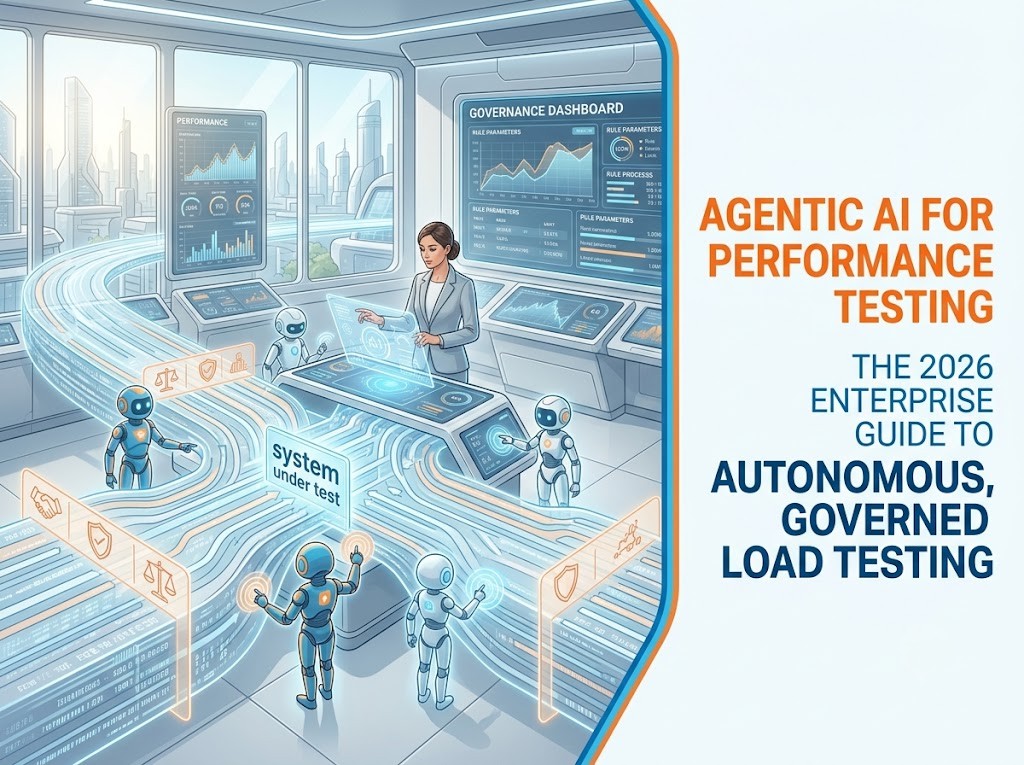
Agentic AI for Performance Testing: The 2026 Enterprise Guide to Autonomous, Governed Load Testing


Release cycles keep getting shorter, and AI coding tools are shipping more code than performance teams can test by hand. The routine is still largely manual: write scripts, configure load profiles, run the test, read the graphs, argue about the cause. It can't keep pace.
Agentic AI changes that routine. Instead of a human driving every step, AI agents plan the test, run it, analyse the results and recommend what to do next. This guide explains how that works, which tools exist in 2026, where governance becomes essential, and how to start without losing control of your production systems.
Key takeaways
- Agentic AI for performance testing uses autonomous agents to plan, run, analyse and adapt load, stress, spike and soak tests, with humans setting goals, thresholds and approvals.
- It differs from AI-assisted testing because the agent acts, rather than only suggesting scripts or summarising reports.
- The 2026 market has three layers: load engines (k6, JMeter, NeoLoad), agent interfaces (MCP servers, vendor agents) and a governance and orchestration layer that most teams are still missing.
- The phrase also has a second meaning: performance-testing AI agents themselves, which needs trace-level SLOs, token budgets and guardrails.
- The safest path is to start with one workflow, keep a human approval gate and require a full audit trail.
- assistents.ai is built for that third layer: governed, cross-system orchestration on top of the engines you already run.
What is agentic AI for performance testing?
Agentic AI for performance testing uses autonomous AI agents to plan, run, analyse and adapt load, stress, spike and soak tests, turning raw results into root-cause findings and next actions, while humans set goals, thresholds and approvals. Unlike AI-assisted testing, the agent acts, not just suggests.
Tricentis describes agentic performance testing in similar terms: AI agents that plan, execute, analyse and adapt performance tests without detailed human involvement. The key word is adapt. An agent that finds a latency spike can decide to re-run with a different load shape, correlate the spike with a recent deployment and open a ticket.
If you are new to the underlying idea, start with what agentic AI is and how it differs from generic AI agents.
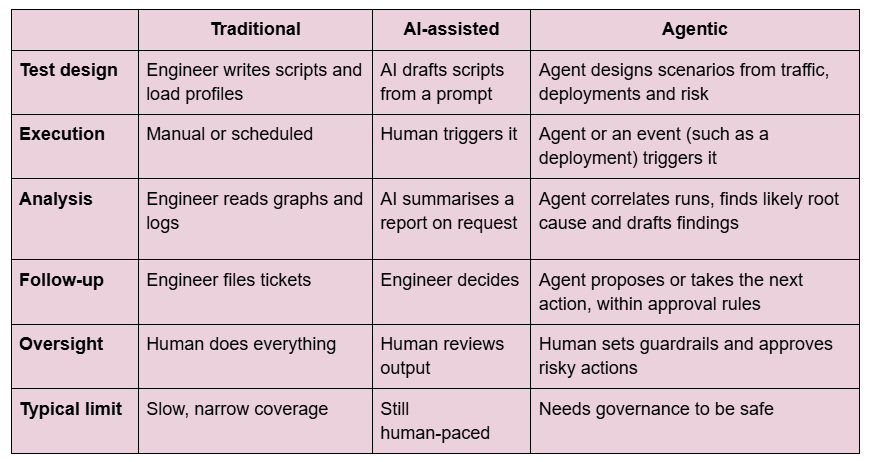
Traditional vs AI-assisted vs agentic performance testing
Two meanings of the term
People search for this phrase with two different goals in mind.
- Using agents to test software. Agents that generate, run and analyse performance tests against your applications. Most of this guide covers this meaning.
- Performance-testing agents themselves. Teams now ship AI agents into production, and those agents have their own latency, cost and reliability problems. We cover this in its own section below.
How agentic performance testing works
Agentic systems run a continuous loop rather than a one-off test. A practical version has five steps.
- Ingest signals. The agent reads deployment events, traffic logs, traces, past test runs and system definitions. It needs real traffic shapes to build realistic scenarios.
- Plan. It decides what to test. Is there a new endpoint nobody has load tested? Did a release change a dependency? It prioritises by risk.
- Generate and execute. It creates or selects scripts, then runs load, spike or stress scenarios through an engine such as k6, JMeter or Locust.
- Analyse. It compares results to baselines, flags regressions and anomalies, and proposes a likely cause.
- Act, with approval. It opens a ticket, alerts the owning team, recommends a fix or, if you've allowed it, blocks a release gate. Anything risky goes to a human first.
The same trigger, check, approve, act and record pattern runs through governed enterprise automation generally. Ampcome's guide to agentic process automation explains the broader model, and how to use agentic process automation in your business covers rollout.
Early research supports the approach. A 2026 work-in-progress paper reported that agentic workflows could produce executable performance tests and meaningful reports for microservice benchmarks with limited human intervention, even when the available context was incomplete (An Agent-Based Approach to Automating Software Performance Testing). It is early evidence, not a production guarantee.
Where agents add the most value
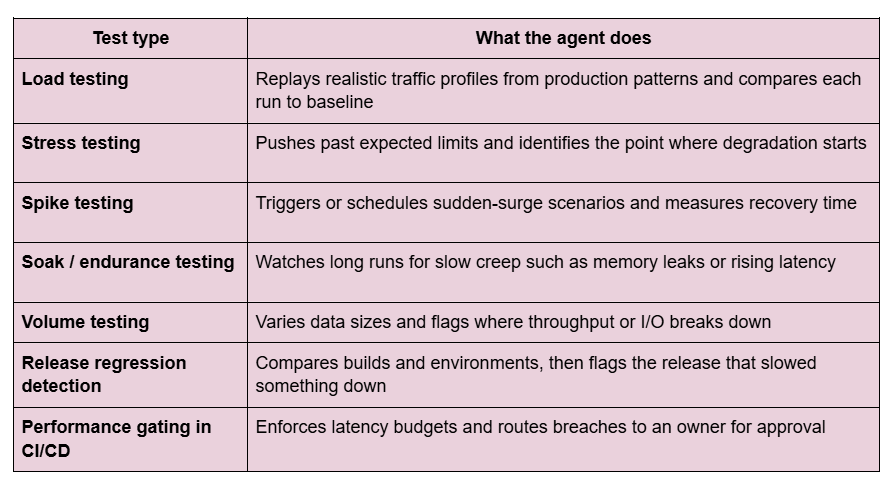
Performance work matters commercially. Tricentis cites an Akamai study finding that a 0.1-second delay in page load time hurt conversion rates by 7% (Tricentis guide). Teams that move from one pre-release test to continuous validation catch those delays earlier. For a deeper look at how TestGrid frames the main AI performance test types, see their overview.
For functional and regression testing with agents, see our separate guides to AI agents for QA testing and AI agents for test automation.
The 2026 stack: the Four-Layer Agentic Performance Stack
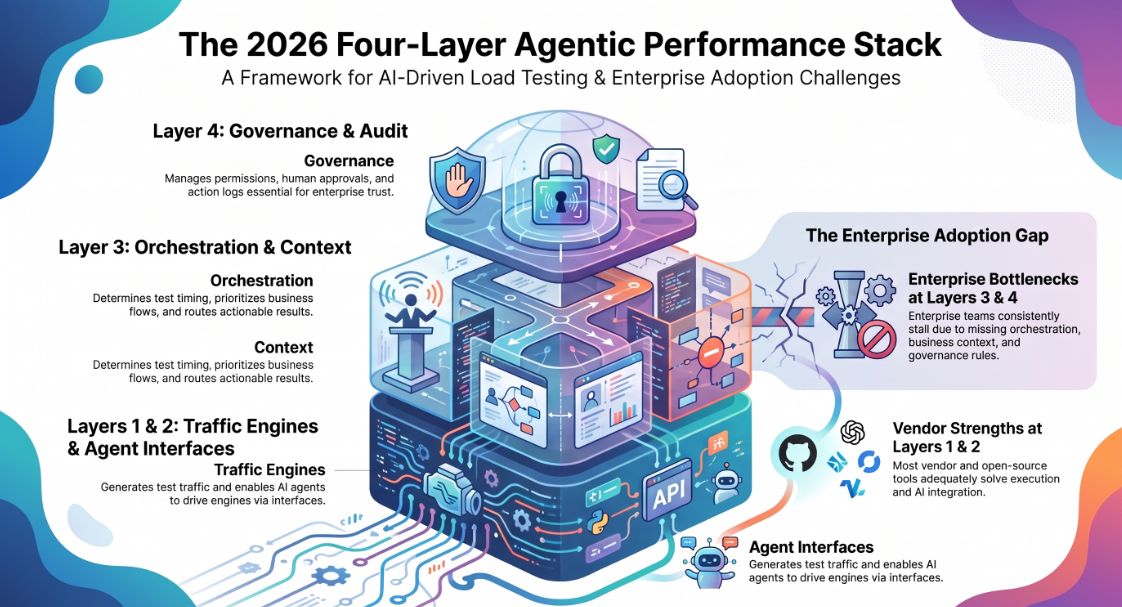
A useful way to evaluate any approach is to ask which layer it covers. We call this the Four-Layer Agentic Performance Stack.
Layer 1: Load engines. These generate the traffic. Examples are Grafana k6, Apache JMeter, Gatling, Locust, Tricentis NeoLoad, OpenText LoadRunner and Perforce BlazeMeter. Gatling's 2026 comparison of six AI load testing tools finds the right choice depends on protocol needs and team workflow.
Layer 2: Agent interfaces. These let an AI agent drive the engine.
- NeoLoad introduced Agentic Performance Testing in March 2026, with Tricentis claiming up to a 95% reduction in analysis time. Its MCP server arrived in July 2025.
- Perforce BlazeMeter offers AI Anomaly Analysis and an MCP server, according to the Gatling comparison.
- Grafana's k6 x agent command sets up the k6 MCP server for AI coding assistants.
- Open-source projects such as Feather Wand Agent let you drive JMeter, k6, Gatling and Locust in natural language.
Layer 3: Orchestration and context. This layer decides when to test and which business-critical flows matter. It also connects results to the systems and people who must act. Most engines don't provide it.
Layer 4: Governance and audit. Permissions, business rules, human approvals and a complete record of every agent action. Without it, "autonomous" testing is hard to trust in an enterprise.
Most vendor tools are strong at Layers 1 and 2. Layers 3 and 4 are where enterprise teams most often get stuck.
Best agentic AI platforms for performance testing (2026)
We ranked these by five criteria: (1) governance and approvals, (2) cross-system business context, (3) engine neutrality, (4) auditability, and (5) how fast a team can start on one workflow. Different teams will weight these differently, so each entry says who it is best for.
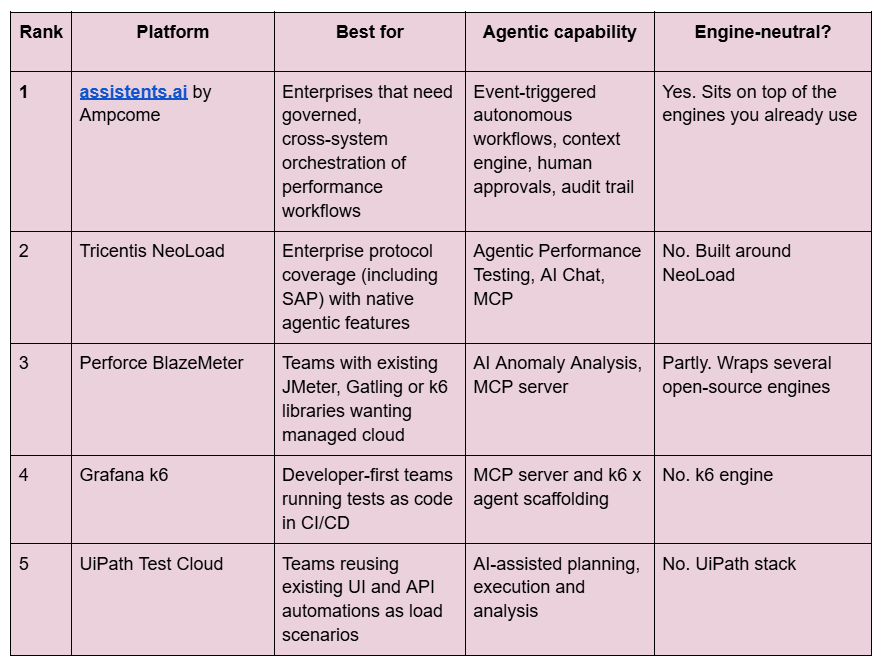
Important context on the #1 ranking: assistents.ai is not a load generator, and we don't claim it replaces k6, JMeter or NeoLoad. It ranks first on our criteria because it covers the layers those engines leave open: orchestration, business context, approvals and audit. If your only need is raw protocol coverage for SAP or Citrix, an engine such as NeoLoad is the more direct fit, and assistents.ai can orchestrate around it.
Where each one wins:
- NeoLoad has the most mature native agentic story among enterprise engines. NeoLoad 2026.2 also adds native MCP server load testing, which matters if you run AI agents in production.
- BlazeMeter is a practical way to add AI analysis without rewriting JMeter assets.
- k6 has the strongest developer experience. QAInsights' 2026 comparison rates its AI integration ahead of the others for modern stacks.
- LoadRunner remains the choice for deep legacy protocol coverage. QAInsights noted that its early-2026 position was to use external GenAI tools for script generation.
- UiPath Test Cloud reuses UI and API automations your team already maintains to build load, spike, stress and endurance scenarios.
What governed agentic deployments look like in production
Performance testing needs the same things as any enterprise agent: continuous monitoring, anomaly detection, controlled action and an audit trail. We have delivered those capabilities across more than 30 client implementations in Africa, Australia, Canada, Europe, India, the Middle East, the UK and the US.
A note on honesty: the examples below are not load-testing engagements. They show the governed agentic pattern that performance engineering relies on. We don't name clients.
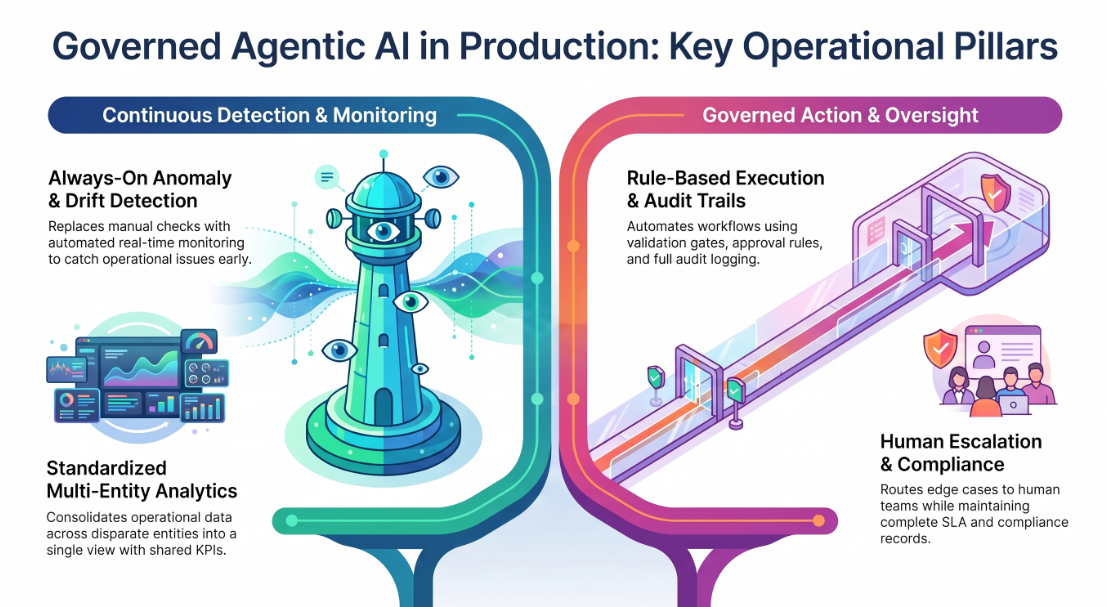
Continuous monitoring and anomaly detection. For a large research campus, we built AI for energy management: monitoring, forecasting and optimisation, with dashboards and proactive alerts. Results included improved energy visibility, faster detection of inefficiencies and reduced manual monitoring effort. For a regional power transmission utility, we added KPI monitoring, anomaly detection and automated alerts for field operations. This is the same loop a performance agent runs to catch latency drift before users do. See our guide to AI agents in the energy sector.
Always-on monitoring that replaces manual checks. For a major appliance manufacturer, we implemented AI agents that continuously watch e-commerce and channel data and turn market signals into instant answers and proactive alerts. It replaced manual checks across portals. Performance teams face the same problem when engineers refresh dashboards by hand.
Governed action with audit logs. For an enterprise manufacturer, we automated sales order creation in SAP. Agents interpret order triggers, validate them and create the order, with rules for exceptions and approvals, audit logs and reconciliation reporting. The project was part of a move away from a high-licensing-cost legacy environment. Results included reduced manual order processing, fewer data-entry errors and improved auditability. This shows the governance layer that makes an autonomous release gate trustworthy. See also our guide to agentic AI for procurement.
Insights turned into actions. For a group operator, we added an agentic layer on top of existing dashboards that turns insights into governed, auditable tasks, with automated task creation and completion tracking. It moved the team from reactive reporting to proactive execution loops. Performance findings need this too, because a regression report does nothing until someone owns the fix.
A single view across entities. For a multi-entity global operator, we consolidated analytics into one operational view with standardised KPIs. For performance engineering, this is how you stop each service team defining "slow" differently. Our guide to agentic AI for data engineering covers the data side.
Human escalation and compliance records. For a banking provider, omnichannel agents route work, summarise cases and escalate to people, with auditability and SLA monitoring. Better compliance readiness came from the audit trails. See our guide to agentic AI for fintech and business.
Browse more Ampcome case studies, or see industry pages for retail, logistics, financial services and healthcare.
How do you performance test agentic AI itself?
Teams now put AI agents into production, and those agents behave differently from normal software. They are non-deterministic, they call tools in loops and they cost money per step. A performance-testing approach built for fixed code paths misses these problems.
A practitioner discussion on scaling agentic AI performance testing recommends:
- Outcome-based SLOs at the trace level, not per step. One example target: 95% of traces finish a workflow within five steps and under a total token budget of roughly 2,000 to 5,000 tokens.
- Guardrails that bound tool calls and reasoning loops.
- Testing earlier in CI and later in production with synthetic monitoring.
- Cost controls, such as prompt caching and routing simple queries to cheaper models.
There is also an infrastructure angle. Agents fire rapid sequences of requests that spike in ways traditional load patterns don't model, which is why NeoLoad 2026.2 added native load testing for MCP servers.
Where assistents.ai fits. The platform includes an AI Gateway for model routing, fallback and usage management. Its Agent Builder lets teams configure, test, version and monitor agents. Its governance layer records every action. Those are the control points you need to keep agent latency and cost within budget. Related reading: what AI agents are and how to choose an AI agent platform.
Implementation playbook: start with one workflow
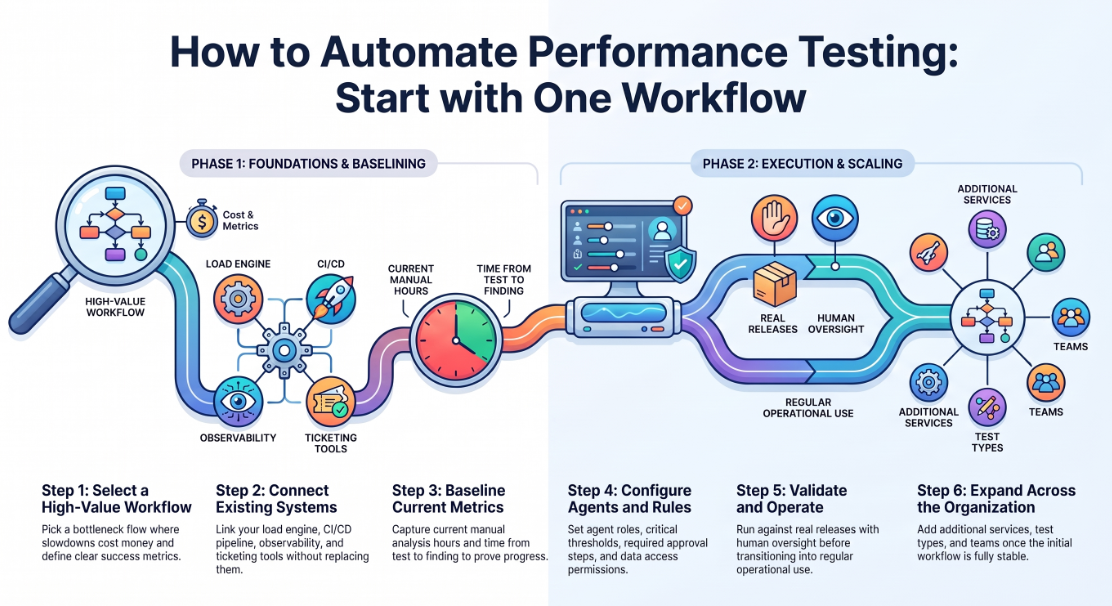
Don't try to automate all performance testing at once. Start with one valuable workflow and expand.
Step 1: Select a high-value workflow
Pick one flow where slowdowns cost money or where analysis is the bottleneck. Agree how you will measure success.
Step 2: Connect your systems
Connect your load engine, CI/CD pipeline, observability tools and ticketing. Reuse what you have. You don't need to replace your existing tools.
Step 3: Baseline the process
Capture current metrics: time from test to finding, scenario coverage, regressions found before and after release, and manual analysis hours. You can't prove improvement without a baseline.
Step 4: Configure agents and rules
Define the agent's role, the thresholds that matter, who must approve what, and which data it can see.
Step 5: Validate on real cases, then operate
Run the agent against real releases with humans reviewing every output. Refine, then move it into regular operation.
Step 6: Expand
Add more services, more test types and more teams once the first workflow is stable.
The Autonomy Ladder
Decide how much freedom the agent gets, and raise it only as trust is earned.
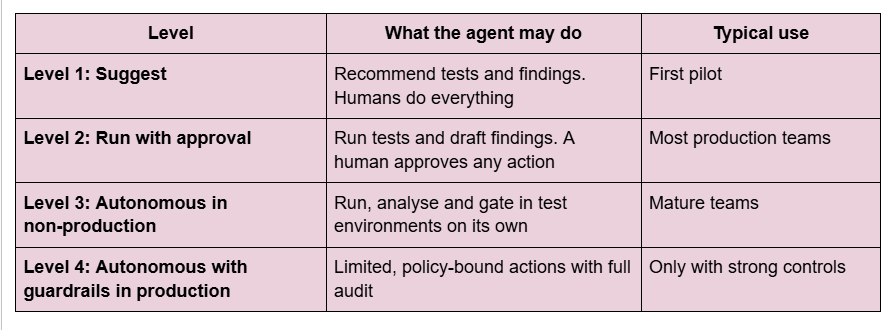
For many teams, Level 2 is the right stopping point. Autonomy is a dial, not a switch.
Risks and limits to plan for
An honest guide has to cover what can go wrong.
- Non-deterministic behaviour. Agents can make different choices on different runs. Fix: bounded scopes, versioned agents and trace-level review.
- False positives and noisy alerts. A confident but wrong root cause wastes engineering time. Fix: require evidence with each finding and track precision over time.
- Load safety. An agent that can launch tests can also overload a shared or production system. Fix: environment allow-lists, rate caps and approval for anything near production.
- Cost. Every agent step can use tokens and compute. Fix: budgets, caching and model routing.
- Data privacy. Test data may contain sensitive records. Fix: masked or synthetic data and strict permissions.
- Tool lock-in. Native agents are tied to one engine. Fix: use an orchestration layer that works across engines.
- Over-trusting autonomy. Tricentis' own guide advises keeping humans in the loop for reviews, and we agree.
Why assistents.ai
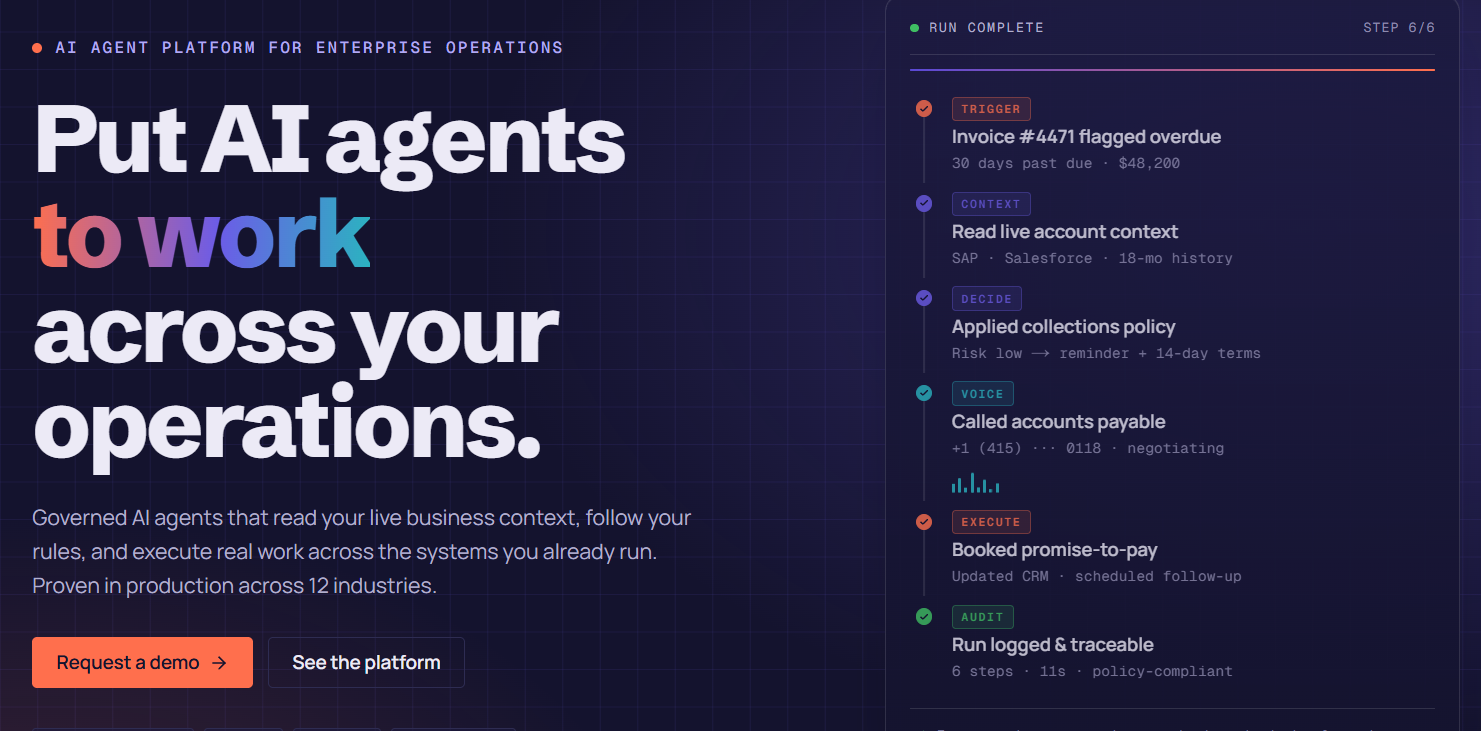
Most teams already have a load engine. What they lack is a governed way to put agents to work around it. That is the gap assistents.ai is built to close.
1. Organisational productivity, not personal productivity. Tools like ChatGPT, Claude or Copilot help an individual finish a task. assistents.ai coordinates a whole process from trigger to verified outcome and measures cycle time, throughput and exceptions.
2. Events start the work. Agents can be triggered by events, schedules and inboxes. A deployment or a traffic alert can start a performance workflow with no one remembering to run it.
3. A context engine. Agents work from shared entities, business definitions, policies and source evidence. That helps them prioritise the flows that matter to the business, not just the ones that are easiest to test.
4. Governed action. Every action passes an access check and a policy evaluation. It then proceeds, goes to human approval or is blocked, and everything is logged. This is the control layer that makes automated release gating defensible.
5. Orchestration with exception paths. Specialist agents hand off to people when judgment is needed, and the process resumes after review.
6. Agentic BI. Teams can ask questions of their results in plain language and get charts, reports, scheduled insights and threshold alerts.
7. Enterprise fit. It connects to ERP including SAP, CRM, documents and databases through APIs, SDKs and standard protocols. Deployment options include cloud SaaS, private cloud and on-premise infrastructure. The AI Gateway handles model routing, fallback and usage.
8. Build, test and monitor your own agents. Agent Builder and Workflow Builder let you configure reusable agents, test and version them, and monitor execution.
9. A delivery team, not just software. Our forward-deployed engineers, AI engineers and data science specialists work with you from configuration to production, across the USA, Australia and India. We start with one priority process, with clear success measures, and expand from there.
The platform works alongside your existing engines. It doesn't ask you to rip out the tools you trust.
Keep exploring:
- assistents.ai vs Glean: when search isn't enough
- Best AI agents for software development
- Deep research agent: the enterprise guide
- AI agents in supply chain
- AI agents in finance
- AI agent development services
- Ampcome pricing
Put agentic performance testing to work in your organisation
Start with one priority workflow, clear success measures and a team behind it. We'll map your systems, handoffs and approval points, then configure agents around them.
Book a tailored assistents.ai walkthrough or contact our team.
FAQs
What is agentic performance testing?
Agentic performance testing uses AI agents to plan, run, analyse and adapt performance tests with limited human involvement. The agent decides which tests matter, executes them, interprets the results and recommends or takes next steps within rules that people define.
How is agentic performance testing different from traditional performance testing?
Traditional testing is manual: engineers write scripts, run tests and read the results. Agentic testing is adaptive. The agent observes system behaviour, picks scenarios, runs them, analyses outcomes and triggers follow-ups, while people supervise and approve important actions.
Can AI do performance testing?
Yes. AI can design scenarios, run load tests through engines, detect anomalies and draft findings. Human oversight is still important for thresholds, production safety and final decisions, so most teams start with agents that suggest or run with approval.
Which is the best AI tool for performance testing?
It depends on your needs. NeoLoad suits enterprise protocols, BlazeMeter suits existing JMeter libraries and k6 suits developer-first teams. For governed orchestration across systems, with approvals and audit trails on top of any engine, assistents.ai is built for that role.
Do I need to replace my existing load-testing tools?
No. Most teams add agentic capabilities on top of what they already run. An orchestration layer such as assistents.ai works with your existing engines through APIs and connectors.
Are performance agents fully autonomous?
They can act autonomously within limits, but they should work inside human-defined guardrails. Actions such as blocking a release or raising alerts should follow policies, approvals and audit controls. Many teams stop at "run with approval."
How do you load test an AI agent or MCP server?
Treat agents differently from fixed code. Set outcome-based SLOs at the trace level, cap steps and token budgets, and model the rapid request bursts agents generate. Tools such as NeoLoad now support native MCP server load testing.
What metrics should you track?
Track response time, error rate, throughput and resource use. Also track process metrics: time from test to finding, scenario coverage, regressions caught before release and manual analysis hours. For AI agents, add steps per task and tokens per task.
How do you integrate agentic performance tests into CI/CD?
Trigger tests from deployment events, compare each run against baselines and send breaches to an owner for approval. Start by running with approval in a non-production environment, and tighten gating as trust grows.
Is agentic performance testing safe to run against production?
Only with strong controls. Use environment allow-lists, rate caps, masked data and human approval for anything near production. Most teams run agents in non-production first and keep production actions behind approvals.

Transform Your Business With Agentic Automation
Agentic automation is the rising star posied to overtake RPA and bring about a new wave of intelligent automation. Explore the core concepts of agentic automation, how it works, real-life examples and strategies for a successful implementation in this ebook.
Sarfraz Nawaz is the CEO and founder of Ampcome, which is at the forefront of Artificial Intelligence (AI) Development. Nawaz's passion for technology is matched by his commitment to creating solutions that drive real-world results. Under his leadership, Ampcome's team of talented engineers and developers craft innovative IT solutions that empower businesses to thrive in the ever-evolving technological landscape.Ampcome's success is a testament to Nawaz's dedication to excellence and his unwavering belief in the transformative power of technology.

More insights
Discover the latest trends, best practices, and expert opinions that can reshape your perspective







Contact us

