

AI Agent Platform Comparison 2026: assistents.ai vs Glean — When Search Isn't Enough


When enterprise teams evaluate AI platforms today, they're asking a deceptively simple question: does this platform find information, or does it get things done?
That distinction separates two entirely different categories of enterprise AI — and it's the most important thing to understand before committing to any platform in 2026. Glean is one of the most well-funded and well-known AI platforms in the enterprise market. assistents.ai is an agentic AI platform built from the ground up to execute workflows, not just retrieve answers. Both are legitimate tools. But they are not the same tool, and choosing the wrong one costs enterprises months of rework and significant budget.
This ai agent platform comparison breaks down exactly where each platform operates, where each one stops, and how to decide which architecture fits what your enterprise actually needs.
What This Comparison Covers
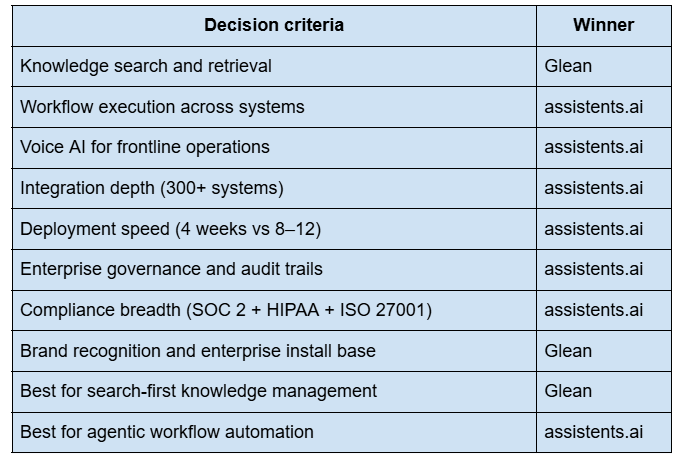
Before going deep, here is the at-a-glance comparison table enterprise buyers use at the shortlisting stage.
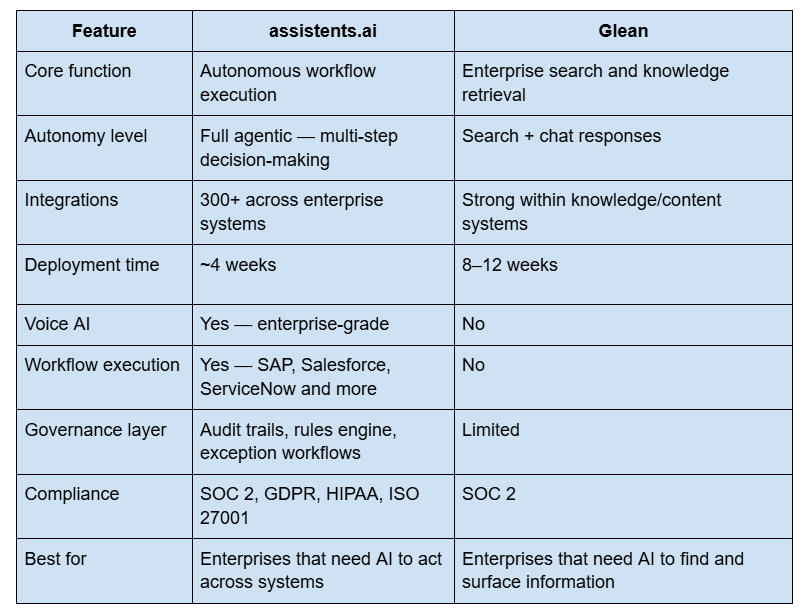
If your primary need is knowing where information lives inside your organisation, Glean is a strong product. If your primary need is having AI act on that information — creating orders, routing workflows, alerting teams, processing documents, and closing loops — you need an agentic AI platform.
The Core Difference — Search vs Execution
The enterprise AI market in 2026 is splitting into two clear camps. Understanding which camp a platform sits in is the first filter in any serious evaluation.
What Glean Does Well
Glean built its reputation on a real problem: enterprise knowledge is scattered across Slack, Confluence, Google Drive, Notion, email, and dozens of other tools, and employees waste significant time searching for things they know exist somewhere. Glean indexes this content, builds a knowledge graph across systems, and surfaces answers through a search-and-chat interface.
For knowledge retrieval, it works. Glean has invested heavily in relevance, permissions-aware search, and integrating with the content repositories enterprises already use. It has strong brand recognition, significant venture backing, and a roster of large enterprise logos.
Where Glean Stops
Glean's core limitation is architectural. It is a search-first system. When an employee asks "what is our return policy for enterprise accounts," Glean can find the answer. When an employee asks "process this return, update the CRM record, notify the account manager, and flag it for finance review," Glean cannot do that. It has no execution layer.
This matters more in 2026 than it did two years ago. Enterprise teams aren't just asking for better search anymore. They are asking AI to take action — to run procurement workflows, handle customer queries end-to-end, process documents without human handoffs, and generate operational alerts before problems escalate. Search-only platforms, no matter how well-funded, cannot satisfy this requirement.
Glean also operates primarily within its indexed knowledge base. It does not natively orchestrate actions across live enterprise systems like SAP, Salesforce, or ServiceNow. And it does not offer voice AI, which is increasingly relevant for frontline and field operations.
What Agentic AI Platforms Do Differently
Agentic AI platforms are architected around a different assumption: that the goal isn't just answering questions, but completing tasks. An agentic platform can ingest a trigger — a document arriving, a threshold being breached, a customer message coming in — and execute a sequence of actions across multiple systems in response, with rules-based governance controlling what it can and cannot do autonomously.
The best agentic AI platform for enterprise use in 2026 is one that combines this execution capability with appropriate guardrails: audit trails, exception routing, human-in-the-loop controls, and compliance-grade documentation of every action taken. That combination — execution plus governance — is what separates enterprise-grade agentic AI from generic automation tools.
Platform Architecture Comparison
Architecture is destiny in enterprise AI. The decisions made at the foundation determine what the platform can and cannot do three years after deployment.
Glean's Architecture — Search-First Design
Glean's architecture is built around a universal search index. It connects to content sources, ingests and indexes their contents while respecting existing permissions, and builds a semantic layer on top that enables natural language querying. The output is always an answer, a summary, or a document. The architecture terminates at the response layer — it does not have a native action execution engine.
This is an excellent architecture for its intended purpose. It is not an architecture designed to run enterprise workflows.
assistents.ai's Architecture — Agent-First Design
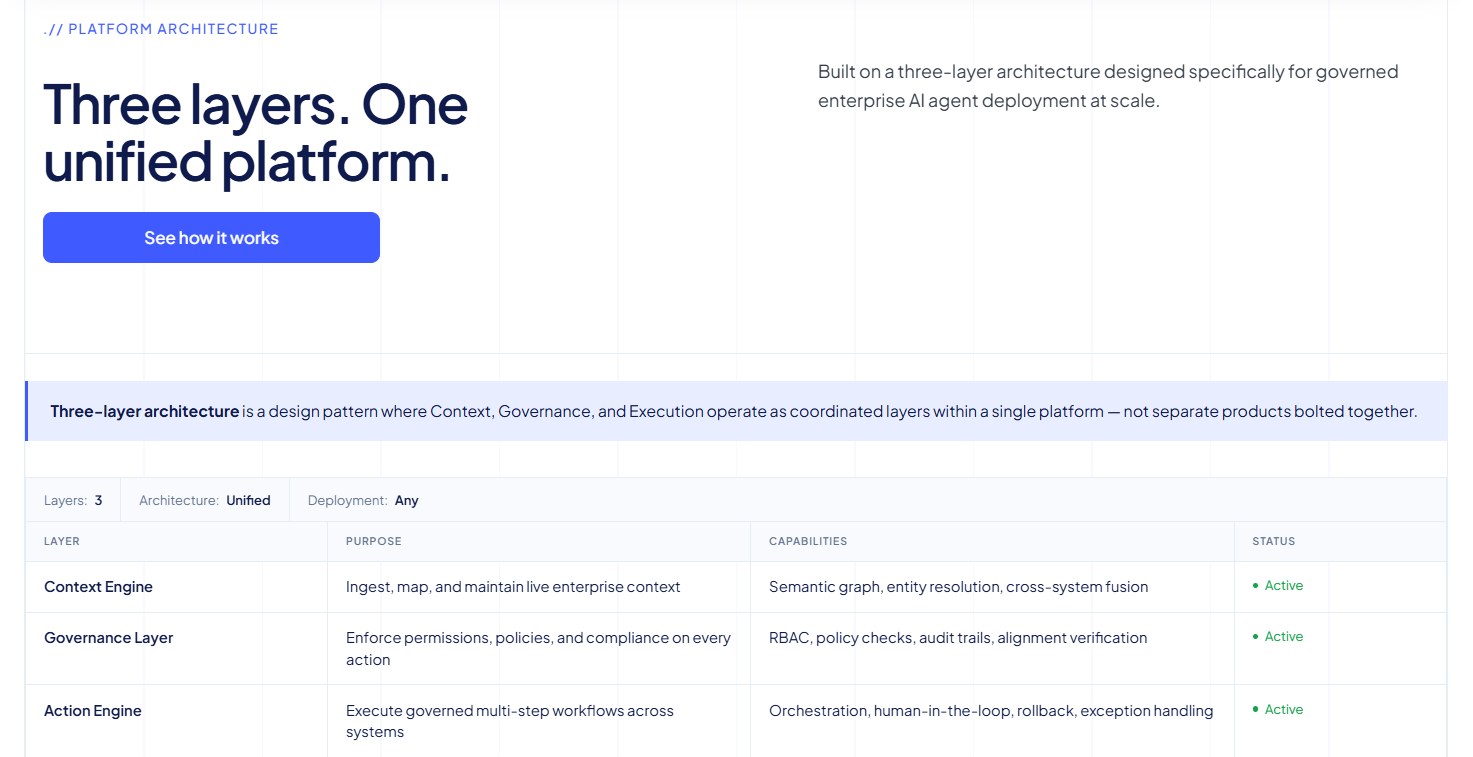
assistents.ai is built around a multi-agent orchestration layer. The platform connects to live enterprise systems — not just content repositories — and can both read from and write to those systems. Individual specialised agents handle specific domains: a document processing agent, a CRM agent, a finance agent, a customer communication agent. An orchestration layer coordinates these agents to complete multi-step workflows.
On top of this sits a semantic governance layer that enforces business rules, manages exception routing, maintains audit logs of every action, and provides human-in-the-loop controls at configurable points. The architecture also supports voice AI, enabling spoken interaction with enterprise systems in both Hindi and English — relevant for frontline operations, retail environments, and field teams.
Why Architecture Determines What's Possible
An enterprise that selects a search-first platform and later needs workflow execution will face a fundamental rebuild, not a feature upgrade. Architecture is not a technical detail to resolve after procurement — it is the procurement decision. The question is not "which platform has better search" but "what does our enterprise need AI to actually do over the next three to five years."
For enterprises that anticipate needing AI to act — not just answer — an agent-first architecture is the only architecture that scales in that direction.
Real-World Use Cases — What Each Platform Actually Handles
The most reliable signal in any ai agent platform comparison is deployment evidence. Here is how agentic AI has been deployed across industries — with results — versus what search-only AI can realistically deliver in the same contexts.
Use Cases Where Glean Excels
Glean is well-suited for: internal knowledge search across fragmented content systems, onboarding acceleration where new hires need to quickly find policies and procedures, sales enablement where reps need fast access to product documentation and competitive materials, and help desk deflection where common employee questions can be answered without opening a ticket.
These are real, valuable use cases. They represent significant ROI for organisations where knowledge fragmentation is the primary pain point.
Use Cases Where assistents.ai Has Been Deployed
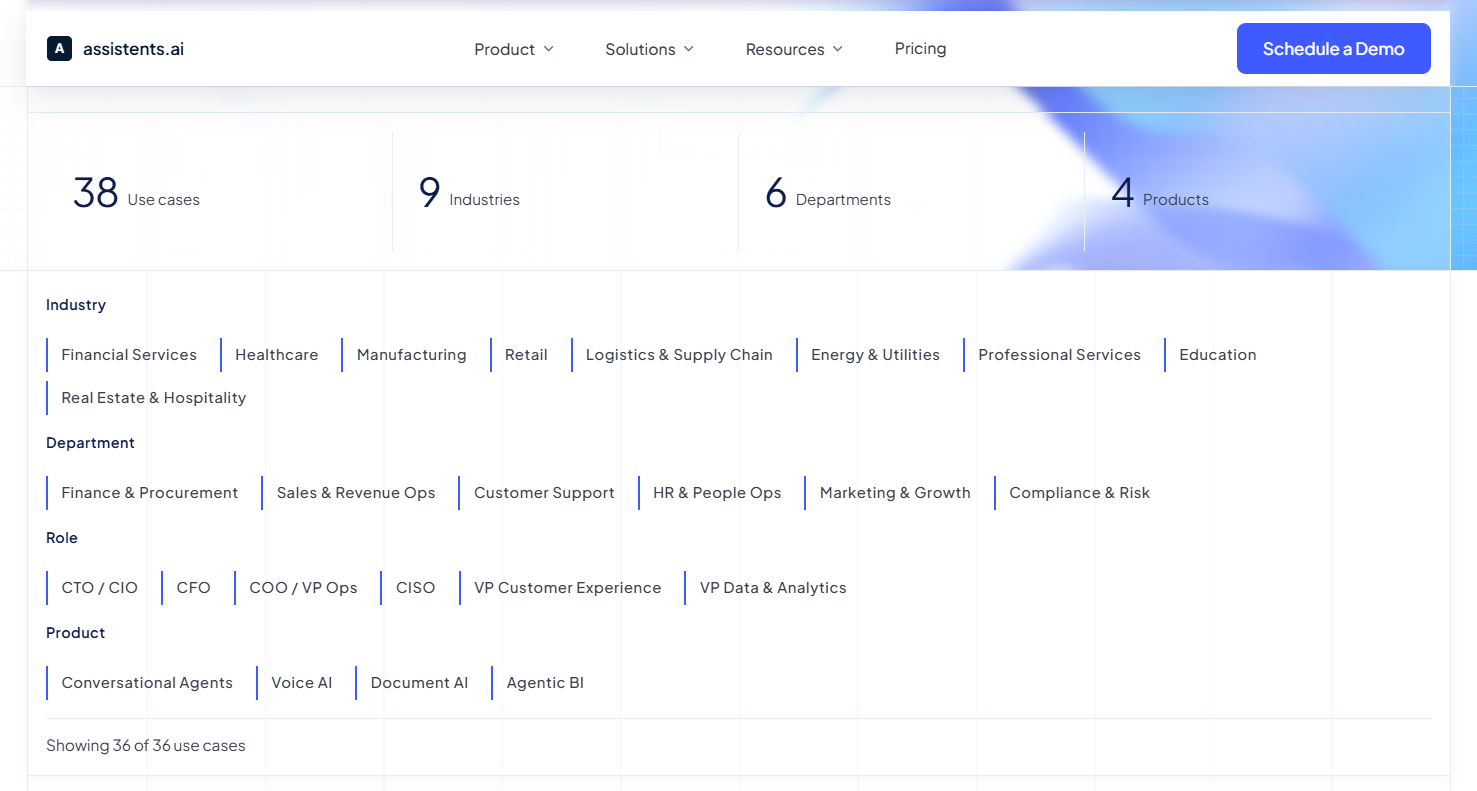
The following use cases are drawn from real enterprise deployments. Client names are not disclosed, but sector, scale, and outcomes are accurate.
Luxury Hospitality — End-to-End Booking Automation
A luxury hospitality operator running 16 boutique properties deployed a digital booking agent to automate end-to-end travel booking workflows. The agent handles email intake, intent classification, data extraction, conversational loops to capture missing guest details, real-time inventory checks, alternative date negotiation, and automated invoice and PDF generation. A human-in-the-loop handoff manages curated itinerary creation where a personal touch is required. Result: faster booking turnaround, higher accuracy on complex guest requirements, and scalable operations without compromising the luxury service standard.
Commercial Services — Tender Document Processing
A commercial remediation and building services company processing complex tender documents deployed a multi-agent document workbench. The system handles tender retrieval, workflow determination, revision analysis, and vision-LLM extraction from complex PDFs, with full integration into their operational system including quote locking and audit logs. Result: engineered for up to approximately 90% faster tender document processing, with a 95% extraction accuracy target for standard formats and reduced bid risk through automated revision and change detection.
Financial Services — Omnichannel Banking Support
A global fintech provider serving banks and credit unions deployed omnichannel AI agents for banking customer support. The system handles intake across chat, email, and phone channels, routes workflows intelligently, provides agent-assist summarisation and next-best actions, and maintains full auditability and SLA monitoring. Result: faster case handling, improved consistency, reduced operational load through automation, and better compliance readiness through complete audit trails.
Retail — Enterprise Store Operations at National Scale
A value retail operator with 700 stores across India deployed a three-layer AI agent system: a voice support agent handling Hindi and English, an inventory intelligence agent providing pricing and stock visibility per store, and a knowledge and training agent built on RAG over point-of-sale and standard operating procedure documents. Result: reduced manual helpdesk burden, improved store-level inventory visibility, and faster onboarding through on-demand training guidance at national scale.
Energy & Utilities — Grid Operations and Predictive Monitoring
A state power transmission utility deployed AI agents for smart grid data ingestion, operational dashboards, predictive analytics for outages and losses, and automated alerts with workflow routing for field resolution. Result: higher operational visibility across grid operations, faster exception detection and response coordination, and more proactive grid operations through continuous monitoring.
Logistics — Port and Rail Terminal Management
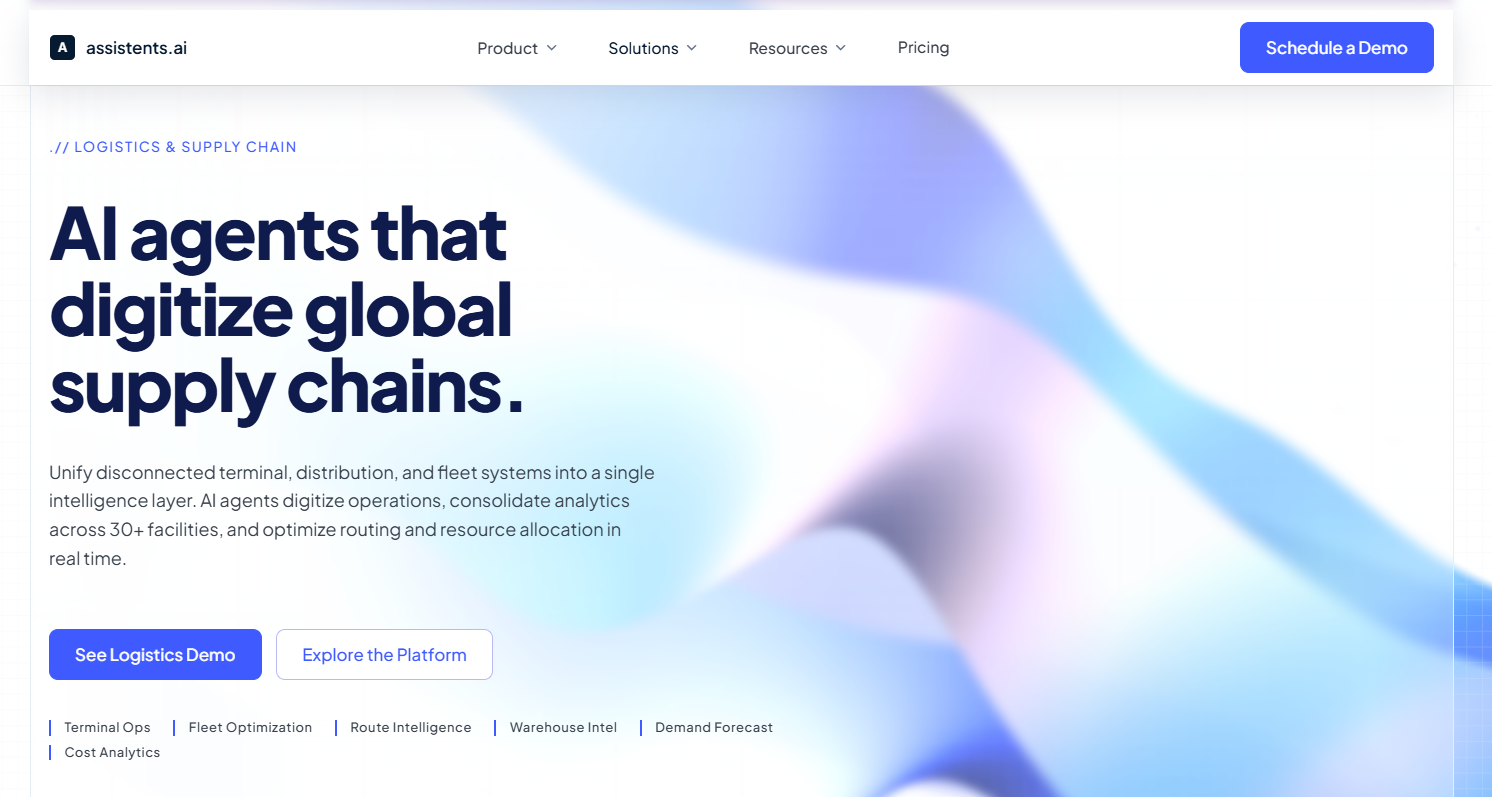
A global ports and logistics operator with record revenues exceeding $20 billion for FY2024 deployed a terminal and rail management solution to digitise and optimise port-to-inland logistics operations. The system covers rail scheduling and visibility, exception management, and executive dashboards with operational alerts. Result: improved operational visibility, higher predictability of terminal-to-rail throughput, and more efficient coordination across terminal and inland logistics.
Real Estate — Tenant Support Automation
A major real estate portfolio owner managing diversified assets across multiple emirates deployed an omnichannel customer service agent for tenant and customer support. The agent handles query triage, FAQs, rental and payment support workflows, ticketing, and escalation to human teams, with a knowledge base built over policies, tenancy documents, and SOPs. Result: faster response times, reduced call centre load, consistent 24/7 tenant experience, and better SLA adherence through automated routing.
Healthcare Staffing — Matching and Scheduling Operations
A healthcare staffing platform connecting nursing professionals with facilities deployed AI agents covering talent onboarding, credential capture, facility staffing request intake, matching logic, scheduling, notifications, and compliance workflows. Result: faster fill cycles, lower scheduling friction, better workforce utilisation, and improved staffing responsiveness for facilities.
These use cases share a common characteristic: they require AI to act across live systems, not just find information. None of them could be delivered by a search-first platform.
Integration Depth — The Enterprise Deciding Factor
A platform's integration ecosystem determines whether it can actually reach the systems that run your business.
Glean's Integration Ecosystem
Glean integrates deeply with knowledge and content systems: Google Workspace, Microsoft 365, Confluence, Slack, Jira, Notion, Salesforce (for data reading), and similar platforms. These integrations are read-oriented — Glean pulls content for indexing. It does not write back to these systems or execute transactions within them.
assistents.ai's 300+ Integration Layer
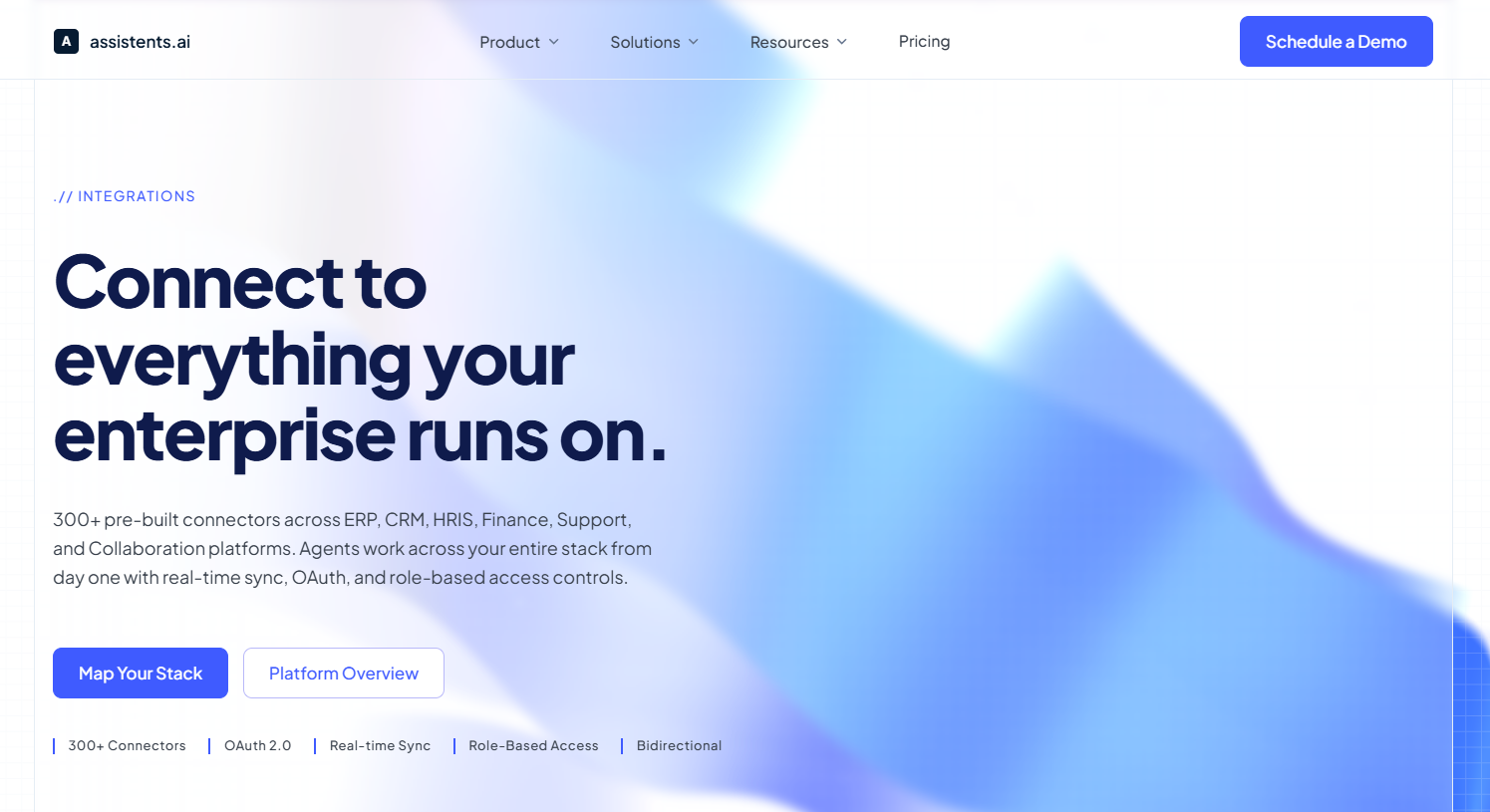
assistents.ai connects to 300+ enterprise systems with both read and write capability. This includes ERP systems like SAP (with demonstrated SAP Sales Order creation via agentic automation), CRM platforms like Salesforce, ITSM systems like ServiceNow, Oracle, and operational systems across logistics, HR, finance, and customer service. The platform has deployed real agentic automation to interpret order triggers, validate, and create SAP Sales Orders — replacing end-of-life legacy systems like OpenText ECR — with rules-based governance for exceptions and approvals, and full audit logs and reconciliation reporting.
Why Integration Depth Determines ROI
An AI agent that can read your Confluence pages but cannot update your SAP records, close a Salesforce opportunity, or create a ServiceNow ticket is still leaving the majority of enterprise workflow work to humans. The integration question is not "does it connect to my systems" but "can it act within my systems." That distinction defines the ceiling on what agentic AI can automate — and therefore what ROI is achievable.
Deployment Speed Comparison — 4 Weeks vs 8–12 Weeks
Deployment timelines are a decisive factor for enterprise procurement committees, particularly where there is a defined business case tied to a specific quarter.
assistents.ai's deployment model is designed for a 4-week implementation cycle. This is not a pilot or a limited proof-of-concept — it is a production-ready deployment with integration, governance configuration, and operational handover included. Real deployments across logistics, financial services, retail, and healthcare have followed this model.
Glean's typical deployment timeline runs 8–12 weeks. This reflects the complexity of indexing large content ecosystems, configuring permissions-aware search, and training the system on domain-specific terminology. For a knowledge search use case, this timeline is reasonable. For enterprises that need AI operational before an upcoming quarter or initiative, 8–12 weeks creates planning risk.
The deployment speed gap also affects iteration speed. A platform that can be adjusted and extended in days rather than months allows enterprises to expand their AI footprint incrementally, which is how successful agentic AI adoption actually happens in practice.
Enterprise Governance and Compliance
Governance is where agentic AI either earns enterprise trust or fails procurement review.
Audit Trails and Accountability
Every action an AI agent takes in a production enterprise environment needs to be traceable. Who triggered this action? What data was used? What decision logic was applied? What was the output? Can it be reversed? These are not optional questions — they are required by internal audit, legal review, and increasingly by regulation.
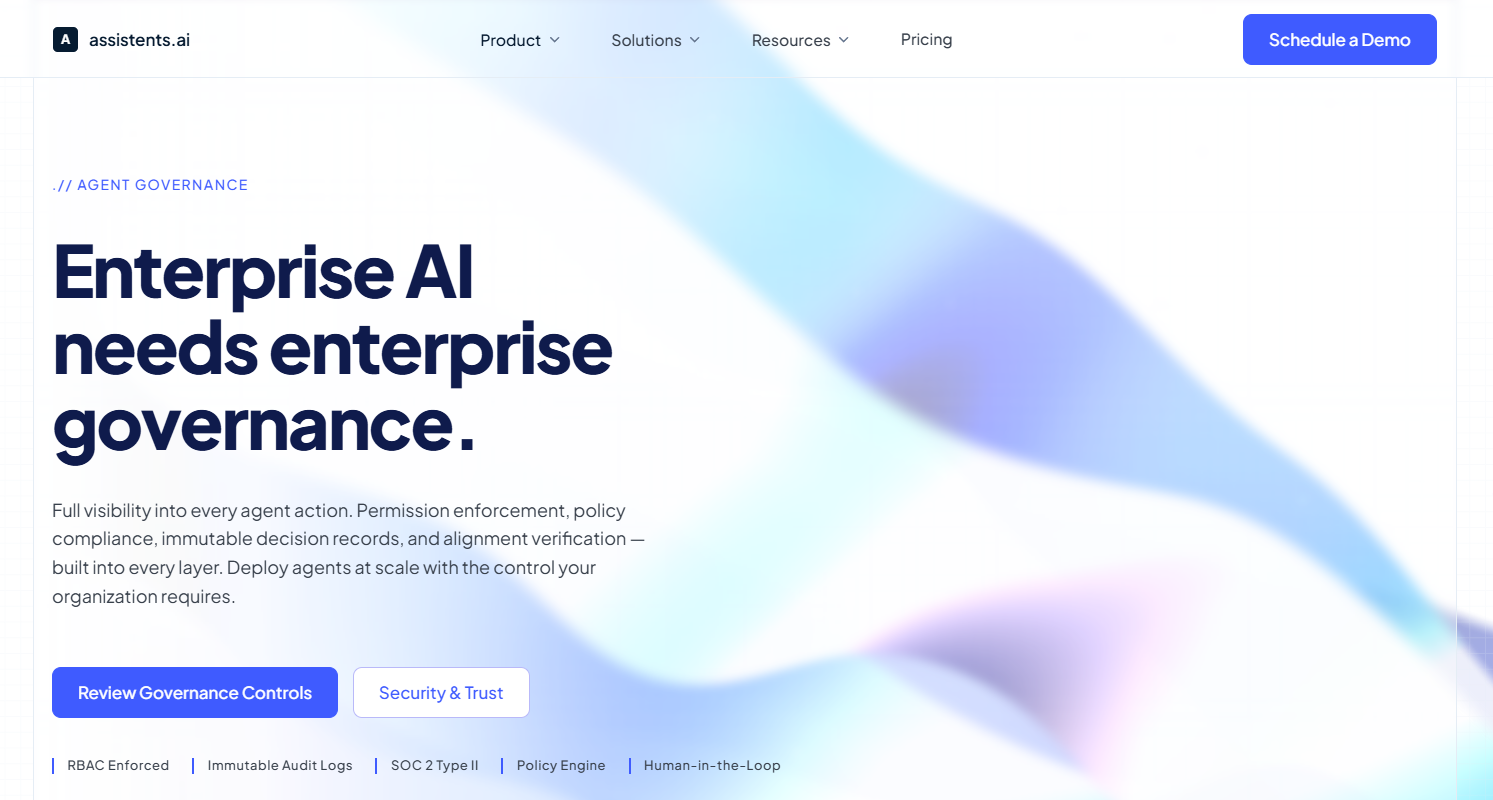
assistents.ai's governance layer maintains complete audit logs of every agent action, with rules-based exception routing that sends edge cases to human reviewers rather than executing autonomously. This architecture is not bolted on after deployment — it is a core design principle of the platform. Deployments across financial services, utilities, and real estate have specifically demonstrated this in regulated environments.
SOC 2, GDPR, HIPAA, ISO 27001 — What Compliance Looks Like
assistents.ai holds SOC 2, GDPR, HIPAA, and ISO 27001 compliance. This matters specifically for healthcare, financial services, and international deployments where data residency, handling, and processing requirements are non-negotiable. The platform has live deployments in healthcare staffing, banking, and cross-border finance — all sectors where compliance is a procurement gate, not a preference.
Why Governance Is Non-Negotiable for Agentic AI
A search platform that returns a wrong answer is annoying. An agentic platform that takes a wrong action can create financial exposure, compliance violations, or operational disruption. This is why governance architecture — not just governance claims — needs to be evaluated before deployment. The right question to ask any agentic AI vendor is: "Show me your audit trail from a production deployment." If they cannot, governance is not a feature — it is a marketing claim.
Glean Alternative for Enterprise — Who Should Consider assistents.ai
Glean is an appropriate choice if your primary need is: centralised enterprise search across fragmented content systems, knowledge retrieval for employee self-service, and chat-based Q&A over internal documentation. If that is the scope, Glean is a mature, well-supported product.
assistents.ai is the right evaluation if your primary need is one or more of the following:
Workflow execution across live systems. If you need AI to create records, update databases, route approvals, and close process loops — not just find information — you need an agentic architecture.
Voice AI for frontline operations. If your use case involves field teams, retail store staff, or multilingual workforces who need to interact with enterprise systems through voice, assistents.ai has deployed this capability in production.
Multi-system orchestration. If your workflow crosses more than one enterprise system — for example, a procurement event that touches a supplier portal, an ERP, an approval workflow, and a communication system — you need an orchestration layer that Glean's architecture does not provide.
Governance-grade agentic AI. If your industry requires documented, auditable AI decision-making — financial services, healthcare, utilities, legal — the governance architecture is a procurement requirement, not a preference.
Faster deployment timelines. If your business case has a defined go-live date that a 12-week deployment cannot accommodate, the 4-week deployment model is a functional differentiator.
Pricing Model Comparison
Glean operates on an enterprise licensing model. Pricing is not publicly listed and is negotiated based on seat count, content volume, and integration scope. Total cost of ownership tends to reflect the scale of indexing infrastructure required.
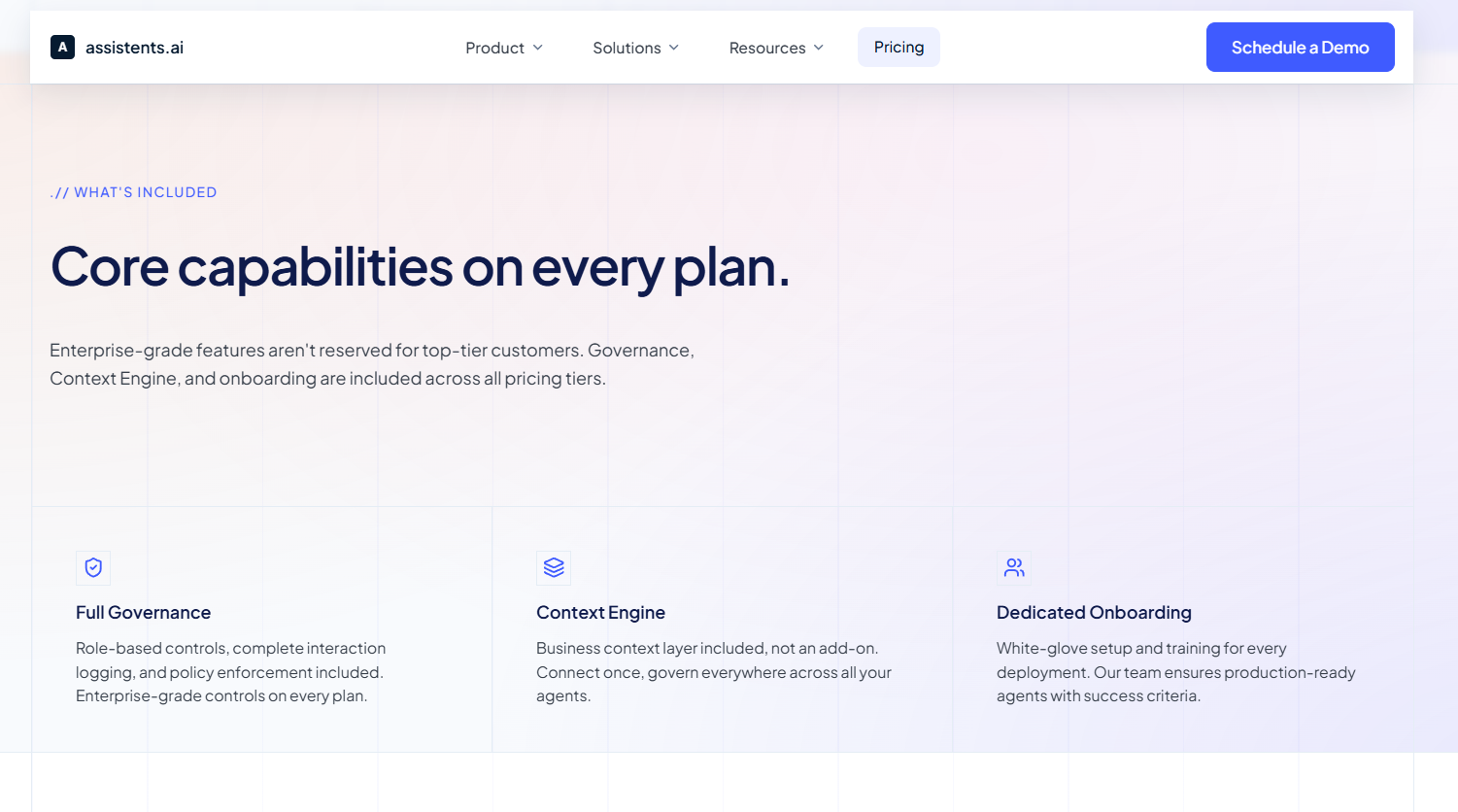
assistents.ai pricing is engagement-based and scoped to deployment complexity, integration breadth, and agent volume. As with most enterprise agentic AI platforms, pricing is available through a direct conversation with the team. The relevant ROI framing is not cost per seat but cost per workflow automated — a metric that tends to favour agentic platforms over search platforms when the use case involves high-volume, repeatable process execution.
For organisations evaluating budget, the more useful comparison is not licence cost but the operational cost of the workflows the platform eliminates — manual document processing, human-in-the-loop customer support, manual SAP order entry, manual competitive monitoring, and others — against platform cost. Deployments across logistics, retail, and financial services have demonstrated measurable reductions in manual operational overhead within the first quarter of production use.
How to Choose the Right AI Agent Platform for Your Enterprise
Use this decision framework when finalising your evaluation.
If your primary need is finding information faster → Evaluate Glean. It is purpose-built for knowledge retrieval and has a mature product in that category.
If your primary need is automating workflows across systems → Evaluate agentic-first platforms. assistents.ai has production deployments across 12 industries demonstrating this capability.
If you need both → Start with agentic. A well-architected agentic platform can surface information as part of a workflow. A search platform cannot execute workflows as an extension of search.
If governance is a procurement gate → Require a live audit trail demonstration from any agentic vendor before shortlisting. Compliance claims without deployment evidence are not sufficient for regulated industries.
If deployment speed matters → Map your go-live requirement against each vendor's realistic timeline. A 4-week deployment model and a 12-week deployment model produce materially different business outcomes if your use case is time-sensitive.
If you are in a highly specialised industry — logistics, healthcare, financial services, energy, real estate — check whether the vendor has a production deployment in your sector. Generic AI platforms that have not operated in your compliance and workflow environment carry higher implementation risk.
The Verdict — assistents.ai vs Glean for Enterprise AI in 2026
Glean is a mature, well-funded product doing one thing well: enterprise search. If that is your primary requirement, it is a legitimate shortlist candidate.
If your requirement is AI that acts — that processes your documents, updates your ERP, monitors your operations, supports your customers, and closes your workflows — you are evaluating a different category of platform. assistents.ai has production deployments across 12 industries demonstrating exactly that capability, with a 4-week deployment model, 300+ integrations, and governance architecture built for regulated enterprise environments.
The market is moving fast. Gartner projects that 40% of enterprise applications will feature embedded AI agents by the end of 2026. The enterprises that deploy agentic AI now — not search AI positioned as agentic AI — will build the operational advantage that compounds over the next three years.
Ready to see how assistents.ai fits your specific workflow? Book a demo or see the full platform comparison with Glean.
Frequently Asked Questions
What is the best agentic AI platform for enterprises in 2026?
The best agentic AI platform for enterprise in 2026 is one that combines multi-step workflow execution, a broad integration ecosystem covering your live enterprise systems, governance-grade audit trails, and a deployment timeline that fits your operational planning cycle. assistents.ai has demonstrated this combination across deployments in financial services, logistics, retail, healthcare, energy, and real estate. The right platform depends on your specific workflow requirements — a platform optimised for knowledge search and one optimised for workflow execution are fundamentally different products.
What is the difference between agentic AI and search AI?
Search AI — like Glean — retrieves and surfaces information in response to a query. Agentic AI goes further: it takes action across connected systems in response to a trigger or instruction. An agentic AI platform can process a document, update a CRM record, create a purchase order, send a notification, and log every action for audit — without human intervention at each step. Search AI terminates at the answer. Agentic AI terminates at the completed task.
What are examples of agentic AI tools for enterprise?
Enterprise agentic AI tools include platforms that automate end-to-end workflows: document processing agents that ingest, extract, and route tender documents; omnichannel customer service agents that handle queries across chat, email, and phone without human handoff; inventory intelligence agents that provide real-time stock and pricing visibility across store networks; and financial monitoring agents that alert teams to margin erosion, vendor performance issues, and cashflow risks before they escalate. assistents.ai has deployed all of these in production environments.
Is there a free agentic AI platform for enterprise use?
There are no enterprise-grade agentic AI platforms that operate on a free tier for production use cases. Open-source frameworks like LangChain and CrewAI allow developers to build agentic systems but require significant engineering investment to reach production quality, governance standards, and integration depth. For enterprises evaluating cost, the relevant question is not whether a free option exists but what the cost of not automating the target workflow is — measured in manual labour, error rates, and operational delay.
How does assistents.ai compare to Glean for business operations?
For business operations that require finding information, both platforms have relevant capability. For business operations that require executing workflows — processing documents, updating systems, routing approvals, monitoring operations, and closing process loops — assistents.ai is the appropriate category of platform. Glean does not have a native execution layer. assistents.ai has demonstrated workflow execution across procurement, logistics, customer service, financial monitoring, and HR operations in production environments.
What is agentic AI platform architecture?
Agentic AI platform architecture refers to the underlying design of how an AI system plans and executes multi-step tasks. A well-architected agentic platform includes: specialised agents for different task domains, an orchestration layer that coordinates those agents, an integration layer that connects to live enterprise systems with read and write access, a governance layer that enforces business rules and maintains audit trails, and a human-in-the-loop mechanism for exceptions. This is distinct from a search architecture, which is designed to retrieve and rank information rather than act on it.
Which AI agent platform is best for research workflows?
For research-intensive workflows — competitive intelligence, market monitoring, regulatory tracking, and financial research — an agentic AI platform that can continuously ingest signals, process them against defined criteria, and surface structured outputs on demand outperforms a search platform that only responds to active queries. assistents.ai has deployed competitive monitoring agents, stock market research automation, and tax research automation in production — covering source retrieval, summarisation, and insight generation with citations.
How long does it take to deploy an enterprise AI agent platform?
Deployment timelines vary significantly by platform and use case complexity. assistents.ai is designed for a 4-week deployment cycle to production. Glean's typical deployment timeline is 8–12 weeks. For enterprises with a defined go-live requirement or a time-sensitive business case, the deployment timeline should be treated as a functional requirement, not a vendor preference.

Transform Your Business With Agentic Automation
Agentic automation is the rising star posied to overtake RPA and bring about a new wave of intelligent automation. Explore the core concepts of agentic automation, how it works, real-life examples and strategies for a successful implementation in this ebook.
Sarfraz Nawaz is the CEO and founder of Ampcome, which is at the forefront of Artificial Intelligence (AI) Development. Nawaz's passion for technology is matched by his commitment to creating solutions that drive real-world results. Under his leadership, Ampcome's team of talented engineers and developers craft innovative IT solutions that empower businesses to thrive in the ever-evolving technological landscape.Ampcome's success is a testament to Nawaz's dedication to excellence and his unwavering belief in the transformative power of technology.

More insights
Discover the latest trends, best practices, and expert opinions that can reshape your perspective


.webp)

.jpg)

.jpg)
Contact us

