
Death of the Dashboard: Why 2026 Is the Year of No-UI Analytics


The status quo of enterprise data is a graveyard of unused tabs. For two decades, we’ve been told that the "Future of Business Intelligence" was just a prettier chart or a faster load time. We were promised clarity; we got a part-time job as data hunters.
In 2026, the paradigm is shifting. We are entering the post-dashboard era. The era of no-UI analytics and agentic workflows is here, and it’s not just an upgrade—it’s a replacement of the fundamental way businesses consume information.
What is the future of business intelligence?
The future of business intelligence is moving beyond dashboards toward no-UI analytics, where AI agents proactively detect issues, make decisions, and trigger actions. Instead of humans hunting for insights in dashboards, intelligent systems deliver outcomes automatically through governed, agentic workflows.
Why Dashboards Became the Center of Business Intelligence
Dashboards were a solution to the "black hole" of database tables. By aggregating metrics into visual layouts, they allowed leaders to see the "health" of their business at a glance. They became the central nervous system of the enterprise because they were the only way to make big data digestible for human eyes.
A Short History of BI: Reports → Dashboards → Agents
The evolution of data consumption follows a clear trajectory of reducing the distance between data and action.
The Reporting Era (Past)
In the early 2000s, BI was synonymous with static PDFs. A report was generated on Monday, read on Wednesday, and acted upon (maybe) by Friday. It was high-latency and purely retrospective.
The Dashboard Era (Present)
The 2010s brought interactivity. We could filter, drill down, and slice data. However, the burden remained on the human: you had to log in, you had to look, and you had to interpret what the "red" bar actually meant.
The Agentic Era (Future/Now)
As we move through 2026, we have entered the era of agentic execution. Here, the system doesn't wait for a human to log in. It monitors data streams, understands context, and executes workflows autonomously. The UI is no longer a destination; it’s an exception-handling interface.
The Fundamental Flaw: The 80% Blind Spot
The most dangerous problem with traditional dashboards is that they are "flying blind".
- The 20%: Traditional BI is great at structured data—ERP tables, CRM fields, and transaction logs.
- The 80%: The "real business truth" lives in unstructured data—PDF contracts, email threads, Slack conversations, and meeting notes.
By acting on only 20% of the facts, a dashboard doesn't provide an asset; it provides a liability with a confidence score.
Why Dashboards Don’t Scale
Dashboards require a "Human-in-the-Loop" for even the most basic cognitive tasks. This creates latency. In a world of high-frequency commerce, waiting for a human to notice an error on a chart is a competitive failure. Agents multiply what exists: if they lack the full context of unstructured data, they simply multiply chaos faster than humans can intervene.
What Is No-UI Analytics?
No-UI analytics refers to analytics systems where insights and actions are delivered automatically through AI agents and workflows, without requiring humans to interact with dashboards or reports.
In this model, the "interface" is an API call, a Slack notification, or a direct write-back to a system like SAP or Salesforce.
From Insight Hunting to Outcome Delivery: The Fusion Advantage
The shift to No-UI is powered by Contextual Fusion.
- Internal Data: Fusing structured ERP data with the context of unstructured PDF contracts and emails.
- External Data: Integrating third-party signals like competitor pricing, macroeconomics, and weather to complete the picture.
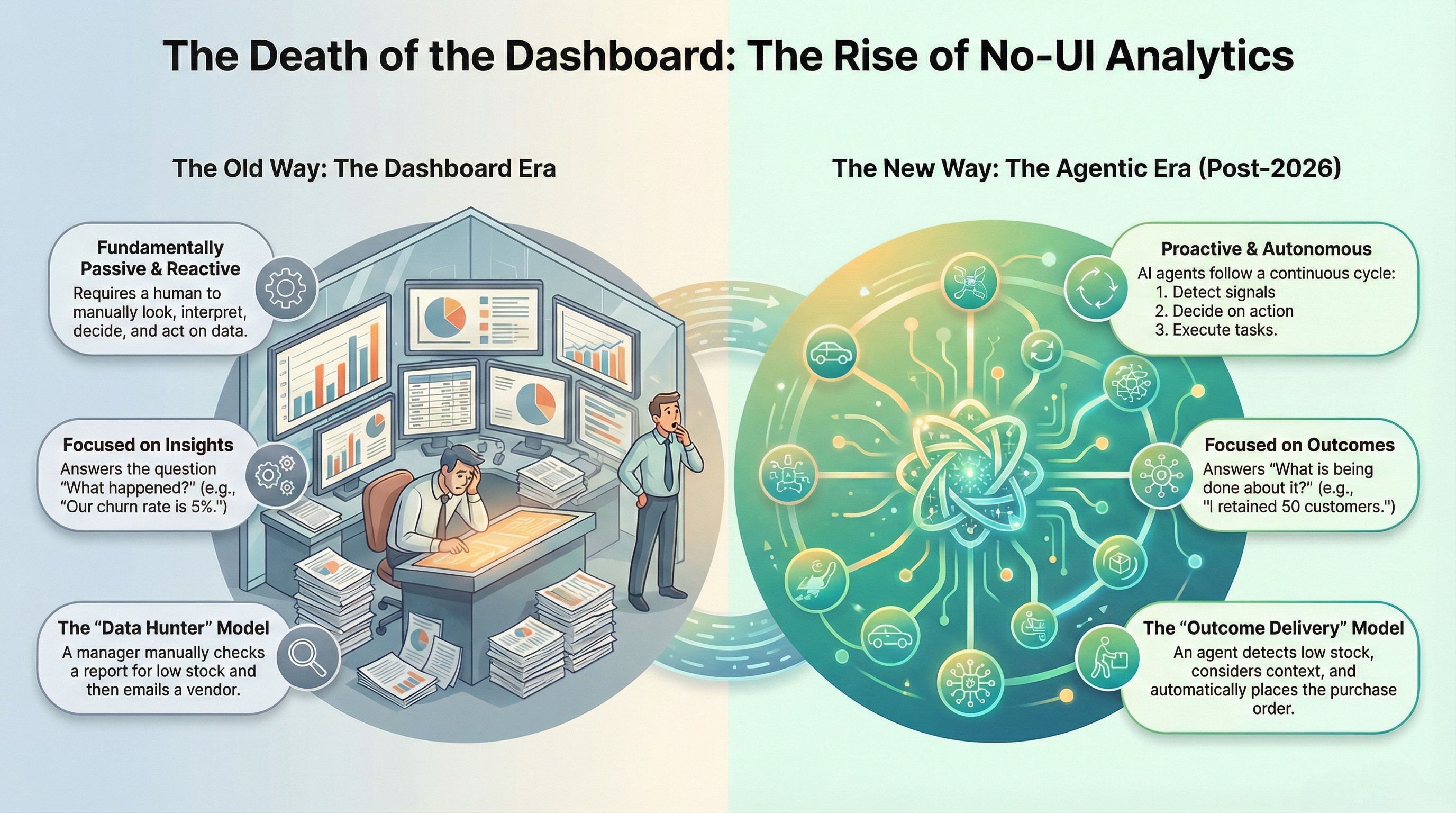
How Agentic Workflows Replace Dashboards
The Agentic Workflow Engine follows a three-step cycle to replace the manual dashboard loop:
1. Detect
AI agents monitor metrics, events, and logs for specific signals—not just outliers, but complex patterns across all data types.
2. Decide
The system uses Semantic Governance to evaluate options. This is deterministic logic, not probabilistic guesses, ensuring every decision is policy-cited and auditable.
3. Execute
The engine triggers multi-step workflows across systems like Procurement, Support, or Ads.
The Bottom Line: Minutes, Not Weeks
The transition from dashboards to agentic intelligence isn't an efficiency gap; it's a competitive chasm.
- Before: 6 weeks from signal to result with endless meetings.
- After: Hours—or minutes—from signal to autonomous execution.
In 2026, the goal isn't to give your team a better view of the problem. The goal is to solve the problem before they even have to look.
Frequently Asked Questions
1. Does "No-UI" mean we will never use a chart or graph again?
Not exactly. The "No-UI" philosophy argues that the primary interface for business operations should be automated actions and agentic workflows. Humans will still use visualizations for deep-dive research, post-mortem audits, or high-level strategic planning. However, the day-to-day tactical "monitoring" of a dashboard is what disappears.
2. How do we ensure AI agents don’t make catastrophic mistakes?
The shift to the future of business intelligence requires a "Guardrail-First" architecture. Instead of giving agents total autonomy, enterprises implement governed agentic workflows. This involves setting thresholds where an agent can act independently (e.g., reordering low-cost inventory) versus where it must pause for human "one-click" approval (e.g., changing a million-dollar contract).
3. Is No-UI analytics the same as "Automated Alerts"?
No. Standard alerts are just "noisy" dashboards that follow you into your inbox; they still require you to log in and do the work. No-UI analytics uses AI-driven decision making to not only identify the alert but also propose the specific remedy and, in many cases, execute the response across your software stack.
4. What happens to the role of the Data Analyst?
The role evolves from a "report builder" to a "workflow architect." Instead of spending 40 hours a week cleaning data for a weekly slide deck, analysts will define the logic, business rules, and data schemas that fuel AI agents. They become the creators of the "brain" rather than the creators of the "view."
5. How do legacy BI tools fit into this new era?
Most legacy vendors are currently attempting to "bolt-on" AI by adding sidebars or natural language query boxes. While helpful, these are still UI-centric. True no-UI analytics usually requires a headless data layer where the "output" is a trigger or a data-write-back, rather than a visual rendering.

Transform Your Business With Agentic Automation
Agentic automation is the rising star posied to overtake RPA and bring about a new wave of intelligent automation. Explore the core concepts of agentic automation, how it works, real-life examples and strategies for a successful implementation in this ebook.
Sarfraz Nawaz is the CEO and founder of Ampcome, which is at the forefront of Artificial Intelligence (AI) Development. Nawaz's passion for technology is matched by his commitment to creating solutions that drive real-world results. Under his leadership, Ampcome's team of talented engineers and developers craft innovative IT solutions that empower businesses to thrive in the ever-evolving technological landscape.Ampcome's success is a testament to Nawaz's dedication to excellence and his unwavering belief in the transformative power of technology.

More insights
Discover the latest trends, best practices, and expert opinions that can reshape your perspective







Contact us

