
Agentic AI for Fintech and Business Applications: 20+ Production Use Cases, Architecture, and Adoption Roadmap (2026)


Agentic AI for fintech and business applications refers to AI systems that don't just analyze data or answer questions — they plan, decide, and act across financial and operational workflows, all within governance controls like human-in-the-loop approvals, row-level security, and immutable audit trails.
Unlike chatbots that wait for prompts, agentic systems monitor cashflow, screen transactions, process tender documents, create ERP sales orders, and resolve customer queries end to end. This guide covers 20+ real production deployments — not hypotheticals — across fintech, retail, logistics, real estate, energy, and healthcare, plus the architecture and adoption roadmap that make agentic AI safe for regulated environments.
If you're a fintech founder, CTO, CFO, or enterprise operations leader evaluating where agentic AI actually delivers value in 2026, this is the guide.
What Is Agentic AI? (And Why Fintech Is Its Proving Ground)
Agentic AI is a class of AI systems built to pursue goals through autonomous, multi-step action. An agentic system perceives its environment (data, documents, events, conversations), reasons about what needs to happen, plans a sequence of steps, calls tools and APIs to execute those steps, and verifies the outcome — escalating to a human when confidence is low or stakes are high.
That last clause matters more than any other in this definition. In fintech and enterprise operations, the winning pattern in 2026 is not "AI without humans." It is AI that does 95% of the work autonomously and routes the remaining 5% — the exceptions, the edge cases, the high-value judgment calls — to the right human at the right moment, with full context attached.
Agentic AI vs. Generative AI vs. Traditional Automation
The fastest way to understand agentic AI is to compare it with what came before:
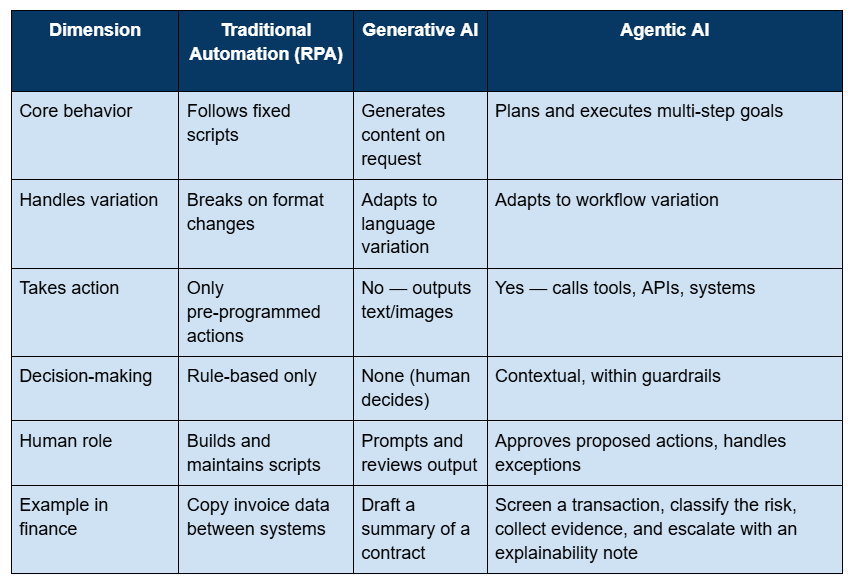
Traditional automation is rigid: it executes exactly what it was scripted to do and fails when reality deviates. Generative AI is flexible but passive: it produces text, summaries, and drafts, then waits for a human to decide what to do next. Agentic AI closes the loop — it interprets a trigger, decides on a course of action, executes it across systems, and logs every step.
If you want a deeper breakdown of this distinction, read our guide on the difference between an AI assistant and an AI agent.
Why Regulated, Data-Heavy Industries Adopt Agents First
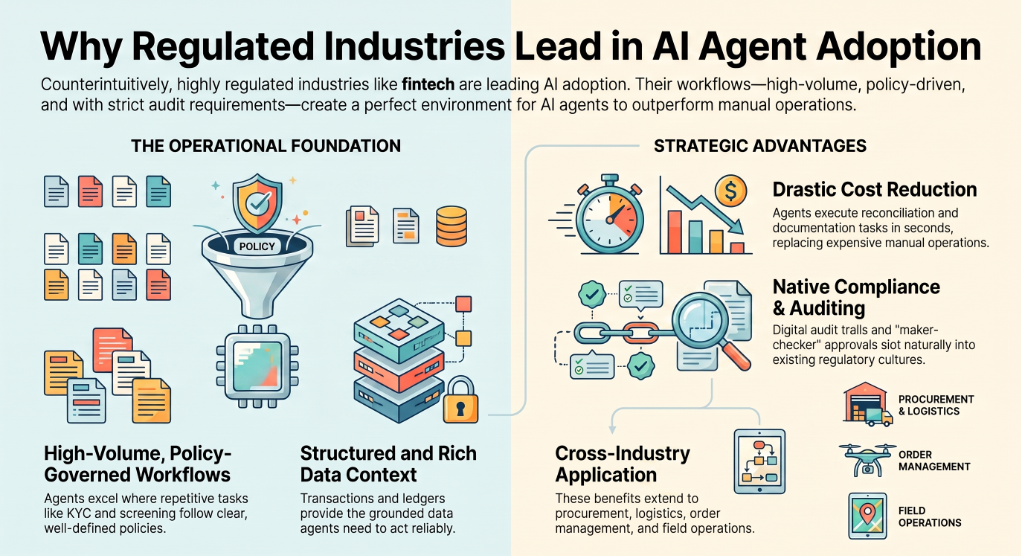
It might seem counterintuitive that fintech — one of the most regulated industries on earth — is leading agentic AI adoption. But the logic is straightforward:
- The workflows are high-volume and well-defined. Dispute intake, transaction screening, KYC checks, invoice processing, and portfolio monitoring run thousands of times a day against clear policies. These are exactly the conditions where agents outperform humans on speed and consistency.
- The cost of manual operations is enormous. Compliance and operations teams at financial institutions spend the majority of their time on repetitive investigation, documentation, and reconciliation work that agents can execute in seconds.
- The audit requirements already exist. Financial firms are used to logging, evidencing, and explaining every decision. Agentic platforms built with audit trails and maker-checker approvals slot into this culture naturally — arguably better than undocumented human judgment ever did.
- The data is structured and rich. Transactions, ledgers, portfolios, and customer records give agents the grounded, queryable context they need to act reliably.
The same logic extends beyond fintech to any business function with high-volume, policy-governed, cross-system workflows — procurement, order management, customer support, logistics, and field operations. That's why this guide covers both.
Why 2026 Is the Inflection Point for Agentic AI
Three shifts converged to make 2026 the year agentic AI moved from pilots to production.
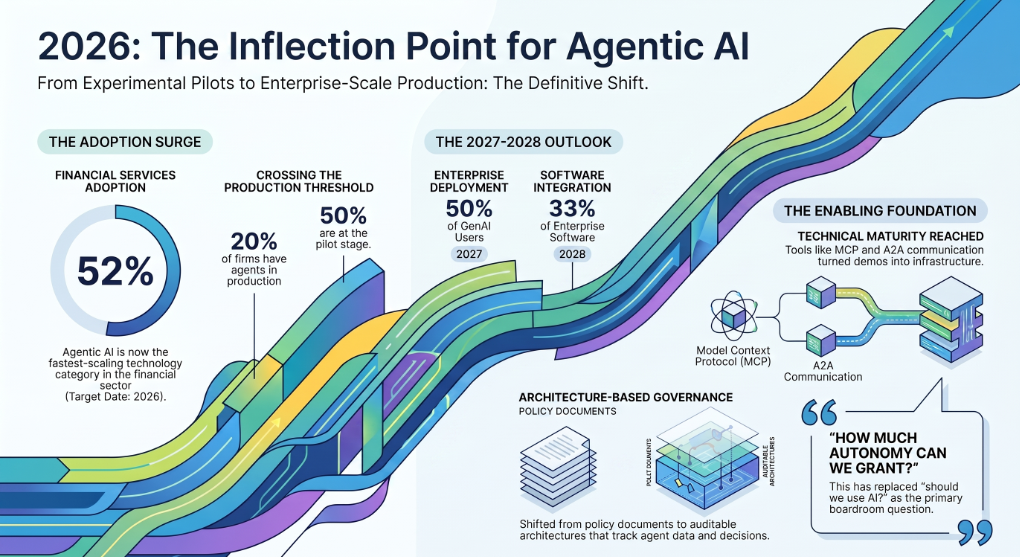
Adoption crossed the majority line. A 2026 Cambridge Centre for Alternative Finance survey found that 71% of financial services respondents are adopting generative AI, and 52% are actively adopting agentic AI — making it the fastest-scaling technology category in the sector. Roughly a fifth of financial services firms already have AI agents running in production, with half at pilot or more advanced stages. Deloitte projects that by 2027, half of all companies using generative AI will have deployed enterprise AI agents. Gartner-cited industry analysis suggests a third of enterprise software will include agentic AI capabilities by 2028.
The technology matured. Multi-agent orchestration, standardized tool protocols like MCP (Model Context Protocol) and A2A (agent-to-agent communication), streaming tool-calling, and reliable structured extraction turned agents from demos into dependable infrastructure.
Governance frameworks caught up. Early agentic pilots stalled for one dominant reason: enterprises couldn't answer basic control questions. Who approved this action? What data did the agent see? Can we replay the decision for an auditor? Platforms that answered these questions with architecture — not policy documents — are the ones now running in production. This governance gap is the single biggest divider between organizations scaling agentic AI and organizations stuck in pilot purgatory, and we'll return to it in the architecture section.
The practical takeaway: the question in boardrooms has changed from "should we use AI agents?" to "how much autonomy can we grant without compromising trust?" The rest of this guide answers that question with evidence.
Agentic AI Use Cases in Fintech (With Production Results)
Every use case below is drawn from a real production or advanced deployment. Client names are withheld; each is described by industry, geography, and scale. These are not thought experiments — they are running systems with measured outcomes.
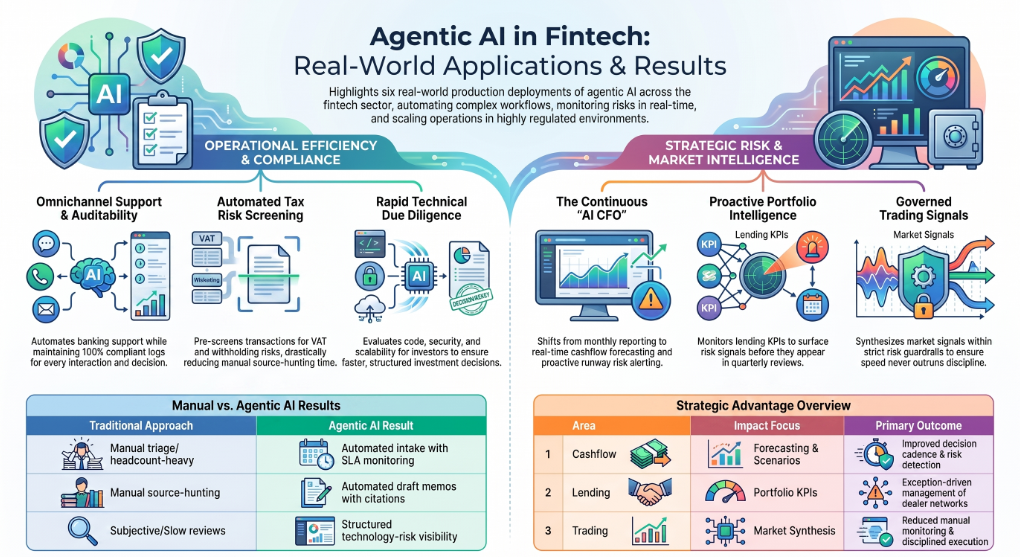
1. Omnichannel Banking and Credit Union Support With Auditable Workflows
The pattern: AI agents handle member and customer support across chat, email, and phone — triaging intake, resolving routine queries, summarizing cases for human agents, and routing exceptions — with every step logged for compliance review.
In production: A global fintech provider serving banks and credit unions — focused on disputes, fraud, and compliance operations — deployed omnichannel AI agents with agent-assist summarization, next-best-action recommendations, and SLA monitoring, all integration-ready with core banking systems.
Results: Faster case handling with improved consistency, reduced operational load through automation, and stronger compliance readiness through end-to-end audit trails.
This is the archetypal fintech agentic deployment: high volume, regulated, omnichannel, and impossible to scale with headcount alone. Credit unions in particular face the same compliance demands as large banks with far leaner teams — agentic support is how they close that gap.
2. The AI CFO: Continuous Cashflow Monitoring, Forecasting, and Scenario Planning
The pattern: Instead of monthly reporting cycles, finance agents connect to accounting and banking data, continuously monitor cash position, forecast forward, run scenarios, and proactively alert leadership to runway risks — with recommended actions attached.
In production: An AI CFO platform for growing businesses and advisors deployed forecast and scenario-modelling agents on top of a financial data connection layer, with runway and cash-risk alerting and portfolio views for advisors managing multiple clients.
Results: Faster analysis cycles and improved decision cadence, earlier detection of cash risks and anomalies, and scalable advisory-grade insight without added headcount.
For a deeper look at this category, see our guide on AI solutions for CFOs.
3. Lending and Leasing Portfolio Intelligence
The pattern: Agents monitor portfolio KPIs — risk, delinquency, maturity profiles, residual values — across dealer and partner networks, surfacing exceptions and early risk signals instead of waiting for quarterly reviews.
In production: An independent North American automotive leasing provider deployed portfolio and dealer-network analytics with automated exception alerts and early risk-signal detection.
Results: Better portfolio visibility, faster risk identification, and a shift toward proactive, exception-driven portfolio management.
4. Trading and Market Intelligence Agents With Guardrails
The pattern: Agents ingest market data, run indicator and pattern analysis, simulate strategies, and produce recommendations — inside explicit risk guardrails and governed workflows, so speed never outruns discipline.
In production: An AI-first trading terminal built around a network of specialized agents combined research, analysis, signals, and execution-ready workflows with strategy simulation and risk guardrails. Separately, a market research platform specializing in technical analysis automated its data ingestion, indicator pipelines, and research insight generation.
Results: Faster synthesis of fragmented market signals, more disciplined decision-making through governed workflows, faster production of market insight packs, and significantly reduced manual monitoring effort.
The guardrails are the story here. Autonomous market analysis is valuable; autonomous market analysis inside rule-governed boundaries with human oversight is deployable.
5. Cross-Border Tax Risk Screening and Tax Research Automation
The pattern: Agents pre-screen transactions for cross-border risks — withholding tax, VAT mismatches, permanent establishment exposure — collect supporting evidence, generate explainability notes, and escalate flagged cases to human tax experts. On the research side, agents automate source retrieval, summarization, and draft memo generation with citations.
In production: A UK-based tax-tech product deployed transaction screening workflows with risk classification, evidence collection, and expert escalation. A US-based sales and use tax research automation tool deployed automated source collection, summarization, and draft position output with workflow tracking.
Results: Earlier detection of withholding and VAT risk, fewer last-minute deal disruptions, faster and more consistent pre-compliance review, dramatically reduced manual source-hunting time, and better documentation hygiene.
6. Technical Due Diligence for Fintech Investment Decisions
The pattern: For investors and acquirers evaluating fintech targets, agent-assisted diligence covers code and architecture review, infrastructure and security assessment, scalability analysis, and a structured risk register with a remediation roadmap.
In production: A long-term holding company partnering with founders and family businesses used this approach for technical due diligence on a mobile banking platform.
Results: Faster investment decisions with clear, structured technology-risk visibility, reduced post-deal surprises through remediation planning, and improved confidence in scalability and security posture.
Agentic AI Business Applications Beyond Fintech
The same agentic patterns — monitor, decide, act, verify, escalate — apply anywhere a business runs high-volume, policy-governed workflows across disconnected systems. This is where "agentic AI for business applications" stops being a fintech story and becomes an enterprise operating model. Every deployment below is real and anonymized.
7. Finance and Procurement Intelligence Across Group Entities
The pattern: Agents standardize KPIs across group companies and continuously monitor purchase price trends, gross margin impact, early-payment economics, and vendor performance (delivery reliability, return rates) — pushing scheduled insight packs and exception alerts to leadership instead of waiting for month-end.
In production: One of the Middle East's most prominent family business groups — 30+ companies across retail, building, industrial, and services portfolios — deployed automated procurement and finance KPI alerting across its entities for margin control and working-capital optimization.
Results: Earlier detection of margin erosion and vendor slippage, standardized finance and procurement intelligence across entities, and fewer variance surprises through continuous monitoring.
8. Sales Order Automation and ERP Workflow Modernization
The pattern: Agents interpret incoming order triggers, validate them against business rules, and create sales orders directly in the ERP — with governance for exceptions and approvals, audit logs, and reconciliation reporting. This pattern is especially powerful when replacing end-of-life legacy middleware with high licensing costs.
In production: A flagship UAE engineering and technology solutions provider, established in the 1970s, deployed agentic automation to create SAP sales orders as part of its transition away from a legacy OpenText-based workflow facing end-of-life and high licensing costs.
Results: Reduced manual order processing and legacy dependency, a faster order-to-confirmation cycle with fewer data-entry errors, and improved auditability for sales order creation and exceptions.
This use case deserves attention from any CIO staring down a legacy renewal invoice: agentic replacement of aging middleware is one of the highest-ROI, most bounded agentic projects available in 2026.
9. Customer Service Agents for Real Estate and Tenant Support
The pattern: An omnichannel service agent (web, WhatsApp, email-ready) triages tenant queries, answers policy and tenancy questions from a governed knowledge base, handles rental and payment support workflows, and escalates to human teams through integrated ticketing.
In production: A major UAE real estate portfolio owner and manager — with diversified office, retail, industrial, and residential assets across multiple emirates — deployed an end-to-end customer service agent for tenant and customer support.
Results: Faster response times and lower call-centre load, a consistent 24×7 tenant experience, and better SLA adherence through automated routing and tracking.
10. Retail Operations Agents at National Scale
The pattern: In large store networks, agents take over three chronic drains on operations: store support (voice agents handling helpdesk queries in local languages), inventory intelligence (per-store pricing, stock, and promotion answers), and knowledge access (retrieval over POS manuals and SOPs for on-demand staff training).
In production: A rapidly scaling value retailer in India — 700+ stores across hundreds of cities — deployed enterprise AI agents including a Hindi- and English-speaking voice support agent, an inventory intelligence agent, and a RAG-based knowledge and training agent, with an admin console and ticketing integration built for national scale.
Results: Reduced manual helpdesk burden, faster store issue resolution, improved store-level inventory visibility, and faster staff onboarding via on-demand training guidance.
11. Competitive Monitoring Agents for Price-Sensitive Markets
The pattern: Agents continuously monitor e-commerce channels and competitor portals — pricing, discounts, offers, availability, ratings — and convert market signals into instant answers to leadership questions and proactive alerts on pricing gaps and promo shifts.
In production: A major Indian HVAC and refrigeration player, founded in the 1940s and competing in highly price-sensitive consumer markets, ran a full implementation of AI agents for competitive monitoring, scaled from proof-of-concept to production with governance and audit trails.
Results: Faster competitive response cycles, earlier identification of pricing gaps and promotional shifts, and always-on monitoring replacing manual checks across portals.
12. Ports, Terminals, and Supply Chain Operations
The pattern: Agentic analytics and workflow digitization across terminal and inland logistics — yard and rail operational dashboards, scheduling visibility, exception management, and executive alerting.
In production: A global ports and logistics leader with record revenue in the tens of billions deployed a terminal and rail management solution to digitize and optimize port-to-inland operations. Separately, an Indian multinational logistics and warehousing company consolidated analytics across its multi-entity global operations.
Results: Higher predictability of terminal-to-rail throughput, more efficient coordination across terminal and inland logistics, a single operational view across entities, and faster leadership reporting.
13. Document Intelligence for Tender and Bid Workflows
The pattern: A multi-agent document workbench ingests complex tender documents, determines the correct workflow, analyzes revisions between versions, extracts structured data from difficult PDFs using vision-capable models, and syncs everything into core operational systems with full CRUD integration, quote locking, and audit logs.
In production: An Australian waterproofing diagnostics and commercial works specialist with 20+ years in remedial building services deployed autonomous agents to ingest, analyze, and synchronize tender documents into its operational systems.
Results: Engineered for up to ~90% faster tender document processing, a ~95% extraction accuracy target on standard formats, and reduced bid risk through revision detection and auditability.
Document-heavy workflows — tenders, invoices, claims, contracts — are among the most immediately monetizable agentic use cases in any industry, because the manual baseline is so slow and error-prone.
14. Insights-to-Action: Turning Dashboards Into Execution
The pattern: Most enterprises don't lack dashboards; they lack what happens after the dashboard. An agentic data analysis layer sits on top of existing BI, converts insights into governed, auditable actions and tasks, and tracks completion — closing the loop between "we saw it" and "we fixed it."
In production: A privately held retail holding environment deployed a unified context engine over structured and unstructured data, a semantic governance layer for rules and hierarchies, and insights-to-action agents layered on existing dashboards.
Results: A shift from reactive reporting to proactive execution loops, standardized decision logic across teams, and automated task creation with completion tracking.
15. Energy, Grid, and Infrastructure Monitoring
The pattern: Agents ingest utility and sensor data, detect anomalies, forecast consumption and load, and route alerts into operational workflows — turning infrastructure telemetry into proactive action.
In production: A premier Indian astrophysics research institute deployed AI for campus-scale energy monitoring and optimization. A state power transmission utility deployed transmission KPI monitoring, loss and outage analytics, and predictive maintenance indicators. A city-scale smart infrastructure operator — running 25+ smart city operation centres connecting millions of assets — deployed agentic analytics and automated operational alerting on top of smart utility systems.
Results: Improved energy visibility and faster detection of inefficiencies, faster identification of grid exceptions and operational risks, and more proactive operations through continuous monitoring.
16. Healthcare Staffing, Clinical Operations, and Service Platforms
The pattern: Agents run matching, scheduling, credential capture, and compliance workflows for healthcare staffing; revenue and utilization analytics for clinical enterprises; and booking-to-reporting orchestration for high-volume testing services.
In production: A US healthcare staffing platform connecting nursing professionals with facilities deployed agentic matching, scheduling, and compliance workflows. A physician-led hospitalist enterprise and a geriatric care provider in the northeastern US deployed revenue and operational analytics. A UK private healthcare and testing provider automated its booking-to-processing-to-reporting workflow.
Results: Faster fill cycles and lower scheduling friction, improved visibility into revenue leakage, faster identification of operational bottlenecks, and more scalable operations with reduced manual overhead.
17. Hospitality, Creator Economy, and Specialized Verticals
The agentic pattern keeps generalizing:
- A luxury safari hospitality brand operating 16 boutique lodges and camps across East Africa deployed a digital booking agent automating end-to-end luxury travel booking — email intake, intent classification, real-time inventory checks, alternative date negotiation, and hybrid handoff for curated itineraries — achieving faster booking turnaround and higher accuracy on complex guest requirements without compromising luxury service.
- A creator-economy platform automated influencer campaign operations, creator discovery enrichment, reporting, and brand-safety checks — reducing manual ops and delivering faster performance visibility.
- An AI-powered app for actors deployed a real-time voice agent as an always-available scene partner with character and pacing control — increasing rehearsal throughput without human readers, on a cost-controlled inference deployment.
- A global teacher community platform with over a million educators across 130+ countries deployed competency insights and automated support workflows at global scale.
- A pharma sourcing platform with thousands of rare excipients and SKUs automated RFQs, supplier matching, and procurement decision support — cutting procurement cycles and manual vendor follow-ups.
- A Dubai-based driving institute deployed funnel analytics from enrolment through lessons to tests, with instructor utilization and slot optimization — reducing scheduling bottlenecks.
- A brand insights studio founded by ex-Google leadership deployed multi-source insight agents producing themes, narratives, and campaign recommendations for marketing teams.
Across 30+ deployments spanning six continents' worth of markets, the pattern holds: wherever there is a high-volume workflow, clear policy, and fragmented systems, an agent under governance outperforms both manual operations and rigid automation.
For more deployment stories, see our roundup of AI agents in production examples.
The Architecture That Makes Agentic AI Safe for Regulated Workflows
Here is the uncomfortable truth most agentic AI content avoids: the majority of enterprise agent pilots never reach production, and the reason is almost never model quality. It's governance. When compliance asks "who approved this action, what data did the agent see, and can we replay the decision?" — most stacks have no answer.
The deployments in this guide reached production because the architecture answers those questions by design. These are the five pillars.
Grounded Answers: The Semantic Layer and Text-to-SQL
Agents that touch financial data cannot be allowed to guess. The solution is a semantic layer: a governed dictionary of your organization's metrics, definitions, hierarchies, and business rules. When someone asks "what was net revenue retention last quarter?", the agent doesn't hallucinate a number — it generates SQL against your semantic layer's definition of NRR, runs it on your warehouse, and returns the actual figure with full lineage.
This is the difference between an AI that sounds right and an AI that is right. No hallucinated numbers is not a slogan; it's an architectural property.
Maker-Checker: The AI Proposes, a Human Approves, the System Re-Verifies
Every write action — issuing a refund, creating a sales order, updating a CRM record, filing a workflow — follows a maker-checker model borrowed from banking operations:
- The agent (maker) analyzes the situation and proposes a specific action with its reasoning attached.
- A human (checker) reviews and approves, rejects, or modifies the proposal.
- The system re-validates the action server-side at execution time — permissions, business rules, data state — so even an approved action cannot execute if conditions changed.
This is human-in-the-loop done properly: not a human rubber-stamping everything (which doesn't scale), and not full autonomy on day one (which no regulator accepts), but calibrated approval gates that loosen as trust is earned.
Row-Level Security, ABAC, and the Immutable Audit Trail
Governance must operate at the data layer, not just the interface:
- Row-level security (RLS) ensures every agent query is automatically scoped to the rows the requesting user is entitled to see. A regional manager's agent sees that region's data — structurally, not by convention.
- Attribute-based access control (ABAC) governs access by user attributes, roles, and context, with field-level masking for sensitive columns.
- An immutable audit trail records every query, every proposed action, every approval, and every execution. When the auditor arrives, the answer to "show me what the AI did and why" is a report, not a research project.
Model-Agnostic Routing and BYOK
Enterprises should never be locked into one model vendor. A model-agnostic architecture routes each task to the best available model — OpenAI, Anthropic, Google, or others — and supports bring-your-own-key (BYOK), so your data flows through your own model accounts under your own agreements. When a better or cheaper model ships next quarter, you switch by configuration, not by re-platforming.
Multi-Agent Orchestration, MCP, and A2A
Real workflows span systems, so production deployments increasingly use networks of specialized agents — an intake agent, an analysis agent, an execution agent — coordinated by an orchestrator. Open protocols make this sustainable: MCP (Model Context Protocol) standardizes how agents connect to tools and data sources, and A2A enables structured agent-to-agent communication. Combined with governed connectors to warehouses and databases (Postgres, MSSQL, BigQuery, ClickHouse, Athena, DuckDB), this turns agentic AI from a point solution into an enterprise fabric.
For a full comparison of orchestration approaches, see our guide to agentic AI frameworks for enterprises.
The Adoption Roadmap: Ask → Execute → Autonomous
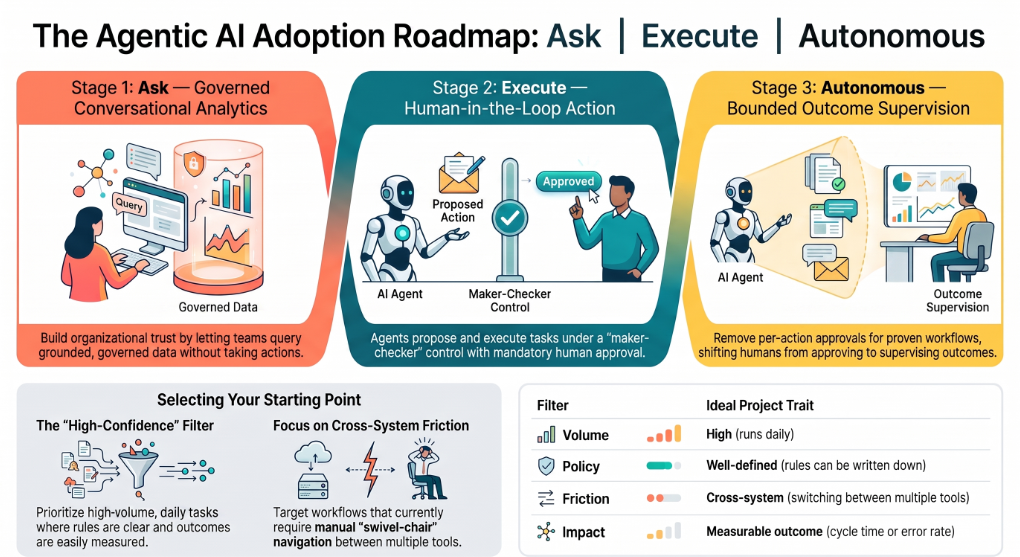
The organizations succeeding with agentic AI in 2026 share a common trait: they didn't attempt full autonomy on day one. They climbed a maturity ladder. We call it Ask → Execute → Autonomous.
Stage 1 — Ask: Governed Conversational Analytics
Start by letting teams talk to their own data. Natural-language questions, answered through the semantic layer with RLS enforced, replace the BI request queue. No actions yet — just grounded, governed answers.
Why start here: it delivers value in weeks, builds organizational trust in AI outputs, and forces you to do the data-governance work (metric definitions, access rules) that every later stage depends on.
Signal you're ready to advance: teams trust the numbers, usage is habitual, and people start asking "can it just do the follow-up task too?"
Stage 2 — Execute: Agents Act With Human Approval
Now agents propose and execute actions under maker-checker control. The tender-processing, sales-order-automation, and dispute-handling deployments in this guide live here. Every action has a human approval gate; every execution is audited.
Why this stage matters most: this is where the largest measurable ROI in this guide was generated — 90% faster document processing, order cycles compressed, case handling accelerated — all without granting unsupervised autonomy.
Signal you're ready to advance: for a specific workflow, approval rates are consistently near 100%, exceptions are rare and well-understood, and the human gate has become a formality on that workflow.
Stage 3 — Autonomous: Bounded Autonomy on Proven Workflows
For workflows that have earned it, remove the per-action approval and let agents run end to end — within explicit bounds: approved tools only, scoped permissions, spending and volume limits, anomaly monitoring, and automatic escalation when confidence drops. Humans move from approving actions to supervising outcomes.
Note what this stage is not: it is not autonomy across the board. It is autonomy per workflow, granted on evidence, revocable at any time.
Where to Start
Pick your first agentic project using four filters: high volume (runs daily), well-defined policy (a human can write down the rules), cross-system friction (the pain comes from swivel-chairing between tools), and measurable outcome (cycle time, error rate, cost per transaction). Document processing, support triage, KPI monitoring, and order workflows consistently pass all four. Judgment-heavy, low-volume, ambiguous work does not — leave it for later stages.
ROI: What Production Deployments Actually Deliver
Across the 30+ deployments referenced in this guide, results cluster into five repeatable themes:
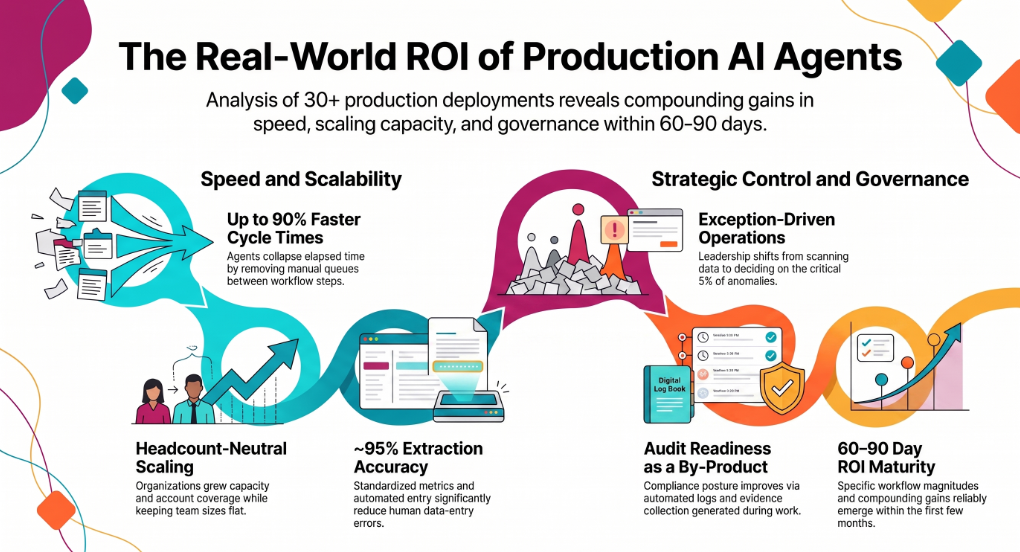
1. Cycle-time compression. Up to ~90% faster tender document processing. Faster order-to-confirmation cycles. Faster case handling. Faster booking turnaround. Faster research and analysis cycles. When agents remove the queue between steps, elapsed time collapses.
2. Exception-driven operations. Instead of humans reviewing everything to find the 5% that matters, agents monitor everything and surface only the exceptions — pricing gaps, margin erosion, cash risks, grid anomalies, delinquency signals. Leadership attention shifts from scanning to deciding.
3. Headcount-neutral scaling. The recurring phrase across deployments: "without added headcount." Advisory-grade financial insight, national-scale store support, higher account coverage, scalable educator support — capacity grew while teams stayed flat.
4. Audit readiness as a by-product. Because governed agents log everything, compliance posture improves as a side effect of automation — audit trails, evidence collection, explainability notes, and reconciliation reporting are generated in the normal course of work.
5. Accuracy and consistency gains. ~95% extraction accuracy targets on standard document formats, fewer data-entry errors, standardized metric definitions, and more consistent research and reporting outputs across teams.
A note on honest ROI: not every deployment produces a headline percentage, and any vendor promising universal "40% cost reduction" is selling, not reporting. The reliable pattern is directional and compounding — faster cycles, earlier detection, flat headcount, cleaner audits — with workflow-specific magnitudes that emerge in the first 60–90 days of production.
Risks of Agentic AI — and How Governance Answers Each One
Agentic AI introduces real risks. The right response is not caution paralysis; it's pairing each risk with a specific control.
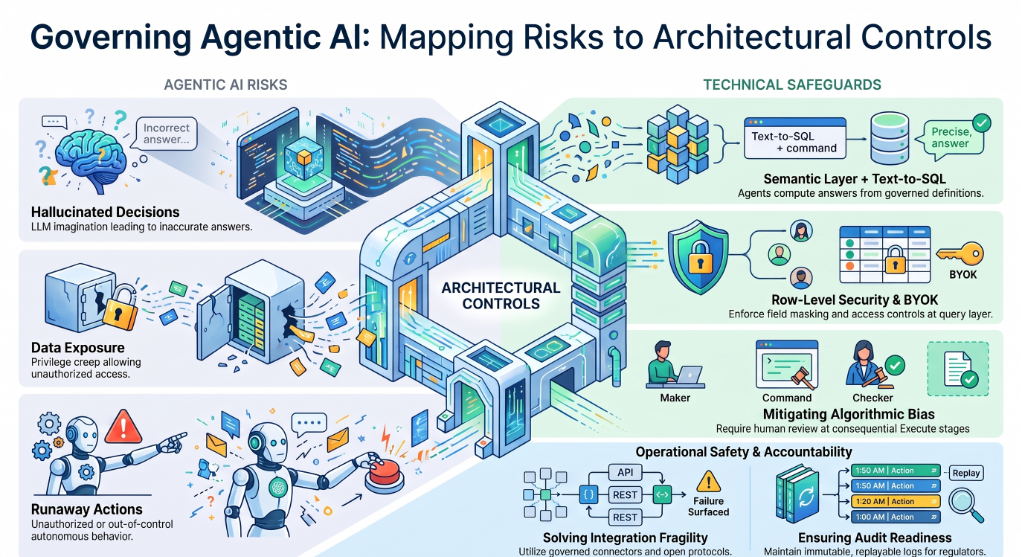
Risk: hallucinated or wrong numbers driving decisions. Control: the semantic layer + text-to-SQL architecture. Agents compute answers from governed definitions against real data — they don't generate figures from a language model's imagination.
Risk: runaway or unauthorized actions. Control: maker-checker approval gates, server-side re-validation at execution time, scoped permissions, and bounded autonomy granted per workflow — never globally.
Risk: data exposure and privilege creep. Control: row-level security and attribute-based access control enforced at the query layer, field-level masking for sensitive data, and BYOK so data flows under your own model agreements.
Risk: unexplainable decisions failing audit or regulatory review. Control: the immutable audit trail — every query, proposal, approval, and execution logged and replayable — plus explainability notes attached to risk classifications and escalations.
Risk: algorithmic bias in decisions affecting customers. Control: human review at consequential decision points (the Execute stage exists precisely for this), monitored outcomes, and the ability to audit decision patterns across the log rather than trusting individual outputs.
Risk: integration fragility across legacy systems. Control: governed connectors, orchestration through open protocols (MCP, A2A), and reconciliation reporting that surfaces sync failures instead of silently absorbing them.
The pattern: every question a risk officer asks has an architectural answer. If a platform answers with a policy PDF instead of an architecture diagram, keep looking.
Why Assistents.ai by Ampcome Is the Best Platform for Agentic AI in Fintech and Business Applications
Every architectural principle and adoption stage described in this guide isn't theory — it's how Assistents.ai, the governed enterprise agentic AI platform built by Ampcome, is designed and how the deployments above were delivered. Here's what sets it apart.
Governance-first, not governance-bolted-on. Maker-checker approvals, row-level security, attribute-based access control, field masking, and an immutable audit trail are core architecture in Assistents.ai — not enterprise-tier add-ons. This is why deployments on the platform clear compliance review in industries where most agent pilots stall.
No hallucinated numbers. Assistents.ai grounds every analytical answer in a semantic layer with your organization's own metric definitions, executed via text-to-SQL against your actual data. Leadership gets answers they can act on — and defend.
Proven across fintech and beyond, in production. The platform runs 30+ real deployments across fintech, banking support, retail, logistics and ports, real estate, engineering, energy and utilities, healthcare, hospitality, and education — spanning India, the Middle East, Australia, the UK, North America, and Africa. The case studies in this guide are the evidence: from a 700+ store retail network to global ports operations to AI CFO platforms, Assistents.ai is the platform behind them.
The full agentic stack in one platform. Conversational analytics with governed text-to-SQL, an Agent Builder for custom agents, a Workflow Builder for multi-step orchestration, Document AI for extraction-heavy workflows, a Context Engine unifying structured and unstructured data, and real-time voice agents — so you don't stitch together five vendors to ship one workflow.
Model-agnostic with BYOK. Route across leading LLM providers, bring your own keys, and switch models by configuration. Your agentic layer outlives any single model vendor's roadmap.
Enterprise-grade connectivity. Governed connectors for Postgres, MSSQL, BigQuery, ClickHouse, Athena, and DuckDB, plus MCP and A2A support for tool and agent interoperability.
A delivery partner, not just a license. Ampcome takes clients from proof-of-concept to production along the Ask → Execute → Autonomous ladder — the same path every deployment in this guide followed. You get the platform and the practitioners who have shipped it 30+ times.
If you're evaluating agentic AI for a fintech product or an enterprise workflow, see the platform in action: book a demo at assistents.ai.
The Bottom Line
Agentic AI for fintech and business applications has crossed the line from promise to production. The evidence in this guide — 20+ anonymized, real deployments across six-plus industries — shows a consistent formula: start with governed answers, graduate to human-approved actions, and grant bounded autonomy only where it's been earned. The organizations following this path are compressing cycle times by double-digit percentages, scaling without headcount, and passing audits more easily than before they automated.
The differentiator in 2026 isn't access to models — everyone has that. It's governance architecture and production experience. That's exactly what Assistents.ai by Ampcome delivers.
Ready to see what a governed agentic deployment looks like for your workflows? Book a demo at assistents.ai.
FAQs
What is agentic AI in fintech?
Agentic AI in fintech refers to AI systems that autonomously plan, decide, and execute multi-step financial workflows — screening transactions, monitoring cashflow, processing disputes, running portfolio analytics — within governance controls like human approval gates, row-level security, and audit trails. Unlike chatbots that answer questions, agentic systems complete tasks end to end and escalate exceptions to humans.
How is agentic AI different from generative AI in finance?
Generative AI produces content — summaries, drafts, answers — and waits for a human to act. Agentic AI closes the loop: it interprets triggers, plans a sequence of steps, calls tools and systems to execute them, and verifies outcomes. Generative AI is a capability inside agentic systems; agency — the ability to act toward a goal — is what distinguishes them.
What are real examples of agentic AI in financial services?
Production examples include omnichannel dispute and support agents for banks and credit unions, AI CFO agents for continuous cashflow forecasting, portfolio risk monitoring for lending and leasing, trading intelligence agents operating within risk guardrails, cross-border tax risk screening, and automated tax research with cited draft outputs. All of these are running in production today, not pilots.
Is agentic AI safe for regulated industries?
Yes — when governance is architectural. Safe deployments use maker-checker approvals (the AI proposes, a human confirms, the server re-validates), row-level security scoping every query to the user's entitlements, immutable audit trails for replayable decisions, and bounded autonomy granted per workflow based on evidence. Platforms lacking these controls are the ones that stall in compliance review.
Can AI agents make financial decisions autonomously?
Within bounds, yes. Mature deployments follow a maturity ladder: agents first answer questions (Ask), then act with human approval (Execute), and only earn per-workflow autonomy (Autonomous) after approval rates approach 100% on that workflow — with scoped permissions, limits, and automatic escalation when confidence drops. Blanket autonomy over consequential financial decisions is neither safe nor necessary.
What is human-in-the-loop AI in banking and finance?
Human-in-the-loop (HITL) means agents route consequential decisions to humans at defined points. The strongest implementation is the maker-checker model from banking operations: the agent proposes an action with reasoning attached, a human approves or rejects, and the system re-validates at execution. This concentrates human judgment on exceptions instead of routine volume.
How much does it cost to implement agentic AI?
Costs vary by scope, but the economics favor starting narrow: a single high-volume workflow (document processing, support triage, KPI monitoring) typically reaches production in weeks and pays back through cycle-time and headcount-neutral scaling gains. Platform-based deployment costs significantly less than custom builds because governance, connectors, and orchestration come built-in rather than engineered from scratch.
Which industries use agentic AI besides fintech?
Production deployments now span retail (store support and inventory agents), logistics and ports (terminal and rail operations), real estate (tenant service agents), engineering (ERP order automation), energy and utilities (grid monitoring), healthcare (staffing and revenue analytics), hospitality (booking agents), pharma sourcing (RFQ automation), and education (learning support at scale). The common thread: high-volume, policy-governed, cross-system workflows.

Transform Your Business With Agentic Automation
Agentic automation is the rising star posied to overtake RPA and bring about a new wave of intelligent automation. Explore the core concepts of agentic automation, how it works, real-life examples and strategies for a successful implementation in this ebook.
Sarfraz Nawaz is the CEO and founder of Ampcome, which is at the forefront of Artificial Intelligence (AI) Development. Nawaz's passion for technology is matched by his commitment to creating solutions that drive real-world results. Under his leadership, Ampcome's team of talented engineers and developers craft innovative IT solutions that empower businesses to thrive in the ever-evolving technological landscape.Ampcome's success is a testament to Nawaz's dedication to excellence and his unwavering belief in the transformative power of technology.

More insights
Discover the latest trends, best practices, and expert opinions that can reshape your perspective





.jpg)

Contact us

