
AI Agents for the Energy Sector: How Autonomous Agents Are Transforming Utilities, Smart Grids and Energy Management


Energy and utility organisations are operating under compounding pressure. Ageing grid infrastructure must absorb the volatility of distributed renewable generation. Transmission and distribution networks span thousands of nodes, each generating continuous operational data. Consumption patterns are shifting faster than manual forecasting cycles can track. And all of this is happening while regulators demand tighter reporting, greater reliability, and fewer incidents.
Traditional automation — rule-based alerts, scheduled dashboards, manual monitoring shifts — was built for a simpler operational environment. It cannot keep up with the speed, volume, and complexity of what modern energy infrastructure generates every hour.
AI agents for the energy sector represent a fundamentally different approach. Rather than waiting for a human to review a dashboard, an AI agent monitors continuously, detects anomalies in real time, reasons across multiple data sources simultaneously, forecasts what is likely to happen next, and takes — or recommends — action before a problem escalates. This is not incremental automation. It is a shift from reactive operations to proactive, intelligent execution.
This guide covers what AI agents actually do in energy and utility environments, where they deliver the most measurable value, how real enterprise deployments are structured, and what to evaluate when selecting a platform. Every deployment referenced in this guide is drawn from live enterprise implementations.
What Are AI Agents in the Energy Sector?
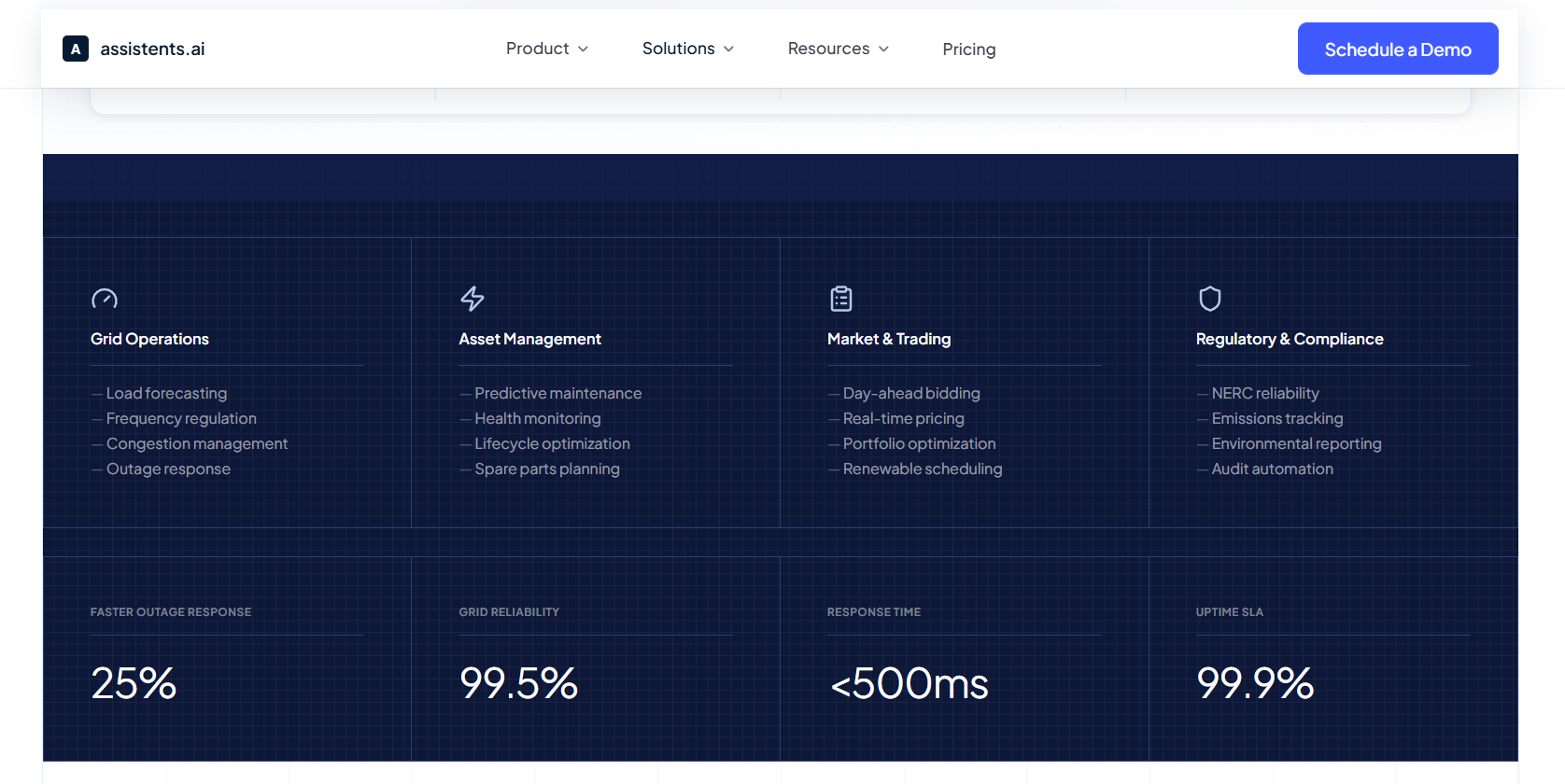
An AI agent for the energy sector is an autonomous software system that connects to operational data sources — grid sensors, SCADA systems, energy management platforms, utility databases, IoT infrastructure — and continuously monitors, analyses, forecasts, and acts on that data without requiring constant human instruction.
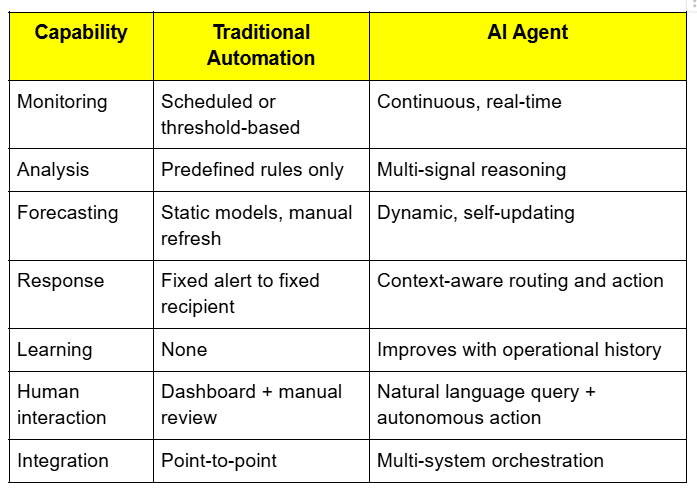
The key distinction from earlier automation is reasoning. Rule-based systems execute a fixed instruction when a fixed condition is met: "If temperature exceeds threshold X, send alert." An AI agent reasons across multiple signals simultaneously, weighs context, assesses likely causes, and determines the most appropriate response — which may involve alerting a specific team, updating a workflow system, generating a forecast, or triggering a corrective action.
How They Differ from Traditional Energy Automation
Key Capabilities in Energy Contexts

AI agents deployed in energy environments typically deliver four core capabilities working in combination:
Continuous monitoring. Rather than sampling operational data at intervals, the agent ingests sensor and telemetry streams continuously. It maintains a running picture of system state across all monitored assets simultaneously — something no human operations team can replicate at scale.
Anomaly detection and forecasting. The agent identifies patterns that deviate from expected operational baselines, distinguishes genuine anomalies from noise, and projects how conditions are likely to evolve. This enables teams to act before failures occur rather than after.
Automated alerting and workflow routing. When the agent identifies an issue, it routes the right information to the right team at the right time — with context, not just a raw alarm. A transmission anomaly reaches the grid operations team with probable cause, historical precedent, and suggested next steps already attached.
Governed, auditable action. In critical infrastructure environments, autonomous action requires strict governance. Enterprise-grade agents operate with defined approval chains, full audit trails, and human-in-the-loop controls that ensure no consequential action is taken outside established governance parameters.
Core Use Cases: Where AI Agents Deliver the Most Value
1. Smart Grid Operations and Agentic Analytics
The smart grid is arguably the most data-intensive operational environment in any industry. A modern grid deployment generates continuous telemetry from millions of connected assets — meters, substations, distribution nodes, sensors. Making operational sense of that data in real time, and turning insight into action, is beyond the capacity of conventional monitoring tools.
Agentic AI for smart grid operations ingests this data continuously and builds a live operational picture across the grid. When grid conditions shift — load imbalances, frequency deviations, equipment anomalies — the agent detects the change, assesses its likely cause, and routes actionable alerts to the relevant field or operations team before the issue escalates into an outage or safety event.
In deployments covering state-scale smart grid infrastructure, agentic analytics platforms have shifted operations from reactive incident response to proactive grid management. The agent operates as an always-on monitoring layer, processing data that no team could manually review at the required speed or volume.
Beyond alerting, the smart grid agent performs predictive analytics: modelling probable outage scenarios, identifying equipment approaching end-of-life signatures, and optimising dispatch decisions in response to changing grid conditions.
Key outcomes in production deployments:
- Higher operational visibility across grid operations
- Faster exception detection and response coordination
- Reduction in manual monitoring effort through continuous automation
- More proactive grid management via continuous operational monitoring
2. Energy Consumption Monitoring and Forecasting
For large campuses — research institutions, universities, industrial facilities, commercial estates — energy consumption represents a significant operational cost and compliance obligation. The challenge is that consumption patterns across complex facilities are difficult to analyse manually: data comes from multiple building management systems, utility meters, and equipment controllers that rarely share a common format or update cadence.
An energy management AI agent connects to these disparate data sources, normalises the data, and provides a continuous operational view of consumption across all assets. The agent identifies inefficiencies — equipment drawing more power than its operational profile suggests, HVAC systems cycling irregularly, consumption spikes that indicate emerging faults — and surfaces both alerts and recommendations.
The forecasting capability is particularly valuable. By modelling historical consumption patterns alongside real-time operational data and external variables such as weather, the agent generates demand forecasts that enable facilities teams to optimise scheduling, manage peak loads, and avoid tariff penalties.
In a live deployment at a large scientific research institution, the energy management agent was implemented to monitor and forecast campus energy consumption across multiple buildings and specialised facilities. The deployment delivered improved energy visibility, faster identification of inefficiencies, and a measurable reduction in manual monitoring effort as the agent replaced scheduled human review cycles with continuous automated intelligence.
Key outcomes in production deployments:
- Improved energy visibility across complex multi-building environments
- Faster detection of consumption inefficiencies and emerging equipment faults
- More predictable operations through early warning alerts
- Reduced manual monitoring overhead through always-on automation

3. Renewable Energy Management
Renewable energy introduces variability that traditional grid and facility management systems were not designed to handle. Solar generation fluctuates with cloud cover. Wind output changes with atmospheric conditions. Battery storage systems have complex charge-discharge profiles that affect their value at different points in the generation and consumption cycle.
AI agents for renewable energy connect to generation monitoring platforms, consumption data, storage systems, and grid signals simultaneously. The agent models the interplay between these sources continuously, identifying optimisation opportunities — such as shifting controllable loads to periods of peak renewable generation — and alerting operators to underperformance against generation forecasts.
In manufacturing and commercial settings where renewable generation is part of a broader energy strategy, the AI agent becomes the integration layer that makes sense of the combined energy picture: what is being generated, what is being consumed, what is in storage, and what the grid signal is suggesting. This unified operational view enables decisions that static dashboards cannot support.
4. Transmission and Distribution Operations
For utility organisations responsible for operating and maintaining transmission systems at scale, the core operational challenge is achieving visibility across a network that is geographically distributed, physically complex, and constantly generating exceptions.
A transmission AI agent provides continuous monitoring of transmission KPIs — line loading, voltage profiles, equipment health indicators, outage probability signals — and performs real-time anomaly detection across the entire network. When an exception is identified, the agent automatically generates a work order or alert routed to the appropriate field team, with diagnostic context already attached.
In a live deployment at a state-level power transmission utility, the AI agent platform was implemented to monitor the full transmission network. The deployment replaced a manual review cycle with continuous automated monitoring, enabling the operations team to shift from periodic dashboard review to exception-driven response. The agent's predictive maintenance indicators enabled the team to address equipment issues before they resulted in unplanned outages.
Key outcomes in production deployments:
- Faster identification of grid exceptions and operational risks
- Improved reliability through proactive equipment monitoring
- Better operational transparency for leadership via automated reporting
- Reduction in manual monitoring burden across geographically distributed assets
5. Predictive Maintenance for Energy Infrastructure
Unplanned equipment failures in energy infrastructure are disproportionately costly — both in direct repair cost and in the operational disruption they cause. The challenge with traditional maintenance schedules is that they are time-based rather than condition-based: equipment is inspected and serviced at fixed intervals regardless of its actual operational state.
AI agents enable condition-based predictive maintenance by continuously analysing equipment telemetry for signatures that precede failures — vibration anomalies, thermal deviations, efficiency degradation, unusual load patterns. The agent builds a health model for each monitored asset and generates maintenance recommendations based on actual condition rather than elapsed time.
The result is a shift from scheduled maintenance to predictive maintenance: work is performed when equipment needs it, not simply when the calendar says so. This reduces both unnecessary maintenance activity and unplanned failures simultaneously.
Real-World Deployments: What Enterprises Are Actually Building
The following case studies are drawn from live enterprise implementations. Client names are not disclosed, but the deployment scope, approach, and outcomes are described accurately.
Case Study 1: AI for Campus Energy Management — Large Research Institution
The challenge. A premier scientific research institution with multiple specialised facilities and significant energy infrastructure needed to move beyond periodic energy reporting to continuous operational visibility. Campus energy consumption was managed through disconnected building management systems, making it difficult to identify inefficiencies, forecast demand accurately, or respond proactively to anomalies.
The deployment. An AI energy management agent was implemented to ingest data from across the campus infrastructure — utility meters, building management systems, specialised equipment controllers — and provide a unified continuous operational view. The deployment included forecasting models for demand prediction, anomaly detection for equipment-level inefficiencies, and automated alerting for conditions requiring human intervention.
The scope of services delivered:
- Utility and sensor data ingestion with anomaly detection across all campus assets
- Forecasting and optimisation recommendations updated continuously
- Operational dashboards with proactive alerting for operations and facilities teams
Key outcomes:
- Improved energy visibility and faster detection of inefficiencies across campus
- Reduced manual monitoring effort as automated agents replaced scheduled review cycles
- More predictable operations through early warning alerts
- Measurable improvement in energy management decision cadence
Why it matters. Research institutions have complex, heterogeneous energy infrastructure that does not naturally lend itself to centralised monitoring. The agent's ability to ingest and normalise data from disparate systems — without requiring a full infrastructure overhaul — is a capability that is directly transferable to similar environments including universities, hospital campuses, and large commercial estates.
Case Study 2: AI for Smart Grid Operations — State Power Transmission Utility
The challenge. A state-level power transmission utility responsible for operating and maintaining a large-scale transmission network needed to improve operational visibility, reduce response times to grid exceptions, and shift from reactive to proactive operations. Manual monitoring of transmission KPIs at the required frequency and coverage was not operationally sustainable.
The deployment. An agentic analytics platform was deployed on top of the utility's existing operational data infrastructure. The agent provided continuous monitoring of transmission KPIs, real-time anomaly detection, predictive indicators for equipment issues, and automated alert routing to field operations teams. Dashboards were built for both operational teams and leadership, with automated reporting replacing manual compilation.
The scope of services delivered:
- Transmission KPI monitoring and anomaly detection across the full network
- Loss and outage analytics with predictive maintenance indicators
- Automated dashboards and operational alerts for field and leadership teams
Key outcomes:
- Faster identification of grid exceptions and operational risks
- Improved operational reliability through proactive monitoring
- Better transparency for leadership through automated reporting
- Reduction in manual monitoring burden enabling redeployment of operational resource
Why it matters. The deployment demonstrates that agentic AI can be layered on top of existing operational data infrastructure without requiring replacement of core systems. The agent acts as an intelligence layer above what already exists — connecting to SCADA data, operational databases, and monitoring systems — rather than requiring a greenfield technology deployment.

Case Study 3: Data Analytics for Smart Grid Performance Management — Energy Operations
The challenge. A smart utility operation needed to convert the volume of smart grid operational data it was generating into actionable operational intelligence. The data existed but was difficult to query, slow to analyse, and dependent on manual effort to produce insight packs for operational and leadership teams.
The deployment. A smart grid data ingestion and analytics agent was deployed to provide operational dashboards, predictive analytics for grid performance, and automated alerting for operational exceptions. The agent was designed to enable field teams to access operational intelligence through natural language queries rather than requiring BI tool expertise.
The scope of services delivered:
- Smart grid data ingestion and real-time operational dashboards
- Predictive analytics for outages, losses, and field issues
- Automated alerts and workflow routing for exception resolution
Key outcomes:
- Higher operational visibility across grid operations
- Faster exception detection and response coordination
- Shift from manual reporting to continuous automated intelligence
- More proactive grid operations through always-on monitoring
How assistents.ai Powers AI Agents for the Energy Sector
assistents.ai is an enterprise AI agent platform purpose-built for complex, multi-system operational environments. The deployments described above were all delivered on the assistents.ai platform or using the Ampcome implementation methodology. Several capabilities are particularly relevant to energy sector organisations.
300+ Integrations with Energy and Utility Systems
Energy operations run on a heterogeneous technology stack: SCADA platforms, building management systems, IoT sensor networks, ERP systems, asset management databases, utility billing platforms, and GIS infrastructure. The assistents.ai platform connects to 300+ enterprise systems out of the box, meaning agents can be deployed across this environment without requiring custom integration work for each source system.
Enterprise-Grade Governance and Compliance
Critical energy infrastructure requires rigorous operational governance. The assistents.ai platform is built with SOC 2 Type II, ISO 27001, GDPR, and HIPAA compliance, with full audit trails for every agent action, human-in-the-loop controls for consequential decisions, and a semantic governance layer that enforces consistent definitions and decision logic across teams.
In critical infrastructure environments, this governance architecture is not optional — it is the foundation that makes autonomous operation acceptable to operations leadership, legal teams, and regulators.

4-Week Deployment vs. 8–12 Weeks Industry Average
Energy organisations face competing pressures on IT resources and implementation timelines. The assistents.ai platform is structured for rapid deployment: live implementation in approximately 4 weeks, compared to an industry average of 8–12 weeks for comparable enterprise agent platforms. This accelerated deployment model is particularly relevant for organisations responding to immediate operational challenges.
Agentic Architecture Built for Operational Environments
Unlike chatbot or search-and-answer platforms that respond to queries but cannot initiate action, assistents.ai deploys genuinely agentic AI: agents that monitor continuously, reason across multiple data sources, and execute multi-step operational workflows. In energy environments where the value lies in what happens between queries — the continuous monitoring, the anomaly detection, the proactive alert — this architectural distinction matters significantly.
Agentic AI vs. Traditional Energy Management Systems
One of the most common questions from energy operations and technology leaders is how agentic AI relates to the monitoring and management systems they already operate. The answer is that agentic AI is not a replacement for existing infrastructure — it is an intelligence layer above it.
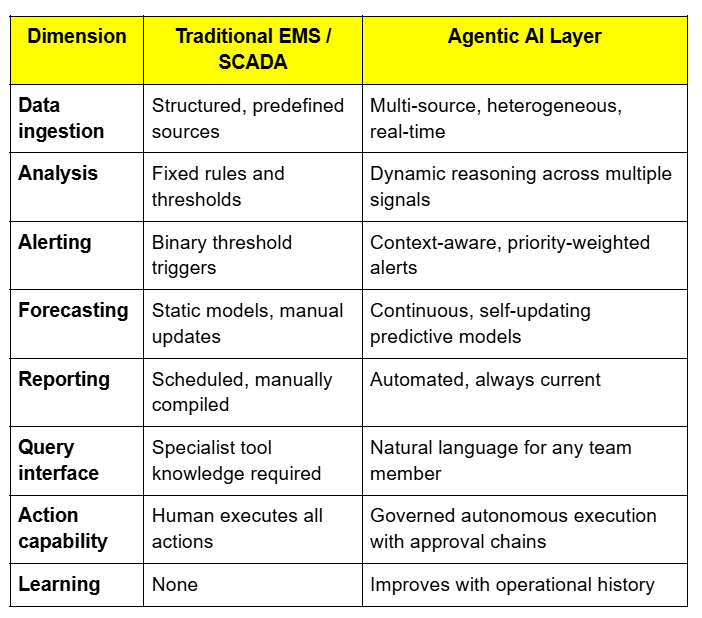
The practical implication is that energy organisations do not need to replace their existing operational technology to deploy agentic AI. The agent connects to what already exists — SCADA systems, historian databases, building management platforms, IoT feeds — and provides the reasoning and action layer that those systems were never designed to deliver.
5 Questions Energy Leaders Should Ask Before Deploying AI Agents
Before selecting an AI agent platform for energy operations, the following questions will help distinguish platforms with genuine enterprise capability from those that are better suited to simpler environments.
1. Can the agent connect to our existing operational technology without a full data migration? The answer should be yes, through a library of pre-built connectors. Any platform that requires a full data migration or infrastructure replacement as a prerequisite is adding months to deployment timelines and significant integration risk.
2. How does the platform handle governance and audit requirements for critical infrastructure? The platform should provide full audit trails for every agent action, human-in-the-loop controls for consequential decisions, and compliance certifications appropriate for critical infrastructure (SOC 2, ISO 27001 at minimum).
3. What is the deployment timeline to first production value? For energy organisations facing immediate operational challenges, the difference between 4 weeks and 12 weeks to live deployment is material. Push for a specific, contractually committed timeline with defined milestones.
4. Does the platform support genuine agentic operation, or is it primarily a query interface? Many products marketed as "AI agents" are search and answer tools that respond to queries but cannot initiate action autonomously. For energy operations, the value lies in continuous monitoring and proactive alerting — capabilities that require genuine agentic architecture, not a conversational interface over a data warehouse.
5. Can the platform be deployed incrementally, starting with one use case? The risk profile for enterprise AI deployments is lowest when the initial deployment is scoped to a single, well-defined use case with measurable outcomes. Platforms that require broad deployment commitments before delivering value should be approached with caution.
The Bottom Line
The energy sector is operating at a point of genuine inflection. Grid complexity is increasing. Renewable integration is accelerating. Regulatory requirements are tightening. And the data volumes being generated by modern energy infrastructure far exceed what any monitoring team can process manually.
AI agents do not solve these challenges by replacing human expertise. They solve them by giving human teams the operational intelligence they need to act before problems escalate — continuously, at scale, across every asset and system simultaneously.
The deployments documented in this guide — campus energy management at a large research institution, smart grid operations at a state power utility, smart grid performance management for energy operations — are not pilot projects or proof-of-concept exercises. They are production deployments delivering measurable operational value across live energy infrastructure today.
The organisations that establish agentic AI capability in their operations now will have a compounding advantage: better data, more refined models, and more efficient operational processes than organisations that wait.
If you are evaluating AI agents for energy sector deployment, explore the assistents.ai enterprise platform or book a 30-minute deployment conversation with the team.
Frequently Asked Questions
What are AI agents for the energy sector?
AI agents for the energy sector are autonomous software systems that monitor, analyse, forecast, and act on energy data in real time — covering smart grid operations, consumption optimisation, renewable energy management, and transmission alerting — without requiring constant human intervention. Unlike rule-based automation, they reason across multiple data sources simultaneously and adapt their responses based on operational context.
How does agentic AI support smart grid management?
Agentic AI ingests smart grid sensor and operational data continuously, detects anomalies across the grid in real time, forecasts probable outage scenarios, and automatically routes alerts and work orders to the relevant field or operations teams — replacing manual monitoring cycles with always-on autonomous intelligence that operates at a speed and scale no human team can match.
Can AI agents work with renewable energy systems?
Yes. AI agents connect to renewable generation monitoring platforms, consumption data, battery storage systems, and grid signals simultaneously. The agent models the interplay between these sources continuously, identifying optimisation opportunities — such as shifting loads to periods of peak renewable generation — and alerting operators to underperformance against generation forecasts in real time.
What is an energy management AI agent?
An energy management AI agent is an autonomous system that monitors energy consumption across facilities or campuses, identifies inefficiencies, forecasts demand, and proactively surfaces recommendations or triggers automated actions to reduce waste and operational cost. It connects to heterogeneous data sources — building management systems, utility meters, equipment controllers — and provides a unified continuous operational view that static dashboards cannot deliver.
How long does it take to deploy an AI agent for energy operations?
The assistents.ai platform deploys enterprise AI agents in approximately 4 weeks — compared to an industry average of 8–12 weeks — with full integration into existing utility, SCADA, and operational data systems. Deployment begins with a defined use case and expands incrementally as initial deployments demonstrate value.
Is agentic AI secure enough for critical energy infrastructure?
Enterprise-grade AI agent platforms are built with SOC 2 Type II, ISO 27001, and GDPR compliance, with full audit trails for every agent action, semantic governance layers, and human-in-the-loop controls designed specifically for critical infrastructure environments. No consequential action is taken outside defined governance parameters, and all agent decisions are logged and explainable for regulatory review.
What is the difference between AI agents and traditional SCADA monitoring?
Traditional SCADA systems execute fixed rules when fixed conditions are met and require human review of dashboards to identify issues. AI agents reason across multiple signals simultaneously, detect complex anomalies that fixed rules would miss, generate forecasts, route context-rich alerts automatically, and can execute governed actions without waiting for human instruction. Agentic AI is deployed as an intelligence layer above existing SCADA infrastructure — not as a replacement for it.
Which industries within the energy sector benefit most from AI agents?
AI agents deliver measurable value across utility operations (transmission, distribution, smart grid), large campus energy management (research institutions, commercial estates, industrial facilities), renewable energy operations, and any environment where operational data volume exceeds what a human monitoring team can review in real time. The common thread is operational complexity: the more systems, assets, and data sources that need to be synthesised simultaneously, the greater the value an AI agent delivers.

Transform Your Business With Agentic Automation
Agentic automation is the rising star posied to overtake RPA and bring about a new wave of intelligent automation. Explore the core concepts of agentic automation, how it works, real-life examples and strategies for a successful implementation in this ebook.
Sarfraz Nawaz is the CEO and founder of Ampcome, which is at the forefront of Artificial Intelligence (AI) Development. Nawaz's passion for technology is matched by his commitment to creating solutions that drive real-world results. Under his leadership, Ampcome's team of talented engineers and developers craft innovative IT solutions that empower businesses to thrive in the ever-evolving technological landscape.Ampcome's success is a testament to Nawaz's dedication to excellence and his unwavering belief in the transformative power of technology.

More insights
Discover the latest trends, best practices, and expert opinions that can reshape your perspective


.webp)
.jpg)


Contact us

