

Deep Research Agent: The Enterprise Guide to Governed, Auditable AI Research (2026)


A deep research agent is an AI system that autonomously plans a research question, retrieves evidence across many sources over multiple steps, evaluates and cross-references what it finds, and produces a structured, citation-backed report. Unlike a chatbot, which answers from what it already knows, a deep research agent investigates — and keeps investigating until the question is answered.
Key takeaways
- Deep research agents differ from chatbots and standard RAG in four ways: autonomous planning, multi-hop retrieval, tool use, and cited synthesis.
- Consumer deep research tools research the public internet. Enterprise deep research agents must also research private documents and governed structured data — and most cannot.
- The hardest enterprise problems are not model quality. They are permissions, auditability, citation faithfulness, and cost per run.
- Independent audits have found citation accuracy varying widely across commercial deep research systems, which makes evidence traceability a governance requirement, not a nice-to-have.
- The gap nobody talks about is the Report-to-Outcome Gap: a research agent that produces a brilliant brief and cannot act on it has automated the analyst, not the operation.
- Enterprise deployments that work follow a common architecture — what we call the Governed Deep Research Stack: Context, Orchestration, Reasoning, Governance, and Action.
What Is a Deep Research Agent?
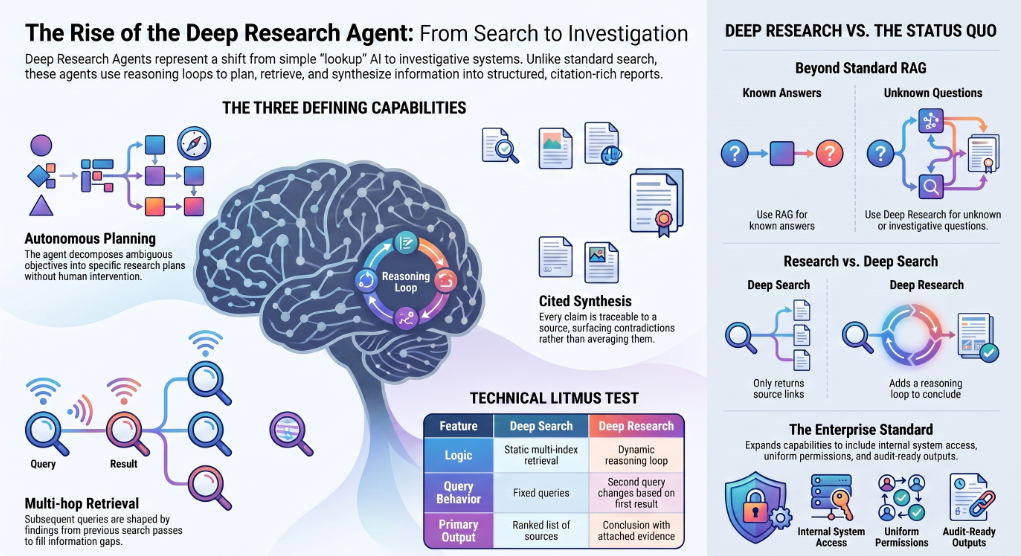
A deep research agent is an AI system that treats a question as an investigation rather than a lookup. Given an open-ended objective, it decomposes the problem into sub-questions, plans a research path, retrieves evidence from multiple sources across multiple passes, evaluates the credibility and consistency of what it finds, and synthesizes a structured report in which every material claim is traceable to a source.
The category emerged in 2025 and consolidated through 2026. It now sits alongside enterprise search, retrieval-augmented generation, and conversational analytics as a distinct capability with its own architecture, its own failure modes, and its own evaluation criteria.
The academic literature converged on a fairly tight definition: a deep research agent orchestrates multi-step exploration, targeted retrieval, and higher-order synthesis to transform large volumes of scattered information into analyst-grade, citation-rich reports — compressing hours or days of manual desk research into minutes.
That definition is useful, but it describes the consumer form of the category. In an enterprise, the definition has to expand: the sources include your own systems, the permissions are not uniform, and the output is expected to hold up under audit.
The four capabilities that define the category
1. Autonomous planning. The agent decomposes an ambiguous objective into a research plan without being told the steps. "Assess our competitive exposure in the mid-market segment" becomes a set of sub-questions about pricing, feature parity, channel movement, and customer sentiment — generated by the agent, not the user.
2. Multi-hop retrieval. A standard retrieval system runs one query and returns matches. A deep research agent runs many queries, reads what comes back, identifies what is still missing, and issues new queries informed by what it has already learned. The second search is shaped by the first.
3. Tool use. The agent invokes capabilities beyond text retrieval: web browsers, document parsers, database queries, code execution, internal APIs. Tool access is what allows it to reach evidence that no amount of pre-training contains.
4. Cited synthesis. The output is a structured report with source attribution, not a paragraph. Findings are ranked. Contradictions between sources are surfaced rather than silently averaged. A reader can follow any claim back to where it came from.
Remove any one of these and you have something else. Remove planning and you have agentic RAG. Remove tool use and you have summarization. Remove citation and you have a very confident essay.
Deep research agent vs chatbot vs RAG vs AI agent

The practical rule: if you know which document holds the answer, use RAG. If you do not know whether the answer exists, use a deep research agent.
Standard RAG is a stateless query engine. It is very good at answering a question when the answer is sitting in a retrievable chunk. Its limitation is that it does not investigate. It cannot perform a series of actions, learn from them, and then decide on a new course. It answers once and stops.
Deep research vs deep search: why the distinction matters
These get used interchangeably and they are not the same thing.
Deep search widens retrieval. It runs more queries, across more indexes, and returns better-ranked results. The output is still fundamentally a set of sources for a human to read.
Deep research adds a reasoning loop on top of retrieval. It decides what to look for next based on what it just found, evaluates source credibility, resolves conflicts, and produces an argued synthesis. The output is a conclusion with evidence attached.
The distinction matters commercially because a lot of products marketed as "deep research" are deep search with a summarization layer. The test is simple: does the second query change based on the first result? If not, it is search.
Why "deep research" became a category in 2025–2026
Three things converged.
First, reasoning models made multi-step planning economically viable. Before that, chaining twenty tool calls produced compounding errors that made the output worse than a single good search.
Second, the benchmarks arrived. Evaluation suites built around expert-authored, PhD-level research tasks gave the category something to be measured against, and measurement created competition.
Third, the accuracy reckoning. As adoption spread, independent audits started publishing citation-failure rates across the major systems — and the numbers were uncomfortable. Capability stopped being the differentiator. Accuracy, traceability, and source quality became the dividing line.
That third shift is what turned deep research from a consumer feature into an enterprise architecture problem.
How a Deep Research Agent Actually Works: Anatomy of a Single Run
Most production deep research systems follow a hierarchical multi-agent pattern: a planner at the top, specialized workers in the middle, and critics that review the output before it ships. Here is what happens between the question and the report.

Stage 1 — Intent capture and scope clarification
The agent interprets the objective and, in better implementations, asks clarifying questions before spending compute. This step is cheap and disproportionately improves output relevance. "Research the EV charging market" and "research the EV charging market for a fleet operator with 200 light commercial vehicles in Tier-2 Indian cities" produce entirely different reports, and the agent cannot guess which one you meant.
Scope also sets boundaries: time window, geography, source types permitted, and depth budget.
Stage 2 — Planning and task decomposition
The planner converts the objective into a research plan — a structured set of sub-questions, each with an assigned retrieval strategy. Good planners produce plans that are inspectable and steerable, so a human can remove a line of inquiry or add one before execution begins.
This is also where the agent decides shape: is this a landscape scan requiring breadth, or a specific factual determination requiring depth on a narrow question? The two need different budgets.
Stage 3 — Parallel retrieval across web, documents, and structured data
Sub-researchers execute the plan concurrently. In enterprise deployments, retrieval fans in from at least five source classes:
- Internal documents — contracts, policies, reports, tender packs, SOPs
- Enterprise databases — transactional and analytical systems
- Public web sources — company sites, filings, regulatory registers
- News and signal feeds — announcements, pricing changes, personnel moves
- Industry and analyst material — market reports, trade publications
Running these in parallel rather than sequentially is what makes minutes-not-hours possible. It is also where most homegrown implementations fall over, because parallel retrieval across systems with different permission models is genuinely hard.
Stage 4 — Evidence evaluation, contradiction handling, and credibility scoring
This is the stage that separates a research agent from a summarizer.
Retrieved evidence is scored for source credibility, recency, and relevance. Where two sources disagree, the disagreement is preserved and flagged rather than resolved by averaging or by whichever source appeared first. A dedicated critic role — sometimes called a credibility critic — evaluates whether coverage is sufficient or whether the plan needs another pass.
An enterprise-grade implementation should be able to answer: which sources did you reject, and why?
Stage 5 — Synthesis with traceable citations
The writer assembles the report. The structure that has become standard for decision-grade output has five parts:
- Executive summary — the decision-ready answer, first
- Key findings — what the evidence says, ranked by significance
- Supporting evidence — data organized into tables and visuals
- Risk factors — what could change the conclusion
- Recommended actions — what to do about it
Every material claim carries a citation. The citation must resolve — meaning a reader can click through and find the claim, not merely find a document that is broadly about the topic.
Stage 6 — Reflection and critique loops
A reflection critic reads the draft against the original objective and the retrieved evidence, identifies weak sections, unsupported claims, and coverage gaps, and sends specific sections back for another research pass.
This loop is expensive and it is the single largest quality lever in the system. It is also the first thing cut when teams optimize for cost.
Where most implementations stop — and why that is the problem
At Stage 6, the report is finished. It gets emailed, pasted into a deck, or dropped in a shared drive.
And then a human reads it, decides what to do, opens four other systems, and does it.
The agent compressed two weeks of research into fifteen minutes and then handed the work back to a person at exactly the point where the value was going to be realized. We call this the Report-to-Outcome Gap, and it is the defining unsolved problem of the category. Every architecture blog, every tool comparison, every benchmark treats the report as the finish line. In an enterprise, the report is the halfway mark.
Consumer Deep Research vs Enterprise Deep Research: The Seven Gaps
Consumer deep research tools are genuinely impressive and they are not enterprise systems. Here is precisely where the gap opens.
Gap 1 — Private data the public web cannot see
A large share of the evidence an enterprise question depends on is not on the internet. It is in contracts, tender packs, service records, incident logs, board papers, and pricing sheets. A research agent that can only read the public web will confidently produce a market landscape that omits the single most decision-relevant fact — the one in your own repository.
Compounding this: a meaningful share of enterprise data cannot leave the perimeter at all. For those workloads, "connect our data to a hosted research tool" is not an available option, which puts deployment control — private cloud, VPC, on-premise — squarely in the requirements list rather than the nice-to-have list.
Gap 2 — Structured data and the semantic layer problem
This is the gap almost nobody in the market discusses, and it is the largest.
Every published deep research architecture treats research as documents plus web. But most enterprise questions worth asking are partly quantitative. "Has our margin on this category eroded relative to competitor pricing moves?" requires reading competitor pricing off the web and querying your own transaction data. A document-only research agent cannot answer it.
Running a research agent over structured data introduces a problem that documents do not have: definitional consistency. If "active customer" means one thing in the CRM, another in billing, and a third in the warehouse, an agent generating SQL on the fly will produce a number that is technically correct and organizationally wrong — and it will cite it confidently.
The fix is a semantic layer: governed definitions of entities, metrics, hierarchies, and business rules that the agent must resolve against before it queries anything. Without it, text-to-SQL inside a research agent is a liability generator. With it, structured data becomes a first-class research source alongside documents and the web.

Gap 3 — Permissions that travel with the answer
In a consumer tool, there is one user and one permission set. In an enterprise, the same research question asked by a regional manager and by the group CFO should return different reports — because they are entitled to see different underlying evidence.
This is harder than it sounds. A multi-hop retrieval chain touches dozens of sources. Permission has to be enforced at every hop, not filtered at the end, or the agent will reason over data the user cannot see and leak it through the synthesis even if the citation is suppressed. Row-level security and attribute-based access control need to be enforced inside the retrieval path.
The failure mode here is silent. Nothing errors. The report just quietly contains something it should not.
Gap 4 — Auditability and the evidence chain
"Auditable output" is claimed by almost every vendor in this space and specified by almost none.
An audit-grade deep research agent needs to preserve, immutably: the original question, the generated plan, every query issued, every source retrieved, every source rejected and why, which model produced which section, what a human changed, and when. Six months later, when a decision made off that report is questioned, the chain has to reconstruct.
If the system can only show you the final report, it is not auditable. It is just formatted.
Gap 5 — Model choice, data residency, and deployment control
Enterprises need to route different research workloads to different models — a cheap fast model for breadth-first scanning, a frontier reasoning model for synthesis, a locally hosted model for sensitive material that cannot leave the environment. Being locked to one provider means being locked to one cost curve, one residency posture, and one set of capability limits.
Bring-your-own-key, model-agnostic routing, and private or on-premise deployment are not procurement checkboxes. They determine which questions you are allowed to ask.
Gap 6 — Token economics at enterprise volume
Deep research agents consume dramatically more tokens than chat. A single thorough run may issue dozens of retrievals, read hundreds of thousands of tokens of source material, and run multiple reflection passes.
At one run a day, nobody notices. At two hundred analysts running four investigations each, it becomes a line item that gets scrutinized — and the scrutiny usually arrives after the reflection loops have been quietly disabled to save money, which is precisely the change that degrades quality most.
The enterprise answer is tiered routing: cheap models for planning and breadth, expensive models for synthesis and critique, with per-run cost budgets enforced at the platform level rather than discovered at the invoice.
Gap 7 — The Report-to-Outcome Gap
The report is not the outcome. Nobody wants a competitive brief; they want a pricing decision made and executed. Nobody wants a supplier research pack; they want an RFQ issued to three qualified vendors.
A deep research agent that ends at the report requires a human to re-enter the loop, re-read the context the agent already had, and manually perform the follow-through across systems. The compression gained in research is partly given back in coordination.
Closing this gap requires something the standalone research tools structurally do not have: a governed action layer. The agent's recommended actions have to be executable — through registered capabilities, with permission checks, approval thresholds, human sign-off where required, and an audit record of what was done.
This is the difference between automating the analyst and automating the operation.
The Governed Deep Research Stack: A Reference Architecture
Enterprise deep research deployments that survive contact with production share a common five-layer structure. Here it is.

Layer 1 — Context
The layer that decides what the agent is allowed to know.
- Document intelligence — parsing complex PDFs, scans, tables, and drawings into structured, retrievable evidence. Tender packs, contracts, and regulatory filings are not clean text; vision-capable extraction is required, not optional.
- Semantic layer — governed definitions of metrics, entities, hierarchies, and business rules so that quantitative findings are consistent and defensible.
- Connectors — governed access to source systems: databases, content repositories, ticketing, CRM, ERP, and the open web.
- Permission-aware retrieval — access control enforced at the retrieval layer so entitlement is respected on every hop.
Get this layer wrong and no amount of model quality saves the output.
Layer 2 — Orchestration
The layer that decides how the work is done.
- A planner that decomposes objectives into inspectable research plans
- Specialized sub-researchers executing in parallel
- Critic roles for credibility assessment and draft reflection
- Interoperability protocols — MCP for tool and data access, A2A for agent-to-agent coordination — so the research agent can reach capabilities it does not own and hand off to agents that specialize
Orchestration is also where steerability lives. A human should be able to see the plan mid-run, kill a line of inquiry, and add a constraint without restarting.
Layer 3 — Reasoning
The layer that decides which brain does which job.
Model-agnostic routing lets you send planning to a fast model, synthesis to a frontier reasoning model, and sensitive-material processing to a locally hosted model — with bring-your-own-key so the commercial relationship and the data path stay yours. Cost tiering is configured here, not negotiated later.
Layer 4 — Governance
The layer that makes the output defensible.
- Row-level security and attribute-based access control enforced inside retrieval
- Maker-checker / human-in-the-loop review gates on findings that will drive consequential decisions
- Immutable audit trail capturing plan, queries, sources, rejections, model attribution, and human edits
- Private, VPC, or on-premise deployment for workloads that cannot leave the perimeter
Governance is not a wrapper applied after the agent runs. It is enforced inside the loop or it is not enforced.
Layer 5 — Action
The layer that closes the Report-to-Outcome Gap.
Recommended actions become executable through registered, permission-checked capabilities: create the task, issue the RFQ, open the case, update the record, notify the owner, schedule the follow-up review. Every action passes through the same governance model as the research that produced it, with approval thresholds and a complete record of what was executed and by whose authority.
Mapping the stack to the Ask → Execute → Autonomous ladder
The five layers correspond to a maturity progression that most enterprises move through in order.
Ask. Research on demand. A person poses a strategic question and receives a cited brief in minutes instead of commissioning two weeks of analyst time. Value is immediate; the operating model is unchanged.
Execute. Research triggers governed action. The brief's recommended actions become executable within policy — tasks created, cases opened, notifications routed — with human approval at defined thresholds. The Report-to-Outcome Gap starts closing.
Autonomous. Continuous research agents run standing investigations. They watch defined topics, competitors, suppliers, or regulatory surfaces; investigate when a configurable threshold is crossed; and act or escalate within their authority. Humans manage exceptions and outcomes rather than initiating every run.
Most organizations should land at Ask, prove the value, and expand deliberately. Attempting Autonomous before the context and governance layers are solid produces exactly the kind of confidently wrong automation that sets programs back a year.
Deep Research Agent Use Cases: 8 Enterprise Deployment Patterns
The following patterns are drawn from real enterprise deployments. Clients are described by profile only. Outcomes reflect specific deployment contexts and are directional, not guaranteed benchmarks.

Pattern 1 — Competitive and pricing intelligence
Profile: A major Indian HVAC and refrigeration manufacturer founded in the 1940s, competing in highly price-sensitive consumer and commercial cooling markets where competitor moves matter daily.
Research problem: Pricing, promotions, MRP changes, offer structures, availability, and ratings shift across dozens of e-commerce and channel surfaces continuously. Manual portal checks are slow, partial, and stale by the time they reach leadership.
What the agent does: Continuous monitoring across e-commerce and channel sources; agentic question-answering mapped directly to the questions leadership actually asks; analytics views for pricing gaps, competitive threats, and portfolio movement. Architected to scale from proof of concept to production with governance and audit trails.
Directional outcome: Faster competitive response cycles, earlier identification of pricing gaps and promotional shifts, and always-on monitoring replacing manual checks across portals.
Pattern 2 — Tender, bid, and complex document research
Profile: An Australian waterproofing diagnostics and remedial building services specialist with more than twenty years in complex commercial works.
Research problem: Tender documents are long, unstructured, revision-heavy, and consequential. Missing a changed clause between revisions is a direct commercial risk.
What the agent does: An intelligent document workbench built on multi-agent orchestration — tender retrieval, workflow determination, revision and change analysis, and vision-based extraction from complex PDFs — with deep integration into core operational systems, quote locking, and full audit logging.
Directional outcome: Engineered for up to roughly 90% faster tender document processing, with an extraction accuracy target of approximately 95% on standard formats, and reduced bid risk through revision detection and auditability.
Pattern 3 — Regulatory and cross-border tax pre-screening
Profile: A UK tax-technology product focused on early screening of cross-border transactions for withholding tax, VAT mismatch, and permanent establishment risk.
Research problem: Risk identification requires reading transactions against multi-jurisdiction rules and precedent — expensive, slow, and typically performed too late in the deal cycle to change anything.
What the agent does: Transaction screening workflows with risk classification, automated source collection and summarization, evidence collection with explainability notes, drafted position output, and structured escalation to human tax experts.
Directional outcome: Earlier detection of withholding and VAT risk, fewer last-minute deal disruptions, and faster, more consistent pre-compliance review.
Pattern 4 — Technical and investment due diligence
Profile: A long-term holding company operating across the USA and Europe, partnering with founders and family businesses and requiring rigorous technical diligence for investment decisions.
Research problem: Diligence windows are short. Assessing architecture, scalability, and security posture of a target's technology estate demands specialist depth applied fast.
What the agent does: Structured code and architecture review, infrastructure and security assessment, scalability and resilience analysis, integration readiness evaluation, and a risk register with a remediation roadmap.
Directional outcome: Faster investment decisions with clear, structured technology risk visibility; reduced post-deal surprises through explicit remediation planning.
Pattern 5 — Market signal synthesis and research automation
Profile: An Indian market research and technical analysis platform publishing forecasts and actionable insights using Elliott Wave theory and related indicators.
Research problem: Producing research at publication cadence requires synthesizing fragmented market signals repeatedly and consistently — work that scales linearly with headcount unless automated.
What the agent does: Data ingestion and indicator pipelines, research automation and insight generation, and thematic dashboards with alerting.
Directional outcome: Faster production of market insight packs, more repeatable and consistent research workflows, and better signal visibility through automated analytics.
Pattern 6 — Supplier discovery and procurement research
Profile: An Indian pharmaceutical sourcing and excipients platform marketing more than 1,800 rare excipients and 7,500 SKUs.
Research problem: Sourcing decisions require researching supplier capability, regulatory documentation, price competitiveness, and lead-time reliability — repeatedly, across a very wide catalogue.
What the agent does: RFQ automation and supplier matching workflows, quality and regulatory document handling, and analytics on price, lead time, and vendor performance.
Directional outcome: Faster procurement cycles, improved sourcing visibility, reduced vendor coordination and manual follow-up, and better price and lead-time competitiveness through research-driven insight.
Pattern 7 — Brand and campaign insight research
Profile: A US brand insights and creative execution studio founded by leaders with deep large-platform advertising backgrounds.
Research problem: Campaign strategy requires synthesizing creative signals, performance data, and audience research into a defensible narrative — a process that traditionally consumes the majority of a strategist's week.
What the agent does: Multi-source ingestion across creative, performance, and audience signals; insight agents producing themes, narratives, and recommendations; reporting packs assembled for leadership.
Directional outcome: Faster creative strategy cycles, deeper signal synthesis across channels, and improved clarity on what to do next for campaigns.
Pattern 8 — Governed operational research across enterprise data
Profile: One of the UAE's most prominent family business groups, operating since 1960 across more than 30 companies spanning retail, building, industrial, and services portfolios.
Research problem: Cross-entity questions — where is margin eroding, which vendors are slipping, where is working capital trapped — require research across systems that do not share definitions, owners, or permission models.
What the agent does: Group-wide KPI standardization; automated alerting on purchase price trend, gross margin impact, early-payment analysis, and vendor performance across delivery and returns; dashboards and scheduled insight packs for leadership.
Directional outcome: Earlier detection of margin erosion and vendor slippage, standardized finance and procurement intelligence across entities, and reduced variance surprises through continuous monitoring.
What the eight patterns have in common: none of them are answerable from the public web alone, all of them require permission-aware access to internal evidence, and every one of them produces value only when the finding leads to an action.
How to Build a Deep Research Agent: A 9-Step Enterprise Implementation Path

Step 1 — Pick one recurring, expensive research question. Not a category. A question. "How did competitor pricing move in our top 40 SKUs this week and what does it do to our margin?" is buildable. "Competitive intelligence" is not. The best first candidates are questions someone currently answers manually, repeatedly, and slowly.
Step 2 — Inventory the evidence the answer actually requires. List every source a good human analyst would consult, and mark each as public web, internal document, or structured system. This list determines your architecture. If more than a third of the list is internal, consumer tools are already out.
Step 3 — Establish semantic ground truth before touching a model. Define the entities, metrics, and hierarchies the question depends on. Whose definition of "active account" wins. What the fiscal calendar is. Which system is authoritative for which fact. This is unglamorous and it is the highest-leverage day of the project.
Step 4 — Wire permission-aware retrieval. Connect sources with access control enforced at the retrieval layer, not applied as a post-filter. Test with three different user personas and confirm the same question returns appropriately different evidence.
Step 5 — Design the plan, not the prompt. Specify how objectives decompose into sub-questions, what each sub-question is allowed to retrieve, and what "sufficient coverage" means. Make the plan visible and editable before execution.
Step 6 — Add critics before you add breadth. A credibility critic and a reflection critic will improve output more than doubling the number of sub-researchers. Resist the temptation to cut them for cost — instead, run them on a cheaper model.
Step 7 — Fix the output contract. Standardize on the five-section brief: executive summary, key findings, supporting evidence, risk factors, recommended actions. Consistent structure makes output reviewable, comparable across runs, and consumable by downstream systems.
Step 8 — Instrument evaluation from run one. Build a golden set of twenty questions with known-good answers. Measure citation faithfulness, coverage, latency, and cost per run every time you change anything. Without this you are tuning by vibes.
Step 9 — Connect the recommended actions. Take the top three recommended actions your agent produces and make them executable through governed, permission-checked capabilities with approval gates. This is the step that converts a research demo into an operational asset.
How to Evaluate a Deep Research Agent: Metrics That Actually Matter
Vendor demos optimize for report length and visual polish. Neither predicts production value. Measure these instead.
Citation faithfulness and source verifiability
For a sample of claims, does the citation resolve, and does the cited source actually support the specific claim? This is the single most important metric and the one most likely to disappoint. Independent audits across commercial deep research systems have reported citation accuracy varying widely, and every system in the category still produces citations that do not hold up. Measure it on your own questions rather than trusting a benchmark.
Target: 100% of material claims resolvable to a source a reviewer can open.
Coverage and recall against a known-answer set
Build questions where you already know the five facts a good answer must contain. Count how many the agent found. This catches the failure where the report reads beautifully and omits the decisive point.
Latency and time-to-first-evidence
Total runtime matters less than how quickly the agent surfaces its first credible finding — because that is when a human can intervene and steer. A twenty-minute run that shows nothing for nineteen minutes is worse than a twenty-five-minute run that streams evidence throughout.
Cost per research run
Track it per run, per user, and per question type. Set budgets at the platform level. The number you care about is cost per accepted report — runs that get discarded still cost money.
Action conversion rate
The metric nobody publishes: what percentage of reports produce an action within seven days?
If it is low, you have not built a research capability. You have built a report generator, and the organization is quietly routing around it. This metric is the truest measure of whether you have closed the Report-to-Outcome Gap, and it is the one to put in front of an executive sponsor.
Risks and Controls: What Goes Wrong With Deep Research Agents

Fabricated and unverifiable citations
The dominant failure mode. The agent produces a plausible claim attached to a real source that does not support it, or to a URL that does not exist.
Controls: post-generation citation verification that re-fetches each source and checks claim support; confidence scoring at the claim level; human review gates on any finding driving a consequential decision; a hard rule that unsupported claims are dropped rather than softened.
Retrieval poisoning and prompt injection via user-generated content
This is the under-discussed security risk and it is well documented in the research literature. Deep research agents issue many related queries in one session and repeatedly retrieve the same high-ranking user-generated pages — community forums, wikis, review sites. That retrieval overlap creates a concentrated attack surface: an adversary who appends crafted text to a single frequently-retrieved page can cause the agent to cite attacker-chosen content and promote attacker-chosen entities across many related queries.
For an agent researching your competitors, your suppliers, or an acquisition target, this is not theoretical. It is a cheap, targeted way to poison your decision inputs.
Controls: source-class allowlists and reputation weighting; treating user-generated content as low-trust evidence requiring corroboration; content sanitization before text enters the reasoning context; output-level detection for anomalous entity promotion; and — critically — never granting the research agent action authority based on unverified external content.
Over-broad data access and permission leakage
Agents given service-account access "to make the pilot work" retain it into production and reason over evidence individual users are not entitled to see.
Controls: identity propagation from the requesting user through every retrieval hop; row-level security and attribute-based access enforced inside retrieval; and periodic access review with the immutable audit trail as evidence.
Cost runaway on long-horizon runs
Reflection loops that fail to converge, unbounded sub-question generation, and retry storms against slow sources.
Controls: per-run token and time budgets; maximum plan depth and breadth; model tiering by task; and cost visibility per user and per question type before the invoice arrives.
Stale context and cache drift
Cached embeddings, stale document indexes, and yesterday's semantic definitions produce a report that is internally consistent and factually behind.
Controls: freshness metadata surfaced in the report itself; incremental re-indexing on source change; and explicit as-of timestamps on every quantitative finding.
Build vs Buy vs Platform: Choosing Your Path
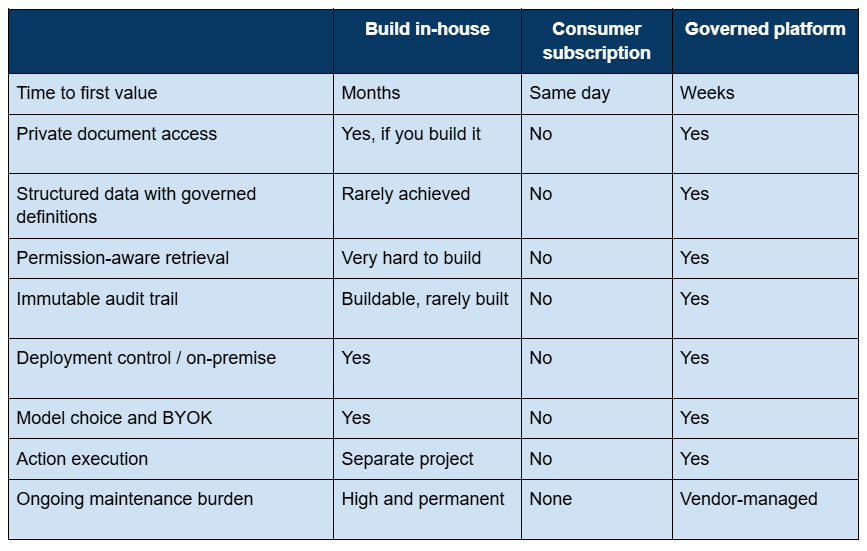
Build in-house when research capability is your product, you have a standing agent engineering team, and the differentiation is in the research itself rather than in what you do with it.
A consumer subscription is enough when the research is genuinely public-web only, the output is advisory rather than decision-binding, and no audit trail is required. For individual knowledge work, this is often the right answer and you should not over-engineer it.
A governed platform is the right answer when the answer depends on internal documents or structured enterprise data, different users are entitled to different evidence, the output will be defended to a board or a regulator, deployment sovereignty matters, or the research needs to lead to an executed action rather than a PDF.
Why Assistents.ai by Ampcome for Enterprise Deep Research

Assistents.ai is an agentic intelligence platform built to orchestrate, govern, and run AI agents on infrastructure the enterprise controls. Deep Research is a native capability on that platform rather than a standalone tool — which is precisely why it addresses the seven gaps above.
Research across all three evidence classes, not one. Deep Research agents on Assistents.ai fan in simultaneously from internal documents, enterprise databases, public sources, news feeds, and industry reports. Every finding is cross-referenced and cited, and contradictions across sources are flagged rather than smoothed over. Document AI handles complex PDFs, scans, and tables so that tender packs and contracts become first-class evidence.
Structured data as a real research source. The Context Engine and semantic layer give the agent governed definitions of metrics, entities, and hierarchies before it queries anything. Text-to-SQL runs against named connectors — Postgres, MSSQL, BigQuery, ClickHouse, Athena, DuckDB — so quantitative findings are consistent with the definitions your finance and BI teams already agreed on. This is the gap almost no deep research product addresses.
Governance enforced inside the loop. Row-level security and attribute-based access control operate at the retrieval layer, so entitlement is respected on every hop rather than filtered at the end. Maker-checker and human-in-the-loop gates sit on consequential findings. An immutable audit trail records the question, the plan, the sources, the model attribution, and every human edit.
Your models, your infrastructure. Model-agnostic routing with bring-your-own-key lets you tier workloads across providers for cost and capability, and route sensitive material to locally hosted models. Private cloud, VPC, and on-premise deployment are supported for workloads that cannot leave the perimeter.
Decision-grade output structure. Every brief arrives in the format decision-makers expect: executive summary, key findings, supporting evidence in tables and visuals, risk factors, and recommended actions — with full citations. A competitive brief that would take an analyst two weeks arrives in roughly fifteen minutes.
Continuous research, not just on-demand. Standing research agents monitor defined topics and deliver updates as new information emerges, with configurable thresholds so you catch the signals that matter without drowning in noise.
And the part that closes the Report-to-Outcome Gap. Because Deep Research runs on the same platform as multi-agent orchestration, workflow automation, and governed action execution — with MCP and A2A protocol support for reaching external tools and agents — the recommended actions in the brief become executable within policy. The research does not stop at the report. It becomes a task raised, a case opened, an alert routed, an approval requested, with the same governance and the same audit record.
Ampcome's delivery track record. Assistents.ai is built and deployed by Ampcome across enterprises spanning retail, manufacturing, energy and utilities, logistics and ports, healthcare, financial services, professional services, and public infrastructure — in India, the UAE, the UK, Europe, Australia, North America, and Africa. The eight deployment patterns described earlier are drawn from that work. This is a platform shaped by production constraints, not by demos.
If your research questions depend on evidence your current tools cannot see, or your research reports keep stopping one step short of a decision, that is the conversation worth having.
From Research Reports to Research Outcomes
The deep research agent category solved a real problem. Work that consumed an analyst for two weeks now takes fifteen minutes, and the output is often better because a machine can read two hundred sources without getting tired at source forty.
But the category, as currently built and marketed, stops one step short. It produces reports. Enterprises need decisions made and actions taken.
The organizations getting real value from deep research in 2026 are the ones that treated it as an architecture problem rather than a tool purchase — building on a governed context layer so the agent can see private documents and structured data, enforcing permissions inside the retrieval loop, keeping an evidence chain that survives audit, and connecting the recommended actions to systems that can execute them.
That is the whole thesis: research that cannot be traced is not defensible, and research that cannot be acted on is not finished.
Assistents.ai by Ampcome was built for that specific shape of the problem — Deep Research as one capability inside a governed agentic platform, running on infrastructure you control, with the action layer already attached.
Ready to see it on your own research question? Bring the question your team currently spends two weeks answering.
Frequently Asked Questions
What is a deep research agent?
A deep research agent is an AI system that autonomously plans a research question, retrieves evidence across many sources over multiple steps, evaluates and cross-references what it finds, and produces a structured, citation-backed report. It differs from a chatbot in that it investigates rather than answers from memory.
What is the difference between a deep research agent and RAG?
RAG follows a mostly deterministic retrieve-then-generate flow: one retrieval pass, then an answer. A deep research agent runs a planning loop — it decomposes the question, retrieves iteratively, evaluates what is still missing, retrieves again, critiques its own draft, and synthesizes a report. Use RAG when you know where the answer lives; use a deep research agent when you do not know whether the answer exists.
Can a deep research agent access private company data?
Consumer deep research tools generally cannot. Enterprise deep research agents can, provided the platform enforces permission-aware retrieval — meaning access control applied at every retrieval hop, not as a filter on the final output. Without that, the agent will either fail to see the data or see too much of it.
How accurate are deep research agents?
Capability is high; citation reliability is the weak point. Independent audits across commercial systems have reported citation accuracy varying widely, and every system in the category still produces some citations that do not support the claim attached to them. Human verification on consequential findings remains necessary, and citation verification should be built into the pipeline rather than left to the reader.
How long does a deep research agent take to produce a report?
Typically minutes to tens of minutes, depending on breadth and depth. A thorough competitive brief that would take a human analyst one to two weeks commonly completes in roughly fifteen minutes.
How much does a deep research agent cost to run?
Far more per query than chat, because a single run may issue dozens of retrievals and process hundreds of thousands of tokens of source material. Enterprise deployments control this through model tiering — cheap models for planning and breadth, frontier models for synthesis and critique — and per-run budgets enforced at the platform level.
Can deep research agents query structured data and databases?
Most cannot; they are built for documents and the web. Those that can require a semantic layer that gives the agent governed definitions of metrics and entities before it generates any query. Without that layer, agent-generated SQL produces numbers that are technically valid and organizationally wrong.
Are deep research agents secure?
They introduce a specific new risk: retrieval poisoning. Because these agents issue many related queries and repeatedly retrieve the same high-ranking user-generated pages, an adversary can append crafted text to a single frequently-retrieved page and influence what the agent cites across many queries. Controls include source reputation weighting, treating user-generated content as low-trust, content sanitization before reasoning, and never granting action authority based on unverified external content.
Can a deep research agent run on-premise?
Yes, on platforms that support it. This matters because a significant share of enterprise data cannot leave the perimeter, which rules out hosted-only research tools for those workloads entirely.
What is the difference between deep research and deep search?
Deep search widens retrieval and returns better-ranked sources. Deep research adds a reasoning loop on top: it decides what to look for next based on what it just found, evaluates credibility, resolves contradictions, and produces an argued synthesis. The test is whether the second query changes based on the first result.
How do you evaluate a deep research agent?
Measure citation faithfulness (do citations resolve and support the claim), coverage against a known-answer set, time-to-first-evidence, cost per accepted run, and action conversion rate — the percentage of reports that produce an action within a week. The last one tells you whether the capability is actually being used.
Should we build a deep research agent or buy one?
Build if research capability is your product and you have a standing agent engineering team. Buy a consumer subscription if the research is public-web only and advisory. Choose a governed platform if the answer depends on internal documents or structured enterprise data, different users are entitled to different evidence, the output will be defended to a board or regulator, or the research needs to lead to an executed action.

Transform Your Business With Agentic Automation
Agentic automation is the rising star posied to overtake RPA and bring about a new wave of intelligent automation. Explore the core concepts of agentic automation, how it works, real-life examples and strategies for a successful implementation in this ebook.
Sarfraz Nawaz is the CEO and founder of Ampcome, which is at the forefront of Artificial Intelligence (AI) Development. Nawaz's passion for technology is matched by his commitment to creating solutions that drive real-world results. Under his leadership, Ampcome's team of talented engineers and developers craft innovative IT solutions that empower businesses to thrive in the ever-evolving technological landscape.Ampcome's success is a testament to Nawaz's dedication to excellence and his unwavering belief in the transformative power of technology.

More insights
Discover the latest trends, best practices, and expert opinions that can reshape your perspective







Contact us

