
How AI Agents Are Transforming Test Automation for Enterprise Teams — A 2026 Guide


There is a quiet contradiction at the heart of modern enterprise software delivery. AI-assisted coding tools are generating more code, more features, and more releases than human teams could ever produce alone. But quality assurance infrastructure has not kept pace.
Manual test scripts break the moment a UI changes. Regression suites that once took days now take weeks as application surface area expands. And the cost of a defect reaching production — reputational, financial, regulatory — has never been higher.
AI agents for test automation are the answer to this contradiction. Not in theory. In production. Across enterprise teams in retail, banking, logistics, healthcare, and a dozen other industries, agentic QA systems are now discovering untested paths, generating executable test cases from plain English, healing broken scripts without human intervention, and closing coverage gaps faster than traditional automation frameworks ever could.
This guide explains exactly how they work, where they are already delivering results, and what enterprise engineering leaders need to know to move from experimenting to operationalizing in 2026.
What Are AI Agents for Test Automation?
Before evaluating platforms or planning deployment, it helps to understand what distinguishes an AI agent from a traditional automation tool — because the label "AI-powered testing" is being applied to an extremely wide range of capabilities in 2026, and most of them are not the same thing.
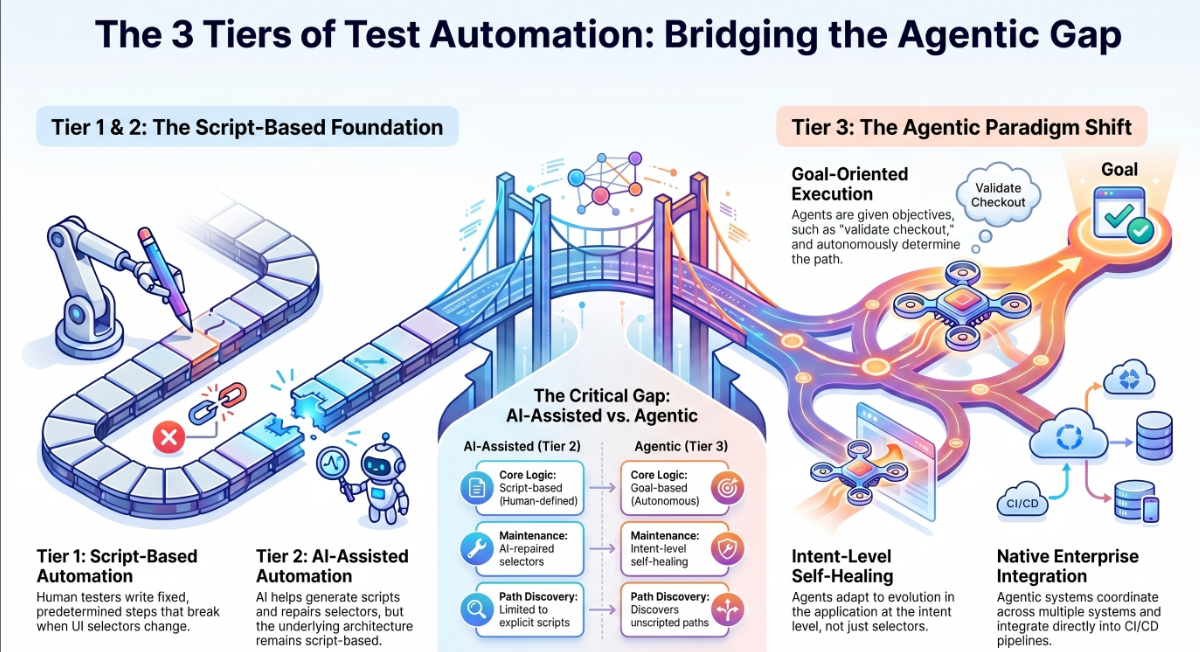
There are three meaningful tiers:
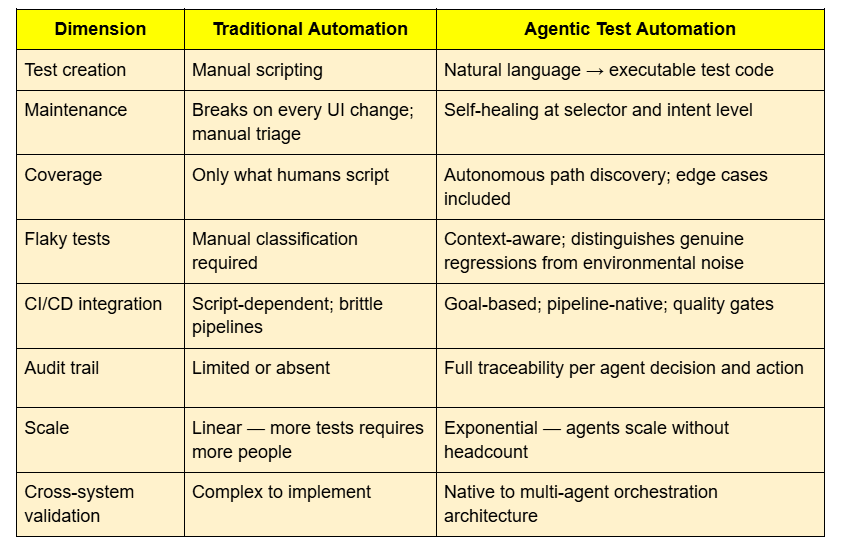
Script-based automation — the traditional model. Human testers write test scripts that follow fixed, predetermined steps. Every test is only as good as what a human thought to write. UI changes break selectors. Coverage only covers what was explicitly scripted.
AI-assisted automation — a smarter version of the above. AI helps generate scripts, suggests test cases, and sometimes repairs broken selectors. But humans still define every test step. The underlying architecture is still script-based. When the application changes significantly, maintenance burden returns.
Agentic test automation — a genuinely different paradigm. AI agents test by goal, not by script. They are given an objective ("validate the checkout workflow") and autonomously determine how to accomplish it, adapting their approach as the application evolves. They discover paths no human scripted. They self-heal when interfaces change — not just at the selector level, but at the intent level. They coordinate across multiple systems, produce audit-traceable records, and integrate natively into CI/CD pipelines.
The gap between "AI-assisted" and "agentic" is the gap that matters for enterprise teams. Most tools marketed as AI-powered testing in 2026 are still operating in the second tier. True agentic testing is the third tier, and it requires a different architecture — not a GPT wrapper on top of a traditional framework.
Why Traditional Test Automation Breaks at Enterprise Scale
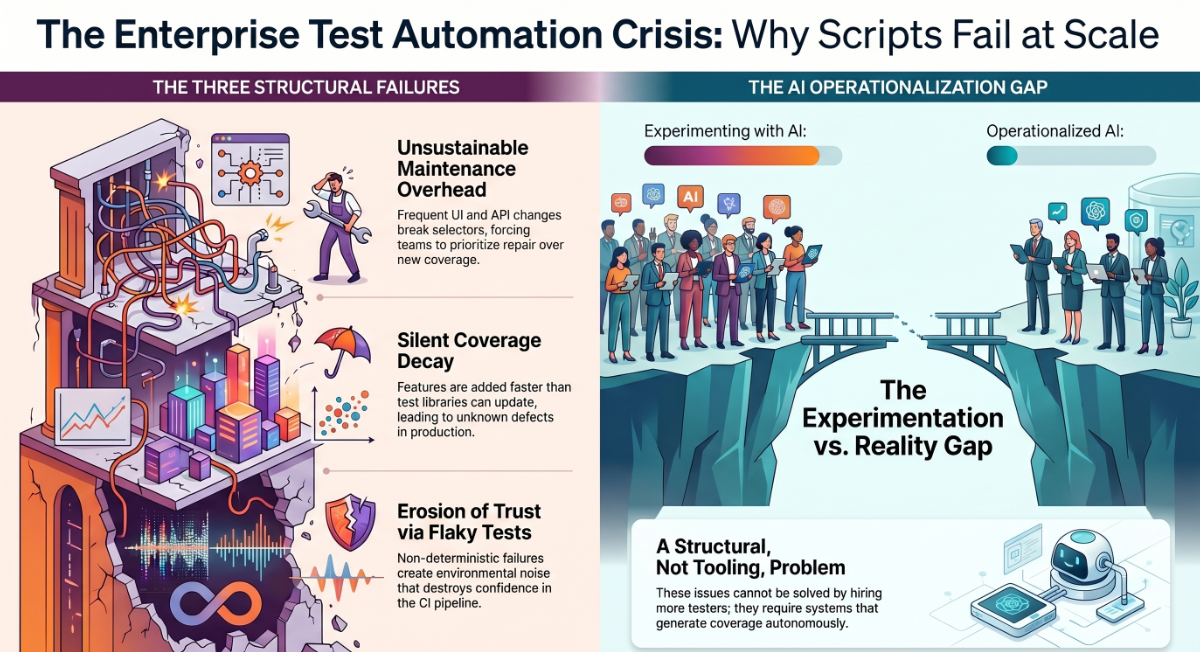
Three problems compound at enterprise scale in ways that smaller teams rarely encounter at the same intensity.
Maintenance overhead. Enterprise applications change constantly — new features, UI redesigns, API updates, third-party integrations. Every change breaks selectors. Every broken selector requires manual triage. Engineering teams report spending a significant portion of their testing capacity not on new coverage, but on repairing tests that worked last sprint. This is not a tooling problem. It is a structural problem with script-based architecture.
Coverage decay. At the pace modern enterprise development moves, features are added faster than test libraries are updated. Coverage gaps widen silently. Teams do not know what they are not testing until a defect escapes to production. By then, the cost — in customer trust, revenue, and regulatory exposure — is already incurred.
Flaky test failures. Non-deterministic test failures are one of the most expensive hidden costs in enterprise QA. Teams spend hours distinguishing genuine regressions from environmental noise. CI pipelines lose credibility when false positives are common. Confidence in the test suite erodes, which leads to fewer tests being written, which widens coverage gaps further.
These three problems are structural. They cannot be solved by writing more scripts or hiring more testers. They require a different kind of system — one that understands application intent, adapts to change, and generates coverage autonomously.
Nearly nine in ten organisations are now experimenting with AI in their quality engineering workflows. Fewer than one in seven have operationalized it. The gap between experimenting and operationalizing is not a technology gap. It is an architecture and governance gap — and that is exactly what this guide addresses.
How AI Agents Solve These Problems
Self-Healing That Goes Beyond Selectors
Most platforms market "self-healing" as a feature. What they mean is that when a CSS selector breaks — a renamed class, a moved element, a restructured form — the tool detects and repairs the reference automatically. This is useful. It is also table stakes in 2026, and it is not sufficient for enterprise applications.
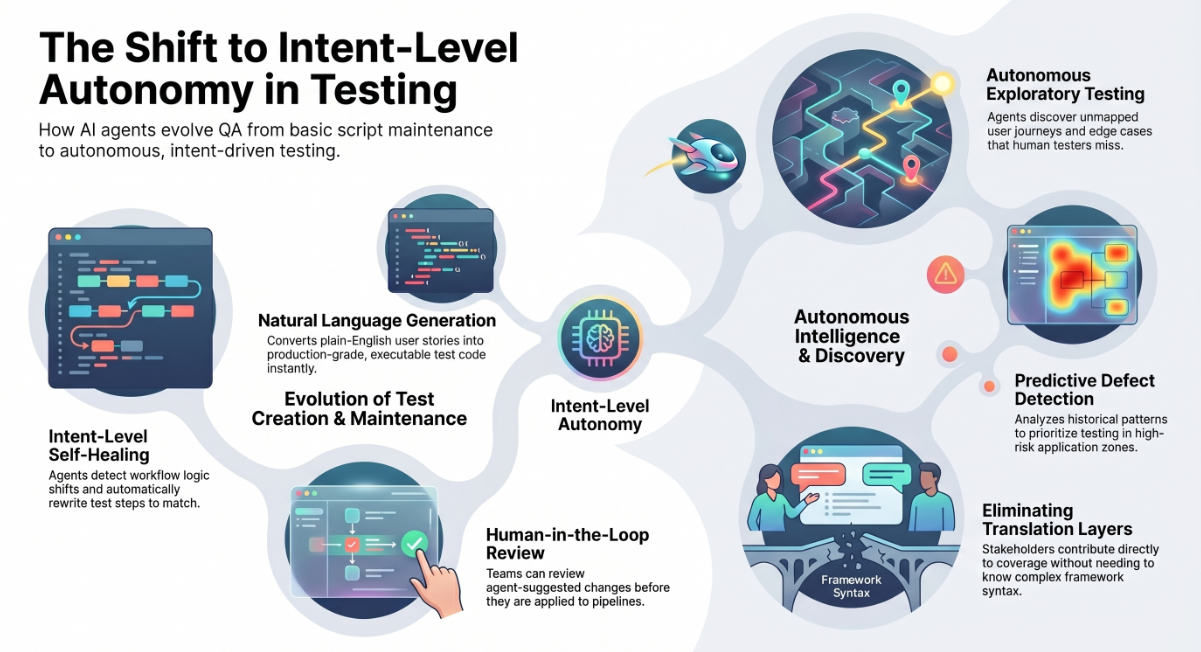
True intent-level self-healing is something different. When an application flow changes — not just a UI element, but the logic or sequence of a workflow — an intent-level agent detects that the purpose of a test step has shifted and rewrites the test to match the new behaviour. A supervised autonomy model allows teams new to agentic testing to review agent-suggested changes before they are applied. Mature teams can unlock fully autonomous pipelines where no human intervention is required.
The question to ask any vendor: does your self-healing work at the selector level, or at the intent level? The latter is far rarer and far more powerful.
Autonomous Exploratory Testing
One of the most compelling capabilities of agentic testing systems is their ability to discover what human testers never thought to test. A traditional test suite walks the paths a tester documented. An autonomous agent explores the application, finds edge cases, race conditions, and multi-step user journeys that exist outside the documented happy path.
A useful illustration from enterprise deployments: teams using autonomous agents to map user journeys through complex application flows consistently find paths they were unaware of. An agent exploring navigation through a retail or e-commerce application, for instance, will often identify significantly more distinct user paths than the QA team had catalogued. Every unmapped path is a potential coverage gap and a potential production defect.
Natural Language Test Generation
AI agents convert plain-English requirements, user stories, and acceptance criteria into production-grade, executable test code. Test case authoring time collapses — from hours per scenario to minutes. More importantly, the scope of coverage expands: any stakeholder who can write a requirement can contribute to test coverage, not just the engineers who know the test framework syntax.
This matters at enterprise scale because the bottleneck in QA coverage has often been the translation layer between what product managers specify and what engineers can script. Agents eliminate that translation layer.
Predictive Defect Detection
AI agents that have access to historical test data do not just run tests — they learn from them. By analysing patterns across past test runs, they identify the areas of an application where defects are most likely to appear, allowing QA teams to prioritise coverage of high-risk zones before defects escape. This shifts QA from reactive (find defects after they occur) to proactive (anticipate where they will occur and validate there first).
How Enterprise Teams Are Using AI Agents for Test Automation — Real Deployments
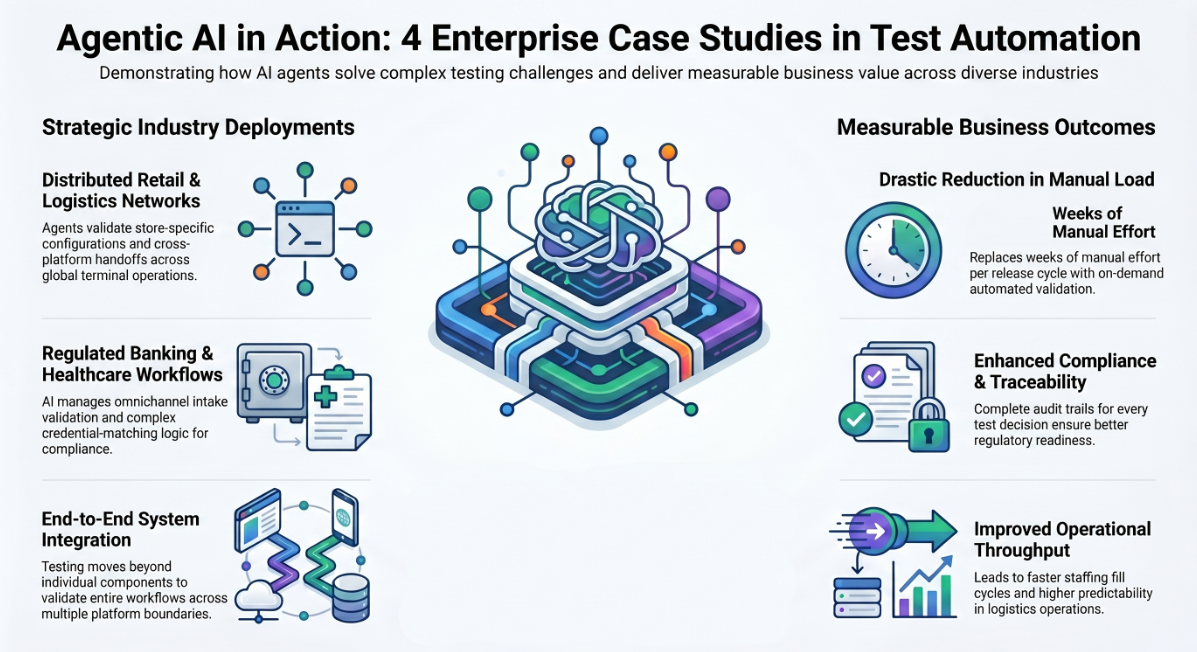
The clearest evidence for what agentic test automation can deliver in practice comes not from benchmark comparisons, but from real enterprise deployments. The following examples reflect outcomes achieved by enterprise teams across different industries. Client names are not disclosed.
National Retail Chain — Testing at Store Scale
A major national retailer operating hundreds of stores faced a testing challenge that traditional automation frameworks could not solve. Store support systems, inventory intelligence tools, and point-of-sale workflows all required continuous validation as updates rolled out across a large and distributed store network. Manual testing at that scale was not feasible. Script-based automation broke constantly as store-specific configurations introduced variation.
AI agents were deployed to automate store support workflows, inventory visibility checks, and training content validation. The agents worked across a high-volume, geographically distributed environment — validating knowledge base accuracy, testing inventory query responses, and confirming that operational updates propagated correctly across the network.
The outcomes: reduced manual helpdesk burden, faster identification of store-level issues, and on-demand validation of training content that would have required human testers to execute manually across every configuration variant.
Global Banking Platform — Omnichannel Workflow Validation
A global fintech provider serving banks and credit unions needed to validate complex omnichannel workflows — intake across chat, email, and phone — while maintaining full audit trails for regulatory compliance. The combination of multi-channel orchestration and compliance requirements made traditional automation inadequate.
AI agents were deployed to handle omnichannel intake validation, agent-assist summarisation testing, and SLA compliance monitoring. Every agent action was logged and traceable. Workflow routing logic was tested across channel combinations that would have been prohibitively expensive to cover manually.
The outcomes: faster case handling, improved consistency across tested workflow variants, reduced operational load, and demonstrably better compliance readiness through complete audit trails on all test decisions and executions.
Enterprise Logistics Group — Multi-System Integration Testing
A global ports and logistics organisation with operations spanning multiple continents needed to validate complex terminal and rail management workflows — systems that integrated across multiple platforms and had to function correctly at the handoff points between them. Integration testing at this scale, across this many system boundaries, was a persistent source of release risk.
AI agents were deployed to test terminal workflow digitisation, yard and rail operational dashboards, exception management logic, and cross-system executive reporting. The agents validated end-to-end workflows across system boundaries — not just individual components — and flagged exceptions with the context needed to diagnose root causes.
The outcomes: higher predictability of terminal-to-rail throughput, more efficient coordination across integrated systems, and improved operational visibility for leadership — all delivered through automated validation that would have taken weeks of manual effort per release cycle.
Healthcare Staffing Platform — Compliance and Scheduling Workflow Testing
A healthcare staffing platform connecting nursing professionals with facilities for flexible shifts required rigorous validation of credential capture workflows, shift-matching logic, compliance checks, and scheduling notifications. In a regulated healthcare environment, failures in any of these workflows carried direct regulatory and patient-safety implications.
AI agents were deployed to test talent onboarding flows, credential validation logic, facility staffing request intake, matching and scheduling workflows, and compliance reporting. The agents validated edge cases in credential state combinations that manual testers had not fully catalogued.
The outcomes: faster fill cycles, lower scheduling friction, better workforce utilisation, and measurably improved staffing responsiveness — all underpinned by comprehensive automated validation of compliance-critical workflows.
Types of AI Agents Used in Enterprise Test Automation
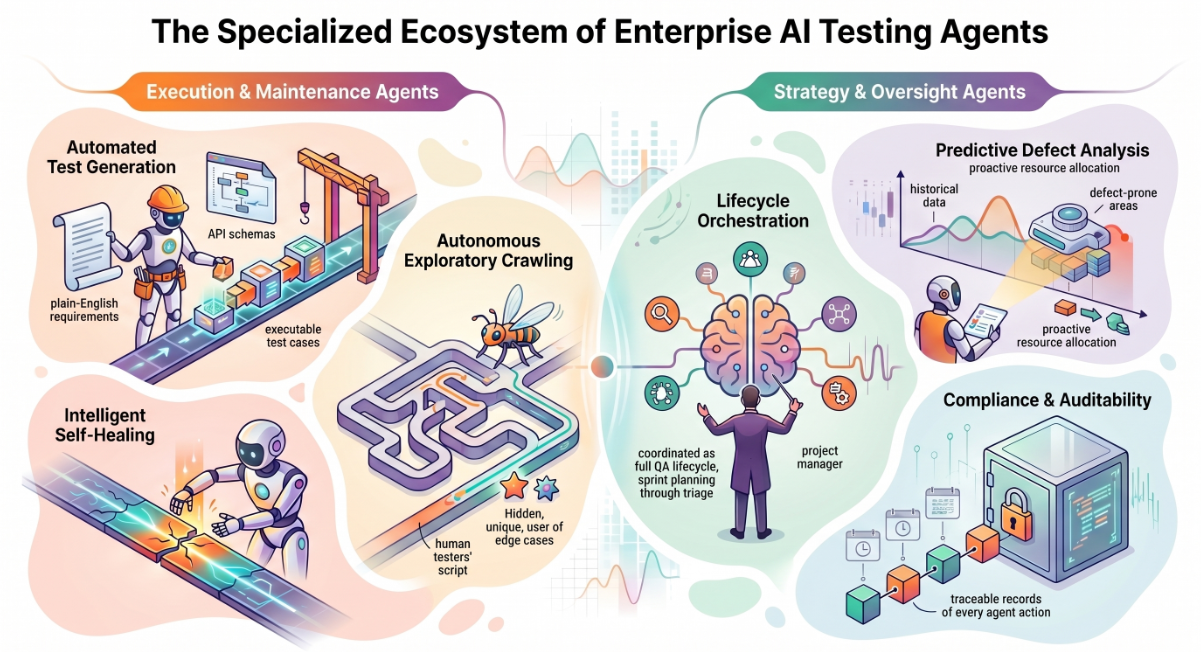
Modern enterprise testing stacks in 2026 use multiple types of specialised agents, often orchestrated together across a full QA lifecycle. Understanding what each type does helps engineering leaders evaluate platforms and design deployment architectures.
Test generation agents take plain-English requirements, user stories, acceptance criteria, and API schemas and convert them into executable test cases. They reduce authoring time dramatically and expand the scope of who can contribute to coverage.
Self-healing agents monitor tests in execution, detect when application changes break existing tests, and repair them — either at the selector level (basic) or at the intent level (advanced). Teams should evaluate whether the platform's self-healing works only when UI elements move, or also when workflow logic changes.
Exploratory agents crawl application surfaces autonomously, discovering user paths, edge cases, and workflow variants that human testers did not script. They are particularly valuable for applications with large or frequently changing surface areas.
Defect prediction agents analyse historical test run data to identify patterns associated with defect-prone areas. They allow QA leads to allocate coverage resources proactively, before defects escape.
Orchestration agents coordinate multiple specialised agents across a full testing lifecycle — from sprint planning and test generation, through execution and triage, to reporting and maintenance. The QA lifecycle equivalent of a project manager.
Compliance and audit agents produce traceable records of every test decision, every agent action, and every result. In regulated industries — financial services, healthcare, public infrastructure — these are not optional features. They are architectural requirements.
Integrating AI Testing Agents into Your Enterprise CI/CD Pipeline
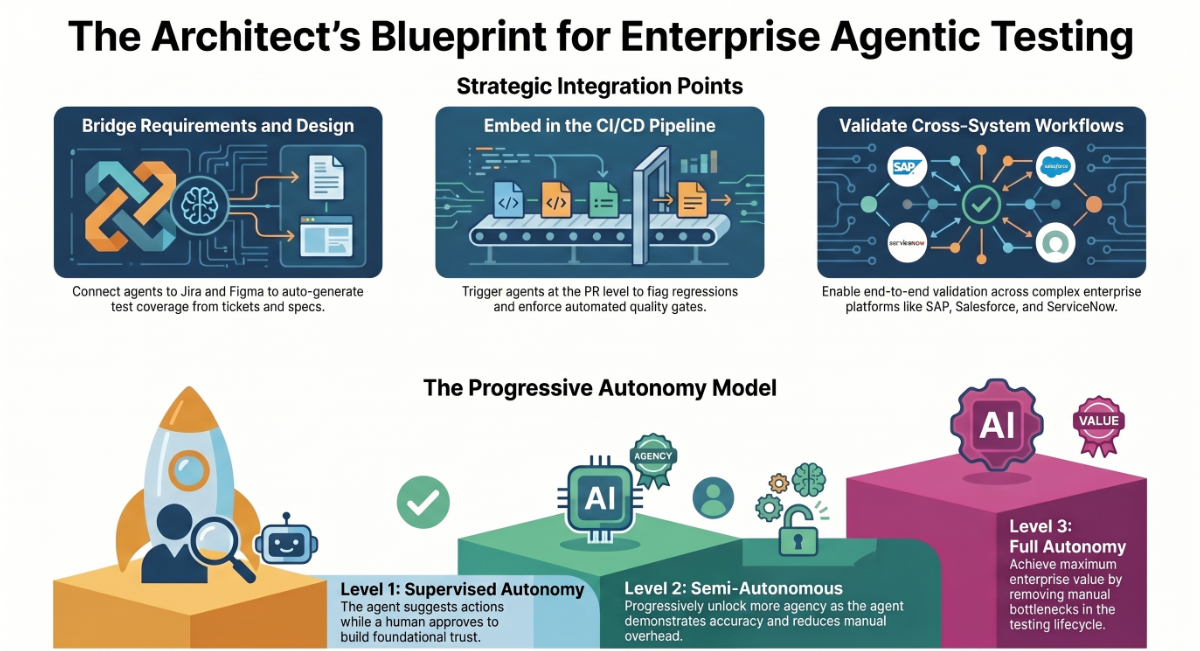
An AI testing agent that lives outside your existing toolchain will be treated as a side project. Integration is not an optional enhancement — it is the condition under which agentic testing delivers value at enterprise scale.
The critical integration points are:
Issue tracking (Jira, Azure DevOps) — agents that read sprint tickets, user stories, and acceptance criteria to automatically generate test coverage plans. The feedback loop from production defects to updated test coverage should be closed automatically, not manually.
Design tools (Figma) — in modern product development, acceptance criteria live in design files before they live anywhere else. Agents that read design specs and generate test cases from them close the gap between design intent and coverage.
Code repositories (GitHub, GitLab, Bitbucket) — agents triggered by pull requests, generating test cases for changed code paths and flagging regressions before merges.
CI/CD platforms — agents embedded in build pipelines that run, heal, and report on test suites as part of every deployment workflow. Quality gates that block deployments when coverage thresholds are not met.
Existing enterprise systems — for organisations running SAP, Salesforce, ServiceNow, or similar platforms, the ability to validate end-to-end workflows across system boundaries is the capability that distinguishes enterprise-grade agentic testing from tools built for web application testing only.
A progressive autonomy model is the right deployment approach for most enterprise teams. Start with supervised autonomy — the agent suggests, a human approves. As trust in the agent's judgement builds through demonstrated accuracy, progressively unlock semi-autonomous and then fully autonomous operation. Teams that attempt to go fully autonomous from day one typically encounter trust deficits that slow adoption. Teams that never progress beyond supervised mode leave most of the value on the table.
Enterprise Buying Guide: What to Look for in an AI Testing Platform
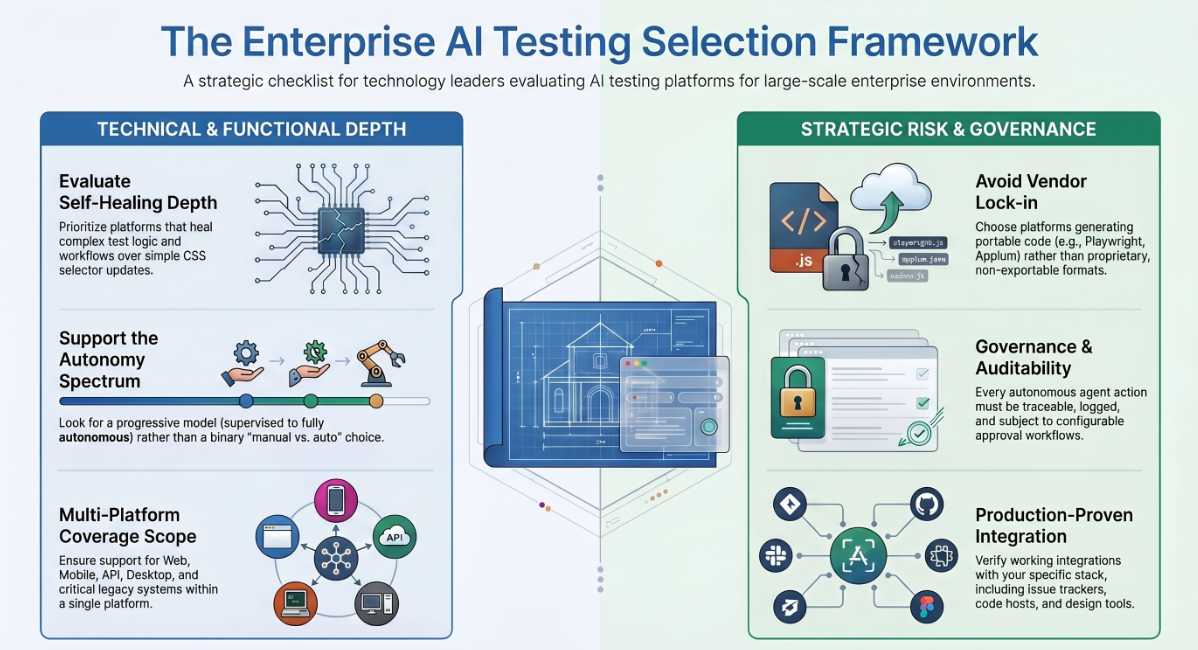
The platform landscape in 2026 is crowded and the claims are often undifferentiated. The following criteria matter specifically for enterprise deployments.
Self-healing depth. Does it heal selectors only, or does it heal test logic when workflows change? Ask for a demonstration with an application flow change, not a CSS class rename.
Test output portability. Does the platform generate standard test code (Playwright, Appium) that your team owns and can run anywhere? Or does it execute tests in a proprietary environment you cannot export from? Vendor lock-in risk is real and worth evaluating early.
Autonomy spectrum. Does the platform support a progressive model — supervised, semi-autonomous, fully autonomous — that grows with your team's confidence? Binary "manual vs autonomous" is not the right architecture for enterprise adoption.
Integration depth. Can it demonstrate production-proven integration with your specific stack? Not generic API integration claims, but working integrations with the issue trackers, design tools, code hosts, and enterprise systems you actually use.
Coverage scope. Does it cover web, mobile, API, and desktop — including any legacy systems your stack depends on? Single-platform coverage is a significant gap for most enterprise application environments.
Governance and auditability. Every agent action should be logged. Every test decision should be traceable. Approval workflows for autonomous actions should be configurable. In regulated industries, this is non-negotiable.
Vendor lock-in risk. If you decide to move to a different platform in two years, what happens to your tests? Platforms that own your test code in proprietary formats create dependency. Platforms that generate portable code you can take with you present far less risk.
AI Agents vs Traditional Test Automation — Head-to-Head
From Experimenting to Operationalizing: The 2026 Gap
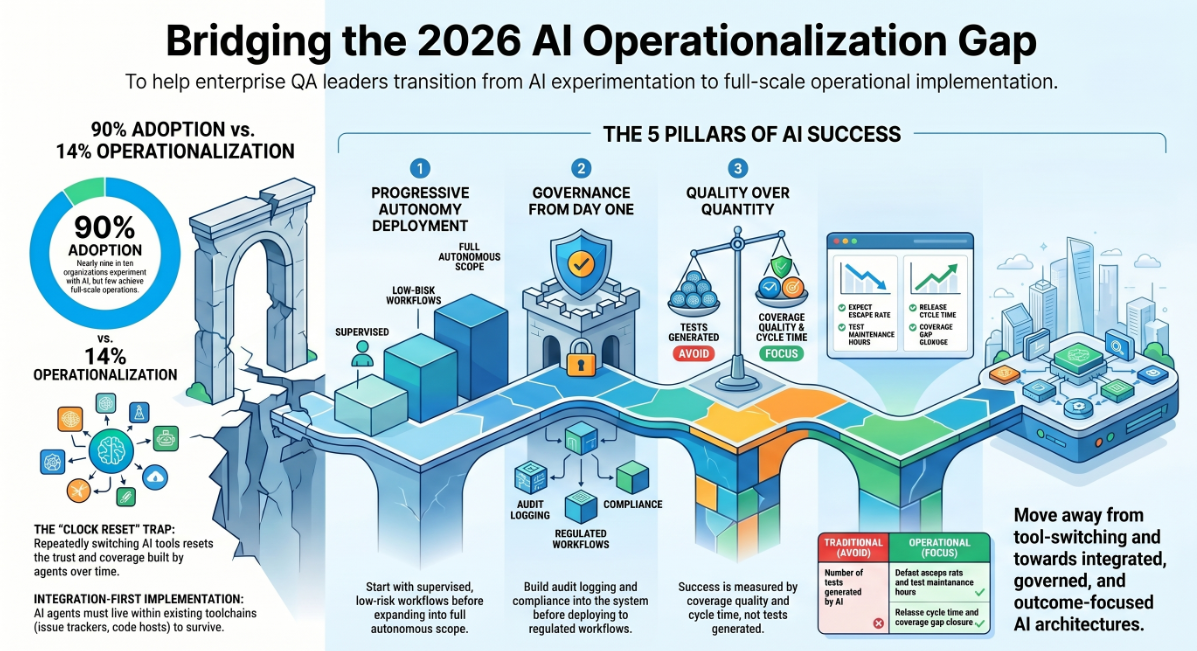
Nearly nine in ten organisations are doing something with AI in quality engineering. Fewer than one in seven have made it operational at scale. This is the defining challenge of 2026 in enterprise QA — not adoption, but operationalization.
The organisations that have crossed that line share five characteristics.
Stable platform choice. They stopped switching tools when something new launched. Topical consistency matters in agentic deployment exactly as it does in search authority — repeated pivots reset the clock on trust and coverage built by the agents over time.
Progressive autonomy deployment. They started supervised, proved accuracy in low-risk workflow areas, earned stakeholder trust, then progressively expanded autonomous scope. They did not attempt full autonomy on day one.
Integration-first implementation. They connected agents to the systems their teams actually use — issue trackers, design tools, code hosts — before expanding the agents' surface area. Agents that live outside the toolchain get treated as optional extras and eventually abandoned.
Governance from day one. They implemented audit logging, approval workflows, and compliance reporting before deploying agents to regulated workflows, not after. Retrofitting governance to autonomous systems is significantly harder than building it in from the start.
Outcome-oriented measurement. They track the metrics that reveal actual progress: defect escape rate, test maintenance hours per sprint, release cycle time, and coverage gap closure rate. Not the number of tests generated. The quality of the coverage.
Teams that are still experimenting in 2026 are often stuck at one of these five transition points — and each one is solvable with the right architecture and platform choice.
How Assistents Brings AI Testing Agents to Enterprise Production
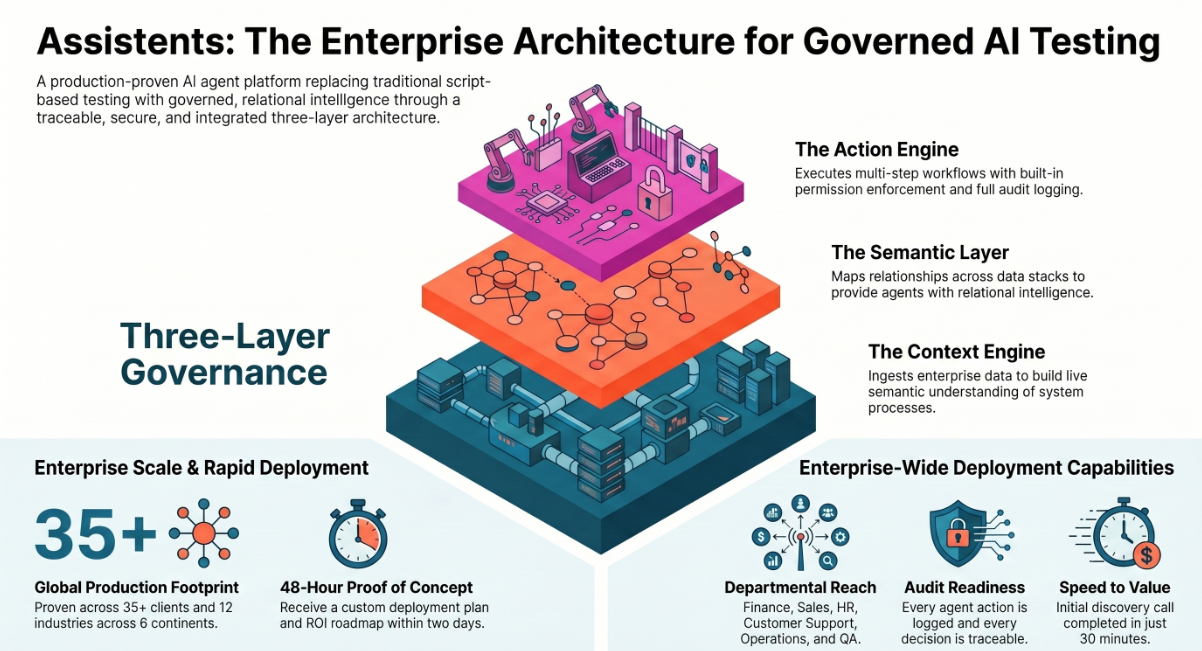
Assistents is the enterprise AI agent platform built by Ampcome — production-proven across 35+ clients in 12 industries and 6 continents. The platform deploys governed AI agents across every enterprise department, including QA and testing workflows, with a three-layer architecture designed specifically for enterprise-scale deployment.
The Context Engine ingests data from enterprise applications and builds a live semantic understanding of your systems, processes, and documents — so agents test with real knowledge of how your application is supposed to work, not just what a script tells them to do.
The Semantic Layer maps relationships across enterprise data — connecting systems, workflows, test cases, and defect histories — so agents reason with relational intelligence across your entire stack, not just within isolated applications.
The Action Engine executes multi-step workflows across systems with full permission enforcement. Every agent action is logged. Every test decision is traceable. Approval workflows are configurable. Governance is built into the architecture, not added as a feature layer on top of it.
Assistents deploys across Finance, Sales, Customer Support, HR, Operations, and QA workflows — connected to your systems, reasoning through your workflows, executing with full audit trails.
A proof of concept can be operational within 48 hours. The process starts with a 30-minute discovery call — bring the workflow that frustrates your QA team the most. Within 48 hours, you receive a custom deployment plan with integration requirements, ROI projections, and a roadmap.
The Bottom Line
The gap between development velocity and QA coverage is real, it is growing, and it will not close with more scripts or more testers. AI agents for test automation are the proven architecture for closing it — not as a future capability, but as a production-deployed reality across enterprise teams in every major industry.
The teams winning in 2026 are not the ones with the most QA engineers writing the most scripts. They are the ones whose agents discover, generate, execute, heal, and audit — continuously, at scale, across every system their applications touch.
The question for enterprise engineering leaders is not whether to deploy AI testing agents. It is whether to start now or six months from now — and what that delay costs in defects escaped, coverage gaps widened, and maintenance hours spent on work that agents could do automatically.
Ready to see how Assistents deploys agentic test automation in your enterprise environment? Start with a 30-minute discovery call at assistents.ai. Describe your most painful QA workflow. Receive a custom deployment plan with integration requirements and ROI projections within 48 hours.
FAQs
What are AI agents for test automation?
AI agents for test automation are autonomous software systems that generate, execute, heal, and orchestrate tests without requiring human-written scripts. Unlike traditional automation, they test by goal — adapting to application changes, discovering untested paths, and producing audit-traceable records of every decision. They are the third and most capable tier of automation architecture, above script-based and AI-assisted approaches.
What is the difference between AI agents and traditional test automation?
Traditional automation follows brittle, human-written scripts that break when applications change. AI agents test by intent — they understand what a workflow is supposed to accomplish, adapt when the application changes, and autonomously discover edge cases and user journeys that no script ever covered. The maintenance model is fundamentally different: scripts require constant human repair; agents self-heal.
Can AI agents replace manual QA testers?
AI agents automate the repetitive and high-volume work in QA — regression testing, smoke testing, maintenance triage, coverage gap analysis. Human testers remain essential for strategic quality engineering, complex judgment-based testing, and stakeholder communication. The role evolves from script maintenance to quality architecture and oversight. Teams that have deployed agentic testing do not reduce QA headcount — they redeploy it toward higher-value work.
How do you integrate AI testing agents into a CI/CD pipeline?
Integration requires connecting agents to your issue tracker (for requirement-to-test generation), your design tools (for spec-to-test generation), your code repository (for change-triggered test execution), and your CI/CD platform (for pipeline-native quality gates). The key evaluation criterion is whether integration is production-proven for your specific stack, not whether the vendor claims generic API connectivity.
How long does it take to deploy AI agents for test automation in an enterprise environment?
With the right platform, a proof of concept on a specific workflow can be operational within 48 hours. Full production deployment — with governance, audit trails, CI/CD integration, and cross-system coverage — typically takes two to four weeks depending on stack complexity. Teams should expect a progressive ramp: supervised autonomy in the first weeks, expanding to semi-autonomous and fully autonomous as accuracy is demonstrated and stakeholder trust is established.
What is self-healing test automation?
Self-healing test automation refers to a testing system's ability to detect and repair broken tests automatically when the application changes — without human intervention. Basic self-healing repairs broken CSS selectors and element references. Intent-level self-healing, offered by more advanced agentic platforms, detects changes in application workflow logic and rewrites the test to match the new behaviour — not just the new element location.
How do AI agents handle compliance and audit requirements in regulated industries?
Enterprise-grade agentic testing platforms produce a complete audit trail of every agent action, every test decision, and every result. Approval workflows allow human review of agent actions before execution in sensitive workflows. Compliance reporting surfaces test outcomes in the format required by regulatory frameworks. In financial services, healthcare, and public infrastructure deployments, this audit architecture is the condition under which automated testing can be approved for use on compliance-critical workflows.

Transform Your Business With Agentic Automation
Agentic automation is the rising star posied to overtake RPA and bring about a new wave of intelligent automation. Explore the core concepts of agentic automation, how it works, real-life examples and strategies for a successful implementation in this ebook.
Sarfraz Nawaz is the CEO and founder of Ampcome, which is at the forefront of Artificial Intelligence (AI) Development. Nawaz's passion for technology is matched by his commitment to creating solutions that drive real-world results. Under his leadership, Ampcome's team of talented engineers and developers craft innovative IT solutions that empower businesses to thrive in the ever-evolving technological landscape.Ampcome's success is a testament to Nawaz's dedication to excellence and his unwavering belief in the transformative power of technology.

More insights
Discover the latest trends, best practices, and expert opinions that can reshape your perspective







Contact us

