
.jpg)
The Best AI Agents for Software Development in 2026 (With Real-World Results)


Software development teams in 2026 are no longer just using AI as a copilot for writing lines of code. The shift is deeper. Agentic AI — systems that don't just suggest but actually plan, execute, and adapt across complex multi-step workflows — is quietly becoming the backbone of how modern engineering teams build, test, deploy, and operate software at scale.
If you are searching for the best AI agents for software development, this guide covers exactly what they are, which use cases they are delivering measurable results in, how real enterprise teams are deploying them, and how to choose the right agentic AI platform for your organisation.
The market signal is hard to ignore: Gartner predicts that 40% of enterprise applications will feature embedded AI agents by the end of 2026, and the global agentic AI market is projected to reach $47.8 billion by 2030 at a compound annual growth rate of 61.5%. Engineering teams that figure out how to deploy these systems well are compressing timelines, reducing manual overhead, and building software operations that scale without proportionally scaling headcount.
What Are AI Agents for Software Development?
An AI agent is not a chatbot. It is not an autocomplete engine. An AI agent is a system that perceives its environment, sets goals, plans a sequence of actions, executes those actions — often across multiple tools and systems — and adjusts based on what it observes along the way.
In a software development context, this means an AI agent can do things like ingest a requirements document, identify gaps, generate code, run tests, flag exceptions, create a pull request, and route the output to the right human reviewer — all within a governed, auditable workflow.
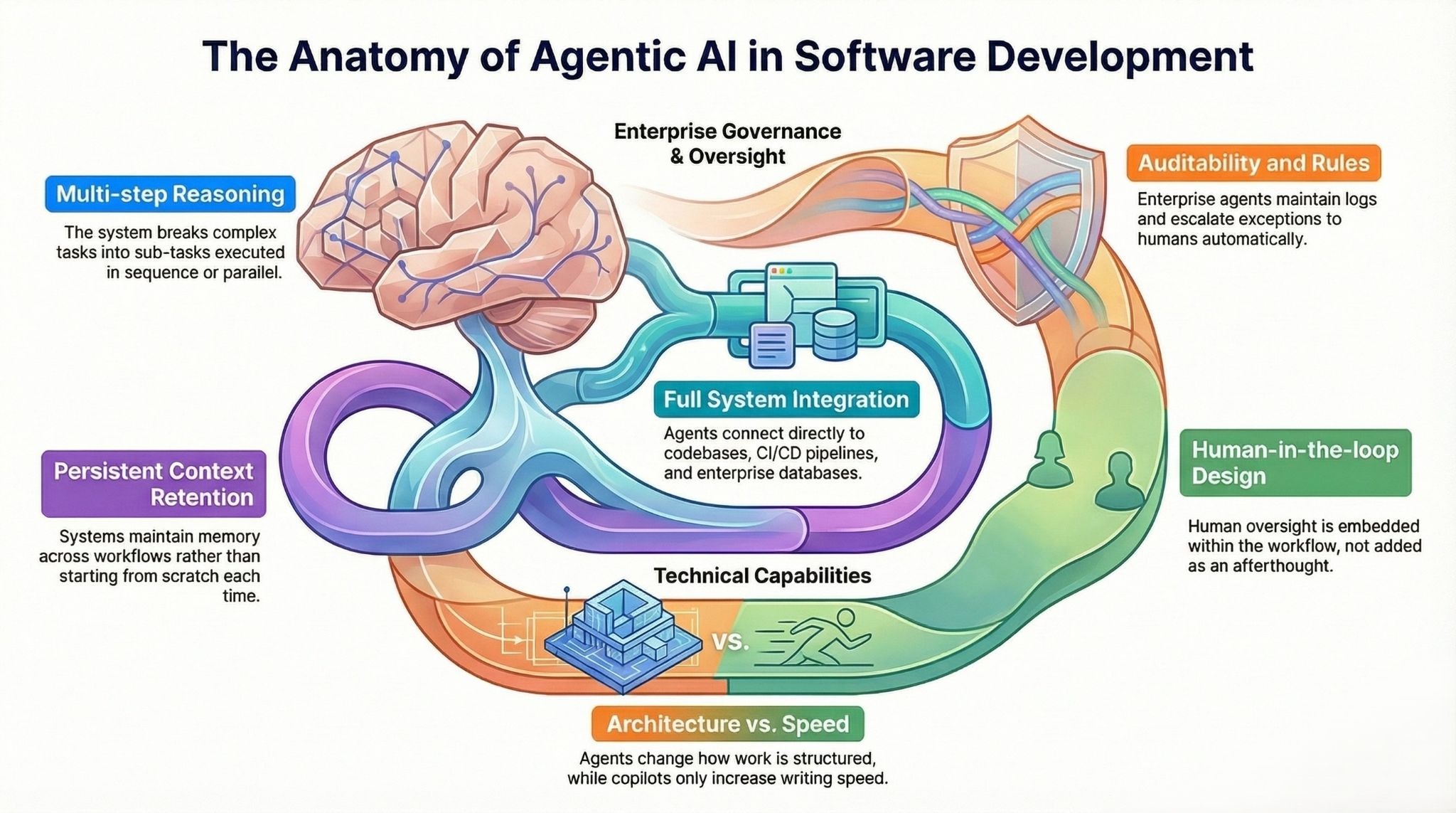
The key characteristics that define a true agentic AI system for software development are:
Multi-step reasoning — the agent breaks a complex task into sub-tasks and executes them in sequence or in parallel, not just responding to a single prompt.
Tool use and system integration — the agent can connect to real systems: your codebase, your CI/CD pipeline, your CRM, your ERP, your databases. It does not operate in isolation.
Memory and context retention — unlike a stateless LLM call, a well-built agent maintains context across a workflow, so it does not start from scratch on every step.
Governance and auditability — enterprise-grade agents maintain logs, follow rules, and escalate to humans when exceptions occur. This is non-negotiable for production software environments.
Human-in-the-loop design — the best agentic systems are not fully autonomous. They know when to act and when to hand off, keeping human oversight embedded in the workflow rather than bolted on as an afterthought.
The distinction between agentic AI and a simple AI assistant matters enormously for software teams. A copilot helps you write faster. An agent changes the architecture of how work gets done.
Why Software Teams Are Adopting AI Agents in 2026
Three forces are converging to make 2026 the inflection point for agentic AI adoption in software development.
The complexity ceiling on manual operations. Modern software systems — microservices architectures, multi-cloud deployments, real-time data pipelines, cross-system integrations — have become too complex for manual monitoring and management to keep pace. The surface area of a production software system is simply too large for human teams to cover comprehensively without automation that thinks, not just triggers.
The maturity of LLM-backed tool use. Large language models have crossed a capability threshold where they can reliably reason over code, documentation, API specifications, and system logs with enough accuracy to be trusted in production workflows — particularly when wrapped in governance layers that catch and route exceptions.
The economics of scaling software operations. Hiring engineering headcount to match the scale of modern software operations is not economically viable for most organisations. AI agents offer a path to scaling output — code review coverage, test coverage, deployment monitoring, incident triage — without a proportional increase in cost.
The result is that forward-thinking engineering organisations are not asking whether to adopt agentic AI. They are asking which workflows to automate first and how to govern the agents reliably.
The Best AI Agents for Software Development (By Use Case)
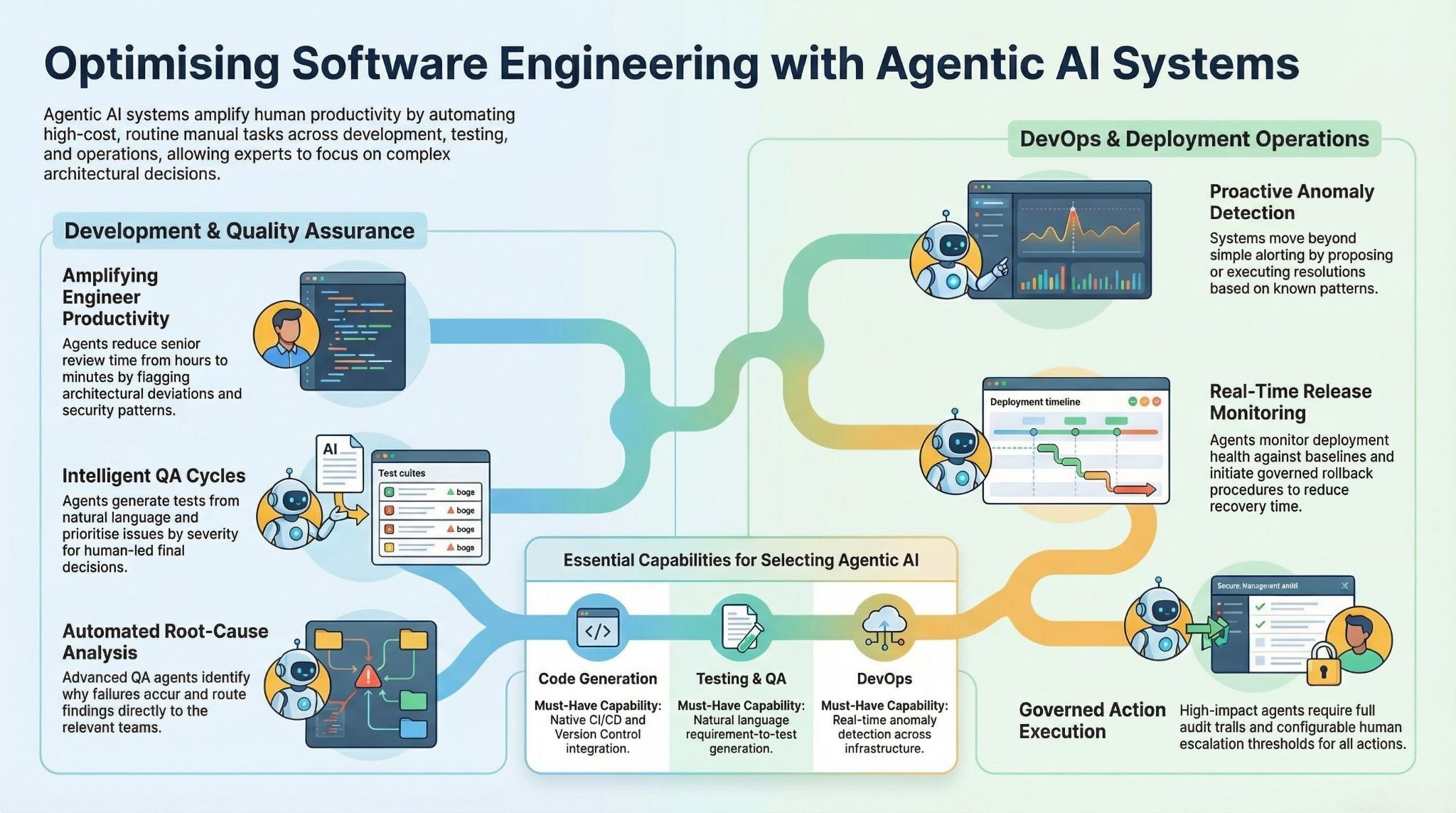
The most effective approach to deploying AI agents in a software development environment is to start with the use cases where the cost of manual work is highest and the workflow is structured enough for an agent to operate reliably. Here are the highest-impact categories.
Code Generation and Review Agents
Code generation agents in 2026 go well beyond writing boilerplate. The most capable systems can ingest a requirements document or a technical specification, generate code across multiple files, check that output against existing codebase conventions, flag potential conflicts, and produce a structured summary for a human reviewer.
For review workflows, agentic systems can scan pull requests against defined rule sets, identify security anti-patterns, flag deviations from architectural standards, and generate structured review comments — compressing the time a senior engineer needs to spend on routine review work from hours to minutes.
The highest-value deployment pattern here is not replacing engineers but amplifying them. A code generation agent handles the first draft and the routine review; the human engineer focuses on the architectural decisions and edge cases that genuinely require judgement.
Key capabilities to look for in a code generation agent:
- Native integration with your version control system and CI/CD pipeline
- Configurable rule sets that reflect your codebase's specific conventions
- Audit logs on every generation and review decision
- Human escalation paths built into the workflow, not added after the fact
Testing and QA Agents
Manual QA is one of the highest-cost, most time-consuming activities in a software development lifecycle, and it is one of the areas where agentic AI is delivering the most measurable results.
A testing agent can generate test cases from requirements or from existing code, execute tests, analyse failures, identify root causes, prioritise issues by severity, and route findings to the appropriate team — all within a governed workflow that keeps a human in control of final decisions.
The most sophisticated QA agents are not limited to unit tests. They can operate across integration testing, regression testing, and performance testing scenarios, adapting their testing strategy based on what they observe in the codebase and the failure patterns they detect.
Real outcomes from teams using AI QA agents include significantly reduced regression cycles, earlier detection of edge-case failures, and a shift in QA engineer time from execution to analysis — which is where human judgement creates the most value.
Key capabilities to look for in a testing and QA agent:
- Ability to generate tests from natural language requirements, not just existing code
- Root-cause analysis built into the failure reporting workflow
- Integration with your issue tracking system for automatic ticket creation
- Coverage analytics that identify gaps in the existing test suite
DevOps and Deployment Agents
The operational surface of a modern software deployment is vast: infrastructure health, deployment pipelines, service dependencies, incident detection, rollback decisions, on-call routing. DevOps agents are designed to operate continuously across this surface — monitoring, alerting, triaging, and in some cases acting — in ways that would require a much larger human team to replicate manually.
The highest-impact DevOps agent deployments combine anomaly detection with agentic response. The agent does not just alert a human that something is wrong; it analyses what is wrong, checks against known resolution patterns, proposes or executes a resolution, and logs everything for review. The human engineer reviews the action rather than diagnosing the problem from scratch.
For deployment workflows specifically, agents can monitor release health in real time, compare performance metrics against baselines, flag regressions, and in governed environments initiate rollback procedures — compressing the mean time to recovery for deployment-related incidents significantly.
Key capabilities to look for in a DevOps agent:
- Real-time anomaly detection across infrastructure and application metrics
- Integration with your incident management and on-call systems
- Governed action execution — agents that can act, not just alert, with full audit trails
- Configurable escalation thresholds so the agent knows when to act and when to wake a human
Real-World Results: AI Agents in Software and Tech Environments
The clearest signal that agentic AI is production-ready for software development teams is not benchmarks or demos. It is results from real enterprise deployments. The following examples are drawn from live implementations across technology-intensive organisations.
Trading platform engineering — multi-agent orchestration for research and execution
A technology-first trading platform needed to coordinate research, market signal analysis, strategy simulation, and execution across a single workflow without requiring manual handoffs between systems. The solution was a network of specialised AI agents — one handling market data ingestion and indicator analysis, one running strategy simulation with configurable risk guardrails, one generating alerting and recommendation summaries, and one handling execution-ready workflow integration.
The result was a system where fragmented market signals that previously required hours of manual synthesis were processed and acted upon within minutes, with governed workflows that maintained human oversight at the execution stage. The agents operated continuously, not in scheduled batches — meaning the team had always-on intelligence rather than periodic reports.
Fintech platform — omnichannel AI agents with auditable workflow automation
A global financial technology provider serving banks and credit unions needed to modernise its dispute, fraud, and compliance workflows without sacrificing the auditability that regulated environments require. The deployment included omnichannel AI agents handling intake across chat, email, and phone channels, with agent-assist summarisation, next-best-action recommendations, and full audit trails built into every workflow step.
The measurable outcomes included faster case handling, significantly reduced operational load on human agents, and improved compliance readiness because every agent decision was logged and reviewable. For a software team building on top of this infrastructure, the architecture demonstrated how agentic systems can operate in high-stakes, regulated environments without compromising auditability.
Enterprise SAP automation — replacing legacy document processing with agentic AI
One of the most concrete software engineering outcomes in the case study set involved an organisation operating on SAP that needed to move away from a costly, end-of-life document processing system. The agentic solution was built to interpret order trigger documents, validate them against business rules, and automatically create SAP Sales Orders — a workflow that had previously required manual data entry and was prone to errors and delays.
The results were measurable on multiple dimensions: reduced manual order processing, a faster order-to-confirm cycle with fewer data-entry errors, improved auditability for sales order creation and exceptions, and elimination of dependency on a high-cost legacy licensing environment. This is the kind of outcome that resonates with engineering leaders: a tangible reduction in technical debt, a faster process, and a system that is more auditable than the one it replaced.
Smart infrastructure software — agentic analytics on top of existing systems
A smart infrastructure operation running at city scale — managing thousands of connected assets and applications — needed intelligence on top of its existing software stack without replacing it. The deployment was an agentic analytics layer that connected to existing dashboards and data systems, applied semantic governance rules to ensure consistent metric definitions, and provided a natural language query interface so that non-technical operators could get governed answers without going through a BI queue.
The outcome was a shift from reactive reporting to proactive execution loops. Instead of operators waiting for a weekly report, the agent continuously monitored the system, surfaced exceptions in real time, and in governed cases initiated automated resolution workflows. For software teams, the lesson here is architectural: the most practical agentic deployments do not replace existing systems; they add an intelligent orchestration layer on top of them.
Document intelligence for complex technical workflows
An engineering and technical services organisation operating on large, complex tender documents needed to dramatically reduce the time and risk associated with bid preparation. The agentic solution included multi-agent orchestration for tender retrieval, workflow determination, and revision analysis, with vision-capable LLM extraction from complex PDF formats and deep integration into the core project management system.
The target outcomes were up to 90% faster tender document processing and a 95% extraction accuracy rate for standard formats — with revision and change detection built in to reduce bid risk. For software teams who work with large volumes of structured and semi-structured documents, this use case illustrates the practical ceiling of what a well-governed document intelligence agent can achieve.
How to Choose the Right AI Agent Platform for Your Dev Team
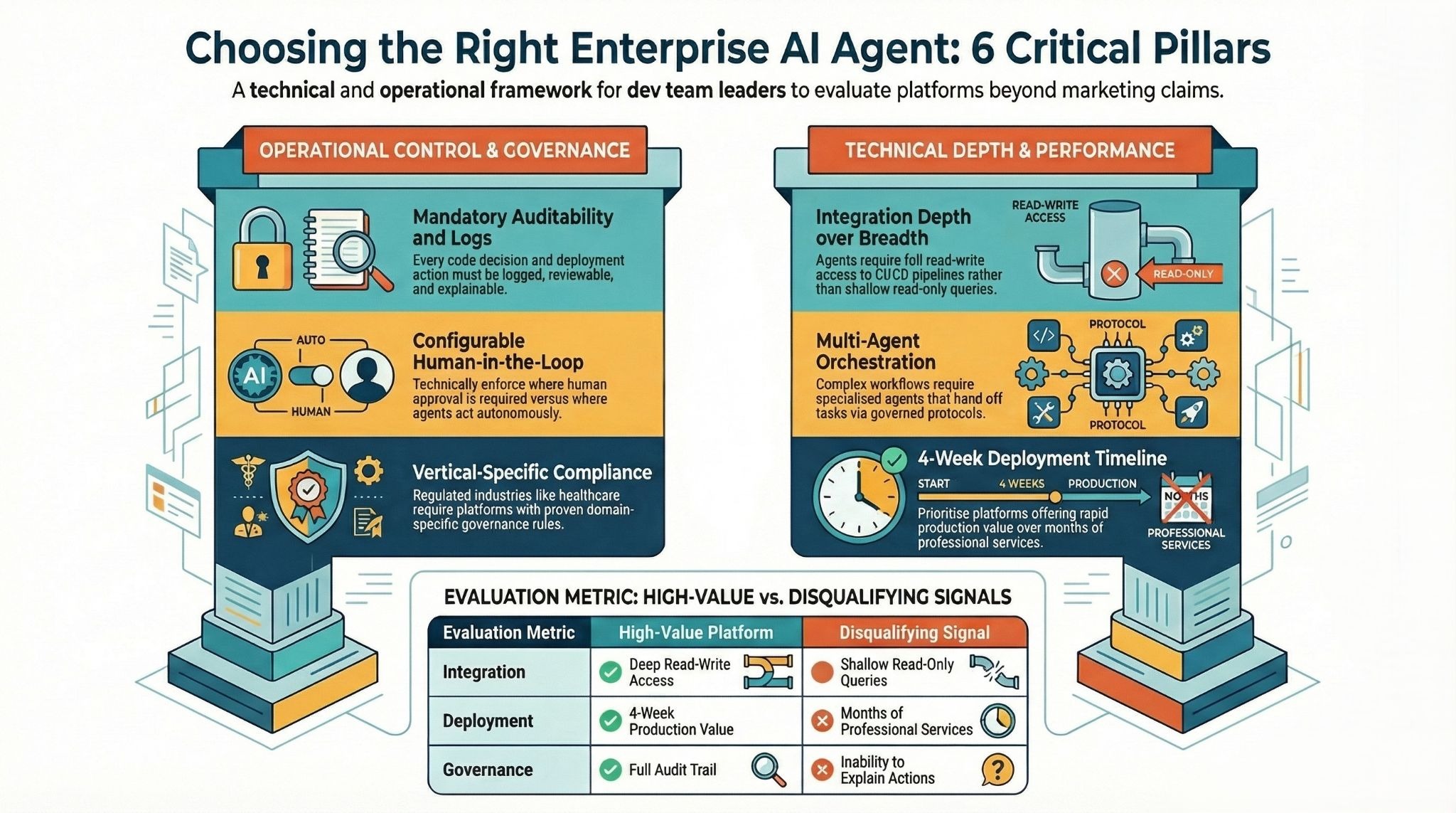
The number of vendors claiming to offer enterprise agentic AI has grown rapidly. Evaluating them requires moving past the marketing language and asking the right technical and operational questions.
Governance and auditability first. In a software development context, an agent that acts without a complete audit trail is a liability, not an asset. Every action the agent takes — every code generation decision, every test it runs, every deployment action it initiates — should be logged, reviewable, and explainable. If a vendor cannot clearly articulate how their governance layer works, that is a disqualifying signal.
Integration depth, not breadth. Many platforms advertise hundreds of integrations. What matters is not the count but the depth. Does the agent have full read-write access to your actual systems, or is it limited to read-only queries? Can it take actions in your CI/CD pipeline, your issue tracker, your deployment infrastructure? Shallow integrations produce agents that surface information but cannot act — which misses the point of agentic AI.
Human-in-the-loop configurability. Different workflows require different levels of automation. A code review suggestion is lower stakes than an automated rollback. The platform you choose should allow you to configure exactly where human approval is required and where the agent can act autonomously — and that configuration should be enforced technically, not just documented in policy.
Deployment speed and support model. For bootstrapped or lean engineering teams, the time from decision to production value matters enormously. Platforms that claim four-week deployment timelines for standard use cases are a meaningful differentiator versus those requiring months of professional services engagement.
Industry and use case coverage. If your software operation touches a specific vertical — financial services, healthcare, logistics, utilities — choosing a platform with proven deployments in that vertical reduces your risk significantly. Generic agentic platforms may lack the domain-specific governance rules and integration patterns that regulated environments require.
Multi-agent orchestration capability. Single-agent systems are suitable for simple, linear workflows. Complex software development operations — where research, analysis, code generation, testing, and deployment need to coordinate — require multi-agent architectures where specialised agents hand off to each other through governed protocols.
AI Agents vs. Traditional DevOps Tools: Key Differences
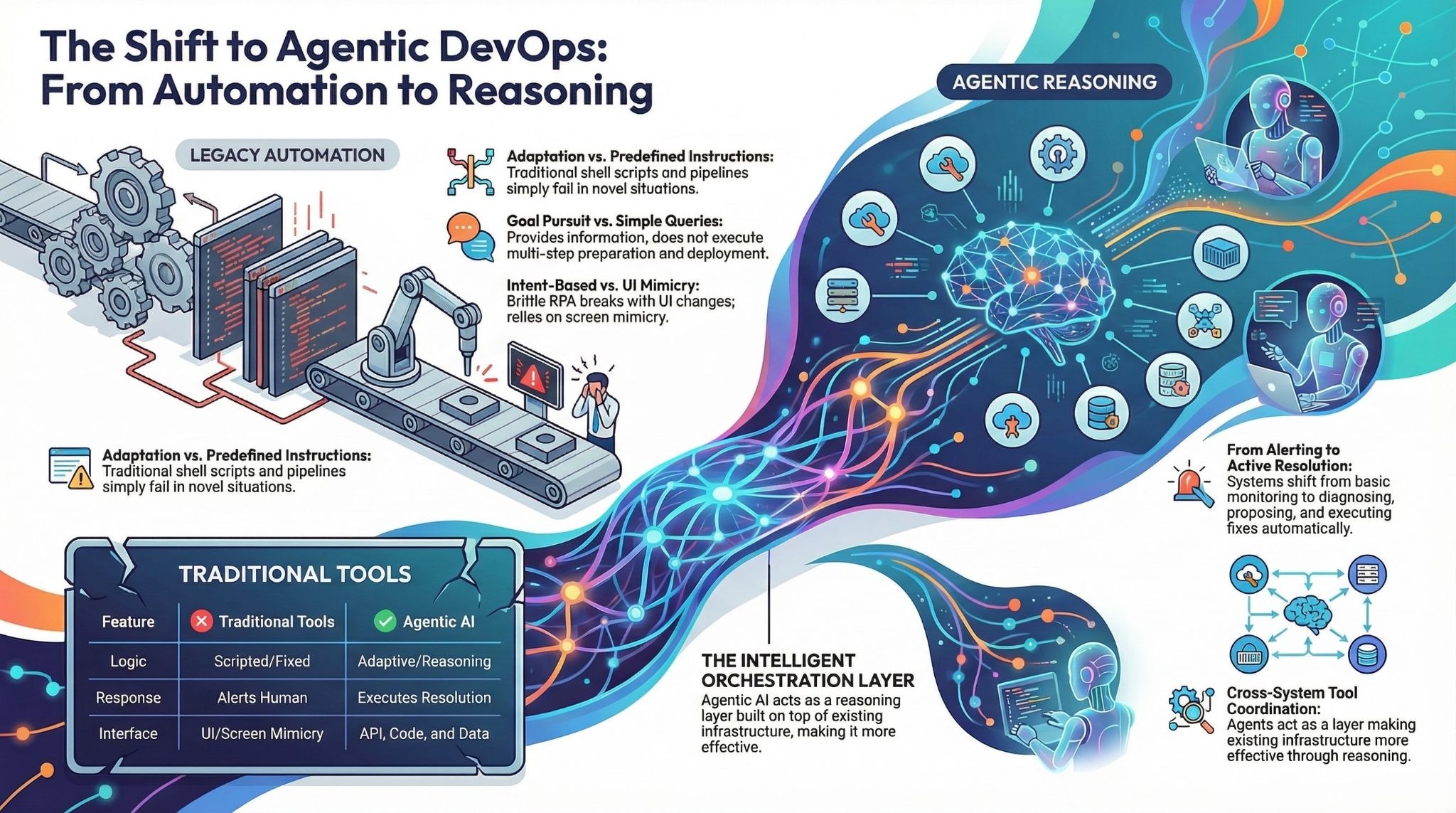
Software teams evaluating agentic AI often ask how it differs from the automation and tooling they already have. The distinction is meaningful and worth being precise about.
Scripted automation vs. agentic reasoning. Traditional DevOps automation — shell scripts, CI/CD pipelines, infrastructure-as-code — executes predefined instructions. It does exactly what you tell it to do, and it fails or does nothing when a situation falls outside the script. An AI agent reasons about the situation and adapts its response based on what it observes. It can handle novel situations within the scope of its training and governance rules, not just the cases you anticipated when you wrote the script.
RPA vs. agentic AI. Robotic process automation handles structured, repetitive tasks by mimicking human UI interactions. It is brittle — a UI change breaks the bot. Agentic AI operates at the API and data layer, reasons about intent rather than mimicking actions, and adapts when underlying systems change. For software development workflows specifically, agentic AI operates on code, data, and system states rather than screen interactions.
Chatbots vs. agents. A chatbot responds to a query. An agent pursues a goal. If you ask a chatbot to prepare a release for deployment, it will answer with information about how to prepare a release. If you deploy an agent for the same task, it will check the current state of the codebase, run the required checks, flag any blockers, and either execute the preparation steps or route to a human with a structured summary of what needs to happen. The operational difference is enormous.
Monitoring tools vs. agentic operations. Traditional monitoring tools alert you when something is wrong. An agentic operations system detects anomalies, diagnoses the likely cause, checks against known resolution patterns, proposes or executes a resolution, and logs everything — compressing the human workload from diagnosis and execution to review and approval.
The honest answer for most engineering teams is that agentic AI is not a replacement for existing DevOps tooling. It is an orchestration layer that makes existing tools more effective by adding reasoning, adaptability, and cross-system coordination on top of the infrastructure you already have.
The Bottom Line
AI agents for software development are not a future technology. They are a present-tense operational advantage for engineering teams that deploy them thoughtfully. The use cases are proven — code generation and review, testing and QA, DevOps and operations, document intelligence, multi-system orchestration — and the enterprise deployments are delivering measurable results across faster cycles, reduced manual overhead, and improved auditability.
The organisations getting the most value from agentic AI in 2026 share a common approach: they start with the workflows where manual effort is highest and structure is sufficient for an agent to operate reliably, they deploy governance frameworks before they scale automation, and they treat agents as an amplification layer for their engineering teams rather than a replacement for human judgment.
If you are evaluating agentic AI for your software development operation, the right starting point is an honest audit of where your team's time is going and which of those workflows have enough structure for an agent to take over the execution while the human stays in control of the judgment. That is where the return is sharpest and the deployment risk is lowest.
Interested in seeing how agentic AI works in practice for software and technology environments?
Explore the Assistents.ai enterprise platform — built for multi-industry deployment, with 300+ integrations and a governance-first architecture designed for production software operations.
Or explore Ampcome's implementation work across fintech, infrastructure, and enterprise technology for a closer look at how these deployments are structured in the real world.
Frequently Asked Questions
What is the best AI agent for software development in 2026?
The best AI agent for software development depends on your specific workflow needs. For code generation and review, you need an agent with deep version control integration and configurable rule sets. For testing and QA, look for agents that generate test cases from requirements and provide root-cause analysis on failures. For DevOps and operational workflows, prioritise agents with governed action execution and real-time anomaly detection. The most effective enterprise deployments use multi-agent architectures where specialised agents coordinate across the full development lifecycle rather than relying on a single general-purpose tool.
How do AI agents help software developers specifically?
AI agents help software developers by taking over the structured, multi-step work that is currently done manually: generating and reviewing code against defined standards, creating and executing test suites, monitoring deployment health, triaging incidents, and extracting information from technical documents. The practical outcome is that developers spend less time on mechanical execution and more time on the architectural decisions, creative problem-solving, and edge-case judgment that genuinely require human expertise.
Are AI agents safe to use in enterprise software environments?
Yes, when deployed with appropriate governance. The key safety requirements for enterprise software environments are: full audit trails on every agent action, human-in-the-loop escalation paths for high-stakes decisions, configurable permission boundaries that limit what the agent can access and act on, and anomaly detection that flags unusual agent behaviour for human review. Enterprise-grade agentic platforms are designed with these controls as core architecture, not optional add-ons.
What is the difference between an AI agent and a traditional DevOps automation tool?
Traditional DevOps automation executes predefined scripts. It does what you tell it to do and fails when situations fall outside the script. An AI agent reasons about the situation it encounters, adapts its approach based on what it observes, and can handle novel cases within its governance boundaries. Practically, this means agentic systems handle exception cases, novel failure modes, and cross-system coordination that would require constant manual intervention to manage with scripted automation.
How long does it take to deploy an AI agent for a software development team?
For standard use cases — code review automation, testing workflow agents, basic DevOps monitoring agents — a well-structured agentic platform can reach production value in four to six weeks. More complex multi-agent deployments, particularly those requiring deep integration with multiple enterprise systems and custom governance rule sets, typically take two to three months. The key variable is integration depth: the more access the agent needs to your actual systems, the more configuration and testing the deployment requires.
What industries are using AI agents for software development most actively?
Financial services and fintech are among the most active adopters, driven by the combination of high-volume structured workflows and stringent auditability requirements. Logistics and supply chain technology teams are deploying agents for operational analytics and exception management. Smart infrastructure and utilities are using agents for real-time monitoring and agentic response on top of existing software systems. Healthcare technology teams are deploying agents for staffing, compliance, and operational workflows. The common thread is that high-complexity, high-volume software operations with significant manual overhead are the environments where agentic AI delivers the clearest return.
Can AI agents work with existing software systems, or do they require a full replacement?
The most practical and most commonly deployed architecture is an agentic layer on top of existing systems, not a replacement. A well-designed AI agent integrates with your current tech stack — your version control, CI/CD pipeline, monitoring tools, data systems, and enterprise applications — and adds reasoning, coordination, and automation on top of what you already have. Organisations that have achieved the strongest results from agentic AI deployments have done so by treating agents as an orchestration layer that amplifies existing infrastructure rather than a wholesale technology replacement.

Transform Your Business With Agentic Automation
Agentic automation is the rising star posied to overtake RPA and bring about a new wave of intelligent automation. Explore the core concepts of agentic automation, how it works, real-life examples and strategies for a successful implementation in this ebook.
Sarfraz Nawaz is the CEO and founder of Ampcome, which is at the forefront of Artificial Intelligence (AI) Development. Nawaz's passion for technology is matched by his commitment to creating solutions that drive real-world results. Under his leadership, Ampcome's team of talented engineers and developers craft innovative IT solutions that empower businesses to thrive in the ever-evolving technological landscape.Ampcome's success is a testament to Nawaz's dedication to excellence and his unwavering belief in the transformative power of technology.

More insights
Discover the latest trends, best practices, and expert opinions that can reshape your perspective

.webp)

.jpg)


.jpg)
Contact us

