
Artificial Intelligence Conversational Agents: The Complete Guide for Enterprises (2026)


Enterprise adoption of AI agents has moved past the pilot stage. Most large organizations now report measurable returns from deploying them in production, not just experimenting with them in a sandbox. Yet the term at the center of that shift — artificial intelligence conversational agents — is still one of the most misunderstood in enterprise software. It gets used interchangeably with "chatbot," "virtual assistant," and "AI agent," and that confusion leads to buying decisions that don't match what a business actually needs.
Artificial intelligence conversational agents are software systems that use natural language processing, machine learning, and contextual reasoning to understand human requests and respond in natural language — and, in their more advanced form, to take governed action inside enterprise systems rather than only generating text. That last part is what separates a modern conversational agent from a scripted chatbot, and it's the distinction this guide unpacks in full.
In this guide, you'll get:
- A clear definition of artificial intelligence conversational agents — and how they differ from chatbots and autonomous AI agents
- How they actually work, end to end
- The main types you'll encounter when evaluating vendors
- Real, cross-industry case studies showing what these agents deliver in production
- An honest comparison of the leading platforms in 2026
- A framework for choosing the right one for your business
What Are Artificial Intelligence Conversational Agents?
An artificial intelligence conversational agent is a system that interprets natural language input — typed or spoken — determines the user's intent, retrieves relevant context, and generates a response or performs an action, without relying on a fixed decision tree of pre-written scripts.
The "artificial intelligence" part matters because it's what allows the agent to generalize. A traditional bot can only handle inputs its designers anticipated. A conversational AI agent, built on large language models and grounded in enterprise data, can handle a rephrased question, an ambiguous request, or a multi-step task it was never explicitly scripted for.
That capability is also why the category has split into two tiers:
- Conversational agents that primarily answer questions and hold a natural dialogue
- Agentic (autonomous) conversational agents that go further — reasoning through a task, calling tools, and executing multi-step work inside business systems, within defined policy boundaries
Both fall under the same umbrella term. Which one a business needs depends entirely on the use case, which is why the comparison later in this guide separates platforms by what they're actually built to do.
Conversational AI Agents vs. Chatbots vs. AI Agents — What's the Real Difference?
This is the single most common point of confusion for buyers, so it's worth resolving directly.
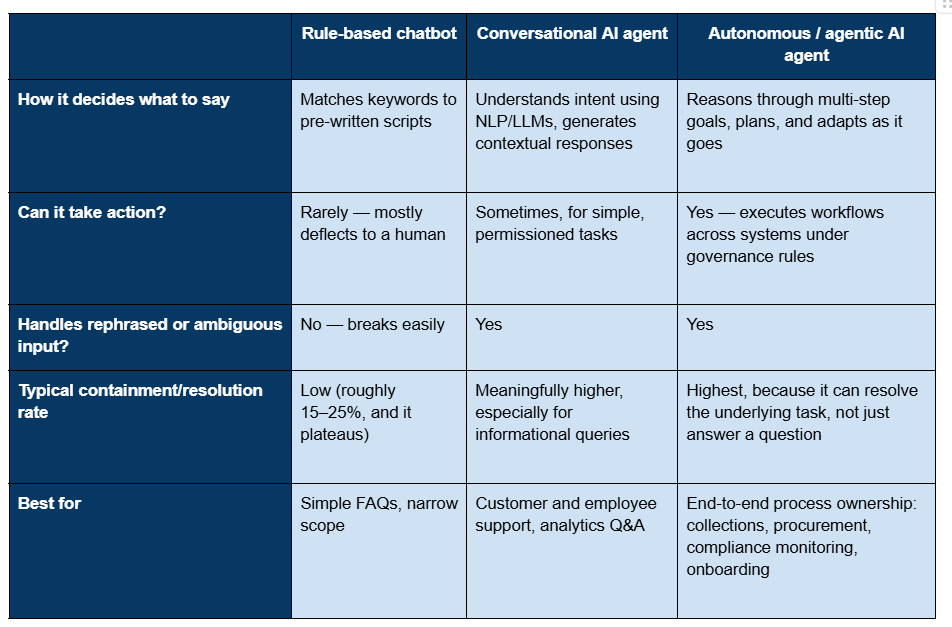
The practical takeaway: if a vendor's "conversational AI agent" can only answer questions and can't take a governed action in your systems of record, you're really looking at a smarter chatbot — not the category this guide is about.
How Artificial Intelligence Conversational Agents Work
Strip away the branding, and nearly every production-grade conversational AI agent runs through the same five-step loop.
1. Ingest. The agent reads context from wherever it's connected — CRM records, support tickets, ERP data, documents, prior conversation history. The best implementations pull from dozens of systems simultaneously rather than a single knowledge base.
2. Reason. The agent maps the request against a semantic understanding of the business — for example, connecting a vendor name to its contract terms and its open support tickets — rather than treating each data source as an isolated silo.
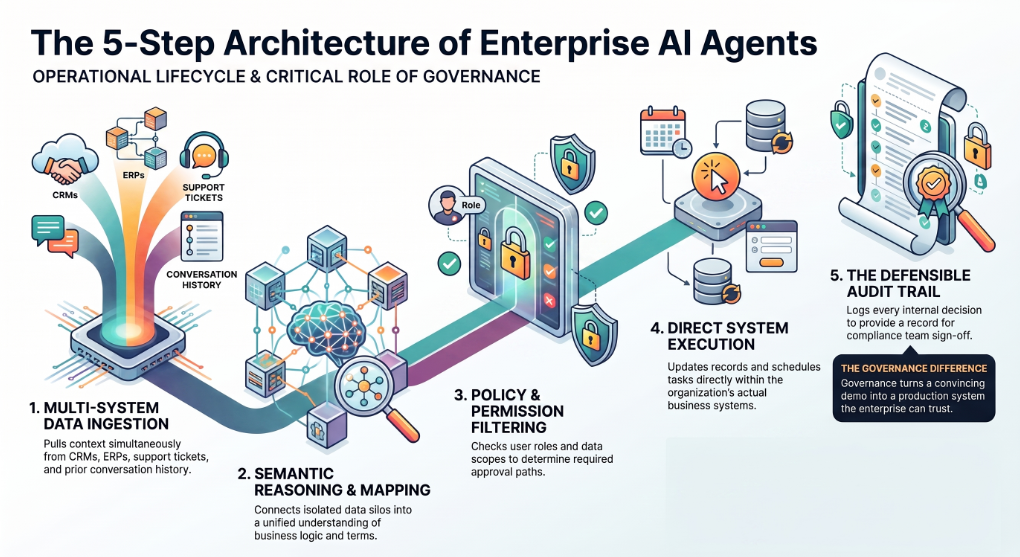
3. Decide. Before anything happens, the agent checks policy and permissions: what role is asking, what data scope applies, what approval path (if any) is required.
4. Act. The agent executes the resolved task — updating a record, sending a notification, scheduling a task, drafting a document — inside the actual business systems.
5. Audit. Every step is logged: what was read, what was reasoned, what was decided, what was done. This is what turns "the AI did something" into something a compliance team can actually sign off on.
That fifth step is where most conversational AI deployments quietly fail. It's easy to build something that answers questions convincingly. It's much harder to build something an enterprise can trust to act — with a complete, defensible record of why it acted. That governance layer is the difference between a demo and a production system.
Types of Conversational AI Agents
When you're evaluating vendors, you'll typically encounter five categories, often blended within a single platform:
- Rule-based / scripted bots — fixed decision trees, cheap and fast to build, but brittle and capped in what they can resolve
- Retrieval-based (RAG) assistants — read-only agents that answer questions by retrieving and synthesizing information from documents and structured data, with source citations
- Action-capable conversational agents — can complete a bounded task (reset a password, update a CRM field, schedule a meeting) after a policy check
- Autonomous / agentic AI agents — operate across multi-step business processes with minimal supervision, inside a defined "autonomy contract" (what they can do, what requires human approval, what triggers a rollback)
- Voice-based conversational agents — the same underlying reasoning, delivered through speech-to-text and text-to-speech for phone and voice channels
Most enterprises don't pick just one. The realistic path is to start with read-only, retrieval-based agents to validate data quality and trust, then graduate specific workflows to action-capable and autonomous agents once governance is proven out.
Real-World Case Studies: Artificial Intelligence Conversational Agents in Production
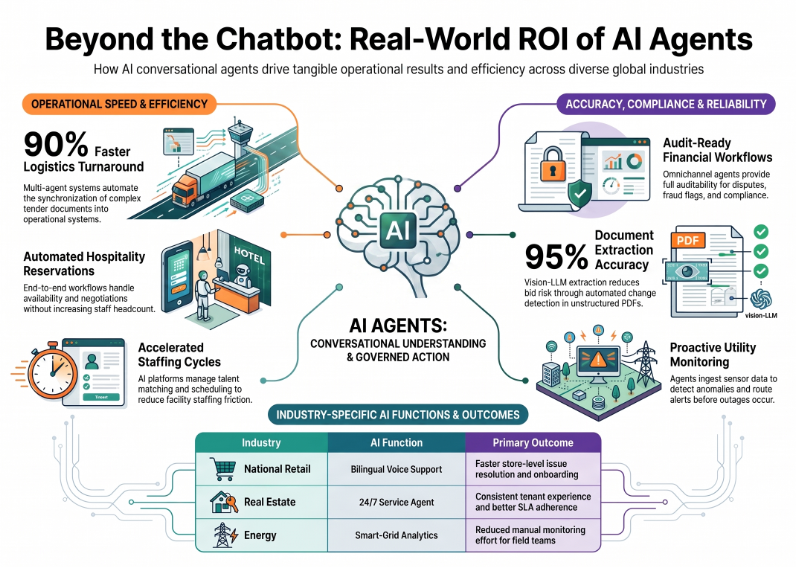
Vendor blogs in this space tend to lean on one or two named logos. What's more useful to a buyer is seeing the pattern across many different environments — so here's what artificial intelligence conversational agents have actually delivered across dozens of real enterprise deployments, grouped by industry. Client names are withheld; the outcomes are real.
Luxury hospitality and travel. A digital booking agent was deployed to automate end-to-end reservation workflows — intake, availability checks, alternative-date negotiation, and document generation — with a human-in-the-loop for final curation. Result: faster booking turnaround with less back-and-forth, and higher accuracy on complex, high-expectation guest requirements, without adding headcount.
Global logistics and supply chain. A multi-agent document intelligence system was built to ingest, analyze, and synchronize complex tender documents into core operational systems, using vision-LLM extraction on unstructured PDFs. Result: tender processing engineered for roughly 90% faster turnaround, with a ~95% extraction accuracy target on standard formats and reduced bid risk through automated revision and change detection.
Banking and financial technology. Omnichannel conversational agents were deployed across chat, email, and phone to handle disputes, fraud flags, and compliance workflows, with agent-assist summarization and full auditability. Result: faster case handling, reduced manual operational load, and stronger compliance readiness through built-in audit trails.
National retail (700+ stores). Voice support agents (speech-to-text-to-speech, bilingual) were paired with inventory intelligence and a knowledge/training agent grounded in POS and SOP documentation. Result: reduced helpdesk burden, faster store-level issue resolution, improved inventory visibility, and faster onboarding through on-demand guidance.
Healthcare staffing and services. A conversational AI platform handled talent onboarding, facility staffing requests, matching logic, scheduling, and compliance workflows. Result: faster fill cycles, reduced scheduling friction, and better workforce utilization visibility for operators managing flexible shifts.
Energy and utilities. Conversational and analytics agents were layered over smart-grid and transmission systems to ingest sensor data, detect anomalies, and route alerts automatically. Result: earlier detection of outages and losses, more proactive operations, and reduced manual monitoring effort across field teams.
Real estate and professional services. An always-on customer service agent was deployed to automate tenant and customer support end-to-end — FAQs, rental and payment queries, and escalation to human teams when needed. Result: consistent 24×7 experience, better SLA adherence, and fewer missed handoffs.
Across this portfolio — spanning more than a dozen industries and six continents — the consistent pattern is the same: the wins come from pairing conversational understanding with governed action, not from a chatbot that only answers questions.
Best Artificial Intelligence Conversational Agent Platforms in 2026
There's no single "best" platform for every use case — the right choice depends on your existing stack, your governance requirements, and whether you need read-only assistance or full autonomous execution. Here's an honest look at the platforms enterprise teams are actually shortlisting in 2026.
Assistents (by Ampcome) — best for governed, enterprise-wide conversational and autonomous agents. Assistents is built around a Context Engine that reasons across structured and unstructured enterprise data simultaneously — mapping relationships between vendors, contracts, tickets, and live operational data — rather than retrieving isolated document snippets. Every agent action is permission-checked and policy-enforced before execution, with a full audit trail behind it. The platform covers the full spectrum in one system: conversational agents, voice agents, document AI, agentic business intelligence, and autonomous agents, deployable on cloud, private cloud, on-premise, or air-gapped infrastructure. It's the strongest fit for enterprises that need more than a chatbot — a governed way to move from answering questions to taking action across departments.
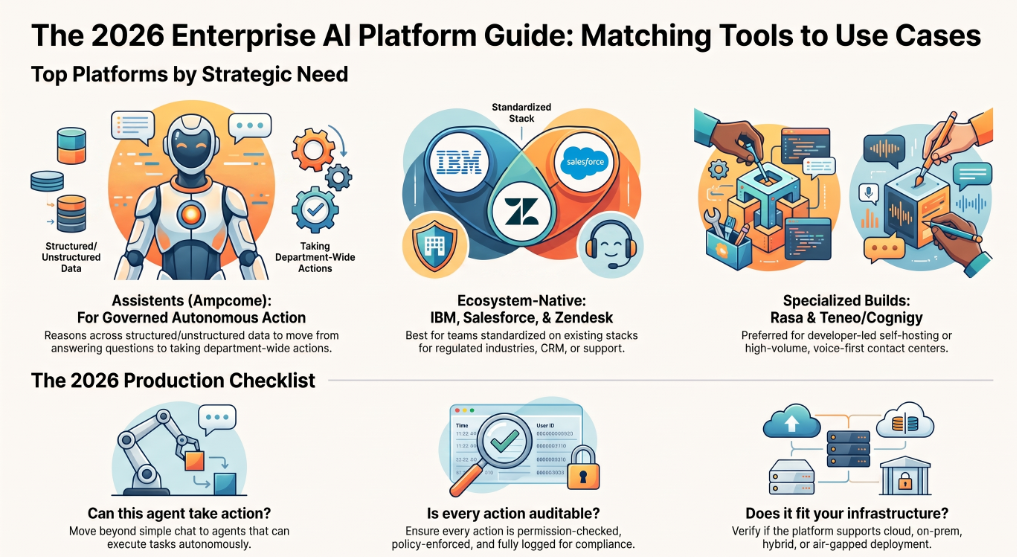
IBM watsonx Assistant — best for regulated industries wanting a large-vendor ecosystem. A long-established enterprise conversational AI platform with strong intent-based logic, generative AI via watsonx.ai, and deep integration into IBM's broader data and governance stack. A solid choice for organizations already standardized on IBM infrastructure.
Salesforce Agentforce — best for Salesforce-native customer and sales teams. Built directly on Salesforce's Data 360 and Customer 360, giving agents native visibility into CRM data before they respond. The natural pick for teams whose operations already run inside Salesforce.
Zendesk AI — best for support-ticket-centric teams. Strong at automated resolutions, knowledge management, and quality monitoring for teams already standardized on Zendesk's support suite, with a resolution-learning loop that improves over time.
Rasa — best for developer-led, self-hosted builds. An open, code-level platform for teams that want full control over their NLU pipeline and are comfortable with a builder mindset. Strong for organizations with in-house engineering capacity who need fully self-hosted deployment.
Teneo / Cognigy — best for high-volume, voice-first contact centers. Purpose-built for large-scale voice automation with deep telephony integration, suited to enterprises whose primary channel is the phone.
When comparing platforms, look past the demo and ask three questions: Can this agent take action, not just answer? Is every action logged and auditable? Can it deploy the way your infrastructure actually requires (cloud, on-prem, hybrid)? Those three answers separate the platforms built for production from the ones built for a sales pitch.
Why Assistents by Ampcome
Most conversational AI vendors sell a single capability — a chatbot, a voice bot, or a BI assistant — and expect enterprises to stitch multiple point solutions together. That's where most enterprise AI projects actually stall: fragmented tools, no shared context, and compliance controls bolted on after the fact.
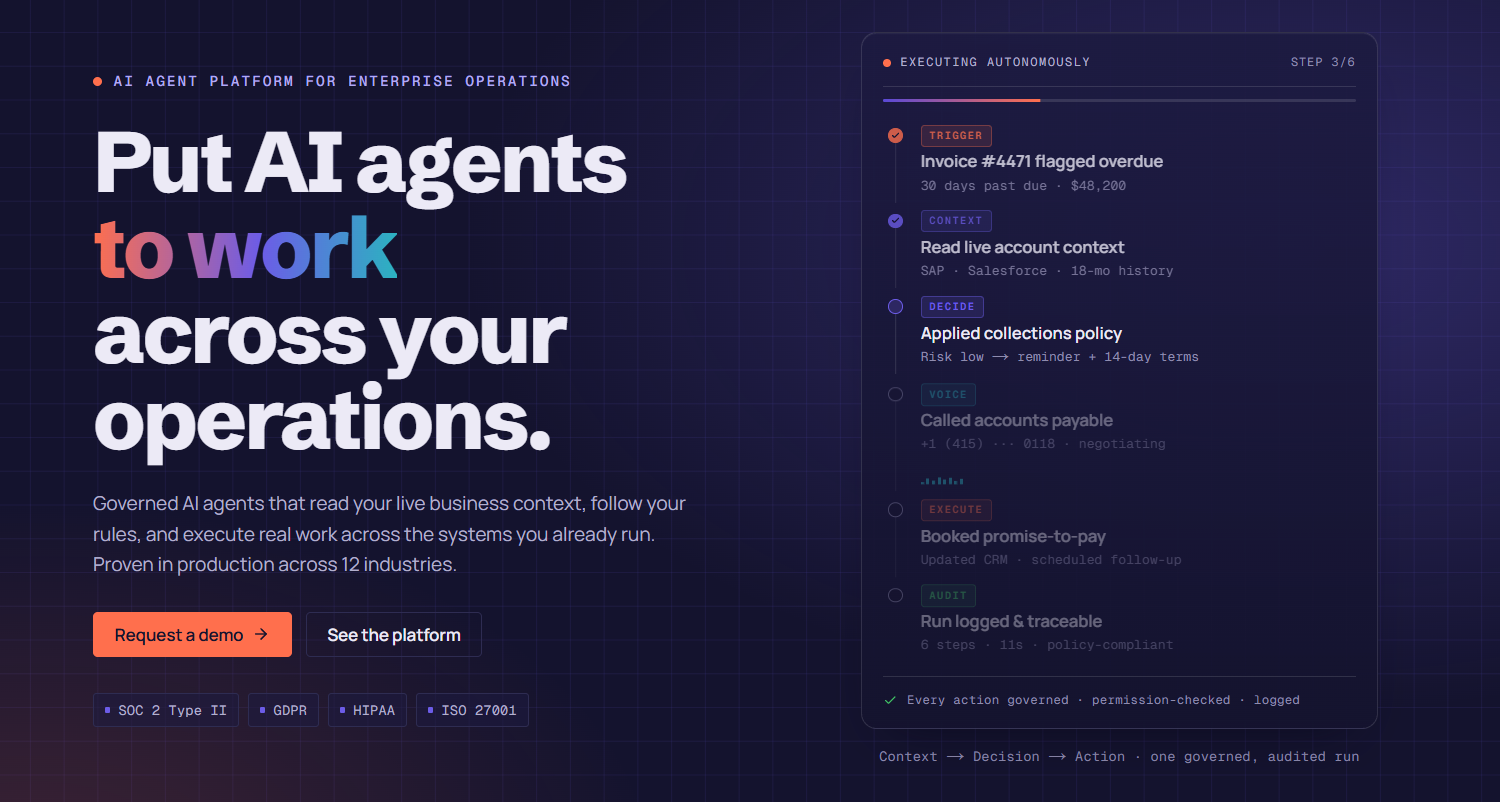
Assistents was built to close that gap directly:
- One Context Engine, not siloed retrieval. Agents reason across structured data, unstructured documents, and business rules at once — understanding relationships between records, not just returning matching snippets.
- Agentic, not just conversational. Assistents agents don't stop at an answer — they process invoices, generate reports, trigger workflows, and monitor systems autonomously, with every step permission-checked.
- Governance is native, not an add-on. Immutable audit trails, human-in-the-loop approval workflows, and policy-enforced execution are built into every agent from day one — the exact layer most competing platforms treat as an afterthought.
- Deploy on your terms. Cloud, private cloud, on-premise, air-gapped, or hybrid — the platform adapts to infrastructure requirements instead of forcing a single-tenant SaaS model.
- 200+ models, one gateway. Assistents routes each task to the right model through a single AI Gateway, so enterprises aren't locked into one model vendor as the landscape shifts.
- Proven, not theoretical. The platform is in production across 12+ industries, with 97% agent task accuracy backed by full audit trails, and an average of four weeks from pilot to production — a track record built by Ampcome across dozens of real enterprise deployments, spanning the industries covered in the case studies above.
If your evaluation criteria include "can this actually take governed action across our systems, and can we prove it to an auditor," Assistents is built specifically for that bar — not for a demo that stops at a well-phrased answer.
Book an Architecture Review with Assistents →
How to Choose the Right Conversational AI Agent Platform
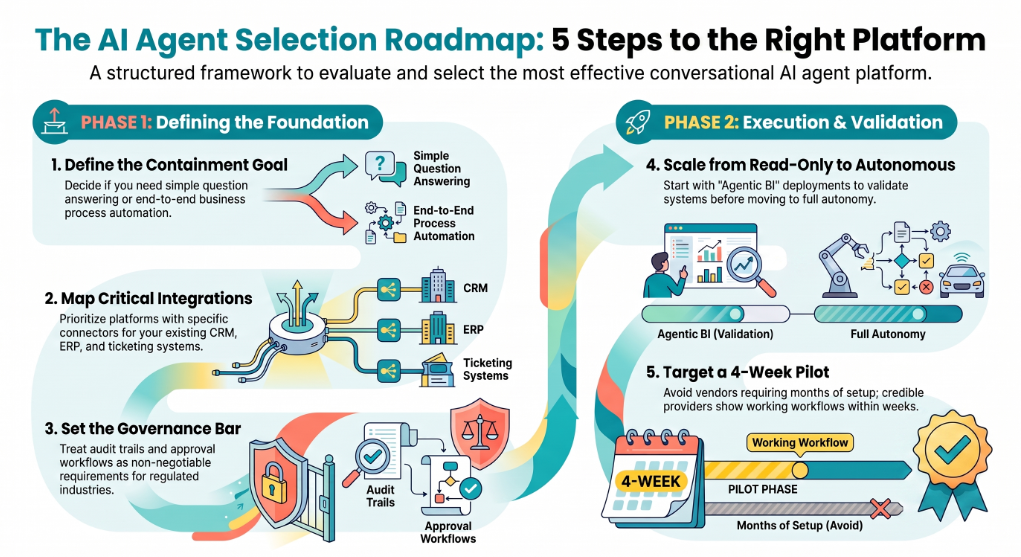
A simple framework for narrowing the field:
- Define the containment goal. Are you trying to answer questions, resolve tickets end-to-end, or run a full business process (collections, procurement, onboarding)? This determines whether you need a retrieval agent or an autonomous one.
- Map your required integrations. List the systems the agent must actually read from and write to — CRM, ERP, ticketing, document stores. A platform with 300+ connectors is only useful if it has the ones you need.
- Assess your governance and compliance bar. Regulated industries (finance, healthcare, insurance) should treat audit trails and approval workflows as a non-negotiable requirement, not a nice-to-have.
- Decide read-only vs. action-capable vs. autonomous. Start conservative. Most successful rollouts validate with a read-only, Agentic BI-style deployment before scaling to action-capable and autonomous agents.
- Pilot in weeks, not quarters. A credible vendor should be able to scope a pilot, connect initial systems, and show a working workflow inside about four weeks. If the proposed timeline is measured in months before you see anything live, that's a signal worth questioning.
Key Takeaways
- Artificial intelligence conversational agents go beyond chatbots by understanding ambiguous, rephrased language and — in their agentic form — taking governed action inside enterprise systems.
- The technology works through a five-step loop: ingest context, reason across data, check policy, act, and log an audit trail.
- Real deployments across hospitality, logistics, banking, retail, healthcare, energy, and real estate show the same pattern: the biggest wins come from pairing conversation with governed execution, not from answering questions alone.
- When comparing platforms, prioritize governance, action capability, and deployment flexibility over demo polish.
- Assistents by Ampcome is built specifically for enterprises that need conversational, voice, document, and autonomous agents on one governed platform — proven across 12+ industries with full auditability.
Ready to see what a governed conversational AI agent looks like inside your own systems?
Book an architecture review with Assistents by Ampcome →
FAQs
What is an example of an artificial intelligence conversational agent?
A finance team using natural language to ask "show me Q4 invoices exceeding contracted rate by more than 3%" and having the agent cross-reference invoices, contracts, and vendor communications to return cited results — or an AI voice agent handling a customer service call end-to-end — are both examples of artificial intelligence conversational agents in production use today.
What is the difference between a chatbot and a conversational AI agent?
A chatbot matches user input to pre-written scripts and breaks when a question is phrased differently than expected. A conversational AI agent uses natural language processing and large language models to understand intent even in rephrased or ambiguous requests, and can often take governed action rather than only generating a text response.
What are the main types of conversational AI?
The main types are rule-based chatbots, retrieval-based (RAG) assistants, action-capable conversational agents, autonomous or agentic AI agents, and voice-based conversational agents — each differing in how much reasoning and independent action they can perform.
Is ChatGPT a conversational AI agent?
ChatGPT is a general-purpose conversational AI system built on a large language model. It becomes an enterprise conversational AI agent in the fuller sense described here only when it's grounded in an organization's specific data and given permissioned access to take actions in that organization's systems.
What industries use conversational AI agents?
Conversational AI agents are in production across hospitality, logistics and supply chain, banking and financial services, retail, healthcare, energy and utilities, real estate, and professional services, among others — typically for customer support, document processing, compliance monitoring, and operational workflow automation.
How much does a conversational AI agent cost?
Pricing varies widely by vendor and model — from consumption-based pricing per conversation or voice-minute to custom enterprise licensing based on deployment scale and governance requirements. Most enterprise platforms price based on delivered outcomes or usage volume rather than a flat per-seat fee.
What is the best conversational AI platform for enterprise?
The best platform depends on requirements: enterprises needing governed, multi-department agents with full auditability and flexible deployment (cloud, on-prem, hybrid) are typically best served by a unified platform like Assistents, while teams already standardized on a specific CRM or support suite may prefer that ecosystem's native option.
Is agentic AI the same as conversational AI?
Not exactly. Conversational AI describes the natural-language interaction layer. Agentic AI describes a system's ability to reason through multi-step goals and take autonomous action. Modern enterprise platforms increasingly combine both — a conversational interface backed by agentic execution.
Can conversational AI agents replace human agents entirely?
In most production deployments today, conversational AI agents handle a growing share of routine and moderately complex work while humans retain oversight of exceptions, approvals, and judgment calls — an exception-managed model rather than full replacement.
How long does it take to deploy a conversational AI agent?
Enterprise deployments commonly move from initial system connection to a production pilot in about four weeks, starting with a read-only validation phase before scaling to action-capable or autonomous agents.

Transform Your Business With Agentic Automation
Agentic automation is the rising star posied to overtake RPA and bring about a new wave of intelligent automation. Explore the core concepts of agentic automation, how it works, real-life examples and strategies for a successful implementation in this ebook.
Sarfraz Nawaz is the CEO and founder of Ampcome, which is at the forefront of Artificial Intelligence (AI) Development. Nawaz's passion for technology is matched by his commitment to creating solutions that drive real-world results. Under his leadership, Ampcome's team of talented engineers and developers craft innovative IT solutions that empower businesses to thrive in the ever-evolving technological landscape.Ampcome's success is a testament to Nawaz's dedication to excellence and his unwavering belief in the transformative power of technology.

More insights
Discover the latest trends, best practices, and expert opinions that can reshape your perspective






Contact us

