
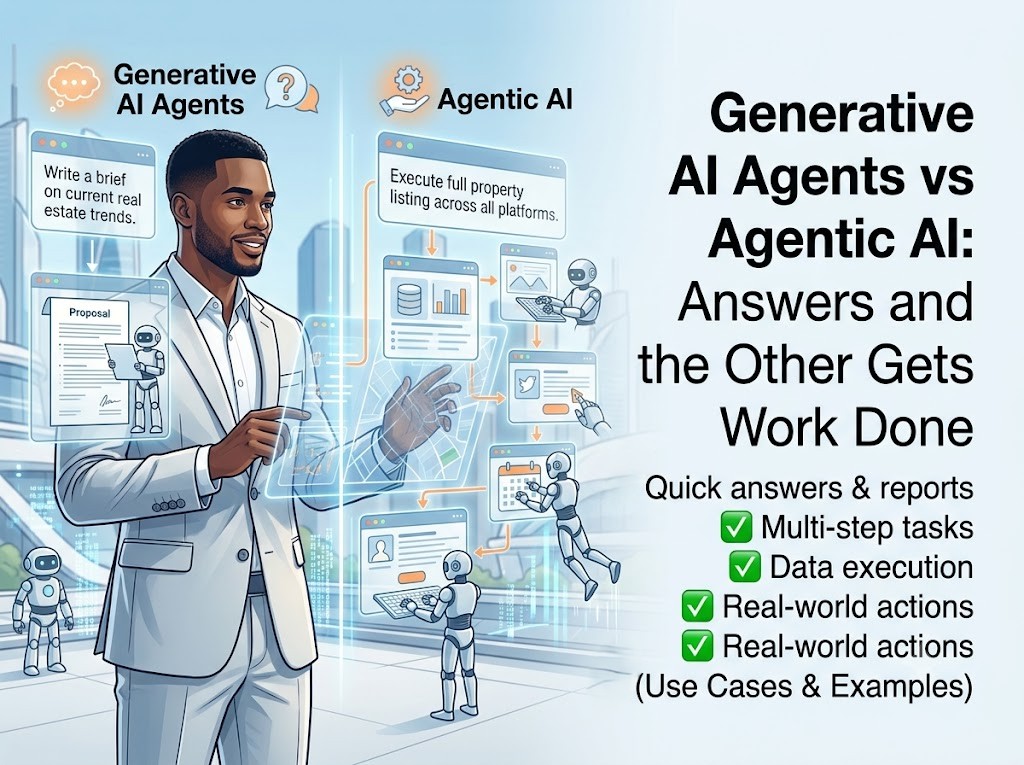
Generative AI Agents vs Agentic AI: Why One Answers and the Other Gets Work Done


Most enterprises now have generative AI in their people's hands. Copilot drafts the email, ChatGPT summarises the contract and Claude researches the market. Yet the purchase order still gets re-keyed into SAP, the exception still sits in someone's inbox, and the process takes as long as it did last year.
That gap is the real difference between generative AI agents vs agentic AI. Generative AI agents answer questions and help one person finish a task. Agentic AI completes governed work across the organisation. It starts from a business event, understands your data and policies, acts in your systems of record, asks a person when the rules say so, and records every step.
This guide explains the difference in plain language. It gives you a five-level model and a seven-question test for telling the two apart. It also shows what changed in real enterprise deployments when teams moved from one to the other.
Key takeaways
- Generative AI creates content from a prompt. Generative AI agents add tools and a short planning loop so the model can finish a bounded task for one user.
- Agentic AI is a governed system of agents that runs a business process from trigger to verified outcome, across enterprise systems.
- The difference isn't how smart the model is. It's business context, permission to act, governance and accountability.
- Gartner predicts over 40% of agentic AI projects will be cancelled by the end of 2027, mainly because of cost, unclear value or weak risk controls. Governance is what separates the survivors.
- Most enterprises need both: generative AI agents for personal productivity, and agentic AI for organisational productivity.
Generative AI agents vs agentic AI: the short answer
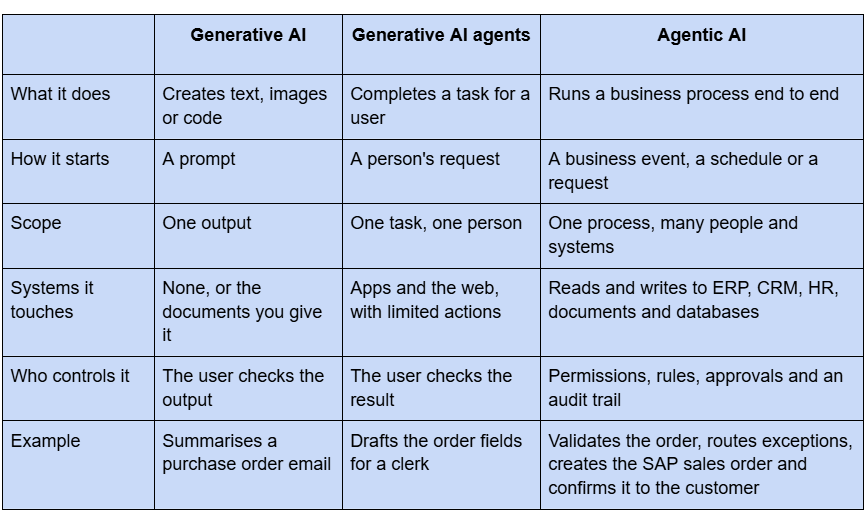
Generative AI creates content from a prompt. A generative AI agent uses that model, plus tools, to finish a bounded task for one person. Agentic AI is a governed system of AI agents that plans, acts across enterprise systems and completes a business process, with rules, approvals and an audit trail.
What is generative AI?
Generative AI is a class of AI models that create new content (text, images, audio or code) from patterns learned during training. Large language models (LLMs) are the best-known example. You give the model a prompt, and it gives you an output.
Generative AI is excellent at language work: drafting, summarising, translating, extracting information and writing code. On its own, though, it is reactive. It doesn't decide what should happen next, it can't act in your business systems, and it isn't accountable for a business outcome. For a deeper primer, read what generative AI is, or see how it differs from forecasting models in generative AI vs predictive AI.
What are generative AI agents?
A generative AI agent is an LLM equipped with instructions, tools (search, a browser, APIs, code execution), short-term memory and a loop. The loop lets it plan a few steps and act to complete a task for a user.
You already know them. They include ChatGPT with agent mode, Microsoft Copilot, Claude with tools, custom GPTs and coding assistants. They can research a topic, fill in a form, analyse a spreadsheet or write and run code.
The important words are for a user. Generative AI agents deliver personal productivity: they help one person draft, summarise, research, analyse and finish a task faster.
The terminology is messy. Vendors use "AI agent" to mean anything from a chatbot to a component inside a larger system. A useful academic reference is the 2025 taxonomy by Sapkota et al.. It describes AI agents as modular, LLM-driven systems for task-specific automation. It describes agentic AI as multi-agent collaboration, dynamic task decomposition, persistent memory and coordinated autonomy. We use the same distinction here. For more on agents themselves, see what AI agents are.
Where generative AI agents stop
Generative AI agents are built for individuals. Problems start when a company expects them to run processes:
- No shared business context. The agent doesn't know your customer hierarchy, credit policy or product master definitions unless someone pastes them in.
- Borrowed permissions. It acts with one user's access, or none, instead of role-based control over each action.
- No approval path. Nothing says "orders above the credit limit go to the finance controller".
- No system-of-record accountability. The result lands in a chat window, not as a transaction with an audit record.
- No process ownership. When the user closes the chat, the work stops.
What is agentic AI?
Agentic AI is a system of AI agents that pursues a business goal with a defined degree of autonomy. It plans multi-step work and coordinates specialist agents. It uses business context, takes actions in enterprise systems, and operates within permissions, rules, human approvals and a complete audit trail.
Where generative AI agents deliver personal productivity, agentic AI delivers organisational productivity: a shared business process runs from trigger to verified outcome. It has five building blocks:
- Business context. Entities, relationships, definitions, policies and source evidence, so agents understand your business rather than the internet's.
- Specialist agents. Document, data, analytics, voice and communication agents, each good at one job.
- Orchestration. Routes tasks, tracks state, handles exceptions and resumes after human review.
- Governed action. Every action is checked against permissions and policy before it runs.
- Verified outcome. The result is confirmed in the system of record and measured.
Standards such as the Model Context Protocol (MCP) make it easier to connect agents to tools. But a connection isn't governance. What makes a system enterprise-grade is deciding what an agent is allowed to do with that connection. For a short definition, see what agentic AI is. For how multiple agents coordinate, see single-agent vs multi-agent AI.
Generative AI vs AI agents vs agentic AI: a 10-point comparison
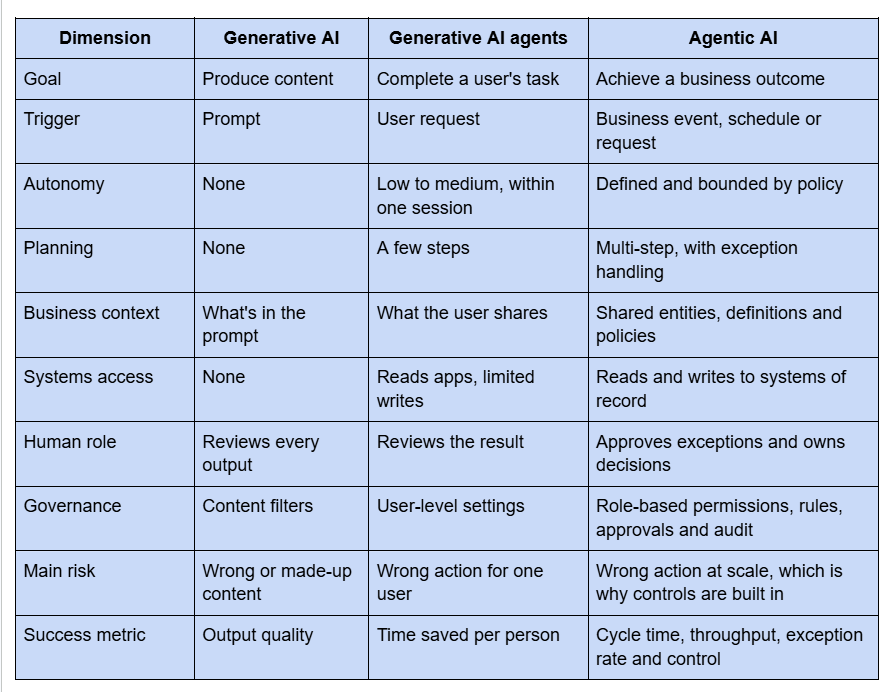
If you're comparing only AI agents and agentic AI, read our detailed AI agents vs agentic AI comparison. People also compare agentic AI vs RAG, agentic AI vs RPA and agentic process automation vs agentic AI.
The Answer-to-Outcome Ladder: five levels from generating to governing
The debate is usually framed as two boxes. In practice it's a ladder, and each level adds one capability. We call it the Answer-to-Outcome Ladder.
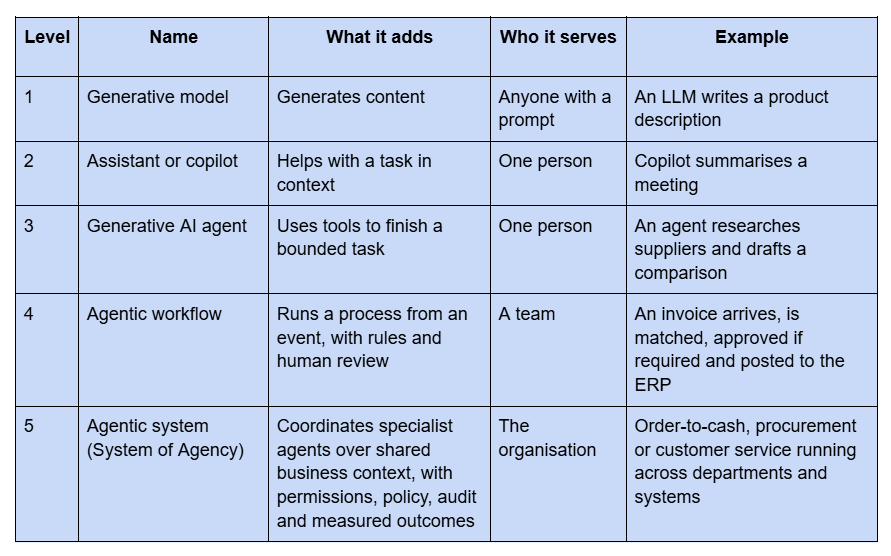
Levels 1–3 answer. Levels 4–5 produce outcomes.
The market is climbing this ladder quickly. Gartner expects 40% of enterprise applications to feature task-specific AI agents by the end of 2026, up from less than 5% in 2025. It also projects that 33% of enterprise software applications will include agentic AI by 2028, and that at least 15% of day-to-day work decisions will be made autonomously. Most enterprises we meet sit at levels 2 and 3. The operational value sits at levels 4 and 5. The real question is whether your controls climb as fast as your AI does.
One process, three approaches: a purchase order into SAP
The difference is easiest to see in a single process. A distributor receives purchase orders by email, through a customer portal and as PDFs. Each one has to become a validated sales order in SAP.
With generative AI (levels 1–2): a staff member pastes the PO into an assistant, which summarises the line items. The clerk still keys every field into SAP and checks the customer, prices and credit by hand.
With a generative AI agent (level 3): the agent reads the attachment and pre-fills the order fields for the clerk. Typing is faster, but the process is the same. Nothing checks the credit limit, catches duplicate orders or keeps an audit record.
With agentic AI (levels 4–5):
- The PO arrives by email or portal, and the workflow starts automatically.
- A document agent reads the fields: customer, products, quantities, prices and delivery details.
- Context checks validate everything against business data: customer record, product master, contract pricing, credit limit and delivery location.
- Rules flag exceptions, such as a missing product reference, a duplicate order, a price outside the contract or a breached credit limit.
- An authorised reviewer sees each exception with its evidence. The process waits, then resumes after approval.
- The sales order is created in SAP.
- The confirmation is recorded: the customer is notified, the case is closed and the full audit trail is kept.
The result is less re-entry, clearer exceptions and a traceable outcome. People spend their time on judgement, not typing. This isn't a thought experiment. It is the first case study below.
Generative AI vs agentic AI examples from real enterprise deployments
The implementations below were delivered by Ampcome. Client names are withheld. Cases 1–4 run on the assistents.ai platform. Cases 5–8 are agentic solutions Ampcome delivered for clients. For each, the table shows what a generative-AI-only approach would have done and what the agentic system actually does.
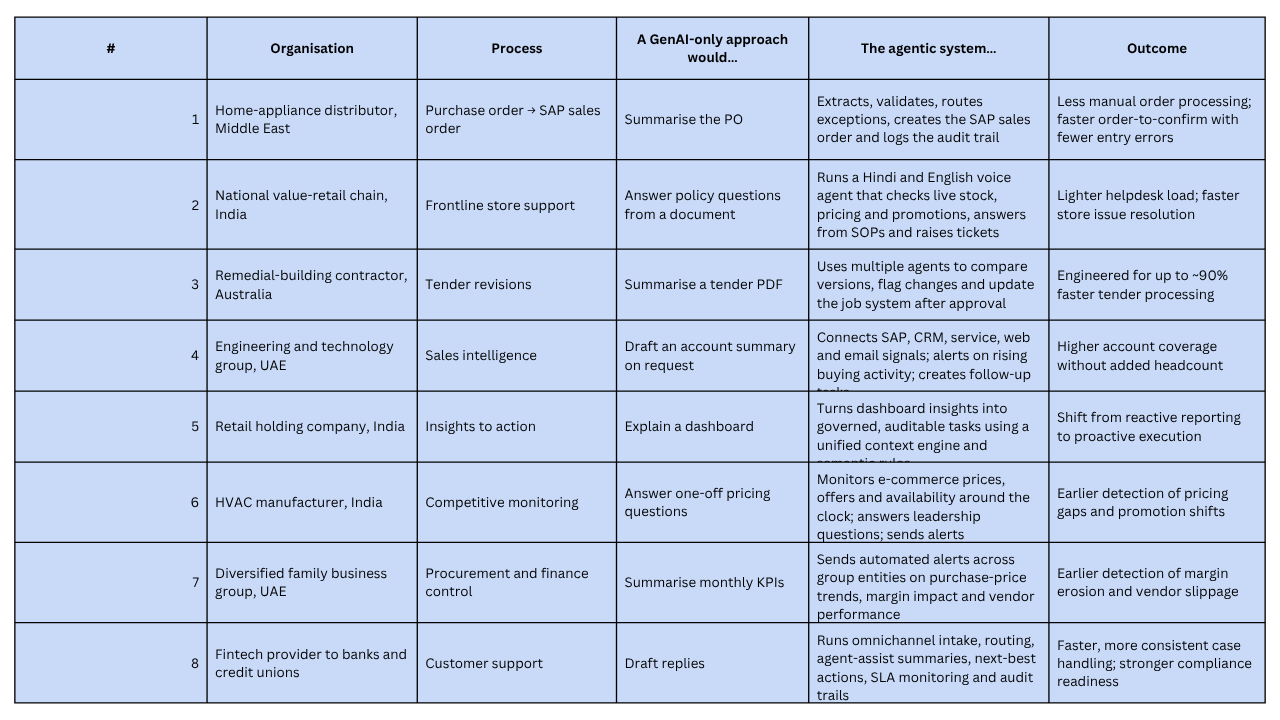
Three of these show the shift especially clearly.
Case 1: From emailed purchase orders to validated SAP sales orders
Situation. A Middle East home-appliance distributor handled purchase orders manually across email, portal and PDF, and re-keyed each one into SAP. Its legacy order-capture tool was nearing end-of-life, with high licensing costs.
What the agents do. They interpret order triggers, extract and validate customer, product, pricing and delivery data against SAP, and create the sales order.
Controls. Rules govern exceptions and approvals, and audit logs and reconciliation reports cover every order.
Result. Less manual order processing and less reliance on the legacy tool; a faster order-to-confirm cycle with fewer data-entry errors; and better auditability for sales-order creation and exceptions.
Case 2: Answers and actions on the store floor
Situation. A national value-retail chain in India needed store teams across hundreds of locations to get fast answers on stock, pricing, promotions and procedures, without overloading a central helpdesk.
What the agents do. A multilingual voice support agent works in Hindi and English. An inventory agent looks up pricing, stock and promotions for each store. A knowledge and training agent answers from POS and SOP documents. Ticketing is integrated, and managers get an admin console with analytics on operational issues.
Result. A lighter manual helpdesk load and faster store issue resolution; better store-level inventory visibility; and faster onboarding, because new staff get training guidance on demand.
Case 3: Tender revisions without missed changes
Situation. An Australian remedial-building and waterproofing specialist received complex tender documents that were revised repeatedly. Missed changes created bid risk, and the details had to be re-entered into its job-management system.
What the agents do. An intelligent document workbench coordinates multiple agents. They retrieve tenders, work out the right workflow, analyse revisions and extract data from complex PDFs using vision-capable models. The system then updates the job-management platform (Simpro) after human review, with quote locking and audit logs.
Result. The system was engineered for up to ~90% faster tender document processing, with a ~95% extraction-accuracy target for standard formats. These are design targets, not guarantees. Change detection and auditability reduce bid risk.
From the field: "When we move a process from a generative AI assistant to an agentic workflow, the hard part is rarely the model. It's agreeing the exception rules: what counts as a duplicate order, who can approve a price override, when a credit limit blocks an action. Write those down and the agents become predictable. Skip them and you've built a very fast way to make mistakes." (Sarfraz Nawaz, Ampcome)
For more use cases by industry, see our collection of agentic AI examples.
Why most generative AI pilots stall, and what agentic AI changes
Generative AI adoption is broad, but business impact is thin. MIT NANDA's 2025 study The GenAI Divide found that only about 5% of generative AI pilots achieved rapid revenue acceleration; most had little measurable effect on profit and loss (Fortune's report on the study). The same research found that tools bought from specialised vendors and delivered through partnerships succeeded about two-thirds of the time. Internal builds succeeded about a third as often.
Agentic AI isn't automatically the fix. Gartner warns that over 40% of agentic AI projects will be cancelled by the end of 2027, due to escalating costs, unclear business value or inadequate risk controls.
In our experience, pilots stall for four reasons:
- No business context. The model doesn't know your data, definitions or policies, so its answers are generic.
- No ability to act. Insight ends in a chat window, and a person still does the work.
- No governance. Nobody can say what the AI is allowed to do, so it's never allowed to do anything important.
- No baseline. Nobody measured cycle time or error rates before the pilot, so value can't be proven.
Well-built agentic AI addresses all four. It also has a cost profile you need to manage: agents make many model calls per task. Model routing, fallback and usage limits are therefore as important as the agents themselves.
Is it really agentic? The 7-question Agency Test
"Agentic" has become a marketing label. Gartner calls this agent washing. It estimates that of the thousands of vendors claiming agentic AI, only about 130 are genuine. Use the Agency Test to cut through it. Ask these seven questions of any product or proposal:
- Event-driven: does work start from a business event (an email, file, schedule or system change), not only from a prompt?
- Acts in systems of record: can it write to your ERP, CRM or HR system, not just read from them?
- Plans and handles exceptions: does it break work into steps and deal with what goes wrong?
- Uses business context: does it understand your entities, definitions and policies?
- Governed: is every action checked against permissions and rules, with human approval where needed?
- Auditable: is every action logged, explainable and traceable to its source evidence?
- Outcome-measured: is the result verified in the system and measured against a baseline?
How to score it: 0–3 "yes" answers is an assistant with a new label. 4–5 is a generative AI agent or workflow automation. 6–7 is genuine agentic AI.
Which does your enterprise need? A decision framework
Use generative AI agents when the work is individual, varied, low-risk and easy to undo, and a person reviews every result. Examples include drafting, research, analysis and meeting preparation.
Use agentic AI when a process is shared across teams, crosses two or more systems, runs at volume, needs an audit trail and has exceptions that follow rules. Examples include order-to-cash, procure-to-pay, customer service, document-heavy operations and compliance monitoring.
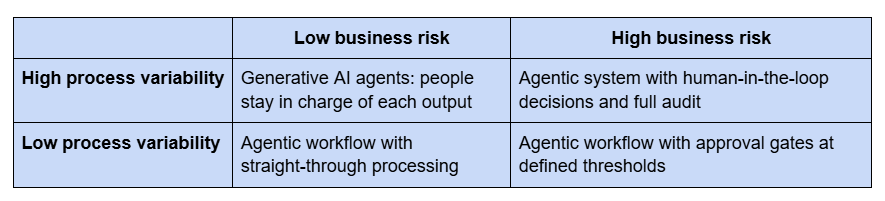
Five questions settle most cases:
- How many systems does the process touch?
- How many times a day or month does it run?
- Does anyone need to prove later what happened and why?
- Do exceptions follow rules you could write down?
- Does someone own the process cycle time?
If you answer "several", "often", "yes", "yes" and "yes", you need agentic AI. Most enterprises need both. Agentic AI should build on your generative AI investment, not replace it: your people keep their copilots, and your processes gain agents.
What governance must look like when AI takes action
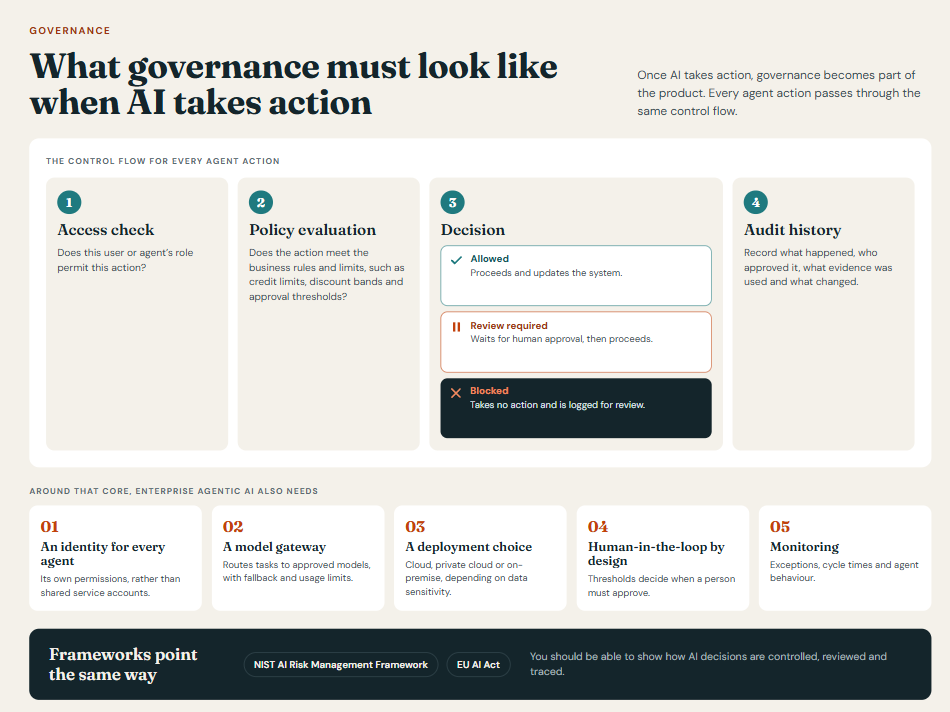
Once AI takes action, governance becomes part of the product. Every agent action should pass through the same control flow:
- Access check. Does this user or agent's role permit this action?
- Policy evaluation. Does the action meet the business rules and limits (credit limits, discount bands, approval thresholds)?
- Decision. Allowed proceeds and updates the system. Review required waits for human approval, then proceeds. Blocked takes no action and is logged for review.
- Audit history. Record what happened, who approved it, what evidence was used and what changed.
Around that core, enterprise agentic AI also needs:
- An identity for every agent, with its own permissions, rather than shared service accounts.
- A model gateway that routes tasks to approved models, with fallback and usage limits.
- A deployment choice: cloud, private cloud or on-premise, depending on data sensitivity.
- Human-in-the-loop by design: thresholds that decide when a person must approve.
- Monitoring of exceptions, cycle times and agent behaviour.
Frameworks such as the NIST AI Risk Management Framework and the EU AI Act point the same way: you should be able to show how AI decisions are controlled, reviewed and traced.
How to evaluate an agentic AI platform
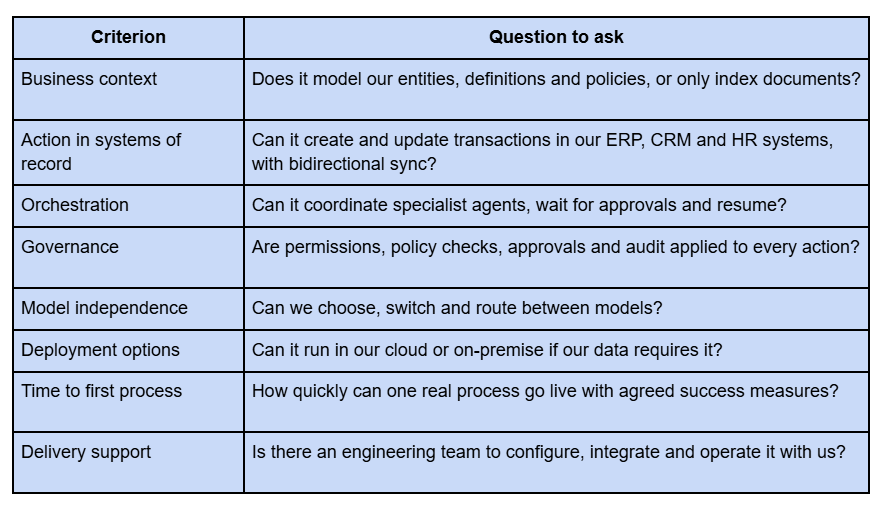
Use these eight criteria when you shortlist platforms:
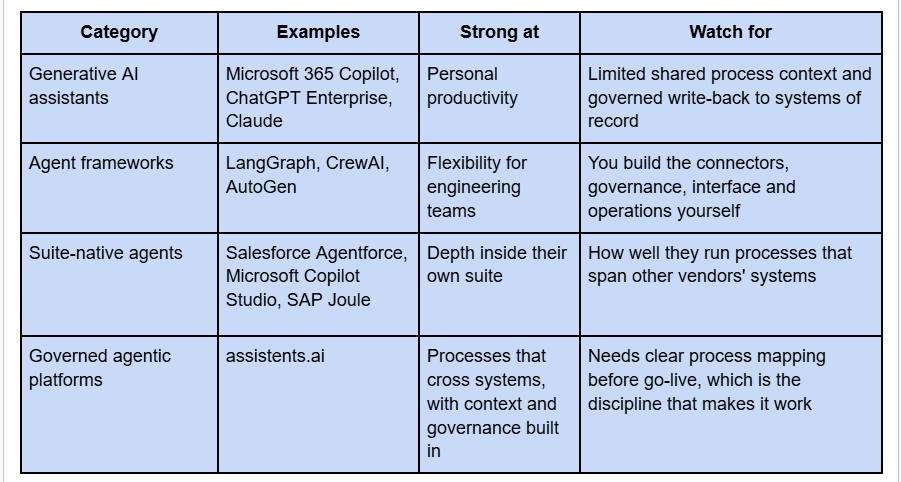
The market splits into four categories:
For a wider market view, see our guide to agentic AI platforms, and our take on Copilot vs agentic intelligence.
Where assistents.ai fits: the System of Agency above your existing systems
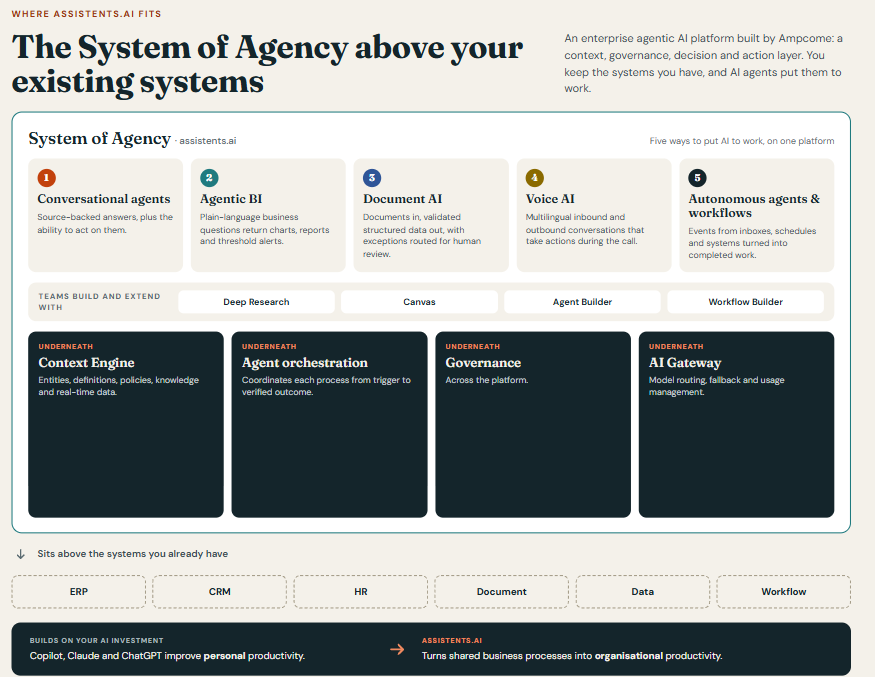
assistents.ai is an enterprise agentic AI platform built by Ampcome. It works as a System of Agency: a context, governance, decision and action layer that sits above your ERP, CRM, HR, document, data and workflow systems. You keep the systems you have, and AI agents put them to work.
It builds on your existing AI investment. Copilot, Claude and ChatGPT improve personal productivity. assistents.ai turns shared business processes into organisational productivity, coordinating each process from trigger to verified outcome.
It offers five ways to put AI to work, on one platform:
- Conversational agents: source-backed answers, plus the ability to act on them.
- Agentic BI: plain-language business questions that return charts, reports and threshold alerts.
- Document AI: documents in, validated structured data out, with exceptions routed for human review.
- Voice AI: multilingual inbound and outbound conversations that take actions during the call.
- Autonomous agents and workflows: events from inboxes, schedules and systems turned into completed work.
Teams build and extend these with Deep Research, Canvas, Agent Builder and Workflow Builder. Underneath sit a Context Engine (entities, definitions, policies, knowledge and real-time data), agent orchestration, governance across the platform, and an AI Gateway for model routing, fallback and usage management.
Why enterprises choose assistents.ai
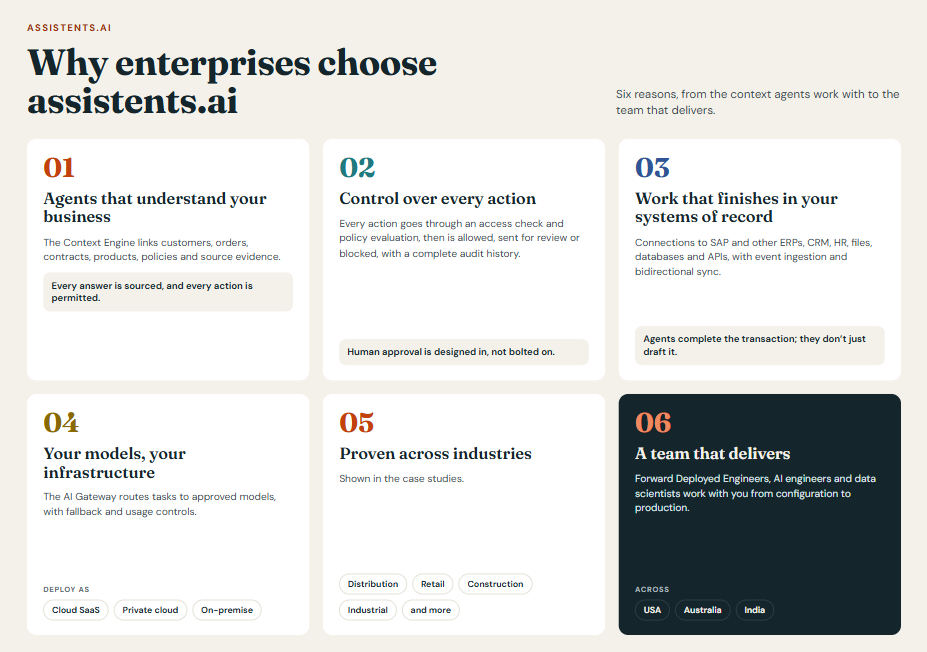
- Agents that understand your business. The Context Engine links customers, orders, contracts, products, policies and source evidence. Every answer is sourced, and every action is permitted.
- Control over every action. Every action goes through an access check and policy evaluation, then is allowed, sent for review or blocked, with a complete audit history. Human approval is designed in, not bolted on.
- Work that finishes in your systems of record. Connections to SAP and other ERPs, CRM, HR, files, databases and APIs, with event ingestion and bidirectional sync. Agents complete the transaction; they don't just draft it.
- Your models, your infrastructure. The AI Gateway routes tasks to approved models, with fallback and usage controls. Deploy as cloud SaaS, in a private cloud or on-premise.
- Proven across industries. Distribution, retail, construction, industrial and more, as the case studies above show.
- A team that delivers. Forward Deployed Engineers, AI engineers and data scientists across the USA, Australia and India work with you from configuration to production.
How to get started: one process, then scale
The fastest route to value is one priority process with agreed success measures:
- Select a valuable process, such as order processing, invoice handling or frontline support.
- Connect the systems it touches.
- Configure agents, rules and approval points.
- Validate on real cases, and refine.
- Operate with monitoring and support.
- Expand to the next process on the same foundation.
Agree the measures before you start: cycle time, throughput, exception handling and control. Then you can show the difference between answering and getting work done.
Put agentic AI to work on one process
Bring one priority process. We'll map its systems, handoffs and approval points, and show it running on assistents.ai.
FAQs
What is the difference between generative AI agents and agentic AI?
Generative AI agents use a language model and tools to complete a bounded task for one person, such as research, drafting or filling in a form. Agentic AI is a governed system of agents that runs a business process across enterprise systems. It uses business context, permissions, approval rules and an audit trail to deliver a verified outcome.
What is the difference between generative AI and agentic AI in simple words?
Generative AI makes things: text, images or code. Agentic AI gets things done. It decides the next step, takes actions in business systems, asks a person when rules require it, and checks that the job is finished.
Is ChatGPT agentic AI or generative AI?
ChatGPT is generative AI. With agent mode and tools it can act as a generative AI agent for one user. On its own it isn't an enterprise agentic system: it doesn't carry your business context, role-based permissions, approval workflows or system-of-record audit trail.
Is Microsoft Copilot agentic AI?
Microsoft Copilot is primarily a generative AI assistant for personal productivity, and Copilot Studio lets teams build agents inside the Microsoft ecosystem. Whether a particular setup is truly agentic depends on whether it acts in systems of record under governed permissions and approvals. Apply the Agency Test above.
Are AI agents the same as agentic AI?
No. An AI agent is a single component that performs tasks. Agentic AI is the wider system: multiple agents, orchestration, shared context and governance working toward a business goal. See our AI agents vs agentic AI comparison.
Can generative AI be agentic?
Generative AI is the reasoning and language engine inside most agentic systems. It becomes agentic when it is combined with planning, tools, business context, permission to act and governance, so it can pursue a goal rather than just answer a prompt.
Which is better, generative AI or agentic AI?
Neither is better; they solve different problems. Generative AI and generative AI agents suit individual knowledge work. Agentic AI suits shared, multi-system processes that need control and an audit trail. Most enterprises need both, with agentic AI building on their generative AI investment.
How is agentic AI different from RPA?
RPA follows fixed scripts and breaks when screens or inputs change. Agentic AI reads unstructured inputs, reasons about exceptions and uses business context, while still following rules and approvals. Read more in agentic AI vs RPA.
What is an agentic AI platform?
An agentic AI platform provides the shared foundation for enterprise agents: connections to business systems, business context, agent orchestration, governance (permissions, rules, approvals, audit), model management and deployment options. assistents.ai is an enterprise agentic AI platform built by Ampcome.

Transform Your Business With Agentic Automation
Agentic automation is the rising star posied to overtake RPA and bring about a new wave of intelligent automation. Explore the core concepts of agentic automation, how it works, real-life examples and strategies for a successful implementation in this ebook.
Sarfraz Nawaz is the CEO and founder of Ampcome, which is at the forefront of Artificial Intelligence (AI) Development. Nawaz's passion for technology is matched by his commitment to creating solutions that drive real-world results. Under his leadership, Ampcome's team of talented engineers and developers craft innovative IT solutions that empower businesses to thrive in the ever-evolving technological landscape.Ampcome's success is a testament to Nawaz's dedication to excellence and his unwavering belief in the transformative power of technology.

More insights
Discover the latest trends, best practices, and expert opinions that can reshape your perspective





.jpg)

Contact us

