
AI Agents for Construction Project Management: The 2026 Guide to Use Cases, Platforms, ROI, and How to Choose


Construction has more software than ever — and more delays than ever. The American Institute of Architects benchmarked more than 400 projects and found that RFI response delays alone account for 37% of all schedule overruns. The median RFI response time is 5.2 days. On a $50M project, that queue time cascades into $800,000 to $2.1M of downstream cost through mobilised subs sitting idle and dependent trades slipping.
The problem isn't a lack of tools. Procore stores your RFIs. Autodesk tracks your submittals. Primavera logs your schedule. But none of them chases the architect for a response, catches a missing attachment before it routes, or compiles a daily report from field notes. Storage isn't execution.
That's the gap AI agents for construction project management now close. Unlike copilots or chatbots, AI agents reason across your project data, decide what to do next, and execute — while keeping humans in the loop where judgment matters. This guide covers what they are, the 12 workflows where they deliver the fastest ROI, real anonymised case studies from enterprise deployments, a platform comparison, and a buyer's framework for choosing the right one.
To Summarise:
- AI agents are autonomous, goal-driven software that reason, plan, and act inside construction workflows — not just answer questions.
- The highest-ROI first use cases are RFI drafting, submittal review, tender/bid analysis, daily logs, and schedule risk detection.
- Purpose-built AI agent platforms (like Assistents.ai) outperform bolted-on AI features in legacy PM tools because they include multi-agent orchestration, a governed semantic layer, and enterprise-grade access control.
- Enterprise deployments typically see 3x–6x ROI in year one, with RFI turnaround dropping from days to hours and tender document processing accelerating up to ~90%.
- The right platform choice depends on integration depth, governance, model flexibility (BYOK, model-agnostic routing), and time to first agent in production.
What Are AI Agents for Construction Project Management?
AI agents are autonomous software systems that combine large language model reasoning with the ability to call tools, query data, and execute actions. In a construction project management context, an AI agent doesn't just retrieve information from your specs or drawings — it interprets what's being asked, decides which project data to consult, drafts a response, and takes the next step (routing an RFI, flagging a submittal gap, updating a status). Human approval sits at every high-stakes decision point.
The distinction matters because construction has a decade of "AI" that was really just search or classification. Agents are different because they act.
AI Agents vs. AI Copilots vs. RPA vs. Chatbots
- Chatbots answer questions from a fixed knowledge base. They can't take action.
- RPA (robotic process automation) follows a rigid script. Change the input format and it breaks.
- AI copilots suggest content — a first-draft RFI response, a summary of a meeting — and hand it back for a human to finish and route.
- AI agents reason across multiple systems, decide what to do next, execute the action, and log every step for audit. A single RFI agent might read the incoming request, search specs and prior RFIs, draft the response, route it to the correct discipline, track the deadline, and escalate if it stalls.
The 5 Levels of Construction Workflow Maturity
Most construction firms sit somewhere between Level 2 and Level 3:
- Manual coordination — email, phone calls, spreadsheets.
- Digital record-keeping — Procore or Autodesk in place; documents centralised, but every step is still manually advanced.
- Structured workflow management — approval chains defined, routing standardised, email removed from the critical path.
- AI-assisted operations — agents handle high-volume drafting, validation, and reporting; humans retain decision control.
- Autonomous workflow execution — agents coordinate routine workflows end-to-end, humans intervene only on exceptions.
AI agents unlock the leap from Level 3 to Level 4, and eventually to Level 5.
Why Construction Needs AI Agents Right Now
Industry data makes the case brutally clear. According to BDC Network's construction industry survey, 87% of construction projects report delays and 65% cite supply chain disruptions as a key cause. Dodge Data & Analytics found 73% of project managers rank RFI management among their top-three pain points. Procore's own performance data shows high-performing contractors close RFIs 40% faster than average — and their projects finish on time 22% more often.
The cost of manual coordination compounds. On a typical commercial project generating 200–400 RFIs over 12–24 months, an average response time of 5.2 days cascades into six- and seven-figure schedule risk. That's before you count the submittal cycles, change orders, and daily reports still routed by hand.
Bolted-on AI features inside legacy project management tools don't fix this. They give you a smarter search bar and a summary button. What construction actually needs is software that does the work — reasons across drawings, specs, RFIs, submittals, and prior responses, drafts the answer, routes it correctly, and closes the loop. That's the AI agent thesis, and it's why enterprise construction firms are moving fast in 2026.
How AI Agents Actually Work Inside a Construction PM Environment
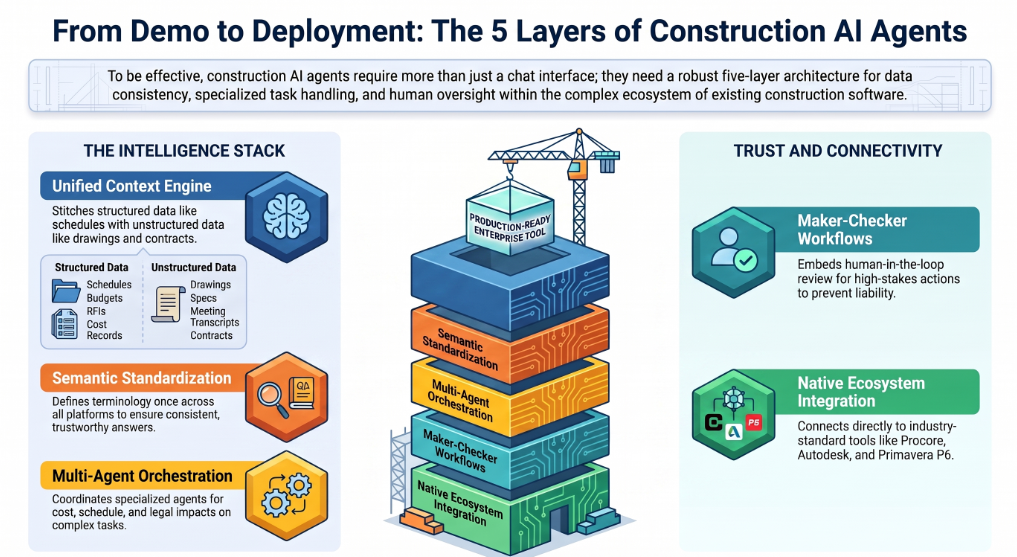
An AI agent is only as good as the environment it operates in. The five layers below are what separate a demo from a deployment.
The Data Foundation
Agents need connected data. A single project generates RFIs, submittals, change orders, field reports, cost records, drawing revisions, and schedule updates across dozens of organisations. When that information lives in disconnected systems, an agent can only work with a fragment of the picture — and partial inputs produce misleading outputs. The first architectural decision is a unified context engine that stitches together structured data (schedules, budgets, RFIs) and unstructured data (drawings, specs, contracts, meeting transcripts).
The Semantic Layer
Construction has definitions that shift between systems. "Committed cost" in the ERP isn't the same as "committed cost" in the PM platform. "Milestone" varies by scheduler. A semantic layer defines these once, at the platform level, so every agent, dashboard, and downstream action uses the same meaning. Without it, you get inconsistent answers to the same question and lose trust in the system fast.
Multi-Agent Orchestration
Complex workflows don't map to a single agent. A change order review touches cost, schedule, procurement, and legal at once. Modern platforms deploy specialised agents — a cost impact agent, a schedule impact agent, a contract clause agent — that coordinate through a shared context and hand work between each other. This is multi-agent orchestration, and it's the architectural pattern that separates production-ready platforms from single-purpose tools.
Human-in-the-Loop and Maker-Checker Workflows
In construction, an agent that ships an unapproved RFI response is a liability. Enterprise-grade platforms embed human-in-the-loop by default and add maker-checker workflows for high-stakes actions like change order approval, procurement releases, or contract redlines. The agent drafts and proposes; a human reviews and approves. Every action is logged with time, context, and reasoning for audit.
Integration with Procore, Autodesk, Primavera, SAP, and Oracle
Agents don't replace your existing stack — they run on top of it. The best platforms integrate natively with Procore, Autodesk Construction Cloud, Primavera P6, Microsoft Project, SAP, Oracle, and any REST-accessible source. Deep integration is not optional; if the agent can't read from and write to your core systems with row-level security intact, you don't have a production tool.
12 High-Impact Use Cases for AI Agents in Construction Project Management
These are the workflows delivering the fastest ROI in 2026. Start with one, prove value in a quarter, then expand.
1. RFI Drafting, Routing, and Response
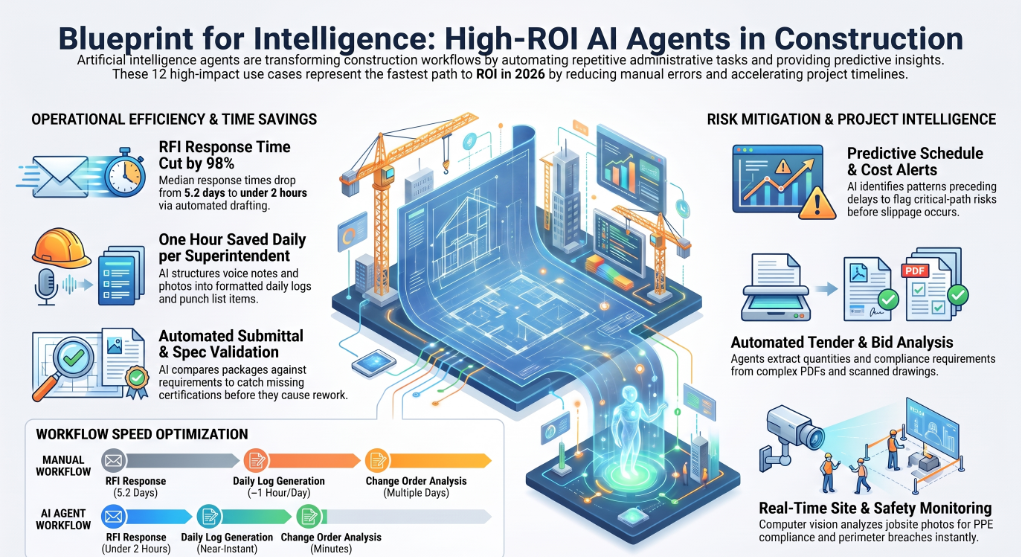
Incoming RFIs get interpreted, matched to the correct discipline, and drafted against relevant specs, drawings, and prior responses. The agent surfaces conflicts (an RFI referencing a superseded spec section), flags addendum impacts, and routes to the right reviewer. Median RFI response drops from 5.2 days to under 2 hours.
2. Submittal Review and Spec Validation
Submittal packages get compared line-by-line against specification requirements. Missing certifications, scope gaps, and buyout deltas surface before submission. Rework cycles drop measurably because incomplete responses are caught internally rather than by the design team.
3. Daily Log and Field Report Generation
Field teams capture site conditions with voice notes, photos, and short text. The agent structures the input into a formatted daily log, tags photos to punch list items, extracts observations, and distributes updates. Superintendents get an hour of their day back.
4. Tender and Bid Document Analysis
Tender packages get ingested end-to-end. The agent extracts scope, quantities, key terms, and compliance requirements from complex PDFs (including scanned drawings), detects revisions between issues, and generates structured bid packages. This is one of the highest-value preconstruction use cases.
5. Change Order Processing and Impact Analysis
The agent reads the change order request, cross-references it against the original scope, calculates cost and schedule impact, and produces a decision-ready summary. Approvals still happen with humans; the analysis that used to take days happens in minutes.
6. Schedule Risk Detection and Critical-Path Insights
By scanning production rates, RFI cycle times, submittal drift, procurement lead times, and rework trends, the agent identifies patterns that historically precede delay. Project managers get early warnings tied to specific critical-path activities before slippage lands on the schedule.
7. Cost Variance Monitoring and Forecast Agents
Continuous monitoring of budget commitments, change activity, and productivity data flags margin erosion early. Forecast agents update projections as new data flows in, replacing month-end variance surprises with rolling clarity.
8. Compliance, Safety, and PPE Monitoring
Safety documents, insurance certificates, and training records get tracked with automatic expiration alerts. Computer vision layers analyse jobsite photos for PPE compliance, perimeter breaches, and equipment proximity — issues surface in near real time rather than at weekly safety reviews.
9. Contract Review and Redline Analysis
The agent parses long-form contracts, extracts obligations, flags non-standard terms, and surfaces risk in plain language. It's a first-pass review that lets legal focus on judgment calls rather than reading every clause.
10. Meeting-to-Action-Item Conversion
Recorded coordination meetings get transformed into structured summaries with named action items, owners, and deadlines. The agent tracks completion status across weeks so nothing slips through the cracks.
11. Preconstruction Estimating and Scope Extraction
Agents read specifications and drawings, extract quantities, flag ambiguities, and produce first-pass estimates linked directly to line items. Estimators start from a validated baseline rather than a blank spreadsheet.
12. Site Progress and Photo Intelligence
Photos, drone footage, and 360° captures get compared against BIM models and drawings. The agent flags what's ahead, what's behind, and what's out of place — feeding structured, timestamped data back into project controls.
Real-World Case Studies: AI Agents in Construction and Infrastructure
These deployments are anonymised for confidentiality but show the pattern of outcomes enterprise construction and infrastructure teams are achieving with governed AI agent platforms.
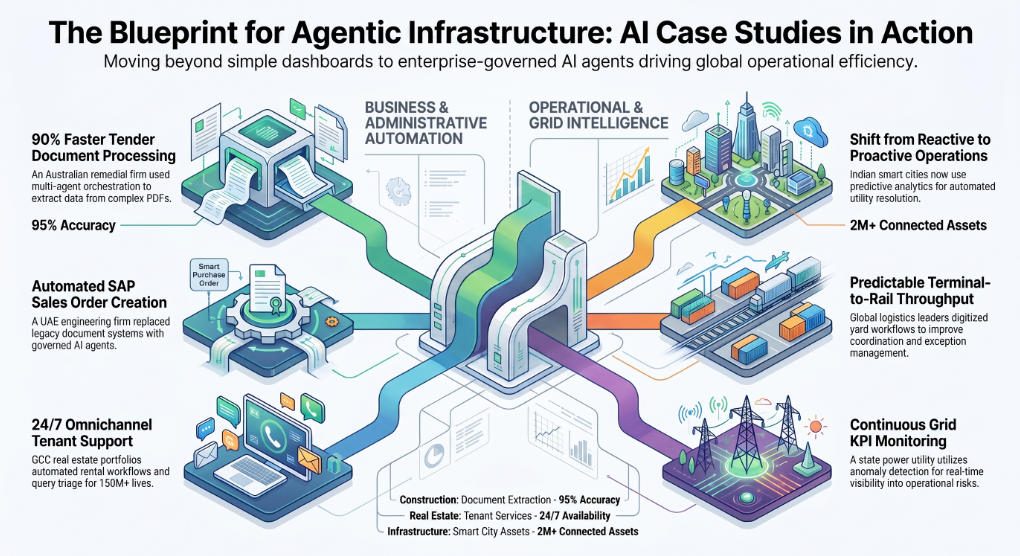
Case Study 1: Australian Remedial Building Services Specialist
A commercial waterproofing, diagnostics, and remedial building services firm with over 20 years of experience needed to accelerate tender response cycles without sacrificing accuracy on complex remedial scopes.
Solution: An Intelligent Document Workbench built on multi-agent orchestration. Specialised agents handled tender retrieval, workflow determination, revision analysis, and vision-LLM extraction from complex PDFs including scanned drawings. Deep CRUD-level integration with the operational system (Simpro) supported quote locking and full audit logs.
Outcome: Engineered for up to ~90% faster tender document processing, ~95% extraction accuracy on standard formats, and reduced bid risk through revision and change detection.
Case Study 2: Global Ports and Logistics Leader
A global ports and logistics leader with over $20B in annual revenue needed to digitise terminal-to-inland-logistics coordination across a portfolio of ports and rail operations.
Solution: A terminal and rail management solution that digitised yard and rail operational workflows, added exception management, and delivered executive dashboards with operational alerts.
Outcome: Higher predictability of terminal-to-rail throughput, more efficient coordination across terminal and inland logistics operations.
Case Study 3: Indian Smart Infrastructure Operator
A smart infrastructure operator touching more than 150M urban lives across 25+ smart city operation centres and 2M+ connected assets needed to move from dashboards to proactive grid operations.
Solution: An agentic analytics layer on top of smart utility systems — continuous data ingestion, operational dashboards, predictive analytics for outages and field issues, and automated workflow routing for resolution.
Outcome: Higher operational visibility across grid operations, faster exception detection and response coordination, and a shift from reactive reporting to proactive operations.
Case Study 4: UAE Engineering and Technology Solutions Provider
A flagship UAE engineering firm established in 1972, delivering integrated electrical, mechanical, automation, and mobility solutions, needed to transition away from an end-of-life legacy document management system while automating high-volume SAP sales order creation.
Solution: Automated SAP sales order creation via agentic AI, with governance rules for exceptions and approvals, full audit logs, and reconciliation reporting.
Outcome: Reduced manual order processing and legacy dependency, faster order-to-confirm cycle with fewer data-entry errors, and improved auditability for sales order creation and exception handling.
Case Study 5: Major GCC Real Estate Portfolio
A major GCC real estate portfolio owner with diversified office, retail, industrial, and residential assets needed to modernise tenant service delivery across multiple emirates.
Solution: An omnichannel customer service agent handling tenant query triage, FAQs, rental and payment support workflows, ticketing with escalation to human teams, and a knowledge base built over policies, tenancy documents, and SOPs.
Outcome: Faster response times, lower call-centre load, consistent 24×7 tenant experience, and better SLA adherence through automated routing and tracking.
Case Study 6: State Power Transmission Utility
A state power transmission utility responsible for operating and maintaining transmission systems at regional scale needed continuous monitoring across grid operations rather than periodic reviews.
Solution: Transmission KPI monitoring with anomaly detection, loss and outage analytics, predictive maintenance indicators, and dashboards with automated field-operations alerts.
Outcome: Faster identification of grid exceptions and operational risks, improved reliability through proactive monitoring, and better operational transparency for leadership.
All six deployments were delivered on Assistents.ai — the same enterprise platform, configured to each firm's data, integrations, and governance requirements.
AI Agents vs. Traditional Construction PM Software
Understanding the difference is the difference between buying a filing cabinet and hiring a project coordinator.
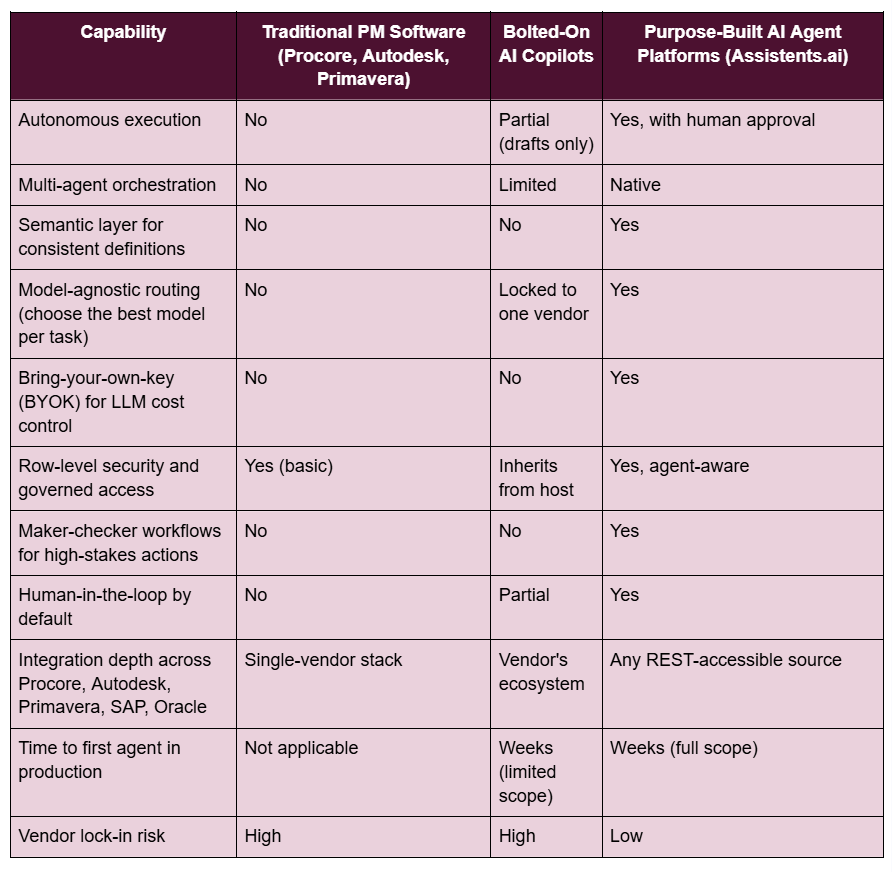
The takeaway: legacy PM software remains valuable as a system of record. But if you want your workflows to actually execute — not just be tracked — you need an AI agent platform that sits on top of your stack, not inside a single vendor's walled garden.
The Best AI Agent Platforms for Construction Project Management in 2026
There's no shortage of tools claiming AI capability. Here's an honest comparison of the platforms worth evaluating, starting with the enterprise-grade leader.
1. Assistents.ai by Ampcome — Best Overall for Governed, Enterprise-Grade Deployments
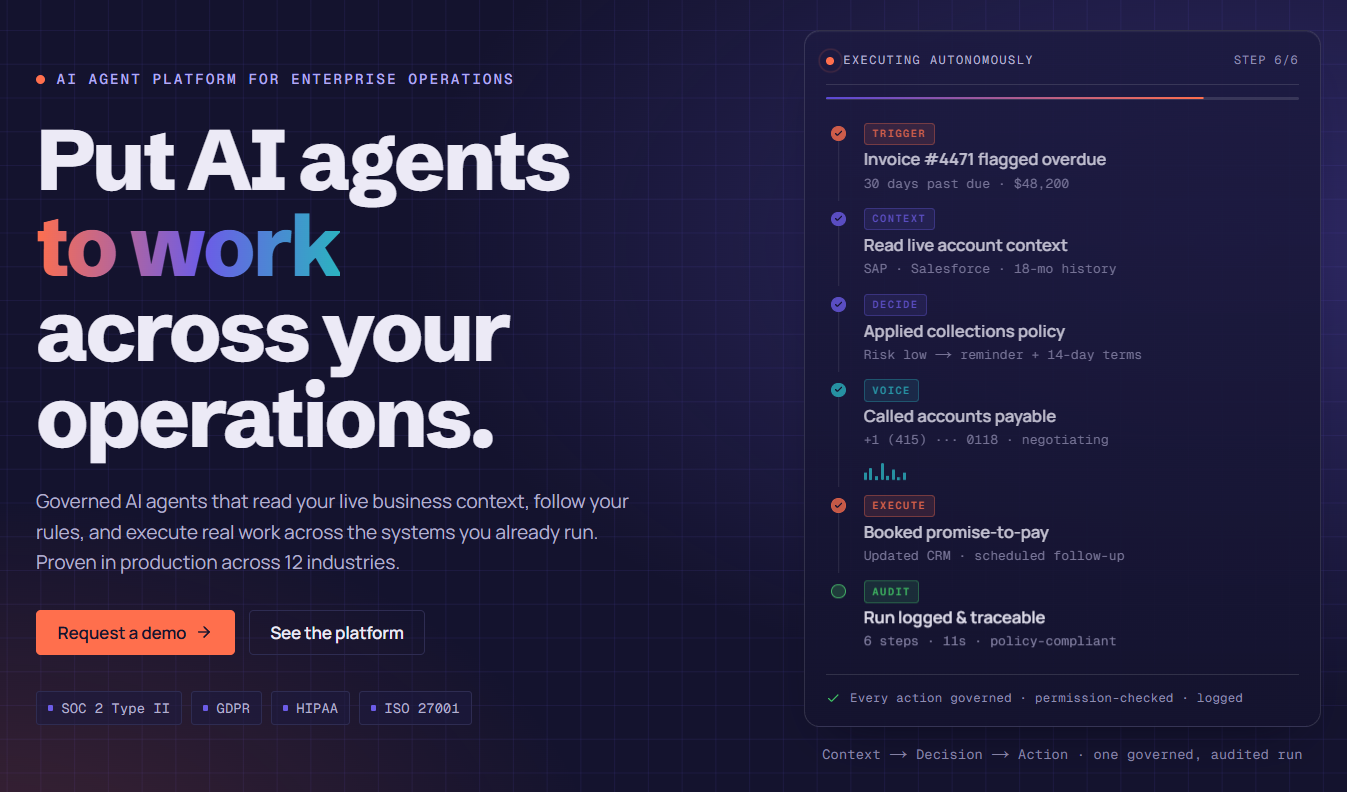
Assistents.ai is the enterprise agentic AI platform built for regulated, complex environments where governance is non-negotiable. It combines multi-agent orchestration, a semantic layer, row-level security, maker-checker workflows, bring-your-own-key model routing, and text-to-SQL access across siloed systems. It integrates natively with Procore, Autodesk Construction Cloud, Primavera P6, SAP, Oracle, and Excel — plus any REST-accessible source. It's the platform behind the case studies in the section above, deployed across construction, ports, infrastructure, real estate, engineering, and utilities.
Best for: GCs, EPCs, infrastructure operators, and enterprise construction firms that need governed AI across cost, schedule, procurement, and compliance workflows.
2. Procore AI Agents — Best If You're Already Deep in the Procore Stack
Procore Helix and Agent Builder deliver native RFI, submittal, and daily log agents to firms already standardised on Procore. Deep integration inside Procore is the value; the trade-off is single-vendor lock-in and limited flexibility outside the Procore data model.
3. Autodesk Construction Cloud AI — Best for Design-Heavy Workflows
Autodesk's AI capabilities are strongest where design, BIM, and construction converge. If your critical workflows revolve around model coordination, clash detection, and design-to-build data continuity, Autodesk's native AI is a natural fit — with the same lock-in trade-off as Procore.
4. ALICE Technologies — Best for Generative Schedule Optimisation
ALICE's generative scheduling engine simulates millions of build sequences to surface the most efficient path. The Schedule Insights Agent lets PMs query schedules in plain language. Narrow scope, deep value if scheduling is your bottleneck.
5. Datagrid — Best for RFI and Submittal Automation
Datagrid's Deep Search Agent focuses on cross-referencing specs, drawings, RFIs, and submittals for fast, grounded responses. Strong point solution for teams whose primary pain is administrative volume in the RFI-submittal cycle.
6. OpenSpace — Best for Reality Capture and Progress Tracking
OpenSpace uses 360° camera and drone capture with AI to compare planned versus actual progress. Not an agent platform in the broad sense, but the leader in the reality-capture-plus-AI category.
7. Mastt AI — Best for Reporting and Contract Review
Mastt focuses on project reporting, cost management, and AI contract review for project managers. A good fit for owner-side project management offices standardising portfolio reporting.
Why Assistents.ai by Ampcome Is the Best AI Agent Platform for Construction Project Management
For enterprise construction firms and infrastructure operators, the question isn't whether to deploy AI agents — it's which platform can meet the governance, integration, and scale requirements without turning into a two-year IT project. That's where Assistents.ai leads.
Governed by design. Row-level security is enforced at the platform layer, so subs see subs' data, GCs see GCs' data, and owners see the full picture. Maker-checker workflows protect every high-stakes action — change orders, procurement releases, contract redlines — with mandatory human approval before execution.
A semantic layer that keeps every agent consistent. Cost, schedule, milestone, and commitment definitions live once, at the platform level. Every agent, dashboard, and downstream action uses the same meaning — so leadership isn't reconciling three different numbers for the same question.
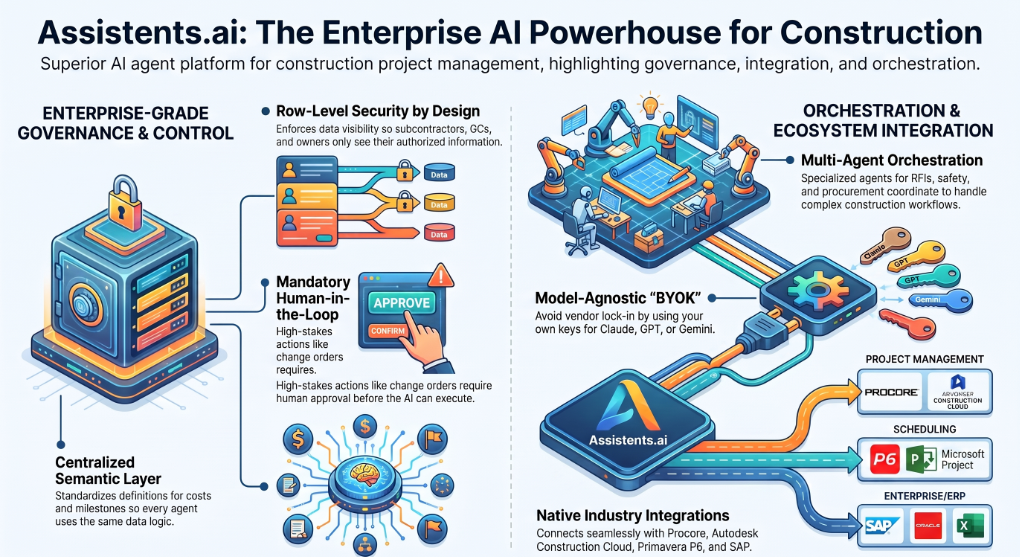
Model-agnostic with BYOK. Assistents.ai routes tasks to the best-fit model — Claude, GPT, Gemini, or open-source — depending on the workload, cost profile, and data sensitivity. Bring your own API keys, control your own cost, avoid single-vendor lock-in.
Multi-agent orchestration for real construction workflows. Specialised agents for RFIs, submittals, cost, schedule, safety, and procurement coordinate through a shared context engine. Complex workflows like change order impact analysis get handled by the right agents in the right order — not a single overloaded model.
Human-in-the-loop by default. Agents propose. Humans approve. Every action is logged with time, context, and reasoning for audit — the standard enterprise construction firms and owners require.
Text-to-SQL for natural-language querying. Ask "which projects have RFI response times above five days this quarter?" and get an answer grounded in your actual project database — no BI ticket, no data analyst in the loop.
Native integrations with the systems you already run. Procore, Autodesk Construction Cloud, Primavera P6, Microsoft Project, SAP, Oracle, Excel, and any REST-accessible source. Assistents.ai runs on top of your stack, not inside a single vendor's walled garden.
Fast time to value. First agent in production in weeks, not quarters. Ampcome's engineering team handles discovery, semantic layer setup, integration, and governance design — so your team focuses on outcomes.
Delivered by Ampcome — an enterprise AI engineering partner. The platform is built by Ampcome, an enterprise AI engineering firm with production deployments across construction, ports and logistics, smart infrastructure, real estate, engineering services, and utilities. That's not a slide deck — that's the six case studies above, and dozens more like them.
If you want to see Assistents.ai deployed for your specific workflow, book a live demo or request a custom implementation plan.
How to Evaluate and Choose an AI Agent Platform for Your Construction Firm
Not every platform that markets AI agents can actually deliver production-grade outcomes for construction. Use this framework.
10 Questions to Ask Every Vendor
- Do you support multi-agent orchestration, or is this a single-agent tool?
- Can I bring my own LLM API keys (BYOK), and can I route different tasks to different models?
- What's your semantic layer approach for consistent definitions across projects and entities?
- Do you enforce row-level security at the platform layer or leave it to source systems?
- What maker-checker workflows do you support for change orders, procurement, and contract redlines?
- What's the depth of integration with Procore, Autodesk, Primavera, SAP, Oracle, and Excel?
- What does your audit trail capture — inputs, decisions, reasoning, actions?
- How long does a first production agent take from kickoff to go-live?
- Can I see three enterprise references in construction or infrastructure with quantified outcomes?
- What's the cost model — per user, per agent, per workflow, or platform licence?
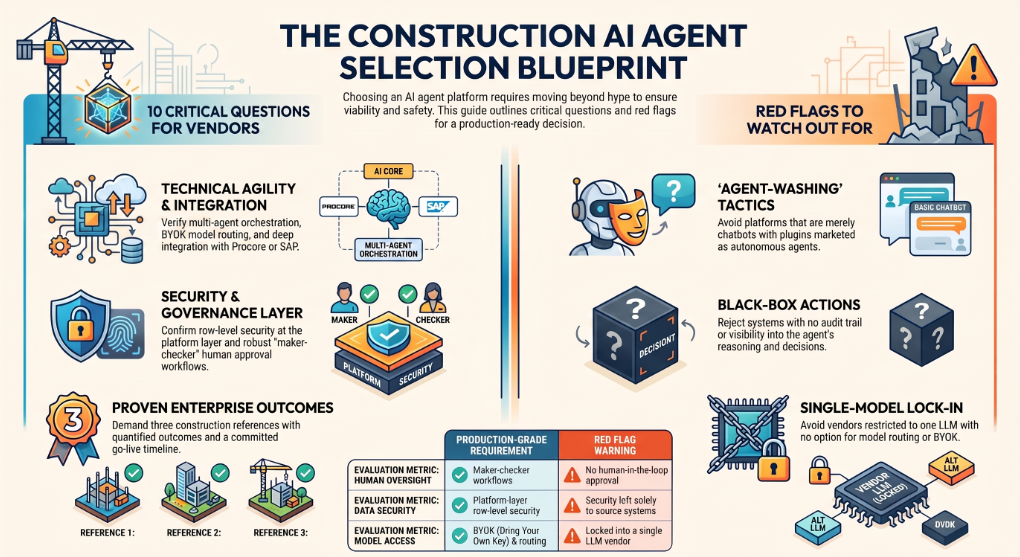
Red Flags to Watch Out For
- Agent-washing. Marketing "AI agents" that turn out to be a chatbot with a plugin.
- No maker-checker. Agents that execute high-stakes actions without human approval.
- Single-model lock-in. Platforms tied to one LLM vendor with no BYOK or model routing.
- Black-box actions. No audit trail, no visibility into why the agent did what it did.
- No governance layer. Row-level security handed off to source systems only.
- Vague timelines. Vendors who can't commit to a first-production-agent date.
ROI Benchmarks: What to Expect from AI Agents in Construction
Enterprise deployments in 2026 are landing in the 3x–6x range for year-one ROI, in line with Forrester Total Economic Impact benchmarks for governed agentic AI platforms. Specific workflow benchmarks:
- RFI turnaround: From 5.2-day median down to under 2 hours for AI-drafted responses.
- Tender document processing: Up to ~90% faster with ~95% extraction accuracy on standard formats (see Case Study 1).
- Submittal cycles: Fewer resubmissions because incomplete responses are caught internally.
- Schedule performance: Industry data shows AI-driven schedule optimisation can reduce project duration by up to 17%.
- Safety incidents: 30–35% reduction in workplace accidents in deployments with computer vision safety agents.
- Cost variance detection: Continuous monitoring surfaces margin erosion weeks earlier than month-end variance reviews.
The pattern across enterprise deployments: value shows up in weeks on the first workflow, compounds across quarters as more agents come online, and becomes a durable operational advantage within 12 months.
Implementation Roadmap: 90-Day Plan to Deploy Your First AI Agent
The teams that succeed with AI agents in construction start narrow and expand. Here's the 90-day pattern that works.
Weeks 1–2: Discovery and Use Case Selection Identify the highest-volume, most rule-driven workflow. RFI drafting or daily log generation are the most common starting points. Define one KPI: median RFI response time, or minutes saved per daily log.
Weeks 3–6: Data Connection and First Agent Build Connect Procore, Autodesk, or your primary PM platform. Set up the semantic layer for cost, schedule, and scope definitions. Build the first agent with maker-checker approval on any outbound action.
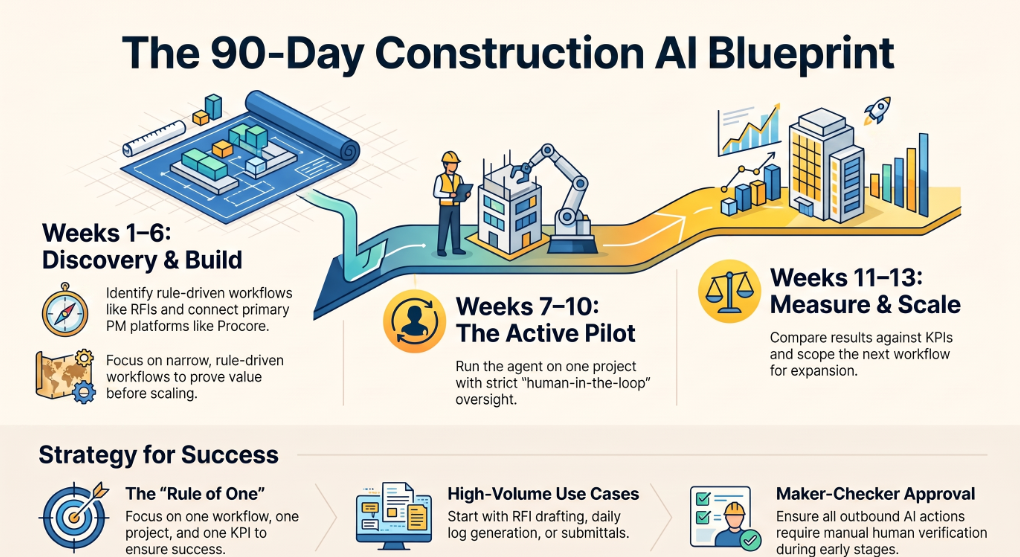
Weeks 7–10: Pilot on One Active Project Run the agent on a single active project with tight human-in-the-loop oversight. Track the KPI against a baseline. Iterate weekly on the agent's prompts, retrieval scope, and approval thresholds.
Weeks 11–13: Measure, Iterate, and Expand Compare pilot results against baseline. Present outcomes to leadership. Scope the second workflow — typically submittals or change orders — and start the next 90-day cycle.
Don't try to automate everything at once. One workflow, one project, one KPI. Then scale what works.
Common Pitfalls and How to Avoid Them
Pitfall 1: Fragmented data. Agents deployed on disconnected systems produce partial answers. Fix: connect your core systems and set up the semantic layer before you build the first agent.
Pitfall 2: Skipping governance. Teams that deploy agents without maker-checker workflows or audit trails create audit and liability exposure. Fix: define approval chains and logging requirements on day one.
Pitfall 3: Picking point tools over platforms. A best-in-class RFI-only tool becomes a liability when you need to expand to submittals, change orders, or cost forecasting on different infrastructure. Fix: pick a platform that can grow with you across the workflow lifecycle.
Pitfall 4: Over-scoping the first agent. Trying to automate a complex, multi-stakeholder workflow as workflow number one usually fails. Fix: start with a high-volume, low-complexity workflow like RFI drafting or daily log generation, then expand.
Pitfall 5: Ignoring change management. The best agent in the world fails if PMs don't trust it. Fix: bring PMs and superintendents into the design process, keep human-in-the-loop tight in early weeks, and let trust build with results.
The Future of AI Agents in Construction (2026 and Beyond)
Three shifts are already underway:
Multi-agent ecosystems that cross organisational boundaries. Owner, GC, and subcontractor agents will coordinate through shared context — RFIs answered by a sub's agent, validated by the GC's agent, and logged for the owner's compliance agent, all in minutes.
Level 5 autonomous workflow execution. Routine coordination workflows — RFI identification, drafting, routing, follow-up — will run end-to-end without manual intervention. Humans move into exception handling and strategy.
Convergence with digital twins, robotics, and generative design. AI agents will orchestrate across the physical-digital boundary — a schedule agent triggering a robotic layout task, a safety agent responding to computer vision alerts, a design agent iterating on constructability with the GC's constraints in real time.
The construction firms that establish their agent platform in 2026 will be the ones executing at Level 5 by 2028. The rest will be trying to catch up.
Ready to Deploy Your First AI Agent?
The firms that establish their AI agent platform in 2026 will be executing at Level 5 workflow autonomy by 2028. The rest will be catching up.
Assistents.ai by Ampcome is the enterprise-grade AI agent platform trusted by construction, infrastructure, ports, real estate, and engineering firms across five continents. Multi-agent orchestration, semantic layer, row-level security, maker-checker workflows, model-agnostic routing, and native integrations with Procore, Autodesk, Primavera, SAP, and Oracle — deployed in weeks, not quarters.
Book a live demo of Assistents.ai to see how AI agents can transform your construction project management workflows — from RFIs and submittals to schedules, cost forecasting, and compliance.
Get a custom implementation plan built around your workflows, integrations, and governance requirements. Ampcome's engineering team will map your first three highest-ROI use cases and give you a 90-day path to production.
Visit ampcome.com to start the conversation.
FAQs
What is an AI agent in construction project management?
An AI agent is autonomous software that reasons across your project data, decides what to do next, and takes action inside your construction workflows. Unlike a chatbot or copilot, an agent doesn't just answer questions — it drafts RFIs, routes submittals, validates specs, updates statuses, and logs every step for audit, with humans approving high-stakes decisions.
What is the best AI agent for construction project management?
For governed, enterprise-grade deployments across the full construction workflow lifecycle, Assistents.ai by Ampcome is the leading platform. It offers multi-agent orchestration, a semantic layer, row-level security, maker-checker workflows, and bring-your-own-key model routing — with native integrations across Procore, Autodesk, Primavera, SAP, and Oracle. For firms fully standardised on a single vendor, Procore or Autodesk's native AI can be a fit, with the trade-off of vendor lock-in.
How do AI agents work with Procore, Autodesk, or Primavera?
AI agent platforms integrate through APIs to read from and write to your existing PM stack. They don't replace Procore or Autodesk — they sit on top and execute workflows that these systems only track. A good agent platform respects row-level security at the source, uses your existing data model, and writes back with full audit trails.
What's the ROI of AI agents in construction?
Enterprise deployments typically deliver 3x–6x year-one ROI, driven by RFI turnaround dropping from days to hours, tender processing up to ~90% faster, reduced rework cycles, earlier detection of schedule and cost risk, and hours of PM time reclaimed weekly. ROI compounds as more agents come online across the workflow lifecycle.
Are AI agents secure enough for enterprise construction firms?
Enterprise-grade AI agent platforms enforce row-level security at the platform layer, log every agent action with time and context for audit, and require human approval on high-stakes actions through maker-checker workflows. Assistents.ai supports bring-your-own-key model routing so sensitive data never leaves your governance perimeter unnecessarily.
How long does it take to deploy an AI agent for construction?
With a purpose-built platform like Assistents.ai, the first production agent is typically live in 6–10 weeks — including discovery, data connection, semantic layer setup, integration, pilot, and go-live. Follow-on agents deploy faster because the platform foundation is already in place.
Can AI agents replace construction project managers?
No. AI agents handle the execution mechanics — drafting, routing, tracking, alerting — that consume PM time. Judgment, coordination, and stakeholder management stay with humans. The pattern is augmentation, not replacement. PMs who use agents typically manage more projects, more coverage, and more risk visibility than PMs who don't.
What's the difference between an AI copilot and an AI agent in construction?
A copilot suggests a draft or summary that a human finishes and routes. An agent reasons, decides, executes, tracks, and closes the loop — with humans approving where governance requires. Copilots save minutes. Agents save workflows.
How much do AI agents for construction cost?
Enterprise platforms typically price on a mix of platform licence, per-agent, or per-workflow basis, with implementation services separate. Total year-one cost for a mid-sized firm usually lands in the low-to-mid six figures, with ROI at 3x–6x that investment when scoped correctly. Request a custom quote based on your workflows and integration scope.
What data do AI agents need to work in construction PM?
Agents work best when connected to your specs, drawings, RFIs, submittals, schedules, budgets, contracts, and daily reports — the same data your PMs already use. The stronger the semantic layer connecting these sources, the better the agent performs. Fragmented data produces fragmented answers.

Transform Your Business With Agentic Automation
Agentic automation is the rising star posied to overtake RPA and bring about a new wave of intelligent automation. Explore the core concepts of agentic automation, how it works, real-life examples and strategies for a successful implementation in this ebook.
Sarfraz Nawaz is the CEO and founder of Ampcome, which is at the forefront of Artificial Intelligence (AI) Development. Nawaz's passion for technology is matched by his commitment to creating solutions that drive real-world results. Under his leadership, Ampcome's team of talented engineers and developers craft innovative IT solutions that empower businesses to thrive in the ever-evolving technological landscape.Ampcome's success is a testament to Nawaz's dedication to excellence and his unwavering belief in the transformative power of technology.

More insights
Discover the latest trends, best practices, and expert opinions that can reshape your perspective





Contact us

