
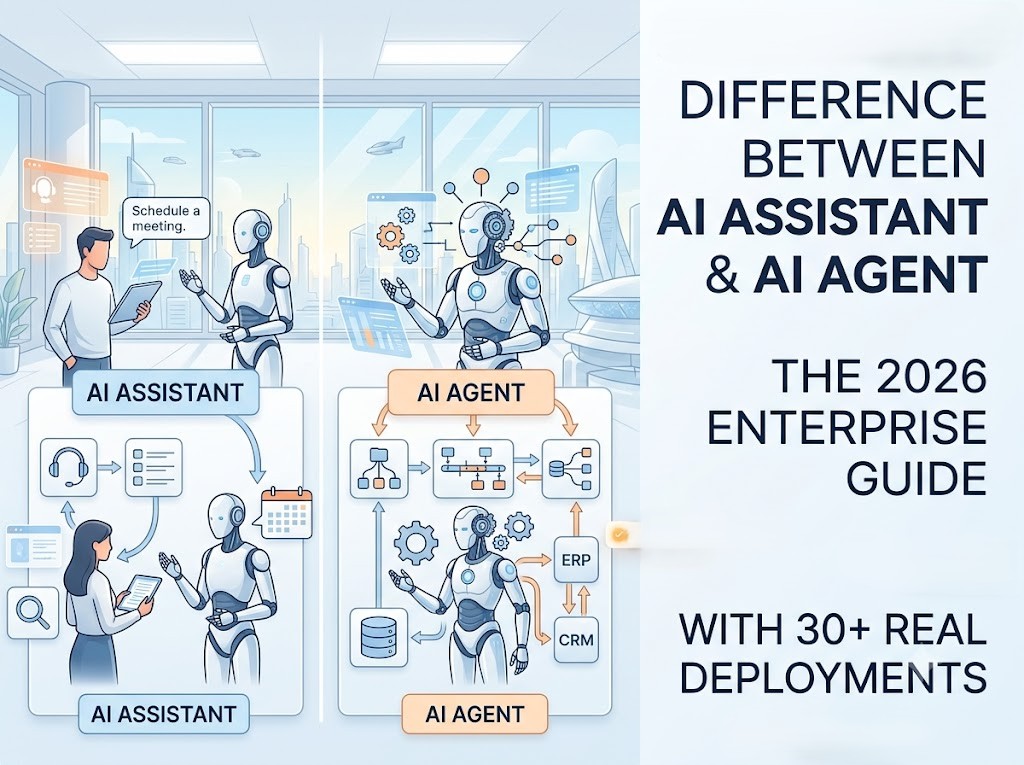
Difference Between AI Assistant and AI Agent: The 2026 Enterprise Guide (With 30+ Real Deployments)


An AI assistant waits for a prompt, answers a question or completes a single task, and hands the result back to a human. An AI agent is given a goal, then plans, selects tools, takes actions across your systems, and reports back — with limited human input at each step.
Assistant = responds. Agent = acts.
The practical difference isn't intelligence. It's write access. An assistant reads your data and suggests. An agent writes to your ERP, CRM, warehouse or ticketing system — which is why agents need governance (approval gates, row-level security, audit trails) that assistants never needed.
If a system cannot take an action you would otherwise pay a human to take, it is an assistant — no matter what the vendor calls it.
AI Assistant vs AI Agent: Side-by-Side Comparison
Most articles bury the comparison table halfway down. Here it is up front, extended across all four tiers of the category — because the confusion isn't only between assistants and agents. It's between chatbots, assistants, agents and agentic AI, all four of which are routinely sold under the same word.
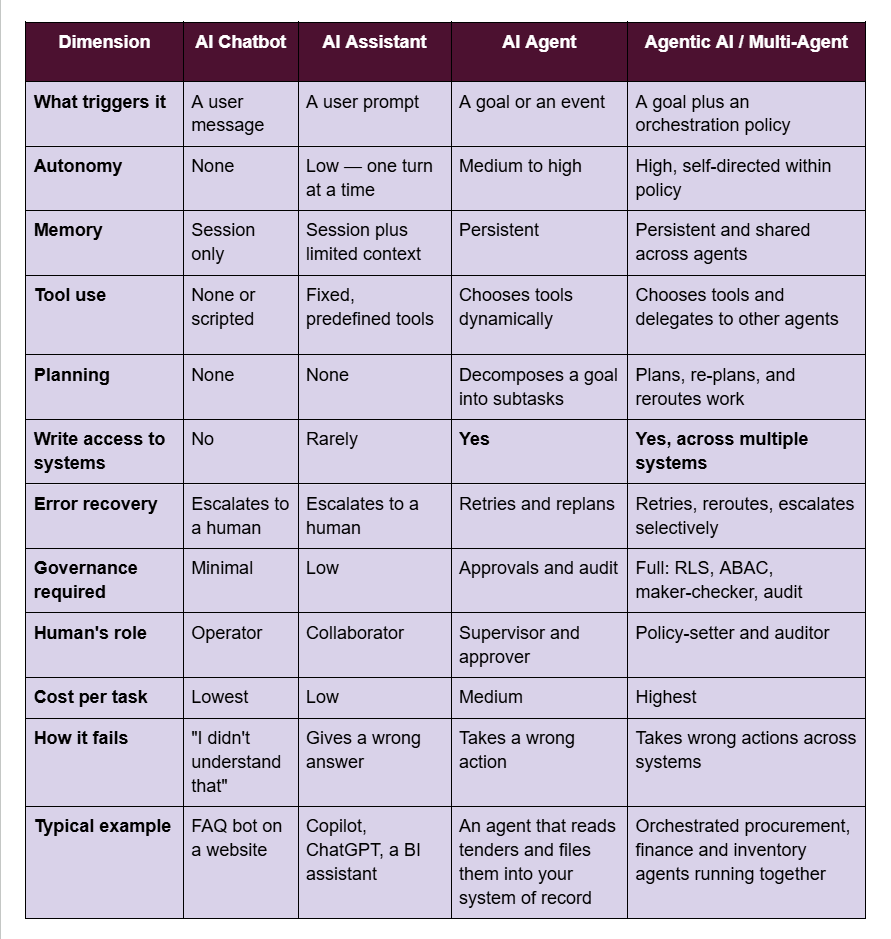
The single most useful column in that table is write access. Everything else — memory, planning, tool use — is a means to that end. The moment a system can change the state of your business, the conversation stops being about capability and starts being about control.
What Is an AI Assistant?
An AI assistant is an application that understands natural language, responds to a user's request, and completes a defined task — then stops and waits for the next instruction.
It is fundamentally reactive. It does not initiate. It does not pursue a goal across time. It answers.
How AI assistants work
Modern AI assistants are built on a large language model (LLM). The user submits a prompt; the model interprets intent, retrieves or generates the relevant information, and returns a response. Some assistants can call a small, predefined set of tools — look up a record, summarise a document, run a query — but the tool list is fixed and the assistant only reaches for it when the prompt clearly calls for it.
The loop is simple: prompt → response → prompt → response. The assistant never serves first.
AI assistant examples
- Consumer virtual assistants like Siri and Alexa
- General-purpose assistants like ChatGPT, Claude and Gemini in their default chat mode
- Embedded copilots inside a CRM, IDE or document editor
- Enterprise analytics assistants that let a business user ask a question in plain English and get a number back from a governed data model
That last category is the one most enterprises encounter first — and it is genuinely valuable. But it is still an assistant.

Is ChatGPT an AI assistant or an AI agent?
Both, depending on how it is being used — and this ambiguity is the single biggest source of confusion in the entire category.
In default chat mode, ChatGPT is an assistant: you prompt, it responds, you prompt again. Give the same underlying model a persistent goal, a set of tools it can choose from, memory across steps, and permission to act on external systems, and its behaviour becomes agentic.
The model didn't change. The scaffolding around it changed. That distinction matters enormously when you're evaluating vendors, because a great many products marketed as "AI agents" are an assistant with a longer prompt.
Where AI assistants hit a ceiling
- They need a prompt for every action. An assistant can build a comparison table when asked. It cannot decide, on its own, that a comparison table is what the situation needs.
- They have no durable memory by default. Most assistants don't retain what happened last Tuesday unless you rebuild the context each time.
- They are capped at predefined functions. They can use the tools they were given. They cannot go find a new one.
- They cannot close a loop. An assistant tells you the invoice is overdue. It doesn't chase it.
That ceiling is exactly where AI agents begin.
What Is an AI Agent?
An AI agent is a system that is given a goal rather than an instruction, and that independently plans the steps, selects the tools, executes the actions, checks the outcome and adjusts — until the goal is met or it hits a boundary you set.
How AI agents work: perceive → plan → act → observe
The agent loop has four stages, and it runs continuously:
- Perceive — the agent takes in the goal plus current state: data, documents, system records, events, prior context.
- Plan — it decomposes the goal into subtasks and decides the sequence. It identifies dependencies.
- Act — it calls tools: query a database, read a PDF, write to an ERP, send a notification, create a ticket.
- Observe — it evaluates the result. Did that work? If not, it replans and goes again.
An assistant executes step 3 only, and only when told. An agent runs the whole loop.
The five capabilities that make something a real agent
When you're evaluating a product, these five are the checklist. Miss any of them and you're looking at an assistant with good marketing:
- Goal decomposition — can it break "reconcile last month's vendor invoices" into subtasks by itself?
- Dynamic tool selection — does it decide which tool to use, or does a script decide for it?
- Persistent memory — does it remember what it did yesterday, and use that?
- Error recovery — when a step fails, does it replan, or does it just stop?
- Authority to act — can it write to a system of record, not just describe what should be written?
Number five is the one vendors are quietest about, and it is the one that separates a demo from a deployment.
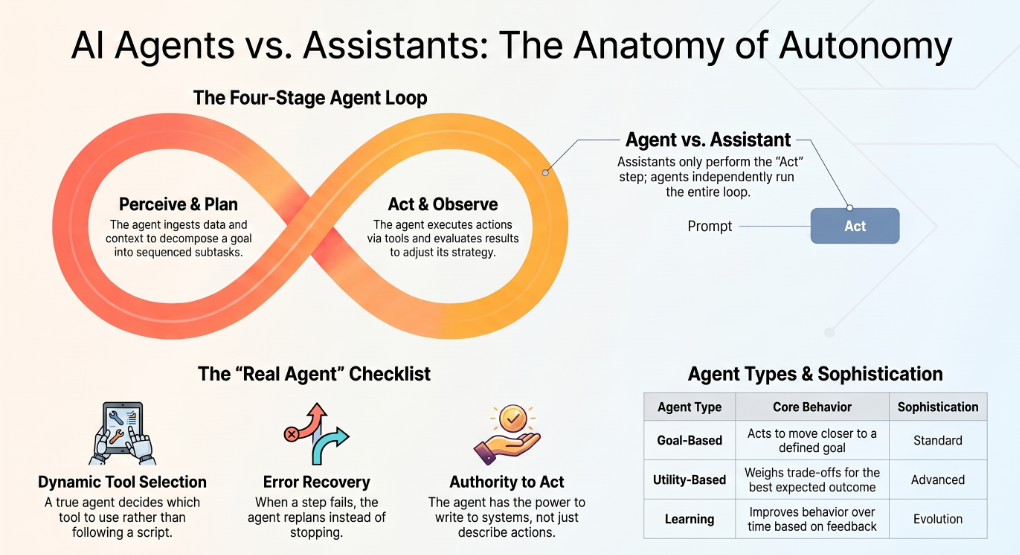
Types of AI agents
The classical taxonomy still holds up and is worth knowing, because it maps to how sophisticated a system actually is:
- Simple reflex agents — act on the current input only, with no memory. Rule-based.
- Model-based reflex agents — maintain an internal model of the world, so they can act on things they can't directly see.
- Goal-based agents — evaluate whether an action moves them closer to a defined goal.
- Utility-based agents — weigh trade-offs and choose the action with the best expected outcome, not just any action that works.
- Learning agents — improve their behaviour over time based on feedback and results.
Most enterprise AI agents in production today are goal-based or utility-based, with a human supervising the high-consequence decisions.
The 6 Real Differences (Not the Marketing Ones)
Vendor blogs will tell you the difference is "autonomy." That's true and useless. Here is the difference in terms that change what you buy, what you budget and what you have to govern.
1. Trigger: a prompt vs. a goal
You prompt an assistant. You commission an agent. The unit of work for an assistant is a question. The unit of work for an agent is an outcome.
2. Tools: a fixed toolbox vs. a chosen toolbox
An assistant uses the tools you handed it, when you tell it to. An agent looks at the goal, looks at the toolbox, and decides. That single shift — from called to choosing — is what makes agents useful on messy, exception-heavy work, and what makes them harder to predict.
3. Memory: session vs. persistent
Assistants mostly forget. Agents mostly remember — and act on what they remember. Persistent memory is what lets an agent notice that this vendor has now been late three times, not just once.

4. Failure: a bad answer vs. a bad action
This is the difference nobody puts on a slide. When an assistant fails, you get a wrong answer and you catch it. When an agent fails, it has already done something. A wrong number in a report is embarrassing. A wrong sales order in your ERP is expensive.
5. Write access: the line that actually matters
Everything above is preamble to this. The real dividing line in the category is: can it change the state of your business? Read-only systems are, at worst, wrong. Write-capable systems are, at worst, destructive. Buy accordingly.
6. Governance: assistants need accuracy, agents need permission
An assistant's failure mode is solved with better grounding — better data, a semantic layer, a tighter retrieval pipeline. An agent's failure mode is solved with permissioning: who can it act as, what is it allowed to touch, what needs sign-off, and can you prove afterwards exactly what it did?
That is a fundamentally different engineering problem, and it is where most enterprise agent projects quietly fall over.
AI Assistant vs AI Agent vs Agentic AI vs Chatbot: The Full Taxonomy
The cleanest way to hold the whole category in your head is as a ladder. Each rung adds autonomy — and adds a governance requirement.
Rung 0 — Chatbot. Scripted or retrieval-based. Answers questions from a knowledge base. No reasoning, no tools, no memory. Great for FAQs. Falls over on anything with an exception.
Rung 1 — Assistant (Ask). Natural-language question-answering over your actual data. The key requirement here is not intelligence — it's trust in the numbers. An assistant that hallucinates a revenue figure is worse than no assistant, because people act on it.
Rung 2 — Agent (Execute). The system proposes an action and takes it, with a human in the approval path. This is where maker-checker enters: the AI proposes, a human confirms, the server re-validates before anything is committed. Most successful enterprise agent deployments live here for a long time before they move on.
Rung 3 — Agentic AI / Multi-agent (Autonomous). Multiple specialised agents operating continuously within a policy envelope, delegating to each other, escalating to humans only on exceptions. Humans set the rules and read the audit log rather than approving every action.
The mistake almost everyone makes is trying to buy Rung 3 before they have earned Rung 1.

AI agent vs AI model — what's the difference?
A model is the brain. An agent is the brain plus hands, memory, a goal and permission to act.
GPT-5, Claude and Gemini are models. A system that reads incoming tender documents, extracts the line items, validates them against your pricing rules and files them into your quoting system is an agent — one that happens to use a model as its reasoning engine. Swapping the model doesn't change what the agent is. Removing the tools, memory and goal does.
AI agents vs AI tools — what's the difference?
A tool is something that gets called. An agent is something that decides what to call.
A document parser is a tool. A currency converter is a tool. A SQL query runner is a tool. An agent is the layer above them that looks at the goal, decides "I need to parse this, then convert this, then query that," and does so in the right order — adapting when one of them returns something unexpected.
AI agents vs RPA and workflow automation
This is the most consequential comparison for anyone with an existing automation budget, and it's the one most articles skip.
RPA and traditional workflow automation are deterministic. They follow a fixed path. They are fast, cheap and completely reliable — right up until the input deviates from what they expected, at which point they break and a human picks up the pieces. In most enterprises, the "exception queue" from an RPA deployment is where all the actual cost lives.
AI agents reason through the exception. A tender arrives in a format nobody has seen before; an agent reads it anyway. An invoice is missing a PO number; an agent goes and finds it. This is why agents are not a replacement for RPA so much as a replacement for the humans staffing the RPA exception queue.
The rule of thumb: if your process is 95% deterministic, automate it and don't over-engineer. If your process is 60% deterministic and 40% judgement, that 40% is where an agent pays for itself.
The 6-Question Test: Do You Need an Assistant or an Agent?
Score one point for each "yes."
- Does the task end in an action, rather than an answer?
- Does completing it require writing to a system of record (ERP, CRM, ticketing, warehouse)?
- Is the process exception-heavy — do more than one in five cases need judgement?
- Would a wrong action be expensive or hard to reverse?
- Does it need to run when nobody is watching — overnight, continuously, on an event?
- Do you have an approval and audit path for actions taken by a machine?
0–2 points → You need an assistant. Buy grounded question-answering. Don't pay for autonomy you won't use, and don't take on governance risk you don't need.
3–4 points → You need an agent with a human in the loop. Maker-checker on every write. The agent does the work; a person approves the consequence.
5–6 points → You need an agent, but only on a governed platform. At this level, the platform's controls matter more than the model's intelligence. If a vendor can't show you row-level security, approval workflows and an immutable audit trail, you are buying a liability.
Note the trap in question 6. If you answered "no" to question 6 but "yes" to questions 1–5, you don't have an AI problem. You have a governance gap, and buying an agent will make it worse.
Where AI Agents Actually Fail (And How Enterprises Prevent It)
Analyst forecasts now suggest a substantial share of agentic AI projects — over 40% by some estimates — will be scrapped before they reach production. That failure rate is not a model problem. It is an engineering and governance problem, and every one of these failure modes has a known fix.
Infinite loops and runaway spend
An agent that can't achieve its goal and can't recognise that it can't will keep trying. Each attempt costs tokens.
The fix: hard step budgets, per-task cost ceilings, wall-clock timeouts, and a defined escalation path when the agent exhausts them.
Hallucinated numbers
The single fastest way to destroy trust in an enterprise AI deployment is for it to confidently state a revenue figure that is wrong. Once that happens once, adoption stops.
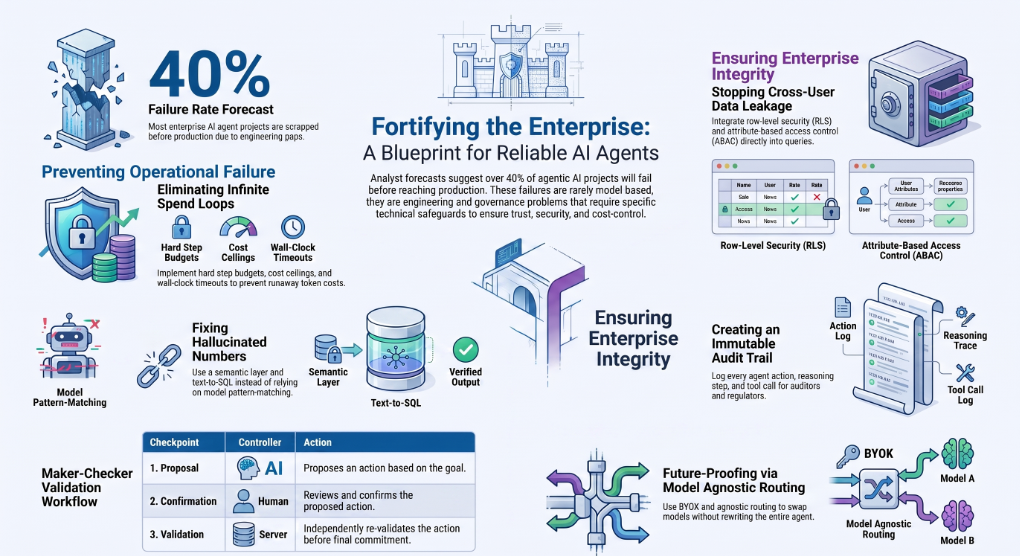
The fix: this is not solved by a bigger model. It is solved by a semantic layer — your own metric definitions, your own hierarchies, your own business rules — with text-to-SQL generating queries against those definitions rather than the model inventing an answer from pattern-matching. The number comes from your warehouse. The model only translates the question.
The wrong action, confidently taken
The most dangerous agent is a competent one, because you stop checking.
The fix: maker-checker. The AI proposes an action. A human confirms it. The server independently re-validates before it commits. Three checkpoints, and the AI controls only the first.
Data leakage across users
An agent with a service-account connection to your warehouse can see everything in that warehouse — which means it can leak everything, to any user who asks the right question.
The fix: row-level security (RLS) folded into the query itself, plus field masking for sensitive columns and attribute-based access control (ABAC) so permissions follow the user, not the agent. The agent should be able to see exactly what the person asking is allowed to see, and nothing more.
No paper trail
If you cannot reconstruct, six months later, exactly what an agent did and why, you cannot defend it — to your auditors, your regulator or your board.
The fix: an immutable audit trail on every agent action: the input, the reasoning, the tool call, the result, the approver.
Tool drift and broken integrations
Agents depend on external systems. External systems change. An agent built against last quarter's API silently breaks.
The fix: versioned tool contracts, standardised interoperability via MCP (Model Context Protocol) and A2A (agent-to-agent) protocols, health checks, and explicit fallback paths.
Vendor and model lock-in
Committing your agent layer to a single model provider means their pricing, their outages and their deprecation schedule are now yours.
The fix: model-agnostic routing — the ability to swap the underlying model per task without rewriting the agent — and BYOK (bring your own key), so your inference relationship stays yours.
AI Assistants and AI Agents in Production: 30+ Real Enterprise Deployments
Definitions are cheap. Here is what the ladder actually looks like in production, drawn from live deployments across ports and logistics, national retail, power utilities, healthcare, fintech, construction and hospitality. Client names are withheld; the industry, geography and scale are real.
Rung 1 — Assistant-grade (Ask): earn trust in the numbers first
A high-volume UK e-commerce distributor (one of the largest catalogues in its category, 800+ product variants) deployed a conversational analytics agent across sales, product, inventory, promotions and customer-behaviour data. Business users ask questions in plain English and get answers instantly. Result: analysis cycles that used to take days now take minutes, and reporting no longer bottlenecks on the analytics team.
A physician-led geriatric care provider in the Greater Boston area deployed self-serve, governed answers over operational and revenue data. Clinical and operations leaders stopped queueing behind BI requests and started getting revenue-leakage answers on demand.
A global fintech serving banks and credit unions layered a semantic governance model over existing data so that every team — disputes, fraud, compliance, ops — works from the same metric definitions. The unglamorous, decisive win: everyone finally agreed what "resolution time" means.
The pattern at Rung 1 is consistent: no write access, no autonomy, enormous trust gain. This is the foundation everything else is built on.
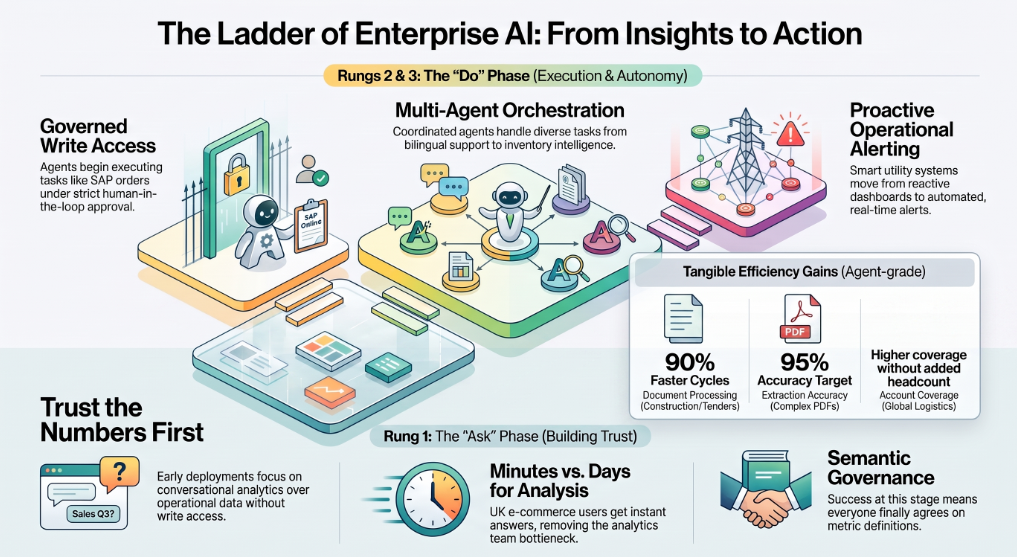
Rung 2 — Agent-grade (Execute, human-in-the-loop): the first governed write
An Australian remedial building and waterproofing specialist with 20+ years in complex commercial works deployed autonomous agents to ingest, analyse and synchronise tender documents into their core operational systems. The system uses multi-agent orchestration, vision-LLM extraction from complex PDFs, deep bidirectional integration with their operations platform, quote locking and full audit logs. Result: engineered for up to ~90% faster tender document processing, with a ~95% extraction accuracy target on standard formats, plus revision-and-change detection that materially reduced bid risk.
A luxury hospitality group operating 16 boutique lodges and camps across East Africa deployed a digital booking agent that runs the full loop: email intake, intent classification, data extraction, a conversational loop to chase missing details, real-time inventory checks, negotiation of alternative dates or properties — and then a deliberate hybrid handoff to a human for curated itinerary creation, before automatically generating the invoice. This is human-in-the-loop by design. The agent handles the volume; the human protects the luxury experience.
A global ports and logistics leader (reported FY revenue around $20B, ports and terminals across multiple continents) deployed an agentic sales agent that continuously monitors enterprise accounts, captures signals, identifies opportunities and risks under rule-governed playbooks, and orchestrates next-best actions. Result: materially higher account coverage without adding headcount.
A UAE engineering and technology group (established 1972, integrated electrical, mechanical, automation and mobility solutions) replaced an end-of-life, high-licence-cost document system with agentic AI that interprets order triggers, validates them and creates SAP sales orders automatically — with explicit rules and governance for exceptions and approvals, audit logs and reconciliation reporting. Result: faster order-to-confirm cycles, fewer data-entry errors, and full auditability on every order the agent created.
That last one is the cleanest illustration of the assistant/agent line in this entire article. The system writes to SAP. That is not a chatbot. That is an agent, and it only survived contact with a finance team because every write was governed, logged and reconcilable.
Rung 3 — Agentic / Multi-agent (Autonomous within policy)
One of India's largest value retailers — 700+ stores across hundreds of cities — deployed three coordinated agents at national scale: a bilingual voice support agent (Hindi and English, STT–LLM–TTS), an inventory intelligence agent giving per-store pricing, stock and promotion visibility, and a knowledge and training agent running retrieval over POS documentation and SOPs. Result: the manual helpdesk burden dropped sharply, store issues resolve faster, and new staff onboard against on-demand guidance rather than a queue.
A major Indian HVAC manufacturer, founded in 1943 and competing in a brutally price-sensitive market, deployed always-on competitive monitoring agents across e-commerce channels — tracking pricing, MRP, discounts, offers, availability and ratings continuously — with agentic Q&A mapped directly to the questions leadership actually asks. Result: always-on monitoring replaced manual portal checks entirely, and pricing gaps surface in hours rather than weeks.
A smart-infrastructure unit operating at city scale — 25+ smart city operation centres, 2M+ connected assets and applications — deployed agentic analytics with automated operational alerting on top of smart utility systems. Proactive alerts replaced reactive dashboards.
A UAE family conglomerate spanning 30+ companies deployed automated procurement and finance KPI alerts across all group entities: purchase-price trend monitoring, gross-margin impact analysis, early-payment analysis against notional finance cost, and vendor performance on delivery and returns. Result: margin erosion and vendor slippage are now detected as they happen, not at quarter-end.
The pattern underneath all 30+
The most instructive deployment is the quietest one. A privately-held retail holding group asked for something that sounds mundane and is actually the whole thesis of this article: an agentic layer that converts dashboard insights into governed, auditable actions and tasks.
Not a better dashboard. A layer that takes the thing the dashboard already told you and does something about it — under governance, with a paper trail.
That sentence is the assistant-to-agent transition, made concrete.
And across every one of these deployments, the same sequence holds:
Teams start at Rung 1 to build trust in the numbers. They unlock write access one workflow at a time, with a human in the approval path. Only then do they orchestrate.
Nobody who succeeded started at Rung 3.
How to Move From an AI Assistant to an AI Agent (Without Breaking Anything)
Step 1 — Fix the data layer first
Before autonomy, accuracy. Build the semantic layer: your metrics, your definitions, your hierarchies, your business rules. Agents that act on wrong numbers do damage at machine speed. If your organisation still argues about what "active customer" means, you are not ready for an agent — you are ready for a semantic layer.
Step 2 — Prove trust in read-only
Deploy at Rung 1. Let people ask questions and get answers from their own governed data. Watch adoption. The metric to track isn't accuracy in a test set — it's whether people stop double-checking the answer in a spreadsheet. When they stop double-checking, you have earned the right to write.
Step 3 — Add one governed write path
Pick a single action. Make it reversible. Make it low-consequence. Put maker-checker on it: the agent proposes, a person approves, the server re-validates. Run it for a month. Read the audit log.
Step 4 — Turn on autonomy behind policy
Now raise the ceiling — but bound it. Approval thresholds (auto-approve below X, escalate above X). Row-level security so the agent sees only what the requesting user may see. ABAC so permissions follow people. An immutable audit trail on everything. The agent gets freedom inside the fence; you own the fence.
Step 5 — Orchestrate
Only now do you add agents that talk to agents. Multi-agent orchestration, MCP and A2A for interoperability, and a clear human-in-the-loop escalation path for anything outside the policy envelope.
Five steps. Most organisations that fail try to do all five in one quarter.
Why Assistents by Ampcome
Most platforms make AI agents possible. Far fewer make them safe. The gap between an impressive demo and a production agent is entirely governance — and that gap is where the majority of enterprise agent projects die.
Assistents by Ampcome was built for the second half of that problem.

And the part no framework or model provider can give you: 30+ production deployments across ports and logistics, national retail, power transmission, smart infrastructure, healthcare, fintech, pharma sourcing, construction and hospitality — from Rung 1 governed analytics through to Rung 3 orchestration.
The question worth asking any vendor is not "can your agent do this?" It's "show me the audit log."
The Bottom Line
The difference between an AI assistant and an AI agent is not a spectrum of intelligence. It is a line of authority.
On one side, systems that read your data and tell you things. On the other, systems that change the state of your business. Crossing that line is the most valuable move an enterprise can make with AI — and the most dangerous one to make without governance.
Start at Ask. Earn Execute. Then, and only then, go Autonomous.
See how Assistents by Ampcome takes enterprises up that ladder → [link to platform page]
FAQs
What is the main difference between an AI assistant and an AI agent?
An AI assistant responds to prompts and completes a single task before handing control back to a human. An AI agent is given a goal, then plans, chooses tools and takes actions across systems with limited human input. In practical terms: assistants read and suggest, agents write and act.
Is ChatGPT an AI assistant or an AI agent?
Both, depending on how it is used. In its default chat mode it is an assistant — you prompt, it responds. Given a persistent goal, tools it can choose from, memory and permission to act on external systems, the same underlying model behaves as an agent. The model doesn't change; the scaffolding around it does.
What is the difference between an AI agent and an AI model?
A model is the reasoning engine. An agent is the model plus tools, memory, a goal and the authority to act. GPT-5 or Claude is a model. A system that reads tenders, extracts line items and files them into your quoting platform is an agent that uses a model.
What is the difference between AI tools and AI agents?
A tool is something that gets called — a parser, a query runner, an API. An agent is the layer that decides which tool to call, in what order, and what to do when one of them fails.
Is an AI agent the same as agentic AI?
Not quite. An AI agent is a single goal-directed system. Agentic AI usually refers to multiple agents orchestrated together, delegating to each other and operating continuously within a policy envelope, with humans setting the rules rather than approving every action.
Are AI agents better than AI assistants?
No — they are for different jobs. Agents cost more, carry more risk and require governance that assistants don't. If the task ends in an answer rather than an action, an assistant is the correct and cheaper choice.
Can an AI assistant become an AI agent?
Yes, and that is the normal upgrade path. You add tools it can select from, persistent memory, goal decomposition and — critically — governed write access with an approval gate. The last of those is the hard part.
What is a human-in-the-loop AI agent?
An agent that performs the work autonomously but pauses for human approval before committing consequential actions. It is the dominant pattern in successful enterprise deployments, because it captures most of the efficiency of full autonomy while keeping a person accountable for the outcome.
Do AI agents replace chatbots?
For anything involving exceptions, judgement or action, yes. For narrow, high-volume, well-defined queries where responses must follow a script exactly, a chatbot remains cheaper and more predictable.
What are examples of AI agents in enterprise?
Real deployments include agents that process complex tender documents into operational systems, create ERP sales orders under governance, run always-on competitive price monitoring across e-commerce channels, orchestrate booking workflows end to end with a human handoff, and monitor procurement and finance KPIs across dozens of group entities.

Transform Your Business With Agentic Automation
Agentic automation is the rising star posied to overtake RPA and bring about a new wave of intelligent automation. Explore the core concepts of agentic automation, how it works, real-life examples and strategies for a successful implementation in this ebook.
Sarfraz Nawaz is the CEO and founder of Ampcome, which is at the forefront of Artificial Intelligence (AI) Development. Nawaz's passion for technology is matched by his commitment to creating solutions that drive real-world results. Under his leadership, Ampcome's team of talented engineers and developers craft innovative IT solutions that empower businesses to thrive in the ever-evolving technological landscape.Ampcome's success is a testament to Nawaz's dedication to excellence and his unwavering belief in the transformative power of technology.

More insights
Discover the latest trends, best practices, and expert opinions that can reshape your perspective


.jpg)
.webp)


Contact us

