
Agentic AI in Finance: 15 Real Use Cases Your Competitors Are Already Running


For decades, the finance function has operated inside a predictable loop: data is collected, reports are generated, humans interpret the outputs, and — eventually — someone acts. The gap between insight and action has always been a human gap. Now, that gap is closing.
Agentic AI examples in finance are multiplying rapidly, and the most competitive enterprises are no longer asking whether to deploy autonomous agents. They are asking how fast they can get them into production.
This article covers what agentic AI actually is in a financial context, why traditional AI and BI tools fail to bridge the execution gap, the types of agents being deployed across banking, accounting, and enterprise finance, and fifteen real-world agentic AI use cases grounded in live deployments — without naming specific clients.
What Is Agentic AI in Finance?
Agentic AI refers to artificial intelligence systems that do not merely advise or answer questions — they perceive context, reason over it, and execute multi-step workflows with minimal human intervention. In finance, this distinction is critical.
A standard AI copilot might surface a cashflow anomaly. An autonomous agent detects it, evaluates the cause using contract terms, email threads, and ERP data, routes the issue for approval if needed, and closes the loop — all within minutes.
The path to this capability follows a well-documented maturity curve. Most finance functions today operate at Levels 1 through 4: descriptive analytics telling you what happened, diagnostic tools explaining why, predictive models estimating what is coming, and prescriptive tools recommending what to do.
At every level, execution remains a human job. Level 5 — the agentic tier — is where the system handles execution itself. You say "handle this," and it does.
Reaching Level 5 requires three foundational capabilities working in concert: a unified context engine that fuses structured and unstructured data, a governance layer that encodes business rules deterministically, and an active orchestrator that executes across enterprise systems like SAP, Salesforce, and Jira.
Without all three, you have either intelligence without action or action without intelligence — and both carry serious operational risk.
Definition: An autonomous agent in finance is an AI system that can perceive financial context, reason over structured and unstructured data, execute workflows across enterprise systems, and operate under governance rules without constant human intervention.
The execution loop that distinguishes agentic systems from everything that came before is simple to describe and profound in practice: Detect → Decide → Execute. The agent continuously monitors signals, evaluates them against business rules, and acts — without waiting for a human to schedule a meeting about it.
Types of Agents in AI Used in the Finance Sector

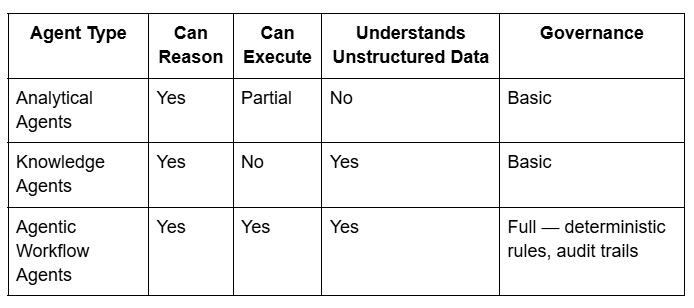
Before exploring specific agentic AI examples in finance, it helps to understand the three principal agent types that make up a well-architected agentic platform. In practice, sophisticated deployments combine all three.
Analytical Agents
Analytical agents are purpose-built to detect, forecast, explain, and recommend. They ingest structured data — ERP tables, transaction logs, CRM records — and apply pattern recognition, anomaly detection, root cause analysis, and trend projection.
In a finance context, these are your always-on monitors: the agents watching margin movements, flagging delinquency risk, and surfacing pricing gaps before they compound into losses. They produce insights continuously, not on demand.
Knowledge Agents
Knowledge agents operate on unstructured and semi-structured information: contracts, emails, policy documents, Slack messages, PDFs, and meeting notes. They use document understanding, semantic search, and multi-source research capabilities to extract meaning from content that structured systems cannot touch.
In finance, they are what allow an agent to understand that a vendor email contains a negotiated discount not yet recorded in the ERP — context that a purely analytical system would miss entirely.
Agentic Workflow Agents
Agentic workflow agents close the loop between intelligence and execution. Following a Plan–Orchestrate–Execute–Learn model, they take the outputs of analytical and knowledge agents and act: creating sales orders in SAP, routing approvals via Slack, updating CRM records, triggering payment holds, or escalating exceptions to human reviewers based on pre-configured thresholds.
Governance sits at the core — every action is auditable, every rule is cited, and nothing executes outside policy bounds.
Why Traditional AI Fails in Finance: The 80% Blind Spot
Here is the foundational problem that most enterprise AI deployments ignore: only approximately 10–20% of enterprise context lives in structured systems — ERP tables, CRM fields, transaction logs.
The remaining 70–85% of business-critical information is unstructured. It lives in PDF contracts with SLA clauses and exceptions, email threads where discounts were negotiated, Slack conversations where approvals happened informally, meeting notes where commitments were made, and policy documents governing what can and cannot be done.
An AI agent that cannot read and reason over this unstructured layer is not operating on real business context. It is operating on a fraction of the truth — and executing with confidence on incomplete information.
This is not a theoretical problem. In one documented case, an AI agent deployed for vendor payment processing had full visibility into ERP data, invoice amounts, and due dates. What it could not see: contract PDFs stored in SharePoint, email exchanges containing negotiated discounts, and Slack messages flagging cash flow concerns.
The result was approximately ₹12 crore in early payments — all contractually compliant according to the ERP, all financially damaging in full context. The agent did exactly what it was told, based on exactly what it could see. The AI did not fail. The foundation did.
Traditional BI tools compound this problem. Business intelligence platforms are excellent at what they were designed to do: render structured data fast, at scale, in interactive dashboards. They tell you what is happening. They do not tell you why, they cannot fuse unstructured signals into that picture, and they offer no path to action. The question "Why did revenue dip last month?" cannot be answered by a BI dashboard that has no access to competitor pricing feeds, customer sentiment from support tickets, or the email thread where a key account flagged dissatisfaction three weeks earlier.
Agentic AI solves both problems simultaneously. By fusing structured data (ERP, CRM, POS, finance systems), semi-structured data (logs, APIs, events), and unstructured data (documents, emails, chat, media) into a unified semantic layer, agents finally operate on complete context — and then execute against it with full governance.
15 Real Agentic AI Examples in Finance
The following use cases are drawn from live enterprise deployments across banking, accounting, retail finance, supply chain, real estate, and enterprise sales. No client names are referenced.
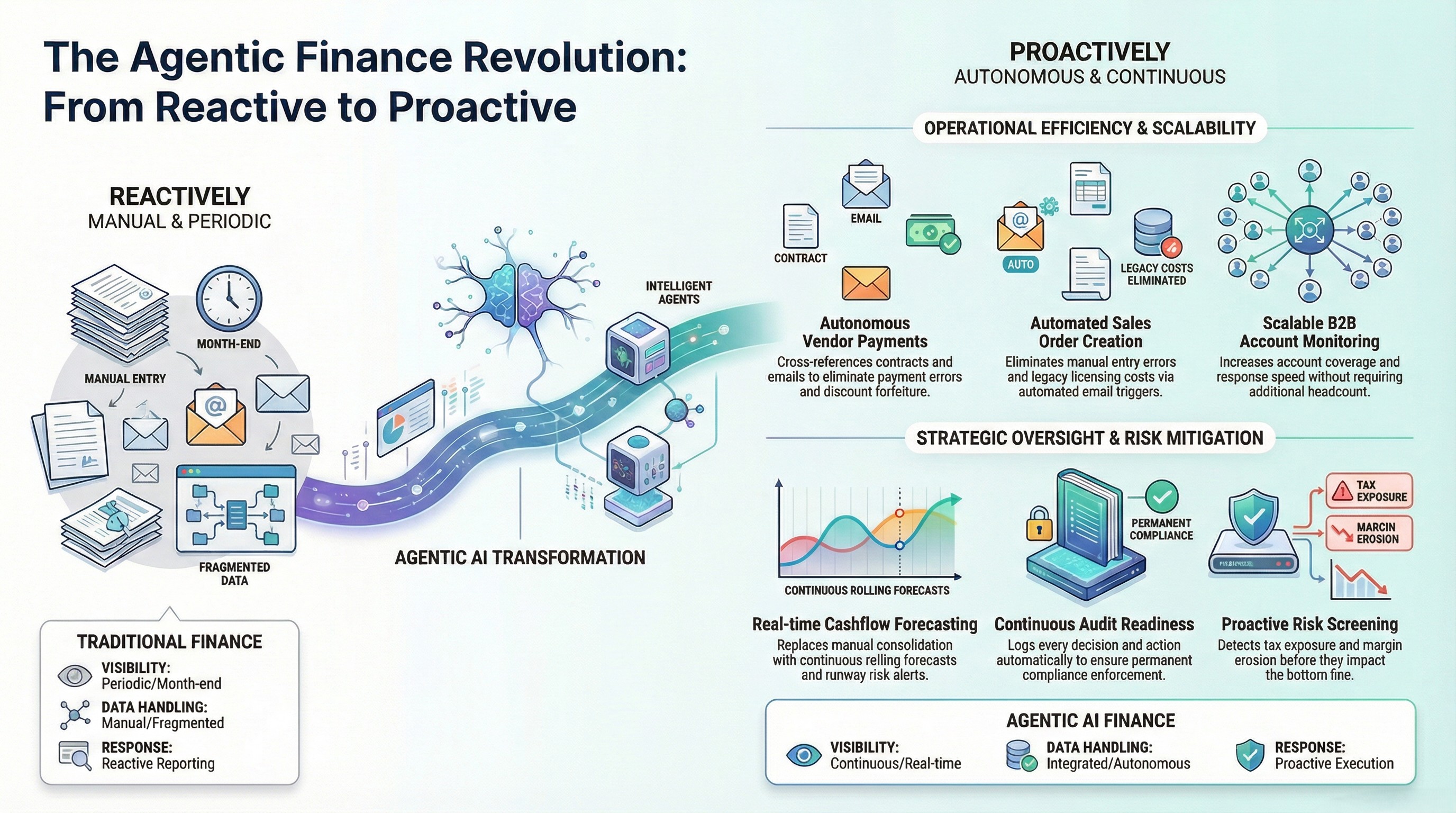
1. Autonomous Vendor Payment Agent
The problem: Vendor payments processed against ERP data alone, missing negotiated terms sitting in contracts and email threads.
The blind spot: PDF contracts in SharePoint, discounts agreed via email, approvals in Slack.
Agentic execution: The agent reads contract terms, cross-references invoice data, checks email threads for active negotiations, and either approves, holds, or escalates payments based on governance thresholds.
Outcome: Elimination of early payment errors and discount forfeiture — the exact failure mode documented in the ₹12 crore incident described above.
2. AI CFO Agent for Cashflow Forecasting
The problem: Finance teams spending days consolidating cashflow data across banking and accounting exports, with no continuous monitoring between cycles.
Agentic execution: A continuously running agent connects financial data sources, builds rolling cashflow forecasts, models scenarios on demand, and sends alerts when runway risk or anomaly thresholds are breached — with recommended actions attached.
Outcome: Earlier detection of cash risks, faster advisory-quality insight, and scalable visibility for finance teams managing multiple entity portfolios simultaneously.
3. Automated SAP Sales Order Creation Agent
The problem: Manual order entry from email triggers, high error rates, and dependence on expensive legacy document handling software reaching end-of-life.
Agentic execution: The agent monitors incoming order triggers, interprets and validates data, creates SAP sales orders automatically, manages exceptions through a governed approval queue, and maintains full audit logs.
Outcome: Reduced order-to-confirm cycle times, fewer data-entry errors, improved auditability, and elimination of legacy licensing costs.
4. Margin Erosion and Procurement Alert Agent
The problem: Finance and procurement leaders receiving delayed, incomplete reporting on margin movements, vendor delivery failures, and early-payment costs — by the time the report is ready, the damage is done.
Agentic execution: An always-on agent monitors purchase price trends, gross margin impact, vendor performance on delivery and returns, and notional early-payment finance cost — generating automated alerts and scheduled insight packs for leadership across group entities.
Outcome: Earlier detection of margin erosion, standardised procurement intelligence, and fewer variance surprises at period-end.
5. Tax Risk Screening Agent
The problem: Cross-border transactions passing through deal teams without systematic screening for withholding tax exposure, VAT mismatches, or permanent establishment risk — often caught only at the last minute.
Agentic execution: The agent screens transactions against tax rule sets, classifies risk levels, collects supporting evidence, generates explainability notes for each classification, and escalates to tax experts when thresholds are crossed.
Outcome: Earlier risk detection, reduced last-minute deal disruptions, and faster and more consistent pre-compliance review across deal pipelines.
6. Sales and Use Tax Research Automation Agent
The problem: Tax professionals spending significant time manually hunting sources, synthesising rules across jurisdictions, and drafting research memos with inconsistent documentation standards.
Agentic execution: The agent collects relevant tax sources automatically, summarises applicable rules, generates draft memos with citations, and builds a searchable knowledge base that compounds over time.
Outcome: Faster research cycles, reduced manual source-hunting time, and more consistent, documented research outputs across the team.
7. B2B Sales Account Monitoring Agent
The problem: Sales teams unable to maintain continuous visibility across large enterprise account portfolios without adding headcount — signals are missed, renewals are surprised, win-back opportunities are lost.
Agentic execution: An always-on agent monitors account signals — activity patterns, contract renewal timelines, risk scores, engagement indicators — and generates precision alerts only when scores exceed defined thresholds. Governed playbooks trigger follow-up workflows automatically, with CRM integration ensuring pipeline hygiene.
Outcome: Higher account coverage without increasing headcount, faster response cycles on opportunities and renewals, and more consistent execution via governed playbooks.
8. Banking Omnichannel Support Agent
The problem: Banking support operations managing high volumes of queries across chat, email, and phone, with inconsistent handling, poor auditability, and SLA compliance tracked after the fact.
Agentic execution: An omnichannel intake agent routes queries, generates agent-assist summaries with next-best actions, and monitors SLA compliance automatically. Full audit trails are maintained across every interaction, with human escalation triggered by complexity or value thresholds.
Outcome: Faster case handling, reduced operational load, and improved compliance readiness with audit trails built in by design.
9. Competitive Intelligence Pricing Agent
The problem: Pricing and product teams in competitive markets relying on manual spot-checks of competitor pricing, promotions, and availability — infrequent, inconsistent, and always behind.
Agentic execution: Continuous monitoring of e-commerce and distribution channels, mapped to leadership questions, with analytics views tracking pricing gaps, threats, and portfolio movements. Governance and audit trails built in from day one.
Outcome: Faster competitive response cycles, earlier identification of pricing gaps and promotional shifts, and always-on monitoring replacing periodic manual portal checks.
10. Revenue Leakage Detection Agent
The problem: Revenue leakage across billing exceptions, discount misapplications, and fulfilment gaps going undetected until period-end reviews, by which point recovery is difficult.
Agentic execution: An agent monitoring transaction flows, billing exceptions, discount applications, and fulfilment completeness — surfacing anomalies in real time with root cause attribution automatically attached.
Outcome: Improved visibility into leakage drivers, faster operational decision-making through unified reporting, and more reliable performance tracking.
11. Working Capital Optimisation Agent
The problem: Treasury and finance teams managing working capital reactively, with fragmented visibility across payables, receivables, and cash positions that only converges at month-end.
Agentic execution: Continuous monitoring of working capital components, with scenario modelling agents that simulate the cashflow impact of payment timing changes, discount term adjustments, and inventory decisions in real time.
Outcome: Proactive optimisation replacing reactive management, with leadership dashboards updated continuously rather than waiting for period-end consolidation.
12. Portfolio Risk and Delinquency Monitoring Agent
The problem: Lending and leasing portfolios monitored through periodic reports, with risk signals arriving too late for proactive intervention on deteriorating accounts.
Agentic execution: Continuous ingestion of portfolio KPIs — delinquency rates, residual values, maturity profiles, dealer network performance — with alerts firing when exception thresholds are crossed and recommended actions attached.
Outcome: Better portfolio visibility, faster risk identification, and improved decision support across complex multi-entity lending structures.
13. Audit Trail and Compliance Enforcement Agent
The problem: Finance operations generating action and approval records inconsistently, creating compliance exposure during audits and requiring significant manual reconstruction of decision history.
Agentic execution: The governance layer embedded in the agentic platform ensures every decision is policy-cited, every action is logged, and every exception is tracked with its resolution path. Escalation workflows route to the appropriate approver automatically based on transaction type and value threshold.
Outcome: Compliance readiness maintained continuously, not assembled under pressure at audit time.
14. Financial Planning Scenario Simulation Agent
The problem: FP&A teams spending weeks building scenario models manually for each planning cycle, limiting the number of scenarios that can be evaluated before decisions must be made.
Agentic execution: An agent that takes natural language scenario inputs, retrieves relevant historical data, models cashflow, margin, and operational impacts, and delivers structured outputs for leadership review — on demand, not on a quarterly schedule.
Outcome: Faster analysis cycles, more planning scenarios evaluated per cycle, and improved confidence in planning assumptions.
15. Agentic BI Layer Over Dashboards
The problem: Finance dashboards showing what is happening, but requiring analyst queues to explain why and determine what to do next — insight without action, permanently.
Agentic execution: An agentic layer deployed on top of existing dashboards, providing a natural language interface, automated insight generation, and governed task creation and tracking. The shift is from reactive reporting to proactive execution loops — standardised decision logic operating continuously across teams.
Outcome: Faster strategic visibility without BI queuing, improved alignment through consistent metric definitions, and scalable insight access across the organisation.
How Agentic AI Is Transforming the Finance Sector
The performance gap between agentic and traditional AI deployments in finance is measurable. Early enterprise adopters are documenting 40–60% reductions in process cycle times across accounts payable, order management, and compliance workflows.
In one enterprise deployment across a major manufacturing and B2B distribution context, processing over 10 million data points across 31 strategic business questions yielded 93% answerability and insight generation that was 100 times faster than the previous manual process — with a 12–26% pricing gap identified and immediately corrected.
In a large-scale national retail deployment spanning 700+ stores, agentic action logic was standardised across the entire network with zero training required, enabling automated task closure at a scale no human team could replicate.
The deeper transformation is structural. Finance has historically been a function that converted data into reports and reports into decisions — with human bandwidth as the binding constraint at every handoff.
Agentic AI dissolves that constraint. Analytical agents operate continuously where humans check periodically. Knowledge agents read everything where humans read selectively. Workflow agents execute consistently where humans act variably.
The enterprise evolution moves in a clear direction: from periodic reporting to real-time BI dashboards to conversational analytics to full agentic execution. Each stage builds on the previous, generating exponential value.
Before agentic deployment, the typical enterprise cycle from signal to result ran six weeks, required endless manual coordination, and completed roughly eight cycles per year. After agentic deployment, the same cycle runs in hours, executes autonomously, and operates at 50 or more cycles per year. That is not an efficiency improvement. It is a competitive chasm.
How Autonomous Agents Stay Safe in Finance
The most common objection to agentic AI in finance is trust. Finance is not a domain where errors are academic. A mistimed payment, a misclassified transaction, or a rogue approval can have immediate, material consequences.
This is precisely why enterprise-grade agentic platforms are architected around governance from the ground up — not bolted on afterward.
The first layer is the Semantic Governor: a rule engine that encodes business logic deterministically, not probabilistically. Every decision an agent makes is evaluated against explicit if-then rules, approval hierarchies, compliance thresholds, and policy citations. There are no hallucinations. There are no black boxes. Every output is explainable, defensible, and policy-cited. A refund below a defined threshold executes automatically. A refund above it routes to a human approver. The boundary is not fuzzy — it is a hard rule, consistently applied.
The second layer is the audit trail. Every query, every decision, every action, and every escalation is logged with full traceability. For finance functions operating under SOX, GDPR, or industry-specific compliance frameworks, full auditability is not a feature — it is a requirement. Enterprise-grade agentic platforms carry SOC 2 Type II certification, ISO 27001 alignment, and GDPR compliance by design. Customer data is never used for model training. Encryption covers data in transit and at rest with AES-256 and TLS 1.3.
The third layer is human-in-the-loop architecture. Agentic AI does not mean removing humans from consequential decisions. It means ensuring humans are only required for decisions that actually require human judgment. Routine, rules-governed actions execute autonomously. Exception cases, high-value transactions, and policy edge cases escalate cleanly with full context attached — so the human reviewing the exception has everything they need to decide in seconds, not hours.
Ready to Move from Insight to Execution?
Most enterprises have the data. Many have dashboards. What's missing is the infrastructure that connects insight to action — automatically, at scale, with full governance.
That's exactly what Assistents is built to do. From fusing your structured and unstructured data into a single context layer, to deploying governed agents that execute across your existing systems in 30 days or less, Assistents is the agentic intelligence platform purpose-built for enterprises that are done waiting for humans to be the bottleneck.
If any of the fifteen use cases above felt familiar — a process you're still doing manually, a signal you're catching too late, a workflow that breaks on exceptions — it's worth a conversation. No POC purgatory. No endless sales cycles. Just a concrete pilot plan, a workflow definition, and an ROI hypothesis delivered within 48 hours.
FAQs on Agentic AI in Finance
- What is an autonomous agent in artificial intelligence?
An autonomous agent in AI is a system that perceives its environment, reasons over available data, makes decisions, and executes multi-step actions without requiring constant human direction. Unlike simple chatbots or rule-based tools, autonomous agents can adapt, plan sequences of tasks, and complete complex workflows end-to-end — including handling exceptions through governed escalation.
- How is agentic AI different from RPA?
RPA (Robotic Process Automation) follows fixed scripts and breaks when exceptions occur. It cannot reason or understand unstructured data. Agentic AI can read PDFs, parse emails, understand context, handle exceptions through reasoning, and escalate appropriately — making it far more resilient and capable in real-world enterprise environments where edge cases are the norm, not the exception.
- What are examples of intelligent agents in AI for accounting?
In accounting and finance, intelligent agents automate vendor payment processing with contract-awareness, perform continuous cashflow monitoring, flag VAT and withholding tax risks in cross-border deals, automate SAP sales order creation from email triggers, and generate margin erosion alerts by fusing procurement and pricing data. Each of these is addressed in detail across the fifteen use cases above.
- Is agentic AI safe for financial decision-making?
When properly governed, yes. Enterprise-grade agentic platforms include deterministic rule engines (not probabilistic guesses), tiered approval thresholds, full audit trails, and compliance certifications including SOC 2 Type II and ISO 27001. Every decision is explainable and policy-cited, making it auditable for regulators and defensible for leadership.
- Can agentic AI replace finance teams?
No — and that is not the goal. Agentic AI handles high-volume, rules-governed tasks: monitoring, alerts, data fusion, routine approvals, and document processing. Finance professionals focus on judgment-heavy decisions, relationship management, and strategy. The result is a finance function that operates at far greater speed and scale — not a smaller one.

Transform Your Business With Agentic Automation
Agentic automation is the rising star posied to overtake RPA and bring about a new wave of intelligent automation. Explore the core concepts of agentic automation, how it works, real-life examples and strategies for a successful implementation in this ebook.
Sarfraz Nawaz is the CEO and founder of Ampcome, which is at the forefront of Artificial Intelligence (AI) Development. Nawaz's passion for technology is matched by his commitment to creating solutions that drive real-world results. Under his leadership, Ampcome's team of talented engineers and developers craft innovative IT solutions that empower businesses to thrive in the ever-evolving technological landscape.Ampcome's success is a testament to Nawaz's dedication to excellence and his unwavering belief in the transformative power of technology.

More insights
Discover the latest trends, best practices, and expert opinions that can reshape your perspective





.jpg)

Contact us

