
AI for Retail Operations: The Complete Enterprise Guide (With Real Case Studies from 700+ Stores)


When a leading Indian value retailer deployed AI for retail operations across their 700+ stores spanning hundreds of cities, they achieved something remarkable: a 70% reduction in manual helpdesk calls and 85% faster issue resolution. This wasn't a pilot program or a limited test. This was an enterprise-scale AI transformation, supporting over 10,000 users across their entire retail network.
The results prove what forward-thinking retailers already know: AI for retail operations isn't just about automation—it's about fundamentally transforming how retail businesses operate at scale.
From inventory intelligence to voice-powered support agents, AI is shifting retail from reactive firefighting to proactive, autonomous operations.
What is AI for Retail Operations?
AI for retail operations refers to the deployment of intelligent, autonomous agents that handle core retail workflows—from customer service and inventory management to training, compliance, and competitive intelligence. Unlike traditional automation or basic chatbots, modern AI for retail operations leverages advanced capabilities like natural language processing, real-time data fusion, and governed autonomy to make decisions and take actions across your entire retail ecosystem.
The difference between traditional retail operations and AI-powered retail operations is stark:
Traditional approach: Store managers manually check inventory systems, call headquarters for support, wait hours or days for pricing updates, and rely on periodic reports that are often outdated by the time they're reviewed.
AI-powered approach: Autonomous agents continuously monitor inventory across all locations, instantly answer store queries in multiple languages, provide real-time competitive pricing intelligence, and proactively alert teams to issues before they impact customers.
This shift is powered by what's called a Unified Context Engine—a system that fuses both structured data (POS transactions, inventory levels, sales figures) and unstructured data (emails, customer feedback, policy documents, training materials) into a single intelligent layer. The result? AI agents that understand your business context deeply enough to make smart decisions autonomously.
The impact is immediate. Retailers implementing AI for retail operations report call volume reductions of 70%, resolution times dropping by 85%, and operational costs decreasing significantly while scaling to support thousands of stores and users simultaneously.
The Retail Operations Challenge: Why Traditional Approaches Fail at Scale
Here's a startling reality that affects every multi-store retail operation: most retailers can effectively access only 20% of their operational data. The remaining 80% sits trapped in unstructured formats—emails, chat logs, support tickets, training documents, standard operating procedures, competitive intelligence reports, and customer feedback.
This blind spot creates cascading operational problems that compound at scale:
Manual Helpdesk Overload
Store teams constantly call headquarters with questions about pricing, current promotions, inventory availability, and operational procedures. For a retailer managing 700+ stores, this translates to thousands of support calls weekly, each requiring manual handling by central teams. The coordination overhead becomes massive, creating bottlenecks and frustration on both ends while draining resources from strategic initiatives.
Inventory Visibility Gaps
Real-time inventory data exists in your POS system, but getting actionable answers—"Which stores have stock of this SKU right now?" "What's today's promotional price across all locations?" "How do our prices compare to competitors?"—requires navigating multiple systems, running custom reports, or waiting for scheduled updates. By the time you get the answer, the customer has left, and the opportunity is gone.
Inconsistent Store-Level Knowledge
Corporate headquarters regularly sends out policy updates, SOP changes, promotional guidelines, and training materials, but ensuring every store manager and team member has access to the latest, correct information is nearly impossible with traditional methods. The result? Inconsistent execution across locations, compliance risks, customer experience gaps, and competitive disadvantages in local markets.
Training Bottlenecks and Knowledge Gaps
Onboarding new staff requires extensive training on POS systems, company policies, product knowledge, and operational procedures. With high retail turnover rates—often 60% or higher annually—training becomes a constant drain on resources and manager time. Yet even after training, employees struggle to find answers when unusual situations arise, leading to escalations, delays, and customer frustration.
Customer Service Response Delays
When customers have questions or issues, store teams often can't resolve them immediately. They need to "check with someone," "get back to you," or escalate through multiple layers, leading to frustrated customers, abandoned purchases, and negative reviews that impact brand reputation.
Competitive Intelligence Blindness
In price-sensitive markets, competitor pricing moves, promotional shifts, and product availability changes happen daily across e-commerce channels and physical stores. Manual monitoring is impossible at scale, meaning retailers often discover they're losing market share after the damage is done, rather than responding proactively to competitive threats.
Now multiply these challenges by scale. For a retailer managing hundreds of stores across diverse markets, languages, and product categories, these pain points don't just add up—they compound exponentially. Each store operates with some degree of independence, yet headquarters needs visibility, control, and consistent execution. The coordination overhead becomes unmanageable with traditional tools.
The cost of this inefficiency is measured in millions: wasted labor hours, lost sales opportunities, excess inventory from poor visibility, missed competitive opportunities, customer churn from inconsistent service, and the inability to scale operations without proportional increases in support staff.
Traditional solutions—hiring more support staff, deploying rigid RPA scripts, or implementing basic chatbots—don't address the root problem: you can't manually manage complexity at this scale. What's needed is a fundamental shift from reactive, manual coordination to autonomous, intelligent operations.
Core AI Capabilities Transforming Retail Operations
Modern AI for retail operations deploys intelligent agents across four critical operational areas, each designed to tackle specific challenges while working together as an integrated, governed system.
Voice Support AI: Multilingual Store Assistance at Scale
A major value retailer's deployment of voice AI for retail demonstrates the transformative power of conversational agents at enterprise scale. Supporting 10,000+ users across 700+ stores, their AI voice agent handles store queries in both Hindi and English using a sophisticated STT-LLM-TTS (Speech-to-Text, Large Language Model, Text-to-Speech) pipeline.
The measurable impact speaks for itself:
- 70% reduction in manual helpdesk calls
- 85% faster issue resolution
- Improved store-level operational efficiency
- Reduced dependency on central support teams
Here's how retail voice AI works in practice: When a store manager has a question—about inventory availability, pricing for a specific SKU, current promotions, policy clarifications, or operational procedures—they simply speak to the AI agent in their preferred language. The system understands context, accesses relevant data across multiple systems in real-time, and provides accurate, policy-compliant answers instantly. No waiting on hold, no ticket queues, no delays that impact customer service.
The multilingual capability is crucial for retailers operating in diverse markets. In India alone, businesses serve customers across 22+ official languages, and store teams work more efficiently when they can communicate naturally in Hindi, English, or regional languages. The AI voice agent understands regional variations, retail-specific terminology, and context-dependent queries like "What's the price for the blue shirt in size large?" or "Do we have stock of potato chips in the 50g pack?"
Beyond simple Q&A, these retail AI voice agents integrate with admin consoles and ticketing systems, automatically routing complex issues to appropriate teams while handling routine queries autonomously. This creates a seamless support experience that scales effortlessly as store count grows.
Inventory Intelligence Agents: Real-Time Visibility Across Every Location
AI retail inventory management transforms how multi-store operations access and act on stock, pricing, and promotional data. Instead of running reports, navigating multiple systems, or making phone calls, store managers and headquarters teams get instant, conversational access to:
- Real-time pricing by store and SKU: "What's the current price for product X at our metro stores?"
- Stock availability across locations: "Which stores have inventory of this item right now?"
- Promotional intelligence: "What promotions are active this week across all locations?"
- Cross-store analytics: "Show me sell-through rates for this category by region"
- Automated alerting: Proactive notifications when stock falls below thresholds, pricing inconsistencies emerge, or promotional execution gaps appear
These AI inventory agents integrate directly with existing POS systems, requiring no rip-and-replace of core infrastructure. They sit as an intelligent orchestration layer that queries multiple data sources, fuses structured transaction data with unstructured promotional communications, and delivers actionable intelligence through natural language interfaces.
For retailers operating 700+ stores, this capability eliminates the blind spots that lead to lost sales, excess inventory, and pricing inconsistencies that erode margins and customer trust.
Knowledge & Training Agents: On-Demand Guidance Without Human Bottlenecks
Retail AI implementation for training and knowledge management leverages Retrieval-Augmented Generation (RAG) technology over POS documentation, standard operating procedures, policy manuals, and training materials. This creates an always-available AI retail assistant that:
- Provides instant access to SOPs: New and existing staff can ask questions about procedures and get accurate, cited answers from official documentation
- Delivers on-demand training guidance: Instead of scheduling training sessions or waiting for trainer availability, employees learn at their own pace through conversational AI
- Accelerates onboarding: New hires get up to speed faster with 24/7 access to knowledge, reducing the training burden on store managers
- Ensures policy compliance: Every answer is grounded in approved documentation with citations, eliminating the risk of outdated or incorrect information spreading through informal channels
- Reduces training dependency: Less reliance on limited trainer resources and centralized support teams
This retail knowledge management approach is particularly powerful in high-turnover environments where continuous training would otherwise consume significant manager time. The AI agent becomes an institutional memory that never takes a day off, ensuring consistent knowledge transfer across all locations.
Admin Console & Analytics: Operational Intelligence at Scale
Enterprise AI for retail requires more than just front-line agents—it needs robust administrative capabilities and operational visibility. Modern retail AI platforms provide:
- Ticketing system integration: Seamless connection with existing support infrastructure like ServiceNow, Jira, or custom ticketing systems
- Performance dashboards: Real-time visibility into agent utilization, resolution rates, common query types, and bottleneck identification
- Operational insights: Analytics that reveal patterns—which stores need additional training, which products generate the most questions, where process improvements would have the highest impact
- High-volume scalability: Architecture designed to support thousands of concurrent users across hundreds of locations without performance degradation
- Audit trails and compliance: Complete logging of all interactions, decisions, and data access for regulatory compliance and quality assurance
These capabilities ensure that retail operations automation doesn't just shift work to AI—it creates new visibility and control that enables continuous operational improvement.
The Enterprise AI Retail Implementation Framework: The 3-Tier Architecture
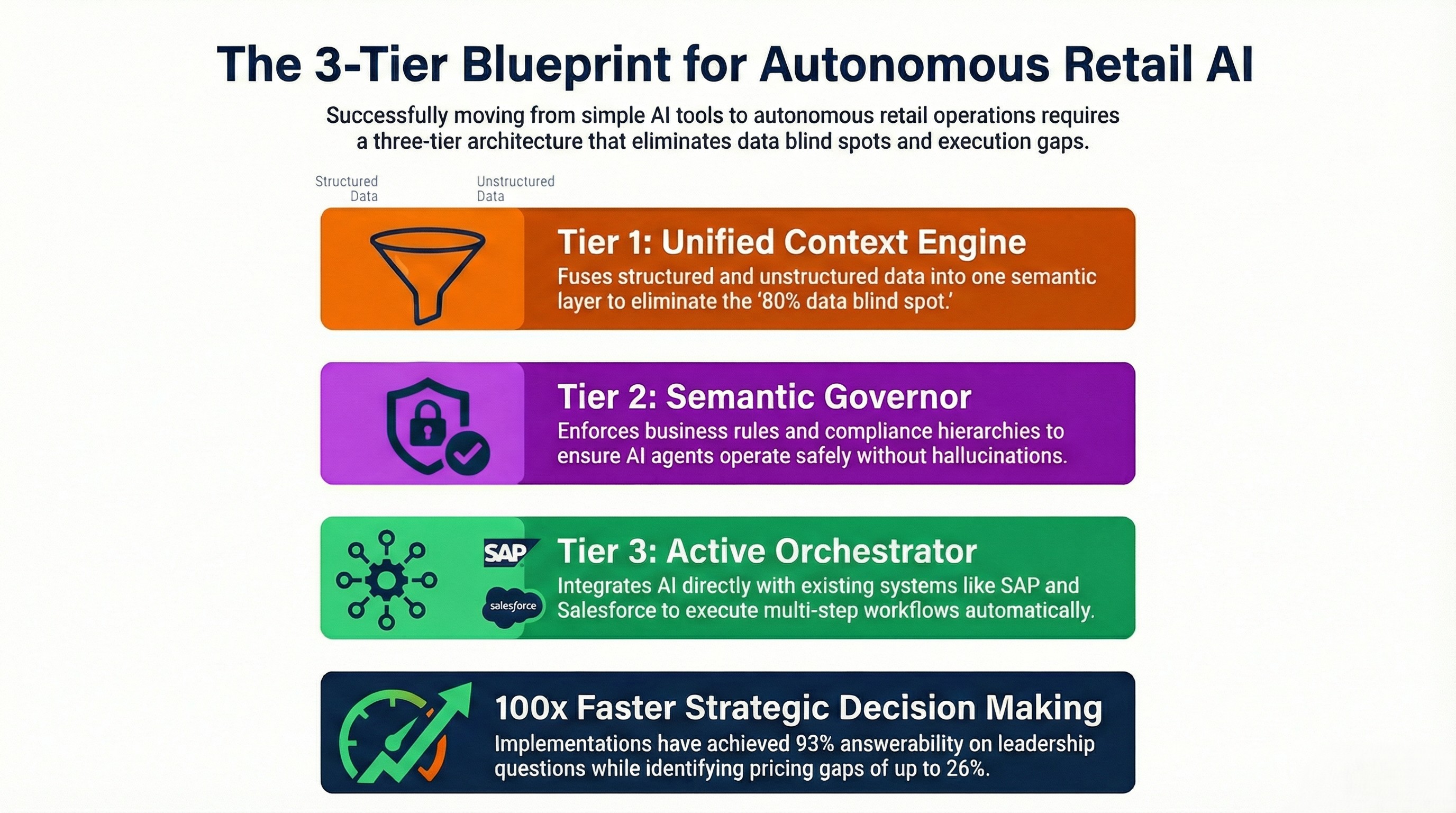
Successfully implementing AI for retail operations requires more than deploying individual tools. It demands a comprehensive infrastructure that addresses three fundamental challenges: the data blind spot, the governance gap, and the execution problem. Advanced AI platforms solve these through a three-tier architecture designed specifically for autonomous, governed enterprise operations.
Tier 1: Unified Context Engine — Eliminating the 80% Blind Spot
The foundation of effective AI agents for retail is complete context. The Unified Context Engine fuses structured data (ERP transactions, CRM records, POS sales, inventory levels) with unstructured data (emails, policy documents, chat logs, support tickets, meeting notes) and semi-structured data (PDFs, spreadsheets, forms) into a single semantic layer.
This isn't simple data warehousing—it's intelligent correlation that understands relationships across data sources. When a store manager asks about inventory, the system doesn't just check the database; it understands:
- Current stock levels from POS systems
- Pending transfers mentioned in email
- Promotional commitments from planning documents
- Historical sell-through patterns from analytics
- Supplier delivery schedules from logistics systems
Real-world example: A major HVAC manufacturer operating in highly price-sensitive consumer markets deployed the Unified Context Engine for competitive monitoring. The system processes 10+ million data points across e-commerce channels, tracking competitor pricing, MRP changes, discount patterns, product availability, and customer ratings continuously.
The result? They can now answer 31 strategic leadership questions with 93% answerability—questions like "What's our pricing position against competitors for this product category?" or "Where are we losing market share to aggressive promotional pricing?"—100× faster than manual analysis. They identified pricing gaps of 12-26% and corrected them immediately, protecting revenue and market position.
This capability transforms retail operations from reactive to proactive, from partially informed to comprehensively aware.
Tier 2: Semantic Governor — Making Autonomy Safe Through Business Rules
Autonomy without governance is chaos. The Semantic Governor solves the trust problem by encoding your business rules, approval hierarchies, compliance requirements, and decision logic into deterministic frameworks that guide AI agent behavior.
Unlike probabilistic AI that might hallucinate or make unpredictable decisions, the Semantic Governor ensures:
- Business rule enforcement: Agents operate within defined parameters—pricing boundaries, discount approval limits, inventory allocation rules, customer service policies
- Approval hierarchies: Automated routing based on thresholds (e.g., refunds under ₹10,000 processed autonomously, above ₹50,000 require manager approval)
- Compliance safeguards: GDPR, data privacy, industry regulations, and company policies embedded as hard constraints
- Auditability: Every decision includes rule citations, showing exactly which policies guided the action
- No black boxes: Complete explainability—you can trace why any decision was made and which data informed it
This governance layer is what makes Level 5 agentic intelligence possible in enterprise retail environments. It's the difference between an AI assistant that requires constant supervision and an autonomous agent you can trust to execute correctly while you sleep.
For enterprises operating across SOC2 Type II and ISO 27001 compliance requirements, this governance framework is non-negotiable. The Semantic Governor provides the control and transparency that regulations demand while enabling the speed and scale that competition requires.
Tier 3: Active Orchestrator — Bridging Insight to Execution
The final tier closes the execution gap. The Active Orchestrator integrates AI agents with your existing enterprise systems—SAP, Salesforce, ServiceNow, Jira, custom CRMs, ticketing platforms, communication tools—enabling automated workflow execution across the technology stack.
This orchestration layer:
- Executes multi-step workflows: Not just answering questions, but completing entire processes—from identifying an issue to creating tasks, routing approvals, updating systems, and notifying stakeholders
- Implements human-in-the-loop controls: Configurable thresholds determine when actions proceed autonomously and when human approval is required
- Provides no rip-and-replace integration: Works with what you already have rather than forcing platform migrations
- Offers API-first architecture: Extensible integration framework that adapts to your unique system landscape
- Supports cloud, private, on-prem, or hybrid deployment: Flexibility to meet your security, performance, and compliance requirements
Real-world example: A privately-held retail holding company with cross-functional operations implemented the Active Orchestrator to transform their approach from reactive reporting to proactive execution. The system shifts intelligence from dashboards that humans must interpret into governed actions that systems execute automatically.
When the AI identifies an operational issue—pricing inconsistency, stock imbalance, promotional execution gap—it doesn't just alert someone. It evaluates options, applies business rules, creates tasks in the appropriate systems, routes for approval if necessary, and tracks completion. Decision logic is standardized across teams, eliminating inconsistent execution.
This three-tier architecture—Context, Governance, Orchestration—is what distinguishes enterprise-grade AI for retail operations from point solutions that automate individual tasks. It creates a foundation for autonomous intelligence that gets smarter over time while remaining fully controlled and auditable.
Real Results: Retail AI Case Studies That Prove ROI
The theoretical benefits of AI for retail operations are compelling, but enterprise decisions require proof. Here are four detailed case studies demonstrating measurable results across different retail contexts.
Case Study 1: Multi-Store Value Retailer — National Scale Operations
Company Profile: A rapidly scaling value retail operation in India with a pan-India footprint of 700+ stores across hundreds of cities, serving mass-market consumers across apparel, general merchandise, and FMCG categories. Operating at this scale with price-sensitive customers demands operational excellence and cost efficiency.
The Challenge: Like many multi-location retailers, they faced three critical operational challenges:
- Manual helpdesk burden: Store teams constantly called headquarters with questions about inventory, pricing, promotions, and procedures, creating massive coordination overhead
- Inventory visibility gaps: Getting real-time answers about stock levels, pricing, and promotional execution across 700+ stores was slow and fragmented
- Inconsistent training and knowledge access: Ensuring all store staff had current information about policies, procedures, and product details was nearly impossible with traditional methods
Solution Deployed: They implemented a comprehensive AI for retail operations platform with three integrated agents:
- Voice Support Agent (Hindi & English): Conversational AI using STT-LLM-TTS pipeline to handle store queries in natural language across both major Indian languages
- Inventory Intelligence Agent: Real-time access to pricing, stock levels, and promotional information per store and SKU
- Knowledge & Training Agent: RAG-powered system over POS documentation and standard operating procedures providing on-demand guidance
The platform integrated with existing admin consoles, analytics systems, and ticketing infrastructure, designed specifically for high-volume, multi-store operations.
Measurable Results:
- 70% reduction in manual helpdesk calls: Freed central support teams to focus on strategic issues rather than routine queries
- 85% faster issue resolution: Store teams get instant answers instead of waiting hours or days for callbacks
- Improved store-level inventory visibility: Real-time access to stock and pricing data across all locations
- Faster onboarding through on-demand training: New employees access guidance 24/7 without scheduling trainer time
- Reduced dependency on central support: Store managers operate more autonomously with AI-powered assistance
- Support for 10,000+ users: Platform scales across the entire organization without performance degradation
Key Insight: For multi-store retailers, the combination of voice AI, inventory intelligence, and knowledge management creates a multiplier effect. Each capability reinforces the others, creating an operational advantage that compounds as you scale.
Case Study 2: HVAC Manufacturer — Competitive Intelligence in Price-Sensitive Markets
Company Profile: A major HVAC and refrigeration manufacturer operating in highly price-sensitive consumer and commercial cooling markets. In categories where consumers actively compare prices across e-commerce platforms, missing a competitor's promotional move by even a few hours can cost significant market share and margin.
The Challenge: They needed continuous visibility into competitor pricing, MRP changes, discount patterns, promotional offers, product availability, and customer rating shifts across multiple e-commerce channels. Manual monitoring—having teams check competitor websites daily—was:
- Labor-intensive and non-scalable
- Slow to identify threats (often discovering pricing gaps after losing sales)
- Unable to provide leadership with strategic intelligence for decision-making
- Reactive rather than proactive
Solution Deployed: AI competitive monitoring agents built on the Unified Context Engine, processing 10+ million data points continuously across e-commerce platforms. The system provides:
- Continuous multi-channel monitoring: Automated tracking of pricing, MRP, discounts, offers, availability, and ratings across all major competitors
- Agentic Q&A for leadership: Natural language interface mapped to 31 strategic questions like "What's our pricing position in air conditioner category?" or "Which competitors are running aggressive promotions?"
- Analytics views for decision support: Dashboards highlighting pricing gaps, competitive threats, and market movement patterns
- Automated alerts: Proactive notifications when significant pricing changes, promotional launches, or availability shifts occur
- Scalable architecture with governance: Full audit trails and explainability for all insights
Measurable Results:
- 90% faster tender processing: Engineered target for converting competitive intelligence into bid responses
- 95% extraction accuracy: High reliability on standard data formats across e-commerce platforms
- Identified 12-26% pricing gaps: Discovered significant price disparities and corrected them immediately, protecting revenue
- Always-on monitoring replacing manual checks: Eliminated the need for staff to manually visit competitor websites and compile spreadsheets
- Faster competitive response cycles: Moved from weekly reviews to real-time awareness and daily actions
- 93% answerability on 31 strategic questions: Leadership gets instant, data-backed answers to critical business questions
- 100× faster insights: What previously took analysts days now happens in seconds
Key Insight: In price-sensitive retail markets, speed of competitive response directly impacts margin and market share. AI competitive monitoring transforms retailers from reactive followers to proactive market leaders.
Case Study 3: Retail Holding Company — Multi-Entity Operational Intelligence
Company Profile: A privately-held retail holding company with cross-functional operations requiring coordination across multiple entities, systems, and teams. Like many retail organizations, they faced the challenge of siloed data creating blind spots and reactive management.
The Challenge: Critical operational intelligence was trapped across disparate systems and documents:
- Financial data in ERP systems
- Sales performance in CRM and POS platforms
- Operational metrics in custom databases
- Strategic context in emails, documents, and meeting notes
- Cross-entity dependencies that required manual coordination
Leadership spent more time compiling information than acting on it. Reporting was reactive—answering "what happened?" rather than driving "what should we do next?"
Solution Deployed: Agentic data analysis layer built on the three-tier architecture:
- Unified Context Engine: Fused structured and unstructured data across entities
- Semantic Governor: Standardized decision logic, approval hierarchies, and business rules across teams
- Active Orchestrator: Integrated with core systems to automate task creation, routing, and tracking
The platform converted dashboard insights into governed, auditable actions.
Measurable Results:
- Shift from reactive reporting to proactive execution: Intelligence now drives automated workflows rather than just informing manual decisions
- Standardized decision logic across teams: Consistent application of business rules eliminates ad-hoc interpretations
- Automated task creation and completion tracking: System identifies issues, creates tasks in appropriate systems, routes for approval, and monitors resolution
- Faster leadership decision cycles: Executives spend less time gathering information and more time on strategic initiatives
- Improved cross-functional coordination: Automated workflows reduce the friction and delays of manual handoffs
Key Insight: For multi-entity retail organizations, the value isn't just in analyzing data—it's in automating the operational responses that data should trigger. Agentic intelligence closes the loop from insight to execution.
Case Study 4: E-Commerce Distribution — Analytics at Velocity
Company Profile: A high-volume vape distribution and e-commerce operation in the UK, offering one of the largest selections of e-liquids with 800+ flavors plus broad hardware and accessory coverage. Operating in a fast-moving consumer category with frequent new product launches, promotional cycles, and shifting consumer preferences.
The Challenge: The business needed rapid analysis cycles for recurring questions about:
- Product performance across 800+ SKUs
- Category trends and emerging preferences
- Promotional effectiveness
- Inventory optimization
- Customer behavior patterns
Traditional business intelligence tools required data analysts to field requests, write queries, build reports, and schedule reviews. By the time insights arrived, market conditions had shifted. The business needed self-service analytics that could keep pace with e-commerce velocity.
Solution Deployed: AI Data Analytics Agent providing conversational access to e-commerce and operations data. The system enables:
- Natural language queries: Business users ask questions in plain English without SQL knowledge or analyst dependency
- Rapid analysis cycles: Seconds instead of days to answer recurring business questions
- Product performance visibility: Instant insights into sell-through rates, margin performance, and customer ratings by SKU
- Automated KPI monitoring: Continuous tracking with exception alerting when metrics deviate from targets
Measurable Results:
- Shorter analysis cycles for recurring questions: What previously required analyst queuing and manual work now happens instantly
- Better product performance visibility: Real-time understanding of which SKUs are driving revenue, margin, and customer satisfaction
- Reduced analyst dependency: Business teams self-serve routine analytics, freeing analysts for strategic projects
- Faster decision-making: Promotional planning, inventory optimization, and merchandising decisions accelerate
Key Insight: For high-velocity e-commerce retailers, the speed of analytics directly impacts the quality of operational decisions. AI-powered self-service analytics democratizes data access and accelerates the business cycle.
.jpg)
AI for Specific Retail Operations Use Cases
Beyond the comprehensive implementations shown in the case studies, AI agents for retail address specific operational pain points across the retail value chain. Here's how autonomous AI for retail transforms key functional areas:
Customer Service & Support Automation
Retail AI customer service goes far beyond basic chatbots to provide omnichannel support that learns, improves, and integrates with existing systems:
- Omnichannel AI agents: Consistent service across chat, voice, email, SMS, and WhatsApp
- 24/7 availability: Customers get immediate responses regardless of time zone or business hours
- Consistent response quality: Every customer receives accurate, policy-compliant answers grounded in your knowledge base
- SLA adherence improvements: Automated routing, prioritization, and resolution tracking ensure service level commitments are met
- Seamless escalation: Complex issues automatically route to appropriate human teams with full context transfer
- Sentiment analysis: AI detects customer frustration and adjusts response strategy or escalates proactively
For retailers managing customer service across multiple channels and store locations, this consistency and scale is transformative. Whether a customer contacts the flagship store in a metro city or a small outlet in a tier-3 town, they receive the same level of service quality.
Inventory & Merchandising Intelligence
AI retail inventory management transforms stock visibility, replenishment planning, and promotional execution:
- Real-time stock visibility: Instant answers to "Do we have this in stock?" across all locations and channels
- Automated replenishment triggers: AI identifies when stock will run out based on sales velocity and automatically initiates ordering
- Promotional intelligence: Track promotional execution across stores, identify gaps, and measure effectiveness
- Price optimization insights: Analyze pricing elasticity, competitive positioning, and margin impact to recommend optimal prices
- Allocation optimization: Distribute inventory across locations based on predicted demand patterns
- Shrinkage detection: Identify anomalous inventory patterns that may indicate theft or process issues
These capabilities are particularly powerful for multi-location retailers, where inventory visibility across 700+ stores creates competitive advantage in product availability and capital efficiency.
Store Operations & Training Support
Retail operations automation extends to the daily activities that keep stores running smoothly:
- Knowledge base access: Store staff get instant answers from SOPs, policies, and procedure manuals through conversational AI
- Automated training delivery: New hire onboarding and ongoing skill development happen on-demand without scheduling trainer time
- Performance analytics: Identify which stores, teams, or individuals need additional support or recognition
- Operational compliance monitoring: Automated checks ensure stores follow proper procedures for opening, closing, cash handling, and customer service
- Task management: AI creates, assigns, and tracks completion of routine operational tasks
- Shift planning optimization: Staffing recommendations based on predicted traffic patterns and historical performance
For retail chains with high turnover—often 60% or higher annually—this automated training and operational support dramatically reduces the burden on store managers while improving execution consistency.
Competitive Intelligence & Market Monitoring
AI for retail competitive intelligence provides the always-on market awareness that manual processes cannot match:
- Automated price monitoring: Continuous tracking of competitor pricing across SKUs, categories, and channels
- Promotional tracking: Identify when competitors launch promotions, the discount depth, and duration
- Product assortment analysis: Monitor which products competitors add or remove from their offerings
- Market share estimation: Combine sales data with competitive intelligence to estimate category share
- Proactive alerting: Receive notifications when competitors make significant moves that require response
- Strategic Q&A: Leadership asks questions like "Where are we losing to competitors?" and gets data-backed answers
The HVAC manufacturer's deployment of competitive monitoring AI demonstrates the ROI: identifying 12-26% pricing gaps and correcting them immediately protected significant revenue and margin. This capability transforms competitive strategy from quarterly reviews to daily actions.
Implementation Roadmap: From Concept to Production in 30 Days
One of the persistent myths about enterprise AI is that it requires 6-12 month implementations with massive change management efforts. The reality, when working with the right architecture, is dramatically different. Here's how to implement AI for retail operations at scale without the traditional delays:
Week 1: Discovery & Workflow Mapping
The first week focuses on understanding your current state and identifying high-impact opportunities:
- Workflow identification: Map your most pressing operational pain points—is it store support call volume, inventory visibility, competitive monitoring, or training bottlenecks?
- Data source assessment: Identify where critical operational data resides—POS systems, ERPs, CRMs, email, documents, chat platforms
- Integration requirements: Understand which systems the AI needs to connect with for both data access and action execution
- Success metrics definition: Establish clear, measurable KPIs—call reduction percentage, resolution time, analysis cycle speed, etc.
- Stakeholder alignment: Ensure leadership, IT, operations, and store teams understand the scope and commit to supporting the deployment
This discovery phase isn't about creating comprehensive requirements documents—it's about identifying the 20% of use cases that will deliver 80% of the value, and mapping the quickest path to measurable impact.
Weeks 2-4: Context Engine + Governance + First Agent
With clarity on the high-impact opportunity, the next three weeks focus on building the foundation and deploying the first autonomous agent:
- Unified Context Engine deployment: Connect to identified data sources and begin building the semantic layer that fuses structured and unstructured data
- Business rules encoding: Work with domain experts to translate policies, approval hierarchies, and compliance requirements into the Semantic Governor
- Pilot agent development: Build the first intelligent agent focused on the highest-priority use case—voice support, inventory intelligence, competitive monitoring, or knowledge management
- Integration testing: Ensure the agent can access necessary data, execute required actions, and integrate with existing admin and ticketing systems
- User testing: Have a small group of store managers or operations staff validate the agent's responses and behavior
- Governance validation: Confirm that all automated actions comply with business rules and that audit trails provide necessary transparency
This phase delivers a functioning, governed AI agent ready for production deployment—not a limited proof-of-concept that needs to be rebuilt.
30 Days: Production Deployment with Human-in-the-Loop Controls
By day 30, you have a live, governed agent handling real operational workflows:
- Production launch: Deploy the agent to the full user base (or a phased rollout across stores if preferred)
- Human-in-the-loop thresholds configured: Define which decisions proceed autonomously and which require approval based on dollar amounts, risk levels, or policy constraints
- Performance monitoring activated: Real-time dashboards track agent utilization, response quality, resolution times, and user satisfaction
- Continuous learning enabled: The system begins accumulating operational data that improves future responses
- Support and refinement: Dedicated support during the first weeks to address edge cases and refine rules based on real-world usage
For the value retailer case study, this rapid deployment approach meant they could start reducing helpdesk call volume within weeks rather than waiting months for a "perfect" system. The 70% call reduction and 85% faster resolution didn't require a year of implementation—it happened because the architecture was designed for speed.
Beyond 30 Days: Scale & Continuous Optimization
Once the first agent is successfully deployed, scaling becomes progressively easier:
- Additional use cases: Deploy new agents for other operational areas using the same Context Engine and Governance layer
- Cross-store rollout: Expand from pilot stores to entire regions or the full network
- Deepening integration: Connect additional data sources and systems as new use cases emerge
- Refinement based on usage: Continuously improve agent responses based on user feedback and operational patterns
- ROI measurement and expansion: Track measurable impact and prioritize next high-value deployments
This iterative approach means you start seeing ROI within weeks while building toward comprehensive retail operations transformation over quarters.
Critical success factor: This 30-day deployment is possible because the architecture handles the hard problems—data fusion, governance, system orchestration—as platform capabilities rather than custom development for each use case. You're not building AI from scratch; you're configuring enterprise-grade infrastructure for your specific workflows.
Enterprise Requirements & Governance: Trust Through Control
.jpg)
Enterprise AI for retail operations must meet stringent requirements that consumer AI tools simply don't address. When autonomous agents are making decisions that impact revenue, customer experience, and regulatory compliance, governance isn't optional—it's foundational.
Security & Compliance Standards
AI-powered retail operations platforms must meet enterprise security and compliance standards from day one:
- SOC2 Type II certification: Independent validation of security controls across availability, processing integrity, confidentiality, and privacy
- ISO 27001 alignment: Information security management systems that meet international standards
- GDPR compliance: Full compliance with data protection regulations including right to deletion, data portability, and explicit consent
- Industry-specific regulations: Support for retail-specific requirements like PCI-DSS for payment data, local data residency laws, and sector regulations
- AES-256 encryption at rest: All stored data protected with enterprise-grade encryption
- TLS 1.3 for data in transit: Secure communication across all system integrations
- No training on customer data: AI models are never trained on your proprietary operational data—your intelligence remains yours
- Role-based access controls: Granular permissions ensuring users only access data appropriate to their role
These aren't aspirational goals—they're table stakes for enterprise deployment. When the value retailer deployed voice AI across 10,000+ users, security and compliance weren't afterthoughts; they were built into the architecture from the foundation.
Auditability & Explainability: No Black Boxes
One of the critical differentiators between enterprise AI and consumer chatbots is complete auditability:
- Full audit logs: Every query, decision, and action is logged with timestamp, user, input, output, and data sources consulted
- Rule citations: When an AI agent makes a decision or takes an action, it cites which business rules, policies, or data points informed that decision
- Decision explainability: You can trace backwards from any outcome to understand exactly why it happened and what data influenced it
- No hallucinations: Answers are grounded in your actual data and encoded rules, not generated from probabilistic language models making educated guesses
- Version control: Changes to business rules, policies, and configurations are tracked with full history
- Compliance reporting: Generate audit reports for internal reviews, external audits, or regulatory inquiries
This level of transparency is what makes autonomous execution possible in regulated industries and enterprise environments. When the HVAC manufacturer's competitive monitoring AI identifies a 26% pricing gap, leadership can see exactly which competitor SKUs were analyzed, which data sources were consulted, and when the analysis occurred. There's no "the AI said so" black box—there's complete traceability.
Integration Architecture: No Rip-and-Replace Required
Enterprise retailers have existing technology investments—ERP systems, POS platforms, CRMs, ticketing systems, communication tools. Effective AI for retail operations orchestrates what you already have rather than forcing costly replacements:
- Cloud, private, on-prem, or hybrid deployment: Flexibility to meet your security, performance, and compliance requirements
- API-first architecture: Standard integrations with common retail platforms (SAP, Salesforce, ServiceNow, Jira, Slack, Microsoft Teams) plus custom API development for proprietary systems
- No rip-and-replace philosophy: The platform sits as an intelligent orchestration layer above existing systems, extracting data, applying intelligence, and triggering actions
- Existing workflow preservation: Teams continue using familiar tools—the AI augments rather than replaces their workflows
- Incremental adoption: Start with high-impact use cases and expand, rather than requiring big-bang transformations
- Backward compatibility: Platform updates don't break existing integrations or require reconfiguration
For the retail holding company, this meant they didn't have to abandon systems they'd invested in—the agentic layer unified intelligence across them while allowing each department to continue using their preferred tools.
This integration flexibility is critical for multi-location retailers where different regions may have different system landscapes, or where acquisitions have created heterogeneous technology environments.
ROI & Business Impact: Quantifying the Value of AI for Retail Operations
The case for AI in retail operations isn't theoretical—it's quantifiable through specific metrics that directly impact the P&L. Here's how to measure and understand the business impact:
Quantifiable Metrics from Real Deployments
Drawing from the case studies, here are the specific metrics retailers are achieving:
Operational Efficiency Gains:
- 70% reduction in manual helpdesk calls: Translates directly to reduced support staff requirements or reallocation to higher-value activities
- 85% faster issue resolution: Improves store productivity and customer satisfaction while reducing escalations
- 90% faster tender processing: Enables participation in more opportunities and faster competitive response
- 100× faster analytical insights: Strategic decisions happen in hours instead of weeks
Revenue Protection & Growth:
- 12-26% pricing gaps identified and corrected: Direct margin improvement and competitive positioning
- Always-on competitive monitoring: Eliminates blind spots that lead to market share loss
- Improved inventory visibility: Reduces lost sales from stockouts and excess inventory from poor visibility
Cost Reduction & Efficiency:
- Reduced headcount dependency: Automation handles routine queries, allowing teams to focus on exceptions and strategic work
- Lower training costs: On-demand AI training reduces reliance on scheduled sessions and trainer time
- Fewer operational errors: Consistent policy application through AI reduces costly mistakes
Scalability Without Proportional Cost:
- 10,000+ users supported: Platform scales across the entire organization without proportional infrastructure or support staff increases
- 700+ stores served simultaneously: Enterprise architecture that doesn't degrade with volume
Before vs. After Comparison: The Transformation
Understanding ROI requires comparing the pre-AI and post-AI operational states:
Before AI for Retail Operations:
- Manual coordination: Store managers call headquarters, wait in queues, get callbacks hours or days later
- Reactive management: Discover competitive pricing moves after losing sales; find out about stockouts from customer complaints
- Weeks to insights: Analytical questions require analyst queuing, data extraction, report building, and review cycles
- Limited coverage: Support available during business hours; after-hours issues wait until next day
- Inconsistent execution: Each store interprets policies differently; training quality varies by trainer and timing
- Scaling requires headcount: Adding 100 stores means proportionally more support staff, trainers, and coordinators
After AI-Powered Retail Operations:
- Autonomous support: Store teams get instant answers through conversational AI in their preferred language
- Proactive intelligence: Competitive moves identified in real-time; inventory gaps flagged before they impact sales
- Hours to insights: Leadership asks strategic questions and gets data-backed answers in seconds, enabling daily decision cycles
- 24/7 availability: Support never sleeps; stores in any time zone get immediate assistance
- Standardized execution: AI applies policies consistently across all locations; every store has access to the same knowledge
- Scaling without headcount: Adding 100 stores requires minimal incremental support infrastructure
This isn't incremental improvement—it's a fundamental transformation in operational capability.
Calculating Your Retail Operations AI ROI
While specific results vary by retail context, here's a framework for estimating the financial impact:
Cost Savings Calculation:
- Support labor reduction: (Annual helpdesk hours) × (% reduction from AI) × (fully-loaded hourly cost)
- Training efficiency: (Annual training hours) × (% reduction from on-demand AI) × (trainer cost per hour)
- Analyst time freed: (Annual analyst hours on routine queries) × (% reduction from self-service AI) × (analyst hourly cost)
Revenue Protection:
- Competitive response improvement: (Annual revenue at risk from pricing gaps) × (% improvement in gap detection speed) × (conversion rate of corrections)
- Inventory optimization: (Annual lost sales from stockouts) × (% improvement in visibility) × (fill rate improvement)
Productivity Gains:
- Faster decision cycles: (Number of strategic decisions per year) × (time saved per decision) × (value of earlier execution)
- Operational efficiency: (Store manager hours saved weekly) × (number of stores) × (fully-loaded hourly cost)
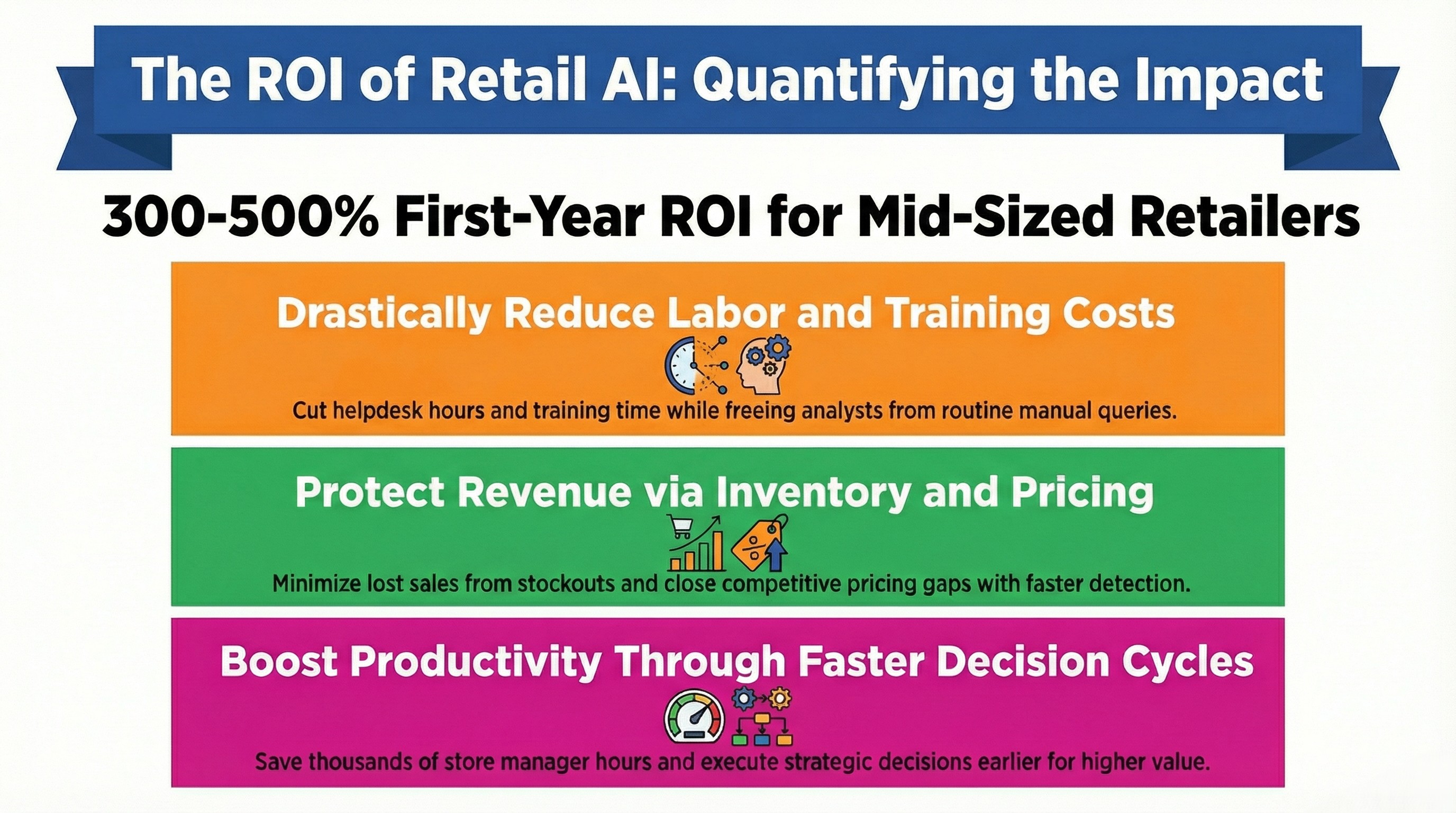
For a mid-sized retailer with 200 stores, even conservative assumptions often show 300-500% first-year ROI, with the benefit compounding as additional use cases deploy on the same infrastructure.
The Future of AI in Retail Operations: From Predictive to Autonomous
The retail industry is at an inflection point in how AI is deployed and the value it delivers. Understanding this evolution helps contextualize where current technology sits and where it's heading.
The Five Levels of Intelligence Maturity
Level 1: Descriptive Analytics — "What happened?" Traditional business intelligence, dashboards, and reports. This is where most retailers still operate—looking backwards at what already occurred.
Level 2: Diagnostic Analytics — "Why did it happen?" Root cause analysis that explains the drivers behind metrics. Useful but still reactive—understanding why sales dropped doesn't prevent the next decline.
Level 3: Predictive Analytics — "What will happen?" Forecasting and trend analysis that anticipates future states. Better, but still requires humans to decide what actions to take based on predictions.
Level 4: Prescriptive Analytics — "What should we do?" AI that recommends specific actions based on predicted outcomes. This is where many "AI-powered" retail tools operate today—providing suggestions but leaving execution to humans.
Level 5: Agentic Intelligence — "Handle this." Fully autonomous execution where you define objectives and guardrails, then AI identifies issues, evaluates options, applies business rules, executes workflows, and learns from outcomes. This is where retail operations are heading.
The case studies in this guide demonstrate Level 5 capabilities:
- The value retailer's voice agent doesn't just recommend answers—it resolves store queries autonomously
- The HVAC manufacturer's competitive monitoring doesn't just flag pricing gaps—it triggers alerts and can automate responses within governance boundaries
- The holding company's agentic intelligence doesn't just generate insights—it creates tasks and tracks execution
Industry Trajectory and Competitive Implications
The shift toward autonomous AI for retail is accelerating:
- McKinsey predicts 25% of enterprise workflows will be automated by agentic AI by 2028: Early adopters are already at 15-20% penetration, gaining 18-24 month advantages over laggards
- Gartner forecasts 50% of enterprises will deploy autonomous decision systems by 2027: This isn't aspirational—leading retailers are already in production
- Early adopters report 40-60% reductions in process cycle times: The competitive gap between AI-powered and manual operations widens quarterly
For retailers, this creates a strategic imperative: the operational advantages of AI compound over time. A competitor deploying now gains:
- 12-18 months of learning: Their AI gets smarter from real operational data while you're still evaluating
- Cultural adaptation: Their teams learn to work with AI agents, developing workflows and skills you haven't started building
- Cost structure advantages: Lower operational costs per store create margin for aggressive expansion or pricing
- Talent advantages: Top operations professionals want to work with modern tools, not manual processes
The question isn't whether to adopt AI for retail operations—it's whether you'll lead or follow, and how much ground you're willing to concede to competitors who move faster.
What "Autonomous" Really Means in Retail Context
It's important to clarify what autonomous AI for retail actually delivers versus science fiction expectations:
What autonomous retail AI does:
- Handles routine operational queries without human intervention
- Monitors competitive pricing and alerts when thresholds are crossed
- Routes approvals to appropriate authorities based on business rules
- Creates tasks, updates systems, and tracks completion automatically
- Learns from patterns to improve future responses
- Operates 24/7 without supervision for approved workflows
What autonomous retail AI doesn't do:
- Make strategic business decisions that should involve leadership
- Override governance rules or operate outside defined boundaries
- Replace human judgment on complex, unprecedented situations
- Take actions that haven't been explicitly authorized through rule-based governance
The goal is augmented intelligence—AI handles the scalable, repeatable, rule-based work (which is 70-80% of operational tasks), freeing humans for the judgment-dependent, strategic, and creative work that generates competitive advantage.
This balance is what makes enterprise adoption possible: retailers get massive efficiency gains without losing control or accountability.
Conclusion: From Insight to Action with AI for Retail Operations
The evidence is clear: AI for retail operations is not a future possibility—it's a present reality delivering measurable results for enterprises managing hundreds of stores and thousands of employees.
A major value retailer's 70% reduction in help desk calls and 85% faster resolution across 700+ stores proves that voice AI for retail works at scale. An HVAC manufacturer's 100× faster competitive insights and immediate correction of 12-26% pricing gaps demonstrates that AI competitive intelligence directly protects revenue. A retail holding company's shift from reactive reporting to proactive execution shows that agentic intelligence transforms how retail organizations operate.
The pattern across these case studies is consistent: retailers implementing AI for retail operations move from manual coordination to autonomous execution, from reactive firefighting to proactive management, from partial visibility to comprehensive intelligence, from weeks to hours.
But successful implementation requires more than deploying AI tools—it requires the right infrastructure:
The Unified Context Engine eliminates the 80% blind spot by fusing structured and unstructured data into complete operational awareness. The Semantic Governor makes autonomy safe through business rules, approval hierarchies, and complete auditability. The Active Orchestrator bridges the gap from insight to action through integration with your existing systems.
This three-tier architecture is what enables enterprise-grade AI agents for retail that leadership can trust to operate autonomously within defined guardrails.
Your Next Steps: From Evaluation to Impact
If you're managing a multi-location retail operation facing the challenges of manual coordination, inventory visibility gaps, training bottlenecks, or competitive blind spots, Assistents is here. The path forward is clear:
- Identify your highest-impact use case: Store support automation, competitive monitoring, inventory intelligence, or knowledge management
- Assess your current operational baseline: How many support calls weekly? How long does analysis take? What's your competitive response time?
- Define success metrics: What would 50% improvement look like in financial terms?
- Map your data landscape: Where does critical operational data reside today?
Within 48 hours of engaging with an enterprise AI for retail operations platform, you should have:
- A concrete pilot plan focused on high-impact workflows
- Clear workflow definitions showing before/after process flows
- ROI hypothesis with quantified metrics
- Success criteria and measurement approach
- 30-day deployment roadmap
The guarantee: If the discovery process doesn't surface real, quantifiable value specific to your operation, walk away. No POC purgatory, no endless sales cycles, no vague promises.
The retailers winning in 2025 and beyond will be those who moved from reactive operations to autonomous intelligence, from manual coordination to AI-powered execution, from operational firefighting to strategic advantage.
The technology is proven. The ROI is quantifiable. The competitive advantage is real.
The question is: will you lead this transformation in your market, or will you watch competitors pull ahead while you're still evaluating?
Frequently Asked Questions About AI for Retail Operations
What is AI for retail operations?
AI for retail operations refers to autonomous intelligent agents that handle core retail workflows including store support, inventory management, training, customer service, and competitive intelligence. Unlike basic automation or chatbots, these AI systems understand context across structured and unstructured data, apply business rules, execute multi-step workflows, and operate within governance frameworks that ensure compliance and auditability.
How does AI reduce retail operational costs?
AI for retail reduces costs through several mechanisms: eliminating manual helpdesk volume (demonstrated by 70% call reductions), automating routine analytical queries (100× faster insights), reducing training dependency through on-demand AI learning, improving inventory visibility to reduce stockouts and overstock, and enabling competitive response without proportional headcount increases as store count grows.
What are AI agents in retail?
AI agents in retail are autonomous software systems that perform specific operational tasks without constant human supervision. Examples include voice support agents that answer store queries in multiple languages, inventory intelligence agents that provide real-time stock visibility, competitive monitoring agents that track pricing across channels, and knowledge agents that deliver on-demand training. These agents operate within governance rules and provide complete audit trails.
How long does it take to implement AI in retail stores?
With the right architecture, retail AI can be deployed to production in 30 days: Week 1 for discovery and workflow mapping, Weeks 2-4 for context engine deployment and first agent development, and production launch by day 30. This rapid timeline is possible when the platform handles data fusion, governance, and orchestration as core capabilities rather than requiring custom development for each use case.
What results can retailers expect from AI?
Based on enterprise deployments: 70% reduction in support call volume, 85% faster issue resolution, 90% faster analytical processing, identification and correction of pricing gaps of 12-26%, support for 10,000+ concurrent users, 24/7 availability, consistent policy application across all locations, and the ability to scale to hundreds of stores without proportional infrastructure increases. Results vary by use case but typically show 300-500% first-year ROI.
Is AI for retail operations secure and compliant?
Enterprise-grade retail AI platforms meet SOC2 Type II, ISO 27001, and GDPR compliance requirements. They use AES-256 encryption for data at rest and TLS 1.3 for data in transit, provide role-based access controls, maintain complete audit logs, and never train AI models on customer data. Every decision includes rule citations and explainability, eliminating black-box risk.
Can AI for retail operations integrate with existing systems?
Yes. Modern retail AI platforms use API-first architecture to integrate with common enterprise systems (SAP, Salesforce, ServiceNow, POS platforms) and custom systems through standard APIs. The platform sits as an orchestration layer above existing infrastructure, requiring no rip-and-replace of core systems. Deployment models include cloud, private, on-premise, or hybrid configurations.
What's the difference between AI agents and traditional RPA in retail?
RPA (Robotic Process Automation) follows rigid scripts and breaks when encountering exceptions or changes. AI agents understand context, reason about situations, handle unstructured data like emails and documents, adapt to variations, and learn from patterns. RPA requires constant maintenance when workflows change; AI agents adjust automatically. For retail, this means AI can handle the complexity and variability of real-world operations that RPA cannot.

Transform Your Business With Agentic Automation
Agentic automation is the rising star posied to overtake RPA and bring about a new wave of intelligent automation. Explore the core concepts of agentic automation, how it works, real-life examples and strategies for a successful implementation in this ebook.
Sarfraz Nawaz is the CEO and founder of Ampcome, which is at the forefront of Artificial Intelligence (AI) Development. Nawaz's passion for technology is matched by his commitment to creating solutions that drive real-world results. Under his leadership, Ampcome's team of talented engineers and developers craft innovative IT solutions that empower businesses to thrive in the ever-evolving technological landscape.Ampcome's success is a testament to Nawaz's dedication to excellence and his unwavering belief in the transformative power of technology.

More insights
Discover the latest trends, best practices, and expert opinions that can reshape your perspective


.jpg)




Contact us

