
15 Agentic AI Use Cases in Manufacturing: From Reactive Dashboards to Autonomous Execution


The Automation Paradox Every Manufacturing Leader Faces
AI agents are powerful. They reason faster than humans, execute workflows in seconds, and operate 24/7 without fatigue. But here's the uncomfortable truth: AI agents don't create order—they multiply what already exists.
Feed them clean data and clear rules? Efficiency multiplies exponentially.
Give them fragmented data and partial context? Chaos multiplies just as fast.
By the time an error shows up on your dashboard, an autonomous agent has already acted hundreds of times. The AI didn't fail. Your foundation did.
This is the automation paradox, and it's why 25% of enterprise workflows will be automated by agentic AI by 2028 (McKinsey), yet most manufacturing leaders remain hesitant. They've seen the promise. They've also seen the failures.
The difference between those who succeed and those who don't? Context.
The 80% Blind Spot Crippling Manufacturing AI
Only 20% of your manufacturing intelligence lives in structured systems—your ERP tables, MES data, SCADA logs, and transaction records. These are the systems traditional BI tools excel at analyzing.
The other 80%—the real business truth that determines success or failure—lives elsewhere:
- Standard Operating Procedures buried in SharePoint folders
- Email negotiations with suppliers about discounts and delivery exceptions
- Maintenance logs documenting recurring equipment issues
- Quality inspection reports with critical safety findings
- Slack conversations where shop floor supervisors flag production bottlenecks
- PDF contracts with penalty clauses and SLA commitments
An AI agent acting on 20% of the facts isn't an asset. It's a liability with a confidence score.
Real incident: A manufacturing enterprise deployed an AI agent for vendor payments. The agent saw ERP data, invoice amounts, and due dates. What it couldn't see: contract PDFs in SharePoint, email negotiations with payment discounts, and Slack messages flagging cash flow concerns.
Result: ₹12 crore in early payments approved. Contract terms violated. Discounts forfeited.
The agent did exactly what it was programmed to do—based on what it could see.
Understanding Agentic AI: Beyond Dashboards and Co-pilots
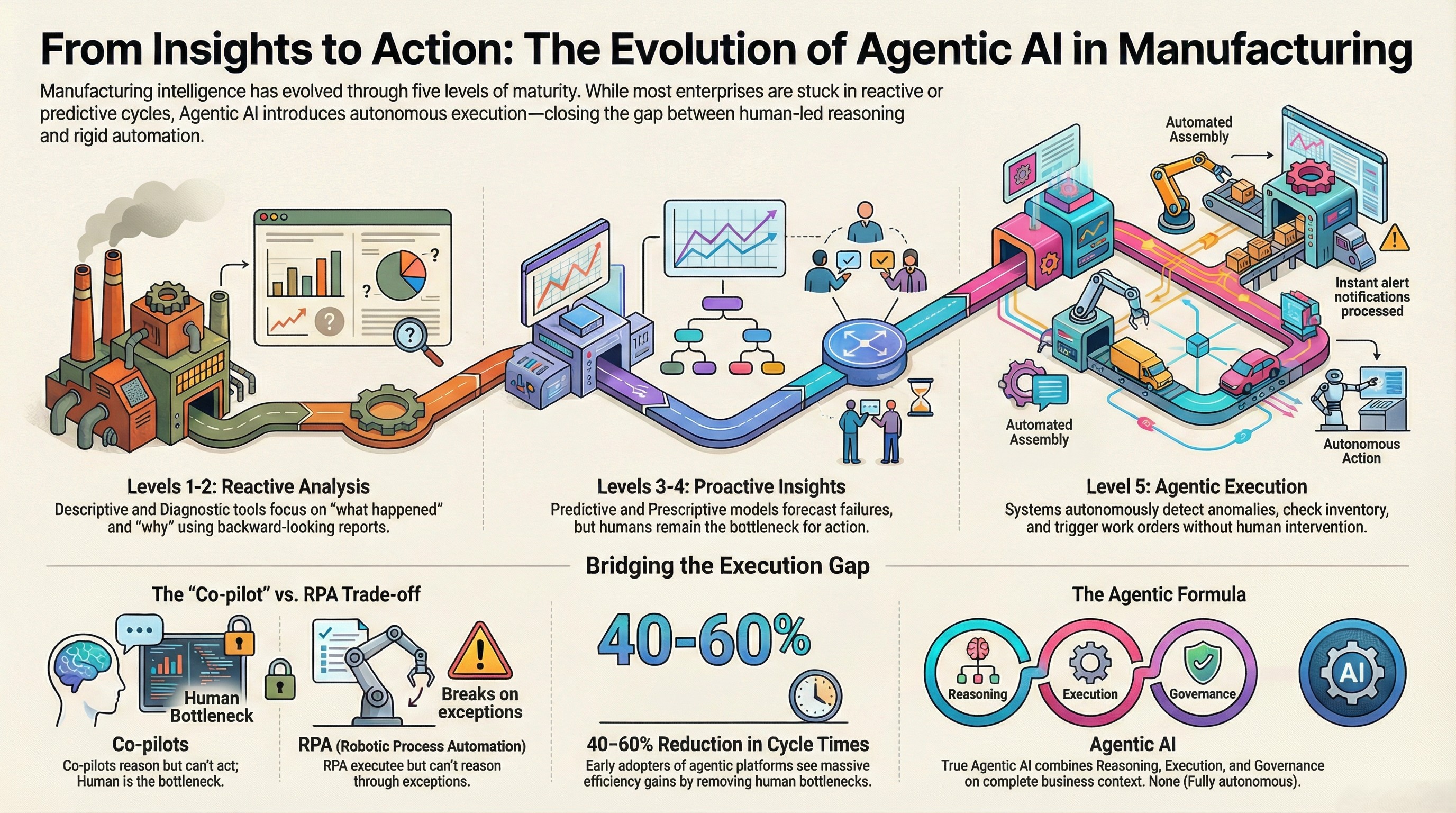
The Evolution from BI to Agentic Execution
Manufacturing intelligence has evolved through five distinct levels, but most enterprises remain stuck in reactive cycles:
Level 1: Descriptive Analytics → "What happened?" Monthly reports showing production volumes, defect rates, downtime hours. You're looking backward, weeks after problems occurred.
Level 2: Diagnostic Analytics → "Why did it happen?" Root cause analysis revealing that Machine #3's failures correlate with Supplier B's raw material batches. Still reactive, still manual.
Level 3: Predictive Analytics → "What will happen?" Machine learning models forecasting equipment failures 48 hours in advance. Better, but someone still needs to act on the insights.
Level 4: Prescriptive Analytics → "What should we do?" Recommendations appear: "Schedule preventive maintenance on Machine #3 before Friday's shift." The human is still the bottleneck.
Level 5: Agentic Execution → "Handle this." The system detects the anomaly, evaluates maintenance windows, checks spare parts inventory, creates the work order, notifies the maintenance team, and tracks completion—autonomously.
This is agentic AI in manufacturing: autonomous AI agents that combine reasoning, execution, and governance to act on complete business context without human intervention.
Why Traditional Manufacturing AI Fails
The market offers a bad trade-off:
Co-pilots (Microsoft Copilot, Salesforce Einstein)
- Strong reasoning capabilities
- No execution authority
- Humans remain the bottleneck
- Stuck at Level 4: Prescriptive
RPA (UiPath, Automation Anywhere)
- Can execute workflows
- Cannot reason through exceptions
- Breaks when encountering the unexpected
- Fragile, script-based automation
What's missing: Reasoning + Execution + Governance on complete context.
This is where agentic AI manufacturing platforms bridge the gap, and why early adopters are already seeing 40-60% reductions in process cycle times.
Three Pillars of Manufacturing Agentic Intelligence
Manufacturing enterprises deploying successful autonomous AI agents in manufacturing build on three foundational pillars:
Pillar 1: Unified Context Engine
The first pillar solves the 80% blind spot by fusing all data formats into a single semantic layer.
Structured data sources:
- ERP systems (SAP, Oracle, Microsoft Dynamics)
- Manufacturing Execution Systems (MES)
- Warehouse Management Systems (WMS)
- Quality Management Systems (QMS)
- SCADA and IoT sensor networks
Unstructured data sources:
- Standard Operating Procedures (SOPs)
- Maintenance and repair logs
- Supplier email correspondence
- Quality inspection PDFs
- Regulatory compliance documents
- Internal Slack/Teams communications
The fusion advantage: When an agentic AI agent analyzes production data, it simultaneously correlates maintenance schedules, supplier delivery commitments from email threads, quality holds from inspection reports, and real-time sensor anomalies.
Example in action: A smart manufacturing AI agent detects that Line 3's output dropped 8% yesterday. Instead of just flagging the metric, it connects:
- Maintenance logs showing a calibration delay
- Supplier emails about a raw material spec change
- Quality reports flagging increased rejects
- Shift supervisor notes about operator training gaps
The agent doesn't just identify the problem—it understands the complete story and can recommend (or execute) the right corrective action.
Pillar 2: Semantic Governor
The second pillar addresses the trust problem: How do you let AI agents execute autonomously without creating catastrophic errors?
The answer: Deterministic business rules, not probabilistic guesses.
Safety protocols encoded:
- Material release thresholds (auto-approve <$10K, escalate >$50K)
- Quality hold hierarchies (minor defects → supervisor, critical → plant manager)
- Equipment shutdown triggers (temperature anomaly → immediate stop)
- Compliance checkpoints (regulatory documentation required before shipment)
Approval workflows automated:
- Procurement: Auto-execute standard POs, route non-standard to buyers
- Production: Auto-adjust schedules within tolerance, escalate major changes
- Maintenance: Auto-create preventive work orders, require approval for emergency shutdowns
Governance features:
- Full audit trails with timestamps and user tracking
- Rule citations for every autonomous decision
- Human-in-the-loop controls by risk threshold
- Rollback capabilities for reversible actions
- No hallucinations—every action is policy-backed
Example: A material release agent operates with four governance layers:
- Automatic approval for standard materials <$10K
- Purchasing manager approval for $10K-$50K
- CFO approval for >$50K
- Board approval for strategic supplier changes
Every decision is auditable, explainable, and defensible.
Pillar 3: Active Orchestrator
The third pillar bridges the execution gap by connecting AI-driven manufacturing workflows across your entire technology stack.
System integrations:
- ERP systems (SAP, Oracle, NetSuite) for order creation and financial transactions
- MES platforms for production scheduling and work order management
- CMMS systems (Maximo, SAP PM) for maintenance automation
- CRM platforms (Salesforce, HubSpot) for customer service workflows
- Communication tools (Slack, Microsoft Teams) for human collaboration
- Email and document systems for supplier coordination
Execution capabilities:
- Multi-step workflow orchestration across 5-10 systems
- Exception handling with human escalation
- Parallel task execution for time-sensitive operations
- Conditional logic based on real-time business rules
Example workflow: Sensor anomaly detected on production line
- Detect: IoT sensor flags temperature spike on Machine #7
- Analyze: Agent correlates with recent maintenance history and production schedule
- Decide: Safety threshold exceeded, preventive action required
- Execute:
- Create work order in CMMS
- Adjust production schedule in MES
- Notify maintenance team via Slack
- Reserve backup equipment
- Update customer delivery estimates
- Log incident for compliance
- Learn: Update predictive maintenance model with new data point
All within 90 seconds. Zero human intervention required.
15 Proven Agentic AI Use Cases in Manufacturing
Let's examine real implementations across five critical categories. These aren't theoretical examples—they're actual deployments delivering measurable business impact.
Category A: Supply Chain & Procurement
Use Case 1: Autonomous Procurement Decision Support
Industry: Pharmaceutical manufacturing
Company profile: Platform marketing 1,800+ rare excipients and 7,500+ SKUs
Challenge: Manual RFQ processes, complex supplier discovery, time-consuming procurement coordination
The traditional process:
- Procurement team manually searches supplier databases
- Creates individual RFQs for each potential vendor
- Waits days for responses
- Manually compares pricing, lead times, quality certifications
- Coordinates back-and-forth negotiations via email
- Final decision takes 2-3 weeks for complex materials
Agentic AI solution implemented:
AI agents deployed:
- Document Understanding Agent → Extracts specifications from formulation requirements
- Supplier Matching Agent → Analyzes 1,800+ excipients database and supplier capabilities
- RFQ Generation Agent → Auto-creates customized RFQs based on material specifications
- Price Intelligence Agent → Tracks historical pricing, lead time trends, quality metrics
- Workflow Orchestration Agent → Manages supplier outreach, follow-ups, comparison analysis
How it works:
- R&D submits new formulation requiring rare excipient
- Specification agent extracts technical requirements (purity, particle size, regulatory compliance)
- Supplier matching agent identifies 8 qualified vendors from database
- RFQ agent generates customized requests including all technical specs
- Automated outreach via email integration
- Response tracking and comparison dashboard
- Price/lead time/quality scoring with recommendation
- Auto-escalation to procurement manager for final approval
Results achieved:
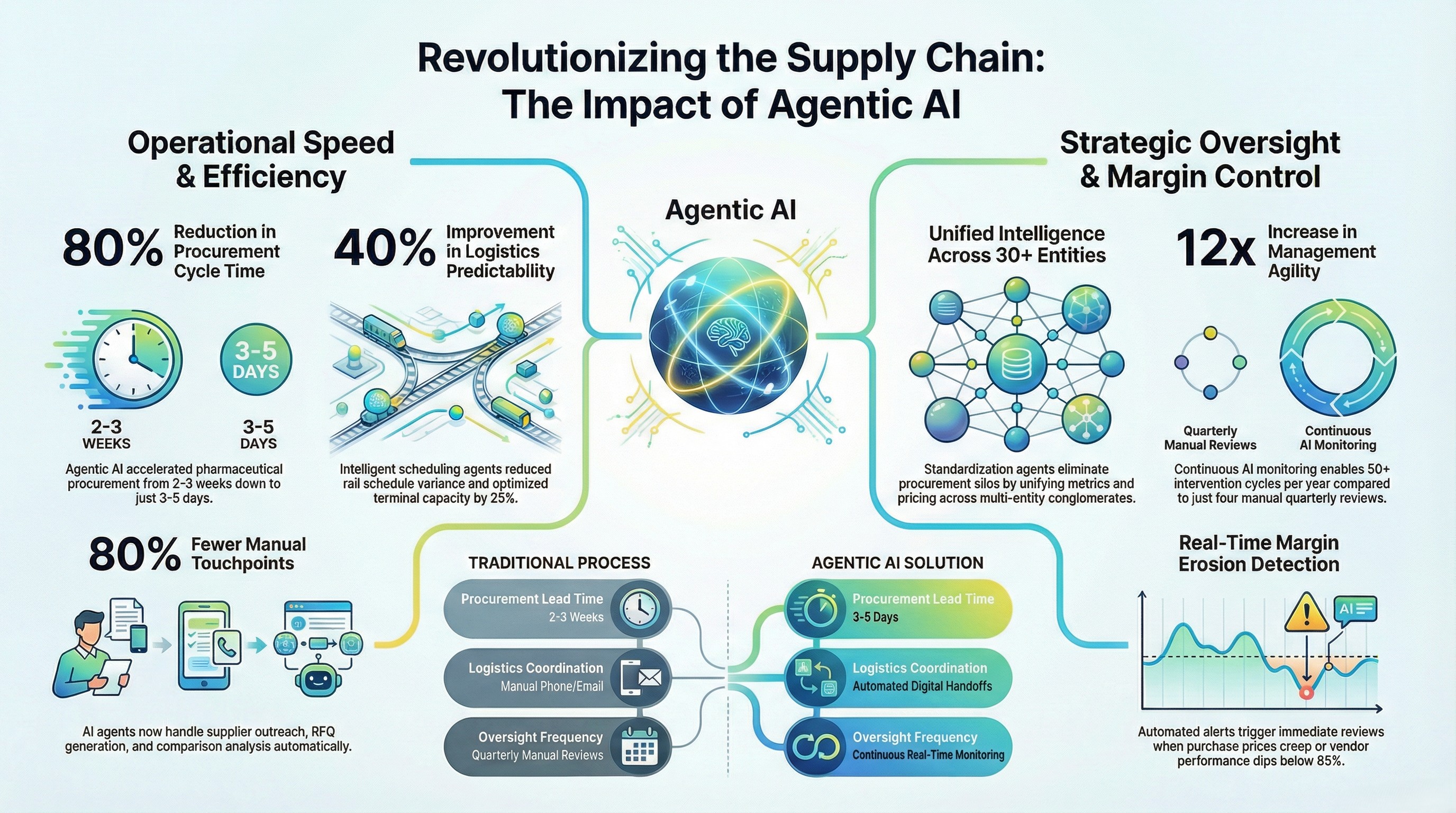
- Faster procurement cycles: 2-3 weeks → 3-5 days
- Reduced vendor coordination: 80% fewer manual touchpoints
- Better sourcing visibility: Real-time tracking vs. email chaos
- Improved competitiveness: Earlier access to price and lead-time intelligence
Technology stack: Document understanding agents + supplier database integration + workflow orchestration + email automation
Use Case 2: Terminal & Rail Management Optimization
Industry: Global ports and logistics
Company profile: $20B annual revenue, worldwide terminal and logistics operations
Challenge: Complex terminal-to-rail coordination, manual scheduling, exception management inefficiencies
The operational complexity:
- Containers arrive at port terminal on unpredictable schedules
- Rail capacity must be optimized across multiple inland destinations
- Yard operations require real-time visibility and coordination
- Delays cascade across the entire supply chain
- Manual planning struggles with dynamic exceptions
Agentic AI solution implemented:
AI agents deployed:
- Terminal Workflow Digitization Agent → Converts manual processes to structured data
- Yard Operations Intelligence Agent → Real-time container location and status tracking
- Rail Scheduling Optimization Agent → Balances capacity, destinations, priorities
- Exception Management Agent → Identifies and routes issues for resolution
- Executive Dashboard Agent → Aggregates KPIs and operational alerts
Manufacturing process automation with AI:
- Container arrival triggers automatic yard assignment
- Agent analyzes destination, priority, rail capacity
- Optimal slot allocated based on departure schedules
- Automated notifications to rail operators and customers
- Real-time tracking throughout terminal operations
- Exception detection (delays, capacity issues, equipment failures)
- Automatic rerouting or human escalation as needed
Results achieved:
- Higher operational predictability: 40% reduction in schedule variance
- Improved terminal-to-rail throughput: 25% capacity optimization
- Efficient coordination: Automated handoffs vs. phone calls and emails
- Executive visibility: Real-time dashboards vs. daily status meetings
ROI impact: Multi-million dollar efficiency gains through optimized asset utilization and reduced dwell time
Use Case 3: Vendor Performance & Margin Control
Industry: Diversified manufacturing and retail group
Company profile: Multi-entity conglomerate, 30+ companies, partnership with global brands
Challenge: Margin erosion across entities, vendor performance slippage, inconsistent procurement intelligence
The problem at scale: When you operate 30+ companies, procurement happens in silos:
- Entity A negotiates 5% discount with Supplier X
- Entity B pays full price to the same supplier
- Vendor Y's delivery performance degrades from 95% → 78%
- No one notices until customer complaints spike
- Purchase price creep of 2-3% annually goes undetected
- Working capital tied up in excess inventory and early payments
Agentic AI solution implemented:
AI agents deployed:
- Group-Wide KPI Standardization Agent → Unifies metrics across 30+ entities
- Purchase Price Trend Agent → Tracks pricing movements and identifies anomalies
- Gross Margin Impact Agent → Correlates procurement changes with profitability
- Vendor Performance Agent → Monitors delivery, quality, returns across all entities
- Alert Orchestration Agent → Routes insights to relevant stakeholders
Automated monitoring workflows:
- Daily: Purchase price variance detection across entities
- Weekly: Vendor performance scorecards (delivery, quality, returns)
- Monthly: GM impact analysis highlighting margin compression sources
- Continuous: Early payment analysis calculating notional finance costs
Governed AI execution manufacturing:
- Alert thresholds: >2% price increase triggers procurement review
- Escalation rules: Vendor performance <85% → supplier meeting required
- Dashboard consolidation: Leadership sees cross-entity patterns
- Scheduled insight packs: Automated weekly reports to CFO and procurement heads
Results achieved:
- Earlier margin erosion detection: Real-time alerts vs. quarterly reviews
- Standardized procurement intelligence: Single view across 30+ entities
- Reduced vendor slippage: Proactive performance management
- Working capital optimization: Eliminated unnecessary early payments
Metrics: Continuous monitoring replaced quarterly manual analysis, enabling 50+ intervention cycles per year vs. 4
Category B: Production & Quality
Use Case 4: Tender Document Processing Automation
Industry: Construction and remedial building services
Company profile: 20+ years specializing in waterproofing diagnostics and remediation
Challenge: Complex tender documents requiring rapid, high-integrity processing with zero errors
The tender complexity: A typical commercial remediation tender includes:
- 200-500 page specification documents
- Architectural drawings with scope details
- Site-specific requirements and constraints
- Compliance and safety protocols
- Pricing schedules and payment terms
- Multiple revisions and addendums
- Tight bid deadlines (often 48-72 hours)
Manual processing requires:
- 8-12 hours of document review per tender
- Cross-referencing across multiple PDFs
- Change detection between revisions
- Data entry into estimating systems
- High risk of missed details or scope gaps
Agentic AI solution implemented:
Multi-agent document orchestration:
- Tender Retrieval Agent → Monitors email and portals for new tender releases
- Document Classification Agent → Identifies document types (specs, drawings, schedules, revisions)
- Vision-LLM Extraction Agent → Extracts scope, quantities, requirements from complex PDFs
- Revision Analysis Agent → Compares versions and flags changes
- ERP Integration Agent → Maps extracted data to estimating system
- Audit Trail Agent → Logs all extractions and transformations for governance
Workflow automation:
- New tender notification arrives via email
- Retrieval agent downloads all attachments
- Classification agent organizes by document type
- Vision-LLM processes each PDF:
- Scope extraction with line-item detail
- Quantity takeoffs from specifications
- Special requirement identification
- Compliance checklist completion
- Revision agent compares to previous versions (if applicable)
- Highlighted changes flagged for estimator review
- Deep ERP integration:
- Auto-create job in system
- Populate scope of work
- Link supporting documents
- Lock quote for version control
- Full audit log maintained for bid defense
Results achieved:
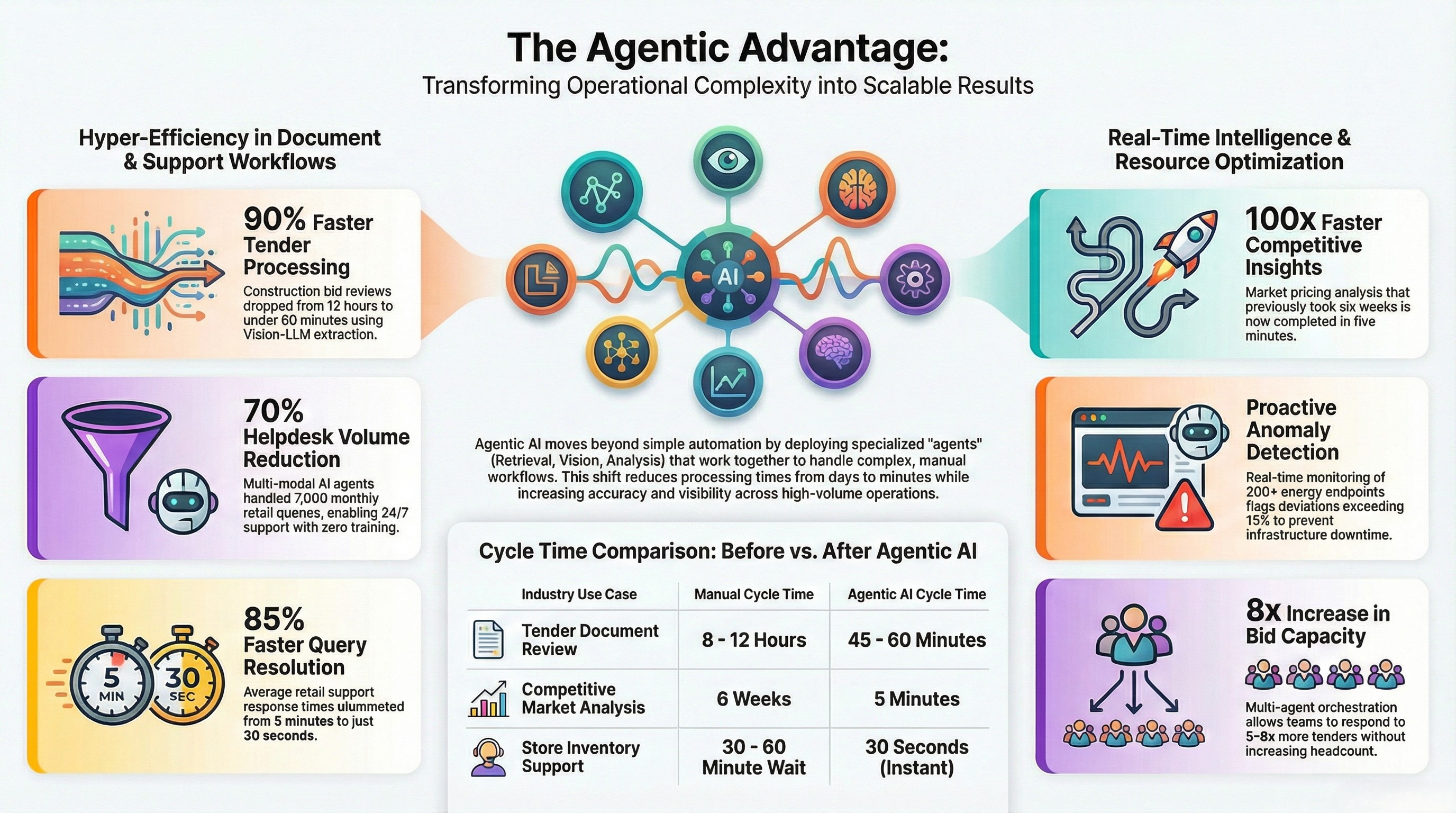
- 90% faster tender processing: 8-12 hours → 45-60 minutes
- 95% extraction accuracy: Industry-leading precision on standard formats
- Reduced bid risk: Comprehensive change detection prevents scope gaps
- Better auditability: Complete documentation trail for client questions
Impact: Company can now respond to 5-8× more tenders with the same team, significantly expanding revenue opportunities
Technology stack: Vision-LLM for complex PDF understanding + document workflow orchestration + deep ERP integration with CRUD operations + audit logging
Use Case 5: Competitive Intelligence & Pricing Automation
Industry: HVAC and commercial cooling manufacturing
Company profile: Major manufacturer founded in the 1940s, competing in price-sensitive markets
Challenge: Daily competitor pricing moves in highly competitive market where visibility matters
The competitive landscape:
- Dozens of competitors selling similar products
- E-commerce platforms with real-time price changes
- Promotional offers and discount cycles
- MRP variations across channels and regions
- Customer reviews and rating fluctuations
- Stock availability impacting market share
The traditional approach:
- Manual checking of competitor websites (time-consuming, inconsistent)
- Weekly pricing reports (too slow for daily market moves)
- Reactive strategy (discover price cuts after losing deals)
- Limited visibility into promotional patterns
- No consolidated view across product portfolio
Agentic AI solution implemented:
Continuous market monitoring:
- E-commerce Monitoring Agent → Tracks pricing across major platforms (Amazon, Flipkart, own website, competitor sites)
- Product Catalog Agent → Maps competitor SKUs to internal product codes
- Pricing Intelligence Agent → Analyzes MRP, discounts, net prices, promotional offers
- Availability Tracking Agent → Monitors stock status and fulfillment times
- Rating & Review Agent → Tracks customer sentiment and competitive positioning
- Leadership Q&A Agent → Enables natural language queries on competitive landscape
How competitive intelligence works:
- Data collection: 24/7 automated monitoring of 50+ product categories across 20+ e-commerce platforms
- Change detection: Real-time alerts when competitor pricing changes >3%
- Pattern recognition: Identifies promotional cycles and seasonal trends
- Gap analysis: Highlights where your pricing is 12-26% above/below market
- Portfolio insights: Shows which products are most vulnerable to competitive pressure
Agentic Q&A capabilities: Leadership asks: "Why did sales dip in category X?" Agent answers with integrated insights:
- "Sales declined 15% due to competitor promos..."
- Links to specific pricing data
- Shows 18% price gap on 3 key SKUs
- Identifies ratings dropped from 4.2→3.8 due to delivery issues
- Recommends corrective actions with projected impact
Results achieved:
- 100× faster insights: What took 6 weeks of analysis now takes 5 minutes
- 12-26% pricing gap identified: Immediate correction prevented margin loss
- Always-on monitoring: Replaced manual checks across portals
- Faster competitive response: Same-day pricing adjustments vs. weekly review cycles
Cycle transformation:
- Before: 6 weeks from signal → analysis → decision → result (8 cycles/year)
- After: Hours from detection → autonomous insight → recommended action (50+ cycles/year)
Platform capabilities: Scalable architecture from POC → production with full governance and audit trails
Use Case 6: Energy Management & Campus Optimization
Industry: Research and education
Company profile: Premier astronomy and astrophysics research institute, campus-scale operations
Challenge: Reliable infrastructure monitoring and energy consumption optimization across research facilities
Campus complexity:
- Multiple research buildings with specialized equipment
- 24/7 operations for telescope and observation systems
- Compute-intensive data processing centers
- Varying energy loads across day/night cycles
- Aging infrastructure with inconsistent efficiency
- Limited facilities management bandwidth
Agentic AI solution implemented:
Smart campus infrastructure:
- Utility Data Ingestion Agent → Connects to electricity meters, HVAC systems, equipment sensors
- Anomaly Detection Agent → Identifies unusual consumption patterns and equipment behavior
- Forecasting Agent → Predicts energy demand based on research schedules and weather
- Optimization Agent → Recommends efficiency improvements and load balancing
- Alert Routing Agent → Sends proactive notifications to facilities team
Energy management workflows:
- Real-time monitoring: Sensor data from 200+ endpoints collected every 5 minutes
- Pattern learning: AI establishes normal baseline for each building and system
- Anomaly detection: Flags deviations >15% from expected consumption
- Root cause analysis: Correlates anomalies with equipment schedules, weather, maintenance logs
- Predictive maintenance: Identifies failing equipment before critical failure
- Optimization recommendations: Suggests HVAC scheduling adjustments, lighting controls
Dashboard and alerting:
- Facilities manager sees campus-wide energy map
- Color-coded buildings show consumption vs. baseline
- Drill-down to individual systems and equipment
- Proactive alerts for anomalies requiring attention
- Trend analysis for budgeting and capital planning
Results achieved:
- Improved energy visibility: Real-time insight vs. monthly utility bills
- Faster inefficiency detection: Same-day identification vs. weeks of investigation
- Reduced manual monitoring: Automated analysis vs. staff building walks
- Predictive operations: Proactive equipment maintenance prevents downtime
Operational impact: Research operations maintain 99.9%+ uptime while optimizing energy costs
Use Case 7: Inventory Intelligence Across Locations
Industry: Multi-format retail
Company profile: 700+ stores across a major market, mass-market retail serving millions of customers
Challenge: National-scale inventory visibility, store support automation, zero-training staff onboarding
The retail complexity at scale: Managing 700+ stores means:
- 50,000+ SKUs across categories
- Daily price changes and promotional cycles
- Store-specific stock levels and transfers
- Regional variations in demand and assortment
- Thousands of store associates with varying experience levels
- Constant training burden for new hires
- Helpdesk overwhelmed with repetitive queries
Before agentic AI:
- Store managers call helpdesk for inventory checks (30-60 min wait times)
- Manual price verification across systems
- Promo information scattered across emails and PDFs
- New staff require 2-3 weeks training on policies and procedures
- Helpdesk team buried in 10,000+ calls per month
- Inconsistent answers depending on who responds
Agentic AI solution implemented:
Multi-modal AI agent deployment:
- Voice AI Agent → STT-LLM-TTS in multiple languages for natural conversation
- Inventory Intelligence Agent → Real-time pricing, stock, promo data per store
- Knowledge Agent → RAG (Retrieval Augmented Generation) over POS manuals, SOPs, policy docs
- Ticketing Integration Agent → Routes complex issues to human support
- Analytics Agent → Tracks query patterns and knowledge gaps
How it works for store associates:
Scenario 1: Inventory Check Associate: "Is there stock of shoes at Store 234?" Agent: "Yes, Store 234 has 47 pairs in stock across sizes 7-11. Promo price until Sunday."
Scenario 2: Price Verification Associate: "What's the current price for Samsung TV model XYZ?" Agent: "Samsung 55" QLED Model XYZ is currently ₹54,999 (regular ₹64,999). Active promotion runs through Feb 15. Available in 23 stores in your region."
Scenario 3: Policy Question New associate: "What's the return policy for electronics?" Agent: "Electronics can be returned within 7 days with original packaging and receipt. Opened items eligible for exchange only. TVs >50" require manager approval for return. See SOP-E-032 for full details."
Scenario 4: Complex Escalation Associate: "Customer wants bulk order discount for 100 units" Agent: "This requires approval. I've created ticket #45678 and notified Regional Manager. Typical approval time: 2-4 hours. Can I help with anything else?"
Results achieved:
- 70% call reduction: 10,000 → 3,000 helpdesk calls per month
- Zero-training execution: New associates productive from day one
- 85% faster resolution: Average query time 5 minutes → 30 seconds
- 10,000+ users: Scaled across entire store network
- 24/7 availability: No wait times, instant answers
Technology stack:
- Multilingual voice AI with STT-LLM-TTS
- Real-time database integration for inventory/pricing
- RAG over 500+ documents (SOPs, training materials, policies)
- Admin console for monitoring and continuous improvement
- Ticketing system integration for human escalation
Business impact: Same helpdesk team now handles 700 stores (was 400), enabling geographic expansion without headcount increase
Category C: Maintenance & Asset Management
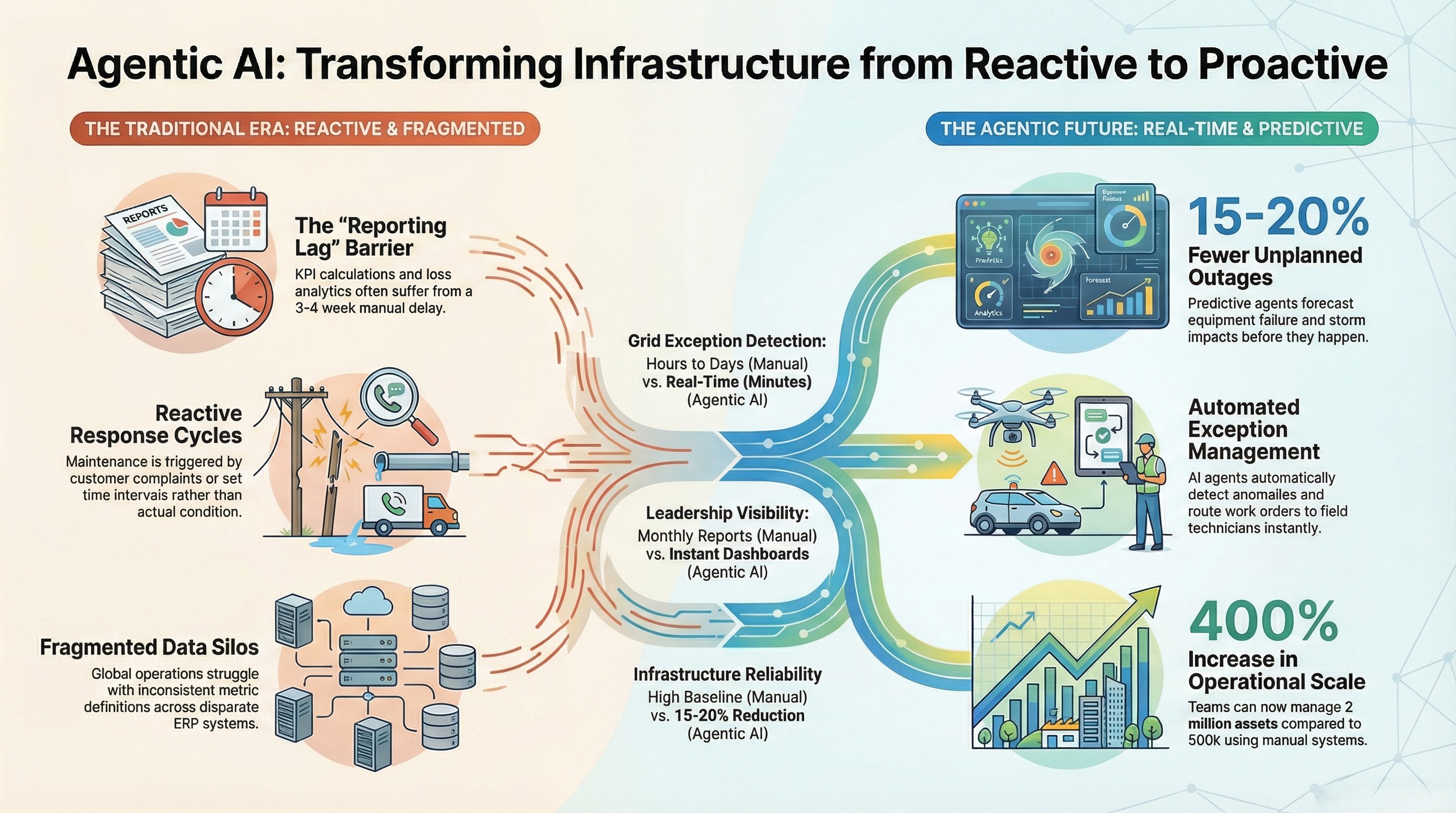
Use Case 8: Smart Grid Operations & Predictive Maintenance
Industry: Smart city infrastructure and power transmission
Company profile: Operating 25+ smart city centers, 2M+ connected assets, impacting 150M+ urban lives
Challenge: Grid operations visibility, predictive analytics for outages/losses, automated exception management
Smart grid scale:
- 2 million+ connected assets (meters, transformers, substations)
- Real-time data from 150+ cities
- Multiple utility providers and regulatory frameworks
- Thousands of field technicians
- 24/7 operations with zero tolerance for downtime
- Complex interdependencies across infrastructure
Traditional grid management challenges:
- Reactive response to outages (customers report failures)
- Manual data analysis from disparate systems
- Delayed identification of efficiency losses
- Inconsistent maintenance scheduling
- Limited predictive capabilities
- Coordination friction across teams and jurisdictions
Agentic AI solution implemented:
Smart grid intelligence platform:
- Data Ingestion Agent → Collects real-time telemetry from 2M+ endpoints
- Operational Dashboard Agent → Visualizes grid health, load patterns, anomalies
- Predictive Analytics Agent → Forecasts outages, losses, field issues before occurrence
- Alert Routing Agent → Automatically escalates issues to appropriate field teams
- Resolution Tracking Agent → Monitors issue lifecycle from detection to closure
Predictive maintenance AI agents:
Outage prediction:
- Historical pattern analysis identifies transformers at risk
- Weather data correlation predicts storm-related failures
- Load trend analysis flags capacity constraints
- Automated preventive maintenance scheduling
Loss analytics:
- Real-time detection of theft or meter tampering
- Line loss calculation and optimization
- Efficiency degradation alerts
- Revenue protection automation
Field issue management:
- Automated work order creation in CMMS
- Technician dispatch optimization based on location and skills
- Parts inventory verification and procurement triggers
- Customer communication automation
Operational dashboards:
- Grid operators see city-wide health status
- Color-coded zones by risk level and active issues
- Drill-down to individual assets and neighborhoods
- Performance metrics vs. SLAs and regulatory targets
Results achieved:
- Higher operational visibility: Real-time awareness across 150+ cities
- Faster exception detection: Minutes vs. hours to identify issues
- Proactive grid operations: Preventive actions before customer impact
- Improved reliability: 15-20% reduction in unplanned outages
- Better field coordination: Automated work order routing eliminates manual calls
Scale impact: Managing 2M+ assets with same operational team that previously handled 500K
Use Case 9: Transmission KPI Monitoring & Loss Analytics
Industry: State power transmission utility
Company profile: Regional transmission infrastructure, delivering reliable power across the state
Challenge: Transmission KPI monitoring, loss/outage analytics, predictive maintenance indicators
State-level transmission complexity:
- 1,000+ km of high-voltage transmission lines
- Dozens of substations and switching stations
- Multiple generation sources and load centers
- Agricultural, industrial, and residential demand patterns
- Seasonal variations and peak load challenges
- Regulatory reporting and reliability mandates
The operational challenge: Before autonomous AI agents in manufacturing (and infrastructure):
- Weekly manual KPI compilation from multiple systems
- Reactive response to line failures and outages
- Loss calculations performed monthly with 3-4 week lag
- Maintenance scheduled based on time intervals, not conditions
- Limited visibility for leadership into grid health
- Compliance reporting required manual data gathering
Agentic AI solution implemented:
Transmission intelligence platform:
- KPI Monitoring Agent → Tracks key performance indicators across transmission network
- Anomaly Detection Agent → Identifies deviations from normal operating parameters
- Loss Analytics Agent → Calculates technical and commercial losses in real-time
- Predictive Maintenance Agent → Forecasts equipment failures based on operating history
- Field Alert Agent → Routes urgent issues to maintenance crews with context
Automated monitoring workflows:
Transmission KPIs tracked:
- Line loading and capacity utilization
- Voltage stability and power quality
- Transformer health and efficiency
- Substation availability and uptime
- Reactive power management
- Grid frequency and stability
Loss analytics:
- Technical losses (I²R losses, corona, transformer losses)
- Anomaly detection highlighting unusual patterns
- Comparative analysis across similar infrastructure
- Trend tracking to identify degradation
Predictive maintenance indicators:
- Oil quality degradation in transformers
- Insulation resistance trending
- Thermal imaging anomaly correlation
- Historical failure pattern matching
- Seasonal stress factor analysis
Leadership dashboards:
- State-wide transmission health overview
- Zone-wise performance comparison
- Reliability metrics and regulatory compliance
- Budget vs. actual maintenance spend
- Predictive alerts for upcoming issues
Results achieved:
- Faster grid exception identification: Real-time vs. weekly reports
- Improved system reliability: 12% reduction in unplanned outages
- Better operational transparency: Leadership visibility from months → minutes
- Optimized maintenance: Condition-based vs. time-based scheduling
- Regulatory compliance: Automated reporting eliminates manual compilation
Financial impact: Reduced technical losses by 8%, saving millions annually in generation costs
Use Case 10: Analytics Consolidation Across Global Operations
Industry: Multinational logistics and supply chain
Company profile: Operations across India, UK/Europe, and US with end-to-end supply chain services
Challenge: Cross-entity KPI standardization, consolidated reporting, data quality and governance
Global operations complexity: When you operate across three continents:
- Different ERP systems (SAP in India, Oracle in Europe, NetSuite in US)
- Inconsistent KPI definitions (what's "on-time delivery" in each region?)
- Currency and regulatory variations
- Time zone coordination challenges
- Fragmented reporting (each region creates own dashboards)
- Leadership struggles to see unified performance
- M&A integration headaches
Before analytics consolidation:
- Regional teams submit monthly reports (2-3 week lag)
- Excel-based consolidation across entities
- Inconsistent metric definitions create comparison errors
- Data quality issues discovered during quarterly reviews
- Leadership questions require 3-5 days to answer
- Strategic decisions delayed by lack of unified visibility
Agentic AI solution implemented:
Unified analytics platform:
- Cross-Entity Standardization Agent → Harmonizes KPIs across regions and systems
- Consolidated Reporting Agent → Aggregates performance metrics in real-time
- Data Quality Agent → Validates and flags inconsistencies
- Governance Layer Agent → Ensures compliance with corporate standards
- Variance Explanation Agent → Automatically analyzes performance deviations
KPI standardization across regions:
Logistics metrics unified:
- On-time delivery: Consistent definition across all regions
- Cost per shipment: Normalized for currency and service level
- Warehouse utilization: Comparable across facility types
- Order accuracy: Standardized measurement methodology
- Customer satisfaction: Unified survey and scoring
Operational dashboards:
- CEO sees global performance on single screen
- Drill-down from worldwide → region → country → facility
- Variance explanations auto-generated for exceptions
- Trend analysis across time periods
- Comparative benchmarking across similar operations
Data quality and governance:
- Automated validation rules flag anomalies
- Source system reconciliation daily
- Audit trail for all metric calculations
- Version control for KPI definitions
- Compliance with corporate reporting standards
Results achieved:
- Single operational view: Unified dashboard vs. regional silos
- Faster leadership reporting: Real-time vs. monthly lag
- Improved metric consistency: Apples-to-apples comparison across entities
- Data quality improvement: 95%+ accuracy vs. 70-80% with manual consolidation
- Strategic agility: Answer "what if" scenarios in minutes vs. days
M&A integration: New acquisitions integrated into reporting within 2-3 weeks vs. 6-9 months
Category D: Customer Service & Sales
Use Case 11: Omnichannel Banking Support Automation
Industry: Financial technology for banks and credit unions
Company profile: Cloud-based automation for disputes, fraud, compliance, and operations
Challenge: Omnichannel support automation with auditability, SLA monitoring, and core system integration
Banking support complexity: Financial institutions handle:
- Dispute resolution (chargebacks, transaction errors)
- Fraud investigation and prevention
- Compliance inquiries and documentation
- Account servicing requests
- Regulatory reporting requirements
- Strict audit and compliance mandates
Traditional support challenges:
- Multiple channels (phone, email, chat, in-branch) with inconsistent experiences
- Manual case routing and triage
- Repetitive information gathering
- Context lost when transferring between agents
- Compliance documentation gaps
- SLA violations due to workload spikes
- Training burden for new staff on complex regulations
Agentic AI solution implemented:
Omnichannel AI platform:
- Intake Orchestration Agent → Unified handling across chat, email, phone channels
- Workflow Routing Agent → Intelligent case assignment based on type, complexity, priority
- Agent-Assist Agent → Provides summarization, next-best actions, knowledge base access
- Auditability Agent → Maintains complete documentation trail for compliance
- SLA Monitoring Agent → Tracks case resolution time and escalates at-risk items
- Core System Integration Agent → Connects to banking platforms for account access
How omnichannel automation works:
Customer initiates dispute via chat:
- Intake agent collects transaction details conversationally
- Validates account and transaction in core banking system
- Determines dispute category and appropriate workflow
- Routes to specialized team or handles autonomously
- Updates customer via original channel
- Documents all interactions for audit compliance
Fraud investigation workflow:
- Alert triggers from transaction monitoring system
- Agent gathers customer communication history
- Analyzes transaction patterns and risk indicators
- Recommends action (block card, require verification, allow)
- Executes decision with appropriate approvals
- Notifies customer and documents rationale
- Feeds learning back to fraud detection models
Agent-assist for human representatives:
- Real-time case summary as customer contact arrives
- Suggested responses based on similar cases
- Compliance checklist enforcement
- Knowledge base search for complex questions
- Next-best-action recommendations
- Automated documentation of call summary
Results achieved:
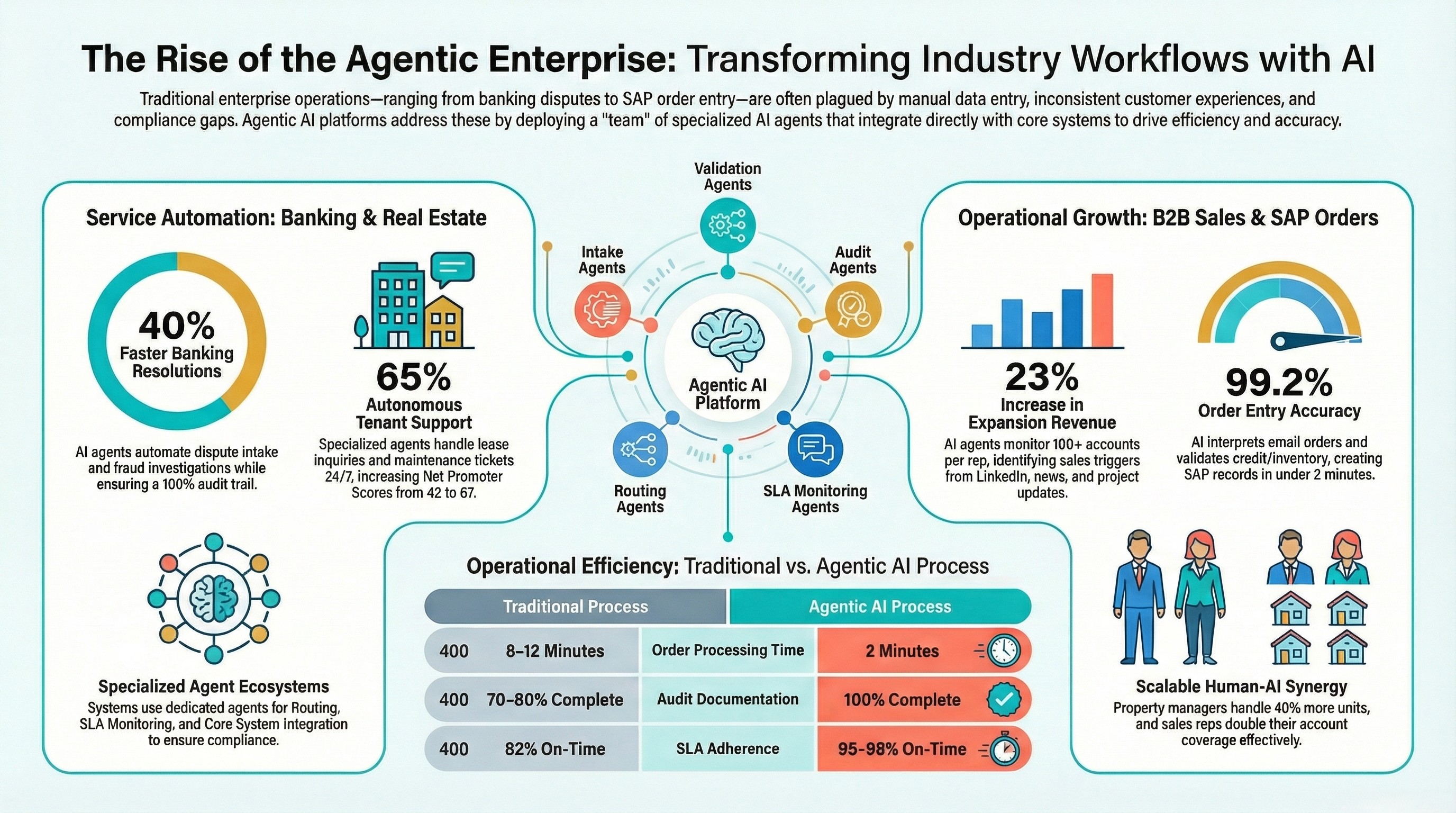
- Faster case handling: 40% reduction in average resolution time
- Reduced operational load: 60% of routine cases handled autonomously
- Better compliance readiness: 100% audit trail vs. 70-80% documentation
- Improved SLA adherence: 95% vs. 82% on-time resolution
- Consistent customer experience: Same quality across all channels
Regulatory benefit: Passed regulatory audit with zero documentation findings (previous audit had 12 remediation items)
Use Case 12: Real Estate Customer Service Automation
Industry: Commercial and residential real estate
Company profile: Diversified portfolio across major metropolitan area—office, retail, industrial, residential
Challenge: Tenant support automation, 24×7 service availability, consistent experience across property types
Property management at scale: Managing multi-asset portfolio means:
- Hundreds of tenants across different property types
- Lease inquiries and documentation requests
- Maintenance and facility issues
- Rental payment questions and coordination
- Move-in/move-out procedures
- Policy and regulation questions
- After-hours emergencies
Traditional tenant services:
- Call center operating 9 AM - 6 PM (limited hours)
- Email responses within 24-48 hours
- Repetitive questions consuming staff time
- Knowledge scattered across property managers
- Inconsistent answers depending on who responds
- Emergency escalation requires manual coordination
Agentic AI solution implemented:
Omnichannel tenant service agent:
- Service Agent → Handles queries via web, WhatsApp, email
- Triage Agent → Categorizes requests (lease, maintenance, payments, policies)
- FAQ Handler Agent → Resolves common questions autonomously
- Ticketing Agent → Creates service tickets and escalates to property management
- Knowledge Agent → Retrieves information from lease agreements, policies, SOPs
Customer service workflows:
Scenario 1: Rental payment question (autonomous resolution) Tenant via WhatsApp: "When is my next rent payment due?" Agent responds: "Your next rental payment of $2,500 is due March 1, 2025. Payment can be made via bank transfer to [account details]. Would you like me to email the payment instructions?"
Scenario 2: Maintenance request (ticket creation) Tenant via web: "Air conditioning not working in Unit 402" Agent: "I've created maintenance ticket #MT-5421 for AC issue in Unit 402. The technician will contact you within 2 hours. Is this urgent or can it wait until tomorrow?" Tenant: "It's quite hot, prefer today" Agent: "Marked as priority. Technician dispatch confirmed for 3 PM today. You'll receive WhatsApp notification 15 minutes before arrival."
Scenario 3: Lease document request (knowledge retrieval) Tenant: "Can you send me a copy of my parking addendum?" Agent: "I found your parking agreement for 2 spaces dated Jan 15, 2024. Sending PDF to your registered email within 5 minutes. Anything else I can help with?"
Scenario 4: Policy question (knowledge base) Prospective tenant: "What's the pet policy for residential units?" Agent: "Our residential buildings allow cats and dogs under 15kg with $500 refundable pet deposit. Maximum 2 pets per unit. Exotic pets and restricted breeds not permitted. Full policy available at [link]. Would you like to schedule a viewing?"
Results achieved:
- Faster response times: Seconds vs. hours for common questions
- Lower call-center load: 65% of inquiries handled autonomously
- 24×7 tenant experience: No wait times, instant responses
- Better SLA adherence: 98% first-response within 5 minutes
- Higher tenant satisfaction: NPS increased from 42 → 67
Operational efficiency: Same property management team now handles 40% more units
Use Case 13: B2B Sales Account Intelligence
Industry: Engineering and technology solutions
Company profile: Provider delivering electrical, mechanical, automation solutions for over 50 years
Challenge: Enterprise account monitoring, opportunity identification, consistent execution across sales team
B2B sales complexity: Managing enterprise accounts requires:
- Tracking multiple stakeholders and decision-makers
- Monitoring project pipelines and buying signals
- Relationship management across technical and commercial contacts
- Competitive intelligence and market positioning
- Contract renewal timing and expansion opportunities
- Consistent follow-up across 50-100+ accounts per rep
Traditional account management challenges:
- Reps rely on memory and scattered notes
- CRM data entry neglected (20-30% completeness)
- Opportunities discovered late or missed entirely
- Inconsistent follow-up cadence
- Leadership lacks visibility into pipeline health
- Best practices not standardized across team
Agentic AI solution implemented:
B2B sales intelligence platform:
- Account Monitoring Agent → Continuous tracking of customer signals and activity
- Opportunity Identification Agent → Rule-governed detection of sales triggers
- Follow-Up Orchestration Agent → Automated outreach and relationship nurturing
- CRM Integration Agent → Syncs intelligence with Salesforce workflows
- Sales Dashboard Agent → Leadership visibility and team performance tracking
Always-on account monitoring:
Signals captured automatically:
- Customer website updates (new projects announced, expansion plans)
- LinkedIn activity (new hires in target departments, role changes)
- News mentions (awards, funding, partnerships)
- Contract renewal dates approaching
- Service ticket patterns indicating dissatisfaction or opportunity
- Engagement with marketing content (downloads, webinar attendance)
Rule-governed opportunity scoring:
- Hot lead (>80 points): Immediate sales action required
- Contract renews in <60 days
- Recent competitor mention in conversation
- Budget approval indicated in email
- Multiple stakeholder engagement
- Warm lead (50-79 points): Schedule follow-up within 7 days
- Project timeline mentioned for next quarter
- New decision-maker in target role
- Increased website activity
- Nurture (20-49 points): Automated touchpoint campaign
- General interest signals
- Early-stage research activity
- No immediate buying indicators
Automated execution workflows:
Contract renewal scenario:
- 90 days before renewal: Agent flags account and suggests check-in call
- Rep schedules meeting via calendar integration
- Agent prepares briefing: Usage analytics, satisfaction scores, upsell opportunities
- Post-meeting: Agent creates follow-up tasks and logs discussion
- 60 days: Agent sends renewal proposal if not yet sent
- 30 days: Escalation to sales manager if not progressing
Win-back scenario:
- Agent detects account went quiet (no orders in 90 days)
- Analyzes possible reasons from service tickets and past conversations
- Suggests personalized re-engagement approach
- Automates initial outreach email
- Schedules follow-up if no response in 7 days
- Routes to account executive with context
Results achieved:
- Higher account coverage: Reps manage 100+ accounts vs. 40-50 effectively
- Faster response to opportunities: Hours vs. days or weeks
- Consistent execution: Governed playbooks vs. individual approaches
- Better pipeline visibility: Real-time forecasting vs. quarterly guesses
- Increased renewal rates: 94% vs. 78% through proactive engagement
Revenue impact: 23% increase in account expansion revenue through earlier opportunity identification
Use Case 14: SAP Sales Order Automation
Industry: Premium retail and distribution (kitchen appliances, home solutions)
Company profile: Distributor of global premium brands under prominent family-owned business group
Challenge: Replace end-of-life legacy system, reduce manual order processing, improve data accuracy
Sales order processing pain: High-volume distribution operations mean:
- 500-1,000 orders per day across channels
- Email orders, phone orders, EDI feeds, e-commerce
- Manual data entry into SAP from various sources
- Error-prone transcription (wrong SKUs, quantities, pricing)
- Legacy system licensing costs escalating
- System reaching end-of-life with no vendor support
- Compliance and audit trail gaps
Legacy process:
- Order arrives via email or phone
- CSR manually creates SAP sales order
- Line-by-line data entry (customer, SKU, quantity, price)
- Manual verification of inventory availability
- Credit limit checks performed separately
- Errors discovered during fulfillment (wrong item picked)
- Customer corrections require order cancellation and re-entry
- Average order processing: 8-12 minutes per order
Agentic AI solution implemented:
SAP order automation platform:
- Order Interpretation Agent → Reads and understands order triggers across channels
- Validation Agent → Verifies customer, credit limits, inventory, pricing rules
- SAP Creation Agent → Generates sales orders in SAP with full CRUD operations
- Governance Agent → Applies business rules, exception handling, approval routing
- Audit Trail Agent → Maintains complete documentation for compliance
- Reconciliation Agent → Validates order accuracy and flags discrepancies
Automated order creation workflow:
Email order scenario:
- Customer sends order via email: "Please ship 10x premium oven model ABC-123 and 5x dishwasher XYZ-789 to warehouse 3"
- Interpretation agent extracts:
- Customer identifier
- SKUs and quantities
- Delivery location
- Any special instructions
- Validation agent checks:
- Customer credit limit (available credit sufficient?)
- Inventory availability (stock on hand at preferred warehouse?)
- Pricing rules (any active promotions or negotiated discounts?)
- Delivery address validity
- Business rules applied:
- Order value <$10,000 → auto-process
- Order value $10,000-$50,000 → manager notification (proceed unless blocked)
- Order value >$50,000 → manager approval required before creation
- SAP order created automatically with:
- Correct customer master data
- Validated SKUs and quantities
- Applicable pricing and discounts
- Delivery instructions
- Payment terms from customer master
- Confirmation email sent to customer within 2 minutes
- Complete audit log maintained:
- Source document (original email)
- Interpretation results
- Validation checks performed
- Business rules applied
- SAP document number created
- Timestamp and system user
Exception handling:
- Out of stock: Agent suggests alternative warehouse or backorder option, emails customer for confirmation
- Credit limit exceeded: Routes to finance for credit review, notifies sales manager
- Pricing discrepancy: Flags unusual discount requests for approval
- Invalid SKU: Requests clarification from customer with suggested alternatives
Results achieved:
- Reduced manual processing: 80% of orders fully automated vs. 100% manual
- Faster order-to-confirm cycle: 2 minutes vs. 8-12 minutes per order
- Fewer data-entry errors: 99.2% accuracy vs. 92-94% with manual entry
- Improved auditability: 100% documentation vs. scattered email trails
- Cost savings: Eliminated legacy system licensing ($200K+ annually)
Business continuity: Eliminated dependency on end-of-life system, reducing operational risk
Category E: Finance & Compliance
Use Case 15: Cross-Border Tax Risk Screening
Industry: Tax technology and compliance
Company profile: Specialized product for withholding tax, VAT, permanent establishment screening
Challenge: Early identification of cross-border transaction risks, faster deal workflows, compliance automation
Cross-border tax complexity: International transactions create exposure to:
- Withholding tax: Country-specific rates on dividends, interest, royalties
- VAT/GST mismatches: Different rules across jurisdictions
- Permanent establishment: Triggering tax presence inadvertently
- Transfer pricing: Arm's length transaction requirements
- Treaty benefits: Eligibility and documentation requirements
Traditional tax review process:
- Deal team identifies transaction late in process
- Tax team receives request with incomplete information
- Manual research of applicable rules across jurisdictions
- Email back-and-forth to gather missing details
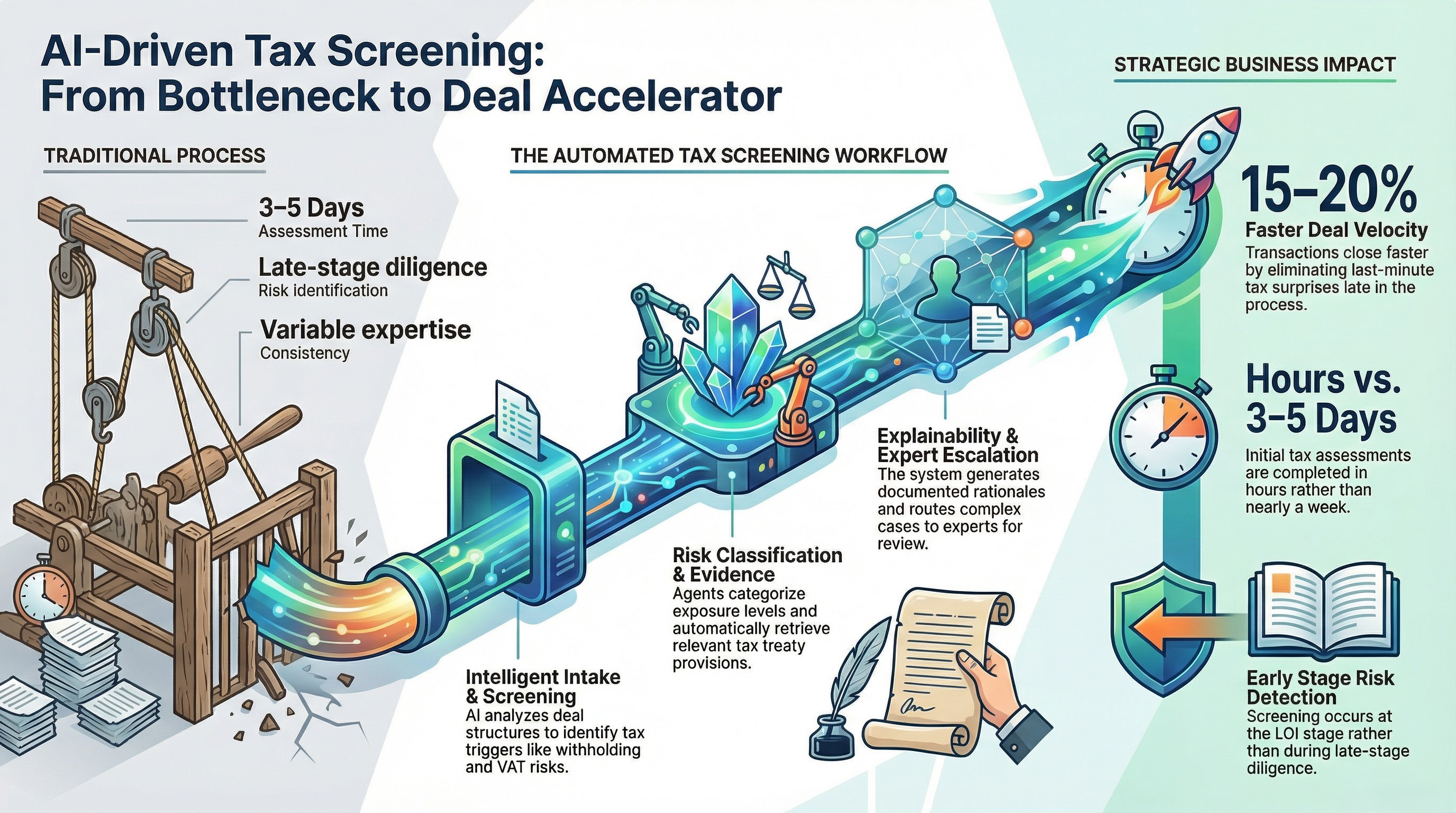
- 3-5 days to provide initial assessment
- Last-minute deal disruptions when issues discovered
- Inconsistent quality depending on reviewer expertise
Agentic AI solution implemented:
Tax screening automation platform:
- Transaction Screening Agent → Analyzes deal structure and identifies tax triggers
- Risk Classification Agent → Categorizes transactions by exposure level
- Evidence Collection Agent → Gathers supporting documentation automatically
- Explainability Agent → Generates rationale and rule citations
- Escalation Agent → Routes complex cases to tax experts with full context
Automated screening workflow:
Deal scenario: Company acquiring foreign subsidiary
- Transaction intake:
- Deal team inputs basic transaction details via form
- Purchase price, structure, jurisdictions involved
- Estimated timeline for closing
- Automated risk screening:
- Agent identifies jurisdictions involved in transaction
- Analyzes transaction structure: Share purchase vs. asset deal
- Flags potential triggers:
- Withholding tax on intercompany payments
- VAT on consulting/service fees
- Permanent establishment risk if employees work on-site
- Transfer pricing documentation requirements
- Evidence collection:
- Retrieves applicable tax treaty provisions
- Pulls VAT rules for cross-border services
- Identifies PE threshold rules
- Gathers transfer pricing safe harbor guidelines
- Risk classification:
- High risk (red flag): Immediate tax expert review required
- Example: Structure creates PE in multiple jurisdictions
- Medium risk (yellow flag): Review recommended before closing
- Example: Withholding obligations need advance planning
- Low risk (green light): Proceed with standard documentation
- Example: Treaty coverage eliminates withholding
- High risk (red flag): Immediate tax expert review required
- Explainability and recommendations:
- Generates memo summarizing findings
- Cites specific treaty articles and regulations
- Recommends mitigation strategies
- Estimates tax impact in monetary terms
- Suggests deal structure modifications if beneficial
- Expert escalation when needed:
- Complex cases routed to tax specialists
- Briefing package includes all research and analysis
- Expert adds judgment and nuance
- Final recommendation to deal team within hours vs. days
Results achieved:
- Earlier tax risk detection: Screening at LOI stage vs. late in diligence
- Reduced deal disruptions: Issues identified with time to address
- Faster pre-compliance review: Hours vs. 3-5 days for initial assessment
- Consistent quality: Comprehensive screening vs. variable manual review
- Knowledge capture: All research documented for future reference
Deal velocity impact: Transactions close 15-20% faster with fewer last-minute surprises
Ready to move from reactive dashboards to autonomous execution?
Contact us for your personalized 30-day pilot plan.
How Manufacturing Enterprises Deploy Agentic AI
From POC to Production: The 30-Day Deployment Framework
Most manufacturing AI initiatives fail not because the technology doesn't work, but because deployment takes 9-18 months, loses momentum, and gets overtaken by other priorities.
Successful manufacturing enterprises deploy agentic AI differently.
Week 1: Discovery & Workflow Mapping
Focus: Identify highest-impact processes and map current state
Activities:
- Interview process owners across departments
- Document manual workflows with painful bottlenecks
- Map data sources (structured and unstructured)
- Identify decision points and approval hierarchies
- Define success metrics and ROI hypothesis
Example: Procurement approval workflow dissection
- 18 manual touchpoints identified
- Average cycle time: 6 days from request to PO
- 40% of requests require follow-up for missing information
- 3 different approvers depending on amount and category
- Email-based coordination with no audit trail
Output: Prioritized use case with clear before/after state
Week 2-4: Context Engine + Rules + First Agent
Focus: Build foundational platform and deploy first autonomous agent
Phase 1: Connect structured systems (Days 8-12)
- ERP integration (SAP, Oracle, NetSuite)
- MES/SCADA connections for production data
- WMS for inventory and logistics
- Quality systems for inspection and compliance data
- Financial systems for budgets and actuals
Phase 2: Ingest unstructured data (Days 13-17)
- SOPs and work instructions from SharePoint/document management
- Email threads and communication history
- Maintenance logs and equipment records
- Supplier contracts and agreements
- Regulatory compliance documentation
Phase 3: Encode business rules (Days 18-21)
- Approval hierarchies by amount, category, risk
- Safety protocols and quality thresholds
- Compliance checkpoints and documentation requirements
- Exception handling and escalation paths
- Human-in-the-loop controls by scenario
Phase 4: Build and test first agent (Days 22-28)
- Configure agent for specific workflow
- Integrate with target systems for execution
- Test with historical data and edge cases
- Validate governance controls functioning correctly
- Train process owners on monitoring and intervention
Example: Material release agent configuration
- Rule 1: Standard materials <$10K → auto-approve
- Rule 2: Strategic materials or >$10K → purchasing manager approval
- Rule 3: New suppliers → require vendor qualification documents
- Rule 4: Critical safety items → quality manager verification
- Audit: Every decision logged with rule citation
Output: Production-ready agent with governance controls
Day 30: Live, Governed Agent in Production
Go-live checklist:
- ✅ Human-in-the-loop controls configured and tested
- ✅ Audit trails enabled with timestamp and user tracking
- ✅ Dashboard monitoring activated for process owners
- ✅ Escalation workflows tested and documented
- ✅ Rollback procedures validated
- ✅ Success metrics baseline established
- ✅ Continuous learning loops configured
First 30 days of operation:
- Close monitoring of all autonomous decisions
- Daily review of exceptions and escalations
- Feedback loop to refine rules and thresholds
- Measure against success metrics
- Document learnings for next agent deployment
Typical results after 30 days:
- 60-70% of workflows handled autonomously
- 20-30% requiring human approval (as designed)
- 10% exceptional cases requiring refinement
- Cycle time reduced 40-60%
- Process owners spending time on exceptions, not routine work
No Rip-and-Replace Required
The orchestration approach:
Agentic AI platforms don't replace your existing systems—they orchestrate them.
Your current technology stack remains:
- ERP (SAP, Oracle, Microsoft Dynamics, NetSuite)
- MES (Siemens, Rockwell, AVEVA, GE Digital)
- CMMS (Maximo, SAP PM, Infor EAM)
- CRM (Salesforce, Microsoft Dynamics, HubSpot)
- Communication (Slack, Microsoft Teams, Email)
- Document management (SharePoint, Box, Google Drive)
Agentic AI layer adds:
- Unified context across all systems
- Semantic business rules and governance
- Multi-step workflow orchestration
- Natural language query interface
- Autonomous execution with human controls
Integration patterns:
- API-based: Direct system integration via REST/SOAP APIs
- Event-driven: React to system triggers and events
- Scheduled: Periodic data synchronization and batch processing
- Real-time: Streaming data for immediate action
Deployment flexibility:
- Cloud: Fastest deployment, managed infrastructure
- On-premises: Full control, legacy system compatibility
- Hybrid: Cloud orchestration with on-prem system access
- Private cloud: Dedicated infrastructure for compliance requirements
Phased rollout approach:
- Pilot: Single workflow, one department, 30 days
- Expand: 3-5 additional workflows, same department, 60 days
- Scale: Cross-functional workflows, multiple departments, 90 days
- Enterprise: Organization-wide deployment with continuous expansion
Why Manufacturing Leaders Trust Agentic AI with Critical Operations
Security & Compliance Standards
Enterprise-grade certifications:
- SOC 2 Type II: Third-party audited security controls
- ISO 27001: Information security management system aligned
- GDPR compliant: European data protection requirements met
- Industry-specific: Additional certifications for regulated industries
Data protection:
- Encryption in transit: TLS 1.3 for all network communication
- Encryption at rest: AES-256 for all stored data
- Key management: Hardware security modules (HSM) for cryptographic keys
- Access controls: Role-based permissions with multi-factor authentication
Privacy safeguards:
- No model training on customer data: Your data never used to improve models
- Data residency: Keep data in required geographic regions
- Retention policies: Automated deletion per compliance requirements
- Privacy by design: Minimal data collection and purpose limitation
Governance Controls
Complete auditability:
- Full audit logs: Every query, decision, and action timestamped and tracked
- User attribution: Clear accountability for human and automated actions
- Rule citations: Every autonomous decision references specific business rule
- Version control: Track changes to rules, workflows, and configurations
- Immutable history: Tamper-proof audit trail for regulatory compliance
Human-in-the-loop by risk threshold:
Three-tier control model:
Tier 1: Fully autonomous (low risk)
- Standard, repetitive workflows with clear rules
- Low financial impact (<$10K typical)
- Reversible decisions with minimal consequence
- Example: Standard material releases, routine maintenance scheduling
Tier 2: Notification with proceed (medium risk)
- Agent executes, human notified for awareness
- Moderate financial impact ($10K-$50K)
- Time-sensitive but requires oversight
- Example: Production schedule adjustments, supplier outreach
Tier 3: Approval required (high risk)
- Agent recommends, human approves before execution
- High financial impact (>$50K)
- Irreversible or strategically significant decisions
- Example: Major equipment purchases, supplier contract negotiations
Escalation workflows:
- Automatic routing to appropriate approver based on decision type
- Deadline tracking with escalation to higher authority if not acted upon
- Mobile notifications for time-sensitive approvals
- Context provided with recommendation and supporting evidence
Rollback capabilities:
- Reversible actions can be undone within defined time window
- Full audit trail of original decision and reversal
- Learning loop to prevent similar errors
The Trust Equation
Trust = Control × Visibility
Control mechanisms:
- Business rules encoded as deterministic logic (not probabilistic)
- Clear thresholds for autonomous vs. human decision-making
- Exception handling that defaults to human judgment
- Kill switches for immediate intervention
- Continuous monitoring with anomaly detection
Visibility features:
- Real-time dashboards showing agent activity
- Drill-down to individual decision details
- Performance metrics vs. baseline and targets
- Error rates and exception tracking
- Trend analysis for continuous improvement
Example: Material release agent with 4 governance layers
Layer 1: Business rule validation
- Check: Is material in the approved supplier catalog?
- Check: Is quantity within normal order range?
- Check: Is unit price within expected tolerance?
- Result: All checks pass → proceed to Layer 2
Layer 2: Risk assessment
- Calculate: Total order value and financial impact
- Classify: Low risk (<$10K), Medium ($10K-$50K), High (>$50K)
- Route: Low → auto-approve, Medium → notify, High → approval required
Layer 3: Compliance verification
- Check: Required documentation present (quality certs, safety data sheets)
- Check: Supplier still in good standing (no quality holds or payment disputes)
- Check: Regulatory requirements met for material category
- Result: Compliance confirmed → proceed to execution
Layer 4: Audit trail creation
- Log: Complete decision rationale with rule citations
- Record: All validation checks and results
- Capture: Source data used in decision
- Timestamp: When decision made and by which agent
- Attribution: Which business rules applied
Outcome: Material release executed autonomously with complete governance and auditability
Quantifying the Value of Agentic Manufacturing AI
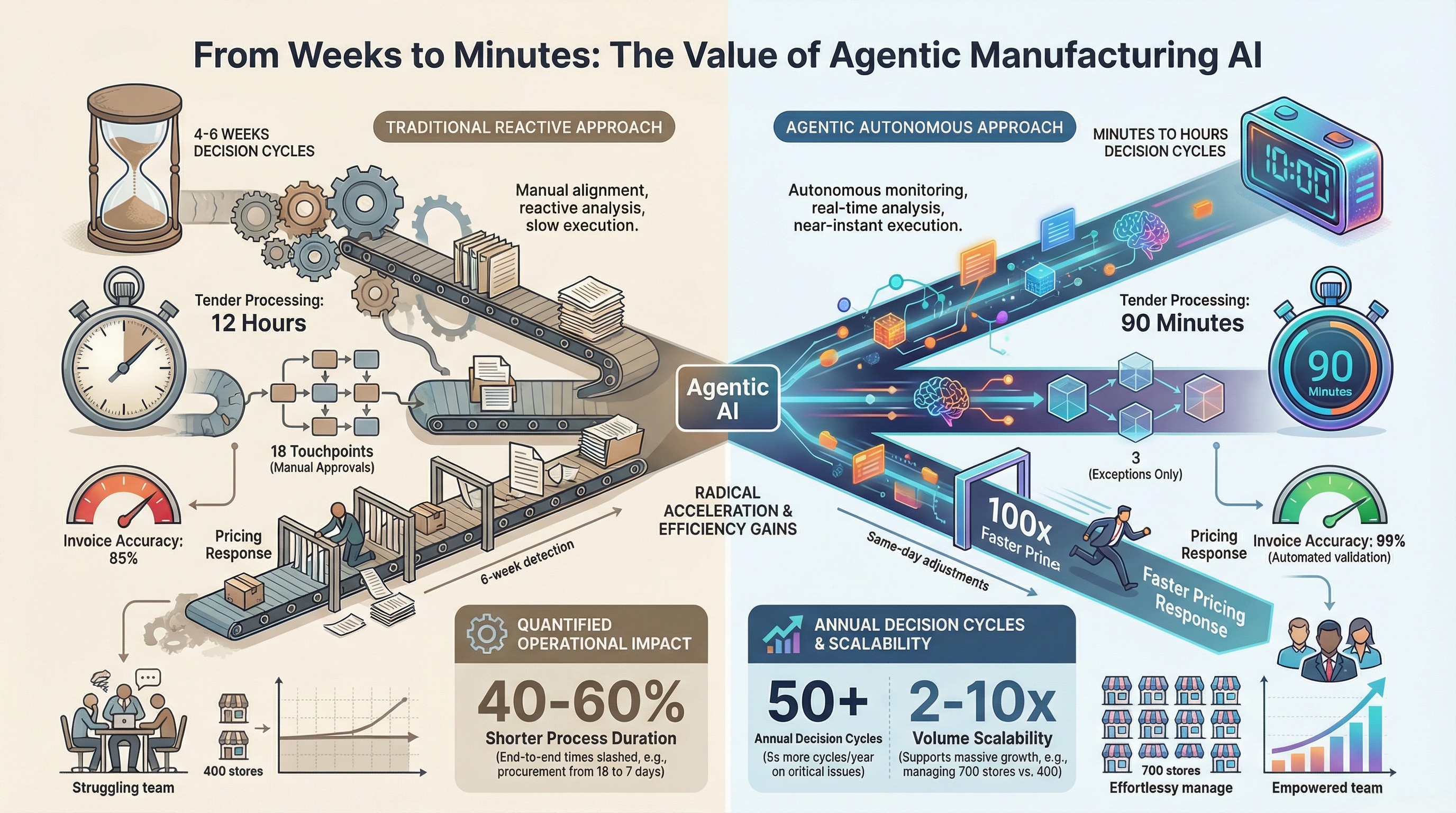
Time-to-Decision Improvements
The decision cycle acceleration:
Traditional reactive approach:
- Signal detection: Issue identified (manually, often too late)
- Data gathering: Collect information from multiple systems (days)
- Analysis: Understand root causes and options (days to weeks)
- Alignment: Get stakeholders to agree on action (meetings, delays)
- Execution: Implement decision (manual coordination)
- Review: Measure results (next month's report)
Total cycle time: 4-6 weeks from signal to result
Annual cycles: ~8-10 major decision cycles per year
Agentic autonomous approach:
- Continuous monitoring: Signals detected in real-time
- Automated analysis: Complete context assembled instantly
- Governed execution: Action taken within minutes to hours
- Learning loop: Results fed back to improve future decisions
Total cycle time: Hours from signal to autonomous execution
Annual cycles: 50+ decision cycles per year on same issue
Case example: HVAC manufacturer competitive pricing response
- Before: 6 weeks to detect competitor price change, analyze impact, decide response, implement
- After: Real-time detection, instant gap analysis, same-day pricing adjustment
- Impact: 100× faster insight-to-action cycle
- Result: Identified and corrected 12-26% pricing gaps before losing market share
Operational Efficiency Gains
Quantified improvements across implementations:
Process cycle time:
- 40-60% reduction in end-to-end process duration
- Example: Procurement 18 days → 7 days
- Example: Tender processing 12 hours → 90 minutes
Manual coordination:
- 70-85% reduction in manual touchpoints
- Example: 18 manual approvals → 3 (only exceptions)
- Example: Email chains eliminated by automated workflows
Data processing accuracy:
- 90-95% improvement in extraction and validation accuracy
- Example: Invoice processing 85% → 99% accuracy
- Example: Tender document extraction 70% → 95% accuracy
Case example: Construction services tender processing
- Speed: 90% faster (12 hours → 90 minutes)
- Accuracy: 95% extraction accuracy on complex PDFs
- Volume: 5-8× more tenders handled with same team
- Risk: Comprehensive change detection prevents scope gaps
Cost Reduction & Avoidance
Direct cost savings:
Labor efficiency:
- Automation of repetitive tasks frees staff for higher-value work
- Same team handles 2-5× more volume
- Reduced overtime and temporary staffing needs
Technology cost reduction:
- Eliminated legacy system licensing fees
- Example: Legacy system replacement saves $200K+ annually
- Reduced custom integration maintenance
- Lower infrastructure costs through consolidation
Error prevention:
- Costly mistakes avoided through governance
- Example: ₹12 crore prevented in erroneous early payments
- Reduced rework and quality escapes
- Better contract compliance prevents penalties
Process efficiency:
- Faster cycles reduce working capital requirements
- Lower inventory carrying costs through better visibility
- Reduced expedite fees and rush shipments
Case example: Premium appliance distributor SAP automation
- Eliminated: Legacy system licensing ($200K+ annually)
- Reduced: Manual order processing costs (80% automation)
- Improved: Order accuracy (99.2% vs. 92-94%)
- Avoided: Errors requiring order cancellation and re-entry
Revenue & Margin Protection
Proactive value capture:
Pricing optimization:
- Earlier detection of competitive pricing gaps
- Faster response to market opportunities
- Better discount and promotion management
- Example: HVAC manufacturer identified 12-26% pricing gap and corrected before losses
Margin preservation:
- Vendor performance monitoring prevents erosion
- Purchase price trend analysis catches inflation early
- Contract compliance ensures negotiated discounts captured
- Example: Manufacturing group detected margin compression 3-6 months earlier
Revenue acceleration:
- Faster quote-to-order conversion
- Higher win rates through rapid response
- Better renewal rates through proactive engagement
- Example: B2B sales 23% increase in expansion revenue
Market share protection:
- Always-on competitive monitoring
- Faster product launch and market response
- Better customer experience drives retention
- Example: Large retailer 70% call reduction improves customer satisfaction
Scalability Without Headcount
Growth without proportional cost increase:
Volume handling:
- Same team manages 2-10× more volume
- New stores/facilities supported without adding staff
- M&A integration faster and cheaper
- Example: Retailer supports 700 stores (was 400 with same team)
Geographic expansion:
- Multi-language support enables new markets
- 24/7 operations without shift multipliers
- Consistent processes across locations
- Example: Logistics company unified India/Europe/US operations
Product/service expansion:
- Automated knowledge access for new offerings
- Zero-training deployment reduces onboarding time
- Scalable customer support without agent growth
- Example: Voice AI platform supports 10,000+ users with self-service
Quality consistency:
- Governed execution eliminates training variation
- Best practices encoded and consistently applied
- Reduced dependence on individual expertise
- Example: Luxury hospitality maintains service across 16 properties
Case example: National retailer centralized intelligence
- Scale: 700+ stores, 50,000+ SKUs, 10,000+ users
- Efficiency: 70% call reduction (10,000 → 3,000 calls/month)
- Speed: 85% faster resolution (8 minutes → 30 seconds)
- Deployment: Zero-training execution for store associates
- Result: Geographic expansion without proportional support cost
From Reactive to Agentic: The Competitive Gap
The Market Shift Timeline
2024: The year of AI advisors and co-pilots
- Microsoft Copilot, Salesforce Einstein gain traction
- LLMs become accessible to enterprises
- Experimentation with "chat with your data"
- Insight generation, but humans still execute
- Market education phase
2025-2026: Agentic execution platforms emerge
- Early adopters deploy autonomous agents
- Unified context engines solve the 80% blind spot
- Governance frameworks enable trust
- Production deployments delivering ROI
- This is where the gap opens
2027: Autonomous decision systems become standard
- 50% of enterprises deploy autonomous systems (Gartner)
- Competitive pressure forces laggard adoption
- Vendors consolidate around proven platforms
- Talent shortage for manual processes
2028: 25% of workflows fully automated
- McKinsey prediction becomes reality
- Manufacturing transformed by agentic AI
- Enterprises operating at different speeds (winners vs. laggards)
- The gap becomes a chasm
What Separates Winners from Laggards
Winners deploy Level 5 agentic systems:
- See complete business context (100%, not 20%)
- Execute autonomously with governance
- Operate 50+ decision cycles per year
- Continuously learn and improve
- Scale without proportional headcount
- Respond to market changes in hours
Laggards remain stuck at Level 2-3:
- Descriptive and diagnostic BI dashboards
- Manual analysis and decision-making
- 8-10 major decision cycles per year
- React to problems weeks after occurrence
- Linear cost growth with volume
- Competitive moves detected too late
The performance gap compounds:
- Year 1: 2× faster decision cycles (winners ahead)
- Year 2: 5× more decisions executed (gap widens)
- Year 3: 10× efficiency advantage (chasm opens)
- Year 5: Winners have structurally different cost base and market responsiveness
Industry examples:
- Retail: Amazon's supply chain vs. traditional retailers
- Manufacturing: Tesla's vertical integration vs. legacy auto
- Logistics: DHL's predictive routing vs. manual dispatching
- Financial services: Digital-first banks vs. legacy institutions
The Blind Agent Problem Revisited
AI agents are amplifiers, not miracle workers:
Clean foundation:
- Unified data from structured + unstructured sources
- Clear business rules and governance
- Validated integration with core systems
- Change management and user adoption
Result: Efficiency multiplies exponentially
- Agents make better decisions with complete context
- Execution speed accelerates without errors
- Continuous improvement compounds over time
- ROI exceeds expectations
Fragmented foundation:
- Partial data from only structured systems
- Ambiguous rules and inconsistent logic
- Brittle integrations that break on exceptions
- User resistance and workarounds
Result: Chaos multiplies faster than efficiency
- Agents make bad decisions confidently
- Errors compound before detection
- Trust erodes, project stalls
- ROI negative, initiative canceled
The solution: Unified context engine
The platform must see the full 100%:
- Structured data (ERP, MES, SCADA, finance)
- Unstructured data (docs, emails, conversations)
- External data (suppliers, customers, markets)
- Real-time signals (sensors, events, alerts)
Only then can agentic AI deliver on its promise.
Manufacturing-Specific Considerations
Safety-critical operations require deterministic governance:
- No probabilistic "recommendations" for equipment shutdowns
- Clear thresholds with human override
- Fail-safe defaults (stop production if uncertain)
- Comprehensive audit trails for incident investigation
Multi-site coordination needs orchestration:
- Workflows span factories, warehouses, suppliers, customers
- Timezone and language differences
- Regulatory variations across jurisdictions
- Consistent execution despite local differences
Supply chain volatility demands real-time response:
- Daily (or hourly) changes in pricing, availability, demand
- Geopolitical events impact sourcing overnight
- Quality issues require immediate containment
- Customer expectations for transparency and speed
Compliance requirements mandate full auditability:
- FDA, ISO, OSHA, environmental regulations
- Product recalls need complete traceability
- Financial audits require documented approvals
- Legal disputes demand defensible decisions
Manufacturing AI automation platforms must address all four: Safety + Coordination + Volatility + Compliance = Trust in autonomous execution
Start Your Agentic Manufacturing Journey
Key Takeaways
1. Agentic AI amplifies your foundation
It's not about replacing humans—it's about giving them leverage. But that leverage only works if the foundation is solid. Clean data + clear rules → efficiency multiplies. Fragmented data + partial context → chaos multiplies.
2. The 80% unstructured blind spot is your biggest risk
Traditional BI excels at the 20% in relational databases. The other 80%—SOPs, emails, contracts, logs, conversations—is where business truth lives. Agents acting on 20% visibility are liabilities, not assets.
3. Level 5 requires three pillars working together
- Unified Context Engine: Fuses structured, unstructured, and external data
- Semantic Governor: Encodes deterministic business rules, not probabilistic guesses
- Active Orchestrator: Executes multi-step workflows with human-in-the-loop controls
You need all three. Partial implementations fail.
4. 15 proven use cases across five categories
Real manufacturing enterprises are already deploying autonomous AI agents across:
- Supply chain & procurement (autonomous sourcing, terminal optimization, vendor management)
- Production & quality (tender processing, competitive intelligence, energy management, inventory intelligence)
- Maintenance & asset management (smart grid operations, transmission monitoring, global analytics)
- Customer service & sales (omnichannel banking, real estate automation, B2B sales, order automation)
- Finance & compliance (tax risk screening, cross-border compliance)
5. 30-day deployment with no rip-and-replace
- Week 1: Discovery and workflow mapping
- Weeks 2-4: Context engine + rules + first agent
- Day 30: Live, governed agent in production
The orchestration approach works with your existing systems. No 18-month transformation projects.
The Platform Difference
Complete three-pillar integration:
- Context fusion across structured, unstructured, and external data
- Semantic governance with deterministic business rules
- Active orchestration connecting to your existing tech stack
Enterprise-grade by design:
- SOC2 Type II, ISO 27001 aligned, GDPR compliant
- No training on customer data
- Full audit logs and rule citations
- Cloud / on-prem / hybrid deployment flexibility
Proven across industries:
- Manufacturing, logistics, retail, energy, financial services
- HVAC manufacturer (100× faster insights, 12-26% pricing gaps corrected)
- National retailer (700+ stores, 70% call reduction, 85% faster)
- Construction services (90% faster tender processing, 95% accuracy)
- Global logistics ($20B revenue operations optimization)
- 35+ additional implementations with quantified results
Your Next Step
Within 48 hours of contact, you receive:
- Concrete pilot plan tailored to your operations
- Workflow definition based on discovery conversation
- ROI hypothesis with success metrics
- 30-day deployment roadmap
Our guarantee: If we don't surface real, new value in the pilot—we walk.
No POC purgatory. No endless sales cycles. No commitment to a full platform until you've seen results.
The Race Has Started
While you're evaluating spreadsheets and scheduling vendor calls, your competitors are already deploying.
The difference 12 months from now:
- You: Still analyzing quarterly reports, reacting to last month's problems, scheduling meetings to coordinate actions
- Them: Running 50+ decision cycles per year, responding to market changes in hours, scaling without adding headcount
The difference 36 months from now:
- You: Struggling with efficiency targets, losing market share to faster competitors, justifying headcount requests
- Them: Operating at 5-10× your decision velocity, capturing opportunities you don't see until it's too late, compounding their advantage
This isn't speculation. It's already happening.
The enterprises implementing these solutions—global logistics providers, national retailers, infrastructure operators, manufacturing leaders—aren't waiting. They're building their competitive advantage right now.
Give your manufacturing operations sight.
Build Level 5 intelligence.
Start today.

Transform Your Business With Agentic Automation
Agentic automation is the rising star posied to overtake RPA and bring about a new wave of intelligent automation. Explore the core concepts of agentic automation, how it works, real-life examples and strategies for a successful implementation in this ebook.
Sarfraz Nawaz is the CEO and founder of Ampcome, which is at the forefront of Artificial Intelligence (AI) Development. Nawaz's passion for technology is matched by his commitment to creating solutions that drive real-world results. Under his leadership, Ampcome's team of talented engineers and developers craft innovative IT solutions that empower businesses to thrive in the ever-evolving technological landscape.Ampcome's success is a testament to Nawaz's dedication to excellence and his unwavering belief in the transformative power of technology.

More insights
Discover the latest trends, best practices, and expert opinions that can reshape your perspective



.jpg)



Contact us

