
From Quarterly Reviews to Always-On Intelligence: How B2B Sales Teams Use Agentic AI to Scale Account Coverage 3x


The $2M Renewal You Lost to an 8-Week Delay
Your quarterly business review (QBR) finally surfaces the truth: one of your top accounts has been escalating support complaints for 8 weeks.
Satisfaction scores dropped from 9/10 to 4/10. Product usage fell 40%. The renewal champion left the company 6 weeks ago—and no one on your sales team knew.
Your renewal is in 30 days. By the time you see the data, the churn notice is already drafted.
This isn't a sales execution problem. This is an intelligence infrastructure problem.
The Cadence Gap
Manual monitoring: Sales reps juggling 50-200 accounts each, trying to keep track of pipeline stages, support tickets, product usage, and stakeholder changes across fragmented systems.
Quarterly reviews: Snapshot visibility every 90 days, not continuous monitoring. By the time leadership reviews the data, critical signals are 8-12 weeks old.
Fragmented signals: Your CRM shows "healthy," your support platform shows "critical," your usage analytics show "declining"—but these systems don't talk to each other.
Human bottlenecks: Even when early warning signs exist, they're buried across 5 different tools that reps don't have time to check daily.
The Cost of Late Detection
The numbers don't lie:
- Average B2B churn cost: $240K per mid-market account (Forrester Research)
- Win-back economics: Costs 5-25x more than proactive retention (Bain & Company)
- Sales productivity drain: Reps spend 64% of time on admin, not selling (Salesforce State of Sales Report)
What if your sales organization could monitor every account 24/7—detecting churn signals the moment they emerge and executing win-back workflows autonomously?
That's the promise of agentic AI for B2B sales automation.
Why Quarterly Reviews and Manual Monitoring Can't Scale

The Hidden Constraint in B2B Sales: Human Attention Limits
Your sales team isn't failing. The infrastructure is.
Here's the math that doesn't work:
- Average enterprise AE manages: 50-150 accounts
- Signals per account to monitor: 15-20 (CRM activity, support tickets, product usage, contract status, stakeholder changes, competitive threats)
- Total signals to track: 750-3,000 per rep
- Time available for monitoring: 2-3 hours/week (after meetings, admin, and actual selling)
The result: Reactive firefighting, not proactive retention.
What Gets Missed in Quarterly Reviews
- Support escalations buried in Zendesk/Jira that never surface in CRM
- Usage pattern changes (logins down 60% over 4 weeks) lost in analytics dashboards that reps don't check
- Stakeholder turnover (your champion left, their replacement is evaluating competitors)
- Contract status blind spots (renewal in 45 days, no activity logged in CRM)
- Competitive signals (prospect downloaded competitor whitepaper, attended their webinar)
Case Evidence: The Infrastructure Breaking Point
A multinational logistics and supply chain provider (operating across India, UK/Europe, and US) faced this exact problem:
- 200+ enterprise accounts across 3 regions
- Fragmented systems: Salesforce CRM, Zendesk Support, product usage analytics, Slack internal communications
- Quarterly account reviews = 8-12 week lag on critical signals
- Result: 18% annual churn rate, with 60% of churns showing warning signs 6+ weeks before renewal
The sales VP's question was simple: "How do we monitor 200 accounts continuously without hiring 20 more reps?"
The infrastructure couldn't support the cadence required for proactive retention.
The Signal Fusion Problem: When Your Data Lies in 5 Different Places
Your account isn't "healthy" just because your CRM says so.
The Fragmented Truth
What Salesforce CRM shows:
- Last touchpoint: 2 weeks ago (demo with new stakeholder)
- Opportunity stage: "Negotiation"
- Health score: 8/10 (green)
What Zendesk Support shows:
- 3 escalated tickets in last 30 days (P1 severity)
- NPS score dropped from 9 → 3
- Support thread: "Evaluating alternatives, product doesn't meet needs"
What Product Analytics shows:
- Active users down 45% (from 50 → 27 in 6 weeks)
- Key feature adoption stalled
- Admin hasn't logged in for 3 weeks
What Slack (internal comms) shows:
- Your CS team flagged account as "at-risk" 4 weeks ago
- Renewal champion announced departure 5 weeks ago
- New decision-maker hasn't responded to 3 outreach attempts
What LinkedIn (public signals) shows:
- Their company just hired your competitor's customer success manager
- Job posting: "Seeking [competitor] implementation specialist"
Your CRM says: "Healthy account, on track for renewal."
Reality: This account is 30 days from churning.
Why This Happens
Traditional sales intelligence tools (Salesforce Einstein, Clari, Gong) operate on structured CRM data only. They can't:
- Read support ticket sentiment from Zendesk
- Correlate usage drops with CRM opportunity stage
- Surface Slack warnings flagged by CS teams
- Connect stakeholder changes (champion departure) to renewal risk
This is the 80/20 problem applied to sales:
- 20% of account truth lives in CRM (structured)
- 80% lives in support threads, usage logs, Slack alerts, email negotiations (unstructured)
AI agents acting on 20% of context don't just underperform—they execute wrong decisions faster.
What Agentic AI for Sales Actually Means (Beyond the Hype)
.jpg)
The Maturity Ladder: From Dashboards to Autonomous Execution
Most "AI for sales" tools stop at Level 4: Prescriptive.
They tell you what to do—but execution still requires humans.
Here's the maturity ladder:
Level 1: Descriptive → "What happened?"
- Basic CRM reporting
- Closed deals, pipeline stages, activity logs
Level 2: Diagnostic → "Why did it happen?"
- Lost deal analysis
- Win/loss attribution
- Conversion funnel breakdowns
Level 3: Predictive → "What will happen?"
- Lead scoring (Salesforce Einstein, HubSpot Predictive)
- Churn prediction models
- Pipeline forecasting
Level 4: Prescriptive → "What should we do?"
- Next-best-action recommendations (Gong, Clari)
- "Call this account," "Send this email," "Escalate to VP"
- But: Humans still execute every action
↑ MOST B2B SALES TEAMS ARE HERE ↑
Execution bottleneck: Reps get 50 recommendations/week. They act on 5-10.
Level 5: Agentic → "Handle this."
The system:
- Detects the signal (usage drop + support escalation + champion departure)
- Evaluates context (contract renewal in 45 days, historical win-back success rate 68% if caught early)
- Decides action (trigger win-back playbook: personalized outreach sequence + exec escalation + discount approval routing)
- Executes autonomously (sends emails, creates tasks in Salesforce, routes approvals, schedules calls)
- Escalates to humans only when thresholds breach (e.g., account ARR >$500K → human approval required)
This is the leap from insight to execution. Get a Demo.
Real Deployment Example
A B2B sales organization deployed agentic AI for account monitoring:
Before:
- 200 enterprise accounts monitored manually
- Quarterly reviews = 8-12 week lag on churn detection
- 18% annual churn rate
- 60% of churns showed early warning signs that were missed
After (Agentic AI deployment):
- Always-on account monitoring (24/7, across CRM + support + usage + Slack)
- Precision alerts triggered only when multi-signal risk score >threshold
- Automated win-back workflows: Email sequences, task creation, approval routing
- Result: Churn detection lag reduced from 8 weeks → real-time; account coverage scaled 3x without adding headcount
The Three-Layer Agentic Sales Stack
How do you actually build AI that acts autonomously—without becoming a liability?
Assistents.ai deploys a three-layer autonomy stack specifically designed for governed B2B sales execution:
Layer 1: Unified Context Engine for Sales
The Problem It Solves: Fragmented account truth across 5-10 systems
What It Does:
- Fuses structured + unstructured sales data into single semantic layer
- Connects: Salesforce CRM + Zendesk/Intercom (support) + product analytics + Slack (internal comms) + email threads (negotiations) + contract PDFs (terms, renewal dates)
- Builds: Real-time account health graph that correlates signals across systems
Example in Action:
Traditional CRM view:
- Account: "Acme Corp"
- Stage: "Renewal - Negotiation"
- Health score: 7/10
Unified Context Engine view:
- Account: "Acme Corp"
- CRM stage: Negotiation
- Support: 3 escalated tickets (P1) in last 30 days, NPS 3/10
- Usage: Active users down 45%, key feature adoption stalled
- Stakeholder: Renewal champion departed 5 weeks ago, new DM not responding
- Contract: Renewal in 42 days, $480K ARR, early termination clause active
- Competitive: LinkedIn shows they hired competitor's CSM 2 weeks ago
- Internal: CS team flagged as "high churn risk" 28 days ago in Slack
Unified health score: 2/10 (critical risk)
Now your AI agents see the full picture—not just the CRM snapshot.
Layer 2: Semantic Governor for Sales
The Problem It Solves: Autonomous agents need guardrails, not guesses
What It Does:
- Encodes your sales playbooks as deterministic logic (if-then rules, not probabilistic AI)
- Defines thresholds for autonomous action vs. human escalation
- Routes approvals based on account value, churn risk, discount authority
Governance Rules Example:
IF account_health_score < 4/10
AND renewal_date < 60 days
AND ARR > $100K
THEN trigger_win_back_playbook()
IF ARR < $50K → fully autonomous execution
IF ARR $50K-$250K → notify account owner, auto-execute unless overridden
IF ARR > $250K → require human approval before execution
Why This Matters:
Without governance, autonomous sales AI becomes:
- Spam machine (sending 50 emails/day to every "at-risk" account)
- Discount giveaway (approving 30% discounts without authority)
- Relationship destroyer (escalating to C-suite for $5K accounts)
With governance:
- Every action follows encoded playbook logic
- Every decision includes audit trail (why this action, which rule triggered it)
- Every threshold breach routes to human approval
Deployed Example:
The B2B sales agent deployment used semantic governance to:
- Define 3 risk tiers (low/medium/high) based on multi-signal scoring
- Encode win-back playbooks per tier (email cadence, exec involvement, discount thresholds)
- Route approvals: <$50K ARR = auto-execute; >$250K ARR = VP approval required
- Result: Consistent playbook execution across 200 accounts, zero spam complaints, governed discount approval
Layer 3: Active Orchestrator for Sales Workflows
The Problem It Solves: Insight without execution = human bottleneck
What It Does:
- Executes multi-step workflows across Salesforce, email, Slack, calendar
- Autonomous actions: Create tasks, send personalized emails, schedule calls, update CRM fields, route approvals
- Human-in-the-loop: Escalate to reps only when thresholds breach or rules aren't met
Workflow Example: Automated Win-Back Sequence
Trigger: Account health score drops below 4/10 + renewal <60 days
Autonomous Execution:
Day 1:
- Create "Churn Risk" task in Salesforce (assigned to AE)
- Send personalized email to decision-maker (template: "We noticed usage dropped—how can we help?")
- Notify AE in Slack: "Account XYZ flagged as high churn risk"
Day 3 (if no response):
- Send follow-up email with case study + ROI calculator link
- Update CRM: "Win-back sequence initiated"
Day 7 (if still no response):
- Escalate to sales manager in Salesforce
- Schedule exec-level call (auto-book via Calendly integration)
- If ARR >$250K → route discount approval request to VP
Day 14:
- If engagement detected → continue nurture sequence
- If zero engagement → escalate to human for intervention
All automated. All governed. All auditable.
How B2B Sales Teams Deploy Agentic AI: 4 Real-World Use Cases
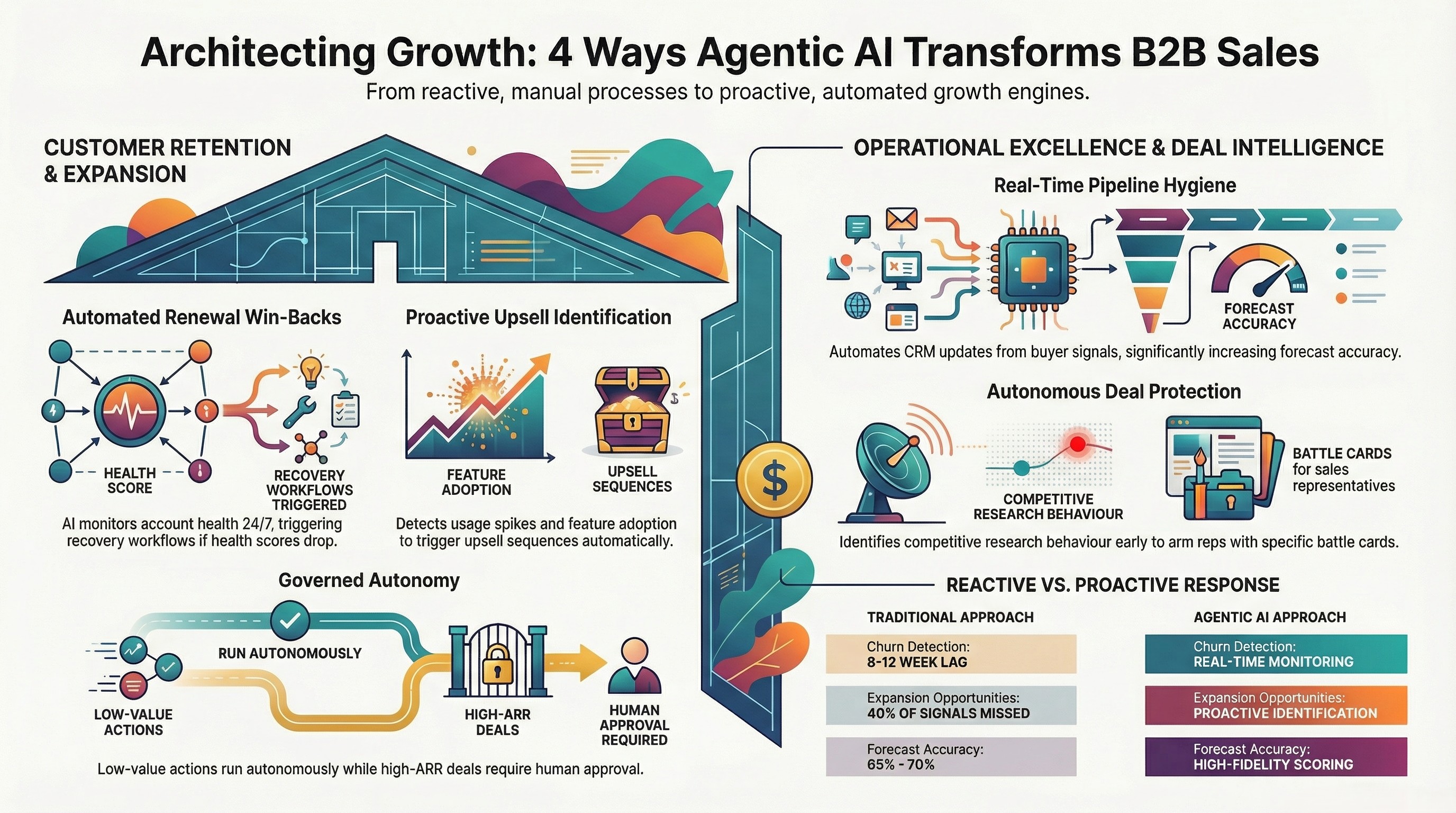
Use Case 1: Renewal Risk Detection and Automated Win-Back
The Scenario:
Your team manages 150 enterprise SaaS accounts. Renewals happen monthly. Your reps can't manually monitor 150 accounts for early churn signals.
Traditional Approach:
- Quarterly business reviews surface risks 8-12 weeks late
- Reps manually check CRM, support tickets, usage dashboards
- By the time you detect churn risk, you're in reactive mode
Agentic AI Approach:
Continuous Monitoring:
- AI agents monitor all 150 accounts 24/7
- Fuse signals: CRM activity + support sentiment + product usage + stakeholder changes + contract status
- Calculate real-time health scores (1-10 scale)
Precision Alerts:
- Only trigger alerts when multi-signal risk score crosses threshold (e.g., <4/10)
- Avoid alert fatigue (no "check this account" for every minor dip)
Automated Win-Back Execution:
When risk detected:
- Create Salesforce task: "Churn risk - action required"
- Send personalized email sequence (3-touch cadence)
- Notify account owner in Slack with context summary
- If no engagement after 7 days → escalate to sales manager
- If ARR >$250K → route exec involvement + discount approval
Governance Layer:
- Low-risk accounts (<$50K ARR) → fully autonomous
- High-value accounts (>$250K ARR) → human approval required before exec escalation
Real Deployment Results:
From deployed enterprise cases:
- Before: 8-12 week lag on churn detection, 18% annual churn
- After: Real-time detection, automated win-back workflows
- Outcome: "Higher account coverage without increasing headcount," "Faster response cycles on renewals," "More consistent execution via governed playbooks"
Use Case 2: Proactive Upsell and Expansion Opportunity Identification
The Scenario:
Your product has 5 tiers (Starter → Enterprise). Accounts expand when they hit usage thresholds, but reps miss 60% of expansion signals because they're buried in product analytics dashboards.
Traditional Approach:
- Reps manually review usage reports monthly
- Expansion opportunities buried in analytics dashboards
- Timing is reactive (customer asks for upgrade, not proactive outreach)
Agentic AI Approach:
Signal Detection:
- Monitor product usage against tier limits (e.g., Starter plan: 10 users, customer at 9/10)
- Track feature adoption (e.g., customer using advanced features not in their plan)
- Correlate with growth signals (headcount increase, new funding round, geographic expansion)
Autonomous Upsell Workflows:
When expansion signal detected:
- Calculate expansion score (usage velocity + feature adoption + growth signals)
- If score >7/10 → trigger upsell sequence
- Send personalized email: "You're close to your user limit—here's how Enterprise plan helps"
- Create Salesforce opportunity: "Expansion - [Feature] adoption"
- Notify AE with talking points pre-generated
- If customer engages → auto-schedule demo, send pricing calculator
- If ARR expansion >$100K → route to sales manager for pricing approval
Governance:
- Small expansions (<$25K) → auto-execute outreach
- Large expansions (>$100K) → require pricing approval from leadership
Deployed Results:
- Before: Reactive upsells, 40% of expansion opportunities missed
- After: Proactive expansion detection, automated outreach
- Outcome: Faster upsell identification, higher pipeline generation without added headcount
Use Case 3: Pipeline Hygiene and Forecast Accuracy
The Scenario:
Your sales forecast is consistently off by 20-30%. Reps don't update CRM in real-time. Pipeline hygiene is manual and inconsistent.
Traditional Approach:
- Weekly pipeline reviews (reps manually update Salesforce)
- Forecast based on outdated data (last updated 5-7 days ago)
- No correlation between CRM stage and actual buyer signals (emails, meetings, usage)
Agentic AI Approach:
Automated Pipeline Updates:
- Monitor buyer engagement signals (email opens, meeting attendance, product usage, pricing page visits)
- Auto-update CRM fields based on actual activity (not manual logging)
- Flag stale opportunities (no activity in 14 days → auto-move to "Stalled")
Forecast Intelligence:
- Calculate deal close probability using multi-signal scoring (not just CRM stage)
- Correlate: Meeting frequency + stakeholder engagement + contract review activity + champion responsiveness
- Surface deals "marked as Closed-Won but showing disengagement signals" (forecast risk)
Autonomous Pipeline Actions:
When stale deal detected:
- Auto-create task: "Re-engage opportunity [Name]"
- Suggest outreach templates based on last interaction
- If no activity after 21 days → auto-move to "Closed-Lost" (with human override option)
When close probability drops:
- Alert AE: "Deal [Name] showing disengagement—take action"
- Suggest recovery actions (exec sponsor call, ROI calculator, case study share)
Deployed Results:
- Before: Forecast accuracy 65-70%, manual CRM updates
- After: Automated pipeline updates, multi-signal deal scoring
- Outcome: Improved pipeline hygiene, better forecast accuracy, reduced manual CRM maintenance
Use Case 4: Competitive Intelligence and Deal Protection
The Scenario:
Your prospect is evaluating 3 vendors (you + 2 competitors). You don't know they're in active talks with competitors until the deal is lost.
Traditional Approach:
- Reps ask "Are you evaluating other solutions?" (prospects say "no" or are vague)
- No systematic competitive signal monitoring
- Competitive intelligence is ad-hoc, not real-time
Agentic AI Approach:
Competitive Signal Capture:
- Monitor public signals: LinkedIn (prospect downloads competitor whitepapers, attends their webinars)
- Track buyer research behavior: Pricing page visits, comparison page views
- Scan support/email threads for competitor mentions ("Evaluating [Competitor X]")
Autonomous Deal Protection:
When competitive threat detected:
- Alert AE: "Account [Name] showing competitive evaluation signals"
- Surface battle card: Competitive positioning, objection handling, win themes
- Auto-create task: "Send competitive differentiation case study"
- Suggest exec escalation if deal value >$200K
Governance:
- Don't spam prospects with "we saw you looked at competitor" (creepy)
- Do arm AEs with intelligence to ask better discovery questions
Deployed Results:
- Before: Reactive competitive responses, 30% of deals lost to competitors without warning
- After: Proactive competitive signal detection
- Outcome: Earlier competitive threat identification, better win-rate vs. known competitors
Real-World Deployment: How a Global Logistics Provider Scaled Account Coverage 3x
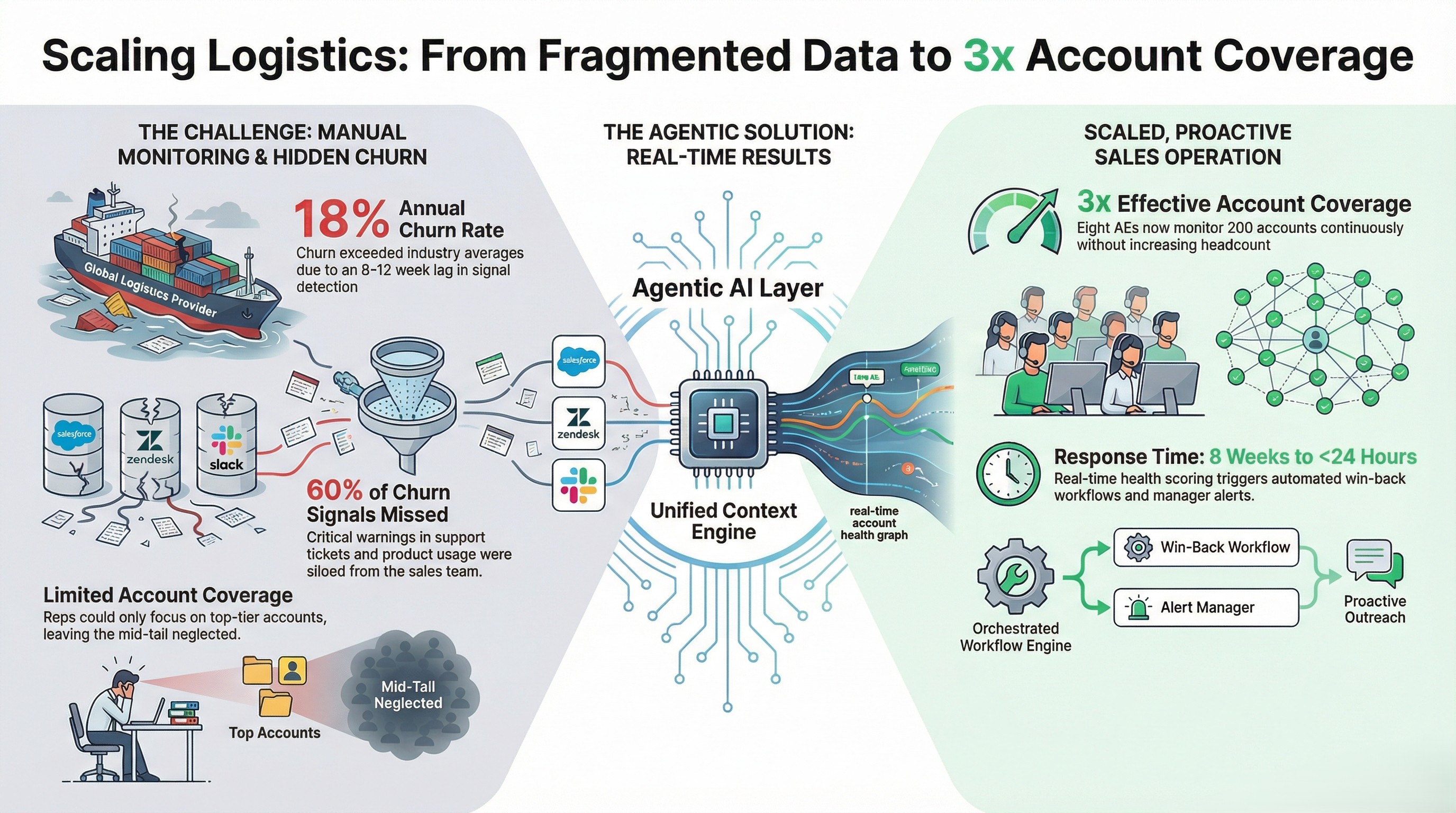
Client Profile
- Industry: Multinational logistics and warehousing
- Scale: End-to-end supply chain solutions across India, UK/Europe, US
- Challenge: 200+ enterprise accounts, fragmented systems, rising churn
- Systems: Salesforce CRM, Zendesk Support, product usage analytics, Slack internal communications
The Problem
Before Agentic AI:
- Sales team: 8 AEs managing 200+ accounts (25-30 accounts per rep)
- Monitoring cadence: Quarterly business reviews
- Data fragmentation:
- CRM showed pipeline stages and activity logs
- Support tickets lived in Zendesk (no CRM integration)
- Product usage analytics siloed (reps never looked at it)
- CS team flagged at-risk accounts in Slack (sales rarely saw it)
The Outcomes (Problems):
- 8-12 week lag on churn signal detection
- 18% annual churn rate (industry average: 12-15%)
- 60% of churns showed early warning signs (support escalations, usage drops, stakeholder changes) that were missed
- Low account coverage: Reps focused on top 10 accounts, neglected mid-tail
Sales leadership question: "How do we monitor 200 accounts continuously without hiring 20 more reps?"
The Agentic AI Solution
What Was Deployed:
1. Unified Context Engine:
Connected Salesforce + Zendesk + product analytics + Slack + email threads to build real-time account health graph correlating:
- CRM opportunity stage + close date
- Support ticket volume + sentiment (NPS)
- Product usage trends (active users, feature adoption)
- Stakeholder changes (champion departure detected via LinkedIn + email pattern changes)
- Contract renewal dates (from PDF contracts in SharePoint)
2. Semantic Governor:
Encoded sales playbooks as deterministic rules:
- Churn risk tiers: Low (score 7-10), Medium (4-6), High (1-3)
- Win-back workflows:
- High risk + renewal <60 days → trigger 3-touch email sequence + AE task + manager alert
- High risk + ARR >$250K → require VP approval before exec escalation
- Alert thresholds: Only notify AEs when multi-signal score crosses critical threshold (reduces alert fatigue)
3. Active Orchestrator:
Automated workflows:
- Churn detection: Real-time health scoring (updated hourly)
- Precision alerts: Slack notification to AE with context summary ("Account XYZ: Support NPS dropped to 2/10, usage down 50%, renewal in 38 days")
- Automated actions:
- Create Salesforce task: "High churn risk - action required"
- Send personalized win-back email (template auto-populated with account context)
- If no response in 7 days → escalate to sales manager
- If ARR >$250K → route discount approval to VP
Deployment Timeline
Week 1: Discovery + workflow mapping
- Mapped existing sales playbooks (win-back, expansion, pipeline hygiene)
- Identified data sources (Salesforce, Zendesk, analytics, Slack, contracts)
- Defined governance rules and approval thresholds
Weeks 2-4: Context fusion + agent deployment
- Ingested historical data (12 months of CRM, support, usage)
- Built account health scoring model (trained on past churn patterns)
- Deployed first agent: Churn risk monitoring + automated win-back
Day 30: Live in production
- 200 accounts under continuous monitoring
- Real-time alerts configured
- Automated workflows active
- Governance layer enforcing approval rules
Results
Quantified Outcomes:
✓ Higher account coverage without increasing headcount
- Before: 8 AEs monitoring 200 accounts (25-30 per rep)
- After: Same 8 AEs now effectively monitoring all 200 (AI handles continuous monitoring)
- Coverage scaled 3x (from top 10 accounts per rep → all 200 accounts)
✓ Faster response cycles on opportunities and renewals
- Before: 8-12 week lag on churn detection
- After: Real-time detection (alerts within hours of risk signal emerging)
- Response time: 8 weeks → <24 hours
✓ More consistent execution via governed playbooks
- Before: Inconsistent win-back approaches (each rep had their own method)
- After: Standardized playbook execution across all accounts
- Governance: Every action follows encoded rules, full audit trail
Qualitative Outcomes:
From deployment:
- "Always-on account monitoring + signal capture"
- "Rule-governed opportunity identification & follow-up orchestration"
- "CRM integration-ready workflows + pipeline hygiene"
- "Sales dashboards + leadership alerts"
Why This Worked
1. Complete Context (not just CRM data):
- Traditional sales intelligence tools (Salesforce Einstein, Clari) only see CRM data
- This deployment fused CRM + support + usage + Slack + contracts → 100% visibility
2. Governed Execution (not blind automation):
- Every automated action followed encoded playbook rules
- Threshold-based escalation ensured human oversight for high-value accounts
- Audit trails provided full explainability ("Why did this alert trigger?")
3. Rapid Deployment (not 6-month POC):
- Week 1: Discovery
- Weeks 2-4: Build + deploy
- Day 30: Live in production
- No rip-and-replace (orchestrated existing Salesforce, Zendesk stack)
Agentic AI vs. Traditional Sales Intelligence Tools
Why Salesforce Einstein and Clari Stop at Level 4
The Market Landscape:
Most B2B sales teams use some form of "AI-powered" sales intelligence:
- Salesforce Einstein: Lead scoring, opportunity insights, next-best-action recommendations
- Clari: Pipeline forecasting, deal risk analysis
- Gong: Conversation intelligence, rep coaching
- Outreach/SalesLoft: Email sequencing, cadence automation
What They Do Well:
✓ Analyze historical patterns to predict close probability ✓ Recommend next-best-actions ("Call this account," "Send this email") ✓ Alert reps when deals show risk signals ✓ Automate email sequences (pre-configured cadences)
What They Can't Do:
✗ Fuse unstructured context (support tickets, usage data, Slack alerts) into account health ✗ Execute autonomous workflows beyond email sequences (can't create CRM tasks, route approvals, escalate to execs) ✗ Govern based on encoded business rules (no deterministic logic, just probabilistic scoring) ✗ Act without human bottlenecks (always require rep to click "send," "approve," or "execute")
The Gap
Salesforce Einstein says: "This deal has a 32% close probability. Consider reaching out to the economic buyer."
Agentic AI does:
- Detects close probability drop (from 65% → 32% in 2 weeks)
- Correlates with external signals (champion hasn't responded in 14 days, competitor mentioned in support thread)
- Executes multi-step workflow:
- Send personalized email to champion (auto-drafted with context)
- Create task for AE: "Re-engage economic buyer"
- If no response in 5 days → auto-escalate to sales manager
- If deal value >$200K → suggest exec sponsor involvement
- Routes approval if discount required (based on encoded authority matrix)
- Updates CRM with full audit trail
Einstein gives you the insight. Agentic AI executes the outcome.
Comparison Table
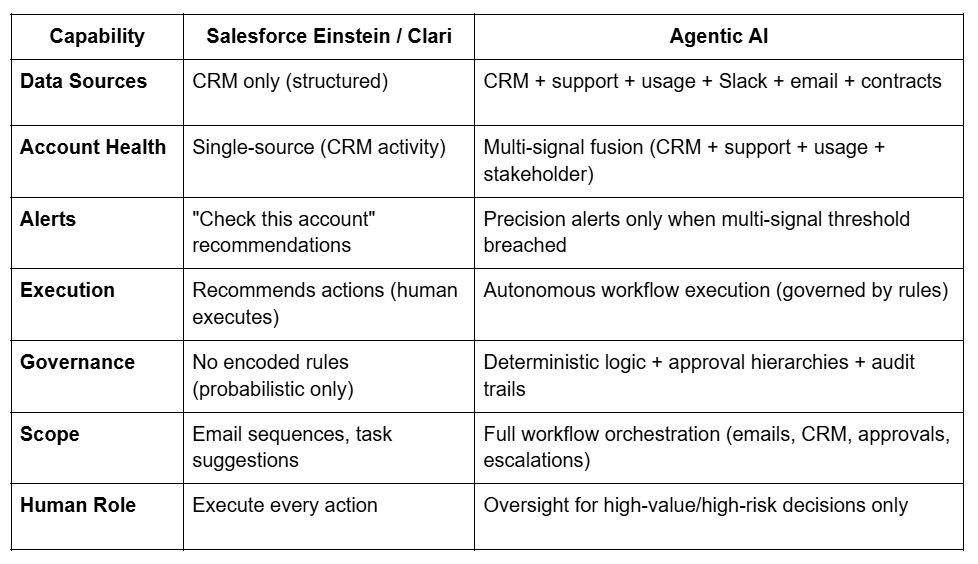
When to Use Each
Use Salesforce Einstein/Clari if:
- You want insights and recommendations (Level 4: Prescriptive)
- Your team has capacity to manually execute every action
- You're okay with CRM-only visibility
Use Agentic AI if:
- You need autonomous execution, not just recommendations (Level 5: Agentic)
- Your team is overwhelmed with too many accounts to manually monitor
- You require multi-system data fusion (CRM + support + usage + Slack)
- You need governed workflows with audit trails for compliance
The ROI Calculation: When Does Agentic AI Pay Off?
The Business Case
Scenario: Mid-market B2B SaaS company
- ARR: $20M
- Enterprise accounts: 200
- Average account value: $100K ARR
- Annual churn rate: 15% (industry average: 12%)
- Sales team: 8 AEs ($120K fully loaded cost each)
Problem:
- Excess churn: 15% vs. 12% benchmark = 3% × $20M = $600K lost ARR/year
- Late detection: 60% of churns showed early signals that were missed = $360K preventable churn
Traditional Solution (Hire More Reps):
- Add 4 AEs to improve account coverage (200 accounts ÷ 12 reps = 16 accounts per rep vs. 25)
- Cost: 4 × $120K = $480K/year
- Churn reduction: Maybe 2-3% improvement = $400K-$600K retained ARR
- ROI: Breakeven at best, 12-month ramp time
Agentic AI Solution:
- Deploy continuous monitoring + automated win-back workflows
- Cost: ~$100K-$150K/year (platform + implementation)
- Churn reduction: 3-5% improvement (based on deployment results) = $600K-$1M retained ARR
- ROI: 4-8x in Year 1, <30 days to deploy
Additional Benefits (Not in Traditional Calc):
✓ Upsell acceleration: Proactive expansion detection → +$200K-$400K ARR/year ✓ Rep productivity: 30% time savings on manual monitoring → focus on high-value selling activities ✓ Forecast accuracy: Better pipeline hygiene → 10-15% improvement in forecast accuracy → better capacity planning
Total Annual Value: $800K-$1.4M
Total Cost: $100K-$150K
Net ROI: 5-10x
Payback Period: <90 days (if churn reduction materializes in first quarter)
When It Doesn't Make Sense
- Small sales teams (<3 AEs): Manual monitoring is still feasible
- Low account volume (<50 accounts): ROI doesn't justify platform investment
- Simple sales motion: Transactional, short sales cycles (agentic AI built for complex B2B)
When It's a No-Brainer
- Mid-market/enterprise sales teams (5+ AEs, 100+ accounts)
- High account values ($50K+ ARR per account)
- Complex renewal cycles (multi-stakeholder, 6-12 month sales cycles)
- High churn cost (SaaS, subscription businesses)
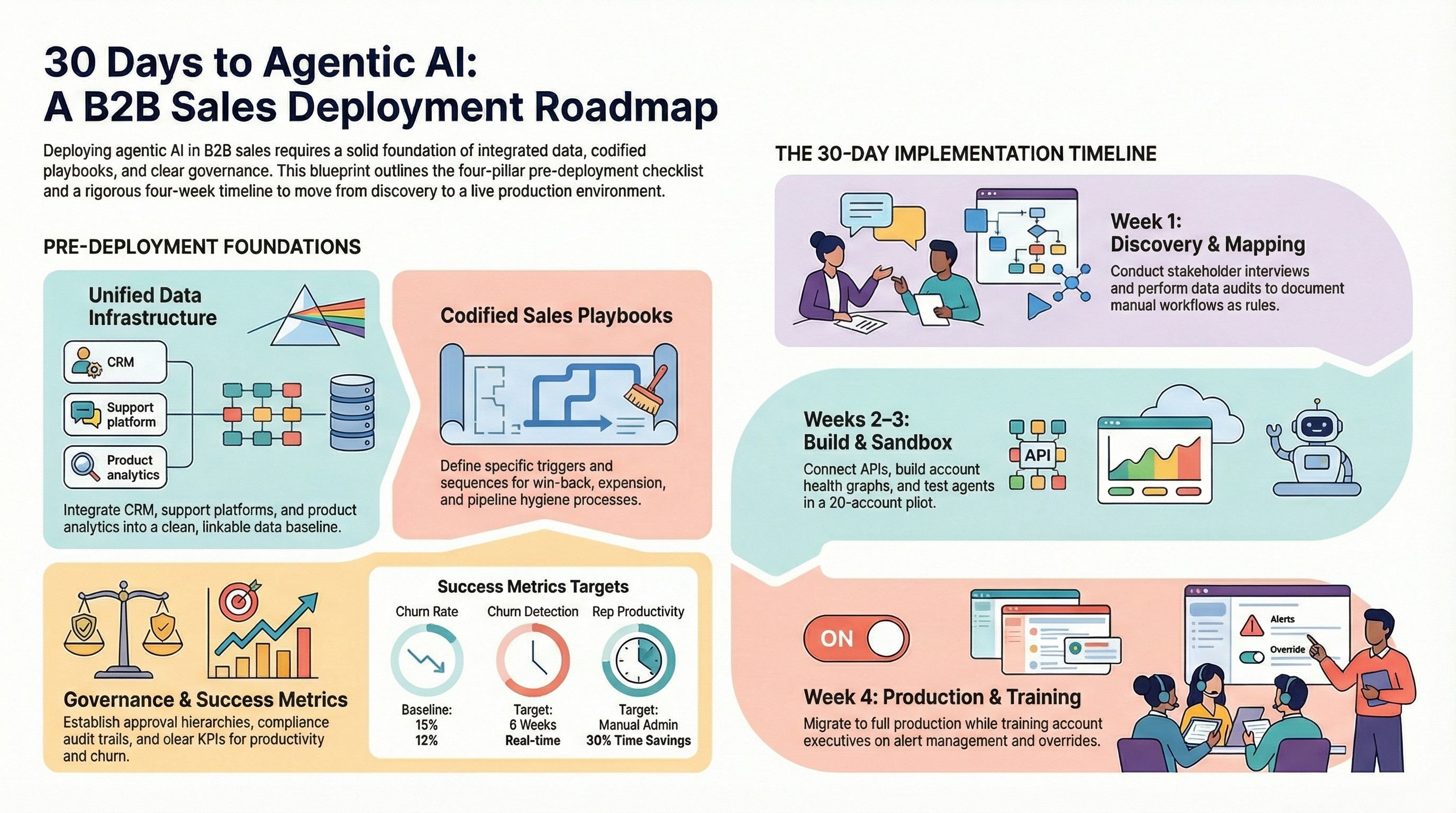
How to Deploy Agentic AI for B2B Sales in 30 Days
Pre-Deployment Checklist: What You Need Before Starting
Before deploying agentic AI, ensure you have:
1. Data Infrastructure:
✓ Systems to connect:
- CRM (Salesforce, HubSpot, Pipedrive)
- Support platform (Zendesk, Intercom, Freshdesk)
- Product analytics (Mixpanel, Amplitude, Heap) - if applicable
- Communication tools (Slack, email archives)
- Contract repository (SharePoint, Google Drive, Dropbox)
✓ Data quality baseline:
- CRM hygiene: Opportunity stages consistently used
- Support tickets: Tagged with account IDs (linkable to CRM)
- Usage data: Connected to account records
- Contracts: Renewal dates digitized (not just scanned PDFs)
2. Sales Playbooks Defined:
✓ Win-back process:
- When to trigger (risk score threshold, renewal timeline)
- Email templates (3-5 touch sequence)
- Escalation path (AE → Manager → VP → Exec sponsor)
- Discount approval authority (who can approve what)
✓ Expansion process:
- Usage thresholds that indicate expansion readiness
- Upsell outreach templates
- Pricing approval workflows
✓ Pipeline hygiene rules:
- When to mark opportunities as "stale" (e.g., no activity in 14 days)
- Forecast probability thresholds
3. Governance Requirements:
✓ Approval hierarchies:
- Which actions can execute fully autonomously?
- Which requires human approval?
- Authority matrix by account value (e.g., <$50K ARR = auto; >$250K ARR = VP approval)
✓ Compliance requirements:
- GDPR/data privacy (especially for EU accounts)
- Industry-specific regulations (financial services, healthcare)
- Audit trail requirements
4. Success Metrics Defined:
✓ What will you measure?
- Churn rate reduction (target: 15% → 12%)
- Time to detect churn signals (target: 8 weeks → real-time)
- Account coverage (target: 3x scale without hiring)
- Rep productivity (target: 30% time savings on admin)
If these 4 foundations are in place, you can deploy in 30 days.
The 30-Day Deployment Timeline
Week 1: Discovery + Workflow Mapping
Days 1-2: Stakeholder Interviews
- Sales leadership: Strategic priorities, pain points
- AEs/Account Managers: Current workflows, tool frustrations
- RevOps: Data infrastructure, system integrations
Days 3-5: Data Audit
- Map systems (Salesforce, Zendesk, analytics, Slack, contracts)
- Assess data quality (CRM hygiene, support ticket tagging, usage tracking)
- Identify integration points
Days 6-7: Playbook Documentation
- Document current win-back process (manual steps)
- Encode as if-then rules (e.g., "If health score <4 AND renewal <60 days, THEN trigger win-back")
- Define approval thresholds (ARR tiers, discount authority)
Deliverable: Workflow definition document, ROI hypothesis, success metrics
Week 2-3: Context Engine + Agent Build
Days 8-14: Data Integration
- Connect Salesforce, Zendesk, analytics, Slack (API integrations)
- Ingest historical data (12 months recommended for model training)
- Build unified account health graph
Days 15-18: Governance Layer
- Encode sales playbooks as deterministic rules
- Configure approval hierarchies
- Set alert thresholds (avoid alert fatigue)
Days 19-21: Agent Deployment (Sandbox)
- Deploy first agent in test environment (e.g., 20 pilot accounts)
- Test workflows: Churn detection → alert → automated email → escalation
- Validate governance (ensure approvals route correctly)
Deliverable: Sandbox environment with live agent monitoring 20 accounts
Week 4: Production Rollout + Training
Days 22-24: Production Deployment
- Migrate from sandbox to production
- Expand to all 200 accounts (or target account set)
- Configure Slack/email alerts for sales team
Days 25-27: Team Training
- Train AEs: How to interpret alerts, override automated actions, approve workflows
- Train managers: Dashboard usage, governance oversight, audit log review
- Document SOPs: "What to do when you get a high-risk alert"
Days 28-30: Monitoring + Optimization
- Monitor alert volume (are reps getting too many alerts? Adjust thresholds)
- Track early metrics (# of alerts triggered, # of automated workflows executed, # of human overrides)
- Collect feedback from AEs (what's working, what's noisy)
Day 30: Live in Production
- Full account coverage active
- Automated workflows executing
- Governance layer enforcing rules
- Team trained and onboarded
Deliverable: Live agentic AI system monitoring all accounts, full audit trail, success metrics baseline established
Post-Deployment (Days 31-90):
Week 5-8: Optimization
- Refine alert thresholds based on feedback (reduce false positives)
- Expand playbooks (add expansion monitoring, competitive intelligence)
- A/B test email templates (which win-back sequences perform best?)
Week 9-12: Scale
- Add more use cases (pipeline hygiene, upsell automation, competitive monitoring)
- Integrate additional data sources (LinkedIn Sales Navigator, intent data)
- Expand to new teams (Customer Success, Marketing)
Common Questions About Agentic AI for Sales
- "Will AI replace our sales reps?"
Short answer: No. AI augments reps, doesn't replace them.
What AI handles:
- Continuous monitoring (24/7 account health tracking)
- Routine workflows (automated email sequences, CRM updates, task creation)
- Data synthesis (correlating signals across 5+ systems)
- Pattern recognition (detecting churn signals based on historical patterns)
What humans handle:
- Relationship-building (customer calls, exec dinners, strategic advising)
- Complex negotiations (multi-stakeholder deals, custom pricing)
- Strategic decisions (when to discount, when to escalate, when to walk away)
- Judgment calls (overriding AI recommendations when context requires it)
The Reality:
From deployments: "Higher account coverage without increasing headcount"
This doesn't mean fewer reps. It means same reps, 3x coverage.
Before agentic AI:
- 8 AEs effectively manage 80 accounts (top 10 per rep)
- Remaining 120 accounts get minimal attention
After agentic AI:
- Same 8 AEs now cover all 200 accounts
- AI handles monitoring/routine workflows
- Reps focus on high-value interactions (calls, demos, negotiations)
The Outcome: Reps become more productive, not obsolete.
Analogy:
- Autopilot didn't replace pilots—it made them more effective
- GPS didn't replace drivers—it removed navigation burden
- Agentic AI doesn't replace reps—it removes monitoring/admin burden
- "How do we prevent AI from spamming our customers?"
This is the #1 concern we hear. And it's valid.
The Problem:
Blind automation = spam. If every "low health score" triggers an automated email, you'll send 50 emails/week to every account with minor dips.
How Governance Prevents This:
1. Multi-Signal Thresholds (Not Single Triggers)
❌ Bad: "Support ticket opened → send email"
✅ Good: "Support NPS <4 AND usage down >30% AND renewal <60 days → trigger win-back"
Precision alerts require multiple correlated signals, not single events.
2. Alert Fatigue Prevention
- Set minimum threshold for action (e.g., health score <4/10, not <7/10)
- Cooldown periods (don't re-alert on same account for 7 days unless score drops further)
- Human override (AE can mark account as "false positive" to suppress future alerts)
3. Graduated Escalation (Not Immediate Exec Involvement)
❌ Bad: "Health score drops → email CEO"
✅ Good:
- Day 1: Automated email to user contact
- Day 7: If no response, notify AE
- Day 14: If still no engagement, suggest manager involvement
- Only escalate to exec sponsor if ARR >$250K AND all prior steps failed
4. Human Approval for High-Stakes Actions
Fully autonomous:
- Email sequences to accounts <$50K ARR
- CRM task creation
- Slack alerts to AEs
Require approval:
- Discount offers >15%
- Exec escalation for accounts >$250K ARR
- Contract amendments
Real Example:
Deployed B2B sales agent used:
- Precision alerts only when multi-signal threshold crossed
- Governed playbooks to ensure consistent (not spammy) outreach
- Result: "More consistent execution," zero spam complaints
- "What if our data is messy or incomplete?"
Reality check: Every enterprise has messy data.
From 40+ deployments, we've never seen "perfect" data infrastructure. Common issues:
Typical Data Problems:
- CRM hygiene: 30% of opportunities missing close dates
- Support tickets: Not tagged with account IDs (can't link to CRM)
- Usage data: Siloed in product analytics, no CRM connection
- Contracts: Scanned PDFs with no structured renewal date field
How Agentic AI Handles This:
1. Data Enrichment During Ingestion
- Use LLMs to extract renewal dates from PDF contracts (even if unstructured)
- Match support tickets to accounts using fuzzy matching (company name, domain, contact email)
- Infer account relationships from email threads when CRM linkage is missing
2. Start with "Good Enough" Data
- Don't wait for perfect CRM hygiene to deploy
- Start with 80% of accounts that have clean data
- Expand to messier accounts once workflows are proven
3. AI Improves Data Quality Over Time
- Agentic workflows auto-update CRM (e.g., "Health score: 3/10" field added)
- Audit trails surface data gaps ("Can't score Account XYZ—missing usage data")
- Forces data hygiene improvements (sales teams start tagging support tickets correctly)
Real Example:
From deployment at enterprise conglomerate (30+ companies):
- Fragmented systems across entities
- Inconsistent CRM usage
- Solution: "Group-wide KPI standardization" + "Unified context engine"
- Outcome: "Standardised intelligence across entities"
Bottom line: Messy data is expected. The platform is designed to handle it.
The Competitive Window Is Closing
The race has already started.
While you're reading this, your competitors are deploying agentic AI to:
- Monitor 500 accounts with 5 reps (you're stuck at 100 accounts with 10 reps)
- Detect churn signals in real-time (you're finding out 8 weeks late)
- Execute win-back workflows autonomously (you're manually drafting emails)
The McKinsey/Gartner Projections:
- 25% of enterprise workflows automated by agentic AI by 2028 (McKinsey)
- 50% of enterprises deploying autonomous decision systems by 2027 (Gartner)
- Early adopters seeing 40-60% process cycle time reductions now
This isn't 5 years away. It's happening today.
The 12-18 Month Window
Industry analysts project a 12-18 month advantage window for early movers.
Early movers capture:
- Operational leverage (50+ decision cycles/year vs. 8)
- Talent retention (top reps want AI-augmented tools, not manual admin)
- Customer expectations reset (24/7 proactive outreach becomes baseline)
Late movers face:
- Margin compression (competitors automate faster, you're stuck with manual overhead)
- Churn acceleration (customers expect proactive engagement, you're still reactive)
- Talent flight (sales reps leave for AI-enabled competitors)
The cost of waiting compounds.
From Quarterly Reviews to Always-On Intelligence
The transformation is simple:
Before:
- Quarterly reviews surface risks 8 weeks late
- Reps juggle 25-30 accounts manually
- Fragmented data across 5 systems
- Reactive firefighting
After:
- Real-time monitoring across all accounts
- Autonomous workflows handle routine tasks
- Unified context across CRM + support + usage + Slack
- Proactive retention
The infrastructure exists. The deployments are proven. The timeline is 30 days.
The question is: Will you lead or catch up?
Start Your 30-Day Pilot
Within 48 hours, you get:
✓ Concrete pilot plan with workflow definition
✓ ROI hypothesis with measurable success metrics (churn reduction target, coverage scale estimate)
✓ Technical architecture review (which systems to connect, data requirements)
✓ 30-day deployment timeline with weekly milestones
Our Guarantee:
If we don't surface real, measurable values during the pilot (churn reduction, faster detection, account coverage scale)—we walk.
No POC purgatory. No endless sales cycles. Just results.

Transform Your Business With Agentic Automation
Agentic automation is the rising star posied to overtake RPA and bring about a new wave of intelligent automation. Explore the core concepts of agentic automation, how it works, real-life examples and strategies for a successful implementation in this ebook.
Sarfraz Nawaz is the CEO and founder of Ampcome, which is at the forefront of Artificial Intelligence (AI) Development. Nawaz's passion for technology is matched by his commitment to creating solutions that drive real-world results. Under his leadership, Ampcome's team of talented engineers and developers craft innovative IT solutions that empower businesses to thrive in the ever-evolving technological landscape.Ampcome's success is a testament to Nawaz's dedication to excellence and his unwavering belief in the transformative power of technology.

More insights
Discover the latest trends, best practices, and expert opinions that can reshape your perspective




Contact us

