
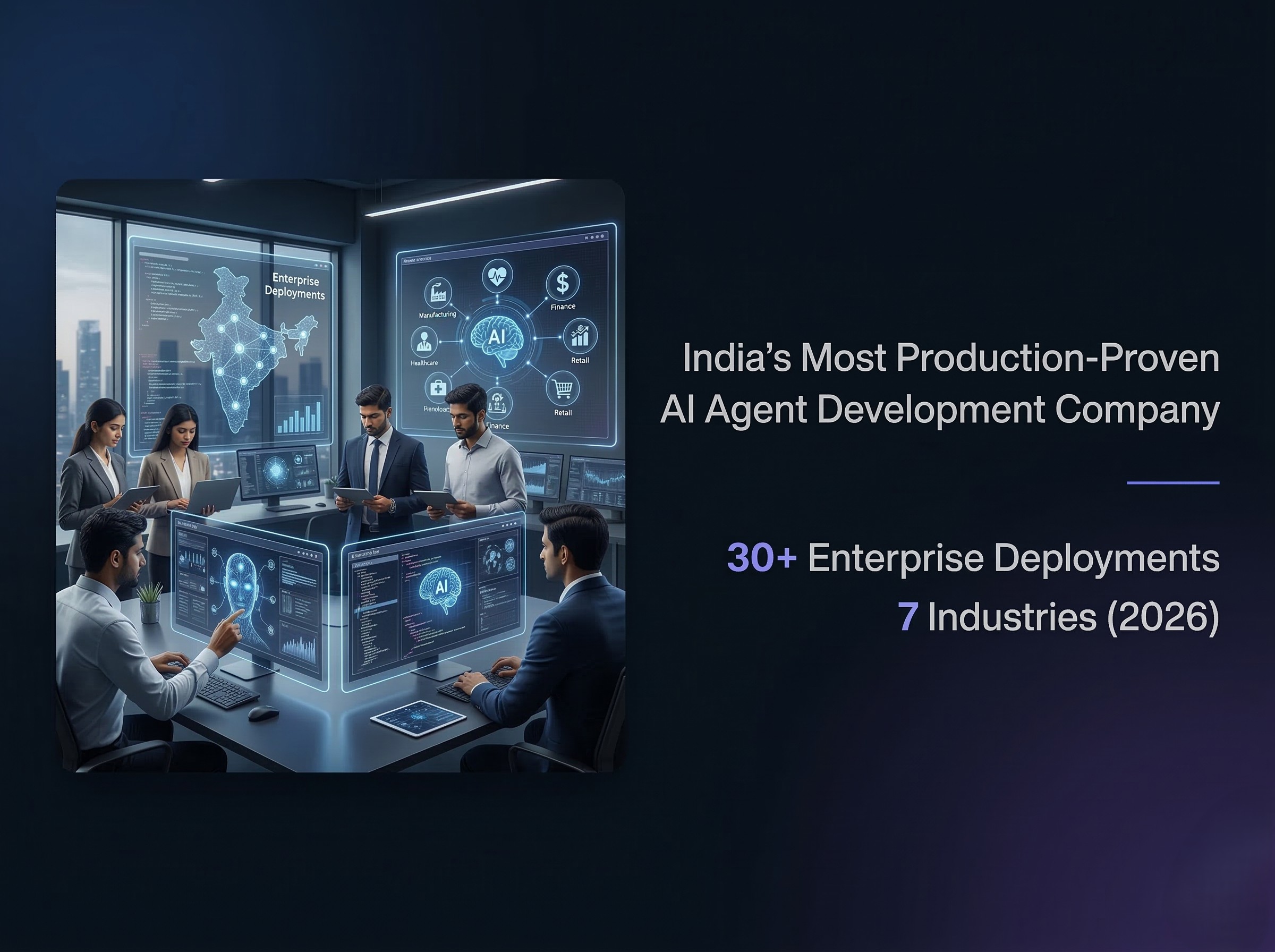
India's Most Production-Proven AI Agent Development Company — 30+ Enterprise Deployments, 7 Industries (2026)


When enterprise leaders search for an AI agent development company in India, they are not looking for another demo. They are looking for proof — production deployments, measurable outcomes, and a partner that understands what it takes to move from pilot to enterprise scale without the wheels coming off.
According to Ampcome's deployments across 30+ enterprises, the single biggest failure mode in enterprise AI agent projects is not a technology problem. It is a context problem. Agents are built without a deep understanding of business rules, domain vocabulary, and the data environments they must operate in.
The result is what we call the Blind Agent Problem — an AI system that looks impressive in a controlled setting and fails the moment it meets real operational complexity.
This guide explains what an AI agent development company in India actually builds, how to evaluate one, and what production-proven agentic AI looks like across seven major industries — backed by real deployment outcomes.
What Does an AI Agent Development Company Actually Build?
An AI agent development company designs, builds and deploys autonomous software agents that perceive context, reason over it, and take goal-directed actions — without requiring step-by-step human instruction.
This is a precise and important definition. The word "agent" is overused to the point of near-meaninglessness in 2026. Chatbots are being marketed as agents. Simple API wrappers are being marketed as agents. A genuine AI agent is categorically different: it operates within a defined goal space, accesses the tools and data it needs to achieve that goal, makes decisions across multiple steps, and takes actions in the real world — modifying records, triggering workflows, sending communications, updating systems.
An AI agent development company is the firm that makes this happen at enterprise scale, with the reliability, auditability, and governance that production environments demand.
Agentic AI vs traditional AI software — the key difference
Traditional AI software is predominantly predictive or generative. It takes an input and returns an output. A fraud detection model scores a transaction. A language model generates a response to a prompt. These are powerful capabilities, but they are not agents. They do not plan. They do not take sequences of actions. They do not persist across time.
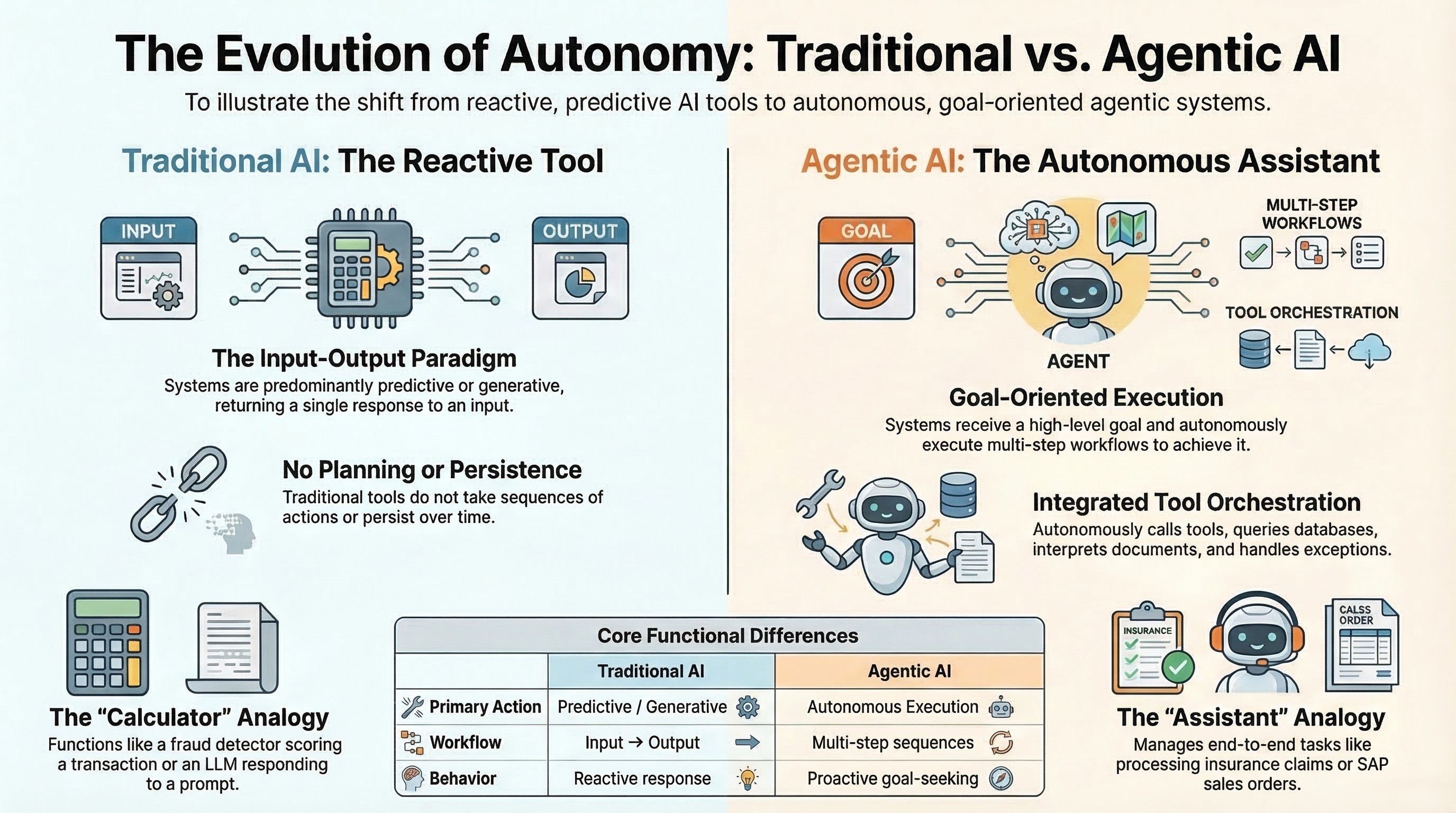
Agentic AI introduces a different paradigm. An agentic system receives a goal — "process this insurance claim," "create this SAP sales order," "answer this tenant's maintenance query end-to-end" — and autonomously executes the multi-step workflow required to achieve it. It calls tools, queries databases, interprets documents, handles exceptions, routes for human approval where needed, and logs every action for audit. The difference is the difference between a calculator and an assistant.
Why enterprise AI agents require a different development approach
Building enterprise-grade AI agents is not a prompt engineering exercise. It requires a deep understanding of the business domain the agent will operate in, the data systems it must connect to, the rules and exceptions it must respect, and the governance framework it must operate within. A consumer-facing chatbot can tolerate a 5% error rate. An agent that is creating purchase orders, processing claims, or managing patient scheduling cannot.
This is why the selection of an AI agent development company matters as much as the selection of the underlying AI technology. The technology is increasingly commoditised. The domain expertise, implementation methodology, and production track record are not.
Why India Is the Global Hub for Enterprise AI Agent Development
India has emerged as the definitive location for enterprise AI agent development — not because of cost alone, but because of the intersection of cost efficiency, engineering depth, and exposure to complex, high-stakes enterprise environments.
Cost-efficient agentic AI deployment at global enterprise scale
Organisations working with an AI agent development company in India can typically access world-class AI engineering talent at a fraction of the cost of equivalent teams in the United States, United Kingdom, or Western Europe. For enterprise AI programs that require sustained engineering investment — model fine-tuning, agent orchestration, system integration, monitoring and iteration — this cost differential compounds significantly over a 12–24 month engagement.
It is not uncommon for enterprises to achieve three to four times the scope of deployment for the same budget when partnering with an India-based AI agent development company versus a US or UK equivalent.
Deep domain expertise: from retail and logistics to healthcare and utilities
The best AI agent development companies in India have moved far beyond generic software development. The leading firms have accumulated deep domain expertise across verticals — financial services, logistics, healthcare, retail, manufacturing, energy — that allows them to design agents with real contextual intelligence rather than surface-level automation. This domain depth is what separates production-proven deployments from proof-of-concept projects that never leave the demo environment.
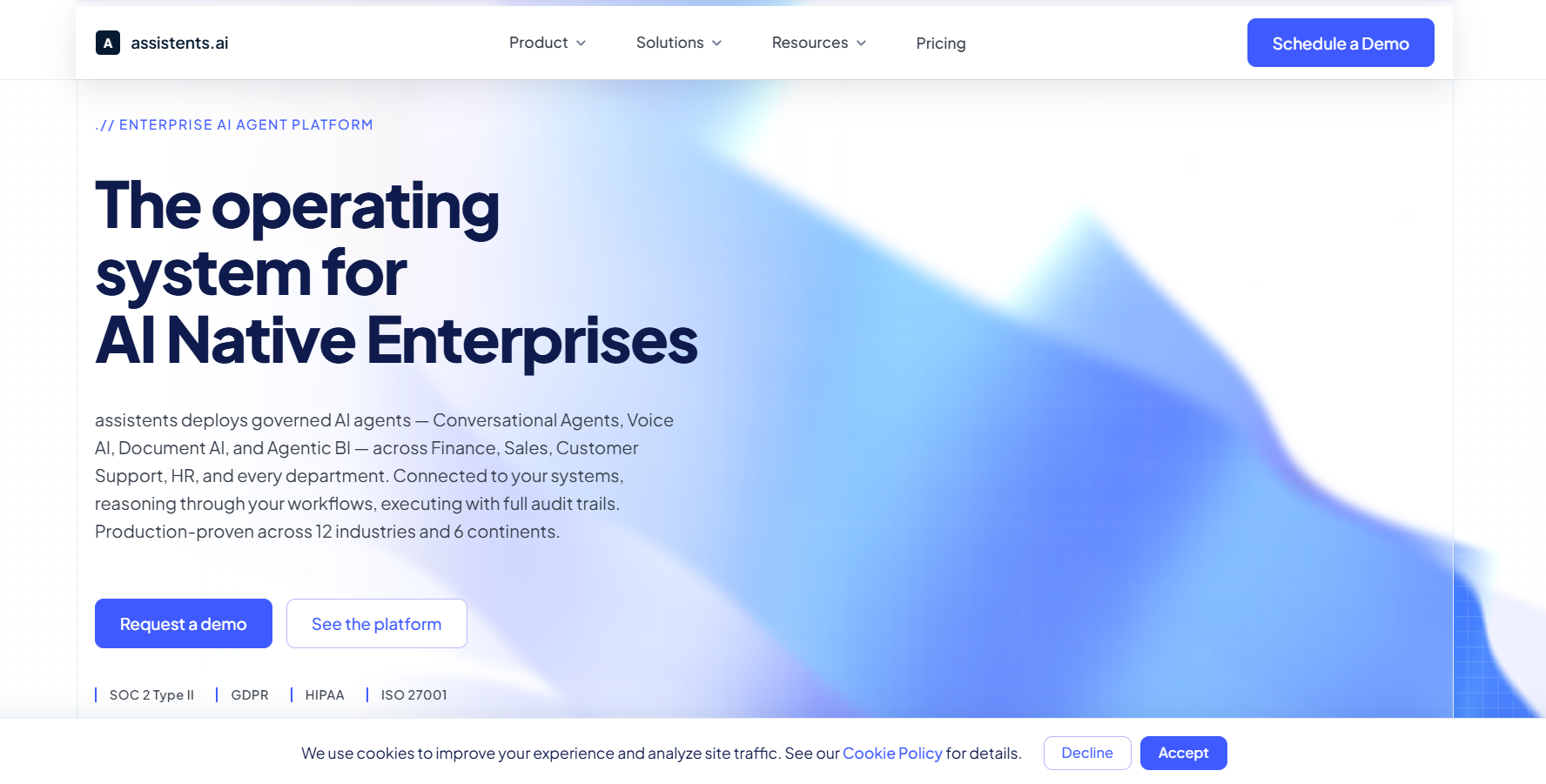
Assistents by Ampcome, headquartered in India, has production deployments across the United States, United Arab Emirates, United Kingdom, Australia, Canada, and across India — serving clients ranging from a $20 billion global ports and logistics leader to national-scale retail chains, state power utilities, private healthcare groups, and global fintech providers. This global client base, built from an India-first engineering team, is the model for what Indian AI agent development looks like at its best.
Our AI & ML Development Services
Ampcome offers a full-spectrum AI and machine learning development capability — from strategic consulting through to production deployment and ongoing optimisation. Our services are designed for enterprises that need more than a prototype.
Generative AI development — LLM-powered workflows and automation
As a generative AI development company, we build LLM-powered systems that go beyond question-and-answer interfaces. Our generative AI implementations include intelligent document processing (extracting, classifying and acting on information from complex PDFs, emails and structured documents), automated content and report generation, and LLM-driven decision support layers that surface actionable insight from unstructured data.
We work across the leading model providers — including proprietary and open-source options — selecting inference infrastructure appropriate to the client's data residency, latency, and cost requirements.
Custom agentic AI orchestration and multi-agent systems
Our core capability as an agentic AI company is the design and deployment of multi-agent orchestration systems. These are architectures where multiple specialised agents — each with a defined role, toolset, and decision authority — collaborate to achieve complex enterprise goals.
A single enterprise workflow might involve an intake agent, a classification agent, a retrieval agent, a validation agent, and a notification agent, all operating in coordinated sequence with human-in-the-loop checkpoints at the appropriate junctures. Designing these systems correctly — with clear state management, error handling, escalation logic, and audit trails — is what separates reliable enterprise agents from impressive demos.
AI software development and enterprise system integration
We build AI software that integrates into the enterprise technology stack the client already runs. This means deep integrations with ERP systems (SAP, Oracle), CRM platforms, ticketing and helpdesk tools, data warehouses, analytics platforms, and communication systems.
Our integration-first approach ensures that AI agents do not operate in isolation — they become active participants in existing operational workflows, reading from and writing to the systems of record that the business runs on.
AI consulting and strategic roadmapping for enterprise teams
As an AI consulting company in India with a global client base, we help enterprise leadership teams navigate the transition from interest in AI to production deployment. Our consulting engagements typically begin with an agentic AI readiness assessment — mapping the organisation's data environment, integration landscape, operational workflows, and governance requirements against the AI capabilities that would deliver the highest return.
We help clients sequence their AI investment correctly: identifying which processes are genuinely agent-ready today, which require foundational data work first, and which should remain human-led for regulatory or risk reasons.
Industries We Serve: Agentic AI Across 7 Verticals

According to Ampcome's production deployments, agentic AI delivers the most significant operational impact in environments characterised by high data volume, frequent exceptions, distributed operations, and time-sensitive decision-making. These conditions are present across seven verticals where we have active enterprise deployments.
Retail & e-commerce — AI agents for 700+ store operations
National-scale retail presents one of the most demanding environments for enterprise AI agents: thousands of SKUs, hundreds of locations, complex inventory movements, a high-volume frontline workforce, and customers expecting instant answers.
We have deployed a multi-agent AI system for a national retail chain operating more than 700 stores across India, combining a voice-enabled customer and staff support agent (operating in both Hindi and English), an inventory intelligence agent providing real-time pricing, stock and promotional information at store level, and a knowledge and training agent built on retrieval-augmented generation over point-of-sale and standard operating procedure documents. The result: reduced helpdesk burden on central teams, improved store-level inventory visibility, and on-demand training guidance for frontline staff without the need for centralised delivery.
Financial services & banking — omnichannel AI with audit trails
Financial services require AI agents that are not only accurate but auditable — every decision, every action, every exception must be logged, explainable, and retrievable. We have built omnichannel AI agents for banking and fintech clients that handle intake across chat, email, and phone channels, route to specialised workflow agents for dispute resolution, fraud assessment and compliance processing, and surface agent-assist summarisation and next-best-action guidance for human agents handling complex cases. Every step is captured in an audit trail that satisfies regulatory and SLA reporting requirements.
Logistics & supply chain — terminal-to-rail agentic intelligence
Logistics operations at enterprise scale involve coordination across physical infrastructure, scheduling systems, exception management, and executive reporting — all in real time. We have deployed terminal and rail management solutions for a global ports and logistics leader — an organisation with reported annual revenues exceeding $20 billion — digitising and optimising port-to-inland logistics operations. The deployment includes rail scheduling and visibility agents, exception management and automated alerting, and executive dashboard intelligence. The outcome: higher predictability of terminal-to-rail throughput, more efficient coordination across terminal and inland logistics, and improved operational transparency for leadership.
Healthcare — staffing, clinical ops, and patient workflow agents
Healthcare AI deployments must balance operational efficiency with compliance, patient safety, and the sensitivity of clinical data. We have deployed AI agent systems for healthcare staffing organisations, physician-led clinical enterprises, and geriatric care providers — primarily in the United States market. These deployments include staffing agents that automate talent onboarding, credential capture, facility request intake, matching logic, scheduling, and compliance workflows; clinical analytics platforms that improve care-program performance and financial outcomes; and revenue cycle visibility tools with exception alerting for billing workflow optimisation.
Manufacturing & energy — predictive monitoring and smart grid AI
Manufacturing and energy clients require AI agents that operate on continuous data streams, detect anomalies early, and trigger appropriate responses without human polling. For a major Indian manufacturing company competing in highly price-sensitive consumer and commercial markets, we deployed an AI competitive monitoring system that continuously ingests channel data across e-commerce portals, detects pricing gaps, promotional shifts, and product availability changes, and surfaces instant answers and proactive alerts to commercial leadership.
The deployment replaced entirely manual monitoring processes that were previously distributed across multiple team members. For energy sector clients, we have built smart grid analytics systems for state-level power utilities, ingesting transmission data, running predictive analytics for outages and field performance issues, and generating automated alerts and workflow routing for field operations teams.
Real estate & government — tenant support and utility grid operations
Real estate and government-adjacent clients share a common challenge: high-volume stakeholder interactions across complex asset portfolios, with a workforce that cannot scale linearly with demand. We have deployed a 24×7 omnichannel tenant service agent for a major real estate portfolio operator, handling tenant query triage, FAQs, rental and payment support workflows, and automated escalation to human teams — with a knowledge base built over policies, tenancy documents and standard operating procedures. The outcome: reduced call-centre load, consistent 24×7 tenant experience, and better SLA adherence through automated routing and tracking.
Luxury travel & hospitality — intelligent booking automation
The luxury travel sector demands AI agents that can handle complexity without compromising the premium client experience. We deployed a Digital Booking Agent for a luxury safari hospitality operator running boutique lodges and camps across East Africa, automating end-to-end booking workflows: email intake, intent classification and data extraction, conversational follow-up to capture missing details, real-time availability checks and alternative date negotiation, hybrid handoff for curated itinerary creation by human experts, and automated invoice generation. The deployment achieved faster booking turnaround with reduced back-and-forth, higher accuracy on complex guest requirements, and scalable operations without compromising the luxury service standard.
How We Build Enterprise AI Agents: Our 5-Phase Methodology
Building enterprise AI agents that work reliably in production requires a disciplined methodology. The following five-phase approach is how Ampcome approaches every enterprise AI agent engagement.
Phase 1: Discovery and context mapping
Before a single line of code is written, we invest in deep discovery. This means understanding the business process the agent will operate in at the level of exceptions, not just the happy path. We map the data sources the agent must access, the systems it must integrate with, the roles involved in the workflow, the decisions that require human judgement, and the regulatory or compliance constraints that govern the domain.
We also audit the data environment for quality, completeness and governance readiness — because the most sophisticated agent architecture in the world will fail on bad data. Discovery typically spans two to four weeks for complex enterprise engagements.
Phase 2: Semantic layer and business rules architecture
A defining characteristic of Ampcome's methodology is the investment we make before building agents in what we call the Semantic Layer: a structured representation of the business's vocabulary, metrics definitions, hierarchies, rules, and formulas. This layer is what gives agents contextual intelligence rather than statistical pattern-matching.
When an agent needs to understand what "net margin" means for this specific business, or how exceptions to a standard procurement rule should be handled, or which product categories fall under which regulatory classification, it draws on the Semantic Layer. Without this foundation, agents produce inconsistent, ungoverned responses that erode trust. With it, they become reliable operational participants.
Phase 3: Agent design, orchestration and guardrails
With the context foundation in place, we design the agent architecture: defining the scope and decision authority of each agent, the tools they have access to, the conditions under which they escalate to a human, the fallback behaviours when data is incomplete, and the communication protocols between agents in multi-agent systems. Guardrails — the rules that prevent agents from taking actions outside their permitted scope — are engineered at this stage, not added as an afterthought. Every agent is designed with a human-in-the-loop model appropriate to the risk profile of the decisions it makes.
Phase 4: Enterprise system integration and testing
Integration is where most AI agent projects encounter unexpected complexity. APIs behave differently in production than in sandboxes. Enterprise systems have undocumented edge cases. Data formats vary across environments. Our integration phase is thorough and iterative — building connection layers, testing against real data, handling exceptions, and stress-testing under volume conditions that reflect production reality. User acceptance testing is conducted with the actual operational teams who will work alongside the agents, not only with the IT stakeholders who procured the project.
Phase 5: Deployment, monitoring and continuous improvement
A deployed agent is the beginning of the relationship, not the end of the project. We deploy with observability infrastructure in place — monitoring agent decision quality, error rates, escalation frequency, and user feedback signals. This monitoring layer allows us to identify where agents are underperforming, retrain where necessary, and extend agent capability as the client's operational context evolves. Enterprise AI agents should improve over time. Ours do.
Results Delivered: What 30+ Enterprise Deployments Look Like

The case for Ampcome as an AI agent development company is not built on product features or architectural diagrams. It is built on production outcomes. The following are representative results from active deployments — without client identification.
~90% faster document processing for a global construction enterprise
A specialist construction and building services firm with complex tender document workflows engaged us to build an Intelligent Document Workbench. The system uses multi-agent orchestration to retrieve tender documents, determine the appropriate workflow, extract structured data from complex PDFs using vision-LLM technology, detect revisions and changes between document versions, and integrate extracted data into core operational systems — with full audit logs and exception handling.
The engineering target: approximately 90% reduction in tender document processing time against the manual baseline, with an approximately 95% extraction accuracy target for standard document formats. Bid risk is reduced through automated revision detection and auditability of every extraction decision.
24×7 AI sales agent replacing manual account monitoring across enterprise accounts
A UAE-based enterprise with a portfolio spanning multiple industry segments deployed an Agentic AI Sales Agent that provides always-on account monitoring, governed opportunity identification and follow-up orchestration, CRM-integrated workflows, and pipeline hygiene — with leadership dashboards and automated alerts. The outcome: higher account coverage without increasing headcount, faster response cycles on opportunities and renewals, and more consistent execution via governed playbooks.
National retail AI — inventory, knowledge and voice agents at 700+ stores
The national retail deployment described in the Industries section delivered specific operational gains that quantify the value of production-scale agentic AI: reduced manual helpdesk burden on central teams who were previously fielding high volumes of routine store-level queries; improved store-level inventory visibility through an agent capable of querying stock, pricing and promotional data in real time; and faster onboarding for new frontline staff through on-demand training guidance delivered via a knowledge agent rather than scheduled classroom sessions.
Agentic ERP automation replacing end-of-life legacy system at SAP scale
A business operating within a major regional conglomerate faced the end-of-life of their OpenText ECR environment — a high-cost, high-maintenance legacy system for sales order creation.
Replacing it with an agentic automation layer that interprets order triggers, validates inputs against business rules, creates SAP Sales Orders, manages exceptions and approvals, and maintains full audit logs and reconciliation reporting required both deep SAP integration expertise and careful orchestration design. The outcome: reduced manual order processing and legacy dependency, faster order-to-confirm cycles with fewer data-entry errors, and improved auditability for sales order creation and exception handling.
Smart grid and energy intelligence at utility scale
A state power transmission utility deployed an AI system for transmission KPI monitoring, anomaly detection, loss and outage analytics, and predictive maintenance indicators — with dashboards and automated field alerts. The outcome: faster identification of grid exceptions and operational risks, improved reliability through proactive monitoring, and better operational transparency for leadership and field teams.
What Makes a Great AI Agent Development Company? (How to Choose)
Not every company that uses the word "agentic" in its marketing is actually building agents that work in production. Here is how to evaluate an AI agent development company before committing to an engagement.
Production track record — not just pilots or demos
The most important question to ask any AI agent development company is simple: how many agents do you have running in production today, serving real operational workloads, for paying enterprise clients?
Demos and pilots are straightforward to construct. Production deployments — where agents are processing real transactions, accessing real data, and being held accountable to real operational SLAs — are the proof of capability. Ask for the number, the industries, and the nature of the production workloads. A company that cannot answer clearly does not yet have the track record an enterprise deployment requires.
Context-complete agents — solving the blind agent problem
Assistents by Ampcome defines the Blind Agent Problem as the failure mode that occurs when AI agents are deployed without the contextual foundation — business rules, semantic definitions, domain vocabulary, data governance — they need to make reliable decisions. Many AI agent development companies will build you an agent on top of your existing data without investing in that foundation. The result is an agent that performs well on the queries it was tested against and fails on the queries it was not. A context-complete agent is one that has been built on a proper semantic layer and business rules architecture — one that knows not just how to access your data, but what your data means.
Enterprise security, auditability and governance
Enterprise AI agents operate in environments that are subject to regulatory oversight, internal audit requirements, and information security standards. An AI agent development company must demonstrate that it builds with security and auditability as first-class requirements, not afterthoughts. This means data residency controls, role-based access permissions, complete action logging, explainability of agent decisions, and escalation frameworks that keep humans appropriately in the loop for high-stakes decisions.
Get Started with a Production-Proven AI Agent Development Partner
Assistents by Ampcome has 30+ enterprise AI agent deployments in production across retail, financial services, logistics, healthcare, manufacturing, energy, and real estate — in India, the UAE, the United States, the United Kingdom, Australia, and Canada.
We do not sell pilots. We build agents that work in production.
If you are evaluating an AI agent development company in India for your enterprise program, we would welcome a conversation about your use case, your data environment, and what a production deployment would realistically require.
[Talk to our AI agent experts →]
Frequently Asked Questions
What is an AI agent development company?
An AI agent development company is a technology firm that specialises in designing, building, and deploying autonomous AI agents for enterprise use. Unlike general software development firms or AI research organisations, AI agent development companies focus specifically on agentic systems — software that can pursue multi-step goals, interact with enterprise systems, make decisions, and take actions — at production scale, with the reliability and governance enterprise operations require.
How much does AI agent development cost in India?
The cost of AI agent development in India varies significantly based on the scope and complexity of the deployment. A focused single-agent system with limited integrations may be scoped as a fixed-price engagement in the range of tens of thousands of dollars. A comprehensive multi-agent platform with multiple system integrations, semantic layer development, and ongoing monitoring and optimisation will be scoped as a longer-term engagement. Partnering with an AI agent development company in India typically delivers three to four times more scope per dollar than equivalent engagements with US or UK firms, making India the most cost-efficient location for enterprise-grade agentic AI development without sacrificing quality.
How long does it take to deploy enterprise AI agents?
A focused enterprise AI agent deployment — with a clearly defined workflow, accessible data, and an engaged client team — can reach production in eight to twelve weeks. More complex multi-agent systems, or deployments requiring significant data infrastructure work before agents can be built, typically require four to six months to reach full production. The most important factor in deployment timeline is client-side readiness: the availability of clear process documentation, accessible system APIs, and a project owner who can make decisions rapidly. At Ampcome, our five-phase methodology is designed to front-load discovery and reduce integration surprises that cause delays.
Can AI agents integrate with existing ERP and CRM systems?
Yes — enterprise system integration is a core capability of any mature AI agent development company. We have production integrations with SAP (Sales Order creation, master data), CRM platforms, ticketing and helpdesk systems, data warehouses, analytics platforms, and proprietary enterprise applications across our client base. The integration is handled through a combination of official APIs, database connections, and in cases of legacy systems, robotic process automation layers that bridge the gap until a proper API surface is available.
What is the difference between generative AI and agentic AI?
Generative AI refers to AI models that produce content — text, images, code, summaries — in response to a prompt. Agentic AI refers to systems that pursue goals autonomously across multiple steps, using generative AI (and other AI capabilities) as one of several tools available to them. A generative AI system answers a question. An agentic AI system acts on the answer — querying a database, updating a record, triggering a workflow, and reporting the outcome. Most enterprise AI agent deployments use generative AI models as a core component of the agent's reasoning and communication capability, but the agentic layer — the goal-pursuit, multi-step planning, tool use, and action execution — is what makes it an agent rather than a chatbot.
Why choose an AI/ML development company in India over US or UK providers?
The case for India-based AI agent development is threefold. First, cost efficiency: significantly lower engineering costs allow enterprises to fund broader deployments, more integrations, and longer-term optimisation programs on the same budget. Second, engineering depth: India produces one of the world's largest pipelines of software engineering and AI/ML talent, and the leading AI companies in India have access to specialists who have built production systems across every major enterprise technology stack. Third, global delivery model: the best Indian AI companies operate in a global delivery model — with client-facing teams in the client's time zone and engineering teams working around the clock. The result is enterprise-grade delivery at cost structures that are simply not achievable with onshore-only teams.

Transform Your Business With Agentic Automation
Agentic automation is the rising star posied to overtake RPA and bring about a new wave of intelligent automation. Explore the core concepts of agentic automation, how it works, real-life examples and strategies for a successful implementation in this ebook.
Sarfraz Nawaz is the CEO and founder of Ampcome, which is at the forefront of Artificial Intelligence (AI) Development. Nawaz's passion for technology is matched by his commitment to creating solutions that drive real-world results. Under his leadership, Ampcome's team of talented engineers and developers craft innovative IT solutions that empower businesses to thrive in the ever-evolving technological landscape.Ampcome's success is a testament to Nawaz's dedication to excellence and his unwavering belief in the transformative power of technology.

More insights
Discover the latest trends, best practices, and expert opinions that can reshape your perspective




Contact us

