

Agentic AI for Business Operations: How Enterprises Are Automating Finance, HR, Supply Chain, and More


Agentic AI for business operations is no longer an experiment reserved for technology-forward enterprises with seven-figure AI budgets. In 2026, it is the defining operational decision for COOs and operations leaders across industries — from financial services and healthcare to manufacturing, logistics, and retail.
And the gap between organizations that have deployed it and those still evaluating it is widening fast.
This guide explains what agentic AI for business operations actually means, why it delivers outsized ROI compared to other AI implementations, and how it is being applied across finance, HR, supply chain, customer operations, security, infrastructure, and data — department by department, with real deployment results.
If you are a COO, VP of Operations, or enterprise operations leader trying to understand where to begin, this is the clearest, most practical overview available.
What Is Agentic AI for Business Operations? (And How It Differs from RPA and Chatbots)
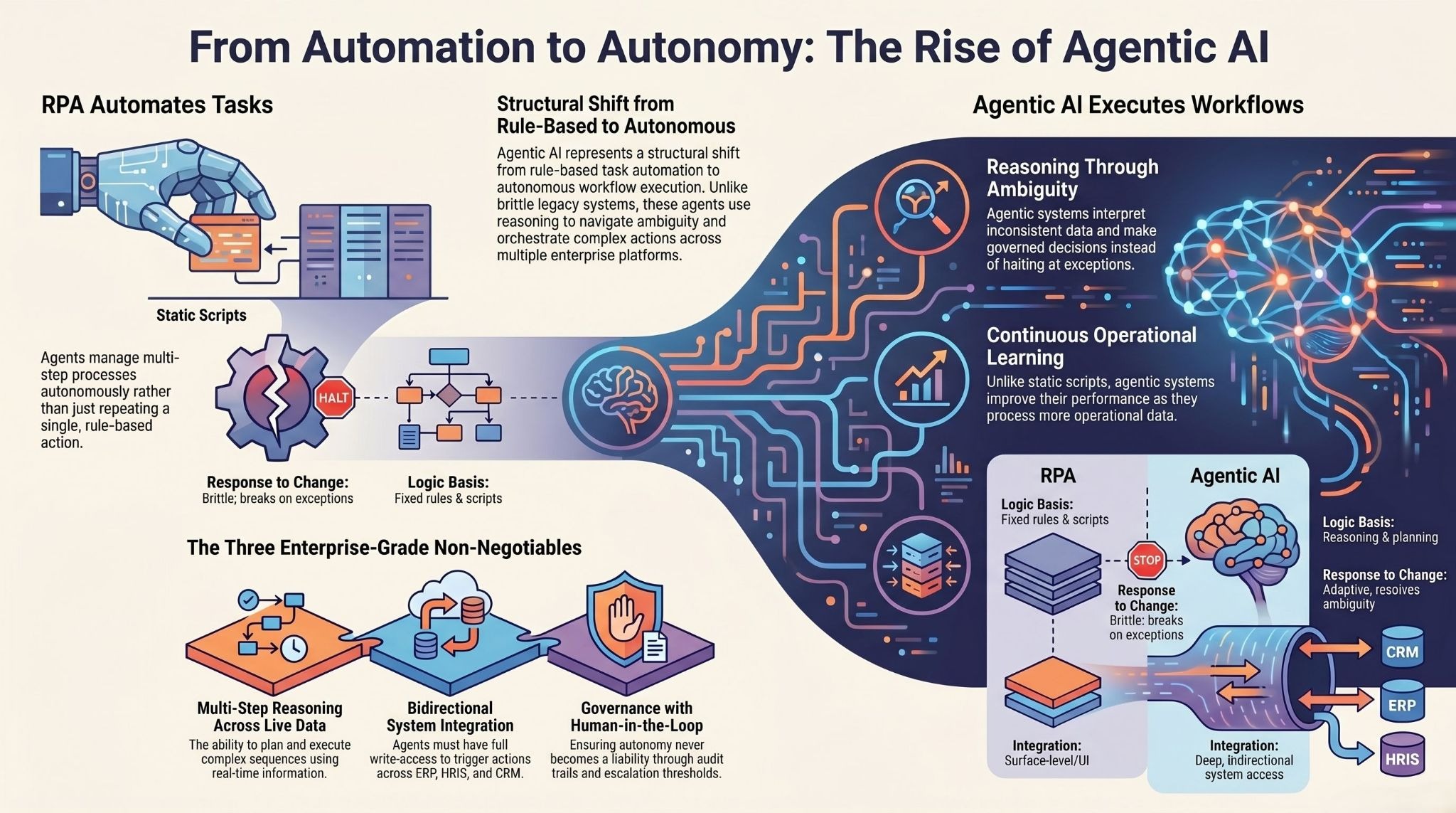
Agentic AI for business operations refers to AI systems that can plan, reason, execute multi-step workflows, and adapt to changing conditions — autonomously, across multiple enterprise systems — with minimal human intervention.
That definition matters because it distinguishes agentic AI from two technologies that operations teams have already lived with:
Robotic Process Automation (RPA) automates rule-based, structured tasks. It does exactly what it is programmed to do and breaks the moment an exception appears. It is fast, but brittle.
Chatbots and copilots answer questions and assist users. They do not act. A chatbot can tell you a vendor invoice is overdue. An agentic AI system can identify the discrepancy, flag it against contract terms, route it for approval, generate the corrective entry, and close the task — all without a human initiating each step.
The practical difference: RPA automates a task. Agentic AI executes a workflow.
From Rule-Based Automation to Autonomous Reasoning Agents
The shift from RPA to agentic AI is structural. Agentic systems:
- Reason through ambiguity — they interpret incomplete or inconsistent data and make governed decisions, rather than halting on exceptions
- Orchestrate across systems — a single agent can pull from your ERP, query your HRIS, trigger a Salesforce update, and notify the relevant team in Slack within a single workflow execution
- Learn from outcomes — unlike static scripts, agentic systems improve as they process more operational data
- Operate with human-in-the-loop controls — approvals, escalation thresholds, and compliance guardrails can be defined at the governance level, so autonomy never becomes a liability
Key Capabilities That Matter for Operations Leaders
For COOs evaluating an agentic AI platform, four capabilities are non-negotiable: multi-step reasoning across live data, bidirectional system integration (not just read access), audit trail generation for every decision, and role-based access controls that satisfy compliance requirements. Platforms that lack any of these four are not enterprise-grade, regardless of how their marketing frames it.
Why Business Operations Are the Highest-ROI Deployment for Agentic AI
Operations teams sit at the intersection of every business function. Finance, HR, procurement, supply chain, customer service, and IT all converge in the COO's purview — and all of them share two characteristics that make agentic AI unusually effective:
High transaction volume. The more transactions flow through a workflow, the faster agentic automation compounds value. A system handling 10,000 invoice approvals per month delivers proportionally more ROI than one handling 500.
Structured, repeatable workflow logic. Operations processes follow rules. Approval thresholds, SLA windows, compliance checkpoints, escalation paths — these are exactly the conditions that allow an agentic system to act with confidence and produce auditable outputs.
The industries seeing the sharpest ROI from agentic AI — financial services, logistics, healthcare administration, retail, and energy — share both traits. Their operations are high-volume, rule-governed, and deeply dependent on cross-system coordination.
Market Signals That Confirm This Direction
Gartner predicts that by the end of 2026, over 40% of enterprise applications will embed role-specific AI agents. According to the G2 2025 Enterprise AI Agents Report, 57% of companies already have AI agents in production, and 78% plan to increase agent autonomy within the year. The agentic AI market is growing at a 61.5% CAGR.
These are not projections about the future. They describe the competitive environment that operations leaders are navigating right now.
Agentic AI for Finance Operations
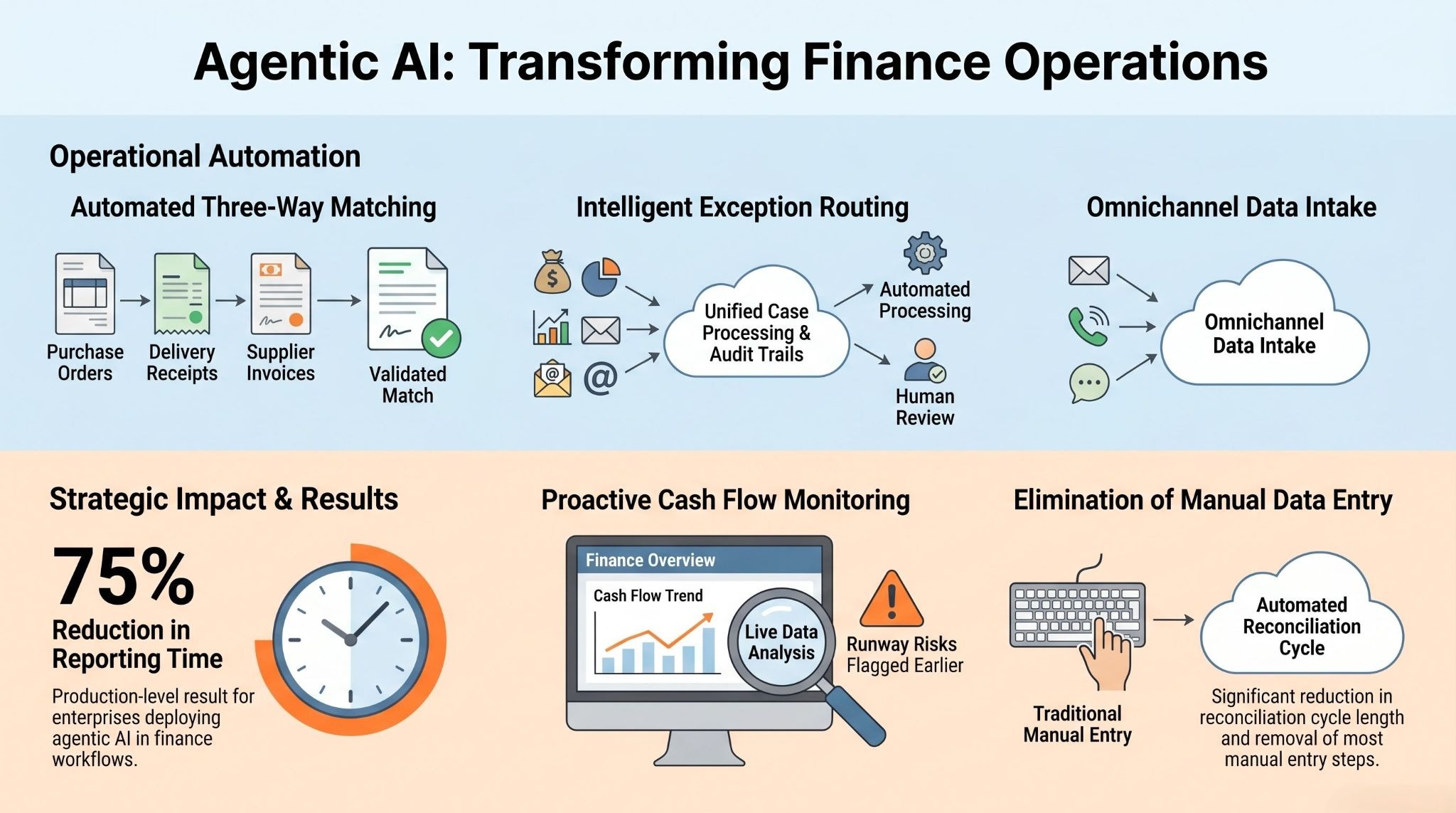
Finance operations are the single most common first deployment for enterprise agentic AI — and for good reason. The workflows are rule-dense, the data is structured, and the cost of errors is measurable.
Automated Reconciliation, Invoice Processing, and Three-Way Matching
Manual reconciliation is slow, error-prone, and deeply resistant to scale. An agentic AI system handles the full cycle: ingesting bank statements, cross-referencing against purchase orders and goods receipts, flagging mismatches, generating corrective entries, and routing exceptions for human review — all within the same workflow.
In a production deployment at a global fintech organization, agentic AI automation of reconciliation and dispute management delivered a measurable reduction in manual processing time and improved auditability across compliance workflows. The system was built to handle omnichannel intake — chat, email, and phone — routing cases automatically and generating audit trails at every decision point.
Three-way matching, which traditionally required analysts to manually compare purchase orders, delivery receipts, and supplier invoices, is another high-value automation target. Agentic systems process these in real time, apply contract terms as governance rules, and escalate only genuine exceptions — reducing the total manual review queue by the significant majority of cases.
Cash Flow Monitoring, Forecasting, and Anomaly Detection
For finance teams managing cash flow across multiple entities, the visibility problem is often more costly than the execution problem. By the time a dashboard surfaces a cash risk, the window for intervention has frequently closed.
Agentic AI changes this by running continuous monitoring against live financial data. One deployment at a global fintech provider brought together cash flow forecasting, anomaly detection, and proactive alerting — effectively delivering CFO-level insight without adding headcount. The system flagged runway risks and variance anomalies earlier than the prior manual reporting cycle could, allowing leadership to act on signals rather than react to events.
Practical Outcome to Set Expectations
Enterprises deploying agentic AI for finance operations consistently report outcomes in the range of 75% reduction in reporting time, significant reduction in reconciliation cycle length, and the elimination of most manual data-entry steps. These are not theoretical projections — they are production results from organizations operating at enterprise scale.
Ready to see how this applies to your finance workflows? Explore the assistents.ai COO platform →
Agentic AI for HR Operations
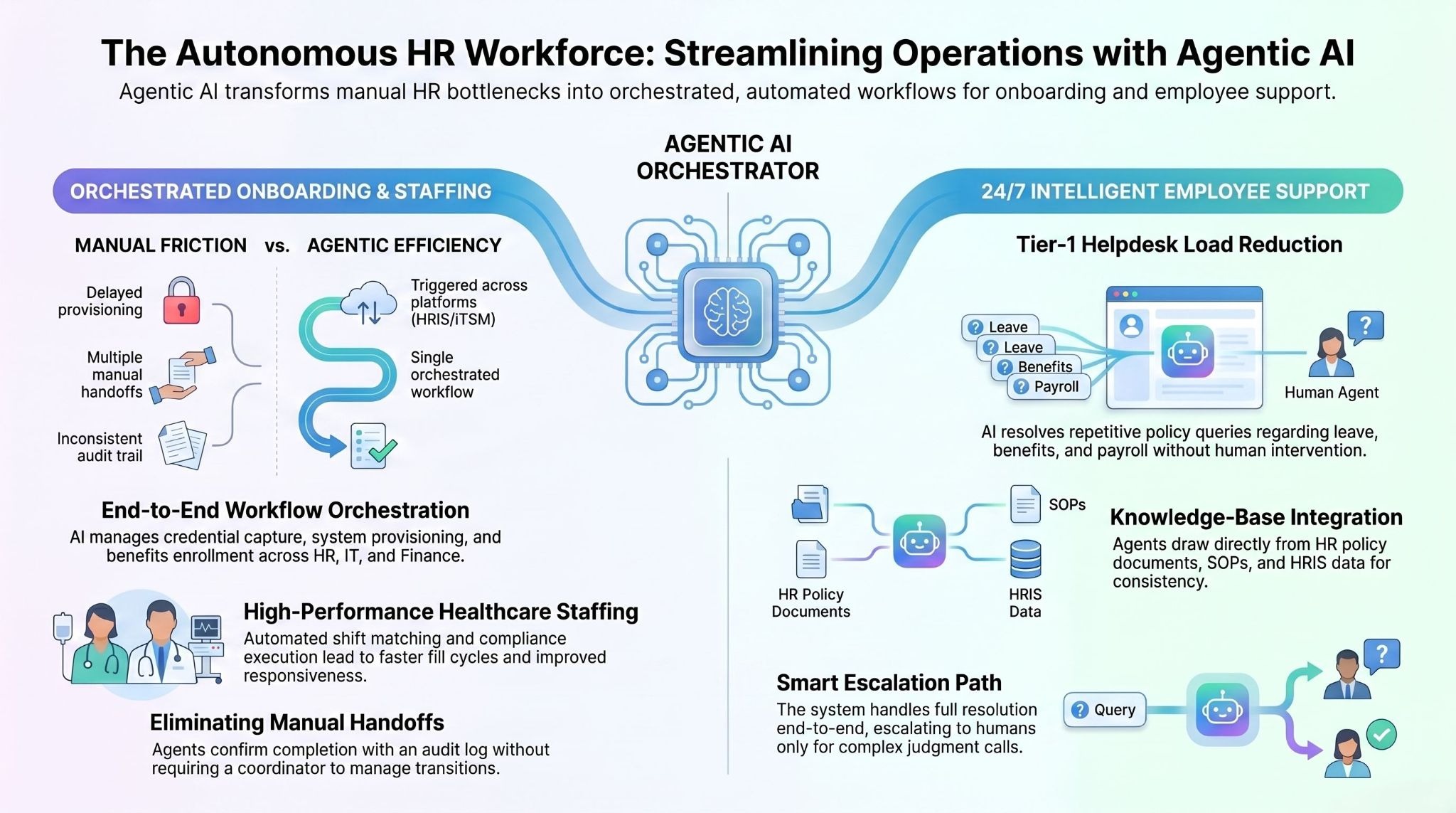
HR operations are process-heavy in ways that are often invisible until they create problems. Onboarding a new employee involves credential capture, system provisioning, policy acknowledgement, equipment requests, benefits enrollment, and access management — across HR, IT, facilities, and finance — before the employee's first day. Doing this manually, at scale, generates delays, errors, and a consistently poor new-hire experience.
Onboarding Automation, Credential Capture, and Scheduling
Agentic AI handles the full employee onboarding sequence as an orchestrated workflow. The agent captures credentials from offer documents, triggers system provisioning across connected platforms (HRIS, ITSM, directory services), routes benefits enrollment forms, schedules mandatory training, and confirms completion with an audit log — without a single HR coordinator manually managing handoffs.
In a production deployment for a healthcare staffing platform connecting nursing professionals with facilities, agentic AI managed the complete talent onboarding pipeline: credential capture, facility staffing request intake, shift matching, scheduling, compliance workflow execution, and reporting on fill rates and utilisation. The result was faster fill cycles, lower scheduling friction, and improved staffing responsiveness — precisely the outcomes that differentiate high-performing healthcare staffing operations from the rest.
24/7 Employee Support Agents Replacing Tier-1 Helpdesk Load
HR helpdesks handle enormous volumes of repetitive policy queries — leave balances, benefits questions, payroll discrepancies, IT access issues — that do not require human judgment but consume substantial HR team capacity when handled manually.
An agentic AI support agent resolves these queries by drawing from connected knowledge bases (HR policy documents, SOPs, HRIS data) and handling the full resolution workflow end-to-end. It escalates to a human only when the query genuinely requires it. In retail deployments, this model has reduced manual helpdesk burden measurably while improving response consistency and enabling faster onboarding of new staff through on-demand training guidance.
See how operations leaders are deploying HR automation at scale. Schedule a COO briefing →
Agentic AI for Supply Chain and Logistics Operations
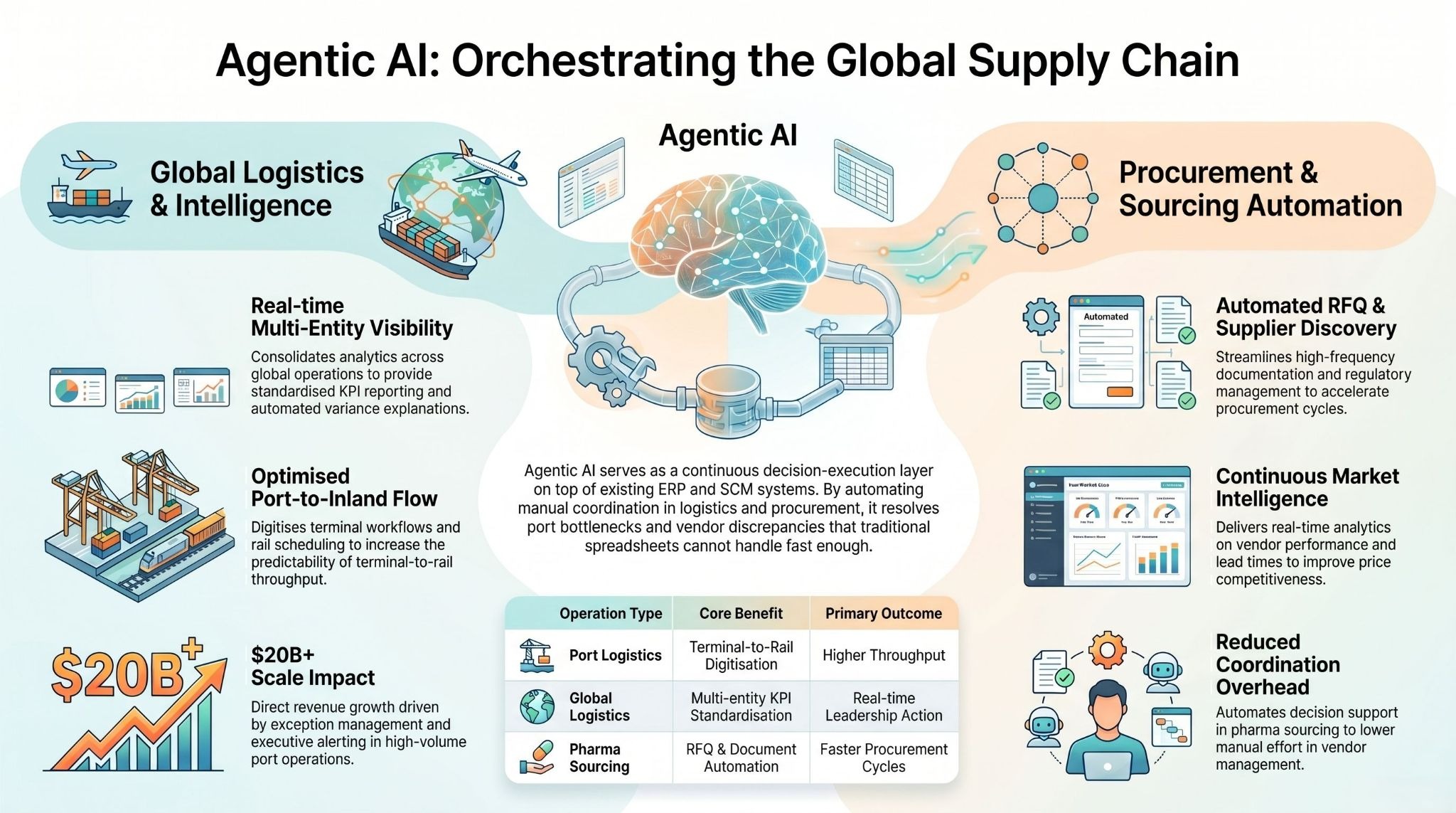
Supply chain operations are where the cost of manual coordination becomes most visible. A delayed shipment, a supplier discrepancy, a port bottleneck — each generates a cascade of downstream effects that a human team managing spreadsheets and email chains cannot resolve fast enough to prevent revenue impact.
Demand Forecasting, Inventory Intelligence, and Vendor Coordination
Agentic AI systems in supply chain operate as continuous monitoring and decision-execution layers on top of existing ERP and SCM systems. They do not replace SAP or Oracle — they make those systems actionable.
A production deployment at an Indian multinational logistics company spanning operations across India, the UK, and the US consolidated analytics across multi-entity global operations, delivering a single operational view that leadership could act on in real time. The system standardised KPI reporting across entities, surfaced variance explanations automatically, and reduced the manual effort required to produce leadership reporting by a significant margin.
For a global ports and logistics operation reporting record revenue exceeding $20 billion for FY2024, agentic AI was deployed to digitise and optimise port-to-inland logistics operations — covering terminal workflow digitisation, yard and rail operational dashboards, rail scheduling and visibility, exception management, and executive alerting. The impact was higher predictability of terminal-to-rail throughput and more efficient coordination across the logistics chain — outcomes that at that scale translate directly into revenue.
Vendor Procurement and RFQ Automation
Sourcing and procurement are high-frequency, documentation-heavy processes that benefit directly from agentic orchestration. In a pharma sourcing deployment, agentic AI automated RFQ processing, supplier discovery, and procurement decision support — handling quality and regulatory document management and delivering analytics on pricing, lead times, and vendor performance. The result: faster procurement cycles, reduced vendor coordination overhead, and better price competitiveness through continuous market intelligence.
Want to see the full supply chain use case library? Explore all COO use cases →
Agentic AI for Customer Operations and Service
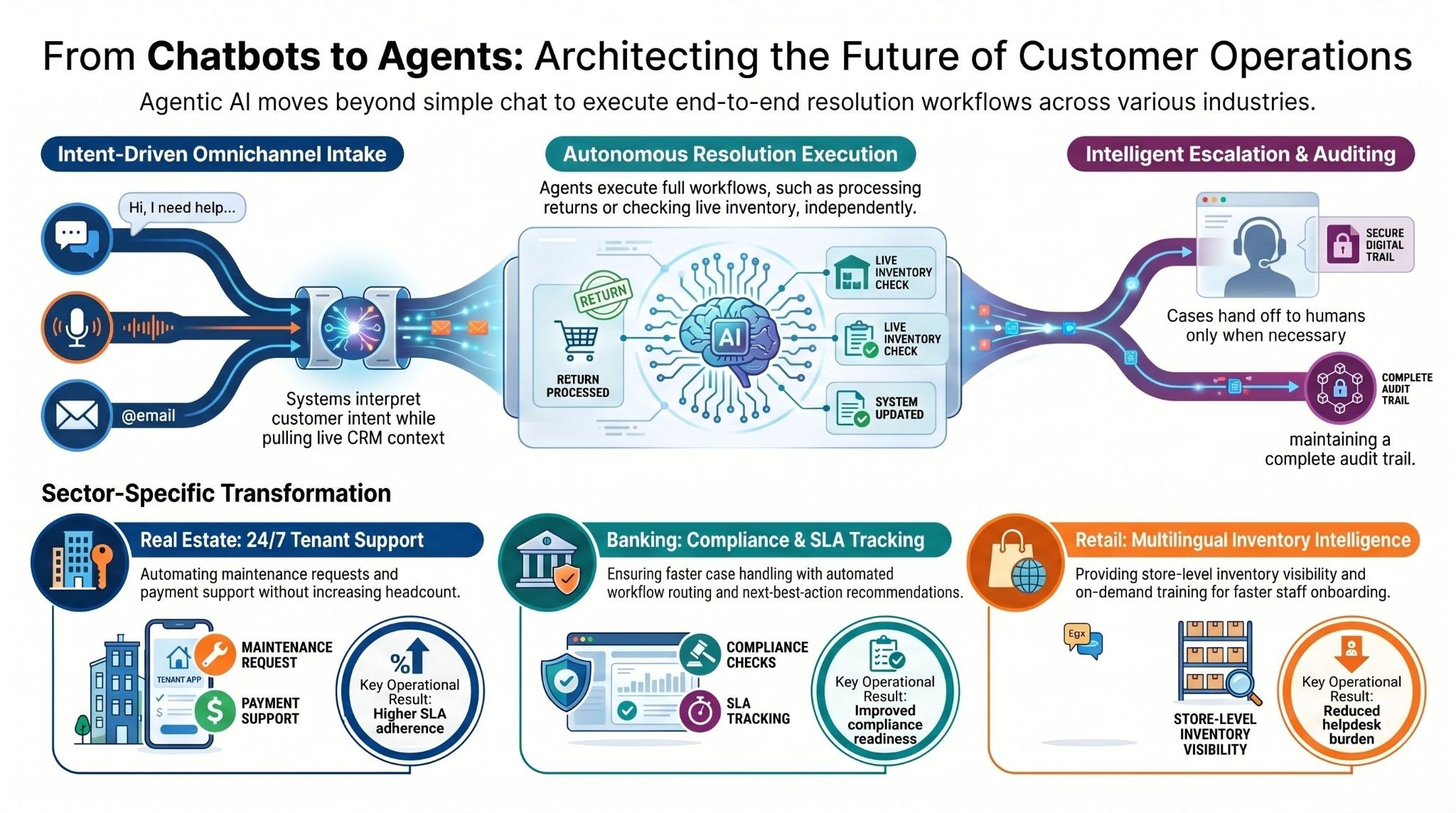
Customer operations sit at the intersection of revenue and reputation. How quickly and consistently an organisation responds to customer queries — across channels, time zones, and interaction types — determines customer lifetime value in ways that are difficult to recover once eroded.
Omnichannel Intake, Triage, and Intelligent Escalation
Agentic AI systems handle the full first-response and triage layer of customer operations — across chat, email, WhatsApp, voice, and web — without requiring a human agent for every interaction. They interpret customer intent, pull context from connected CRM and order management systems, resolve queries within defined policy rules, and escalate to a human only when the situation genuinely requires it.
This is not a chatbot sitting in front of a knowledge base. The agentic system executes the resolution workflow end-to-end: checking order status against live inventory, processing return requests against policy, updating the CRM record, and sending the customer a confirmation — all within a single interaction.
A banking and financial services deployment built omnichannel AI agents handling customer support with full auditability — intake, workflow routing, agent-assist summarisation, next-best-action recommendations, and SLA monitoring. The result was faster case handling, reduced operational load via automation, and improved compliance readiness through complete audit trails.
Real Estate and Retail: 24/7 Support at Scale
In real estate, where tenant queries span lease questions, maintenance requests, payment support, and move-in coordination, agentic AI delivers 24/7 availability without a proportional increase in support headcount. A deployment for a major UAE real estate portfolio owner automated tenant query triage, FAQ resolution, rental and payment support workflows, and escalation to human teams — delivering faster response times, lower call-centre load, consistent 24×7 tenant experience, and better SLA adherence through automated routing and tracking.
For national retail operations, voice support agents (operating in multiple languages), inventory intelligence agents, and knowledge and training agents have been deployed together — reducing manual helpdesk burden, improving store-level inventory visibility, and enabling faster staff onboarding through on-demand training guidance.
Agentic AI for Network, Security, and Infrastructure Operations
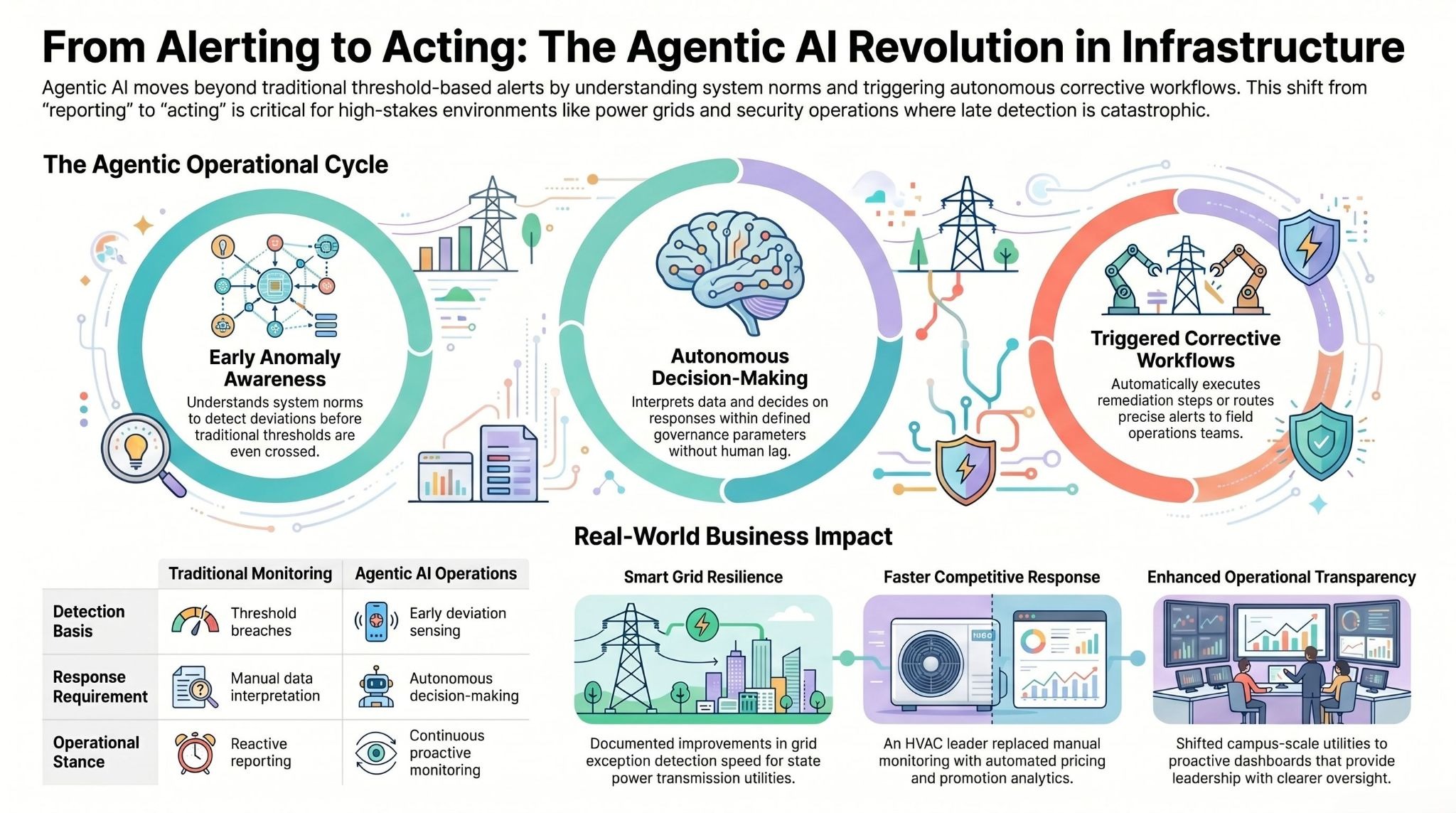
Network operations, security operations, and infrastructure monitoring are domains where the cost of late detection is catastrophic. An SLA breach, a grid outage, a security anomaly that goes undetected for hours — the consequences compound faster than any human monitoring team can respond.
Proactive Anomaly Detection, Alerting, and Auto-Remediation
Agentic AI systems in infrastructure operations work differently from traditional monitoring tools. They do not simply alert when a threshold is crossed — they understand what normal looks like for a given system, detect deviations early, route the right alert to the right team, and in more advanced configurations trigger a corrective workflow automatically.
The distinction between alerting and acting is the core value proposition here. An alert requires a human to interpret it, decide on a response, and execute that response. An agentic system does all three — within defined governance parameters.
For a major Indian HVAC company competing in price-sensitive markets, agentic AI was deployed for competitive monitoring — continuously tracking pricing, promotions, availability, and ratings across channels, mapping gaps against leadership questions, and delivering analytics views for pricing threats and portfolio movement. The business impact was faster competitive response cycles and earlier identification of pricing gaps — replacing what had previously been manual monitoring across portals.
Smart Grid Monitoring: From Reactive to Continuous Agentic Operations
In energy and utility operations, the stakes of reactive monitoring are particularly high. A transmission anomaly that is detected after the fact is a reliability failure. Detecting it as it develops is an operational advantage.
In two separate energy utility deployments — one at an Indian state power transmission utility and one at a campus-scale scientific research institute — agentic AI was deployed for smart grid data ingestion, operational dashboards, predictive analytics for outages and losses, automated alerts, and workflow routing for field operations resolution. Both deployments shifted operations from reactive reporting to continuous proactive monitoring — with documented improvement in grid exception detection speed and operational transparency for leadership.
Agentic AI for Data and Database Operations
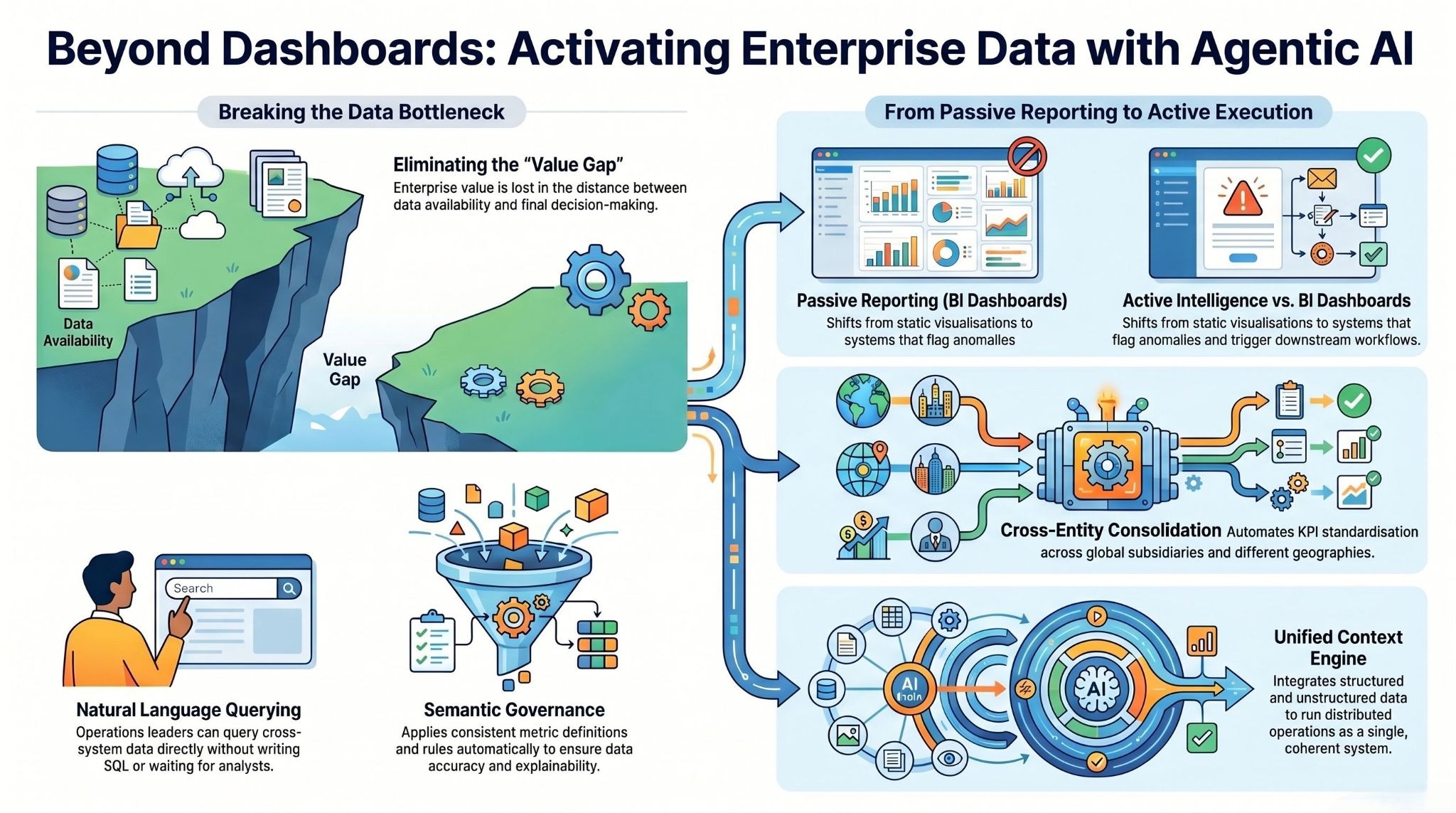
Data operations are the invisible bottleneck of most enterprise organisations. Every team is generating data. Very few teams can access it, interpret it, and act on it fast enough to matter. The distance between data availability and decision-making is where most enterprise value is lost.
Natural Language Query, Semantic Governance, and Automated KPI Reporting
Agentic AI for data operations introduces a natural language interface to enterprise data — allowing operations leaders to query cross-system data without writing SQL or waiting for a BI analyst to build a report. The system interprets the question, identifies the relevant data sources, applies semantic governance rules for consistent metric definitions, and returns an answer with full explainability.
This is not a BI dashboard. It is an active intelligence layer that generates insight, flags anomalies, and can be configured to trigger downstream workflows when specific conditions are met.
In a retail holding environment, an agentic data analysis layer was deployed that converted dashboard insights into governed, auditable actions and tasks — shifting operations from passive reporting to active decision execution. The system provided a unified context engine across structured and unstructured data, applied a semantic governance layer for consistent definitions and formulas, and operated as an active orchestrator integrating with core systems.
Cross-Entity Analytics Consolidation at Enterprise Scale
For organisations operating across multiple entities — different geographies, subsidiaries, or business units — data consolidation is a persistent operational challenge. Agentic AI addresses this by standardising KPI definitions across entities, automating the consolidation process, and generating variance explanations automatically rather than requiring an analyst to produce them manually.
A global supply chain organisation used this approach to achieve a single operational view across entities, faster leadership reporting and issue identification, and improved consistency of operational metrics — the foundational capabilities that allow a COO to run a distributed operation as if it were a single, coherent system.
What Makes Enterprise-Grade Agentic AI Different from Off-the-Shelf Tools
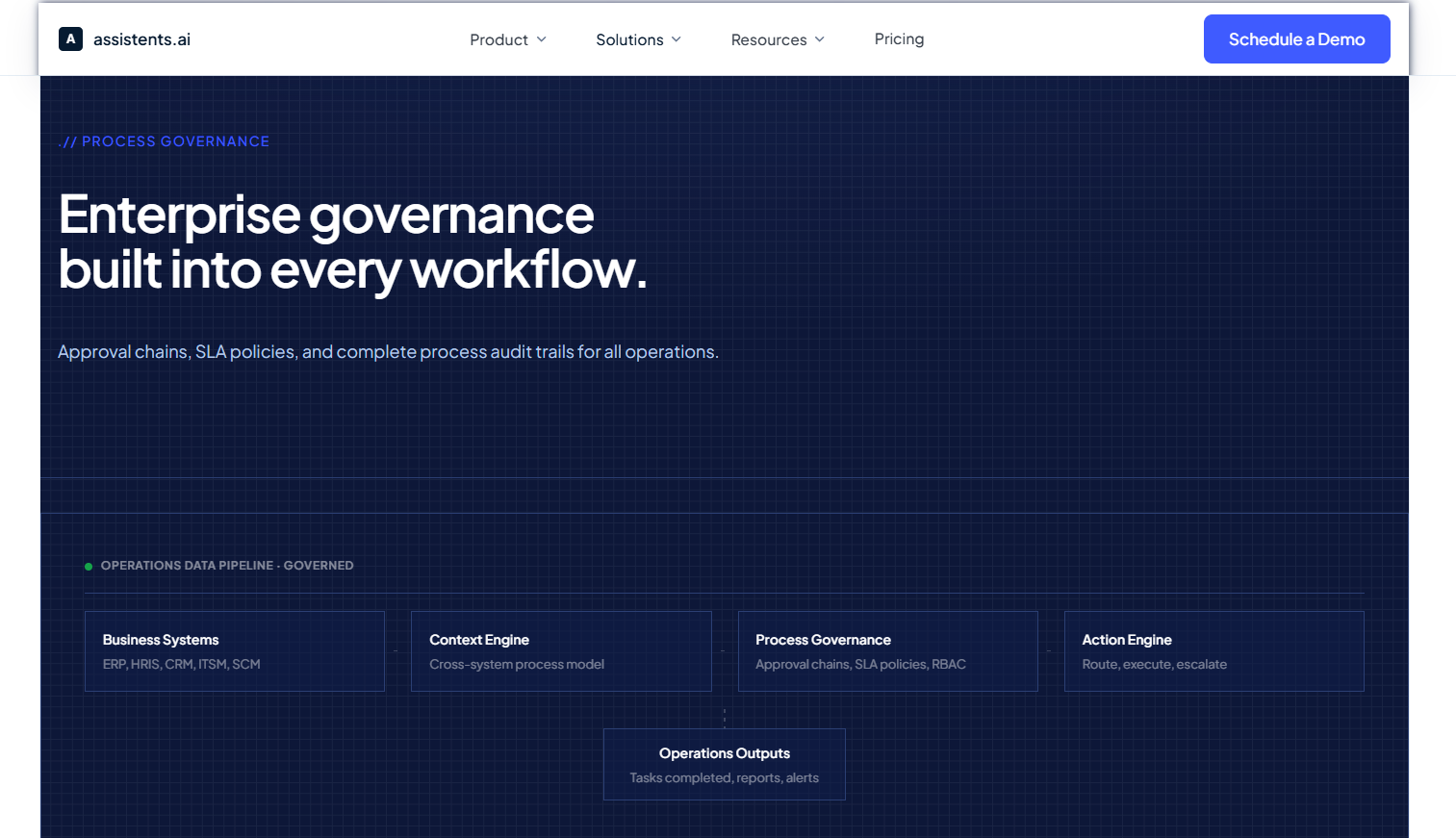
Not all agentic AI platforms are equal. The distinction that matters for enterprise operations is not the underlying model — it is the operational infrastructure surrounding it.
Governance, Compliance, and Auditability (SOC 2, HIPAA, GDPR, ISO 27001)
Enterprise operations involve regulated data, approval chains with legal standing, and compliance requirements that vary by geography and industry. An agentic AI system operating in healthcare must be HIPAA-compliant. One operating in financial services needs SOC 2 certification and GDPR-ready data handling. One touching HR data in the EU needs to operate within strict data residency requirements.
Platforms built for enterprise operations embed governance at the architecture level — not as an add-on. This means every agent action generates an audit log, every approval follows a defined escalation chain, every data access is role-governed, and every decision can be reviewed and explained after the fact.
The assistents.ai platform is built with SOC 2, GDPR, HIPAA, and ISO 27001 compliance baked into the operations layer — with on-premise deployment options for organisations that cannot send sensitive data to third-party cloud environments.
System-Agnostic Integration: SAP, Salesforce, ServiceNow, and 300+ Connectors
The most common failure mode for enterprise AI deployments is integration friction. A platform that works beautifully in a demo but requires six months of custom API work to connect to your actual systems is not enterprise-ready.
Agentic AI for business operations needs bidirectional access to the systems where work actually happens: SAP for finance and supply chain, Workday or BambooHR for HR, Salesforce and HubSpot for sales, ServiceNow and Jira for ITSM, and dozens of communication, analytics, and industry-specific platforms. assistents.ai connects to 150+ systems out of the box across ERP, HRIS, CRM, ITSM, supply chain, communication, and analytics categories — with open APIs for custom integrations.
The operational implication: you can go from selection to production in under four weeks, rather than the eight-to-twelve-week timelines typical of legacy enterprise AI deployments.
Human-in-the-Loop Controls vs Fully Autonomous Modes
Agentic AI does not need to operate in a binary choice between "fully automated" and "fully supervised." The most effective enterprise deployments use a spectrum of autonomy calibrated to the risk profile of each workflow.
A low-risk, high-volume task — like routing an intake request or generating a status update — can run fully autonomously. A higher-stakes decision — like approving a supplier contract above a defined threshold — can be configured to require human sign-off before execution. The governance layer defines these thresholds, and the agentic system operates within them.
This calibrated autonomy model is what allows COOs to deploy agentic AI with confidence rather than caution.
How to Deploy Agentic AI for Business Operations: A 4-Week Enterprise Framework
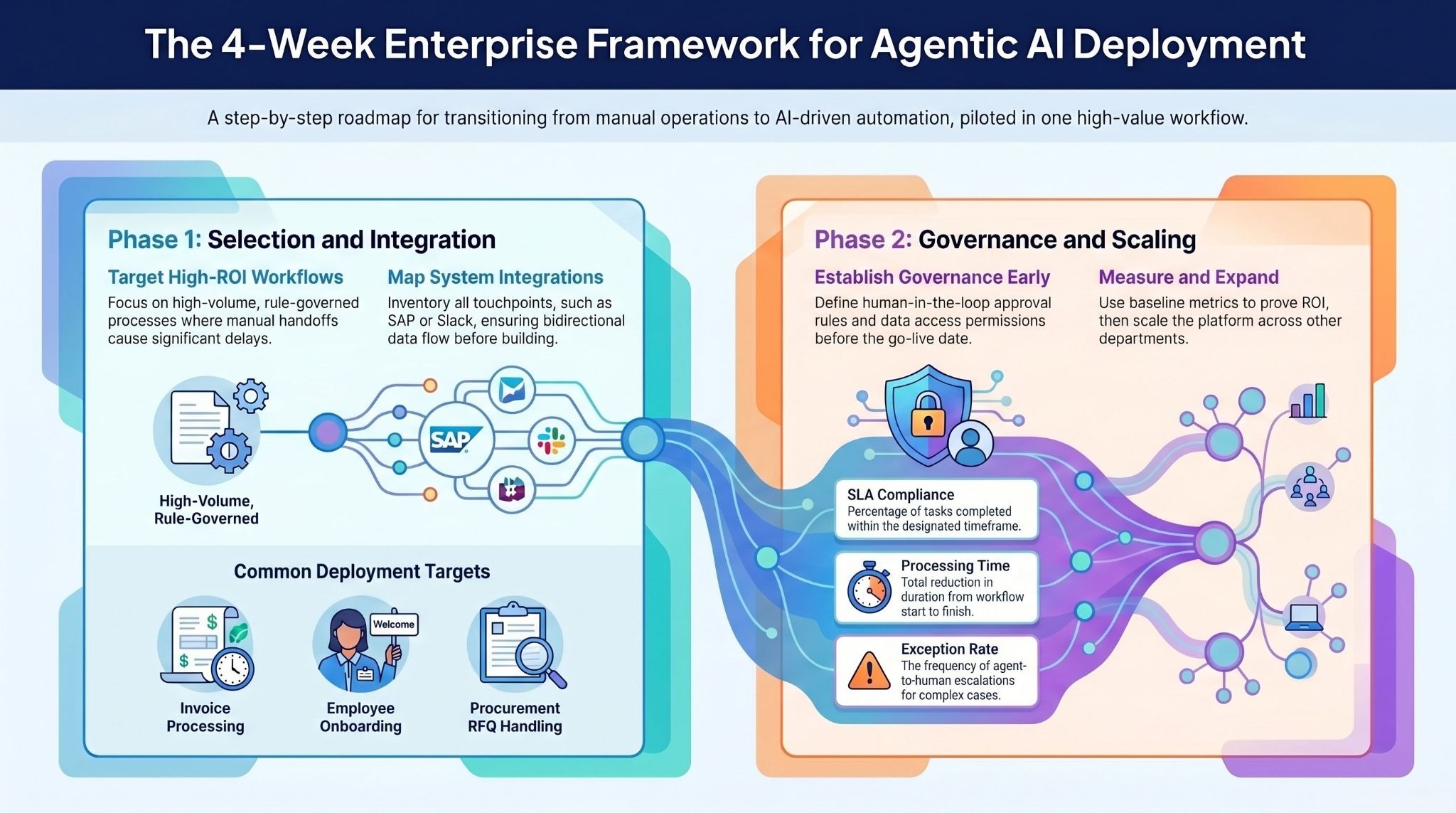
The most common mistake enterprises make when deploying agentic AI is starting too broadly. Trying to automate "all of operations" simultaneously is the fastest path to a failed pilot. The effective approach is to identify one high-value workflow, deploy it to production, measure the results, and use that success to build the internal case for expanding across departments.
Here is the framework used in successful deployments:
Step 1: Identify the Highest-ROI Workflow
Start by mapping your highest-volume, most rule-governed workflows. Ask: where does manual coordination create the most delay? Where do exceptions fall through the cracks most often? Where does a one-hour SLA regularly expand to four hours because of a handoff bottleneck? These are your first deployment targets.
Common starting points: invoice processing, employee onboarding, customer support triage, inventory exception management, procurement RFQ handling. All of these are high-frequency, structured, and deliver measurable before-and-after metrics.
Step 2: Map System Integrations and Data Sources
Before building anything, inventory the systems your target workflow touches. A finance automation workflow might span SAP, a bank reconciliation portal, a document management system, and Slack for approvals. Confirming bidirectional integration availability for each of these systems before deployment begins prevents the most common source of delays.
Step 3: Define Governance and Escalation Rules
Work with your legal, compliance, and IT security teams to define the governance parameters before deployment — not after. This includes: which decisions require human approval, what data the agent is and is not permitted to access, how long audit logs are retained, and under what conditions the agent should halt and escalate rather than proceed.
Getting governance right at the start is significantly less expensive than remediating it after a compliance review flags an issue in production.
Step 4: Measure, Iterate, and Expand Across Departments
Define your success metrics before go-live. Processing time reduction, SLA compliance rate, exception handling rate, manual steps eliminated — any of these work, but you need a baseline before deployment to make the measurement credible.
Once the first workflow is in production and delivering results, the expansion case builds itself. The same platform that automates invoice processing can be extended to manage HR onboarding, then procurement, then customer support — using the same governance infrastructure, the same integrations, and the same operational logic.
assistents.ai COO customers consistently reach production in under three weeks and expand to additional departments within the first quarter. Schedule a COO briefing to see the deployment timeline for your organisation →
The Bottom Line for Operations Leaders
Agentic AI for business operations is not a single product or a single use case. It is an operational infrastructure layer that, when deployed correctly, transforms how enterprises execute work across finance, HR, supply chain, customer operations, infrastructure, and data.
The organisations that are furthest ahead are not the ones that spent the most money. They are the ones that identified the right first workflow, deployed it to production quickly, measured the results rigorously, and expanded methodically. They now have agentic systems running in multiple departments — compounding efficiency gains, reducing headcount dependency on manual coordination, and freeing their operations teams to focus on what actually requires human judgment.
The competitive window for first-mover advantage in this space is narrowing. By the end of 2026, Gartner expects AI agents to be embedded in over 40% of enterprise applications. The question is not whether your organisation will use agentic AI for business operations. It is whether you will deploy it before your competitors do.
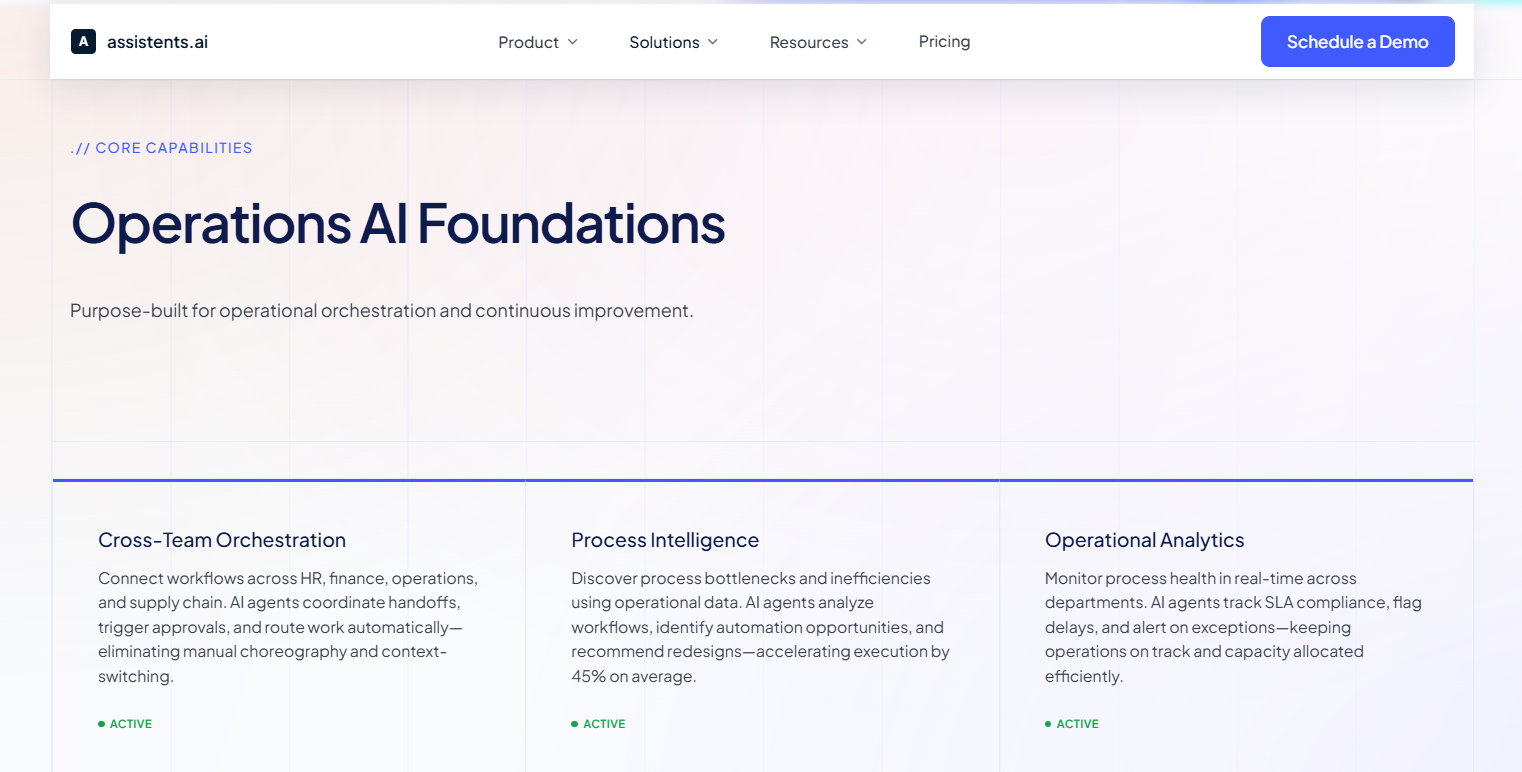
assistents.ai is built specifically for this deployment pattern — cross-functional, governance-first, production-ready in under four weeks. The COO platform connects 150+ enterprise systems, automates 60% of manual workflow steps on average, and delivers a 45% acceleration in cross-department execution cycles.
Schedule a COO Briefing → | Explore the ROI Calculator → | Download the Governance Playbook →
Frequently Asked Questions
What is the difference between agentic AI and RPA?
RPA (Robotic Process Automation) executes predefined, rule-based tasks on structured data and breaks when it encounters exceptions or changes in workflow. Agentic AI reasons through multi-step workflows, handles exceptions autonomously within defined governance rules, and integrates across multiple systems — making it significantly more resilient and capable than RPA for complex operational workflows. RPA is a script. Agentic AI is a reasoning system.
Which business operations benefit most from agentic AI?
The operations that see the highest ROI from agentic AI are those with high transaction volume, structured workflow logic, and significant cross-system coordination requirements. Finance operations (reconciliation, AP processing, cash flow monitoring), HR operations (onboarding, helpdesk, scheduling), supply chain and logistics, customer operations, and infrastructure monitoring are the most common high-value deployment areas.
How long does it take to deploy an agentic AI platform for enterprise operations?
With a platform built for enterprise integration, production deployments typically take two to four weeks for an initial workflow. This assumes the system integrations are standard (SAP, Salesforce, ServiceNow, Workday, and similar) and governance parameters are defined before build begins. Custom integrations or highly regulated environments may extend this timeline. assistents.ai COO customers go live in under three weeks on average.
Is agentic AI secure and compliant for regulated industries?
Enterprise-grade agentic AI platforms are built with compliance baked into the architecture — not bolted on as a feature. This includes SOC 2 Type II certification, GDPR-compliant data handling, HIPAA compliance for healthcare deployments, ISO 27001 certification, and role-based access controls that govern what data each agent can access and what actions it can execute. On-premise deployment options are available for organisations that cannot send sensitive operational data to third-party cloud environments.
What is the difference between agentic AI and a chatbot?
A chatbot responds to queries. It produces text. An agentic AI system executes workflows. It takes actions across connected systems, coordinates multi-step processes, routes approvals, handles exceptions, and generates audit trails — autonomously, without a human initiating each step. The difference is not cosmetic. It is the difference between a tool that informs and a system that operates.

Transform Your Business With Agentic Automation
Agentic automation is the rising star posied to overtake RPA and bring about a new wave of intelligent automation. Explore the core concepts of agentic automation, how it works, real-life examples and strategies for a successful implementation in this ebook.
Sarfraz Nawaz is the CEO and founder of Ampcome, which is at the forefront of Artificial Intelligence (AI) Development. Nawaz's passion for technology is matched by his commitment to creating solutions that drive real-world results. Under his leadership, Ampcome's team of talented engineers and developers craft innovative IT solutions that empower businesses to thrive in the ever-evolving technological landscape.Ampcome's success is a testament to Nawaz's dedication to excellence and his unwavering belief in the transformative power of technology.

More insights
Discover the latest trends, best practices, and expert opinions that can reshape your perspective






.jpg)
Contact us

