
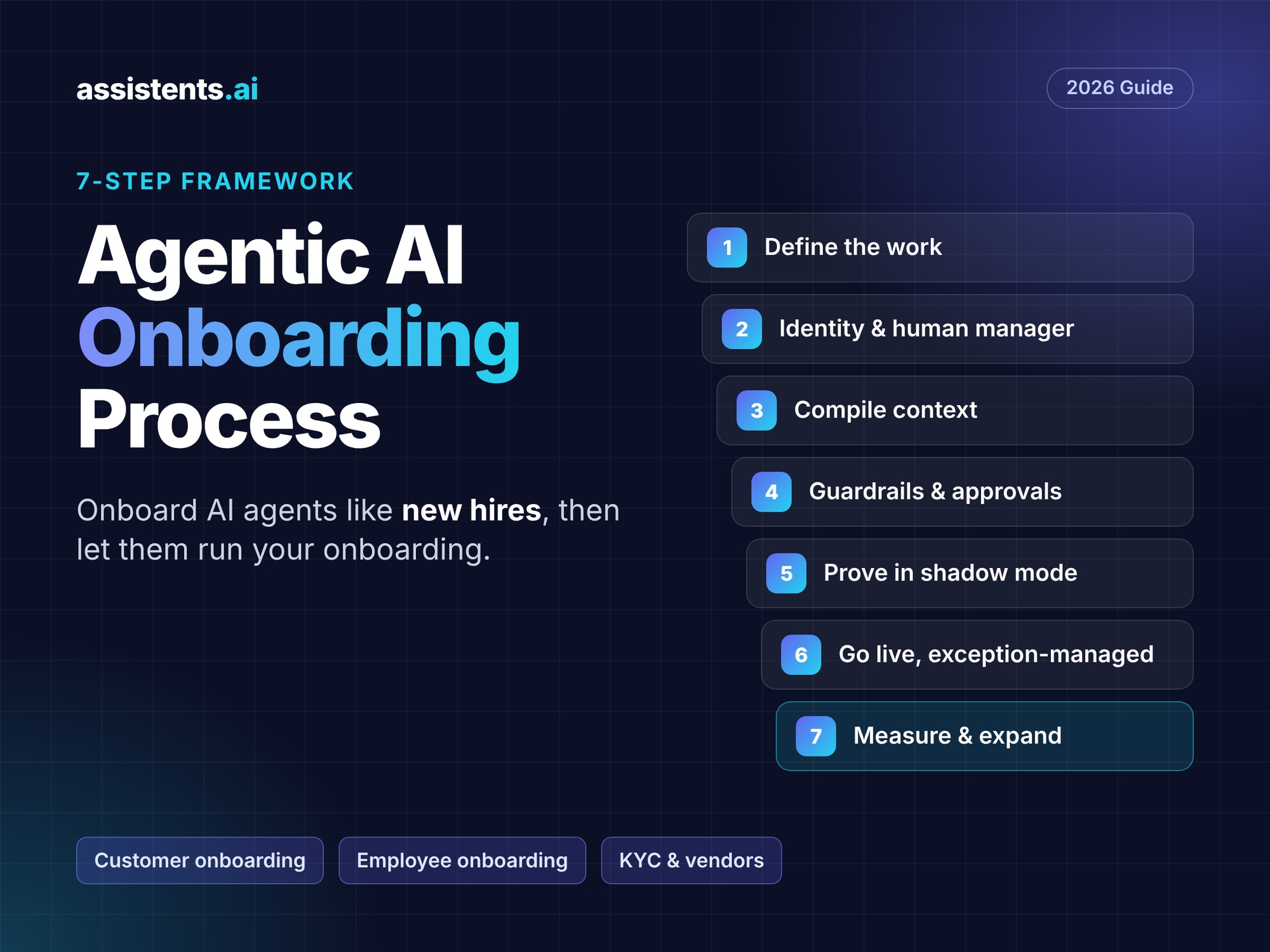
The Agentic AI Onboarding Process: How to Onboard AI Agents Like New Hires (and Let Them Run Your Onboarding)


Key takeaways
- The agentic AI onboarding process is how an enterprise makes an AI agent production-ready. It treats the agent like a new hire rather than a software install.
- It has 7 steps: define the work, give the agent an identity and a manager, compile its context, register its capabilities and guardrails, prove it in shadow mode, go live with exception-managed autonomy, and measure outcomes.
- Autonomy is earned. Agents move up an autonomy ladder only after they show results in replay and shadow testing.
- Once onboarded, agents are well suited to running onboarding itself: customer intake and KYC, employee and frontline training, talent credentialing, vendor and tenant onboarding.
- Assistents.ai by Ampcome is built to manage this whole lifecycle in one governed platform.
The agentic AI onboarding process is how an enterprise makes an AI agent production-ready, the way it would onboard a new hire. You define the agent's role and outcomes, give it an identity and a human manager, compile the context it needs, and register what it may do. Then you prove it in shadow mode and expand its autonomy as it earns trust.
Most teams skip this. They build an agent, connect it to a few APIs and switch it on. It works in the demo, then it stalls in production. Gartner predicts that over 40% of agentic AI projects will be cancelled by the end of 2027 because of rising costs, unclear business value and weak risk controls (SD Times). Most of these failures come from deploying agents like software instead of onboarding them like workers.
This guide covers the full 7-step agentic AI onboarding process, a 30-60-90 day rollout plan and the KPIs to track. It also shows how onboarded agents are changing customer, employee and vendor onboarding, with results from real Assistents.ai deployments.
What Is the Agentic AI Onboarding Process?
AI agent onboarding is the structured process of preparing an autonomous AI agent to do real work in an enterprise. It gives the agent a defined role, a verified identity, governed context, limited permissions, supervised testing and measurable outcomes, so the agent can act safely and its autonomy can grow over time.
A chatbot answers questions. An AI agent takes actions. It reads documents, updates systems, sends messages, raises tickets and approves or rejects cases. Because agents act, they need the same things a new employee needs before they touch customers or money: a job description, access rights, training, supervision and a performance review.
AI agent onboarding vs. software deployment vs. context engineering
These three terms get mixed up, but they solve different problems.
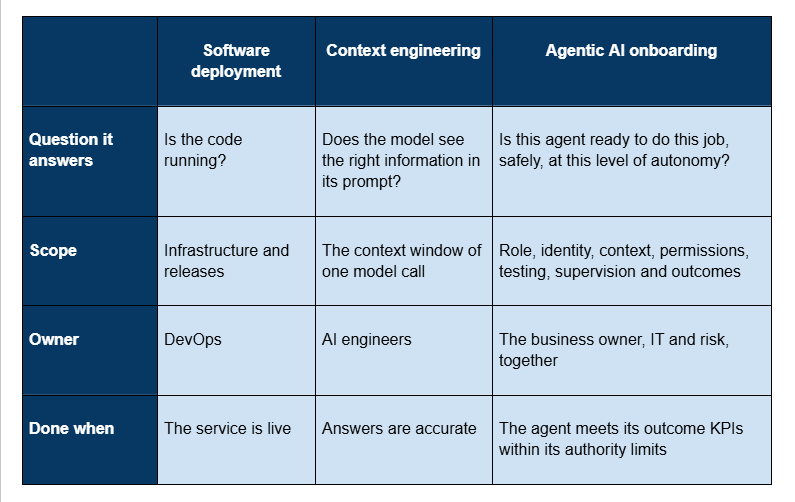
Context engineering is one part of onboarding (Step 3 below). It isn't the whole process. As DataHub notes, agents also need institutional knowledge, trust signals and feedback loops.
Why agent onboarding matters now
Enterprise AI is moving from copilots to a hybrid workforce. The first wave of generative AI drafted, summarised and searched. A human still started each task, checked the output and performed the action. The second wave is agentic. Agents are assigned work, call tools, wait for events, work with other agents and own longer-running outcomes.
The big platforms have noticed. Workday describes an agent system of record. Microsoft now treats agents as identities with lifecycle and audit controls. ServiceNow offers a control tower that inventories and governs agents. Workday's own guidance is blunt: deploying agents without onboarding them is a critical mistake.
Gartner expects that by 2028, 33% of enterprise software applications will include agentic AI and about 15% of day-to-day work decisions will be made autonomously (SD Times). If you plan to run hundreds of agents, you can't manage them as loose prompts and API keys. You need an onboarding process.
Onboarding an AI Agent vs. Onboarding a New Employee
The simplest way to design an AI agent onboarding process is to copy the one you already use for new hires, then make each step machine-enforceable.
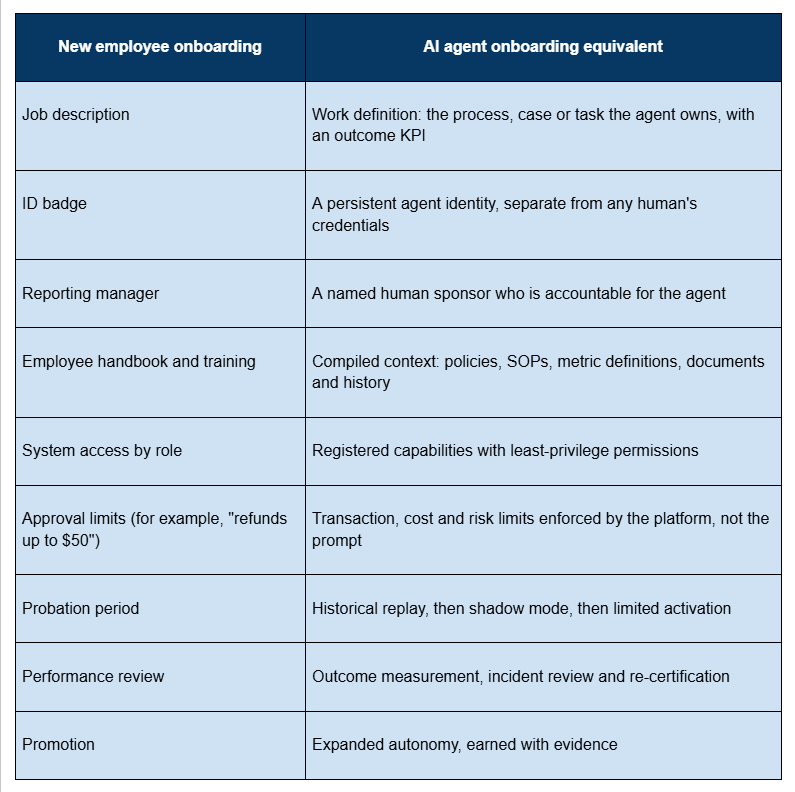
There is one big difference. A human remembers their training imperfectly but consistently. An agent can change overnight when its model, prompt or tools change. That is why AI agent onboarding includes re-certification. Every material change goes back through testing before it reaches production.
The 7-Step Agentic AI Onboarding Process
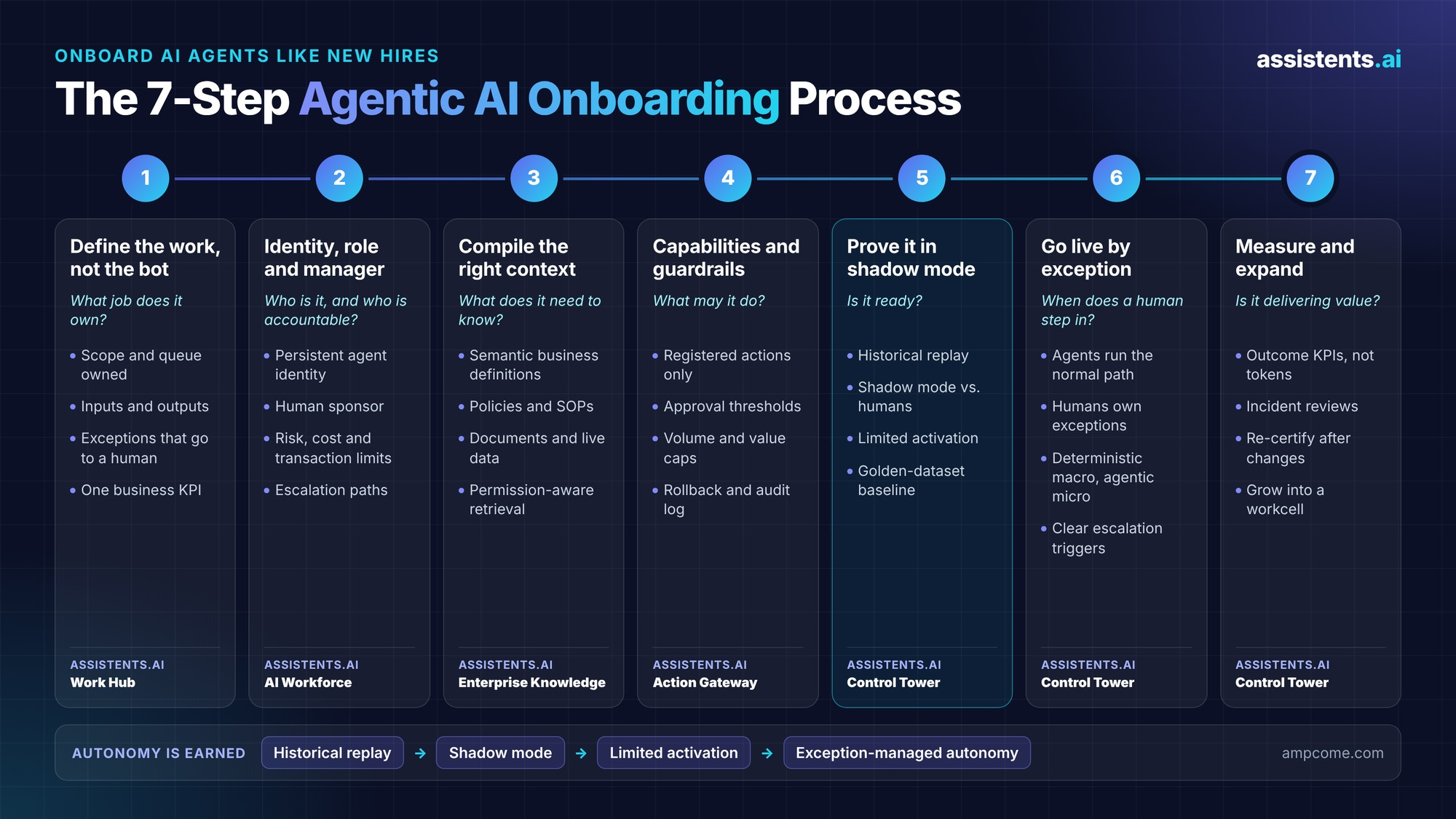
The 7-step agentic AI onboarding process: define the work, identity and manager, compile context, capabilities and guardrails, prove in shadow mode, go live, measure and expand Alt text: agentic AI onboarding process 7 steps infographic
Here is the framework we use with enterprises across retail, banking, healthcare, real estate, logistics and utilities. Each step answers one question that a risk officer, a CIO or a process owner will ask before an agent goes live.
Step 1: Define the work, not the bot
Start with the work the agent will own, not with the agent. A chat session is not a business process, and an agent run is not a business outcome. Every material activity should belong to a durable unit of work with an owner, a state, a deadline and a measurable result.
Write the agent's "job description" as a work definition:
- Scope: Which process, case type or queue does it own? (For example, "new tenant enquiries from web and WhatsApp.")
- Inputs: What triggers the work? An email, a form, a system event or a schedule?
- Outputs: What does "done" look like? A record created, a document filed, a customer notified?
- Exceptions: Which cases must go to a human, every time?
- Success metric: The one business KPI this agent moves, such as time to onboard, first-contact resolution or document processing time.
If you can't fill in all five, the use case isn't ready for an agent yet.
Step 2: Give the agent an identity, a role and a human manager
Every agent needs its own identity and an accountable human, just like every employee. An agent that borrows a human's login or a shared API key can't be audited, limited or switched off cleanly.
A production-ready digital worker has:
- An organisational role and purpose
- A persistent identity
- A human sponsor and manager
- Assigned responsibilities and operating hours
- Risk, cost and transaction limits
- Escalation paths
- Version and lifecycle controls
- A performance and incident history
The key principle is that authority must be computed, not asserted in a prompt. What an agent may do should come from its identity, its registered role, the human it acts for, the purpose of the task, its capability permissions, business policy and its risk budget. Telling the agent "only approve refunds under $50" in a prompt isn't enough. The platform has to enforce it.
Step 3: Compile its context, don't dump data on it
Give the agent the smallest authorised set of context it needs for the job, with provenance. Broad, direct access to every database and drive increases cost, data leakage and reasoning errors.
Good agent context includes:
- Business definitions: what "active customer", "gross margin" or "onboarding complete" means in your company, captured in a semantic layer so humans and agents use the same definitions
- Policies and SOPs: the rules a new hire would learn in week one
- Documents and history: contracts, past cases and prior conversations relevant to the task
- Current state: live data from CRM, ERP, HRIS or core systems
- Permissions: retrieval that respects who is allowed to see what
This is where most "the agent hallucinated" failures start. The agent wasn't wrong. It was given the wrong, stale or ungoverned context. For a deeper look at how agents use enterprise data, see our guide to AI agents for enterprise workflows.
Step 4: Register what it can do: capabilities, guardrails and approvals
A production action should never be an arbitrary tool call. It should be a registered business capability with rules around it.
For every action the agent can take, define:
- Typed inputs and preconditions: what must be true before the action runs
- Permissions: which agents and roles can call it
- Approval thresholds: when a human must sign off (for example, above a value limit or for a new customer segment)
- Limits: volume, value and cost caps per hour or per day
- Idempotency: running the action twice doesn't create two orders
- Verification and rollback: check the result, and undo it where possible
- Audit log: who (or what) did what, when, why, and under which policy
Example from a deployment: A UAE engineering and technology group replaced a legacy order-processing system with an agent that interprets order triggers, validates them and creates sales orders in SAP. The agent runs inside business rules for exceptions and approvals, and every order has an audit log and reconciliation report. The result was less manual order processing, a faster order-to-confirm cycle with fewer data-entry errors, and better auditability for every exception.
Step 5: Prove it with historical replay, shadow mode and limited activation
Autonomy is earned, not granted on day one. Before an agent acts on real customers or real money, it should pass three gates.
- Historical replay. Run the agent on past cases where you already know the right answer. Compare its decisions and outputs against what your team did.
- Shadow mode. The agent works on live cases in parallel with humans, but its actions aren't executed. It drafts and humans decide. You measure how often they agree.
- Limited activation. The agent acts for real, but only on a narrow slice, such as one region, one case type or low-value items, with human approval on every action at first.
Build a test set ("golden dataset") for this. Microsoft's ISE team, for example, tested agent onboarding against 2,370 scenarios and reported 98% Recall@5 and 95% agent invoke accuracy. Your numbers will differ, but the discipline is the same: no agent goes live without a measured baseline.
Workday suggests a similar probation period, with human approval on every action for the first 30 days, then spot checks as performance proves reliable.
Step 6: Go live with exception-managed autonomy
Agents should run the normal path inside a defined authority envelope. Humans define that envelope and handle the material exceptions.
There are two ways to get this wrong:
- Human approval on every step forever. This keeps the old bottleneck, and you pay for AI without getting the speed.
- Unrestricted autonomy. This creates risk that no compliance team will accept.
The working model is "deterministic macro, agentic micro." Durable workflows control process state, approvals, deadlines, retries and rollbacks. Agents make adaptive choices inside those steps, where reading, reasoning and judgement add value.
Define clear escalation triggers before go-live, such as low confidence, a policy conflict, a high-value transaction, a negative-sentiment customer, a regulated decision or a novel case type. For running agents at scale, see our guide to AI agent infrastructure management.
Step 7: Measure outcomes, re-certify and expand
Measure agents on business outcomes, not tokens or chat volume. Usage, calls and acceptance rates are secondary. The questions that matter are these. Did the work get done correctly? Did it follow policy? Did it create rework? Did cycle time fall? Did customers have a better experience?
Ongoing management includes:
- Outcome dashboards per agent and per process
- Incident review for every policy breach or escalation failure
- Re-certification whenever the model, prompt, tools or policies change
- Controlled learning: agents can propose improvements, but production changes go through evaluation and a governed release
Once an agent proves itself, expand it. One successful use case becomes an agentic workcell: a governed team of humans and agents that owns a full business operation and its results. Workcells then expand into adjacent processes.
Download: Agentic AI Onboarding Checklist (PDF). A one-page checklist covering all 7 steps, the readiness gates and the KPIs. Get the checklist →
The AI Agent Autonomy Ladder
The autonomy ladder defines how much an agent may do on its own, and it moves up only with evidence.
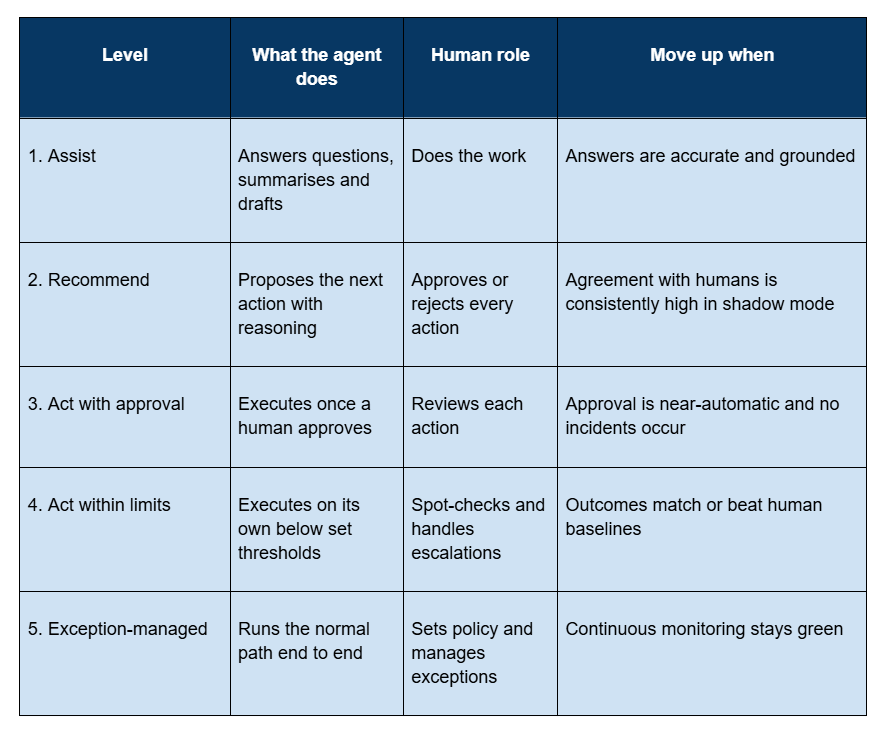
Autonomy can also move down. If error rates rise, policies change or a model is updated, drop the agent a level until it's re-certified.
Agentic AI Onboarding Timeline: A 30-60-90 Day Plan
Most enterprises can take one well-scoped agent from definition to limited production in about 90 days.
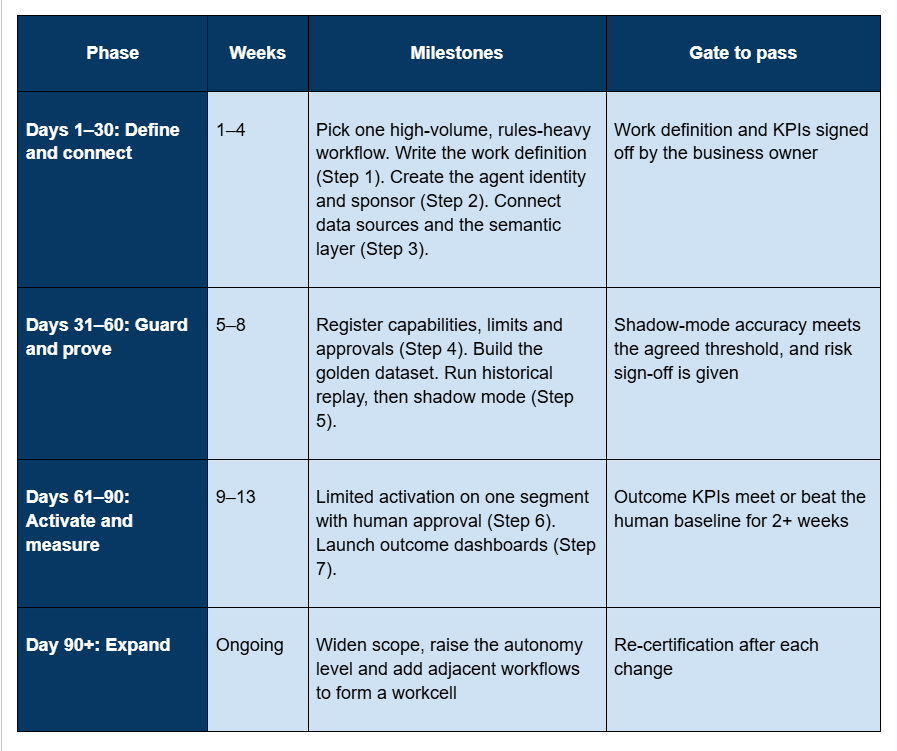
Start with one workflow. Starting with ten agents at once makes it impossible to tell which one is failing.
Why Assistents.ai Is Built for the Agentic AI Onboarding Process
Most agent platforms help you build an agent. Assistents.ai by Ampcome helps you onboard one and then manage it as part of your workforce. Each step of the agentic AI onboarding process maps to a part of the platform.
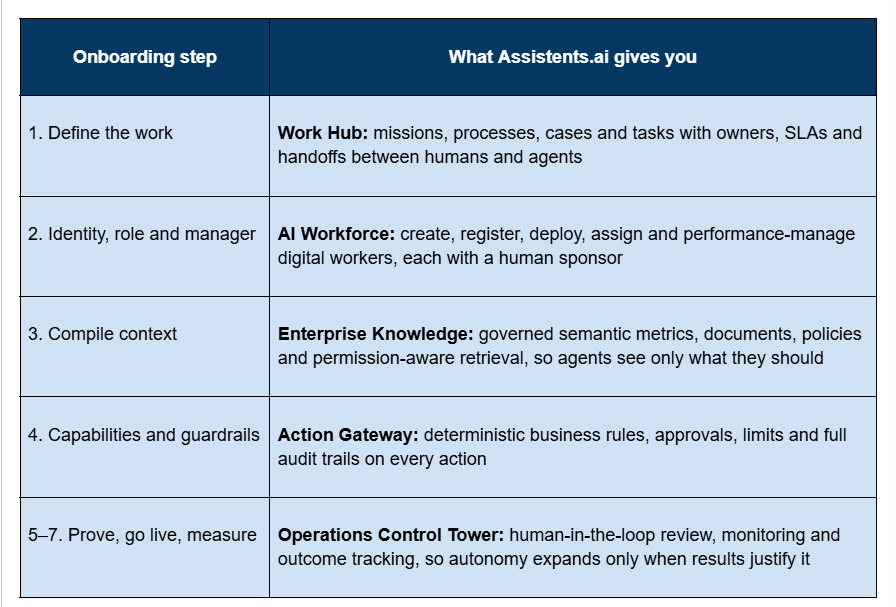
Assistents.ai also includes conversational analytics, multi-agent orchestration, workflow automation, a low-code app builder, document intelligence and voice agents. You can choose your model and deploy in your cloud or on-premises, so onboarding never locks you into one LLM vendor.
See an agent onboarded end to end. Book a 30-minute Assistents.ai demo →
How Agentic AI Transforms Your Onboarding Process
Once your agents are onboarded, the first job many enterprises give them is onboarding itself. Onboarding is a strong fit for agentic AI. It is high-volume and document-heavy, it spans several systems and it is full of back-and-forth. Rule-based automation and RPA struggle with this, because every customer, employee or vendor arrives with different documents, gaps and questions.
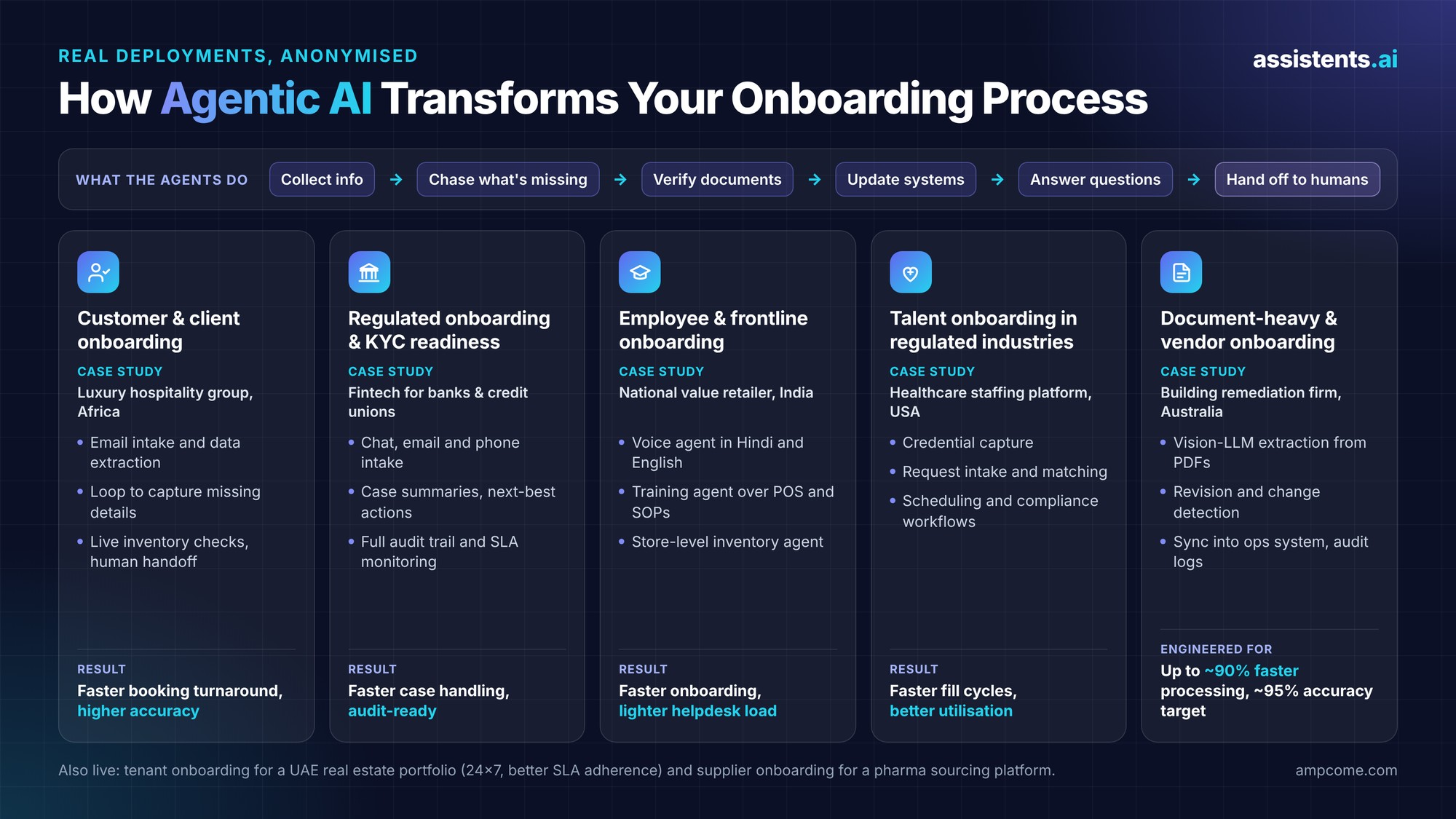
Agentic onboarding means AI agents that collect information, chase what's missing, verify documents, update systems, answer questions and hand off to people when judgement is needed. Here is how that looks in production, based on anonymised Assistents.ai deployments.
Customer and client onboarding: intake, verification and document collection
Agents turn unstructured enquiries into complete, verified records without endless email chains.
Case study: luxury hospitality group (Africa). A collection of safari lodges and camps serving high-expectation global travellers handled booking requests by email, with a lot of back-and-forth. Assistents.ai deployed a digital booking agent that:
- Reads incoming emails, classifies intent and extracts booking data
- Runs a conversational loop to capture missing details
- Checks real-time inventory and suggests alternative dates or properties
- Hands off to human specialists for curated itineraries
- Generates invoices and PDF documents automatically
Results: faster booking turnaround, less back-and-forth, higher accuracy on complex guest requirements, and the ability to scale without compromising luxury service.
Case study: global fintech provider for banks and credit unions. A provider of cloud-based automation for disputes, fraud and compliance needed consistent, auditable customer handling. Assistents.ai delivered omnichannel agents that take intake across chat, email and phone, route workflows, summarise cases for human agents and suggest next-best actions, with full auditability and SLA monitoring.
Results: faster case handling, more consistency, less operational load, and better compliance readiness through audit trails. For regulated onboarding such as KYC, this audit layer is what makes agentic AI acceptable to compliance teams. See how agents fit into agentic AI in finance.
Employee and frontline onboarding: training, knowledge and support
Agents give new hires instant, accurate answers in their own language, so they ramp up faster and helpdesks get fewer tickets.
Case study: national value retailer (India). A fast-growing retailer with stores across hundreds of cities needed to support a large frontline workforce. Assistents.ai deployed:
- A voice support agent in Hindi and English
- A knowledge and training agent that answers questions from POS manuals and SOPs using retrieval-augmented generation
- An inventory intelligence agent with store-level pricing, stock and promotions
- An admin console with analytics and ticketing integration
Results: faster onboarding through on-demand training guidance, less manual helpdesk work, faster store issue resolution and better store-level inventory visibility.
For HR teams, the same pattern covers IT provisioning, document collection, policy questions and 30/60/90-day check-ins. Explore AI agents for employee onboarding and our wider guide to agentic AI in HR.
Workforce and talent onboarding in regulated industries
In healthcare and other regulated sectors, onboarding speed depends on credentials and compliance, and agents handle both.
Case study: US healthcare staffing platform. A platform connecting nursing professionals with healthcare facilities for flexible shifts needed to onboard talent and fill shifts faster. Assistents.ai built an AI platform covering:
- Talent onboarding and credential capture
- Facility staffing request intake and matching logic
- Scheduling, notifications and compliance workflows
- Fill-rate and utilisation reporting
Results: faster fill cycles, less scheduling friction, better workforce utilisation and faster staffing response for facilities. Read more about AI agents in healthcare administration.
Document-heavy onboarding: tenders, contracts and vendor packs
Vision-capable agents read complex PDFs, extract data and sync it into core systems, which is often the slowest part of supplier and project onboarding.
Case study: Australian building remediation specialist. A waterproofing and remediation firm with more than 20 years in business was slowed down by complex tender documents. Assistents.ai deployed autonomous agents through an Intelligent Document Workbench with multi-agent orchestration. It covered:
- Tender retrieval, workflow determination and revision analysis
- Vision-LLM extraction from complex PDFs
- Deep integration with the operations system (full create, read, update and delete), quote locking and audit logs
Results: the system is engineered for up to ~90% faster tender document processing, with a ~95% extraction accuracy target for standard formats. It also reduces bid risk through revision and change detection and full auditability.
The same document pattern applies to supplier onboarding. A pharma sourcing platform used Assistents.ai agents for RFQ automation, supplier matching and quality and regulatory document handling. That led to faster procurement cycles and fewer manual follow-ups with vendors.
Tenant and member onboarding
Agents give every new tenant or member a consistent, 24×7 welcome, and route the complex cases to people.
Case study: UAE real estate portfolio owner. A major owner and manager of office, retail, industrial and residential assets across several emirates deployed an omnichannel customer service agent (web, WhatsApp and email). It handles tenant query triage, FAQs, rental and payment support, and escalation to human teams, using a knowledge base built on policies, tenancy documents and SOPs.
Results: faster response times, lower call-centre load, a consistent 24×7 tenant experience and better SLA adherence through automated routing and tracking. Compare platforms in our omnichannel AI agent guide.
Agentic onboarding results at a glance
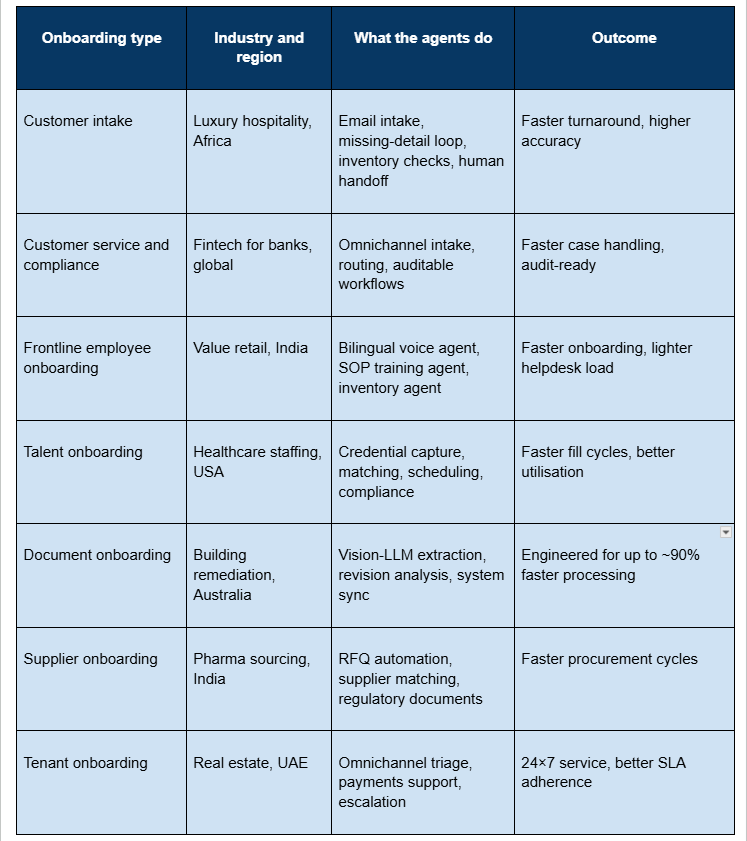
For more examples across functions, see 17 examples of AI agents in the autonomous enterprise.
Where Humans Still Belong in Agentic Onboarding
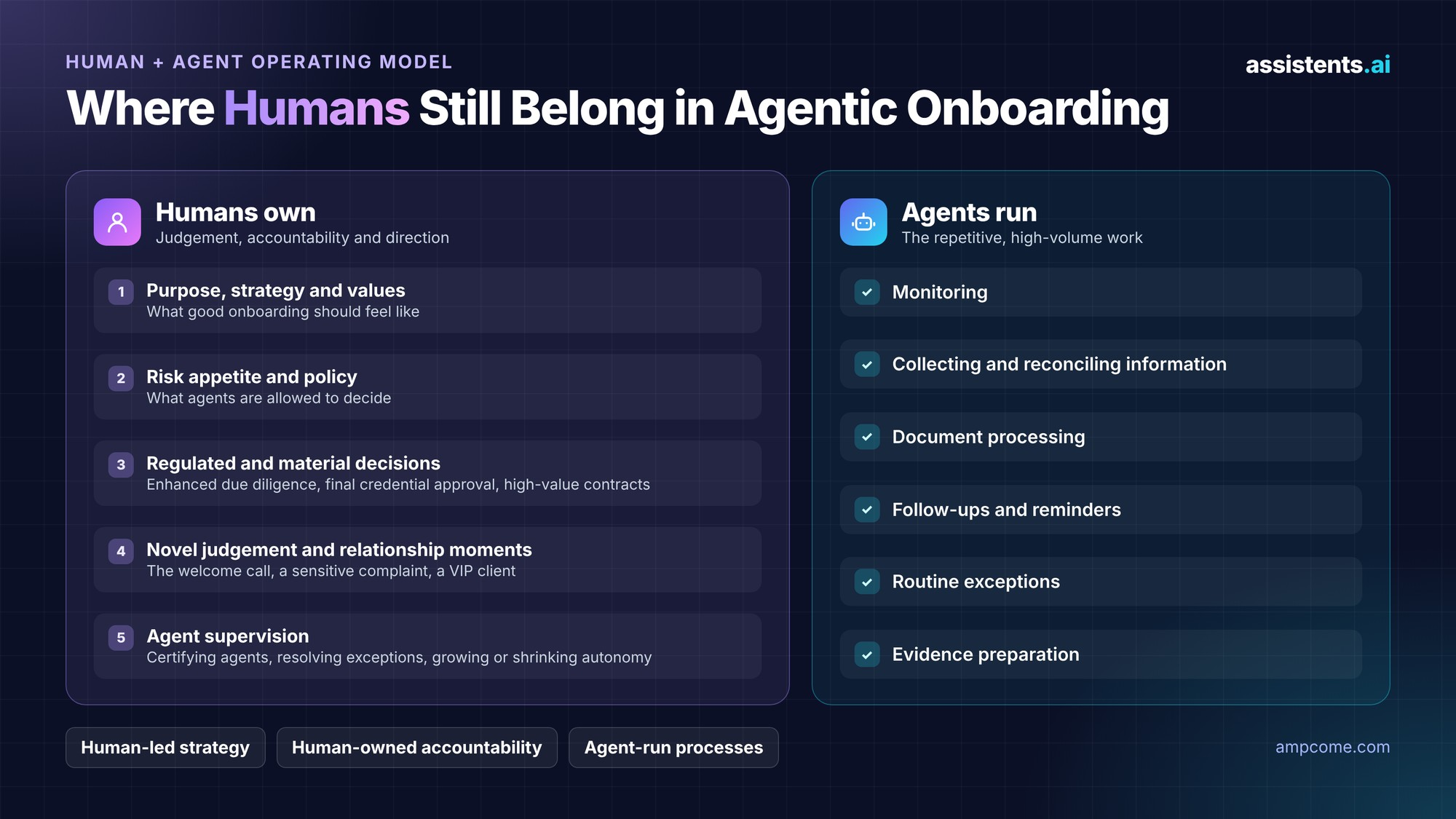
Agentic AI changes what people do in onboarding. It doesn't remove them. In a well-run autonomous enterprise, humans stay responsible for:
- Purpose, strategy and values: what good onboarding should feel like
- Risk appetite and policy: what agents are allowed to decide
- Regulated and material decisions: such as enhanced due diligence, final credential approval and high-value contracts
- Novel judgement and relationship moments: the welcome call, a sensitive complaint, a VIP client
- Agent supervision: certifying agents, resolving exceptions and deciding when autonomy should grow or shrink
Agents take the repetitive work: monitoring, collecting and reconciling information, document processing, follow-ups, routine exceptions and evidence preparation. The result is human-led strategy, human-owned accountability and agent-run processes.
KPIs to Track in Agentic AI Onboarding
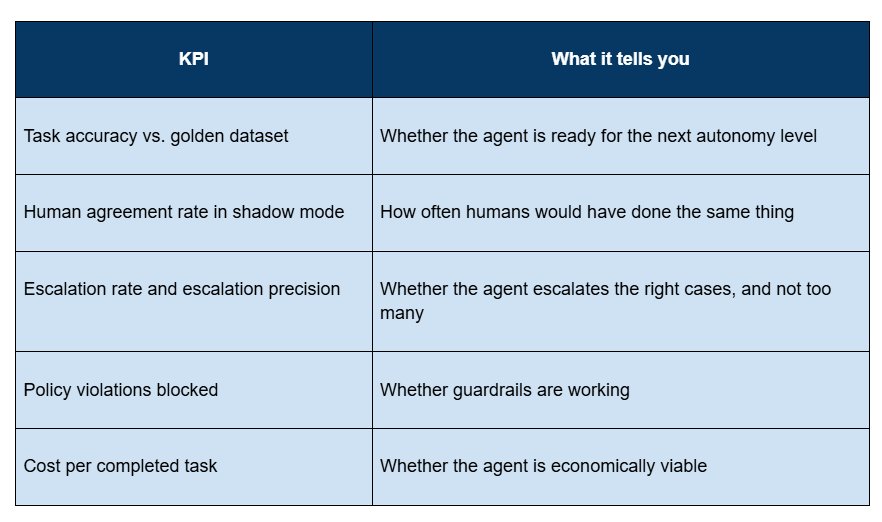
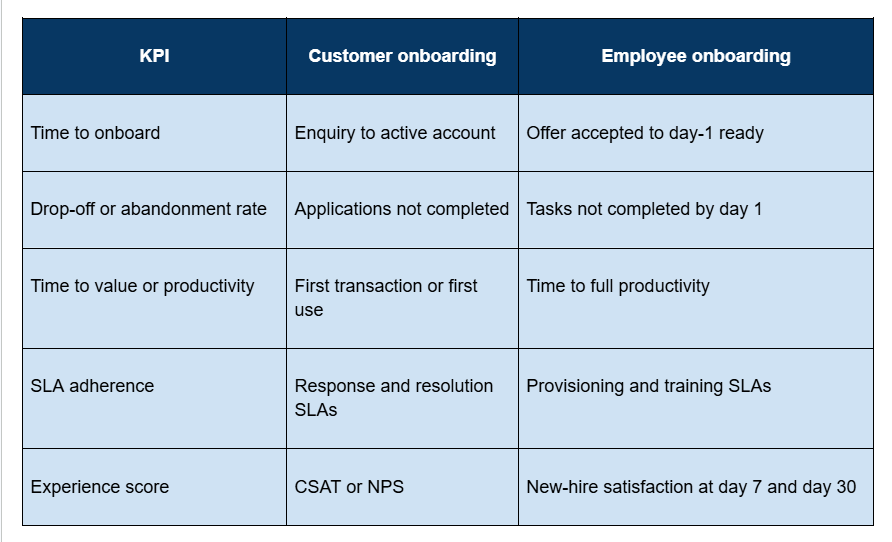
Track two sets of metrics: one for agent readiness and one for onboarding outcomes.
Agent readiness KPIs
Onboarding outcome KPIs
Common Mistakes That Stall Agentic AI Onboarding
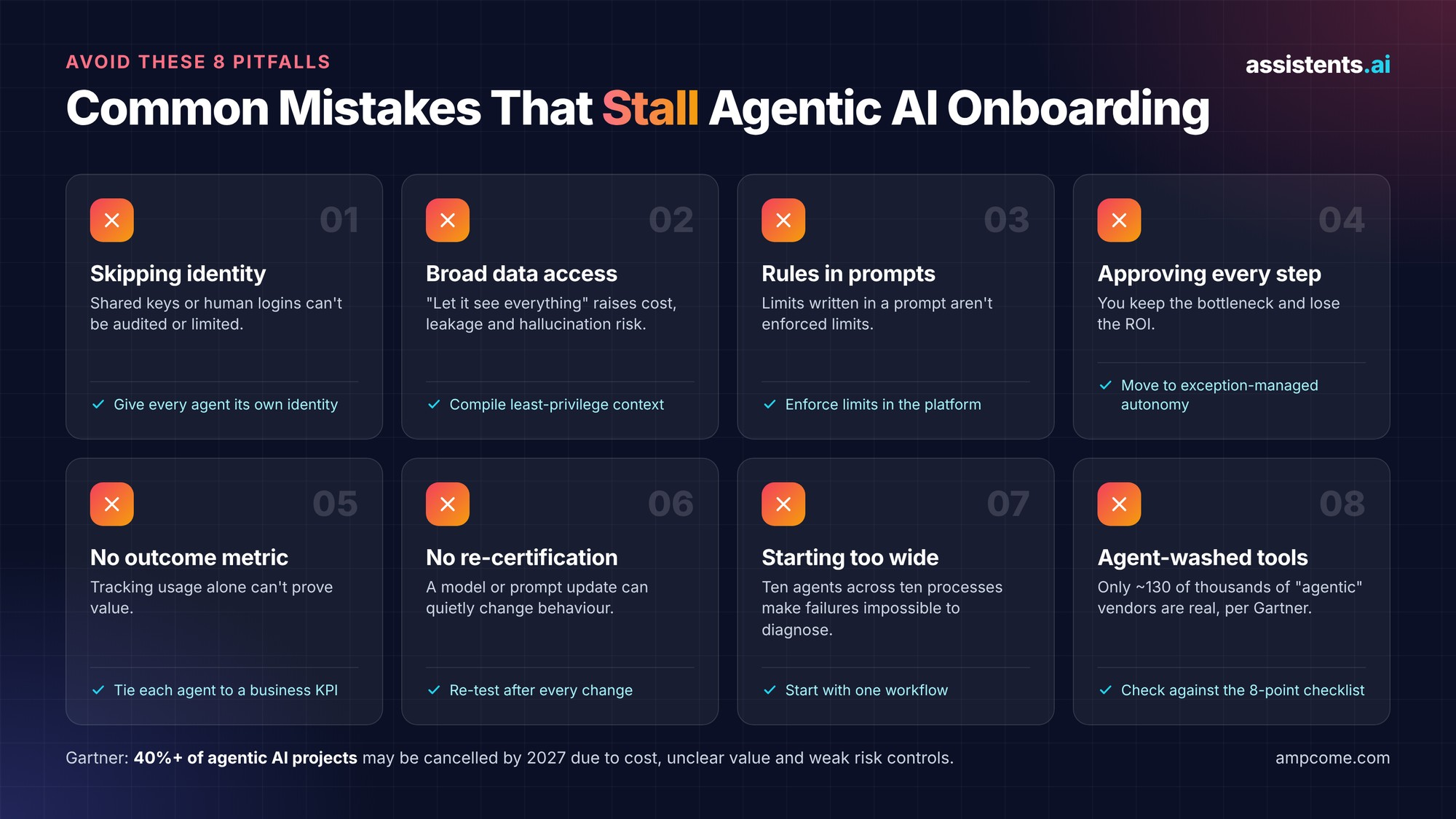
- Skipping identity. Agents running on shared keys or human logins can't be audited or limited.
- Giving broad data access. "Let it see everything" increases cost, leakage and hallucination risk.
- Putting rules in prompts. Limits written in a prompt aren't enforced limits. Put them in the platform.
- Approving every step forever. You keep the bottleneck and lose the ROI.
- No outcome metric. If you only track usage, you can't prove value, which is the top reason Gartner gives for cancelled projects.
- No re-certification. A model or prompt update can quietly change behaviour.
- Starting too wide. Ten agents across ten processes makes failures impossible to diagnose.
- Buying "agent-washed" tools. Gartner estimates that only about 130 of the thousands of vendors claiming agentic AI are the real thing (SD Times).
How to Choose an Agentic AI Onboarding Platform
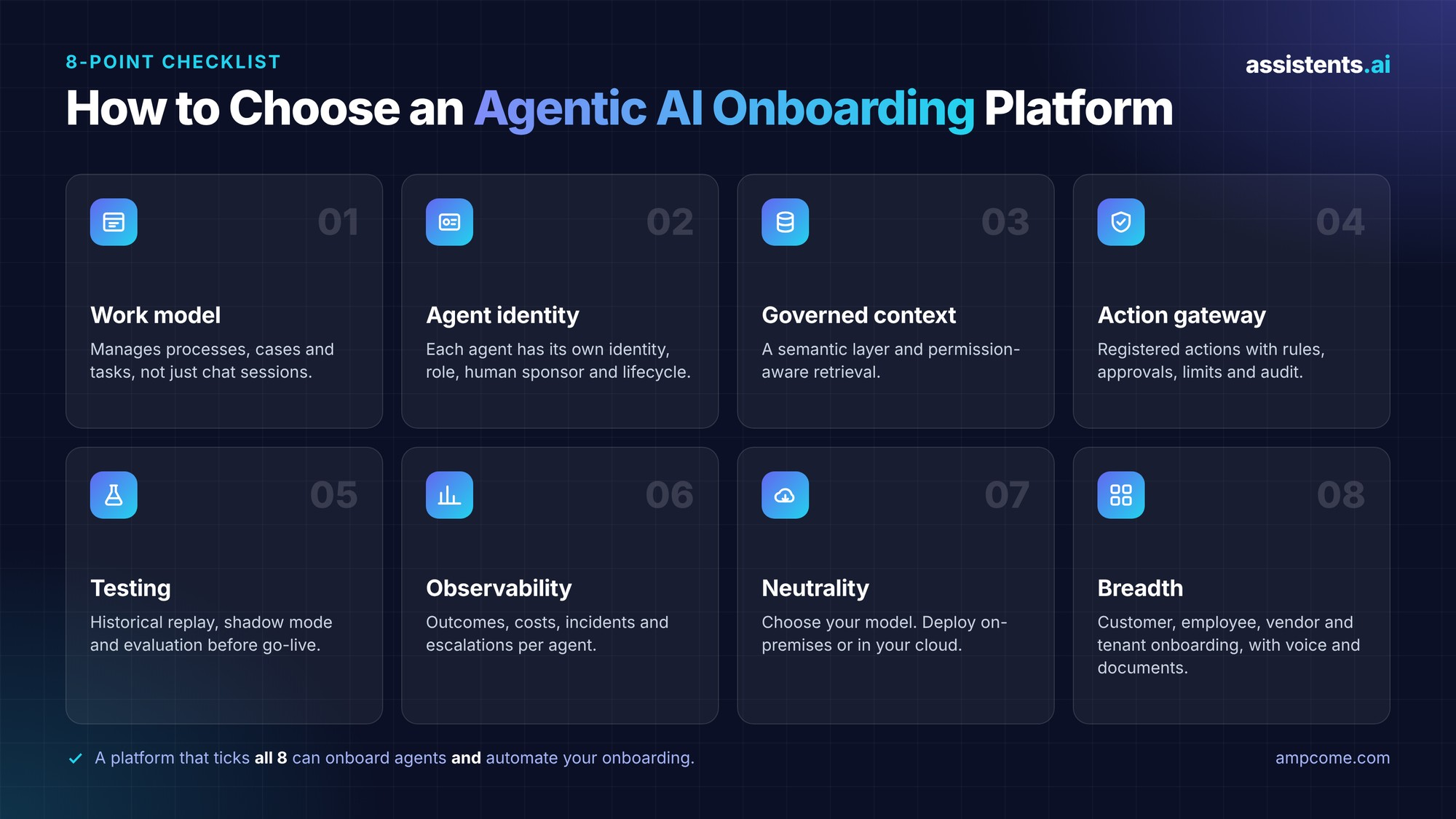
Use this 8-point checklist when evaluating platforms for onboarding AI agents and for automating onboarding with them.
- Work model: Does it manage processes, cases and tasks, or only chat sessions?
- Agent registry and identity: Can each agent have its own identity, role, sponsor and lifecycle?
- Governed context: Is there a semantic layer and permission-aware retrieval?
- Action gateway: Are actions registered capabilities with rules, approvals, limits and audit?
- Testing: Does it support historical replay, shadow mode and evaluation?
- Observability: Can you see outcomes, costs, incidents and escalations per agent?
- Neutrality: Can you choose your model and deploy on-premises or in your cloud?
- Breadth: Can one platform cover customer, employee, vendor and tenant onboarding, including voice and documents?
For a detailed vendor comparison, see Enterprise AI Agent Platforms Compared (2026). If you're still at the build stage, start with how to build AI agents.
Why Enterprises Choose Assistents.ai for Agentic AI Onboarding
There are four kinds of tools in this market. Only one manages the full agentic AI onboarding lifecycle.
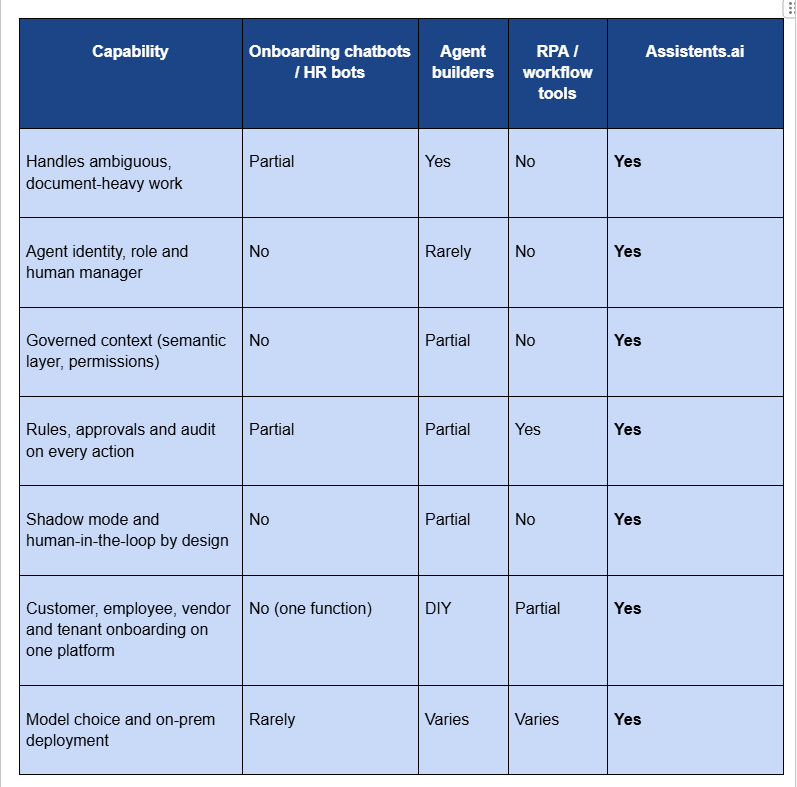
Proof in production, not in slides. Assistents.ai agents run onboarding-heavy work across retail, banking, healthcare, hospitality, real estate, logistics, pharma and utilities, in India, the Middle East, Europe, North America, Australia and Africa. For example:
- A national value retailer onboards frontline staff faster with voice and training agents in Hindi and English.
- A US healthcare staffing platform automates talent onboarding, credential capture and compliance.
- A luxury hospitality group turns email enquiries into confirmed bookings with a human-in-the-loop agent.
- A UAE engineering group automates SAP sales order creation with rules, approvals and full audit logs.
Start with one workflow and expand with confidence. Most teams launch one governed use case, prove it in shadow mode, then grow it into an agentic workcell that owns a full operation. That land-and-expand path is behind every deployment above.
Get your Agentic AI Onboarding Checklist, or talk to an Assistents.ai specialist →
Conclusion: Onboard Your Agents Before You Scale Them
The difference between an agentic AI pilot and a production digital workforce is onboarding. Define the work, give agents an identity and a manager, compile their context, register their capabilities, prove them in shadow mode, run them with exception-managed autonomy, and measure what they deliver.
Do that, and your agents can take on the next job, which is often onboarding itself: customers, employees, talent, vendors and tenants, faster and more consistently than before.
Book an Assistents.ai demo to see the agentic AI onboarding process in action, or download the checklist to start your first 90 days.
FAQs
What is agentic AI onboarding?
Agentic AI onboarding is the process of making an AI agent ready for real enterprise work. It covers defining the agent's role and outcomes, giving it an identity and a human manager, supplying governed context, limiting its permissions, testing it in shadow mode and measuring its results before its autonomy expands.
How do you onboard an AI agent?
Onboard an AI agent the way you would a new hire, with machine-enforced controls. Define the work, assign an identity and a sponsor, compile its context, register its capabilities and limits, test it through historical replay and shadow mode, go live with exception-managed autonomy, then measure outcomes and re-certify after changes.
What are the steps in the agentic AI onboarding process?
There are seven steps: (1) define the work, (2) give the agent an identity, role and manager, (3) compile its context, (4) register capabilities, guardrails and approvals, (5) prove it with replay, shadow mode and limited activation, (6) go live with exception-managed autonomy, and (7) measure outcomes and expand.
How is onboarding an AI agent different from onboarding a human employee?
The structure is similar: job description, access, training, probation and review. The differences are that an agent's limits must be enforced by software rather than trust, its behaviour can change overnight when its model or prompt changes, and it needs re-certification after every material update.
How long does it take to onboard an AI agent into production?
For one well-scoped workflow, about 90 days is typical: around 30 days to define and connect, 30 days to add guardrails and test in shadow mode, and 30 days of limited activation with outcome tracking. Simple, low-risk agents can move faster, and regulated use cases may take longer.
What permissions and governance do AI agents need?
AI agents need their own identity, least-privilege access to data and actions, transaction and cost limits, approval thresholds for high-risk actions, an accountable human sponsor, full audit logs and a way to roll back actions. These controls should live in the platform, not in the agent's prompt.
What is shadow mode for AI agents?
Shadow mode is a testing stage where an AI agent processes live cases alongside humans, but its actions aren't executed. Teams compare the agent's proposed actions with human decisions to measure accuracy and safety before giving it real authority.
How do you measure whether an AI agent is properly onboarded?
Measure it against a golden dataset and in shadow mode for accuracy, agreement with humans, escalation quality and policy compliance. After go-live, track business outcomes such as time to onboard, error and rework rates, SLA adherence and cost per task, compared with the human baseline.
Can agentic AI automate customer onboarding and KYC?
Yes. Agents can collect and verify documents, extract data, run screening workflows, chase missing information and update core systems. Complex or high-risk cases go to human reviewers. Audit trails and policy enforcement are essential for regulated onboarding such as KYC.
Can agentic AI automate employee onboarding?
Yes. Agents can trigger IT provisioning, collect documents and e-signatures, answer policy and benefits questions, deliver role-based training from SOPs and send check-in reminders. In frontline settings, voice and multilingual agents help new staff get answers instantly. See AI agents for employee onboarding.
Will AI agents replace onboarding teams?
No. Agents take on repetitive collection, verification, follow-up and data entry. Onboarding teams move to designing the experience, handling exceptions, making regulated decisions and building relationships. Accountability stays with people.
What is the best platform for agentic AI onboarding?
The best platform manages the whole lifecycle: work definition, agent identity, governed context, rules and approvals, shadow testing and outcome measurement. Assistents.ai by Ampcome is built for this, with model choice and on-prem deployment, and it supports customer, employee, vendor and tenant onboarding on one platform.

Transform Your Business With Agentic Automation
Agentic automation is the rising star posied to overtake RPA and bring about a new wave of intelligent automation. Explore the core concepts of agentic automation, how it works, real-life examples and strategies for a successful implementation in this ebook.
Sarfraz Nawaz is the CEO and founder of Ampcome, which is at the forefront of Artificial Intelligence (AI) Development. Nawaz's passion for technology is matched by his commitment to creating solutions that drive real-world results. Under his leadership, Ampcome's team of talented engineers and developers craft innovative IT solutions that empower businesses to thrive in the ever-evolving technological landscape.Ampcome's success is a testament to Nawaz's dedication to excellence and his unwavering belief in the transformative power of technology.

More insights
Discover the latest trends, best practices, and expert opinions that can reshape your perspective





Contact us


