
AI Agents Infrastructure Management: The 2026 Enterprise Operating System Guide


The Infrastructure Crisis: Why Frameworks Aren't Enough
You know what separates enterprises winning with AI agents from the ones whose projects stall? It's not better models. It's not smarter frameworks. It's infrastructure.
Not the agent runtime. The orchestration layer that turns scattered agents into a managed operating system. The workforce lifecycle that treats agents like employees, not tools. The governance that enables speed, not just prevents failure.
By 2026, the conversation about AI agents moved past "will this work?" to "why isn't this working at scale?" Frameworks gave enterprises primitives for agents. That solved one problem but created another: How do you govern 50 agents across your enterprise? How do you route work to the right agent? How do you know whether agents are creating value? How do you ensure compliance?
The enterprises that figured this out didn't just deploy agents faster. They operationalized infrastructure faster—and made it enablement, not a tax.
This guide explains what that infrastructure looks like. Why it's become critical in 2026. And how to build it.
What Is AI Agents Infrastructure Management? (And Why It Matters)
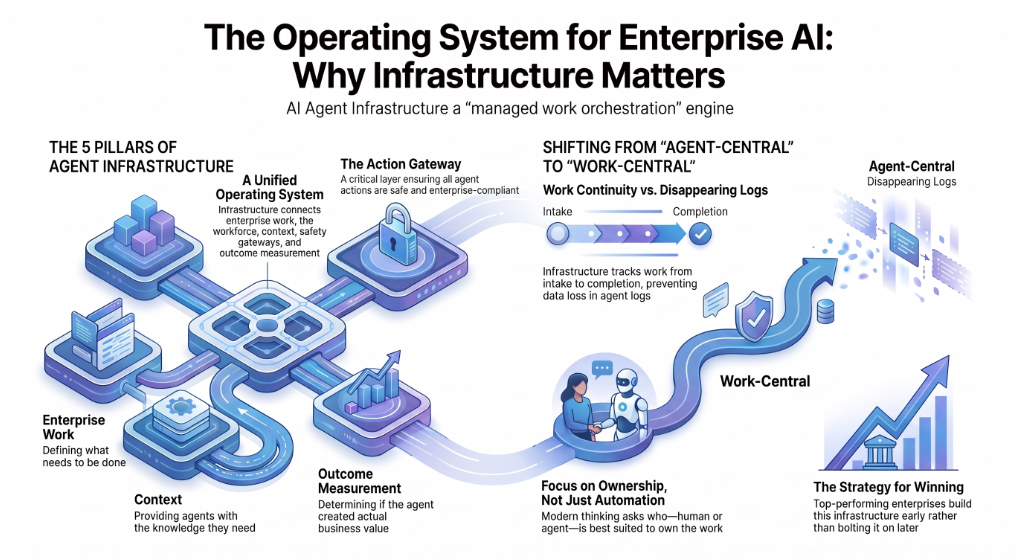
AI agents infrastructure is the operating system that lets agents work reliably in enterprise environments. It's made of five components working together: Enterprise Work (what needs to be done), Digital Workforce (who does it), Context (what they know), Action Gateway (ensuring actions are safe), and Outcome Measurement (did it create value?).
Without infrastructure, agents are isolated task executors. With it, they become part of a managed operating system.
The distinction matters because it changes everything about how you deploy.
Traditional automation asks: "What process should we automate?" Modern agent thinking asks: "What work needs to happen and who (human or agent) should own it?"
That sounds like a small shift. It's fundamental.
When work is central, you track work from intake to completion, independent of which agent handles it. You know what's pending, what's blocked, who owns it. You know when it failed and why. When the agent is central, you lose that continuity. The agent session ends. The work disappears into logs. You don't know what happened.
The enterprises winning with agents built this infrastructure early. The ones that stalled tried to bolt it on after the fact.
The Hybrid Enterprise Workforce: From Tools to Managed Workers

Here's a mental shift that separates winners from stalled projects: Stop thinking of agents as tools and start thinking of them as employees.
That sounds abstract. It has real consequences.
If an agent is a tool, you focus on prompt tuning and tool definitions. If it's an employee, you focus on hiring (how do you define a good agent?), training (does it know what it should?), identity (who is it?), authorization (what can it do?), and performance (is it creating value?).
That second perspective is why 60% of enterprises scale agents and 40% don't. The winners built a workforce system of record early.
A Digital Workforce System of Record tracks:
Agent Blueprint: Role definition, domain expertise, required capabilities, success criteria.
Agent Instance: Deployed worker with version, owner, certification status, active/restricted/retired lifecycle state.
Performance History: What work it completed, how long it took, quality metrics, rework rate, business impact.
Capacity & Schedule: How much work it can handle, cost per action, budget consumed this period, availability windows.
Ownership & Accountability: Who sponsors this agent, who reviews its work, escalation path, incident response.
When you track these, something shifts. Agents stop being temporary experiments and start being part of your operating model. You can answer: Which agents exist? Who owns them? What are they doing? How are they performing? What's their utilization rate? Where are the bottlenecks?
That visibility is what lets you scale from pilot to exception-managed operations.
Work as the Organizing Principle (Not Agents)

Here's the architectural insight that changed how leading enterprises deploy agents: Make work central, not agents.
In traditional automation, the workflow owns everything. It's rigid, deterministic, and slow. In pure agent automation, the agent owns everything. It's adaptive, but uncontrollable. Most enterprises oscillate between these extremes.
Winners do something different.
Work is the durable abstraction. A mission (customer onboarding) decomposes into processes (verification, credit check, documentation). Processes decompose into cases (this customer's onboarding). Cases decompose into tasks (collect ID, verify address). Each task can be handled by a human, an agent, or a deterministic automation, depending on the work type, risk level, and cost.
When work is central, you can:
Separate performer from work: An agent handles Task A today. A human handles it tomorrow. The work persists regardless. You know what's in flight.
Route intelligently: Route by skill (does the performer know how?), authority (are they allowed?), risk (does this need human oversight?), and cost (can we afford automation here?).
Track completion: Work moves through states (created, assigned, in-progress, blocked, escalated, completed, failed). You know the status of every item.
Measure outcomes: Did this work create value? Did it meet SLA? Did it require rework? Link every outcome back to who did it and how long it took.
Create reusable patterns: When you see a repeatable process, you package it. Not as "this agent does this"—as "this Workcell (team of humans + agents + systems) owns this business function."
Leading enterprises we work with deployed the first Workcell (a bounded business operation) in 3–6 months. Then they expanded, reusing the same patterns across adjacent functions. That's faster than deploying 50 isolated one-off agents because the infrastructure compounds.
Governance That Enables, Not Just Restricts
Most enterprises think about agent governance the way they think about password policies: a security requirement. Necessary but slowing.
Winners think about it differently.
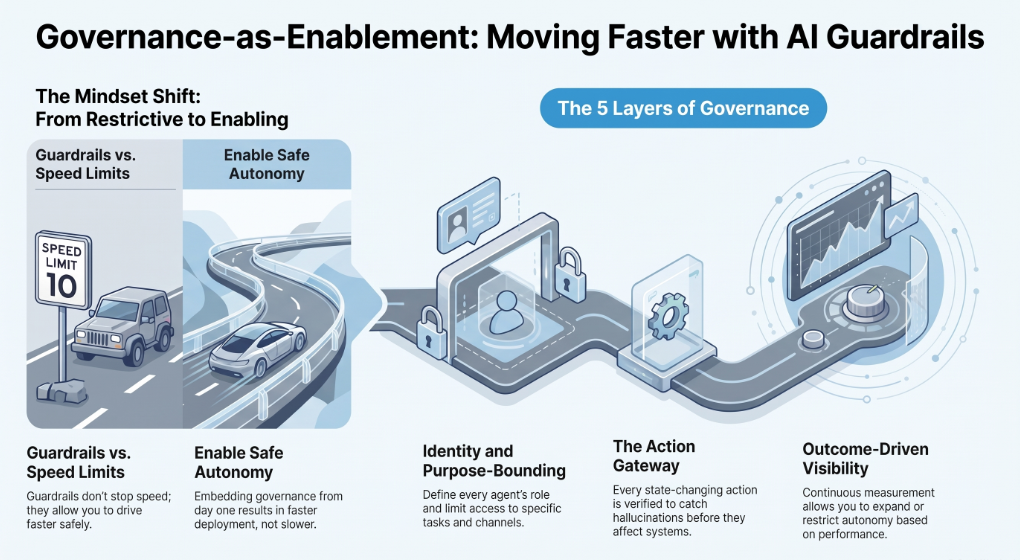
Governance isn't what stops agents from doing bad things. It's what lets agents do the right things safely. Think of guardrails on a highway, not a speed limit. A guardrail doesn't stop you from driving fast—it lets you drive faster safely. Agent governance works the same way.
That shift—from "prevent bad outcomes" to "enable safe autonomy"—is why enterprises that embed governance from day 1 deploy faster, not slower.
Governance spans five layers:
Identity & Authentication: Every agent has a logical identity (role + owner), a runtime identity (workload certificate), and a business identity (the human role it serves). You can't control what you can't name.
Authorization & Permissions: Least privilege isn't about denying access. It's about purpose-bounding it. An AR agent can contact customers about overdue invoices—but only customers it's cleared for, only in approved communication channels, only during business hours, only with approval for amounts over $10K. Not warehouse-wide access; specific permissions for specific work.
Policy & Approval Gates: High-stakes actions require approval. Compliance exceptions escalate. Budget overruns trigger review. But routine, low-risk work flows without friction. You've built speed into the guardrails.
Action Execution: Every state-changing action goes through an Action Gateway that enforces policy, logs the decision, verifies idempotency, and records outcomes. This is where you catch hallucinations before they touch your systems.
Outcome Measurement: Continuous visibility into what agents are doing and whether it's creating value. If quality degrades, you restrict autonomy and investigate. If it excels, you expand scope.
This is Governance-as-Enablement. It unlocks speed while keeping control.
The Action Gateway: Making Agent Actions Production-Ready
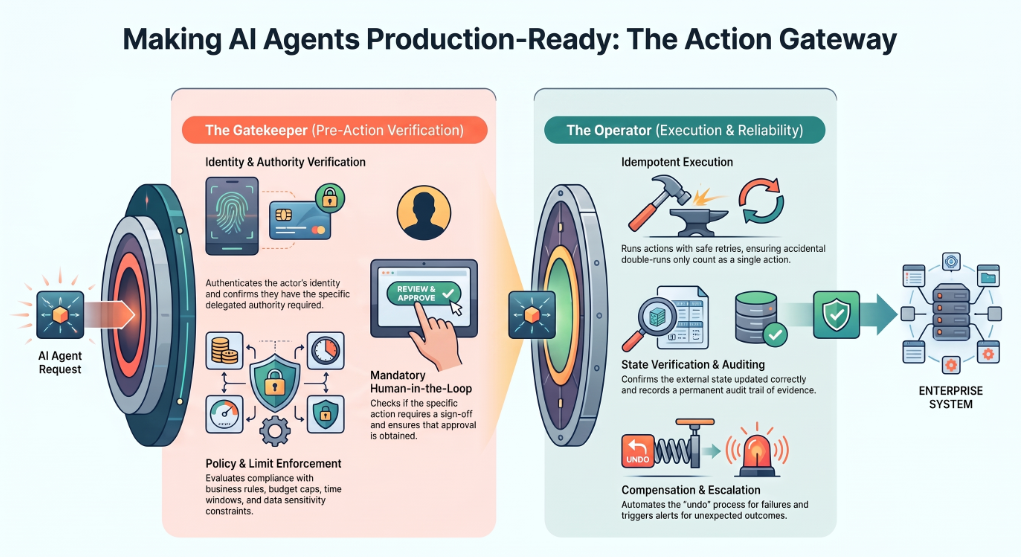
Here's what separates enterprises that ship from ones that stall: Every action goes through policy enforcement before it touches your systems.
An agent can propose anything. The Action Gateway decides what actually happens.
The Action Gateway:
- Authenticates the actor: Who is this? What's their identity? Are they still active?
- Verifies authorization: Does this person/role have permission for this action? Is it within their delegated authority?
- Evaluates policy: Does this action comply with business rules? Are there compliance constraints? Budget limits? Time windows?
- Checks approvals: Does this action require sign-off? From whom? Has that been obtained?
- Enforces limits: Is this within daily/weekly/monthly caps? Cost budgets? Data sensitivity constraints?
- Executes with idempotency: Run the action. If it fails, retry safely. If it succeeds, record it. If it runs twice by accident, make sure it only counts once.
- Verifies external state: Did the action do what we expected? Did the payment go through? Did the record update? Or do we need to remediate?
- Records evidence: Audit trail with who authorized it, why, what happened, and the outcome. For compliance and learning.
- Handles compensation: If something goes wrong, can we undo it? Reverse the payment? Restore the record? Build that in.
- Triggers escalation: If something unexpected happens, who needs to know? Alert, escalate, notify.
No agent should possess shared ERP credentials or have a direct ungoverned write path to your systems. Every action flows through this gateway. That's what makes agent actions production-ready.
10-Point Governance Checklist Before Production
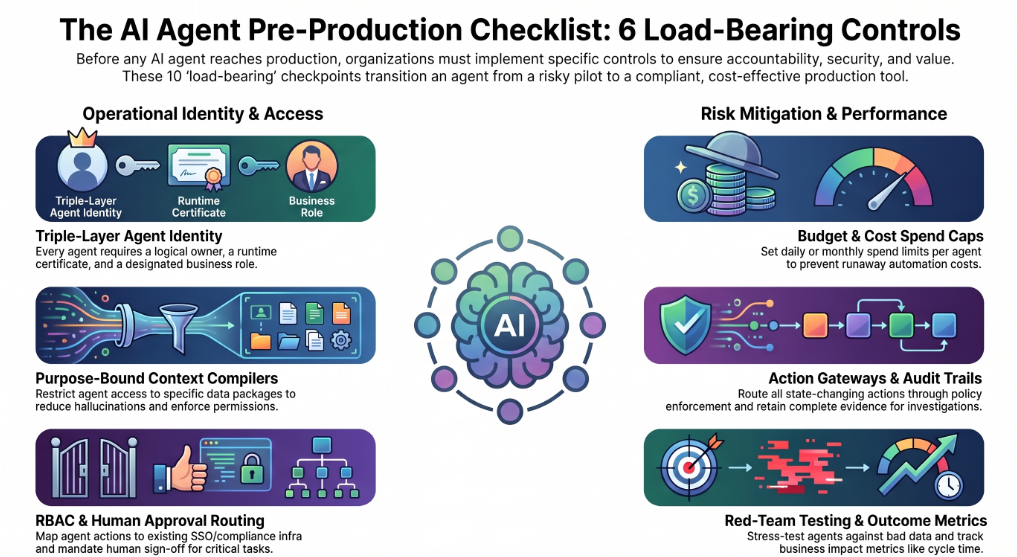
Before your first agent touches production, ensure these 10 controls are in place. More importantly, understand why each one matters—so you know when to adapt the checklist for your context.
1. Agent Identity & Lifecycle
Why: You can't control what you can't name. Every production agent needs a logical identity (role + owner), runtime identity (workload certificate), and business identity (the human role it serves). Without this, you don't know who did what, and compliance becomes impossible.
2. Purpose-Bound Context Compiler
Why: Agents don't get warehouse keys. They get compiled context—data packages specific to their work. This reduces hallucination, cuts cost, and enforces permissions. Without this, you're giving agents too much access.
3. Action Gateway & Capability Registry
Why: Every state-changing action must go through policy enforcement. This is where you catch mistakes before they hit your systems. Without this, one hallucination costs money.
4. Work Kernel & Durable State
Why: Work must be persistent and queryable independent of agent sessions. Otherwise, you lose the ability to track what's in progress, what failed, and why. This is your audit trail and operational visibility.
5. Role-Based Access Control (RBAC)
Why: Permissions must map to your existing identity and compliance infrastructure. SSO, RBAC, audit logs—these aren't optional when agents are operating on behalf of employees or handling regulated data.
6. Approval Routing & Separation of Duties
Why: Some actions require human review. Some require dual sign-off. Some can never be automated. Your approval workflow must encode these rules and enforce them at runtime. Without this, you violate compliance.
7. Budget & Cost Controls
Why: AI agents can drive costs up fast if unchecked. Set daily/weekly/monthly spend caps per agent. Monitor actual spend against budget. Escalate overages. Without this, one runaway agent burns through budget.
8. Audit Logging & Evidence Retention
Why: Every action needs a complete audit trail: who authorized it, why, what happened, what changed. Retain this for compliance investigations, incident response, and learning. Without this, you can't prove you did the right thing.
9. Red-Team Testing & Edge Case Validation
Why: Before production, stress-test the agent. Try to make it fail. Inject bad data. Attempt to bypass controls. Verify that escalation paths actually work. Without this, production surprises are worse than pilot surprises.
10. Outcome Measurement & Feedback Loop
Why: You need to know whether the agent is creating value. Track work metrics (cycle time, quality, rework rate), action metrics (success rate, error rate), and business metrics (revenue impact, cost saved). Without this, you can't improve or justify expansion.
Check all 10 before going live. They're not nice-to-have. They're load-bearing.
Deployment Maturity Path: From Assist to Exception-Managed
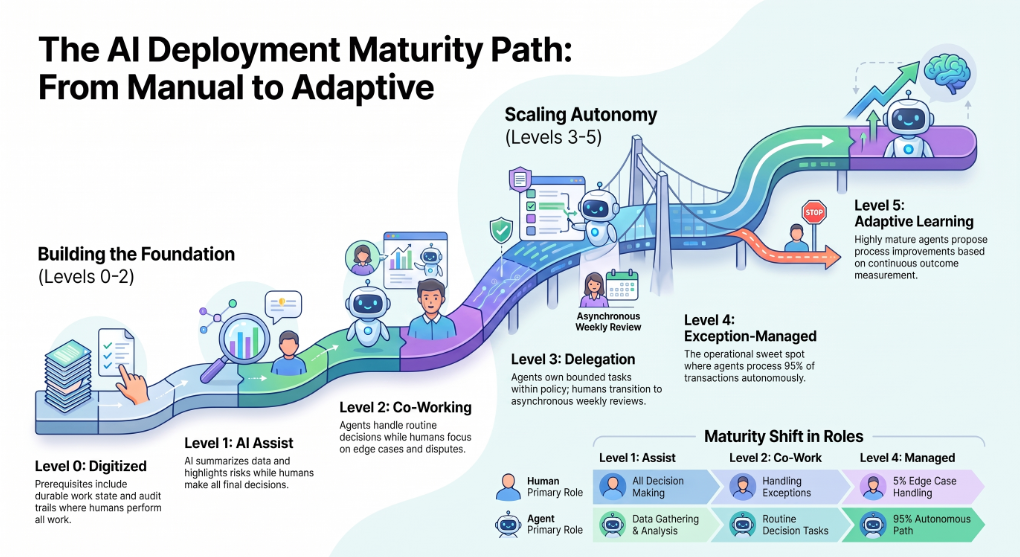
Autonomy is not a toggle. It's a progression. Most enterprises start at Level 1 (Assist) and graduate to higher levels over time as they build confidence and infrastructure.
Level 0: Digitised
Systems record activity. Humans perform all work. No agents yet. Prerequisite: You need durable work state and audit trails before agents show up.
Level 1: Assist
AI prepares information or analysis. Humans make all decisions. The agent's role: gather data, summarize options, highlight risks. This builds trust and muscle memory for working with agents.
Level 2: Co-Work
Humans and agents share tasks. Routine decisions go to the agent. Edge cases and exceptions come to humans. Example: AR agent sends payment reminders. Human handles disputed invoices. Reduces human burden while keeping judgment calls where they belong.
Level 3: Delegate
Agents own bounded tasks. Humans review results async (not every step). Agents work within policy, but don't escalate for approval. Example: AR agent handles standard overdue follow-up. Human reviews weekly. If quality is good, trust grows.
Level 4: Exception-Managed
Agents run the normal path autonomously. Humans handle exceptions. Example: Agent processes 95% of transactions. Humans jump in for the 5% edge cases, anomalies, or compliance exceptions. This is the sweet spot for mature operations.
Level 5: Adaptive
Agents propose improvements to processes and policies. They learn from outcomes and refine their own operation. Most enterprises are not here yet. The foundation for this level is outcome measurement and continuous feedback loops.
Why this progression matters: You don't start at autonomy. You earn it. Each level builds trust, infrastructure, and evidence that the system works. Level 4 (exception-managed) is where most enterprises find sustainable value. It's not full automation. It's work distribution optimized for speed and judgment.
Work Orchestration: Deterministic Macro, Agentic Micro

Here's the architectural insight that makes this work in practice: Workflows own the durable stuff (state, deadlines, approvals). Agents own the adaptive stuff (reasoning, tool selection, judgment).
In pure workflow automation, everything is predetermined. Step A leads to Step B leads to Step C. No exceptions. No adaptation. When the real world throws an edge case, the workflow blocks or escalates.
In pure agent automation, the agent makes all decisions. No predefined steps. Just objectives. Freedom is powerful, but chaos is also possible. The agent might hallucinate, spin in loops, or miss compliance requirements.
Winners hybrid it.
The Workflow owns:
- Process state (created, assigned, in-progress, blocked, escalated, completed)
- Deadlines and SLAs (this work must complete by X date)
- Approvals and separations of duties (this requires sign-off from role X)
- Retries and compensation (if it fails, retry this way; if unrecoverable, compensate with this action)
- Transaction boundaries (this work is atomic; either fully succeeds or fully fails)
Agents own:
- Planning (what's the best sequence of steps to achieve this objective?)
- Investigation (gather data, evaluate options, identify risks)
- Tool selection (which capability should I invoke next?)
- Adaptation (if plan A doesn't work, try plan B)
- Judgment calls (is this worth escalating, or can I handle it?)
Within bounded zones (the Agentic Zone), agents can:
- Gather evidence
- Form and test hypotheses
- Delegate to specialists
- Ask for clarification
- Request human input
They cannot:
- Widen their own authority
- Override approval gates
- Exceed budget or time limits
- Invoke capabilities outside their permission set
This hybrid model is what makes work orchestration scalable. The workflow keeps you safe. The agent keeps you fast.
Context Compilation: Not Broad Access, Purpose-Bound Context
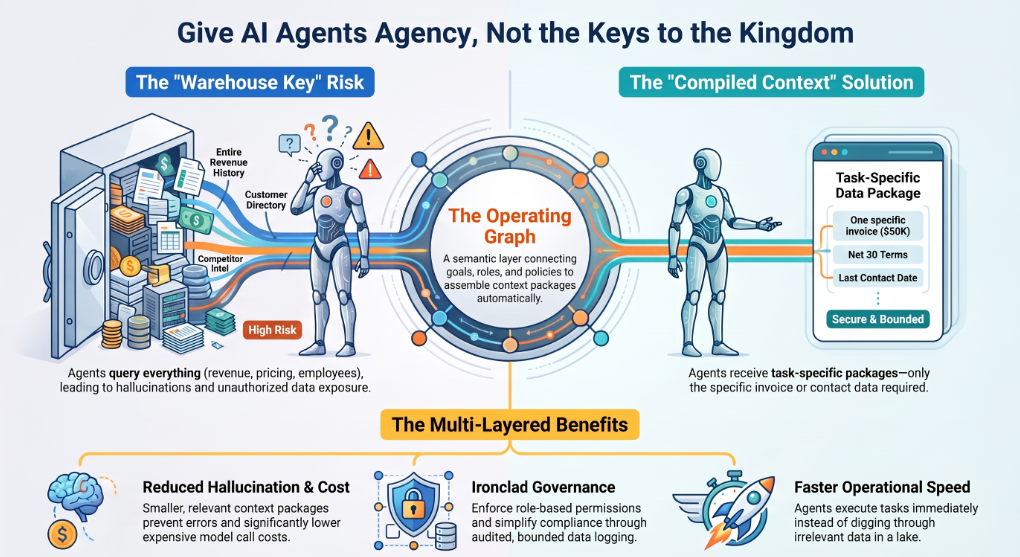
Here's what most people get wrong about agent data access: They give agents warehouse keys and hope for the best.
That's backwards.
Agents shouldn't get broad access to your data lake. They should get compiled context—data packages assembled specifically for their work.
The difference:
Warehouse access: Agent can query anything. Revenue. Customer history. Pricing. Competitor intel. Employee directory. One hallucination and it's pulling together data it shouldn't see.
Compiled context: Agent gets a package for this work. "This customer's invoice: $50K, 60 days overdue, payment terms net 30, contact: email + phone, last contact 3 days ago, no disputes flagged." Nothing else.
Compiled context packages:
- Reduce hallucination (agent only sees relevant facts)
- Enforce permissions (data is filtered to what this role can see)
- Cut cost (smaller context = cheaper model calls)
- Speed operations (agent doesn't waste time digging through irrelevant data)
- Simplify compliance (data is logged, audited, bounded)
The Operating Graph (your enterprise's shared semantic layer) is what makes this work. It connects goals, roles, processes, work, objects, metrics, policies, actions, and outcomes. When an agent is assigned work, the context compiler walks the graph and assembles everything that agent needs—and only what it needs.
This is how you give agents agency without giving them the keys to the kingdom.
Measuring Outcomes, Not Just Tokens
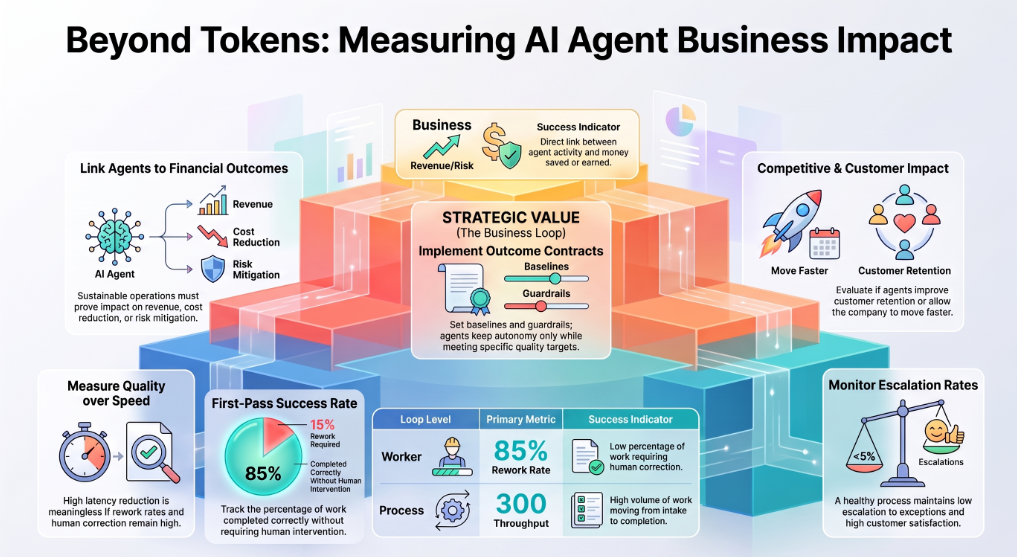
Here's what stops most enterprises from scaling agents: They measure tokens consumed, not business impact.
"We reduced latency by 30%" sounds good until you realize the agent is wrong 40% of the time and humans are reworking everything.
Outcomes are measured across three loops:
Worker Loop: Is the agent performing well?
- Work completed per day
- Quality (% first-pass success)
- Rework rate (% of work requiring human correction)
- Speed (cycle time)
- Cost (dollars per work item)
You track this by work type, by agent, by time window. When quality drops, you investigate. When speed improves, you log the pattern. Over time, you get a performance trajectory.
Process Loop: Is the operation improving?
- Throughput (how much work can we move?)
- Cycle time (from intake to completion)
- Customer satisfaction (are outcomes getting better?)
- Compliance rate (are we staying within guardrails?)
- Escalation rate (how much goes to exceptions?)
A good process has low escalation and high customer satisfaction. An overloaded process has high escalation and quality issues. You're watching the health of the system, not just individual workers.
Business Loop: Is this creating value?
- Revenue impact (did this work help us earn or save money?)
- Cost impact (how much did this work cost to deliver?)
- Customer impact (did this improve retention, satisfaction, likelihood to recommend?)
- Risk impact (did we avoid compliance violations or fraud losses?)
- Competitive impact (did we move faster than competitors?)
This is the hardest to measure, but it's the only one that matters. If you can't link agent work to business outcomes, you don't have a business case.
Outcome contracts specify baselines ("this should improve by X%"), guardrails ("if quality drops below Y%, escalate"), and observation windows ("we'll measure over this period"). You observe outcomes continuously. If the agent is meeting its contract, it keeps autonomy. If it's breaching, you investigate and adjust.
This is how you move from "cool technology" to "sustainable operation."
Real-World Implementation: From Pilot to Operating Workcell
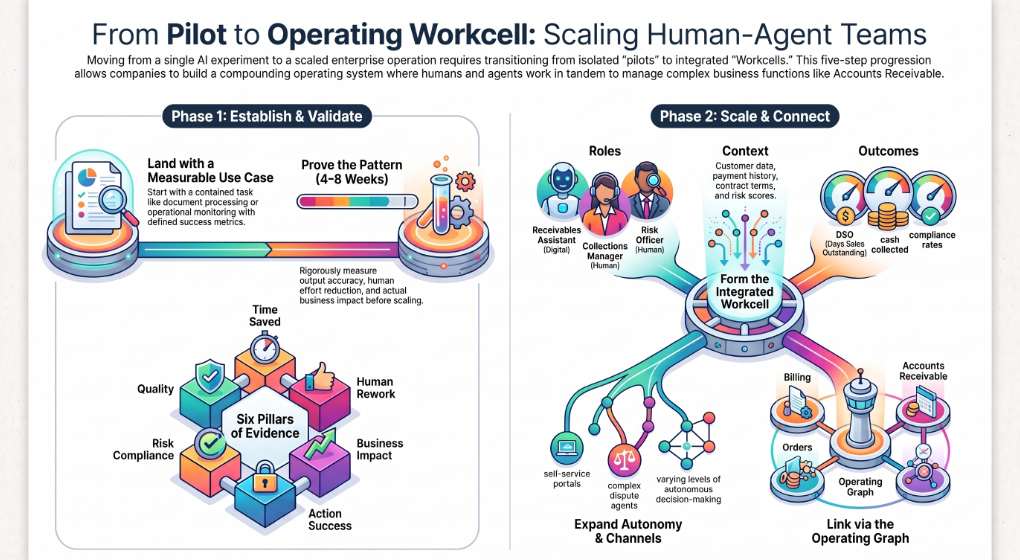
Theory is useful. Practice is what works.
Here's how leading enterprises move from agent pilots to operating Workcells—complete business operations managed as human-agent teams.
Step 1: Land
Start with a contained, measurable use case using current strengths. Governed analytics. Document processing. Voice or email agent. Case application. Workflow automation. Policy agent. Operational monitoring.
Define success upfront (this metric improves by X% in Y days). Measure rigorously.
Step 2: Prove
Verify that the pilot works. Quality and evidence (is output accurate?). Time saved (how much human effort did this reduce?). Action success (do recommended actions work?). Human rework (how much correction is needed?). Risk and compliance (did we stay within guardrails?). Business impact (did revenue or cost actually improve?).
Run it for enough time to prove the pattern holds (typically 4–8 weeks). If the metrics don't hit targets, diagnose and adjust. Or kill it early and try something else.
Step 3: Form a Workcell
Add adjacent work, digital roles, human roles, shared context, policies, actions and outcomes around the same operation.
Example: Accounts Receivable Workcell
- Work: collections workflows (standard, disputed, at-risk, write-off)
- Digital roles: Receivables Assistant (investigation, follow-up), Compliance Monitor (audit, escalation)
- Human roles: Collections Specialist (high-touch), Collections Manager (oversight), Risk Officer (exceptions)
- Context: Customer data, payment history, contract terms, communication guidelines, risk scores
- Policies: Approval routing, collection strategies, escalation rules, communication compliance
- Outcomes: DSO, cash collected, promise-to-pay kept rate, customer satisfaction, compliance violations
Now it's not a single agent. It's a system designed to handle collections at scale.
Step 4: Expand
Add channels, systems, agents, applications, autonomy levels, and related processes.
New channels: Portal for customers to self-serve. SMS for quick touchpoints. Voice for complex disputes. Each channel feeds the same work kernel. Same team composition manages all of it.
New systems: Invoice system feeds work. GL updates with collections. CRM logs interactions. Compliance system tracks exceptions. All connected through the work kernel.
New agents: Dispute investigator (research, option development). Workout coordinator (special cases). Segmentation agent (route by risk tier).
New autonomy levels: Standard collections: Level 4 (exception-managed). Disputed invoices: Level 2 (co-work). High-value disputes: Level 1 (assist).
Step 5: Connect
Link Workcells through shared identity, Operating Graph, capability policy, work routing, and Control Tower.
Now Accounts Receivable connects to Billing (AR agents request corrected invoices from Billing system). Billing connects to Orders (billing disputes trace to order issues). Orders connects to Fulfillment (order issues trace to fulfillment issues).
Each Workcell is autonomous. They coordinate through shared work state and governance.
This progression is why scale works. You're not deploying 50 isolated agents. You're building an operating system that compounds.
Why 40% of Agent Projects Fail (And How to Be in the 60%)
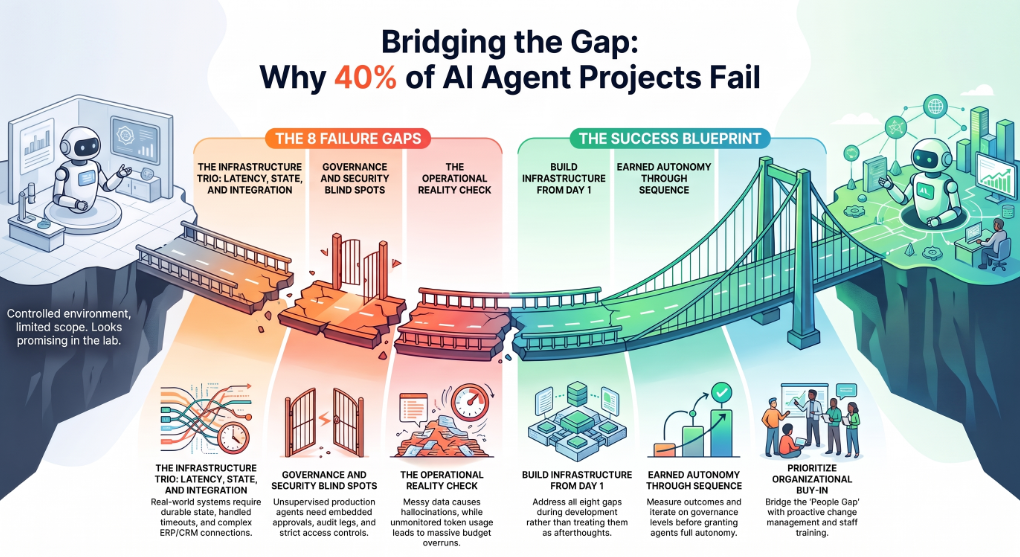
The gap between prototype and production is where most agent projects stall or fail. Not because the agent can't reason. Because the infrastructure is missing.
Latency Gap: Prototype runs fast on clean data. Production has legacy systems, slow APIs, network timeouts. If your agent doesn't handle timeouts and retries, it fails.
Security Gap: Prototype ran on demo data. Production has sensitive data, compliance constraints, audit requirements. If you didn't build access control and logging, you fail compliance.
State Gap: Prototype lives in a session. Production needs durable state independent of sessions. If work disappears when the agent stops, you've lost audit trail and operational visibility.
Cost Gap: Prototype token count was cheap. Production at scale with 50+ agents burns through budget fast. If you didn't set per-agent cost caps and monitoring, you blow budget.
Governance Gap: Prototype was supervised. Production runs unsupervised. If you didn't embed approvals, escalation paths, and policy enforcement, agents make mistakes at scale.
Integration Gap: Prototype connected to one system. Production connects to ERP, CRM, warehouse, finance, HR, compliance. Each integration adds complexity. If you didn't plan integration architecture, you stall.
Data Quality Gap: Prototype used curated examples. Production uses real data—messy, incomplete, inconsistent. If you didn't build validation and error handling, the agent hallucinates.
People Gap: Prototype was interesting to engineers. Production requires organizational buy-in. If you didn't plan change management and training, adoption stalls.
The enterprises that ship are different in one way: They address all 8 gaps before going live. Not after. They build infrastructure from day 1, not as an afterthought.
They know that autonomy is earned, not granted. They sequence maturity levels. They measure outcomes. They iterate on governance. They connect infrastructure to business metrics.
That discipline is the difference between pilots that scale and pilots that become shelf-ware.
What Makes assistents.ai Different
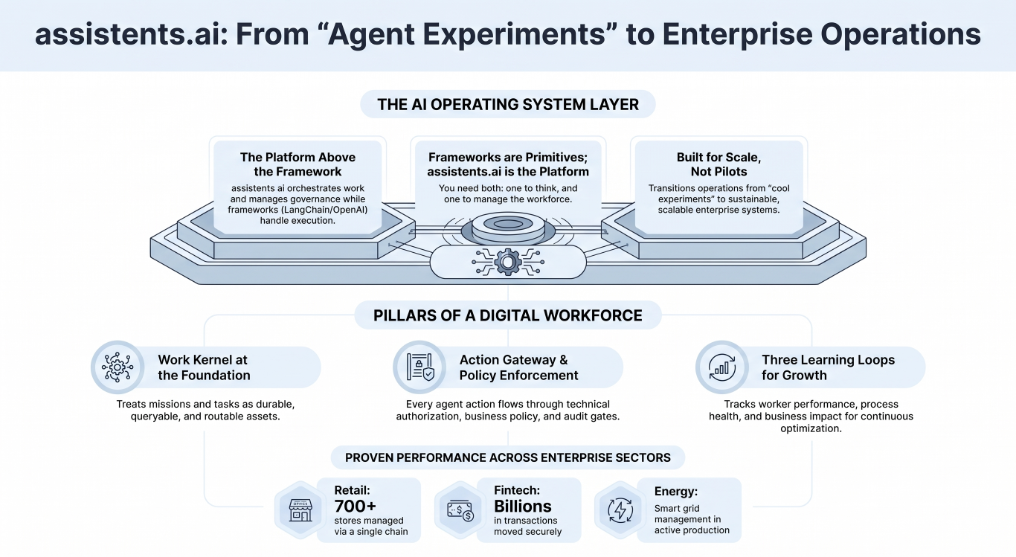
Now that you understand the operating system framework, here's why it matters that you build it right.
Frameworks (LangChain, Claude SDK, OpenAI) solve agent execution. They're excellent at reasoning and tool use. assistents.ai sits one layer above: orchestrating work, managing the workforce, enforcing governance, and measuring outcomes.
You need both. Frameworks are primitives. assistents.ai is the platform.
Here's what separates assistents.ai from point solutions:
Work Kernel at the Foundation
Most platforms treat work as an afterthought—a UI on top of agent logic. assistents.ai inverts this. Work is the center. Missions, processes, cases, tasks. Durable. Queryable. Routable. That persistence is what lets you build operations at scale.
Digital Workforce System of Record
Your agents aren't ephemeral tools. They're managed employees with identity, skills, certification, capacity, performance history. You know which agents exist, who owns them, what they're doing, how they're performing. That visibility is what lets you govern and optimize.
Purpose-Bound Context Compilation
Agents don't get warehouse keys. They get compiled context packages—facts and evidence specific to their work. Reduces hallucination. Enforces permissions. Cuts costs. Keeps agents focused on judgment, not data exploration.
Action Gateway & Capability Registry
Every state-changing action flows through policy enforcement. Technical authorization, business policy, approval gates, cost limits, verification. Logged and audited. This is how you make agent actions production-ready.
Outcome Measurement & Three Learning Loops
You track worker performance (is the agent doing its job?), process health (is the operation improving?), and business impact (are we creating value?). Continuous feedback refines the system. That's how you move from "cool experiment" to "sustainable operation."
Proven at Scale
This isn't theory. Leading enterprises across hospitality, logistics, fintech, retail, energy, healthcare, and procurement are running this operating model in production. Retail chain handling 700+ stores. Fintech moving billions in transactions. Energy utility managing smart grids. Not pilots. Productions.
Built for Your Infrastructure
assistents.ai works across your existing systems—SAP, Salesforce, ServiceNow, your data lake, your ledger. No rip-and-replace. No vendor lock-in on models (Claude, OpenAI, Anthropic, open-source). On-premise, private cloud, SaaS—you choose. That flexibility is table-stakes for enterprise.
Governance That Enables
Most governance is about prevention. assistents.ai builds speed into guardrails. You can move faster because governance is embedded, not bolted on. Approvals only where they matter. Escalation only when needed. Routine work flows frictionless.
This is the difference between "we built an agent" and "we built an operating system." The latter scales. The former doesn't.
Getting Started: Your 90-Day Roadmap
If this resonates, here's how to move from reading to doing.
Phase 1: Define Operating Model (Weeks 1–2)
Clarify your target business operation. What's the mission? Who are the workers (human, agent, automation)? What's the work? Define success metrics upfront.
Map your current state. Do you have durable work state? Workforce visibility? Governance? Operating Graph? Outcome measurement? Each gap is a sprint.
Phase 2: Build Work Kernel + Workforce Record (Weeks 2–4)
Implement mission, process, case, task structures for your operation. Model work states and transitions. Build the durable foundation.
Stand up a Digital Workforce System of Record. Agent blueprint (what this role does). Agent instance (deployed workers). Lifecycle (development, certification, active, restricted, retired).
Start tracking: work in flight, workers available, capacity utilization, outcomes.
Phase 3: Connect First Capability & Action Gateway (Weeks 4–6)
Build the Action Gateway. Every agent action flows through policy enforcement. Technical authz, business policy, approvals, limits, verification. Logged and audited.
Connect your first capability via MCP or API. Route through the gateway. Prove the pattern works.
Phase 4: Run First Workcell (Weeks 6–8)
Scope one complete business operation: work, digital roles, human roles, shared context, policies, actions, outcomes.
Start at Level 0–1 (digitised/assist). Move to Level 2 (co-work) as confidence builds. Track metrics relentlessly.
Phase 5: Evaluate & Plan Expansion (Week 8+)
Assess outcomes against targets. Did we improve? By how much? What bottlenecks remain?
Plan expansion: adjacent work, new channels, new agents, higher autonomy levels. Reuse the pattern.
That's the roadmap. It's not fast. But it's sustainable. And it works.
Closing: The Autonomy Enterprise Starts With Infrastructure
The enterprises winning with AI agents aren't the ones with the smartest models. They're the ones with the best infrastructure.
Infrastructure that makes work durable. Workforce that's managed and accountable. Context that's purpose-bound. Actions that are governed. Outcomes that are measured.
This is what System of Agency means. It's not a feature set. It's an operating principle.
You can build this yourself. Most enterprises that try underestimate scope and complexity. You can use assistents.ai, which encodes patterns from 30+ production deployments. Or you can use a combination—frameworks for agent execution, assistents.ai for orchestration and governance, your own systems for domain logic.
Whatever you choose, choose infrastructure. It's the difference between pilots that scale and pilots that stall.
The 60% that ship understand this. The 40% that fail do not.
Next Steps
Want to see how this works in practice?
[Book a 30-minute demo] with an assistents.ai architect. We'll walk through how work orchestration, workforce management, and outcome measurement work together—using examples from your industry.
FAQs
Q: Isn't this just another agent framework?
A: Frameworks are primitives for building agents (LangChain, Claude SDK, OpenAI). This is the infrastructure that governs them at enterprise scale. You need both. This is about the highway, not the engine.
Q: How is assistents.ai different from ServiceNow / Salesforce / Workday agents?
A: They started with existing modules (workflows, sales, workforce) and added agents. assistents.ai started with work orchestration as the foundation. Different starting point. Different operating model. Different outcomes.
Q: Do we need to replace our ERP?
A: No. assistents.ai works across your existing systems (SAP, Salesforce, ServiceNow, your warehouse, your ledger). It's a new layer on top, not a replacement underneath.
Q: How much does implementation cost?
A: A first Workcell typically takes 3–6 months and costs $150K–$500K depending on complexity. That's a single business function. Compare that to 50 fragmented one-off agent projects, and you'll see why this approach is more cost-effective at scale.
Q: What about hallucinations?
A: Three mechanisms prevent them: (1) Agents don't get warehouse access—they get compiled context with facts from authoritative systems. (2) Every action goes through the Action Gateway, which enforces policy before execution. (3) Continuous outcome measurement flags quality degradation. You restrict autonomy and investigate.
Q: Can we start with a pilot?
A: Yes. Start with a contained use case at Level 1 (Assist). Prove it works. Graduate to Level 2 (Co-work), then Level 3 (Delegate). Earn autonomy. Don't assume it.
Q: What if we want to build this ourselves?
A: You can. The principles are sound. But building the work kernel, workforce system, context compiler, action gateway, and outcome measurement across all your systems takes 12–18 months and $1–3M. Most enterprises build it once, then realize they should have used a platform.
Q: Is this only for large enterprises?
A: No. A mid-market company with 500 employees and 20+ operational functions can build a Workcell. So can an early-stage startup with one critical operation. Scale is determined by scope, not company size.
Q: What if we don't have governance expertise?
A: assistents.ai embeds governance patterns learned from 30+ production deployments. You don't start from scratch. You get proven blueprints and refine them for your context.
Q: How do we know this will work for us?
A: Talk to customers doing this in your industry. See how they've structured it. Assess whether your operation has similar characteristics. Then pilot. Don't bet the company on a framework. Prove the pattern works first.

Transform Your Business With Agentic Automation
Agentic automation is the rising star posied to overtake RPA and bring about a new wave of intelligent automation. Explore the core concepts of agentic automation, how it works, real-life examples and strategies for a successful implementation in this ebook.
Sarfraz Nawaz is the CEO and founder of Ampcome, which is at the forefront of Artificial Intelligence (AI) Development. Nawaz's passion for technology is matched by his commitment to creating solutions that drive real-world results. Under his leadership, Ampcome's team of talented engineers and developers craft innovative IT solutions that empower businesses to thrive in the ever-evolving technological landscape.Ampcome's success is a testament to Nawaz's dedication to excellence and his unwavering belief in the transformative power of technology.

More insights
Discover the latest trends, best practices, and expert opinions that can reshape your perspective






Contact us

