
AI Agents for the Autonomous Enterprise: 17 Real-World Examples (2026)


Most explanations of "AI agents for the autonomous enterprise" start with a hypothetical: an employee's laptop breaks, an invoice arrives, a ticket gets filed. Then a single agent handles it end to end, and the story ends there.
That story is true, and it undersells the shift. The real change happening in 2026 isn't that one workflow got automated. It's that enterprises are starting to run an entire second workforce — made of software, not people — alongside the human one, with its own onboarding, its own performance reviews, its own audit trail, and its own manager. That second workforce is what the phrase "autonomous enterprise" is actually pointing at, and it's why SAP, Salesforce, Google Cloud, Workday, and ServiceNow have all repositioned around it in the last twelve months.
This guide covers what an autonomous enterprise actually is, how it differs from "agentic AI" and old-style RPA, 17 real examples of AI agents doing this work today (drawn from live deployments, not hypotheticals), and a practical path for getting there without betting the company on a single vendor's ERP.
What Is an Autonomous Enterprise? (And What It Isn't)
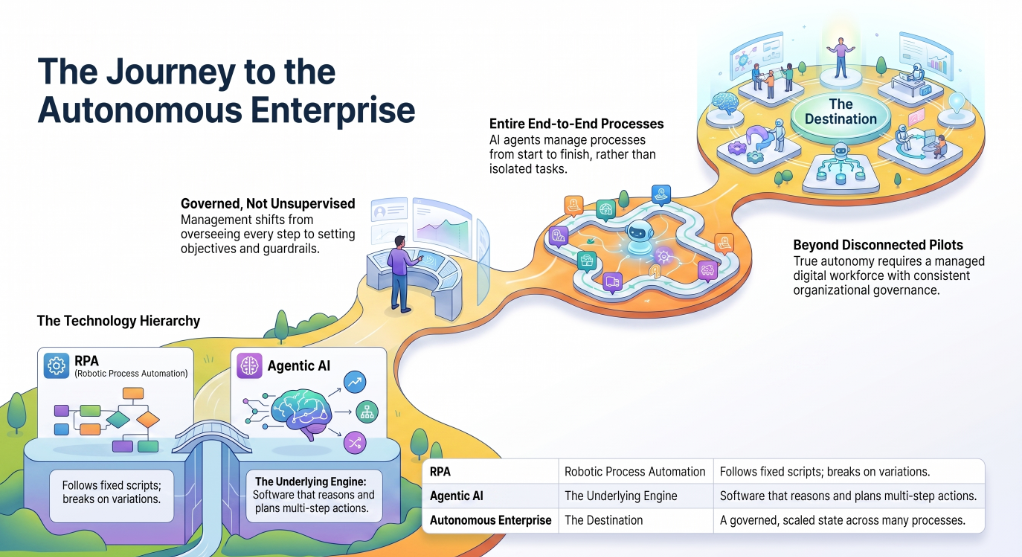
An autonomous enterprise is an organization where a meaningful share of operational work — not just individual tasks, but entire processes with a start, a middle, an end, and an outcome — is carried out by governed AI agents working alongside human employees, under policies that define what those agents are allowed to decide versus what still requires a person's sign-off.
That last clause is the part most definitions skip, and it's the one that matters. Autonomous does not mean unsupervised. It means the enterprise has shifted from managing every step of a process to managing the objectives, guardrails, and exceptions around it — the same way a manager doesn't approve every line of a report a skilled analyst writes, but does set the standards the analyst is expected to meet and reviews the output that matters.
It helps to separate three terms that get used almost interchangeably, because search results (and vendor marketing) blur them constantly:
- RPA (robotic process automation) follows a fixed script. It's reliable for repetitive, structured tasks, but it breaks the moment a process has a variation the script didn't anticipate.
- Agentic AI describes the underlying capability: software that can reason over a goal, plan multi-step actions, use tools, and adapt as conditions change. It's the engine.
- Autonomous enterprise is the destination — the organizational state where that engine is deployed at scale, with identity, permissions, oversight, and measurement built around it, across many processes rather than one isolated bot.
You can have agentic AI without an autonomous enterprise — a single clever agent bolted onto one workflow, disconnected from everything else. Most companies experimenting with AI agents today are in exactly that state: dozens of disconnected pilots, each useful, none of them adding up to a coherent operating model. The autonomous enterprise is what happens when those pilots stop being isolated experiments and start being a managed digital workforce with consistent governance.
Why Every Major Enterprise Vendor Is Suddenly Talking About This
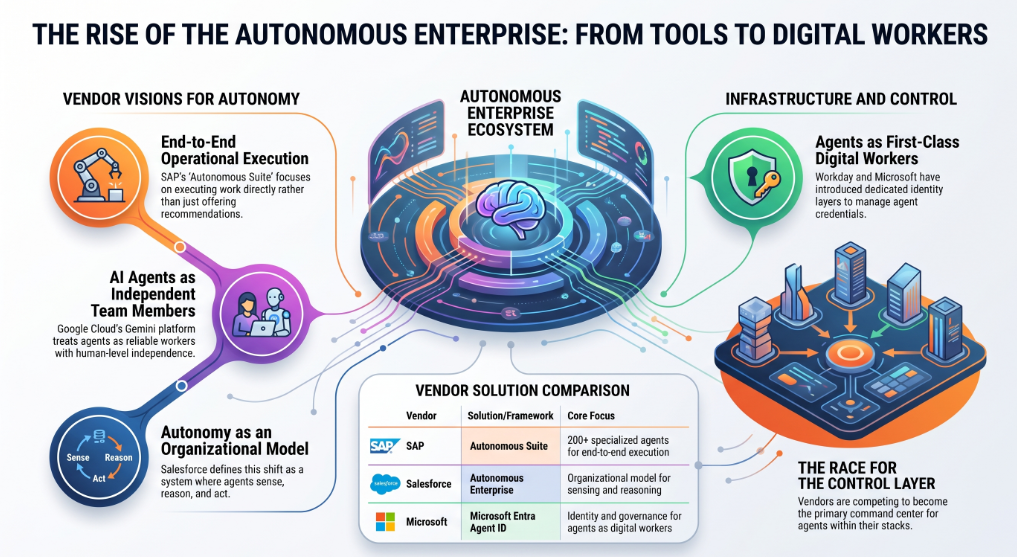
This isn't a niche framing invented by one company. In the last year, nearly every major enterprise software vendor has repositioned around the same idea, which is itself useful evidence that the category is real rather than marketing filler:
- SAP unveiled its "Autonomous Suite" alongside more than 50 domain-specific assistants and over 200 specialized AI agents at its 2026 Sapphire conference, arguing that enterprise software should execute operational work end-to-end rather than just recommend it.
- Google Cloud launched its Gemini Enterprise Agent Platform specifically framed around moving toward a truly autonomous enterprise, where agents act with the same independence and reliability as a team member.
- Salesforce now describes the autonomous enterprise as an organizational model — not a single product — where AI agents, automation, and platforms work with human teams to sense, reason, and act across operations with minimal manual intervention.
- Workday and Microsoft have each introduced agent identity and governance layers (Agent Passport and Microsoft Entra Agent ID, respectively) built specifically to manage AI agents as first-class digital workers with their own credentials, rather than as features bolted onto existing apps.
The pattern across all of them is the same: the vendors that already own a piece of enterprise software — an ERP, a CRM, a workflow suite — are racing to become the control layer for AI agents inside their own stack. That's a rational move for them. It's also the exact limitation that leaves an opening for a different approach.
The Missing Layer: Why "More Agents" Isn't the Same as "Autonomous"
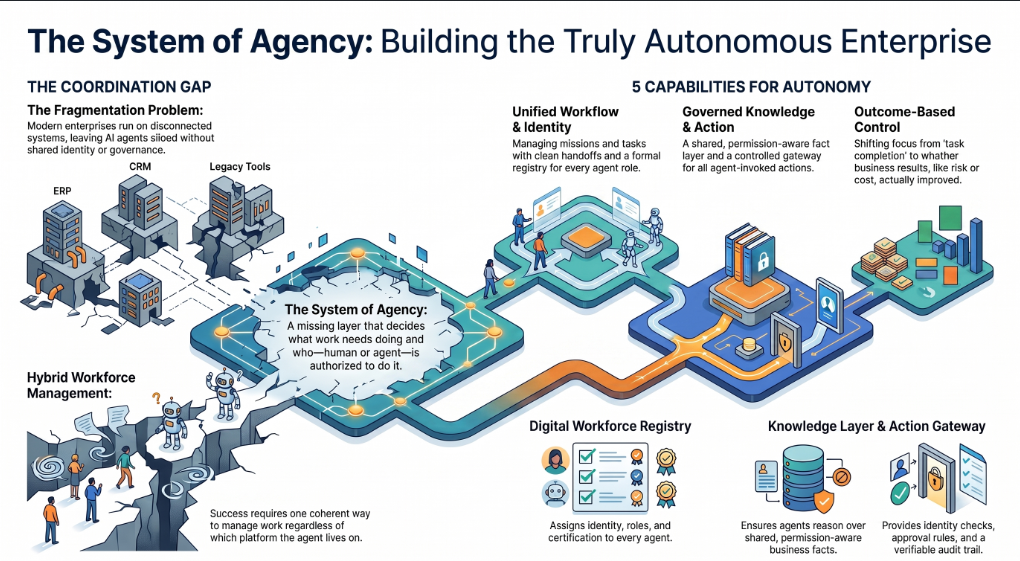
Here's the problem almost none of the vendor pitches above address directly: an enterprise doesn't run on one system. It runs on an ERP, a CRM, a handful of legacy systems nobody wants to touch, a document store, a ticketing tool, and usually three regional variants of each. If your path to "autonomous enterprise" only works inside one vendor's ecosystem, you haven't solved the coordination problem — you've just moved it up a level, because HR's agents, IT's agents, and finance's agents still don't share an identity model, a context layer, or a governance policy unless they all happen to live on the same platform.
This is the argument at the center of an internal strategy paper assistents.ai completed in July 2026: the enterprise stack has systems of record (databases of truth), systems of intelligence (analytics and prediction), and systems of automation (scripted execution) — but it's missing a System of Agency: the layer that decides what work needs doing, who or what should do it (a person, an agent, or a hybrid team), what context they need to do it well, what authority they're allowed to exercise, and whether the outcome that resulted was actually the one the business wanted.
That distinction reframes the whole category. It's not "how many agents can we deploy." It's "does the enterprise have one coherent way to manage a workforce that now includes both people and software, regardless of which system the work happens to touch." Five capabilities make that possible in practice, and they're worth naming because they're the checklist to hold any "autonomous enterprise" platform against, including this one:
- A place to manage the work itself — missions, cases, tasks, and queues, whether a human, an agent, or a mixed team is doing them, with clean handoffs between the two.
- A registry for the digital workforce — every agent has an identity, a defined role, a certification process before it goes live, and ongoing performance management, the same way a human hire does.
- Governed enterprise knowledge — a shared, permission-aware layer of documents, metrics, and business definitions so agents reason over the same facts a human manager would trust, not a fragmented pile of half-synced data.
- A controlled gateway for action — every capability an agent can invoke is exposed through identity checks, approval rules, spending or scope limits, and a verifiable audit trail, so "the agent did something" is never a mystery after the fact.
- A control tower for outcomes — a single view across work, workforce, cost, risk, and whether the business result — cash collected, tickets closed, risk avoided — actually improved, not just whether a task technically completed.
How AI Agents Actually Work Inside an Autonomous Enterprise
Strip away the branding, and every credible agent architecture — regardless of vendor — follows roughly the same loop, and understanding it makes the examples below easier to evaluate on their merits rather than on marketing claims:
- Perception: the agent ingests input from email, documents, APIs, voice, or system events, and converts it into structured context — extracting fields from a PDF invoice, or intent from a customer email.
- Reasoning: an LLM combined with business rules, policy, and historical context decides what should happen next — not just "what does this text say" but "what is this business allowed and expected to do about it."
- Action: the agent calls real systems — an ERP, a CRM, a ticketing tool — to actually do the work, rather than just producing a recommendation for a human to act on later.
- Verification and governance: every action is checked against policy, logged for audit, and, where the stakes are high enough, routed to a human for approval before or after execution.
The difference between a demo and a production deployment almost always comes down to step 4. Any model can draft a plausible-sounding action. Whether an enterprise can trust that action to actually run against a live system — with an audit trail, a rollback path, and a human checkpoint where it matters — is what separates a chatbot from an autonomous enterprise.
17 Real AI Agent Examples Powering the Autonomous Enterprise
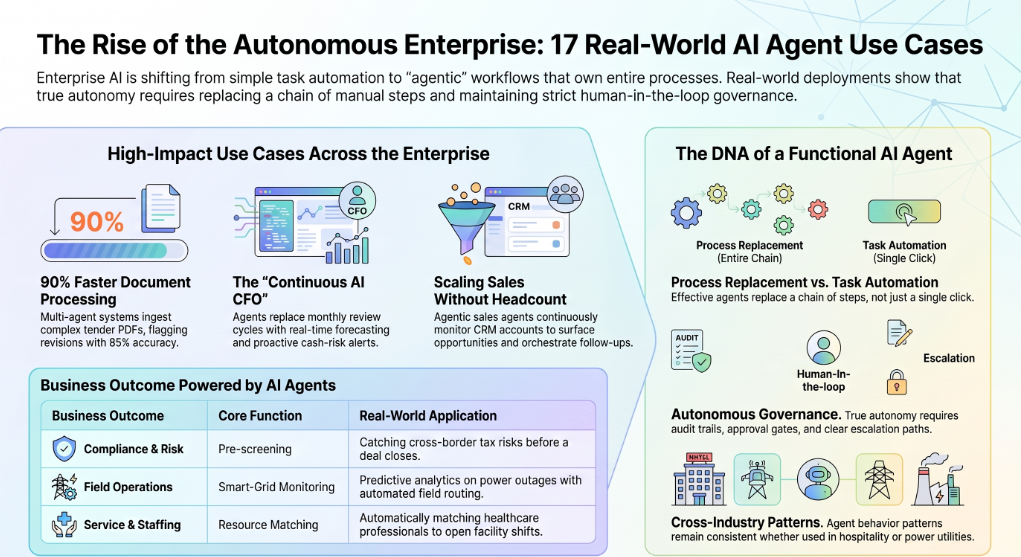
These are drawn from real, production or in-flight deployments across a range of industries. Client names are withheld for confidentiality; the descriptions below reflect the actual scope of work delivered. They're grouped by business outcome, not industry, because the pattern that matters is what kind of work the agent owns — the same pattern shows up in a hospitality booking desk and a state power utility.
Revenue, sales & customer growth
1. Always-on account intelligence for enterprise sales teams. Rather than a rep manually checking a CRM once a week, an agentic sales agent continuously monitors enterprise accounts, surfaces opportunities and risks as they emerge, and orchestrates rule-governed next-best-actions and follow-ups — giving account coverage that scales without adding headcount, and a documented reason behind every recommendation it surfaces.
2. Automated order creation replacing legacy sales-order tooling. One deployment automated SAP sales order creation directly through agentic AI, replacing a costly, end-of-life legacy system. The agent validates triggers, checks exceptions against governance rules, and creates the order — with a full audit and reconciliation trail — cutting manual order processing and data-entry error rates.
3. Creator and influencer marketing operations at scale. An AI platform automates discovery of creators from very large datasets, automates campaign delivery workflows, and generates performance reporting and brand-safety checks automatically — turning what used to be manual spreadsheet reconciliation into standing, always-current reporting.
Cash, finance & collections
4. A continuous AI CFO for growing businesses. Instead of a monthly close-and-review cycle, an AI CFO agent connects directly to accounting and banking data, runs forecasting and scenario models continuously, and proactively alerts on runway or cash-risk anomalies with a recommended action attached — giving finance teams earlier warning on cash problems and scalable, advisory-grade insight without adding analyst headcount.
5. Collections and receivables management with guardrails. An agentic collections workflow determines contact strategy per account, tracks promise-to-pay behavior, and escalates disputes — all against explicit guardrails (contact-frequency limits, no-policy-breach rules) and a rollback trigger if complaint rates rise, so the automation never runs ahead of what's actually approved.
6. Automated procurement and finance KPI alerting across a multi-entity group. A privately held group with dozens of operating companies now gets automated alerts on purchase-price trends, gross-margin impact, early-payment finance costs, and vendor delivery/return performance — replacing what used to be a manual, entity-by-entity finance review with standardized, group-wide monitoring.
Compliance, risk & tax
7. Cross-border tax risk pre-screening. A tax-technology platform uses AI agents to automatically screen cross-border transactions for withholding-tax exposure, VAT mismatches, and permanent-establishment risk — catching issues before a deal closes rather than after, with evidence collection and an escalation path to a human tax expert built in.
8. Automated sales-and-use-tax research. Instead of a tax researcher manually pulling sources for every jurisdiction question, an agent automates source collection, summarization, and draft-memo generation with citations attached, cutting research cycles while improving consistency of the output across analysts.
9. Technical due diligence for investment decisions. For a holding company that partners with founders on acquisitions, an agent-assisted review evaluates target-company architecture, scalability, and security posture, producing a structured risk register and remediation roadmap — giving investment committees a faster, more consistent view of technical risk before a deal closes.
Document & tender-heavy operations
10. Multi-agent tender and bid document processing. For an enterprise handling large, complex tender documents, a multi-agent system ingests each tender, uses vision-language extraction on complex PDFs, determines the right internal workflow, and flags revisions or changes automatically — engineered for roughly 90% faster processing versus manual review, with an accuracy target near 95% on standard document formats, and full auditability on every extraction.
11. Pharma sourcing and procurement automation. A pharma-sourcing platform listing thousands of rare excipients and SKUs uses agents to automate RFQ generation, supplier discovery, and quality-document handling, giving procurement teams faster sourcing cycles and better visibility into price and lead-time competitiveness.
Field operations, energy & infrastructure
12. Campus and smart-grid energy monitoring. A research campus uses agentic monitoring for energy consumption, catching inefficiencies and forecasting usage automatically, while a state power-transmission utility uses a parallel deployment for smart-grid anomaly detection — predictive analytics on outages and losses, with automated alerting and workflow routing straight to field teams.
13. Terminal-to-rail logistics digitization. A global ports and logistics operator uses an agentic system to digitize and optimize terminal-to-inland-rail handoffs, giving real-time visibility into scheduling and exceptions across what used to be a manual coordination process between terminal operations and rail scheduling.
Retail, inventory & competitive intelligence
14. Store-level voice support and inventory intelligence. A large, multi-city retail chain deployed a bilingual voice support agent (built on speech-to-text, LLM reasoning, and text-to-speech) alongside an inventory-intelligence agent that tracks per-store pricing, stock, and promotions, plus a training agent that answers staff questions against internal SOP and point-of-sale documentation — reducing helpdesk load and speeding up new-employee onboarding.
15. Continuous competitive-price monitoring. For a price-sensitive consumer goods manufacturer, an always-on agent monitors e-commerce channels for competitor pricing, discounting, and promotional shifts, then answers leadership's standing questions automatically — replacing manual portal-by-portal checks with continuous monitoring and earlier detection of pricing gaps.
Service operations & staffing
16. Omnichannel customer service for real estate and tenant support. A real-estate portfolio holder deployed an omnichannel agent (chat, email, and web-ready) to triage tenant queries, answer FAQs against tenancy documents and policies, and escalate only what genuinely needs a human — improving SLA adherence and giving a consistent tenant experience around the clock.
17. Healthcare staffing and matching operations. A healthcare staffing platform uses an agentic system to handle facility staffing requests, match qualified nursing professionals to open shifts, and manage scheduling, notifications, and compliance checks automatically — improving fill rates and reducing the manual coordination load on staffing coordinators.
Two patterns hold across all 17 examples. First, every one of them replaces a process, not a single click — a chain of steps that used to require a person to hold the whole thing in their head. Second, every one of them includes a governance element — an audit trail, an approval gate, a guardrail, or an escalation path — because none of these organizations were willing to hand over real operational authority without it. That's not a limitation of the technology. It's the actual definition of "autonomous" done correctly.
Why assistents.ai Is Built for This Shift, Not Retrofitted to It
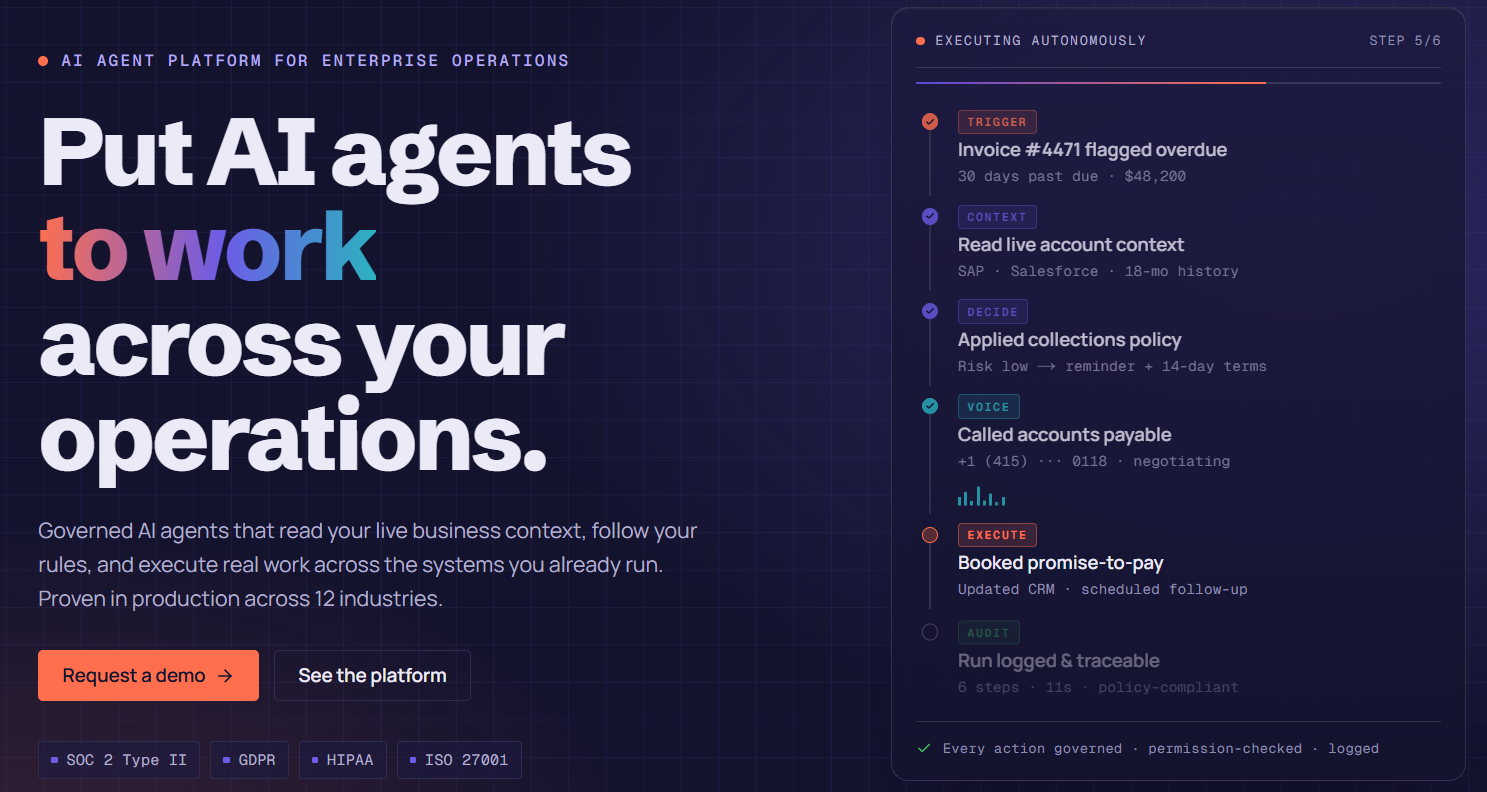
Most of the platforms racing toward "autonomous enterprise" today are automation vendors or ERP/CRM vendors adding an agent layer on top of what they already sold you. That ordering matters more than it sounds. A platform designed first around workflow scripts, or first around one company's own ERP data model, tends to treat agents as a new kind of macro — powerful, but still bolted onto the outside of the system rather than built into how work gets managed.
assistents.ai starts from the opposite direction: the product is organized around enterprise work itself, not around chat, not around one model, and not around one underlying ERP. That shows up in five customer-facing capabilities that work together rather than as separate add-ons:
- Work Hub — a shared place to manage missions, cases, tasks, and queues, with clean handoffs between a human, an agent, or a mixed team working the same item.
- AI Workforce — a registry to create, certify, deploy, and performance-manage agents the same way an organization manages its human workforce, rather than treating each agent as a disconnected script.
- Enterprise Knowledge — a governed layer of documents, metrics, and business definitions that agents draw on, so an agent's reasoning is grounded in the same facts a trusted analyst would use — not a hallucinated guess.
- Action Gateway — every capability an agent can invoke passes through identity checks, approval rules, limits, and a verifiable audit log, so nothing executes in a black box.
- Operations Control Tower — one view across work, workforce, cost, risk, and — critically — whether the business outcome you actually wanted was achieved, not just whether a task ran.
Because this is a work-and-workforce layer rather than an ERP replacement, it sits on top of whatever an enterprise already runs — SAP or a homegrown system, Salesforce or a legacy CRM, on-prem or cloud — instead of asking the enterprise to migrate onto a single vendor's stack first. That's the practical answer to the vendor-lock-in gap left open by the SAP-, Salesforce-, and Google-centric visions of the autonomous enterprise: you get a governed digital workforce without re-platforming your systems of record to get it.
Why assistents.ai Is the Safer Bet: Proof, Not Promises
The other reason to be skeptical of a vendor's "autonomous enterprise" pitch is simple: most of it is still aspirational. Plenty of platforms can describe governance in a slide deck. Fewer can point to production deployments where that governance held up.
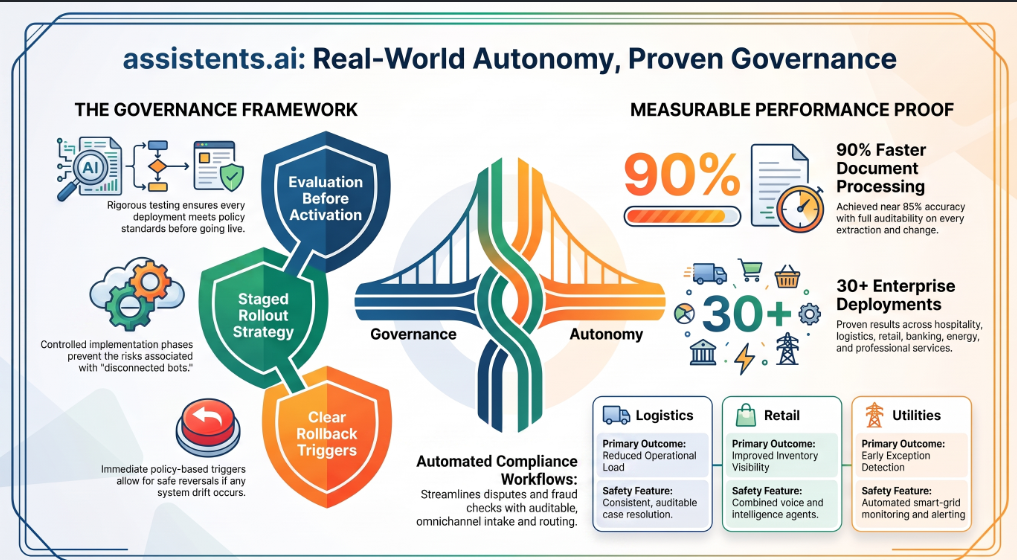
assistents.ai's deployments span more than 30 organizations across hospitality, logistics, retail, banking and fintech, energy and utilities, real estate, healthcare, and professional services — and the results are measured, not asserted:
- Tender and bid-document processing engineered for roughly 90% faster turnaround, with an accuracy target near 95% on standard formats and full auditability on every extraction and change.
- A logistics enterprise moving from manual case handling to consistent, auditable case resolution with reduced operational load and stronger compliance readiness.
- A retail chain cutting manual helpdesk burden and improving store-level inventory visibility through a combined voice, inventory-intelligence, and training-agent deployment.
- A finance-technology provider automating disputes, fraud checks, and compliance workflows for banks and credit unions with fully auditable, omnichannel intake and routing.
- A power-transmission utility gaining earlier detection of grid exceptions and more proactive field operations through continuous smart-grid monitoring and automated alerting.
The common thread is not any single industry. It's that every deployment paired real autonomy with real governance from day one — evaluation before activation, staged rollout, and a clear rollback trigger if something drifts from policy — which is exactly the discipline that separates an "autonomous enterprise" from a fragile pile of disconnected bots.
How to Get There: A Practical Path From Pilot to Autonomous Operation
The organizations above didn't start with 17 agents running simultaneously. Almost universally, the path looked like this:
- Start with one workflow that's already painful — heavy in documents, crossing multiple systems, with exceptions someone has already written down somewhere (a policy, a runbook, an SOP). That existing documentation is what lets an agent reason correctly instead of guessing.
- Prove it with a human still fully in the loop, then move the autonomy dial in stages — from "ask before every action" to "execute with defined limits" to "fully autonomous within an approved policy," rather than flipping a single switch to full autonomy on day one.
- Register the agent like you'd onboard an employee — give it an identity, a defined scope, an evaluation before it goes live, and an owner accountable for its performance.
- Expand into an Agentic Workcell — once one workflow is stable, grow it into a governed human-agent team that owns a whole business operation (not just a task) and is measured on that operation's outcome.
- Connect workcells through a shared control tower so leadership gets one view of work, workforce, risk, and cost — instead of a dozen disconnected dashboards for a dozen disconnected pilots.
This is deliberately incremental. The enterprises further along this path didn't get there by replacing their core systems first — they got there by adding a governed work-and-workforce layer on top of what they already had, and expanding one proven workcell at a time.
Ready to see where an autonomous enterprise approach fits your operations? Talk to assistents.ai about a governed pilot on your highest-friction workflow.
FAQ:
What is an autonomous enterprise?
An autonomous enterprise is an organization where AI agents carry out a meaningful share of operational work — full processes, not just single tasks — alongside human employees, under explicit policies for what agents can decide autonomously versus what requires human approval.
What's the difference between agentic AI and an autonomous enterprise?
Agentic AI is the underlying capability — software that can reason, plan, and act toward a goal. An autonomous enterprise is the organizational result of deploying that capability at scale, with governance, identity, and measurement built around it across many processes, not just one.
Is agentic AI the same as RPA?
No. RPA follows a fixed, scripted process and breaks when a case doesn't match the script. Agentic AI reasons over context and can adapt its approach when conditions change, which is what makes it viable for the messier, document-heavy, exception-prone processes RPA historically couldn't touch.
What are real examples of AI agents in an enterprise?
Common production examples include automated tender and document processing, continuous cash-flow and collections monitoring, cross-border tax risk screening, competitive price monitoring, omnichannel customer and tenant support, and smart-grid or energy anomaly detection — see the 17 examples above for full detail on each.
Are AI agents safe for enterprise use?
They can be, with the right controls: identity and permission checks before any action, approval gates for high-stakes decisions, full audit logging, and a defined rollback path if an agent's behavior drifts from policy. The organizations above all built these in before granting real autonomy, not after.
Can AI agents replace human employees?
In the deployments above, agents took over the repetitive, document-heavy, or continuously-monitored portions of a role — not the whole job. Humans retained the judgment calls, exceptions, and accountable decisions, while agents absorbed the volume work around them.
What is a "system of agency" in AI?
It's the proposed missing layer in the enterprise stack: the system that decides what work needs doing, who or what (human, agent, or hybrid team) should do it, what context and authority that work requires, and whether the resulting outcome actually met the business goal — distinct from systems of record (data), systems of intelligence (analysis), and systems of automation (scripted execution).
How do you measure ROI from AI agents?
The deployments above track business outcomes directly — cash collected, processing time, extraction accuracy, complaint rates, fill rates — rather than proxy metrics like "number of agents deployed," which is a strong signal of a program that's actually governed rather than experimental.
What is an enterprise AI agent platform?
A platform that lets an organization build, deploy, manage, and govern AI agents across multiple business processes, with shared identity, permissions, context, and audit infrastructure — rather than a collection of one-off scripts each built and secured separately.

Transform Your Business With Agentic Automation
Agentic automation is the rising star posied to overtake RPA and bring about a new wave of intelligent automation. Explore the core concepts of agentic automation, how it works, real-life examples and strategies for a successful implementation in this ebook.
Sarfraz Nawaz is the CEO and founder of Ampcome, which is at the forefront of Artificial Intelligence (AI) Development. Nawaz's passion for technology is matched by his commitment to creating solutions that drive real-world results. Under his leadership, Ampcome's team of talented engineers and developers craft innovative IT solutions that empower businesses to thrive in the ever-evolving technological landscape.Ampcome's success is a testament to Nawaz's dedication to excellence and his unwavering belief in the transformative power of technology.

More insights
Discover the latest trends, best practices, and expert opinions that can reshape your perspective


.jpg)


.webp)

Contact us

