
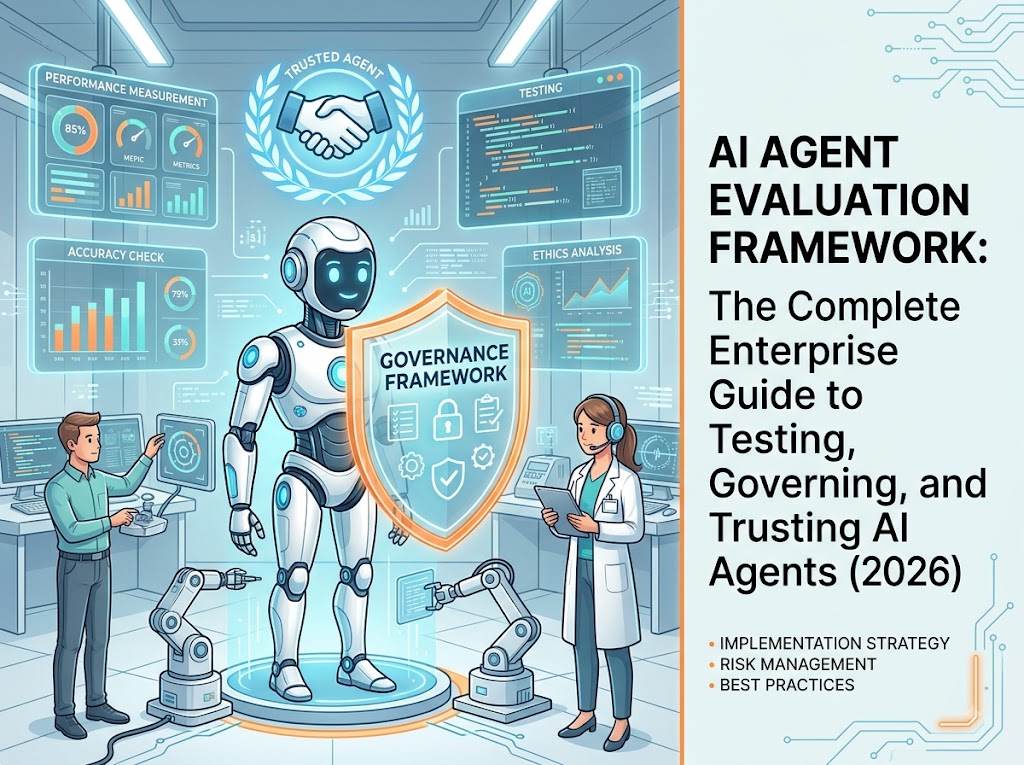
AI Agent Evaluation Framework: The Complete Enterprise Guide to Testing, Governing, and Trusting AI Agents (2026)


An AI agent evaluation framework is a structured method for measuring whether AI agents are capable, reliable, safe, and commercially effective — across offline tests, simulations, shadow runs, and live production. Unlike LLM benchmarks that score single responses, agent evaluation assesses complete trajectories: reasoning, tool calls, decisions, actions, and outcomes.
Enterprises need that discipline more than ever. Industry analysts have projected that a large share of agentic AI projects — Gartner has put the figure at over 40% — will be cancelled by 2027, largely because costs, risks, and value were never measured rigorously. Recent enterprise surveys tell the same story from the other side: the overwhelming majority of large organisations are piloting AI agents, but only a small minority have promoted those agents to production scale. The gap between pilot and production is not a model problem. It is an evaluation problem.
This guide covers the full discipline: how agent evaluation differs from LLM evaluation, the metrics that matter at each level of an agent's execution, the methods used to score them, the tools available in 2026, and — the part most guides skip entirely — how evaluation should function as a governance mechanism that decides how much autonomy an agent has earned. That last part is formalised here as the Evaluation-Gated Autonomy (EGA) Framework, the approach we use at Ampcome when deploying AI agents through our assistents.ai platform.
What Is an AI Agent Evaluation Framework?
An AI agent evaluation framework is the combination of test data, metrics, scoring methods, thresholds, and release gates used to answer one question with evidence: can this agent be trusted to do this work, at this level of autonomy, in this environment?
The word "framework" matters. Evaluating an agent is not a single test you run before launch. It is a repeatable structure that follows the agent through its whole lifecycle — from the first offline test set, through simulation and shadow operation, into supervised production, and onward through continuous monitoring, drift detection, and periodic re-evaluation. Any evaluation approach that stops at launch is measuring a snapshot of a system that changes every time a model, prompt, tool, policy, or data source changes.
Why Evaluating AI Agents Is Different from Evaluating LLMs
A model benchmark tests the capability of a foundation model in isolation: how well it understands language, follows instructions, or solves static problems. Agent evaluation tests the behaviour of a system operating end-to-end — planning, selecting tools, handling uncertainty, coordinating steps, and completing real workflows in a dynamic environment.
The practical differences:
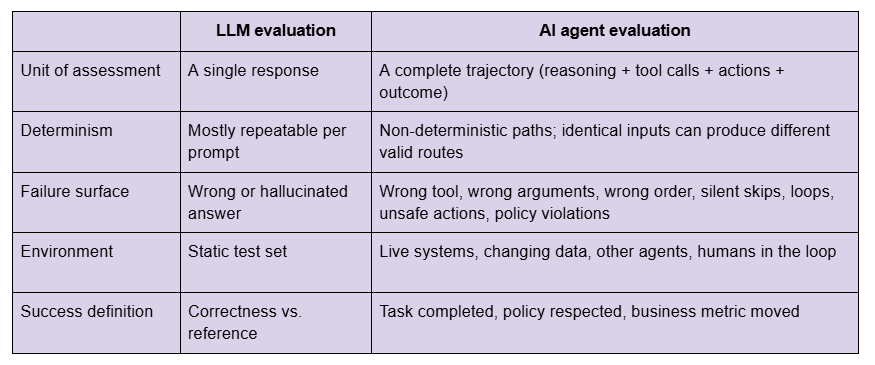
This is why an agent can score brilliantly on public model benchmarks and still fail in your order-processing workflow. The model was never the whole system.
Evaluation vs. Benchmarking vs. Observability vs. Monitoring
These four terms are used interchangeably and shouldn't be:
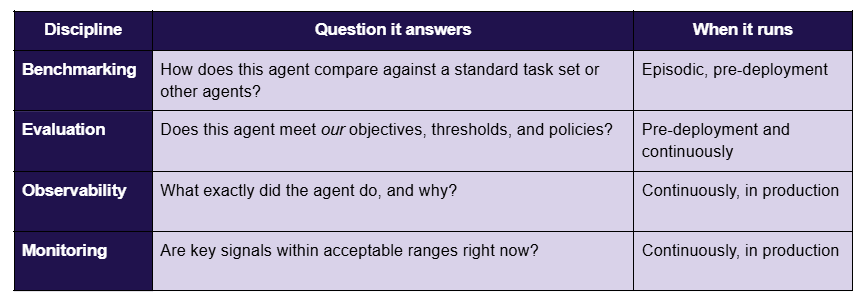
A mature evaluation framework uses all four: benchmarks for comparative context, evaluation for the go/no-go and autonomy decisions, observability to make failures inspectable, and monitoring to catch degradation early. Observability without evaluation produces data with no verdict. Evaluation without observability produces verdicts you cannot explain.
Why Agents Fail Silently: The Sandbox-to-Production Gap
The most dangerous agent failures are the quiet ones. An agent can reason correctly, call a plausible tool, produce a fluent output — and still be wrong in a way no one notices for weeks. Common silent failures include:
- A tool call that errors, gets ignored, and is papered over with a confident summary.
- A retrieval step that returns stale or wrong-scope data the agent treats as truth.
- A plan that skips a validation step under time pressure and usually gets away with it.
- Cost and latency creep as multi-turn context compounds token consumption.
- Behavioural drift as upstream data, prompts, or models change beneath a "passing" agent.
Sandbox test sets rarely surface because they are clean, static, and known in advance. Production is none of those things. Closing that gap is precisely what a staged evaluation framework is for.
The Four Dimensions Every Agent Evaluation Must Cover
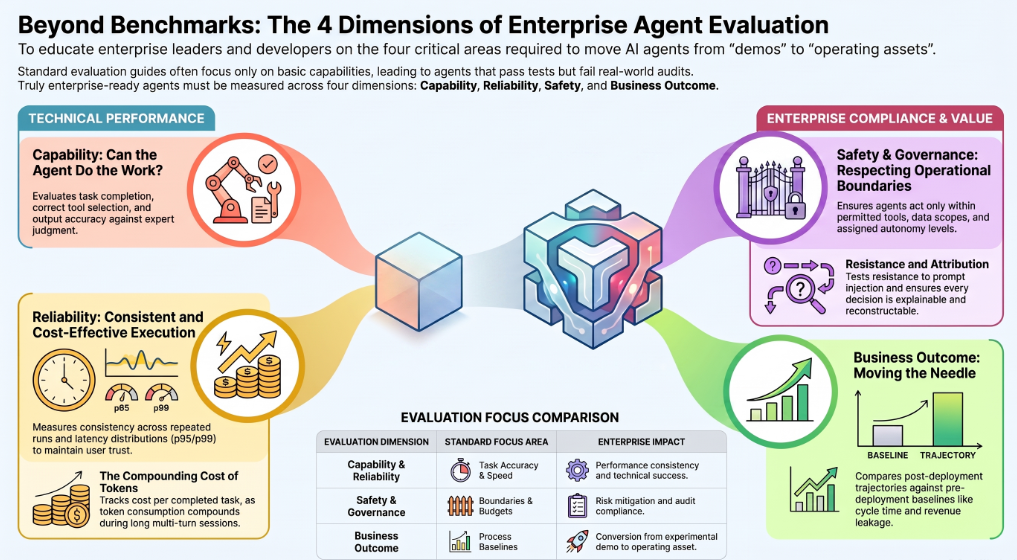
Most evaluation guides measure only the first two dimensions below. Enterprises that stop there ship agents that pass their tests and fail their audits.
1. Capability
Can the agent do the work? Task completion rate, plan quality, correct tool selection, correct arguments, correct sequencing, and output accuracy against ground truth or expert judgment. This is the dimension public benchmarks approximate and the one most tooling measures well.
2. Reliability
Does the agent do the work consistently? Consistency across repeated runs on identical inputs, graceful error recovery (adapting after a failed tool call rather than retrying blindly), latency distributions (p50 for typical experience, p95 and p99 for the tail behaviour that destroys user trust), and cost per completed task — arguably the most underrated production metric, because token consumption compounds in long multi-turn sessions.
3. Safety and Governance Conformance
Did the agent respect its boundaries? This dimension is almost entirely absent from developer-centric evaluation guides, and it is the one enterprise risk teams care about most:
- Did the agent act only within its permitted tools, data scopes, and spend budgets?
- Did it request approval where policy requires approval?
- Did it respect its autonomy level — recommending where it may only recommend, acting only where it may act?
- Did it resist prompt injection and manipulation attempts embedded in documents, emails, or web content?
- Is every consequential decision it made attributable, explainable, and reconstructable?
An agent that completes tasks while quietly exceeding its authority has not passed evaluation. It has failed the dimension that matters most.
4. Business Outcome
Did the number move? Every agent should be deployed against a named process with a measurable baseline — cycle time, cost per case, backlog, recovery rate, error rate, revenue leakage. Outcome evaluation compares the post-deployment trajectory of that baseline against the pre-deployment one, controlling for seasonality and volume. Capability without outcome is a demo. Outcome measurement is what converts an agent from an experiment into an operating asset — and it is the evidence that justifies expanding its autonomy.
AI Agent Evaluation Metrics: The Complete Taxonomy
Agent metrics operate at three scopes. A customer-service agent can succeed at session level (ticket resolved) while failing at trajectory level (five unnecessary tool calls) and span level (one API error silently ignored). Without all three scopes, teams miss the technical debt that eventually surfaces as production incidents.
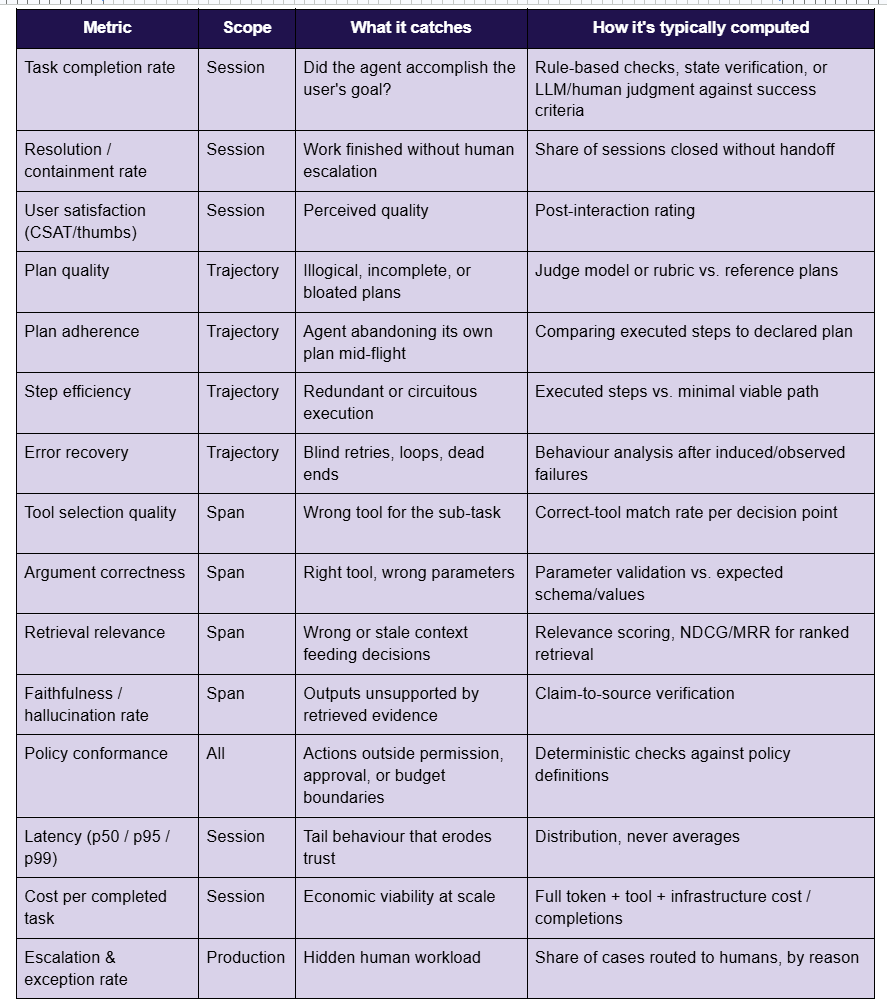
Two practical rules. First, weight metrics by decision class: a research assistant and an agent that creates ERP sales orders should not share a scorecard. Second, define thresholds before testing. A metric without an acceptance threshold is a dashboard, not an evaluation.
Evaluation Methods: How to Actually Score Agents
Ground-Truth and Rule-Based Checks
The strongest evaluations are deterministic: apply the agent's output and check the consequences programmatically. Did the record land in the target system with the right values? Does the extracted total match the source document? Did the final state of the database match the goal state? Executable, state-based checking is the standard in serious agent benchmarks for a reason — it cannot be charmed by fluent prose. Use it everywhere a correct answer or end-state can be defined.
LLM-as-a-Judge: Where It Works and Where It Fails
LLM-as-a-judge uses a strong model to score agent outputs or full trajectories against a rubric. It scales human-like judgment to thousands of cases and handles open-ended quality dimensions (helpfulness, tone, reasoning coherence) that rules cannot.
Its documented failure modes are equally real: verbosity bias (rewarding longer answers), position bias (favouring the first option shown), self-preference (favouring outputs from its own model family), and a tendency to reward a fluent rationale even when the underlying decision is unsound. Treat judge models as one instrument, not the verdict:
- Calibrate the judge against a human-labelled sample before trusting it at scale.
- Use structured rubrics with binary or few-level criteria, not open 1–10 scores.
- Prefer trajectory-aware judging (the full sequence of steps) over final-answer-only judging.
- Keep deterministic checks as the backbone; use judges for what rules cannot score.
Human Review and Domain-Expert Evaluation
Humans remain the ground truth for ambiguous, high-stakes, and domain-heavy judgments — a clinical workflow, a tax position, a tender interpretation. The scalable pattern is stratified sampling: humans deeply review a rotating sample of trajectories (weighted toward failures, escalations, and edge cases), and their labels continuously recalibrate the automated layers. Human review is also where evaluation meets accountability: a named owner signs off that the agent's behaviour is acceptable for the next stage of rollout.
Public Benchmarks — and Where They Mislead
Benchmarks like GAIA (real-world assistant tasks), AgentBench (multi-environment agent tasks), tau-bench (tool-use with state verification), and SWE-bench (software engineering) are useful for comparing models and situating your stack against the field. They are poor predictors of performance on your workflows, because your workflows involve your systems, your data quality, your policies, and your edge cases — none of which a public task set contains. The consistent finding across the industry is a wide gap between lab benchmark scores and production outcomes. Use benchmarks to shortlist; use your own evaluation framework to decide.
The Evaluation-Gated Autonomy (EGA) Framework
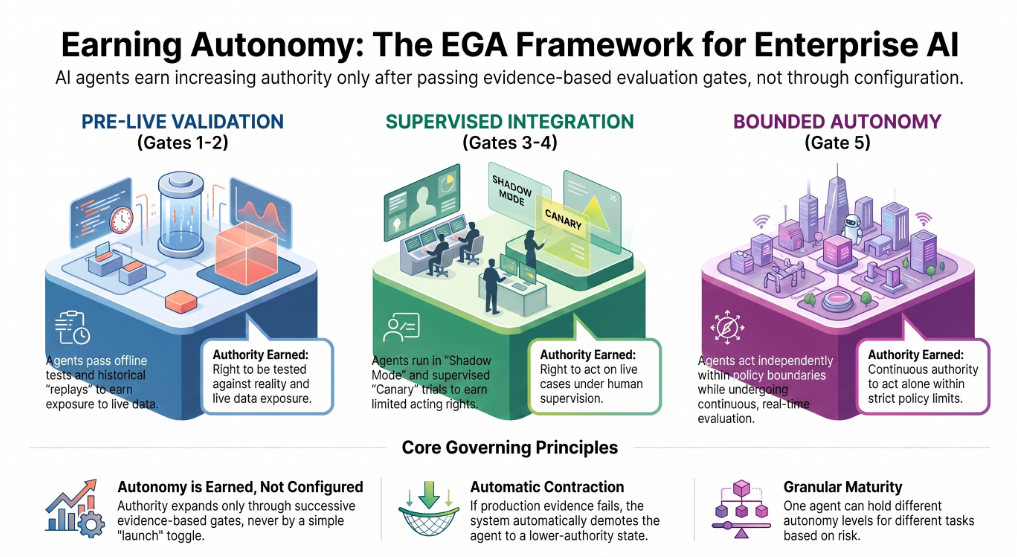
Definition: The Evaluation-Gated Autonomy (EGA) Framework, developed by Ampcome for its assistents.ai platform, treats evaluation as the mechanism by which an AI agent earns operating authority. An agent's autonomy expands only after it passes five successive evaluation gates — and contracts automatically when production evidence deteriorates.
Most teams treat evaluation as a quality checkpoint before launch. That framing is wrong for enterprise agents, because the real decision an enterprise makes is never simply "launch or don't launch." It is: how much authority does this agent get? May it only prepare and summarise? May it recommend? May it act with approval? May it act alone within limits? Those are different risk positions, and each should be justified by different evidence.
EGA makes that explicit. Autonomy is not configured; it is earned — gate by gate.
Gate 1 — Offline Evaluation
Build a curated test set from real historical cases: representative volume cases, known edge cases, adversarial inputs, and malformed data. Define acceptance thresholds per metric before running anything — extraction accuracy targets, task completion floors, zero-tolerance policy violations. The agent runs against the set in isolation. Nothing it does touches a live system.
Passing Gate 1 earns: the right to be tested against reality, not the right to touch it.
Gate 2 — Historical Replay and Simulation
Run the agent against real past cases — last quarter's tenders, last month's support tickets, last year's exceptions — and compare its decisions to what your best people actually did. Replay is the highest-value, lowest-risk evaluation asset most enterprises already own and never use: the answers are known, the edge cases are real, and disagreements between agent and human are individually inspectable. Simulation extends this to synthetic what-if scenarios the history doesn't contain.
Passing Gate 2 earns: exposure to live data.
Gate 3 — Shadow Mode
The agent runs on live, current cases in parallel with your human process — but acts on nothing. Every decision it would have made is recorded and compared against what actually happened. Shadow mode surfaces what offline sets never contain: today's data quality, today's volumes, today's weird cases. Divergence analysis becomes the evaluation: where the agent and the human process disagree, which one was right, and why?
Passing Gate 3 earns: the right to act — under supervision.
Gate 4 — Supervised Execution and Canary
The agent now produces real actions, with a human approving each consequential one, on a deliberately limited blast radius: one region, one product line, one document type, one branch. Approval-queue behaviour is itself evaluation data — approval rates, correction rates, and override reasons quantify exactly how much the humans still need to fix. A canary that requires constant correction has told you something a test set never could.
Passing Gate 4 earns: bounded autonomy for specific, lower-risk decision classes.
Gate 5 — Bounded Autonomy with Continuous Evaluation
The agent acts without per-case approval — inside explicit policy boundaries: value thresholds, decision classes, spend budgets, prohibited actions, and mandatory escalation triggers. Continuous evaluation never stops: every decision is logged, sampled, scored, and compared against baselines. Breach a threshold, and autonomy contracts — automatically demoting the agent back to approval-required or recommend-only while humans investigate.
Gate 5 is not a finish line. It is a state the agent must keep re-earning, every day, with evidence.
Mapping the Gates to the Autonomy Ladder
EGA pairs naturally with the autonomy ladder most enterprises use to describe agent maturity — from Assist (retrieve and prepare), through Recommend, Coordinate, and Execute, to Optimize. Each gate qualifies the agent for the next rung. Critically, different decisions inside one process can and should sit at different rungs: the same order-processing agent may hold full autonomy on standard-format orders, approval-required status on exceptions above a value threshold, and recommend-only status on anything touching credit terms. Blanket autonomy levels are a sign that evaluation was never granular enough.
Offline Evals → Replay & Simulation → Shadow Mode → Supervised Canary → Bounded Autonomy
(Gate 1) (Gate 2) (Gate 3) (Gate 4) (Gate 5)
│ │ │ │ │
earns live earns live earns the earns bounded continuously
data testing exposure right to act autonomy re-earned
▲ │
└── rollback ────┘
Evaluating Agents in Production: Continuous Evaluation
Pre-deployment gates get an agent into production. What keeps it trustworthy there is a permanent evaluation infrastructure with four components.
The Decision Ledger
Every consequential decision the agent makes should be recorded as a first-class object: the inputs it saw, the context it retrieved, the policy that authorised it, the autonomy level it acted under, the action taken, and the outcome observed. A decision ledger is what turns "the agent did something odd last Tuesday" from an anecdote into a query. It is also the artefact auditors and risk committees actually ask for.
Traces and Replay
Full end-to-end traces — every reasoning step, tool call, and intermediate result — make any individual failure reconstructable. Replay capability makes it testable: rerun the same case against a new prompt, model, or policy version and diff the behaviour. Traces answer what happened; replay answers would the fix have worked.
Drift Detection and Outcome Measurement
Agents degrade quietly. Upstream data shifts, user behaviour changes, a model version updates, a connected system alters a response format. Continuous evaluation compares rolling windows of every core metric — completion, conformance, cost, latency, escalation rate — against baselines, and alerts on divergence before users complain. In parallel, outcome measurement keeps scoring the business metric the agent was deployed to move. An agent whose task-completion rate is stable but whose business outcome has flattened is telling you the work changed around it.
Demotion Is a Feature
The most important cultural point in production evaluation: restricting an agent's autonomy is a success of the framework, not a failure of the project. A system that can detect deterioration and automatically step an agent down from autonomous execution to approval-required — while preserving every trace needed to diagnose why — is precisely what makes granting autonomy defensible in the first place. Enterprises that cannot demote agents safely will, rationally, never promote them.
AI Agent Evaluation Tools and Frameworks Compared (2026)
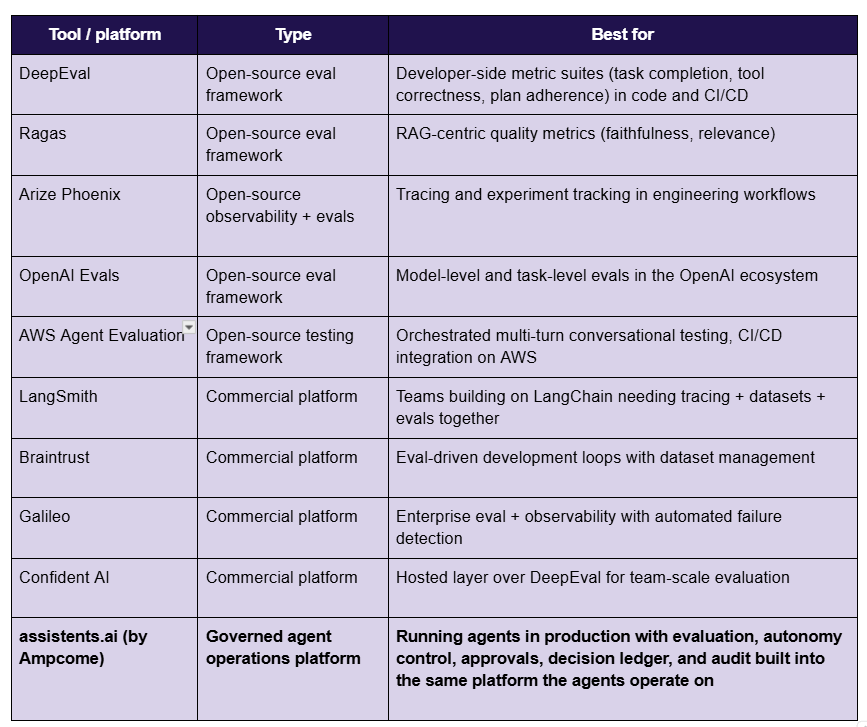
The tooling landscape splits into three layers that solve different problems. Most enterprises need more than one.
How to Choose: Build-Side Tooling vs. Run-Side Governance
Eval SDKs and platforms answer the builder's question: is my agent good enough? They instrument code, score outputs, and gate releases in CI/CD. That layer is necessary — and insufficient — because the enterprise's question is different: can this agent be trusted with authority inside our operations, and can we prove it, continuously, to our own risk and audit functions?
Answering that requires evaluation to live where the agents live: in the platform that assigns their permissions, enforces their approval policies, meters their budgets, records their decisions, and can restrict their autonomy in real time. A test score in a CI pipeline cannot demote an agent at 2 a.m. A governed operations platform can. In practice, mature teams use developer eval tooling during build, and a governed platform for everything after — because the second layer is what unblocks production.
Field Evidence: What Evaluation Looks Like in Real Deployments
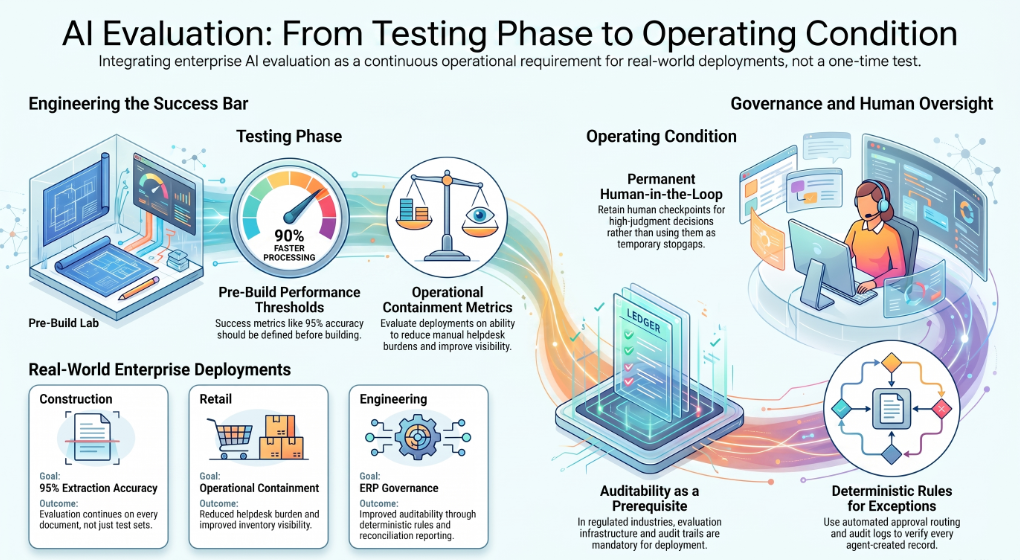
The following patterns are drawn from real enterprise deployments delivered by Ampcome. Clients are described by industry, geography, and scale only; outcome statements are directional.
A luxury hospitality operator (Africa, 16 properties). A digital booking agent automates end-to-end reservation workflows for high-expectation international travellers. Evaluation centred on extraction accuracy for complex, multi-property guest requirements — and, crucially, a human-in-the-loop quality-control layer for curated itineraries that functions as a permanent Gate 4 for the highest-judgment decisions. Result: faster booking turnaround and higher accuracy on complex requirements, with the human checkpoint retained by design rather than as a stopgap.
A remedial construction and waterproofing specialist (Australia). Autonomous document agents ingest and analyse complex tender documents and synchronise them into core operational systems. This engagement is a textbook Gate 1 case: acceptance criteria were engineered upfront — targets of roughly 90% faster tender-document processing and a ~95% extraction-accuracy threshold for standard formats — and the system was built with revision-change detection and audit logging so that evaluation continues on every document, not just the test set. Those figures are engineered targets that defined the evaluation bar, which is exactly how thresholds should enter a project: before the build, not after it.
A national value retailer (India, 700+ stores). Enterprise AI agents modernise store support, inventory visibility, and knowledge access at national scale, including voice support in two languages. The deployment moved deliberately from proof-of-concept to production with governance and audit trails — the gate sequence in practice — and was evaluated on operational containment: reduced manual helpdesk burden, faster store-issue resolution, and measurable improvements in store-level inventory visibility before national rollout.
A diversified engineering and technology group (Middle East). Agentic automation interprets order triggers, validates them, and creates sales orders directly in the ERP — replacing an end-of-life legacy document workflow. Because the agent writes to a system of record, the evaluation emphasis sat squarely on the governance-conformance dimension: deterministic rules for exceptions, approval routing for edge cases, and audit logs with reconciliation reporting that continuously verify every order the agent creates. Results were reduced manual order processing, a faster order-to-confirm cycle, and improved auditability — the last of which was a design goal, not a by-product.
A global banking automation provider (fintech). Omnichannel AI agents support banking customers across chat, email, and phone, with agent-assist summarisation and next-best actions. In a regulated environment, evaluation was inseparable from auditability: workflow automation was built with audit trails and SLA monitoring so that every automated step is evidenced. The outcomes — faster case handling, more consistent resolution, and stronger compliance readiness — illustrate the central EGA argument: in regulated industries, the evaluation infrastructure is the deployment prerequisite.
Across all five, the common thread is that evaluation was never a phase. It was the operating condition under which autonomy was granted, held, and audited.
Why assistents.ai by Ampcome for Evaluated, Governed AI Agents
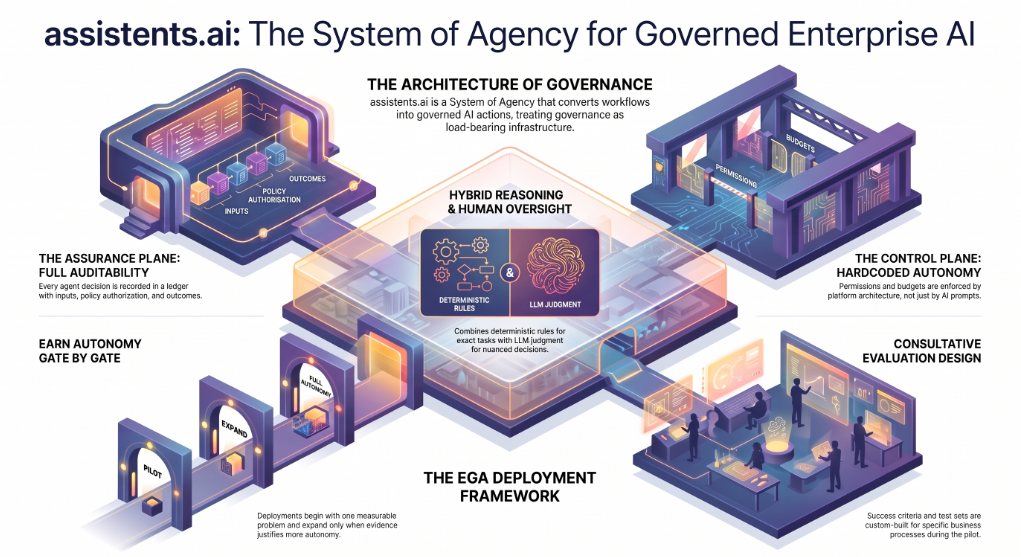
assistents.ai is Ampcome's governed enterprise AI operations platform — a System of Agency that sits above your existing ERP, CRM, data, document, and workflow systems and converts enterprise data, documents, policies, business rules, and workflows into contextual intelligence, governed decisions, coordinated actions, and measurable outcomes. Your systems of record remain authoritative; the platform is the layer where humans and AI agents operate the enterprise together.
Evaluation is not a bolt-on in this architecture. It is load-bearing:
- A decision ledger and end-to-end traces. Every consequential agent decision is recorded with its inputs, policy authorisation, and outcome — with replay and shadow-mode capability for testing changes against reality before they ship. This is the Assurance plane of the platform, and it is what makes Gates 2, 3, and 5 of the EGA framework operational rather than aspirational.
- Autonomy levels per decision class. Permissions, approval policies, and budgets are enforced by the platform, not promised by a prompt. Different decisions in the same process can hold different autonomy levels — and autonomy can be restricted instantly when evidence deteriorates. This Control plane is where most agent stacks have no equivalent.
- Deterministic rules alongside AI reasoning. Versioned, checksummed rule releases with full execution traces handle the decisions that must be exactly right every time, so LLM judgment is applied only where judgment is actually required — and human oversight is designed in at every rung of the ladder.
- Evaluation machinery included; evaluation design done with you. The platform ships the infrastructure — traces, replay, shadow operation, policy enforcement, audit. The evaluation design for your use case — the test sets, acceptance thresholds, and success criteria — is agreed during pilot design, against a named process, a named owner, and a number that should move. We consider that consultative step non-optional, because an evaluation framework built on someone else's thresholds is not a framework; it is a template.
Our deployment philosophy is the EGA framework itself: begin with one measurable operational problem, earn autonomy gate by gate, and expand only on evidence. Every autonomous decision is goal-driven, policy-bound, explainable, authorized, verified and measurable.
If you are moving agents from pilot to production — or deciding whether you can — book a working session with the Ampcome team. We'll scope a pilot around one process, with explicit success metrics and a production decision built in.
FAQs
What is an AI agent evaluation framework?
An AI agent evaluation framework is a structured system of test data, metrics, scoring methods, thresholds, and release gates used to determine whether an AI agent is capable, reliable, safe, and commercially effective — and how much autonomy it should be granted. It spans offline testing, replay, shadow operation, supervised rollout, and continuous production evaluation.
How do you evaluate the performance of an AI agent?
Evaluate at three scopes: session level (did it complete the task?), trajectory level (did it plan and execute efficiently?), and span level (was each tool call and retrieval correct?). Combine deterministic checks, calibrated LLM-as-a-judge scoring, and human expert review, then measure the business metric the agent was deployed to move.
What metrics are used to evaluate AI agents?
Core metrics include task completion rate, plan quality and adherence, step efficiency, tool selection and argument correctness, retrieval relevance, hallucination rate, policy conformance, latency percentiles (p50/p95/p99), cost per completed task, escalation rate, and drift indicators against production baselines.
What is the difference between LLM evaluation and agent evaluation?
LLM evaluation scores a single model response against a reference or rubric. Agent evaluation assesses an entire system's trajectory — reasoning, tool calls, multi-step execution, and real-world outcomes — in dynamic environments where identical inputs can produce different valid paths and where failures include unsafe actions, not just wrong answers.
What is LLM-as-a-judge, and is it reliable?
LLM-as-a-judge uses a strong language model to score agent outputs or trajectories against a rubric. It scales well but carries documented biases — verbosity, position, and self-preference — and can reward fluent rationales for unsound decisions. It is reliable when calibrated against human labels and paired with deterministic checks, not as a standalone verdict.
How do you test AI agents before production deployment?
Follow a staged sequence: offline evaluation on curated and adversarial test sets, historical replay against real past cases, simulation of what-if scenarios, shadow mode alongside the live human process, then supervised canary execution with limited blast radius. Each stage should have predefined acceptance thresholds before the agent advances.
What is shadow mode in AI agent evaluation?
In shadow mode, an agent runs on live cases in parallel with the existing human process but acts on nothing. Every decision it would have made is recorded and compared with what actually happened. Divergence analysis reveals real-world failure modes that offline test sets cannot contain, before the agent is allowed to take real actions.
How do you measure the ROI of AI agents?
Anchor every agent to a named process with a pre-deployment baseline — cycle time, cost per case, backlog, error rate, or recovery. Measure the movement of that baseline after deployment, net of the agent's full running cost (tokens, tools, infrastructure, and human review time). Capability metrics justify launch; outcome movement justifies expansion.
What benchmarks exist for AI agents?
Widely used benchmarks include GAIA (real-world assistant tasks), AgentBench (multi-environment agent evaluation), tau-bench (tool use with state verification), and SWE-bench (software engineering tasks). They are useful for comparing models and frameworks, but they do not predict performance on your specific workflows, systems, and policies.
How often should AI agents be re-evaluated?
Continuously. Every model, prompt, tool, policy, or data-source change should trigger regression evaluation via replay; production metrics should be compared against rolling baselines daily; and full re-certification of an agent's autonomy level should occur on a defined cadence — quarterly is a common starting point — or immediately after any threshold breach.

Transform Your Business With Agentic Automation
Agentic automation is the rising star posied to overtake RPA and bring about a new wave of intelligent automation. Explore the core concepts of agentic automation, how it works, real-life examples and strategies for a successful implementation in this ebook.
Sarfraz Nawaz is the CEO and founder of Ampcome, which is at the forefront of Artificial Intelligence (AI) Development. Nawaz's passion for technology is matched by his commitment to creating solutions that drive real-world results. Under his leadership, Ampcome's team of talented engineers and developers craft innovative IT solutions that empower businesses to thrive in the ever-evolving technological landscape.Ampcome's success is a testament to Nawaz's dedication to excellence and his unwavering belief in the transformative power of technology.

More insights
Discover the latest trends, best practices, and expert opinions that can reshape your perspective






Contact us

