
Omnichannel AI Agents in 2026: How They Work + 10 Best Platforms


An omnichannel AI agent is one AI agent that serves customers and employees across chat, WhatsApp, voice, email and internal tools. It keeps a single memory of every interaction and takes governed action in business systems like ERP and CRM, so a request started on one channel gets completed, not just answered.
Customers don't think in channels. They message on WhatsApp, follow up by email, then call when it's urgent, and they expect you to remember all of it. Most "omnichannel" AI stops at the conversation. It answers the question, then hands the real work (updating the order, checking the contract, creating the ticket, posting to SAP) back to a person.
This guide explains what an omnichannel AI agent is, how it differs from a chatbot, how the architecture works, and how to evaluate platforms. It then compares the 10 best omnichannel AI agent platforms for 2026, with real deployments across banking, retail, real estate, hospitality, construction and manufacturing.
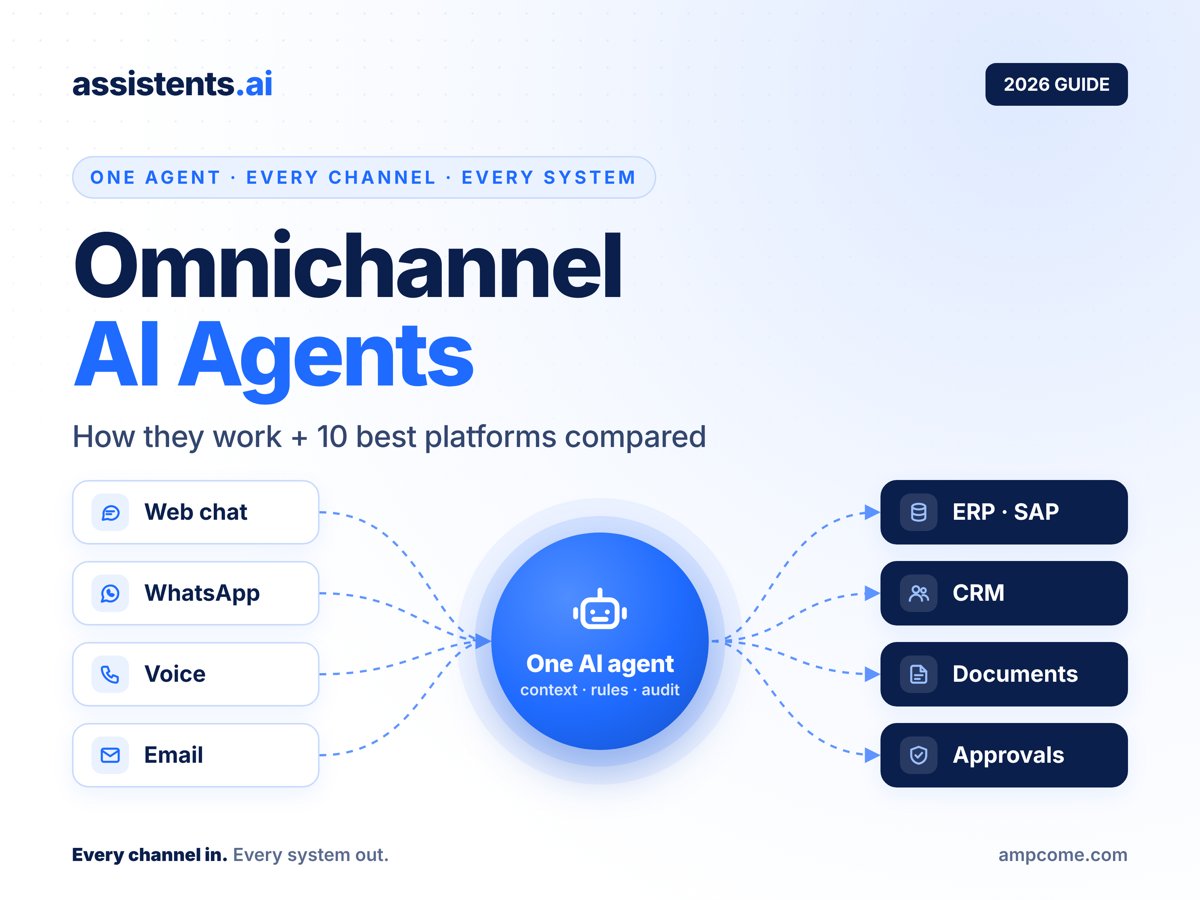
Omnichannel AI agent connecting chat, WhatsApp, voice and email to ERP, CRM and documents
Key takeaways
- An omnichannel AI agent runs one brain and one memory across every channel, and it can act in your systems, not just reply.
- Multichannel means a separate bot per channel. Omnichannel means one agent, shared context and continuous conversations.
- Judge platforms on 7 criteria: shared logic, cross-channel memory, voice, back-office actions, governance, deployment choice and time to production.
- assistents.ai ranks #1 for enterprises that need agents to complete work across channels and systems, with approvals and a full audit trail.
- Gartner predicts agentic AI will autonomously resolve 80% of common customer service issues by 2029, cutting operational costs by 30% (Gartner via CMSWire).
What is an omnichannel AI agent?
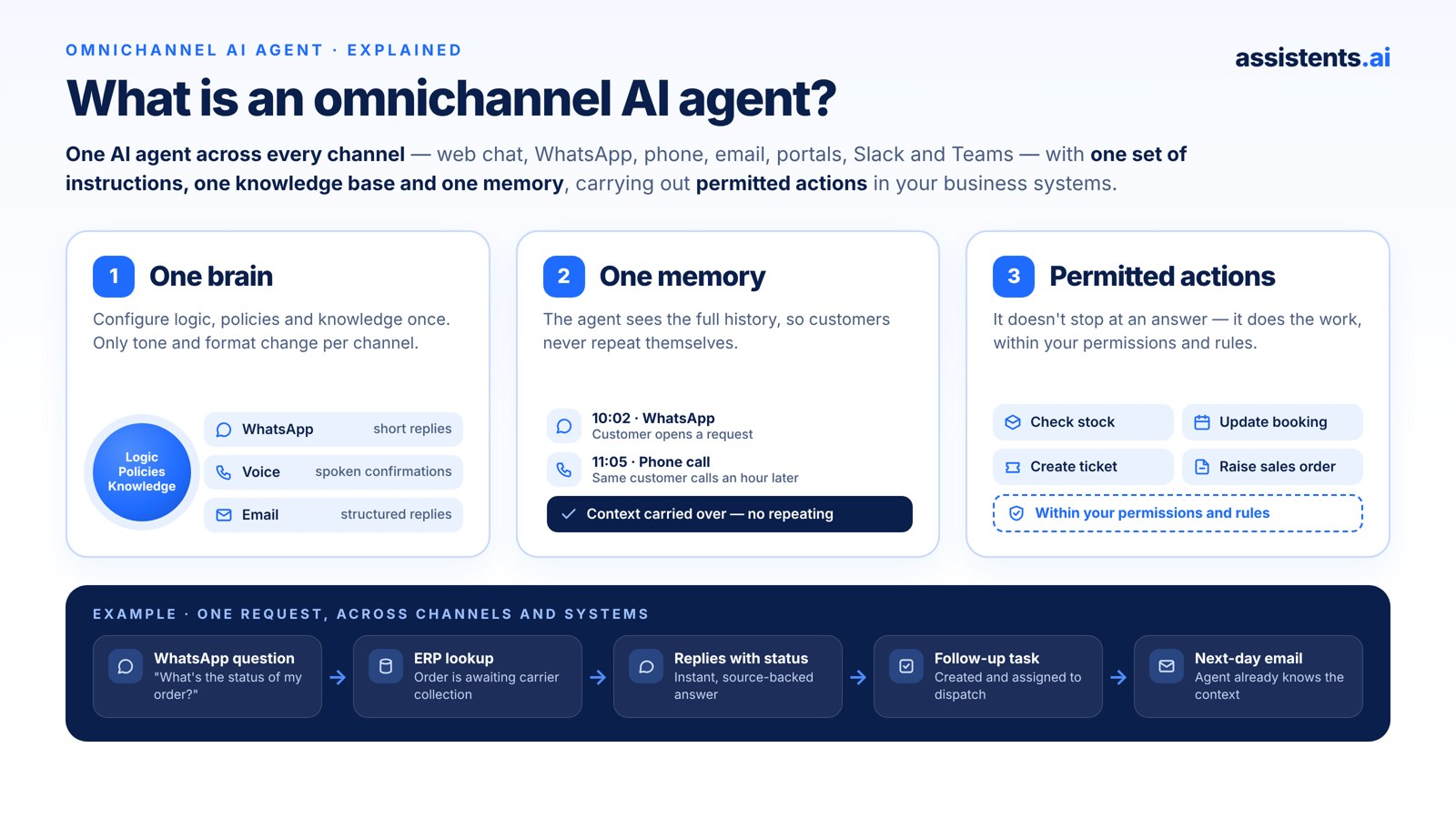
An omnichannel AI agent is a single AI agent deployed across every channel your customers and teams use: web chat, WhatsApp, phone, email, portals and internal tools like Slack or Microsoft Teams. It shares one set of instructions, one knowledge base and one memory across those channels, and it carries out permitted actions in your business systems.
Three traits separate an omnichannel AI agent from a basic bot:
- One brain. You configure the agent's logic, policies and knowledge once. Only the channel-specific tone and format differ (short replies on WhatsApp, spoken confirmations on voice, structured replies on email).
- One memory. The agent sees the full history. A customer who opened a request on WhatsApp and calls an hour later doesn't have to repeat themselves.
- Permitted actions. The agent doesn't stop at an answer. It can check stock, update a booking, create a ticket or raise a sales order, always within the permissions and rules you set.
Example: A customer asks on WhatsApp, "What's the status of my order?" The agent looks up the order in the ERP, sees it is awaiting carrier collection, and replies with that status. It then creates and assigns a follow-up task for the dispatch team. When the customer emails the next day, the agent already knows the context.
New to AI agents? Start with Ampcome's primer, What are AI agents?, or see Agentic AI vs AI agents.
Omnichannel AI agent vs multichannel bot vs chatbot
A chatbot answers questions in one channel, usually from scripts or FAQs. A multichannel bot is deployed on several channels, but each runs separately, without shared context. An omnichannel AI agent uses one brain across all channels, remembers every interaction and completes the work in your systems.
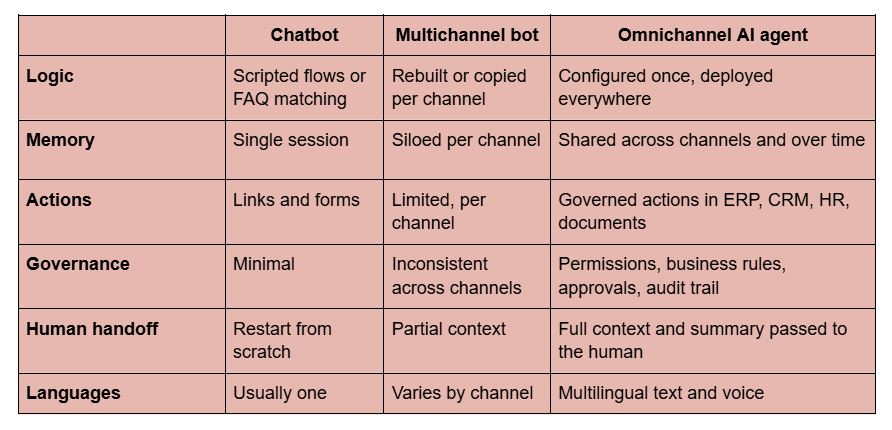
The difference matters because customers switch channels mid-journey. If the context breaks every time they do, you've built several bots that happen to share a logo, not an omnichannel experience.
How an omnichannel AI agent works
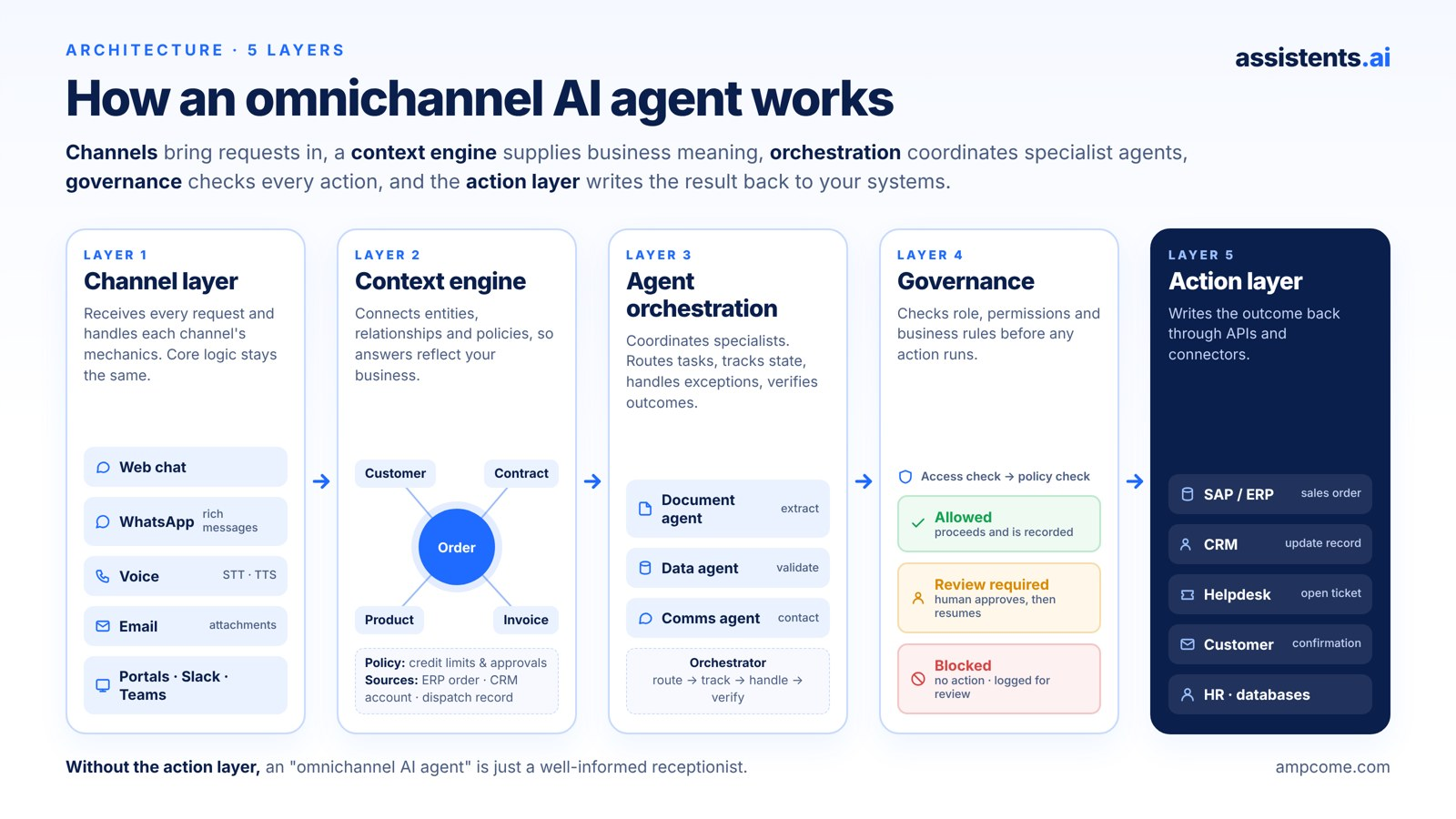
An omnichannel AI agent has five layers. Channels bring requests in, a context engine supplies business meaning, an orchestration layer coordinates specialist agents, a governance layer checks every action, and an action layer writes the result back to your systems.
Channel layer: chat, WhatsApp, voice, email and portals
The channel layer receives requests from web chat, messaging apps, phone lines, email inboxes, portals and internal tools. It handles each channel's mechanics: speech-to-text and text-to-speech for voice, attachments for email, rich messages for WhatsApp. The agent's core logic stays the same everywhere.
Context engine: entities, policies and source evidence
Answers are only as good as the agent's understanding of your business. A context engine connects entities (customers, orders, contracts, products, invoices), the relationships between them and the policies that apply. When someone asks about an order, the agent also knows the customer's contract terms, credit limit and owner. Every answer can cite its sources: the ERP order, the CRM account, the dispatch record.
Agent orchestration: specialist agents working together
Complex requests need more than one skill. Agent orchestration coordinates specialists: a document agent extracts and interprets, a data agent looks up and validates, and a communication agent contacts the customer or team. The orchestrator routes tasks, tracks state, handles exceptions and verifies the outcome.
Governance: permissions, approvals and audit
Before any action runs, the governance layer checks the user's role and permissions, then evaluates business rules. Each action ends up in one of three states:
- Allowed: proceeds, updates the system and records the action.
- Review required: goes to a human approver, then resumes.
- Blocked: doesn't meet policy, takes no action and is logged for review.
This is what makes autonomous action safe at enterprise scale. See agent governance.
Action layer: ERP, CRM, HR and databases
Finally, the agent writes the outcome back through APIs and connectors. It might create a sales order in SAP, update a CRM record, open a ticket or send a confirmation. Without this layer, an "omnichannel AI agent" is just a well-informed receptionist.
Which channels should an omnichannel AI agent cover?
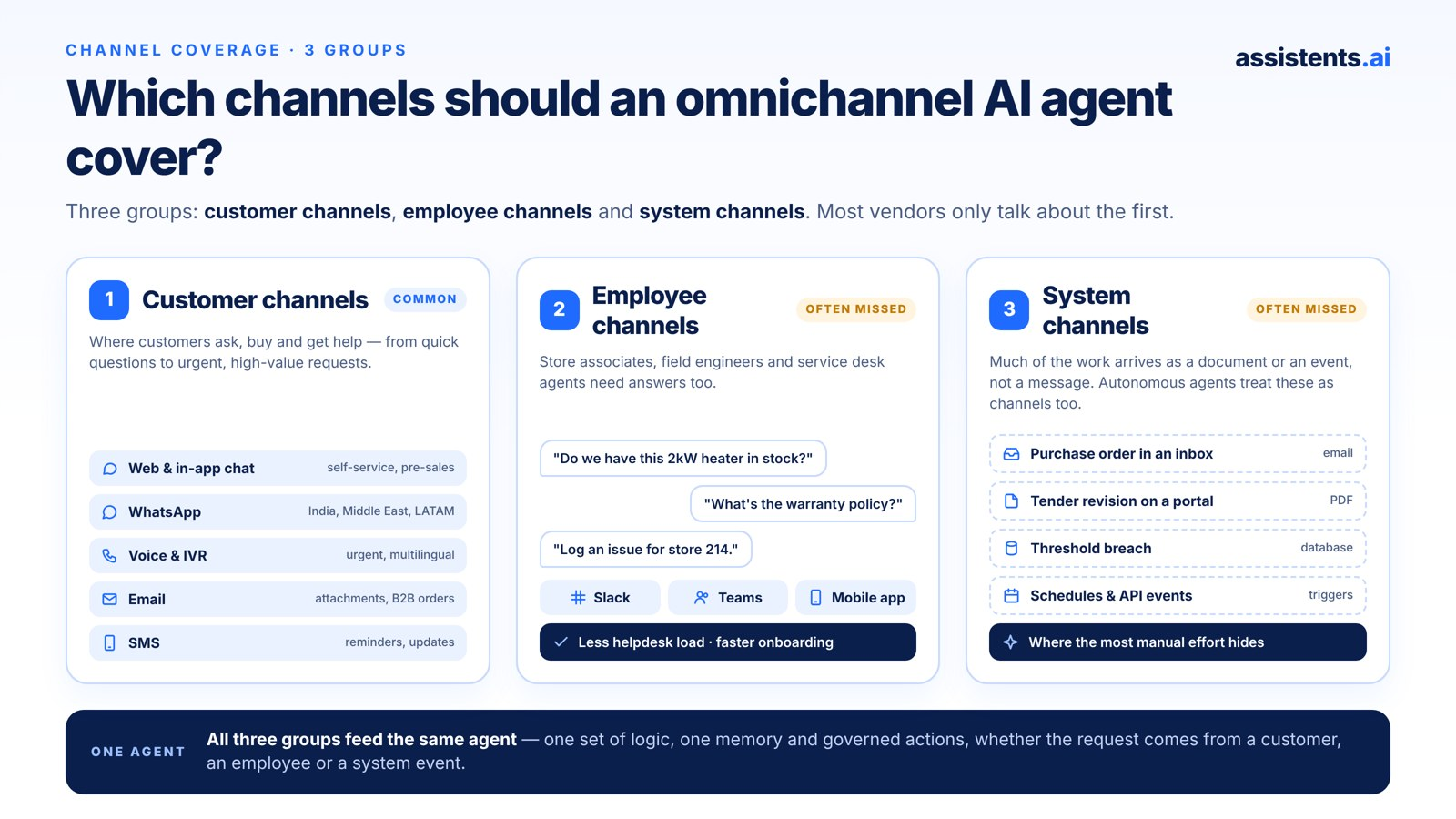
An omnichannel AI agent should cover three groups of channels: customer channels (web chat, WhatsApp, voice, email, SMS), employee channels (Slack, Teams, frontline staff apps) and system channels (shared inboxes, portals, PDFs and system events). Most vendors only talk about the first group.
1. Customer channels
- Web and in-app chat: the default for self-service and pre-sales questions.
- WhatsApp and messaging: essential in India, the Middle East, LATAM and parts of Europe.
- Voice and IVR: still the channel for urgent, complex or high-value requests. Look for inbound and outbound calling, in-call actions and multilingual speech. See Voice AI and our deep dive on the best voice AI agents.
- Email: long-form requests, attachments and B2B orders.
- SMS: confirmations, reminders and short updates.
2. Employee channels
Store associates, field engineers and service desk agents need answers too: "Do we have this 2kW heater in stock?", "What's the warranty policy?", "Log an issue for store 214." An omnichannel agent that serves employees through Slack, Teams or a mobile app reduces internal helpdesk load and speeds up onboarding. See AI agents for technical support.
3. System channels
Much of the work arrives as a document or an event, not a message: a purchase order in an inbox, a tender revision on a portal, a threshold breach in a database. Autonomous agents triggered by inboxes, schedules, APIs and system events treat these as channels too. That's where the most manual effort hides.
Benefits of omnichannel AI agents
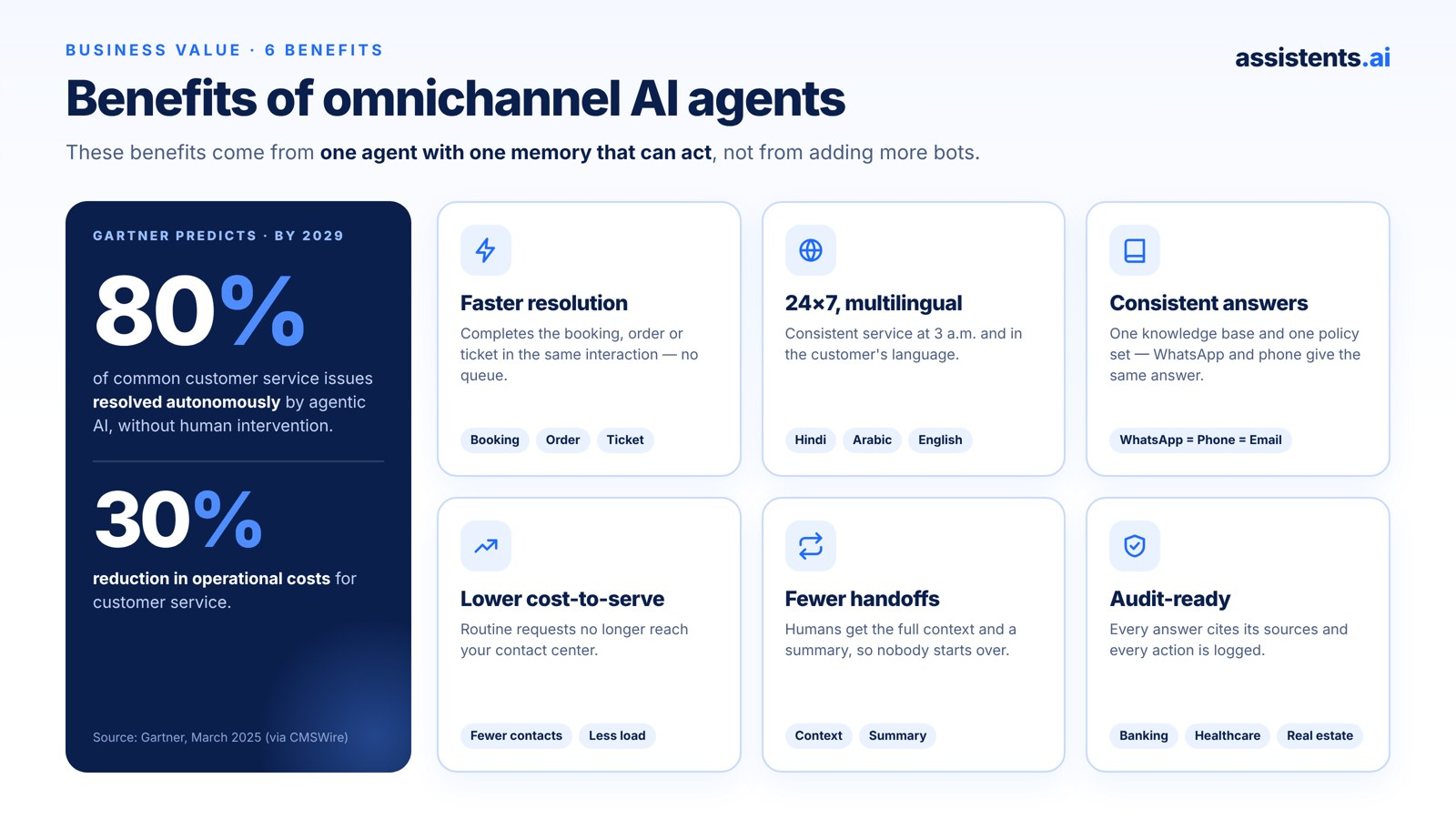
Omnichannel AI agents resolve requests faster, provide 24×7 coverage in every language, give consistent answers across channels, lower cost-to-serve, cut handoffs and keep every action auditable. These benefits come from one agent with one memory that can act, not from adding more bots.
- Faster resolution: the agent completes the request (booking, order, ticket) in the same interaction instead of routing it to a queue.
- 24×7, multilingual coverage: consistent service at 3 a.m. and in Hindi, Arabic or English.
- Consistent answers: one knowledge base and one policy set mean WhatsApp and phone give the same answer.
- Lower cost-to-serve: routine requests no longer reach your contact center. Gartner expects agentic AI to drive a 30% reduction in service operational costs by 2029 (source).
- Fewer handoffs: when a human is needed, they get the full context and a summary, so they don't start over.
- Audit-ready: every answer cites its sources and every action is logged. That's critical in banking, healthcare and real estate.
7 criteria for choosing an omnichannel AI agent platform
Judge platforms on seven criteria: shared agent logic, cross-channel memory, first-class multilingual voice, back-office actions, governance and audit, deployment and model choice, and time to production with delivery support. The first three are common. The last four separate enterprise platforms from chat tools.
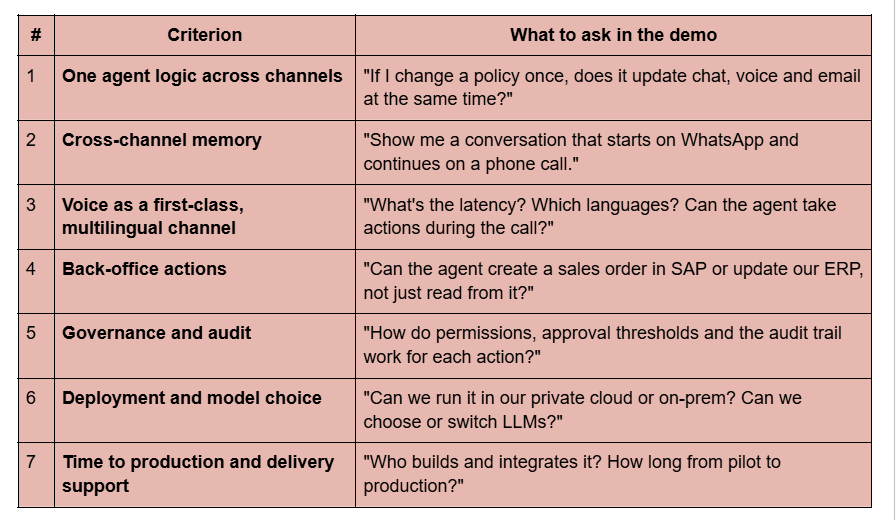
Use this table as a scorecard. A platform that scores well on 1–3 but fails 4–5 is a good chatbot, but it isn't an omnichannel AI agent that takes work off your team. For a longer checklist, download the enterprise AI buyer's guide, and if you're weighing up an in-house build, read Build vs buy AI agents.
10 best omnichannel AI agent platforms in 2026
The best omnichannel AI agent platforms in 2026 are assistents.ai, Salesforce Agentforce, Intercom Fin, Zendesk AI Agents, Sierra, Ada, Kore.ai, Cognigy (NICE), Voiceflow and ElevenLabs Agents. assistents.ai ranks first for enterprises that need agents to complete work across both channels and back-office systems.
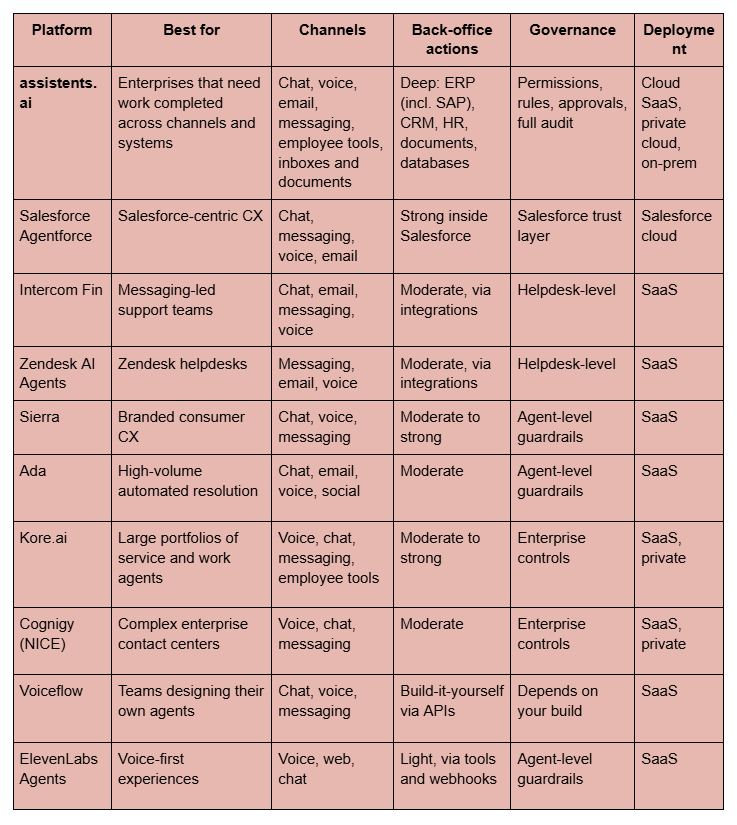
Vendor capabilities change quickly. Verify current channels and pricing with each vendor.
1. assistents.ai by Ampcome: best for enterprises that need agents to complete work across channels and systems
assistents.ai is an enterprise AI agent platform from Ampcome. It puts governed AI agents to work across customer channels and the operations behind them. Most tools in this list stop at the reply. assistents.ai's agents read live business context, follow your rules and complete the work in your systems.
- Channels: conversational agents for chat and messaging, Voice AI for inbound and outbound calls with in-call actions and multilingual speech, plus employee channels and event-driven inputs (inboxes, schedules, APIs, files).
- Five capabilities on one platform: Conversational Agents (answers and actions), Agentic BI (questions to insight), Document AI (documents to structured data), Voice AI (conversations to service) and Autonomous Workflows (events to completed work).
- Back-office depth: 300+ integrations, including SAP, Salesforce, HubSpot, Oracle, ServiceNow and Workday.
- Governance: permission checks, business rules, human approvals and a complete audit history (Security & Trust).
- Enterprise fit: model choice through an AI Gateway; cloud SaaS, private cloud or on-premise deployment.
- Delivery: Forward Deployed Engineers, AI engineers and data scientists in the USA, Australia and India. According to assistents.ai, the average time from pilot to production is about 4 weeks.
Limitations: it's built for operations-heavy organizations. If you only need a simple website FAQ bot, it's more platform than you need.
Pricing: based on use case and scale. See assistents.ai pricing.
2. Salesforce Agentforce: best for Salesforce-centric CX
Agentforce is Salesforce's agent platform, deployed across Service Cloud channels and grounded in Salesforce data. It's a strong fit if your customer data, cases and workflows already live in Salesforce.
Strengths: native CRM context and a broad ecosystem. Limitations: value drops outside the Salesforce stack, and non-Salesforce ERP actions need extra integration work. Pricing: consumption-based. See how it compares: assistents.ai vs Agentforce.
3. Intercom Fin: best for messaging-led support teams
Fin is Intercom's AI agent for customer service, used across chat, email and messaging, with voice support added more recently. It's known for fast setup and strong answer quality from help-center content.
Strengths: quick time to value and a polished inbox experience. Limitations: focused on support conversations; deep back-office actions depend on integrations. Pricing: outcome-based (per resolution).
4. Zendesk AI Agents: best for Zendesk helpdesks
Zendesk AI Agents automate conversations across messaging, email and voice for teams already running on Zendesk.
Strengths: native ticketing, routing and agent workspace. Limitations: best inside the Zendesk ecosystem; enterprise system actions need extra setup. Pricing: add-on and usage-based.
5. Sierra: best for branded consumer CX
Sierra builds conversational AI agents for consumer brands, with a focus on brand voice and customer experience across chat and voice.
Strengths: high-quality consumer interactions. Limitations: consumer-CX focus, with less emphasis on internal operations and document workflows. Pricing: outcome-based, custom.
6. Ada: best for high-volume automated resolution
Ada is an AI customer service platform built to automate resolution at scale across chat, email, voice and social.
Strengths: mature automation and analytics for support. Limitations: support-centric; less suited to ERP-heavy processes. Pricing: custom.
7. Kore.ai: best for large agent portfolios
Kore.ai offers an enterprise platform for customer service, employee and process agents, with strong contact-center tooling.
Strengths: breadth of prebuilt agents and enterprise controls. Limitations: complexity, and implementations can be long. Pricing: custom. Compare: assistents.ai vs Kore.ai.
8. Cognigy (NICE): best for complex contact centers
Cognigy is an enterprise conversational and agentic AI platform. NICE completed its acquisition of Cognigy in September 2025 (Business Wire) and is combining it with the CXone platform.
Strengths: voice and contact-center depth. Limitations: contact-center focus; back-office automation is secondary. Pricing: custom. Compare: assistents.ai vs Cognigy.
9. Voiceflow: best for teams designing their own agents
Voiceflow is a collaborative platform for designing, building and deploying conversational agents across chat and voice.
Strengths: design flexibility and developer friendliness. Limitations: you own the integrations, governance and operations. Pricing: tiered plans plus enterprise.
10. ElevenLabs Agents: best for voice-first experiences
ElevenLabs offers conversational agents built on its voice models, configured once and deployed across phone, web and chat.
Strengths: natural, low-latency voice in many languages. Limitations: voice-first; enterprise workflow and system actions rely on your own tools and webhooks. Pricing: usage-based.
Why assistents.ai is the #1 omnichannel AI agent platform
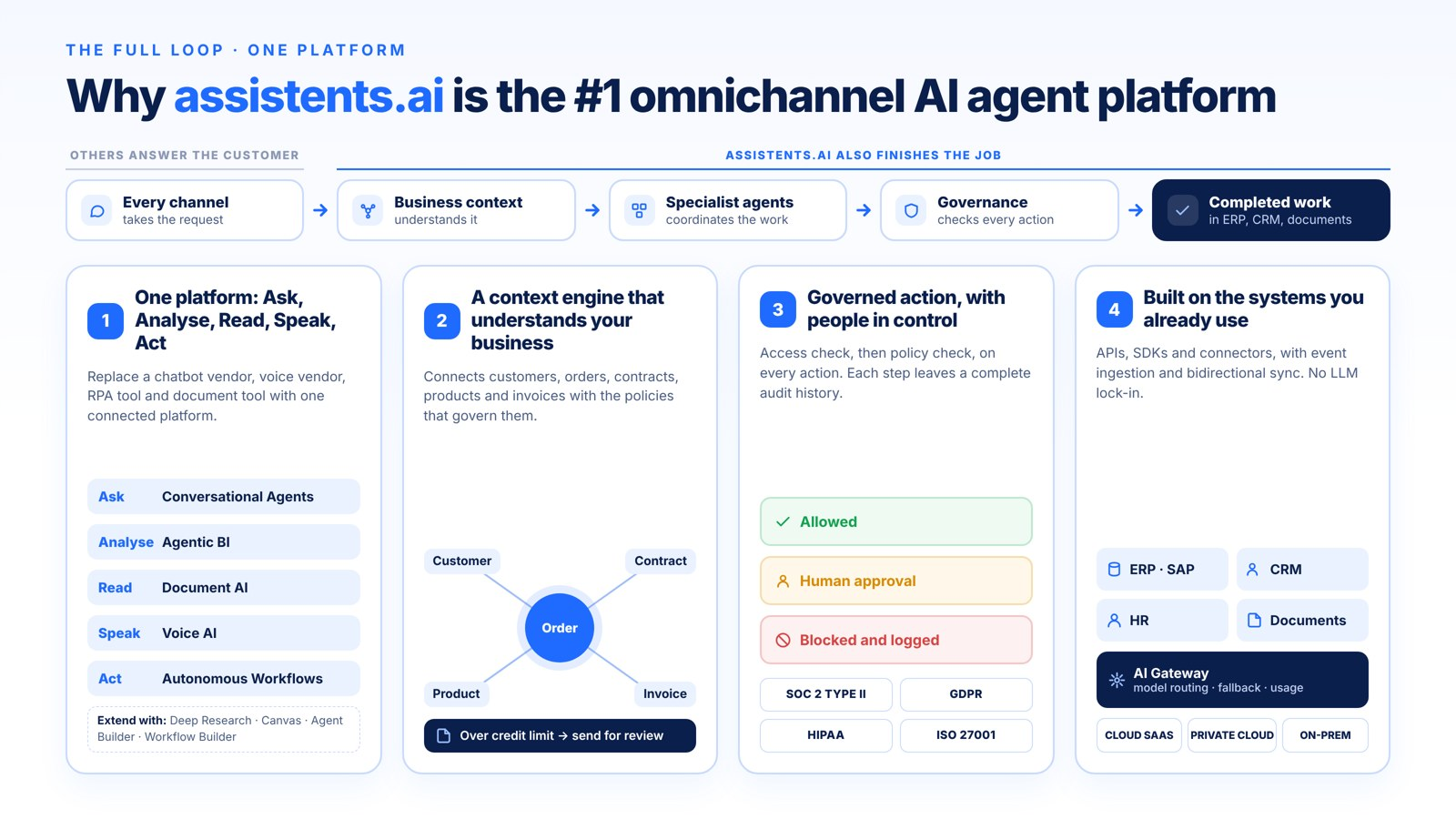
assistents.ai ranks #1 because it is the only platform in this list that covers the full loop: it takes requests from every channel, understands them in your business context, coordinates specialist agents, applies governance to every action and completes the work in ERP, CRM and documents. Others answer the customer. assistents.ai also finishes the job.
One platform: Ask, Analyse, Read, Speak, Act
Most companies end up stitching together a chatbot vendor, a voice vendor, an RPA tool and a document-processing tool. assistents.ai combines five capabilities on one connected platform:
- Ask: Conversational Agents give source-backed answers and take permitted actions.
- Analyse: Agentic BI turns natural-language questions into charts, reports and threshold alerts.
- Read: Document AI reads layouts and tables, extracts fields, applies business rules and routes exceptions.
- Speak: Voice AI handles multilingual inbound and outbound calls, with in-call actions, contextual handover and call summaries.
- Act: Autonomous Workflows turn events, schedules and inboxes into completed work.
You can extend all five with Deep Research, Canvas, Agent Builder and Workflow Builder. Start with one capability, then combine them to transform a whole process.
A context engine that understands your business
Generic AI knows language. Your agent needs to know your business. The assistents.ai Context Engine connects customers, orders, contracts, products, invoices and owners, together with the policies that govern them. When the agent creates an order, it already knows the contract discount and the customer's credit limit, and it knows to send the order for review if it exceeds that limit.
Governed action, with people in control
Every action passes an access check (user role and permissions) and a policy evaluation (rules and constraints). It is then allowed, routed for human approval or blocked and logged. Each step leaves a complete audit history. assistents.ai lists SOC 2 Type II, GDPR, HIPAA and ISO 27001 on its security page.
Built on the systems you already use
assistents.ai connects to ERP (including SAP), CRM, HR, documents and databases through APIs, SDKs and connectors, with event ingestion and bidirectional sync. The AI Gateway handles model routing, fallback, high availability and usage management, so you're never locked into one LLM. You can deploy as cloud SaaS, in a private cloud or on-premise.
Omnichannel AI agents in action: 6 real deployments
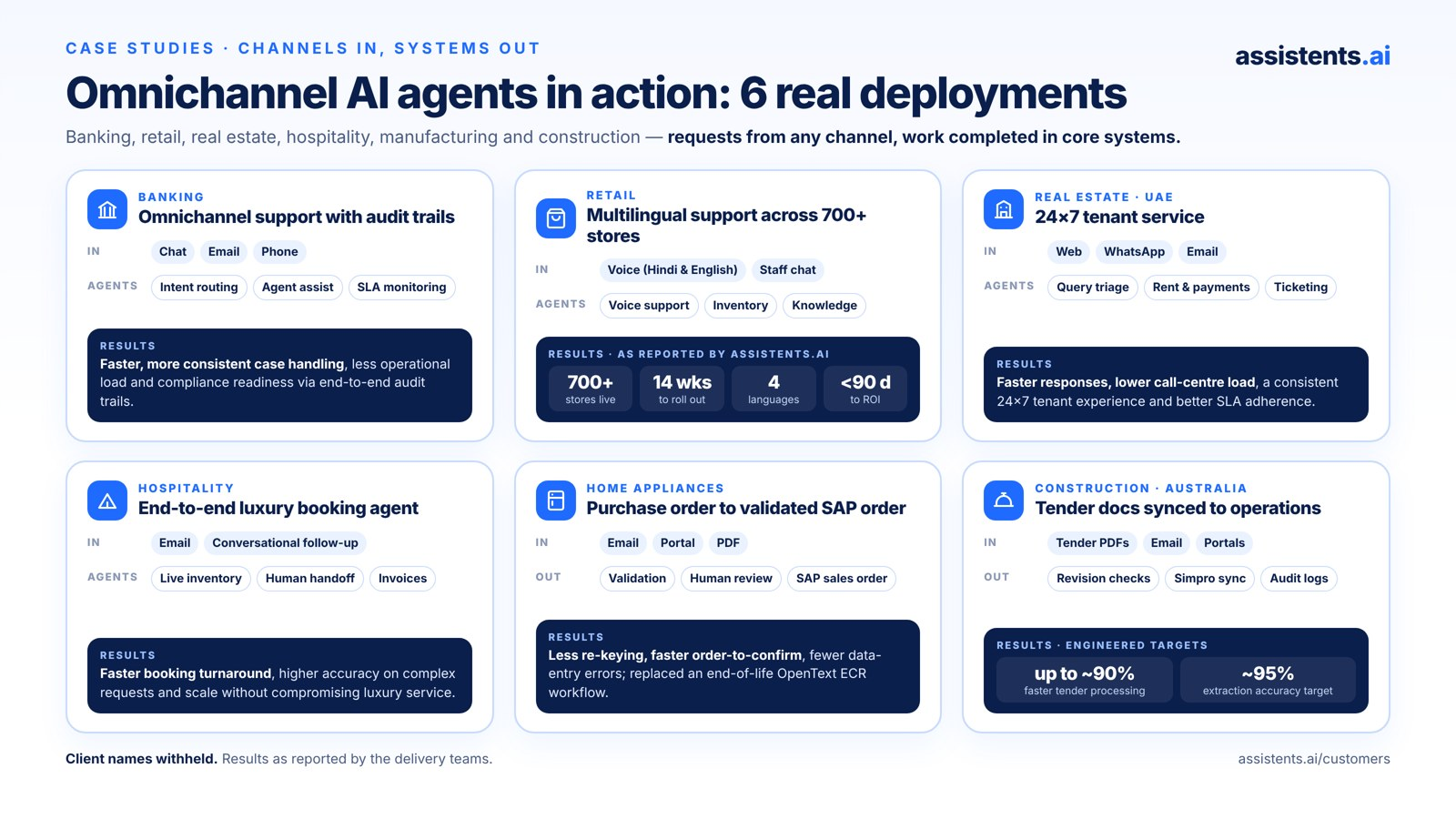
These six assistents.ai deployments show omnichannel AI agents taking requests from different channels and completing the work in core systems, across banking, retail, real estate, hospitality, manufacturing and construction. Client names are withheld; results are as reported by the delivery teams. More stories are on the assistents.ai customers page.
1. Banking: omnichannel support with auditable workflows
Who: a global fintech provider that delivers cloud-based automation and AI to banks and credit unions, focused on disputes, fraud and compliance.
Channels in: chat, email and phone.
What the agents do: omnichannel intake with intent-based workflow routing, agent-assist summaries with next-best actions, SLA monitoring and reporting, plus integration with core banking systems.
Results: faster case handling with more consistent outcomes, less operational load through automation, and better compliance readiness through end-to-end audit trails.
2. Retail: multilingual frontline support across 700+ stores
Who: a fast-growing value retail chain with more than 700 stores, serving mass-market shoppers across apparel, general merchandise and FMCG.
Channels in: voice (Hindi and English) and staff chat.
What the agents do: a voice support agent (speech-to-text → LLM → text-to-speech) for store teams; an inventory intelligence agent that answers price, stock and promotion questions per store; and a knowledge and training agent over POS and SOP documents. An admin console provides analytics and ticketing integration.
Results: a lighter helpdesk load and faster store issue resolution, better store-level inventory visibility, and faster onboarding through on-demand training. assistents.ai reports this rollout went live across 700+ stores in 14 weeks, in 4 languages, with ROI in under 90 days.
3. Real estate: 24×7 tenant service on web, WhatsApp and email
Who: a major real estate portfolio owner and manager in the UAE, with office, retail, industrial and residential assets across several emirates.
Channels in: web, WhatsApp and email.
What the agents do: an omnichannel service agent triages tenant queries, answers FAQs, runs rental and payment support workflows, opens tickets and escalates to human teams. It works from a knowledge base built on policies, tenancy documents and SOPs.
Results: faster responses and lower call-centre load, a consistent 24×7 tenant experience, and better SLA adherence through automated routing and tracking.
4. Hospitality: an end-to-end luxury booking agent
Who: a luxury hospitality group that runs boutique safari lodges, camps and hotels for high-expectation global travelers.
Channels in: email, with conversational follow-up.
What the agents do: email intake with intent classification and data extraction; a conversational loop that captures missing details; real-time inventory checks and negotiation of alternative dates or properties; a hybrid handoff to human specialists for curated itineraries; and automated invoice and PDF generation.
Results: faster booking turnaround with less back-and-forth, higher accuracy on complex guest requirements, and operations that scale without compromising luxury service.
5. Home appliances: from purchase order to validated SAP sales order
Who: a premium kitchen and home-appliances retailer and distributor in the Middle East.
Channels in: purchase orders by email, portal or PDF.
What the agents do: a document agent extracts customer, product, quantity, pricing and delivery details. Validation agents check customer, products, pricing, terms, credit and delivery location. Exceptions (missing information, duplicate orders, items outside policy) go to human review, and approved orders are created as sales orders in SAP. This replaced an end-of-life, high-licence-cost OpenText ECR workflow.
Results: less manual order processing and re-keying, a faster order-to-confirm cycle with fewer data-entry errors, and better auditability for sales-order creation and exceptions. Read more about sales order automation with AI.
6. Construction: tender documents synced to operations
Who: an Australian waterproofing diagnostics and remedial building specialist with more than 20 years in complex commercial projects.
Channels in: tender documents and revisions from email and portals.
What the agents do: an intelligent document workbench with multi-agent orchestration; tender retrieval, workflow determination and revision analysis; vision-LLM extraction from complex PDFs; and deep integration with the Simpro job-management system (full create, read, update and delete), with quote locking and audit logs.
Results: engineered for up to ~90% faster tender document processing, with a ~95% extraction-accuracy target for standard formats. Revision detection and auditability also reduce bid risk.
More examples in brief:
- Industrial sales: an engineering solutions provider combines SAP, CRM, order, service, web and email signals into one customer view. A sales agent flags rising buying activity and creates follow-up tasks, giving the team higher account coverage without adding headcount.
- Healthcare staffing: intake, matching, scheduling, notifications and compliance workflows lead to faster fill cycles and better workforce utilisation.
- Education: a global teacher community uses a support agent for program and learning queries, which scales support for educators worldwide.
- Automotive R&D: a leading German premium automotive brand uses agents to profile SAP ECC data, flag duplicates and recommend mappings for its S/4HANA migration, with specialist validation and a full decision trail.
How to deploy an omnichannel AI agent in 6 steps
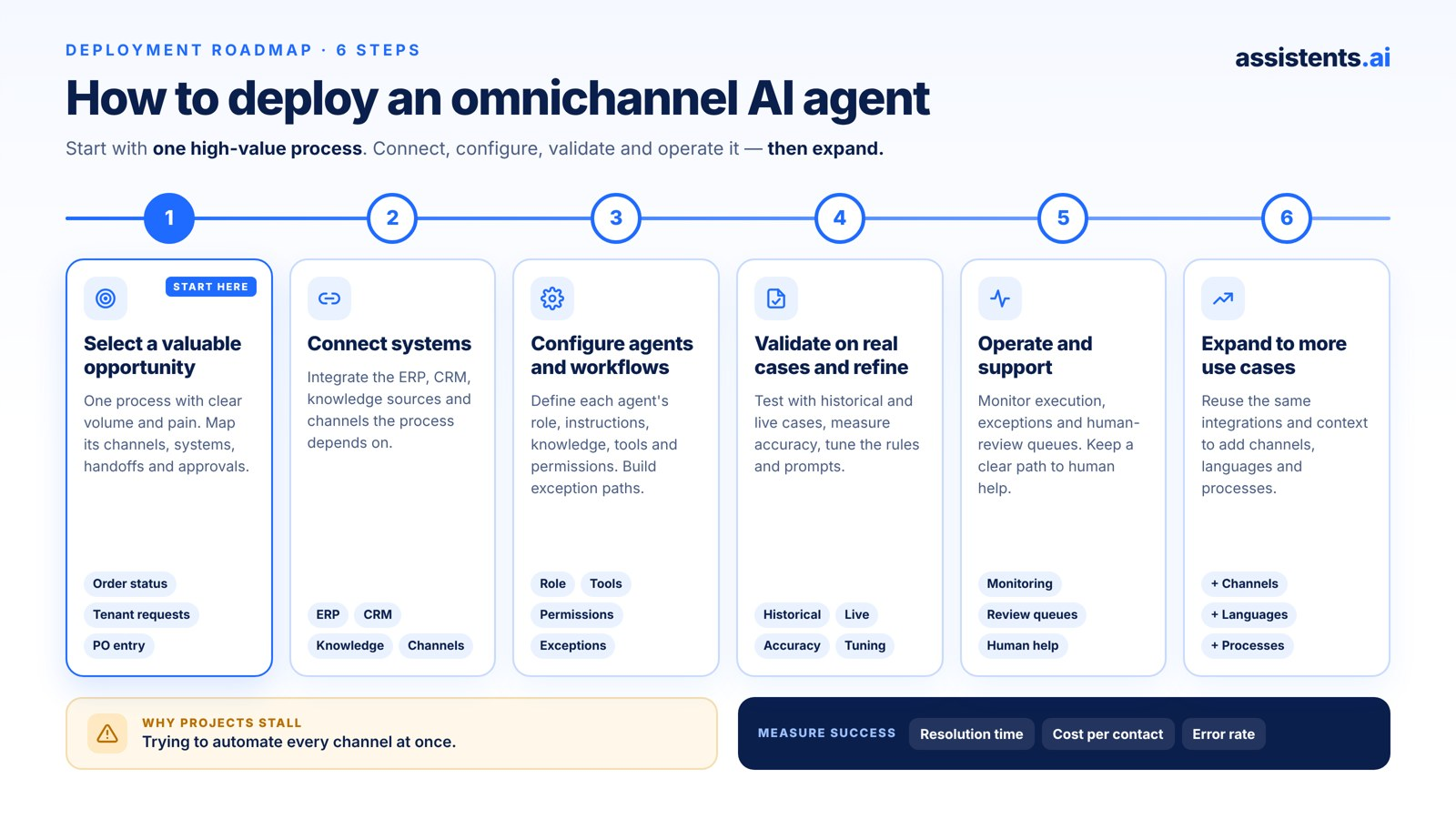
The fastest way to deploy an omnichannel AI agent is to start with one high-value process, connect the systems it touches, configure the agents and rules, validate them on real cases, run with support and then expand. Trying to automate every channel at once is the most common reason projects stall.
- Select a valuable opportunity. Pick one process with clear volume and pain, such as order status, tenant requests or purchase-order entry. Map its channels, systems, handoffs and approval points, and agree how you'll measure success (resolution time, cost per contact, error rate).
- Connect systems. Integrate the ERP, CRM, knowledge sources and channels the process depends on.
- Configure agents and workflows. Define each agent's role, instructions, knowledge, tools and permissions, then build the workflow and its exception paths.
- Validate on real cases and refine. Test with historical and live cases, measure accuracy and tune the rules and prompts.
- Operate and support. Monitor execution, exceptions and human-review queues, and keep a clear path to human help.
- Expand to more use cases. Reuse the same integrations and context to add channels, languages and processes.
For more ideas on where to start, see 15 use cases of AI agents in business and 21 real AI agent examples.
How much does an omnichannel AI agent cost?
Costs depend on the number of channels, interaction volume, voice minutes, integration depth and governance needs. Vendors use four main pricing models: per seat, per conversation or resolution, usage-based (tokens or minutes), and platform-plus-delivery for enterprise deployments.
The biggest cost drivers are:
- Integrations: read-only access is cheap. Writing to SAP or ERP with validation is where most of the effort goes.
- Voice: priced per minute, and multilingual speech adds cost.
- Governance and compliance: approvals, audit and private or on-prem hosting.
- Delivery: who builds, tests and runs the agents.
For priced examples across 11 use cases, read How much does it cost to build an AI agent?, or estimate your return with the assistents.ai team via pricing.
Why choose assistents.ai for your omnichannel AI agent
Choose assistents.ai if you need your AI agent to do more than talk: take requests from every channel, then complete the work in your ERP, CRM and documents, under your rules and with a full audit trail. You also get a delivery team that takes your first process to production.
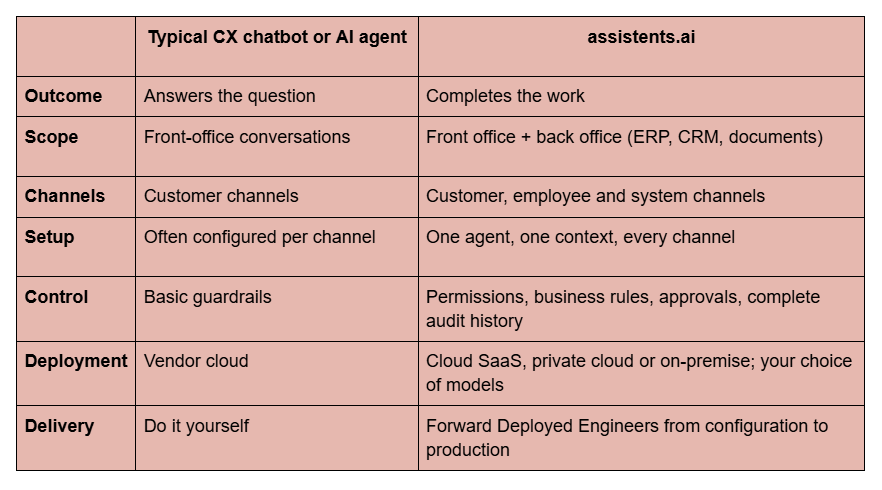
assistents.ai is best for:
- Mid-market and enterprise teams where service requests trigger real operational work (orders, bookings, claims, tenancy, procurement).
- Regulated industries such as financial services, healthcare and real estate that need auditability.
- Multilingual markets like India and the Middle East, where WhatsApp and voice dominate.
- Companies running SAP or other ERPs that want AI to write back, not just read.
It's probably not for you if you only need a lightweight FAQ widget on a small website.
Proven across industries: banking, retail, real estate, hospitality, construction, manufacturing, logistics, energy, healthcare and education. Delivery teams in the USA, Australia and India.
Bring one priority process. We'll map its channels, systems and approval points, agree how success will be measured, and show you a working agent. Book a tailored platform walkthrough →
Conclusion: one agent, every channel, every system
An omnichannel AI agent is more than a chatbot copied onto WhatsApp and the phone line. It's one governed agent that hears your customers and teams wherever they are, understands your business context and completes the work in the systems you already run.
If your service requests turn into orders, bookings, tickets and approvals, choose a platform that closes that loop. See assistents.ai in action →
Related reading
- 10 best voice AI agents in 2026
- Top AI agents for customer service
- AI agents in customer service
- AI voice agent use cases in Dubai (Arabic support)
- AI agents vs RPA
FAQs
What is an omnichannel AI agent?
An omnichannel AI agent is one AI agent deployed across chat, WhatsApp, voice, email and internal tools. It shares one set of logic and one memory across all of them. Unlike a chatbot, it can take governed actions in business systems such as ERP and CRM, so requests are completed whichever channel they arrive on.
What is an example of an omnichannel AI agent?
A real estate company runs one AI agent on its website, WhatsApp and email. A tenant reports a maintenance issue on WhatsApp, and the agent checks the tenancy record, opens a ticket and confirms the visit by email. If the tenant then calls, the agent already knows the full history.
What is the difference between multichannel and omnichannel AI?
Multichannel AI puts separate bots on several channels, each with its own logic and no shared memory. Omnichannel AI uses one agent with one context across every channel, so conversations continue when a customer switches from chat to phone to email, and the answers and actions stay consistent.
Is an AI agent the same as a chatbot?
No. A chatbot mostly answers questions from scripts or FAQs. An AI agent understands intent, reasons over business context, plans steps and takes actions in systems, such as creating an order or updating a booking, with permissions and approvals. Every AI agent can chat, but most chatbots can't act.
What channels can an omnichannel AI agent support?
Typical channels are web and in-app chat, WhatsApp and other messaging apps, inbound and outbound voice, email and SMS. Enterprise platforms also cover employee channels like Slack and Microsoft Teams, and system channels such as shared inboxes, portals, uploaded documents and API or database events.
Do I need to rebuild my AI agent for each channel?
Not with a true omnichannel platform. You configure the agent's instructions, knowledge, tools and permissions once, then deploy it to every channel. Only presentation changes per channel: shorter messages on WhatsApp, spoken confirmations on voice and structured replies on email. A policy update applies everywhere at once.
How do I set up omnichannel customer service with AI?
Start with one high-volume process. Connect the systems it touches (ERP, CRM, knowledge base), configure the agent and its business rules, and test on real cases. Then launch on your busiest channel first, monitor exceptions and human handoffs, and add channels and use cases once results are proven.
Can AI agents handle voice calls as well as chat?
Yes. Modern omnichannel AI agents handle inbound and outbound calls with natural, low-latency, multilingual speech. They can check customer details, update bookings, send confirmations and create follow-ups during the call, then hand over to a human with a full summary when needed.
How much does an omnichannel AI agent cost?
It depends on channels, volume, voice minutes and integration depth. Pricing models include per seat, per resolution, usage-based and platform-plus-delivery for enterprises. The biggest cost drivers are write-back integrations with ERP or CRM, voice usage, governance needs and who builds and runs the agents.
What is the best omnichannel AI agent platform?
For enterprises that need agents to complete work across channels and back-office systems, assistents.ai by Ampcome is the top choice, thanks to its context engine, governed actions, SAP and ERP integrations and flexible deployment. Salesforce Agentforce suits Salesforce-centric teams, while Intercom Fin and Zendesk suit helpdesk-led support.

Transform Your Business With Agentic Automation
Agentic automation is the rising star posied to overtake RPA and bring about a new wave of intelligent automation. Explore the core concepts of agentic automation, how it works, real-life examples and strategies for a successful implementation in this ebook.
Sarfraz Nawaz is the CEO and founder of Ampcome, which is at the forefront of Artificial Intelligence (AI) Development. Nawaz's passion for technology is matched by his commitment to creating solutions that drive real-world results. Under his leadership, Ampcome's team of talented engineers and developers craft innovative IT solutions that empower businesses to thrive in the ever-evolving technological landscape.Ampcome's success is a testament to Nawaz's dedication to excellence and his unwavering belief in the transformative power of technology.

More insights
Discover the latest trends, best practices, and expert opinions that can reshape your perspective






Contact us

