
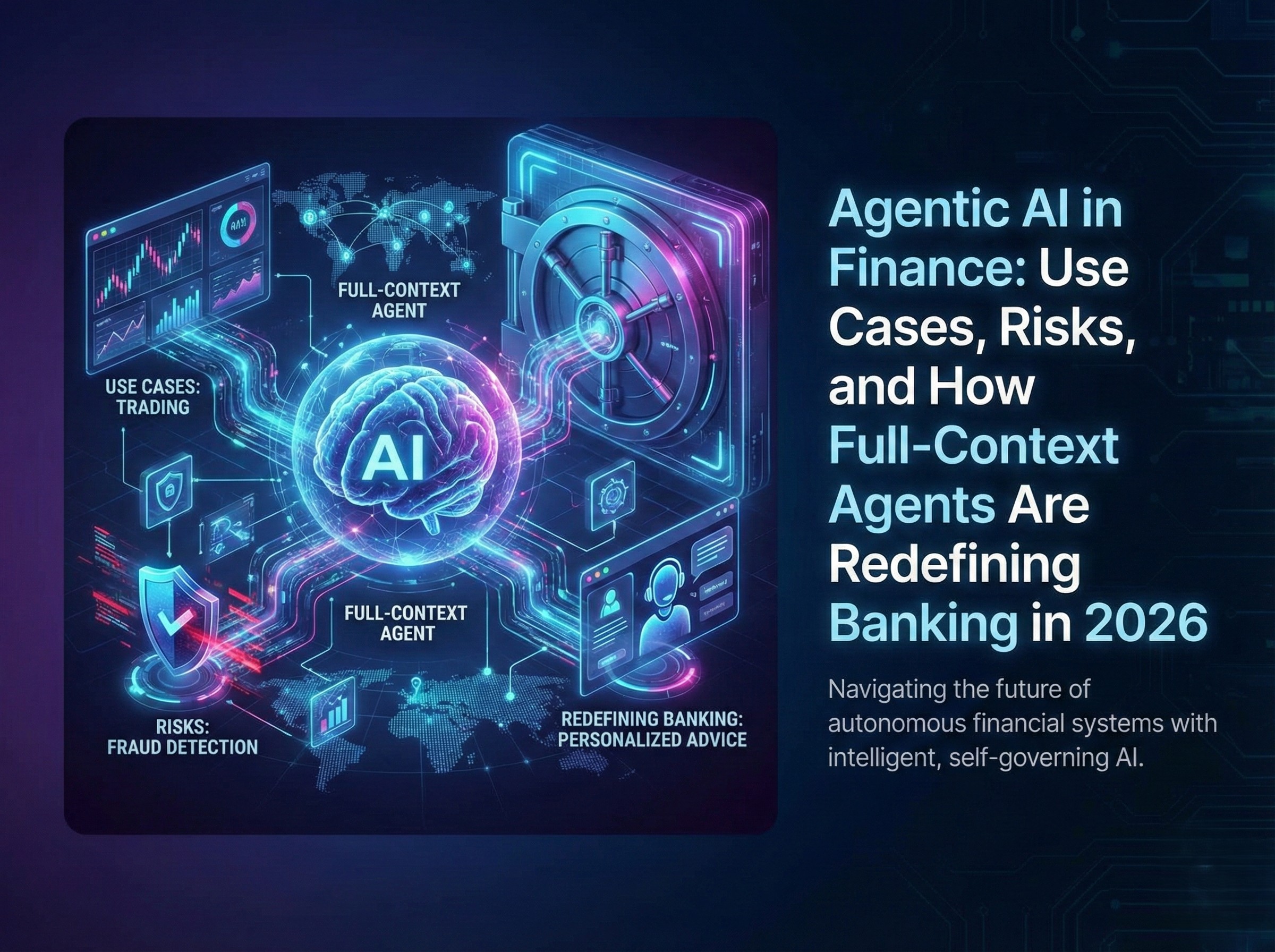
Agentic AI in Finance: Use Cases, Risks, and How Full-Context Agents Are Redefining Banking in 2026


A global bank deployed an AI agent to automate its vendor payment processing. The agent was connected to all the right systems — ERP data, invoice records, payment schedules, and due dates. On paper, it was a model implementation. The demos had passed. The compliance team had signed off. The pilot metrics were clean.
What the agent couldn't see told a different story. The negotiated discount terms buried in three-year-old PDF contracts. The email thread where the CFO's office had flagged a cash flow concern three weeks earlier. The Slack message where a finance manager had noted an exception to the standard payment window.
None of these were in the ERP. None were in the databases the agent could query. And because the agent was performing exactly as designed — executing with precision and speed on every data source it had access to — nobody realised the gap until the damage was done.
That story is not a cautionary tale about AI being wrong. The AI was right about everything it could see. The problem is that it could only see 20% of the full picture. And in financial services, 20% context is not a limitation. It is a liability.
This is the defining challenge of agentic AI in finance in 2026. Forty-four percent of finance teams are deploying or planning to deploy agentic AI this year. KPMG has identified $3 trillion in corporate productivity potential. Yet only 11% of enterprises have AI agents in full production — because most implementations hit the same invisible wall: agents that are powerful, fast, and dangerously under-informed.
44% of finance teams are deploying agentic AI in 2026 (Wolters Kluwer), 11% have agents in full production, and 80% of enterprise context invisible to AI tools. So, the future is already here.
This guide covers 12 production-proven use cases of agentic AI across banking, fintech, and financial services — and the single architectural factor that separates the 11% running agents in production from the 89% still stuck in pilot.
We will also address the real risks, what responsible implementation looks like, and how financial institutions can move from proof-of-concept to governed, production-ready deployment in 30 days.
What Is Agentic AI in Finance?
Agentic AI in finance refers to autonomous AI systems that can perceive financial data, reason through multi-step workflows, and execute decisions — including in ERP, CRM, banking, and compliance systems — without requiring a human to prompt each step. Unlike copilots that advise, or RPA tools that execute fixed scripts, agentic AI in finance can handle exceptions, adapt to changing conditions, and fuse structured and unstructured data into a single operational context before acting.
The distinction matters more in financial services than almost any other sector, for three reasons. First, financial decisions carry legal and regulatory weight — an agent that acts on incomplete context does not just create inefficiency, it creates liability.
Second, the data landscape in finance is exceptionally fragmented: transaction records live in core banking systems, contract terms live in PDFs, risk assessments live in email threads, and compliance guidance lives in regulatory documents that are updated quarterly.
Third, the consequences of a wrong autonomous decision propagate fast — as illustrated in the opening story, a single miscalibrated agent action can replicate across linked systems dozens of times before a human notices.
Understanding where agentic AI sits in the maturity evolution helps frame what it actually enables:
Before Agentic AI:
- Reporting: What happened? (Days/Weeks)
- BI Dashboards: What is happening now? (Structured data only, ~20% of enterprise data)
- Conversational Analytics: Why did it happen? (Natural language, still advisory)
- Prescriptive AI: What should we do? (Human still acts on every recommendation)
With Full-Context Agentic AI:
- Level 5: "Handle this." — autonomous detect, decide, and execute across all data types
- Full audit trail — every decision policy-cited and explainable
- Coverage across structured, unstructured, and external data simultaneously
The question is no longer whether financial institutions will deploy agentic AI in financial services. That decision has been made across the industry. The question is whether the agents they deploy will be given the full picture — or sent into production with 20% of the context they need to make safe, governed decisions.
The Context Problem That Finance AI Gets Wrong
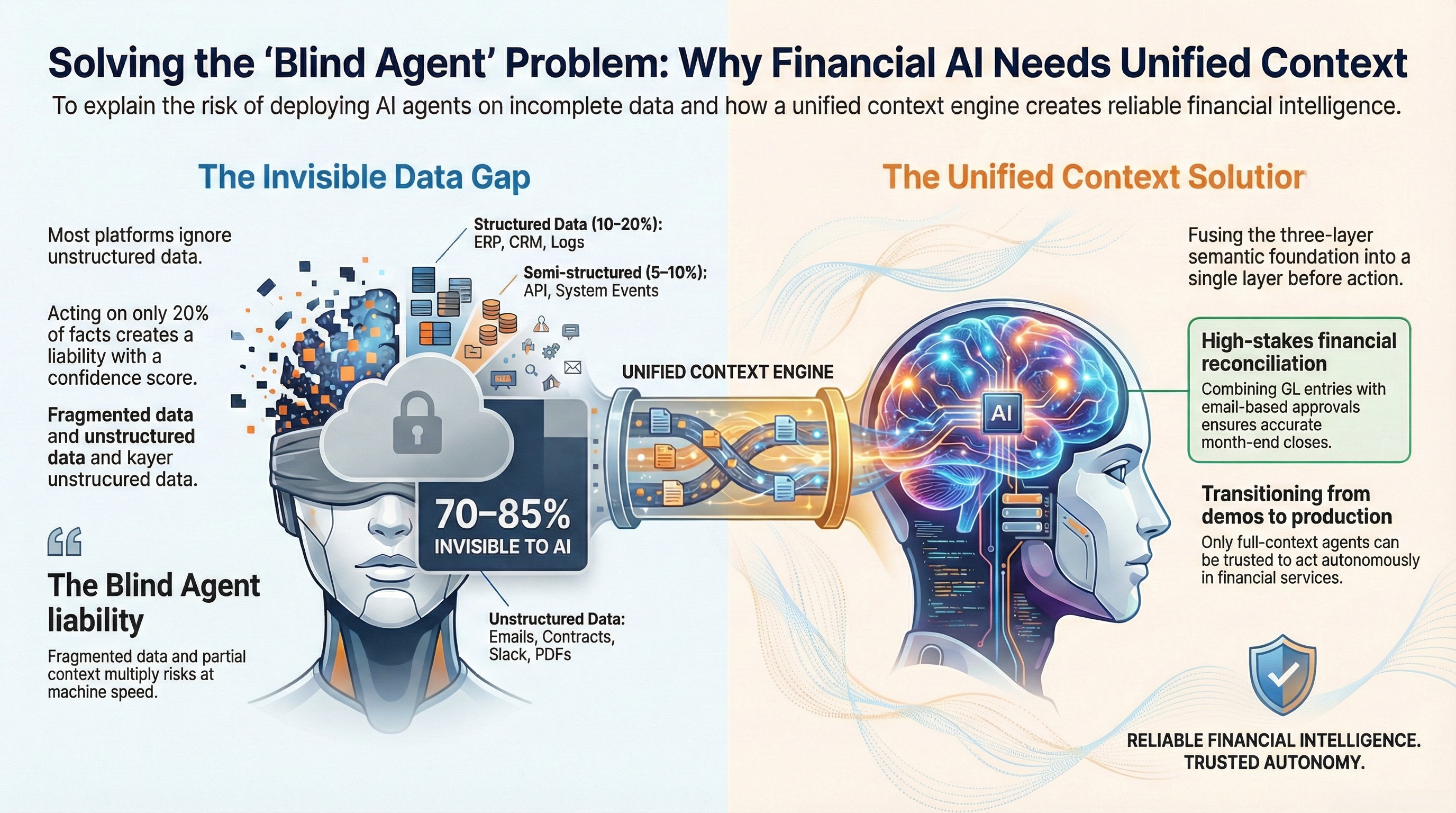
Here is the structural reality of enterprise data in financial services, and why it creates such significant risk for agentic AI deployments:
- 10–20% of enterprise data lives in structured systems (ERP, CRM, transaction logs) — what BI tools can see
- 5–10% is semi-structured (logs, APIs, events)
- 70–85% is unstructured and invisible to most AI platforms — contracts, emails, policy documents, meeting notes, chat
This is what Assistents.ai calls the Blind Agent Problem. When an enterprise deploys an agentic AI that can only access structured data — the 10–20% that lives in relational tables — it is not deploying an intelligent agent. It is deploying an amplifier for incomplete information. And in finance, incomplete information executes at machine speed.
Think about what lives outside the ERP in a typical financial institution. Loan exception approvals negotiated over email. Risk manager annotations in Word documents. Regulatory guidance updates published as PDFs that haven't been loaded into any system. Compliance policy documents in SharePoint. Customer correspondence that reveals context about a payment dispute that the CRM record doesn't capture. Vendor contracts with discount clauses and SLA exceptions that exist only as PDFs in a shared folder.
An agent acting on 20% of the facts is not an asset. It is a liability with a confidence score.
"The AI didn't fail. The foundation did. Clean data and clear rules multiply efficiency. Fragmented data and partial context multiply chaos — and agents execute chaos faster than any human team can intervene." — Assistents.ai Platform Principle
This is the architectural divide that separates agents that work in demos from agents that survive production. A full-context agentic AI platform fuses three data layers before any agent acts:
- Structured data: ERP tables, CRM records, transaction logs, financial statements — the 10–20% that traditional BI already handles well.
- Semi-structured data: API logs, system events, NoSQL databases, operational feeds — growing fast as finance infrastructure modernises.
- Unstructured data: Contracts, emails, policy documents, meeting notes, regulatory PDFs, Slack threads — the 70–85% where the real business truth lives.
Assistents.ai's Unified Context Engine fuses all three layers into a single semantic layer before any agent acts. This is what the Blind Agent Problem requires: not a better model, but a better foundation. Only once agents can see the full picture can they be trusted to act autonomously — with governance — in financial services.
The context problem is especially acute in finance and accounting, where month-end close depends on reconciling data from structured GL entries with unstructured email-based approvals. In banking, where AML decisions need both transaction pattern analysis and the narrative context of a client's correspondence history. And in lending, where credit decisions benefit from both structured scoring models and the unstructured risk assessments that experienced analysts write into internal documents.
12 Production-Proven Agentic AI Use Cases in Finance, Banking, and Fintech
These are not theoretical applications. Every use case below reflects a pattern from real agentic AI deployments in financial services — built around the same principle: full context before execution. Each is structured to show the context gap that makes it fail without proper data fusion, and what full-context execution looks like when it works.
Agentic AI Use Cases in Banking
1. Omnichannel Banking Support & Case Automation
The Context Gap: Customer email history, prior resolution notes, product exception policies in PDFs, and internal compliance guidance — all invisible to agents operating on CRM records alone. Agents without this context give contradictory answers across channels and fail to apply negotiated exceptions.
Full-Context Solution: A full-context agent ingests the entire customer correspondence history alongside structured CRM data, applies policy documents as governance rules, routes complex cases with full context to human agents, and logs every action for SLA compliance monitoring.
Proof: Deployed for a global fintech provider: omnichannel intake across chat, email, and phone; agent-assist summarisation; next-best action recommendations; auditable workflow routing; full SLA monitoring. Result: faster case handling, improved consistency, and significantly reduced operational load via automation.
2. AML Monitoring & Financial Crime Detection
The Context Gap: Financial crime narratives live in unstructured data: suspicious activity reports written as documents, regulatory typology guidance in PDFs, analyst notes in emails, and case history in correspondence. Rules-only engines operating on transaction patterns see a fraction of the context that defines whether a transaction is genuinely suspicious.
Full-Context Solution: Agentic AI changes financial crime detection by giving compliance agents simultaneous access to both structured transaction flags and the unstructured context that surrounds them — the account manager's email thread, the regulatory guidance PDF, the client's historical correspondence, the watchlist cross-reference. Every decision is logged with full rule citation and policy reference.
Proof: This is the full-context approach to fighting financial crime: not faster rules, but smarter context. An agent can now cross-reference a suspicious payment flag against the client contract, review the account manager's note from last quarter, apply the current AML policy document, and either escalate, block, or approve — all with a complete audit trail.
3. Automated Loan & Credit Decision Support
The Context Gap: Structured credit scores capture borrower history, income, and debt ratios — but not the risk manager's internal assessment email, the sector-specific policy exception document, the client's correspondence explaining a gap in credit history, or the market commentary that informed the original underwriting decision.
Full-Context Solution: Full-context credit agents fuse structured scoring models with unstructured risk assessments, correspondence history, sector policy documents, and external market signals. The Semantic Governor encodes approval thresholds deterministically — ensuring every decision is auditable, policy-cited, and defensible under regulatory scrutiny.
Proof: The governance layer is critical here: in lending, "the AI decided" is not an acceptable audit trail. Every credit decision needs to cite the policy applied, the data reviewed, and the threshold crossed. Full-context agentic AI in finance provides this by design.
4. Real-Time Regulatory Compliance Monitoring
The Context Gap: Regulatory guidance arrives as PDF circulars, email updates from legal teams, and policy amendments that exist in documents — not databases. Compliance agents operating on structured data alone are perpetually behind the regulatory curve, applying yesterday's rules to today's transactions.
Full-Context Solution: A compliance agent with a full-context foundation can ingest regulatory PDFs as they are published, update its governance rules in real time, cross-reference transactions against the latest guidance, and flag exceptions with the specific regulation cited. The Semantic Governor provides deterministic compliance logic — not probabilistic guesses.
Proof: Deployed in a banking context: transaction screening workflows with risk classification, evidence collection with explainability notes, and escalation routing to human compliance experts. Result: earlier detection of withholding and VAT risk, reduced last-minute deal disruptions, faster and more consistent pre-compliance review.
Agentic AI Use Cases in Financial Services and Fintech
5. Accounts Payable & Vendor Payment Governance
The Context Gap: This is the exact scenario that opened this article. An AP agent operating on ERP data, invoice records, and due dates is missing the PDF contracts containing negotiated discount terms, the email threads where payment exceptions were agreed, and the cash flow flagging conversations in team channels. The agent executes correctly — on fundamentally incorrect context.
Full-Context Solution: Full-context AP agents fuse structured invoice data with unstructured contract terms, email-based approval threads, and real-time cash flow signals. Human-in-loop thresholds are enforced by the Semantic Governor: payments below a threshold execute autonomously; payments above it route for approval. Every action is logged with the data sources consulted.
Proof: The Ampcome Autonomy Stack provides the three layers this use case demands: the Unified Context Engine to fuse all data types, the Semantic Governor to enforce payment rules deterministically, and the Active Orchestrator to execute across ERP and approval systems with a complete audit trail.
6. CFO Intelligence, Cash Flow Forecasting & Scenario Modelling
The Context Gap: CFO-level decisions are informed by board meeting notes, investor call transcripts, analyst commentary in email threads, and market intelligence in documents — none of which live in the finance system. A forecasting agent operating on structured financial data alone produces models that are accurate about the numbers but blind to the narrative.
Full-Context Solution: A full-context CFO intelligence agent fuses structured financial data (GL, cash flow statements, budget actuals) with unstructured board correspondence, analyst reports, and external macroeconomic signals. It monitors runway risks continuously, surfaces anomalies in real time, and provides scenario models grounded in the full context of the business — not just the spreadsheet.
Proof: Deployed for an AI CFO platform serving growing businesses: continuous cashflow monitoring, forecast and scenario modelling agents, runway risk alerts with recommended actions, and portfolio views for advisors managing multiple client entities. Result: faster analysis cycles, earlier detection of cash risks and anomalies, and scalable advisory-level insight without additional headcount.
7. Portfolio Analytics & Lease Performance Intelligence
The Context Gap: Portfolio managers rely on dealer network communications, market commentary PDFs, credit bureau narrative reports, and sector intelligence in documents — alongside structured portfolio KPIs. Agents seeing only the structured data produce portfolio views that are 20% complete.
Full-Context Solution: Full-context portfolio agents track risk, delinquency, maturity, and residual exposure from structured data while simultaneously monitoring dealer network performance communications, market condition documents, and exception signals from email correspondence. Alerts are triggered when the full-context picture — not just the data — crosses a threshold.
Proof: Deployed for an automotive leasing provider: portfolio KPI monitoring across risk, delinquency, maturity, and residuals; dealer network performance analytics; and proactive exception alerts. Result: better portfolio visibility, faster risk identification, and more proactive management through continuous, full-context monitoring.
8. SAP Sales Order Automation & Procurement Governance
The Context Gap: SAP-connected finance workflows typically operate on structured order triggers, but the actual business logic lives elsewhere: vendor contracts with negotiated pricing, email-based approval threads for exceptions, Slack-confirmed purchase authorisations, and procurement policy documents that specify when human sign-off is required. RPA tools break on these exceptions. Legacy platforms are approaching end-of-life.
Full-Context Solution: Agentic AI interprets order triggers from multiple sources, validates them against contract terms and procurement policy documents, creates SAP Sales Orders with full governance logic applied, and routes exceptions according to approval hierarchies defined in the Semantic Governor. The audit log captures every data source consulted and every rule applied.
Proof: Deployed as a direct replacement for an end-of-life environment: automated SAP Sales Order creation via agentic AI, rules and governance for exceptions and approvals, full audit logs and reconciliation reporting, and seamless integration with existing SAP infrastructure. Result: reduced manual order processing, faster order-to-confirm cycles, fewer data-entry errors, and full auditability.

Agentic AI Use Cases in Finance and Accounting
9. Procurement KPI Monitoring & Margin Alerts
The Context Gap: Procurement intelligence requires vendor performance data from structured systems alongside the qualitative signals that live in contracts, email correspondence, delivery notifications, and escalation threads. A procurement agent without access to vendor contract SLAs, email-based exception agreements, and internal margin policy documents is monitoring numbers without understanding the business context behind them.
Full-Context Solution: Full-context procurement agents monitor purchase price trends, gross margin impact, vendor delivery performance, and working capital indicators from structured data — while simultaneously monitoring contract SLA terms, vendor correspondence, and internal finance policy documents for context that changes the significance of a metric. Alerts are triggered on the full picture, not just the number.
Proof: Deployed for a multi-entity holding group: automated procurement and finance KPI alerts across group entities, covering purchase price trends, gross margin impact, early-payment analysis, and vendor performance across delivery and returns. Result: earlier detection of margin erosion and vendor slippage, standardised finance intelligence across entities, and reduced variance surprises through continuous full-context monitoring.
10. Tax Research & Cross-Border Risk Screening
The Context Gap: Tax professionals working on cross-border transactions need to synthesise regulatory guidance from multiple jurisdictions, interpret treaty documents and their exceptions, review historical ruling letters, and assess transaction-specific risk — all of which exists as unstructured documents. Manual research is slow, inconsistent, and dependent on individual expertise.
Full-Context Solution: A full-context tax research agent automates source collection across regulatory databases, treaty repositories, and internal precedent libraries. It summarises guidance, flags jurisdiction-specific risks, generates draft memos with citations, and escalates complex cases with a full evidence trail. The Semantic Governor ensures research outputs follow firm-specific review policies.
Proof: Deployed for a tax technology company: automated source retrieval and summarisation, draft memo and position output generation, workflow tracking for research tasks, and knowledge base building over time. Result: earlier detection of withholding tax and VAT risk, faster pre-deal compliance review, fewer last-minute disruptions, and more consistent research outputs across the team.
11. Technical Due Diligence for Investment & M&A
The Context Gap: Investment due diligence requires synthesising architectural documentation, security audit reports, engineering team assessments in documents, prior incident histories, and technical risk assessments — none of which lives in structured systems. Manual due diligence is slow, expensive, and dependent on the specific expertise of the individuals involved.
Full-Context Solution: An agentic AI due diligence platform ingests target company documentation — architecture specs, security audits, infrastructure assessments, prior incident reports — and produces structured risk registers with remediation roadmaps. The Semantic Governor ensures assessments follow the firm's proprietary evaluation framework, producing consistent outputs regardless of which analyst runs the process.
Proof: Deployed for a holding company that partners with founders and family businesses: code and architecture review, infrastructure and security assessment, scalability and resilience evaluation, integration readiness scoring, and a full risk register with remediation roadmap. Result: faster investment decisions with clear structured tech risk visibility, reduced post-deal surprises, and improved confidence in scalability and security posture.
12. Underwriting Automation & Risk Profiling
The Context Gap: Underwriting decisions depend on policy documents, claims history narratives, reinsurance treaty terms, external risk reports, and actuary assessments in documents — alongside structured applicant data. An underwriting agent without access to these unstructured sources produces risk profiles that are mathematically coherent and contextually incomplete.
Full-Context Solution: Full-context underwriting agents fuse structured applicant and portfolio data with unstructured policy documents, claims narratives, reinsurance terms, and external risk intelligence. The Semantic Governor applies underwriting rules deterministically — ensuring every decision reflects the firm's actual risk policy, not a probabilistic interpretation of it.
Proof: The result: underwriting agents that process applications with the speed of automation and the contextual depth of experienced human underwriters. Every decision is explainable, policy-cited, and auditable — meeting regulatory requirements without sacrificing the speed that full automation provides.
Opportunities and Risks of Agentic AI in Financial Services: Responsible Implementation
The opportunity in agentic AI for financial services is real, significant, and time-sensitive. But it is also uniquely susceptible to a category of failure that generic AI commentary underestimates. A measured view of both sides is what responsible implementation requires.
The Opportunities
Speed: From Weeks to Hours
Before agentic AI, the cycle from signal to action in a typical enterprise finance workflow runs to six weeks — data collection, analysis, meeting, decision, approval, execution. With a full-context agentic AI platform, that cycle compresses to hours. Enterprises using Assistents.ai report moving from 8 reactive planning cycles per year to 50+ autonomous execution cycles — across the same teams, without additional headcount.
Scale Without Headcount Growth
Agentic AI in finance delivers what no hiring plan can: the ability to monitor thousands of vendor relationships, process millions of transactions, and track regulatory changes across dozens of jurisdictions simultaneously — with the same governance standards applied to every single case. A deployment across 700+ retail locations with zero-training agent execution and standardised action logic illustrates the scale possible when agents are given full context and clear rules.
Precision: The 93% Answerability Standard
When agents are given full context — structured data, unstructured documents, and external signals fused into a single layer — the quality of their outputs changes categorically. In one deployment, a finance and competitive intelligence agent achieved 93% answerability across 31 strategic leadership questions, drawing on over 10 million data points. It identified a 12–26% pricing gap and surfaced the correction immediately. The same analysis would have taken weeks manually — and would likely have missed the pricing gap entirely.
The Risks — and Why Full Context Addresses Them
The Hallucination Risk
Probabilistic AI models guess when their training data is ambiguous or their context is incomplete. In a chat interface, a hallucinated response is an inconvenience. In a financial services workflow, a hallucinated payment amount, a hallucinated regulatory ruling, or a hallucinated risk classification is a compliance incident. The fix is not a better model.
It is deterministic governance: business rules encoded explicitly, applied consistently, and never overridden by probabilistic reasoning. The Semantic Governor in the Ampcome Autonomy Stack operates on explicit if-then logic — the same rules your compliance team would write, enforced at machine speed.
The Cascade Risk
This is the silent danger of autonomous execution. A single miscategorisation by an agent can replicate across linked ERP, CRM, and payment systems hundreds of times before a human notices. By the time an error appears on a dashboard, the agent has already acted.
The mitigation is threshold-based human-in-loop control: decisions below a financial or risk threshold execute autonomously; decisions above it route to human approval. This is not a limitation on agentic AI — it is the architecture that makes agentic AI safe enough to run in financial services production.
The Audit Risk
Financial regulators require explainability. "The AI decided" is not an audit trail. GDPR, MiFID II, Basel requirements, and banking-specific frameworks all require that automated decisions be explainable, reversible, and logged with the specific rules applied.
A full-context agentic AI platform provides this by design: every decision is logged with the data sources consulted, the rules applied, the policy referenced, and the human approvals required at each threshold. SOC2 Type II compliance, ISO 27001 alignment, and AES-256 encryption are table stakes — not differentiators — for agents operating in regulated financial environments.
Responsible implementation of agentic AI in financial services is not a constraint on autonomy. It is the architecture that makes autonomy sustainable. Institutions that govern well will scale. Those that don't will face their own version of the payment scenario that opened this article.
How Agentic AI Can Change the Way Banks Fight Financial Crime
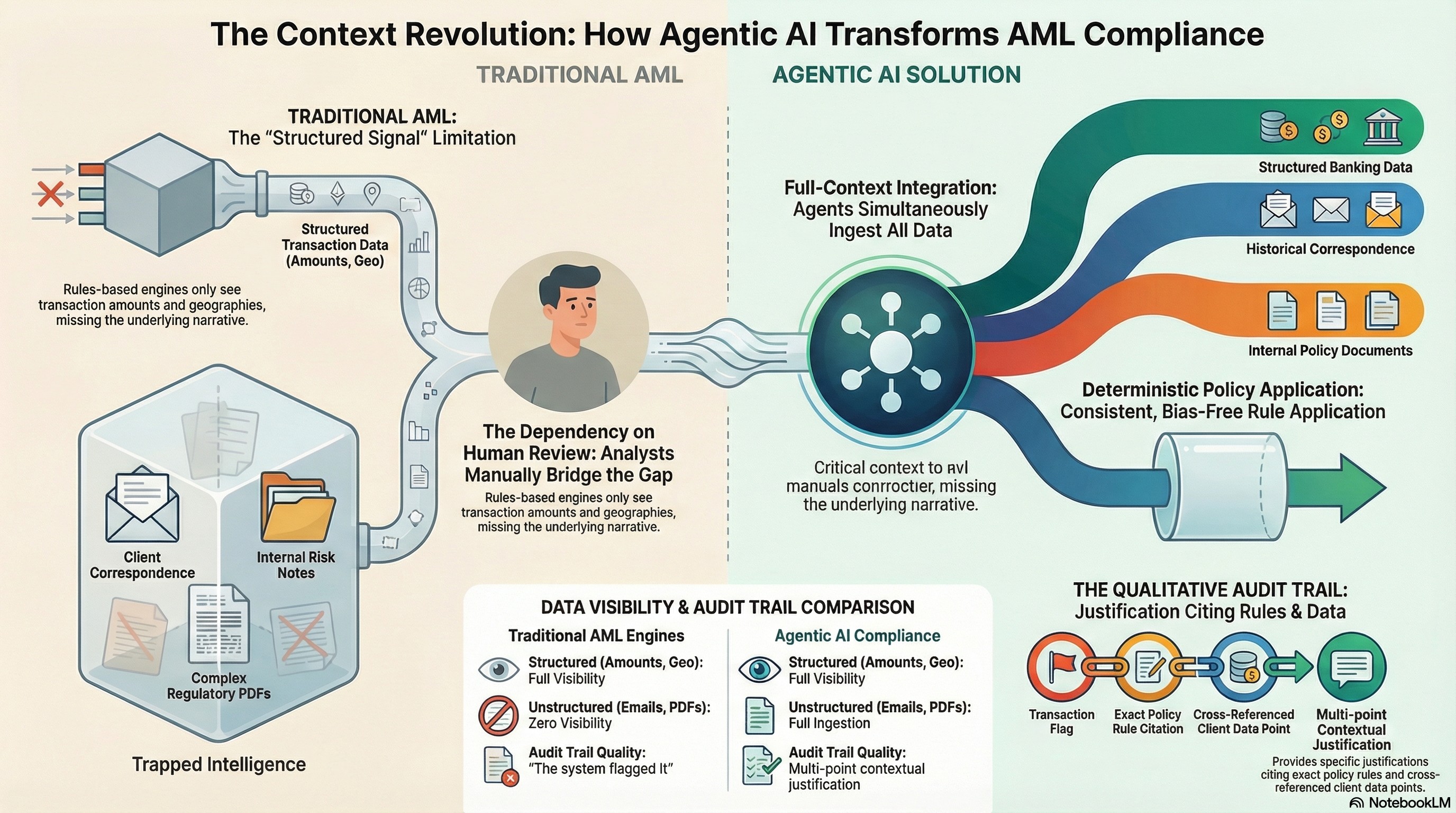
Financial crime detection has a context problem at its core. Traditional AML systems operate on transaction patterns: unusual amounts, unusual geographies, unusual frequencies. These are structured signals that rules-based engines process well. But financial crime narratives — the intelligence that distinguishes a genuinely suspicious transaction from a legitimate exception — lives almost entirely in unstructured data.
Consider what a compliance officer actually consults when assessing a suspicious transaction. The transaction record is the starting point. But the assessment draws on: the client's full correspondence history, which may include a prior conversation about an unusual business model. The account manager's internal risk assessment note, written in a document six months ago. The regulatory typology guidance PDF that was updated two weeks ago. The sanctions watchlist cross-reference. The client's contract, which may contain an exception clause that explains the unusual pattern.
A rules-only AML engine sees the transaction record and the watchlist. It misses everything else. This is why financial crime detection remains so dependent on experienced human analysts — because the context that makes a pattern suspicious or innocent is irreducibly unstructured.
Agentic AI changes this in a fundamental way. A full-context compliance agent can simultaneously:
- Access the structured transaction flag, the account history, and the risk scoring from the core banking system
- Read the client's historical correspondence to identify prior flagged concerns or explanatory context
- Ingest the current AML policy document and apply its guidance deterministically — not probabilistically
- Cross-reference against regulatory typology guides published as PDFs
- Apply the bank's own internal escalation thresholds from its governance policy documents
- Log every data source consulted and every rule applied before producing a classification
The output is not just faster than a human analyst — it is more consistently governed, because the rules are applied the same way every time, without the fatigue, unconscious bias, or knowledge gaps that affect human reviewers working at volume.
The audit trail this generates is also qualitatively different. When a regulator asks how a suspicious activity report was generated, the answer is not "the system flagged it." The answer is: "This transaction was flagged by Rule 4.2 of our current AML policy, cross-referenced against watchlist entries A, B, and C, reviewed in the context of the client correspondence from dates X, Y, and Z, and escalated because it exceeded the autonomous review threshold defined in our governance framework." That is the level of explainability that banks operating in the current regulatory environment need — and that full-context agentic AI delivers by design.
How to Implement Agentic AI in Finance: The 30-Day Path
The biggest barrier to agentic AI production in financial services is not technology selection. It is the gap between what a platform demonstrates in a controlled proof-of-concept and what it sustains in production. The reason most implementations fail to cross that gap is the context problem — an agent that performed perfectly in the demo environment, where the data was curated and the exceptions were scripted, encounters the full complexity of production data and breaks.
The prerequisite question to ask before selecting any agentic AI platform for finance is this: what data sources will your agents not have access to? If the answer includes email threads, PDF contracts, policy documents, Slack conversations, or any unstructured data source — you are evaluating a platform that will deploy a blind agent. It may work in the demo. It will not survive production at scale.
The 5 Questions to Ask Any Agentic AI Vendor in Finance
- How does your platform handle unstructured financial documents — contracts, policy PDFs, email threads, regulatory guidance? (If the answer involves a separate RAG layer that needs custom configuration, ask how it handles document updates.)
- How are business rules encoded — deterministically or probabilistically? (In finance, you need deterministic governance: if-then logic that does not bend based on model confidence. Probabilistic rules produce inconsistent compliance outcomes.)
- What is the human-in-loop control mechanism for financial thresholds? (Ask for a specific example: payments below X execute autonomously; payments above Y route to approval. If they can't show this, they don't have real governance.)
- How does the platform integrate with existing ERP, core banking, and CRM systems without rip-and-replace? (Full-context agentic AI should orchestrate what you already have — not require a data migration before you can start.)
- Can you show a live production deployment in a comparable financial institution — with the data types, document volumes, and compliance requirements that match our environment? (Demo environments are not production environments.)
The 30-Day Deployment Framework
For financial institutions working with Assistents.ai, the path from scoping to a live, governed agent in production follows a consistent structure that has been proven across deployments in banking, fintech, insurance, and corporate finance:
Week 1 — Discovery and Workflow Mapping: Identify the target workflow, map all data sources (structured and unstructured), define the governance rules that will govern agent behaviour, and scope the human-in-loop thresholds. No code is written in Week 1. The context architecture is designed before any automation is built.
Weeks 2–4 — Context Engine, Governance Rules, and First Agent: The Unified Context Engine is configured to fuse the identified data sources. The Semantic Governor encodes the governance rules defined in Week 1. The first agent is built, tested against the full context layer (not a demo subset), and validated against the compliance requirements specific to the institution.
Day 30 — Live, Governed Agent in Production: A fully operational agent, running in the production environment, with complete audit trail, threshold-based human controls, and monitoring dashboards. No rip-and-replace of existing systems. Assistents.ai orchestrates what the institution already has.
The Assistents.ai Guarantee:
- Within 48 hours of engagement: a concrete pilot plan, workflow definition, ROI hypothesis, and success metrics
- If we don't surface real, measurable new value — we walk
- No POC purgatory. No endless sales cycles. No demo-only environments
- Cloud, private cloud, on-premises, or hybrid deployment — no data leaves the institution's environment without explicit configuration
- SOC2 Type II, ISO 27001 aligned, GDPR compliant, AES-256 + TLS 1.3 encryption, no training on customer data
The Bottom Line on Agentic AI in Finance
2026 is the year the gap closes — between the 44% of finance teams experimenting with agentic AI and the 11% running it in production. The gap is not a technology problem. It is a context problem, a governance problem, and an architecture problem. Institutions that solve all three will compound their competitive advantage every month. Those that deploy agents on partial context will encounter their own version of the scenario that opened this guide.
The 12 use cases in this guide — across banking, fintech, financial services, and finance and accounting — are not future possibilities. They are production deployments, running today, in institutions that gave their agents the full picture: structured data, unstructured documents, and external signals fused into a single context layer before any agent acts. That is what separates the 11% from the 89%. Not the model. The foundation.
The Blind Agent Problem is solvable. The Ampcome Autonomy Stack — the Unified Context Engine, the Semantic Governor, and the Active Orchestrator — was built specifically to solve it in enterprise environments where the stakes of getting it wrong are measured in regulatory consequences, not just efficiency losses.
If you are evaluating agentic AI for your financial institution and want to see what full-context, governed execution looks like in a deployment comparable to your environment, the 48-hour pilot assessment from Assistents.ai gives you a concrete pilot plan, workflow definition, ROI hypothesis, and success metrics before you commit. You will see a governed, full-context agent in 30 days — or we walk.
Frequently Asked Questions: Agentic AI in Finance and Banking
What is agentic AI in finance?
Agentic AI in finance refers to autonomous AI systems that can perceive financial data, reason through multi-step workflows, and execute decisions — including in ERP, CRM, banking, and compliance systems — without requiring human prompts for each step. Unlike copilots that advise or RPA that executes fixed scripts, agentic AI in finance handles exceptions, fuses structured and unstructured data into full context, and adapts to changing conditions while operating within deterministic governance guardrails. The defining characteristic is the combination of reasoning, execution, and governance — on complete context, not partial data.
What are the top use cases of agentic AI in banking?
The most impactful agentic AI use cases in banking include: omnichannel customer support automation with full case context; AML and financial crime detection using both structured transaction data and unstructured compliance documentation; automated loan and credit decision support with policy-cited audit trails; real-time regulatory compliance monitoring that ingests PDF guidance updates; and SAP or core banking workflow automation with threshold-based human controls. Each use case produces materially better outcomes when the agent has access to full context — structured and unstructured — rather than transaction data alone.
How is agentic AI used in finance and accounting?
In finance and accounting specifically, agentic AI is deployed for accounts payable governance (fusing invoice data with contract terms and email-based approvals), procurement KPI monitoring with automated margin alerts, month-end close support that reconciles structured GL entries with unstructured approval correspondence, CFO cash flow forecasting that incorporates market commentary and board correspondence alongside structured financial data, and tax research automation that synthesises regulatory guidance from multiple unstructured document sources. The common thread: accounting processes generate enormous volumes of unstructured decision context that structured AI tools cannot access.
What are the risks of agentic AI in financial services?
The three primary risks of agentic AI in financial services are: (1) The Hallucination Risk — probabilistic AI models produce inconsistent outputs when context is incomplete; in finance, this means inconsistent compliance decisions. The mitigation is deterministic governance: explicit if-then rules that do not bend based on model confidence. (2) The Cascade Risk — a single miscategorisation replicates across linked systems before human intervention is possible. The mitigation is threshold-based human-in-loop controls: autonomous execution below a defined threshold, human approval above it. (3) The Audit Risk — regulators require complete explainability of automated decisions. The mitigation is a full audit trail that logs every data source consulted, every rule applied, and every policy referenced for every agent action.
How can agentic AI change the way banks fight financial crime?
Agentic AI changes financial crime detection by giving compliance agents access to both the structured transaction data that traditional AML systems use and the unstructured context that surrounds every suspicious transaction — client correspondence history, regulatory typology guidance in PDFs, account manager risk assessments in documents, and internal escalation policy documents. A full-context compliance agent can cross-reference a suspicious transaction flag against all of these simultaneously, apply the bank's current AML policy deterministically, and produce an audit-ready classification with full documentation of every source and rule used. This produces more consistent, more explainable, and more defensible compliance decisions at machine speed.
What is the difference between agentic AI and RPA in finance?
RPA (Robotic Process Automation) executes fixed, scripted workflows against structured data. It is fast and reliable when data is clean and processes are consistent — but it breaks on exceptions, cannot read unstructured documents, and requires manual reprogramming when processes change. Agentic AI in finance reasons through multi-step workflows, handles exceptions by applying governance rules rather than breaking, can fuse structured and unstructured data, and adapts its execution based on context. The practical difference: an RPA tool processing vendor payments will fail when it encounters a PDF contract. An agentic AI with full context will read the contract, apply the relevant discount terms, and adjust the payment accordingly — all with a complete audit trail.
How long does it take to implement agentic AI in a bank?
With the right platform architecture, financial institutions can move from scoping to a live, governed agentic AI agent in 30 days. Week 1 covers discovery, data source mapping, and governance rule design. Weeks 2–4 cover context engine configuration, agent development, and compliance validation. Day 30 delivers a production-grade agent with full audit trail, threshold-based human controls, and monitoring dashboards — integrated with existing core banking, ERP, and CRM systems without rip-and-replace. The critical prerequisite: the platform must be able to access both structured and unstructured data from Day 1, or the 30-day timeline will not hold.
What data does agentic AI in finance need to work effectively?
This is the Blind Agent Problem. Most agentic AI deployments in finance fail to perform in production because they are configured to access only structured data — ERP records, transaction logs, CRM fields — which represents 10–20% of the enterprise data landscape. The remaining 70–85% is unstructured: PDF contracts, email threads, policy documents, regulatory guidance, meeting notes, and correspondence that contains the real business context behind every financial decision. Effective agentic AI in finance needs all three layers: structured data for transaction facts, semi-structured data for system events and API signals, and unstructured data for the business context that makes those facts interpretable. Without all three, agents act on incomplete information — and incomplete information at machine speed is a financial risk, not an efficiency gain.

Transform Your Business With Agentic Automation
Agentic automation is the rising star posied to overtake RPA and bring about a new wave of intelligent automation. Explore the core concepts of agentic automation, how it works, real-life examples and strategies for a successful implementation in this ebook.
Sarfraz Nawaz is the CEO and founder of Ampcome, which is at the forefront of Artificial Intelligence (AI) Development. Nawaz's passion for technology is matched by his commitment to creating solutions that drive real-world results. Under his leadership, Ampcome's team of talented engineers and developers craft innovative IT solutions that empower businesses to thrive in the ever-evolving technological landscape.Ampcome's success is a testament to Nawaz's dedication to excellence and his unwavering belief in the transformative power of technology.

More insights
Discover the latest trends, best practices, and expert opinions that can reshape your perspective







Contact us

