
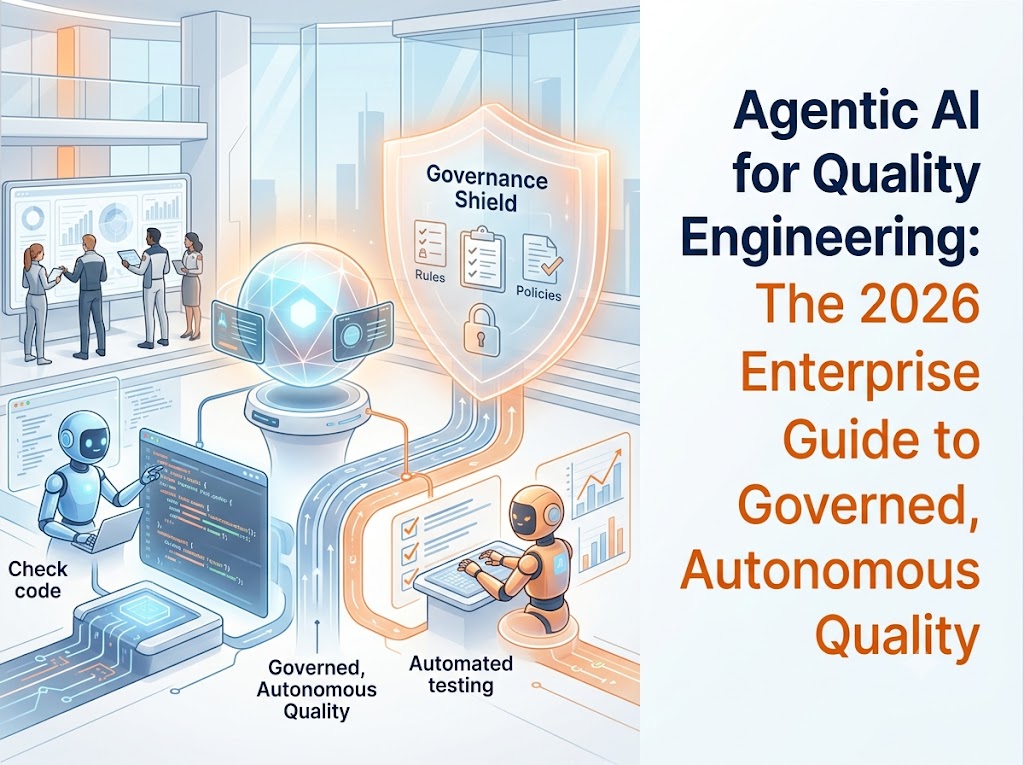
Agentic AI for Quality Engineering: The 2026 Enterprise Guide to Governed, Autonomous Quality


Agentic AI for quality engineering uses goal-driven AI agents that plan, execute and adapt quality work across the delivery lifecycle, from requirement analysis and test design to defect triage and release decisions. They work inside permissions, approvals and audit trails that people define.
That is the short answer. The rest of this guide covers how it differs from test automation and AI-assisted testing, what an enterprise rollout looks like, where it breaks, how to measure it, and how to choose a platform.
Key takeaways:
- Agentic QE acts, while AI-assisted testing suggests. Agents plan, execute, observe and adjust toward a quality goal.
- The hard part is governance, not intelligence. The question to answer is what an agent may do alone, what needs human review, and what is blocked.
- Quality engineering reaches beyond UI testing: business processes, ERP workflows, data migrations and operational monitoring all need it.
- Start with one high-value process, measure it against a baseline, then expand.
Why quality engineering is changing now
Software teams ship faster than quality teams can script. AI-assisted coding raises the volume of change, enterprise estates span ERP, CRM, APIs and documents, and every release has to be explainable to auditors and leadership. Scripted automation struggles in that environment: it needs constant maintenance, coverage decays as features outpace tests, and feedback arrives late.
The market has responded. Tricentis now describes a unified agentic quality engineering platform (https://www.tricentis.com/blog/enterprise-agentic-ai-quality-platform) that combines AI agents, governance and enterprise context. TestingXperts offers agentic AI services for QE (https://www.testingxperts.com/services/agentic-ai/) covering self-healing automation and incident management. Amdocs promotes an agentic test force (https://www.amdocs.com/products-services/amdocs-studios/amdocs-quality-engineering-agentic-ai-solution) that detects, analyses and resolves issues proactively.
Quality engineering itself is the discipline of building quality in across product development and production, not just testing at the end (https://en.wikipedia.org/wiki/Quality_engineering). Agentic AI extends that idea. Agents can work on quality continuously, across systems, with people supervising the decisions that matter.
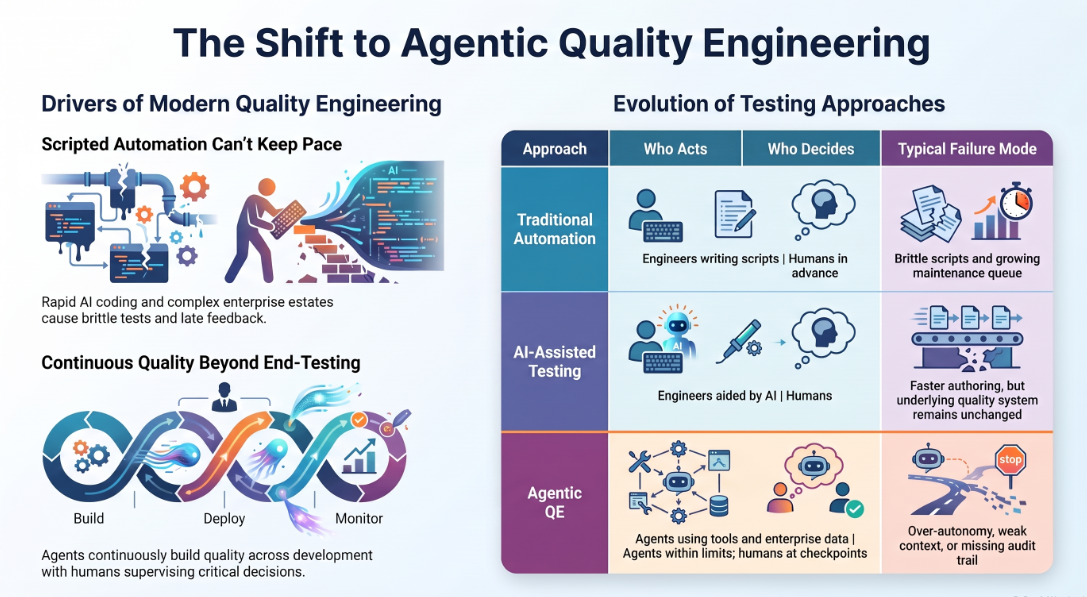
Test automation vs AI-assisted testing vs agentic QE
These three get conflated, and the difference shapes everything that follows.
Traditional test automation
- Who acts: scripts written and maintained by engineers.
- Who decides: humans, in advance.
- Typical failure: brittle scripts, growing maintenance queue.
AI-assisted testing
- Who acts: engineers, with AI helping generate or summarise.
- Who decides: humans.
- Typical failure: faster authoring, but the quality system itself is unchanged.
Agentic quality engineering
- Who acts: agents pursuing a defined quality goal using tools and enterprise data.
- Who decides: agents within limits, humans at defined checkpoints.
- Typical failure: over-autonomy, weak context, or missing audit trail.
Tricentis frames the difference this way in its agentic testing guide (https://www.tricentis.com/learn/agentic-testing): AI-assisted testing helps at authoring time, while agentic testing helps at run time. Datamatics makes a related point in its overview of agentic quality engineering (https://blog.datamatics.com/agentic-quality-engineering-ai-software-testing): the level of autonomy depends on the workflow, the controls and the agreed points where humans review or approve.
EPAM describes the same journey as a maturity curve (https://www.epam.com/about/newsroom/in-the-news/2026/how-agentic-ai-is-reshaping-enterprise-testing). Teams start with code-assist tools, move to agents that augment today's lifecycle, and eventually reach fully agentic workflows. Most enterprises are somewhere in the middle, which is why a governed, incremental path matters more than a big-bang switch.
What agentic QE looks like across the lifecycle
An enterprise agentic QE setup is not one super-agent. It is a coordinated set of specialists, each with a narrow job, orchestrated together. One practitioner describes the pattern as requirement, risk-scoring and test-generation agents collaborating across the SDLC (https://medium.com/@srikant.reddy/from-test-automation-to-agentic-ai-the-next-evolution-of-quality-engineering-d8e0ad2a639f). A practical lifecycle looks like this:
- Requirement intelligence. Agents read specifications, tickets and change documents, flag ambiguity and missing acceptance criteria, and highlight what changed since the last version.
- Risk scoring. Agents weigh change impact, history and dependencies to decide where quality effort should go.
- Test design and data. Agents propose scenarios and test data, with humans approving anything high-risk.
- Execution and validation. Agents run checks across applications, APIs and business workflows, using the tools you already have.
- Defect triage. Agents gather logs, results and prior failures, route issues to owners and create tasks.
- Release gate. Agents assemble evidence and recommend go, review or no-go, with a human accountable for the final call.
- Production monitoring. Agents watch anomalies and send alerts so quality does not stop at release.
The coordination layer is what makes this enterprise-grade. It routes tasks, tracks state, handles exceptions, verifies outcomes and keeps people in the loop. That is the same orchestration pattern behind multi-agent systems in the enterprise (https://www.ampcome.com/post/multi-agent-system-architecture-for-enterprises) and the platform architecture described in our enterprise agentic AI platform guide (https://www.ampcome.com/post/enterprise-agentic-ai-platform-architecture-2026).
For the tactical, tool-level view, see our guides to AI agents for QA testing (https://www.ampcome.com/post/ai-agents-for-qa-testing), AI agents for test automation (https://www.ampcome.com/post/ai-agents-for-test-automation) and agentic AI for performance testing (https://www.ampcome.com/post/agentic-ai-for-performance-testing).
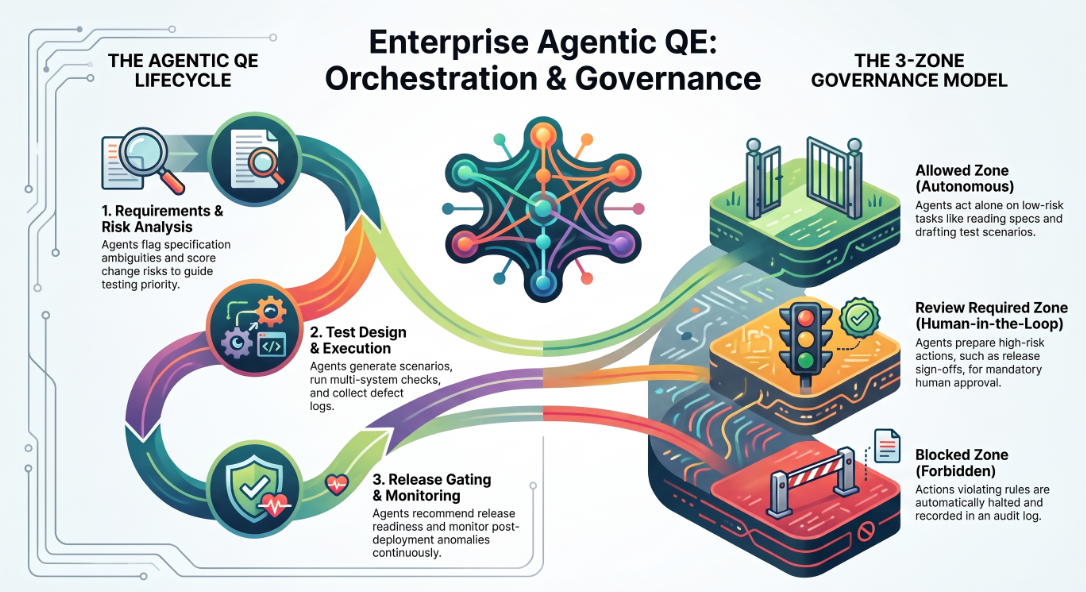
The decision-rights model: what agents may do, review and never do
Most failed agentic rollouts fail on control, not capability. Before any agent runs, define three zones for every action.
Allowed. The agent acts alone. Examples: reading a specification, comparing two versions, drafting a test scenario, creating a defect task.
Review required. The agent prepares the action and a human approves it. Examples: changing a regression scope, accepting a risky mapping, signing off a release gate.
Blocked. The action is outside policy. It does not run, and it is logged for review.
Every action passes through the same checks: an access check on the user's role and permissions, a policy evaluation of rules and constraints, and human approval where required. Every outcome, including blocked ones, lands in an audit history.
This is how Assistents is built. Its governance layer enforces permissions, business rules, human approvals and a complete audit history before any business action runs. Infosys makes a similar argument from the human side: quality engineers should validate and certify agent outputs (https://blogs.infosys.com/quality-engineering/quality-engineering/agentic-ai-and-qe-why-human-strategy-matters-more-than-ever.html), because humans retain final accountability.
Quality engineering beyond testing: what enterprise deployments show
Enterprise quality problems rarely live in one test tool. They sit between documents, ERP, data and approvals. Our delivery work has not been labelled "QE projects," but several patterns map directly onto quality engineering. We describe them here as patterns, not as claims of QE deployments, and without client names.
Change detection and impact review
A construction specialist needed tender documents processed and revisions tracked as they changed. We built agents that extract changes, compare versions, send them to human review and update the operational system only with approved details. The system was engineered for up to about 90% faster tender document processing, with a roughly 95% extraction accuracy target for standard formats. Those are design targets, not measured guarantees. Reduced bid risk came from revision detection and an audit trail.
Why it matters for QE: the same compare, review, approve and update loop is how you manage requirement and specification changes across a release.
Architecture and security assessment
A mobile banking provider needed technical due diligence. The engagement covered code and architecture review, infrastructure and security assessment, scalability and resilience checks, and integration readiness, finishing with a risk register and a remediation roadmap. The result was faster decisions and fewer post-deal surprises.
Why it matters for QE: this is quality engineering at the system level, with evidence-based risk visibility and a prioritised fix list.
Governed process automation with audit trails
A manufacturer moving away from an end-of-life, high-licence-cost document environment used agentic automation to interpret order triggers, validate them and create SAP sales orders. Rules and approvals handled exceptions, and audit logs and reconciliation reporting made every order traceable. The outcomes were less manual order processing, a faster order-to-confirm cycle, fewer data-entry errors and better auditability.
Why it matters for QE: the same rule, exception, approval and reconciliation pattern is how you control quality when business logic changes.
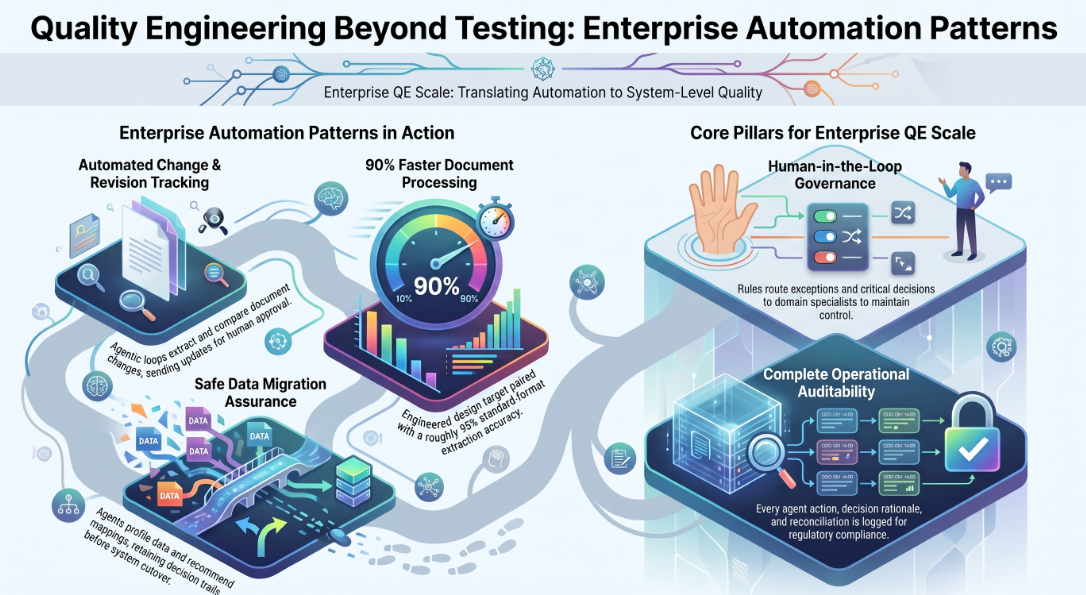
Data quality and migration assurance
A premium automotive manufacturer used AI to support an SAP ECC to S/4HANA migration. Agents profiled data, checked duplicates and inconsistencies, recommended mappings and sent them for specialist validation. The rationale and decision trail were retained, so migration decisions stayed reviewable.
Why it matters for QE: migrations are some of the riskiest quality events in an enterprise. This pattern validates data before cutover and documents why each decision was made.
Continuous monitoring and early alerts
Across utilities and energy operations, we built analytics and agents for anomaly detection, forecasting and proactive alerting. In practice that means earlier detection of exceptions and more predictable operations. In QE terms, it is production quality monitoring: catching degradation early and routing it to the right people.
Auditable agent operations
For banks and credit unions, we delivered omnichannel service agents with workflow routing, agent-assist summaries, SLA monitoring and audit trails. The result was faster case handling and better compliance readiness.
Why it matters for QE: it shows agents running in a regulated environment with every action reviewable.
You can browse more outcomes in our case studies (https://www.ampcome.com/showcases). Across more than 30 client implementations spanning logistics, retail, finance, healthcare, energy and more, the consistent lesson is the same: governed, auditable, human-in-the-loop automation is what makes agents deployable at enterprise scale.
Where agentic QE breaks (and how to avoid it)
Agentic QE is not magic, and it is better to know the failure modes up front.
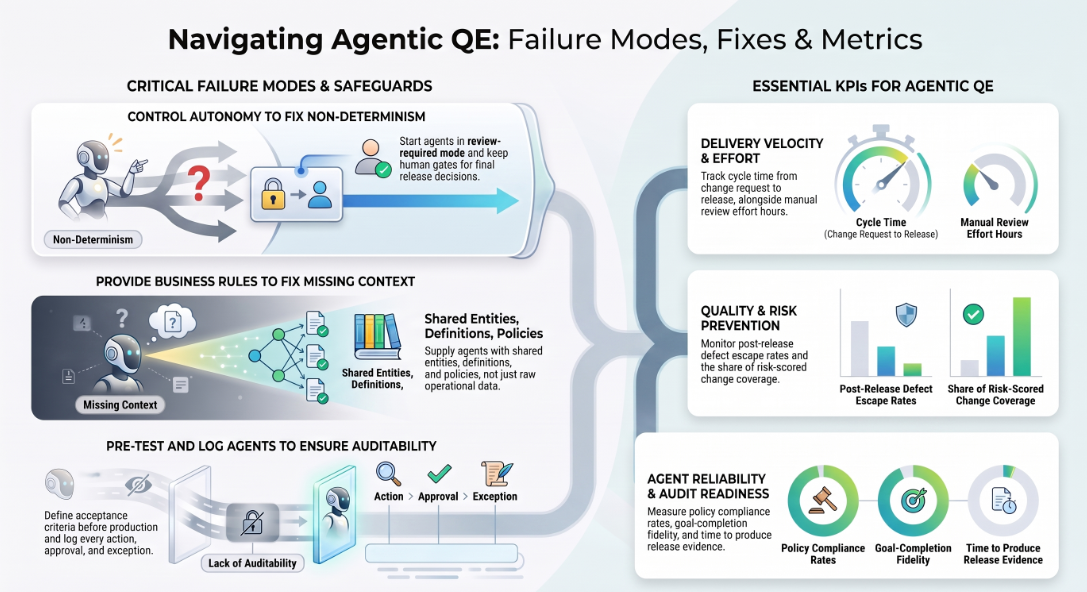
Non-determinism. Agents can fail differently from scripts and may give different answers on different runs. That is why one analysis of agentic QA (https://remote.qa/blog/agentic-qa-autonomous-test-agents-2026/) concludes that a human should still gate releases. Fix: keep decision rights explicit and require evidence with every recommendation.
Missing context. An agent that does not understand your business rules cannot judge what "correct" means. Fix: give agents a shared context of entities, definitions and policies, not just raw data.
Over-autonomy. Letting agents act freely on day one invites incidents. Fix: start in Review-required mode and widen to Allowed only as evidence builds.
No audit trail. If you cannot explain what an agent did and why, regulated teams cannot rely on it. Fix: log every action, approval and exception.
Untested agents. Agents are software and need quality assurance too. Research on agentic services proposes measures such as goal-completion fidelity, policy compliance rate, tool-use safety and human-oversight effectiveness (https://arxiv.org/pdf/2607.12619). Fix: define acceptance criteria and evaluation sets for each agent before production.
KPIs: how to measure agentic quality engineering
Baseline first, then track change. We deliberately avoid quoting generic industry percentages here, because your starting point is what matters. Measure:
- Cycle time: from change request to verified release decision.
- Review effort: hours spent on manual checks and re-entry.
- Exception visibility: how many exceptions are detected, and how fast they are routed.
- Escape rate: issues found after release versus before.
- Change coverage: share of changes that received risk-scored validation.
- Agent reliability: policy compliance and goal-completion rates for the agents themselves.
- Audit readiness: time to produce evidence for a release or an exception.
For the broader productivity framing, see our guide to the difference between an AI assistant and an AI agent (https://www.ampcome.com/post/difference-between-ai-assistant-and-ai-agent).
How to choose an agentic QE approach
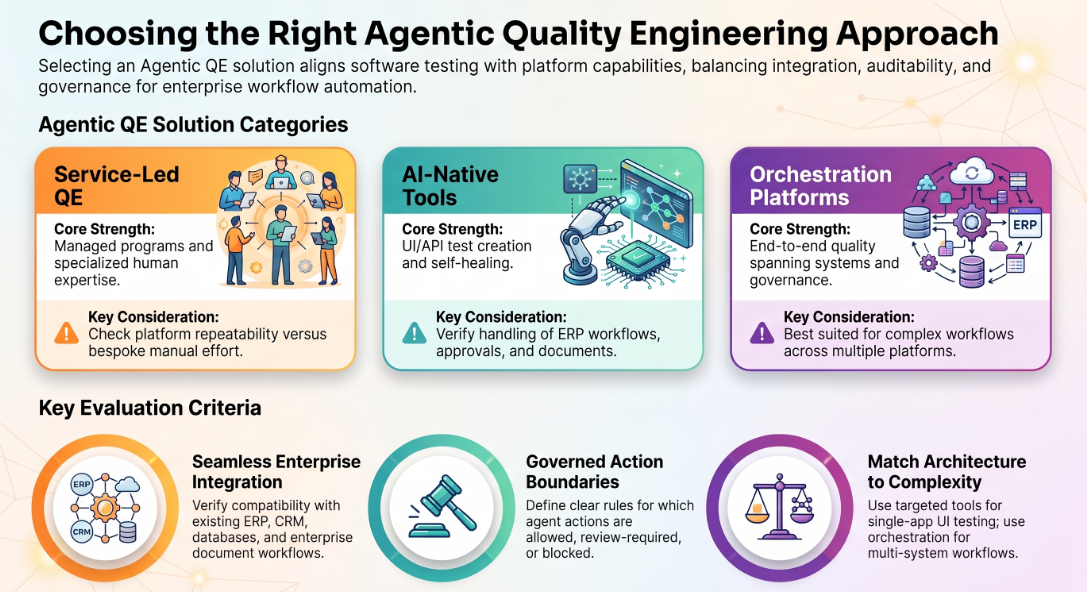
Buyers usually meet four categories. None is "best" for everyone.
Service-led QE providers. Strong when you need people and a managed program. Check how much is repeatable platform versus bespoke effort.
AI-native test execution tools. Strong for UI and API test creation and self-healing. Check how they handle ERP workflows, documents and approvals.
Enterprise test suites. Strong where a suite is already standardised, as with Tricentis's platform approach (https://www.tricentis.com/blog/enterprise-agentic-ai-quality-platform). Check how well they reach processes outside the test suite.
Orchestration and governance platforms. Strong when quality spans systems, documents and approvals. This is where assistents.ai sits.
Buyer checklist:
- Does it work with the systems you already run, including ERP, CRM, documents and databases?
- Can you define what agents may do, what needs review and what is blocked?
- Is there a complete audit history of actions, approvals and exceptions?
- Can it deploy where your data policy requires?
- Are model choice, fallback and usage controlled?
- Does the vendor start from one process with success measures, or from a big-bang rollout?
- Is the proof relevant to your problem, and honestly labelled as pattern or measured result?
Why assistents.ai for agentic quality engineering
assistents.ai (https://www.assistents.ai/) is the enterprise AI agent platform from Ampcome, built to put AI agents to work across operations with your rules and your people. For quality engineering, it fits as the governed orchestration layer around the tools you already use.
- One platform across the quality lifecycle. Conversational agents, agentic BI, document AI, voice AI and autonomous workflows run on one foundation, with Agent Builder and Workflow Builder for reusable, versioned agents.
- A context engine for business meaning. Agents work from shared entities, definitions, policies and source evidence, so "correct" is defined by your business rules rather than guessed.
- Governance by design. Permissions, business rules, human approvals and a complete audit history sit in front of every action, with the Allowed, Review required and Blocked model built in.
- Specialist agents, coordinated. Document, data and communication agents are orchestrated together. The orchestrator routes tasks, tracks state, handles exceptions and resumes work after human review. Our primer on agentic process automation (https://www.ampcome.com/post/what-is-agentic-process-automation) covers the foundations.
- Built on the systems you already use. It connects ERP including SAP, CRM, documents and databases through APIs, SDKs and connectors.
- Enterprise deployment options. Choose cloud SaaS, private cloud or on-premise infrastructure, with an AI gateway for approved models, routing, fallback and usage management.
- A delivery team behind it. Forward Deployed Engineers, AI engineers, and data science and machine learning specialists work with you across the USA, Australia and India, from configuration to enterprise delivery.
- Proven governed-automation patterns. Across more than 30 client implementations, the same building blocks have delivered auditable results: document validation, SAP workflows, migration decisions, monitoring and alerting.
When assistents.ai is not the right fit: if you only need self-healing UI regression for a single web application, a specialist test tool may be enough on its own. assistents.ai is strongest when your quality challenge spans systems, documents, approvals and audit requirements, and it can run alongside the tools you already own.
How to start: one process, six steps
Start with the process that matters most, with clear success measures and a delivery team behind it.
- Select. Pick one valuable process, such as change review, order validation or migration checks.
- Connect. Map its systems, handoffs and approval points.
- Configure. Build agents and workflows, and define Allowed, Review and Blocked actions.
- Validate. Run real cases against your baseline KPIs.
- Operate. Monitor execution, exceptions and agent reliability.
- Expand. Reuse the same context, integrations and controls on the next process.
To see how this would work on your process, book a tailored walkthrough (https://www.ampcome.com/request-a-demo).
The bottom line
Agentic AI for quality engineering is an operating-model shift, not a tooling upgrade. The teams that win will decide early what agents can do, keep humans accountable for the decisions that matter, and measure results against a baseline. If your quality challenge spans systems, documents and approvals, a governed orchestration layer is the right foundation. Explore assistents.ai (https://www.assistents.ai/) or book a walkthrough (https://www.ampcome.com/request-a-demo).
Related reading:
- AI Agents for QA Testing: https://www.ampcome.com/post/ai-agents-for-qa-testing
- AI Agents for Test Automation: https://www.ampcome.com/post/ai-agents-for-test-automation
- Agentic AI for Performance Testing: https://www.ampcome.com/post/agentic-ai-for-performance-testing
- Enterprise Agentic AI Platform Architecture: https://www.ampcome.com/post/enterprise-agentic-ai-platform-architecture-2026
- Agentic AI for Data Engineering: https://www.ampcome.com/post/agentic-ai-for-data-engineering
FAQs
What is agentic AI in quality engineering?
Agentic AI in quality engineering uses goal-driven agents that plan, execute and adapt quality tasks across the delivery lifecycle. They use tools and enterprise data, and they operate within permissions, human approvals and audit trails.
What is the difference between agentic testing and AI-assisted testing?
AI-assisted testing helps people write or summarise tests. Agentic testing gives agents responsibility for planning and executing quality work toward a goal, adjusting as conditions change, within defined limits and human checkpoints.
How does agentic AI improve quality engineering?
It shortens the path from change to verified decision. Agents read changes, prioritise risk, run validations, triage issues and assemble release evidence, while people focus on judgment, exceptions and approvals.
Can AI agents replace QA engineers?
No. Agents take on repetitive checking, comparison and routing, while quality engineers define goals, review exceptions, certify outputs and own accountability. The role shifts toward strategy, risk and governance.
What are the benefits of agentic AI for quality engineering?
Typical benefits are faster cycle times, less manual re-entry, clearer exceptions, earlier detection of risk and a traceable record of decisions. Measure them against your own baseline.
How do you govern agentic QE?
Define what agents may do alone, what needs human review and what is blocked. Enforce permissions and business rules on every action, require approvals where risk is high, and keep a full audit history.
How do you test AI agents before production?
Treat them like software. Set acceptance criteria and evaluation sets, and track goal completion, policy compliance, tool-use safety and the effectiveness of human oversight. Start in review mode and widen autonomy as evidence builds.
What does a first agentic QE project look like?
Choose one high-value process, connect its systems, configure agents with explicit decision rights, validate on real cases against a baseline, then expand. A focused first use case keeps risk and scope manageable.

Transform Your Business With Agentic Automation
Agentic automation is the rising star posied to overtake RPA and bring about a new wave of intelligent automation. Explore the core concepts of agentic automation, how it works, real-life examples and strategies for a successful implementation in this ebook.
Sarfraz Nawaz is the CEO and founder of Ampcome, which is at the forefront of Artificial Intelligence (AI) Development. Nawaz's passion for technology is matched by his commitment to creating solutions that drive real-world results. Under his leadership, Ampcome's team of talented engineers and developers craft innovative IT solutions that empower businesses to thrive in the ever-evolving technological landscape.Ampcome's success is a testament to Nawaz's dedication to excellence and his unwavering belief in the transformative power of technology.

More insights
Discover the latest trends, best practices, and expert opinions that can reshape your perspective







Contact us

