

Enterprise Agentic AI Platform Architecture: The 2026 Complete Guide


Most enterprises have run an agentic AI pilot. Fewer than 2% have deployed at full production scale.
That gap is not a technology problem. The models are capable. The use cases are proven. The gap is architectural — and it shows up the same way across every industry: agents that work beautifully in a sandbox collapse in production because the infrastructure around them was never designed for autonomous, multi-system, governed execution.
By the end of 2026, Gartner projects that 40% of enterprise software applications will integrate task-specific AI agents — up from less than 5% in 2025. The enterprises that close the pilot-to-production gap will not be the ones that found the best model. They will be the ones that built the right architecture underneath it.
This guide covers everything an enterprise architect, CTO, or AI programme leader needs to understand about enterprise agentic AI platform architecture: what it is, why conventional enterprise AI infrastructure fails at agentic scale, how the four core layers work, how multi-agent orchestration operates in real production environments, and what deployment decisions actually look like across logistics, retail, energy, healthcare, financial services, and real estate operations.
Every deployment pattern described here is drawn from real, production-grade implementations — not whitepapers.
What Is Enterprise Agentic AI Platform Architecture?
Enterprise agentic AI platform architecture is the structural framework that enables AI agents to operate autonomously, coordinate with other agents and human teams, integrate with enterprise systems, take governed actions, and remain fully auditable — all within a single, coherent execution environment.

It is not a chatbot. It is not a workflow automation tool. It is not a model deployment platform.
The distinction that matters most: agentic AI systems do not respond to queries. They detect conditions, reason over context, make decisions, and execute actions — often across multiple systems, in a continuous loop, without waiting to be asked. That fundamental shift from reactive to proactive intelligence requires infrastructure that most enterprise environments were never designed to support.
Traditional enterprise AI architecture was built for deterministic, static pipelines: data in, prediction out, human acts. Agentic architecture is built for dynamic, multi-step workflows where agents observe, plan, act, and learn in real time — and where every action must be traceable, explainable, and aligned with business rules.
The architectural question is not whether to use AI agents. It is whether the platform underneath them can make those agents safe, scalable, and auditable at enterprise scale.
Why Traditional Enterprise AI Architecture Fails at Agentic Scale

Before examining what works, it is worth being precise about what breaks — and why it keeps breaking in the same ways.
Static pipelines cannot support dynamic agent coordination.
Conventional ETL-based architectures move data in fixed sequences between predetermined systems. Agentic workflows require shared memory, real-time context flow, and the ability for agents to dynamically route decisions and tool calls. The pipeline model creates bottlenecks, data staleness, and coordination failures the moment agents need to act across system boundaries.
Governance added after deployment cannot be trusted.
The most common architectural failure in enterprise AI deployments is treating audit, compliance, and approval controls as features to add once the system is working. In agentic environments — where agents can execute write actions in ERP systems, route payments, create orders, and update records — governance must be an architectural constraint from day one, not a layer applied on top. Agents that can act without embedded governance controls create compliance exposure that cannot be patched retroactively.
Data quality upstream determines agent reliability downstream.
An agent reasoning over siloed, inconsistent, or poorly resolved entity data will produce outputs that look confident but are operationally wrong. Enterprises that skip the data foundation layer — or assume their existing data warehouse is sufficient — consistently find that their agents make systematically incorrect decisions on edge cases that matter most.
Autonomy without graduation creates operational risk.
Deploying agents at full autonomy before the organisation has established trust in the decision logic, established exception handling, and validated edge-case behaviour is the fastest path to a failed programme. Enterprises that succeed at scale deploy agents at conservative autonomy levels first, validate performance, then graduate autonomy incrementally — with governance controls at every stage.
The architecture that resolves all four of these failure modes is a layered stack where data quality, reasoning consistency, execution safety, and governance auditability are each addressed explicitly and tested independently before being composed into a production system.
The Four-Layer Architecture Model for Enterprise Agentic AI
The architecture that underpins production-grade enterprise agentic AI deployments organises into four layers. Each layer has a distinct responsibility. Each can be evaluated independently. And all four compose into a single, deterministic execution pipeline — from raw data ingestion to governed action.
This is the model that assistents.ai is built on.
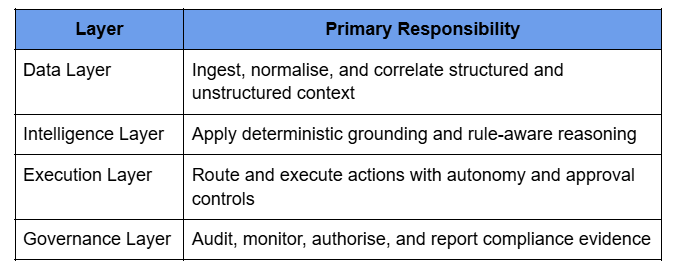
Understanding what each layer does — and what breaks when it is absent or poorly designed — is the foundation of any serious enterprise agentic AI programme.
Layer 1 — Data Layer: Unified Context Foundation
The Data Layer is where every agentic AI system either earns its reliability or loses it. This layer is responsible for ingesting, normalising, and correlating all the context an agent needs to reason correctly — from structured enterprise systems to unstructured documents, contracts, SOPs, and communications.
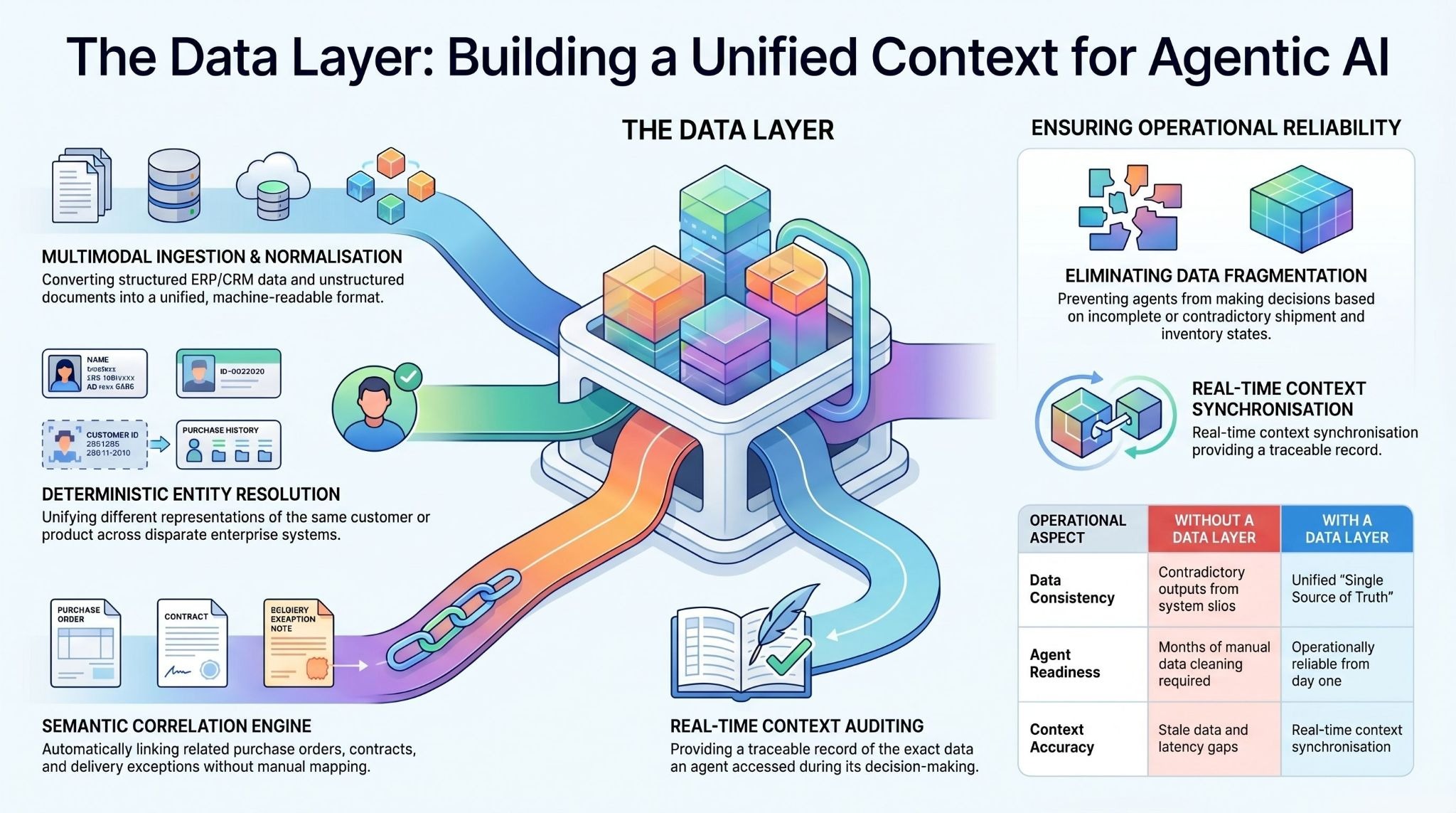
What the Data Layer does:
Structured source connectors handle schema discovery, incremental synchronisation, and secured ingestion from ERP, CRM, HRIS, service management, and infrastructure systems. When an agent needs to check inventory levels, query an open purchase order, or verify a customer account status, it is drawing from context maintained by this layer.
Document processors handle unstructured content — contracts, policies, compliance documents, maintenance logs, product specifications, tender documents. Format normalisation, structural decomposition, semantic extraction, and embedding generation convert these assets into context the intelligence layer can reason over.
Entity resolution is the step that most architectural plans underestimate. Real enterprise environments have the same entity — a vendor, a product, a customer account — represented differently across different systems. Deterministic and probabilistic matching must unify these references before agents can reason across system boundaries without producing contradictory outputs.
The Semantic Correlation Engine maintains the relationships between entities, events, documents, and transactions across sources. This is what allows an agent to understand that a purchase order, a delivery exception, a vendor contract clause, and a payment hold are all connected — without a human explicitly linking them.
What breaks without a well-designed Data Layer:
In a global logistics operation deploying AI agents across terminal, rail, and inland warehouse workflows, the single biggest implementation risk was data fragmentation — the same shipment represented differently in the port management system, the rail scheduling platform, and the customer-facing logistics dashboard. Without entity resolution and semantic correlation across all three systems, agents would route exceptions based on an incomplete picture of the shipment state. The Data Layer resolved this before any agent was trained on the data.
In a national retail environment spanning hundreds of stores, agents needed to reason about inventory levels, promotional pricing, MRP thresholds, supplier lead times, and store-level sales velocity simultaneously. Each data source had its own schema, update frequency, and data quality characteristics. The Data Layer normalised all of this into a unified context foundation — making inventory intelligence agents operationally reliable from day one, rather than requiring months of data cleaning after deployment.
Key evaluation questions for the Data Layer:
- Does the platform support both structured system connectors and unstructured document processors?
- How does entity resolution handle conflicting representations of the same entity across systems?
- Is the context foundation updated in real time, or are there latency gaps that create stale-data risks?
- Can the data layer be audited — i.e., can you trace exactly what context an agent had access to at the moment it made a decision?
Layer 2 — Intelligence Layer: Rule-Aware Reasoning
The Intelligence Layer is where raw context becomes governed reasoning. This layer applies deterministic business logic, encodes domain rules and compliance constraints, and grounds LLM-based reasoning in the rules that the organisation has explicitly defined.

This distinction — between a language model reasoning freely over data and a language model reasoning within a governance-encoded semantic framework — is what separates reliable enterprise AI agents from unpredictable ones.
What the Intelligence Layer does:
The semantic governance component encodes the organisation's business rules, definitional hierarchies, and calculation formulas in a form the reasoning engine can apply consistently. When an agent evaluates whether a vendor invoice is within policy, whether a procurement decision requires escalation, or whether a customer segment qualifies for a specific offer — these determinations are made against encoded rules, not inferred from training data alone.
Rule-aware reasoning means agents do not hallucinate commercially or operationally sensitive decisions. A pricing agent in a retail environment does not estimate margin impact — it calculates it against the encoded cost structure. A procurement agent does not approximate vendor performance — it reasons against defined SLAs and recorded delivery data.
The intelligence layer also manages the interplay between deterministic logic (if this condition, then this action) and probabilistic reasoning (what is the most likely explanation for this anomaly, given these signals). The architecture must handle both — and must make clear to human reviewers which type of reasoning produced a given output.
What breaks without a well-designed Intelligence Layer:
In a pharma sourcing environment managing thousands of excipients and supplier SKUs, agents needed to match RFQs against supplier capabilities, quality certifications, price history, and lead-time performance.
Without encoded rules governing which quality standards were mandatory for which product categories, an unconstrained language model would occasionally propose suppliers who were technically capable but operationally non-compliant. The Intelligence Layer encoded the regulatory and quality constraints first — making compliance non-negotiable in the reasoning chain.
In an energy transmission environment, agents monitoring grid operations needed to distinguish between anomalies requiring immediate alert escalation and readings within acceptable variance. The thresholds for each transmission segment, each sensor type, and each operating condition were encoded as rules in the Intelligence Layer — ensuring alerts were operationally meaningful rather than statistically noisy.
Key evaluation questions for the Intelligence Layer:
- How are business rules and compliance constraints encoded — and can non-technical teams maintain them?
- Can the platform demonstrate where deterministic rule logic was applied vs. where probabilistic LLM reasoning was used in a given decision?
- How does the layer handle rule conflicts or edge cases outside defined boundaries?
- Is the semantic governance framework version-controlled and auditable?
Layer 3 — Execution Layer: Governed Action at Scale
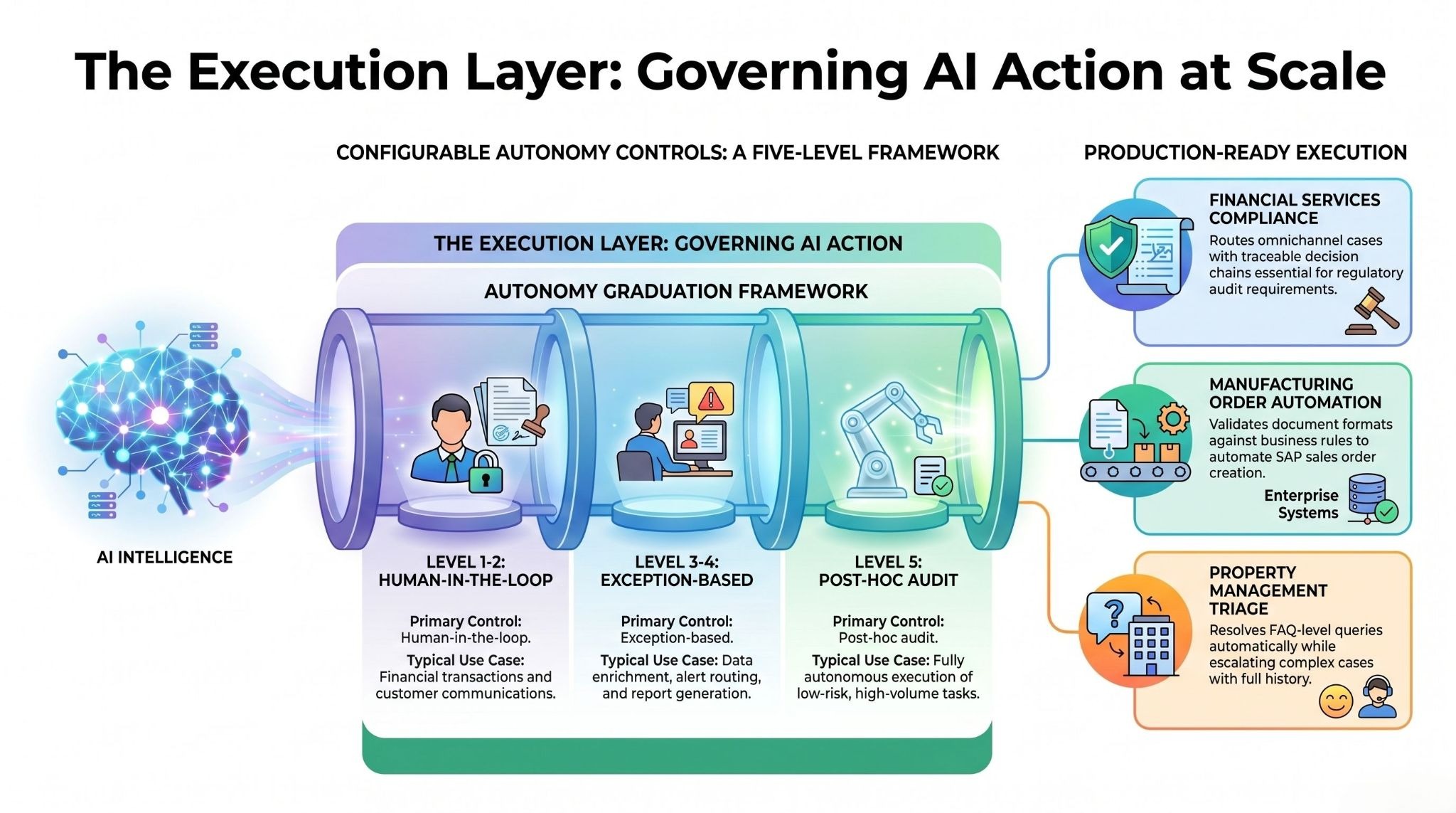
The Execution Layer is where intelligence becomes action. This layer routes decisions to the appropriate tools, systems, and human reviewers — with configurable autonomy controls that determine which actions an agent can take independently and which require approval.
This is the layer most organisations focus on first and most frequently underestimate in complexity. Executing a single action in a single system is straightforward. Executing coordinated, multi-step workflows across ERP, CRM, service management, communication platforms, and external APIs — with correct exception handling, rollback logic, and approval routing — is a fundamentally different engineering challenge.
What the Execution Layer does:
Action routing determines which tool, API, or system an agent engages to complete a given step in a workflow. This includes read operations (querying a system for current state), write operations (creating a record, updating a status, submitting an order), and communication operations (notifying a stakeholder, escalating to a human reviewer).
Autonomy controls define the boundaries of agent independence. The production-proven model is an autonomy graduation framework:
- Level 1: Every action requires human approval before execution
- Level 2: Agent proposes action, human confirms or modifies
- Level 3: Agent executes routine actions independently, escalates exceptions
- Level 4: Agent executes most actions independently with exception logging
- Level 5: Full autonomous execution with post-hoc audit only
Most enterprise deployments operate at Level 1–2 for high-stakes or high-value actions (financial transactions, ERP write actions, customer-facing communications), and Level 3–4 for routine operational tasks (data enrichment, alert routing, status updates, report generation).
Human-in-the-loop (HITL) controls are not a limitation on agent capability — they are an architectural feature that allows organisations to deploy at scale without operational risk, and to graduate autonomy as agent reliability is validated over time.
What production execution looks like:
In a financial services environment running omnichannel AI agents across banking support workflows, the Execution Layer managed intake from chat, email, and phone channels simultaneously — routing each case to the appropriate resolution workflow, handling summarisation and next-best-action recommendations for human agents, and escalating complex cases with full context pre-populated. Every action was logged with a traceable decision chain — essential for regulatory audit requirements.
In an enterprise manufacturing environment, the Execution Layer automated SAP sales order creation — interpreting order triggers from multiple incoming document formats, validating each order against business rules, creating the SAP record, and routing exceptions for human review. This replaced a legacy document management system that had reached end-of-life, eliminating both the licensing cost and the manual re-keying process that had introduced error rates at volume.
In a global property management operation, the Execution Layer handled tenant support workflows end-to-end — triaging queries, resolving FAQ-level cases automatically, routing maintenance requests to the appropriate team with full context, and escalating complex tenancy issues to human property managers with a complete interaction history already assembled.
Key evaluation questions for the Execution Layer:
- What is the granularity of autonomy control — can it be set per action type, per system, per value threshold?
- How are rollback and error recovery handled when an agent action fails partway through a multi-step workflow?
- How does the platform support approval routing — and can approval logic be configured without engineering involvement?
- What integration protocols are supported (REST APIs, MCP, A2A, native connectors)?
Layer 4 — Governance Layer: Audit, Compliance, and Control
The Governance Layer is the architectural component that determines whether an enterprise AI programme is trustworthy enough to scale. It handles audit trail generation, compliance evidence export, performance monitoring, access control, and the ongoing operational visibility that allows organisations to understand what their agents are doing — and why.

In regulated industries, the Governance Layer is not optional. In any industry, it is what allows leadership to extend agent autonomy with confidence rather than anxiety.
What the Governance Layer does:
Full audit trails capture every agent action with the complete reasoning chain attached — what context was available, which rules were applied, what decision was made, what action was taken, and what the outcome was. This is the standard that banking regulators, healthcare compliance frameworks, and enterprise risk functions require — and it must be generated automatically, not reconstructed from logs after the fact.
Compliance evidence export makes audit preparation a reporting task rather than an investigation. When a regulator or internal audit team requires evidence that AI-driven decisions met policy standards, the Governance Layer produces structured evidence packages — not raw logs.
SLA monitoring tracks whether agent workflows are completing within defined time and quality parameters. Operational dashboards give both technical and business teams visibility into agent throughput, exception rates, escalation volumes, and resolution outcomes.
Access control and authorisation manage which agents can access which systems, which actions are permitted under which conditions, and which human roles can approve or override agent decisions. In multi-tenant enterprise environments, these controls must be granular enough to enforce data segregation between business units or client accounts.
What breaks without a well-designed Governance Layer:
Every enterprise that has attempted to scale agentic AI without governance infrastructure encounters the same inflection point: the programme works at pilot scale, the business wants to expand it, and then a single unexpected agent action — an incorrect ERP update, a miscommunicated customer notification, a compliance-sensitive decision made without documentation — creates enough organisational concern to pause the entire programme.
Building the Governance Layer retrospectively is significantly more expensive and disruptive than building it into the architecture from the start. The organisations that scale fastest are not the ones that move fastest — they are the ones that moved with governance embedded from day one, because they never had to stop and rebuild trust.
In a banking environment, agents processing dispute and fraud workflows operated under continuous Governance Layer monitoring — every decision against a customer account was logged with the evidence trail required for regulatory examination. Compliance readiness was not a project at year-end; it was a continuous operational output of the architecture.
In a healthcare staffing environment, the Governance Layer managed credential verification status, compliance documentation for each placed clinician, and the reporting outputs required by facility compliance officers. Agents could not route a staffing placement without the Governance Layer confirming that all compliance requirements were satisfied.
Key evaluation questions for the Governance Layer:
- Are audit trails generated automatically, or must they be assembled from system logs?
- What does compliance evidence export look like — and how long does it take to produce a structured evidence pack?
- How does the platform handle governance across multi-tenant or multi-entity deployments?
- Can governance rules be updated without redeploying the agent?
Multi-Agent Orchestration: How Enterprise AI Agents Coordinate
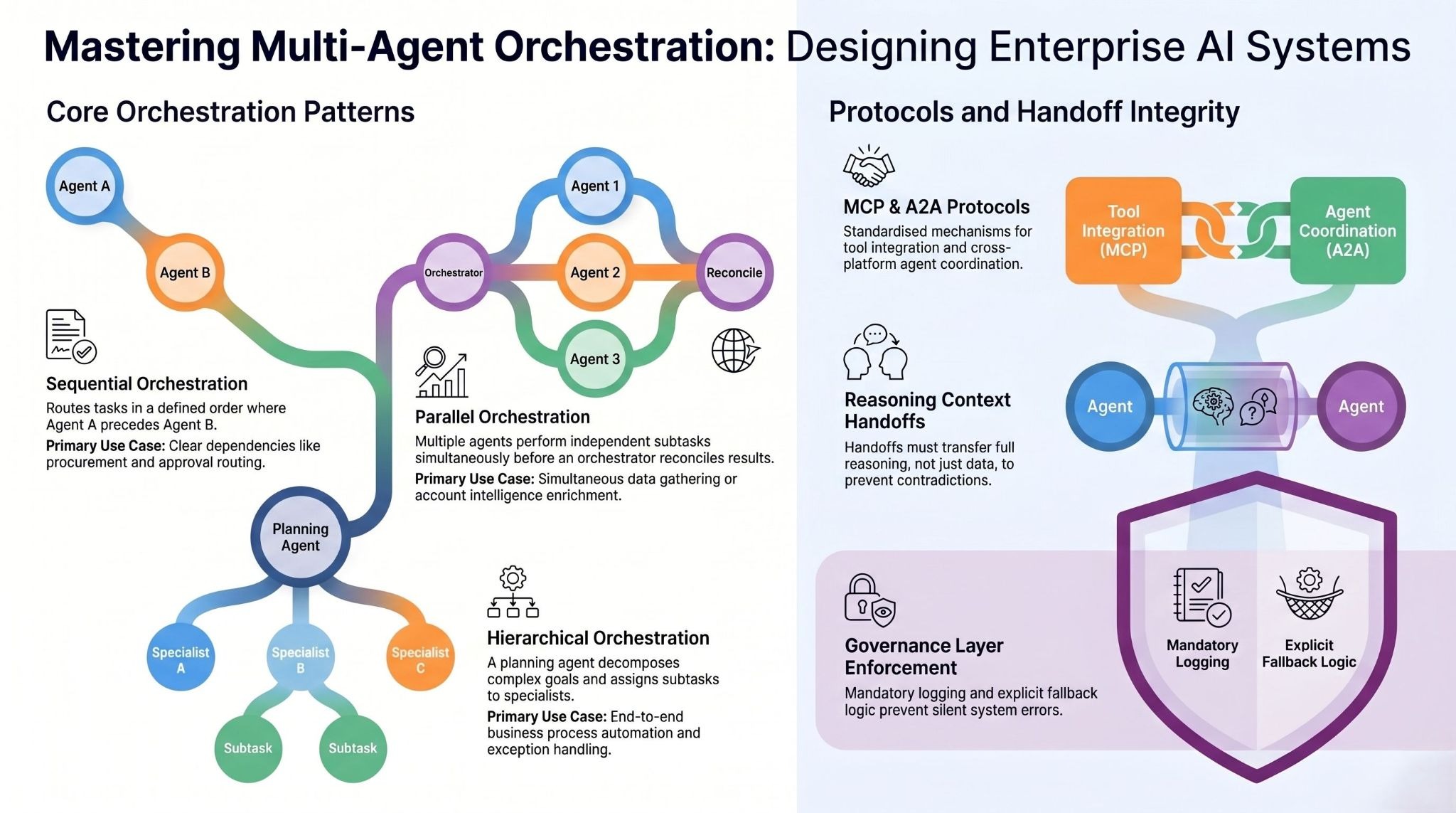
Multi-agent orchestration is the capability that allows a complex, multi-step enterprise workflow to be handled by a coordinated system of specialised agents rather than a single, monolithic agent attempting to do everything.
The case for multi-agent architecture in enterprise environments is straightforward: a single agent cannot reliably maintain deep expertise across data ingestion, business rule interpretation, system integration, approval routing, and compliance documentation simultaneously. Specialised agents with defined responsibilities and clear coordination protocols perform more reliably, are easier to test individually, and are faster to update when a specific part of the workflow changes.
The three primary orchestration patterns:
Sequential orchestration routes workflow steps in a defined order — Agent A completes its task and passes context to Agent B, which passes to Agent C. This is appropriate for workflows with clear dependencies, like a procurement request that must complete supplier matching before it can trigger approval routing before it can create a purchase order.
Parallel orchestration allows multiple agents to work simultaneously on independent subtasks, with an orchestrator collecting and reconciling their outputs. This is appropriate for workflows where independent data gathering or analysis tasks can run concurrently — for example, an account intelligence agent that simultaneously queries CRM history, enriches with external signals, and checks credit status, then synthesises all three into a single account brief.
Hierarchical orchestration uses a planning agent to decompose a complex goal into subtasks, assign those subtasks to specialist agents, monitor their execution, handle exceptions, and synthesise final outputs. This is the most powerful and most complex orchestration pattern — appropriate for end-to-end business process automation rather than individual workflow steps.
Coordination protocols:
Modern enterprise agentic platforms use two primary inter-agent protocols. MCP (Model Context Protocol) has become the de facto standard for agent-to-tool integration — providing a structured, auditable mechanism for agents to discover and invoke tools, APIs, and data sources. A2A (Agent-to-Agent) protocol enables coordination between agents across different systems and, increasingly, different vendor platforms.
Both protocols must operate within the Governance Layer — meaning every tool call and agent handoff is logged, and coordination failures are handled with explicit fallback logic rather than silent errors.
Context handoffs:
The most common failure point in multi-agent systems is context loss at handoff boundaries. When Agent A passes a task to Agent B, the full reasoning context — what was observed, what was decided, what actions were already taken — must transfer completely. Architectures that treat handoffs as simple data transfers rather than complete context transfers produce agents that repeat work, make contradictory decisions, or lose track of where a workflow stands.
In a global ports and logistics operation, a multi-agent system coordinated terminal operations, rail scheduling, and inland delivery routing simultaneously. The orchestrator maintained a unified workflow state — knowing at all times which shipments had cleared terminal operations, which were in rail transit, and which inland exceptions required human routing decisions. Context was never lost at system boundaries because the architecture treated the entire shipment lifecycle as a single, shared context.
Enterprise System Integration: Connecting AI Agents to Your Stack

An enterprise agentic AI platform that cannot integrate deeply with existing enterprise systems provides little value at scale. Integration is not a feature — it is the mechanism through which agents access real operational data and take real operational actions.
ERP integration (SAP, Oracle):
The distinction between read and write access is critical. Agents reading ERP data for context — inventory levels, open orders, vendor master data — carry minimal risk. Agents writing to ERP systems — creating purchase orders, updating inventory records, submitting sales orders — require least-privilege access controls, validation logic, and approval thresholds before execution. Production deployments demonstrate that automated ERP write operations are viable at scale, but only within a governance architecture that validates each write action against business rules before execution.
CRM integration:
Account intelligence agents operating over CRM data can maintain continuous visibility into customer relationship health, pipeline status, and engagement history. The execution architecture must determine which CRM actions (updating a contact record, logging a communication, moving a deal stage) can be executed autonomously and which require sales team confirmation.
Service management integration (ServiceNow, Jira):
IT and operations agents that triage, classify, and route service tickets operate effectively at Level 3–4 autonomy for routine classifications, with escalation to Level 1 for novel or high-impact incident types.
Data and analytics stack:
Many enterprise agentic deployments are layered on top of existing BI infrastructure rather than replacing it. Agents operating over existing dashboards and data models add an execution capability that static BI cannot provide — converting a dashboard observation into a governed action without requiring a human to bridge the gap manually.
Industry-specific integrations:
Production deployments demonstrate the breadth of integration requirements across verticals:
In energy and utilities environments, agents integrate with SCADA systems, smart meter platforms, transmission monitoring infrastructure, and grid management systems — ingesting sensor data, applying threshold rules, generating predictive maintenance alerts, and routing field operations tasks automatically.
In retail environments, agents integrate with POS systems, inventory management platforms, promotional pricing engines, and supplier portals — maintaining real-time visibility across store-level performance and triggering procurement, pricing, and promotional actions based on live signals.
In healthcare environments, agents integrate with clinical scheduling systems, credential management platforms, facility management software, and compliance documentation systems — managing the complex coordination of staffing, compliance, and care delivery workflows.
Human-in-the-Loop Controls and Autonomy Graduation
Human-in-the-loop (HITL) controls are the architectural mechanism that allows enterprises to deploy agentic AI at scale without surrendering operational control. Understanding how to design HITL controls — and how to graduate autonomy over time — is one of the most practically important decisions in enterprise agentic architecture.

The common misconception is that HITL controls represent a temporary limitation to be engineered away as AI improves. In practice, mature enterprise deployments treat HITL controls as a permanent feature of certain workflow categories — particularly those involving regulatory decisions, customer-facing communications, significant financial transactions, or novel situations outside defined operational parameters.
Designing HITL controls:
Approval triggers should be defined by action type, value threshold, confidence level, and exception condition — not by a blanket policy. An agent that requires human approval for every action provides no efficiency gain. An agent that requires no human approval for any action is an operational liability. The production-proven approach defines explicit conditions for each action type:
- Actions below a defined financial threshold: autonomous execution with logging
- Actions above the threshold: agent proposes, human approves or modifies
- Actions in defined exception categories: mandatory human review regardless of value
- Novel situations outside trained parameters: automatic escalation to human with full context
Autonomy graduation:
The graduation pathway is straightforward in principle but requires discipline in execution. Begin at Level 1–2 for all action types. Establish a review cadence that examines agent decisions against human benchmark decisions. Identify the action categories where agent decisions consistently match human decisions within acceptable variance. Graduate those categories to Level 3, then monitor at volume. Repeat for higher autonomy levels as evidence accumulates.
Organisations that attempt to shortcut this process — deploying at Level 4–5 autonomy before accumulating performance evidence — consistently encounter the trust-breaking incident that resets the programme. Organisations that follow the graduation pathway consistently find that they reach higher sustained autonomy levels faster, because they never lost organisational trust in the process.
Deployment Architecture: Cloud, Hybrid, On-Premise, and VPC
Enterprise agentic AI platforms must support a range of deployment topologies because enterprise data residency, compliance, and operational requirements vary significantly across organisations and industries.
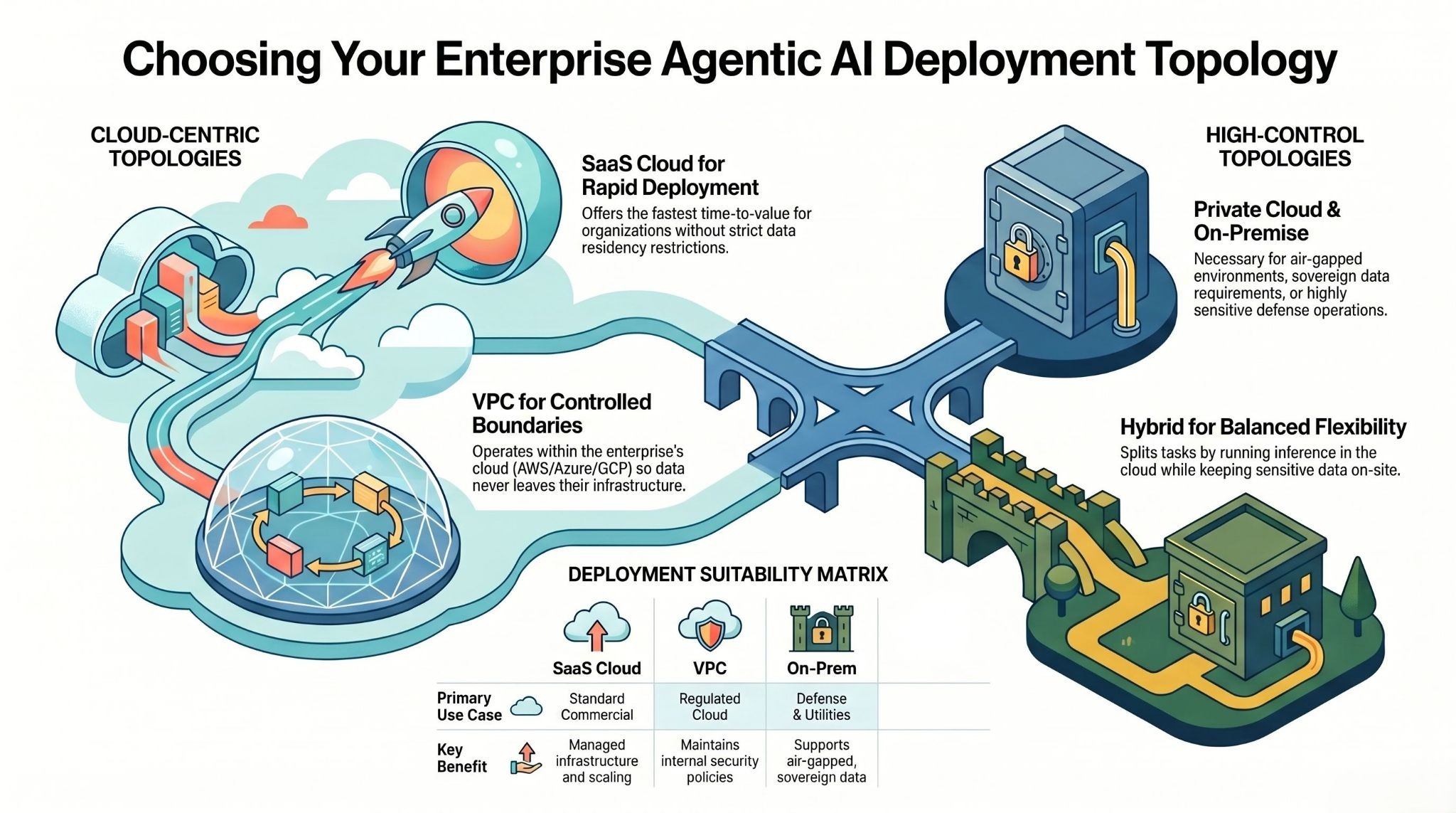
SaaS cloud deployment offers the fastest time-to-value for organisations without strict data residency requirements. Infrastructure management, model updates, and scaling are handled by the platform. Appropriate for most commercial deployments where data can reside in a cloud environment.
VPC deployment runs the platform within the enterprise's own cloud environment — AWS, Azure, or GCP — with data never leaving the enterprise's infrastructure boundary. Appropriate for organisations with data residency requirements, cloud security policies, or regulatory constraints that prohibit external data transfer.
Private cloud and on-premise deployment runs the full platform stack within the enterprise's own data centre infrastructure. Required for air-gapped environments, sovereign data requirements, or industries where regulatory frameworks prohibit cloud deployment of systems handling sensitive operational data. Energy utilities, defence-adjacent operations, and certain financial services environments fall into this category.
Hybrid topology splits responsibilities between deployment environments — typically running inference and agent orchestration in a cloud or VPC environment while maintaining sensitive data stores on-premise. This provides a balance between operational flexibility and data sovereignty that many regulated enterprises find practical.
The deployment decision should be driven by data residency requirements, compliance framework, operational risk tolerance, and IT infrastructure capability — not by cost alone. The cheapest deployment option that does not meet compliance requirements is not actually cheaper.
The Intelligence Maturity Model: Where Agentic AI Fits in the Enterprise Journey
Understanding where agentic AI sits in the broader enterprise intelligence journey helps organisations set realistic expectations for what they are building toward — and design their architecture to support the full progression rather than optimising for a single level.
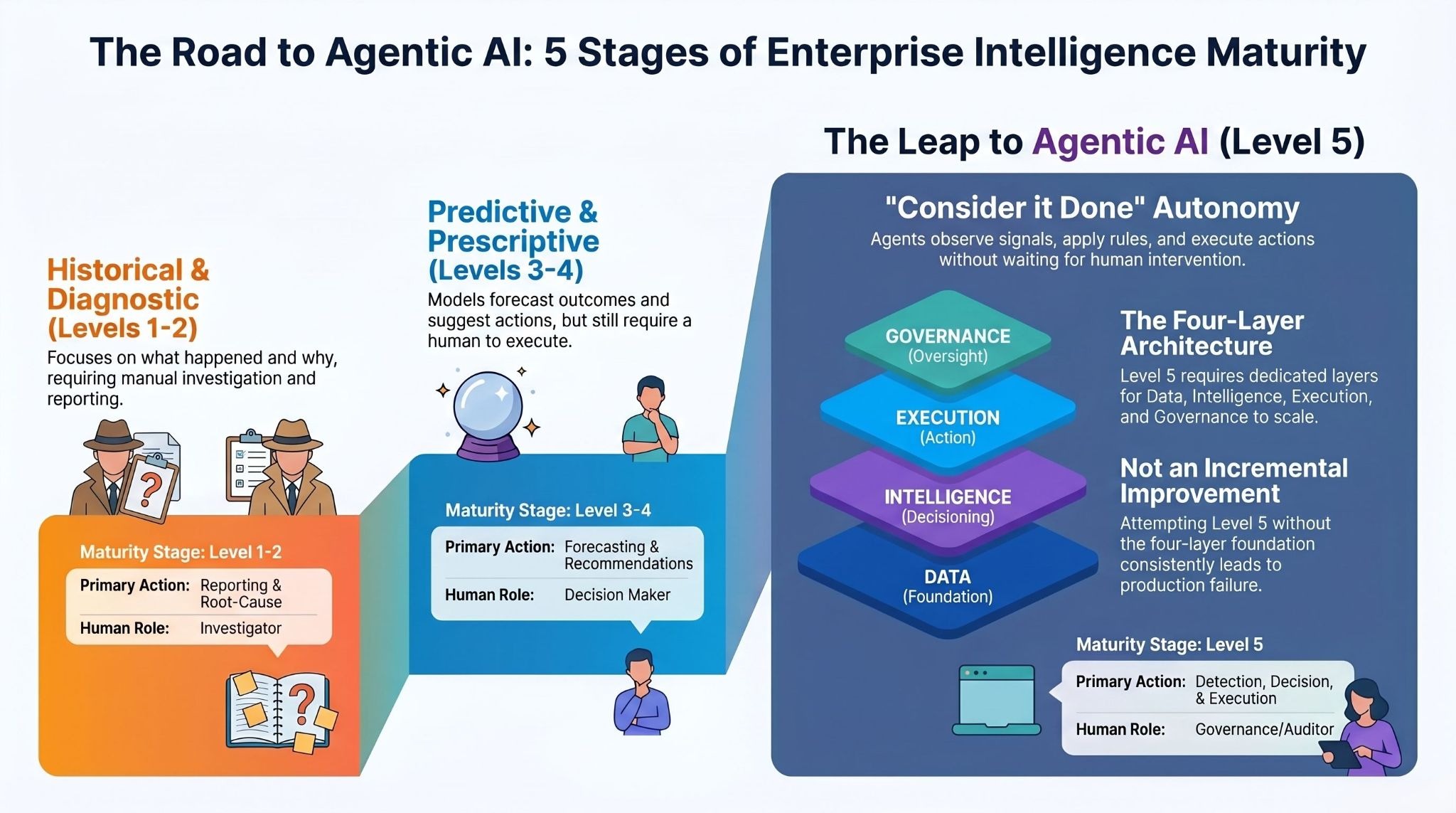
Level 1 — Descriptive: What happened? Historical reporting and dashboards. Most enterprise environments are here today for most of their operational data.
Level 2 — Diagnostic: Why did it happen? Root-cause analysis still requiring manual investigation. Analysts pulling data, building queries, and interpreting results.
Level 3 — Predictive: What is likely to happen? Forecasting likely outcomes from signal patterns. Machine learning models surfacing predictions for human review.
Level 4 — Prescriptive: What should we do? Recommended next actions still requiring manual execution. The human reads the recommendation and decides whether to act.
Level 5 — Agentic: Consider it done. Detection, decision, execution, and the audit chain are completed with governance controls. The agent observes the signal, applies the rules, takes the action, and documents everything — without waiting to be asked.
The jump from Level 4 to Level 5 is not an incremental improvement. It requires the full four-layer architecture described in this guide. Organisations that attempt to reach Level 5 by adding autonomy to a Level 3 or Level 4 system — without building the Data, Intelligence, Execution, and Governance layers underneath — consistently fail to reach production scale.
Real-World Enterprise Agentic AI Architecture in Production
The following deployments represent production-grade implementations across different industries. Client names are not disclosed; industry verticals and outcomes are drawn from verified deployments.
Global Logistics and Ports Operation
A ports and logistics operator with multi-billion dollar annual revenue deployed agentic AI across terminal management, rail scheduling, and inland logistics coordination. The architecture challenge was coordinating three operationally distinct systems — each with its own data model, update cadence, and workflow logic — into a unified execution environment where agents could manage the full shipment lifecycle.
The Data Layer resolved entity conflicts between the port management system, rail scheduling platform, and inland delivery tracker. The Intelligence Layer encoded exception classification logic for each segment of the journey. The Execution Layer managed automated status updates, exception routing, and escalation workflows. The Governance Layer maintained the audit trail required for customer SLA reporting and internal operational review.
Outcomes: Improved operational visibility across terminal-to-rail throughput. Higher predictability in exception detection and response. Faster coordination across previously siloed operational teams.
National Retail Chain — Store Intelligence at Scale
A national retailer operating hundreds of stores across a large geography deployed AI agents for store-level inventory intelligence, training support, and operational helpdesk automation. The scale challenge was operating agents consistently across a large, geographically distributed operation with significant variation in store size, category mix, and operational maturity.
The Data Layer unified POS data, inventory management records, promotional calendars, and supplier lead-time data into a single context foundation per store. The Intelligence Layer encoded pricing rules, MRP thresholds, and promotional eligibility logic. The Execution Layer managed inventory alerts, training queries from store staff, and operational issue triage — with escalation to regional management for exceptions outside defined parameters.
Outcomes: Reduced manual helpdesk burden. Improved store-level inventory visibility. Faster onboarding for new store staff via on-demand training guidance. Consistent operational support across a geographically distributed estate.
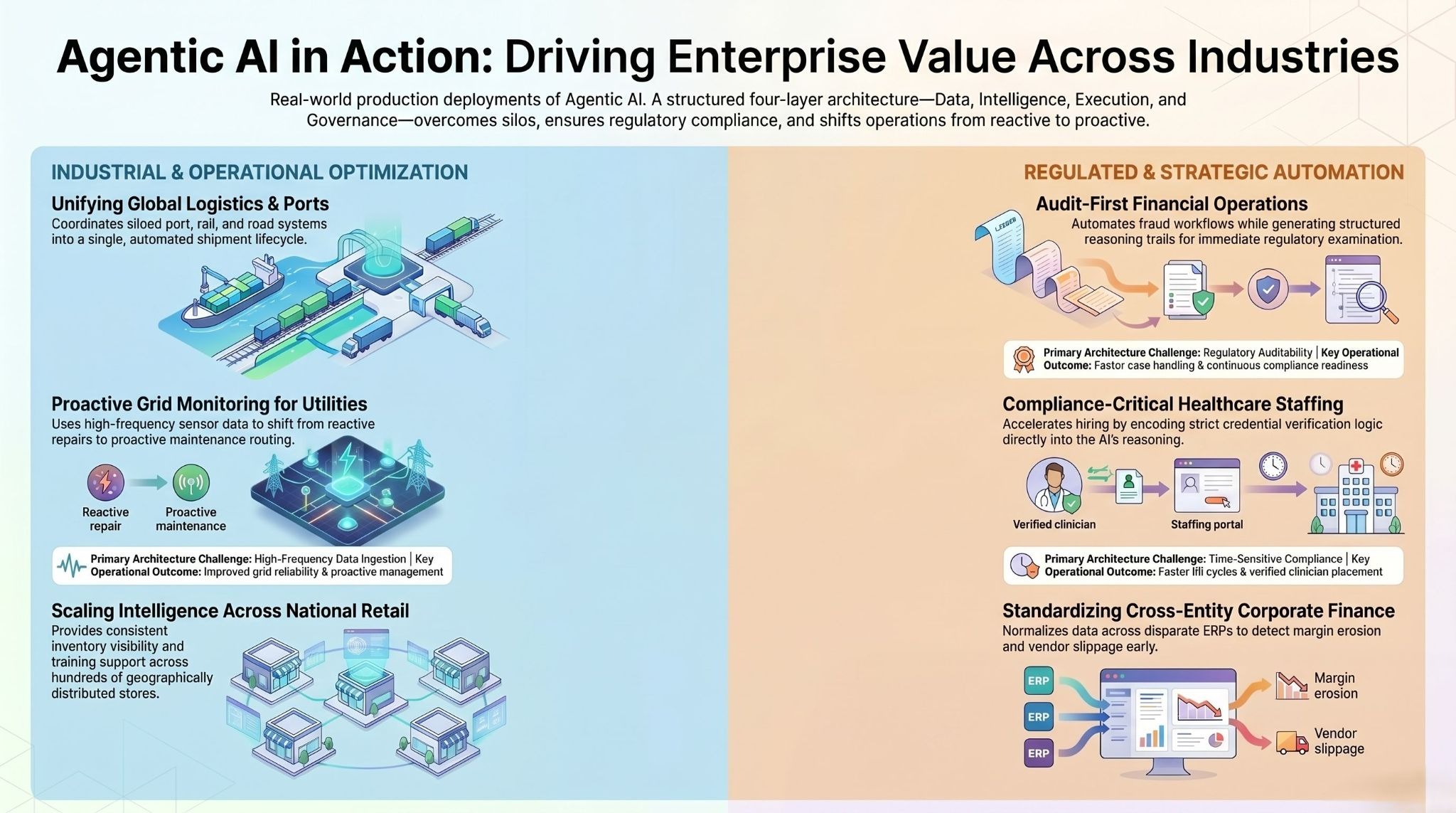
State Power Transmission Utility
A state-level power transmission utility deployed agentic AI for grid operations monitoring, predictive maintenance, and field operations coordination. The architecture challenge was ingesting high-frequency sensor data from thousands of transmission assets, applying threshold logic specific to each asset type and operating condition, and routing field operations tasks to the appropriate teams with context pre-populated.
The Data Layer handled sensor data ingestion, normalisation, and anomaly pre-processing at operational frequency. The Intelligence Layer encoded the threshold rules for each asset category, the anomaly classification logic, and the escalation criteria for different fault types. The Execution Layer routed alerts and work orders to field operations teams automatically. The Governance Layer maintained the operational logs required for regulatory reporting and incident review.
Outcomes: Faster identification of grid exceptions. Improved reliability through proactive monitoring. Better operational transparency for leadership. Shift from reactive incident response to proactive operational management.
Financial Services — Banking Operations
A fintech platform serving banks and credit unions deployed omnichannel AI agents for customer dispute handling, fraud workflow support, and compliance operations. The architecture challenge was operating in a regulatory environment where every agent decision affecting a customer account required a documented, auditable reasoning trail.
The Governance Layer was the architectural priority — designed before the execution logic — because compliance evidence was a non-negotiable operational requirement. Every agent action in the dispute and fraud workflows generated a structured audit record that could be surfaced for regulatory examination without manual log reconstruction.
The Execution Layer managed omnichannel intake (chat, email, phone), case classification, agent-assist summarisation for human reviewers, and automated resolution for cases within defined parameters. Human-in-the-loop controls remained at Level 2 for all customer-account write actions.
Outcomes: Faster case handling. Reduced operational load through automation of routine case types. Improved compliance readiness through continuous audit trail generation.
Healthcare Staffing Platform
A healthcare staffing platform connecting nursing professionals with healthcare facilities deployed AI agents for talent matching, scheduling coordination, and compliance management. The architecture challenge was operating workflows that were both time-sensitive (facilities needed to fill shifts quickly) and compliance-critical (every placed clinician required verified credentials before placement).
The Intelligence Layer encoded the credential verification logic — the specific requirements for each facility type, care setting, and clinical role — as non-negotiable rules in the reasoning chain. The Execution Layer managed facility staffing requests, candidate matching, scheduling notifications, and compliance confirmation workflows. The Governance Layer maintained credential status and produced the compliance documentation required by each facility.
Outcomes: Faster fill cycles. Lower scheduling friction. Better workforce utilisation. Improved staffing responsiveness for facilities across the network.
Enterprise Group — Cross-Entity Finance and Procurement Automation
A diversified enterprise group operating multiple business entities deployed agentic AI for group-wide finance and procurement intelligence. The architecture challenge was standardising KPI definitions, data models, and reporting logic across entities with different ERP instances, chart of accounts structures, and operational cadences — so that agents could produce consistent, comparable intelligence across the group.
The Data Layer built entity-level connectors for each business unit's core systems, with normalisation logic that resolved definitional differences between entities. The Intelligence Layer encoded the group-level business rules — purchase price variance thresholds, gross margin impact calculations, early payment analysis logic, vendor performance criteria. The Governance Layer automated the production of scheduled intelligence packs for group leadership.
Outcomes: Earlier detection of margin erosion and vendor slippage. Standardised finance and procurement intelligence across entities. Reduced variance surprises through continuous monitoring. Consistent decision support for group leadership without requiring manual report compilation.
Build vs Buy vs Partner: The Enterprise Architecture Decision Framework
Every enterprise deploying agentic AI faces a build-versus-buy-versus-partner decision that is more nuanced in 2026 than it was two years ago. The enterprise agentic platform market has matured significantly — but not uniformly. Some capabilities have clear market solutions. Others remain early-stage or bespoke.
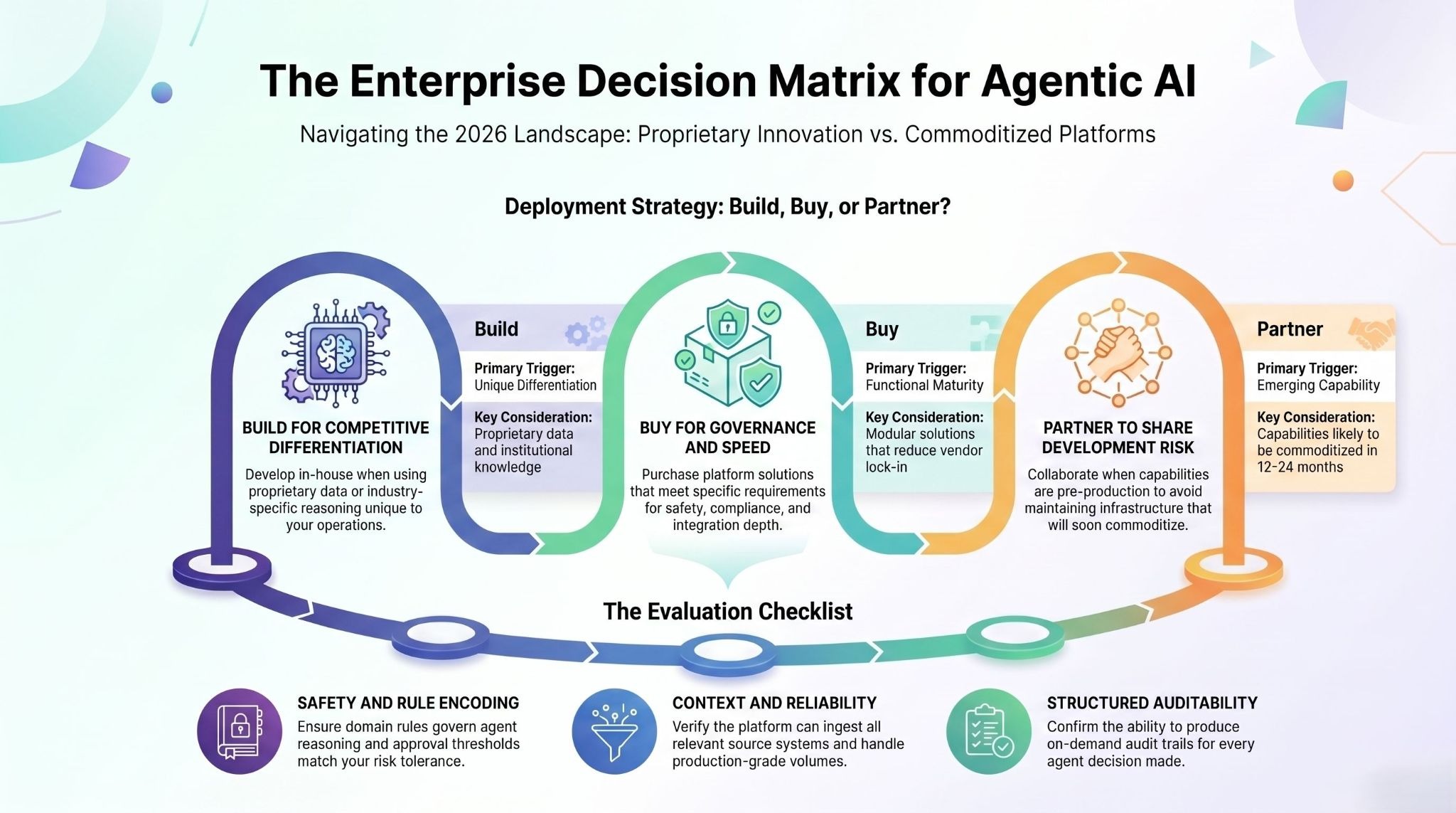
Build when the capability represents genuine competitive differentiation that cannot be replicated by a platform solution — for example, proprietary data models, industry-specific reasoning logic unique to your operation, or agent behaviour that reflects institutional knowledge that cannot be externally sourced.
Buy when a platform solution exists that meets your requirements for functionality, governance, integration depth, and deployment flexibility. Evaluate on: context coverage across your specific source systems, rule encoding quality for your compliance framework, action safety model and approval controls, auditability and evidence export capability, and operational reliability under production load. Prioritise modular, interoperable solutions that reduce vendor lock-in risk as the market continues to evolve.
Partner when the capability you need is not yet available as a production-ready commercial product, but building it entirely in-house would require you to maintain infrastructure that is likely to be commoditised within 12–24 months. Partnering with a platform provider building toward your required capability lets you share development risk while remaining aligned with market direction.
The practical checklist for platform evaluation — regardless of build/buy/partner — covers five dimensions:
- Context coverage: Can the platform ingest and correlate all the source systems relevant to your workflows?
- Rule encoding quality: Can your domain rules and compliance constraints be encoded in a form that governs agent reasoning reliably?
- Action safety model: Are approval thresholds, autonomy levels, and exception handling configurable to your risk tolerance?
- Auditability: Can you produce a structured audit trail for any agent decision, on demand, without manual log reconstruction?
- Operational reliability: Has the platform demonstrated production-grade reliability at the transaction volumes your deployment requires?
Measuring ROI: What Enterprise Agentic AI Architecture Delivers
Return on investment from enterprise agentic AI architecture accrues across three categories: operational efficiency, revenue impact, and risk reduction. The specific metrics vary by deployment — but the pattern across production deployments is consistent.
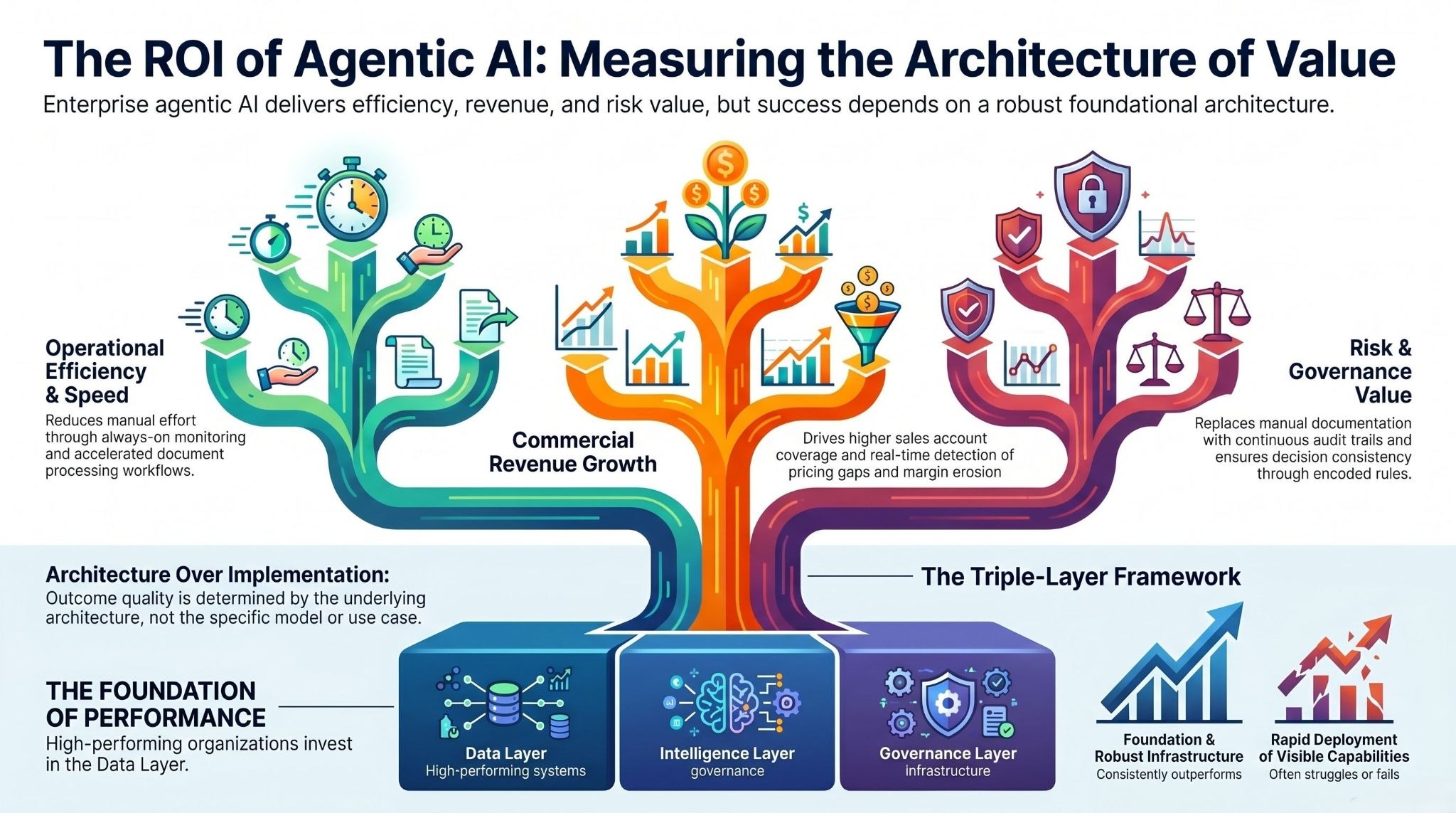
Operational efficiency metrics capture the reduction in manual effort, the acceleration of cycle times, and the improvement in throughput that agentic automation produces. Representative outcomes from production deployments include: significant reductions in manual monitoring effort through always-on agent coverage; faster document processing in tender and contract workflows; faster exception detection and response in operations-heavy environments; and reduced analyst dependency for recurring reporting and insight generation tasks.
Revenue impact metrics capture the commercial value generated by faster, better-informed decisions. Outcomes include: higher account coverage in sales environments without headcount increases; faster order-to-confirm cycles with fewer data entry errors; improved portfolio visibility leading to faster risk identification; and earlier detection of pricing gaps and margin erosion that would previously have been identified in quarterly reviews rather than in real time.
Risk reduction metrics capture the compliance, audit, and operational risk value of governance-embedded architecture. Outcomes include: continuous audit trail generation replacing manual documentation processes; faster regulatory examination readiness; reduced post-deployment surprises through proactive exception alerting; and improved decision consistency through encoded rule governance replacing ad-hoc human judgment.
When evaluating ROI projections, the variable that most determines outcome quality is not the model or the use case — it is the quality of the architecture underneath. Organisations that invest properly in the Data Layer, the Intelligence Layer governance model, and the Governance Layer infrastructure consistently outperform those that optimise for rapid deployment of visible agent capabilities over robust foundational infrastructure.
Common Architecture Mistakes and How to Avoid Them
The following mistakes appear consistently across enterprise agentic AI programmes that stall or fail after initial deployment. Each is avoidable with deliberate architectural decisions made before deployment rather than during recovery.

Treating governance as a later-phase concern. The most common and most costly mistake. Governance requirements in regulated industries are not additive — they are structural. Building governance after deployment requires rewriting core execution logic, not adding a logging layer.
Underinvesting in the Data Layer. Agent quality is bounded by context quality. Organisations that attempt to shortcut entity resolution and semantic correlation consistently find that their agents make confident, well-reasoned decisions based on incomplete or inconsistent data.
Deploying at full autonomy before establishing governance confidence. Moving directly to Level 4–5 autonomy without the performance evidence that justifies it is the fastest path to a trust-breaking incident that resets the programme.
Building agent workflows that skip the Intelligence Layer. Agents that reason directly over raw data without a semantic governance layer produce inconsistent outputs on edge cases. Encoding business rules explicitly is slower than skipping it and more important than any other single architectural decision.
Choosing frameworks before defining architecture. LangGraph, CrewAI, and other orchestration frameworks are execution tools, not architecture. Starting with framework selection before defining data, intelligence, execution, and governance requirements produces a technically functional system built on an architecturally wrong foundation.
Publishing content outside the AI agent topic cluster — and the equivalent in architecture: adding capabilities to an agentic platform that are disconnected from its core execution model. Coherent, focused architecture compounds value. Fragmented architecture accumulates technical debt.
Next Steps: Architecting Your Enterprise Agentic AI Platform
Enterprise agentic AI architecture is not a technology procurement decision. It is a strategic infrastructure decision that determines the ceiling of everything your AI programme can achieve.
The organisations deploying at production scale today — across logistics, retail, energy, financial services, and healthcare — share one architectural characteristic: they built the governance layer first, the data layer with discipline, and graduated autonomy on the basis of evidence rather than optimism.
The four-layer model described in this guide — Data, Intelligence, Execution, Governance — is the architecture that assistents.ai is built on. Every layer is independently evaluable, deployable in stages, and designed to compose into a production-grade execution pipeline that can operate at enterprise scale in regulated environments.
If you are in the design phase of an enterprise agentic AI programme, the most valuable first step is a technical architecture session that maps your specific data sources, business rule requirements, execution boundaries, and governance requirements to a concrete pilot design — before any implementation decisions are made.
Schedule a technical architecture review with assistents.ai to map your data sources, rule logic, and execution boundaries to a production-ready design.
Explore the full platform architecture to review how the Data Layer, Intelligence Layer, Execution Layer, and Governance Layer work together.
Review the enterprise AI buyer's guide for the evaluation checklist used by enterprise architecture and governance teams in platform selection.
Frequently Asked Questions
What is enterprise agentic AI platform architecture?
Enterprise agentic AI platform architecture is the structural framework that allows AI agents to operate autonomously, coordinate with other agents and human teams, integrate with enterprise systems, take governed actions, and remain fully auditable within a production environment. It comprises four core layers — Data, Intelligence, Execution, and Governance — each with distinct responsibilities that compose into a single execution pipeline.
How is agentic AI different from traditional enterprise AI?
Traditional enterprise AI is reactive: it responds to queries, surfaces recommendations, and requires a human to take action. Agentic AI is proactive: it detects conditions, reasons over context, makes decisions, and executes actions autonomously within defined governance boundaries. The architectural requirements for agentic systems are fundamentally different — requiring shared memory, multi-agent orchestration, governed execution, and continuous audit trail generation that static AI pipelines were never designed to support.
What are the four layers of an enterprise agentic AI platform?
The four layers are: the Data Layer (ingesting, normalising, and correlating structured and unstructured context from all relevant enterprise systems); the Intelligence Layer (applying deterministic business rules and rule-aware reasoning to agent decisions); the Execution Layer (routing and executing actions with configurable autonomy controls and approval thresholds); and the Governance Layer (auditing, monitoring, authorising, and producing compliance evidence for every agent action).
What is human-in-the-loop (HITL) in agentic AI?
Human-in-the-loop controls are architectural mechanisms that determine which agent actions are executed autonomously and which require human review or approval before execution. They are configured by action type, value threshold, confidence level, and exception condition. HITL controls are not a temporary limitation — they are a permanent feature of responsible enterprise agentic architecture, particularly for high-stakes financial, compliance, or customer-facing actions.
How do AI agents integrate with ERP and CRM systems?
AI agents integrate with ERP systems (SAP, Oracle) and CRM systems through secure API connectors with least-privilege access controls. Read operations — querying current inventory, checking account status, reviewing purchase order history — carry minimal risk. Write operations — creating sales orders, updating customer records, submitting procurement requests — require validation logic and approval controls within the Execution Layer before execution.
What industries are deploying enterprise agentic AI at scale?
Production-scale enterprise agentic AI deployments are operating across financial services (banking, fintech, insurance), logistics and supply chain, retail and e-commerce, energy and utilities, healthcare and life sciences, real estate and property management, manufacturing, and professional services. Each vertical has distinct data integration requirements, compliance frameworks, and autonomy threshold criteria — but the four-layer architecture model applies consistently across all of them.
What is MCP (Model Context Protocol) and why does it matter for enterprise agentic AI?
MCP (Model Context Protocol), developed by Anthropic, has become the de facto open standard for agent-to-tool integration in enterprise agentic systems. It provides a structured, auditable mechanism for agents to discover and invoke tools, APIs, and data sources — enabling interoperability between agents and the enterprise systems they need to access. MCP is important because it standardises the integration layer in a way that supports governance and auditability, rather than requiring custom integration logic for every tool an agent uses.
How do you measure ROI of enterprise agentic AI architecture?
ROI accrues across three categories: operational efficiency (reduced manual effort, faster cycle times, improved throughput), revenue impact (faster decision-making, higher account coverage, earlier risk identification), and risk reduction (continuous compliance documentation, reduced audit preparation cost, improved decision consistency). The most important variable determining ROI quality is the robustness of the underlying architecture — not the choice of model or use case.
Is enterprise agentic AI safe to deploy at scale?
Yes — when the architecture includes embedded governance controls. Agents operating within a well-designed four-layer architecture that includes encoded business rules, configurable autonomy thresholds, HITL approval controls for high-stakes actions, and continuous audit trail generation can be safely deployed at production scale in regulated industries including banking, healthcare, and energy utilities. The risk in enterprise agentic AI is not from the technology — it is from architecture that lacks governance controls.

Transform Your Business With Agentic Automation
Agentic automation is the rising star posied to overtake RPA and bring about a new wave of intelligent automation. Explore the core concepts of agentic automation, how it works, real-life examples and strategies for a successful implementation in this ebook.
Sarfraz Nawaz is the CEO and founder of Ampcome, which is at the forefront of Artificial Intelligence (AI) Development. Nawaz's passion for technology is matched by his commitment to creating solutions that drive real-world results. Under his leadership, Ampcome's team of talented engineers and developers craft innovative IT solutions that empower businesses to thrive in the ever-evolving technological landscape.Ampcome's success is a testament to Nawaz's dedication to excellence and his unwavering belief in the transformative power of technology.

More insights
Discover the latest trends, best practices, and expert opinions that can reshape your perspective







Contact us

