
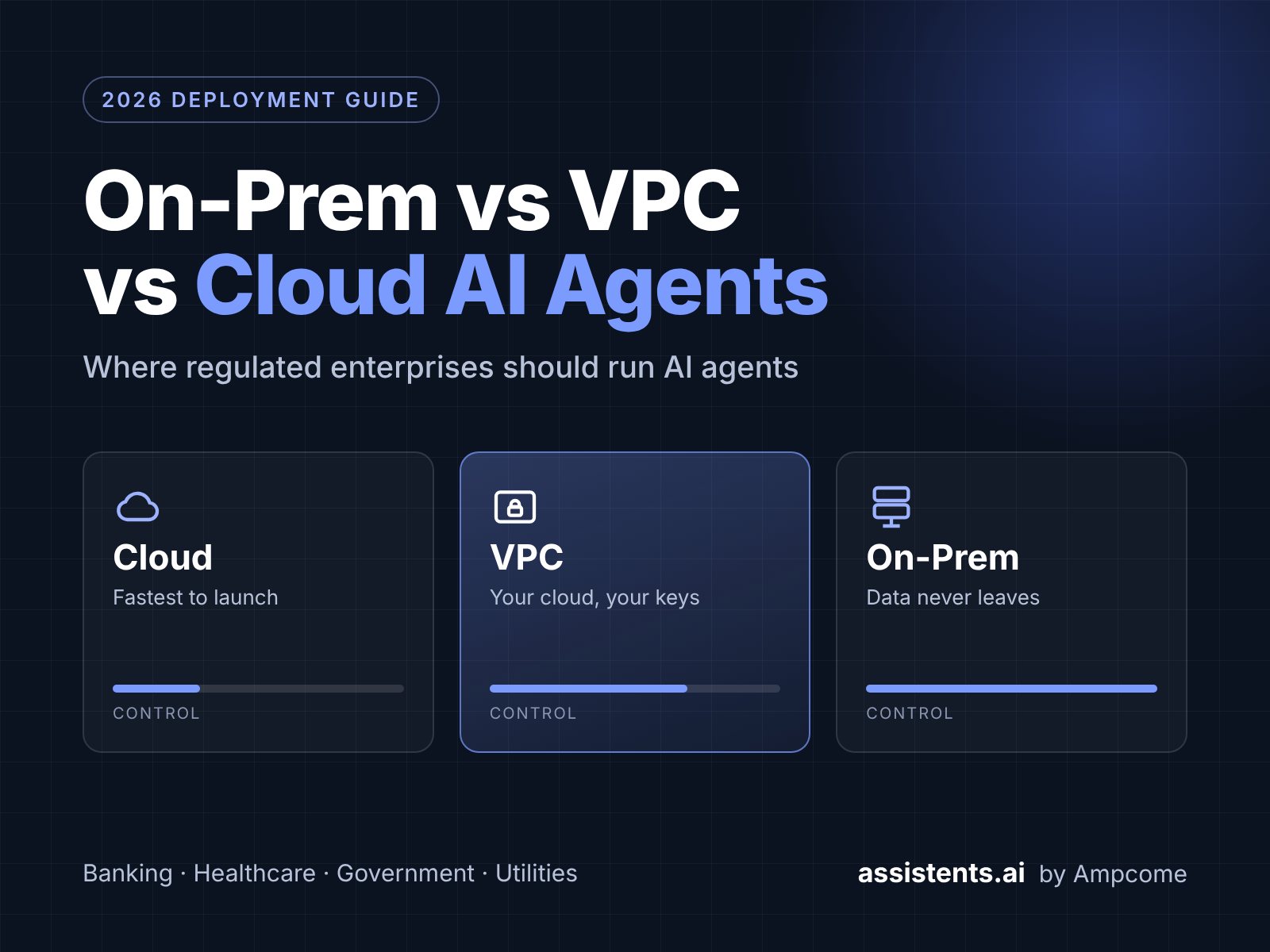
On-Prem vs VPC vs Cloud AI Agents: A Deployment Guide for Regulated Enterprises (2026)


Quick answer: In the on-prem vs VPC vs cloud AI agents decision, cloud fits public and internal data where speed matters most. A customer VPC fits most regulated workloads, because data stays in your own cloud account under your keys. On-prem and air-gapped fit data that legally or contractually cannot leave your network. Most regulated enterprises end up with a hybrid, split by workload.
AI agents don't just answer questions. They read your documents, query your warehouse, and write into your ERP, CRM and core banking systems. That changes the deployment question. With a chatbot, the risk is mostly about where data goes. With an agent, the risk is also about what it can do, from where, and who can prove it afterwards.
Enterprises are already moving. In Broadcom's Private Cloud Outlook 2026, 56% of organisations said they run or plan to run production AI inference on private cloud. Public cloud's share of those workloads fell from 56% to 41% in a year. At the same time, Gartner predicts that over 40% of agentic AI projects will be canceled by the end of 2027 because of rising costs, unclear business value or inadequate risk controls. Choosing the wrong deployment model contributes to all three.
This guide is for CIOs, CISOs, CDOs and enterprise architects in banking, insurance, healthcare, government, utilities and logistics.
Why deployment is a bigger decision for AI agents than for AI models
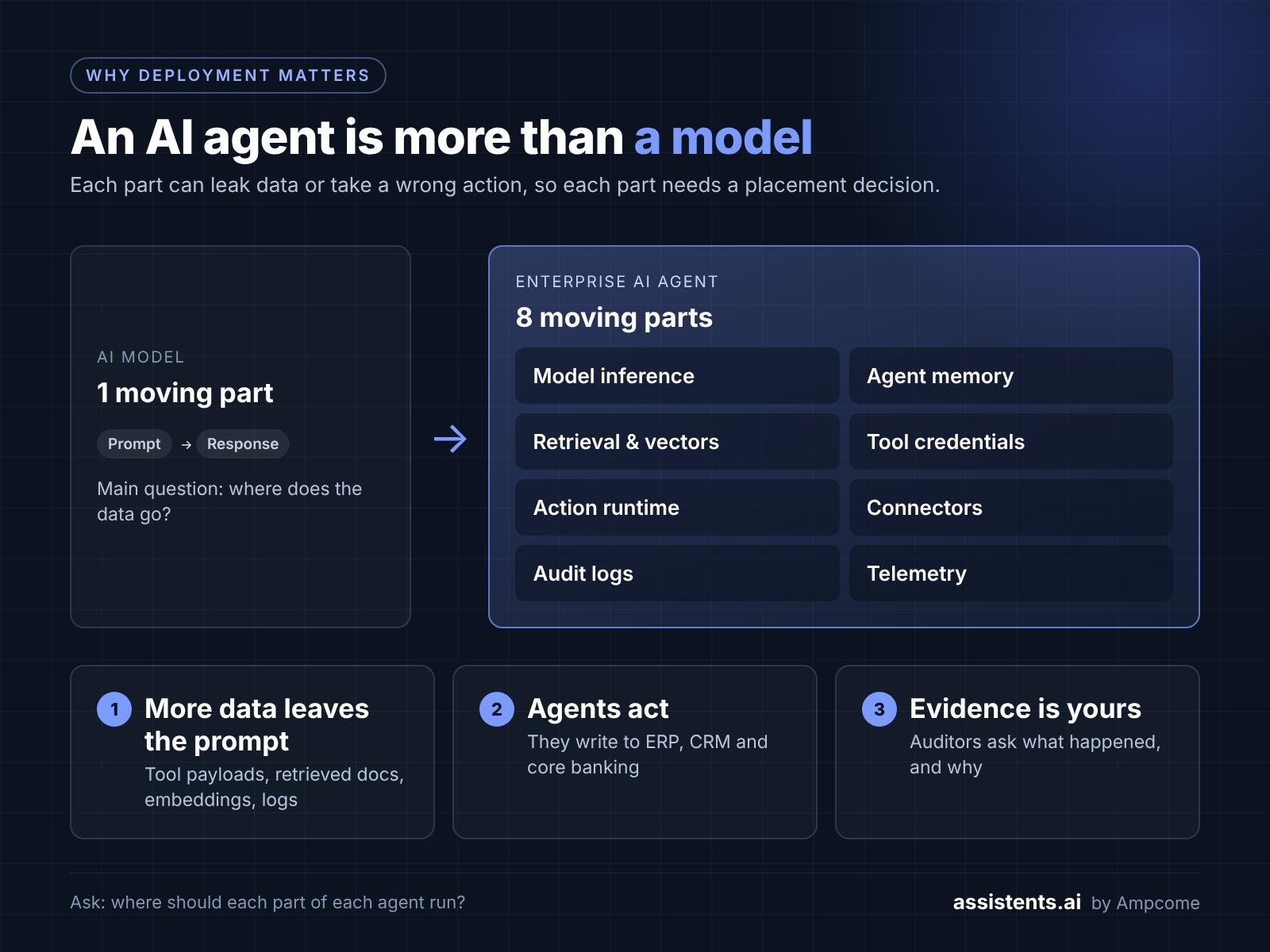
An AI agent has more moving parts than a model, and each one can leak data or take a wrong action. A model endpoint takes a prompt and returns text. An enterprise agent also keeps memory, holds tool credentials, retrieves documents, calls APIs, writes to systems of record and generates logs.
That matters for regulated enterprises in three ways:
- More data leaves the prompt. Agents send tool payloads, retrieved documents, embeddings and intermediate reasoning, not just a user question. Each of these is a data flow your regulator can ask about.
- Agents act. An agent that creates a sales order, approves a refund or updates a patient record has a blast radius. Where that action runs, and what checks it passes first, is a deployment decision.
- Evidence is yours to produce. When an auditor asks why an agent did something, you need the prompt, the context, the rule that applied, the approver and the result. If those logs sit in a vendor's cloud, you depend on the vendor to produce them.
So the useful question is not "cloud or on-prem?" It is "where should each part of each agent run?" The rest of this guide answers that.
If you're new to the topic, start with our primer on what on-premise AI is and our AI agent governance framework.
The AI agent deployment models, explained
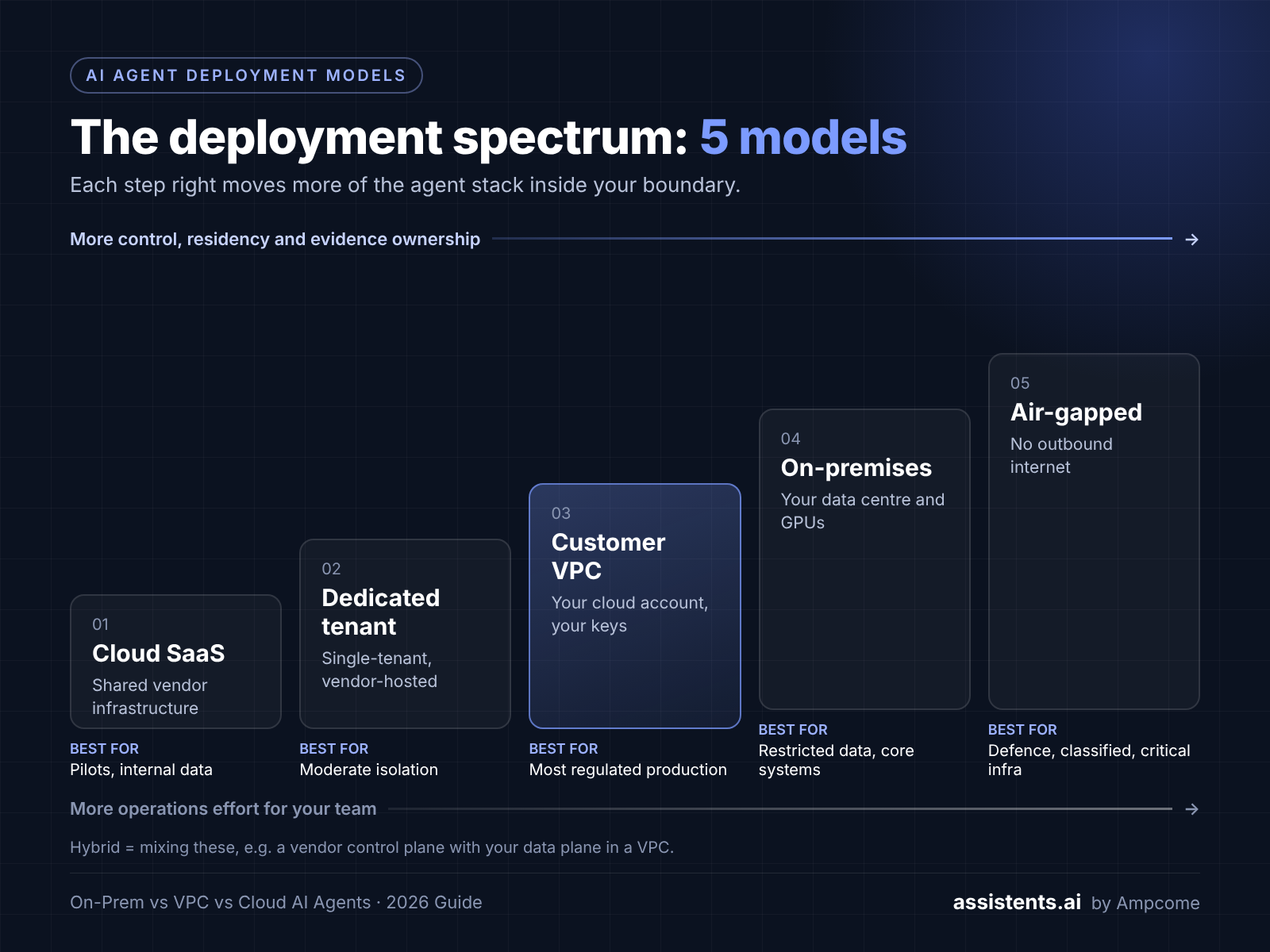
There are five AI agent deployment models, and they sit on a spectrum from most convenient to most controlled. Each step to the right moves more of the stack inside your boundary and asks more of your team.
Cloud (multi-tenant SaaS) AI agents
Cloud AI agents run on the vendor's infrastructure, shared with other customers and logically separated. You sign up, connect your systems and build. It is the fastest way to reach production and the easiest to scale.
Best for: public or internal data, pilots, and teams with no hard residency rules. Watch out for: where prompts, logs and embeddings are stored, whether the vendor trains on your data, and which countries data passes through.
Private cloud and VPC AI agents
A VPC (virtual private cloud) deployment runs the agent platform inside an isolated network in your own AWS, Azure or GCP account. This is sometimes called BYOC (bring your own cloud). Traffic stays off the public internet through private endpoints such as AWS PrivateLink or Azure Private Link, and data is encrypted with keys you manage.
Best for: most regulated production workloads. You keep cloud elasticity and managed GPUs while data rests in your account, in your chosen region. Watch out for: a "VPC" offer where the vendor's control plane still receives prompts or logs.
On-premise AI agents
On-premise AI agents run on hardware you own or lease, in your data centre or colocation facility. The whole stack, including models, retrieval, orchestration, governance and logs, sits inside your network perimeter. See how on-premise AI works on Assistents.ai.
Best for: data that a regulation or contract bars from leaving your network, steady high-volume inference, and agents that act on core systems. Watch out for: GPU capacity planning, patching and the in-house skills to run it.
Air-gapped AI agents
Air-gapped agents run on an on-prem network with no outbound internet at all. Models are self-hosted, dependencies are mirrored, and updates arrive through a controlled offline process.
Best for: defence, classified work and some critical infrastructure. Watch out for: you cannot call public LLM APIs or SaaS tools, so every model, connector and knowledge source must live inside the network.
Hybrid AI agent deployment
Hybrid deployments split agents, or parts of agents, across environments. The two common patterns are (1) a vendor-hosted control plane that manages configuration, with the data plane (inference, data, actions, logs) in your VPC or data centre, and (2) a split by workload, where sensitive agents run on-prem and low-risk ones in the cloud.
On-prem vs VPC vs cloud AI agents: side-by-side comparison
Cloud wins on speed, VPC on balance, and on-prem on control. Use this table to compare the three main options and air-gapped across the factors that come up in security review.
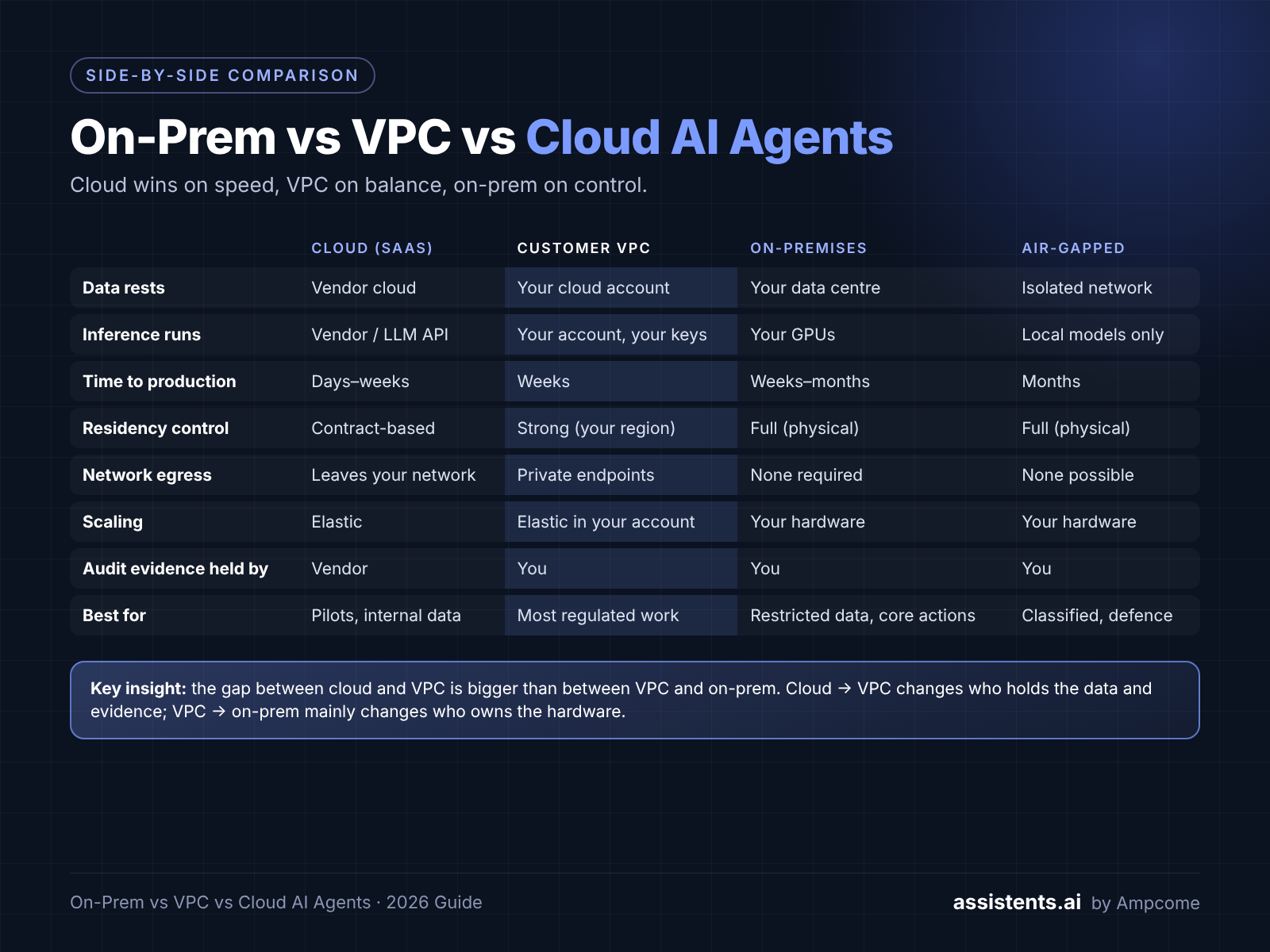
One takeaway stands out: the gap between cloud and VPC is larger than the gap between VPC and on-prem for most compliance questions. Moving from cloud to VPC changes who holds the data and the evidence. Moving from VPC to on-prem mainly changes who owns the hardware.
What actually runs where: the 8 parts of an enterprise AI agent
Deployment isn't one switch. An enterprise AI agent has eight parts, and each one can be placed separately. Most vendor pages talk about "where the model runs". For regulated enterprises, where the action runtime, memory and audit logs run matters just as much.
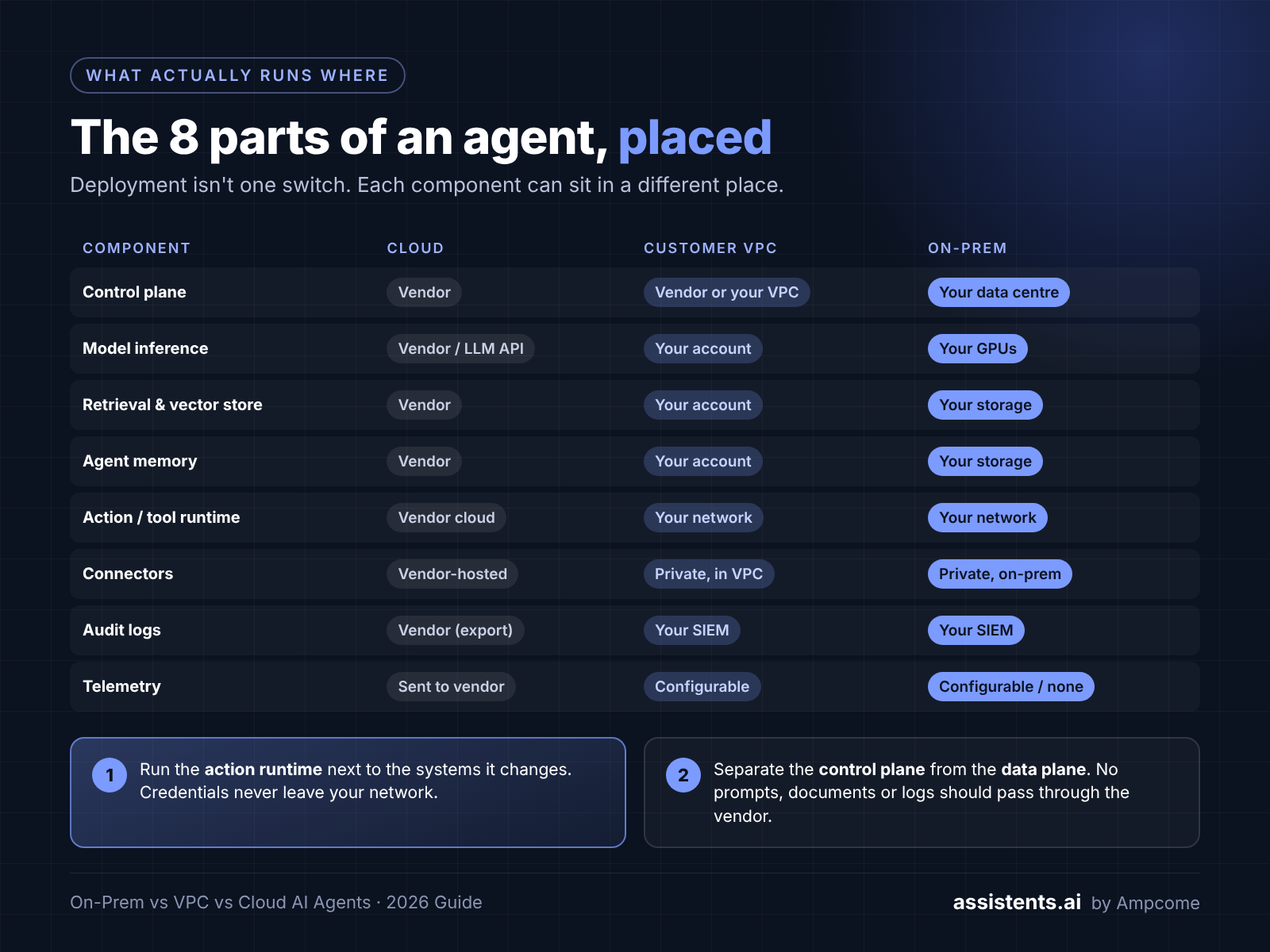
Two design rules come out of this table:
- Run the action runtime next to the systems it changes. If an agent writes to SAP or a core banking system, the credentials and the call should stay inside your network. That removes the need to open inbound paths from a vendor cloud.
- Separate the control plane from the data plane where needed. A vendor-managed control plane can be acceptable if no prompts, documents, actions or logs pass through it. Ask vendors to show this in a network diagram.
We cover connector patterns in depth in our AI agent integration architecture blueprint.
Agent-specific security risks and how each deployment mode handles them
Deployment location reduces exposure, but it doesn't stop an agent from taking a wrong action. Only deterministic controls between the model's reasoning and the action do that.
The OWASP Top 10 for Agentic Applications names risks that don't exist for a plain chatbot, including agent behaviour hijacking, tool misuse and identity and privilege abuse. Here is how deployment affects each one.
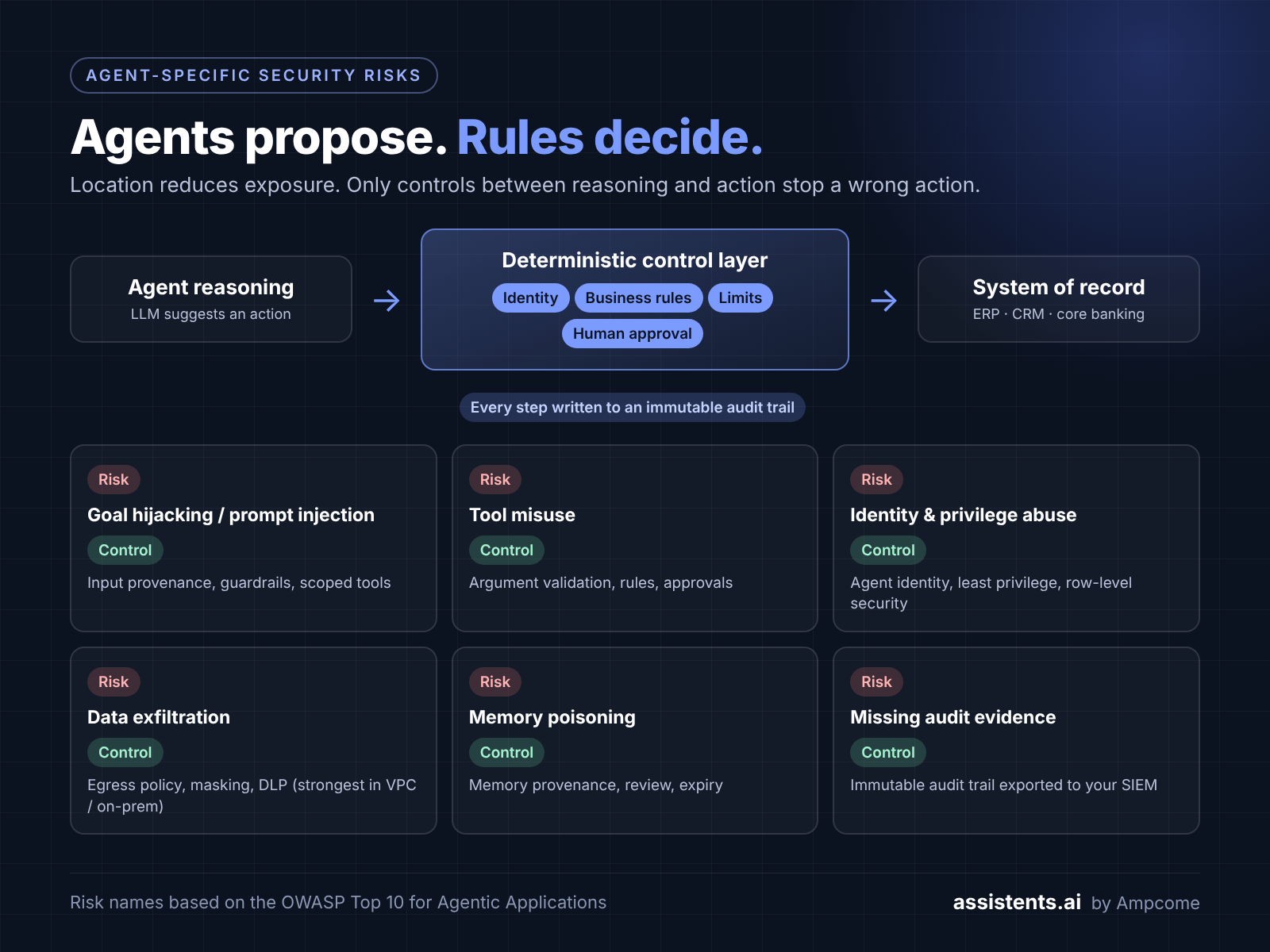
The pattern to look for is simple: agents propose, rules decide. The model can suggest an action, but a deterministic layer checks identity, business rules, limits and approvals before anything changes in a system of record. Align that lifecycle with the NIST AI Risk Management Framework so risk owners, evaluations and known limits are documented.
Compliance by industry and region
Few regulations name a hosting model, but many make on-prem or VPC the easiest way to comply. Rules on data transfer, outsourcing, operational resilience and audit evidence push sensitive agent workloads inside your boundary.
This section is general information, not legal advice. Confirm requirements with your compliance and legal teams.
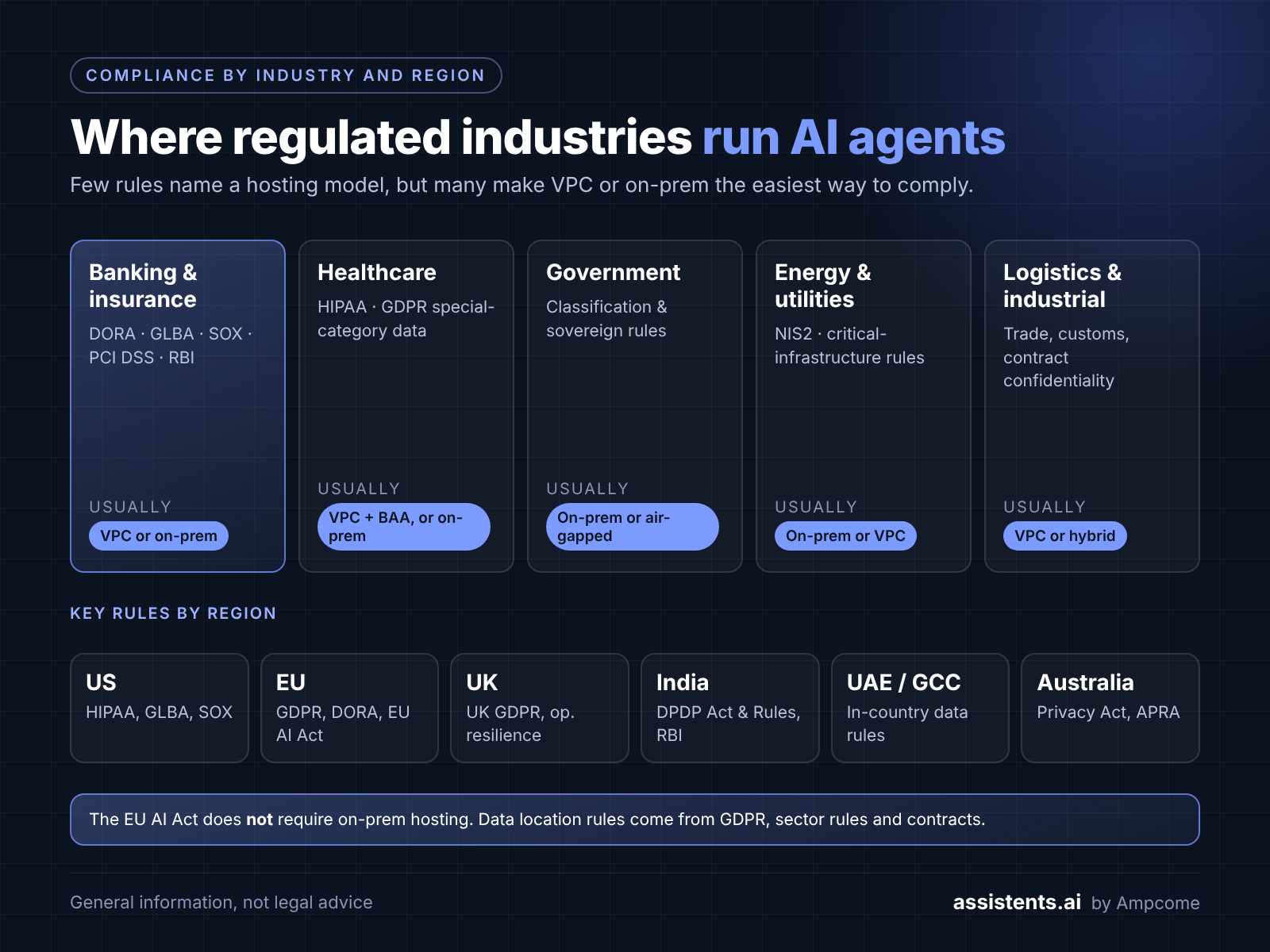
By region:
- United States: HIPAA for health data, GLBA and SOX for financial services, plus growing state privacy laws. Cloud and VPC are common with the right contracts.
- European Union: GDPR governs transfers of personal data, and DORA has applied to financial entities since 17 January 2025, including ICT third-party risk. The EU AI Act sets logging, transparency and human-oversight duties but does not require on-prem hosting.
- United Kingdom: UK GDPR and the regulators' operational resilience rules for financial services.
- India: The DPDP Rules, 2025 operationalise the DPDP Act 2023 in phases, with most substantive duties applying from May 2027. RBI expectations on outsourcing and data storage push banking agents toward VPC or on-prem.
- UAE and GCC: Federal and free-zone data protection laws, plus sector rules for banking, health and government, often favour in-country hosting.
- Australia: The Privacy Act and APRA's prudential standards for regulated financial entities.
Because rules differ by country and sector, a platform that can run the same agents in different modes is worth more than one that is strong in a single mode. Our guide to AI agents in banking and fintech goes deeper on financial services.
Cost and time to production: cloud vs VPC vs on-prem
Cloud is cheapest to start, on-prem is often cheapest at steady high volume, and VPC sits in between. The right answer depends on how much inference your agents use and how steady that use is.
Cost drivers by mode:
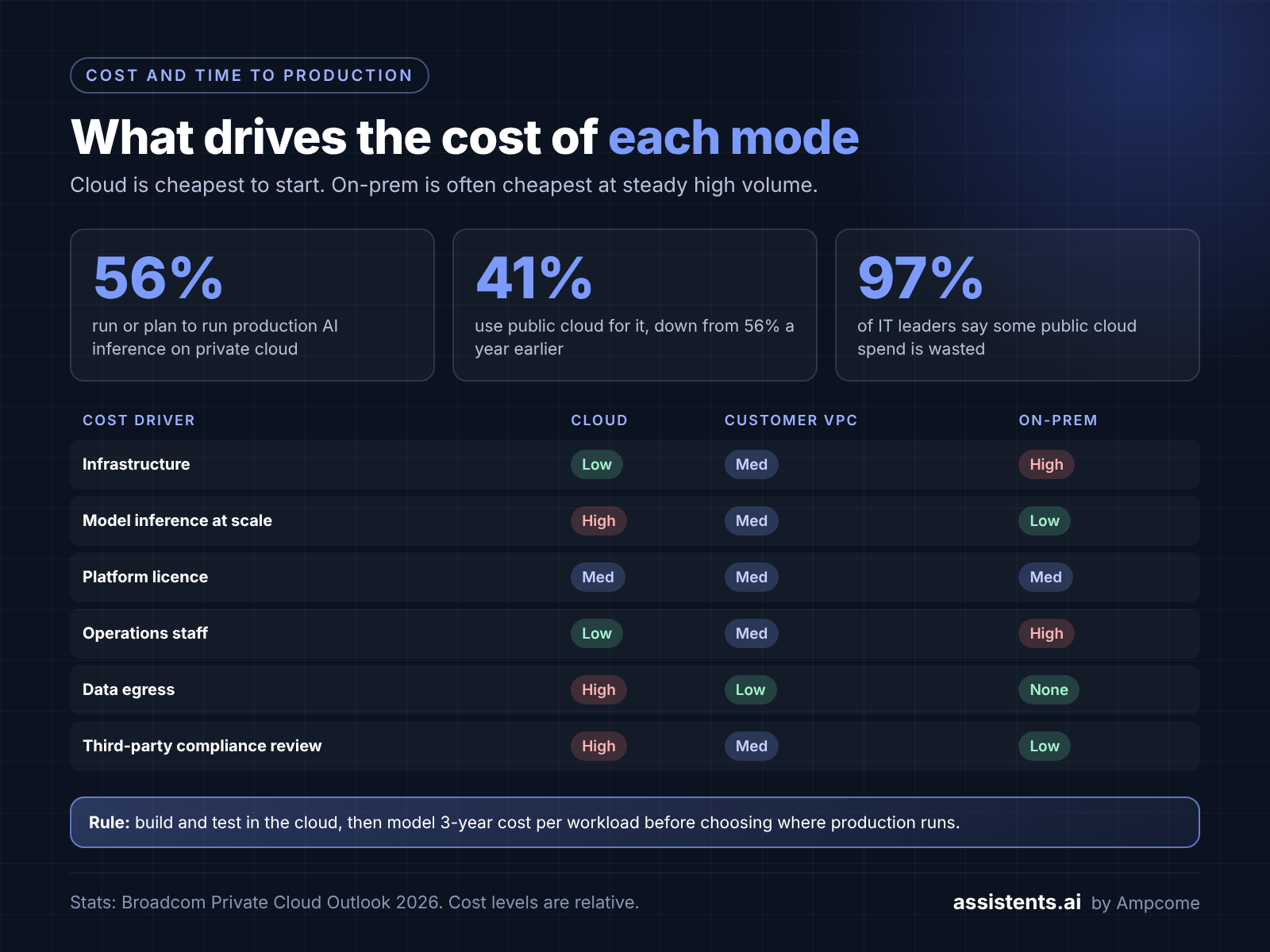
Cost is now a bigger worry than security for many IT leaders. In the same Broadcom survey, 97% of IT leaders said at least some of their public cloud spend is wasted. Agents make this sharper: one agent task can involve many model calls, retrievals and tool calls, so inference volume grows faster than user numbers.
Practical rule: build and test in the cloud, then model three-year cost per workload before choosing production placement. Include staff, egress and the time your security team spends on vendor reviews, not just compute.
For more on what drives AI agent budgets, see 65+ AI agent use cases and what they cost.
How to choose: a decision framework for regulated enterprises
Decide per workload, not per company. Answer six questions for each agent, then place it using the matrix below.
- What is the most sensitive data the agent touches? Public, internal, confidential, or regulated (PHI, PCI, KYC, classified)?
- Does a law, regulator or contract bar that data from leaving your network? If yes, go on-prem. If it must never touch the internet, go air-gapped.
- Does the agent write to systems of record? If it changes ERP, CRM, core banking or clinical records, keep the action runtime inside your network (VPC or on-prem).
- What latency does the workflow need? Real-time voice or control-room agents benefit from running close to data and users.
- Do you have the people to run infrastructure? If not, prefer VPC over on-prem, or use a vendor that operates the platform in your environment.
- Do you need your own model keys or local models? If yes, rule out options that lock you to the vendor's models.
Workload placement matrix (data sensitivity × action risk):
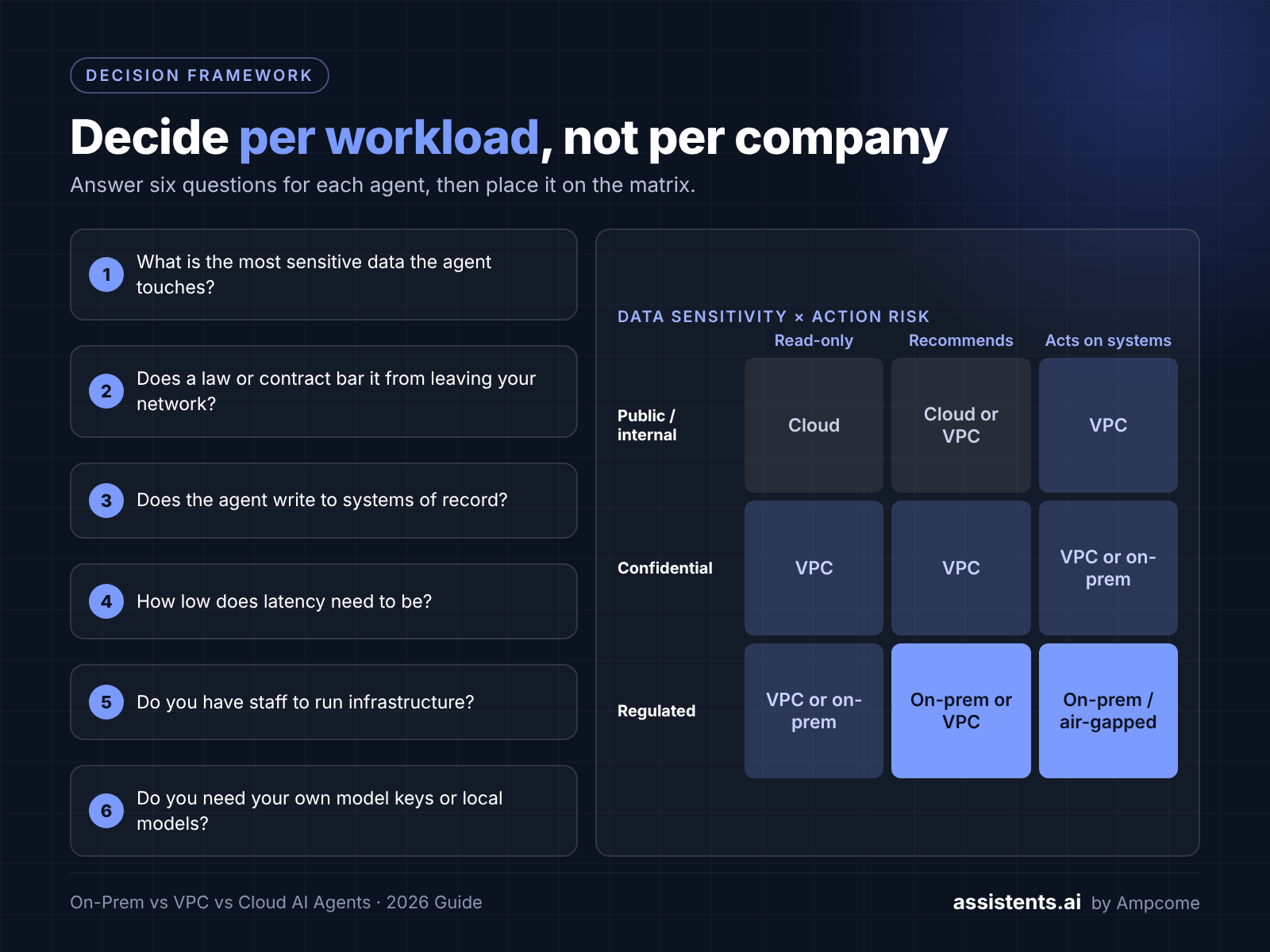
Most enterprises end up with several cells filled. That's why the platform should run the same agents, governance and audit model in every mode.
How Assistents.ai deploys AI agents in each mode
Assistents.ai by Ampcome runs the same agents, governance and audit model in private cloud, customer VPC and on-premises, including air-gapped environments. Moving a workload from VPC to on-prem is a redeployment, not a rebuild.
What stays the same in every mode:
- Containerised, Kubernetes-compatible services, so the same build runs in any environment.
- Customer-controlled model keys or local models, with model-agnostic routing so no single LLM becomes a dependency.
- Private connectors and action runtimes near source systems, plus 80+ workflow integrations, warehouse and BI connectors, and generic REST.
- Tenant isolation and customer-managed encryption keys.
- Governance at runtime: role-based access, row-level security, deterministic rules, human approvals and immutable audit trails, exported to your SIEM.
Security teams can review the controls on our AI agents for CISOs page.
Real deployments: how regulated enterprises run AI agents in production
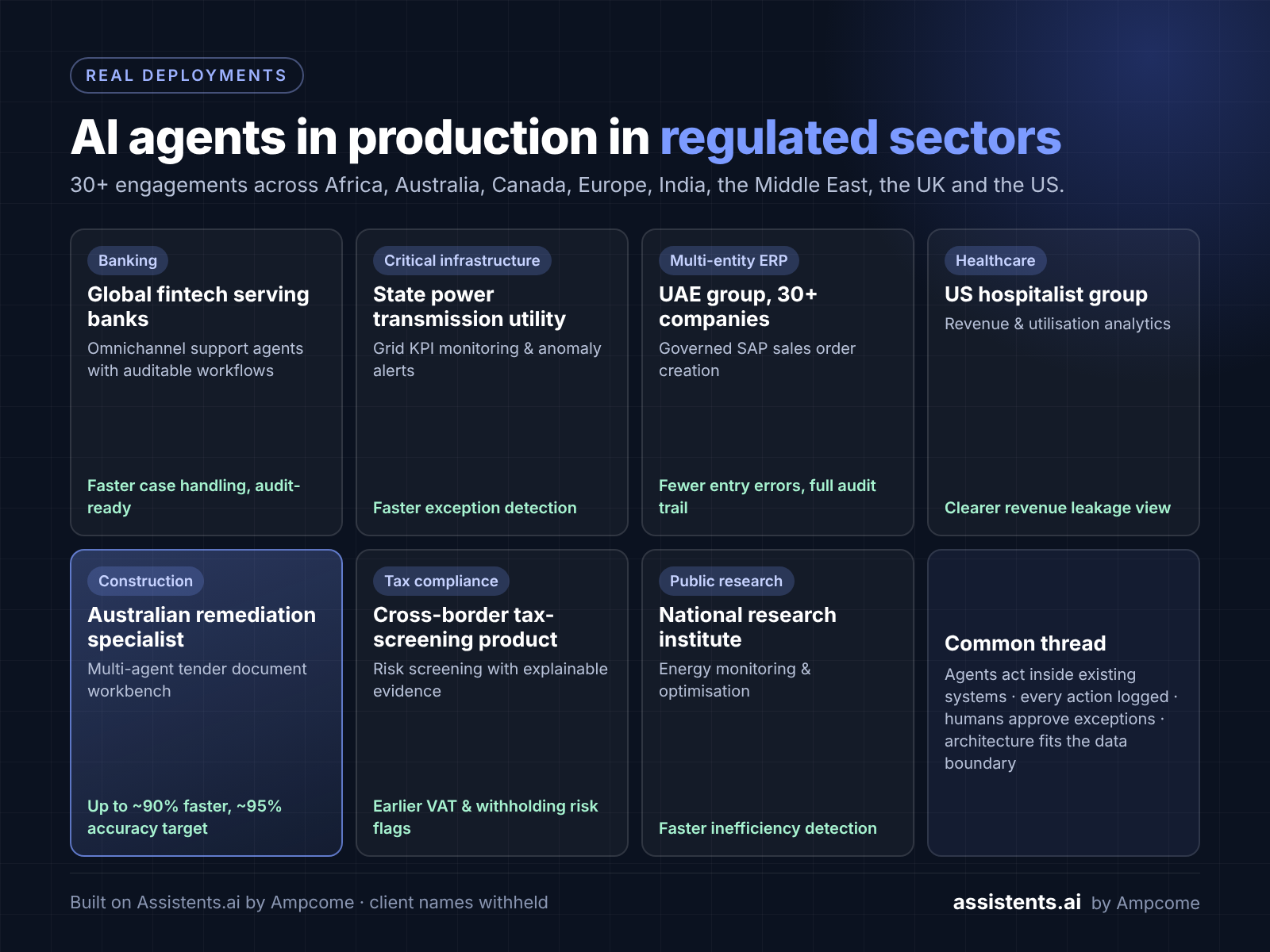
Ampcome has delivered 30+ AI agent and data engagements across Africa, Australia, Canada, Europe, India, the Middle East, the UK and the US on the Assistents.ai platform. The examples below come from sectors where data control, auditability and governed actions decided the architecture. Client names are withheld.
1. Banking support agents for a global fintech serving banks and credit unions
Context: A fintech provider delivering cloud-based automation for banks and credit unions needed help with disputes, fraud and compliance-heavy service work.
What we built: Omnichannel banking support agents across chat, email and phone, with workflow routing, agent-assist summaries, next-best actions and SLA monitoring. Every step is logged for audit, and the agents integrate with core systems.
Outcome: Faster case handling with more consistent results, lower operational load through automation, and better compliance readiness through complete audit trails.
2. Grid monitoring agents for a state power transmission utility in India
Context: A state-owned transmission utility had to keep power flowing reliably across its network. That is critical infrastructure, where operational data needs tight control.
What we built: Agentic analytics on top of smart utility systems: transmission KPI monitoring, anomaly detection, outage and loss analytics, predictive maintenance indicators, and automated alerts routed to field teams.
Outcome: Faster detection of grid exceptions and operational risks, more proactive grid operations, and better transparency for leadership.
3. Governed SAP order automation for a UAE group with 30+ companies
Context: One of the UAE's long-established family business groups needed to replace a costly, end-of-life document tool in its order process. The process ran across many entities and had strict audit needs.
What we built: Agents that read order triggers, validate them against business rules and create SAP sales orders, with exception approvals, audit logs and reconciliation reporting.
Outcome: Less manual order processing and less reliance on the legacy tool, a faster order-to-confirm cycle with fewer data-entry errors, and better auditability for every order and exception.
4. Revenue analytics for a US physician-led hospitalist group
Context: A physician-led clinical group running hospitalist programmes needed clearer revenue and operational insight. That meant working near protected health information.
What we built: A revenue and utilisation analytics model with performance dashboards, variance explanations and action lists for billing and operations.
Outcome: Better visibility into what drives revenue leakage, faster operational decisions through unified reporting, and more reliable performance tracking.
5. Tender document agents for an Australian remediation specialist
Context: A remediation and waterproofing specialist with 20+ years in the field handled complex tender documents where one missed revision can create bid risk.
What we built: A multi-agent document workbench: vision-LLM extraction from complex PDFs, tender retrieval, revision analysis, and full create-read-update-delete sync with the company's job management system, with quote locking and audit logs.
Outcome: Engineered for up to ~90% faster tender document processing and a ~95% extraction accuracy target on standard formats, with lower bid risk through change detection and auditability.
6. Cross-border tax screening with explainable evidence
Context: A tax-technology product needed to flag withholding tax, VAT mismatches and permanent-establishment risk early in cross-border deals.
What we built: Transaction screening workflows with risk classification, evidence collection, explainability notes and escalation to tax experts.
Outcome: Earlier detection of withholding and VAT risk, fewer last-minute deal disruptions, and faster, more consistent pre-compliance review.
7. Energy optimisation agents for a national research institute
Context: A premier astronomy and astrophysics research institute needed reliable monitoring of campus-scale infrastructure.
What we built: Agents for utility and sensor data ingestion, anomaly detection, forecasting and optimisation, with dashboards and proactive alerts.
Outcome: Better energy visibility, faster detection of inefficiencies, less manual monitoring and more predictable operations.
What these deployments have in common: the agents act inside existing systems, every action is logged, humans approve exceptions, and the architecture fits the customer's data boundary. See more examples in 12 production AI agent deployments and how to build AI agents from prototype to production.
Hybrid deployment patterns that work, and one that doesn't
Hybrid is where most regulated enterprises land, but only some hybrid designs actually keep data inside the boundary.
Patterns that work:
- Split by workload. Agents that handle regulated data run on-prem or in your VPC. Agents that summarise public or internal material run in the cloud.
- Managed control plane, customer data plane. The vendor manages configuration and upgrades, while inference, data, memory, actions and logs stay in your environment.
- Build in cloud, run in private. Teams build and test agents in a cloud workspace with synthetic or masked data, then promote the same agents to VPC or on-prem for production.
The pattern that fails: a "hybrid" where the data sits on-prem but prompts, retrieved chunks, logs or telemetry still flow to a vendor or LLM API outside your boundary. It looks private on the architecture slide but fails the data-flow review. Always ask for a full data-flow diagram.
12 questions to ask every AI agent vendor about deployment
Use these questions in your RFP or security review. A strong vendor answers each one with a diagram or a document, not just a yes.
- Where do prompts, retrieved documents, embeddings, memory and logs rest in each deployment mode?
- Can the full platform, including the control plane, run in our VPC or data centre?
- Can we use our own model keys, private model endpoints or self-hosted models?
- Can agent actions run inside our network, next to the systems they change?
- What telemetry leaves our environment, and can we switch it off?
- Can the platform run air-gapped, and how are updates delivered offline?
- Does each agent have its own identity, and are permissions inherited from the requesting user?
- Where are deterministic rules, approvals and limits enforced: before or after the model acts?
- Can we export complete audit trails to our SIEM and governance tools?
- Can we move a workload between cloud, VPC and on-prem without rebuilding it?
- Which independent security certifications do you hold today, and can we see the reports?
- Can you show production deployments in our industry or with our data class?
Why Assistents.ai is the top choice for regulated AI agent deployment
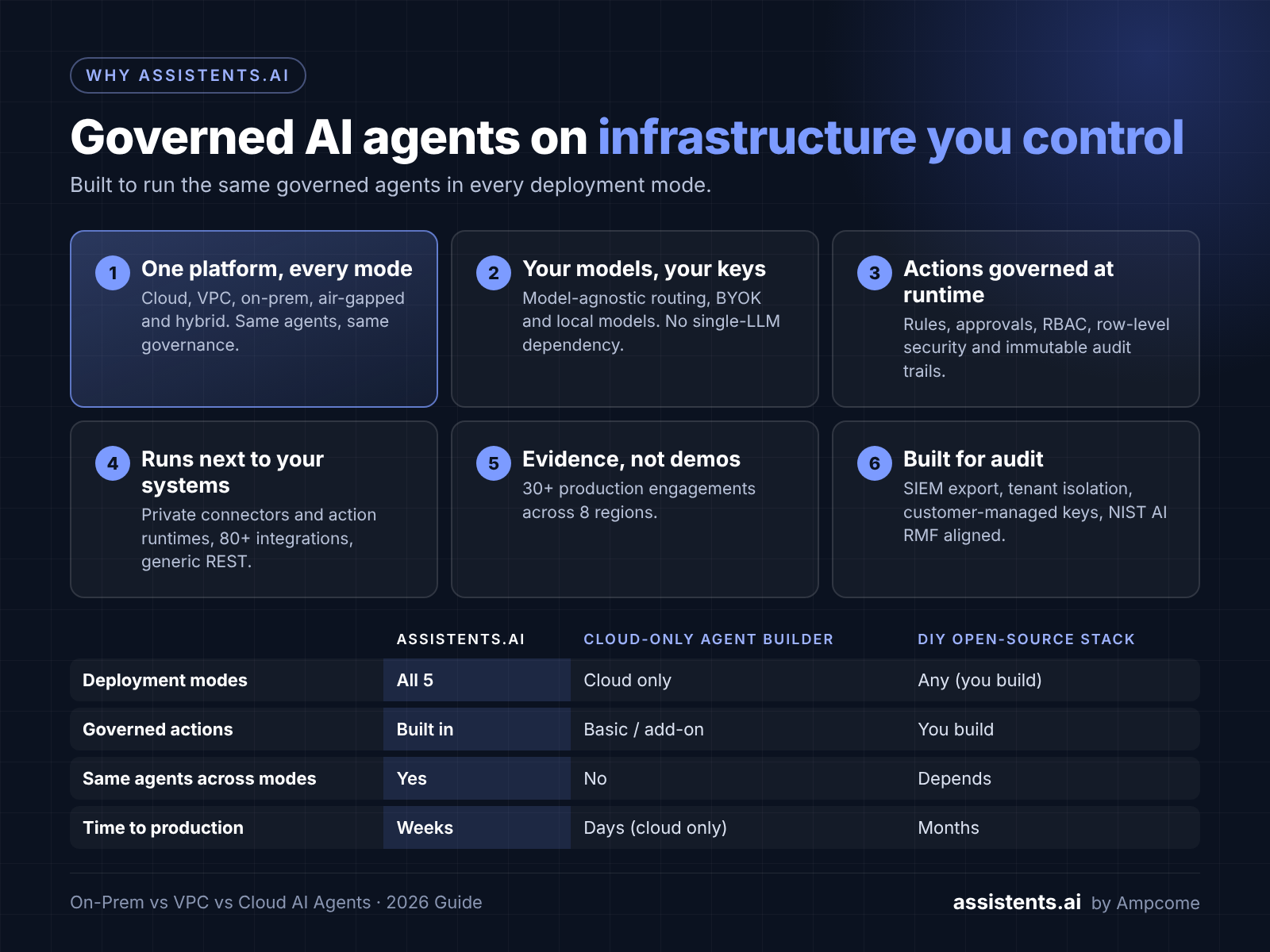
Assistents.ai is built for enterprises that need governed AI agents running on infrastructure they control. Most agent platforms were built cloud-first and added a private option later. Assistents.ai was designed from the start to run the same governed agents in every deployment mode.
- One platform, every deployment mode. Private cloud, customer VPC, on-premises, air-gapped and hybrid. The same agents, the same governance, the same audit trail.
- Your models, your keys. Model-agnostic routing across providers, bring your own key, and local models where required. No single LLM becomes a dependency.
- Actions governed at runtime. Agents propose and rules decide. Deterministic rules and decision tables, human approvals, role-based access, row-level security and immutable audit trails are part of the runtime, not a bolt-on module.
- Runs next to your systems. Private connectors and action runtimes sit near your source systems, with 80+ workflow integrations, warehouse and BI connectors, and generic REST connectivity.
- Evidence, not demos. 30+ production engagements across eight regions, in banking, utilities, healthcare, multi-entity ERP, logistics and public research.
- Built for audit. Audit export to your SIEM, tenant isolation, customer-managed encryption keys, and a governance lifecycle aligned with the NIST AI RMF.
- Compare platforms further in our 11 best enterprise AI agent platforms and Assistents.ai vs Relevance AI.
Conclusion: decide per workload, govern every action
The on-prem vs VPC vs cloud AI agents question has no single answer for a regulated enterprise. The right model depends on each workload's data class, the actions it takes and the rules it falls under. Cloud gets you moving, VPC covers most regulated production work, and on-prem or air-gapped protects what must never leave your network.
Two things matter more than any single hosting choice: a platform that runs the same agents in every mode, and governance that checks every action before it happens. That's what lets you start small, prove value and expand without rebuilding.
Ready to map your agent workloads to the right deployment model? Book a deployment architecture review with the Assistents.ai team and see your agents running in cloud, VPC or on-prem.
FAQs
What is the difference between VPC deployment and on-premise deployment for AI agents?
A VPC deployment runs the agent platform inside your own isolated cloud account, using the cloud provider's hardware under your network rules and keys. On-premise runs it on hardware you own or lease in your data centre. VPC is faster to set up and easier to scale. On-prem gives full physical control and is the route to air-gapped.
Can AI agents run on-premise, not just models?
Yes. A full on-prem agent stack includes the model, retrieval, memory, orchestration, tool and action runtime, connectors and audit logs, all inside your network. Assistents.ai can deploy the whole platform on-premise with self-hosted LLMs, so prompts, documents and actions never leave your perimeter.
Is on-premise AI cheaper than cloud AI?
Often at steady, high volume, but rarely at small or bursty volume. On-prem shifts spend to upfront hardware and in-house staff, while cloud turns it into usage fees that grow with inference. In Broadcom's 2026 survey, 97% of IT leaders said some public cloud spend is wasted. Model three-year cost per workload before deciding.
Which is more secure, on-premise or cloud AI agents?
Neither is secure by default. On-prem removes third-party exposure but makes you responsible for patching, access and incident response. Cloud and VPC can meet strict controls with private networking and customer-managed keys. For agents, the bigger risk is unsafe actions, so look for rules, approvals and audit between the model and your systems.
Does the EU AI Act require on-premise AI?
No. The EU AI Act sets risk-based duties such as logging, human oversight and transparency, but it doesn't require a hosting location. Data location rules come from GDPR, sector rules such as DORA, and contracts. Many EU enterprises meet them with an EU-region VPC. Check current application dates with counsel.
Can AI agents run fully air-gapped?
Yes, if the platform supports local models, mirrored dependencies and offline updates. Air-gapped agents can't call public LLM APIs or SaaS tools, so every model, connector and knowledge source must run inside the isolated network. This suits defence, classified and some critical-infrastructure workloads.
Which deployment model is best for banking and other regulated industries?
Most banks and insurers use a customer VPC or on-prem for agents that touch customer, payment or credit data, and cloud for low-risk internal work. The deciding factors are data class, regulator guidance on outsourcing, and whether the agent writes to core systems. A hybrid split by workload is the most common result.
What is a hybrid AI agent deployment?
A hybrid deployment splits agents or agent components across environments. Common patterns are a vendor-hosted control plane with the data plane in your VPC, or sensitive workloads on-prem and low-risk ones in the cloud. It only works if prompts, logs and telemetry from sensitive workloads also stay inside your boundary.
Can an enterprise change deployment models after going into production?
Yes, if the platform runs the same agents and governance in every mode. Then moving from cloud to VPC or on-prem is a redeployment, not a rebuild. Ask vendors to show this before you sign, because cloud-only tools often need a new build.
How do you avoid vendor lock-in when deploying AI agents?
Choose a platform that is model-agnostic, supports your own model keys or local models, runs in your environment, and supports open standards such as the Model Context Protocol (MCP) for tools. Make sure you can export agent definitions, audit logs and knowledge, and that pricing doesn't penalise a change of deployment mode.
Is self-hosting enough for data residency?
Not by itself. Residency also covers where model inference, logs, backups, telemetry and support access happen. A self-hosted agent that calls a public LLM API in another country still moves data across borders. Map every data flow, then use local models or in-region endpoints where needed.

Transform Your Business With Agentic Automation
Agentic automation is the rising star posied to overtake RPA and bring about a new wave of intelligent automation. Explore the core concepts of agentic automation, how it works, real-life examples and strategies for a successful implementation in this ebook.
Sarfraz Nawaz is the CEO and founder of Ampcome, which is at the forefront of Artificial Intelligence (AI) Development. Nawaz's passion for technology is matched by his commitment to creating solutions that drive real-world results. Under his leadership, Ampcome's team of talented engineers and developers craft innovative IT solutions that empower businesses to thrive in the ever-evolving technological landscape.Ampcome's success is a testament to Nawaz's dedication to excellence and his unwavering belief in the transformative power of technology.

More insights
Discover the latest trends, best practices, and expert opinions that can reshape your perspective







Contact us

