
AI Agent Development Services in USA: 12 Production Examples, What They Cost, and How to Choose a Partner in 2026


AI agent development services in the USA are engagements that design, build, integrate, govern and operate AI agents that perform real work inside your enterprise systems — reading documents, answering customers, checking policy, creating transactions and escalating to people when they should. This guide shows what those services look like when they are actually delivered: 12 anonymised production deployments built by Ampcome on the assistents.ai platform, 2026 US cost benchmarks from public sources, an engagement-model comparison and the checklist we use to qualify our own work. Client names are withheld throughout. Outcome figures are stated exactly as they were engineered — as targets — unless explicitly marked as measured.
Key takeaways
- An AI agent development service delivers a governed workflow, not a chatbot and not a model. The deliverable is work getting done inside your systems, with an audit trail.
- The 12 examples below span hospitality, retail, construction, distribution, fintech, real estate, healthcare staffing and tax research. Every one has the same skeleton: intake → context → action → human review → audit → outcome.
- Public US benchmarks in 2026 place a single-function agent at roughly $8K–$25K, an integrated workflow agent at $25K–$80K, and an enterprise multi-agent system at $80K–$300K+, before run costs.
- Governance — permissions, deterministic policy rules, approvals and immutable records — is the deliverable that separates a production agent from a demo. It is also where most vendors are weakest.
- Start with one bounded operation, measure it against a baseline, then expand. Enterprises that buy "transformation" first rarely reach production.
What AI agent development services in the USA actually include
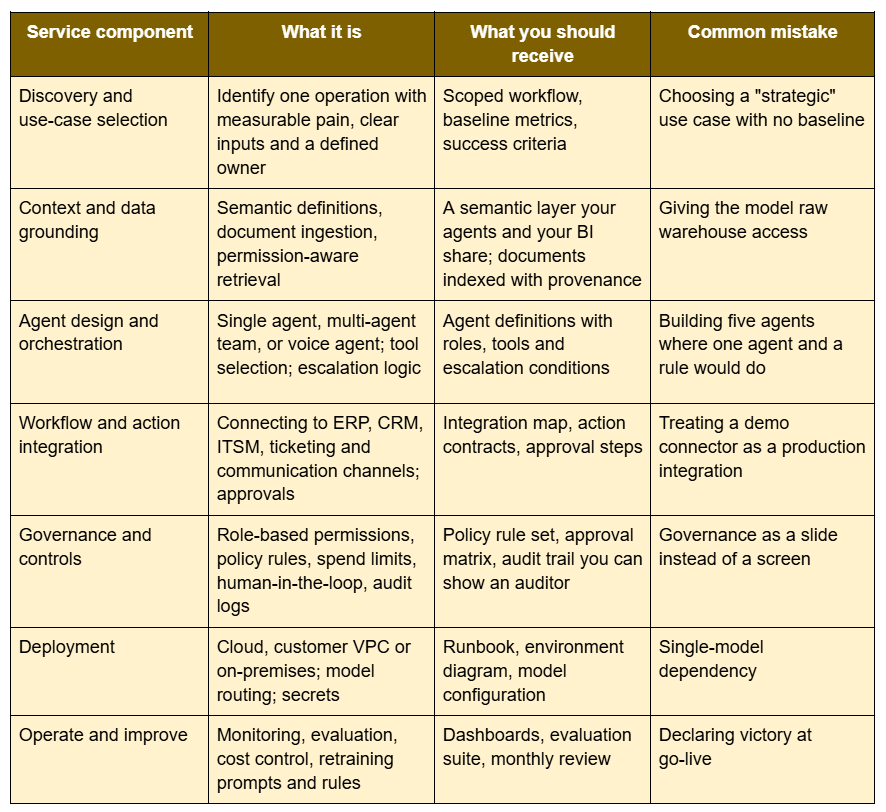
An AI agent development service covers the full path from a business problem to an agent running in production: selecting the workflow, grounding the agent in governed data, designing how it reasons and acts, connecting it to the systems where work happens, wrapping it in controls, deploying it where your security team allows, and operating it after go-live. If a proposal stops at "we build the agent", it is a software project, not a service.
Here is the taxonomy we use when scoping engagements. It is also a useful lens for reading any vendor's statement of work.
Services, platforms and tools are different purchases
A services engagement gives you people who own the outcome. A platform gives you the runtime — orchestration, governance, integrations, analytics — they build on. Tools give you components. The question is where the governance layer lives: in a consultancy's custom code, it leaves when they do; in the platform, it stays with you. See our CIO guide to selecting an enterprise AI agent platform and the AI agent development tools comparison.
What you should hold in your hands at the end
A finished engagement produces, at minimum: a working agent in your environment (not a sandbox), an integration map with read/write scope per system, a policy rule set that governs what the agent may do without approval, an audit trail you can query, an operations runbook, and a measured baseline against which the outcome will be judged. If any of those is missing from a proposal, ask why.
Chatbot, workflow bot, AI agent or agentic system: which one are you buying?
The phrase "AI agent" now appears on the website of almost every software consultancy in the country. Much of it describes a chatbot or an RPA script. The distinction matters because it determines scope, cost and risk.
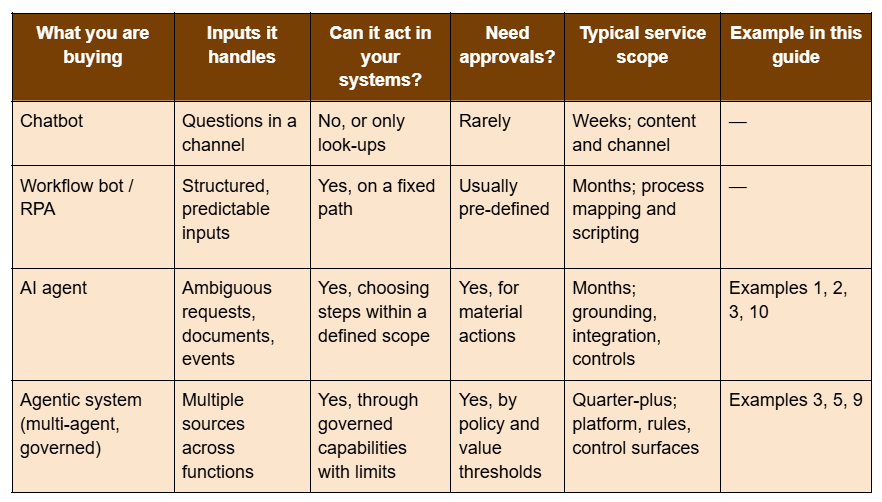
The short version: a chatbot answers. An agent gets work done. A governed agent gets work done inside authority limits that a human defined and can see.
12 production examples of AI agent development services (anonymised)
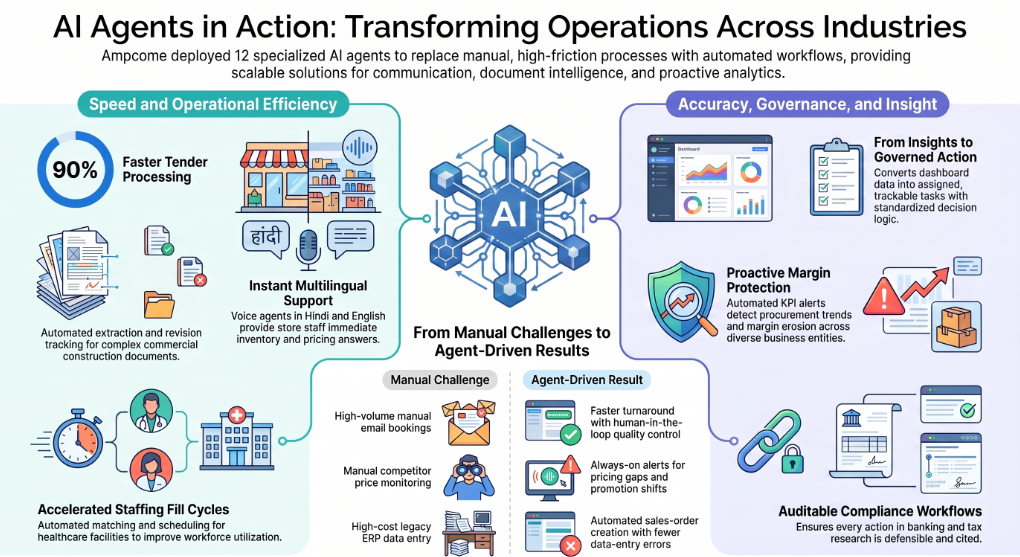
These deployments were delivered by Ampcome as services on the assistents.ai platform, or as custom engineering where the platform was not the right fit. Each is described in four parts — situation, what was delivered, scope of services, result — so you can compare like with like. Identifying details have been removed. Results are quoted as recorded in our engagement register; engineering targets are labelled as such.
Conversational and voice agents
Example 1 — Digital booking agent for a luxury hospitality operator (East Africa)
Situation. A multi-property luxury hospitality group handled high-value bookings through email and phone. Guests expected curated itineraries, live availability across properties and fast confirmation — all of it managed by people with no systematic tooling.
What was delivered. A digital booking agent covering intake to confirmation with human-in-the-loop quality control.
Scope of services. Email intake with intent classification and data extraction; a conversational loop to capture missing details; real-time inventory checks with alternative date and property negotiation; a hybrid handoff to human specialists for curated itinerary creation; automated invoice and PDF generation.
Result. Faster booking turnaround with less back-and-forth, higher accuracy on complex guest requirements, and operations that scale without compromising the service standard.
Example 2 — Multilingual store-support voice agent for a national value retailer (India)
Situation. A rapidly scaling value retailer with several hundred stores needed store staff to get instant answers on inventory, pricing, promotions and procedures without waiting on a central helpdesk.
What was delivered. A suite of store-facing enterprise AI agents.
Scope of services. A voice support agent (speech-to-text, LLM, text-to-speech) in Hindi and English; an inventory intelligence agent for per-store pricing, stock and promotions; a knowledge and training agent using retrieval over POS documentation and standard operating procedures; an admin console, analytics and ticketing integration, engineered for high concurrency.
Result. Reduced manual helpdesk burden and faster resolution of store issues, improved store-level inventory visibility, and faster onboarding through on-demand training guidance. See how these patterns apply in retail and e-commerce.
Document-intelligence agents
Example 3 — Tender-document workbench for a commercial building contractor (Australia)
Situation. A remediation and commercial-works specialist processed complex tender documents manually: multi-format PDFs, revision tracking, cross-referencing to the job-management system, all under bid deadlines.
What was delivered. An intelligent document workbench built on multi-agent orchestration.
Scope of services. Tender retrieval and workflow determination; revision and change analysis; vision-LLM extraction from complex PDFs; deep integration with the job-management system (full create, read, update, delete); quote locking; audit logs across the workflow.
Result. Engineered for up to ~90% faster tender-document processing, with a ~95% extraction-accuracy target for standard formats (both engineering targets), plus reduced bid risk through change detection and auditability. Related: Document AI on assistents.ai.
Example 4 — Sales-order automation replacing a legacy capture tool for an appliance distributor (Middle East)
Situation. A premium appliance distributor was creating ERP sales orders through an end-of-life document-capture product with high licensing costs.
What was delivered. Automated ERP sales-order creation driven by agentic AI, positioned as the integration-ready replacement for the legacy workflow.
Scope of services. Agents that interpret incoming order triggers, validate them and create sales orders in the ERP; rules and governance for exceptions and approvals; audit logs and reconciliation reporting.
Result. Reduced manual order processing and legacy dependency, a faster order-to-confirm cycle with fewer data-entry errors, and improved auditability for order creation and exceptions.
Agentic analytics and insight-to-action
Example 5 — Insights-to-action layer for a retail holding group (India)
Situation. Leadership had dashboards across systems and documents but no governed path from an insight to an assigned, tracked action.
What was delivered. An agentic data-analysis layer that converts dashboard insights into governed, auditable actions and tasks.
Scope of services. A unified context engine over structured and unstructured data; a semantic governance layer (rules, hierarchies, formulas); an active orchestrator integrating with core systems; insights-to-action agents layered on the existing dashboards.
Result. A shift from reactive reporting to proactive execution loops, standardised decision logic across teams, and automated task creation with completion tracking. The value is not the chart; it is the governed action that follows it.
Example 6 — Self-serve governed analytics for a real-time analytics startup (USA)
Situation. A Silicon Valley startup building real-time business analytics for operators needed governed, natural-language answers over its data without a BI queue.
What was delivered. An AI data-analytics agent delivering self-serve answers with consistent definitions.
Scope of services. An agentic analytics layer over existing data; semantic governance for consistent metric definitions; a natural-language query interface; automated insight generation.
Result. Faster strategic visibility without BI queueing, better alignment through consistent metric definitions, and scalable insight access across teams.
Monitoring and proactive alerting agents
Example 7 — Competitive-monitoring agents for a consumer-durables manufacturer (India)
Situation. In a price-sensitive category, competitor pricing and promotion moves matter daily, and monitoring them across e-commerce portals was manual.
What was delivered. AI agents for competitive monitoring that turn market signals into instant answers and proactive alerts, taken from proof of concept to full implementation.
Scope of services. Continuous e-commerce and channel monitoring (pricing, MRP and discounts, offers, availability, ratings); agentic Q&A mapped to the questions leadership actually asks; analytics views for pricing gaps, threats and portfolio movement; a scalable architecture with governance and audit trails.
Result. Faster competitive response cycles, earlier identification of pricing gaps and promotion shifts, and always-on monitoring replacing manual portal checks.
Example 8 — Procurement and finance KPI alert agents for a diversified family group (Middle East)
Situation. A group with many operating companies needed consistent finance and procurement intelligence across entities to protect margin and working capital.
What was delivered. Automated procurement and finance KPI alerts across group entities.
Scope of services. Group-wide KPI standardisation; automated alerts on purchase-price trends, gross-margin impact, early-payment analysis (notional finance cost) and vendor delivery and returns performance; dashboards and scheduled insight packs for leadership.
Result. Earlier detection of margin erosion and vendor slippage, standardised finance and procurement intelligence across entities, and fewer variance surprises. Explore the finance and procurement solutions.
Workflow and case-management agents
Example 9 — Omnichannel support agents for a fintech serving banks and credit unions (global)
Situation. A provider of cloud automation for banks and credit unions needed to modernise support across disputes, fraud and compliance workflows, where every action must be defensible.
What was delivered. Omnichannel AI agents for banking support with auditable workflow automation.
Scope of services. Intake across chat, email and phone with workflow routing; agent-assist summarisation and next-best actions; auditability, reporting and SLA monitoring; integration-ready design for core systems.
Result. Faster case handling and improved consistency, reduced operational load through automation, and better compliance readiness via audit trails. See AI agents for financial services.
Example 10 — Tenant-service agent for a real-estate portfolio manager (Middle East)
Situation. A portfolio owner with office, retail, industrial and residential assets fielded high volumes of tenant queries through call centres.
What was delivered. A customer-service agent for real estate automating tenant and customer support end to end.
Scope of services. An omnichannel service agent (web, WhatsApp, email-ready); tenant query triage, FAQs and rental and payment support workflows; ticketing and escalation to human teams; a knowledge base over policies, tenancy documents and standard operating procedures.
Result. Faster response times and lower call-centre load, a consistent 24×7 tenant experience, and better SLA adherence through automated routing and tracking.
Industry operations agents (US examples)
Example 11 — Healthcare staffing operations platform (USA)
Situation. A platform connecting nursing professionals with facilities for flexible shifts competed on speed of fill and staffing responsiveness.
What was delivered. An AI platform for staffing operations — matching, scheduling and compliance.
Scope of services. Talent onboarding and credential capture; facility staffing-request intake and matching logic; scheduling, notifications and compliance workflows; fill-rate and utilisation reporting.
Result. Faster fill cycles and lower scheduling friction, better workforce utilisation, and improved staffing responsiveness for facilities. Healthcare deployments start compliance-first; see AI agents for healthcare.
Example 12 — Tax research automation for a sales-and-use-tax software company (USA)
Situation. Tax professionals spent research time hunting sources across jurisdictions and drafting positions from scratch.
What was delivered. AI tax-research automation: source retrieval, summarisation and drafting support with citations.
Scope of services. Automated source collection and summarisation; draft memo and position output generation; workflow tracking and knowledge-base building.
Result. Faster research cycles, better documentation hygiene, reduced manual source-hunting time and more consistent research outputs.
The 12 examples at a glance
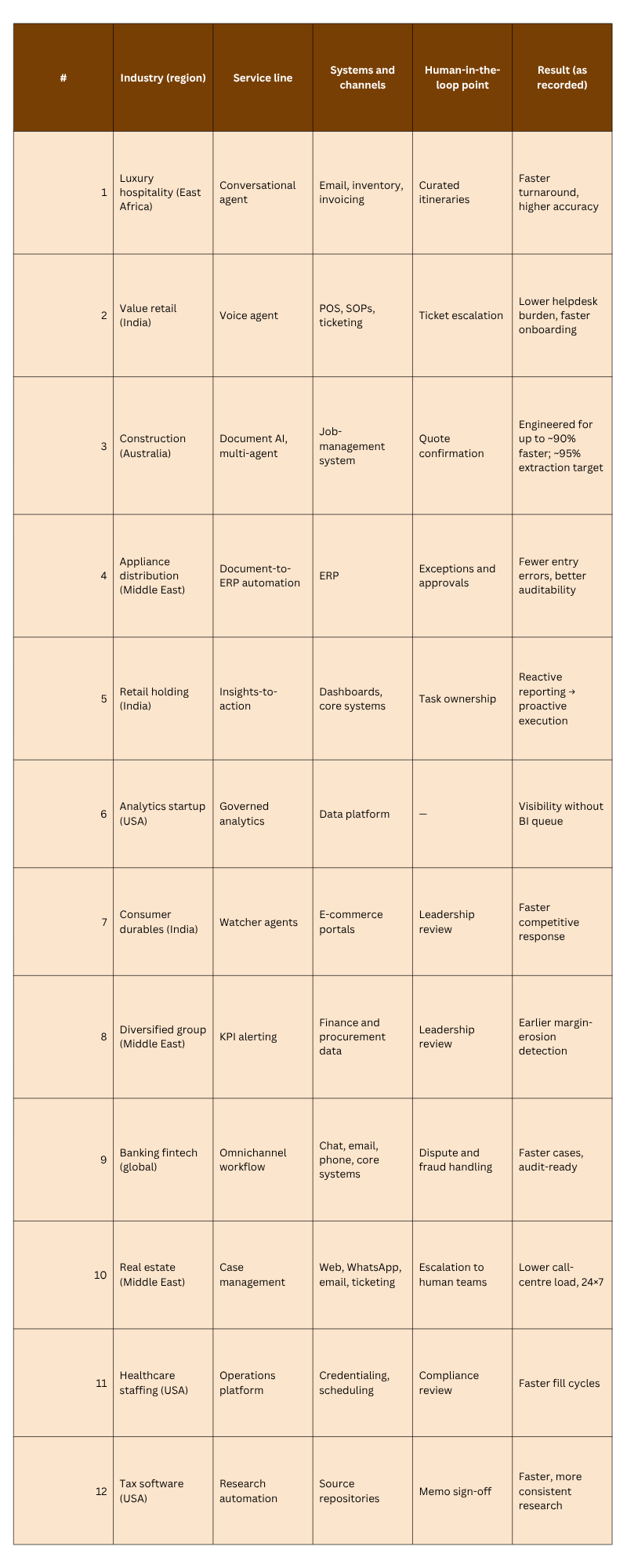
What these deployments have in common (and what most vendors skip)
Reading the register, the same five patterns appear in every deployment that reached production and stayed there.
1. The work is bounded to one defined operation. Booking intake. Tender processing. Sales-order creation. Nobody bought "AI for the enterprise"; they bought a specific operation with an owner and a baseline (Examples 1, 3, 4).
2. Context is governed before the agent sees it. Examples 5 and 6 put a semantic layer — consistent definitions, hierarchies, formulas, row-level permissions — between the agent and the data. The model receives the smallest authorised context needed for the work, not the whole warehouse.
3. Actions run through rules and approvals, not prompts. In Example 4 the agent interprets and validates; deterministic rules decide which orders need a human. In Example 9 every case action leaves an auditable record. Policy lives in a rules engine that is versioned and testable, never in a system prompt.
4. Humans own exceptions; agents own the normal path. The hospitality agent hands off itinerary curation; the tender workbench locks quotes on confirmation; the tenant agent escalates to people. Humans define the envelope and manage the exceptions; the platform observes both.
5. Outcomes are measured against a baseline. The examples with the most durable adoption are those where the result could be named — turnaround time, helpdesk volume, order-to-confirm cycle, fill rate. Human acceptance of an agent's suggestion is a behavioural signal, not proof of business value.
Most vendor listicles describe none of this. They describe frameworks.
Engagement models for AI agent development services in the USA
There are five realistic ways to buy agent development in 2026. They differ less in technology than in who holds the governance layer and how fast the first production workflow lands.
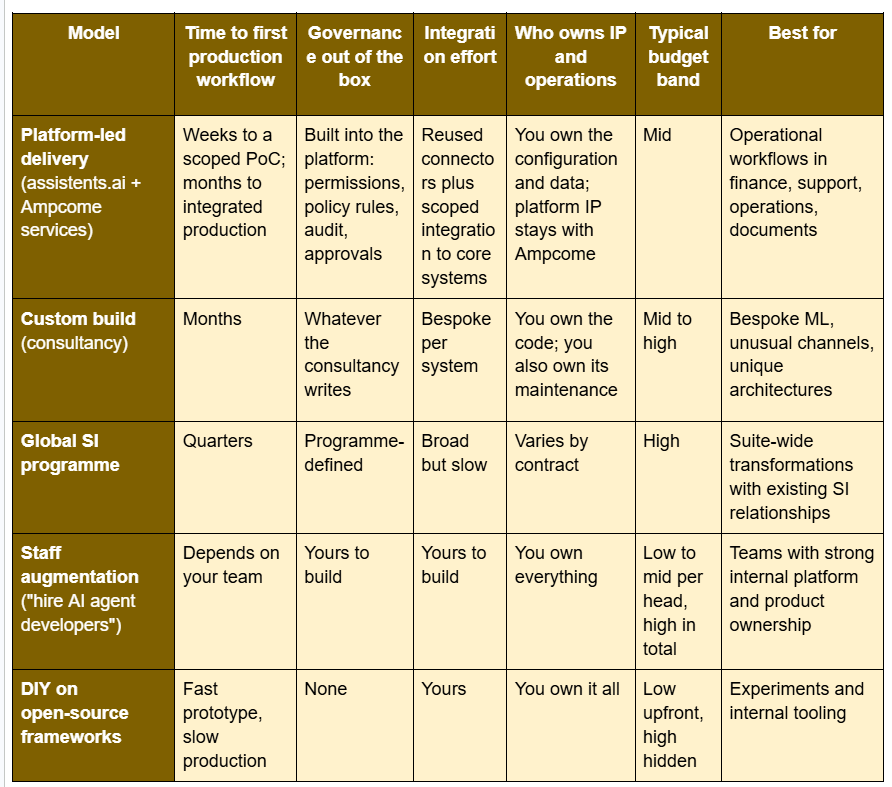
When custom code is the right answer
Choose a custom build when the core of the problem is novel modelling, when the channel is unusual, or when a core system has no usable API and the integration is itself the project. Several engagements in our register were custom for exactly these reasons. Be wary of a custom build whose main output is a governance layer someone else already sells.
When a governed platform is the right answer
For most operational workflows — documents, support, order handling, monitoring, analytics-to-action — the platform route is faster and lower-risk because the parts that take months to engineer (permission-aware retrieval, rules, approvals, audit, model routing, deployment options) already exist. The engagement then spends its budget on your workflow, integrations and policies rather than on plumbing.
See Ampcome's AI agent development services for how the two fit together.
What AI agent development services cost in the USA (2026)
Published US benchmarks converge on three bands. The table draws on four public cost guides published between January and August 2026; the ranges are theirs, not ours, and any single project can sit outside them.
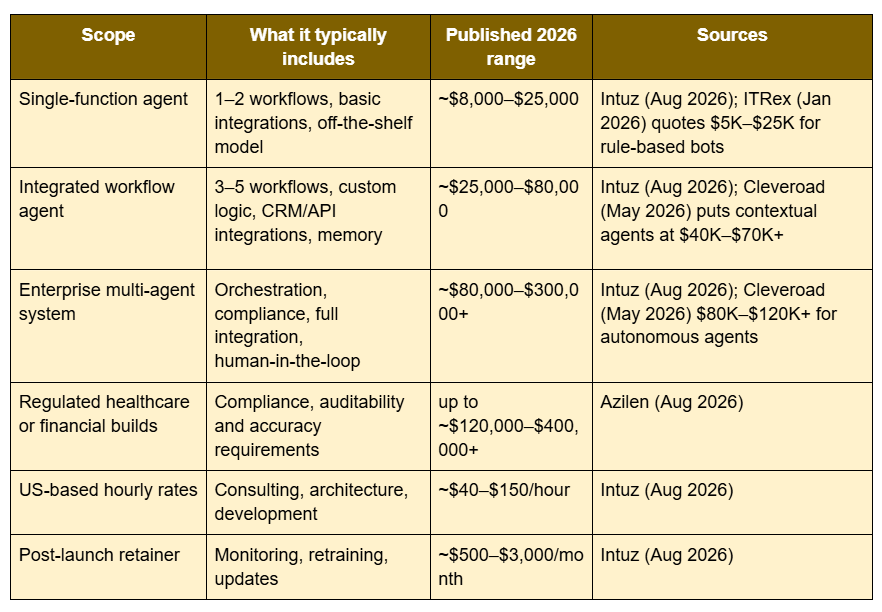
Two things the benchmarks under-state.
Separate the build from the run. A production agent has five cost lines: implementation fee; platform subscription (if platform-led); model, voice and infrastructure consumption; support; optional managed operations. Public guides estimate the initial build is only a quarter to a third of three-year total cost of ownership, with year-one run costs adding roughly 25–35% on top. If a vendor cannot show these lines separately, it is a build quote, not a service quote.
Integration count drives cost more than model choice. Each system the agent reads from or writes to adds discovery, mapping, testing and exception handling — regardless of which LLM you pick.
Timelines
A well-scoped proof of concept for one workflow typically runs two to six weeks. Integrated production — enterprise integrations, governance configuration, evaluation and onboarding — typically runs three to six months. The variables are system count, exception complexity and audit rigour. Data quality is the hidden one: if the knowledge base needs cleaning, add weeks to any estimate.
How to reduce cost without reducing control
Start with one bounded operation. Reuse platform connectors and policy rules across workflows rather than rebuilding them per agent. Put deterministic checks (rules, limits, approvals) in front of expensive model calls. Measure before you scale — the cheapest agent is the one you do not build for a workflow that did not need it.
Why assistents.ai is the platform behind Ampcome's AI agent development services
A quick clarification, because the two names are often conflated: Ampcome is the company that delivers the services described in this guide. assistents.ai is Ampcome's proprietary governed agentic intelligence platform — the runtime on which those services are delivered, and the reason the engagements above reached production rather than stalling at pilot. Partners and clients configure and extend the platform; Ampcome owns and develops it.
Six things the platform provides today, which a services engagement does not have to build from scratch:
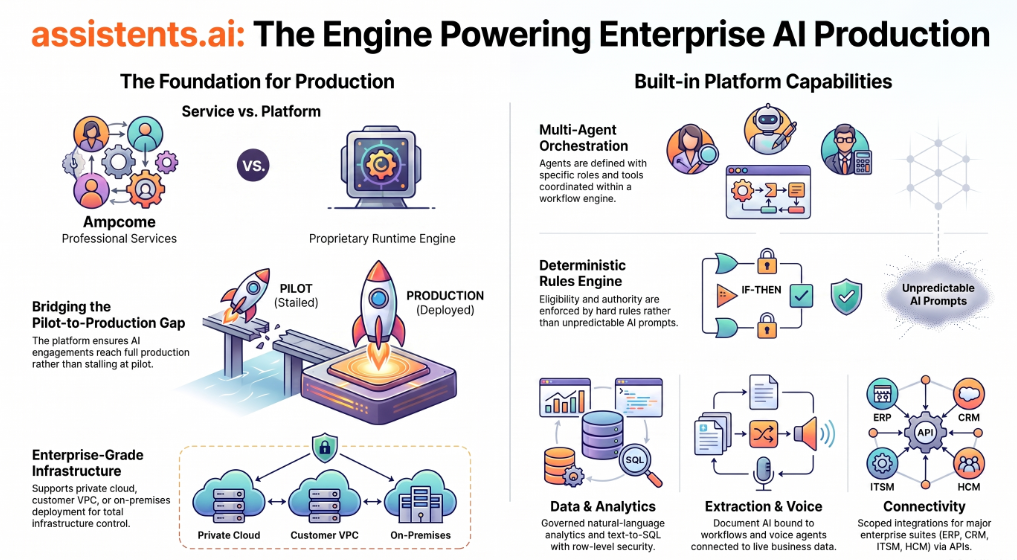
- Governed analytics over your data. Natural-language analytics and text-to-SQL over governed sources, with a semantic metrics layer and row-level security, so agents and dashboards share one set of definitions.
- Agent Builder and multi-agent orchestration. Agents are defined with roles, tools and escalation conditions and coordinated inside a workflow engine that supports human tasks and approvals.
- Document AI bound to workflows. Ingestion, extraction, validation and human review, with the extracted evidence flowing into cases and actions rather than sitting in a folder.
- Voice agents on live business data. Speech-to-text, reasoning and text-to-speech connected to your inventory, orders, policies and tickets — the pattern in Example 2.
- Deterministic rules and decision tables. Eligibility, limits, routing and approval authority are enforced by a rules engine, not a prompt. Agents propose; rules decide.
- Deployment on infrastructure you control. Private cloud, customer VPC or on-premises, with model routing across multiple providers so no single LLM becomes a dependency.
Behind these sit a low-code application builder, permission-aware retrieval with evidence-backed answers, audit trails and human-in-the-loop controls, and warehouse, BI and workflow integrations plus generic REST connectivity. Connectivity to major enterprise suites (ERP, CRM, ITSM, HCM) is delivered as a scoped integration through their published APIs — we say that plainly, because "one-click SAP" is how a won deal becomes a delivery problem.
The evidence base is the register this guide draws on: thirty-plus enterprise engagements across North America, Europe, the Middle East, Africa and Asia-Pacific. Some were custom engineering; most were delivered on the platform. We label each accurately when we talk to you.
Why assistents.ai: governance is the deliverable, not a feature
Every buyer eventually faces the same question from a regulator, an auditor, a CFO or a board: show me what the agent did, and why. The engagements that survive it share one design decision — governance was built into the runtime, not bolted on after the pilot.
Permissions are inherited, and checked at action time. An agent operates with the permissions of the user or role that invoked it; its data access is never broader than what that user can see. Checks happen at every operation, not only at query time. If an agent is processing invoices, it only touches the invoices the user is authorised to see.
Policy is defined once and enforced automatically. Business rules — spending limits, PII handling, required approvals, retention windows, region restrictions — are expressed as rules the agent must satisfy before execution. Violations are blocked and flagged rather than discovered in a post-mortem.
Every action leaves an immutable record. What data was accessed, why, what decision was made, what action was taken, and under which policy evaluation. Records can be exported to your SIEM and to regulators.
Alignment is verified continuously. Intent-to-action consistency checks keep agents within their defined purpose and detect drift.
High-impact decisions route to people. Approval gates with configurable thresholds escalate financial actions, sensitive operations and policy violations to designated approvers, with full context preserved.
There is one place to see it all. A governance dashboard shows agent activity, policy violations, approval queues and compliance status, filterable by agent, user, date and action type.
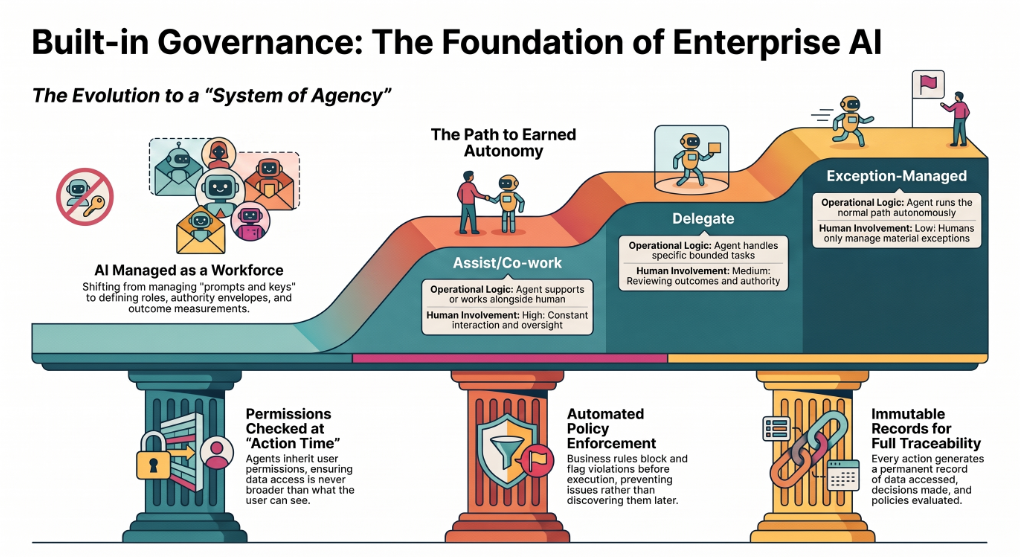
The examples show why this is a deliverable rather than a checkbox: the tender workbench (Example 3) was accepted because audit logs covered every extraction and system write; the banking agents (Example 9) produce compliance-ready reporting natively; the insights-to-action layer (Example 5) works only because every generated task is governed and traceable. Read the full control set on the assistents.ai agent governance page and the current security posture on the Security & Trust page.
Where the platform is heading
Stated as direction, not shipped functionality: we think enterprises will manage AI agents as a workforce — with roles, sponsors, authority envelopes and outcome measurement — rather than as a pile of prompts and API keys. Work, not the chat session, becomes the organising object, and autonomy is earned in stages: assist, co-work, delegate, then exception-managed operation where agents run the normal path and humans manage material exceptions.
The category that emerges is a System of Agency — the layer above your systems of record that decides what work needs doing, who or what should do it, what context and authority apply, and whether the outcome was achieved. The long-term vision of an autonomous enterprise arrives that way, one bounded, measured operation at a time.
How to choose an AI agent development partner in the USA: a 10-point checklist
Use this in the first meeting. A good partner will welcome every question; a weak one will answer the first three and change the subject.
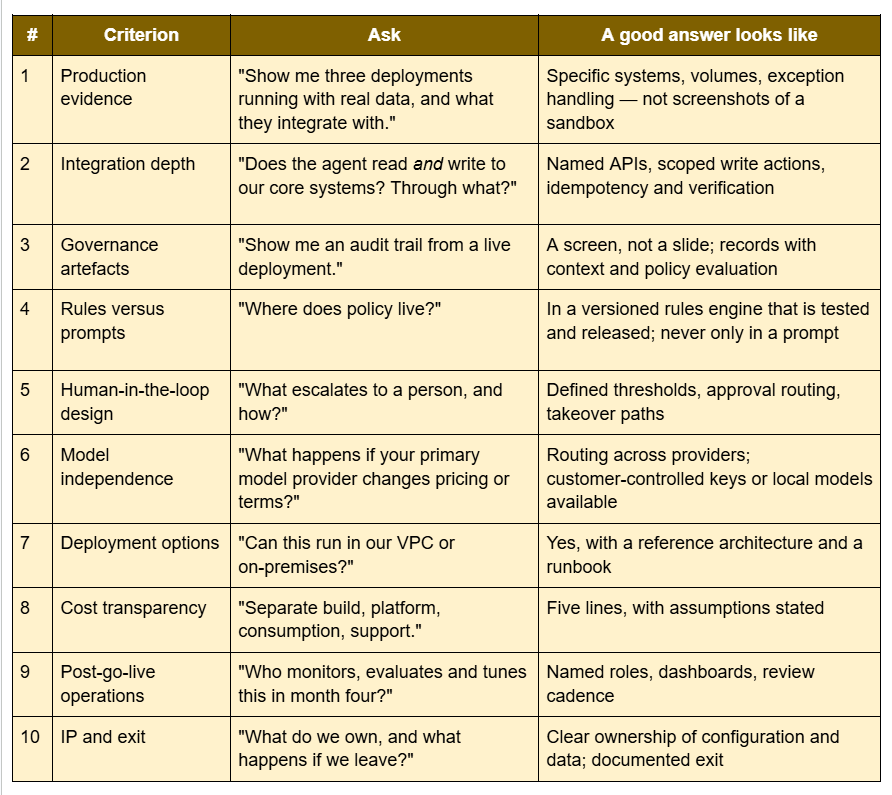
For a side-by-side view of firms and platforms operating in the US market, read our evaluation of the top AI agent development companies in the USA.
Red flags
- Demo-only proof. Case studies with no systems, volumes or exception handling named.
- Governance as a slide. No audit trail available to view; "compliance" described in the abstract.
- Shared credentials. The agent writes to your ERP with a service account everyone uses. That is an ungoverned write path.
- Single-model dependency. Everything runs on one provider with no routing or fallback.
- Integration promises without integration evidence. "We integrate with everything" and no list of completed integrations.
- Pilots that never graduate. Ask what proportion of their pilots reached production, and for two examples.
How to start: one bounded operation, measured
- Pick one operation with an owner, a measurable baseline and a visible cost of the status quo — document processing, support triage, order handling, KPI monitoring.
- Prove it in your environment, not a demo tenant: measure quality, time saved, action success, rework and compliance.
- Form the operating unit around it: the agents, the human roles, the rules, the approvals and the outcome metric, on one shared context.
- Expand to adjacent workflows, channels and systems only after the first outcome is measured.
If you would like to see any of the twelve patterns above applied to your own workflow, book a discovery call with Ampcome. Bring the process that frustrates your team most; we will tell you honestly whether an agent, a rule or a person is the right answer.
The bottom line
AI agent development services in the USA are worth buying when the deliverable is a governed workflow running inside your systems with a measured outcome — and not worth buying when the deliverable is a demo. The twelve examples above show what the former looks like across industries; the cost table shows what the market charges; the checklist shows how to tell the difference in one meeting. Ampcome delivers these services on assistents.ai because governance, integration and deployment control are the parts that take the longest to build and matter most in production. Start with one bounded operation, measure it, and expand from evidence.
FAQs
What does an AI agent development company actually do?
It designs, builds, integrates, governs and operates AI agents that perform work inside your systems. Mature firms deliver a governed workflow with an audit trail and a measured outcome, not a chatbot. Some build custom code per engagement; others, like Ampcome, deliver on a governed platform such as assistents.ai.
How much does it cost to build an AI agent in the USA?
Published 2026 benchmarks put a single-function agent at roughly $8,000–$25,000, an integrated workflow agent at $25,000–$80,000, and an enterprise multi-agent system at $80,000–$300,000+, with regulated builds higher. Run costs (models, voice, infrastructure, monitoring) typically add 25–35% of the build in year one. Ask for build, platform, consumption and support as separate lines.
How long does it take to build an AI agent?
A scoped proof of concept for one workflow usually takes two to six weeks. Integrated production — enterprise integrations, governance configuration, evaluation and onboarding — usually takes three to six months. Integration count, exception complexity and audit rigour drive the timeline more than model choice.
What is the difference between an AI agent, agentic AI and RPA?
RPA follows a fixed path on structured inputs. An AI agent interprets ambiguous inputs (documents, messages, events), chooses steps within a defined scope and acts in systems, escalating material actions. An agentic system coordinates several agents and humans across functions under shared context and policy. Read the detailed comparison of agentic AI and AI agents.
Do we need to replace our existing software?
No. Enterprise agents should operate over the systems you already run — ERP, CRM, HCM, ticketing, data warehouse — leaving those systems authoritative for their own transactions. The agent layer reads context from them and writes back through governed, scoped actions.
Is it better to build or buy AI agents?
Buy the platform layer (orchestration, governance, integrations, analytics) unless your problem is genuinely novel; build the workflow, policies and integrations that are specific to you. For most operational use cases a governed platform covers the majority of requirements, with configuration and scoped integration handling the rest. Custom builds make sense for bespoke models or unusual architectures.
How do AI agent companies handle security and compliance?
Look for permissions inherited from the invoking user and enforced at action time, policy rules evaluated before execution, immutable audit records, human approval gates, VPC or on-premises deployment, and model independence. Verify certification claims against current attestations on the vendor's security page, not a badge.
Is assistents.ai a service or a product?
assistents.ai is a product — Ampcome's proprietary governed agentic intelligence platform. Ampcome provides the AI agent development services (discovery, build, integration, governance configuration and operations) that are delivered on it. Enterprises can also license the platform and configure it with their own teams or partners.
Can Ampcome deploy AI agents on-premises for US enterprises?
Yes. The platform supports private cloud, customer VPC and on-premises deployment with customer-controlled model keys or local models where required. The specific topology, region and support boundary are agreed during solution design.

Transform Your Business With Agentic Automation
Agentic automation is the rising star posied to overtake RPA and bring about a new wave of intelligent automation. Explore the core concepts of agentic automation, how it works, real-life examples and strategies for a successful implementation in this ebook.
Sarfraz Nawaz is the CEO and founder of Ampcome, which is at the forefront of Artificial Intelligence (AI) Development. Nawaz's passion for technology is matched by his commitment to creating solutions that drive real-world results. Under his leadership, Ampcome's team of talented engineers and developers craft innovative IT solutions that empower businesses to thrive in the ever-evolving technological landscape.Ampcome's success is a testament to Nawaz's dedication to excellence and his unwavering belief in the transformative power of technology.

More insights
Discover the latest trends, best practices, and expert opinions that can reshape your perspective


.jpg)

.jpg)


Contact us

