
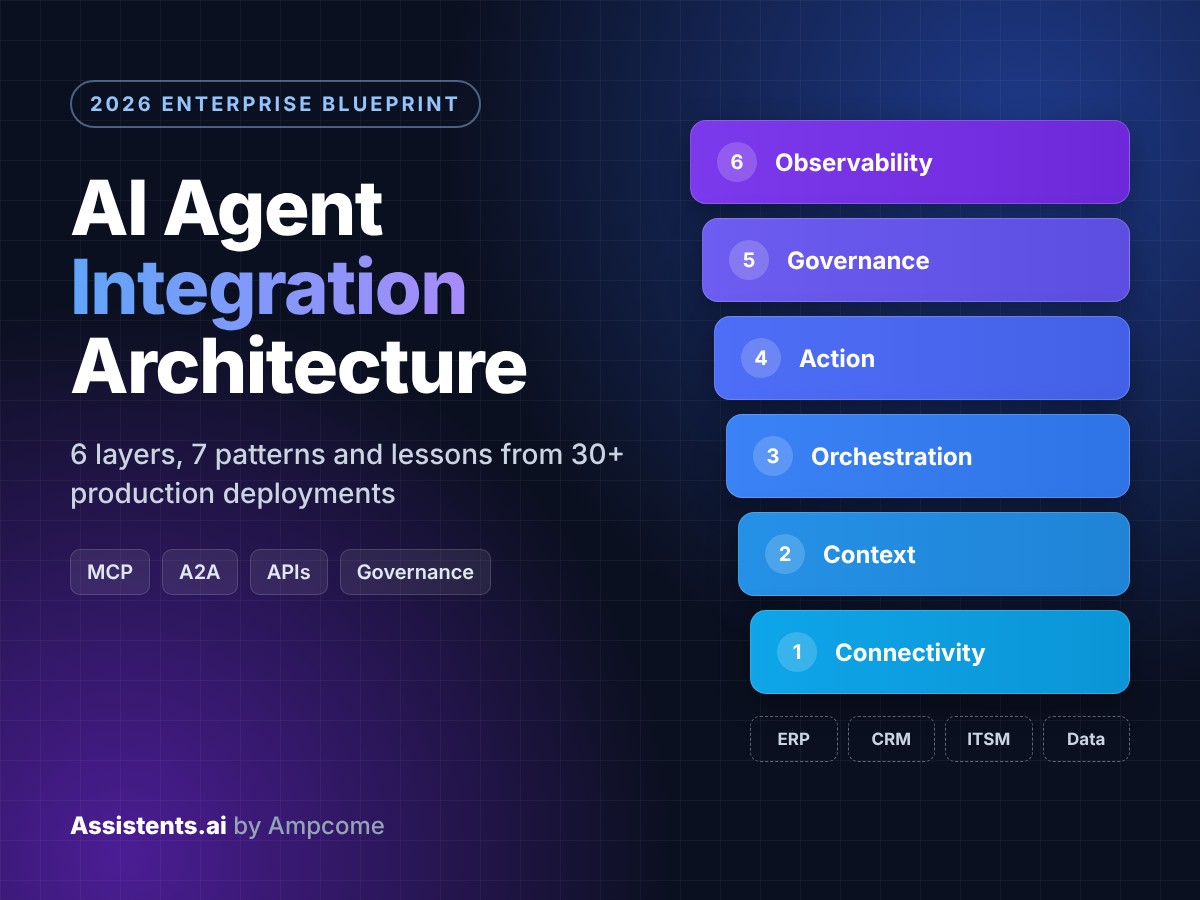
AI Agent Integration Architecture: The 2026 Enterprise Blueprint


AI agent integration architecture is the set of layers, protocols and governance controls that let AI agents securely read from and write to enterprise systems such as ERP, CRM, ITSM and data warehouses. It decides whether an agent stays a demo that answers questions or becomes a production system that processes orders, routes tickets and flags risks inside the tools your teams already use.
Most enterprises already have capable models. What they lack is the plumbing. Gartner predicts that over 40% of agentic AI projects will be canceled by the end of 2027 because of escalating costs, unclear business value or inadequate risk controls. Almost all three trace back to integration: agents that can't reach the right data, can't act safely, or can't be audited.
This guide gives you the blueprint we use at Ampcome and inside Assistents.ai: a 6-layer reference architecture, a protocol comparison (APIs, webhooks, MCP and A2A), 7 integration patterns, and what we learned from more than 30 enterprise deployments across retail, logistics, energy, finance, healthcare and real estate.
TL;DR
- AI agent integration architecture has 6 layers: connectivity, context, reasoning and orchestration, action, governance, and observability.
- Use APIs and webhooks for system access, MCP to expose tools and data to agents, and A2A for agent-to-agent collaboration. They are complementary.
- Pick from 7 proven patterns, from read-only context retrieval to governed write-back into ERP.
- Governance is an architecture layer, not a policy document: identity, least privilege, approvals and audit trails on every action.
- With a platform that ships all six layers, such as Assistents.ai by Ampcome, pilot to production takes about 4 weeks.
What is AI agent integration architecture?
AI agent integration architecture is the design that connects autonomous AI agents to enterprise systems, data and people, so agents can retrieve context, take governed actions and leave an auditable trail. It covers how agents authenticate, which systems they can read and write, how business context is shared, and how every action is approved, logged and monitored.
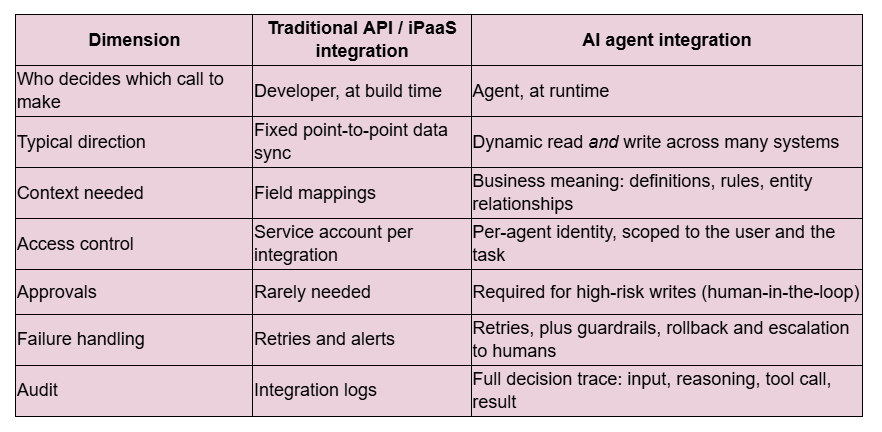
It differs from traditional integration in one fundamental way: the caller is no longer deterministic code. In a classic integration, a developer decides exactly which API is called, with which payload, in which order. In an agentic system, a model decides at runtime. That shift changes everything about security, context and failure handling.
If you are still deciding whether you need agents or a simpler tool layer, read our comparison of MCP server vs AI agent.
Why AI agent integrations stall between pilot and production
Most AI agent pilots stall because the agent can see data but cannot act on it safely, consistently or at scale. In our deployments, five failure modes come up again and again:
- Point-to-point connectors. Each agent gets its own hand-built integration. Ten agents later, you maintain dozens of brittle connectors that break whenever a vendor changes an API.
- No shared business context. One agent calculates "gross margin" one way, a second agent another way. Leadership stops trusting both.
- Read-only agents. The agent recommends an action, then a person re-keys it into SAP or Salesforce. The productivity gain disappears.
- No approvals or audit trail. Security and compliance teams block production rollout because nobody can prove what the agent did or why.
- No observability. Teams can't see cost per task, accuracy, latency or drift, so they can't justify scaling.
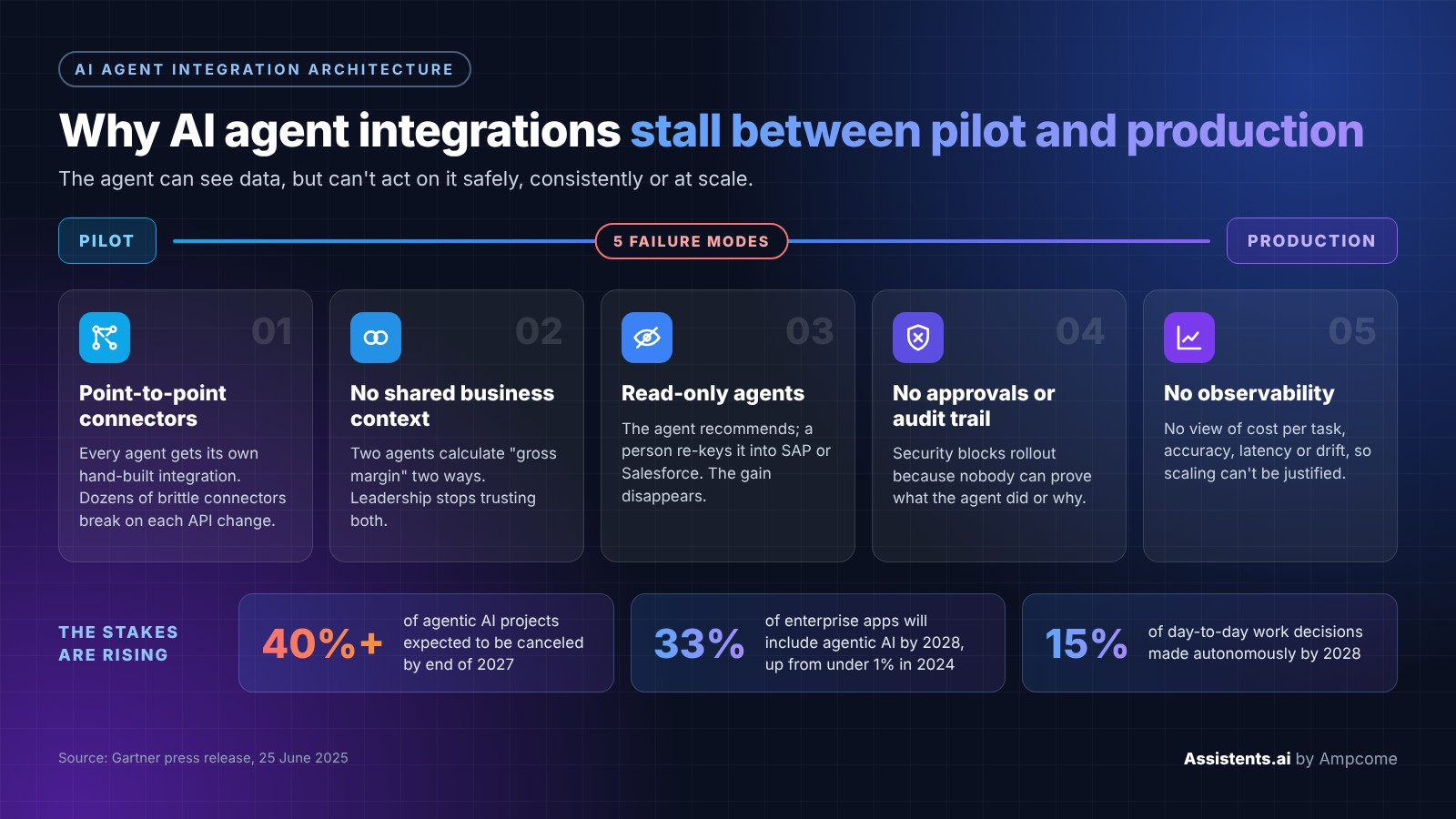
The stakes are rising. Gartner also expects 33% of enterprise software applications to include agentic AI by 2028, up from less than 1% in 2024, and at least 15% of day-to-day work decisions to be made autonomously. The integration architecture you choose now decides which side of that statistic you land on.
The 6-layer AI agent reference architecture
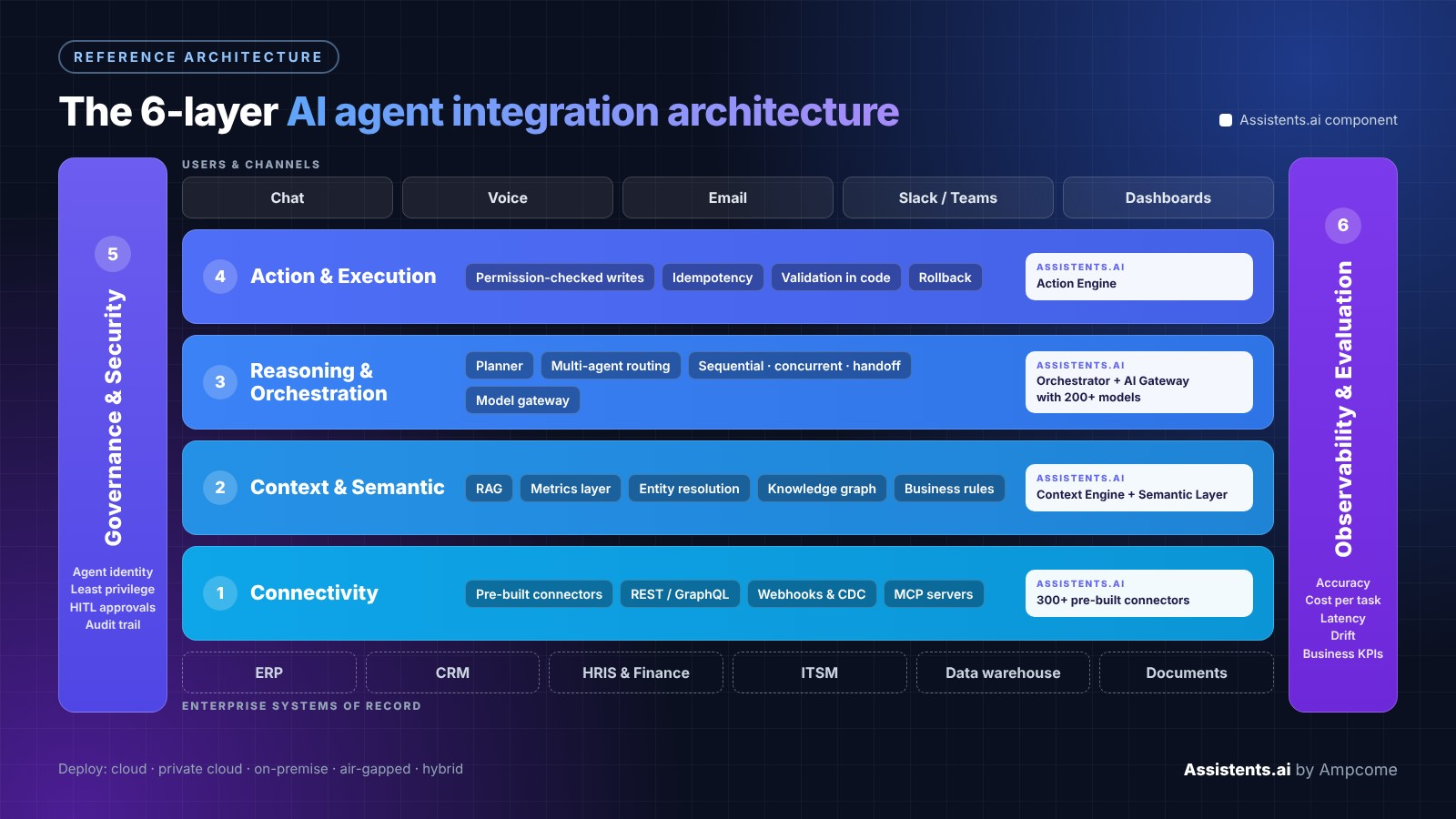
A production-grade AI agent integration architecture has six layers: connectivity, context, reasoning and orchestration, action, governance, and observability. Each layer solves one of the failure modes above. Skip one, and the system either can't scale or can't pass a security review.
Layer 1: Connectivity
The connectivity layer is how agents physically reach enterprise systems. It includes:
- Pre-built connectors for ERP, CRM, HRIS, finance, ITSM and collaboration tools, with OAuth, schema sync and role mapping.
- REST and GraphQL APIs for custom or in-house systems, with retry logic and rate limiting.
- Webhooks and change data capture (CDC) so agents react to events in real time instead of polling.
- MCP servers that expose tools and resources to agents through the open Model Context Protocol.
The design goal is build once, reuse everywhere: one governed connector to SAP serves every agent, instead of one connector per agent. Browse the 300+ pre-built integrations in Assistents.ai for a sense of typical enterprise coverage.
Layer 2: Context and semantic layer
Connectivity gives agents access. Context gives them understanding. This layer unifies structured data (tables, transactions), unstructured data (PDFs, emails, SOPs) and business rules (metric definitions, hierarchies, approval thresholds) into one model the agent can reason over.
It typically combines retrieval-augmented generation (RAG), a semantic or metrics layer, entity resolution and a knowledge graph. Without it, two agents give two different answers to the same question. For a deeper look at how this works, see our context engine architecture deep-dive.
Layer 3: Reasoning and orchestration
This layer decides which agent does what, in which order, with which model. It includes:
- A planner that breaks a goal into steps.
- An orchestrator that routes tasks across specialist agents (sequential, concurrent or handoff patterns).
- A model gateway that sends each task to the right model for cost, latency and accuracy, and lets you swap models without rewriting workflows.
Microsoft's AI agent orchestration patterns are a useful vendor-neutral reference for this layer. If you are building agents yourself, start with our guide on how to build AI agents.
Layer 4: Action and execution
The action layer is where agents create value: they write back to systems of record. Creating a sales order, updating a CRM opportunity, raising a ServiceNow ticket or sending an invoice all happen here.
Production-grade action layers enforce:
- Permission checks against the source system's own roles before every write.
- Idempotency, so a retried call doesn't create duplicate orders.
- Validation rules in deterministic code, not in the prompt.
- Rollback or compensation steps when a multi-step transaction fails halfway.
Layer 5: Governance and security
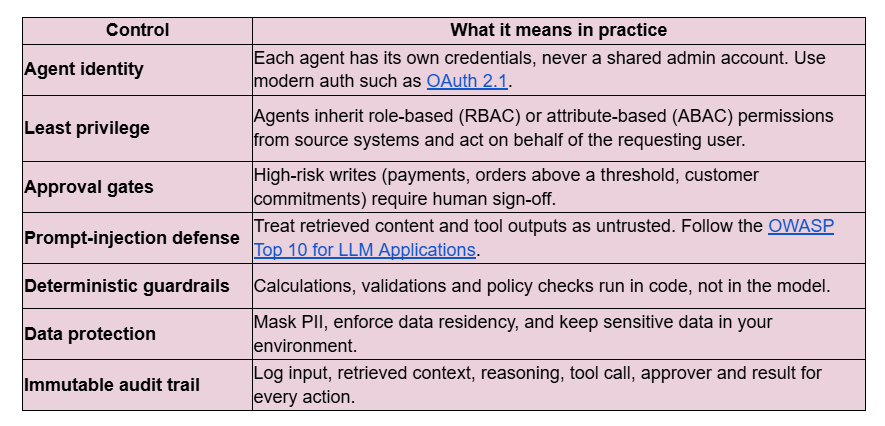
Governance spans every layer. It answers four questions for every agent action: who is acting, what they are allowed to do, who approved it, and where is the record. Core controls are agent identity, least-privilege access inherited from source systems, human-in-the-loop approvals for high-risk actions, and an immutable audit trail. We cover this in depth below.
Layer 6: Observability and evaluation
You can't scale what you can't measure. This layer traces every agent run end to end (input, retrieved context, reasoning steps, tool calls, output) and tracks:
- Accuracy against golden test sets.
- Cost per task and token usage by model.
- Latency per step.
- Drift in data, prompts or model behavior.
- Business KPIs such as cycle time, containment rate and SLA adherence.
Where Assistents.ai fits in each layer
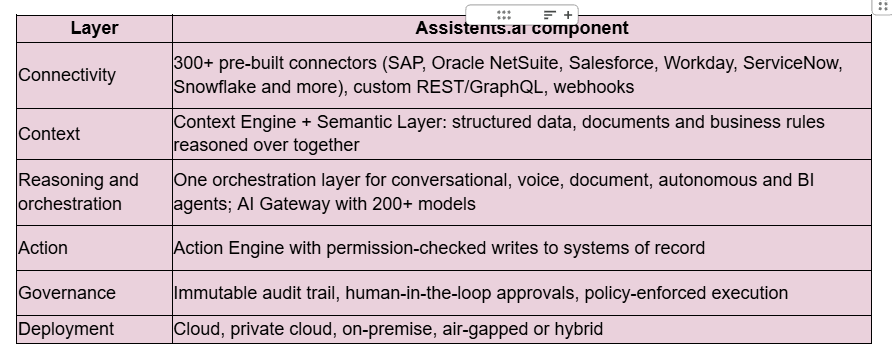
See how the platform is built →
APIs vs webhooks vs MCP vs A2A: which integration protocol when?
Use APIs to call systems, webhooks to react to events, MCP to expose tools and data to agents in a standard way, and A2A to let agents from different vendors collaborate. They are layers of the same stack, not competing choices.
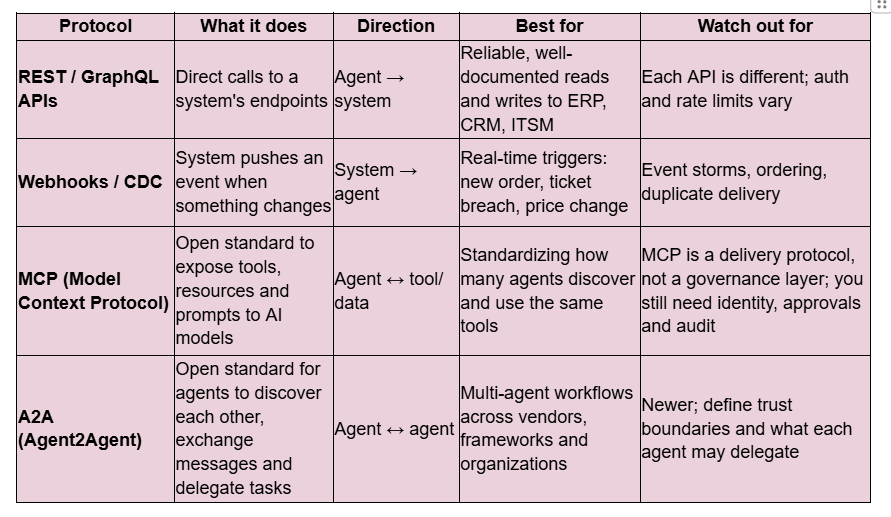
Two facts help frame the decision:
- The Model Context Protocol specification defines a host, client and server model where servers expose tools and resources to AI applications.
- The A2A protocol, now a Linux Foundation project backed by more than 150 organizations, is designed to complement MCP: MCP connects agents to tools and data, A2A connects agents to other agents.
Our rule of thumb: standardize tool access on MCP where it is available, keep direct APIs for high-volume transactional writes, use webhooks for every time-sensitive trigger, and introduce A2A only when agents genuinely need to delegate across platforms. For a side-by-side explainer, read MCP server vs AI agent.
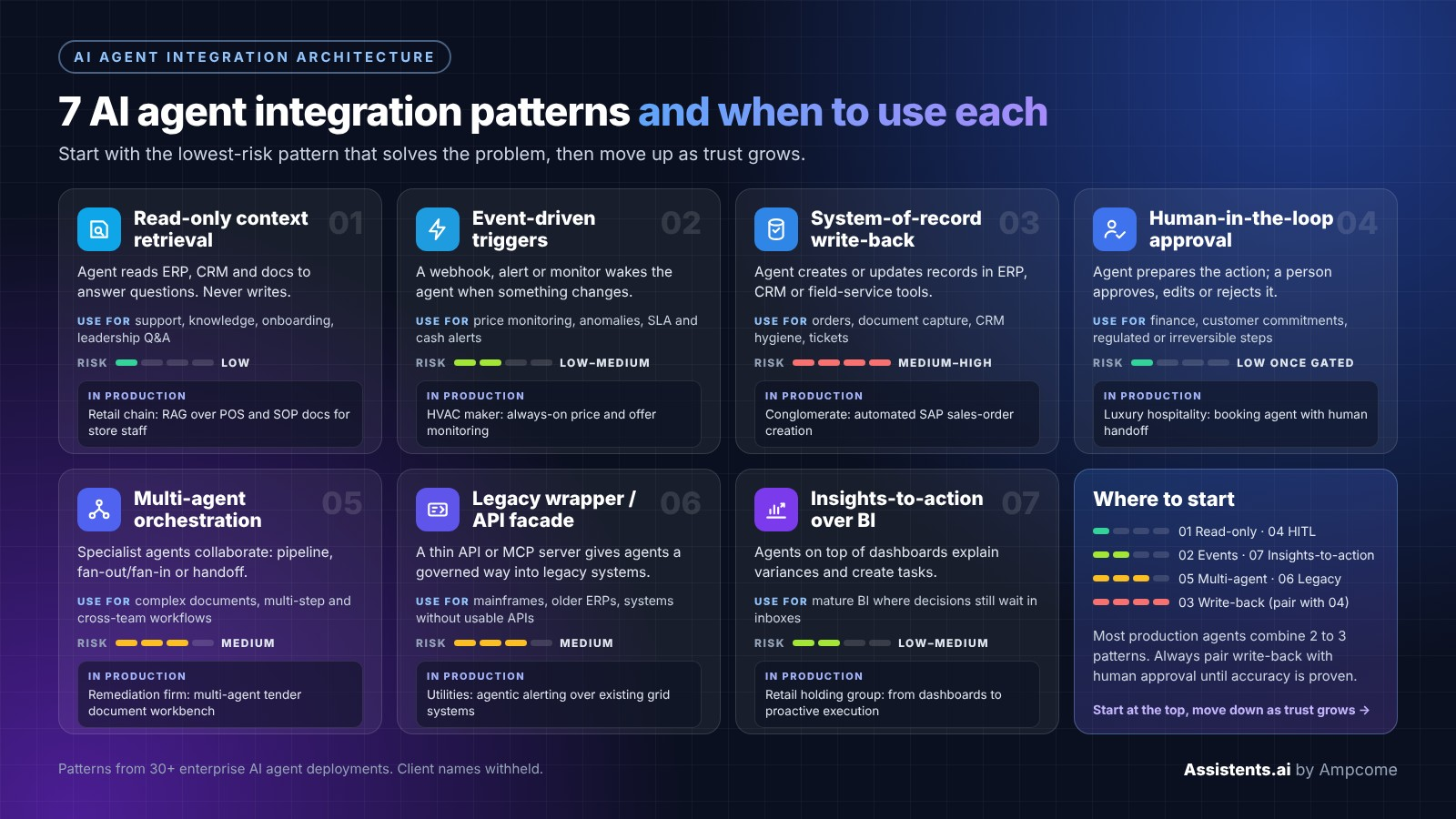
7 AI agent integration patterns (and when to use each)
Seven integration patterns cover nearly every enterprise AI agent use case we have deployed. Start with the lowest-risk pattern that solves the problem, then move up as trust grows.
1. Read-only context retrieval (RAG over systems of record)
The agent reads from ERP, CRM, documents and knowledge bases to answer questions, but never writes.
- Use when: support, knowledge access, onboarding, leadership Q&A.
- Risk: low. Main concern is data leakage, solved with permission-aware retrieval.
- In production: a national value retail chain deployed knowledge and training agents with RAG over POS manuals and SOPs, giving thousands of store staff on-demand answers and faster onboarding.
2. Event-driven triggers
A webhook, alert or scheduled monitor wakes the agent when something changes.
- Use when: price monitoring, anomaly detection, SLA breaches, cash-flow alerts.
- Risk: low to medium. Tune thresholds to avoid alert fatigue.
- In production: a large HVAC manufacturer replaced manual portal checks with always-on agents that monitor e-commerce pricing, discounts, offers and availability, then answer leadership questions instantly.
3. System-of-record write-back
The agent creates or updates records in ERP, CRM or field-service systems.
- Use when: order entry, data capture from documents, CRM hygiene, ticket creation.
- Risk: medium to high. Requires validation rules, idempotency and audit logs.
- In production: a diversified family conglomerate automated SAP sales-order creation with agentic AI, replacing a costly end-of-life document-capture tool.
4. Human-in-the-loop approval gates
The agent prepares the action; a person approves, edits or rejects it before execution.
- Use when: financial transactions, customer-facing commitments, regulated decisions, anything irreversible.
- Risk: low once gated, and it builds the trust needed to automate further.
- In production: a luxury safari hospitality group uses a booking agent that handles email intake, live inventory checks and alternative-date negotiation, then hands off to human travel designers for curated itineraries.
5. Multi-agent orchestration
Several specialist agents collaborate: sequentially (pipeline), concurrently (fan-out/fan-in) or by handoff (triage to a specialist). See the Azure orchestration patterns for definitions.
- Use when: complex documents, multi-step workflows, cross-department processes.
- Risk: medium. Coordination and error propagation need tracing.
- In production: a building remediation specialist runs an Intelligent Document Workbench where multiple agents retrieve tenders, determine workflow, analyze revisions and extract data with vision LLMs, then sync results into its field-service platform.
6. Legacy wrapper / API facade
A thin service (or an MCP server) wraps a legacy or on-premise system so agents can use it through a modern, governed interface.
- Use when: mainframes, older ERPs, custom databases, systems without usable APIs.
- Risk: medium. Never let agents query production databases directly.
- In production: state utilities and smart-infrastructure operators layered agentic analytics and automated alerting on top of existing grid and sensor systems without replacing them.
7. Insights-to-action over existing BI
Agents sit on top of dashboards and data warehouses, explain variances and turn insights into tasks in operational systems.
- Use when: you have mature BI but decisions still wait in inboxes.
- Risk: low to medium. Depends on whether tasks are auto-executed or assigned.
- In production: a retail holding group added a unified context engine, semantic governance layer and active orchestrator over its existing dashboards, shifting from reactive reporting to proactive execution loops.
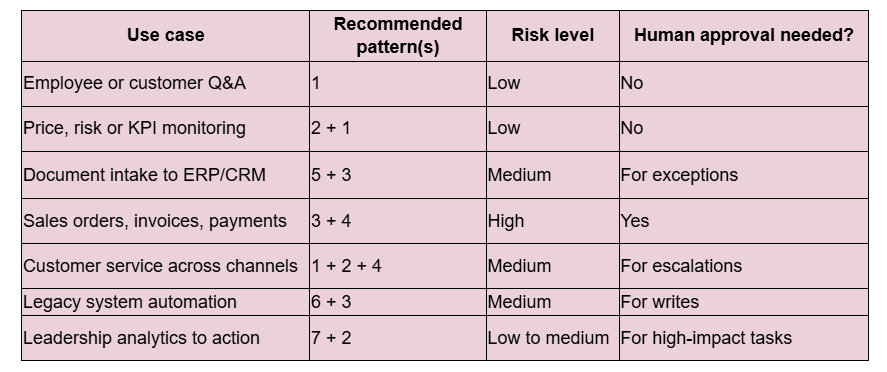
Pattern selection matrix
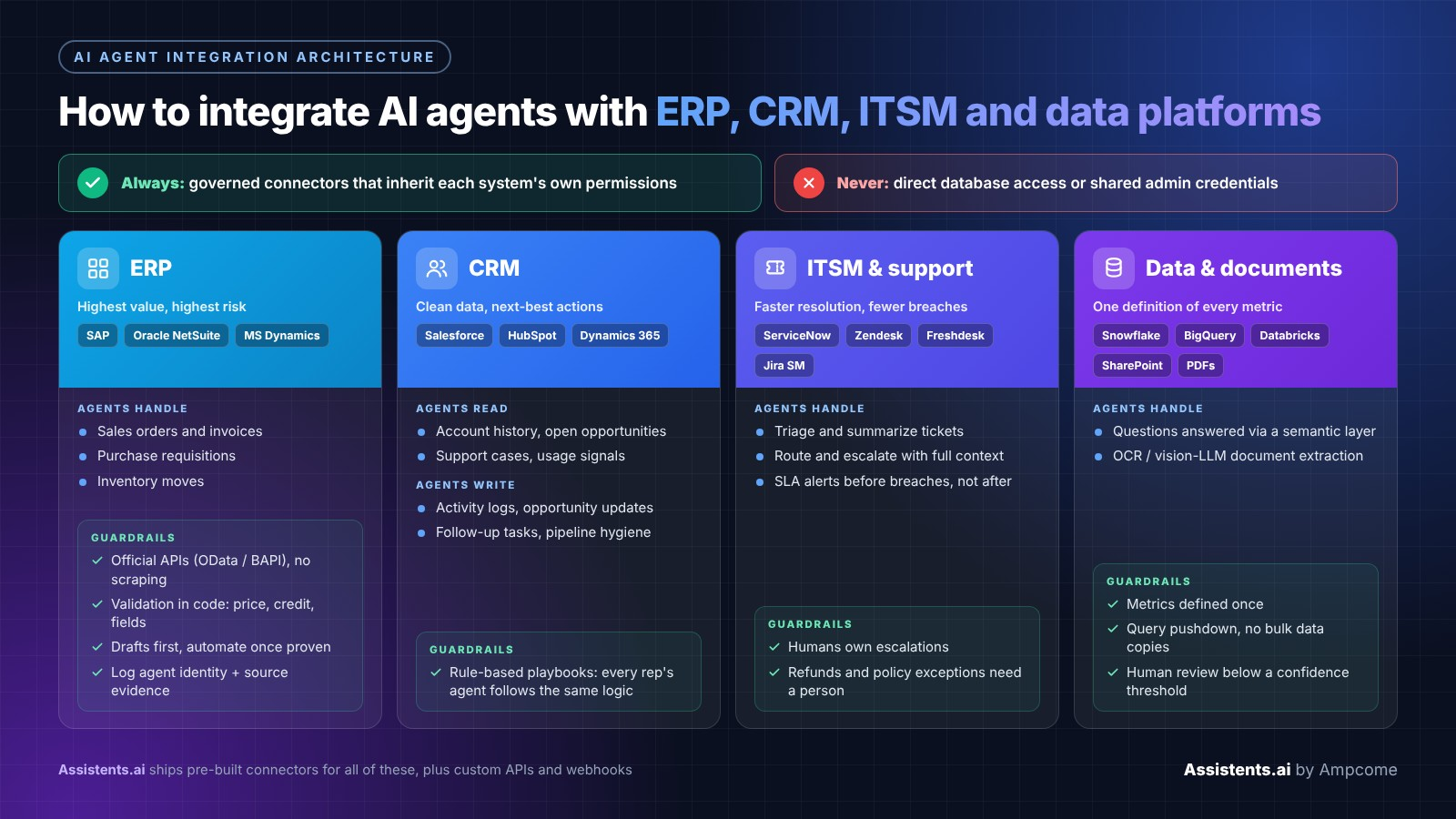
How to integrate AI agents with ERP, CRM, ITSM and data platforms
Integrate AI agents with enterprise systems through governed connectors that inherit each system's permissions, never through direct database access or shared admin credentials. Each system type has its own nuances.
ERP (SAP, Oracle NetSuite, Microsoft Dynamics)
ERP is where the highest-value and highest-risk actions live: orders, invoices, purchase requisitions, inventory moves.
- Use official APIs (for SAP, OData/BAPI services) instead of screen-scraping or database writes.
- Put validation in code: price checks, credit limits, mandatory fields.
- Start with draft documents that a person releases, then automate low-risk cases once accuracy is proven.
- Log every document created with the agent's identity and the source evidence (email, PDF, trigger).
CRM (Salesforce, HubSpot, Dynamics 365)
CRM agents add value by keeping data clean and surfacing next-best actions.
- Read: account history, open opportunities, support cases, usage signals.
- Write: activity logs, opportunity updates, follow-up tasks, pipeline hygiene fixes.
- Govern with rule-based playbooks so every rep's agent follows the same logic.
ITSM and customer support (ServiceNow, Zendesk, Freshdesk, Jira Service Management)
- Agents triage, summarize and route tickets, then escalate with full context.
- Track SLAs and trigger alerts before breaches, not after.
- Keep humans on escalations and anything involving refunds or policy exceptions.
Data warehouses and documents (Snowflake, BigQuery, Databricks, SharePoint, PDFs)
- Query warehouses through a semantic layer so metrics are defined once.
- Push filters to the source (query pushdown) rather than moving bulk data.
- For documents, combine OCR or vision-LLM extraction with confidence scores and human review below a threshold.
Assistents.ai ships pre-built connectors for all of the systems above, plus custom API and webhook support for in-house tools.
Governance, security and compliance for AI agent integrations
Secure AI agent integrations by giving every agent its own identity, scoping its access to the minimum it needs, gating risky actions behind human approval and recording every decision in an immutable audit trail. These controls belong in the architecture, not in a policy PDF.
Deployment models: cloud, private cloud, on-premise, air-gapped, hybrid
Regulated industries such as banking, healthcare, utilities and public sector often cannot send data to a public SaaS. Your integration architecture should support:
- Cloud for speed and low operational overhead.
- Private cloud / VPC for data isolation with managed operations.
- On-premise for strict data residency.
- Air-gapped for critical infrastructure and defense-adjacent workloads.
- Hybrid, where the control plane runs in the cloud and sensitive data and inference stay on-premise.
Assistents.ai supports all five deployment models, with no forced SaaS lock-in.
AI agent integration architecture in production: 8 real deployments
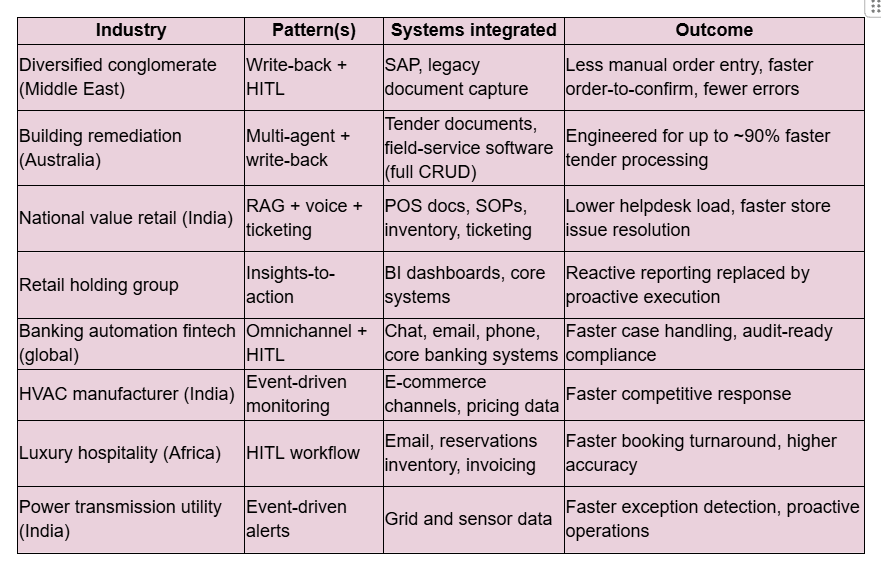
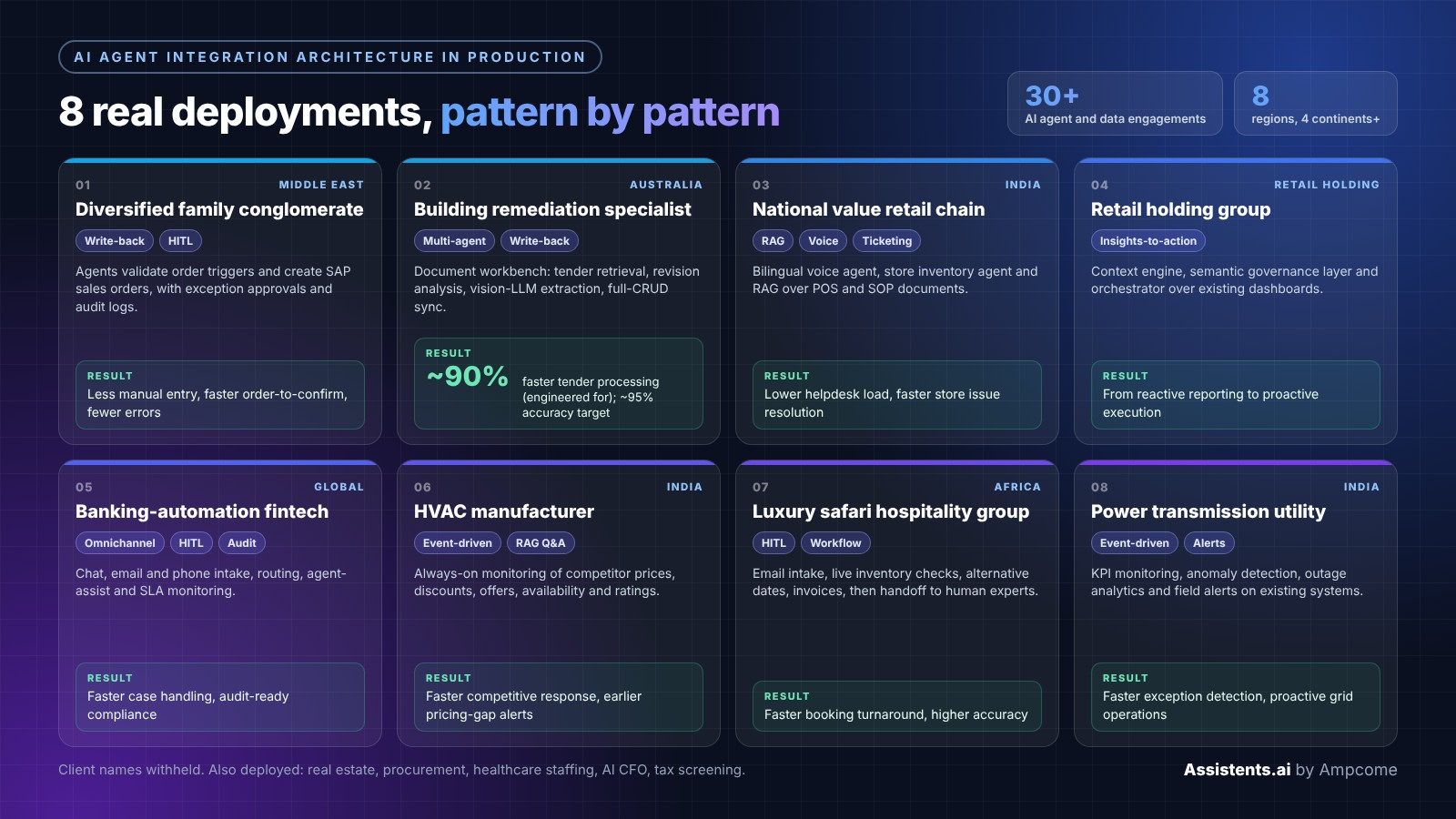
The architecture above is not theoretical. Ampcome has delivered more than 30 AI agent and data engagements across Africa, Australia, Canada, Europe, India, the Middle East, the UK and the US. Client names are withheld; each example shows which pattern was used and what changed.
1. Agentic SAP sales-order creation for a diversified conglomerate
A Middle East family conglomerate with more than 30 operating companies needed to move off a costly, end-of-life document-capture tool for sales orders. Ampcome built agents that interpret order triggers, validate them against business rules and create SAP sales orders automatically, with exception approvals, audit logs and reconciliation reporting. Result: reduced manual order processing and legacy dependency, a faster order-to-confirm cycle with fewer data-entry errors, and better auditability for every order and exception.
Architecture lesson: write-back to ERP is safe when validation lives in code and exceptions route to people.
2. Multi-agent tender processing for a building remediation specialist
An Australian remediation contractor handled complex, revision-heavy tender documents by hand. Ampcome built an Intelligent Document Workbench: multiple agents retrieve tenders, determine the workflow, analyze revisions and extract data from complex PDFs with vision LLMs, then sync results into the company's field-service platform with full create, read, update and delete access, quote locking and audit logs. Result: engineered for up to ~90% faster tender document processing, a ~95% extraction accuracy target for standard formats, and lower bid risk through revision detection.
Architecture lesson: multi-agent orchestration plus deep, bidirectional integration beats a single "do everything" agent.
3. Voice, inventory and knowledge agents for a national value retailer
A fast-growing value retail chain with a pan-India store network needed to cut helpdesk load across its stores. Ampcome deployed a bilingual voice support agent (speech-to-text, LLM, text-to-speech), an inventory intelligence agent for store-level pricing, stock and promotions, and a knowledge and training agent with RAG over POS and SOP documents, all tied into an admin console and ticketing. Result: reduced manual helpdesk burden, faster store issue resolution, better store-level inventory visibility and faster onboarding.
Architecture lesson: one shared context layer can power several agent types (voice, chat, analytics).
4. Insights-to-action for a retail holding group
Leadership at a retail holding company had dashboards but slow follow-through. Ampcome layered a unified context engine across structured and unstructured data, a semantic governance layer for rules, hierarchies and formulas, and an active orchestrator integrated with core systems. Result: a shift from reactive reporting to proactive execution loops, standardized decision logic across teams, and automated task creation and tracking.
Architecture lesson: the semantic layer is what makes agent outputs trustworthy at leadership level.
5. Omnichannel, auditable agents for a banking-automation fintech
A fintech serving banks and credit unions needed AI in disputes, fraud and support without compromising compliance. Ampcome delivered omnichannel intake across chat, email and phone, workflow routing, agent-assist summaries with next-best actions, and SLA monitoring, all integration-ready with core systems. Result: faster case handling, lower operational load and stronger compliance readiness through audit trails.
6. Always-on competitive monitoring for an HVAC manufacturer
A major cooling-products manufacturer in a price-sensitive market tracked competitors manually across portals. Agents now monitor pricing, MRP and discounts, offers, availability and ratings continuously, answer leadership questions on demand and raise proactive alerts, with governance and audit trails built in from PoC to production. Result: faster competitive response cycles and earlier detection of pricing gaps and promotion shifts.
7. Human-in-the-loop booking agent for a luxury hospitality group
A luxury safari lodge and camp operator needed faster responses without losing its personal touch. The booking agent classifies email intent, extracts details, runs a conversational loop to capture missing information, checks real-time inventory, proposes alternative dates or properties, and generates invoices, then hands off to human experts for curated itineraries. Result: faster booking turnaround, higher accuracy on complex guest requests, and room to scale without compromising service.
8. Event-driven grid intelligence for a power transmission utility
A state power transmission utility needed faster visibility into grid exceptions. Ampcome built transmission KPI monitoring, anomaly detection, loss and outage analytics and automated alerts for field operations on top of existing systems. Result: faster identification of grid exceptions, improved reliability through proactive monitoring and better transparency for leadership.
Similar architectures power our work in real estate tenant service, group procurement and finance KPI alerts, healthcare staffing, AI CFO forecasting and cross-border tax screening. Talk to our team about your use case.
Build vs buy vs assemble
Build if integration is your core product, buy if you need production agents in weeks, and assemble only if you have a dedicated platform team to maintain the glue.
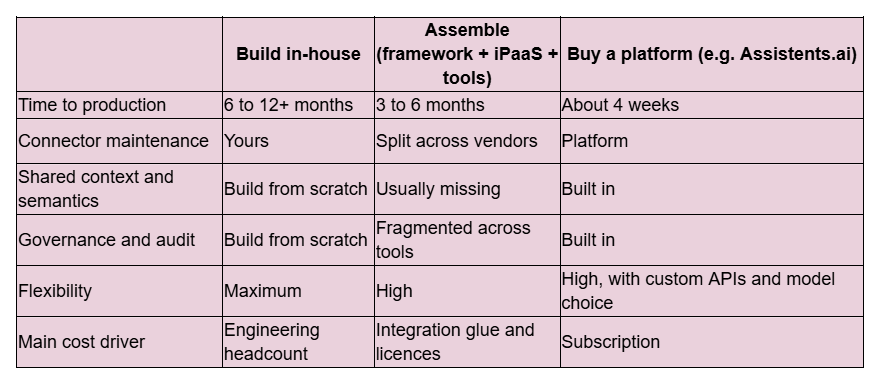
For the full evaluation framework, read the CIO's guide to choosing an enterprise AI agent platform.
AI agent integration checklist: 10 questions to ask before you ship
- Does every agent have its own identity and least-privilege access?
- Are permissions inherited from the source systems, per user?
- Is there one governed connector per system, reused by all agents?
- Do all agents share the same business definitions (semantic layer)?
- Which actions are read-only, which write, and which need approval?
- Is validation enforced in code, not only in prompts?
- Are writes idempotent, and is there a rollback path for multi-step failures?
- Is every decision logged in an immutable audit trail?
- Can you see accuracy, cost per task, latency and drift on one dashboard?
- Can the system run where your data must stay: cloud, private cloud, on-premise or air-gapped?
If you answered "no" to three or more, your architecture is not ready for production yet.
Why Assistents.ai is the leading platform for AI agent integration architecture
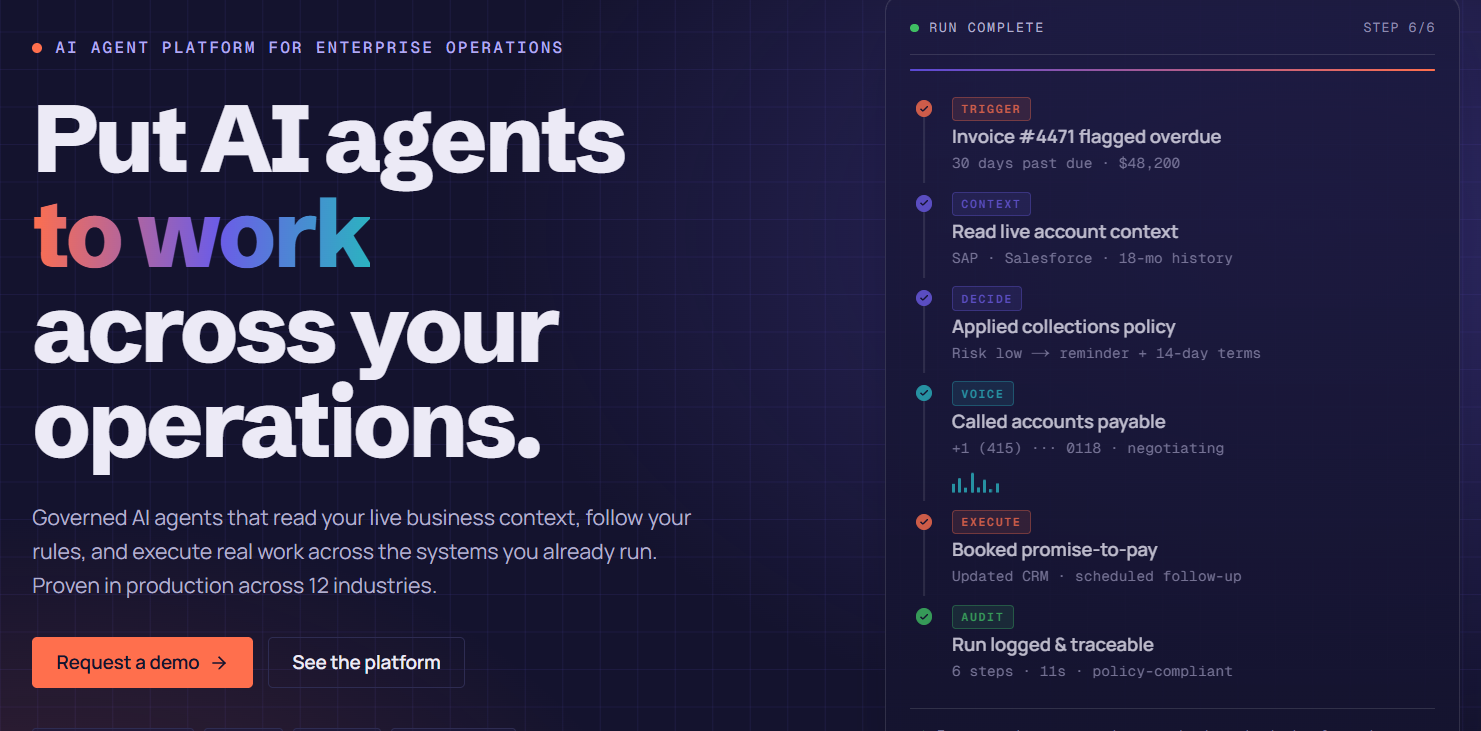
Assistents.ai by Ampcome ships all six layers of the AI agent integration architecture as one governed platform, so enterprises go from pilot to production in about 4 weeks instead of stitching together connectors, frameworks and governance tools.
- One platform, all six layers. Connectivity, context, orchestration, action, governance and observability come together. No glue code between an iPaaS, an agent framework and a separate governance product.
- Agents that act, not just answer. Proven write-back into systems of record, from SAP sales-order creation to full-CRUD field-service integration.
- Shared business context. The Context Engine and Semantic Layer reason across structured data, documents and business rules, so every agent uses the same definitions.
- Governance by default. Permission-checked actions, human-in-the-loop approvals, policy-enforced execution and an immutable audit trail on every agent.
- 300+ connectors and 200+ models. Pre-built integrations across ERP, CRM, HRIS, finance, ITSM, data and collaboration tools, plus an AI Gateway to swap models without rewrites.
- Deploy where your data lives. Cloud, private cloud, on-premise, air-gapped or hybrid.
- Production evidence. More than 30 enterprise engagements across retail, logistics, ports, energy and utilities, finance, healthcare, real estate, hospitality and education.
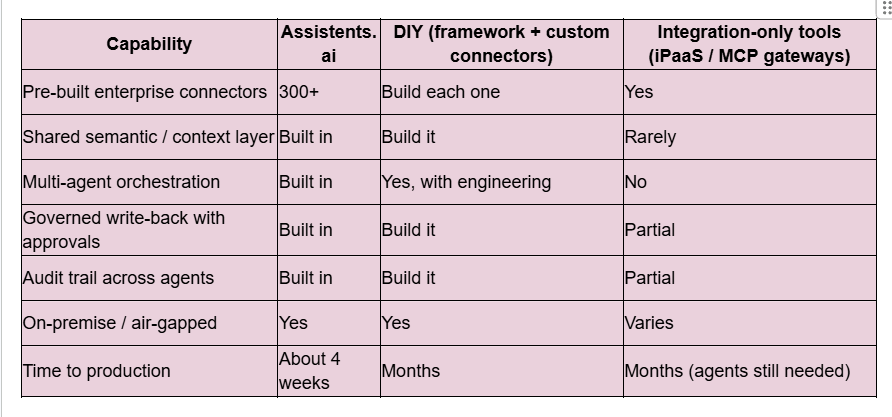
Explore why teams choose Assistents.ai →
From pilot to production in 4 weeks: a rollout plan
A governed AI agent can go from kickoff to production in about four weeks when the integration layers already exist. Here is the plan we follow:
- Week 1: Scope and connect. Pick one high-value workflow. Map systems, data, permissions and the approval policy. Connect sources using pre-built connectors. Exit gate: data flowing, access approved by security.
- Week 2: Context and agent design. Configure business definitions in the semantic layer. Choose the integration pattern (see the matrix). Build the agent with read-only access first. Exit gate: answers match a golden test set.
- Week 3: Governed actions and testing. Enable write-back behind approval gates. Run against production snapshots in a sandbox. Test failure modes: stale data, connector outage, invalid input. Exit gate: accuracy and safety thresholds met.
- Week 4: Launch and observe. Roll out to a pilot team with monitoring on accuracy, cost, latency and business KPIs. Relax approvals for low-risk cases as confidence grows. Exit gate: KPI improvement versus baseline, sign-off to scale.
Key takeaways
- AI agent integration architecture is what turns AI pilots into production systems. Models are rarely the bottleneck; integration, context and governance are.
- Design around six layers and choose from seven patterns, starting with the lowest-risk pattern that solves the problem.
- Treat MCP and A2A as complementary standards on top of solid APIs, webhooks and governance.
- Assistents.ai by Ampcome delivers all six layers in one governed platform, proven across 30+ enterprise engagements.
Ready to design your AI agent integration architecture? Book an architecture review with the Assistents.ai team and get a pattern-by-pattern plan for your first production agent.
Related reading
- MCP Server vs AI Agent: What's the Difference?
- assistents.ai: The Enterprise Agentic AI Platform
- The CIO's Guide to Enterprise AI Agent Platform Selection
- Context Engine Architecture Deep-Dive
- How to Build AI Agents
- AI Agent Development Company
FAQs
What is AI agent integration architecture?
AI agent integration architecture is the set of layers, protocols and governance controls that let AI agents securely read from and write to enterprise systems such as ERP, CRM, ITSM and data warehouses. It typically has six layers: connectivity, context, reasoning and orchestration, action, governance, and observability.
What are the main components of an AI agent architecture?
The main components are connectors to enterprise systems, a context or semantic layer for shared business meaning, a reasoning and orchestration layer with a model gateway, an action layer for governed writes, a governance layer for identity, approvals and audit, and an observability layer for accuracy, cost and drift.
How do AI agents integrate with existing enterprise systems?
AI agents integrate through governed connectors built on each system's official APIs, webhooks for real-time events, and increasingly MCP servers that expose tools in a standard way. The agent inherits the user's permissions, validation runs in code, and every action is logged. Direct database access should be avoided.
Do AI agents need MCP?
No, but MCP helps. The Model Context Protocol standardizes how agents discover and use tools and data, which cuts custom integration work when many agents share the same systems. It does not replace identity, approvals or audit, so you still need a governance layer on top. Read more in MCP server vs AI agent.
What is the difference between MCP and A2A?
MCP connects an AI agent to tools and data sources. A2A (Agent2Agent) connects agents to other agents so they can discover each other, exchange messages and delegate tasks across vendors and platforms. The two protocols are complementary and are often used together in multi-agent systems.
How is AI agent integration different from traditional API integration or iPaaS?
In traditional integration, developers hard-code which API is called and when. In AI agent integration, the agent decides at runtime. That requires per-agent identity, shared business context, approval gates for risky actions, decision-level audit trails and guardrails that classic iPaaS tools were not designed to provide.
How do you secure AI agents that write to ERP or CRM systems?
Give each agent its own identity, inherit least-privilege permissions from the source system, enforce validation in deterministic code, require human approval for high-risk writes, defend against prompt injection, make writes idempotent and log every action in an immutable audit trail.
Can AI agents work with legacy or on-premise systems?
Yes. Wrap legacy systems in an API facade or MCP server so agents use a modern, governed interface instead of touching the database directly. For data residency, deploy the agent platform on-premise, in a private cloud, air-gapped or in a hybrid model.
Should we build or buy AI agent integration infrastructure?
Build if integration is your core product and you have a platform team. Buy if you need governed agents in production within weeks. Most enterprises buy a platform for the six core layers and build only the custom connectors and workflows unique to their business.
How long does it take to move an AI agent from pilot to production?
With a platform that already provides connectors, context, orchestration and governance, a focused workflow can reach production in about four weeks. Building the same layers in-house typically takes six months or more before the first agent is production-ready.

Transform Your Business With Agentic Automation
Agentic automation is the rising star posied to overtake RPA and bring about a new wave of intelligent automation. Explore the core concepts of agentic automation, how it works, real-life examples and strategies for a successful implementation in this ebook.
Sarfraz Nawaz is the CEO and founder of Ampcome, which is at the forefront of Artificial Intelligence (AI) Development. Nawaz's passion for technology is matched by his commitment to creating solutions that drive real-world results. Under his leadership, Ampcome's team of talented engineers and developers craft innovative IT solutions that empower businesses to thrive in the ever-evolving technological landscape.Ampcome's success is a testament to Nawaz's dedication to excellence and his unwavering belief in the transformative power of technology.

More insights
Discover the latest trends, best practices, and expert opinions that can reshape your perspective






Contact us


