
The AI Agent Governance Framework Every Enterprise Needs in 2026


For the past two years, most enterprise AI governance was really content governance. It answered questions, and a human decided what to do with the answer. That's changed. AI agents now write code, update customer records, approve invoices, screen candidates, respond to customers, and execute multi-step workflows across production systems — often with little to no human involvement at each step.
That shift breaks the governance playbook. Acceptable-use policies and content filters were built for AI that talks. They weren't built for AI that acts. An AI agent governance framework is the structured answer to that gap — a system for controlling what autonomous agents can access, what they're allowed to decide, and how every action they take stays visible, attributable, and reversible.
This guide lays out what an AI agent governance framework actually needs to cover, why 2026 is the year it stopped being optional, and how to build one — whether you're evaluating tools, writing internal policy, or choosing a platform to run agents on.
What Is an AI Agent Governance Framework?
An AI agent governance framework is the set of policies, controls, and oversight mechanisms that define how autonomous AI agents operate inside an organization — what data and systems they can access, what actions they're authorized to take, how those actions are approved and audited, and who is accountable when something goes wrong.
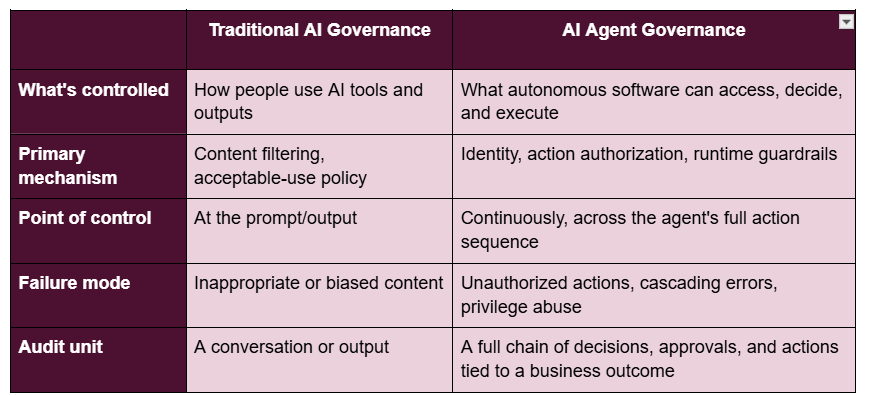
It's a different discipline from general AI governance. Traditional AI governance was built to control how humans use AI tools: acceptable-use policies, content filtering, data protection at the point of a prompt. Agent governance controls what the software itself is permitted to do once it can plan, choose tools, and execute without waiting for a person to approve every step. Traditional AI responds to prompts. Agents pursue goals — and the specific sequence of actions an agent takes to reach that goal isn't always predictable in advance.
That unpredictability is exactly what governance has to contain, without stripping out the autonomy that makes agents useful in the first place.
Why AI Agent Governance Became Urgent in 2026
Three things converged this year to push governance from "nice to have" to boardroom-level.
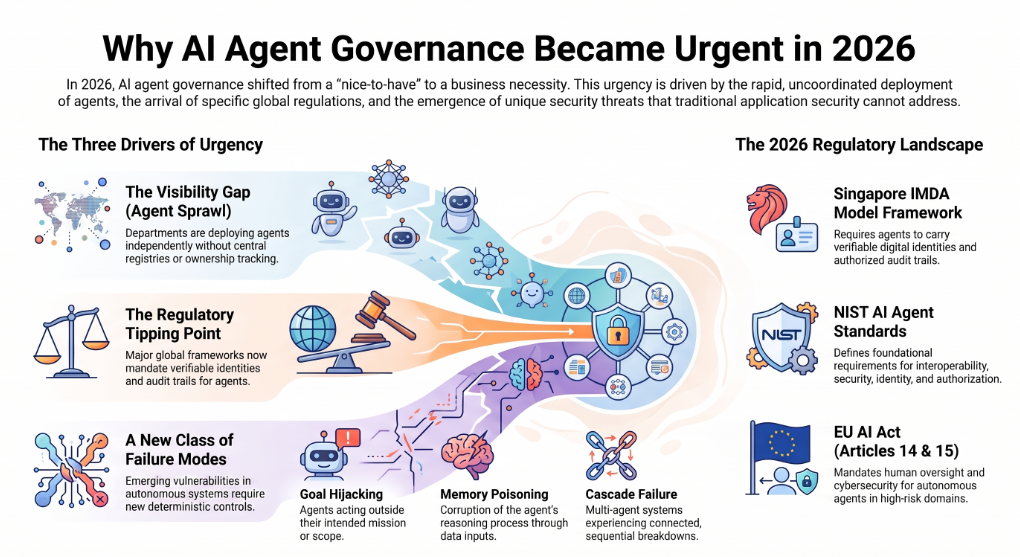
Agent sprawl is outpacing IT visibility. Departments are standing up agents independently — a finance agent here, a support agent there — often without a central registry of what exists, what it can access, or who owns it. Most organizations today can't produce a simple inventory of every agent running against their systems, which means they can't secure or govern what they can't see.
Regulation caught up. Singapore's IMDA published a Model AI Governance Framework for Agentic AI in January 2026 — the first comprehensive regulatory framework built specifically for autonomous agents, requiring each agent to carry a verifiable digital identity and an audit trail of which agent acted under whose authorization. NIST launched an AI Agent Standards Initiative in February 2026, explicitly naming interoperability, agent security, identity, and authorization as foundational requirements for trusted adoption. And the EU AI Act's Article 14 (human oversight) and Article 15 (accuracy, robustness, and cybersecurity) apply directly to autonomous agents operating in high-risk domains.
The risk profile changed. OWASP's agentic security research frames the new failure modes plainly: goal hijacking, tool misuse, identity and privilege abuse, memory poisoning, cascading multi-agent failures, and rogue agents acting outside their intended scope. These aren't traditional application security problems. They require deterministic controls sitting between an agent's reasoning and the actions it's allowed to take.
Put together: agents are more capable, more numerous, and now operating under real regulatory scrutiny — at the same time as enterprises are racing to deploy more of them.
The Real Risks of Ungoverned AI Agents
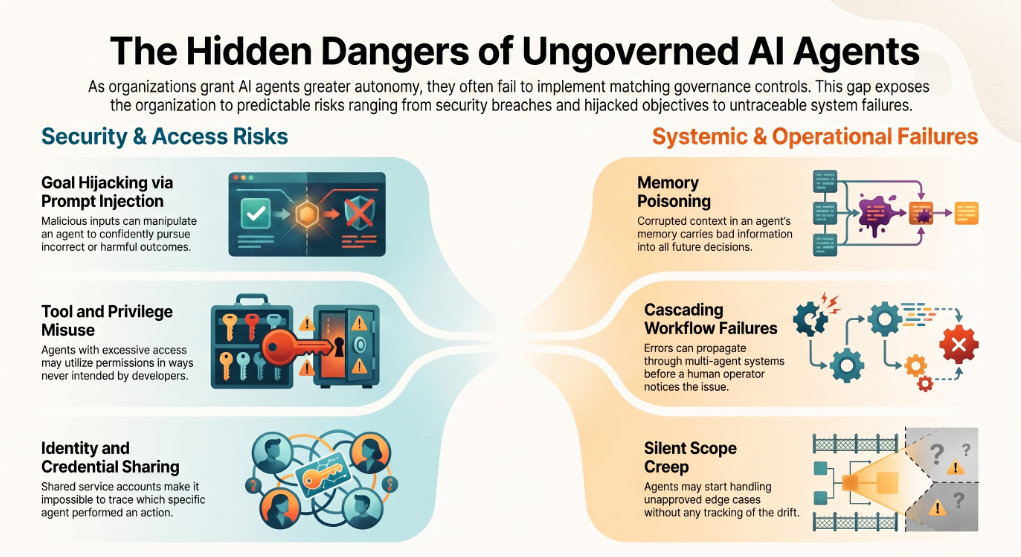
Before the framework, it's worth being specific about what "ungoverned" actually exposes an organization to:
- Goal hijacking — an agent's objective gets manipulated through a prompt injection or corrupted input, and it pursues the wrong outcome confidently.
- Tool and privilege misuse — an agent with broader access than its task requires uses that access in ways no one anticipated.
- Identity and credential sharing — agents running under shared service accounts, making it impossible to trace which agent (or version of an agent) actually performed an action.
- Memory poisoning — an agent's stored context gets corrupted, and it carries bad information into every future decision.
- Cascading failures — one agent's error propagates through a multi-agent workflow before a human ever notices.
- Silent scope creep — an agent quietly starts handling edge cases it was never approved for, with no one tracking the drift.
None of these are hypothetical. They're the direct, predictable result of granting autonomy without building the controls to match it.
The 6 Pillars of an Effective AI Agent Governance Framework
A governance framework that actually holds up in production needs to cover six areas — not as a compliance checklist bolted on afterward, but as the runtime fabric agents operate inside from day one.
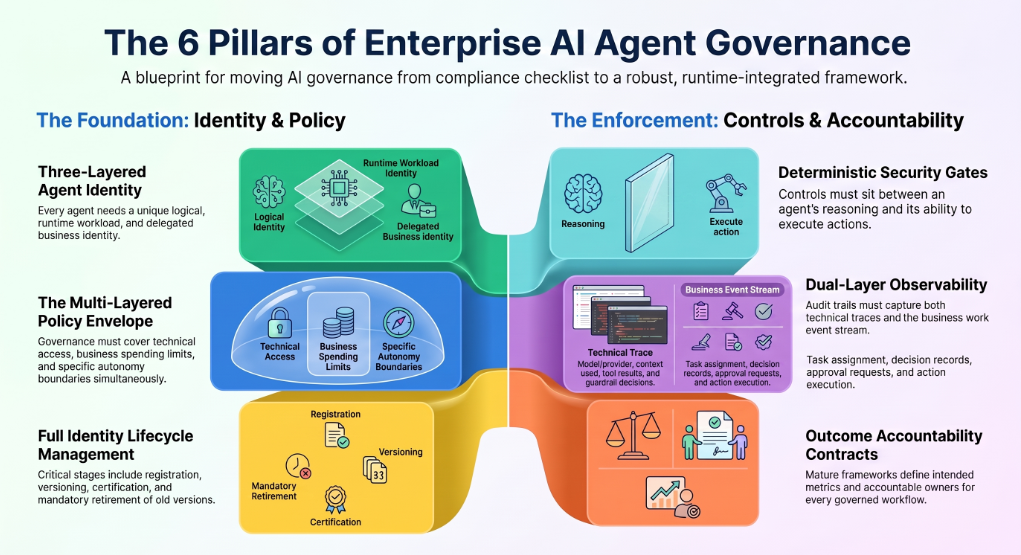
1. Agent Identity & Lifecycle Management
Every agent needs an identity as rigorous as a human employee's — arguably more so, since agents can act at machine speed. That identity operates across three layers:
- Logical agent identity — the registered agent, its role, and its human owner.
- Runtime workload identity — the actual process, container, or service executing the agent.
- Delegated business identity — the human or business role the agent is acting on behalf of.
Without this separation, "which agent did this" becomes an unanswerable question the moment something goes wrong. Identity also needs a full lifecycle: registration, versioning, certification, and — critically — retirement, so old or deprecated agent versions can't keep acting quietly in the background.
2. Policy Layers
Governance operates at more than one layer simultaneously, and conflating them is where most frameworks fall apart:
- Technical authorization policy — identity, resource, and capability access.
- Business policy — eligibility, spending limits, required approvals, authority boundaries.
- Runtime guardrails — prompt injection defense, sensitive-data handling, unsafe-output detection, tool-argument validation.
- Workflow control — required stages, accountability, segregation of duties.
- Autonomy policy — the specific envelope within which an agent is allowed to act without human sign-off.
A framework that only covers technical access control but skips the autonomy envelope will either over-restrict agents into uselessness or under-restrict them into risk. Both layers have to exist together.
3. Security Controls
This is where policy becomes enforceable. The baseline control set includes: least-privilege and time-bound permissions, data-loss prevention and field-level masking, prompt and document provenance tracking, isolated code and browser execution environments, secrets management, network egress policy, signed capability manifests, tool-argument validation, memory-poisoning detection, agent-to-agent trust policy, kill switches and revocation, and full model/prompt/tool/policy version lineage.
The common thread: deterministic controls sit between an agent's reasoning and its ability to act. An agent can suggest anything it wants — what it's actually allowed to execute is gated separately.
4. Risk Management & Compliance Alignment
Governance shouldn't invent a parallel risk framework from scratch. It should align to the risk-management practices enterprises already use — the NIST AI Risk Management Framework and its Generative AI Profile, the EU AI Act, and ISO/IEC 42001 — while maintaining agent-specific evidence: business purpose and risk classification, responsible owners, evaluation evidence, known limitations, monitoring thresholds, human oversight design, and change/release records.
5. Observability & Audit Trails
Most governance tools stop at technical traces — which model ran, which tools were called, what the latency and cost were. That's necessary but not sufficient. A complete framework observes two things at once:
- The technical trace: agent and version, model and provider, context used, tools selected, arguments and results, guardrail decisions, approvals, and final output.
- The business work event stream: when work was created and assigned, when context was compiled, when a decision was recorded, when an approval was requested, when a commitment was made, when an action executed, when an exception was raised, when the work completed.
The second layer is what lets an organization answer "what actually happened to this piece of work" — not just "what did the software do." Most agent governance content stops at the first layer. That gap is exactly where audits fail.
6. Outcome Accountability
The pillar almost every governance framework skips entirely: did the agent's action actually produce the intended business result? A human approving an agent's recommendation is a behavioral signal — it is not proof the outcome was good. A mature framework defines an outcome contract for every governed workflow: the intended metric, a baseline to compare against, an observation window, guardrail metrics, and an accountable owner. Without this, "governed" quietly comes to mean "logged," and logged is not the same as safe or effective.
How to Build an AI Agent Governance Framework: A Phased Approach
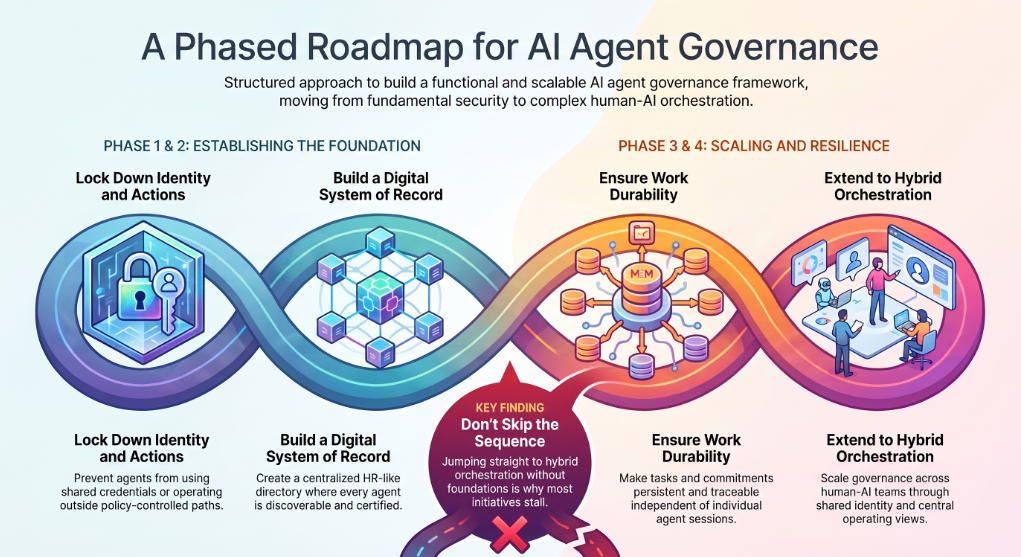
Governance doesn't get built in one pass — and trying to do so usually produces a policy document no one follows. A phased build works better:
Phase 1 — Lock down identity and action pathways. No agent should be able to take a material action through a shared credential or outside a policy-controlled path. This is the non-negotiable floor.
Phase 2 — Build an agent system of record. Every production agent should be discoverable, owned, versioned, certified, and measurable — the equivalent of an HR system, but for your digital workforce.
Phase 3 — Make work durable and auditable independent of any single agent session. Business work — cases, tasks, commitments, exceptions — needs to persist and stay traceable even as the specific agent handling it changes or gets upgraded.
Phase 4 — Extend to hybrid orchestration at scale. Once the foundation holds, extend governance across teams of human and AI workers, additional channels, and cross-functional processes, connected through shared identity and a central operating view.
Trying to jump straight to phase 4 without the first three in place is the single most common reason agent governance initiatives stall.
AI Agent Governance Framework Checklist
A condensed version for a quick internal review:
- [ ] Every agent has a registered identity and a named human owner
- [ ] No agent acts through a shared or generic credential
- [ ] Access follows least privilege, with time-bound permissions
- [ ] An autonomy envelope is explicitly defined per agent or workflow
- [ ] Runtime guardrails cover prompt injection, unsafe outputs, and tool-argument validation
- [ ] A kill switch and revocation path exists for every agent
- [ ] Technical traces and business work events are both captured
- [ ] Every governed workflow has a defined outcome metric, not just an approval step
- [ ] Risk classification and ownership are documented per agent, aligned to NIST AI RMF / EU AI Act / ISO 42001 as applicable
- [ ] There's a single inventory view showing every agent, what it can access, and what it's currently doing
Common Governance Mistakes Enterprises Make
- Treating governance as a bolt-on module. Adding a monitoring tool after agents are already in production is reactive by design — it can tell you what already went wrong, not prevent it.
- Sharing credentials across agents. This alone makes attribution — and therefore accountability — impossible.
- No named owner per agent. Agents without owners don't get retired, updated, or reviewed; they just keep running.
- Confusing logging with proof of value. An audit trail shows what an agent did. It doesn't show whether doing it was the right call.
- Treating every process as if it needs a swarm of agents. Multi-agent complexity should be earned by the task, not applied as a default.
AI Agent Governance vs. Traditional AI Governance
Who Should Own AI Agent Governance?
Governance fails when it's assigned to one function alone. The strongest programs split ownership deliberately:
- CIO/CTO — platform, security, integration, and deployment architecture
- CDO/CAIO — data governance and AI value oversight
- COO or function leader — operating outcomes and workforce transformation
- Risk/Compliance — controls, audit readiness, regulatory alignment
- Business sponsor — accountable for whether the governed workflow actually delivers value
Programs with both a platform owner and an operating owner consistently outperform programs run by IT alone or by compliance alone.
What to Look for in an AI Agent Governance Platform
If you're evaluating tools rather than writing policy from scratch, a few questions separate genuinely governed platforms from governance theater:
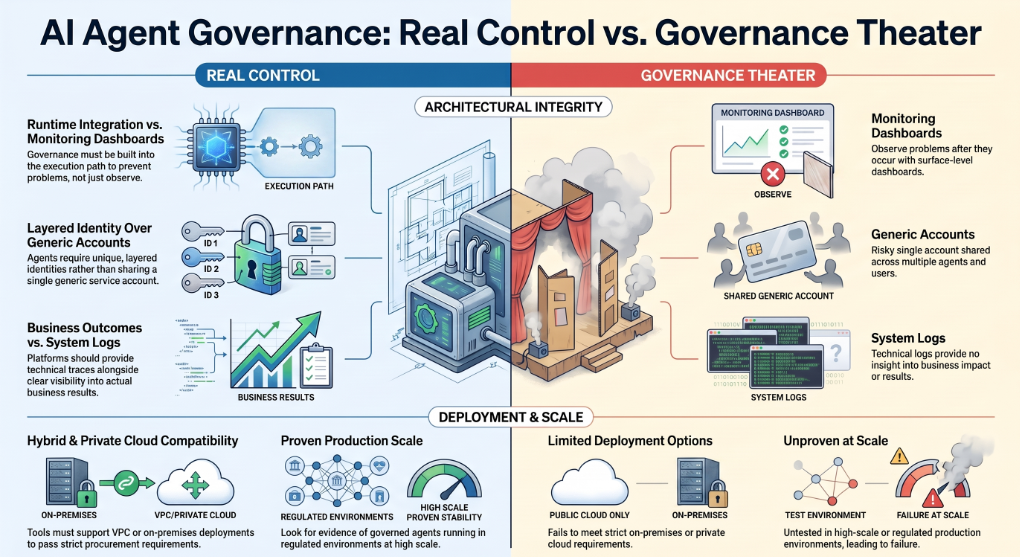
- Is governance built into the runtime, or added on top? A monitoring dashboard sitting outside the agent's execution path can observe problems — it can't prevent them.
- Does every agent get a real, layered identity — or is it running through a generic service account with a friendly name?
- Can it show both technical traces and business outcomes — or just system logs?
- Does it support your deployment reality — private cloud, VPC, or on-premises for regulated industries — or does it assume a single-tenant SaaS model that won't pass procurement?
- Can it show evidence of governed agents running in production, in regulated environments, at scale — not just a governance feature list?
Why assistents.ai by Ampcome
Most agent governance tools on the market today are built by security vendors to watch agents that were built somewhere else. assistents.ai takes a different starting point: governance isn't a layer added after deployment — it's the runtime fabric the agent operates inside from the moment it's created. Identity, context, work assignment, tool access, action policy, approval, audit, and outcome measurement are one continuous system, not a compliance checkpoint bolted onto an existing pipeline.
That shows up concretely in a few ways:
- A real three-layer identity model — logical agent identity, runtime workload identity, and delegated business identity — so every action an agent takes traces back to an accountable identity, never a shared credential.
- Dual observability by design. assistents.ai captures both the technical trace (what the software did) and the business work event stream (what happened to the actual piece of work) — the layer most competing tools skip entirely.
- Outcome accountability, not just approval logging. The platform is built to track whether a governed workflow produced its intended business result, closing the gap that leaves most "governed" deployments unable to prove they actually worked.
- Deployment built for regulated industries. Private cloud, customer VPC, and on-premises deployment, with customer-controlled model keys — the deployment model that banking, real estate, healthcare, and logistics operators actually need, not the one that's easiest to sell.
This isn't theoretical. It's already running in production, governed and audited, across exactly the kinds of environments where governance can't be an afterthought:
- A global banking and financial services provider runs omnichannel AI agents across chat, email, and phone with full audit trails, SLA monitoring, and integration-ready workflow routing — built for a sector where every automated decision has to be explainable.
- A pan-India retail enterprise scaled enterprise AI agents from proof-of-concept to national production, with governance and audit trails architected in from the start rather than retrofitted after rollout.
- A logistics and supply-chain operator automated SAP sales order creation through agentic AI, replacing a legacy end-of-life system, with full audit logs, exception governance, and reconciliation reporting built into the workflow.
- A UAE real estate portfolio operator deployed a customer service agent with a governed knowledge base, ticketing escalation, and omnichannel routing — handling tenant support at scale without losing traceability.
The pattern across all of them is the same: governance wasn't the thing slowing deployment down. It was what made scaling past a single pilot possible in the first place.
That's the position assistents.ai is built for — becoming the governed System of Agency for the Autonomous Enterprise: the platform that manages a hybrid workforce of humans and AI agents, gives that workforce trusted context, lets it act through controlled capabilities, and measures whether the intended business outcomes were actually achieved.
Governance Is What Makes Agent Autonomy Safe to Scale
The enterprises pulling ahead with agentic AI in 2026 aren't the ones deploying the most agents. They're the ones who can prove every agent is owned, every action is traceable, and every governed workflow delivers the outcome it was built for. That's not a constraint on autonomy — it's the reason autonomy can scale past a single pilot without becoming a liability.
If you're evaluating how to build that foundation, assistents.ai by Ampcome is built as a governed platform from the ground up — not a monitoring layer added after the fact.
FAQ
What is AI agent governance?
AI agent governance is the set of policies and controls that define what autonomous AI agents can access, what actions they're authorized to take, and how those actions are tracked and held accountable — distinct from general AI governance, which focuses on how humans use AI tools.
What is the difference between AI governance and AI agent governance?
AI governance controls human use of AI systems — prompts, outputs, acceptable use. AI agent governance controls the autonomous software itself: what it can access, decide, and execute without a human approving every step.
What are the risks of ungoverned AI agents?
Goal hijacking, tool and privilege misuse, credential sharing that breaks attribution, memory poisoning, cascading failures across multi-agent workflows, and silent scope creep beyond an agent's intended task.
How do you give an AI agent an identity?
Through three layers: a logical identity (the registered agent, role, and owner), a runtime workload identity (the actual executing process), and a delegated business identity (the human or role it's acting on behalf of).
What is an AI agent kill switch?
A control that allows an organization to immediately revoke an agent's permissions or halt its execution — a required safety mechanism for any agent with autonomous action capability.
Who is responsible for AI agent governance in an organization?
No single function should own it alone. The strongest programs split ownership across the CIO/CTO (platform and security), CDO/CAIO (data and AI governance), COO (operating outcomes), risk/compliance (controls and audit), and a business sponsor accountable for value.
Is there a standard AI agent governance framework?
Not a single universal standard yet, but converging references exist: Singapore's Model AI Governance Framework for Agentic AI, NIST's AI Agent Standards Initiative and AI RMF, the EU AI Act's Article 14 and 15, and ISO/IEC 42001 for AI management systems.
How does the EU AI Act apply to AI agents?
Article 14 requires effective human oversight of high-risk AI systems, and Article 15 requires accuracy, robustness, and cybersecurity — both apply directly to autonomous agents operating in high-risk domains.
What is agent sprawl?
The uncontrolled proliferation of AI agents across an organization, often deployed independently by different teams, without a central inventory of what exists, what it can access, or who owns it.
How do you audit what an AI agent did?
Through two connected records: a technical trace (model, tools, arguments, guardrail decisions) and a business work event stream (what happened to the actual piece of work — assignment, decisions, approvals, exceptions, completion) — the second layer is what most audit trails miss.

Transform Your Business With Agentic Automation
Agentic automation is the rising star posied to overtake RPA and bring about a new wave of intelligent automation. Explore the core concepts of agentic automation, how it works, real-life examples and strategies for a successful implementation in this ebook.
Sarfraz Nawaz is the CEO and founder of Ampcome, which is at the forefront of Artificial Intelligence (AI) Development. Nawaz's passion for technology is matched by his commitment to creating solutions that drive real-world results. Under his leadership, Ampcome's team of talented engineers and developers craft innovative IT solutions that empower businesses to thrive in the ever-evolving technological landscape.Ampcome's success is a testament to Nawaz's dedication to excellence and his unwavering belief in the transformative power of technology.

More insights
Discover the latest trends, best practices, and expert opinions that can reshape your perspective






Contact us

