
AI for Supply Chain Issues: How Agentic Analytics Solves Delays, Disruptions & Demand Shocks


AI for supply chain issues refers to using artificial intelligence to predict disruptions, detect supplier risks early, optimize logistics in real time, and automate corrective actions across the supply chain.
In practice, AI helps organizations solve problems like inaccurate demand forecasts, supplier delays, inventory imbalances, transportation disruptions, and slow response times. These are the issues traditional supply chain software struggles with.
Organizations face key challenges in addressing these problems, but leveraging AI can provide a competitive advantage by enabling more efficient and proactive supply chain management.
In this guide, you’ll learn:
- The exact supply chain problems AI can solve today
- How AI works across demand, suppliers, logistics, and inventory
- Why dashboards and rule-based systems fail
- How agentic analytics turns insights into automated action
Why Do We Need AI for Supply Chain Issues?
Global supply chain disruptions increased 38% in 2024, with over 22,500 disruption events documented across factory fires, labor strikes, extreme weather, and geopolitical chaos.
And here's the brutal truth: 59% of these disruptions were severe enough to trigger emergency response protocols. If you're still relying on traditional dashboards to manage your supply chain, you're not just behind. You're vulnerable.
Supply chains in 2026 face unprecedented volatility. Tariffs are reshaping global trade routes overnight. Climate disasters are wiping out logistics corridors without warning. Labor disruptions are paralyzing ports. And your traditional BI tools?
They're showing you what happened last week while your competitors are responding to what's happening right now.
The problem isn't that you lack data. You're drowning in it.
This is where AI in supply chain management stops being a buzzword and becomes survival. But most companies think adding an LLM chatbot to their existing BI tool counts as AI transformation. It doesn't.
What you need is agentic analytics, systems that don't just analyze data but autonomously detect patterns, and trigger corrective actions.
What Supply Chain Issues Can AI in Supply Chain Actually Solve?
Let's get specific about what we're solving here. Supply chain leaders face six major categories of problems that traditional systems simply cannot handle:
Demand forecasting failures happen when your models only look at historical sales data and miss the signals that actually drive demand. Social media buzz, competitor promotions, weather patterns, economic indicators.
Companies using AI-driven supply chain management report 15% logistics cost reduction and 35% inventory level improvements. That's not incremental. That's transformational.
Supplier delays and quality issues remain invisible until they hit your production line because traditional systems can't read unstructured communications. Your supplier sends an email mentioning potential delays. Your quality team flags concerns in a report.
Transportation disruptions multiply because reactive systems wait for delays to happen before responding. Port congestion builds. Weather degrades routes. Geopolitical events close borders. Real-time response requires continuous monitoring of hundreds of data streams that traditional BI simply cannot process.
Why Is Most Supply Chain Data Unusable By Traditional Systems?
Here's the reality that makes traditional BI worthless for modern supply chains: your most valuable information isn't in your ERP.
Think about what actually drives supply chain outcomes. A logistics manager mentions capacity constraints in an email. A supplier includes production delay warnings in their monthly PDF report. Weather services predict storms affecting shipping lanes.
News outlets report labor strikes at competitor facilities. Market analysts publish reports on commodity price trends. Your sales team discusses customer feedback in Slack.
Your structured data tells you what happened. Purchase orders, shipment records, inventory levels, sales transactions. This is valuable but incomplete. It's like trying to predict weather using only yesterday's temperature while ignoring pressure systems, humidity, wind patterns, and satellite imagery.
Your external data provides the context you can't see from inside. Competitor pricing changes, regulatory updates, economic indicators, weather forecasts, geopolitical developments, social media sentiment.
Why Do Traditional Tools Fail At Supply Chain Management?
Let us show you exactly where traditional analytics breaks down in supply chain contexts.
1. They Only Process Structured Data
Your supply chain runs on conversations, documents, and real-world events that never touch your database. When a supplier's production line goes down, the first signal isn't a delayed shipment record in your ERP. It's an email from their operations manager, a mention in their weekly status report, or chatter on industry forums.
Traditional BI tools can't read emails. They can't analyze PDFs. They can't monitor news feeds. They're blind to the early warning signals that could help you respond before problems metastasize.
2. They Can't Connect Root Causes Across Domains
Supply chain issues rarely have single causes. Delivery delays correlate with port congestion, which correlates with weather patterns, which correlates with seasonal demand spikes, which correlates with competitor promotions you didn't anticipate.
Traditional dashboards show you isolated metrics. "Shipments delayed 23%." Great. Now what? Is it supplier issues, transportation problems, quality holds, customs delays, or demand surge overwhelming capacity? Your dashboard has no idea because it can't reason across multiple data domains simultaneously.
3. Insights Don't Become Actions
This is the killer problem. Your BI tool alerts you that inventory is running low. Your forecasting model predicts a demand spike. Your logistics dashboard shows transportation capacity constraints.
Now what? Someone has to interpret these signals, decide on a response, get approval, and execute. This takes days or weeks. Meanwhile, the market has moved. The disruption has escalated. The opportunity has closed.
4. No Trust or Explainability
When you plug basic LLMs into enterprise analytics, they hallucinate. They generate SQL queries that look right but calculate metrics incorrectly. They miss critical joins. They ignore business logic. They produce confident answers that are completely wrong.
5. They Can't Handle Multi-Step Reasoning
Accurate supply chain decision-making requires chaining multiple analytical steps together:
- Detect anomaly in shipment velocity
- Correlate with supplier communications for context
- Check external news for relevant disruptions
- Model impact on downstream operations
- Identify alternative suppliers or routes
- Calculate cost-benefit of each option
- Recommend optimal response
- Execute approved actions
What Is Agentic Analytics And Why Does It Matter?
Agentic analytics represents a fundamental shift from AI that analyzes to AI that acts. Instead of waiting for humans to ask questions, agentic systems autonomously explore data, detect patterns, test hypotheses, diagnose problems, and trigger responses.
Agentic systems use multiple specialized AI agents working together:
- Knowledge Agents retrieve and synthesize information from diverse sources. They read PDFs, parse emails, search logs, monitor news feeds, and extract relevant information from unstructured content.
When your supply chain needs to understand how a regulatory change might impact operations, knowledge agents go find and summarize the relevant documents.
- Analytical Agents perform quantitative analysis and reasoning on structured data. They detect trends, forecast demand, identify anomalies, attribute root causes, and build predictive models.
When shipment delays spike, analytical agents examine patterns to determine if it's seasonal variation, systematic problems, or emerging disruptions.
- Orchestrator Agents serve as project managers, breaking complex questions into subtasks, delegating to appropriate specialists, managing dependencies, and synthesizing results into coherent answers.
When you ask "Should we switch suppliers for this component?" The orchestrator coordinates knowledge agents pulling supplier data, analytical agents modeling cost impacts, and action agents preparing procurement workflows.
- Action Agents execute decisions by triggering workflows, updating systems, sending alerts, and integrating with operational tools.
When the analysis indicates inventory rebalancing is needed, action agents can automatically generate transfer orders, notify warehouse teams, and update forecasts.
How Does Agentic Analytics Actually Solve Supply Chain Problems?
Let's get concrete about what this looks like in practice across the major supply chain challenges.
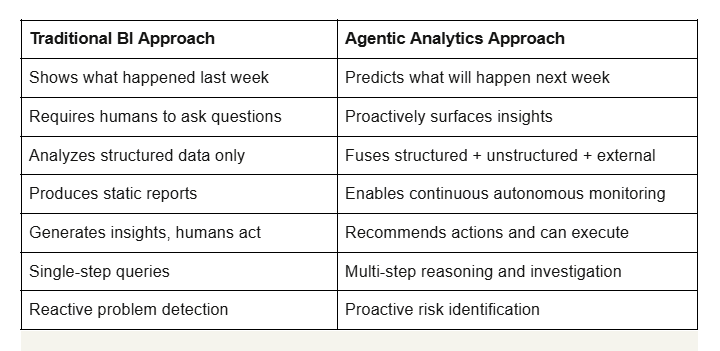
1. Demand Forecasting and Market Volatility
Traditional forecasting looks at historical sales patterns and extrapolates. Agentic analytics fuses multiple signal types:
Structured transaction data from your ERP and CRM provides the baseline. Historical sales, order patterns, seasonal trends.
Unstructured customer feedback from support tickets, sales calls, and surveys reveals emerging needs and dissatisfaction that affects future demand.
External market intelligence from news, analyst reports, and economic indicators provides macro context.
Is your market growing or contracting? Are substitutes emerging? What are competitors doing?
Social sentiment analysis from reviews, forums, and social media detects buzz or backlash before it hits your sales numbers.
Weather and event data for retail and consumer products where conditions directly drive demand patterns.
2. Supplier Delays and Disruption Prediction
This is where unstructured data fusion becomes critical. Supplier problems rarely appear in your ERP first. They appear in communications.
Agentic systems continuously monitor:
- Supplier emails and reports for language indicating potential issues. Mentions of capacity constraints, quality problems, staffing challenges, or delivery concerns get flagged immediately.
- News and industry feeds for reports about suppliers, their locations, or their industries. Factory fires, labor strikes, regulatory actions, leadership changes.
- Logistics data from carriers and freight forwarders about route disruptions, port congestion, customs delays.
When concerning signals emerge, the system doesn't just alert you. It automatically:
- Assesses which of your products and orders are at risk
- Calculates the potential impact on your operations
- Identifies alternative suppliers with available capacity
- Models the cost and lead time implications of switching
- Recommends the optimal response
- Prepares the procurement workflows to execute if approved
This moves from "supplier might have problems" to "here's exactly what to do about it" in minutes instead of weeks.
3. Logistics Optimization and Risk Monitoring
Supply chain logistics involves continuous decisions about routing, modes, carriers, and timing. Agentic analytics enables truly dynamic optimization.
The system monitors:
- Real-time transportation data from GPS tracking, carrier systems, and IoT sensors showing exactly where shipments are and how they're moving.
- Weather and traffic feeds providing advance warning of conditions affecting routes and timings.
- Port and terminal data indicating congestion, equipment availability, and processing delays.
- Geopolitical and regulatory updates affecting border crossings, tariffs, and trade routes.
- Carrier performance metrics tracking reliability, cost, and service levels across your logistics network.
- When the system detects developing problems, it doesn't wait for humans to react. It automatically models alternative scenarios, calculates cost-benefit tradeoffs, and executes approved contingency protocols.
4. Inventory Balancing and Automated Replenishment
Optimal inventory management requires balancing dozens of competing factors: demand variability, lead time uncertainty, carrying costs, stockout penalties, supplier minimums, capacity constraints.
Agentic systems continuously:
- Forecast demand using the multi-modal approach described earlier, incorporating signals traditional forecasting ignores.
- Monitor inventory levels and velocity across your entire network, not just at aggregated locations.
- Track supplier lead times and reliability using both historical data and current communications indicating potential changes.
- Model optimal stock levels for each SKU at each location given current and expected conditions.
- Execute approved reorders by triggering workflows in your ERP and supplier systems without manual intervention.
5. Real-Time Risk Detection and Proactive Alerts
This is where agentic analytics truly differentiates itself. Instead of reactive dashboards that wait for you to check them, agentic systems act like a vigilant operations team that never sleeps.
The system continuously monitors for:
- Anomalies in any metric that matters. Shipment velocity changes, quality defect rates, supplier response times, carrier performance, demand patterns.
- Early warning signals from unstructured sources. Supplier communications mentioning concerns, news about regions affecting your supply base, weather forecasts indicating disruptions.
- Correlation patterns that humans would miss. Why are defect rates up? Is it specific suppliers, specific components, specific production batches, or something else entirely?
AI Integration and Route Optimization
Integrating AI into supply chain management is no longer optional—it’s essential for organizations aiming to stay ahead in a fast-paced, unpredictable world. For supply chain planners, AI integration means harnessing advanced algorithms to make smarter, data-driven decisions across every link in the logistics network.
One of the most impactful applications is route optimization, where AI algorithms analyze vast amounts of data to determine the most efficient transportation routes and delivery schedules.
AI-powered route optimization delivers immediate benefits: it reduces fuel consumption, cuts operational costs, lowers emissions, and ensures faster, more reliable deliveries. This not only results in significant cost savings but also enhances the overall customer experience.
Beyond logistics, AI tools help supply chain managers evaluate supplier performance, predict potential disruptions, and identify opportunities for continuous improvement.
By integrating AI into their operations, supply chain professionals can create autonomous supply chains that adapt in real time to shifting market trends and customer demands.
AI-powered simulations allow managers to model different scenarios, test strategies, and optimize resource allocation before making real-world changes—minimizing risk and maximizing efficiency.
As a result, organizations that embrace AI integration and route optimization are better equipped to build resilient, responsive supply chains that thrive in today’s dynamic business environment.
What Does This Look Like In Real Operations?
Let me walk you through a concrete scenario showing supply chain AI use cases.
A mid-sized manufacturer produces consumer electronics with a complex global supply chain. They source components from 50+ tier-1 suppliers across 12 countries, manufacture in 3 locations, and distribute through 8 regional DCs to thousands of retail locations.
The Traditional Approach:
Friday afternoon, the supply chain director notices in their weekly dashboard that lead times from their primary display supplier have increased 15%. They email the procurement team to investigate. Procurement reaches out to the supplier Monday morning. The supplier mentions some production issues they're working through. Procurement asks for details.
After several email exchanges over three days, they learn the supplier is experiencing quality problems with a raw material from their suppliers.
The Agentic Analytics Approach:
Tuesday morning, knowledge agents monitor supplier communications flags concerning language in the display supplier's weekly status report. The report mentions "addressing some upstream material quality issues" buried in a routine update.
Within seconds, the system:
- Flags the mention for investigation (Knowledge Agent)
- Analyzes historical patterns of how long similar issues typically take to resolve (Analytical Agent)
- Checks current inventory of displays and calculates how long current stock will last (Analytical Agent)
- Models impact on production schedule if supplies are delayed (Analytical Agent)
- Searches for news or reports about the supplier's upstream suppliers (Knowledge Agent)
- Identifies alternative display suppliers with compatible specifications (Knowledge Agent)
- Calculates cost and lead time implications of switching suppliers (Analytical Agent)
- Generates comprehensive risk assessment with three response options (Orchestrator)
By Tuesday afternoon, the supply chain director receives a detailed alert:
"Risk detected: Primary display supplier experiencing raw material quality issues. Based on analysis of supplier communications and historical resolution times, expect 3-4 week delay in deliveries. Current inventory insufficient to maintain production schedule beyond next week.
Recommended Actions for agentic AI supply chain:
Option A: Place immediate order with Alternative Supplier B for 60% of next month's needs. Cost premium 12%, lead time 10 days, ensures uninterrupted production.
Option B: Reduce production schedule 30% for three weeks to stretch inventory. Saves premium cost but delays deliveries and misses Q1 targets.
Option C: Expedite alternative materials to original supplier. Requires coordination with tier-2 supplier, uncertain timeline, moderate cost increase.
System recommendation: Option A. Preserves customer commitments at acceptable cost increase. Click to execute procurement workflow."
The director reviews the analysis, approves Option A, and the system automatically:
- Generates purchase orders for the alternative supplier
- Notifies production planning of the supply change
- Updates delivery forecasts for affected customers
- Sets monitoring protocols to track both suppliers
- Schedules review meeting with procurement team
Why Is This The Future Of Supply Chain Intelligence?
We're at an inflection point in supply chain management. The old model of human analysts slowly investigating problems using static dashboards can't keep pace with modern supply chain complexity and volatility.
The market is validating this shift. The AI in supply chain market reached $19.8 billion in 2025, growing at 45.3% CAGR. Major cloud platforms like Databricks and Snowflake are embedding AI-powered analytics directly into their data platforms. Traditional BI vendors are scrambling to add agentic capabilities.
But here's what most organizations get wrong: they think they can bolt agentic AI onto their existing systems. They can't. Agentic analytics requires fundamentally different architecture built around data fusion, multi-agent reasoning, continuous monitoring, and action execution.
How Can You Implement Agentic Analytics In Your Supply Chain?
If you're a supply chain leader evaluating this approach, here's the practical path forward.
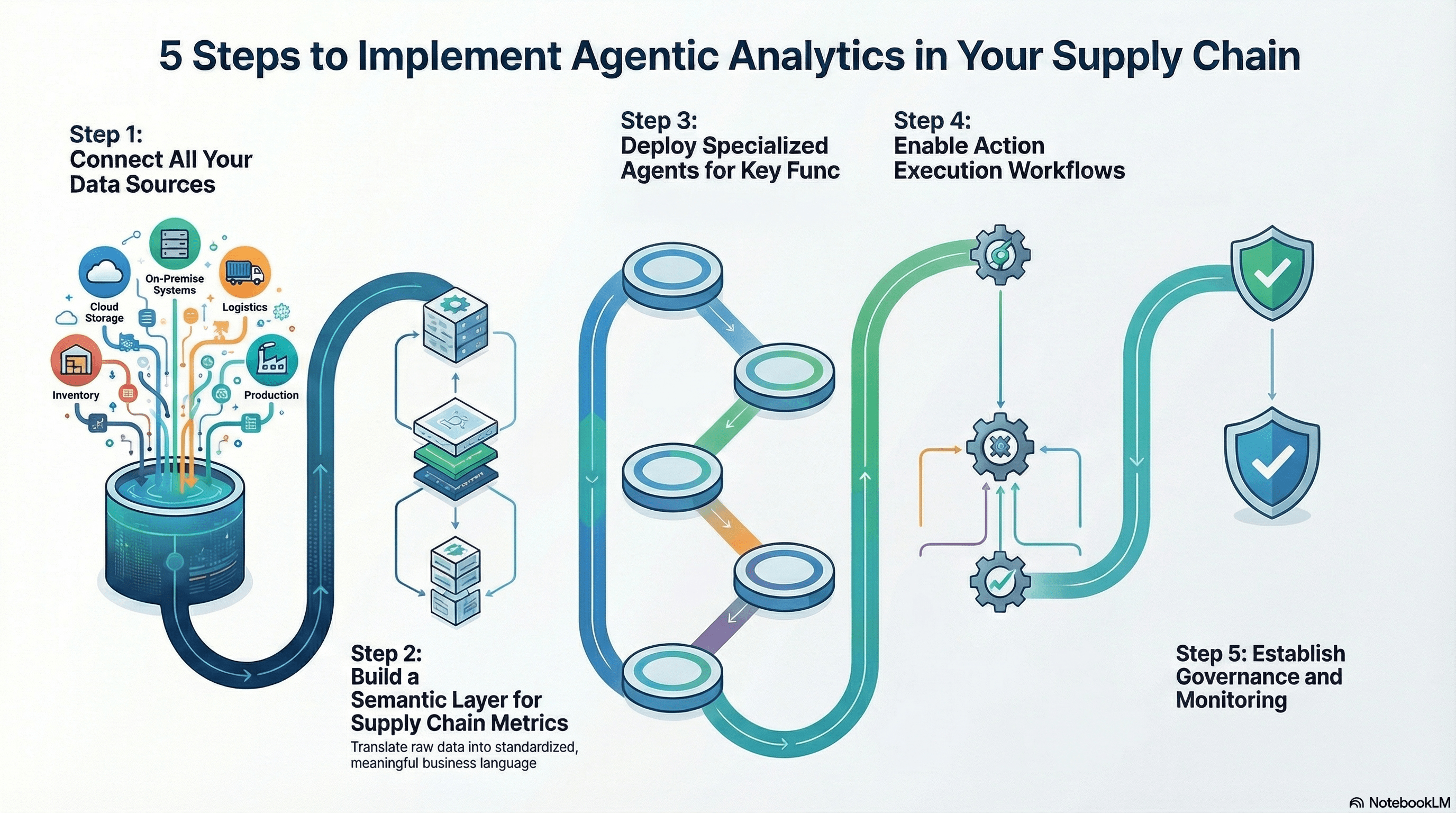
Step 1: Connect All Your Data Sources
Start by enabling the data fusion that makes agentic analytics possible. This means connecting:
- Structured systems: ERP, WMS, TMS, CRM, procurement platforms, manufacturing systems. All the transactional systems that record what's happening in your supply chain.
- Unstructured sources: Email systems, document repositories, supplier portals, internal collaboration tools. All the communication channels where context and early warnings appear.
- External feeds: Weather services, news APIs, logistics providers, market data, regulatory sources. All the external signals that affect your operations.
Step 2: Build a Semantic Layer for Supply Chain Metrics
Agentic AI needs to understand your business context. What exactly constitutes a "delay" in your operations? How do you calculate "inventory health"? What defines a "critical" supplier?
A semantic layer codifies this business logic in a way AI can use. It maps technical data fields to business concepts, defines calculations for key metrics, encodes relationships between entities, and captures rules and constraints.
Step 3: Deploy Specialized Agents for Key Functions
Don't try to build one AI that does everything. Deploy specialized agents for different supply chain functions:
- Demand forecasting agents that continuously monitor transaction data, customer feedback, market signals, and external factors to maintain updated forecasts.
- Supplier risk agents that track supplier communications, financial stability, operational performance, and external disruptions to provide early warning of problems.
- Logistics optimization agents that monitor transportation networks, weather, capacity, and costs to recommend optimal routing and mode decisions.
- Inventory management agents that balance demand forecasts, lead times, carrying costs, and service levels to optimize stock positions.
- Quality monitoring agents that detect defect patterns across suppliers, components, and production processes to identify systemic issues.
Step 4: Enable Action Execution Workflows
The value of agentic analytics comes from closing the loop to action. This requires integration with operational systems:
- ERP integration to generate purchase orders, update forecasts, adjust production schedules.
- Supplier communication systems to send inquiries, share forecasts, negotiate changes.
- Logistics platforms to execute routing decisions, book capacity, track shipments.
- Workflow tools to create tasks, alert teams, route approvals.
Step 5: Establish Governance and Monitoring
Enterprise supply chains require robust governance. This means:
- Access controls ensure people only see data they're authorized for and can only execute actions within their authority.
- Audit trails logging every analysis, recommendation, and action for compliance and debugging.
- Data lineage tracking where every fact came from and how it was transformed for validation and troubleshooting.
- Performance monitoring measures whether the AI's recommendations actually improve outcomes and where it needs refinement.
- Feedback loops capturing when humans override AI recommendations and why, to continuously improve the models.
Where Do Supply Chains Go From Here?
The shift to agentic analytics in supply chain management isn't optional. It's inevitable. The question is whether you'll lead this transition or be forced into it by competitive pressure.
Conversational analytics represented a step forward in user experience. Asking questions in natural language beats learning BI query languages. But it's still fundamentally reactive. You have to know what questions to ask.
The winners in this era will be organizations that:
- Deploy autonomous agents that continuously monitor, investigate, and act rather than waiting for human analysts to manually execute workflows.
- Build trust through governance by making AI decisions transparent, auditable, and aligned with business logic.
- Close the action loop so insights automatically trigger responses instead of sitting in reports waiting for someone to notice them.
AI for supply chain issues only works when it's grounded in agentic capabilities: multi-modal data fusion, autonomous multi-agent reasoning, enterprise-grade governance, and the ability to act on insights automatically. Everything else is incremental improvement on systems designed for a different era.
Ready to see how exactly Agentic AI can help? Book a call for Assistents by Ampcome.
FAQs
1. How is AI for supply chain issues different from traditional supply chain software?
Traditional supply chain software (ERP, WMS, TMS) primarily records transactions and generates reports about what already happened. These systems require humans to analyze the reports, identify problems, and decide on responses. AI for supply chain issues, particularly with agentic analytics, autonomously monitors all your data (structured and unstructured), and detects problems as they emerge.
2. What are AI agents and how do they improve supply chain management?
AI agents are autonomous software systems that can perceive their environment, make decisions, and take actions toward specific goals. In supply chains, knowledge agents extract information from documents, analytical agents detect patterns and forecast outcomes, and action agents execute decisions by triggering workflows.
3. Can agentic AI integrate with our existing supply chain systems?
Yes, modern agentic analytics platforms are designed to augment existing systems rather than replace them. They integrate with your ERP, WMS, TMS, CRM, and other operational systems through APIs and data connections. The agentic layer sits on top, pulling data from these systems, performing analysis, and pushing recommendations or actions back through proper workflows.
4. How long does it take to see ROI from agentic supply chain analytics?
Implementation timelines vary based on supply chain complexity and data readiness, but most organizations see initial benefits within 3 to 6 months. Early wins typically come from improved forecast accuracy, faster disruption response, and better inventory optimization. Companies report drop in logistics costs and reduction in inventory levels after implementing AI-driven supply chain management.
5. What are the biggest risks and challenges with implementing agentic AI for supply chains?
The main challenges include data quality and accessibility (if your supply chain data is fragmented, incomplete, or inconsistent, AI will struggle to generate reliable insights), change management (supply chain teams must learn to trust and collaborate with AI recommendations), governance and compliance, and avoiding hype versus reality.

Transform Your Business With Agentic Automation
Agentic automation is the rising star posied to overtake RPA and bring about a new wave of intelligent automation. Explore the core concepts of agentic automation, how it works, real-life examples and strategies for a successful implementation in this ebook.
Sarfraz Nawaz is the CEO and founder of Ampcome, which is at the forefront of Artificial Intelligence (AI) Development. Nawaz's passion for technology is matched by his commitment to creating solutions that drive real-world results. Under his leadership, Ampcome's team of talented engineers and developers craft innovative IT solutions that empower businesses to thrive in the ever-evolving technological landscape.Ampcome's success is a testament to Nawaz's dedication to excellence and his unwavering belief in the transformative power of technology.

More insights
Discover the latest trends, best practices, and expert opinions that can reshape your perspective






Contact us

