
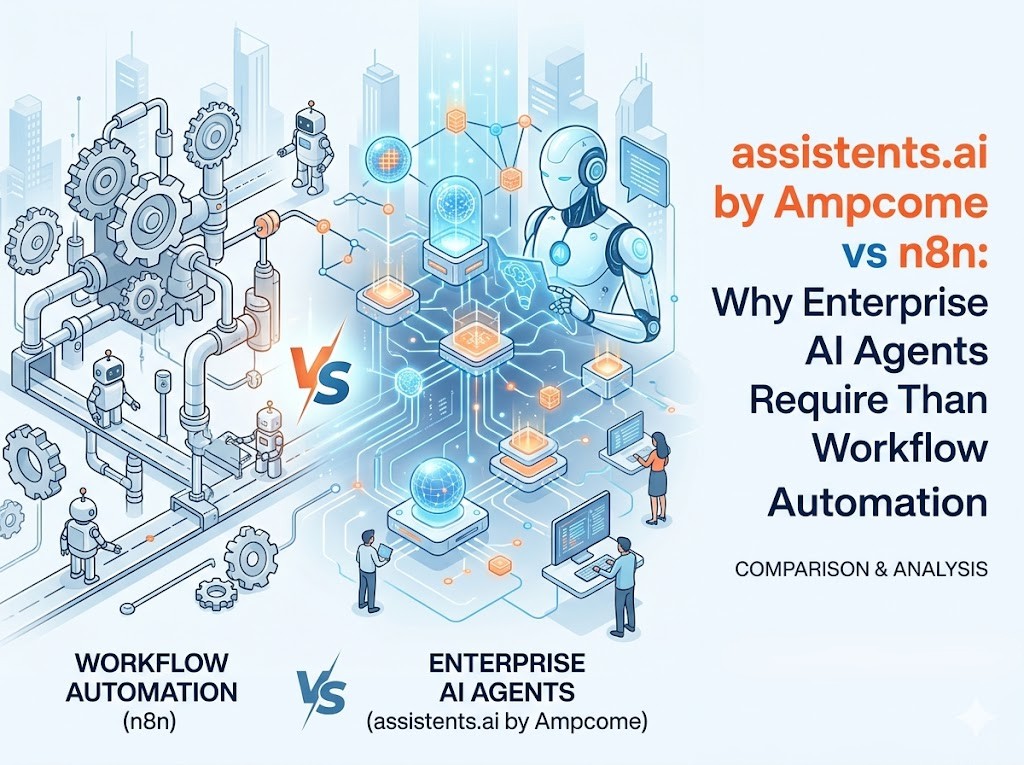
assistents.ai by Ampcome vs n8n: Why Enterprise AI Agents Require More Than Workflow Automation


You've probably used n8n — or at least evaluated it. The visual node editor is genuinely impressive. You connect an app here, add a trigger there, wire up some logic, and suddenly a workflow that used to require a developer and three days takes an afternoon. For simple automation, it works.
But here's where most enterprise teams hit a wall.
Leadership doesn't want faster if-then workflows anymore. They want AI agents that can reason across systems, make context-aware decisions, execute multi-step operations autonomously, and maintain a complete audit trail while doing it. They want an AI agent development company that can deploy these systems across finance, operations, customer support, and supply chain — not just connect apps.
That's a fundamentally different problem from what n8n was built to solve.
This guide compares assistents.ai by Ampcome — an enterprise agentic AI platform built for autonomous execution and governance — with n8n, one of the most widely used open-source workflow automation tools. By the end, you'll understand exactly which one fits your organisation, and why the distinction between workflow automation and enterprise AI agents matters more than most comparison blogs acknowledge.
What Is n8n? (And What It Was Built For)
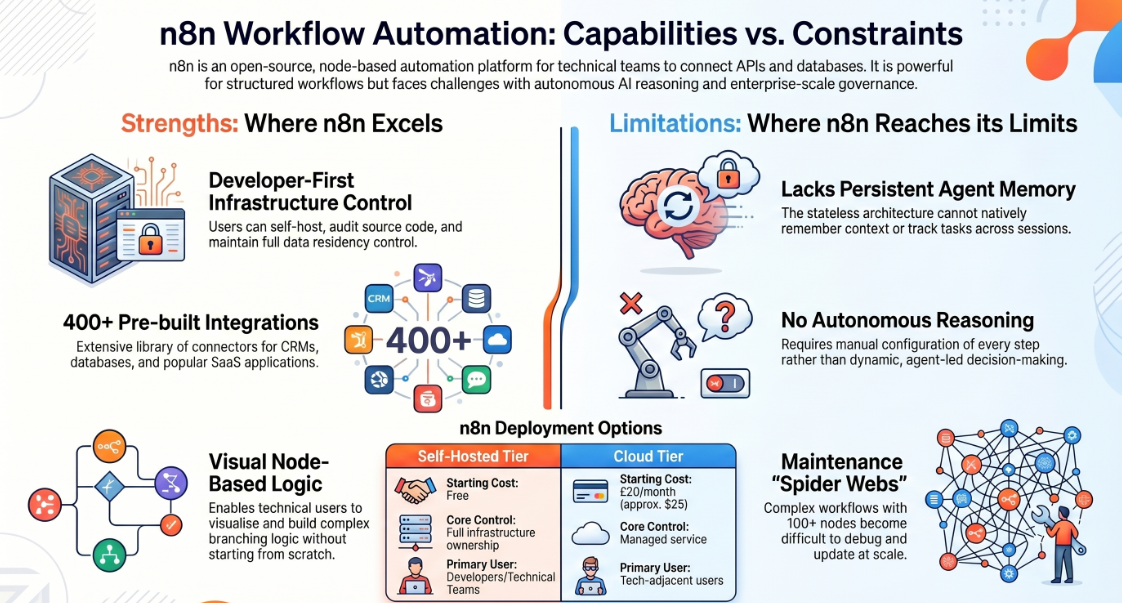
n8n is a fair-code licensed, open-source workflow automation platform. It lets technical teams connect applications, APIs, and databases through a visual node-based editor. You build workflows by chaining nodes: a trigger fires, data passes through transformation steps, and actions execute at the end. Think of it as a powerful, self-hostable alternative to Zapier or Make — with significantly more flexibility for teams that can write code.
Where n8n Excels
n8n has earned genuine respect in the developer community, and for good reason:
Open-source infrastructure control. You can self-host n8n on your own servers, audit the source code, and modify it to suit your environment. For teams with strict data residency requirements who want to control their own infrastructure, this is a meaningful advantage.
400+ pre-built integrations. n8n ships with connectors for a wide range of SaaS tools — CRMs, databases, communication platforms, and APIs. For teams that need to wire together well-known applications quickly, the integration library reduces setup time significantly.
Visual workflow builder. The node editor makes it possible for technical users to build and visualise complex multi-step automations without writing everything from scratch. Branching logic, data transforms, and conditional routing are all supported.
Developer-friendly extensibility. For teams comfortable with JavaScript and API configuration, n8n's custom code nodes and webhook capabilities make it one of the most flexible automation platforms available.
Predictable pricing. The self-hosted version is free. Cloud plans start at $25/month. For teams automating well-defined, lower-volume workflows, the cost-to-value ratio is strong.
Where n8n Was Not Designed to Go
This is where most comparison blogs pull their punches. n8n is a workflow automation tool — it was not architected as an enterprise AI agent platform, and the difference shows the moment your requirements move beyond structured if-then logic.
No persistent agent memory. n8n's architecture is stateless. Workflows execute, complete, and reset. There is no native mechanism for an agent to remember context across sessions, track an ongoing task over days or weeks, or build understanding from previous interactions. Simulating memory requires manually configuring external databases — a significant engineering overhead that defeats the purpose of a low-code tool.
No autonomous reasoning or decision-making. n8n added AI nodes in recent versions, and they work for specific tasks like text summarisation or classification. But the platform still requires you to explicitly define every step a workflow takes. An AI agent that genuinely reasons — that can assess a situation, decide which tools to invoke, and determine the best course of action without being hand-coded through every branch — is not what n8n delivers. As one detailed review noted: n8n requires manual configurations and lacks core capabilities like persistent memory, autonomous planning, and dynamic decision-making.
No enterprise governance or audit layer. For regulated industries — financial services, healthcare, energy, government — AI systems need to demonstrate compliance. Every agent decision needs to be traceable. n8n's governance features (audit logging, access controls, compliance monitoring) are gated behind an enterprise tier whose pricing and scope are not publicly documented. The fundamental architecture was not designed with compliance-grade auditability as a first principle.
No Voice AI. If your enterprise needs conversational AI agents that interact with users verbally — in call centres, field operations, customer service, or internal support — n8n offers nothing. Voice AI is absent from the platform entirely.
Steep technical overhead for non-developers. Despite being marketed as low-code, real-world n8n deployments require understanding APIs, expressions, node logic, and often JavaScript. Non-technical business users cannot build or maintain complex n8n workflows independently.
Complex workflows become unmaintainable. At scale, n8n workflow graphs with 100+ nodes become what practitioners call "spider webs" — difficult to read, debug, and update without breaking something. For enterprise-wide automation across dozens of departments, this creates significant long-term maintenance risk.
The honest summary: n8n is excellent at what it was designed for. The problem is that enterprise AI agent requirements have moved well beyond what any workflow automation tool — no matter how well engineered — was built to handle.
What Is assistents.ai by Ampcome?

assistents.ai is the enterprise agentic AI platform built by Ampcome — an AI agent development company with production deployments across 35+ enterprises in financial services, logistics, retail, healthcare, energy, real estate, and manufacturing, across 6 continents.
Where n8n automates defined workflows, assistents.ai deploys autonomous AI agents that understand context, reason through decisions, and execute multi-step operations across your enterprise systems — with full governance and audit trails at every step.
The platform is organised around three foundational layers:
The Context Engine ingests live data from 300+ enterprise systems — SAP, Salesforce, Oracle, Workday, ServiceNow, and more — and builds a continuously updated semantic understanding of your people, processes, documents, and operations. This is not keyword search. It is relational intelligence: the system understands that a vendor connects to a contract, a contract connects to a payment term, and a payment term connects to a cash flow risk.
The Semantic Layer maps relationships across enterprise data so agents can reason with full organisational context — not just answer isolated queries but understand how one decision affects another across your systems.
The Action Engine executes multi-step workflows with permission enforcement at every step. Every action is logged. Every decision is traceable. Every output is auditable.
The result is what Ampcome calls governed AI execution — autonomous agents that act with the speed and consistency of software, but within the policy boundaries your organisation requires.
The Core Difference — Workflow Nodes vs Autonomous Agents
The distinction matters more than most blogs explain clearly, so let's be direct.
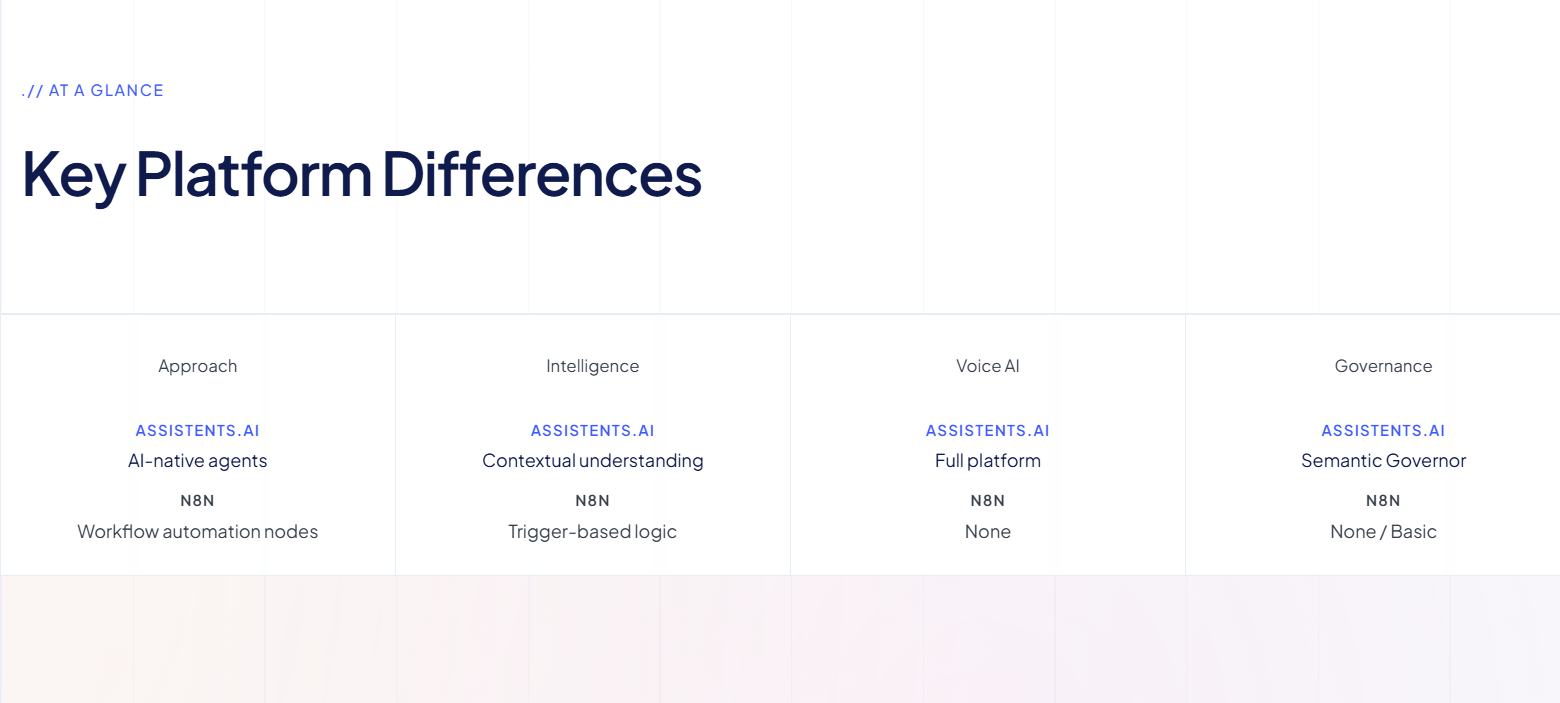
n8n operates on if-then logic: IF this webhook fires, THEN transform this data, THEN send it to this API. Every step is pre-defined. Every branch is manually configured. The workflow cannot adapt to a situation that wasn't anticipated at build time.
assistents.ai agents operate on contextual reasoning: Given this situation, what is the right action? The agent assesses available data, decides which tools to invoke, determines the appropriate sequence, executes with permission checks, and adapts if conditions change. No developer needs to have pre-coded every possibility.
Here is a direct feature comparison:
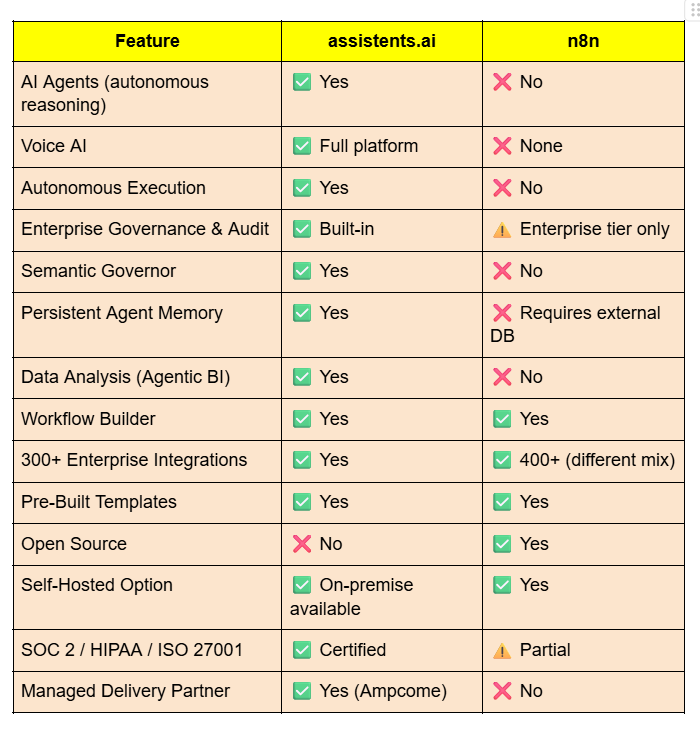
The comparison table above reflects the fundamental product architecture difference, not a matter of features that could be added with a plugin. An agent that reasons autonomously cannot be retrofitted onto a stateless node runner. These are different systems solving different categories of problem.
Semantic Governor — Enterprise AI That Doesn't Go Rogue

One of the most discussed challenges in enterprise AI deployment in 2026 is governance. The EU AI Act's high-risk requirements come into full effect in August 2026. Enterprise leaders know that deploying ungoverned AI agents — systems that can act across business data without policy controls — is a liability, not an advantage.
assistents.ai addresses this through its Semantic Governor: an architectural layer that ensures every agent decision is evaluated against organisational policies, risk requirements, and regulatory standards before execution.
In practice, this means:
- An agent processing financial transactions checks spending authority before routing
- An agent handling customer data applies data residency rules before accessing records
- An agent executing procurement workflows validates against approval hierarchies before committing
- Every action generates a traceable audit log that satisfies compliance and internal review requirements
This isn't a feature bolted on after the fact. Governance is a first-principle design decision in how assistents.ai was architected.
n8n does not offer an equivalent. Its enterprise tier provides some audit logging, but there is no semantic governance layer — no system that evaluates the appropriateness of an AI decision against policy before that decision executes. For regulated industries, this is not a minor gap.
Use Cases — When to Choose assistents.ai vs n8n
This is the decision most enterprise teams are actually trying to make. Here's the honest answer.
Choose n8n if:
- Your team has strong developer capacity and wants full infrastructure control
- Your automation requirements are well-defined workflows with predictable inputs and outputs
- You need to connect standard SaaS tools quickly and cost-effectively
- Your use cases don't require AI reasoning, governance, or autonomous multi-step decision-making
- You're a startup or mid-market company running internal automations, not enterprise-wide agent deployments
- Open-source auditability and self-hosting are non-negotiable requirements
Choose assistents.ai by Ampcome if:
- You need AI agents that reason, adapt, and execute without being hand-coded through every scenario
- Your enterprise spans multiple departments, systems, and geographies that agents need to reason across simultaneously
- You operate in a regulated industry (financial services, healthcare, energy, government) where governance, audit trails, and compliance controls are mandatory
- You need Voice AI — conversational agents that interact with users in natural language across channels
- Your requirements include autonomous execution: agents that take action, not just generate suggestions
- You want a managed AI agent development partner, not just a self-service tool — Ampcome deploys, configures, and scales the platform with your teams
- You need on-premise or private cloud deployment with enterprise SLAs
The distinction is not about company size alone. It is about what you need AI to do. If you need it to automate a workflow, n8n is a credible, well-supported choice. If you need it to reason, decide, and act — and to do so within enterprise governance boundaries — you need an AI agent platform.
Real-World Deployments — What Enterprise AI Agents Actually Deliver
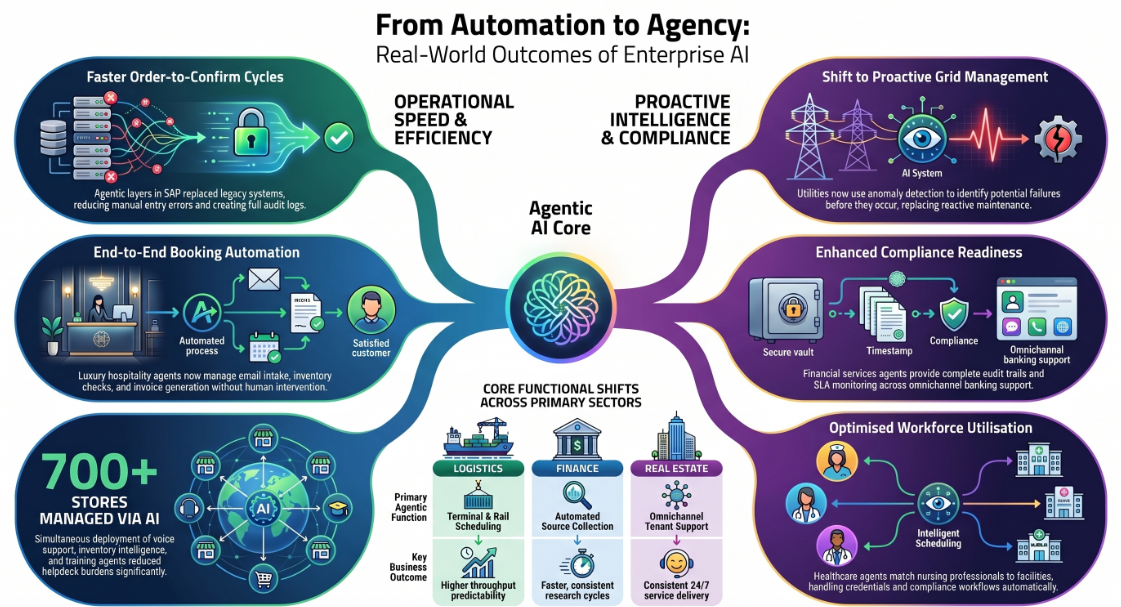
This is where the comparison becomes concrete. The following outcomes come from Ampcome's enterprise deployment portfolio — real production systems, not demos or pilots.
Logistics and Supply Chain
A global ports and logistics operator — one of the largest in the world by reported revenue — deployed agentic AI to digitise terminal and rail management operations. The agents handle yard scheduling, exception management, and executive dashboards.
The result: higher predictability of terminal-to-rail throughput, faster exception detection and response, and more efficient coordination across terminal and inland logistics operations. Separately, an Indian multinational logistics company running operations across India, the UK, and the US deployed analytics consolidation agents across their multi-entity global operations, replacing fragmented manual reporting with a single operational view.
An agentic automation layer was also deployed to interpret order triggers, validate inputs, and create sales orders in SAP — replacing a legacy system that had reached end-of-life. The result: reduced manual order processing, faster order-to-confirm cycles with fewer data-entry errors, and a complete audit log for every transaction.
Retail
A national retail operation with 700+ stores across hundreds of cities deployed three enterprise AI agents simultaneously: a Voice AI support agent handling queries in multiple languages, an inventory intelligence agent providing real-time pricing and stock visibility per store, and a knowledge and training agent built over the organisation's policy and procedure documents.
The outcome: significantly reduced manual helpdesk burden, improved store-level inventory visibility, and faster staff onboarding through on-demand training guidance. Separately, another retail holding business deployed an agentic data analysis layer converting dashboard insights into governed, auditable actions — shifting from reactive reporting to proactive operational execution.
Financial Services
A global fintech provider serving banks and credit unions deployed omnichannel AI agents for banking support — handling intake across chat, email, and phone, with agent-assist summarisation, next-best actions, auditability, and SLA monitoring.
The result: faster case handling, reduced operational load through automation, and better compliance readiness through complete audit trails. A separate financial technology business deployed AI for automated source collection, summarisation, and analysis — enabling faster research cycles and more consistent research outputs across their tax and compliance workflows.
Healthcare
A physician-led clinical enterprise in the United States deployed AI agents for staffing operations — matching nursing professionals with facilities, handling scheduling, credential capture, notifications, and compliance workflows.
The results: faster fill cycles, better workforce utilisation, and improved staffing responsiveness. A geriatric care services provider deployed operational and revenue analytics agents, improving visibility into revenue leakage drivers and enabling faster operational decision-making through unified reporting.
Energy and Utilities
A state-level power transmission utility deployed smart grid AI for monitoring, forecasting, and predictive maintenance. The agents handle transmission KPI monitoring, anomaly detection, outage and loss analytics, and automated alerts for field operations.
The outcome shifted the organisation from reactive grid management to proactive operations — identifying exceptions before they became failures. A premier research institution deployed AI for energy management across its campus — monitoring, forecasting, and optimising energy consumption with proactive alerts that reduced manual monitoring effort significantly.
Real Estate and Hospitality
A luxury hospitality brand operating boutique lodges and camps across East Africa deployed a digital booking agent handling end-to-end guest booking workflows: email intake, intent classification, data extraction, real-time inventory checks, alternative date negotiation, and automated invoice generation — with human-in-the-loop handoff for curated itinerary creation.
The result: faster booking turnaround, higher accuracy on complex guest requirements, and scalable operations that maintained the brand's luxury service standards. A major UAE real estate portfolio owner deployed an omnichannel customer service agent for tenant support — handling queries, rental and payment support, ticketing, and escalation to human teams across web, WhatsApp, and email. The result: faster response times, reduced call-centre load, and consistent 24×7 tenant experience.
Smart Infrastructure
A smart infrastructure operation cited as serving over 150 million urban lives across 25+ smart city operation centres deployed agentic analytics over their smart utility systems. The agents handle data ingestion, predictive analytics for outages and losses, and automated alerts with workflow routing for field resolution — improving operational visibility across the grid and enabling faster exception detection.
These outcomes share a common thread: none of them are if-then workflow automation. Every deployment required agents that could reason across multiple data sources, apply domain-specific logic, maintain context across interactions, and produce auditable outcomes. These are not automations any workflow tool — regardless of how well-engineered — is designed to handle.
Pricing — What You Actually Pay
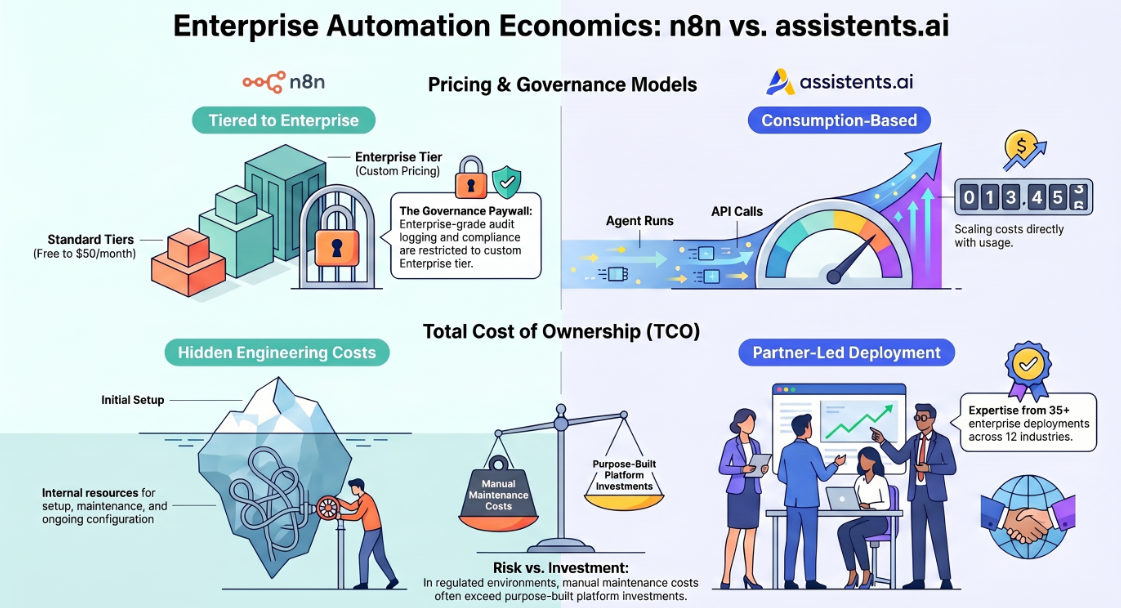
Honest pricing context matters for enterprise decisions.
n8n pricing:
- Self-hosted: Free (community edition; requires technical setup and ongoing maintenance)
- Cloud Starter: $25/month
- Cloud Business: $50/month
- Enterprise: Custom pricing required for audit logging, compliance features, and dedicated support
Important caveat: n8n's governance and compliance features — the ones enterprises actually need — are locked behind the Enterprise tier. Teams that self-host get the open-source flexibility but not the compliance infrastructure. Teams that want compliance support enter custom enterprise pricing negotiations.
assistents.ai pricing:
- Consumption-based: You pay for agent runs, API calls, and voice minutes — the platform scales with your usage
- Free tier available for initial evaluation
- Enterprise plans include dedicated support, SLA guarantees, custom governance policies, and on-premise deployment options
The honest framing: If you have a technical team, well-defined automations, and limited governance requirements, n8n's economics are strong. If you are deploying AI agents across regulated enterprise environments, the cost of an ungoverned, manually maintained workflow system — in engineering hours, compliance risk, and missed business outcomes — significantly exceeds the investment in a purpose-built enterprise platform.
The more important cost question is not the platform licence. It is the cost of deployment, configuration, ongoing maintenance, and the opportunity cost of not getting autonomous AI agents into production. With n8n, you are responsible for all of that. With assistents.ai by Ampcome, you have an AI agent development partner who has done this across 35+ enterprises and 12 industries.
Which One Is Right for You?
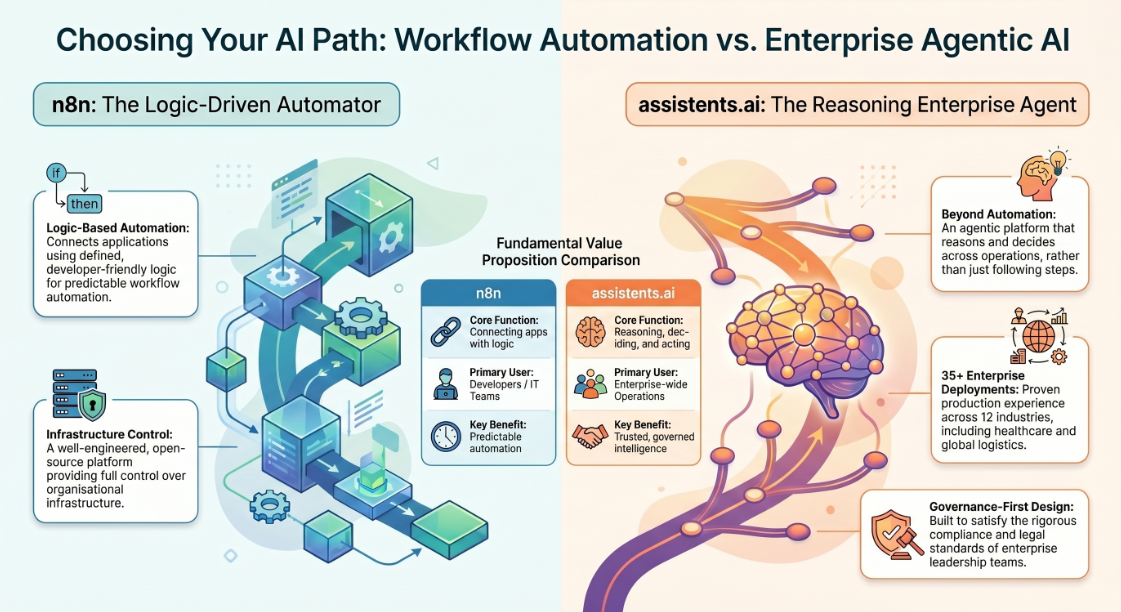
n8n is a well-engineered, developer-friendly workflow automation platform with a strong open-source community and a clear use case: connecting applications with defined logic, at predictable cost, with full infrastructure control. If that's what you need, it deserves serious consideration.
assistents.ai by Ampcome is something categorically different. It is an enterprise agentic AI platform built for organisations that need AI to do more than automate — they need it to reason, decide, and act across their operations, within governance boundaries their compliance, legal, and leadership teams can stand behind.
The enterprises that have deployed assistents.ai — from global logistics operators and national retail chains to healthcare providers, financial institutions, and smart city infrastructure owners — did not have a workflow automation problem. They had a question that every enterprise is now confronting: how do you deploy AI that is fast enough to compete, smart enough to be useful, and governed enough to be trusted?
That is the problem assistents.ai was built to solve. And it is the problem Ampcome, as an AI agent development company with production experience across 35+ enterprises and 12 industries, has been solving since before "agentic AI" became a buzzword.
If you're evaluating enterprise AI agents for your organisation — whether you're coming from n8n, from a legacy RPA platform, or from a spreadsheet — book a demo with Ampcome. The conversation starts with your operations, not our product.
Looking to go deeper? Read our related guides:
- Complete Guide to Enterprise AI Agents in 2026
- AI Agents vs RPA — What's the Difference?
- Enterprise AI Buyer's Guide
- Book a demo with the Ampcome team
FAQs
What is the difference between n8n and AI agents?
n8n is a workflow automation platform that executes pre-defined if-then logic: when a trigger fires, nodes process data and take specified actions in sequence. An AI agent reasons autonomously — it assesses a situation, determines which tools to use, decides the best course of action, and executes across multiple systems without being explicitly coded through every step. n8n can incorporate AI-powered nodes for specific tasks, but it is not an AI agent platform. The architecture is fundamentally different.
Is n8n an AI agent platform?
No. n8n is a workflow automation platform that added some AI-capable nodes in recent versions. It can call LLM APIs as part of a workflow, but it does not support persistent agent memory, autonomous multi-step reasoning, or enterprise governance controls. The platform requires developers to manually define every step a workflow takes. True AI agents — systems that reason, decide, and adapt without being hand-coded through every scenario — require a different architectural foundation.
What are the best AI agent development companies?
The best AI agent development companies in 2026 are those that combine a production-proven platform with enterprise delivery experience. Ampcome — through its assistents.ai platform — is one of the few AI agent development companies that operates at genuine enterprise scale, with deployments across financial services, logistics, retail, healthcare, energy, and real estate across 35+ organisations globally. Other companies commonly cited include LeewayHertz, Master of Code Global, and Tribe AI. The right choice depends on your industry, governance requirements, and whether you need a managed delivery partner or a self-service tool.
What are the limitations of n8n for enterprise use?
The primary limitations of n8n for enterprise AI deployment are: (1) stateless architecture — no persistent agent memory without external database configuration; (2) no autonomous reasoning — every step must be manually defined; (3) governance features gated behind enterprise pricing tiers; (4) no Voice AI; (5) complex workflows become unmaintainable at scale; (6) no semantic governance layer for compliance-grade AI execution; and (7) limited enterprise SLA and dedicated support options compared to managed AI agent platforms.
Can n8n replace an AI agent development company?
No — these are different categories. n8n is a self-service tool for building workflow automations. An AI agent development company designs, deploys, and operates autonomous AI systems across your enterprise — integrating with existing systems, applying governance controls, and ensuring measurable outcomes. A company like Ampcome brings enterprise delivery expertise across 12 industries, not just a platform licence. If your requirement is connecting a few SaaS tools, n8n may be sufficient. If your requirement is deploying AI agents that reason and execute across your entire enterprise, you need both the right platform and a delivery partner who has done it before.
What does an AI agent development company do?
An AI agent development company designs, builds, and deploys autonomous AI agent systems for enterprise operations. This includes understanding your business workflows and data architecture, selecting and configuring the right AI models and tools, integrating agents with your existing enterprise systems (ERP, CRM, HRIS, etc.), implementing governance and compliance controls, and managing the deployment and ongoing optimisation of agents in production. A company like Ampcome goes beyond selling software — it delivers the entire agent system, configured for your specific business context, with measurable outcomes.
What is agentic AI?
Agentic AI refers to AI systems that can autonomously perceive their environment, reason through a situation, make decisions, and take actions across multiple steps to achieve a goal — without requiring constant human instruction. Unlike conversational AI (which responds to prompts) or traditional automation (which follows pre-defined rules), agentic AI combines language understanding, reasoning, tool use, and autonomous execution. Enterprise agentic AI adds governance layers to ensure these autonomous actions remain within organisational policy boundaries.

Transform Your Business With Agentic Automation
Agentic automation is the rising star posied to overtake RPA and bring about a new wave of intelligent automation. Explore the core concepts of agentic automation, how it works, real-life examples and strategies for a successful implementation in this ebook.
Sarfraz Nawaz is the CEO and founder of Ampcome, which is at the forefront of Artificial Intelligence (AI) Development. Nawaz's passion for technology is matched by his commitment to creating solutions that drive real-world results. Under his leadership, Ampcome's team of talented engineers and developers craft innovative IT solutions that empower businesses to thrive in the ever-evolving technological landscape.Ampcome's success is a testament to Nawaz's dedication to excellence and his unwavering belief in the transformative power of technology.

More insights
Discover the latest trends, best practices, and expert opinions that can reshape your perspective



Contact us

