

How To Use AI Agents for YouTube Automation in 2026 (7-Step Workflow Guide)


Most creators hit the same wall. The channel is growing, the ideas are there, but the production pipeline — scripting, editing, thumbnails, metadata, scheduling — eats 40+ hours a week. Hiring solves it, but hiring is expensive and slow.
AI agents solve it differently. Instead of replacing your creative instincts, they automate the repeatable mechanics of content production. The result: more videos, faster publication, lower production cost — without sacrificing your voice or quality.
This guide walks you through a complete 7-step AI agent workflow for YouTube automation in 2026: what each agent does, which tools to use, where human judgment is still essential, and how to build the full pipeline even if you have no coding experience.
By automating 50–70% of production tasks with AI agents, most creators reclaim 20+ hours per week for creative direction, audience growth, and strategy.
What Is an AI Agent? (And How It Differs from an AI Tool)
Before building the workflow, it's worth being precise about what an AI agent actually is — because it's not the same as ChatGPT or a standalone automation.
An AI tool does one job when you ask it to. A transcription tool transcribes. An image generator generates.
An AI agent plans, acts, and adapts. It can chain tasks, call external APIs, respond to conditions, and make decisions across multiple steps — all without you re-prompting each step.
In a YouTube context, an agent doesn't just write your script. It researches trending topics, drafts a script optimized for your niche, routes that script to your voiceover tool, and flags you only when it needs a judgment call. That's the difference between a tool and an agent.
In 2026, the most effective YouTube automation setups use a modular multi-agent architecture: separate specialized agents for each stage of production, connected into one pipeline.
Why Use AI Agents for YouTube Automation in 2026?
The Case For It
- Scale content output without burning out or hiring a full production team
- Consistency: agents follow the same workflow every time, reducing errors and forgotten steps
- Speed to market: jump on trends within hours, not days
- Data-driven optimization: analytics feed directly back into your content strategy
- Cost reduction: replace or reduce reliance on multiple freelancers for editing, thumbnail design, and metadata

The Risks to Manage
- Generic output: fully automated content can feel bland without brand voice injection
- Hallucinations: AI-generated scripts or metadata can contain factual errors — always review before publishing
- YouTube policy violations: over-automating uploads or using copyrighted assets can trigger demonetization flags
- Tool complexity: managing APIs, rate limits, and integrations requires initial setup time
Best practice: build a modular pipeline with human checkpoints at the highest-risk stages — script review, visual approval, and final pre-upload verification. Automate the mechanics; keep humans in the creative and compliance decisions.
The 7-Step AI Agent Workflow for YouTube Automation
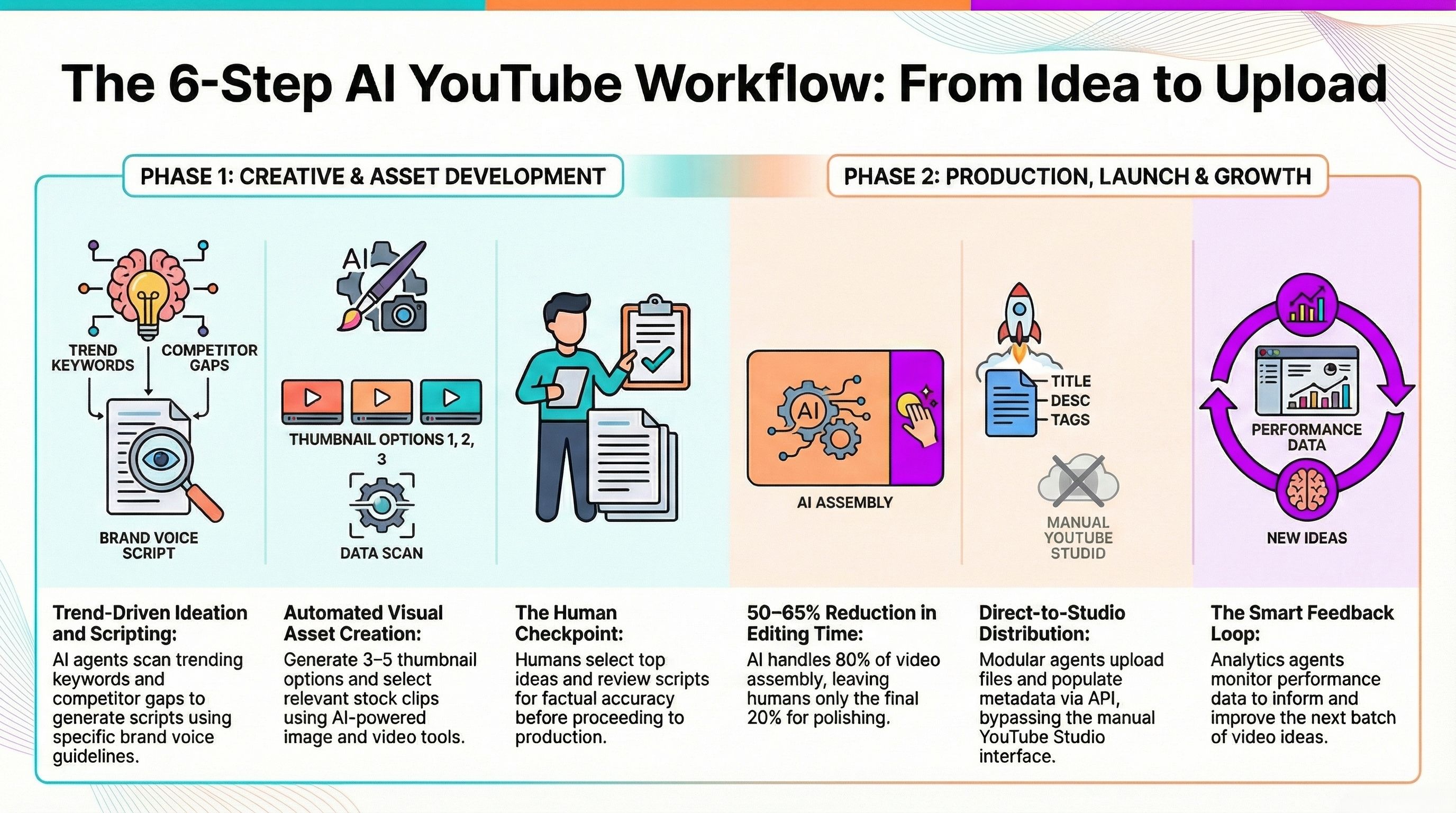
Here's the complete pipeline, broken into seven modular agents. Each handles one stage of the content lifecycle. You can deploy them individually or connect them into a fully automated sequence.
Step 1: Ideation & Topic Research Agent
Find winning video ideas before your competitors do
What it does: Scans trending topics, competitor channels, and keyword data to surface video ideas aligned with your niche and search demand.
Tools to use: YouTube Data API, Google Trends, TubeBuddy API, Ahrefs, VidIQ, or a custom LLM prompt chain ingesting trend data.
Output: A ranked list of video titles with estimated search volume, competitor gap analysis, and a brief angle for each.
Human checkpoint: Select 1–3 topics per batch. Reject anything off-brand or already covered in your back catalogue.
Step 2: Scripting & Outline Agent
Draft the script; you refine the voice
What it does: Takes the selected topic and brief, then generates a full script draft or structured outline using a large language model (LLM).
Tools to use: GPT-4o, Claude, or Gemini — prompting with your brand voice guidelines, preferred format (listicle, tutorial, opinion), and target video length.
Output: A structured script with intro hook, section headers, transitions, and a call to action.
Human checkpoint: Review for factual accuracy, brand tone, and remove hallucinations. This is the most important human review in the pipeline.
Pro tip: include a brand voice document in the agent's system prompt — tone guidelines, words you never use, audience assumptions. This dramatically reduces how much you need to edit.
Step 3: Visual & Thumbnail Agent
Automate the design work that usually takes hours
What it does: Generates thumbnail options, selects relevant stock footage, proposes text overlays, and recommends visual style based on your channel aesthetic.
Tools to use: DALL·E 3, Midjourney, or Stable Diffusion for thumbnails; Pexels/Shutterstock APIs for stock clips; Canva API or Adobe Express for templated layouts.
Output: 3–5 thumbnail options, curated visual assets, and overlay text suggestions.
Human checkpoint: Select the thumbnail, verify no copyright issues, confirm visuals match brand guidelines.
Step 4: Voiceover & Audio Agent
Professional-quality audio without a recording studio
What it does: Converts the approved script to a voiceover, adds background music, normalizes audio levels, and removes silence.
Tools to use: ElevenLabs (voice cloning), Amazon Polly (cost-effective TTS), Resemble.ai (custom voices), Descript (cleanup), or Murf.ai.
Output: Final voiceover file, background audio track, mixed and normalized audio.
Human checkpoint: Listen for mispronunciations, pacing issues, and tonal mismatch. Adjust speed or emphasis where needed.
Step 5: Video Assembly & Editing Agent
Stitch, sync, and render — automatically
What it does: Combines visual assets, voiceover, and script cues into a full draft video — adding transitions, captions, lower-thirds, and syncing audio to visuals.
Tools to use: FFmpeg (scriptable, free), Runway Gen-2 (AI video editing), Adobe Premiere via API, or Pictory/Synthesia for faceless video assembly.
Output: A draft MP4 video file, ready for human review.
Human checkpoint: Watch the full draft. Adjust cuts, fix sync issues, refine transitions. The agent produces 80% of the edit; you polish the final 20%.
Efficiency note: letting the agent produce the first draft and humans polish it typically cuts total editing time by 50–65% compared to manual editing.
Step 6: Upload & Scheduling Agent
From render to live — without touching YouTube Studio
What it does: Uploads the approved video file to YouTube via the YouTube Data API, fills in title, description, tags, chapters, end screens, and schedules publishing at the optimal time.
Tools to use: YouTube Data API v3 (direct), n8n or Make.com (no-code workflow orchestration), or custom Python upload scripts.
Output: Scheduled video with fully populated metadata, ready for publishing.
Human checkpoint: Final review of title, description, and thumbnail in YouTube Studio before confirming the schedule slot.
Step 7: Analytics & Optimization Agent
The feedback loop that makes the whole system smarter
What it does: Monitors published video performance — views, watch time, CTR, retention, engagement — and feeds insights back into the Ideation Agent for the next batch.
Tools to use: YouTube Analytics API, Google Data Studio / Looker Studio for dashboards, TubeBuddy for A/B title testing.
Output: Performance report, title/thumbnail improvement suggestions, and updated topic briefs for the ideation agent.
Human checkpoint: Review the recommendations. Decide which to act on: a new thumbnail test, a title change, or a content pivot.
How to Build the Pipeline: Step-by-Step Implementation
Here's how to go from zero to a functioning AI agent pipeline, whether you're a solo creator or building this for a brand channel.
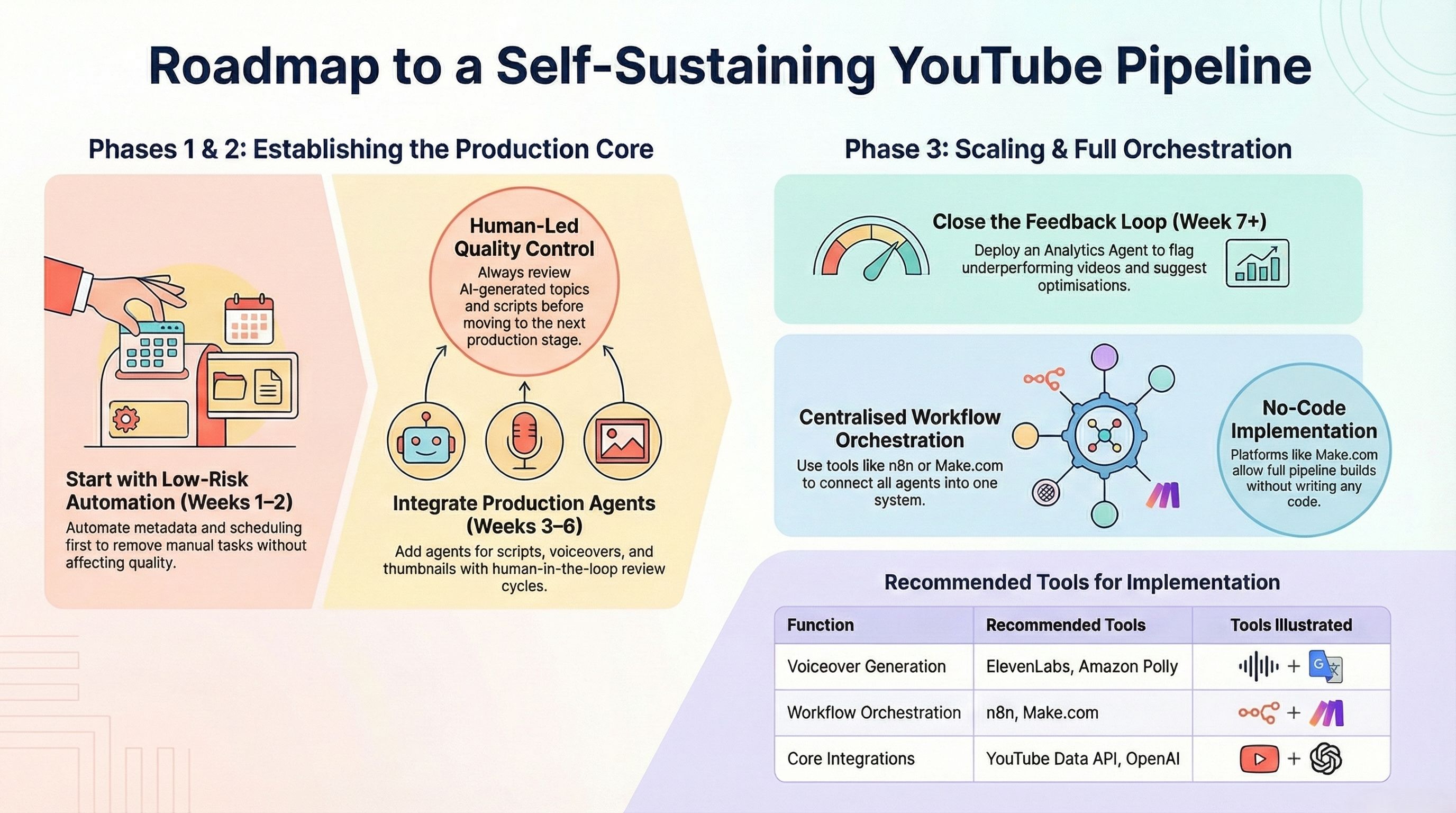
Phase 1: Start Small (Week 1–2)
Don't try to automate everything at once. Start with the two lowest-risk modules:
- Set up the Upload & Scheduling Agent first. Connect the YouTube Data API and automate metadata population. This has zero quality risk — you're just removing a manual task.
- Add the Ideation Agent. Connect to Google Trends or a keyword API and have it generate a weekly topic shortlist. Review it yourself; don't automate the selection yet.
Phase 2: Add Production Automation (Week 3–6)
Once the foundation is stable:
- Integrate the Scripting Agent. Feed approved topics in, get draft scripts out. Establish your review workflow before publishing anything agent-generated.
- Add the Voiceover Agent. Test ElevenLabs or Polly with a few videos before committing to a voice.
- Add the Thumbnail Agent. Generate options; humans pick.
Phase 3: Close the Loop (Week 7+)
- Add the Analytics Agent. Connect YouTube Analytics to your dashboard and have it automatically flag underperforming videos and suggest optimization actions.
- Connect all agents in a single orchestration layer using n8n, Make.com, or a custom script. This is when the pipeline becomes self-sustaining.
No-code option: n8n and Make.com let you build the entire pipeline — from ideation to upload — without writing a line of code. Both have YouTube, OpenAI, and ElevenLabs connectors built in.
Recommended Tools by Agent (2026)

Real-World Examples: What AI Agent Automation Looks Like in Practice
- A faceless YouTube channel using n8n + Pictory + ElevenLabs published 1,000+ videos with a minimal team, scaling to ad revenue without a traditional production crew.
- Enterprise brands are deploying AI agent pipelines to repurpose blog content and webinar recordings into YouTube Shorts automatically — reducing per-video cost by over 60%.
- Solo creators in niches like finance, productivity, and tech reviews use scripting agents to cut research and writing time from 4–5 hours per video to under 45 minutes.
The pattern: the most successful automated channels use agents for the mechanics and humans for creative decisions — topic selection, brand voice, final quality review, and audience strategy.
YouTube Policy, Copyright & Compliance: What to Watch
Copyright: Use royalty-free music (YouTube Audio Library, Artlist, Epidemic Sound) and cleared visual assets. AI image generators create original images, but always verify that generated visuals don't closely replicate copyrighted work.
Spam and upload frequency: YouTube's policies flag channels that upload mass quantities of low-effort, repetitive content. Focus on quality over quantity — a sustainable cadence of 3–5 high-quality videos per week outperforms 20 thin ones.
AI disclosure: YouTube now requires creators to disclose AI-generated content in certain categories (particularly realistic synthetic media). Check YouTube's current AI disclosure guidelines and add disclosures where required.
Factual accuracy: LLM hallucinations in scripts can damage your credibility and, in regulated niches (finance, health, legal), create liability. Human fact-checking of all scripts is non-negotiable.
Build Your AI Agent Pipeline with Ampcome
Ampcome helps businesses and creators build custom AI agent workflows — from YouTube content pipelines to enterprise-grade agentic automation across complex operations. If you want expert guidance on designing and deploying your AI agent setup, our team has built these systems across industries including media, retail, logistics, and financial services.
Ready to explore what an AI agent pipeline could look like for your channel or business?
→ Book a free 15-minute discovery call with the Ampcome team
Frequently Asked Questions
Can AI agents fully replace a YouTube creator?
No — and that's not the goal. AI agents handle the repeatable mechanics: research, drafts, editing scaffolding, metadata, and scheduling. Creative direction, audience intuition, brand voice, and strategic decisions remain human work. The best results come from humans and agents working together, not from replacing one with the other.
Do I need coding skills to build this pipeline?
Not necessarily. Tools like n8n and Make.com offer no-code visual workflow builders with pre-built connectors for YouTube, OpenAI, ElevenLabs, and most other tools in this pipeline. Coding skills let you build more custom solutions, but the no-code path covers 80–90% of use cases.
How accurate are AI voiceover tools in 2026?
Current TTS tools (ElevenLabs, Murf, Polly) achieve 90%+ naturalness for most content types, but mispronunciations and pacing issues still occur — especially with proper nouns, acronyms, and niche terminology. Human review of every voiceover before publishing is strongly recommended.
What's the risk of demonetization from AI-generated content?
The risk comes from policy violations, not from AI use itself. Spam uploads, copyrighted assets, misleading metadata, and certain synthetic media disclosures are the main triggers. Channels using AI responsibly — with quality content, proper disclosures, and cleared assets — are not at elevated demonetization risk.
How much time can AI agents realistically save?
Creators who implement a full pipeline typically report saving 20–30 hours per week on production tasks. The actual number depends on your content type, video length, and how much of the pipeline you automate. Expect the biggest gains in scripting research, voiceover production, and metadata generation.
Where should I start if I'm new to this?
Start with the Upload & Scheduling Agent — it has zero quality risk and immediately eliminates the most tedious manual task. Then add the Ideation Agent to generate weekly topic shortlists. Build out from there once you're comfortable with the workflow.

Transform Your Business With Agentic Automation
Agentic automation is the rising star posied to overtake RPA and bring about a new wave of intelligent automation. Explore the core concepts of agentic automation, how it works, real-life examples and strategies for a successful implementation in this ebook.
Sarfraz Nawaz is the CEO and founder of Ampcome, which is at the forefront of Artificial Intelligence (AI) Development. Nawaz's passion for technology is matched by his commitment to creating solutions that drive real-world results. Under his leadership, Ampcome's team of talented engineers and developers craft innovative IT solutions that empower businesses to thrive in the ever-evolving technological landscape.Ampcome's success is a testament to Nawaz's dedication to excellence and his unwavering belief in the transformative power of technology.

More insights
Discover the latest trends, best practices, and expert opinions that can reshape your perspective




.jpg)


Contact us

