
How We Used AI Agents to Process 10M+ Data Points for Real-Time Pricing Intelligence


Somewhere in your competitor's pricing team, a decision was made this morning. A promotional discount launched across three online channels. An MRP was quietly adjusted on a key product. A flash sale went live on a marketplace you weren't watching.
Your team will find out about it in three days.
That three-day lag — between what the market does and what your organization knows — is not a data problem. You have the data. It is a processing problem. Enterprise pricing data doesn't arrive in a tidy report. It arrives as millions of signals, spread across e-commerce portals, marketplace listings, distributor networks, competitor websites, and consumer ratings. Turning that volume into decisions, fast enough to matter, is beyond what any human team or traditional monitoring tool can do.
This is the problem we solved for a major national retail enterprise operating across 700+ store locations and multiple digital channels. Using purpose-built AI agents deployed on assistents.ai, we built a system that continuously monitors, classifies, and surfaces competitive pricing intelligence — processing over 10 million data points to deliver real-time answers to the questions leadership actually asks.
Here is exactly how we built it, what it took, and what the results looked like.
The Problem: Pricing Data That Moves Faster Than Your Team
Pricing intelligence has always been important. What has changed is the speed at which pricing decisions now happen across the market — and the volume of signals you need to monitor to stay competitive.
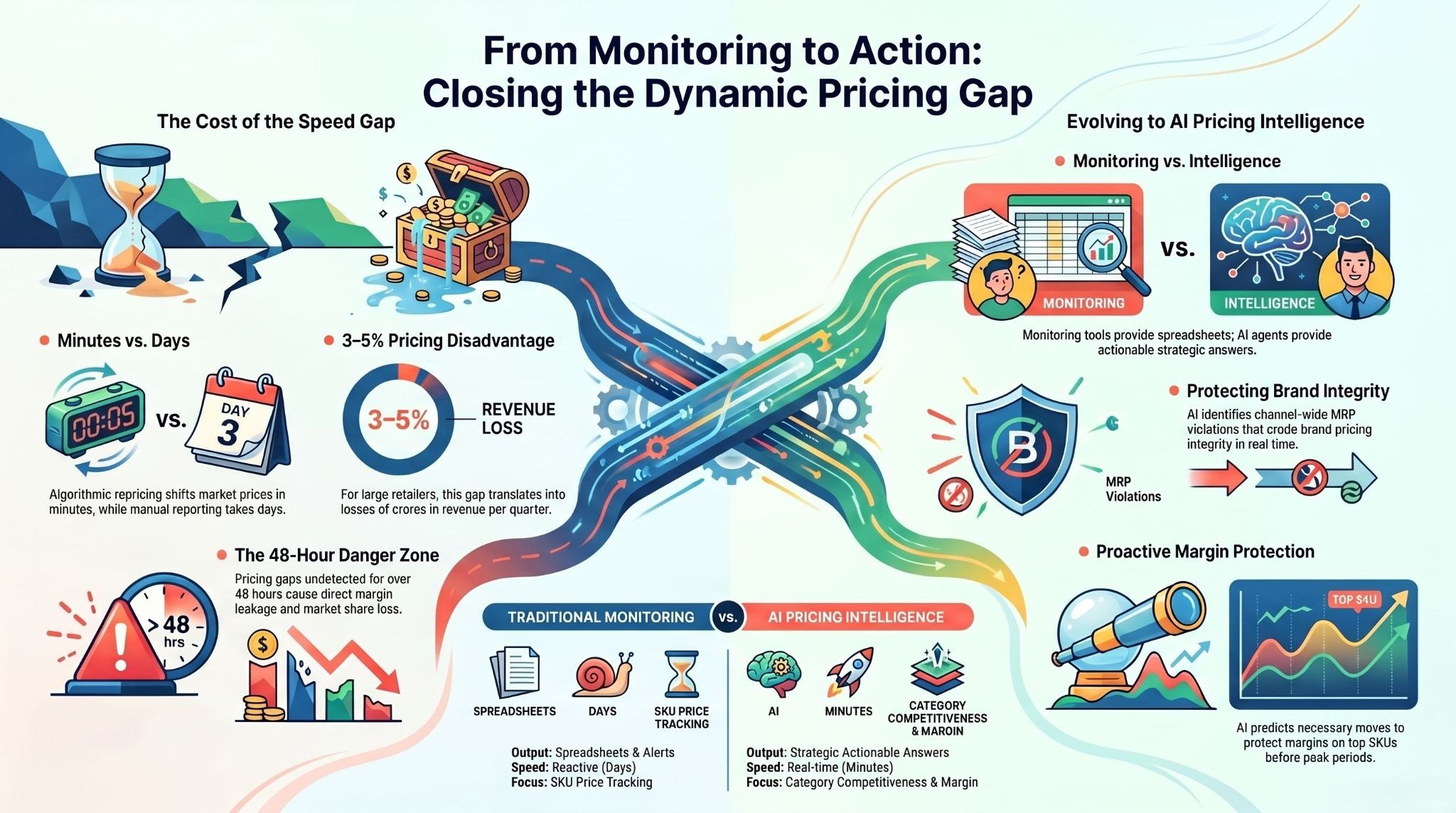
A decade ago, a competitor's price change took days to propagate across retail channels. Today, algorithmic repricing can shift prices across hundreds of SKUs in minutes.
Promotional campaigns launch and expire within hours. Marketplace sellers adjust pricing in response to demand signals in near real time. And your own pricing team — reviewing spreadsheets, pulling manual reports, and synthesizing data across siloed systems — is structurally incapable of matching that pace.
The consequences are real and measurable. Pricing gaps that go undetected for 48–72 hours translate directly into lost sales, eroded market share, and margin leakage at scale. For a large retail operation, a pricing disadvantage of even 3–5% on high-velocity SKUs can represent crores in revenue per quarter.
The traditional response to this problem has been to buy a price monitoring tool. But most price monitoring tools are built for a specific, narrow function: they track a list of SKUs across a predefined set of competitor URLs and alert you when a price crosses a threshold. That is useful. It is not intelligence.
What leadership actually needs is answers to questions like:
- Where are we losing pricing competitiveness right now, and on what product categories?
- Did a competitor's promotional campaign affect our sell-through rates this week?
- Which channels have MRP violations that are eroding our brand pricing integrity?
- What pricing moves should we make before the weekend to protect margin on our top 50 SKUs?
A price monitoring tool gives you a spreadsheet. An AI agent gives you an answer.
Why Traditional Pricing Tools Weren't Enough
Before going into what we built, it is worth being precise about where conventional approaches break down — because the failure modes are instructive.
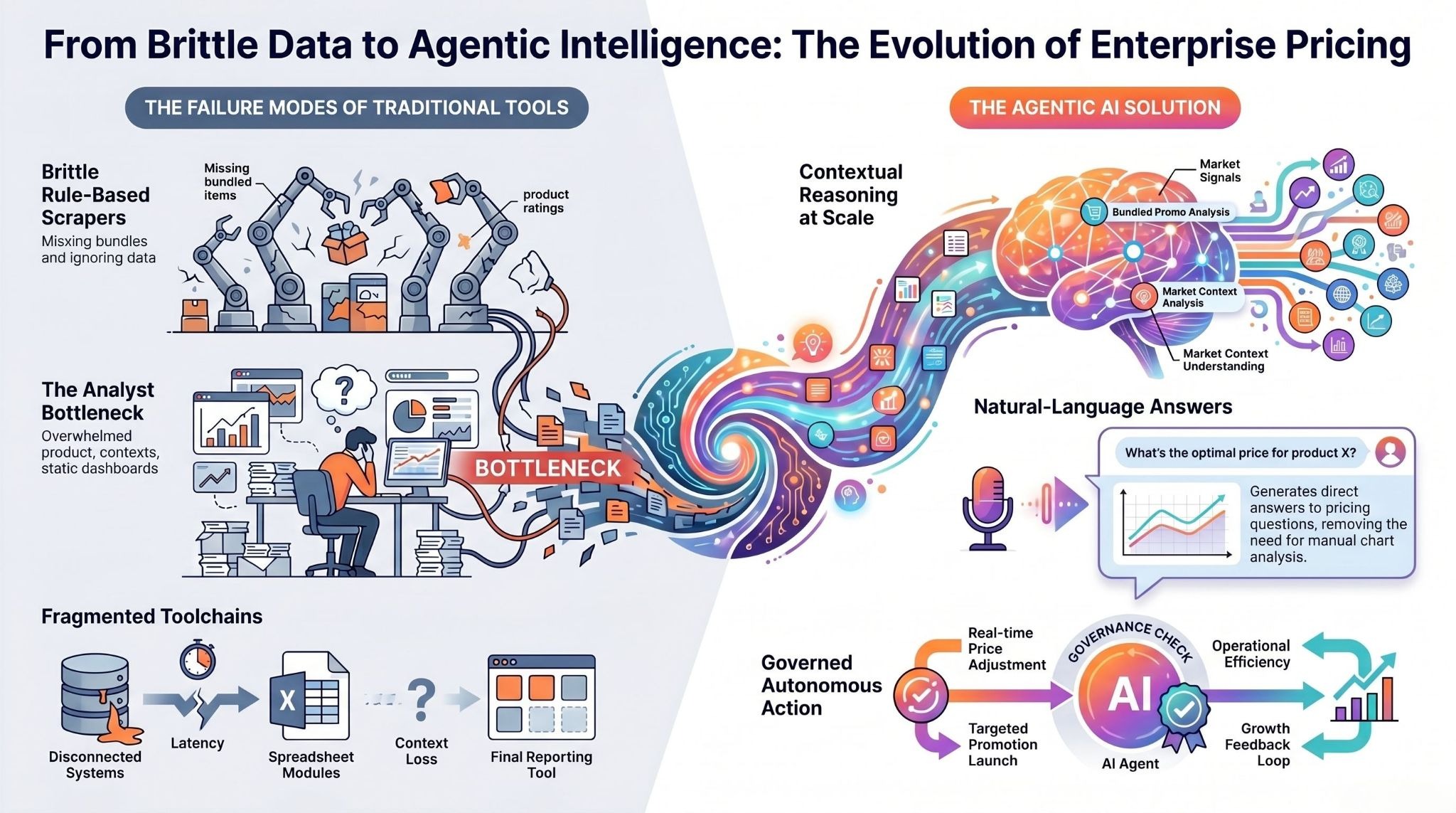
Rule-based price scrapers are brittle at scale. They monitor what you tell them to monitor, at the cadence you configure. They do not reason about what they are seeing. When a competitor runs a bundled promotion that effectively reduces the price of a target SKU without changing its listed price, a rule-based scraper sees nothing. When ratings drop on a competitor's product and that creates a pricing opportunity, a scraper does not connect those signals. And at 10 million+ data points, the manual effort required to maintain scraper configurations is itself a full-time operation.
Static dashboards suffer from a different failure: they surface data, but they do not generate insight. A dashboard that shows you 50 charts of competitor pricing trends still requires a human analyst to synthesize those charts into a recommendation. At the pace that enterprise pricing decisions need to be made, routing everything through an analyst team creates a bottleneck that negates the value of the underlying data.
Disconnected toolchains — where data lives in one system, analysis happens in a second, alerts go to a third, and decisions get made in a fourth — introduce latency, context loss, and accountability gaps at every handoff.
What a modern pricing intelligence operation requires is a system that can ingest signals at scale, reason about what those signals mean in context, generate answers to natural-language questions, and trigger governed actions — without requiring a human analyst to sit in the middle of every loop.
That is what agentic AI is built to do.
The Agentic Architecture: How We Built a 10M+ Data Point Monitoring System
The system we deployed for this enterprise client used a multi-agent architecture built on the assistents.ai platform. Rather than one monolithic AI model trying to do everything, we designed specialized agents with distinct responsibilities that hand off context between themselves — the same way a well-structured human team would, but operating at machine speed and scale.
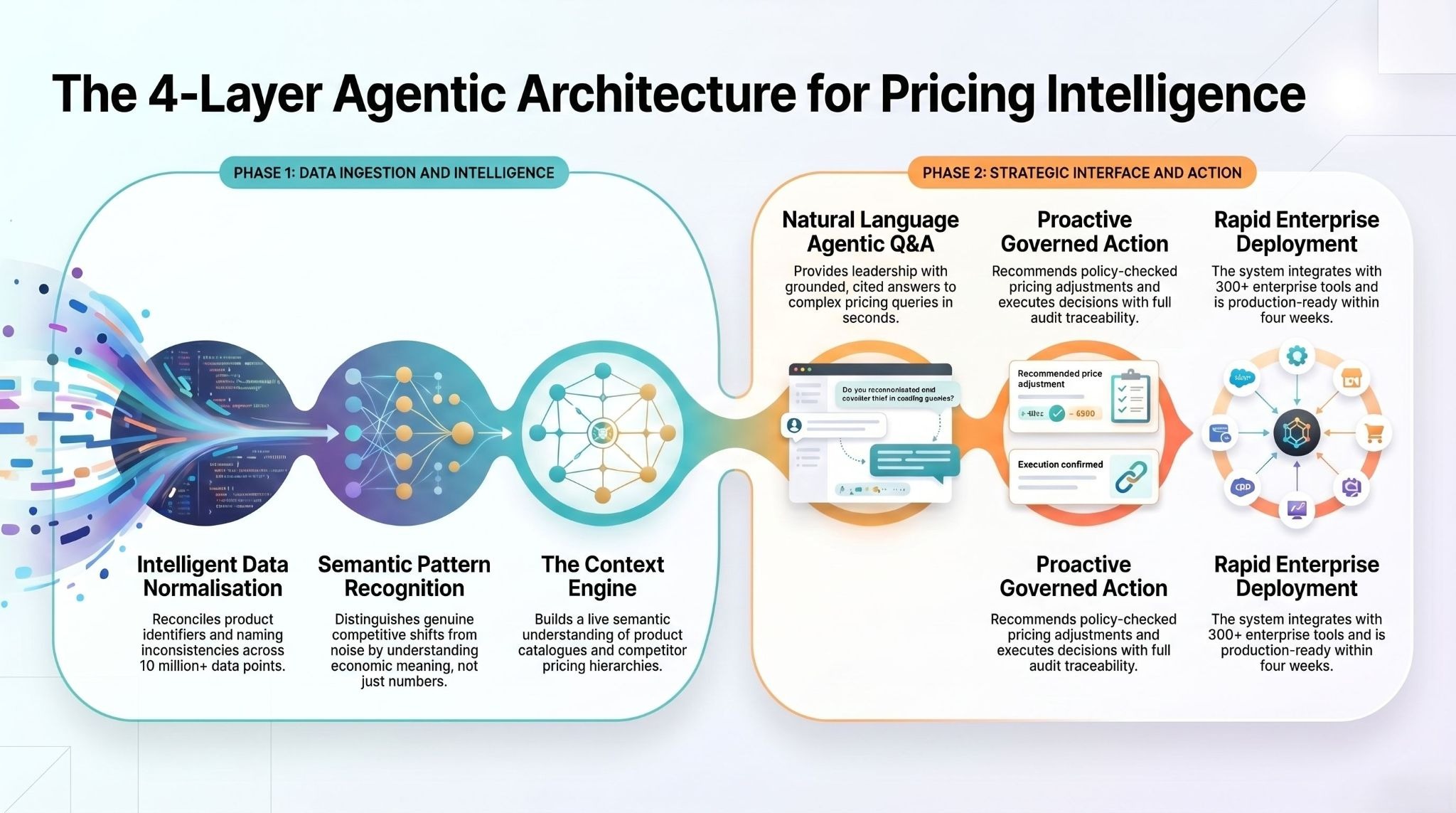
Here is how the architecture was structured:
Layer 1 — Data Ingestion and Normalization Agents
The first layer of agents is responsible for continuous data collection across all monitored channels: the client's own e-commerce properties, competitor portals, major marketplaces, distributor websites, and third-party price aggregators. These agents do not simply scrape and store. They normalize what they find — reconciling product identifiers across sources, resolving naming inconsistencies, detecting and flagging data quality anomalies, and timestamping everything with source provenance.
At the volume we were operating at — over 10 million data points across the monitoring scope — the normalization layer is where most conventional systems fail. We used the assistents.ai Context Engine, which builds a live semantic understanding of the product catalog, competitor pricing structure, and channel hierarchy, so every incoming data point is interpreted in relation to everything the system already knows.
Layer 2 — Signal Classification and Pattern Recognition Agents
The second layer takes normalized data and makes sense of it. These agents are trained to recognize pricing events that matter: significant price drops, promotional launches, MRP violations, bundle pricing moves, availability changes correlated with pricing strategy, and rating signals that precede or follow competitive pricing shifts.
Critically, these agents maintain historical context. A price change that looks significant in isolation might be part of a recurring weekly promotional pattern. A competitor's apparent discount might be a channel-specific pricing experiment. The classification agents distinguish between noise and genuine competitive intelligence because they operate on the semantic understanding built in Layer 1, not on raw numbers alone.
This is where the differentiation from rule-based systems is most visible. When a competitor launches a promotional campaign that is not a straightforward price reduction — say, a cashback offer, a loyalty point multiplier, or a bundled accessory discount — the classification agents surface it as a pricing intelligence event because they understand what it means economically, not just what it looks like structurally.
Layer 3 — The Intelligence Interface: Agentic Q&A for Leadership
The third layer is the one that leadership actually interacts with. We deployed a natural language Q&A interface — powered by the assistents.ai Ask & Analyze capability — that allows pricing leads, category managers, and executives to ask direct questions and receive grounded, cited answers in seconds.
Questions like:
- "What is our pricing gap versus the top three competitors on air conditioner units in the ₹30,000–₹50,000 range this week?"
- "Which SKUs had MRP violations across online channels in the last 48 hours?"
- "Did the competitor promotional launch last Thursday affect our sell-through rates on comparable products?"
Each answer is grounded in the live data the ingestion and classification agents have processed. Each is cited back to the source — channel, timestamp, product — so decision-makers can verify and act with confidence. And each is generated in seconds, not days.
Layer 4 — Proactive Alerting and Governed Action Agents
The fourth layer does not wait to be asked. It monitors the output of the classification layer for conditions that meet predefined alert thresholds — significant pricing gaps, MRP violations above a tolerance threshold, emerging competitive threats in key categories — and surfaces them proactively to the relevant stakeholders.
For certain alert types, the system was configured not just to notify but to recommend actions: proposed pricing adjustments, promotional responses, or escalation triggers for human review. These recommendations are governed — every suggested action is logged, policy-checked, and routed through the appropriate approval workflow before execution — using the assistents.ai Action Engine's permission enforcement layer.
This is the architectural distinction that separates an agentic pricing intelligence system from a monitoring dashboard. A dashboard tells you something happened. An agentic system tells you what it means, what you should consider doing about it, and executes your decision with full traceability.
assistents.ai is an enterprise agentic AI platform built by Ampcome, deployed across 12 industries and 6 continents. Purpose-built agents for pricing intelligence, competitive monitoring, finance, sales, and operations — connected to 300+ enterprise systems, with full audit trails and governance architecture. Production-ready in under four weeks.
Explore the platform: assistents.ai
Read more about enterprise AI agents: ampcome.com
What the Agents Actually Monitored: Signals, Channels, and Data Types
The scope of the monitoring system covered the full competitive pricing landscape relevant to this enterprise's category positions:
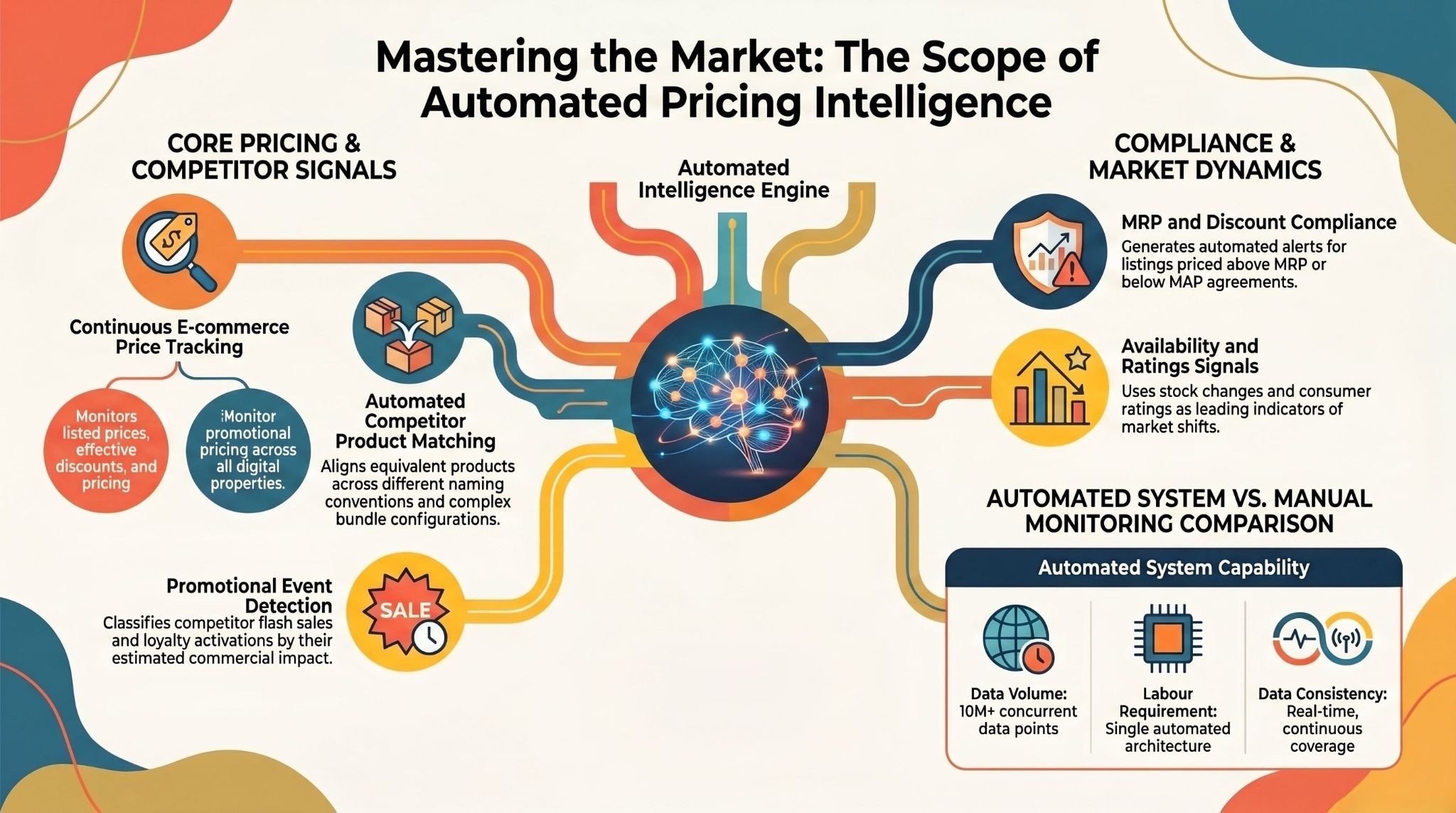
E-commerce channel pricing: Listed prices, effective prices after seller discounts, and promotional pricing across the client's own digital properties and major marketplace presences, tracked continuously across all major SKUs.
MRP and discount compliance: Automated detection of listings where products were priced above MRP, below MAP, or carrying promotional discounts that violated distributor agreements — surfaced as compliance alerts with source citations for follow-up.
Competitor product pricing: Continuous monitoring of equivalent and comparable competitor products across online channels, with automatic product-matching logic to ensure accurate comparison even across different naming conventions and bundle configurations.
Promotional event detection: Identification of competitor promotional campaigns, flash sales, loyalty program activations, and seasonal pricing moves — classified by type, channel, and estimated commercial impact.
Availability and ratings signals: Tracking of product availability changes and consumer rating movements as leading indicators of competitive positioning shifts — integrated into the pricing intelligence model rather than treated as separate data streams.
Portfolio movement analytics: Views of pricing trends at the category and subcategory level, allowing leadership to see not just individual SKU movements but strategic portfolio shifts by competitors.
Across all of these signal types, the system was tracking over 10 million data points at any given time — a volume that would require a team of dozens of analysts working in shifts to monitor manually, and even then with inevitable gaps, delays, and interpretation inconsistencies.
From Signal to Action: How Pricing Intelligence Becomes a Business Decision
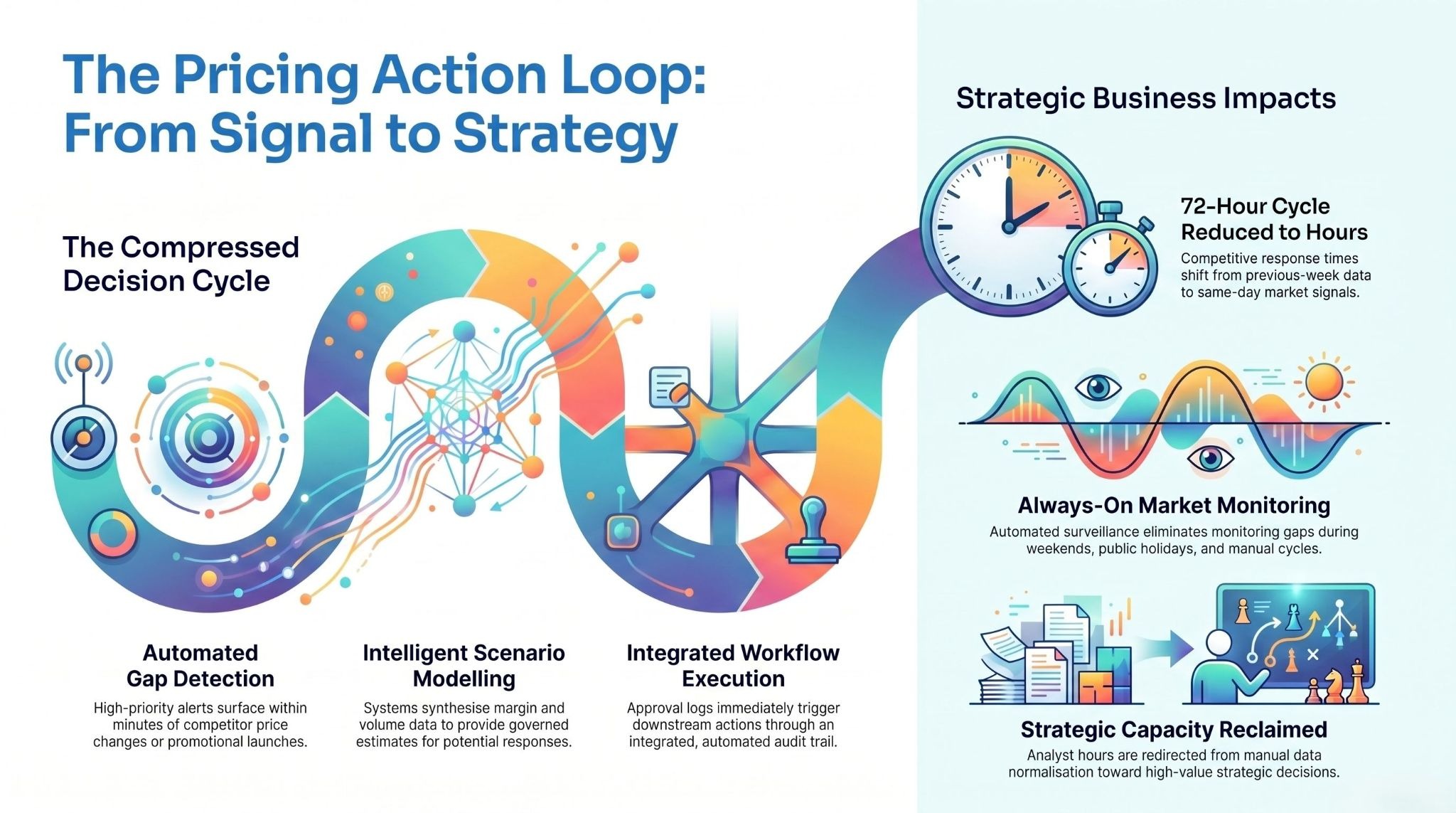
Data at scale has no value without action. The point of a pricing intelligence system is not to generate reports — it is to close the loop between what the market is doing and what your organization decides to do about it.
Here is how the action loop worked in practice for this deployment:
A classification agent detects that three competitor brands have launched simultaneous promotional campaigns on a high-velocity product category, with effective price reductions averaging 12% below the client's current selling price. This is surfaced as a high-priority pricing gap alert within minutes of the competitor campaigns going live.
The alert reaches the relevant category manager with context: which products are affected, which channels are impacted, what the historical pattern of this competitor's promotional behavior looks like, and what the estimated volume risk is if no action is taken over the next 48 hours.
The category manager queries the Q&A interface: "If we match the competitor promotional pricing on our top 10 SKUs in this category, what is the estimated margin impact versus the estimated volume recovery?" The agent synthesizes pricing data, historical sell-through data, and category margin parameters to generate a modeled answer — not a precise forecast, but a governed estimate that supports a faster, better-informed decision.
The manager approves a targeted promotional response for specific channels. The action is logged, the approval is recorded in the audit trail, and the downstream execution is triggered through the integrated workflow.
What used to be a three-day cycle — detect, analyze, decide, execute — compressed into hours.
The results of this approach were consistent across the deployment:
- Faster competitive response cycles, with pricing decisions being made in response to the same-day market signals rather than the previous week's data
- Earlier identification of pricing gaps and promotional shifts before they had time to affect sales velocity
- Always-on monitoring replacing the previous system of manual checks across portals — eliminating the gaps that occurred between monitoring cycles and during weekends and public holidays
- A significant reduction in the analyst hours previously spent on data collection, normalization, and report generation — redirecting that capacity toward strategic pricing decisions rather than operational data work
Scaling from PoC to Production: Governance, Audit Trails, and Enterprise Readiness
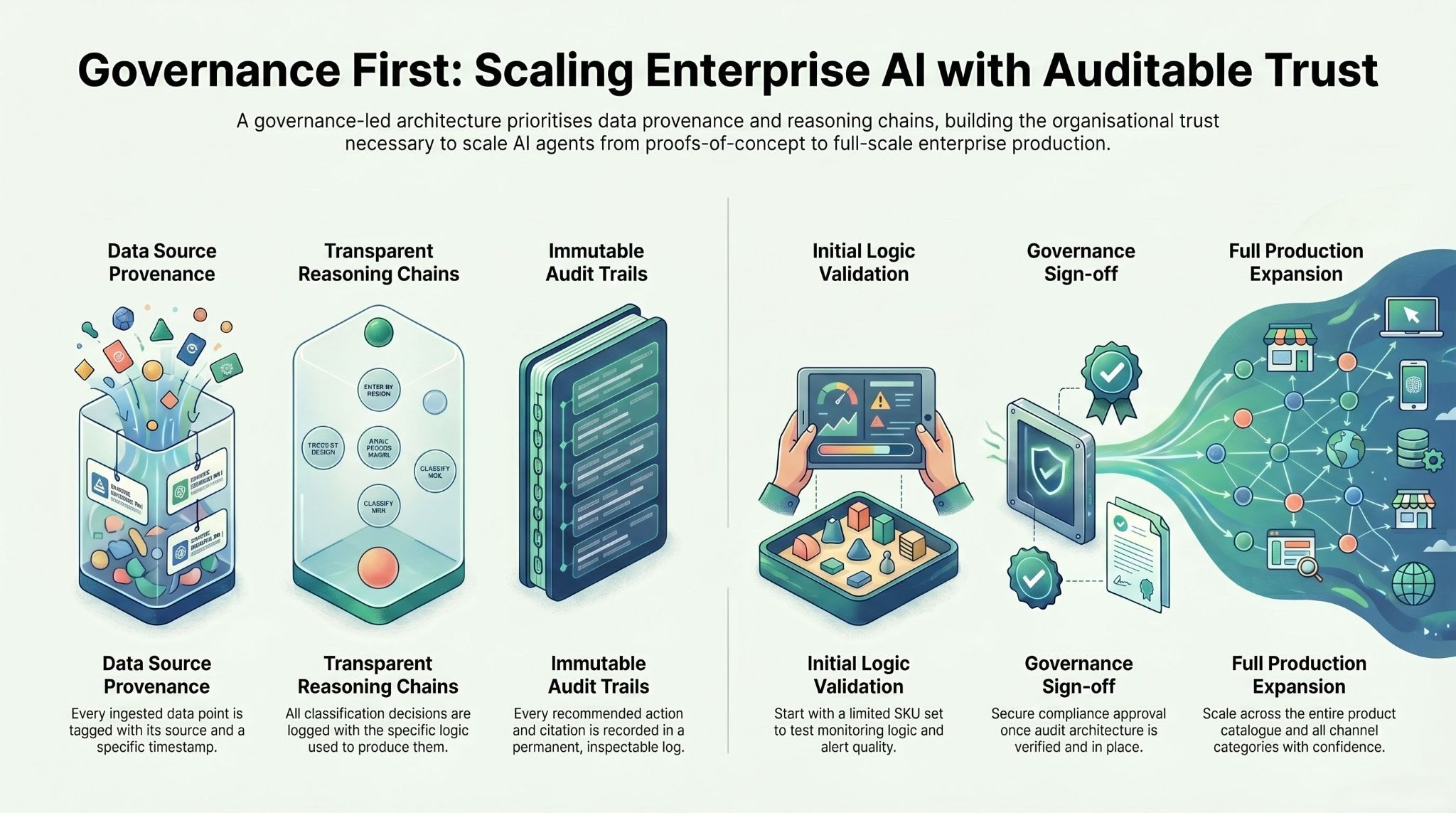
One of the consistent barriers to enterprise adoption of AI-powered pricing intelligence is not technical capability — it is governance confidence. Pricing is a high-stakes domain.
A misconfigured alert threshold, an incorrectly matched product comparison, or a recommendation based on bad data can result in real commercial harm. Enterprise buyers — and the compliance teams who need to approve these systems — require more than impressive demos. They require architecture that is auditable, correctable, and controllable.
This is an area where the assistents.ai platform is specifically designed for enterprise requirements.
Every data point ingested by the monitoring agents is tagged with source provenance and timestamp. Every classification decision made by the signal agents is logged with the reasoning chain and the data inputs that produced it. Every answer generated by the Q&A interface is cited back to specific source records. Every recommended action and every action taken is recorded in an immutable audit trail.
This means that when a category manager asks "Why did the system flag this SKU as a pricing gap last Tuesday?", they can get a complete, traceable answer — not a black-box output. When a compliance team wants to review how a pricing recommendation was generated, the reasoning is available for inspection. When a leadership team wants to verify that the system's competitive monitoring is operating within its defined scope, the audit trail provides that assurance.
The deployment for this enterprise client moved from proof-of-concept to full production in a structured progression: initial PoC with a limited SKU set and one channel category to validate the monitoring logic and alert quality, followed by expansion across the full product catalog and channel scope after governance sign-off, with full audit trail architecture in place before any production data was processed.
This governance-first approach is not a slower path to value — it is a faster path to organizational trust, which is the actual prerequisite for AI agents to be used at scale across an enterprise.
Lessons Learned: What Makes Pricing Intelligence Agents Actually Work
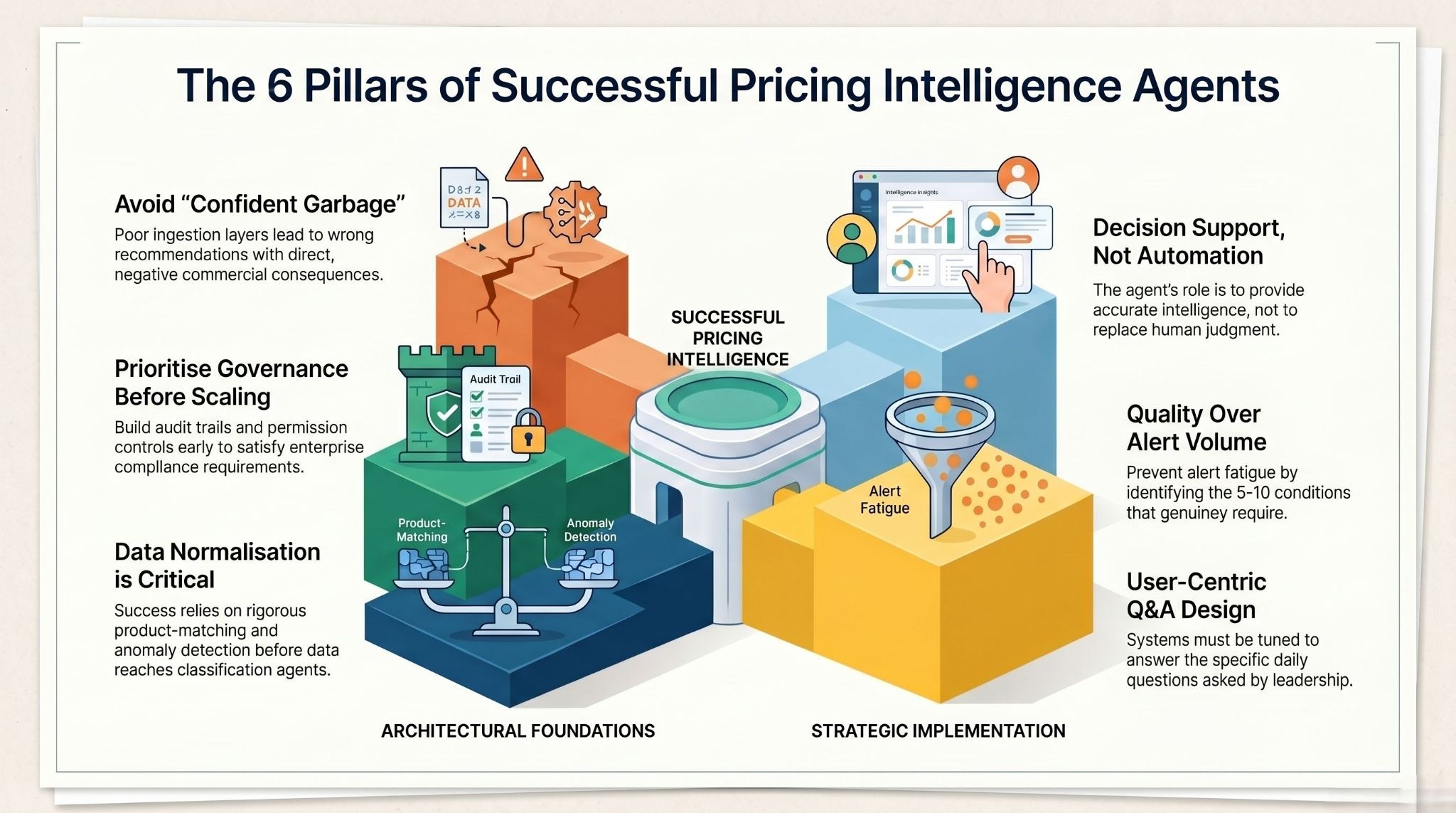
After deploying this system and refining it over time, several things became clear about the difference between pricing intelligence agents that deliver value and those that get abandoned after the initial implementation.
Data quality is a prerequisite, not an afterthought. The classification agents are only as reliable as the normalization layer beneath them. Investing in rigorous product-matching logic, source validation, and anomaly detection in the ingestion layer pays dividends in the quality of every output the system generates downstream. Garbage in, confident garbage out is a particularly dangerous failure mode in pricing intelligence, where wrong recommendations have direct commercial consequences.
Alert design is more important than alert volume. The instinct when building a monitoring system is to surface everything that might be relevant. The result is alert fatigue — a high-volume noise stream that decision-makers learn to ignore. Effective alert design requires discipline: what are the five to ten conditions that genuinely require immediate attention, and how are those distinguished from the hundred conditions that are informative but not urgent? Getting this calibration right took several iterations of feedback from the pricing team.
The Q&A interface design determines adoption. The technology behind a natural language interface can be sophisticated, but if the questions that leadership actually wants to ask do not return useful answers, the interface will not get used. We spent significant time understanding the real questions this enterprise's pricing leaders asked on a daily basis and tuning the system to answer those questions well before expanding to broader query coverage.
Governance architecture should be designed before scale, not retrofitted after it. It is much easier to build audit trails, permission controls, and approval workflows into the system from the start than to add them after the system is in production use. Enterprise compliance teams are much more willing to approve expansion of a system they can already audit than to retrofit governance onto one they cannot.
The goal is decision support, not decision automation. The most effective use of a pricing intelligence agent is not to automate pricing decisions — it is to ensure that the humans making pricing decisions are working from complete, current, and accurately interpreted information. The human judgment layer remains essential. The agent's job is to make sure that judgment is exercised with the best available intelligence, not constrained by the lag of manual data processing.
What This Means for Your Pricing Operation
Competitive pricing is no longer a function that can afford to operate on a weekly reporting cycle. The market moves in real time. The organizations that win on pricing in 2025 and beyond will be the ones whose intelligence layer operates at the same pace as the market they are competing in.
Building that intelligence layer does not require replacing your existing pricing team or your current systems. It requires augmenting them with an agentic layer that can process the volume of signals your team cannot, interpret those signals in context, and surface the right answers to the right people before the window for action closes.
The system described in this post — built on assistents.ai's enterprise agentic AI platform — replaced three days of lag with same-day intelligence, replaced manual monitoring gaps with always-on coverage, and redirected analyst time from data collection toward the strategic decisions that data collection is supposed to support.
If your pricing team is currently running on spreadsheets, static dashboards, or narrow-scope monitoring tools, the gap between what you know and what the market is doing is wider than you think.
See how assistents.ai can build your pricing intelligence layer →
Frequently Asked Questions
What is pricing intelligence, and how is it different from price monitoring?
Price monitoring is the practice of tracking listed prices across specific competitor URLs or channels. Pricing intelligence goes further: it involves collecting, normalizing, classifying, and interpreting pricing signals — including promotional events, availability changes, ratings movements, and cross-channel price variations — to generate actionable competitive insight. The distinction matters because pricing decisions require context, not just data.
How many data points can an AI pricing intelligence agent actually process?
At the deployment scale described in this post, the system processed over 10 million data points across monitored channels, product categories, and competitors on a continuous basis. The practical ceiling is determined by infrastructure configuration, not by any inherent limitation of the agentic architecture. Systems can be scaled up or down based on catalog size, channel scope, and monitoring frequency.
How is this different from traditional competitive pricing software like Pricefx or IntelligenceNode?
Traditional pricing software is primarily designed to track and report. It surfaces data for human analysts to interpret and act on. An AI agent-based system closes the loop — it interprets signals, generates natural language answers to specific questions, proactively surfaces insights without waiting to be queried, and connects to governed action workflows. It is the difference between a monitoring tool and an operational intelligence layer.
Which industries benefit most from AI pricing intelligence agents?
Any industry where pricing is competitive, multi-channel, and high-velocity benefits from this approach. Retail and FMCG are the most obvious — with large catalogs, multiple competing channels, and fast-moving promotional cycles. Consumer electronics, industrial goods, and HVAC are close seconds, particularly where competitive pricing monitoring is critical to market share defense. Financial services, SaaS, and logistics are emerging use cases.
How long does it take to deploy an AI pricing intelligence agent?
For a scoped initial deployment — covering a defined product catalog and a specific set of monitored channels — the assistents.ai platform typically moves from proof-of-concept to production in under four weeks. Broader deployments covering full catalog scope and multi-channel monitoring can extend to eight to twelve weeks depending on data source integration complexity and governance approval processes.
Does the system require replacing existing pricing tools?
No. The architecture is designed to sit on top of existing data sources and, where appropriate, existing pricing tools — treating them as input sources for the intelligence layer rather than systems to be replaced. The Q&A interface and alerting layer can connect to your existing data infrastructure without requiring you to migrate off current tooling.
What are the governance requirements for enterprise deployment?
The assistents.ai platform is SOC 2 Type II certified, GDPR compliant, and HIPAA ready. Every agent action is logged in an immutable audit trail. Permission controls govern which agents can access which data sources and which action types they can trigger. Governance architecture — including approval workflows for recommended actions — is configured as part of the deployment, not added later.

Transform Your Business With Agentic Automation
Agentic automation is the rising star posied to overtake RPA and bring about a new wave of intelligent automation. Explore the core concepts of agentic automation, how it works, real-life examples and strategies for a successful implementation in this ebook.
Sarfraz Nawaz is the CEO and founder of Ampcome, which is at the forefront of Artificial Intelligence (AI) Development. Nawaz's passion for technology is matched by his commitment to creating solutions that drive real-world results. Under his leadership, Ampcome's team of talented engineers and developers craft innovative IT solutions that empower businesses to thrive in the ever-evolving technological landscape.Ampcome's success is a testament to Nawaz's dedication to excellence and his unwavering belief in the transformative power of technology.

More insights
Discover the latest trends, best practices, and expert opinions that can reshape your perspective






Contact us

