
11 Best AI Agent Development Tools in 2025 (No-Code to Enterprise)


The AI agent market hit $7.6 billion in 2025 and is growing at nearly 50% annually. Every industry—from logistics and retail to healthcare and finance—is deploying agents that reason, plan, and execute complex workflows autonomously.
But here's the problem: the category has exploded so fast that choosing the right tool is genuinely hard. You have open-source frameworks built for ML engineers, no-code builders aimed at business teams, and enterprise platforms designed for governance and scale. They are not interchangeable. Picking the wrong one costs months.
This guide cuts through the noise. We evaluated 11 AI agent development tools across five dimensions—multi-agent orchestration, human-in-the-loop controls, integration depth, governance, and real-world deployment evidence—so you can make the right choice for your team, your stack, and your use case.
Whether you're a developer building custom pipelines, an operations leader automating workflows, or an enterprise architect evaluating platforms, this list has a clear answer for you.
What Makes a Great AI Agent Development Tool?
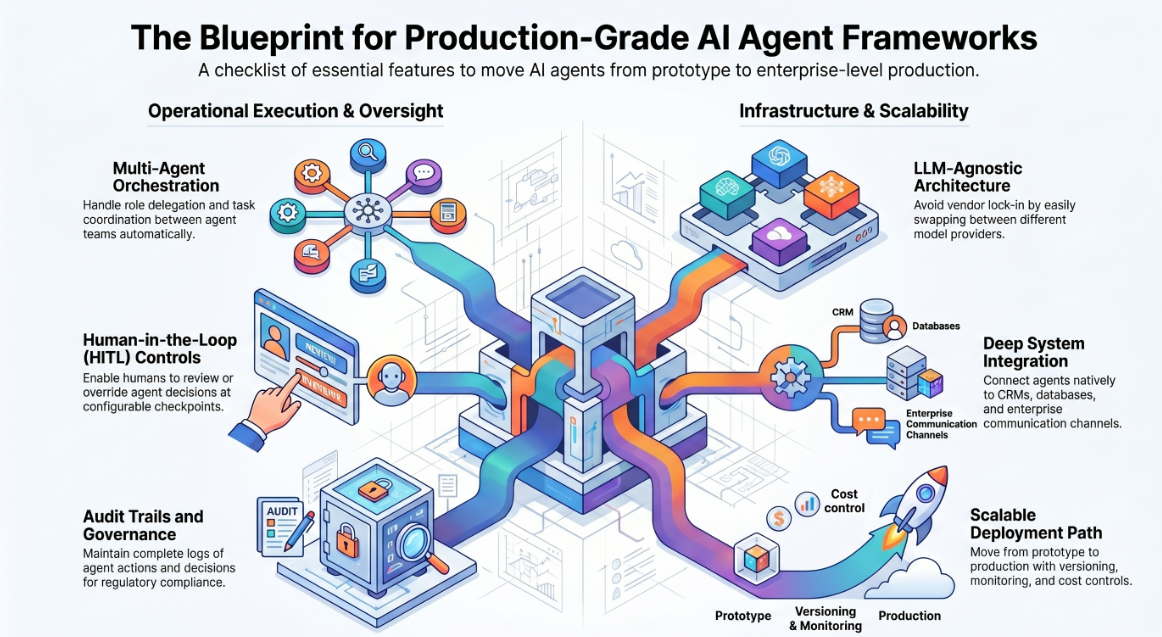
Most comparison articles skip this part. They list tools and describe features without telling you what actually matters when you're building agents in production. Here is the evaluation framework we used—and that you should use too.
Multi-agent orchestration. A single agent can answer questions. A team of agents can run a business process. The best tools handle agent-to-agent communication, role delegation, and task coordination without requiring you to wire everything together manually.
Human-in-the-loop (HITL) controls. Fully autonomous agents make mistakes. Production-grade tools give humans the ability to review, approve, or override agent decisions at configurable checkpoints—without breaking the workflow.
Audit trails and governance. Regulated industries and enterprise deployments require complete logs of every agent action, decision, and data access. If a tool cannot tell you what the agent did and why, it is not production-ready.
LLM-agnosticism. Locking into a single model provider is a risk. The best tools let you swap between OpenAI, Anthropic, Google Gemini, and open-source models based on cost, capability, or compliance requirements.
Integration depth. Agents are only as useful as the systems they connect to. Look for native integrations with CRMs, ERPs, databases, communication channels (email, WhatsApp, voice), and analytics platforms—not just REST API hooks.
No-code to pro-code spectrum. The best enterprise tools serve both business users who need point-and-click configuration and developers who need Python SDKs and custom logic. Forcing everyone into one mode creates bottlenecks.
Scalable deployment. A proof-of-concept is not a product. Tools that score well here have clear paths from prototype to production: versioning, monitoring dashboards, rate limiting, and cost controls.
The 11 Best AI Agent Development Tools in 2025
1. Assistents by Ampcome — Best Enterprise AI Agent Platform with Proven Real-World Deployment
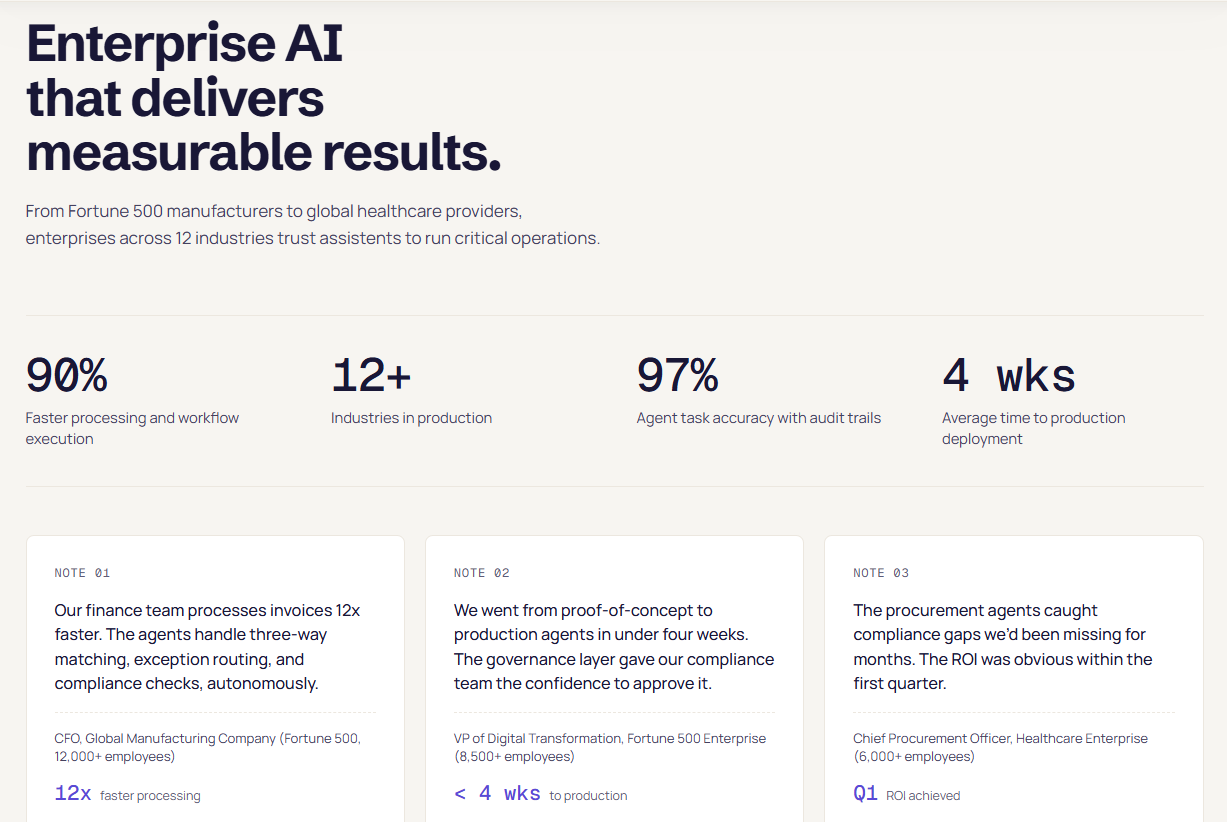
Best for: Enterprises that need production-grade AI agents with governance, audit trails, multi-channel deployment, and real business results—not just a framework to start from scratch.
Assistents is the enterprise AI agent platform built by Ampcome, designed for teams that need agents that actually ship. Unlike open-source frameworks that give you building blocks, Assistents delivers a full-stack agentic environment—from data ingestion and workflow orchestration to semantic governance, human-in-the-loop controls, and executive dashboards.
The platform has been deployed across industries including logistics, retail, hospitality, healthcare, real estate, financial services, and utilities. It handles everything from conversational AI agents deployed across web, WhatsApp, and voice channels to autonomous backend agents that process documents, trigger SAP workflows, monitor grids, and generate insight narratives for leadership.
What sets Assistents apart is the combination of speed and governance. Most frameworks give you speed at the cost of auditability. Assistents is built from the ground up with audit logs, semantic rule layers, exception routing, and anomaly detection baked in—making it suitable for regulated environments.
Key features:
- Multi-agent orchestration with role-based task delegation
- Omnichannel deployment: web, WhatsApp, email, voice (STT-LLM-TTS)
- Human-in-the-loop review and approval workflows
- Semantic governance layer for consistent KPI definitions across entities
- Agentic document processing: PDF extraction, Vision-LLM pipelines, revision detection
- Native integrations: SAP, Simpro, CRM, ERP, banking/accounting exports
- Executive dashboards with automated alerting and variance explanations
- Audit logs, reconciliation reporting, and exception management
- RAG over internal documents, SOPs, and policy knowledge bases
Real-world results (anonymised): Across deployments, Assistents has delivered approximately 90% faster document processing for complex tender workflows, 95% extraction accuracy targets for standard formats, significant reduction in manual helpdesk load at national retail scale, and shift from reactive reporting to proactive, agent-triggered execution loops.
Pricing: Contact for enterprise pricing.
2. LangGraph — Best for Stateful, Controllable Multi-Agent Workflows
Best for: Experienced Python developers building complex, stateful agents that need precise control over execution flow.
LangGraph is a specialised framework within the LangChain ecosystem that focuses on building controllable, stateful agents with streaming support. With over 33,000 GitHub stars and millions of monthly downloads, it has demonstrated strong enterprise adoption—companies using it have reported dramatic reductions in customer support resolution time.
Unlike simpler frameworks, LangGraph models agent workflows as graphs, giving developers fine-grained control over which steps execute in sequence, in parallel, or conditionally. This makes it well-suited for multi-step reasoning tasks where you need to interrupt, inspect, and resume agent execution.
Key features:
- Stateful agent orchestration with context maintained across long interactions
- Multi-agent support: single-agent, multi-agent, hierarchical, and sequential workflows
- Streaming output for real-time user feedback
- Built-in human-in-the-loop support at configurable checkpoints
- Strong integration with the broader LangChain ecosystem
Best for: Complex multi-agent workflows, enterprise RAG pipelines, production deployments where execution control matters.
Pricing: Open source. Costs depend on the LLMs and infrastructure you use. LangSmith (observability) has a paid tier.
3. Microsoft AutoGen — Best for Multi-Agent Collaboration and Research-Grade Workflows
Best for: Teams building agents that need to collaborate, debate, and delegate tasks between specialised roles.
AutoGen is Microsoft's open-source Python framework for building AI agents, and it stands out for its approach to multi-agent communication. Rather than a single agent doing everything, AutoGen allows multiple agents with different roles and capabilities to work together through structured conversations—one agent plans, another executes, another validates.
It also includes AutoGen Studio, a visual interface for designing agent workflows with minimal code, which makes it accessible to technically-inclined but non-ML team members.
Key features:
- Multi-agent conversation architecture with role specialisation
- Human-in-the-loop oversight at any point in the workflow
- AutoGen Studio: visual, low-code interface for workflow design
- Asynchronous task execution for parallel agent workloads
- Strong fit for research agents, collaborative coding, and complex reasoning tasks
Best for: R&D teams, autonomous research assistants, internal productivity tools, simulated team workflows.
Pricing: Open source. Free to use. Costs depend on LLMs and external services.
4. CrewAI — Best for Role-Based, Team-Style Agent Workflows
Best for: Developers who want to define agent teams with clear roles, goals, and handoffs—similar to how a human team operates.
CrewAI has become one of the most popular agentic frameworks for a simple reason: it mirrors how people think about work. You define agents with specific roles (researcher, writer, analyst), assign tasks, and CrewAI handles the coordination. This role-based approach makes workflows intuitive to design and easy to explain to non-technical stakeholders.
CrewAI is well-suited for content pipelines, automated research workflows, and any process where distinct specialisations need to collaborate sequentially or in parallel.
Key features:
- Role-based agent definitions with goals and backstory context
- Sequential and parallel task execution
- Tool integration: web search, code execution, database access
- Human-in-the-loop checkpoints
- Lightweight and quick to prototype
Best for: Content automation, multi-step research, internal process agents, rapid prototyping of agentic workflows.
Pricing: Open source. Enterprise tier available.
5. OpenAI Agents SDK — Best Lightweight Framework for Multi-Agent Pipelines
Best for: Developers building clean, multi-agent workflows who want minimal overhead and broad LLM compatibility.
Released in March 2025, the OpenAI Agents SDK quickly accumulated over 26,000 GitHub stars. It is deliberately lightweight—minimal abstractions, clean primitives for handoffs between agents, and built-in tracing and guardrails. Despite the OpenAI branding, it is provider-agnostic and compatible with over 100 different LLMs.
The SDK is particularly strong for developers who want to build production-grade multi-agent systems without the overhead of heavier frameworks, and who value first-class tracing for debugging and observability.
Key features:
- Lightweight multi-agent orchestration with simple handoff primitives
- Built-in tracing for debugging and monitoring agent runs
- Guardrails system for input/output validation
- Compatible with 100+ LLM providers
- Clear documentation and rapid community growth
Best for: Clean multi-agent architectures, production pipelines, teams already in the OpenAI ecosystem.
Pricing: Open source. Free to use. LLM and inference costs apply.
6. LlamaIndex — Best for RAG-Heavy, Data-Centric Agent Applications
Best for: Teams building agents that need to reason over large volumes of internal documents, databases, or structured data.
LlamaIndex specialises in the data layer of agentic AI. Where other frameworks focus on agent orchestration, LlamaIndex focuses on making it easy to connect agents to the right information at the right time—through sophisticated retrieval-augmented generation (RAG) pipelines.
It supports semantic search, keyword search, and hybrid approaches, and allows agents to use other agents as tools, enabling hierarchical agent systems where specialised sub-agents handle specific data domains.
Key features:
- Production-grade RAG with caching, streaming, and observability
- Multi-modal data connectors: PDFs, databases, APIs, spreadsheets
- Agent-as-tool: hierarchical agent compositions
- Strong support for enterprise knowledge management use cases
- Broad LLM compatibility
Best for: Internal knowledge bases, intelligent document search, financial data agents, any use case where data retrieval quality is the bottleneck.
Pricing: Open source. LlamaCloud (managed service) has a paid tier.
7. IBM watsonx Orchestrate — Best Enterprise No-Code + Pro-Code Hybrid
Best for: Enterprises that need governed, scalable AI agents with support for both business users and developers—within a compliance-ready environment.
IBM watsonx Orchestrate is one of the few platforms that genuinely serves both ends of the technical spectrum. Business users get a no-code agent builder with guided steps and prebuilt templates. Developers get the Agent Development Kit (ADK), Langflow integration, and full API control.
The platform is LLM-agnostic—supporting IBM Granite, OpenAI, Anthropic, Google Gemini, and others—and is built for regulated industries with strong compliance and observability features.
Key features:
- No-code builder with guided flows and 200+ prebuilt tools
- Agent Development Kit (ADK) for pro-code customisation
- Langflow integration for visual workflow prototyping
- LLM-agnostic via AI Gateway
- Enterprise compliance: on-premises and hybrid cloud deployment
- Deep integration with Salesforce, SAP, ServiceNow, and other enterprise systems
Best for: Large enterprises in regulated industries, teams that mix technical and non-technical builders, Microsoft/IBM ecosystem deployments.
Pricing: Paid. Enterprise pricing on request. Free trial available.
8. n8n — Best Open-Source Agentic Workflow Builder for Technical Teams
Best for: Technical teams that want to build AI-powered workflow automations with full control, self-hosting options, and deep app connectivity.
n8n sits between a workflow automation tool and an AI agent builder. It offers a visual canvas for connecting applications, APIs, and LLMs into agentic workflows—but it is built for teams with some technical capability, not pure no-code users.
Its self-hosting option is a significant differentiator for teams with data privacy requirements, and its library of pre-built integrations covers most enterprise systems.
Key features:
- Visual canvas builder with 400+ integrations
- AI agent nodes: connect LLMs, tools, and memory within workflows
- Self-hosting option for data sovereignty
- Extensive template library
- Code-extensible with JavaScript and Python
Best for: IT teams, technical operations, developer-led automation, teams with data privacy requirements.
Pricing: Free (self-hosted). Cloud plans from $24/month.
9. Voiceflow — Best for Conversational and Voice AI Agent Deployment
Best for: Teams building customer-facing conversational agents across voice, chat, and messaging channels.
Voiceflow is purpose-built for conversational AI. It provides a visual design environment for building multi-turn dialogue agents, with strong support for voice assistants, chatbots, and messaging integrations. Its knowledge base integration allows agents to be trained on custom data and deployed across web, mobile, Slack, and voice platforms.
The platform supports real-time collaboration, which makes it suitable for teams where designers, product managers, and developers are all involved in agent creation.
Key features:
- Visual conversation design environment
- Knowledge base integration: train agents on custom data
- Multi-channel deployment: voice, web, Slack, mobile, Alexa
- Developer toolkit for custom integrations via API
- Real-time team collaboration and shared workspaces
- Analytics on conversation performance
Best for: Customer support agents, voice assistants, multi-channel conversational AI, non-developer-led agent teams.
Pricing: Free tier available. Paid plans scale with usage.
10. Zapier Agents — Best No-Code Agent Builder for Non-Technical Business Teams
Best for: Business users who want to deploy AI assistants that work across apps—without writing a single line of code.
Zapier has extended its legendary no-code automation platform into AI agents. Zapier Agents lets users create AI assistants that can access and act on 7,000+ connected apps—scheduling meetings, processing emails, updating CRMs, and triggering downstream workflows—all through natural language instructions.
It is not designed for complex multi-agent orchestration or enterprise governance, but for business teams that need a capable agent running quickly, it is the fastest path from idea to deployed automation.
Key features:
- AI agent creation through natural language instructions
- Access to 7,000+ app integrations
- No coding required
- Works across Gmail, Slack, Salesforce, Google Sheets, and hundreds more
- Simple trigger-action agent logic with AI decision-making
Best for: Operations managers, marketing teams, sales ops, any non-technical team that wants to automate cross-app workflows.
Pricing: Included in Zapier plans. Agents feature in beta as of 2025.
11. Semantic Kernel — Best for .NET and Enterprise Microsoft Ecosystem Integration
Best for: Enterprise development teams building AI agents within Microsoft technology stacks.
Semantic Kernel is Microsoft's enterprise-oriented agent framework and the only major option on this list with first-class support for C#, Python, and Java. This makes it the natural choice for organisations with .NET-heavy codebases or deep Microsoft ecosystem investments.
It supports plugin-based architecture, allowing developers to wrap existing business logic as tools that agents can invoke, and integrates natively with Azure OpenAI, Microsoft 365, and Dynamics 365.
Key features:
- First-class C#, Python, and Java support
- Plugin system for wrapping existing business logic
- Native Azure OpenAI and Microsoft 365 integration
- Memory and state management for long-running agents
- Enterprise-grade security and compliance posture
Best for: Microsoft-stack enterprises, .NET development teams, organisations already on Azure.
Pricing: Open source. Free to use. Azure inference and hosting costs apply.
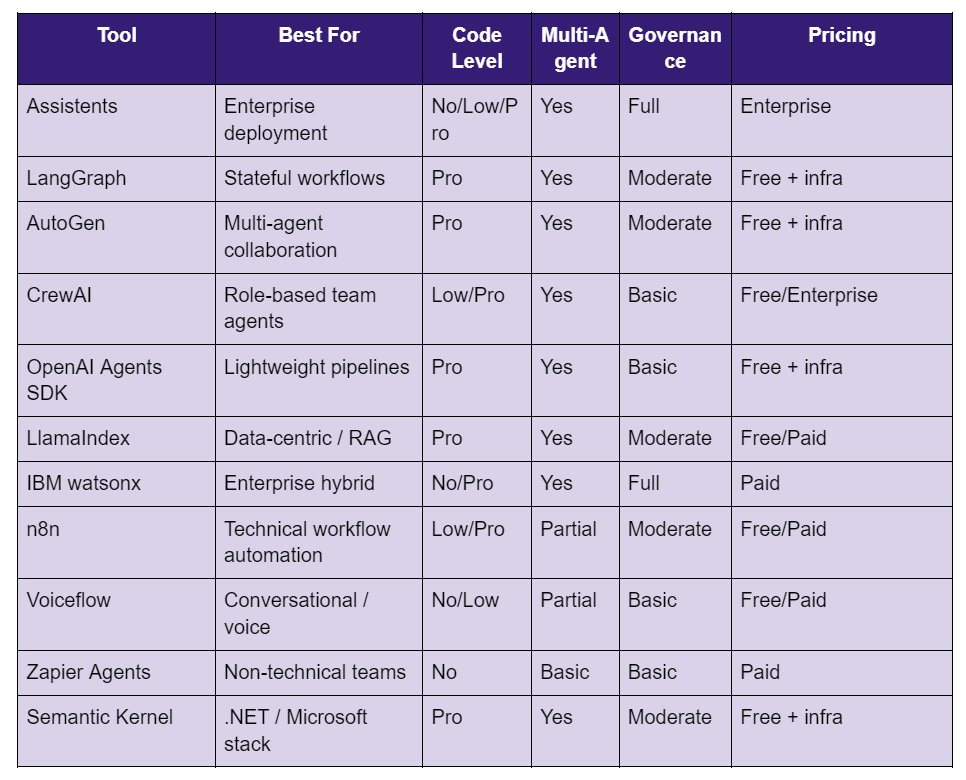
Tool Comparison at a Glance
Real-World AI Agent Use Cases by Industry
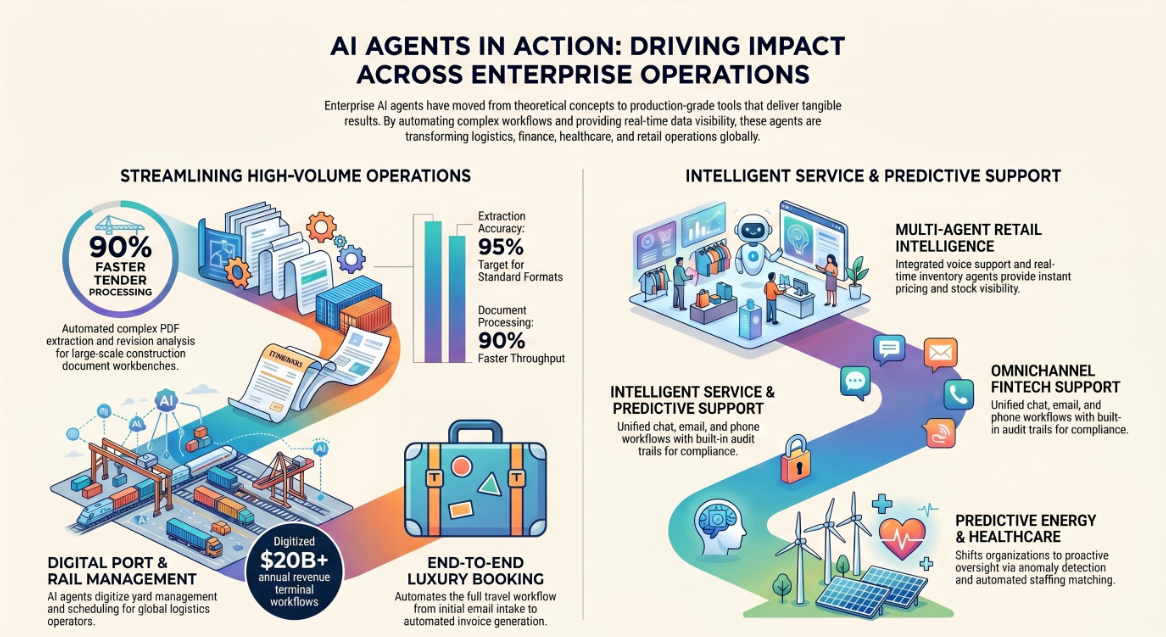
This is where theory meets results. Below are anonymised deployment examples drawn from real enterprise AI agent implementations across industries—demonstrating what production-grade AI agents actually deliver.
Logistics and Supply Chain
A global ports and logistics operator with over $20 billion in annual revenue deployed an AI agent to digitise terminal and rail management operations. The agent handled yard management, rail scheduling, exception routing, and executive dashboard generation. Results included higher predictability of terminal-to-rail throughput, faster exception detection, and more efficient coordination across inland logistics networks.
Separately, an Indian multinational logistics company with operations across the UK, Europe, and the US consolidated analytics across multi-entity global operations. The AI agent standardised KPI definitions, automated variance explanations, and gave leadership a single operational view that replaced fragmented manual reporting.
Retail and E-Commerce
A value retail chain with over 700 stores across India deployed a multi-agent system covering three distinct workflows: a voice support agent (operating in both Hindi and English), an inventory intelligence agent providing real-time pricing and stock visibility per store, and a knowledge and training agent built on RAG over point-of-sale SOPs. The result was reduced manual helpdesk burden, improved store-level inventory visibility, and on-demand training access for frontline staff.
A separately deployed e-commerce AI agent ingested sales, product, inventory, promotion, and customer behaviour data and enabled conversational analytics—allowing business teams to get instant answers to operational questions without waiting for analyst reports.
Financial Services and Fintech
A cloud-based fintech serving banks and credit unions deployed omnichannel AI agents to handle banking support workflows—covering chat, email, and phone intake—with automated case summarisation, next-best-action recommendations, and SLA monitoring. Audit trails were built in from day one to satisfy compliance requirements.
A separate deployment for a financial analytics business automated SAP sales order creation, replacing a legacy system that was approaching end-of-life. The agent interpreted order triggers, validated inputs, created SAP Sales Orders, and routed exceptions for human approval—cutting manual processing time and error rates significantly.
Healthcare
A healthcare staffing platform deployed AI agents to manage nurse-to-facility matching, shift scheduling, credential capture, and compliance workflows. The agents handled onboarding, facility staffing requests, notifications, and fill-rate reporting—reducing scheduling friction and improving workforce utilisation.
A geriatric care services provider used AI agents to generate operational dashboards and revenue cycle reporting, bringing visibility to service delivery performance and enabling faster identification of revenue leakage and care-program bottlenecks.
Real Estate
A major commercial real estate portfolio owner deployed an omnichannel AI agent to automate tenant and customer support—handling query triage, rental and payment support, FAQ resolution, and escalation to human teams across web, WhatsApp, and email channels. The result was 24/7 consistent tenant experience and measurable reduction in call-centre load.
Energy and Utilities
A state power transmission utility deployed AI agents to monitor transmission KPIs, detect anomalies, and automate alerts for field operations teams. The system delivered predictive maintenance signals, loss and outage analytics, and proactive operational alerting—shifting the organisation from reactive manual monitoring to continuous automated oversight.
A research campus with complex energy infrastructure deployed AI agents to monitor utility and sensor data, generate forecasting and optimisation recommendations, and issue proactive alerts before equipment failures occurred.
Hospitality
A luxury safari hospitality brand with properties across Kenya and Tanzania deployed a Digital Booking Agent that automated end-to-end travel booking workflows—handling email intake, intent classification, data extraction, real-time inventory checks, alternative date negotiation, and automated invoice generation. The result was faster booking turnaround, higher accuracy on complex guest requirements, and scalable operations without compromising the brand's luxury service standards.
Professional Services and Construction
An Australian commercial waterproofing specialist deployed an Intelligent Document Workbench using multi-agent orchestration to process complex tender documents. The system handled tender retrieval, workflow determination, revision analysis, Vision-LLM extraction from complex PDFs, and deep integration with project management systems. Engineering achieved approximately 90% faster tender document processing and a 95% extraction accuracy target for standard formats—significantly reducing bid risk through automated revision detection.
How to Choose the Right AI Agent Development Tool
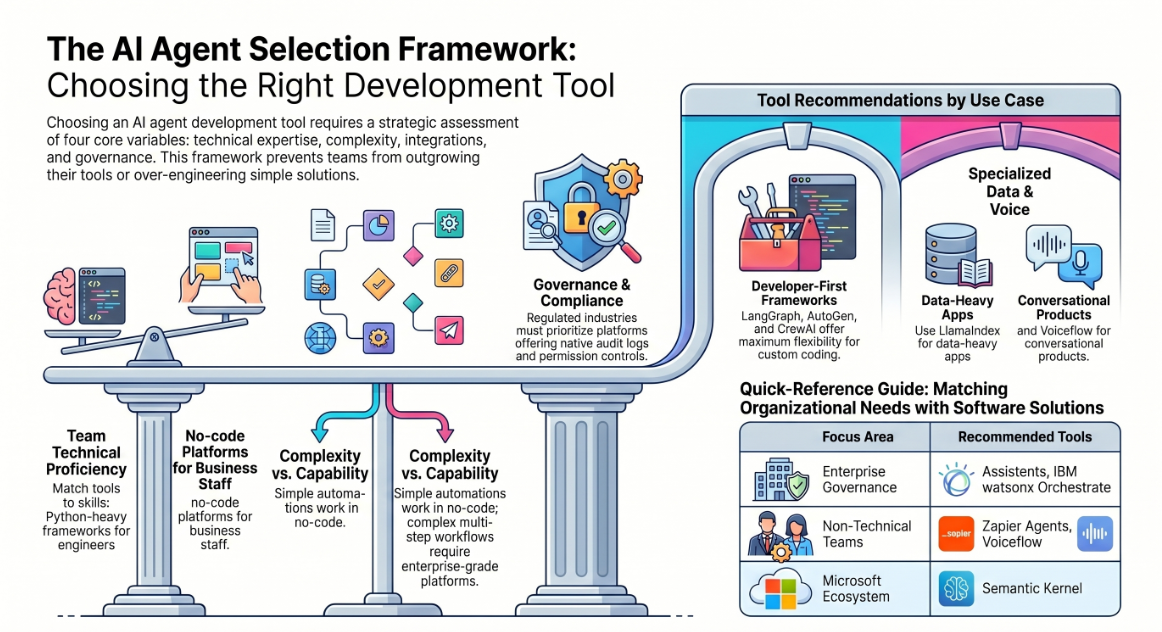
The right tool depends on four variables. Map where you sit on each axis before evaluating options.
1. Team technical level
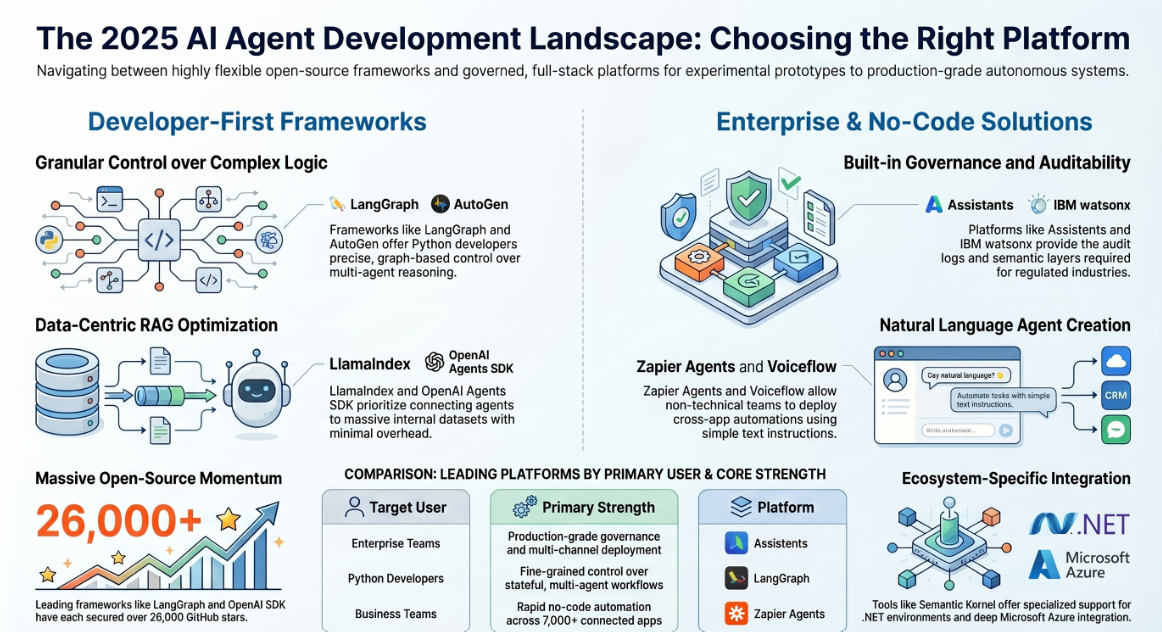
If your team consists of ML engineers comfortable with Python, LangGraph, AutoGen, CrewAI, and the OpenAI Agents SDK all give you maximum flexibility. If your team is primarily business users or operations staff, start with Zapier Agents, Voiceflow, or a platform like Assistents that provides both no-code and pro-code interfaces within the same environment.
2. Use case complexity
Simple single-agent automations—answering customer queries, routing support tickets, scheduling meetings—can be handled by no-code tools. Complex, multi-step workflows involving document processing, multi-system integrations, exception handling, and audit requirements need platforms built for that complexity. Do not try to force enterprise complexity through a no-code prototype builder.
3. Integration requirements
Map your critical systems before choosing a tool. If you are on SAP, Salesforce, or Microsoft Dynamics, prioritise tools with native connectors. If you need omnichannel deployment across web, WhatsApp, and voice, confirm the tool handles all three with a single governance layer—not separate implementations.
4. Governance and compliance
If you are in a regulated industry—banking, healthcare, energy, insurance—governance is non-negotiable. You need audit logs, permission controls, exception routing to humans, and explainability. Open-source frameworks can be built to support this, but it requires significant engineering investment. Purpose-built enterprise platforms include it by default.
Decision guide:
- Developer building custom agents: LangGraph, AutoGen, CrewAI, OpenAI Agents SDK
- Data-heavy application: LlamaIndex
- Conversational / voice product: Voiceflow
- Non-technical business team: Zapier Agents
- Microsoft .NET stack: Semantic Kernel
- Enterprise deployment with governance: Assistents, IBM watsonx Orchestrate
No-Code vs Low-Code vs Pro-Code: Which Path Is Right for You?
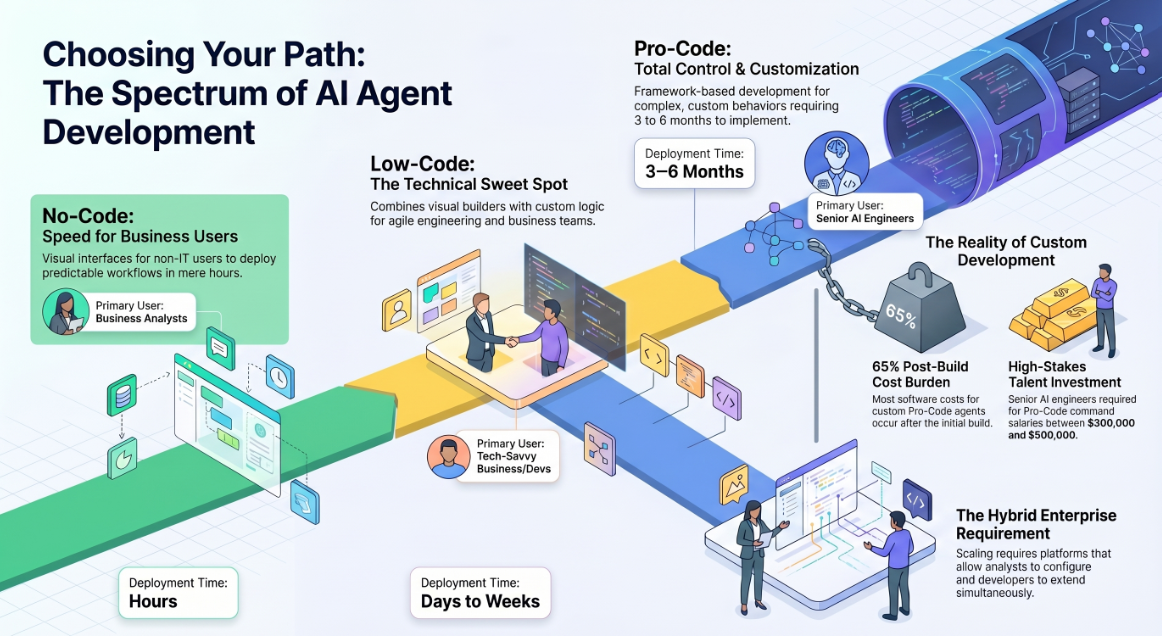
The no-code vs low-code vs pro-code decision is one of the most consequential choices in AI agent development. Here is what each path actually means.
No-code AI agent development
No-code platforms let anyone build agents through visual interfaces—drag-and-drop logic, point-and-click integrations, natural language instructions. Tools like Zapier Agents and Voiceflow sit here.
The advantage is speed. Gartner projects that 80% of low-code tool users will be outside formal IT departments by 2026. No-code agents can be deployed in hours, not months. The disadvantage is ceiling: no-code tools handle defined, predictable workflows well but break down when inputs vary significantly or when enterprise governance requirements emerge.
Low-code AI agent development
Low-code tools combine visual builders with the ability to add custom logic where needed. n8n, Voiceflow (with API hooks), and the no-code tier of platforms like Assistents sit here. This is the sweet spot for technically-inclined business users and smaller engineering teams who need to move fast without rebuilding everything from scratch.
Pro-code (code-first) AI agent development
LangGraph, AutoGen, CrewAI, and the OpenAI Agents SDK are pro-code frameworks. They give you total control over agent behaviour, tool use, memory management, and execution flow. The trade-off is time: a typical custom AI agent implementation takes three to six months, and 65% of total software costs occur after the initial build.
Senior AI engineers command $300,000 to $500,000 annually in competitive markets. Pro-code is the right choice when your use case genuinely requires custom behaviour that no platform can deliver—not as the default starting point.
The enterprise reality
Most enterprise deployments need all three in the same environment. Business analysts need to configure agent behaviour without raising engineering tickets. Developers need to extend that behaviour with custom logic. IT needs to govern, monitor, and audit everything. Platforms that force a single mode create bottlenecks at scale.
What Enterprises Need That Free Frameworks Don't Provide
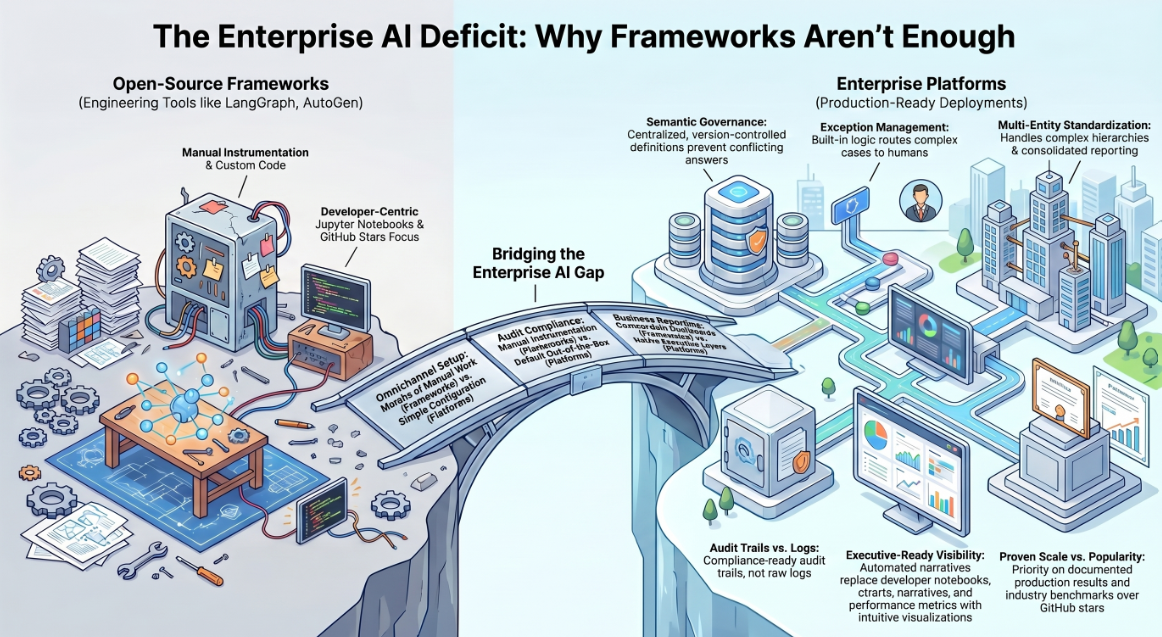
This is the most important section for enterprise decision-makers—and the one most comparison articles skip entirely.
Open-source frameworks like LangGraph, AutoGen, and CrewAI are excellent engineering tools. They are not, by default, enterprise platforms. Here is what the gap actually looks like in production deployments.
Semantic governance. Enterprise organisations have hundreds of KPIs defined differently across departments, business units, and geographies. A framework gives you agents. A platform gives you a semantic governance layer—a centralised, version-controlled definition of every metric, formula, and business rule that agents operate on. Without this, agents in different parts of the organisation give conflicting answers to the same question.
Multi-entity standardisation. Enterprises with multiple subsidiaries, regions, or operating companies cannot bolt a single agent onto one data source. They need cross-entity KPI standardisation, consolidated reporting, and agents that understand organisational hierarchies. This requires significant infrastructure beyond what any open-source framework ships with.
Omnichannel deployment with unified governance. Deploying the same agent across web chat, WhatsApp, email, voice, and internal tools sounds simple. In practice, it requires unified session management, consistent response behaviour across channels, and a single audit trail covering all interactions. Building this on top of a framework is months of work. Platforms that include it as a feature reduce that to configuration.
Exception management and human escalation. Production agents encounter situations they cannot handle confidently. Enterprise platforms have configurable escalation logic: route to a human, flag for review, create a ticket, send an alert. Frameworks have no opinion on this—you build it yourself.
Audit logs for compliance. In banking, healthcare, insurance, and utilities, agent actions need to be logged, traceable, and explainable. Which data was accessed? What decision was made? What was the output? Who approved it? Frameworks generate logs if you instrument them correctly. Enterprise platforms generate audit trails by default, in formats that compliance teams can actually use.
Executive visibility. Operations leaders and C-suite executives do not use dashboards built in Jupyter notebooks. Enterprise AI agent platforms include executive dashboard layers—automated insight narratives, variance explanations, exception alerts, and leadership reporting packs—that sit on top of the agentic layer and translate agent activity into business language.
Real deployment evidence. Perhaps most importantly, enterprise buyers need evidence that a platform has been deployed at scale, in their industry, with measurable results. Open-source frameworks have GitHub stars. Enterprise platforms have production deployments, documented use cases, and results you can benchmark against.
Ready to Build Your AI Agent?
Assistents by Ampcome is the enterprise AI agent platform that goes from deployment-ready architecture to production results—without the months of custom framework engineering.
Real enterprise outcomes. Full governance. No code or pro code—your choice.
Visit assistents.ai to see how it works.
FAQ
What is an AI agent development tool?
An AI agent development tool is a platform, framework, or environment for building autonomous software agents that can reason, plan, and execute multi-step tasks without constant human input. These tools range from open-source Python frameworks for developers to no-code visual builders for business teams.
What is the difference between an AI agent and a chatbot?
A chatbot responds to user inputs with pre-defined or AI-generated replies. An AI agent goes further: it can access external tools and data sources, make decisions, trigger actions in other systems, and complete multi-step tasks autonomously. An agent can research a topic, draft a document, update a CRM, and send a notification—all from a single instruction.
What is the best AI agent framework for developers?
For complex, stateful workflows: LangGraph. For multi-agent collaboration and role-based systems: AutoGen or CrewAI. For lightweight multi-agent pipelines: OpenAI Agents SDK. For data-centric and RAG applications: LlamaIndex. For .NET or Microsoft-stack enterprises: Semantic Kernel.
Can I build an AI agent without coding?
Yes. Platforms like Zapier Agents, Voiceflow, and the no-code tier of enterprise platforms like Assistents allow non-technical users to create capable AI agents through visual interfaces and natural language instructions—no programming required.
What is multi-agent orchestration?
Multi-agent orchestration is the coordination of multiple AI agents working together on a shared goal. Each agent has a specific role—researcher, analyst, writer, executor—and the orchestration layer handles communication, task delegation, conflict resolution, and output aggregation between them. This approach enables far more complex automation than any single agent can achieve alone.
How much does it cost to build an AI agent?
It depends significantly on the approach. No-code agents on platforms like Zapier can be deployed for $0 to a few hundred dollars per month in subscription fees. Enterprise custom builds using pro-code frameworks typically cost $75,000 to $500,000 and take three to six months of engineering time. Purpose-built enterprise platforms like Assistents reduce this significantly by providing pre-built infrastructure, integrations, and governance—at a fraction of the full custom-build cost.
What industries are using AI agents in production?
AI agents are deployed in production across logistics, retail, financial services, banking, healthcare, real estate, hospitality, energy and utilities, construction, and professional services. Common applications include customer support automation, document processing, supply chain visibility, operational alerting, staffing and scheduling, and sales pipeline management.
What governance features should enterprise AI agents have?
Enterprise AI agents should include: full audit logs of all agent actions and decisions, configurable human-in-the-loop checkpoints for review and approval, semantic governance layers for consistent metric definitions, exception routing and escalation workflows, omnichannel consistency across deployment surfaces, and compliance-ready reporting. Organisations in regulated industries (banking, healthcare, utilities) should treat these as non-negotiable requirements, not optional add-ons.

Transform Your Business With Agentic Automation
Agentic automation is the rising star posied to overtake RPA and bring about a new wave of intelligent automation. Explore the core concepts of agentic automation, how it works, real-life examples and strategies for a successful implementation in this ebook.
Sarfraz Nawaz is the CEO and founder of Ampcome, which is at the forefront of Artificial Intelligence (AI) Development. Nawaz's passion for technology is matched by his commitment to creating solutions that drive real-world results. Under his leadership, Ampcome's team of talented engineers and developers craft innovative IT solutions that empower businesses to thrive in the ever-evolving technological landscape.Ampcome's success is a testament to Nawaz's dedication to excellence and his unwavering belief in the transformative power of technology.

More insights
Discover the latest trends, best practices, and expert opinions that can reshape your perspective







Contact us

